




Abstract



ESLAV-ECLAM AALAC-SECAL Conference 2018
Date: Sunday, 14 October 2018
Place: Barcelona, Spain; definitive location will be communicated to participants in due course
Registration: €90; limited to 12 participants
Contact: Janet Rodgers, ECLAM Secretariat (
Agenda
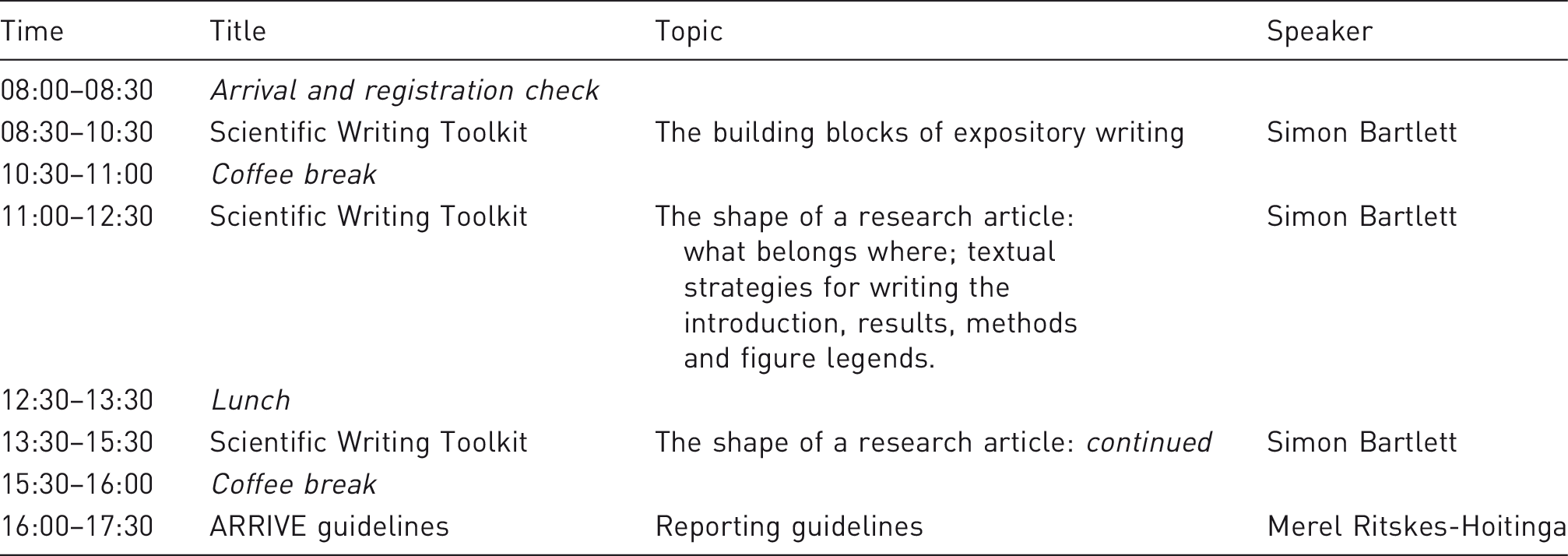
Scientific writing toolkit
Simon Bartlett 1
The sessions and exercises are organised to aid participants in producing publications that meet the standards for professional journals. The course deals with ways to create cohesion in expository prose in English, with a specific focus on the biomedical sciences. The goal is to equip participants with a set of ‘mental tools’ that together provide a clearly structured way of thinking about how a text is constructed, from the internal components of the sentence through to paragraphs and the distinct sections of a research article. The sessions and exercises are organised such that participants discover for themselves how to gain control over their writing by paying close attention to their experience as readers.
The aim is for the sessions to be as interactive as possible, with participants encouraged to ask questions and to provide their own insights and ideas.
A. The building blocks of expository writing
The exercises look at a series of overlapping and complementary themes related to how we choose which types of content belong in the different locations of a text.
These exercises are organized broadly as follows:
Events, action and agency: How do we identify and convey the essential message of a sentence? Character: Choosing how to begin a sentence; why it matters and what criteria we need to apply. Interruptions, separations and clutter: Some common problems that arise in the internal structure of sentences and how to avoid them. Beyond the sentence:
Beginnings: How to ensure a fluid link at the start of a sentence from the preceding material. The difference between subject and topic. Different kinds of linker structure and how to use them. Endings: What do we remember about a sentence? Points of emphasis, and how they are signalled with punctuation and specific clause patterns.
B. The shape of a research article: what belongs where; textual strategies in writing the introduction, results, methods and figure legends
Writing for cohesion: Applying the ideas explored to the analysis and revision of example texts from research articles.
Stylistic requirements for different research article sections. IMRD structure and variants. Research article introductions: the CARS (creating a research space) model Methods, Results and Figure Legend exercise: recognising different content and stylistic requirements of these complementary texts. Overview of Abstracts and Discussion sections (if time allows) Reference and online resources
Reporting guidelines: prepare in time
Merel Ritskes-Hoitinga 2
When writing scientific articles, it is very important to write down all the details, in order for readers to know exactly what you have been doing and to be able to replicate studies in case needed. Also, when performing systematic reviews, it is essential to know the quality of the details of the included primary studies in order to make high quality evidence-based evaluations. There are several reporting guidelines for animal studies available (Gold Standard Publication Checklist, ARRIVE, HARRP, etc.), which will be presented. Participants will get a scientific publication from a high-profile journal and evaluate this article against a checklist with publication requirements. Possible reasons for the current low implementation of reporting guidelines will be discussed and possible solutions. In order to write good publications, it is necessary to prepare well in advance before starting and designing animal studies. The PREPARE guidelines have been developed for achieving exactly that.