




Abstract
Switzerland has implemented a mandatory training in laboratory animal science since 1999; however a comprehensive assessment of its effects has never been undertaken so far. The results from the analysis of participants in the Swiss Federation of European Laboratory Animal Science Associations (FELASA) Category B compulsory courses in laboratory animal science run in 2010, 2012, 2014 and 2016 showed that the participants fully appreciated all elements of the course. The use of live animals during the course was supported and explained by six arguments characterized with cognitive, emotional and forward-looking factors. A large majority considered that the 3R (replacement, reduction and refinement) principles were adequately applied during the course. Responses to an open question offered some ideas for improvements. This overall positive picture, however, revealed divergent answers from different subpopulations in our sample (for example, scientists with more hindsight, scientists trained in biology, or participants from Asian countries).
Switzerland is a leading country in the pharmaceutical and biotechnological sector, with a network of top-quality academic institutions focused on basic research and education in the life and biomedical sciences. Switzerland still relies on animal experimentation for its basic and translational research. In 2015, 682,333 experimental animals were used; the number of experimental animals used dropped substantially in the 1990s (from 1,177,778 in 1990 to 588,778 in 1999), but it rose slightly in the early 2000s (to 681,410 in 2004) and has since stayed at around 600,000 animals. 1
Switzerland has stringent regulations regarding animal protection, 2 which significantly exceed the EU’s standards. Since 1999, a mandatory laboratory animal science (LAS) course has been introduced for every scientist seeking to perform animal experimentation in Switzerland. This course was later accredited, first in the German-speaking region of Switzerland in 2008 by the Federation of European Laboratory Animal Science Associations (FELASA) (and re-accredited under the EU ‘Functions’ scheme in 2015; current FELASA identification: F027/06), and then in the French-speaking region in 2013 (current FELASA identification: 038/12) (see http://www.felasa.eu/accreditation-boards/accreditation-board-for-education-and-training1/felasa-accredited-courses2/ [accessed 2 April 2017]). Both courses have been aimed at people who need to apply procedures to animals, described as EU Function A for the former and FELASA Category B for the latter. (See Appendix 1: The FELASA ‘Categories’ and Directive ‘Functions’, a historical reminder of the paper to be downloaded under the section ‘I am a course provider. How do I get my course accredited?’ at http://www.felasa.eu/accreditation-boards/accreditation-board-for-education-and-training1/ [accessed April 2, 2017].) At the European level, the European Commission’s Directive 2010/63/EU requires, among other things, that researchers undertake specific training in order to be licenced to practise animal experimentation. 3 The European Commission has issued a series of guidance documents to help its Member States to translate the Directive into effective measures for the protection of animals used for scientific purposes.4,5 Among these, the Commission has published a guidance document for the development of a common education and training framework which was heavily inspired by FELASA’s recommendations for the courses of Category B or C researchers. 4
It is legally forbidden in Switzerland to use animals with constraints in education when there are other ways of teaching the skills needed to conduct an in vivo study (Art. 138, let. 1 al. c 6 ). Another piece of legislation (Art. 3, let. C, al. 67) considers the use of live animals in education and training to be an experiment. Therefore, the number of animals, the procedures, the reasons why live animals are needed for skill training, and a cost–benefit assessment have to be provided by the course organizers to the ethical review board for evaluation and approval by the local competent authorities. The applicant will also need to show how the 3R principles – replacement, reduction and refinement – will be implemented in the course.
Swiss legislation requires that skill training on live animals should be delivered during the course. The training should include handling, restraint, weighing, sexing, identification methods of animals, blood, urine and faeces sampling, as well as injections of substances. It is also required that basic procedures in anaesthesia and analgesia are covered in the training (Art. 25, RS 455.109.18).
The course in Switzerland uses a tiered approach in the use of live animals by starting with non-animal alternatives, such as videos, progressing to cadavers and finally to live animals. However, the number of animals used in education and training is generally increasing in Switzerland (4095 mice and rodents in 2000, 5317 in 2010, 5131 in 2014 and 5309 in 2015). 1 This is due to the increasing numbers of students and scientists who need to attend this course, and because course organizers do not want to impose multiple procedures on any single animal, which highlights the classical dilemma between reduction and refinement. 9 The fact to use live animals in education and training programmes is a long-standing issue. As a sequel to the EU Directive, the European Commission has released some guidance on this issue in its recent publication on project evaluation and retrospective assessment. 5
After almost 30 years of the mandatory implementation of LAS education and training in Switzerland and the fact that a considerable number of people have received this training, we felt it was important to assess participants’ attitudes towards the course, particularly with regard to the 3Rs and the use of live animals in education and training. More specifically, we were interested in the participants’ backgrounds and their subsequent careers after the course. What were their attitudes towards the use of live animals in the course after a few years of professionally practising animal experimentation? What did the participants wish to improve or change about the course retrospectively?
Little is known about the scientists’ points of view on these issues. There have been some quantitative studies on scientists’ attitudes towards the 3Rs,10–13 and on general attitudes towards the LAS course. 14 On attitudes towards the use of animals during the LAS course, there have been a quantitative study on undergraduate and postgraduate students 15 and a qualitative study, 16 both in Sweden. However, there have been no studies focusing on all types of participants, or specifically on Switzerland. In 2016 a study was designed to answer these research questions, and a selection of its results is presented here.
Materials and methods
This study was designed in partnership with the Swiss network on Education in Laboratory Animal Science, i.e. its French section, the ‘Réseau des Animaleries de l’Arc Lémanique’ (ResAL) and its German section, the ‘Institut für Labortierkunde Universität Zürich and ETH Zürich’ (LTK), both of which provided information on the participants of the course. The target population was the participants of the FELASA-accredited Category B course on rodents (mice and rats) held in Switzerland, because these animals corresponded to around 75% of the total number of animals used. The course includes 20 h of lectures and 20 h of practical training with topics defined by the Swiss legislation, and accredited as the FELASA B course.
This study aimed to record the attitudes of the participants with various levels of hindsight towards the course, i.e. from participants who had recently finished the course to those who had been practising what they had learned during the course for a few years. Therefore, we opted for a stratified sample. To ensure a valid assessment of the course and to avoid memory bias, it was decided not to go too far back in time and to opt for four strata defined by the calendar year of the course (cohorts 2010, 2012, 2014, and 2016). For each year, a sample of courses were selected.
An online survey was sent to the participants of the selected courses, using the email addresses provided by the training officials. An invitation was sent to the participants in January 2016 for the 2016 cohort, and between June and July 2016 for the three other cohorts. In total, 1451 emails were sent, but 387 were returned due to email addresses being invalid (mostly in the 2010 and 2012 cohorts), illustrating the high mobility of scientists. A total of 510 respondents completed the online survey, which corresponded to a 48% response rate.
The questionnaire featured 28 questions organized in three sections: the first focused on the demographics of the respondent, the second on the course – particularly on the use of live animals, and the third on the 3Rs.
The sociodemographic variables were gender; age (recoded into four age groups: 19 to 25, 26 to 31, 32 to 36, and above 37 years old); and nationality (recoded into five groups of countries: Switzerland, European countries, Asian countries, North American countries, and the rest of the world).
The academic variables were the linguistic regions where the course was taken (German- or French-speaking); the disciplines of the participants’ first degrees (recoded into five groups: biology; chemistry, biochemistry, physics, biophysics or pharmaceutical sciences; medicine; veterinary medicine; and other); a dichotomous variable for their PhD status (‘Yes’ or ‘No’); the participants’ occupations at the time of the survey (six possibilities: lab technician; bachelor’s or master’s student; PhD student; postdoc or senior scientist; principal investigator, faculty teacher and physician; and other); the participants’ international experience (a series of ‘Yes’ or ‘No’ questions on four possibilities of international experience: during their bachelor’s or master’s studies, during their PhD, during their postdoc experience, or during their employment or academic position with a minimum of one year. This last set of items was then recoded into a dichotomous variable indicating whether the respondent had one or more international experience or none).
In the second section, three five-point Likert-type items were used for the assessment of the course (from ‘very good’ to ‘very poor’), and for attitudes towards the use of animals and the 3Rs (from ‘strongly disagree’ to ‘strongly agree’). An aggregate scale was built on the three items of assessment, with higher scores indicating a more positive assessment.
For the open question on animal use, two independent researchers analysed the responses, and found six dimensions which were consistent between the two researchers. The open question’s answers were then recoded in accordance with these six dimensions into a multiple-answer variable because some respondents had provided an answer with multiple arguments. Therefore, the sum of the percentages for each type of argument is higher than 100%.
Descriptive statistics were performed on each variable. Chi-square independence tests were performed to assess the differences between cohorts, gender, linguistic regions, nationalities, disciplines and occupation. When the conventional rule of thumb of less than 25% of cells with expected numbers less than five was not verified, a recoding was undertaken. For example, there were too few veterinarians to be analysed separately therefore we considered respondents with first degrees in medicine and in veterinary medicine together for some analysis. We also recoded the smallest nationality groups, i.e. North American countries and the rest of the world, together. If recoding was not possible, we used resampling techniques (Monte Carlo methods). Because not all respondents answered all of the questions, the group sizes may vary between questions. P values of less than 0.05 were considered to be statistically significant. Two-way analysis of variance (ANOVA) were used to analyse the effects of linguistic regions and nationalities, disciplines and nationalities on the aggregated scale of assessment of the course. We used a heteroscedasticity-corrected coefficient from the library ‘car’ of the R software if the Levene test of homogeneity of variance was rejected. Other statistical analyses were performed using SPSS 23 software (IBM Corp, Armonk, NY, USA).
Results
Sample characterization
Demographics of respondents.
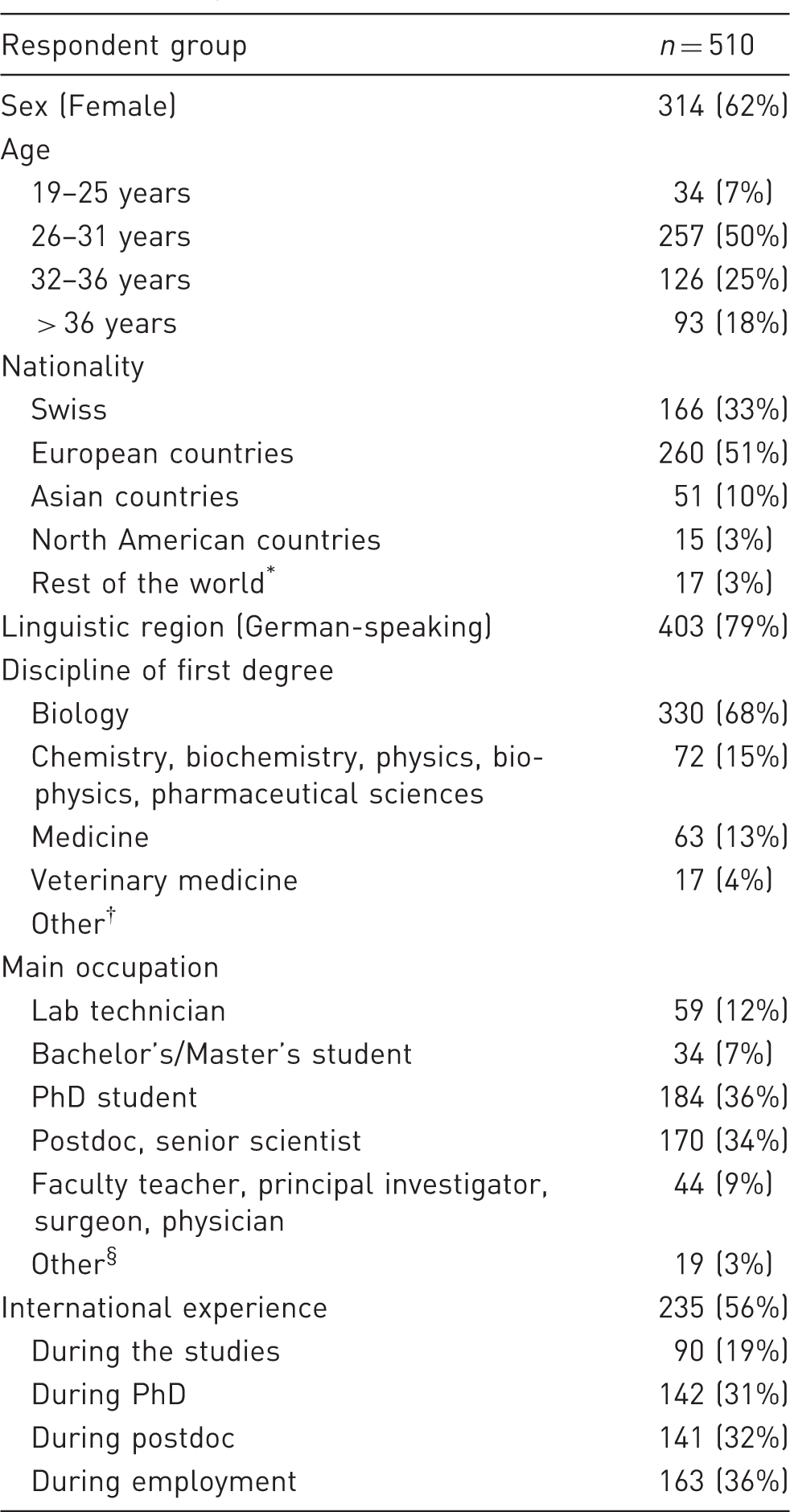
For some analyses, the groups ‘North American countries’ and ‘Rest of the world’ have been gathered together (6%). †For some analyses, the group ‘Other’ has been excluded, and the groups ‘Medicine’ and ‘Veterinary medicine’ have been gathered together (16%). §Among the 19 scientists who ticked ‘Other’, five (1%) indicated that they were unemployed. For some analyses, ‘Other’ has been excluded, the groups ‘Lab technician’ and ‘Bachelor’s/Master’s student’ have been gathered together (19%), the groups ‘Postdoc, et al.’ and ‘Faculty teacher, et al.’ have been gathered together (44%).
Professionally, 68% of the respondents indicated having a first degree in biology, whereas 15% indicated having one in chemistry or biochemistry or physics or pharmaceutical sciences, and 13% in medicine. On the whole, 40% of respondents had a PhD. Among those employed, 36% were PhD students. Furthermore, 34% were postdocs or scientists with a PhD; 12% were lab technicians; and 9% were faculty teachers, principal investigators or physicians. Finally, with regard to the country where they lived when they were 18 years old, 19% of the respondents studied in a different country, 31% earned their PhD in a different country, 32% had postdoc experience in a different country, and 36% had a job in a different country. On the whole, 56% of the respondents had at least one international study or work experience.
Among those who had performed animal experiments so far, a majority of respondents indicated they only had ethical doubts or concerns occasionally regarding animal use in their work (62%), whereas 10% frequently had doubts or concerns, and 27% had no doubts or concerns.
Views on the course
General assessment of the course.
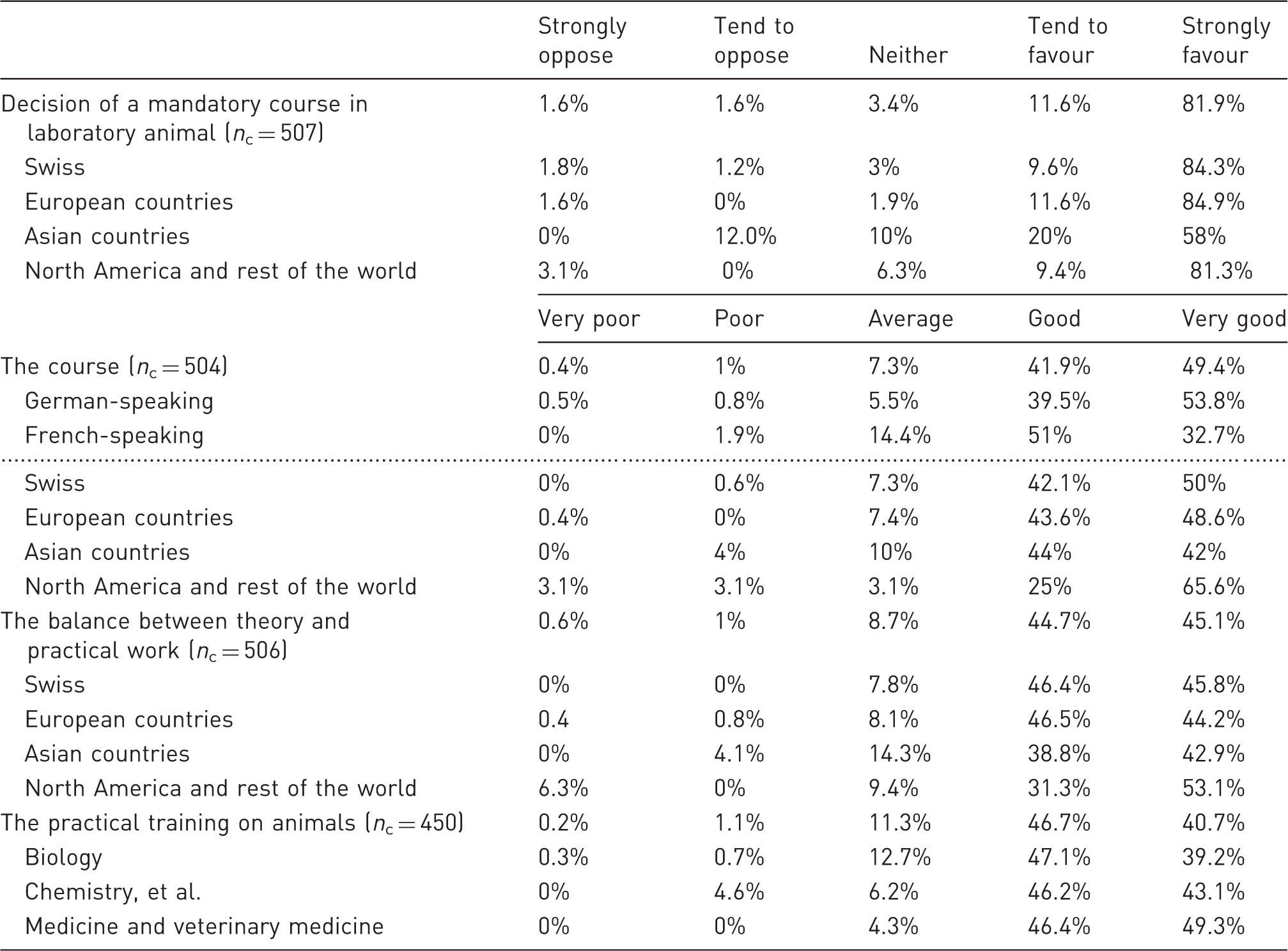
These positive views were very consistent among the subpopulations, bearing no relationship to gender, age group, occupation or level of internationalization. One significant difference was found among the linguistic regions (P < 0.01): those taking the course in the German-speaking part of the country were even more positive about the course than their French counterparts (93% of the German-speaking region indicated ‘good and very good’ against 84% from the French-speaking region, Table 2). There was also a significant difference among the disciplines (P < 0.05): those having studied their first degrees in veterinary medicine or medicine were the most positive about the practical training (96% indicating ‘good and very good’, compared with only 86% of those with biology degrees, who were the least positive, Table 2). The geographical origin of participants revealed three significant differences for people from Asia compared with those from the three other regions: those in Asia were less positive towards the mandatory course (P < 0.001, 78% of agreement against 91% to 97% in the three other groups), towards the course in general (P < 0.05, 86% of ‘good and very good’ against 91% to 92%), and towards the balance between theory and practical work (P < 0.05, 82% against 85% to 92%).
There was a significant difference of repartition among nationalities in the two linguistic regions (χ 2 (4) = 17.94, P < 0.001: higher percentages of European and Asian respondents in the French-speaking region, and a higher percentage of Swiss in the German-speaking region). The aggregated scale of assessment varied between 4 and 15 (M = 12.96, SD = 1.77). Linguistic regions still had an effect on this scale, after controlling for nationality on this scale (F(1,438) = 9.33 P < 0.01). There was also a significant main effect of nationality (F(3,407) = 25.65, P < 0.001: the minimum average was for the respondents with an Asian nationality), and of disciplines (F(2,407) = 4.28, P < 0.05: the minimum average was for the respondents having studied biology), and a significant interaction between nationality and discipline (F(6,407) = 3.11, P < 0.01: the minimum average was for biology for all nationalities, except for the Swiss where this was for medicine and veterinary medicine).
Views on the use of live animals during the course
Secondly, scientists were asked about the use of live animals, and their responses indicated that they approved this approach (Figure 1). A large majority agreed that the course increased their awareness of animal welfare (87% answered ‘strongly and tend to agree’) and their personal skills (88%), and disagreed that the course raised discomfort, fears or phobias (75%) or raised concerns about the death of the animal at the end (56%). On the question of ethical problems, the opinions were divided (36% disagreed, 35% agreed and 29% were ambivalent).
Attitudes towards the use of live animals.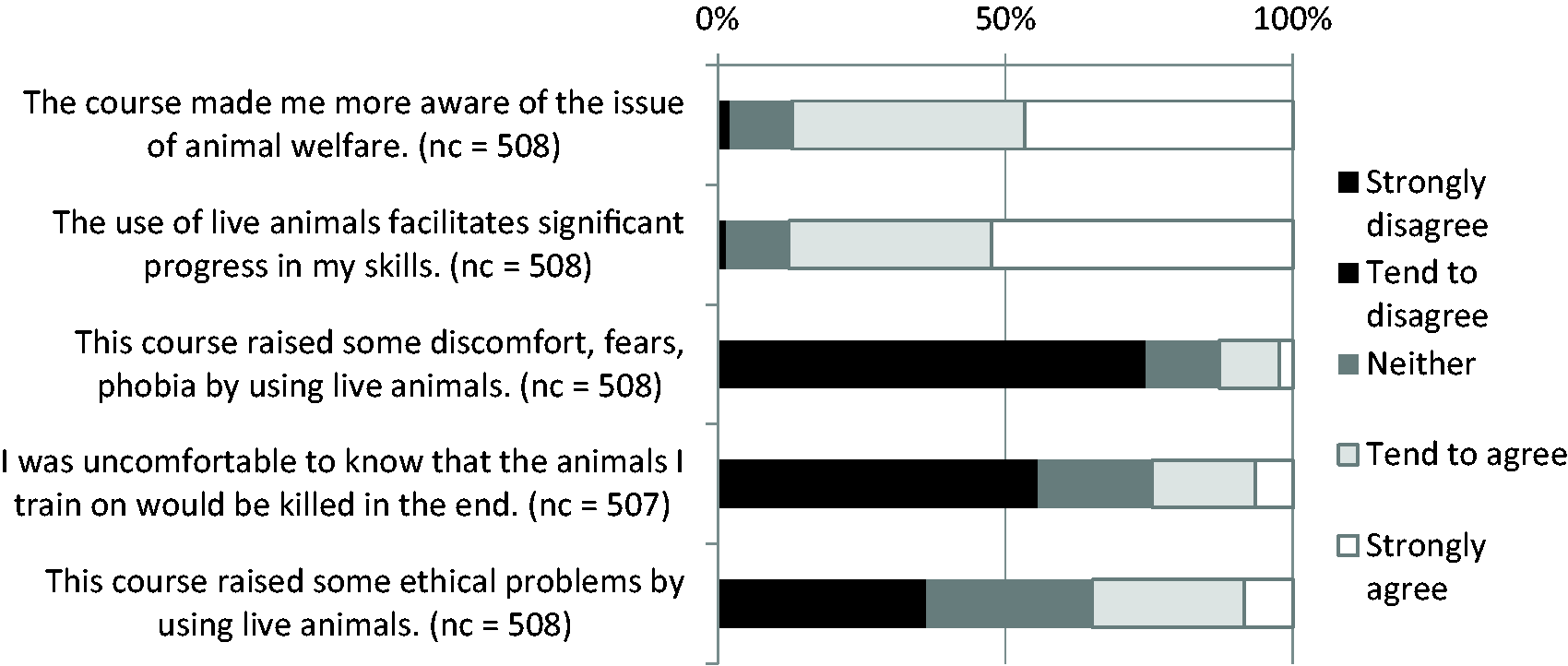
A course without the use of live animals?
A large majority of respondents (75%) rejected the suggestion that a course without live animals would have still enabled them to perform their experiments afterwards to the same level of quality. This opinion was not related to gender, discipline, age group, occupation, nationality or level of internationalization. One difference was found between the linguistic regions (P < 0.05): those who had taken the course in the German-speaking part of the country disagreed more frequently than those in the French-speaking region (78% against 66%).
Among the respondents who favoured the use of live animals in the course, 73% explained their choice in an open question. A content analysis of their responses delineated six dimensions, each of which was an argument in favour of the use of live animals in the course. The first argument was the most important in the whole sample (around 40%), and in each subgroups defined by sociodemographic and academic factors. However, some ranking differences were observed for the second and third most important arguments among the subgroups. Listed below are each of the arguments in their order of importance: the first two and the fourth arguments could be characterized as cognitive factors, the fifth as an emotional factor, and the third and sixth as forward-looking factors.
1. The importance of practice (versus theory) to increase skills (cognitive factor, 69% of total responses)
One can only really learn through practising with, handling, and manipulating live animals, and practice significantly increased skills. These respondents draw a strong distinction and hierarchy between the learning opportunities related to ‘theory’ and to ‘practice’. This argument was expressed the most by those with a first degree in veterinary medicine (among the responses of vets, 82% chose this argument) but was expressed the least by people with a first degree in medicine (64%); the most by lab technicians (88%) but the least by bachelor’s or master’s students (61%); the most in the German-speaking region (71%) and the least in the French-speaking region (60%).
Here is a selection of answers belonging to this dimension:
‘Reaction and behaviours of animals can never be theoretically explained. Hands-on work is necessary.’ ‘This applies to whatever experience in life. Theory is very important to develop awareness and critical sense, but one definitely learns by practice!’ 2. The role of tutors during the first manipulation of live animals (cognitive factor, 17% of total responses)
The second most frequent argument focused on the guidance of the tutors as opposed to the study directors in terms of helping the participants acquire the proper gestures and manipulations in accordance with the latest regulations. Among this group of responses, some outlined the lack of availability and of up-to-date knowledge from the study directors or their deputies in their labs. This argument was expressed the most by women (25% of women against 18% of men), by respondents from the German-speaking region (24% of the German-speaking against 15% of the French-speaking), by bachelor’s and master’s students (44%) and respondents with a North American nationality (56%), and was expressed the least by lab technicians (8%) and participants of Asian nationalities (4%).
‘Doing the course with animals has the strong advantage of being supervised by experienced people who will tell me what I do wrong and like that I will improve my techniques.’ ‘It is important to learn from experts how to handle live animals and how to perform the work in accordance with the most up-to-date regulations (injections, proper anaesthesia, etc.). Learning directly from the supervisor (i.e. study director) in the lab leads to incomplete formation, lack of awareness of newer regulation, variable standards between labs, etc.’ 3. Using live animals for the benefits of animals used in future research (forward-looking factor, 13% of total responses)
The third most frequent argument highlighted the benefits for animals – learning better handling, which causes less harm and stress to animals in future research, and in fine which uses fewer animals. This argument was the second most cited for respondents occupying a position as a principal investigator, faculty teacher or physician (25%) or lab technician (13%); for those in the French-speaking region (17%); for respondents with first degrees in medicine (19%); and in chemistry, biochemistry, physics, biophysics or pharmaceutical sciences (21%).
‘I got more confident about handling animals during the course, what is for sure beneficial for the animals I am handling now.’ ‘The learning course would have been less steep, so more experimental animals would have suffered until I could perform all procedures.’ ‘In the long term it is better to be trained once than using more animals due to the lack of training.’
Finally, we found the last three arguments, which each recorded around 9% of responses (see 4–6 below).
4. The importance of reality—as opposed to simulation, video, etc.—in practice (cognitive factor, 9% of total responses)
The use of live animals put participants in a ‘real situation’ and gave them ‘real and live experience’ very similar to their future work in labs, allowing the development of practical knowledge. This ‘reality’ is invaluable and cannot be replicated by other learning modalities (simulations, puppets, dead animals and so on): when the latter modalities are used, the skills are not fully mastered, and the participant has to relearn them.
‘Hands-on training is remembered differently than just watching a video or seeing a picture.’ ‘The quickness to fix a mouse or the weight of rat or thickness of the skin or moves and reactions when administering an injection cannot be studied theoretically, on a puppet or even an already dead animal.’ ‘Practice with live animals is needed for the training. Simulation is not the same. Blood withdrawal was simulated, then I had to go through a re-training process.’ 5. Using live animals to overcome fear and stress when handling animals (emotional factor, 9% of total responses)
Some respondents provided personal arguments, in which they indicated a change of emotional state as a result of the use of live animals (being more confident, more comfortable, more secure, less fear, less stress), by contrast with general arguments for the use of live animals.
‘In my opinion it’s very important to get in touch with animals during the course and to lose fear and get comfortable handling the animals.’ ‘I had no experience with live animals before, thus the practical part of the course was the most important and useful for me. Before the course I was not confident, insecure to work with animals.’ ‘At least it could help me broke the fear to touch my experimental animal.’ 6. Using live animals for the benefits of future research, and of career (forward-looking factor, 8% of total responses)
Some respondents pointed out the benefits which using live animals should have for future research – better handling reduces measurement errors and, therefore, the variability of the measures which are detrimental to research, and hence increases the quality of research – and in fine to careers.
‘I think without the use of live animals in the course, I wouldn’t be able to perform animal experiments at high quality.’ ‘If the researcher would not work with animals on the course before performing the experiments, the quality of the data would not be reliable and the animal welfare would be compromised.’
Views on the 3Rs and the use of live animals
Finally, an overwhelming majority of respondents considered themselves to be very or fairly well informed about the 3Rs (96%, among them 42% ‘very well’) and believed that these principles were adequately applied during the course with regard to the use of live animals (97% agree). This general agreement did not differ among the sociodemographic and academic groups. However, some respondents expressed concerns in the related open question, which indicated some misunderstandings of the goal, organization and legal framework of the course, i.e. they wished to share an animal with other participants, reuse the animals, or reduce the number of animals by practising only what was necessary; whereas the course builds individual skills, reuses all animals and is, by law, general.
‘Because we used a lot of animal: 1 per person while we could have use one for 3 or 4 persons.’ ‘The animals should have been used further for studies or more courses.’ ‘As far as I know, in any university/institute one can find rat/mice labs where need to euthanize the rat/mice as the experiment required. When such cases are accessible, for training students, we should use those opportunities rather than euthanizing 2–3 animal only for training one student. Furthermore, such training should be extremely narrow designed. For example, if someone will not need to euthanize animals during her/his research or inject, she/he should not euthanize and inject animals as this cause is unnecessary for the animal.’ ‘The practical course develops interesting manipulation and gives ideas about what is possible, but is not often adapted to what we will practice later. We perform manipulation and kill animals for nothing in these cases. I think that smaller varied workshops would be better.’ ‘I was just really uncomfortable that mice and rats we used will be killed for basically nothing (we just inject PBS in these animals and perform a standard anaesthesia). This is for me really a pity that these animals are killed afterwards. I know they can’t be used anymore in other research projects, but they would deserve to be sent for adoption for example.’
Discussion
This study sought to describe scientists’ attitudes towards the LAS courses in Switzerland through an online survey sent to four cohorts of participants in the LAS courses run between 2010 and 2016. Although this was not the main aim of the study, the results provided a glimpse into the professional paths that scientists working in this field could experience. Their careers show frequent turnover (shown by the high number of invalid email addresses 2–6 years after attendance on the LAS course), involve frequent international work or study experience (66% in 2010, 69% in 2012, 47% in 2014, and 46% in 2016), and sometimes involve periods of unemployment after the participants receive their PhDs (4% in cohort 2010 and 2% in 2012).
The analyses showed a great diversity among participants in terms of gender, age, nationality, first degree disciplines, occupation, etc. This diversity constitutes a major hurdle for LAS course organizers and tutors who need to adjust and respond to changes in subgroup sizes from year to year. For illustrative purposes, the percentage of participants having a first degree in biology varied from 51–69% among the cohorts; the variance of age remained high within each cohort – SD of 6.8 in the 2010 cohort and 6.1 in the 2016 cohort; and 14.4% of participants were Asians in 2012 whereas this proportion was 7.1% in 2010.
Overall, the LAS course participants approved of and were very satisfied with the various aspects of the course (87–93%). These figures were in line with the results of the few foreign published studies.14,15 Having said that, analysis of the assessment of the subgroups indicated that some of them showed slightly more reservations than others (biologists or participants with an Asian nationality were the least favourable to the course). In the open questions, some respondents (particularly biologists and Asian respondents) expressed their preferences for a course with more practice and with content tailored more to their previous knowledge and to their future knowledge needs. These results pose questions concerning the usefulness and feasibility of less general LAS courses.
Two to six years after the course, 5% of respondents were no longer performing animal manipulations in their actual job, and 19% had not performed animal experimentation so far. These results raise some questions on the compulsory nature of the course and on the most appropriate timeframe to ensure its relevance. Finally, of those who still performed animal manipulation, 32% performed easy and complex handling in their current jobs, which reinforces the importance of continuous training. Current FELASA recommendations involve the need for institutions ‘to ensure that personnel are competent and trained continually’ (for at least one day a year in Switzerland). 17
One of the features of this study was its combination of closed and open questions, and the latter material was very useful for interpreting the very positive feedback from participants regarding the use of live animals during the course. The arguments provided by respondents cover areas as diverse as cognitive factors (i.e. related to practice, supervision and reality), emotional factors, and forward-looking (i.e. related to the welfare of animals used in, and the high-quality of, future research) factors. The culture of care and animal welfare in animal experimentation that is learned in this course falls within what Holmberg described as ‘learning good handling as a means of doing good research’. 16 Among the cognitive factors, one factor refers to the use of alternatives (simulations and videos) in the course, and it seems that these alternatives cannot replace practice with live animals, which is essential for learning for some participants. Another interesting argument indicates that not using live animals during the course, in order to try to satisfy the 3Rs would result in real learning being only achieved after the course, which would result in increased animal suffering as there would be no one on site to teach and correct the researcher (less refinement), and which may imply the further loss of animals (less reduction). Therefore, any gains achieved from applying the 3Rs during the course would result in less refinement and reduction in the lab after the course for some respondents. Finally, the open question on the 3Rs indicated that some participants had not fully understood the goal, organization and legal framework of the course. For example, some expressed a wish for the animals to be reused, even though they are already reused. There is a need for LAS organizers and tutors to better explain their aims and choices related to the use of animals during the course. Sharing their reflections on this issue is also a way of increasing participants’ awareness towards animals.
It should be acknowledged that there are certain limitations to this study. First, with the method of sampling chosen, we did not intend for this study to be representative of the entire population of scientists doing animal experimentation in Switzerland. We sampled among course participants from within six years ago to ensure they had a reliable memory of the course. The positive assessment among the cohorts seems to highlight the constant effort of LAS teachers to improve their courses; however, this result should be confirmed more fully in future years. Finally, there is a need for research on this issue aimed at confirmed scientists with more experience and at other stakeholders.
Second, the questionnaire did not distinguish between the two rodent species under consideration, but some participants made distinctions between mice and rats in the open questions, and the LAS organizers indicated some differences: there was some tendency for participants to be more apprehensive at working with rats in the beginning but to be more attached to their rats at the end. A later study should address this aspect.
Conclusion
The 2010/63/EU Directive emphasizes the importance of training and competence for scientists performing animal experimentation. 3 The animal experimentation field is often described as performing ‘selective openness’ 18 towards those outside academia, but what about the level of openness within the field between scientists and those who make decisions for them? In Switzerland, decisions are made after consultation with various representatives (i.e. from academic and industrial research, universities, animal protection and cantonal authorities), but legislators rarely listen directly to concerns and suggestions from scientists. The lack of information from those concerned may complicate the implementation of decisions. The study reported in this article has given a voice to scientists who have to take the course in Switzerland. Such a study should be replicated in other European countries because cultural and political differences may be significant.
Footnotes
Acknowledgements
The author would like to thank Philippe Bugnon (LTK), Fabienne Chabaud-Barandum (ResAL), Marcel Gyger (EPFL) for their inputs into the design of the research (i.e. email provision) and their comments on a previous version of this article.
Declaration of Conflicting Interests
The author(s) declared no potential conflicts of interest with respect to the research, authorship, and/or publication of this article.
Funding
The author(s) received no financial support for the research, authorship, and/or publication of this article.