




Abstract

The Foundation of Laboratory Animals Limited
Although Laboratory Animals Limited (LAL) is now celebrating its 50th year, the events which lead to its formation took 25 years in the making.
It was as early as 1942 that the Pathological Society of Great Britain proposed to the Medical Research Council (MRC) and the Agricultural Research Council (ARC) that the Society should ‘take up the question of large scale breeding of healthy experimental animals as a matter of national importance and urgency’. These Research Councils were not convinced of the efficiency or safety of concentrating the breeding in one or two national centres. A Medical Sciences Committee was inaugurated and held open meetings in 1942 and 1943 and subsequently supported the need for a national scheme for the supply of animals.
A Standing Committee was formed to survey the capacity of existing breeding establishments in the UK and to suggest how to set up a central information service to give them advice on how to improve the quality of the animals in terms of genetics, housing and nutrition.
By June 1944 the Standing Committee had met five times and had received responses from 262 users and 896 breeders and dealers of animals in the UK! It then proposed the formation of an Advisory Committee of users and breeders, with the possibility of a small executive forming a central Bureau. Its only stipulation was that one geneticist should serve, as the establishment and maintenance of ‘pure strains’ was a primary concern. The Bureau was to collect and act as a clearing house for information on supply, demand and availability of stocks of animals.
It produced a 19-page Memorandum stating its intention to ‘provide a bibliographical service on any problem concerning experimental animals or their use for special purposes and publication of a periodical for wide distribution’.
The Laboratory Animals Bureau was established at the MRC National Institute for Medical Research but soon moved to the Royal Veterinary College. Its first Director was Ronald E Glover who would soon be replaced by the inspirational appointment of William (Bill) Lane-Petter. Lane-Petter was qualified in natural science and medicine and had spent three years as a Home Office Inspector of animal experiments under the 1876 Cruelty to Animals Act. With his ability to solve problems and motivate staff, and persuade people in power, the Bureau rapidly made an impact. A legendary story details how he established the Bureau’s first colony of white mice (Laboratory Animals Centre A-strain mice [LACA]) by carrying a pair with him in his jacket pocket on the flight back from the USA!
The Bureau became the Laboratory Animals Centre (LAC) and John Bleby took over from Lane-Petter. The world’s first independent Accreditation Scheme for laboratory animal breeders was established. Apart from its main work of improving the quality, care and availability of laboratory animals, the LAC also convened conferences and published their proceedings. The regular ‘News Letter’ and ‘LAC Collected Papers’ (Volume 1 of which came out in 1953) were the de facto predecessors of the journal. They were distributed on request to anyone free of charge.
These peripheral activities eventually posed problems in the justification of resources and by 1963 discussions were under way to set up a society to undertake such work and so the UK Laboratory Animal Science Association (LASA) was established.
From the outset LASA wished to offer some sort of publication as a privilege of membership. An informal agreement was made with an existing journal to ‘look kindly’ on papers submitted to it by LASA members. It was clear, however, that the journal in question was not appropriate for the range of interests to be found in LASA. Peter C Williams was asked to convene a Publications Working Party. The Institute of Animal Technicians (IAT; later Technology) was approached about the possibility of a joint journal and these negotiations were still ongoing when the Working Party reported to Council in February 1966. Eventually the IAT rejected the proposal for a joint journal and the LASA Council invited Williams to become Chairman of an Editorial Board (which was made up of all the members of the Working Party).
At the November 1966 Council, Williams put forward the Editorial Board’s recommendation that it should form from LASA members a Company, limited by guarantee, in order to publish ‘an independent journal devoted to laboratory animal science’. This recommendation was accepted.
At the February 1967 Council meeting, Williams reported that ‘Laboratory Animals Limited’ was in the process of registration as a company and that the first issue of the new journal, Laboratory Animals, was on course for publication on the 2nd of April that year.
At the LASA Annual General Meeting (AGM) of November 1967 the Executive Editor was able to report that a first annual volume of 176 pages of text in two parts had been published and that the first of an occasional series of ‘Laboratory Animal Symposia’ (later to be renamed ‘Laboratory Animal Handbooks’) was in production.
former Chairman of Laboratory Animals Limited
(with thanks to Philip N O’Donoghue, former Executive Editor of Laboratory Animals)
Laboratory Animals, the Journal (LAJ, LAN, LA–UK, Lab Anim)
The first issue of Laboratory Animals was published on 1 April 1967. Up to 1971, two issues per year were published, followed by three issues per year. From 1975 up to 2015 four issues appeared annually, with some additional supplements on special topics. Over the past 50 years many outstanding editors contributed with their hard work to the success of the journal. Special thanks go to Philip N O’Donoghue, Paul Flecknell, Timothy Morris and Colin Dunn.
The international journal Laboratory Animals is the official journal of several subscribing societies, AFSTAL, ESLAV, FELASA, GV-SOLAS, ILAF, LASA, NVP, SECAL, SGV and SPCAL. As one can see on the cover, the number of subscribing societies is growing. The scope of Laboratory Animals is to publish all aspects of the use of animals in biomedical research, including: new animal models; laboratory animal microbiology; clinical case reports; descriptions of new or improved research techniques; reports on the influence of environmental and other variables on research results; descriptions of techniques which offer replacements for in vivo models; and basic data characterizing the haematology, biochemistry or pathology of new or existing animal models. Of special interest are papers that deal with the 3Rs (reduce, refine and replace) or leading to improvements in the welfare or well-being of the animals used. Laboratory Animals has well elaborated guidelines, and authors are strongly recommended to follow those guidelines as well the ARRIVE guidelines that help in the preparation of manuscripts on reporting animal data. Submitted manuscripts are first screened for their suitability for the journal and then put through the peer review process. Over the past years more than 200 manuscripts have been submitted per year. Our goal is to give a first decision on manuscripts within 30 days. The acceptance rate is 34%. The goal of LAL is to make the journal attractive and to raise the impact factor by having reports on high-quality research. The current impact factor is 1.120, ranking the journal 71/153 in zoology and 53/133 in veterinary sciences. For a long time the publisher was the Royal Society of Medicine (RSM) Press Ltd, but several years ago SAGE Publications Press Ltd took over the journal. Next to scientific articles, the journal provides space for advertisements to promote the latest technology and commercial advertisements. For the journal this is important revenue which partially covers printing and distribution costs. Some of the profit is used to fund bursaries to promote projects that deal with continued education in animal welfare and to promote good laboratory animal science (see http://www.lal.org.uk/funding-and-opportunities/bursaries/).
Today, what counts is the visibility of the journal in the field of laboratory animal science, its impact factor, and the use of the profit for bursaries to promote animal welfare and the spirit of the 3Rs. It manages a fine balance between business and the promotion of animal welfare. For the 50th anniversary, Laboratory Animals will change its appearance, and will be published in six issues at bimonthly intervals. There will be several new features. In addition to reviews and working party reports, short reports, original work, letters and comments, abstracts will be translated into French, German and Spanish to make contributions accessible for more readers. For subscribing societies, there is a ‘News’ section for contributions (in English or other languages) that report on events and topics that may be of broad interest. As one may realize, this means extra work, and Laboratory Animals has increased its editorial board as well as editorial staff to maintain quality of publication and also to keep up with a tighter publication schedule. It is also planned for one of the six issues to invite guest editors to prepare an issue with mini reviews on selected topics.
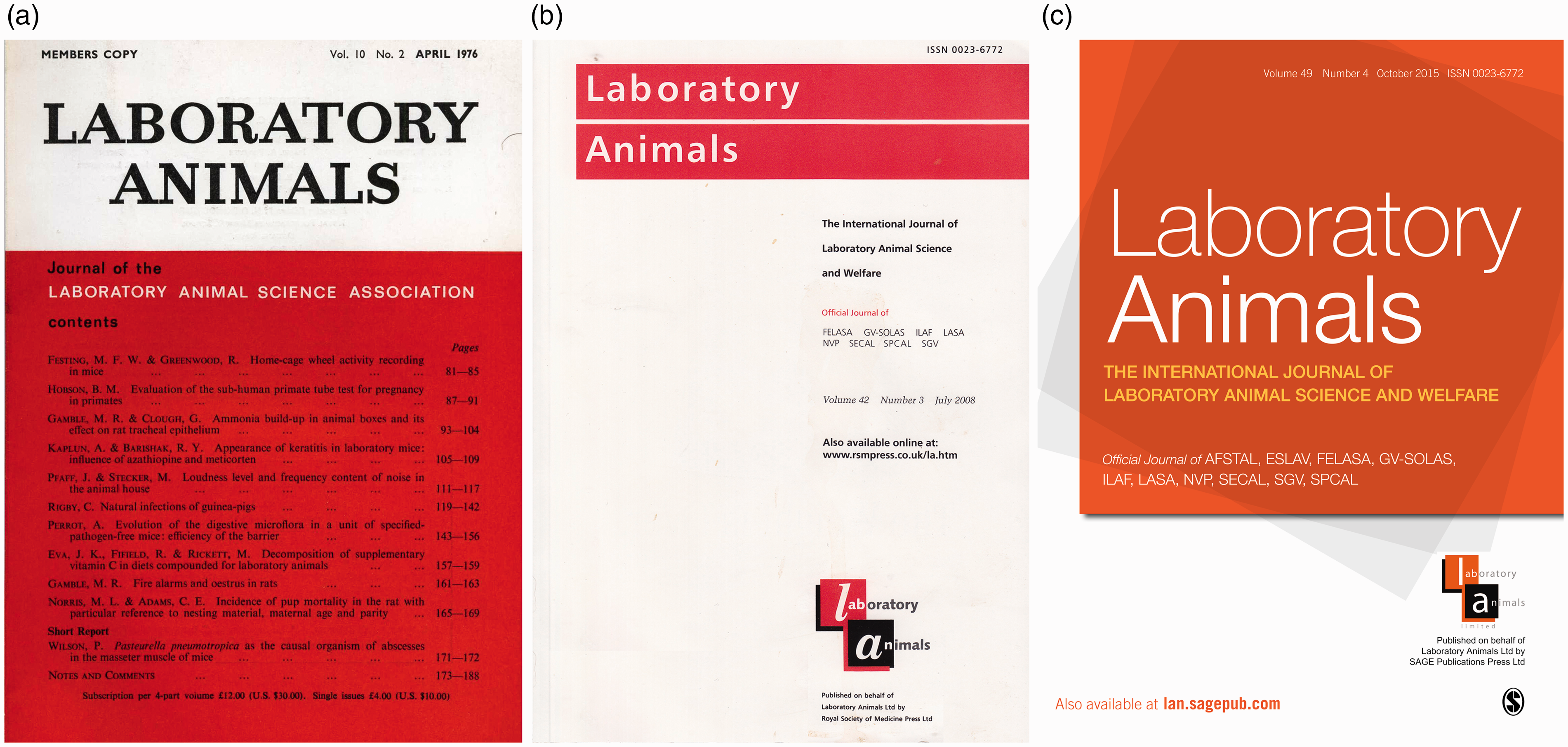
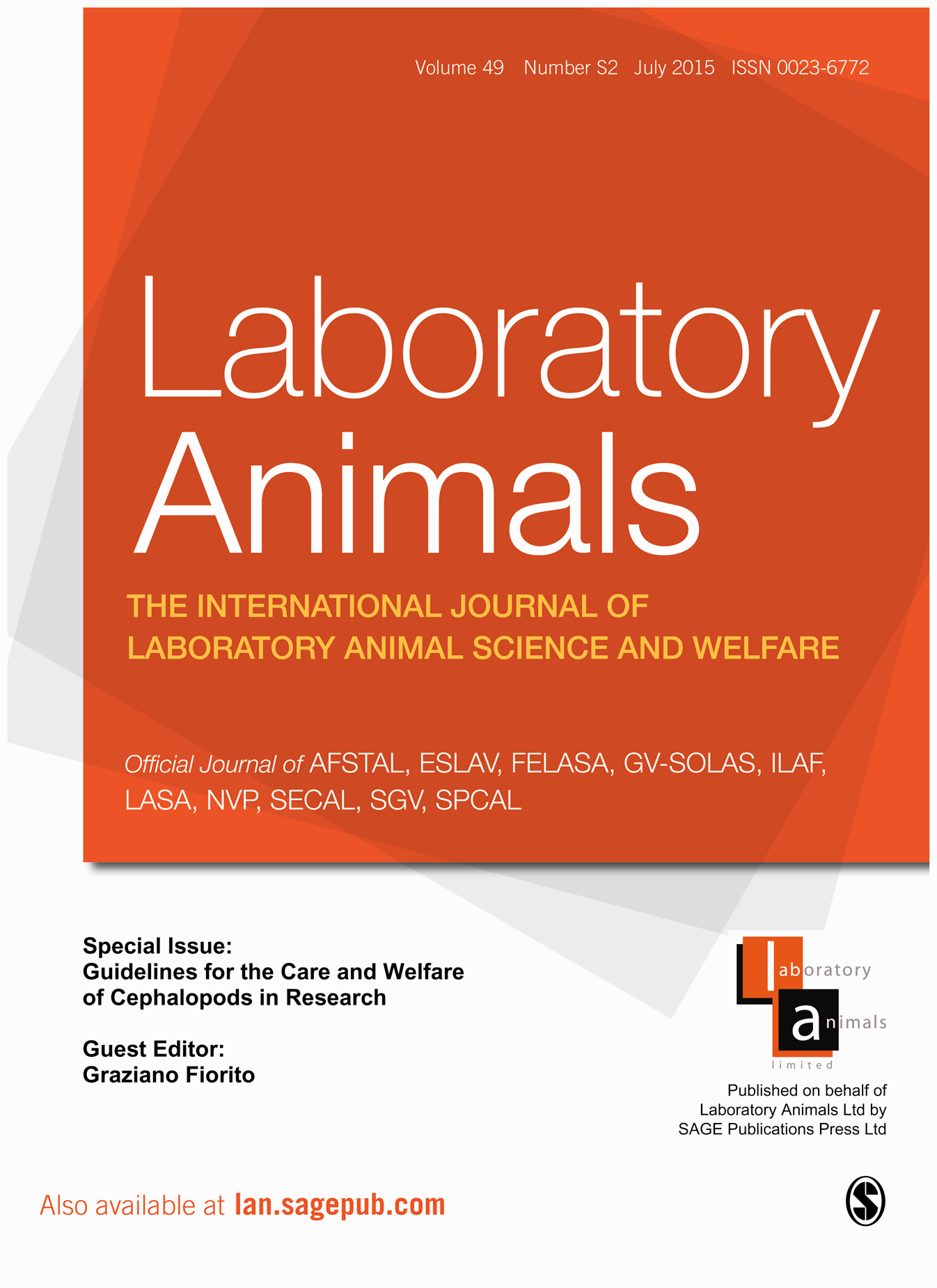
(a–c). Handbooks: The most recent handbooks 12–14 were published by RSM Press and are still available. (d–f) Due to their success they are currently updated and will appear with a similar design as the journal. Covers over the years: the journal size and appearance has changed due to the increasing demand to publish scientific articles. Special issues: in recent years we have started to publish supplementary issues on selected topics. In future one of the six issues will be on special issues.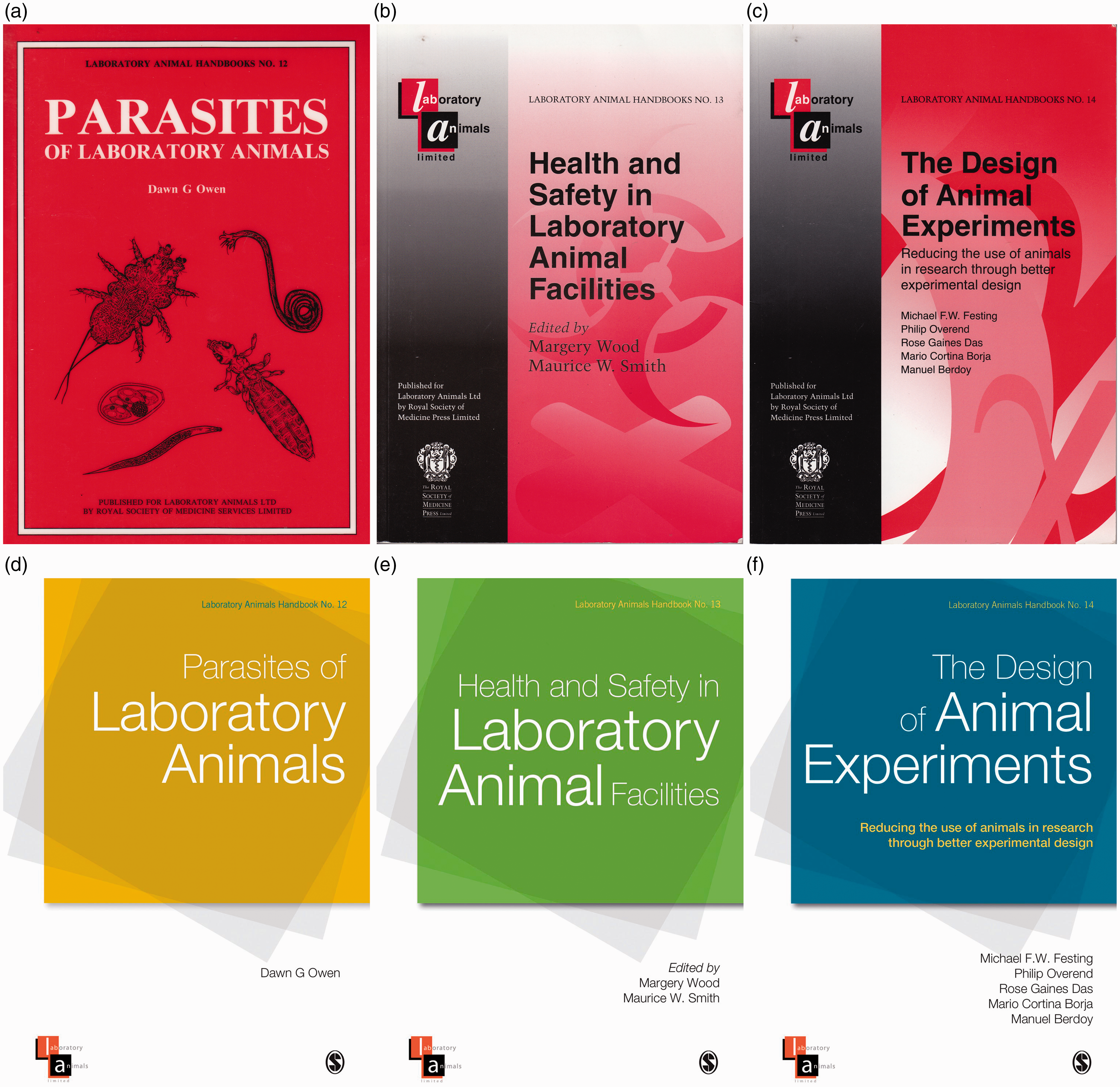
Editor-in-Chief, Laboratory Animals
Laboratory Animals Limited, the Company
Although a company, LAL is better known as a charity. Its charitable activities are its most important activity aside from the publication of Laboratory Animals (the journal). LAL is dedicated to the advancement of all aspects of laboratory animal science and welfare, and this is achieved through supporting education and training with the aim of improving scientific quality and animal welfare. LAL’s funding programme includes bursaries for individual scientists who wish to attend training (courses) in laboratory animal science and welfare. Bursaries are also provided to course organizers. LAL gives priority to those applications that meet the train-the-trainer concept. This way we hope to increase and maximize the action radius of our bursary programme, and hence spend our resources most effectively. Therefore we are also sympathetic to applications for funding the organization of events and conferences, albeit with conditions. Over the past 10 years LAL has given out over 600,000 euro in bursaries and for other activities promoting laboratory animal science and welfare, including attendance at and organization of courses, speakers, and audiovisual platforms. The 50th anniversary of LAJ is being celebrated with an increase in publication frequency of the journal from four to six issues a year. With a rising impact factor there is reason for optimism about the journal’s future. This is good news for the charitable activities of LAL. A few changes are being made to the priority areas of funding. Subscribing associations and their members will have priority. Areas, namely European countries, that have to build laboratory animal science education and training programmes from scratch as a result of the implementation of the European Directive 2010/63/EU will find a favorable ear with LAL’s funding programme. This includes the translation of teaching materials, guidelines and recommendations. LAL has decided to extend the yearly amount of money dedicated to the support programme if the financial situation allows us to do so. The success of the journal is, therefore, of pivotal importance. We wish LAJ a happy birthday and many more years of good works to come.
Chairman of Laboratory Animals Limited