




Abstract
Saimiri (squirrel monkey) is a neotropical primate of the Simian genus that has been bred in captivity for the development of research into human and animal health. They have been widely used in studies in ophthalmology, toxicology, pharmacology, psychiatry, neuroscience, vaccines and drug tests (such as malaria and measles agents), as well as effects on interactive behavior and cognition of Creutzfeldt-Jakob disease in man. The main concern of non-human primate (NHP) research centers is focused on the establishment of self-sustaining breeding colonies providing good quality research animals. Maternal rejection, dystocia and pneumonia are the main causes of newborn deaths in these species. Therefore, in order to ensure the survival of these valuable animals, the Laboratory Animals Breeding Center of the Oswaldo Cruz Foundation (CECAL)/Fiocruz, Rio de Janeiro, Brazil, has developed a protocol for the nursery rearing of these infants.
Non-human primates (NHPs) represent valuable models for human disease research, since they are phylogenetically close to humans, sharing physiological, anatomical and genetic similarities. 1
It is difficult to construct an overview of the use of NHPs in research, since several countries do not provide this information. However, a survey estimating the annual use of NHPs in research suggests a number of around 100,000 to 200,000, with 67% of studies involving Old World Monkey (OWM) and 15.5% New World Monkey (NWM) primates. 2
The Saimiri genus is one of the most commonly chosen among the New World primates and has been used in the development of vaccines against malaria and measles, with a focus on ophthalmology and color blindness research. The study of malaria is of great importance since it affects one-quarter of the world’s population, killing about three million people every year. Its severity is such that the World Health Organization (WHO) considers malaria to be a major public health problem in many countries, particularly developing countries.
The large demand for these primates in biomedical research has led institutions to invest in their captive breeding, focusing on the reproduction and management of animals with a known origin. The use of purpose-bred animals of known origin reduces the number of animals needed and provides better research animals for investigators.
Of the five species of the genus, two are considered to be vulnerable (Saimiri oerstedii and Saimiri vanzolinii) and one is near threatened (Saimiri ustus). Saimiri sciureus and Saimiri boliviensis are not threatened; however, like most species of NHPs, the free-living populations are in decline. 3
The females begin their reproductive periods at approximately 36 months of age and their estrous cycle lasts from 7–12 days. The gestation period ranges from 165–172 days. 4 The estrous cycle in Saimiri spp. varies according to colony conditions, such as temperature, humidity, and the social organization of the group. Most births take place between 02:00 h and 06:00 h. 5 Although widely used in research, little is known about the reproductive physiology of Saimiri spp. Although providing a reasonable rate of conception in captivity, they are very susceptible to stress, with high abortion and neonatal death rates, as well as infant rejection by their mothers. Theft of infants by non-lactating females in the same family group also occurs, which can lead to the deaths of the newborn. Usually the female gives birth to a single offspring which is carried on the back of its mother until weaning at six months old. Newborns weighing less than 90 g may be considered to be premature. 6 Those weighing less than 80 g rarely survive.7,8 In healthy animals, birth weight ranges from 98 to 130 g, which is significantly higher than weights typically recorded for wild animals, probably due to extra nutritional care. The newborn weight is about 20% of the maternal body weight.9,10 Infants are predisposed to hypothermia 11 probably due to their small size, large body surface area, and minimal body fat. 12 The normal temperature for neonate squirrel monkeys ranges from 35 to 37℃, with lower degrees in their extremities like fingers and toes. The normal temperature for adults ranges from 38 to 39.5℃.
Dystocia and trauma account for 53% of neonatal deaths. Of these, 60% occur before the second day of life. Infections such as pneumonia, enteritis, meningitis, and septicemia cause more deaths in infants aged over two days. Infections are causes of death in 14% of infants which die before the second day of life. Infections followed by death also affect 30% of infants between two and seven days and 70% of infants between eight and 30 days. Cases of deaths that occur during the first 24 h of life are considered to be of intrauterine origin. 13 In a study conducted with 51 births of squirrel monkeys, 15 neonatal deaths occurred, five as a result of skull fractures. 14
Immune response of hand-reared animals may differ from those reared with their mothers in two ways: a lack of mother's milk, and an absence of physiological regulation from maternal contact. Mother’s milk is important because it contains growth factors, immunoglobulins, cytokines, and antimicrobial agents, and is nutritious. Maternal contact provides warmth and tactile stimulation which allow the infant to devote more energy for growth and maintenance instead of thermoregulation. The practice of rearing infants in a nursery may prevent female infants from learning maternal skills, which causes the rejection cycle to continue. 15
Providing proper environmental enrichment during the development of hand-reared infants is fundamental to the quality of life and welfare of the animals since they are raised without their mothers. These enrichments should help them develop sensory and tactile skills, and perception which enable the development of self-confidence and social interaction with other group members.
This study aims to describe a protocol for management of hand-reared neonate Saimiri spp. at the Laboratory Animals Breeding Center (Fiocruz, Rio de Janeiro, Brazil) in order to ensure the survival of those animals which are orphaned or rejected by their mothers.
Materials and methods
The Laboratory Animals Breeding Center at Fiocruz has around 231 S. sciureus and 14 S. ustus totaling 245 animals. Both of these species bred at the Fiocruz Primate Center came from a scientific rescue in the Amazon region in 1987. A second group of S. sciureus was donated by the Pasteur Institute of Cayenne in French Guiana in 2009.
There are two types of enclosures for Saimiri spp.: the neotropical pavilion (NP) and the neotropical cage (NC). The construction of an NP includes a concrete structure covered by fiberglass tiles. The sides are made of steel screen and glass which allow the use of natural light, temperature and humidity, which approximates the laboratory environment to the natural habitat of this species. The cages are arranged in double lines forming two sets of seven cages each, with a circulation corridor between them. Each cage has an area of 7 m2 (2 m width × 3.5 m depth). The animals are housed in groups of 8–12 animals per cage, consisting of two males, about five females and their respective offspring, varying from one to five infants. Each NC consists of a complex of six modules built in brick and iron grilles with anticorrosive treatment located in a partially wooded area. Each module has two cages with an outdoor area of 17.10 m2 and an inner (refuge) area of 2.85 m2, making a total of 19.95 m2, with a height of 2.80 m and a common service corridor. In the NC the animals are housed in groups of 18–20 animals per cage, consisting of two or three males, about ten females and their respective offspring, varying from six to ten.
Due to the Brazilian climate, a protection system against extreme cold is not necessary. In Rio de Janeiro (Fiocruz area) the average annual temperature is 23.8℃ and humidity ranges from 77% to 80%. The lighting period consists of 12 h of light in the summer and 11 h of light in the winter. Most enclosures are outdoor facilities, where temperature and humidity vary according to the daily climatic conditions. However, all enclosures are equipped with sprinkler systems that provide cooling on days when temperatures are above 30℃. Polypropylene nests are used to protect infants on cold days.
The animal diet is composed of two types of feed, ‘dry’ and ‘wet’. The dry diet formula is a pelleted feed (Nuvilab Primatas P®, Nuvital Nutrientes Ltd., Curitiba, Paraná, Brazil) which is made up of protein 24%, fat (ether extract) 9%, carbohydrate (nitrogen-free extract) 41%, fiber 5%; dry matter 88%; ME (kcal/kg) 3585.02; Ca 1.5%; P 0.8%; ash 9%. The food is supplied at fixed and permanent times. The first hours of daylight are the preferred time of feeding of the dry food (pellet diet) as these are diurnal animals. Food not consumed within 24 h is removed and replaced with a new portion. The fresh foods, such as banana, apple, mango, carrot, orange, acerola fruit, watermelon and eggplant are sanitized by immersion in chlorinated solution (50 ppm or 50 mg/L) for 15 min without rinsing, and are offered routinely and at one time during the early afternoons. Quail eggs are also offered twice a week, and insect larvae (Tenebrio molitor) once a week.
In Brazil, births of Saimiri spp. occur in the spring or summer, usually between October and February. When there is a birth, the conditions of the neonate and its mother, maternal care and risk of theft by another female are monitored. If any change that puts the neonate’s life at risk is detected, the mother and its infant are removed for clinical exams and sexing.
When a newborn squirrel monkey is found to be off its dam, and all attempts to reunite the infant to its mother or foster parent fail, it is taken to the nursery. In cases of hypothermia, dehydration, malnutrition, absence of reflexes to hold to the mother, or in cases of serious injury, the newborn is taken to the clinic. Clinical examination is performed with an assessment of the oral cavity to make sure that the airways are free, heart and lung auscultation, and measurements of rectal temperature and blood glucose. Evaluating for possible fractures, abdominal palpation and skull examination to assess any presence of trauma are carried out. Monitoring of seizures, and neurological reflexes like eyelid and plantar flexion are undertaken. The level of dehydration, and presence of diarrhea or vomiting are also checked. During treatment the aim is to stabilize the animal, often with oxygen and oral glucose administration, as well as to keep it warm with a thermal mattress or incubator. Depending on the newborn and the mother’s condition after stabilization, the caretakers will then decide whether to return it to the original enclosure group or place it into nursery care.
The team formed to take care of the infants consists of one veterinarian and two laboratory animal technicians who do not work with any other animals of the colony, thereby preventing cross contamination among the different simian species. Personal protective equipment (hats, masks, face protection, gloves, aprons, disposable shoes) should be used when handling animals, manipulating food and washing cages. Employees who work directly with the infants should be up to date with their vaccinations and vermifugation, and should present no symptoms of any infectious disease (such as influenza, herpes or conjunctivitis).
At Fiocruz, the nursery is installed in a room dedicated to infant care. Air temperature is maintained at an average of 26℃ using an air-conditioning system. Relative humidity is maintained between 60 and 80%. Light–dark cycle is regulated with an artificial 12:12 h light–dark regime. There are individual cages with thermal mattresses. A cloth foster mother is provided to orphans, to which the neonates can cling. Items such as toys and environmental enrichment equipment (Figure 1a) are also offered. Once the infant comes to the nursery, the first feed is given as a 5% dextrose solution
16
in 1 mL disposable syringes without a needle, to enable it to get used to being fed by hand and to reduce the danger of aspiration and pneumonia. The following feed is performed with a 1:1 ratio mixture of 5% dextrose and commercial human milk formula (NAN Comfor 1® , Nestlé Brasil Ltd., São Paulo, SP, Brazil). Subsequent feeds are provided only with this commercial milk, which is made up of protein (70% whey, 30% casein protein); fat (97% vegetable fat palm oil, palm kernel oil, canola oil, corn oil, soy lecithin and 3% milk fat from cow’s milk protein); carbohydrates (100% lactose) and prebiotics (4 g/L 90% galacto-oligosaccharides and 10% fructo-oligosaccharides).
(a) Young Saimiri sciureus on a hammock. (b) Twenty-two-day-old Saimiri sciureus stuck to a plush toy and being breastfed. (c) Animal feeding from bottle fixed to the cage.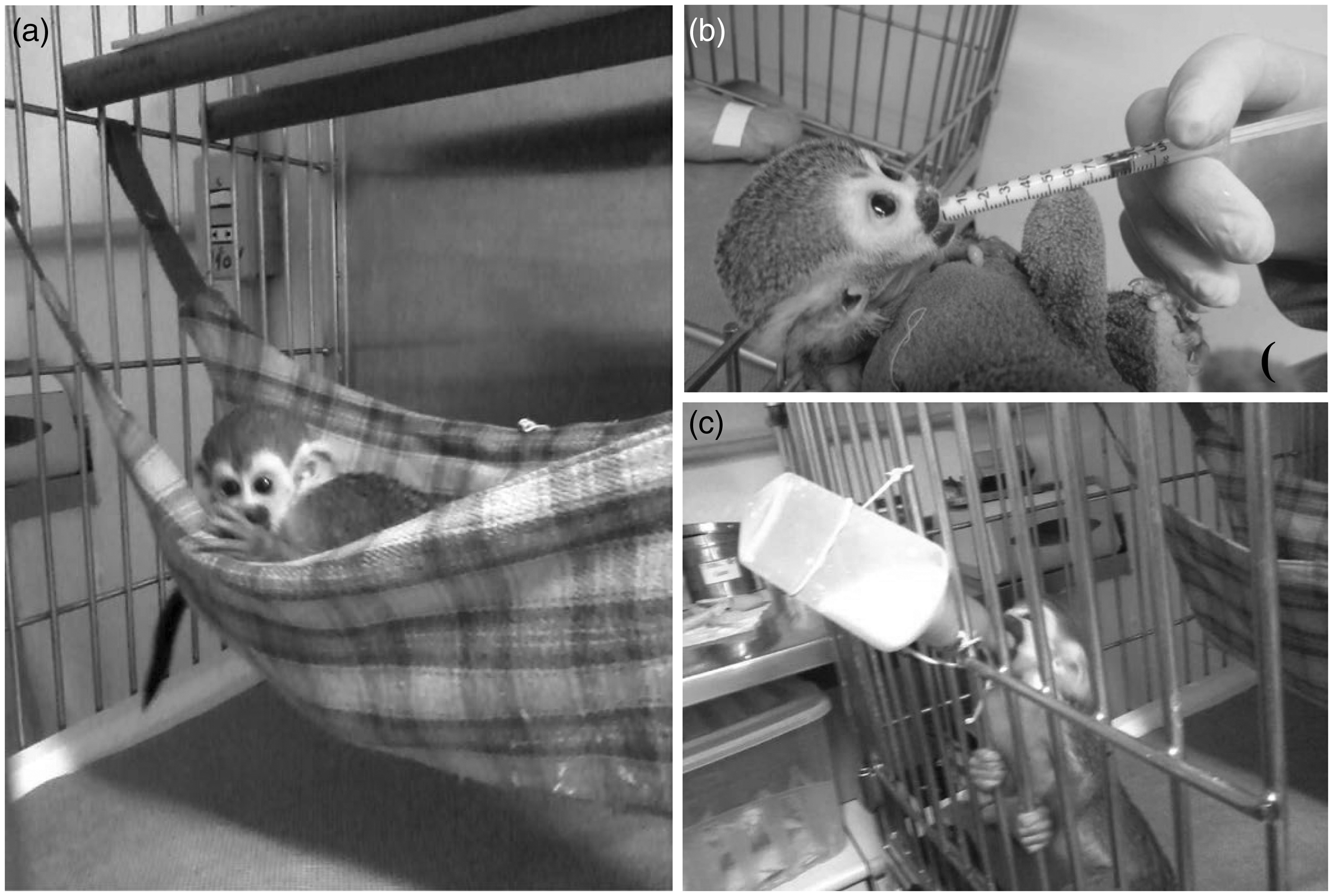
An individual record is opened with the complete birth history, parents’ identification, sex, weight, and nursery entry day. Besides this information, a control table is compiled of milk ingested by the newborn, with the amount of milk in mL/h, and a space for notes such as medications or any other important data that may need to be recorded. The infant should be weighed and its temperature measured daily.
Neonates are placed in incubators or individual cages, and when possible in groups, because of the need of social interaction among NHPs. If there is a sick animal, this should be handled last to avoid any contamination of healthy infants. A technician is also assigned every night since neonates also need to be fed during this period.
Feeding before weaning.
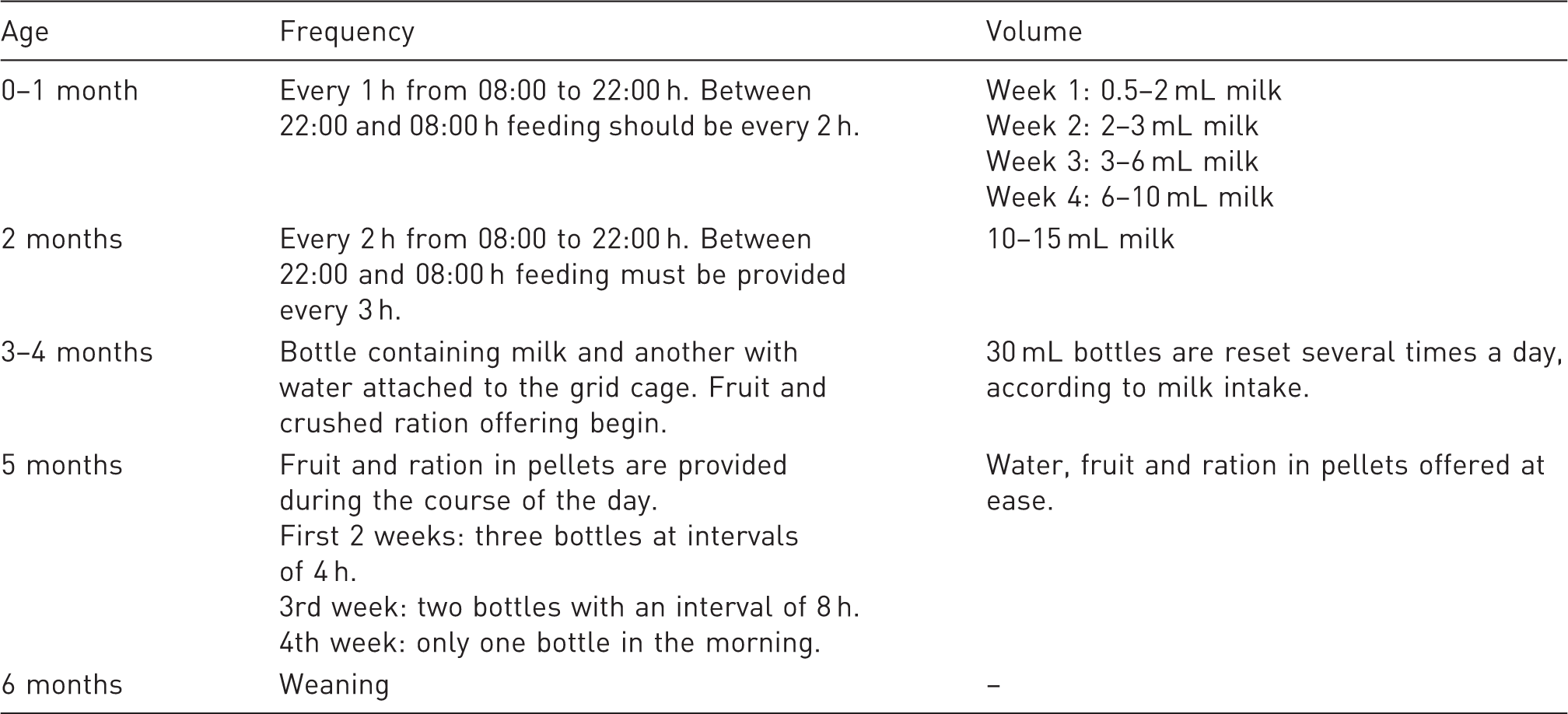
During lactation, the animals are placed in a vertical position to prevent choking from the liquid feed (Figure 1b). Over time, the animal begins to feed itself from a milk bottle attached to the cage (Figure 1c). Some animals do not accept the milk well. In such cases, there are a few options to attempt: (1) to dilute the milk further (one measure of NAN™ milk to 40 mL of filtered water), or (2) to sweeten the milk lightly. After use, the bottles are cleaned with water and mild detergent and sterilized for 10 min by boiling.
After weaning, a process that takes about six months, the animal is returned to its family group, along with other adults. This process is both gradual and slow. During the first week the animal is placed in a transport cage with food and water, in front of its home cage. After this time, the transport cage is placed inside the enclosure for interaction with other animals of the group. At night, the animal returns to the nursery unit. If after the first week there has been no aggression, and the rest of the group show acceptance of the infant, the transport cage is opened. If adaptation fails, the same procedure will be carried out with another group: this animal is removed at night and sent to the nursery. If the process takes place without problems and the infant is accepted well by the group, then the adaptation is considered to be satisfactory.
The breeding colony was maintained in compliance with Brazilian law, registered in IBAMA (Instituto Brasileiro do Meio Ambiente e dos Recursos Naturais Renováveis) under the protocol number 77933 and approved by the Ethics Commission on Animal Experimentation of the Oswaldo Cruz Foundation under protocol number LW-24/09.
Results and discussion
A survey of infant NHPs of the Saimiri genus submitted to nursery-rearing at the Fiocruz Primate Center was performed from 2007 to 2014.
The reasons that led to the breeding of the Saimiri spp. infants in nursery were: mother’s death, maternal rejection, hypothermia and hypoglycemia due to lack of breastfeeding. Females with low maternal ability induce death of their young by abandonment.
Most infants sent to the Fiocruz nursery were one week old or less, as this phase is the most critical for survival. Of the 244 squirrel monkeys born in this center from 2007 to 2014, 156 were alive (63.94%), of which 13 (8.33%) were sent to the nursery where eight (61.54%) were brought up successfully, being re-introduced into the colony. Among opportunistic infections are bacterial agents like Escherichia coli that may result in newborn death 14 and Candida spp. in animals undergoing antibiotic therapy. Infection by Herpesvirus saimiri type 1 is relatively common and may develop ulcers that make it difficult to eat. Treatment is limited to supportive care, fluids, electrolyte balance and intake of caloric foods. 17 The most common cause of death in nurseries is pneumonia secondary to milk aspiration. 18 In agreement with these data, at the Fiocruz colony, the most common causes of infant death have been hypothermia, hypoglycemia, and pneumonia which usually lead to death in 66.66% of newborn monkeys within 48 h of life. Underweight animals are less likely to survive. It was observed that infants weighing less than 95 g were unable to survive. In our study, the minimum weight for successful survival was 103 g. The average weight taken of eight hand-reared animals at 11 months of age was 565 g, while the average weight of eight animals raised by their mothers at the same age was 545 g, demonstrating an advantage to physical development when raised in the nursery.
Saimiri spp. requires a diet of high calorie densities. 19 The milk produced by S. boliviensis was analysed 20 and showed a mean of 4.56% fat, 3.59% crude protein, 6.98% sugar, 16.59% dry matter and 0.91 kcal/g, which is similar to human milk and can be substituted with the commercial milk NAN Confor 1®. Studies have shown the effects of omega-3 deficiency from the visual development in human infants and monkeys.21–23 NAN Confor 1® milk contains omega-3 in its composition, and no evidence of visual deficiency has been observed in animals reared in the nursery at Fiocruz.
During the first month of life, the infants are very quiet, no major movements are observed and they always cling to the plush mother. After this period, they begin exploring their cage and climbing the railings. This display of independence and environment exploration is intensified until weaning. Small breeding groups of infants of approximately the same age were formed to stimulate socialization. This social interaction in the cage can also serve as an overcoming response to separation from their mothers. 24
Weaning in nature occurs at around six months of age and it was observed that 6-month-old infants reared in the nursery were able to live with other members of the colony, including the adults. Re-introduction of the hand-reared infant was possible once the infant was capable of self-feeding. Despite the high costs involved, hand rearing infants in the nursery is still worthwhile, owing to the high probability of success and the value of animals. It is also in keeping with the principle of the 3Rs (reduction, replacement and refinement).
There is no evidence that animals reared in a nursery are more susceptible to infections in adulthood, and no stereotypes have been reported. Animals reared at the Fiocruz nursery have been well accepted in the social group and reproduce normally in captivity, with no history of behavioral or reproductive problems.
Therefore, the 61.54% success rate for Saimiri spp. bred in the nursery is satisfactory when compared with the 62% rate for S. sciureus bred by their mothers. 25 Although the cost of maintaining these animals in the nursery is high, the possibility of preserving their lives represents an invaluable benefit given the high value of these models.
Footnotes
Acknowledgment and Funding
We thank Fundação de Amparo a Pesquisa do Estado do Rio de Janeiro for a Cientific Initiation scholarship (E-26/100.563/2013).