



Abstract

Vienna's public transport museum is at risk of being overshadowed by the city's spectacular palaces and world-renowned art and music venues. With 40,000 visitors annually, it is a minnow not only compared with the city's cultural behemoths like the Schönbrunn Palace (over 4 million) or Kunsthistorischesmuseum (1 million), but also on international comparisons in its own field: the London Transport Museum claims 10 times that total (450,000). 1 That would be a pity, as it has a many-faceted story to tell, is curated to a high standard, and offers a substantial and satisfying visitor experience.
Visitor experience
Housed in a pristinely preserved historic tram depot (the Remise), it lies around two miles (3.5 km) outside the city centre, but is easily reached by U-Bahn, tram or bus (alight Schlachthausgasse). It is not difficult to find, but equally visitors are unlikely to stumble on it. Exhibits are split between three main separate buildings; a nice touch is the recreated historic transit stop in the yard that links them. In the main hall, historic rail and road vehicles (the collection numbers around 120, not necessarily all on show) are interspersed with 15 individually themed booths housing smaller objects and displays. A wide variety of topics is covered, including vehicle technology (e.g. electrification, control systems and AC vs DC power); civil engineering; planning; operations; social and political influences on transport demand, organisation and provision; the impact of war; and more (Figure 1).

The museum's eponymous home is this well-cared-for historic tramshed. Although displays now encompass all public transport, trams still dominate (Credit: Wiener Linien).
One disadvantage of these buildings is that it is clearly not feasible to heat them to standard indoor conditions. On a chilly March day, most visitors retained outdoor clothing, and this might restrict the time you can comfortably spend there. Some more seating areas might help visitors with lower stamina, too, and in a city famed for its café culture, it is disappointing that catering is limited to a couple of vending machines. There is also a small shop stocked with the usual range of merchandise and souvenirs. Nevertheless, it is brightly lit and impressively clean. Displays look vibrant and fresh, showing few signs of wear or use. For those with additional mobility needs, it is helpful that the site has few cramped spaces and generally level access.
The themed booths work well. They provide a comfortable scale-appropriate viewing environment for the smaller exhibits, break up the monotony of a large space, and being topic-specific and numbered, make it easy to identify and select topics of interest and track progress. The overall layout is largely open plan, and while the museum suggests a sequential route on broadly chronological lines, it is easy to wander at will. The bi-lingual display texts are concise and well written, although not every caption is translated into English, so at least a basic level of German reading ability is helpful to the international visitor. Alternatively, there is a multi-lingual audio guide (not sampled). Some visitors chose instead to use smartphone translator apps. Surveys indicate that some 40 per cent of visitors were born outside Austria (the museum does not record visitors’ place of residence), and the multi-lingual design and marketing suggest that it is not intended exclusively for domestic consumption (Figure 2).
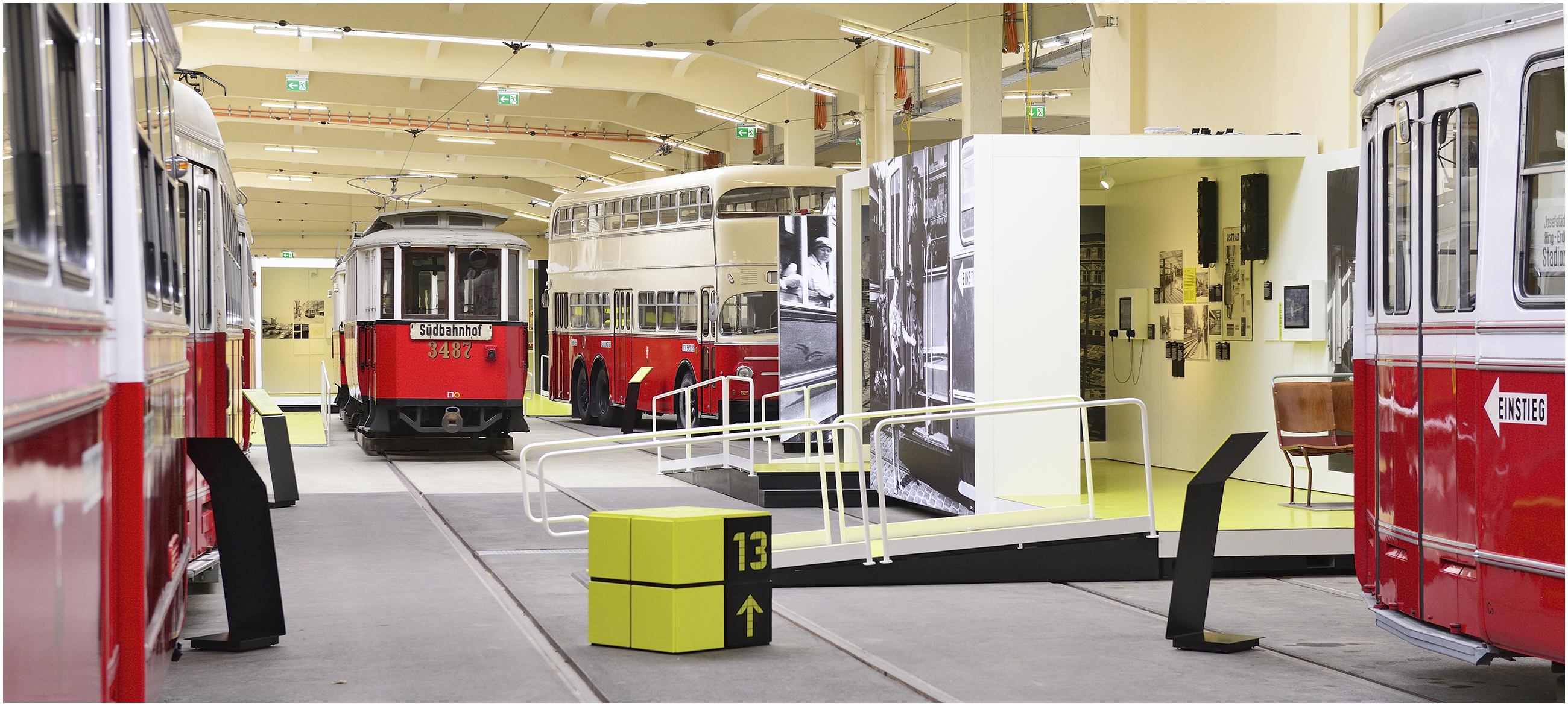
Themed display booths distributed among the vehicles cater to a variety of interests (Credit: Wiener Linien).
Younger visitors are well catered for, with puzzle and activity trails. Boxes with ticket clippers to check off your progress are a neat idea, but proved too stiff for small hands (however, one wonders how many of today's children will ever have seen these in use?). Other attractions include engagingly designed interactive displays and cover themes as varied as Victorian entrepreneurial business modelling and 2020s network control centres. A simple driving simulator is apparently one of the most popular visitor attractions, but it is a rare example of a display that shows its age and could prove a disappointment: it amounts to little more than a mocked-up cab interior with wrap-around pre-recorded cab video; the driver's task is to match a speed/power selector setting with the actual speed in the video.
The museum's message
First opened as the Wiener Straßenbahnmuseum (Vienna Tram Museum) in 1985, the venue was redeveloped into its current form and renamed in 2014 to Verkehrsmuseum Remise. The name reflects a significant widening of scope to be the museum of Wiener Linien, Vienna's integrated public transport organisation, responsible for buses, trams, U-Bahn (metro/underground rail), S-Bahn (regional rail network), and the city's Badner Bahn light rail system. More subtly, it also heralds that the museum's world view (might one say Weltanschauung?) is clearly that of Wiener Linien. The consistent underlying narrative thread intimates an essentially optimistic and progressive view of the contribution of public transport services to Vienna's economic, domestic and cultural life, implicitly premised on the assumption that maximal public transport investment is an incontestably ideal goal. The role of private road vehicles (whether cars, private hire coaches or freight vehicles) is addressed rather peripherally, and often with an implicit sense of threat. For example, as “the car became the universal means of transport” from the 1950s, it “threatened to force public transport entirely off the road”; but ultimately the solution to “crammed roads” (how crammed?) was the city's new rapid transport and underground systems in the 1960s and 1970s which were “an immediate success” (by what measure?). At times, the generally praiseworthy economy of the captioning perhaps leaves too little space to evidence its conclusions and equip visitors with a less superficial reading of events.
This is not to say that historic setbacks and challenges are ducked, and darker episodes of the city's history are addressed sensitively, soberly and frankly. For example, the panel profiling how public transport employees and strategy were targeted and manipulated by the Nazi regime during the 1930s and 1940s is powerful and eloquent, implicitly raising questions about how service organisations and quangos interact with political realities.
Other displays highlight the ways in which transport history can bring different perspectives to wider historical questions. Particularly thought-provoking for the international visitor, the impact of the First World War (1914–18) on Vienna is brought into sharp focus by images and words contrasting pre-war Vienna as the prosperous political and economic nerve centre of the 50-million strong Austro-Hungarian empire with the impoverished “capital of a [defeated] petty state” that it was after: its rail and road networks stripped of resources by wartime requisitions and destruction, and the remaining few operational trams “practically the sole means of urban transportation.” How do you refashion the rump of a network designed with wholly different assumptions for a radically and unexpectedly transformed economic and social reality? What does the transport scene tell you about the city's wider situation? There is plenty of material here to stimulate reflections on how transport history offers insights beyond category boundaries.
Turning to happier times, interesting displays cover the design of the city's underground system, created in the 1970s with an integrated vision of passenger experience and structural design. Cross-modal explainers for signalling, safety, and operations, and accessibility are also provided.
The museum concludes with a fascinating comparison of the transport mix, challenges, and solutions implemented in other cities around the world. This abruptly lifts the museum's gaze from a single medium-sized city to a global level. It is an impressive primer on urban transport planning and historical contingency, and there can be very few who will not learn something from it. Visitors are recommended to preserve some time and energy for it (Figure 3).
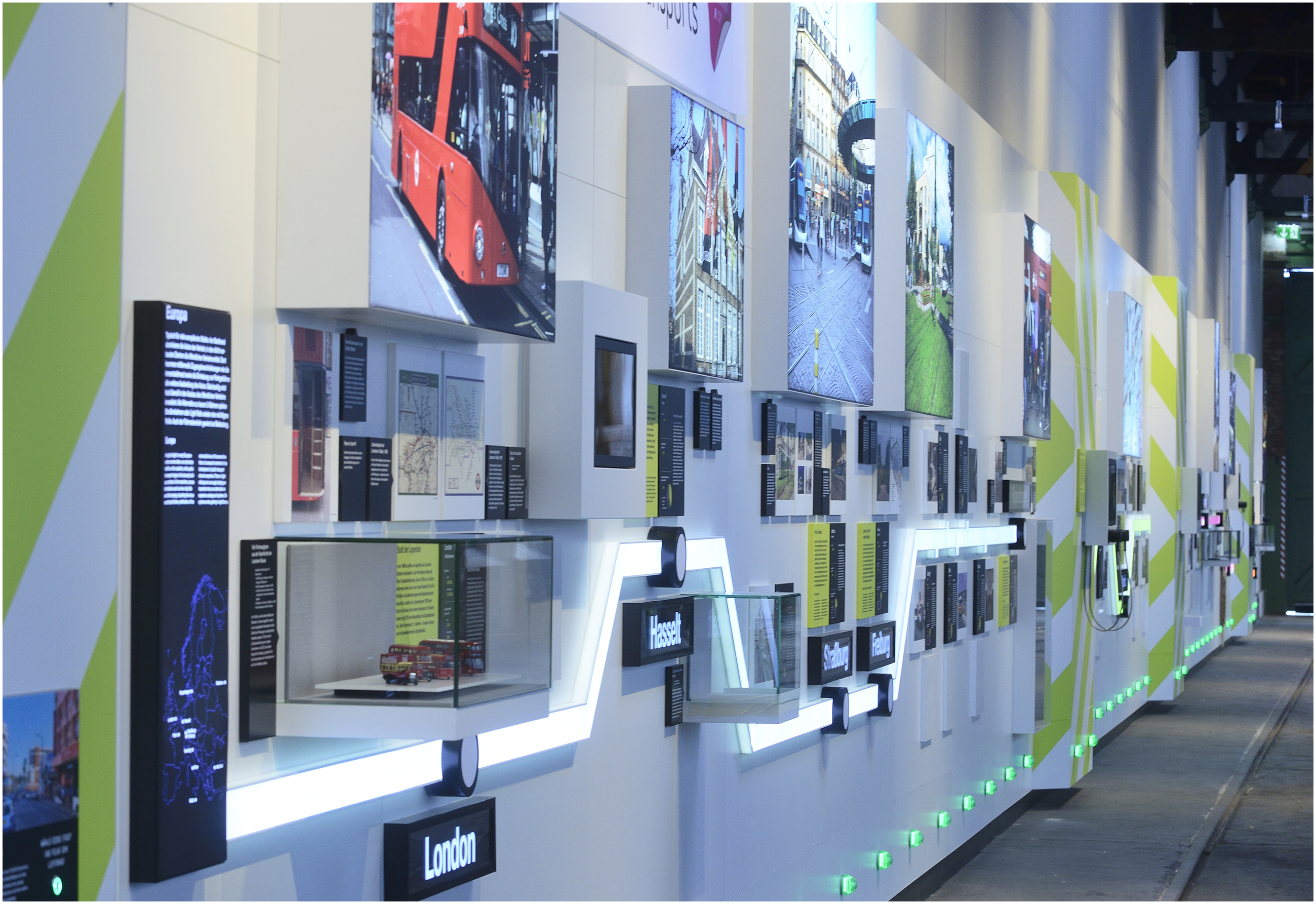
The fascinating closing display highlights the diverse challenges, solutions and characteristics of city transport networks around the world, and the place-specific traveller experiences that result (Credit: Wiener Linien).
Anyone interested in transport or Viennese history will find a visit worthwhile, and the €12 entrance fee is good value. It does an excellent job of representing and contextualising Vienna's public transport history. The ten-year old displays have aged exceptionally well but will need to be updated soon; while the museum has an archive, there is no archivist or full-time curatorial staff, and one feels there is a bigger opportunity here. The remarks from the press office that plans for “comprehensive renewal” are “in an early stage of development” are, therefore, highly encouraging.
