




Abstract
Railway networks developed quickly in the nineteenth century and played a key role in shrinking space and reshaping patterns of development. However in island countries the development of national railway networks required the additional, and often overlooked, innovation of train ferries. Train ferries reduced loading and unloading time and costs substantially, and collapsed time-space. This research focuses on Denmark's pioneering role in building a national railway network in an island country, with international connections to Sweden, Germany and Norway, by establishing 18 roll-on roll-off train ferry routes from 1872 onwards. Denmark's last train ferry only ceased operation in 2022, ending a globally unique era of 150 years of train ferry services. Historic ferry, train and steamship timetables are used to measure the reduction in time-distance resulting from train ferries replacing conventional ships. Later innovations in road and rail fixed links and vehicle ferries replaced train ferries. This completed the process of Denmark moving to a continuous land-based transport system connected to more than 99% of its population. Analysis of historic timetables and other data shows that the development of train ferries in Denmark had the largest effect in collapsing time-space, but they only operated intermittently, whereas fixed link bridges and tunnels have subsequently had a smaller effect in collapsing time-space, but crucially provide continuous connections.
Introduction
Transport plays a key role in shaping spatial patterns of development. Transport innovations can collapse time/space and cost/space and increase transport capacity and frequency. Janelle developed the concept of time–space convergence to reflect the dramatic space-shrinking effects of two centuries of transport innovations. 1 Although the tyranny of distance has been reduced by cheaper and faster transport, important geographical differences remain. 2 Location is critical as time/space relationships collapse differentially. Access to travel is unequal and Massey argues that time–space compression needs to be differentiated socially as the effects of time–space convergence and the propensity to travel vary according to income, social class, gender, age, physical ability and health. 3
Steam powered railways and iron steamships are widely recognised as the most significant nineteenth century transport innovations. Railway networks developed quickly from the 1830s, especially in many European countries and in North America, and facilitated and supported industrialisation. However, in countries made up of many islands the development of national railway networks required the additional, and often overlooked, innovation of train ferries. Island countries depended historically on small ships for trade and passenger movement along coasts, between islands, and to and from other countries. Poor-quality island roads were usually more expensive to use than ships and less able to transport heavy loads. In addition, seas around islands and long tidal river estuaries impose physical barriers to movement by land transport for people and goods and impose significant cost and time barriers resulting from the need for transhipment and the slow speed of maritime transport. This constrains interaction and limits the size of market, social and cultural areas. 4
Geographers’ conceptions of islands have changed since the nineteenth century from bounded, isolated and static spaces to better connected spaces due to innovations in transport and telecommunications that have improved mobility and eased communication. Islands have been rethought as relational spaces emphasising the power of connections and crosscurrents. 5 Due to human intervention, associated with population, economic and urban growth, and the strength of transport connections, islands ‘join, divide, grow or diminish’. 6 Ships and ferries improve connections with island communities but only provide intermittent services, whereas fixed links create permanent connections and remove insularity. 7
An extensive search through Scopus only revealed a very small number of academic research publications that investigated the development of train ferries and their impacts. 8 This research evidence was supplemented by a few important non-academic sources, 9 and some detailed evidence from Denmark. 10
Research objectives and methods
This research paper aims to fill this gap in knowledge by assessing the importance of the technical innovation of train ferries in developing national and international railway networks, and of their later replacement by fixed link bridges and tunnels. Subsequent innovations in bridge construction and tunnel construction and ventilation enabled many of the main train ferries to be replaced by fixed links. Elsewhere, vehicle ferries often replaced train ferries. The research focuses on the time-space reducing effects and spatial impacts of successive investments in a national system of train ferries in Denmark since 1872, and later in major road and rail fixed links. This enabled the transport provision in the island country of Denmark to transform from a sea transport system to a land transport system (Table 1). 11
Denmark – infrastructure investments enabling the transition from a sea to land transport system.
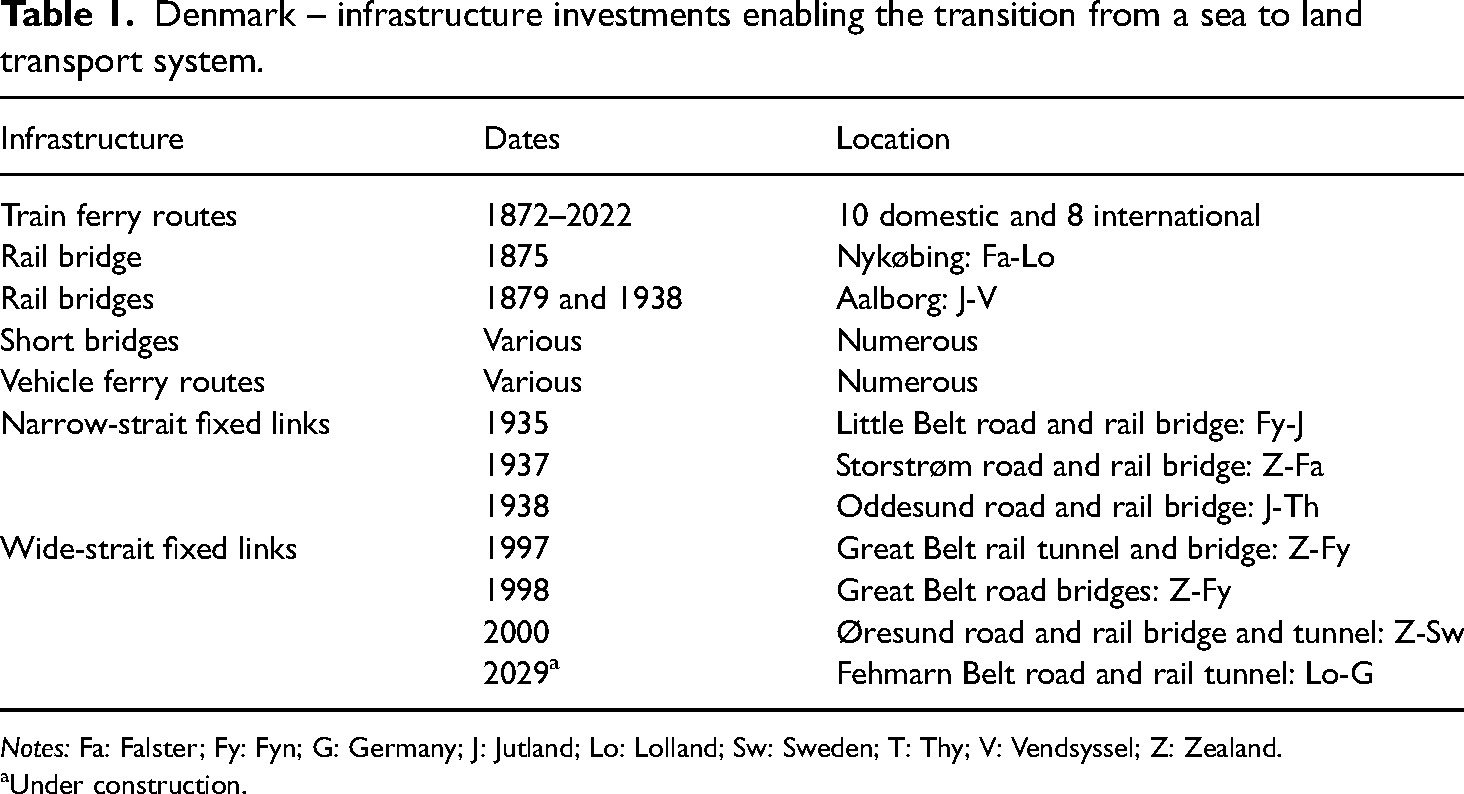
Notes: Fa: Falster; Fy: Fyn; G: Germany; J: Jutland; Lo: Lolland; Sw: Sweden; T: Thy; V: Vendsyssel; Z: Zealand.
Under construction.
An innovative research method was adopted by analysing historic ferry, train and steamship timetables from the 1870s onwards to measure the reduction in time-distance resulting from train ferries replacing conventional ships. Long-term time-series analysis of transport network development can provide important insights into how transport systems evolve. 12 However, printed but non-digitised historic timetables dating back to the mid-nineteenth century are difficult to obtain, and usually form the only comprehensive source of information about travel times and frequencies, which makes data analysis very time consuming.
Transport innovations in train ferries and fixed links
Major technical innovations in shipbuilding and in bridge and tunnel building were required to connect separate island road or railway networks, and networks divided by wide river estuaries. These innovations enabled the development of an integrated land transport network.
Train ferries
Train ferries were an important transport innovation at the beginning of the railway age in the 1830s. The earliest train ferries included a wagon ferry over the Forth and Clyde Canal in Scotland in 1833, and a railway ferry over the Susquehanna River in Maryland, USA in 1836. 13
A more significant technical innovation in the mid-nineteenth century was the development of roll-on roll-off (Ro-Ro) train ferries where freight wagons, passenger carriages or short train sets could travel over a link-span, that rises and falls with the tide, straight from the harbour-side onto a ship with train tracks embedded into its deck. Ro-Ro train ferries could then link together island railway networks and railway networks separated by rivers that were too wide to bridge over or tunnel under. Train ferries reduced loading and unloading costs and time substantially, and collapsed time–space, creating an integrated railway network with increased frequency and capacity.
Ro-Ro train ferries were first designed and pioneered by a civil engineer Thomas Bouch, who was manager of the Edinburgh and Northern Railway in Scotland. In 1850 the first Ro-Ro train ferry route opened to transport freight wagons 8 km across the River Forth estuary between Granton, Edinburgh and Burntisland, Fife. In 1851 the second Ro-Ro train ferry route connected Tayport, Fife to Broughty Ferry, Dundee across the River Tay estuary. These two ferry routes together enabled a through rail route to operate between Edinburgh and Aberdeen for freight and passengers.
Over 100 train ferry routes were subsequently opened in other countries. Most significantly, train ferries enabled national railway networks to be built in the island countries of Denmark in the late nineteenth century and in Japan in the early twentieth century. Ro-Ro train ferries were initially mainly for freight wagons and passenger carriages or foot passengers, but in later years also started to carry cars and lorries. As car ownership grew in the mid-twentieth century many motor vehicle ferry routes opened, some replacing less well-used train ferries. 14
Train ferries replaced by fixed links
A series of technical advances in constructing bridges and tunnels have enabled some shorter ferry routes to be replaced by higher capacity fixed road and rail links. Fixed Links also provide continuous 24 h/7 days a week connections, rather than intermittent connections between separate land transport networks. In Scotland, the innovative Forth and Tay Estuary train ferry routes were an interim solution to create a through railway route and were both replaced by railway bridges within 40 years. Thomas Bouch also designed the Tay Rail Bridge that opened in 1878, but it collapsed in a storm in 1879. Other engineers then designed a new Tay Rail Bridge and a Forth Rail Bridge that opened in 1888 and 1890 respectively.
Countries such as Denmark and Japan, with substantial populations living on several large islands, have benefitted most from the profound spatial and economic impacts of these transport innovations in train ferries, vehicle ferries and fixed link bridges and tunnels. 15 Each of these transport innovations has caused time–space convergence, shrinking travel times and costs.
Denmark played a pioneering role in the late nineteenth century as the first multi-island country able to build a national railway network using train ferry routes to interconnect its island railway networks. Denmark's national capital Copenhagen (København), on the island of Zealand (Sjælland) was connected by train ferries with its other large neighbouring islands of Fyn (Funen) in 1883 and Falster in 1884. Fyn was connected by train ferries to the Jutland (Jylland) Peninsula in 1872, and the north of the Jutland peninsula in turn was connected to Thy in 1883 by the Oddesund train ferry, and to Vendsyssel by the Limfjord railway bridge in 1879 from Aalborg (replaced by a new bridge in 1938).
In the rest of Europe, nearly 100 train ferry routes were developed with Sweden, England and Italy benefitting most. Sweden was connected by train ferries with Denmark, and across the Baltic Sea (Østersøen) with Poland, Germany and Finland. England was connected by several train ferries across the English Channel to France and Belgium, whilst mainland Italy was connected by train ferries to Sicily and Sardinia. 16 Most of these European train ferries, with the major exception of the Messina Strait train ferry from mainland Italy to Sicily, have since either been replaced by vehicle ferries, or fixed links, or closed.
Japan was able to build a national railway network by connecting its main island Honshu to its other large islands with three train ferry routes to Kyushu (1911–1942), Shikoku (1921–1988) and Hokkaido (1924–1988), later replaced respectively by a rail tunnel, rail bridges and a rail tunnel. 17 Japan's urban system, traditionally linked by coastal shipping and a primitive road system, ‘was completely reorganised by the emergence of railways which created new connections and greatly increased the speed of existing links’. 18
Elsewhere several major train ferry routes have been replaced by fixed links including the Channel Tunnel railway between England and France in 1994, Istanbul's rail tunnel under the Bosphorus strait in Turkey in 2015, and the Prince Edward Island road bridge to mainland Canada in 1989.
In many other countries individual train ferry routes survive, some providing significant national connectivity including New Zealand's Interislander train ferry between Wellington (North Island) and Picton (South Island); Alaska's train ferry from Whittier to Seattle in mainland USA; Italy's train ferry from Villa San Giovanni in Calabria to Messina on the island of Sicily; Russia's train ferries between Ust-Luga near St Petersburg and Russia's Baltic exclave of Kaliningrad, and from Russia's Far East mainland to Sakhalin island; and China's train ferry from Guangdong to Hainan island. 19 Some significant international train ferry connections continue including Uganda's train ferry routes across Lake Victoria that connect with Tanzania and Kenya's railways providing onward connections to their Indian Ocean ports; from Baku in Azerbaijan across the Caspian Sea to Turkmenistan and Kazakhstan; from Bolivia to Peru across Lake Titicaca; and from Veracruz in Mexico to Mobile, Alabama in the United States.
Denmark's archipelago and the development of an integrated land transport network
Denmark is fragmented into an archipelago of 483 islands, of which 71 are currently inhabited, and the Jutland peninsula (Table 2).
Denmark: population and fixed links 2023 by Island groups and regions.
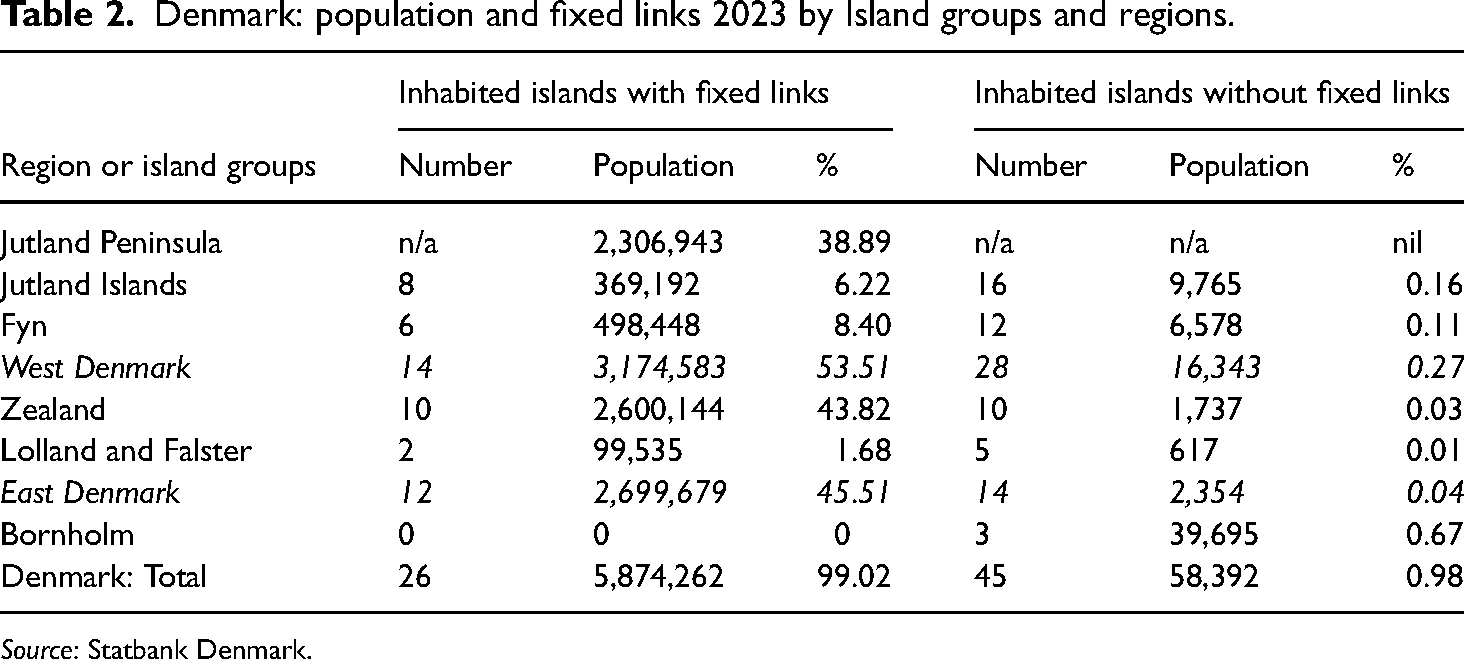
Source: Statbank Denmark.
Many local and inter-regional steamship routes were developed in Denmark in the nineteenth century by three private steamship companies, which merged to form DFDS (The United Steamship Company) in 1866, and some by Denmark's Postal Service. 20 More routes were established after the introduction of freedom of trade in 1857, which removed the trade monopolies of the old royal boroughs. 21 Some steamship routes were connected to newly opened railway routes, but steamships were slow and infrequent. 22 For example, the main DFDS steamship routes in 1880 were only twice weekly between Copenhagen and Aarhus, and Copenhagen and Aalborg, and 14 times weekly between Copenhagen and Helsingør. 23 To create comprehensive national rail and road transport networks, Denmark had to develop robust transport links across numerous sea straits and estuaries, most notably the wide Great Belt (Store Bælt) strait between the islands of Zealand in East Denmark and Fyn in West Denmark, the narrow Little Belt (Lille Bælt) strait between Fyn and the Jutland peninsula, and the narrow Storstrøm strait between the islands of Zealand and Falster. 24 In winter, sea transport was often disrupted by ice that was more prevalent because the Baltic Sea is almost tideless and has low salinity. Train ferries reinforced as ice breakers were introduced to reduce this disruption, initially across the Great Belt from 1894, but thick sea ice in very cold winters still prevented ferries from operating for many days. 25
Denmark's train ferry network
Denmark's first Ro-Ro train ferry route opened in 1872, across the Little Belt between Strib on the island of Fyn and Fredericia on the Jutland peninsula; the small 300-ton double-ended paddle wheel steamship Lillebælt could carry six four-wheeled passenger or goods cars and a small tank engine (Table 3 and Figure 1). 26 Denmark's second train ferry route opened in 1883 across the Great Belt between Korsør on the island of Zealand and Nyborg on the island of Fyn with two 971-ton double-ended paddle wheel ferries with double train tracks. Many more train ferry routes opened subsequently to other Danish islands, Sweden, Germany and Norway. As train traffic grew, larger capacity twin-screw steam or later diesel-powered train ferries were introduced, each with between two and five train tracks on the main routes within Denmark and to Sweden and Germany. Denmark's final train ferry route ceased operating with the closure of the wide-strait Fehmarn Belt (Femer Bælt) service to Germany in August 2022, ending Denmark's uniquely long train ferry era that lasted 150 years. 27
Historical development of Denmark's train ferries.
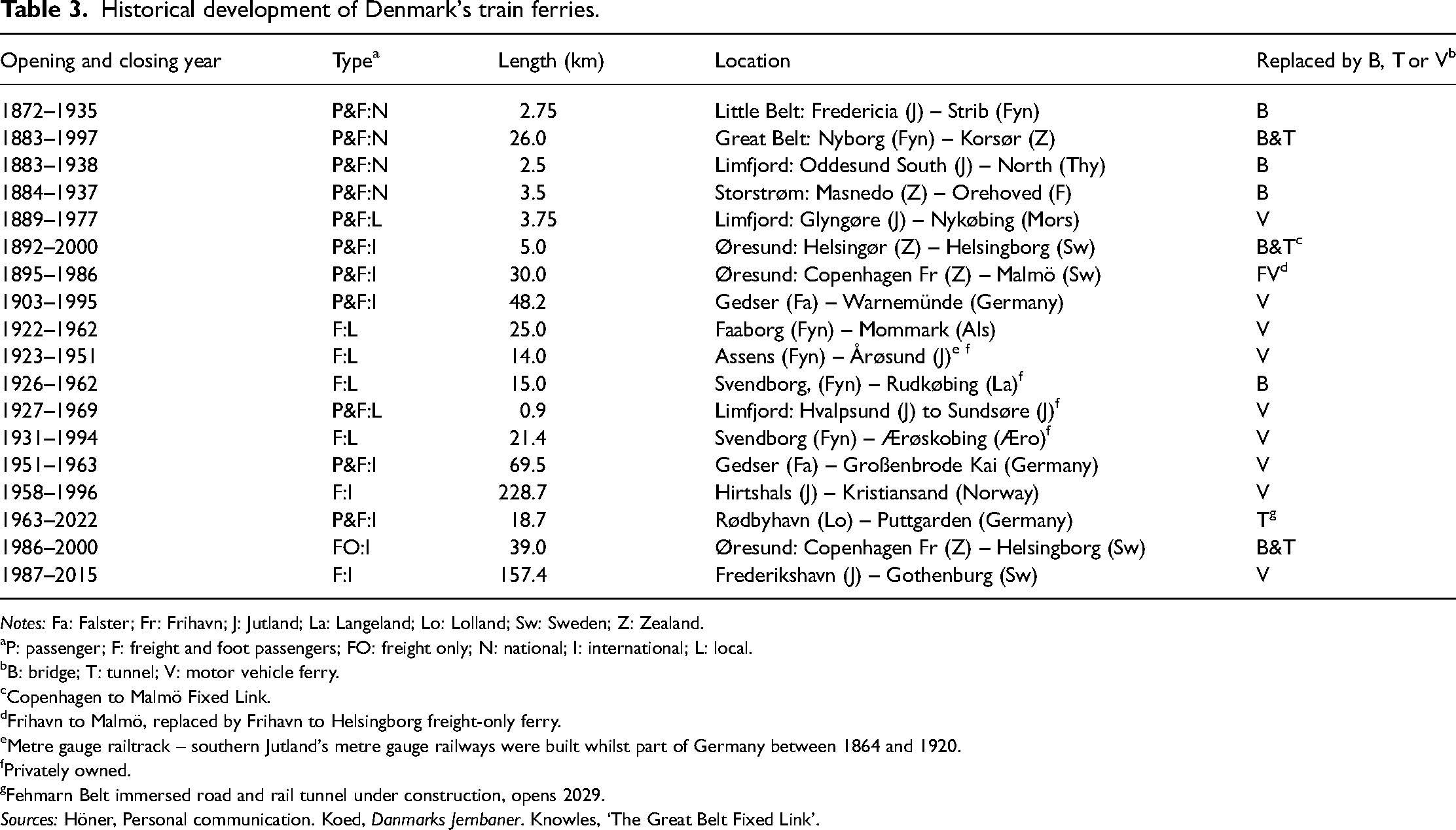
Notes: Fa: Falster; Fr: Frihavn; J: Jutland; La: Langeland; Lo: Lolland; Sw: Sweden; Z: Zealand.
P: passenger; F: freight and foot passengers; FO: freight only; N: national; I: international; L: local.
B: bridge; T: tunnel; V: motor vehicle ferry.
Copenhagen to Malmö Fixed Link.
Frihavn to Malmö, replaced by Frihavn to Helsingborg freight-only ferry.
Metre gauge railtrack – southern Jutland's metre gauge railways were built whilst part of Germany between 1864 and 1920.
Privately owned.
Fehmarn Belt immersed road and rail tunnel under construction, opens 2029.
Sources: Höner, Personal communication. Koed, Danmarks Jernbaner. Knowles, ‘The Great Belt Fixed Link’.
Denmark's network of 18 train ferry routes included eleven for passengers and freight, six mainly freight ferries with some foot passengers, and one freight-only ferry. These roll-on roll-off train ferries enabled Denmark to create a national railway network as well as international railway connections to Sweden, Germany 28 and Norway. Denmark's roll-on roll-off train ferries are best grouped into three categories (Table 3 and Figure 1). 29
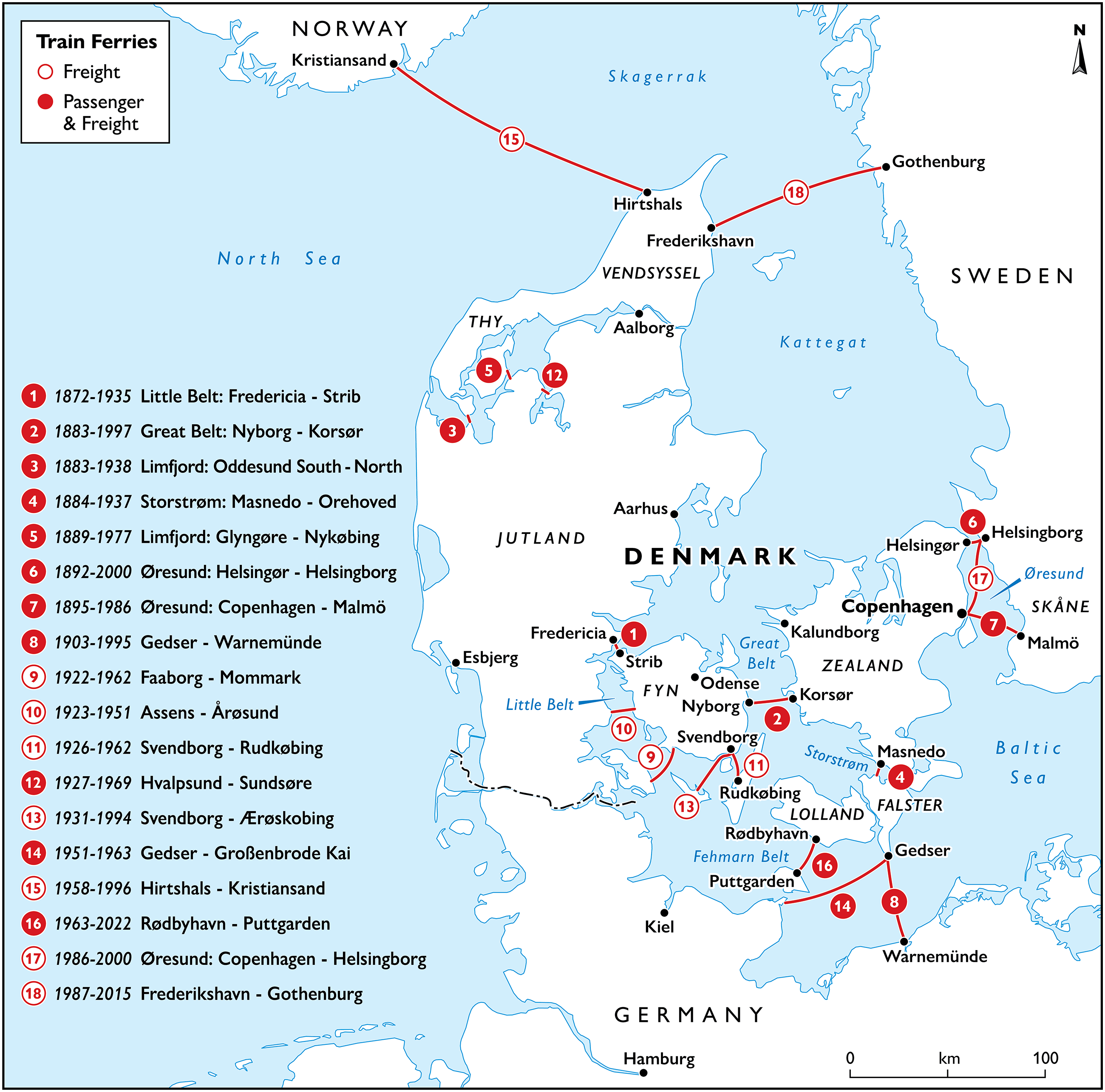
Denmark's train ferries 1872–2022.
National train ferries
Four national train ferry connections operated by the state-owned railway company DSB (Danske Statsbaner – Danish State Railways) that linked together a national railway network
30
:
from Zealand west across the Great Belt strait to Fyn from Fyn to Jutland across the Limfjord at Oddesund to Thy from Zealand south across the Storstrøm strait to Falster, which was connected by a rail bridge to Lolland.
DSB also operated a direct timetabled steamship route between Kalundborg (Zealand), the island of Samsø and Aarhus (Jutland) with connecting trains between Copenhagen and Kalundborg.
International train ferries
Eight international train ferry connections that linked Denmark's railway network to the Scandinavian peninsula and the European mainland:
three train ferry routes from Zealand across the Øresund (The Sound) Strait to Sweden three from Falster or Lolland to Germany two from Vendsyssel island, north of the Jutland peninsula, to Norway and Sweden respectively.
A direct timetabled steamship route operated between Korsør (Zealand) and Kiel (Germany) until 1914 with connecting trains between Copenhagen and Korsør. 31 DSB operated the Englænderen train between Copenhagen and Esbjerg after the opening of the Little Belt Bridge in 1935, connecting with the steamship route between Esbjerg Havn (western Jutland) and Harwich Parkeston Quay (England).
Local Danish train ferries
Six local train ferry connections: two operated by DSB and four by private railway companies.
Time–space compression: Train ferries shrinking Denmark
Denmark's Ro-Ro train ferries transformed inter-island movement by reducing transhipment costs and loading/unloading times for freight wagons and passenger carriages at each port from about 3 h to 30 min or less, which reduced transfer times between train and ship by at least 2 h 30 min (Figure 2).
32
In comparison, mid to late nineteenth century mainline train services in Denmark operated at up to 40 kph and shrank time–space even more. Figure 2 includes three time-space maps between East and West Denmark:
using historic timetables that show mainline trains operating at up to 40 kph, and conventional ship timetables plus loading and unloading times
33
using historic timetables that show mainline trains operating at up to 40 kph, and train ferry timetables including shorter transfer times. from the year 2000, after the opening of the Great Belt and Øresund Fixed Links, with mainline trains on land and over fixed links, both operating at up to around 100 kph.
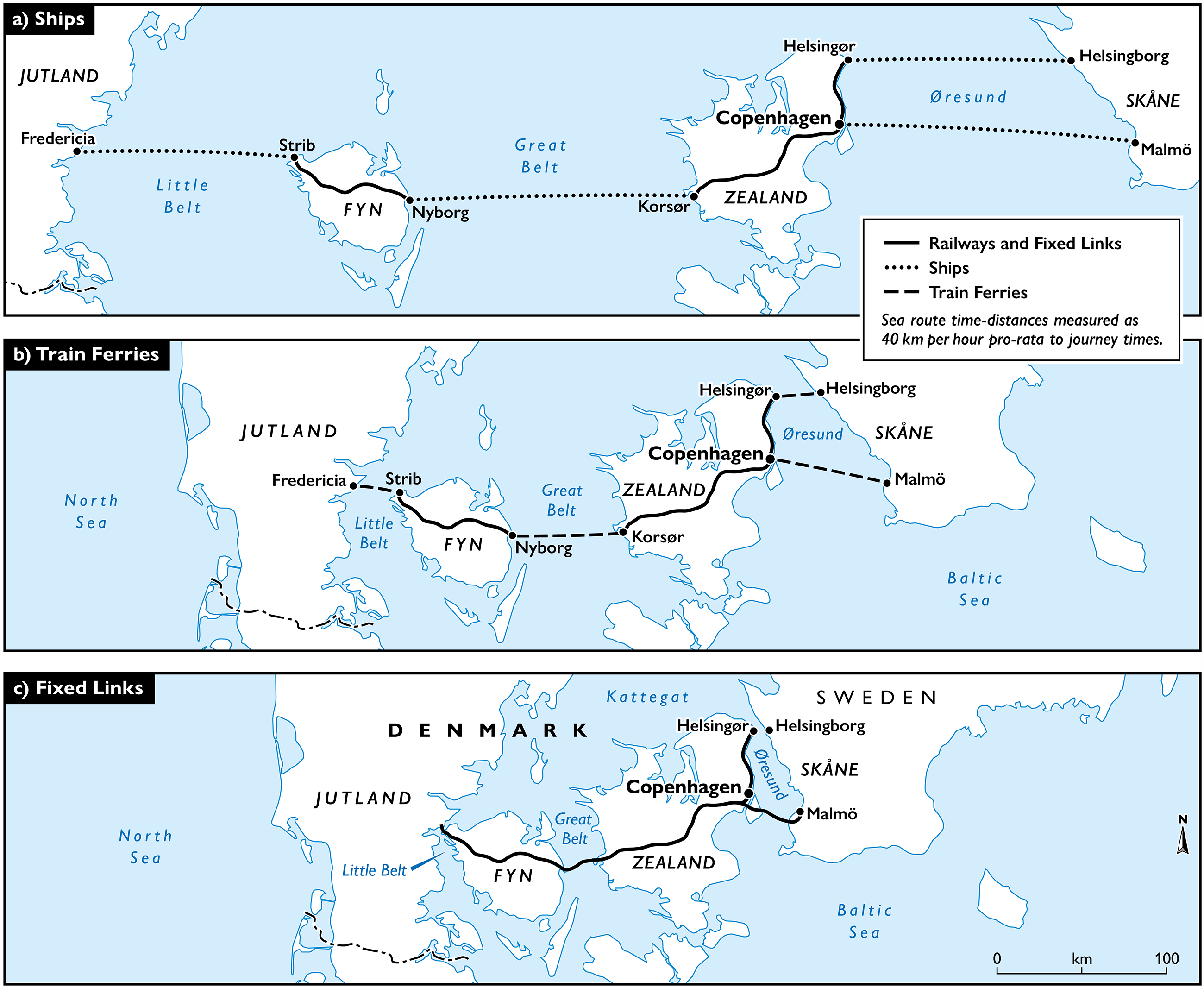
Denmark: spatial impacts of train ferries and fixed links.
The limited length of rail track on the early types of train ferry meant that instead of complete trains, only freight, mail and luggage wagons, and some passenger carriages and sleeping cars were shunted on board, and most passengers boarded the ferries on foot and joined another train at the destination port. 34 Subsequently, longer train ferries with two or more tracks were built for the main ferry routes carrying most traffic.
Through passenger carriages were carried on the main train ferries from Copenhagen (Figure 1):
to Aarhus, Aalborg and Esbjerg in Jutland across the Great Belt and the Little Belt to Oslo, across Øresund from Helsingør (Elsinore) to Helsingborg to Stockholm across Øresund to Malmö to Berlin and Hamburg in Germany across Storstrøm and then across the Baltic Sea from Gedser to Warnemünde
After the Little Belt Bridge opened in 1935, through three-coach diesel passenger railcar trains (Lyntog – lightning trains) were introduced, able to roll on and off train ferries as complete trains across the Great Belt, reducing journey times between Copenhagen and Jutland.
Copenhagen to Jutland
The two main national train ferry routes shrank the effective distance between Copenhagen in East Denmark and Fredericia in Jutland, West Denmark by 52% from 429 to 206 km. The fastest train journey times then were nearly 40 kph. Using this time–distance measure, the Little Belt Train Ferry from 1872 cut the time–distance between Copenhagen and Fredericia in Jutland by 26% from 429 to 316 km (Figure 2). This was mainly due to roll-on roll-off ferries cutting transfer time for loading and unloading freight wagons to up to 30 min compared with an estimated 3 h for conventional steamships. The Great Belt Train Ferry from 1883 cut this time–distance further by 35% from 316 to 206 km.
The spatial impact of this time–space compression was that faster and cheaper transport generated more passenger and freight traffic, which required more frequent and larger train ferries. Although traffic data has not been recorded, traffic growth between east and west Denmark can be demonstrated by the use of much larger ferries containing more rail tracks and the increased frequency of Little Belt train ferries from four a day in 1872 to five in 1884 and eight in 1925, and of Great Belt train ferries from three a day in 1884 to nine in 1925.
Copenhagen to Aarhus
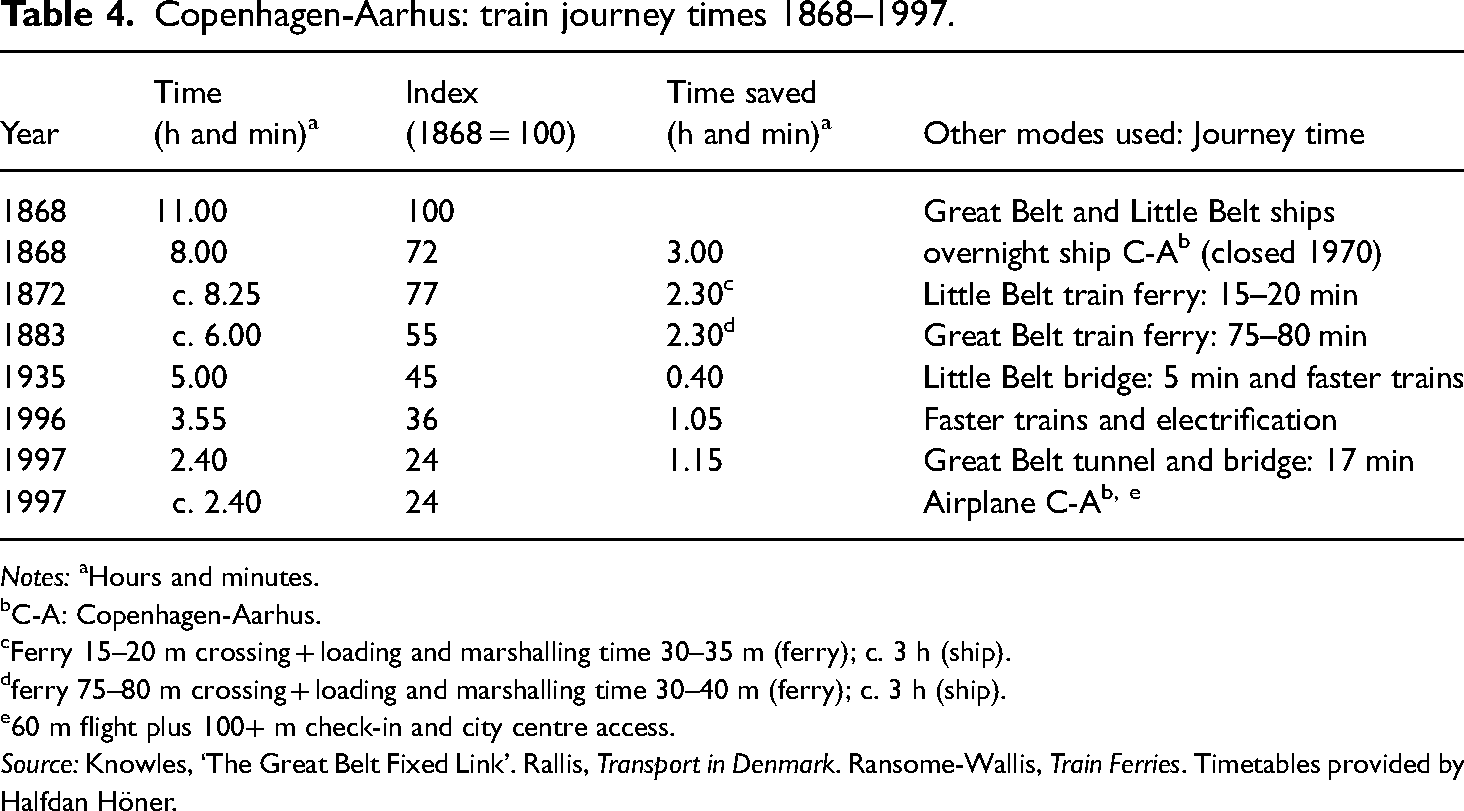
The fastest overland travel time between the national capital Copenhagen and Aarhus in Jutland, Denmark's second largest city, was about 11 h in the late 1860s, much slower than 8 h by the overnight steamship route (Table 4).
Copenhagen-Aarhus: train journey times 1868–1997.
Notes: aHours and minutes.
C-A: Copenhagen-Aarhus.
Ferry 15–20 m crossing + loading and marshalling time 30–35 m (ferry); c. 3 h (ship).
ferry 75–80 m crossing + loading and marshalling time 30–40 m (ferry); c. 3 h (ship).
60 m flight plus 100+ m check-in and city centre access.
Source: Knowles, ‘The Great Belt Fixed Link’. Rallis, Transport in Denmark. Ransome-Wallis, Train Ferries. Timetables provided by Halfdan Höner.
Overland travel time was cut by 24% to 8 h 25 min in 1872 with the opening of the Little Belt train ferries. This was reduced further to about 6 h in 1883 with the opening of the Great Belt train ferries. In 1935, the Little Belt Bridge cut travel time again to about 5 h, and faster trains reduced this further to 3 h 55 min by 1996. In 1997, the opening of the Great Belt Rail Tunnel and Bridge reduced journey time between Copenhagen and Aarhus to just 2 h 40 min, comparable with the air travel time including city centre access and check-in. Over the 125 years between 1872 and 1997 train ferries, fixed links and faster trains had together reduced travel time between Copenhagen and Aarhus to just 24% of the time taken before the innovation of train ferries.
The main spatial impact of these transport innovations was that together they facilitated the economic integration of east and west Denmark, with single rather than separate markets, for example, for manufacturing, food, distribution, logistics, wholesalers, telecoms and electricity supply. 35 The Great Belt fixed link completed this system change in Denmark's economic and social geography. The main beneficiaries were the national capital Copenhagen and Denmark's fourth largest city Odense, located on the island of Fyn between the Great Belt and Little Belt, which were both able to expand their catchment areas for economic interaction (Figure 2).
Copenhagen area to Malmö area in Sweden
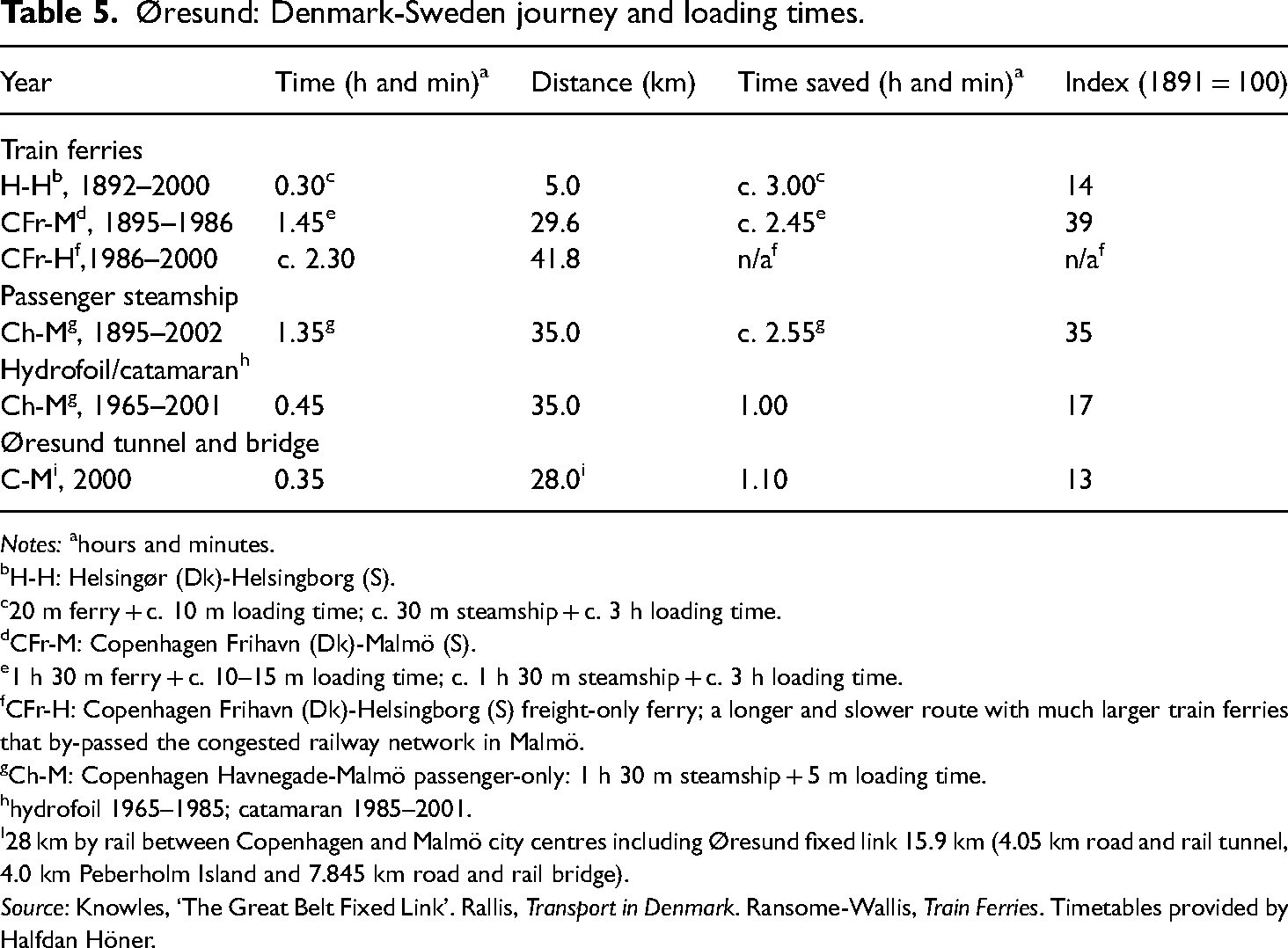
Before 1892, trans-Øresund freight transport by steamship took about 3 h 30 min between Helsingør in north-east Zealand and Helsingborg in Sweden, and about 4 h 30 min between Copenhagen and Malmö, including in both cases about 3 h loading and unloading time.
In the 1890s, two trans-Øresund train ferry routes shrank the effective distance substantially between the Copenhagen area of north-east Zealand in Denmark and the Malmö area of south-west Skåne (Scania) in Sweden (Figure 2). From 1892 the short 5 km Helsingør-Helsingborg train ferry route reduced freight transfer and journey time by around 86% from about 3 h 30 min by steamship to about 30 min (Table 5). From 1895 the Copenhagen Frihavn-Malmö train ferry reduced freight transfer and journey time by around 61% from about four hours 30 min to 1 h 45 min. However, passenger travel was much quicker between the two city centres in 1 h 35 min via the city centre Copenhagen Havnegade-Malmö steamship service.
Øresund: Denmark-Sweden journey and loading times.
Notes: ahours and minutes.
H-H: Helsingør (Dk)-Helsingborg (S).
20 m ferry + c. 10 m loading time; c. 30 m steamship + c. 3 h loading time.
CFr-M: Copenhagen Frihavn (Dk)-Malmö (S).
1 h 30 m ferry + c. 10–15 m loading time; c. 1 h 30 m steamship + c. 3 h loading time.
CFr-H: Copenhagen Frihavn (Dk)-Helsingborg (S) freight-only ferry; a longer and slower route with much larger train ferries that by-passed the congested railway network in Malmö.
Ch-M: Copenhagen Havnegade-Malmö passenger-only: 1 h 30 m steamship + 5 m loading time.
hydrofoil 1965–1985; catamaran 1985–2001.
28 km by rail between Copenhagen and Malmö city centres including Øresund fixed link 15.9 km (4.05 km road and rail tunnel, 4.0 km Peberholm Island and 7.845 km road and rail bridge).
Source: Knowles, ‘The Great Belt Fixed Link’. Rallis, Transport in Denmark. Ransome-Wallis, Train Ferries. Timetables provided by Halfdan Höner.
Between 1986 and the opening of the Øresund Fixed Link in 2000, a large freight-only train ferry service operated between Copenhagen and Helsingborg to provide more capacity and a less congested route between Denmark, Sweden and Norway. 36 From 1965, hydrofoils, and later catamarans, reduced the journey time for passengers between Copenhagen and Malmö city centres to 45 min, whilst the Øresund Fixed Link's train services cut this further to just 35 min in the year 2000 (Table 5). This fixed link also completed a system change facilitating trans-Øresund integration as well as removing a significant impediment to interoperability in the trans-European transport system. 37
Copenhagen to Hamburg
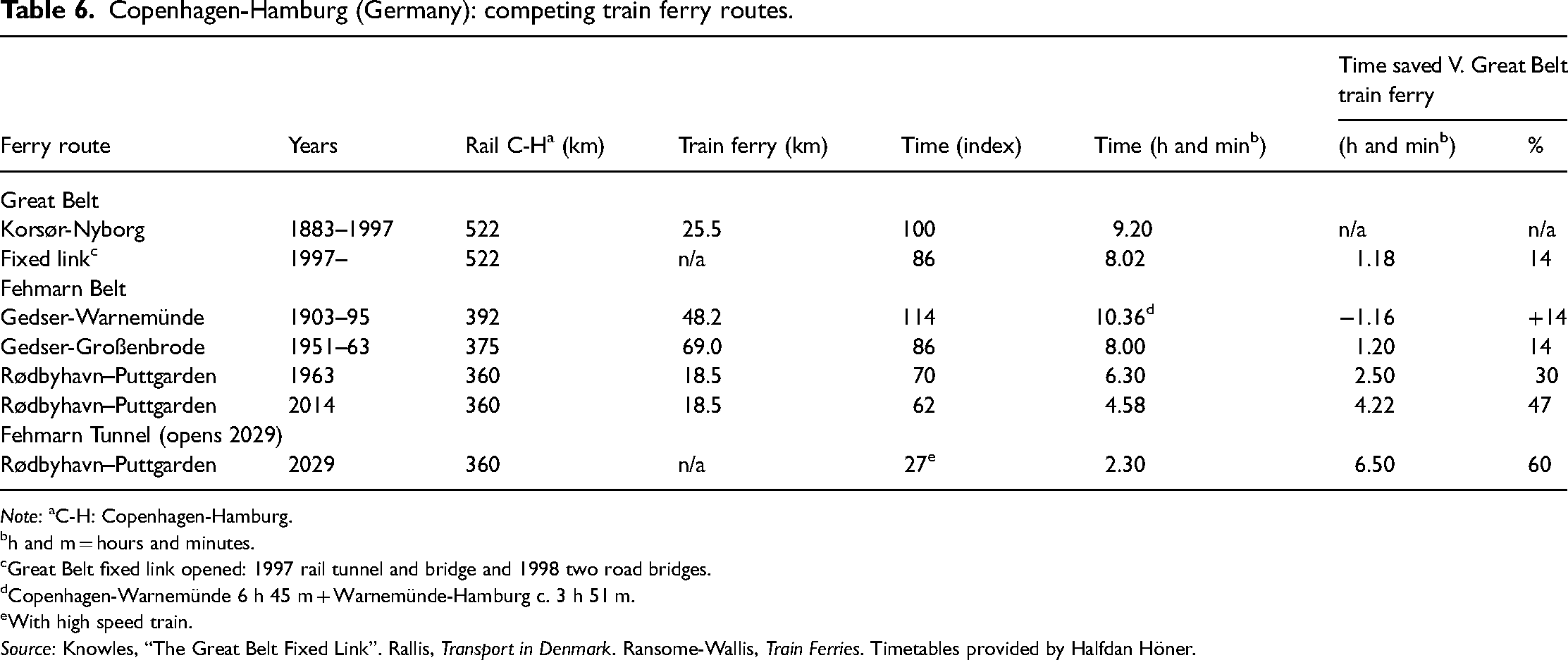
Through, direct train travel between Copenhagen and Hamburg in Germany started with the opening of the Great Belt train ferry in 1883 in 9 h 20 min (Figure 1 and Table 6).
Copenhagen-Hamburg (Germany): competing train ferry routes.
Note: aC-H: Copenhagen-Hamburg.
h and m = hours and minutes.
Great Belt fixed link opened: 1997 rail tunnel and bridge and 1998 two road bridges.
Copenhagen-Warnemünde 6 h 45 m + Warnemünde-Hamburg c. 3 h 51 m.
With high speed train.
Source: Knowles, “The Great Belt Fixed Link”. Rallis, Transport in Denmark. Ransome-Wallis, Train Ferries. Timetables provided by Halfdan Höner.
A slower steamship route had opened previously in 1856 for foot passengers between Korsør in western Zealand and Kiel with a travel time of 15 h, later reduced by 1890 to 11 h 44 min with train connections to/from Copenhagen and to/from Hamburg respectively. 38 From 1903 the route to Hamburg via the Great Belt train ferry faced competition from a 130 km shorter but slower route via the Gedser and Warnemünde train ferry. After World War 2, Warnemünde was in communist East Germany, so an alternative Baltic train ferry route was opened for the main German traffic to West Germany in 1953 from Gedser to Großenbrode Kai. This route to Hamburg was 1 h 20 min faster than the Great Belt route. From 1963 this was replaced by a shorter and faster train ferry route from Rødbyhavn to Puttgarden, marketed as the Vogelfluglinie (Fugleflugtslinjen – Bird-Flight line), that reduced the through train time between Copenhagen and Hamburg to 6 h 30 min. Faster train times reduced this further to less than 5 h by 2014. When the Fehmarn Belt Fixed Link road and rail tunnel, now under construction, opens in 2029, high speed trains are projected to reduce the Copenhagen to Hamburg journey times to 2 h 30 min, just 27% of the original 1883 journey time. This fixed link will remove the last significant impediment to interoperability in the trans-European transport system between Denmark and Germany. 39 Freight trains between Copenhagen and Germany were re-routed via Jutland after the Great Belt Fixed Link opened in 1997 but will revert to the much shorter Fehmarn Belt route after 2029 when its Fixed Link opens.
Spatial impacts of train ferries and fixed links
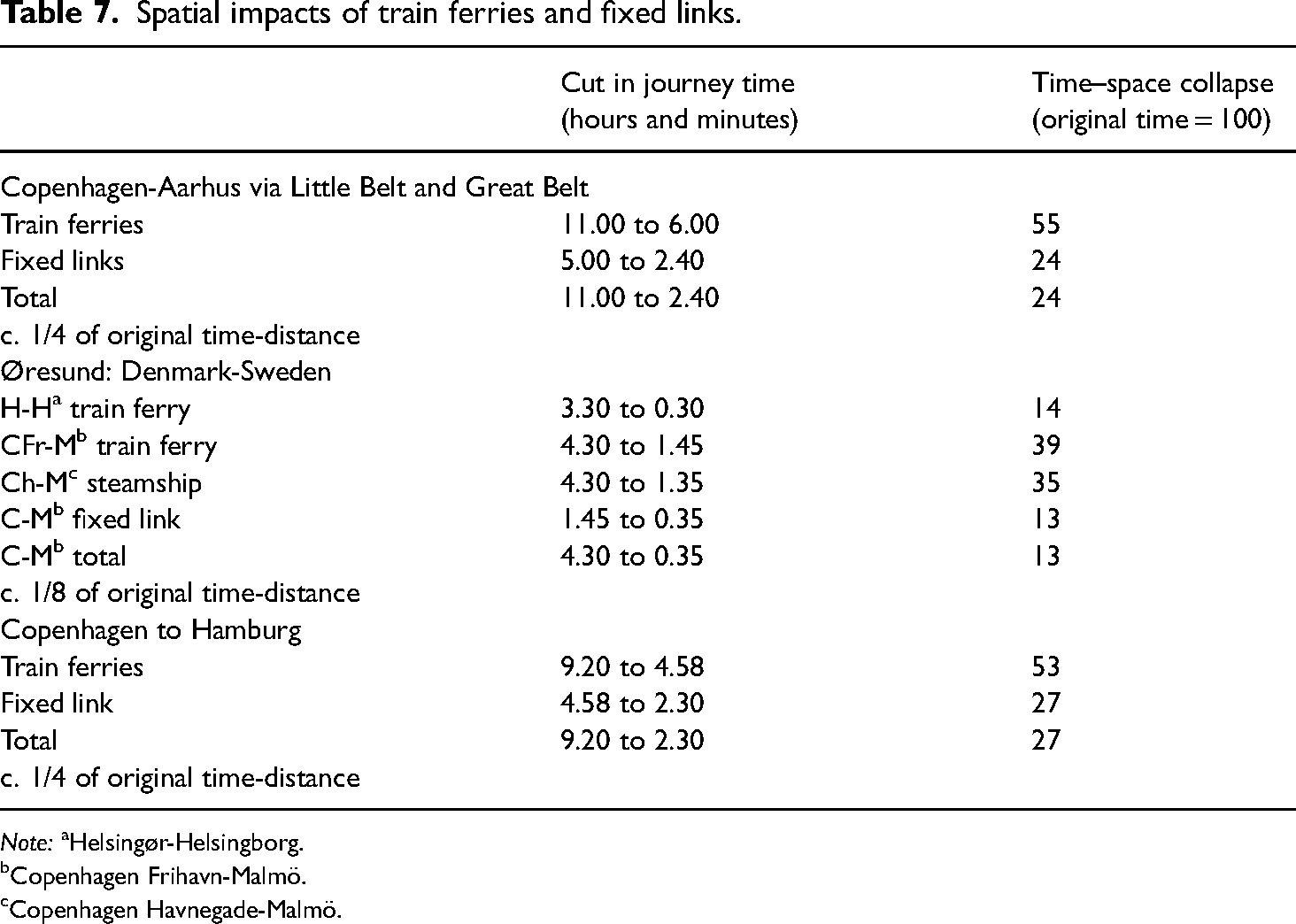
The innovation of roll-on roll-off train ferries in Denmark collapsed time–space dramatically as well as reducing trans-shipment costs. The time saving by train ferries was greater than by the later and much more widely recognised impacts of fixed links (Table 7). Although train ferry frequencies increased over time to cater for greater traffic demand resulting from national economic growth and integration, fixed links provided continuous, 24/7 availability, greater capacity and faster speeds, and generated more traffic. 40 Denmark rejected a Swedish proposal in 2022 for a second Øresund Fixed Link between Helsingborg and Helsingør, with separate road and rail tunnels, that would replace its vehicle ferry route. However, this additional fixed link will probably be built in the future as it would provide a shorter strategic road and rail route between Sweden and Denmark and mainland Europe and relieve congestion in the Malmö area.
Spatial impacts of train ferries and fixed links.
Note: aHelsingør-Helsingborg.
Copenhagen Frihavn-Malmö.
Copenhagen Havnegade-Malmö.
Train ferries en route between Denmark's two largest cities Copenhagen and Aarhus reduced journey time dramatically from 11 h to about 6 h, just 55% of the previous time by train and steamships. The Little Belt and Great Belt Fixed Links later reduced this journey time by a further 53% from 5 h to 2 h 40 min. These two innovations together collapsed time–space to just 24% of the original before the advent of train ferries and facilitated much closer economic and social integration between east and west Denmark.
Between Denmark and Sweden trans-Øresund train ferries reduced journey and loading time from about 3 h and 30 min to 30 min between Helsingør and Helsingborg, just 14% of the previous time by steamship, and from about 4 h 30 min to 1 h 45 min between Copenhagen Frihavn and Malmö, just 39% of the previous time by steamship. The Øresund Fixed Link in 2000 cut the journey time further between Copenhagen and Malmö to only 35 min. Together these innovations collapsed time-space to about one-eighth of the original time–distance and facilitated much closer economic and social cross-border integration between the Copenhagen area of eastern Denmark and the Malmö area of southwest Sweden. 41
Train ferries en route between the Danish capital Copenhagen and Hamburg in Germany reduced journey times by nearly a half from an original 9 h 20 min via the Great Belt and Little Belt to just under 5 h via the Fehmarn Belt. In 2029, when the Fehmarn Belt road and rail tunnel opens, journey time between Copenhagen and Hamburg should be cut by a further half to just 2 h 30 min with high-speed trains, just over one quarter of the original time distance. This should facilitate closer economic cross-border integration between Denmark and Germany, but at a lower level than in the Øresund area between Denmark and Sweden where the large cities of Copenhagen and Malmö are adjacent to the international border. 42
Following important technical innovations in train ferries and vehicle ferries, fixed link bridges and tunnels have transformed Denmark from an archipelago of 483 islands and the Jutland peninsula into a country where 99% of the population now live with direct access to a continuous inter-connected domestic land transport system, with international connections to Sweden and Germany (Table 2). Fewer than 59,000 people now live on 45 isolated islands, all with declining and mostly small populations. Of these, two-thirds live on the distant island of Bornholm situated in the Baltic Sea well to the east of the rest of Denmark.
Conclusion
This research is innovative in identifying the key role of Ro-Ro train ferries in creating national railway networks in countries with multiple large islands, shrinking space, and reducing insularity. It measures the time–space impacts of train ferries and fixed links in Denmark and confirms the key role of transport innovations in collapsing time–space and shaping spatial patterns of development, identified by Janelle, Knowles and Murayama. 43 This research also supports Johnson's view that connected islands join and grow whereas isolated islands tend to diminish. 44
Analysis of historic timetables and other data shows that the development of train ferries in Denmark had the largest effect in collapsing time–space, but they only operated intermittently, whereas fixed link bridges and tunnels have subsequently had a smaller effect in collapsing time–space but crucially provide continuous connections.
The broader implications of this research are that investment in ferries and/or fixed links within and between countries not only shrinks space but can also create a system change in the economic and social geographies of the areas benefitting from transformed connections.
Footnotes
Acknowledgements
I would like to thank Halfdan Höner, Danmarks Jernbanemuseum, Odense for supplying numerous historic train ferry and train timetables and much helpful information; Jamie Quinn, Cartographer at the University of Plymouth, UK for drawing Figures 1 and  ; three anonymous reviewers of the initial paper for providing helpful comments and additional sources; the late Christian Matthiessen, Professor of Geography at Copenhagen University, for encouraging and supporting my research into various aspects of Danish transport, and co-authoring some previous research.
Funding
The author received no financial support for the research, authorship, and/or publication of this article.