



Abstract
Before the introduction of television, the newsreel was a powerful medium in the cinema: moving images, accompanied by music, sound and commentary, shaped people’s views on national and international issues. East and West German newsreels reported separately on the economic boom, including the car industry and motor sport. In the 1950s, newsreels focused on small cars, the successful rise of the automotive industry, exports, and safety issues. This article shows how newsreels in the West reported on the car as a status symbol, especially from the 1960s onwards. In the East, the reports show the car as a necessary everyday vehicle, although not easily accessible to most people in the socialist economic system – a fact not addressed in the newsreels. Environmental pollution caused by car traffic was not an issue in the newsreels, neither in the East nor in the West, unlike the increasing number of accidents.
Introduction
Media plays a major role in shaping the historical perceptions that people hold. Films, with their combination of moving images, sounds, music, and voice, are particularly effective, often leaving a strong emotional impact. The producers of newsreels credited them with significant influence. Heinz Wiers, editor-in-chief and managing director of the Neue Deutsche Wochenschau (New German Weekly Newsreel, hereafter NDW), described his newsreel in a 1954 article as ‘[…] more lively, dramatic and vivid than any other description” and “more effective than the experience of an eyewitness’. 1 Unlike television, which can broadcast live events, cinema newsreels were fully edited films shown in cinemas. Newsreels could not have had a specific target audience because they were shown in the pre-programme of every cinema show. They were distributed by film distributors together with the latest feature film. Which film was shown with which newsreel varied from cinema to cinema, as newsreel editions were passed between cinemas after a week's showing. Moreover, not all cinemas showed the same films.
The car, often referred to as Germans’ favourite child, and epitomised by the Volkswagen Beetle (VW-Käfer), became a symbol of the robust West German car industry during the economic miracle (between 1950 and 1965 2 ). This period witnessed a significant surge in mobility, with trips to Italy becoming a cultural touchstone, still featured in documentaries about the 1950s. This raises pertinent questions: Where does the image of the car as a symbol of the German ‘economic miracle’ originate, and what role did newsreels play in cultivating this perception? This study aims to analyse previously unexplored newsreel material on car drivers and driving to answer several key questions: How was the car portrayed in East and West Germany, and what were the differences? Was the car presented as a status symbol, a commodity or – as early as the 1950s and 1960s – an environmental burden? How were drivers – male and female – characterised: as experts, connoisseurs, responsible or reckless? And finally, what predictions were made about the future of motoring that are still relevant today? As this article shows, newsreels of the 1950s and 1960s were instrumental in shaping public perceptions of the car market, car culture and the social role of the car. They emphasised the affordability, safety and growing status of sports cars, highlighted motor shows, German–German car competition and technological advances, while addressing concerns about road safety, stress and noise. However, the environmental impact of emitting cars was largely overlooked.
A hermeneutic media-scientific approach is applied to study the newsreel editions. Thereby, the film material with its aesthetic design and the way it is presented is taken as a starting point and only then is the meaning examined. 3 Contextual material such as production documents can shed light on the intentions of the producers and the editorial processes. The newsreel is seen as a historical source whose content and design must be read in the light of the circumstances of its production and its meaning for society at the time (as the only audiovisual news medium available). To this end, New Film History offers an interdisciplinary approach to the study of film history, integrating social, economic, technological, aesthetic and audience-related perspectives to facilitate a comprehensive understanding of the development of the medium (including newsreels). 4 Newsreel footage is still used in films and television documentaries today, shaping the memories of generations – the same images are often shown repeatedly, considering the clarification of usage rights and the brevity of the production schedule, reinforcing clichés – although the 51 or 52 editions produced each year mean that there was substantial material never used in documentaries that is genuinely original. Due to the wealth of material contained in the weekly editions, it is only possible to present a few highlights, which speak to the questions raised above. In the following chapter, the characteristics of the newsreels in East and West Germany are examined in more detail to provide a basis for the subsequent analysis.
Newsreels’ design and structure
Post-war newsreels, 5 flourishing during the economic recovery in Germany, were crucial in shaping public perception. They aimed to inform and entertain German viewers and to present Germany as a reliable partner to other countries. But of course, due to their alignment with the two political power blocs, West and East Germany were presented separately in West and East German newsreels. 6 The newsreels were part of a worldwide exchange, meaning that German material was used in foreign newsreels and vice versa. There was also an exchange of footage between newsreel companies in West and East Germany.
By 1950, almost 4,000 cinemas were open for business in West and East Germany, and 487 million visits to the cinema were registered. Due to the lack of alternative leisure activities and limitations of mobility, the ‘cinema around the corner’ became an integral part of families’ weekly routine. 7 Later, the advent of television and the development of a wider range of leisure activities led to a decrease in the number of moviegoers to 443 million in 1962. 8
Both in West and East Germany, films with informative and educational content were shown as a programme before the main feature film started: the so called ‘Kulturfilm’ (literally ‘culture film’, a short documentary film) and an edition of a newsreel. The newsreel was not only presented in the evenings, but also in the afternoon, in the programme with children's and teenager's films. Each newsreel was about 300 metres long (10–11 minutes viewing time) and contained about 8 to 15 short reports covering a mixture of politics, business (including fairs and exhibitions), world events, disasters, fashion, animal stories, cityscapes and sport. In most cases, the films were accompanied by music and sound, and the off-screen commentary could give the report a certain mood, which could not only be factual but also ironic. Due to the political, ideological and economic differences between the two German states, West and East German newsreels often presented controversial information in strikingly different ways. The exchange of footage between West and East German newsreels was used to convey Cold War messages. For these reasons, newsreels cannot be considered an objective medium. Wiers reminds that ‘The claim to be objective will always remain a claim’. 9 Because they were delivered to cinemas on a weekly basis, newsreels were also not up to date (as we understand it today). Editions were structured and composed by the positioning of the reports, and the transitions (through music, images and text) between them created associations fostering viewer interpretation and encouraging personal conclusions.
After the Second World War, occupation newsreels – especially the British–American co-production Welt im Film (World in Film) – were regarded by the Germans as instruments of re-education. The new German government wanted to re-establish a newsreel produced entirely under German responsibility without foreign influence. The Neue Deutsche Wochenschau GmbH (New German Weekly Newsreel Ltd.) was founded in Hamburg by the end of 1949 (after the two German states emerged), promoted by the Federal Press Office, which supported the costly production of the NDW with federal funds. Although those responsible for production denied any political influence, they themselves admitted that the NDW was a ‘semi-official organ’ (‘halbamtliches Organ’). 10 The first edition of the NDW was shown in cinemas in early February 1950. In 1963, NDW was renamed Die Zeitlupe (Slow Motion) to appear more modern, but production ceased as early as 1969. Other newsreels in West Germany continued to exist until the late 1970s (the Ufa-Dabei [Ufa Presents] and Fox tönende Wochenschau [Fox Sound Newsreel]). Welt im Film became Welt im Bild (World in Pictures) in 1952 and Welt im Bild became Ufa-Wochenschau (Ufa Newsreel) in 1956 and was produced in Hamburg as a second newsreel (renamed Ufa-Dabei in 1968). There was also the French-influenced Blick in die Welt (View of the World), published primarily in the former French occupation zone, and the American private production Fox tönende Wochenschau. The newsreels in the West competed with one another.
While there were several newsreels in the Western zones, only Der Augenzeuge (The Eyewitness) was shown in the Soviet occupation zone and later in the German Democratic Republic (hereafter GDR) and was therefore unrivalled. Der Augenzeuge was produced by the state production company DEFA. It was the mouthpiece of the ruling communist party in East Germany, the Sozialistische Einheitspartei Deutschlands (Socialist Unity Party of Germany, hereafter SED). At the beginning of the 1950s, with the rise of the Eastern Bloc, film and newsreels became heavily politicised. 11
Der Augenzeuge became the guardian (‘Vormund’) of the viewer, 12 advertised as an educator of the people (‘“Volkserzieher’). 13 Each issue was approved by a committee of party representatives and Soviet advisers. 14 Its speciality (‘Spezialität’), according to Günter Jordan, was well-designed political reports – that not only presented facts, but above all promoted the connection between politics and everyday life. 15 While the NDW had to ensure that viewers were not overwhelmed with political content (reports or features), the narrative of Der Augenzeuge emphasised the notion of progress in the construction of socialism and of the socialist community.
Ultimately, the design and structure of newsreels in East and West Germany reflected their role in shaping societal views and political narratives during the post-war era. With an understanding of the design and structure of newsreels, we can now delve into their content, particularly how they portrayed the burgeoning car market in post-war Germany and the cultural significance of automobiles in both East and West German societies.
The car market in east and west German newsreels
The German newsreels initially aimed to reconnect the domestic car market with the global market after the Second World War. For example, the British–American newsreel Welt im Film announced on 14 March 1950: ‘Automobile exhibitions are international again’ (‘Automobilausstellungen wieder international!’). In this report, in the background of the section on American cars, signs reading ‘Used cars of all classes’ are visible, indicating that American cars, although not the latest models, were considered desirable by the West German public. The newsreel also highlighted smaller cars that could be bought by the average consumer with the new Deutsche Mark (hereafter DM). 16 Interestingly, it was not the VW Käfer that was shown, but a VW racing model, drawing a contrast between the affordable small cars for everyday use and West Germany's ambitions in modern sports car racing. NDW No. 9 of 28 March 1950, for example, reported on Ferdinand Porsche's return to Germany and presented him as the ingenious inventor of the Volkswagen 17 and his plans to build a fast-touring car with a top speed of 140 km/h. Over the years, the Porsche name has become synonymous with luxury sports cars and motor racing.
East and West German newsreels reveal ideological and political differences in their portrayal of the car market and motoring culture. West German productions often referred the United States and Western Europe, as is visible in numerous reports on car exhibitions in Frankfurt am Main and Geneva. In contrast, East German newsreels focused on socialist countries and competition with the West, reflecting their political alignment. West German newsreels largely ignored the GDR and Eastern Europe, despite historical evidence of significant trade relations, such as VW's customer services in several Eastern Bloc countries, including Yugoslavia, Poland, Bulgaria and Romania in 1966.
The international expansion of West German car manufacturers during the 1960s highlights the global significance of the car industry. Major manufacturers like Daimler-Benz and VW rapidly expanded, particularly in South America. VW, for instance, established a presence in Brazil in 1959, with 180 active dealers. 18 By 1953, VW had expanded its export business to Australia, South Africa, Indonesia and the United Kingdom, with exports to the United States increasing as well. In the United States, VW advertised the car as an ideal second vehicle, ‘cheap, robust, easy to park, and easy to drive in heavy traffic’. 19 The international significance of VW was prominently displayed in a newsreel celebrating the 1,000,000th VW Beetle, where General Director Nordhoff hosted a party at the Wolfsburg sports stadium, featuring dance groups from all VW export countries (NDW no. 289, 12 August 1955).
The growing cultural and social importance of the car in both West and East Germany and its visibility and importance in newsreels discussed throughout this article aligns with what we know about the car market's expansion in this period. In the Federal Republic of Germany (hereafter FRG), car production reached the pre-war level (1938) as early as 1951, with an output of around 380,000 vehicles. From that year on, car industry boomed. In 1956, the number of vehicles produced in the FRG surpassed one million units. Over the 5 years that followed, this figure more than doubled and by 1966, 3 million vehicles had been produced. The number of new registrations of private vehicles rose just as sharply, doubling between 1956 and 1961, with 1.5 million cars registered in 1965 alone (for comparison, total population was around 59 million). 20 Production figures in the GDR were naturally lower due to its smaller population, but here, too, vehicle production surged by the mid-1950s. Between 1950 and 1951, production doubled to around 16,000 vehicles, and by 1955 this figure doubled again, reaching a quarter of a million by 1966. By 1960, approximately 300,000 cars were registered, a figure that more than doubled by 1965, reaching over 660,000 (total population was around 17 million). 21 The automotive industry in the GDR was also keen to develop international relations – especially with socialist states. This was shown, for example, in the report on the Leipzig-spring fair 1959, focusing on the new Skoda 440 Octavia-Cabriolet from the Czech Socialist Republic (Der Augenzeuge no. B22, 1959). The West and East German newsreels show that the car manufacturers saw themselves as part of the international market and presented their products on an equal footing. Foreign markets were not portrayed as explicit competitors. With their coverage of motor shows and fairs, newsreels undoubtedly served as an advertising platform for the car industry. Some reports in both East and West German newsreels functioned as de facto filmed sales brochures, showcasing new models and technical advancements.
Reports like filmed sales brochures
Research on 1950s motor show reports reveals a focus on small and micro cars, likely appealing to consumers with limited budgets. In 1953, however, the new Mercedes 180 was introduced. The report begins with a close-up of the Mercedes star on the reflective paint. The narrator emphasises the Mercedes’ exceptional class: ‘Its new face and interior design maintains the lines of the traditional form. It combines the advantages of a touring car with the speed of a sports car’. The camera shows the interior of the car, and the next shot shows bystanders inspecting the open boot and engine compartment. Among them are Herrmann Lang and Karl Kling – active racing drivers for Mercedes-Benz. In close-up shots, they are presented as ‘testimonials’, their heads nodding in agreement (NDW No. 189, 9 September 1953).
A report on the Wartburg model from Der Augenzeuge, an East German newsreel, offers insights into GDR realities. The Wartburg was one of the most popular mid-range models in the GDR and – as Der Augenzeuge shows – was sold not only in the GDR but also in West Germany (in 1958). Securing western attention was of paramount importance. Der Augenzeuge (No. B80, 1958) depicts a showroom in Duisburg, where a couple appears to be receiving advice regarding the purchase of a car.
The Horch P 240 “Sachsenring”, on the other hand, was clearly designed to meet higher standards. The advantages are listed and illustrated in detail in the report on the Leipzig consumer fair (Der Augenzeuge No. 10, March 1956). However, production of the car did not begin until 1957 and was then only party staff and authorities with very special vouchers could acquire one. The car was intended for export, but it suffered from numerous defects, never reaching the level of the Mercedes, as Walter Ulbricht, the General Secretary of the SED, 22 desired.
In summary, the portrayal of the car market in German newsreels illustrates the ideological divide between East and West Germany. This reflects the broader socio-political context of the time, supporting the idea that newsreels shaped public perceptions of cars in post-war Germany. Having explored how newsreels depicted the car market and its political underpinnings, we now turn to their treatment of road safety. The following part examines the distinct approaches taken by East and West German newsreels to educate the public about traffic safety and the broader implications for societal perceptions of driving.
Safety concerns
Throughout the 1950s and 1960s, both West German newsreels and Der Augenzeuge emphasised road safety, employing different approaches to educate the public. From 1956 to 1958 and again in 1960, West German newsreels featured sketch-like accident prevention scenes with Walther Gross and Jupp Hussels (German actors and cabaret artists). The entities who provided funding for the production of those newsreels were federal institutes: Hauptverband der gewerblichen Berufsgenossenschaften (Federation of Institutions for Statutory Accident Insurance and Prevention, hereafter HVBG) and the Bundesministerium für Verkehr (German Federal Ministry of Transport). 23 Those scenes showcased traffic rules and signs through humorous skits, with Schussel (Walther Gross) playing the role of a clueless driver, consistently flouting traffic rules, and Clever (Jupp Hussels) preventing mishaps and explaining the whys and wherefores of safe driving. These tongue-in-cheek scenes educated drivers about the importance of mindfulness and consideration on the road.
The problem of drunk driving was addressed in the early 1950s in a humorous way (NDW No. 50, 9 January 1951). The narrative unfolds as the camera observes a man entering his car with a bottle of schnapps in his coat pocket. The camera lurches forward, jolting and weaving, mirroring the disorienting experience of drunk driving, immersing the viewer in their impaired perception of the road. In this clearly staged scene, the car is pulled over, and the driver is instructed to provide a breath sample into a balloon for a breathalyser test using a new device from the United States (Figure 1). The commentator's voiceover narrates: ‘Never before had a living creature inflated a balloon so sadly’, while humorously explaining the outcome: ‘Once upon a time, there was a driving licence…’ This newsreel also referenced the adoption American developments and standards on West German roads.
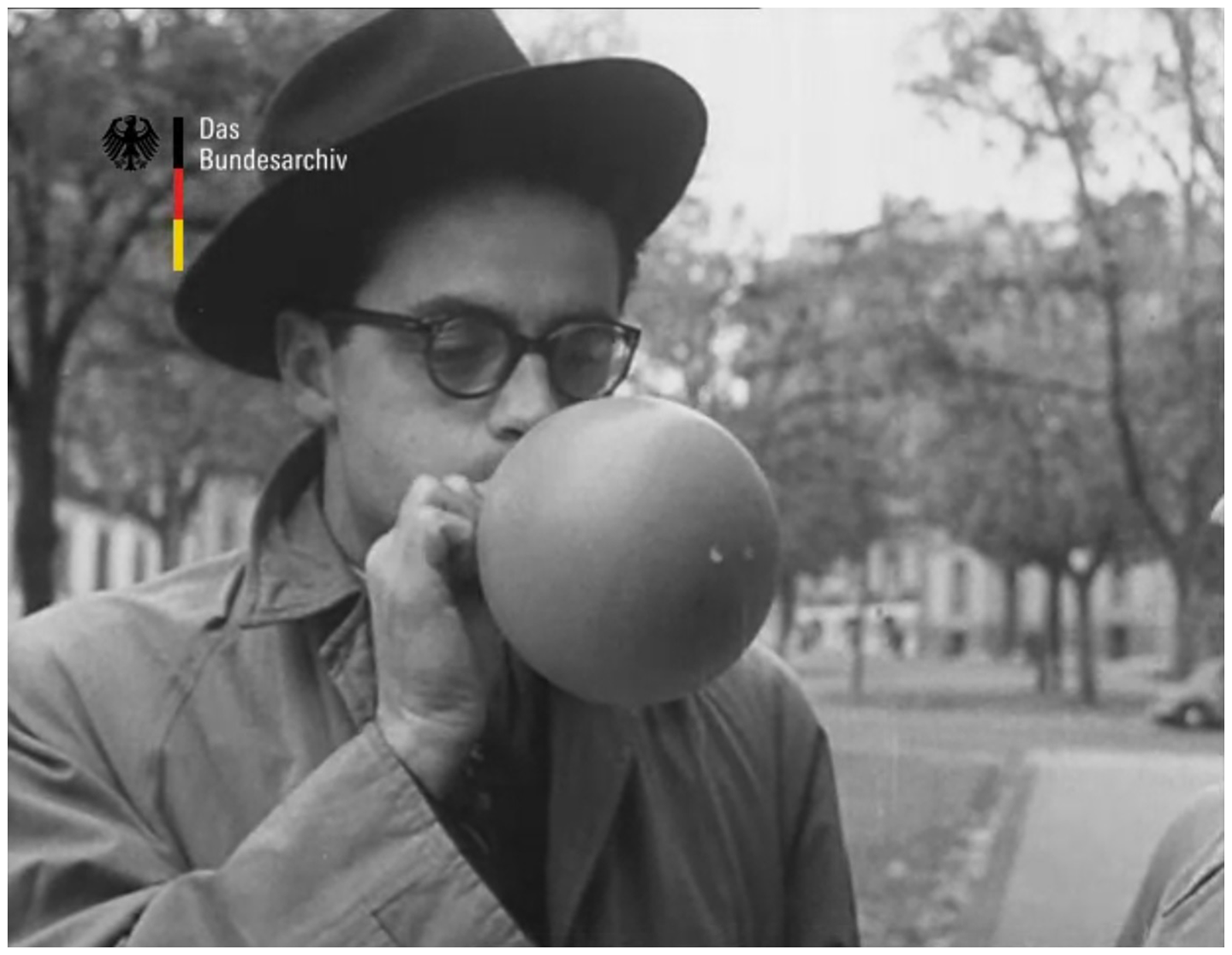
‘Alkoholmesser’, NDW No. 50, 1951.
An earlier report in this issue featured the unveiling of the new Ford Taunus de Luxe, with the North Rhine-Westphalian Transport Minister driving the first car off the production line. The numerous motor shows and exhibitions, such as those in Frankfurt am Main and Geneva, were not only centres of attraction for the presentation of new models, but also significant platforms for the introduction of safety innovations. By the end of the 1950s, the use of seat belts and adequate padding in the interior, for example, on the steering wheel and dashboard, are publicised in a report on the ‘Internationaler Automobilsalon’ [International Motor Show] in Frankfurt am Main. The voiceover comments: ‘The commitment to passenger safety is remarkable. It should be self-evident, but unfortunately it is not always the case. Seatbelts seem to be gradually becoming the norm. In fact, they have already saved many lives’. 24
The East German newsreel Der Augenzeuge also focused on safety. In issue number 27 (July 1954) of Der Augenzeuge, the newsreel reported on the ‘Tag der Volkspolizei’ (‘Day of the People's Police’) and its contributions to road traffic safety. What is interesting here is the subtle critique at West Germany. As the voiceover narrates, the traffic offender confuses the Stalinallee (Stalin Avenue) with the Nürburgring (a racetrack in Rhineland-Palatinate, near Koblenz). One might wonder: Why not the Sachsenring (a racetrack in Sachsen, near Chemnitz) or other racetracks within the GDR? In December 1963, Der Augenzeuge again highlighted the services of the Volkspolizei, this time focusing on their assistance with vehicle headlight adjustments. One phrase in the commentary is subtly altered by a brief pause, strategically placed to emphasise the word setting (‘Einstellung’). It is noted that this time the driver's political or work attitude (with the word for setting and attitude being the same in German) is not assessed. This may be a subtle criticism (‘Zwischen den Zeilen’, ‘between the lines’) of the socio-political surveillance in East Germany. In the early 1960s, the use of seat belts was also endorsed in East German newsreels. A crash test is shown in Der Augenzeuge No. 18 (1961). The commentator insists that that is not a staged performance, but rather a reflection of reality. He adds, almost in passing, that the footage was apparently produced in West Germany. This is also suggested by the car model and the commentator's reference to the driver being ‘rescued’ in Frankfurt am Main. One can only speculate as to the purpose behind the inclusion of the scene in Der Augenzeuge. It is possible that filming such scenes was beyond their resources, or perhaps the aim was to subtly suggest that driving in the West was perceived as faster and more perilous, like the previous mention of the West German racetrack in Der Augenzeuge No. 27.
In summary, both West and East German newsreels played a role in promoting road safety, though their approaches and underlying messages differed. West German newsreels used humour and American innovations to advocate for traffic safety, while East German newsreels emphasised the state's role in public safety. These newsreel segments not only educated the public but also reflected broader political and cultural contexts. Having examined how newsreels addressed immediate safety concerns, we now turn to the broader societal implications of increasing car ownership and traffic. The following chapter explores how newsreels depicted the cultural meaning of cars and the challenges they posed to drivers in the rapidly evolving landscapes of East and West Germany, highlighting particularities based on West and East German newsreels.
Dangers and downsides in the West
By the end of the 1950s and the beginning of the 1960s, newsreels increasingly highlighted the consequences of rising traffic and the proliferation of cars, emphasising the cultural importance of the automobile. The need for good driver training was evident, with professional racing drivers such as Richard von Frankenberg, Graf Berghe von Trips, and Hans Stuck sharing their expertise. For instance, in 1959, the sports section of the Ufa-Wochenschau newsreel showcased drivers, including women, training on a track at the Nürburgring, demonstrating the seriousness and equality of their efforts (Ufa-Wochenschau No. 143, 21 April 1959). The immersive experience was further enhanced by the cameraman driving along, providing spectators with an in-car, windscreen-mounted camera view of the fast-paced obstacle course.
‘Prosperity on the Move’ (‘Wohlstand auf Achse’) is the title of a section 25 in the December 1961 edition of the NDW. The first short report was on the five millionth VW Beetle, followed by a report on the Hamburg Autodrom. Finally, it showcased the latest luxury models at the Düsseldorf Motor Show. At the Hamburg Autodrom, the learning drivers were remote-controlled, so to speak (Figure 2). The original sound from the command centre creates a particularly authentic impression. Again, women are seen behind the wheel.
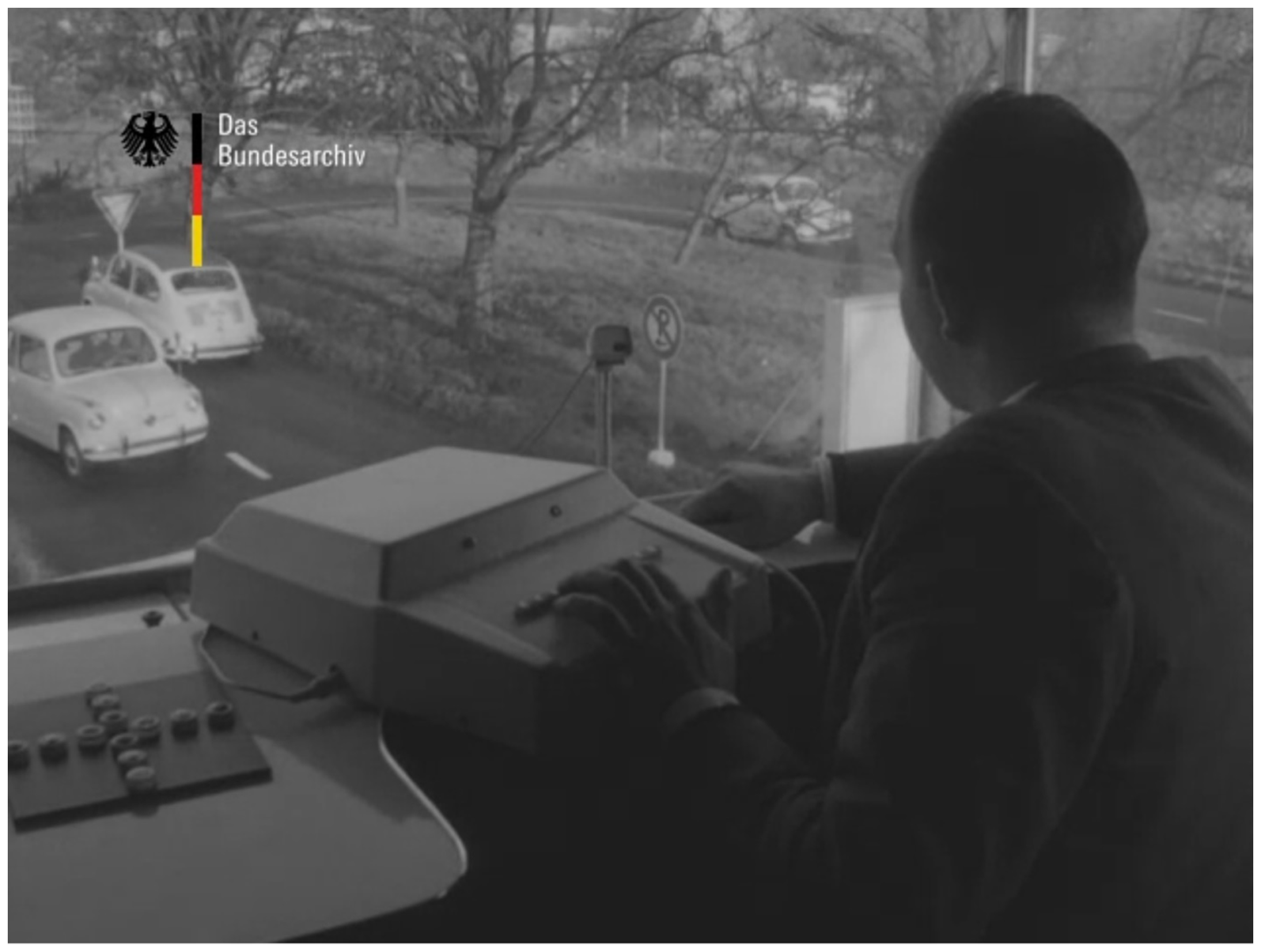
At the Hamburg Autodrom, learner drivers on observation.
Newsreels from the 1960s depict the automobile involved in discourses of affluence, luxury and speed, while subtly highlighting the accompanying increase in stress and traffic. In NDW No. 619, 8 December 1961, the transitions between the reports are particularly striking and become part of the narrative of the entire edition. Starting with the report on the increase in car production to the driving lessons at the Autodrom, it is said that drivers were facing new challenges on the overcrowded roads. As a transition, it is suggested that those seeking their first car after obtaining their driver's licence would find it at the Düsseldorf Motor Show. In this report, the cliché of the car as a status symbol is underscored in a twofold manner: luxury brand cars are showcased with chrome parts gold-plated using a new device. The camera angles are also interesting, with glimpses of people's reflections in the shiny wheel trims. The narrator adds: ‘Our prosperity always offers new perspectives’ (‘Unser Wohlstand bietet immer neue Perspektiven’) as a parenthetical comment to the beginning of the section ‘Wohlstand auf Achse’. This statement has a double meaning: it refers both to the perspectives offered by prosperity and to the camera's frog's-eye view of VW Beetles on a production line. However, it is also stressed that automobile prosperity has its downsides. The Ufa-Wochenschau No. 127, 2 January 1959, addressed the ‘manager's disease’, linking the stress of hectic traffic to health issues. As the report was filmed in France (evident from the Arc de Triomphe in the street scene), it implied a common Western European experience without offering solutions.
In summary, West German newsreels played a role in documenting the societal impacts of increasing car ownership, highlighting the importance of driver training, the cultural meaning of cars and the associated challenges of traffic and stress. In contrast, the East German newsreel Der Augenzeuge, while not directly addressing health effects, noted the importance of motor sport, as illustrated below.
Cars, sports and ideology in the East
The connection between cars and ideology in the East German newsreel Der Augenzeuge is evident in its strategic use of motorsport to foster national pride. Although sport, including motorsport, has always been seen as a unifying force, the competition between West and East German drivers is clearly visible in the newsreels. At first, the commentary in the October 1951 edition emphasises the participants’ desire for unity and peace. Later, however, the Sachsenring became a highly politicised arena, openly reflecting a battle between West and East – with the GDR driver emerging victorious. It was important to underscore that in the socialist system, government support for motorsport was crucial, as evidenced by the mention of the Johannisthal State Racing Collective. The spectators, especially the sports fans in the audience, were undoubtedly familiar with the racing collective, which was explicitly mentioned. One man who became a motorsport hero was Paul Greifzu. The reporting team of Der Augenzeuge visited him in his home in February or March 1952. The commentary clearly highlighted his commitment to technical development. 26 In the same vein, Der Augenzeuge clearly demonstrates that knowledge and experience gained in motorsport are being applied to benefit the car industry and ordinary motorists.
In addition to sports, the newsreel incorporated political commentary through other segments. The reportage and walk through Berlin with the actor Edwin Marian include a subtle political tone (Der Augenzeuge No. 1, 1964). The actor is speaking directly to the camera, engaging cinema viewers. Interestingly, the stroll through the streets reveals some underlying criticism of various grievances – such as the decline of craftsmanship and food waste – which could also be found in other large cities, even in the United States, as the actor notes. Indirect criticism also targeted the socialist slogans that were displayed on the side of the road, for example, ‘Remember this sentence more often: Prosperity is generated at work!’ (‘Denke öfter mal an diesen Satz: Der Wohlstand wächst am Arbeitsplatz!’), intended to motivate people to work more. While driving, Marian reads the lines: ‘Die Republik braucht alle’ (‘The Republic needs all of you’) (Figure 3(a) and (b)). Then, a crashing sound is heard, and the screen goes black. This suggests that those who want to read the slogans are not paying attention to the road, causing accidents (Der Augenzeuge No. 1, 1964).
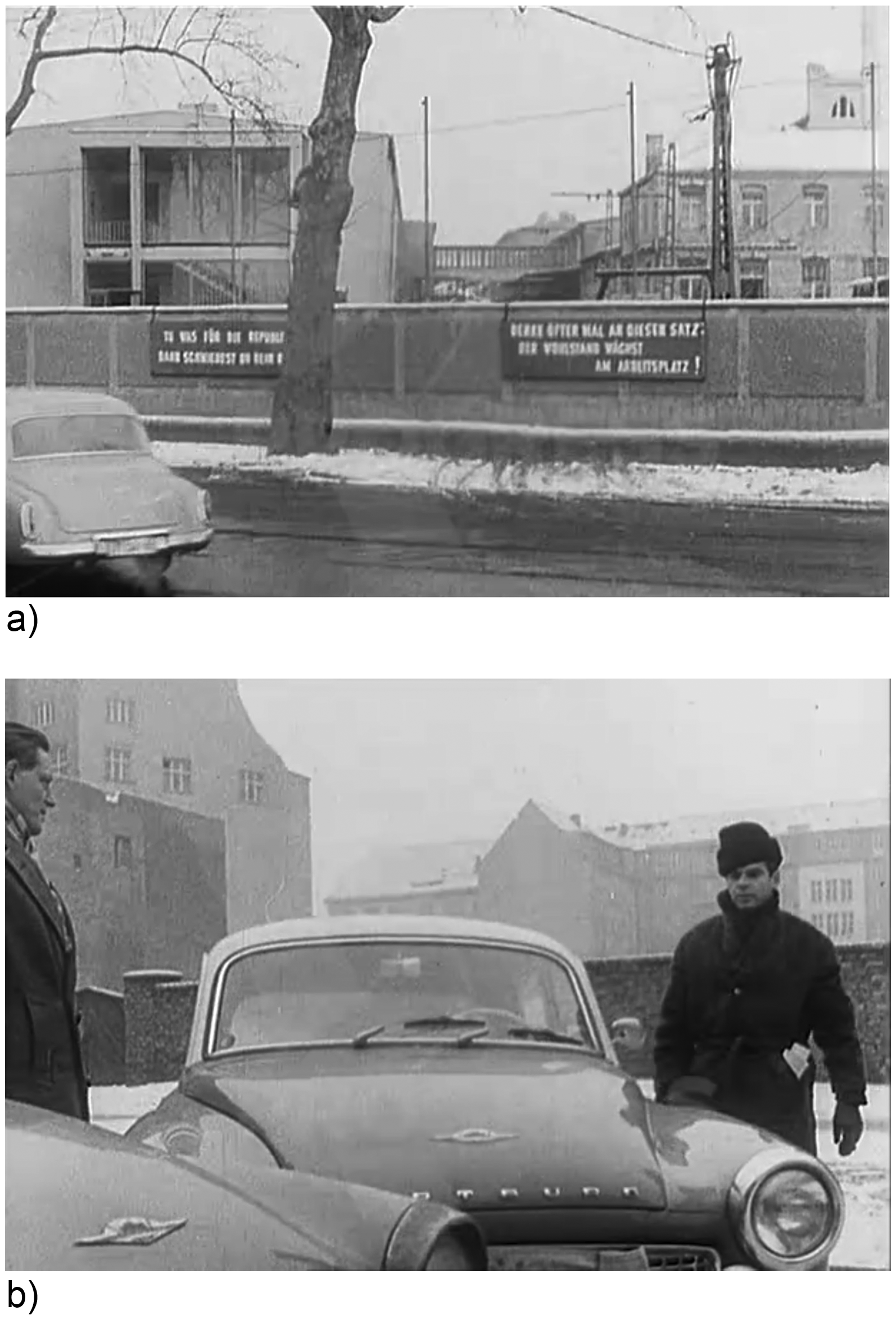
(a) and (b) Reading socialist slogans by the roadside and the consequences.
The fact that such an obvious criticism was possible can probably be explained by a generational change in the editorial staff of the newsreel in 1959. As Günter Jordan notes, the editors did not want to convey agitational ideas, but the new generation wanted to encourage viewers to confront reality. 27
Overall, Der Augenzeuge effectively used motorsport and car-related content to reinforce the role of the car in promoting socialist ideals, while subtly addressing societal challenges.
Similarities and differences in reporting
As we have seen, while the underlying issues are similar in both East and West, the most significant differences are often reflected in verbal expressions. Similarities can be seen in the reports on the treatment of pedestrians and the dangers of accidents caused by carelessness in heavy traffic, which developed from the early 1950s. Der Augenzeuge also features contributions to road safety education, using sketches from the production group Das Stacheltier (The Porcupine), who made agitational shorts but blamed pedestrians rather than drivers for misconduct (Der Augenzeuge No. A99, 1959). Apparently, the newsreel producers believed that rules of behaviour were most effectively transmitted when presented in an entertaining format. Newsreels frequently employed fast motion and crossfading, particularly when depicting the driver's point of view in extreme situations. The viewer's attention is drawn to details of the cars’ interior that one would expect to be of particular interest: the dashboard, the steering wheel and the boot. In some cases, the footage was not shot by the newsreel team but adapted from elsewhere to suit the circumstances. The car reports are usually accompanied by jazz or dance music (sophisticated and modern), especially in the 1960s. While not lead stories, the reports are always thematically linked, such as showcasing car shows alongside road safety themes or transitioning seamlessly to the sports section. In some cases, they are also integrated into the sports section, which is separated by a section title. The car and its use are also integrated into seasonal holiday stories or reports on new transport routes – not to mention the ubiquitous presence of heavy traffic in the background, especially in West German newsreels.
In terms of differences, East German newsreels are particularly noteworthy for their commentary emphasising the performance and competitiveness of GDR cars and highlighting their appeal to West German audiences. The promotion of the car industry by the GDR government is also underscored. As mentioned above, the East German newsreels are rife with political allusions, conveying different messages of anti-Western propaganda or as subtle criticism of the state's own shortcomings. In West German newsreels, often employed humour, including witty phrases and clever associations, to entertain viewers and create a lighter tone, even when covering serious topics that Der Augenzeuge treated with a more sombre approach. For example, the report on the Frankfurt Motor Show in Ufa-Wochenschau No. 478 (21 September 1965), featuring interviews with visitors, was intended as a humorous wink. The interviewees revealed their own preferences. They preferred fast, low-maintenance cars, some even admitting owning several. The last woman interviewed stated that her car had to match the colour of her hair. In this case, the newsreel perpetuated stereotyped about women drivers.
East and West German newsreels depicted cars in ways that mirrored their respective political and economic environments: in the West, cars were often shown as status symbols and indicators of economic prosperity, while in the East, they were portrayed as functional necessities within a socialist framework. This dichotomy highlights the newsreels’ influence on public perceptions and their role in reinforcing ideological narratives. Having explored the similarities and differences in how East and West German newsreels reported on and designed their coverage of cars, it is now time to summarise the key findings and insights from this comprehensive analysis.
Summary and outlook
The newsreel as a medium, which was still very important and widely distributed in the 1950s and 1960s, played a role in shaping perceptions of the car market, driving and the role of cars in society.
Post-war newsreel coverage of the car market and motoring begins with reports on motor shows, featuring small cars designed to be affordable for everyone. The newsreels initially deniy the car's significance as a status symbol. Rather, the big and beautiful cars represent the ultimate dream at motor shows. It is in the 1960s that the car, especially the sports car, truly solidifies its position as a status symbol. Motorsport was a major attraction and a source of national pride, regardless of the driver's nationality. As early as the 1950s, concerns were already emerging about the need to educate the public on road safety. Newsreels began to address growing anxieties, such as the increasing congestion on roads and the dangers of drunk driving, which were condemned more forcefully. Attention was also paid to the health effects of stress and noise associated with driving. The newsreels did not explicitly differentiate between the driving abilities of male and female drivers. Neither gender was portrayed as inherently superior or inferior in their driving skills. A notable omission from these newsreels is a serious consideration of the environmental impacts of car emissions.
How did newsreels envision the future of motoring? This is a crucial question, given the rapid technological advancements occurring globally during this period. Ufa-Wochenschau (No. 86, 19 March 1958) had already ventured into forecasting the future of motoring, by showcasing not only microcars and luxury limousines at the Geneva Motor Show, but also the innovative turbine car. Die Zeitlupe (No. 830, 21 December 1965), published more than 7 years later, serves as both a review of the preceding year and a forecast for 1985. Additionally, the footage showcased multi-storey motorways and self-driving cars, seemingly filmed in the United States.
In conclusion, the portrayal of cars and drivers in East and West German newsreels provides a fascinating lens to observe the cultural, economic and ideological divides of the Cold War era. By shaping public perceptions and reinforcing societal norms, these newsreels played a significant role in the narrative of motoring culture in post-war Germany.
Footnotes
Declaration of conflicting interests
The author declared no potential conflicts of interest with respect to the research, authorship, and/or publication of this article.
Funding
The author received no financial support for the research, authorship, and/or publication of this article.
