




Abstract
This article claims that the Pakistani movie Dukhtar (Urdu/Persian: دختر; transl. Daughter) demonstrates gender dynamics tied to automobility in the Pakistani tribal cultural contexts. To this end, I elaborate on the iron will of the female protagonist Allah Rakhi as a co-driver who shows courage in the most harrowing circumstances. Although the movie does not show a woman behind the wheels, it certainly affirms Rakhi's resistance and resilience. She refuses to accept her husband's decision about trading their only daughter to end a feud by marrying her off to an elderly man, escapes with her on the day of her marriage, and begs a truck driver to transport her to Lahore. The truck becomes her armour and mobile home, signalling freedom and liberty. Even though Rakhi is shot at the end of the journey, she saves her daughter from the malevolent custom of child marriage and thus wins over social and domestic injustice by sacrificing her life.
Keywords
Introduction: The road as a mode of survival
In a country like Pakistan where only women from upper-classes or upper-middle classes drive cars or have access to automobility, women in general are forbidden to use a vehicle in urban spaces. Ordinary means of transport, such as bicycles, motorbikes, or even horse carriages, are mostly used by men, which not only confines women to homes but also makes them dependent on the male members of their family. Unsurprisingly, motor vehicles, especially in Pakistani women literature or domestic dramas and movies, primarily surface in possession of men. Recently, Pakistani Urdu TV drama Sar-e-Rah 2023, a mini serial, on the channel ARY Digital (transl. By the Road or On the Way) about a young female taxi driver, reminiscent of Martin Scorsese's 1976 American thriller Taxi Driver, has created a sensation. In this unconventional drama, the young female protagonist Rania (standing in the middle of the picture below), played by one of the most celebrated female artists Saba Qamar, is compelled to take over her father's taxi to make ends meet, despite facing constant threats from male customers for driving and thus “violating” her role as a woman, secure in the “four walls of the house”. The picture below shows Rania with car key in her hand as the main person behind the wheel (Figure 1).
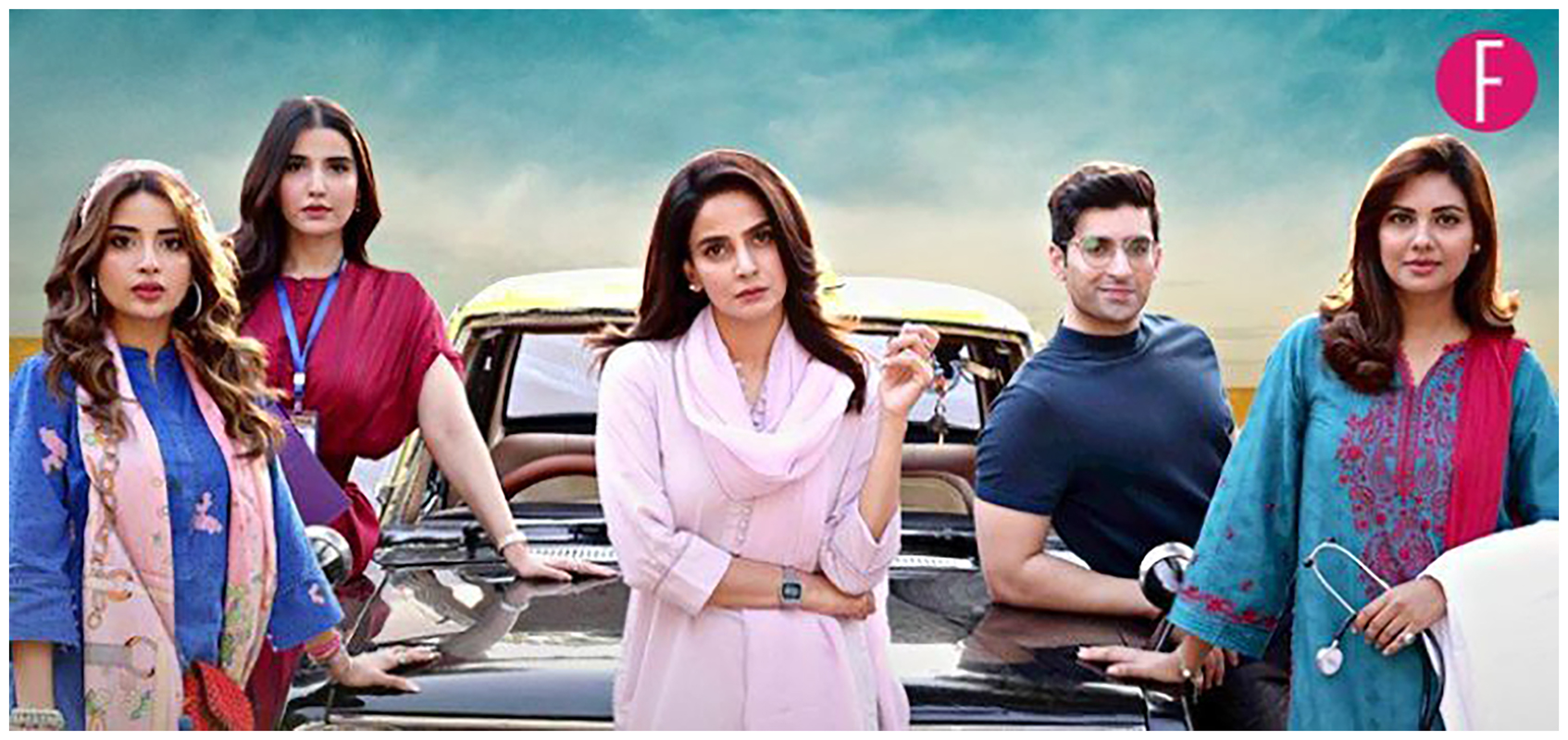
Sar-e-Rah. A scene from the Urdu drama serial Sar-e-Rah (translated as By the Road or On the way). Source: Fuchsia Magazine, 5 February 2023, https://www.fuchsiamagazine.com/sar-e-rah-the-drama-that-seems-to-be-saying-doing-everything-right.
Undoubtedly, this bold drama has captured as well as further energised the new wave of feminism in contemporary Pakistan, 1 which seeks to debunk and dismantle the legacies of the oppressive Islamisation policies of the then dictator General Zia-ul-Haq (1977–1988) who forcefully promoted a bogus norm of female chastity. 2 The moral code “chaddar aur chardewari” (transl. “veil and walls”) was popularised for respectable Muslim women. 3 In short, women were made immobile, so half of the population was excluded from political and public engagements to keep male dominance intact and the corrupt military dictatorship in power, all in the name of a textual or Medieval version of Islam. In the absence of a political or social foundation other than the army, Zia forged a constituency for himself through a policy of “Islamization” supported by the “Saudis”, enforcing a rigid form of “Islam in every sector and walk of life in Pakistan”. 4
Since cars are a symbol of the elite and a spatial luxury of the rich in Pakistan, only financially liberated women are behind the wheel and hence mobile. The lower strata of society, however, tend to rely on lower quality vehicles such as rickshaws (a three-wheeler) or wagons, driven by men for professional purposes. In the federally administrated tribal areas of Pakistan, which has a border with Pushto-speaking regions of Afghanistan, a large majority of semi-illiterate men work as truck or lorry drivers to transport goods to the cities and back to the residents of mountainous regions. Indeed, the northern tribal areas have a culture of their own, which is fundamentally different from the one practised in the metropolitan cities of Lahore, Islamabad, and Karachi in Pakistan. Journalist Marian Brehmer, despite romanticising the geographical dimensions of the remote tribal areas, points to the contradictory cultural patterns in the country: The north-western tribal province of Khyber Pakthunkhwa in Pakistan is a place of fascinating contrasts: of archaic traditions, breath-taking landscapes and idyllic villages, but it is also a place where the strikingly handsome people are exposed to extreme violence and oppression. It is here that Pakistani film director Afia Nathaniel chose to set her debut feature film Dukhtar (Daughter).
5
The film Dukhtar (Urdu/Persian: دختر; transl. Daughter) is a 2014 road thriller, also classified as a “fugitive drama”, 6 written, directed, and produced by film director Afia Nathaniel, in which the truck is the main means of escaping a brutal situation for a mother and a daughter. Nathaniel informs: “It's a road trip film and we shot in the disputed region of the Pakistani side of Kashmir, the Gilgit-Baltistan area, which is a beautiful surreal landscape […] I just fell in love with the idea of making that landscape part of the film!” 7 According to Nathaniel, the stories in the film span genres and cultures. “It's the classic hunter and the hunted”, she comments, but “you also have this very personal journey of a woman and this truck driver who she meets on the road and who becomes a hope in their lives”. 8 Nathaniel's bold portrayal of a woman on the road and her determination to survive seems to set new trends in the history of Pakistani cinema where road movies involving women are quite a novelty. 9
Although the movie underlines the malevolent practice of child marriage in the tribal regions in our contemporary times, I seek to focus on the significant role of women in patriarchal cultures where family constraints and social restrictions limit their movement. My contention is that the movie demonstrates gender dynamics as tied to automobility in the Pakistani tribal cultural contexts. To this end, I elaborate on the iron will of the female protagonist who shows courage in the most harrowing circumstances, particularly encountered on the road. Dukhtar was nominated for the Foreign Language Film Award category at the 87th Academy awards. Inspired by real events, the movie is about a mother, Allah Rakhi (Samiya Mumtaz), who is married off to the much older tribal patriarch Daulat Khan (Asif Khan) at the age of 15. After her marriage, she leaves Lahore and begins to live with him in the remote mountainous village called Nishtar. Twenty-years later, Daulat Khan decides to make peace with his rival tribe leader Tor Gul (Abdullah Ghaznavi), who agrees to end the blood feud between the tribes by marrying Daulat Khan's ten-year-old daughter Zainab (Saleha Aref). Horrified and devastated by this decision, Allah Rakhi escapes with her daughter on the day of her arranged marriage. Before her flight, Rakhi is well aware that she would be pursued by Daulat Khan and Tor Gul's henchmen. While on the road with her only child, she stops a truck transporting goods and implores the young driver Sohail Malik (Mohib Miraz) to take them to Lahore, which is about 1000 miles from Nishtar (Figure 2).
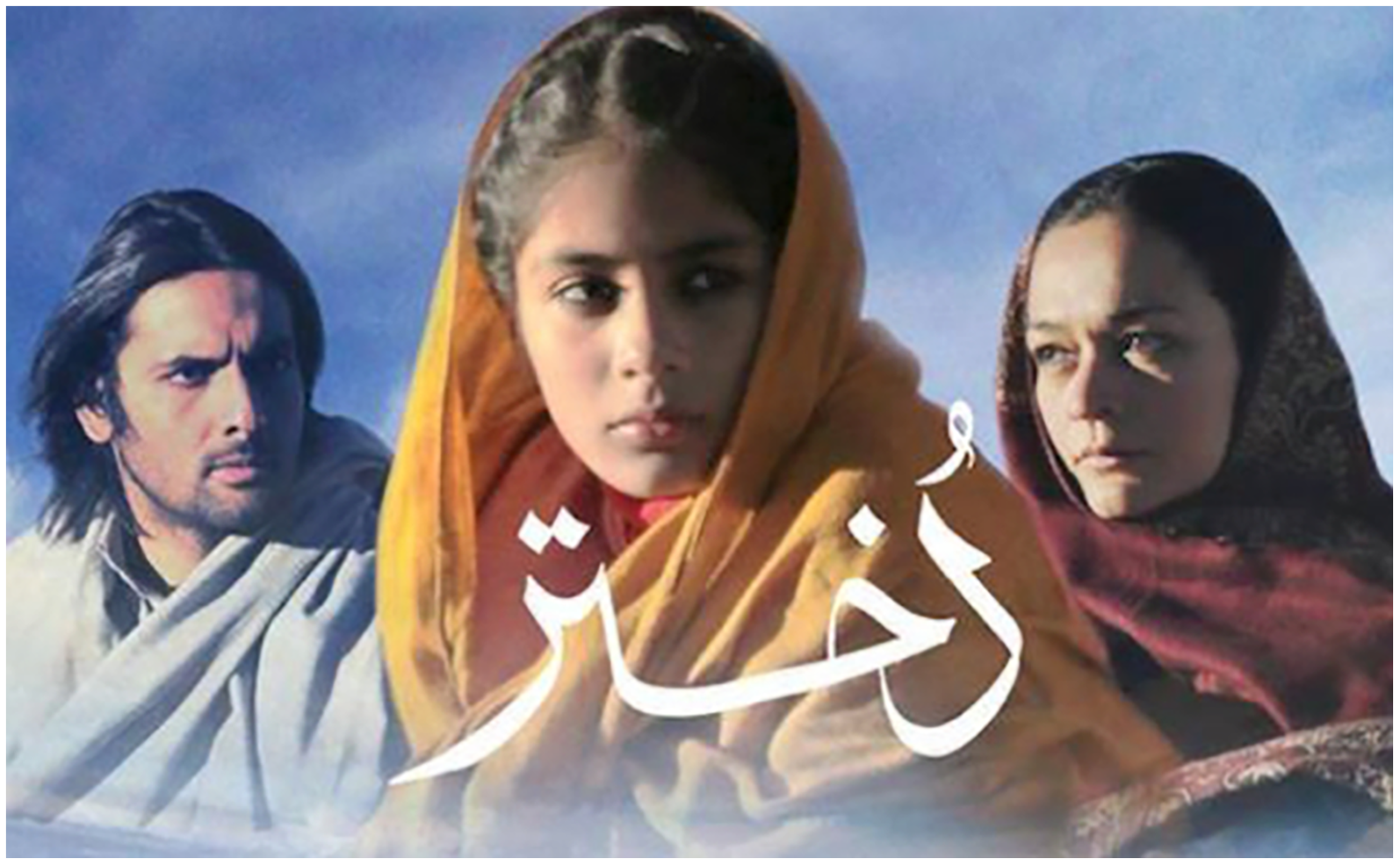
The trio, as shown in this picture, becomes inseparable, bound by the truck. Source: GirlTalkHQ Magazine, 8 September 2015, https://www.girltalkhq.com/dukhtar-pakistans-first-feminist-film-directed-by-a-woman-to-be-released-in-oct/.
Although the movie does not show a woman behind the wheel, I argue that it certainly affirms Allah Rakhi's resistance and resilience as a co-driver. She refuses to obey her husband or accept cruel tribal customs and drives on with Sohail dauntlessly. Thus, not only does she exercise agency by being on the road on her own but sacrifices her life to save her daughter. As a result, the audience do not encounter a classic pattern of female victimisation on the screen but her freewill as embodied in the trope of auto/mobility. Despite being pushed into a motor vehicle whose driver is a complete stranger to her, to Allah Rakhi the truck soon becomes her armour and mobile home; as long as she is in the truck with Sohail as her accomplice, she and her daughter are safe. But as the journey ends, Allah Rakhi is shot dead in Lahore by her husband's handpicked hitman. Set on the road, meandering through stunning mountains, the movie interrogates gender dynamics in relation to automobility in a highly innovative manner. It is the truck, possessed by a man, that appears to be a symbol of freedom and liberty, a mode of transport that can release mother and daughter from a lifetime of misery – from a cruel hand of destiny. Yet, the irony is that as soon as the long journey comes to an end, the hope for a better life for the mother is lost, if not for the daughter. Nevertheless, Allah Rakhi morally raises above social and domestic injustice such as child marriage and honour killing by succumbing only in body but not in spirit. In other words, she succeeds in saving her daughter with her own life and thus surpasses gender and social restrictions.
Understanding automobility and gender in the global road films
In the wake of the new mobilities paradigm,
10
not only has mobility studies become an interdisciplinary area of academic inquiry, but also it has particularly piqued the interest of literary and cultural studies scholars.
11
In light of current scholarship on road mobility, Ann Brigham has perhaps best summed up the major anchors of mobility and mobile stories. According to Brigham: Mobility does not function as an exit from society/home/ the familiar, but instead emerges as a dynamic process for engaging with social conflicts. This makes sense because road stories themselves are plotted around unsettling processes: the crossing of borders, the courting and conquering of distance, the reinvention of identity, and the access, negotiation, and disruption of spaces.
12
Brigham's claim that mobility does not mean escaping or leaving the familiar circumstances but stands for “engaging with social conflicts” is applicable to the movie Daughter, since it is through auto/mobility that social evils are addressed boldly and effectively. I argue that automobility as generating a sense of freedom from social and physical constraints may mean many things. Mike Featherstone therefore draws our attention to “many automobilities”. 13 Clearly, mobility is not a uniform concept but a plural notion, as the road movie Daughter proves in which the female protagonist first moves on foot by running away from home and then by motor vehicle to escape the tribal regions and thus their customs to the urban city of Lahore.
These dynamics of automobility that Urry reads as a unique system 14 and Sheller perceives as evoking feelings or automotive emotions 15 refer to dwelling in movement in the age of increasing globalisation. These forces have reshaped the road movie genre in which a motorised vehicle is the central trope and in which “the metaphor of the car as home” has become the most pervasive, according to Bull. 16
Long associated with America as a nation on the move, “the road movie has been refreshed and galvanised by views well beyond the US borders where global road movies bring the genre to bear, in inclusive ways, on their cultures and histories”, as Timothy Corrigan and José Durate declare.
17
Notably, the road genre from the Global South, compared to the Global North, is dramatically different as noticeable in Pakistani drama series Sar-e-Rah or Bollywood movie Highway; yet, what they have in common is the basic thrust of the road movie genre, namely travelling out and on beyond the familiar borders. In his book Driving Visions: Exploring the Road Movie, David Laderman observes: The driving force propelling most road movies […] is an embrace of the journey as a means of cultural critique. Road movies generally aim beyond the borders of cultural familiarity, seeking the unfamiliar for revelations, or at least, for the thrill of the unknown. Such traveling, coded as defamiliarization, likewise suggests a mobile refuge from social circumstances felt to be lacking or oppressive in some way.
18
Although Laderman has American road movies in mind, some of his observations are noticeable in road movies from the Global South. For instance, the movie Daughter clearly demonstrates an active release from social circumstances that oppress mother and daughter. Laderman rightly defines the road as “a universal symbol of the course of life, the movement of desire, and the lure of both freedom and destiny”. 19 Perhaps a potent trope of utopia or possibility, “the road secures us with direction and purpose”; 20 and yet, “the road can also provoke anxiety: We take the road, but it also takes us”. 21 However, while in the American context, the road may, as Laderman argues, provide “an outlet for our excesses, enticing our desire for thrill and mystery”, 22 in the present context, “the road represents the unknown”, 23 more than adventure or excitement. Even though the road is taken to realise a dream – a humble dream of giving a ten-year-old girl a peaceful life – being on the road also means utter danger and the possible end of that dream.
The question that arises is what connections are drawn between gender and automobility. Over the past three decades, feminist scholars have provided significant evidence, supporting the claim that “[h]ow people move (where, how fast, how often) is demonstrably gendered”. 24 Although women in the Western world have more access to auto/mobility, Western women as drivers tend to face both gender discrimination and marginalisation as Margret Walsh's 25 and Anke Hertling's 26 works lucidly demonstrate. Undeniably, the relationship between women and automobility is complex and ambivalent almost all around the world. However, what is notable is that America as a highly mobile nation dominates current research on road narratives in which men and women are mobile in their own distinct ways. Whereas Brigham declares that American mobility is perhaps nowhere more vividly captured than in the image of the open road with “the road trip as a quintessential expression of Americanness”, 27 Ronald Primeau focuses on how Americans are fascinated by “the lure of the road” and how they conceive of roads and cars as “places of exhilarating motion, speed, and solitude”. 28
Considering these observations, it is hard to deny the fact that the whole discourse of road novels and movies is highly Eurocentric. Robin Law admits that “[t]he gender and transport literature has had relatively little to say about […] third-world countries”. 29 Therefore, it is important to rethink gender and automobility as perceived and practised in non-Western contexts. Certainly, the sphere of automobility reflects both the socio-cultural context as well as specific social problems, which are culturally dependent. Nonetheless, previous studies, mentioned above, have primarily focused on Western civilisation and its gender relations in the automobile discourse. As a result, I would like to shift the focus to Pakistan and the way the dynamics of automobility and gender are imagined and negotiated there.
Turning to the genre of the road movie, more established in the 1960s as an area of academic inquiry, it becomes clear that this genre does not have a very prominent place in Pakistani popular cinema as compared to Western media. For my purposes, I define the road movie genre as an illustration of rebellion, defiance, transgression, and hope. It shows a transgression not only of the obvious geographical and territorial borders, but also of personal borders, when a human being, out of some kind of necessity, rejects the security of home and makes the road his or her (temporary) abode.
I argue that the present road thriller differs from the classical American road movie genre in three fundamental ways: first, the idea of travel for travel's sake or travel as an end itself is not articulated in Daughter. Taking the road is a necessity – a must to manoeuvre cruel social norms or destiny; second, there is no indication of Allah Rakhi's fascination with the road which numerous American narratives display. On the contrary, the road is an open space of human threat and female vulnerability, which the run-away mother must overcome for the sake of her young daughter; finally, while the car is a consumer object in a classical American road movie, promising “to express the idealised uniqueness of the individual consumer”, 30 in the movie Daughter, the female protagonist gets on the truck to escape and fight injustice. In short, the road is neither romanticised nor idealised. Conversely, it is necessary to take the road to simply survive. How the movie Daughter manifests survival of a completely helpless young mother through her truck journey is what I wish to underline in the following. Particularly, I seek to show how the three strands mentioned above surface when I investigate how Rakhi gets on the truck and asks Sohail to drive her to Lahore to save her daughter from child marriage; how she faces impending danger and death on the road with the hitman from the tribal areas at large; and how she keeps travelling on with Sohail by exercising her iron will to fight gender hierarchies that violate women's basic rights.
Allah Rakhi's double journey by truck
It is important to know that the true story of a Pashtun mother of two girls who fled her village, knowing that it was a decision that could cost her life, inspired Daughter. “I could not get the image of that woman on the street out of my mind”, Nathaniel says. “I wanted to present the maternal quest against the background of a society struggling with the conflicting priorities of modernity, tradition and fundamentalism”. 31 Brehmer further ascertains that “[t]he fact that Nathaniel herself became a mother during the shooting gave her quite a different perspective on the project”. 32 Certainly, the movie is a maternal quest, but I contend that it is also a quest of an individual woman to fight tradition and embrace modernity after having been in an unhappy marriage for years. Thus, the movie employs the road trip to critique both cultural and gender dynamics, since an apparently weak and helpless woman exhibits heroic courage in the face of all odds.
Before I start with Allah Rakhi's hitch-hiking and her slippage into the role of a nomad from an obedient wife, it is important to note “Sohail's garishly decorated truck, replete with spangles, gewgaws and bright colours”, 33 and shed some light on the role of trucks as a cultural symbol in cities as well as tribal areas in Pakistan. A personification of masculinity and virility, trucks are always heavily decorated with elaborate artwork and beadwork, since they are supposed to represent the aesthetics of the driver and what he stands for or believes in. Often quotes from well-known poets or verses from the Quran are engraved on them, drawing in people's attention while they are on the roads. By virtue of their prominence on the motorways, flaunting their distinct individuality, several important art books have emerged solely on truck art, such as Graffiti Pakistani Culture: Culture of Truck Art and Rickshaw Art in Pakistan by Muhammad Hamza Naseen and Revising Pakistani Truck Art Symbolically by Rameesha Afzal. 34 Notably, one can hardly ever see a woman driving a truck, which may violate or at least endanger the very image of truck as concomitant with hypermasculinity. A truck driver is expected to be strong and energetic as he must load and unload heavy products or goods. Consequently, a truck is not a woman's domain, although several trucks are decorated with dancing women, female faces, or female body parts in a romantic, idealised, or erotic manner. Ironically, the truck itself is feminised, treated as a female figure possessed by a male driver. In one of her interviews, Nathaniel underlines how women are commodified and objectified in the truck business, as the drivers literally refer to their “trucks as their brides”. 35 This comment brings to mind Marshall McLuhan's notion of “the mechanical bride”. 36 Nathaniel adds that most drivers are “on the road for months and months and months and for them this vehicle is more important that (sic) their life. They take good care of it”. 37
The movie Daughter portrays the main female protagonist, apparently a victim, who blocks the road for a truck driver to escape her predicament at all costs. I argue that as soon as Allah Rakhi gets on the truck with her daughter Zainab, she embarks on a dual journey. First, it is a journey to save her precocious and rambunctious daughter from the fate that awaited Rakhi at the age of 15, namely underage marriage to an elderly man. Second, it is a journey to a life of freedom and liberation by leaving or later on divorcing her husband and going back to the city of her birth Lahore, which is considered to be a hub of culture, education and learning thus a place of several opportunities for women from different classes. According to Frederic and Mary Ann Brussat, this journey is “a passport to a new life of freedom and adventure for her after years of living in a rigid and authoritarian community”. 38
My line of argumentation here will draw on the second aspect. Allah Rakhi is well-aware that she has broken two of her marriage vows by running away: She has violated the “honour” of her husband by abandoning home and hearth, presumably with another man, on the one hand and the honour of the rival tribal chief by not marrying off her ten-year-daughter to him on the other hand. Since there is no verse in the Quran about killing women for leaving or disobeying their husbands, honour killings are not a religious but a cultural phenomenon in Pakistan, 39 especially in the tribal areas where women are often traded for settling blood feuds, compelling many of them to run away and lose their lives in the process – ironically in the name of honour. Thus, Allah Rakhi is believed to have committed a double crime by saving her daughter (in the picture below) for which she is murdered by her husband's henchman Shehbaz Khan (Ajab Gul) who is depicted as a jealous admirer, pursuing Allah Rakhi for having rejected his sexual advances in the past (Figure 3).
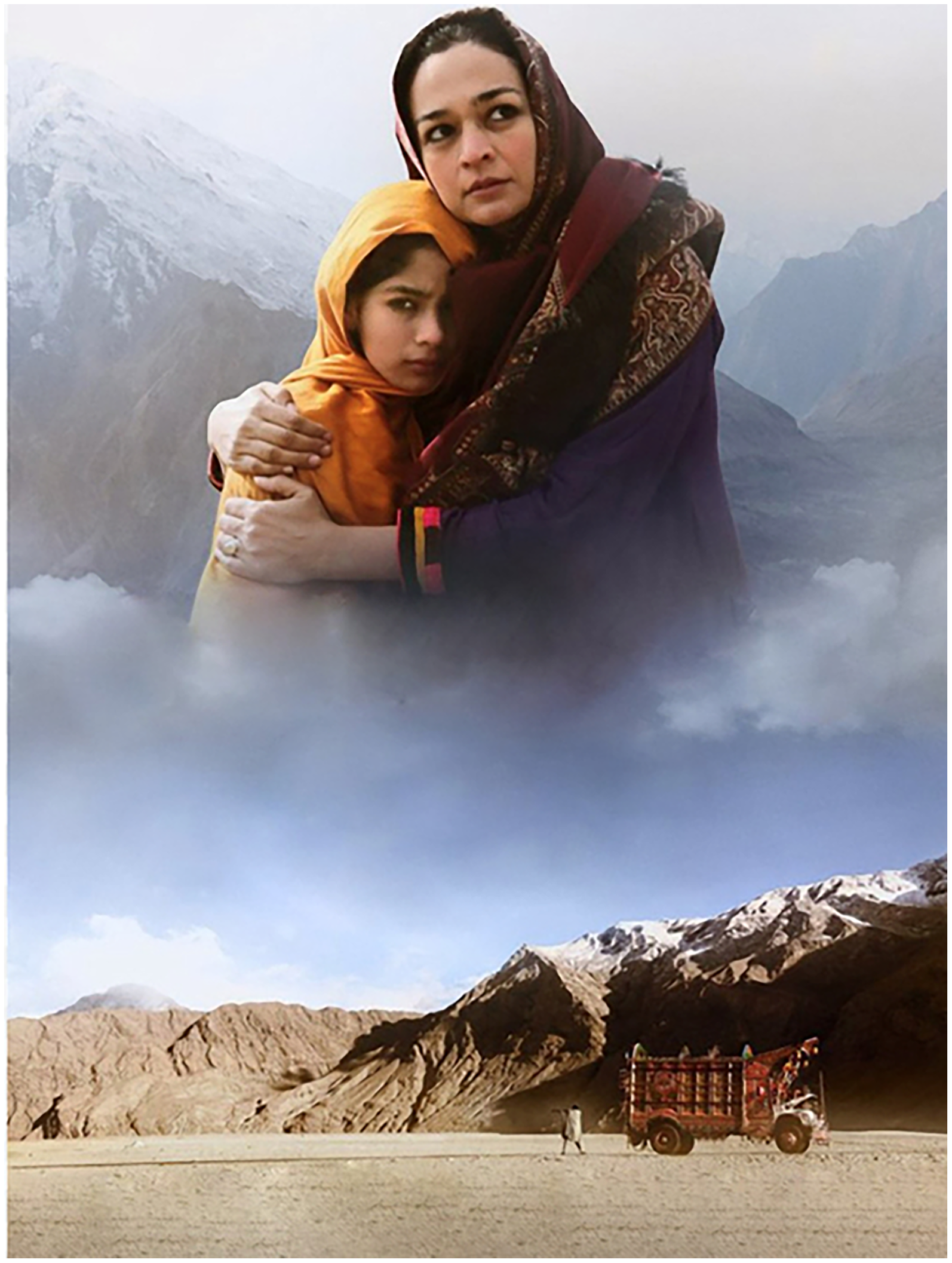
Rakhi as a pillar for her daughter with truck as a symbol of hope. Source: Rotten Tomatoes, 2016, https://www.rottentomatoes.com/m/dukhtar/pictures (accessed 22 January 2025).
As Allah Rakhi drives on with Sohail, a former Mujahid (fighter), “an alternative Pakistani male role model”, 40 she not only shares her heart-wrenching story with him, but she also gets to know him as a kind, sympathetic man who endangers his life to save the mother and daughter in need. Sohail, who initially refuses to take on the duo, faces several dangerous and critical situations in which he is very close to being killed by Allah Rakhi's hitmen at large on the road to Lahore. As the journey continues, Sohail and Allah Rakhi soon develop an intimacy as an outcome of their proximity in the truck, which is normally not allowed in public spaces of tribal regions where men and women are segregated. John Urry rightly points to “the sexualization of the car itself as an extension of the driver's desires and fantasies” 41 in line with the sexualised decorations of trucks in Pakistan mentioned above. As a metaphor of a moving home and a nomadic lifestyle, the truck becomes a cocoon of physical and emotional intimacy, creating a strong bond between a young man and a young mother on the road, which lasted even when the truck journey ends and when the couple finally seek refuge in an abandoned home in a remote village. In short, as the love between Sohail and Allah Rakhi begins to bloom in the safe space of the truck in which the truck becomes a microcosm of human bonding, bringing together two lonely souls, united by chance, necessity, and danger (Figure 4).[9]
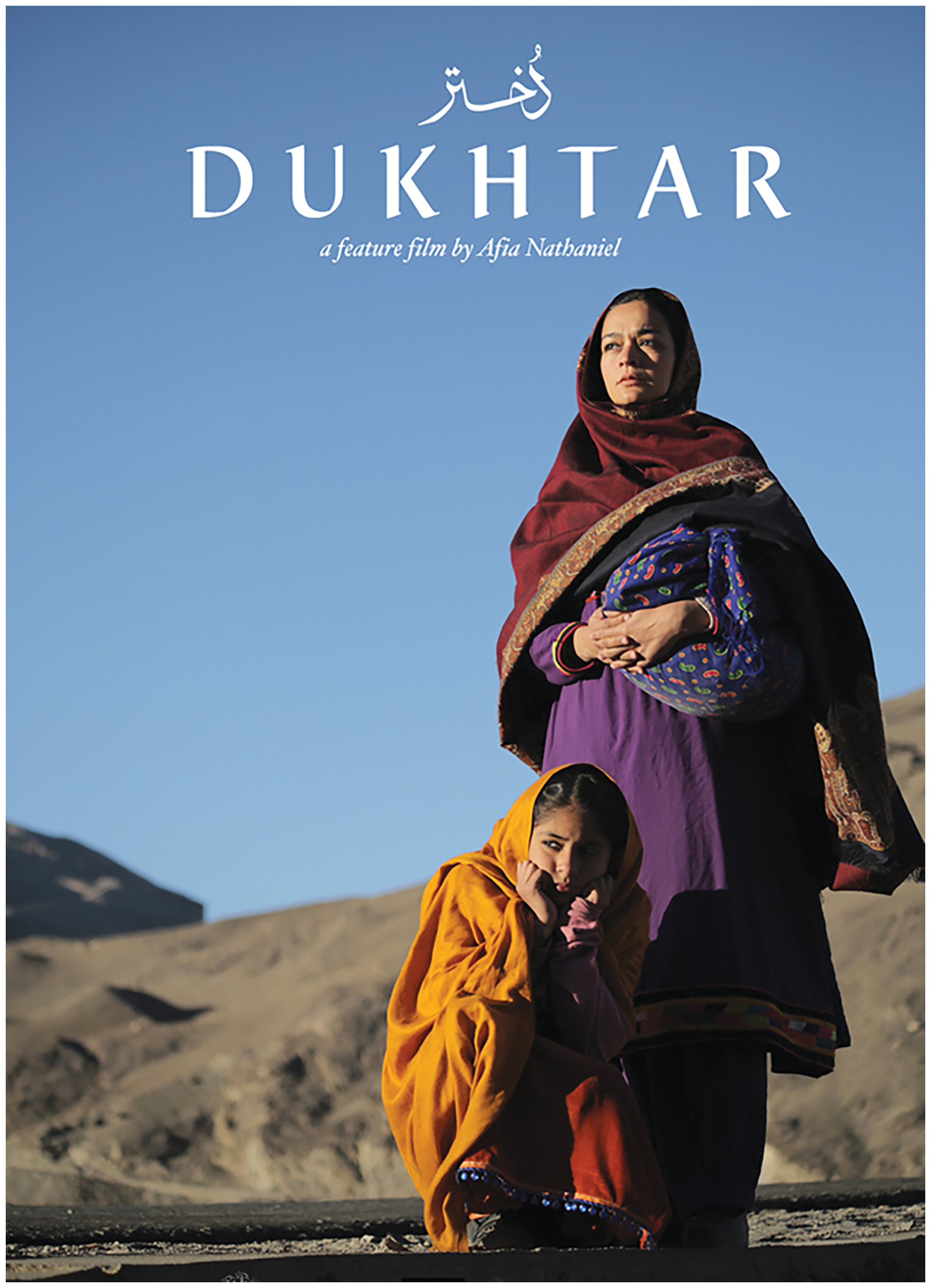
Rakhi on the open road, standing in defiance of all social norms hindering her will to protect her daughter. Source: The Express Tribune, 10 July 2014, https://www.tribune.com.pk/story/733696/from-a-mother-to-her-dukhtar (accessed 22 January 2025).
The price of getting on the truck: Between agency and victimhood
Reading Dukhtar as a road movie from the Global South, victimhood and agency need to be understood against the background of the complex realities of women's lives. First and foremost, it is essential to point out that the understanding of victimhood is somewhat different from its Western perception, since it encompasses several problems that Pakistani women face. These include dire economic situations, responsibilities of looking after the family and unemployment due to a lack of formal education or skills, which means not having a stable income. Likewise, agency has different parameters, compared to the Western notion, in the context of the movie. Agency from the Western perspective, in opposition to victimhood, may mean self-determination to stop abuse and to stand up to the oppressor or the perpetrator. However, in Rakhi's case, agency can only be exercised by leaving, namely forcing an exit from a toxic relationship, from an abusive domestic setup where the woman is reduced to a mere servant and from an unjust social system. Rakhi seems to own her life for the first time by getting on the truck, which becomes a trope of exercising agency and defying victimhood. Even though she is only a passenger, she actively makes the driver Sohail renavigate the route, dodge her chasers and take her to Lahore. Indeed, Sohail follows Rakhi's itinerary, which maps out her new existential trajectory.
In his review for The Daily News, “The Road-Trip Less Travelled”, Ahmer Naqvi claims that “The film's greatest triumph is the cinematography. [ …] The journey in a gorgeous, bejewelled truck through the mountains and plains into the dusty, colourful streets of Lahore is a delight throughout”. 42 To Naqvi's claim, I add that the road underlines the vulnerability as well as the iron-will of a mother to save her daughter's life and future. Allah Rakhi is certainly in great danger, accentuated by the image of the road as a place of complete wilderness, the opposite of the home that she has abandoned, which represented her social position in society as inferior to man. Yet, both characters, Allah Rakhi, a run-away wife, and Sohail, a lonely widower, soon enter into a driver-and-passenger relationship in which both begin to rely on each other. Sohail wilfully embraces Allah Rakhi's fate, knowing the consequences. Naqvi maintains: “Allah Rakhi's simple yet fierce determination is her only protection from being extremely vulnerable, while Sohail's magnanimity is the only example of a trustworthy male in the script”. 43 Indeed, the road begins to shape their narratives and entangle their destinies, as they begin to come closer during the journey and face life-threatening situations together.
However, this “film is also a tragic love story”, as Nathaniel underscores,
44
since the love between Allah Rakhi and Sohail born in extremely dangerous and precarious circumstances does not come into full fruition. Surprisingly, it is the mountainous environment more than humankind that seems to be the most trustworthy companion despite its wilderness. “The film is rooted in a specific visual landscape for the road trip, i.e., the mountains”.
45
The life-threatening situations are set against the surreal scenery that becomes both a protagonist and an antagonist as well as a site of struggle. Moreover, despite the cold and the snow, it is in the wilderness that Rakhi and Sohail together with Rakhi's daughter seek shelter, away from mankind, as they are on a mutual quest. Nathaniel maintains: The surreal landscape and the impossible situation they [the couple] are in makes for compelling cinema especially since the landscape is a character in the film. That's how I wanted to shoot the film. The landscape is the only character in the film that bears silent testimony to their story, their joys and sorrows, their agonies and their ecstasies. And it will be the only thing remaining long after they have gone.
46
Such is the impact of the landscape that it tends to leave a strong impression on the viewers’ imagination, as the conflict between good and evil, power and powerless, and man versus woman is staged against it. In a country like Pakistan where fragile infrastructure and lack of adequate transportation tend to make the common man, especially women, vulnerable to the harsh landscape, female mobility in the lower strata of society is far more limited, compared to the middle and upper classes in cities and tribal areas. Therefore, Rakhi as mobile is an epitome of empowerment, as opposed to powerless as embodied in her statis existence at home. It is hence justified to say that Daughter as “Pakistan's first ‘feminist film’” 47 inverts the traditional gender dynamics: the powerless woman empowers herself. Although being on the road means being exposed to utter danger and death, Rakhi travels on to escape both a miserable marriage and paedophilic tribal men in power.
Although a road movie dramatising woman against landscape, society and culture, Daughter vividly shines light on “Pakistan's brightly coloured soul” 48 – a country of contrast – in which different classes, cultures, and languages unfold a kaleidoscopic and mosaic – like identity of Pakistanis – an identity that denies its monochromatic religious or ethnic dimension, despite the fact that the movie brings out the brutality of some social customs in the tribals areas. Not only does Allah Rakhi's bold escape and companionship with Sohail demonstrate resistance and rebellion, but as Brehmer notes, the lorry itself “becomes a symbol of the country's indomitable soul, of the refusal, come crises, hell or high water, to be beaten down”. 49 In short, the lorry seems to be the sum of Allah Rakhi's trials and tribulations on the open road.
By being mobile, Allah Rakhi embraces mobility as “freedom, as opportunity, and as modernity” which coexists “with mobility as shiftlessness, as deviance, and as resistance”. 50 Opposing the socially acceptable image of women as immobile, Nathaniel locates a mobile woman in a country of contrasts; hence, she does not shy away from underlining the diversity of Pakistani culture through the predicament of Allah Rakhi. Even if there is a portrayal of the fundamentalist way in which Islam is practised in the tribal areas of Pakistan, the movie also includes Sufi shrines in the city of Lahore and the bold rituals, involving men and women in the festivities, as depicted in the second half of the movie. Thus, the movie is not a straightforward road saga, but an odyssey of a woman on the run in a country of cultural and religious variety.
Rafay Mahmood states in The Express Tribune, “Through Dukhtar, Nathaniel intends to rethink the stereotypical image of Pashtun culture in films”. 51 In her talk with Mahmood, Nathaniel declares, “You will get to see a strong Pashtun woman in the lead role in a film (Dukhtar) that doesn’t require her to do an item song. How often do you get to see that depiction in Pakistani cinema?” 52 As most Pashtun movies tend to sexualise women, reducing them to enticing objects of male desire and fantasy, Dukhtar dismisses and deviates from this well-known gender trajectory and draws the audience attention to real-life issues in tribal areas. The strength of the movie lies not merely in exposing social issues and people's indifference to them, but more importantly in problematising the stereotype of Pakistani women as passive and submissive beings and thus victims in a male-dominated society where religion is often instrumentalised to keep the power hierarchies intact. Allah Rakhi refuses to accept her role as a submissive other and fights for her most basic right: protecting her daughter from male exploitation. When her own husband agrees to victimise her and pawn their mutual daughter callously to seek peace among his tribesmen and to secure his position, she takes matters into her own hands and struggles for justice and gender equality on her own terms. Filomena M. Critelli convincingly points out that “[w]omen experience immense pressure to adhere to norms set by the ‘community’, which makes it difficult to leave the family/extended family or social group in order to escape violence or challenge customary practices”. 53 Yet, Allah Rakhi's iron will, as captured in her picture above standing confidently by her daughter sitting on the ground, does not allow these hindrances to come in her way.
Despite the fact that Pakistan is “characterized by a long-standing legacy of underdevelopment, a feudal, elitist socio-political structure and a retreat to conservatism that has marginalized women”, 54 Allah Rakhi refuses to be one of those women who have to “suffer disproportionately from distorted interpretations of Islam and from underdevelopment”. 55 She wields her power as a strong and protective mother to defy male authority, and she demonstrates her agency in the most harrowing situations – starting from her elopement with her daughter on the day of her forced (and unlawful child) marriage to getting on a truck, from being chased by her husband's killer to seeking shelter in an unknown place when the truck breaks down.
Conclusion: Triumph in tragedy
Daughter shows a strong connection between gender and automobility in the domain of road movies from the Global South, which has been critically examined in the important works of Alexandra Ganser 56 and Deborah Paes de Barros 57 in the context of American road narratives. Despite its specific socio-cultural background, Daughter resembles classic road movies like Thelma and Louise (1991), where the two female characters also escape patriarchal structures and domestic spaces and meet an untimely death. In effect, gendering automobility urges us to approach women and car cultures in the Global North and the Global South from different perspectives. Rakhi's role as a woman on the move and as a co-driver demonstrates how auto/mobility empowers her, as she rebels and revolts against the statis of home and hearth. As Rakhi exercises agency by instructing and guiding Sohail to her desired destination, far away from the oppressive tribal norms, she becomes the moving force behind the truck, which opens a new vista of life for her and her daughter.
Although Daughter is a tragic road movie, it does not portray women characters by using cliched images of oppression or by depicting men as the upholders of morality, even though some men do appear in negative light. “By featuring female leads and female-driven narrative”, the movie amplifies “the voices of women” and highlights their everyday struggles, which urge a “shift in women's social standing”. 58 Allah Rakhi remains an indomitable character, who is dauntless and determined to pursue the path she has chosen. So, she is not a victim. She takes full responsibility of her daughter's safety, insists on giving her the social status that men try to take away and thus empowers herself against the more powerful warlords. Unlike the more simplistic idea of Pakistani women in need, Allah Rakhi boldly faces gendered violence, since she is aware that those who perpetrate violence or commit honour crimes are not at all virtuous.
Since the movie provides a dexterous handling of the female protagonist and her agency under most dangerous circumstances, it urges us to think about social customs more deeply, but above all, it draws our attention to the sovereignty of women who refuse to be puppets in the hands of men and create “roads of their own”. 59 Zainabb Hull is, therefore, justified in claiming that the movie “does complicate its message of female emancipation by placing Sohail at the centre of Allah Rakhi's story but nonetheless offers a representation of female agency and strength that urges a shift in women's social standing”. 60 Indeed, Daughter is “powerful and unsettling, a feminist tale set against a backdrop of entrenched patriarchy and endless war” 61 – but a movie that sheds new light on automobility and gender by portraying the triumph of a woman in her tragedy.
Footnotes
Declaration of conflicting interests
The author(s) declared no potential conflicts of interest with respect to the research, authorship, and/or publication of this article.
Funding
The author(s) received no financial support for the research, authorship, and/or publication of this article.
