



Abstract
Using Persian memoirs, periodicals, and photographs, this essay examines how Iranians integrated the bicycle into their everyday lives in the rapidly changing socioeconomic contexts of the Pahlavi period (1925–1979). It seeks to achieve two goals. First, by drawing comparisons from different geographical contexts, it illustrates how Iran's comparatively belated encounter with bicycle technology shaped its use and social meanings, revealing the agency of consumers of small technologies in the global South. Second, by examining competing ideals of manhood associated with the bicycle, it expands Middle Eastern historiography on masculinity beyond the modern middle class. As growing Iranian working-class men developed peculiar aesthetics and practices around the bicycle that distinguished themselves from modern middle-class men, cycle mobility became highly contested along class and gender lines, raising aspirations and anxieties in the Iranian urban space.
The bicycle is not a popular mode of transport in Iran today, comprising less than one percent of the country's urban transport. 1 When we look at historical photographs, however, it becomes evident that the bicycle used to make up part of the Iranian urban landscape. In photographs of Tehran from the Pahlavi period (1925–1979), we often find cyclists crossing major streets and squares, waiting for the traffic officer's hand signal to change, or standing next to the bicycles in front of neighbourhood stores (Figure 1). 2 Textual evidence corroborates that the bicycle comprised the urban space along with cars, buses, trucks, motorbikes, horse carriages, mules, camels, pushcarts, and pedestrians. 3 Who were these cyclists? What did they use the bicycle for? What social meanings did the bicycle have?
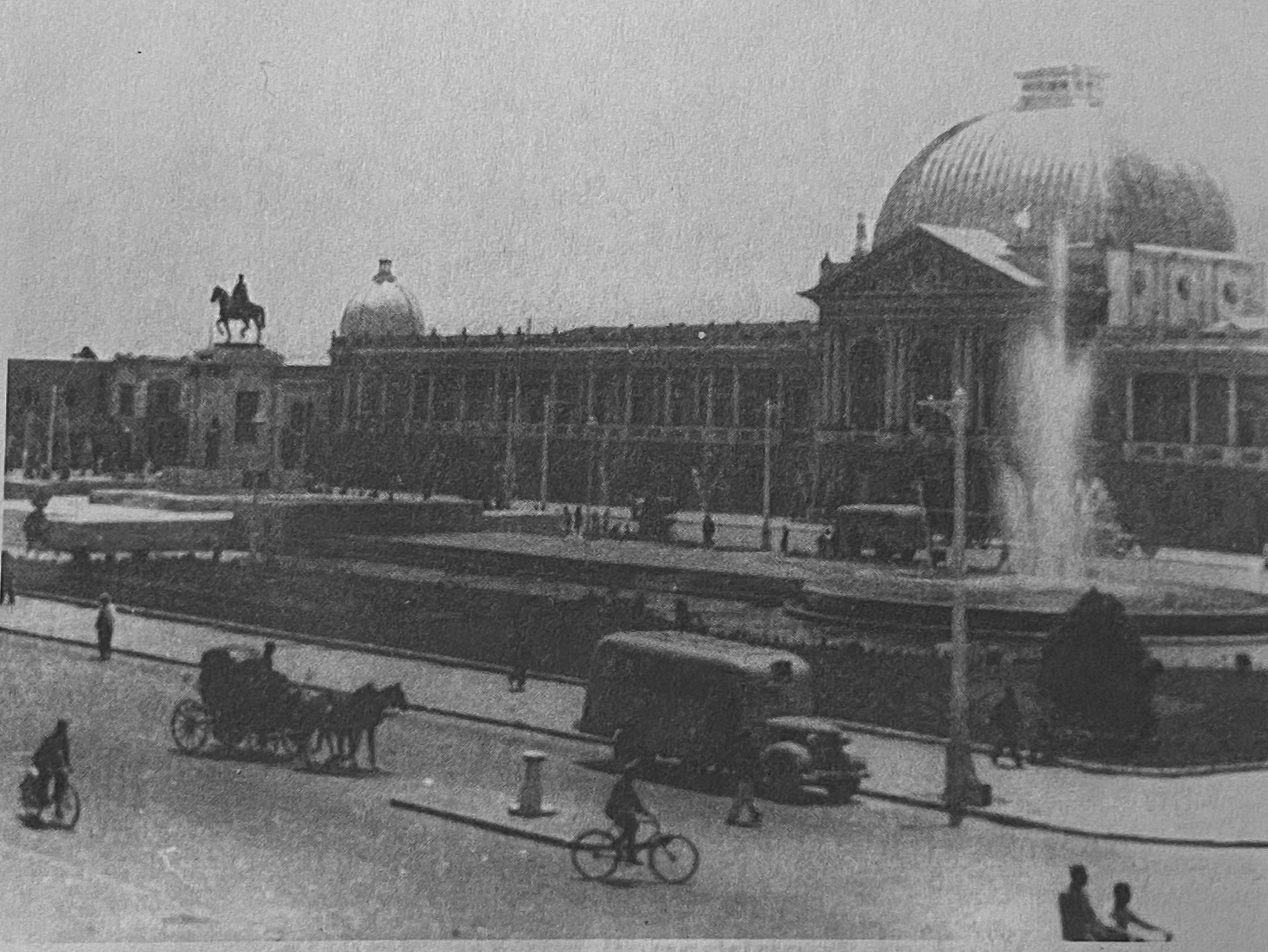
Tupkhaneh Square in the 1940s. Parsaee and Tahami, ‘Aks’ha-ye Qadimi, 21.
To explore these questions, it is important to situate the coming of the bicycle in Iran's urban development in the twentieth century, given that cycle mobility was intimately linked to the production of new space and sociality in modern Iranian cities. In the case of Tehran, following limited yet significant urban transformations during the Qajar period (1796–1925), the new Pahlavi state drastically expanded the scope of urban projects during the interwar period. 4 Particularly important among state-initiated urban projects was the construction of broad streets and large squares, which went hand in hand with the establishment of privately owned new shops that flanked both sides of the streets. 5 While such development was mostly limited to urban centres during the first half of the twentieth century, it produced new social spaces in those cities as cultural institutions, including cafes, restaurants, hotels, and cinemas, appeared in affluent neighbourhoods. 6
These institutions were predicated on the assumption of mobility of urban residents across neighbourhoods, which in turn required not only transport technology but also a set of legal frameworks, mechanical knowledge, and residents’ shared understanding of appropriate behaviour regarding how to move safely and speedily. Indeed, the early Pahlavi period witnessed the initial development of commuter bus services that connected different parts of the city, accompanied by new traffic regulations, driving schools, and the emergence of thousands of workers in the transport sector. Despite the centrality of mobility in urban development, existing scholarship tends to take the movement of people, goods, and ideas for granted, focusing on the social relations that evolve around new cultural institutions. 7 Nevertheless, the movement was not a given. Iranian nationalists viewed the production of movement as a precondition and a symbol of modernity. 8 This essay seeks to recentre mobility in our understanding of new social spaces of Pahlavi Iran by examining how the bicycle was incorporated into everyday life in Iran and how Iranians articulated their aspirations and anxieties through competing visions of cycle mobility. 9
In Europe and North America, the process of the bicycle's incorporation into everyday life took place between the late nineteenth and early twentieth centuries, during which the bicycle's social status considerably declined. From a symbol of middle-class respectability in the late nineteenth century, the bicycle came to be associated with the masses without the means to own a car, from the working class to women and children, a shift precipitated by changes since the 1890s bicycle boom, including the mass production of safety bicycles, the subsequent decrease in bicycle prices, and most importantly the rise of the automobile as the new status symbol. In much of the Anglophone world, the bicycle gradually lost its utilitarian value due to motorization and the sprawling of urban centres as the twentieth century progressed, with its use becoming limited to recreational purposes. 10
As this essay will show, the social meanings of the bicycle in Iran followed a similar trajectory, with the crucial difference that modern middle-class men never associated cycle mobility with respectability. In explaining different paces and degrees of the bicycle's integration into everyday life in the non-West, a recent study that aspires to present a global history of the bicycle attributes the difference to “how ready non-western countries were to adapt to western-style modernization”. 11 In this narrative, the specific economic and cultural conditions of the non-West, be it the lack of surplus income or cultural prejudices against the West, function as barriers to the “diffusion” of “western-style (technological) modernity”. 12 Instead, this essay explores how a new technology that was foreign in origin acquired social meanings of its own in local contexts not only among the modern middle class but also those outside this small percentage of the Iranian population. 13 The bicycle is an ideal form of transport technology for this approach because, unlike “big technology” such as the railway, whose development requires the involvement of state power, the bicycle is a quintessential “small technology” that can be owned by individuals with relatively limited capital.
The bicycle's reach beyond the modern middle class is particularly important when considering the ways technology was incorporated into competing ideals of masculinity. 14 While existing scholarship on Middle Eastern masculinities focuses heavily on the modern middle class and its traditionalist antithesis, examining the gendered use of the bicycle sheds light on how the hitherto largely neglected working class, whose presence increased significantly in Middle Eastern societies during the second half of the twentieth century, formulated and reformulated distinct notions of masculinity by co-opting aspects of modern middle-class values. 15 In short, the bicycle opens the door to studying the agency of heterogeneous consumers in the global South.
By drawing comparisons from different geographical contexts, this essay will illustrate how the specific historical context of Iran's encounter with the bicycle shaped its use, especially who used it and what social meanings were attached to it. In doing so, I will underscore the almost simultaneous rise of divergent modes of cycle mobility that were associated with competing ideals of masculinity in Pahlavi Iran. I will further argue that the limited integration of the bicycle into the everyday lives of modern middle-class men did not illustrate their “unpreparedness” to accept technological modernity. Rather, they did not accept the bicycle precisely because they subscribed to the ideals of what they imagined as contemporary technological modernity that Euro-Americans were experiencing.
The bicycle becomes mundane
The bicycle came to Iran in the late nineteenth century. Among the Europeans who introduced it was the British traveller Thomas Stevens, who cycled around the globe on a high wheel (Penny Farthing) in the 1880s. Travelling across Iran in 1885–1886 before exiting to Afghanistan and India, he performed in Tehran at the request of Naser al-Din Shah Qajar, showing bicycling techniques to curious spectators who had gathered in Tehran's central square of Meydan-e Mashq. 16 Perplexed about how the vehicle maintained its balance with only two wheels, people reportedly called it the “devil's vehicle”. 17
Anecdotal evidence suggests that Iranians, especially aristocrats and state employees, slowly began to use the bicycle in subsequent decades. The tax law passed by the Second Majles (parliament) in 1910 specified taxes imposed on various modes of transport, including bicycles, donkeys, and horse carriages, indicating the relevance of bicycles in urban traffic by the beginning of the twentieth century. 18 At the same time, however, the fact that only 86 bicycles were imported from Britain in 1912, 19 shortly before Iran plunged into political chaos as a battleground of World War I, suggests that the bicycle entered Iran only slowly during the first two decades of the twentieth century. As late as 1921, the city of Tehran's cleaning and garbage collection service operated with only forty bicycles and 50 horses in 1921. 20 Although we do not have exact data for the years immediately before the establishment of the Pahlavi Dynasty in 1925, by 1926, there were 1037 bicycles in Tehran, 615 of which were owned by individuals, while only 564 cars and 135 motorbikes were individually owned. 21 By then, Tehran boasted fifty-eight bicycle assembly shops in seven of the ten city quarters of Tehran, indicating a relatively rapid increase in the availability of the bicycle in the post-war period. 22
Despite this increase, the bicycle was much more peripheral in Tehran's urban landscape when compared to other major cities in Asia. For example, in the same year, there were estimated to be 50,000 bicycles in Saigon-Cholon. 23 Considering that the estimated population in Tehran was 210,000 and that of Saigon-Cholon was 330,000 in 1926, the number of bicycles per capita in Tehran paled in comparison to that of Saigon-Cholon. 24 There are several possible reasons for the relative absence of the bicycle in Tehran at the beginning of the Pahlavi period (1925–1979). Unlike Indochina, which experienced French imperialism, independent Iran's exposure to European cultural trends was comparatively limited until the rise of the Pahlavi state. In addition, as state bureaucracy expanded drastically only under the Pahlavi state, salaried bureaucrats and professionals who would potentially comprise the core users of the expensive vehicle remained a small percentage of Tehran's population until the mid-1920s. 25 The absence of a strong modern middle-class resulted in Iranian cycling clubs’ inability to increase membership, while they flourished in Euro-America and colonized Asia at the turn of the twentieth century and functioned as crucial sites of socialization to consolidate the middle-class identity of urban professionals. In Iran, these clubs emerged only in the second quarter of the twentieth century, and their members were limited to employees of large institutions such as the National Bank and the military. 26
Bicycle and repair stores were initially concentrated in and around relatively chic neighbourhoods such as Manuchehri Street (across the street from the British Legation), ʿAla al-Dowleh Street (present-day Ferdowsi), Naseriyeh Street (present-day Naser Khosrow), and Shahreza Street (present-day Enqelab), close to the Presbyterian Alborz School. 27 Those who could afford it purchased new bicycles produced by British manufacturers such as Raleigh, Hercules, and BSA, while others chose second-hand bikes. Those who could not afford bicycles had the option of renting one at the stores, allowing working-class children to enjoy cycling from the early days of Iran's first bicycle boom in interwar years. 28 The bicycle penetrated provincial centres as well, especially in flat central and southern Iranian cities where Anglo-Indian trade dominated the market, to the extent that the writer Ahmad Aram characterized Isfahan in interwar years as a “city of bicycles”. 29 However, in snowy regions of Iran, such as Orumiyeh, its utility remained seasonal. 30 The popularity of the bicycle in everyday life depended on numerous local factors, from commercial to topographic and climatic.
The bicycle, imported from Europe, India, and Japan, extended its reach to a larger segment of the Iranian population by the mid-twentieth century. 31 An Isfahani former member of the Tudeh Party, Iran's communist party, recalled how workers from the party would come to his high school by bike to take him and a classmate of his to their house for a study group in the 1940s. 32 Similarly, photographic evidence shows that teenage boys on their bicycles joined various workers’ demonstrations during the era of mass politics between the Anglo-Soviet invasion of Iran in 1941 and the overthrow of Mohammad Mosaddeq's government in 1953. 33 The bicycle became increasingly visible in everyday life of urban residents in this period. By 1968, the number of bicycles in Tehran increased to 70,000. 34 Even considering the decuple population growth of Tehran during the same period, the number of bicycles per capita increased by approximately seven times, a trend confirmed by the appearance of bicycle stores in less affluent neighbourhoods in south Tehran. 35 The use of the bicycle was not limited to urban centres. A 1957 economic report on consumption patterns noted its presence even in remote areas of the countryside. 36 By the mid-1960s, the bicycle had been incorporated into the everyday life of Iranians across the country, solidly identified as a vehicle for students (daneshamuzan) and the working-class (kargaran). 37
A 1956 short story published in an Isfahani journal also indicates the general process of the bicycle's incorporation into everyday life as a mundane object. In the story, Amiz Asadollah, the protagonist, goes everywhere on his dilapidated bicycle. This bicycle has no horn, light, or functioning brake after hitting many horse-drawn carriages and cars. Every morning at eight, he rides the bicycle to take his children to school. After dropping them off, he collects clothes from his neighbours, puts them in a large basin placed on his head, and gets water so his wife can wash them. After picking up his children in the afternoon, he puts a melon in the bicycle's front basket, puts bread on his head, and takes yogurt in his hand, while having grapes and vegetables tied around his neck like a necktie. Once he is ready, Amiz Asadollah heads home on the bike at full speed, just like Rostam, the hero of the Persian mytho-historical epic shahnameh, travelled on his horse Rakhsh. When he is not running errands for his family, he uses the bicycle to carry fodder to his fodder-selling store. 38 By the 1950s, the bicycle had become an affordable vehicle that resourceful working-class men like Amiz Asadollah could use to maximize the economic opportunities that it could offer. The devil's vehicle that foreigners brought to Iran became indigenized as the mytho-historical horse that any Iranian reader would recognize.
As the bicycle reached a broader segment of the population in the late Pahlavi period, it acquired a new meaning; it became an indicator of national economic development along with other small technologies such as the radio and the motorbike. Late Pahlavi writings correlated the degree to which the bicycle reached the provincial working class with development. For example, a 1959 article in Nameh-ye Otaq-e Bazargani vividly portrayed the visible presence of the bicycle in the Kerman Province to advertise investment opportunities in the province. According to the article, the “gold rush” in Kerman, driven by pistachio cultivation, required many labourers who dredged and dug the irrigation system. They were known to appear around sunrise and disappear around sunset en masse on their bicycles or motorbikes. To cater to their needs, multiple large bicycle stores, including assembly stores, popped up in Rafsanjan, the centre of Iran's pistachio production. These stores used imported parts and sold bicycles affordably, gaining popularity among the working class. This flourishing market resulted in the overflow of bicycles and motorbikes everywhere in the streets, indicating the city's superior prosperity to the provincial capital of Kerman. 39 Other writings paid extra attention to quantifying bicycle ownership. A 1964 report demonstrated the positive economic impact of the recently completed Dez Dam project by citing the increase in the number of radios (from 108 to 294) and bicycles (from 190 to 415) as well as electricity consumption in the dam's surrounding area in the past eighteen months. 40 Similarly, in assessing rural Khuzestan's economy, another report from the same year detailed changes in the material conditions of a farmer named Abd al-Reza Hashemi, who now owned a radio, a bicycle, and a wrist watch. It also noted that his house was equipped with water pipes and electricity. 41 The devil's vehicle had become the quantifiable barometer of capitalist development. Reminiscent of the social scientific approach of the modernization theory at the time, the presence of technologies that enabled the flow of people, goods, and ideas, such as the radio and the bicycle, was directly associated with the transition of traditional societies into modernity through the intensified circulation of information. 42
The bicycle and competing masculinities
While the bicycle lost cultural prestige in Euro-America by the early twentieth century, it continued to symbolize wealth in Iran during the first several decades of the twentieth century. Photos of Iranian families in the late Qajar and early Pahlavi periods often featured teenage boys and girls in westernized clothes on their bicycles. Adult women on bicycles were sometimes captured on camera. 43 Similar to photographs from fin de siècle Euro-America, some of these pictures appeared to have been taken at photo studios, indicating that Iranians also used the bicycle as a studio prop. 44 A popular youth periodical of the 1930s Mehregan also featured numerous photographs that featured little children on tricycles as part of the journal's photo contest called “The Most Beautiful and Cheerful Children of Iran Contest”. 45 Along with the generally Europeanized sartorial choices, the ownership of the bicycle conveyed the economic status and the cosmopolitan cultural outlook of the individuals featured in the photographs.
Notably, unlike photographs from fin de siècle Euro-America, Iranian photographs did not feature adult men on bicycles. It appears that adult men of aristocratic and modern middle-class backgrounds did not enthusiastically embrace the bicycle. The lack of interest among respectable adult men owed much to the timing of Iranian encounters with the bicycle. The emerging Iranian modern middle class encountered the bicycle mainly in the interwar period, by which the automobile had become the symbol of social status, relegating the bicycle to the working class. This shift in the perception of the bicycle by the interwar period was part of a global story. European elites in colonial India turned away from the bicycle by 1920 at the latest, while colonial Vietnamese elites began to prefer the automobile to the bicycle. 46 Because modern middle-class Iranians encountered the bicycle and the automobile almost simultaneously after WWI, it was the automobile that they viewed as the symbol of technological modernity, not the bicycle. Various cartoons printed in the interwar Iranian press illustrate this point (Figure 2). The flashy automobile (preferably with a chauffeur for those who could afford one), along with the aeroplane, the locomotive (Iran did not have a railway network until the late 1930s), and electricity, captured the aspirations of Iranians who imagined the progress that accelerated movement would bring to their nation. 47 Precisely because modern middle-class Iranians aspired to replicate the contemporary technological society that they imagined existed in Euro-America, they viewed the bicycle primarily as what respectable men would buy for their family members, not for their own use.
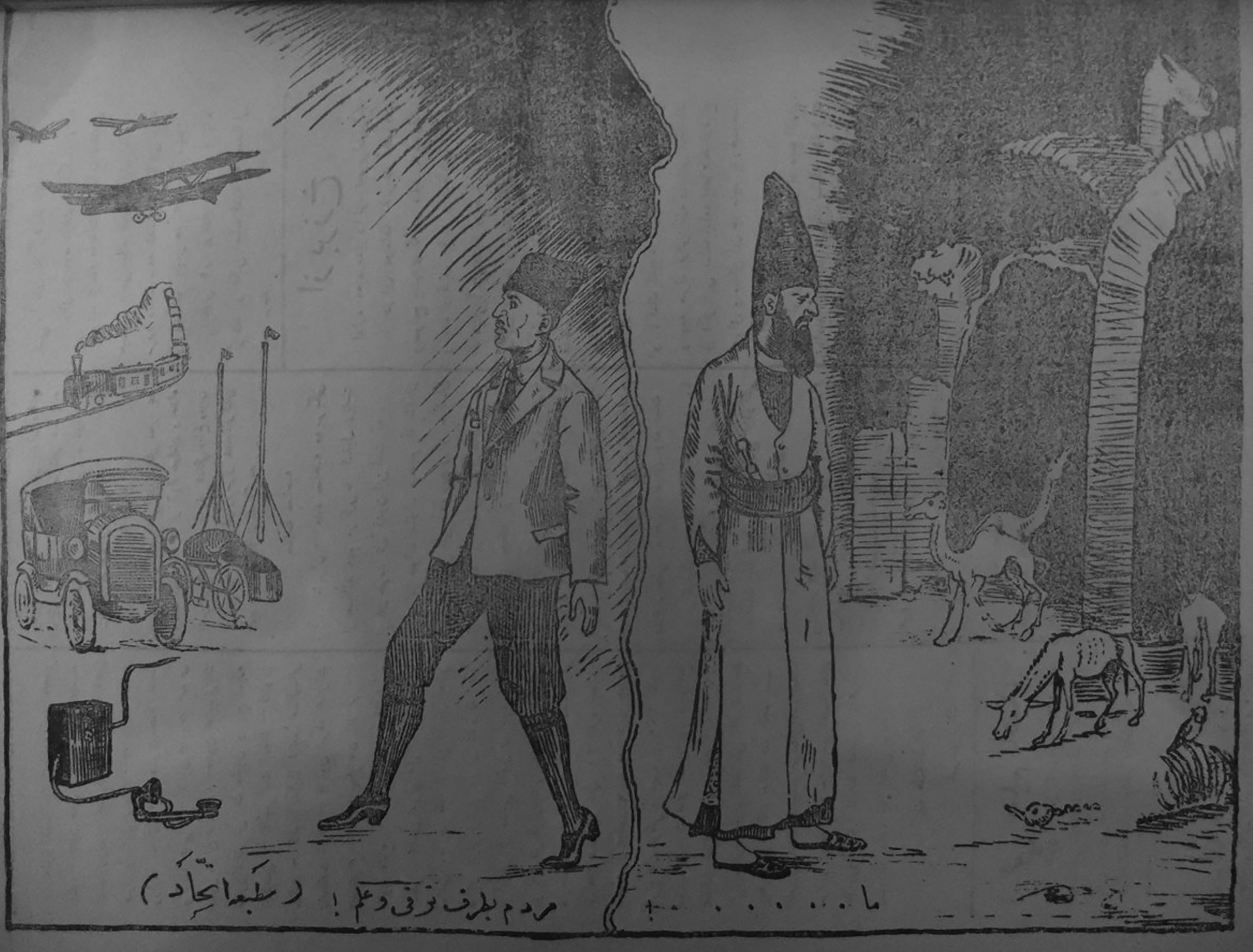
The caption on the left reads “people toward progress and science”, while the caption on the right reads “Us……!” Khalq, July 4, 1926.
Aside from the timing of the bicycle's introduction into Iran, the lack of interest in the bicycle among aristocratic and modern middle-class men could be ascribed to the vehicle's association with the working class, which readily turned to bicycles during the interwar period. For working-class men, bicycles did not require fodder or a stable, while mules did. Various vendors and storeowners came to be known for carrying their merchandise, such as yogurt, meat, fruit, and chelow kebab, speedily on bicycles. 48 In this context, aristocratic and modern middle-class men would become visually undistinguishable from the working class had they chosen the bicycle as their everyday mode of mobility. The ongoing state-imposed sartorial regulations that erased other visible markers of social distinction, such as headgear and clothes, certainly did not ease their anxieties. 49
In particular, we could situate the source of their anxieties in how the bicycle was incorporated into the aesthetics of the lutis. A luti was an “urban rough” who lived on the “edge of legality” 50 and “could be the socially conscious leaders of the poor, whose heroic values inspired them, and they could be every sort of thug, rogue, and thief”. 51 While the lutis embodied manliness called javanmardi in premodern Iranian urban neighbourhoods, by the early Pahlavi period, they were increasingly vilified in the nationalist discourse as unruly thugs who disobeyed state authority, in contradistinction with the new dominant masculine ideal of modern middle-class men, most of whom were state bureaucrats and urban professionals. 52 In his memoir, Abbas Manzerpur recalled seeing in his childhood neighbourhood of Ab Mangal a butcher who was often carrying meat on the saddle of his liberally decorated bicycle with multiple bells, horns, lights, and ribbons. Lutis like the butcher only sometimes rode on their bicycles. Instead, they strolled around neighbourhoods while boastfully pushing their colourful bicycles. 53 Cecil Keeling, a British soldier stationed in Kermanshah following the Anglo-Soviet invasion of Iran in 1941, also noted the distinctness of bicycles that young men of the city owned; they chaotically meandered the roads and pavements on their “half-a-dozen shrill bells on the handlebars”. 54 The visual and auditory impact of the bicycle, combined with the recklessness of its rider, came to comprise the masculine spectacle of Iran's urban landscape by the mid-twentieth century. For modern middle-class men, the bicycle's association with the unruliness of the marginal members of urban societies proved too problematic.
Youth cycling culture
Unlike modern middle-class men, the youth embraced cycling ardently regardless of class. In this regard, the trend in Iran largely followed Euro-America. In response to the declining sale of bicycles by the beginning of the twentieth century, the marketing strategies of American bicycle manufacturers changed, focusing on appealing to the younger male demographic. In the second and third decades of the twentieth century, they began to reframe the bicycle as a vehicle that would promote the fitness and individualism of the juvenile while instilling a patriotic appreciation for the beauty of their homeland. The idea was to brand the bicycle as a beneficial technology that would physically and mentally prepare boys for manhood. 55 Although there was no Iranian bicycle manufacturer to shape consumer trends, bicycle shops occasionally placed ads in popular magazines that targeted the youth. For example, the Momtazi bicycle shop on Tehran's Naser Khosrow Street ran an ad in Mehregan, which read Azizam, barat docharkheh kharidam (My dear, I bought a bicycle for you). 56 Combined with brief instructions on safe cycling, the ad indicated that Iranian bicycle shops targeted youngsters.
In addition, similar to Euro-American trends in the interwar period, the culture of youth athleticism, adventurism, and patriotism flourished in interwar Iran. The early Pahlavi nationalist discourse promoted physical education and sports as a way to mould future soldiers and mothers with healthy minds and bodies who would revive Iran. 57 Compared to calisthenics or team sports, which received attention due to their presumed conduciveness to a sense of fraternity, cycling did not enjoy the most celebrated status among various kinds of physical exercise. Although not explicitly mentioned in sources, the need for a sufficient number of bicycles probably excluded cycling from school curriculums. Nevertheless, it was popular enough for elite schools such as Alborz and Dar al-Fonun to have their own cycling races. 58 The press also discussed cycling as a beneficial activity for fitness, accompanied by photographs of cyclists in Euro-America and Iran. 59 It was considered particularly important for small children, who did not have enough strength to endure the long practices required for intense competitive sports such as soccer. Refuting the theory that cycling would make their back hunched and damage their heart, an article in Amuzesh va Parvaresh, the official monthly journal of the Ministry of Education, argued that cycling would allow small children to develop strength through the repetition of the same pedalling movement. 60 Cycling was the first step to creating future defenders of the nation.
The early Pahlavi state under Reza Shah frequently held national sporting competitions for students, which were celebrated in the Iranian press to display the fitness of the new youth. These reports featured student cyclists, and even polo cyclists in one case, along with athletes in other activities such as soccer, calisthenics, and swimming. Cyclists also marched into stadiums along with scouts and high school students on official occasions, such as the commemoration of the 1921 coup that brought Reza Khan to power. 61 The visibility of cyclists was such that students at the Presbyterian girls’ school in Rasht also expressed the desire to cycle. 62 At least among the growing number of middle-class children who received modern education in this period, cycling became a standard athletic pursuit.
As the youth were exposed to cycling through school events and the popular press, they also began to undertake intercity, or even international, biking adventures. As early as the late 1910s, Abu al-Hasan Ebtehaj, the future head of the National Bank of Iran, made a round trip between the Caspian coastal province of Gilan and Tehran by bicycle, travelling the mountainous terrains of northern Iran. 63 The trend accelerated in the 1930s, when international cyclists who travelled across Eurasia increasingly visited Iran. 64 Inspired by this trend, Iranian secondary students as well as young adult members of bicyclist clubs left Tehran by bike to reach various destinations, from Iranian cities such as Qom and Tabriz to neighbouring countries, including Afghanistan, Pakistan, and Iraq (specifically the Shiʿi shrine city of Karbala). 65 In some cases, these trips were tied to political parties, as illustrated by two young members of the leftist Toilers’ Party who left Tehran to visit the southwestern province of Khuzestan. 66
Regardless of socioeconomic backgrounds, Iranian men who spent their boyhood in the first half of the twentieth century recalled their experience of cycling fondly as a key to adventures. For example, Isa Omidvar, who travelled around the world between 1954 and 1964 with his brother Abdollah, viewed the purchase of a bicycle as the first step toward his exercise of mobility independent of parental supervision, which eventually led to his decade-long globetrotting with his brother. Although travelling had always been part of his childhood, he had never travelled by himself before buying the bicycle around 1940. He was always with his mother, who took him to her numerous trips, including a pilgrimage bus trip to Mashhad that forced him to sit on a hard, uncomfortable seat for long hours. 67 When he was a fourth grader, he bought a used bicycle made in India, where local dealers began using imported parts from Europe and Japan to assemble bicycles. 68 While Omidvar bought it under the pretext of helping his mother grocery shop for a family of eight, he recalled, “buying groceries for the household became an excuse to explore farther neighbourhoods from Bazarcheh-ye Seyyed Ebrahim in east Tehran, where our house was located. Now I could move from one dark alley to another …”. 69 Like Omidvar, children often used bicycles for everyday adventures in the city. Abbas Manzerpur, who recalled the butcher on a decorated bicycle, often used that bicycle while the butcher spoke to his father for as long as an hour or two. He would travel from his father's store in Ab Mangal only to nearby streets such as Rey Street and Abshar Alley, enjoying the slopes of Tehran. Interestingly, despite the relative proximity of the streets he ventured into, he remembered the experience as an exciting adventure to places “pretty far away from the store”. The sense of adventure was enhanced when incidents occurred, such as being chased by a policeman for not having a license. 70 The bicycle was central to transforming the everyday lives of boys in the city into adventures.
Reflecting the rapid economic development of the 1960s, the bicycle's conduciveness to another ideal gained attention by the late Pahlavi period: thriftiness. In 1968, a short story entitled Avvalin Docharkheh, Avvalin Ravash’ha-ye Zendegi (The First Bicycle, the First Ways of Life) was published in Maktab-e Mam, a magazine on childrearing. The story revolved around Mohsen, a little boy who desperately wanted his parents to buy him a bicycle, which would cost eighty toman. His parents agree to pay for half of it but tell their son that he needs to pay forty tomans on his own. For the next three months, Mohsen continues to resist temptations to buy various small consumption items such as his favourite hawthorn berries (zalzalak), pistachios, and lavashak, until he saves forty tomans. The story ends with Mohsen's excitement about getting his first bicycle and an explicit reference to the lessons children need to learn: self-control, frugality, and devotion. 71 Notably, the story does not detail what Mohsen actually does with the bicycle because it is not a story about the adventure of a boy. Instead, the story hinges on the bicycle's quality as a relatively affordable small technology that a boy could purchase. Its principal function is to communicate to Iranian parents the importance of inculcating the desirability of capital accumulation in their children as future responsible citizens of Iran.
While discussions so far underscore various masculine ideals expressed through the bicycle, it must be noted that the bicycle was not exclusively a male vehicle, as indicated by the presence of photographs featuring women. Popular journals such as Mehregan ran articles to encourage exercise among women, notably less intense physical activities that health discourse at the time defined as conducive to the fertile female body. Along with swimming, tennis, dancing, and walking, cycling made the list of “approved” exercises featured in various photographs. 72 At the same time, however, as was the case with contemporary global debates on female fitness, anxieties persisted. 73 Attempting to demonstrate the scientific basis of the religious requirement that men should avoid contact with women during menstruation to maintain ritual purity, an article argued, “all exercises, especially bicycling, horse riding, skiing, and swimming are prohibited during this period, as they would intensify menstruation”. 74 As Camron Michael Amin has argued, Pahlavi-era debates on gender relations strike a precarious balance between women's emancipation and male guardianship over female sexuality. 75
Anxieties of disorderliness
During the late nineteenth-century bicycle boom in Euro-America, the spectacle of reckless cycling threatened the orderly and respectable cycling culture of clubs and formal racing. 76 Similarly, expressions of masculine ideals of athleticism and adventurism through the bicycle in Pahlavi Iran had to distinguish themselves from a disorderly cycling culture that haunted urban space. The anxiety of chaos was particularly acute when capitalist modernity was rapidly reshaping Tehran's urban structure to organize neighbourhoods along socioeconomic lines stratified by class. As men on bicycles, many of whom belonged to less affluent neighbourhoods of Tehran, intruded into chic centres of new consumption such as Lalehzar Street, they crossed not only physical but also social boundaries, raising fear among the modern middle class. In this context of the urban poor's exercise of menacing mobility, early Pahlavi debates on Iran's urban space centred around its perceived disorder, which would undermine the image of Iran that nationalists were trying to project domestically and internationally. The typical culprits blamed for the disorder were those who did not conform to the ideals of respectability shared by the modern middle class. They included the youth and the traditional, whose presence in new social spaces such as tramway stations, cafes and cinemas embodied the “ignorance” of the masses that the nation needed to eradicate. Even as late as the 1960s, the disorder caused by young cyclists was identified as one of the significant problems that exacerbated Tehran's traffic. Cyclists “childishly” rode bicycles as a “fun mode of transport” and performed dangerous techniques (such as standing on the handlebars, racing, and meandering between roads and pavements). 77 Fatal accidents involving cyclists were frequently attributed to their carelessness and recklessness. 78
Efforts to tackle the increasing danger of cycling in the urban space had already begun by the early Pahlavi period, as exemplified by the 1926 by-law (nezamnameh), which stipulated who could ride bicycles and how in Tehran and its surrounding areas. 79 In addition to requiring cyclists to carry a license that they could obtain upon completing the mandatory exam, several clauses imposed age restrictions on cyclists, including the prohibition of cycling by children under the age of thirteen. While this prohibition was not widely implemented, the license requirement was implemented more strictly, as indicated by Manzerpur's fear that his not having a license would result in the confiscation of the luti's bicycle when running away from the policeman. In at least one case, the provincial court issued a sentence of a three-day imprisonment and a fine of 30 riyals to a cyclist who failed to carry a license. 80 Other by-law clauses defined safety requirements. In particular, cycling on sidewalks and in bazaars, cycling in a large group (unless lined up vertically with a safe distance between cyclists), and racing in the streets were prohibited. Regarding the machine's mechanical condition, the bicycle had to be equipped with a horn, a white front light, a red backlight, a registration number plate, mud flaps, and a brake.
The danger caused by the bicycle was not limited to accidents. A legal journal discussed street harassment of women and identified young men dressed like “American and European Teddy Boys” as the main culprits of catcalling. Citing an analysis by a judge, it noted that most catcallers were young, single men who could sometimes harass women from their cars and bicycles; the speed of their vehicles made it possible for them to catcall women and quickly escape the scene and move on to the next target. As the bicycle became closely associated with the youth, especially students, its presence was problematized as symbolic of juvenile recklessness and virility displayed in public. 81
Conclusion
The timing of the bicycle's popularization significantly shaped its use and social meanings. Because Iran did not have the Euro-American experiences of the 1890s bicycle boom and the subsequent decline of its social status at the beginning of the twentieth century, the emerging modern middle-class encountered the bicycle along with newer modes of transport, especially the automobile, in the post-WWI period. The simultaneous popularization of new technologies deprived the bicycle of the respectability with which it was associated when the middle class in Euro-America encountered it. The late popularization of the bicycle also meant that the modern middle-class encountered it simultaneously with the working class and the undesirables, who proudly showed off their decorated bicycles. Being associated primarily with those of lower social status, cycle mobility generated anxieties of transgression. The fear of disorder, especially sexual transgressions by cyclists, continued to haunt urban space in Pahlavi Iran.
In short, the chronologically compressed introduction of the bicycle to Iran played a decisive role in how the new technology acquired local social meanings. The modern middle class shied away from cycling precisely because of the desire to assert their access to the automobile, the state-of-the-art technology that they imagined their counterparts in Euro-America were experiencing. This desire to experience global technological modernity contemporaneously also manifested itself in how interwar Iranian youth cycling culture followed the Euro-American trends and ascribed meanings such as athleticism and adventurism to the bicycle.
The bicycle became increasingly marginalized during the late Pahlavi period as Iran's urban planning prioritized automobile needs. As mentioned earlier, the number of individually owned bicycles in Tehran increased from 615 in 1926 to 70,000, while the number of individually-owned cars increased from 564 to 150,000 during the same period. 82 Following the global trend of automobilization, Iranian cyclists came to be seen as obstacles to the smooth flow of cars and became marginalized in the second half of the twentieth century. Only in recent years, has the bicycle been returning to Iranian cities as an environmentally friendly mode of transport that promotes fitness. Despite its relatively marginal status in contemporary Iran's urban landscape, the bicycle gives us a glimpse of how different social groups projected aspirations and anxieties onto new technology. In particular, the bicycle's affordability allows us to consider the simultaneous emergence of multiple consumer cultures beyond the modern middle class in Pahlavi Iran, where the urban poor developed their own consumer culture whose aesthetics did not conform to the modern middle-class ideals displayed in the press. This essay has studied such multiplicity of Iranian consumption of a small technology.
Footnotes
Acknowledgements
The author would like to thank the editors and anonymous reviewers of the journal for their helpful feedback. The author would also like to thank Babak Tabarraee for sharing with me some of his sources.
Declaration of conflicting interests
The authors declared no potential conflicts of interest with respect to the research, authorship, and/or publication of this article.
Funding
The author received no financial support for the research, authorship, and/or publication of this article.
