




Abstract
This article uses an interdisciplinary approach and concepts of path dependencies, legacies, mental maps and social spaces to analyse the role of railway experts in the process of construction of national space in interwar Southeast Europe on the example of the Kingdom of Serbs, Croats and Slovenes/Yugoslavia as a case study. The spatial analysis of this case study is based on primary and secondary sources: archival material, contemporary journals and newspapers, and contemporary expert's studies. The article analyses the role of transport infrastructure and railway experts in the construction of Yugoslav transport and national space, claiming that the old infrastructure and institutional path dependencies prevented construction of it.
Keywords
Transport infrastructure, railway experts and construction of “social spaces”
In an article about Yugoslavia, some readers might expect a story about ethnic and religious conflicts in this region, but this article will analyse the time when the Yugoslav intellectual elites still believed in the idea of the common Yugoslav nation. More specifically, this article will analyse the role of transport infrastructure and railway experts in the construction of transport, economic and national spaces in Southeast Europe, focusing on the Kingdom of Serbs, Croats and Slovenes (SHS)/Yugoslavia as a case study. The country was officially founded on 1 December 1918 as a national state of South Slavs, 1 but the ethnic and national situation in the new country was complex, 2 which the name of the country obviously suggests. Similarly to Poland and Czechoslovakia, the new statés border did not automatically delineate a national space, because at the time there was neither a unified market nor a common economic or transport area.
Due to the complex ethnic situation in the Kingdom of SHS, the construction of the common Yugoslav transport, economic and national space was reputed essential and to be a precondition for the success of the formation of Yugoslav nation. This process is, anyhow, a research blank spot, 3 as much as the spatial analyses of the role of the transport infrastructure and experts in the construction of national spaces in Eastern Central 4 and Southeast Europe. This article offers a historiographic spatial analysis of the Kingdom of SHS/Yugoslavia. An important question in this context is whether the designers of the social spaces in the new state even tried to construct a common Yugoslav transport and national space. Furthermore, how did the inherited infrastructure and old railway projects affect this process? Did the different cultural heritage, different mental maps and affiliation to different institutions impact the expertś vision of the new state? To answer these questions, we will use a spatial analysis on the macro level that focuses on railway experts and their visions.
As an introduction in the topic, it is useful to look at the state of the railway situation in Southeast Europe after WWI. The newly founded states inherited the partly dense railway networks from the former imperial states. Before 1918, each of these dense railway networks formed parts of distinct but well integrated and functional transport spaces. Across thousands of kilometres of “old” infrastructure the power of the former imperial states was accumulated. 5 No need to stress how the existing infrastructure usually negatively affected the process of construction of new national transport spaces in Eastern Central and Southeast Europe, and, after 1918, this kind of path dependency endangered the nation-building processes within these spaces. Poland and Yugoslavia faced similar problems regarding the spatial integration in the interwar period: disintegrated transport infrastructure, inherited institutions, different currencies and experts with various cultural heritages.
For better comprehension of the spatial approach, we should be aware of the theoretical ground of this research. The theoretical paradigm for spatial analysis of society is based on the idea of multidimensional production of space (as by Henri Lefebvre). In this concept, the most important term is “social space”, which has been produced by people. The analysis of the role of transport infrastructure and experts in the process of constructing the “social space” will consider space as a social and discursive construct. 6 Using Lefebvre's hypothesis of “space production”, the economist Dieter Läpple developed an approach for the spatial analysis of society, drawing a distinction between the macro, meso and micro levels of social spaces. 7 This article pays special attention to the macro level in which the experts and politicians “work on the construction of the imagined national space”. 8
Historical science generally agrees that infrastructural integration had a positive influence on the nation-building process in nineteenth century Europe. 9 So, for example, the topic of the year issue (2021) of Social Science History is the role of the railway network in the territorial integration of Europe 1850–2020. In his paper, Marti-Henneberg consequently uses the terms “state-building” and integration of “state-spaces”. 10 However, the situation in post imperial Eastern Central and Southeast Europe was more complex. Contemporary historiographic spatial research has focused on East and Eastern Central Europe in the interwar period. Yugoslavia, Poland, Czechoslovakia and Romania were identified as complex cases regarding the challenges of the spatial integration. 11 Martin Kohlrausch selected Eastern Central Europe for his research to analyse the relationship between state, experts, and nations. He claimed that “Central and Eastern Europe” are the most suitable for this kind of research, due to the proximity between experts and the state. 12 So far, the spatial research has mostly focused on Czechoslovakia and Poland. Peter Haslinger has extensively researched the “work on the national space” and the construction of its “imagined territory” in Czechoslovakia. 13 Felix Jeschke examines the role of railways for “nation-building” in interwar Czechoslovakia. In this context, he also discusses the role of some railway experts like Viktor Dvorský. 14 Particularly relevant for this article is the project “Phantom borders” 15 which analyses the problems of spatial integration of new national states in Eastern Central and Southeast Europe after 1918. The “phantom borders“ are defined as former political borders which continued to structure the new spaces after their official elimination. 16 The project focuses on interwar Poland and identifies the negative effect of “phantom borders” 17 as a possible reason for the failed spatial integration of the new state. Although the importance of the transport infrastructure and experts for the spatial integration was pointed out, the focus of the project was on the political elites and the political fragmentation of interwar Poland as a result of “phantom borders”. 18
History: the “Yugoslav” railway experts before the founding of the Kingdom of SHS (1878–1914)
In this chapter we will examine the “Yugoslav” railway experts in the time before 1918 and illustrate who they were and what kind of “mental maps” they had. They were actually former Austrian, Hungarian or Serbian state officials, who had different educational and working backgrounds. Due to this fact, their mental maps and spatial visions were different. This situation impacted the construction of the common Yugoslav transport space and sometimes complicated the collaboration between experts. 19 Unlike Croatian or Slovenian railway experts, their Serbian peers had been working since 1878 in the independent Serbia and they actively shaped the Serbian railway policy (prefigurating a national spatial cohesion, which is the reason why the focus in this chapter will be on Serbia and Serbian railway experts).
The railway policy in Austria-Hungary was determined in Vienna and Pest. For Austria-Hungarians South Slavs (Croats, Slovenes, Serbs and Bosniaks) 20 it was possible to build a career as a railway expert solely in the capacity of Austrian or Hungarian state officials. Such railway experts were rare. They often came from Dalmatia and usually did not have a high position. Sabo Jelić (Dubrovnik), Petar Senjanović (Split), Jerko Alačević (Makarska) and Maks Klodič (Trieste) were the most well-known “Yugoslav” railway experts, who all graduated from the Technical University in Vienna.
The highly relevant political question for Croatian and Dalmatian politicians, as part of the Austro-Hungarian Empire, in the second half of the nineteenth century involved a railway connection between Croatia and Dalmatia. The first study about it was drafted in 1861 21 and since then such a connection was demanded. There were two alternatives: (1) across Lika or (2) through the Una-valley in Bosnia. 22 Even though the Una-valley alternative was preferred in Dalmatia, 23 Vienna decided to build a railway across Lika. Sabo Jelić was probably the most qualified and experienced Yugoslav railway expert. After the graduation in 1900, he worked for Austrian State Railways in Trieste, Knin and Split, planning and constructing railways. As an Austrian state official, he developed projects of the Lika- and Una-Railway (variant across Botušnica). From 1912, he worked as technical adviser for the Bosnian Government. He was also responsible for the Lika-Railway project which started in 1914. 24
Because building railways in Serbia was more a diplomatic question than a socio-economic one from the very beginning, the Serbian Governments’ ambivalent position to railways has a long history. The first ideas about building a railway in Serbia were articulated in 1851 in the context of the railway connection Istanbul-Belgrade, but the High Porte refused to give the permission to build this railway. In the 1860s and 1870s, the Serbian Government unsuccessfully tried to organise the construction of the first railway line in Serbia. The problem was not only the Ottoman Empire, but also the political opposition in Serbia. The Serbs were cautious primarily due to lack of sufficient financial resources for construction of railways. 25
The Serbian opposition also feared that Austria-Hungary would use railway construction to exploit Serbia economically and politically. After the Congress of Berlin in 1878, the feared Austrian-Hungarian railway imperialism became reality and Serbia was obligated to build the Oriental railway. Due to lack of own railway experts and constructors, the Government had no choice but to find a foreign investor to build first railways in Serbia. In 1881, the French stock corporation Union Générale was awarded the concession for financing, planning, constructing and managing the Oriental railway in Serbia, followed by its bankruptcy one year later. 26 The railway was eventually built by a new foreign investor and, in the end, the constructed railway turned out to be one of the most expensive ones in Europe. 27 The railway Belgrade-Niš was finished 1884 and the connections from Niš to Sofia and to Thessaloniki four years later – 1888. In Serbia, the financial problems with the construction of these railway lines were so enormous that, for the next ten years after 1888, hardly any new railway line was built.
Furthermore, the lack of the financial resources was not the only problem. There was also a lack of domestic railway experts and contractors in Serbia. The first Serbian railway experts usually received their degrees in Vienna or Berlin. In the 1880s, the young Serbian railway engineers were mainly employed to check the work of foreign contractors. 28 Milivoje Josimović was the most important railway expert in Serbia under Obrenović dynasty. He graduated in Vienna and was also the Chef of Serbian Railways.
Although the Serbian Railways were nationalised 1889, it took nine years to complete the first draft of the Serbian railway network. 29 The dominant question in the 1890s was the track gauge. Due to lower construction costs, the Serbian experts decided in 1895 to build new railways exclusively in narrow gauge, even though, due its limits, the main railway line Belgrade-Niš was built in normal gauge. Josimović played a crucial role in this decision, arguing clearly in favour of narrow gauge. 30 With different track gauges of some main-line railways it was nearly impossible to construct an integrated Serbian transport and economic space. 31
As a result, in 1914, the Kingdom of Serbia had three different track gauges 32 and the state was divided into two parts. The Oriental Railway ran in the middle of the country as a normal gauge railway. Two narrow gauge networks, without direct connection between them, functioned separately in the east and in the west (Figure 1). 33
After the Belgrade May Coup in 1903, railway construction in Serbia was used as an instrument for achieving political and economic independence from Austria-Hungary. The most important political goal was to gain access to the Adriatic Sea. Thus, the railway project of the Trans-Balkan-Railway 34 came into being. Jiraček (in 1908) and Cvijić (in 1913) designed this railway, connecting Serbia to the Adriatic coast through Albania. 35 For the new King Petar, “the military and the railway [were] crucial instruments in the national fight for liberation of Serbian people.” 36 An important part of his policy was the education of the first generation of Serbian railway experts. Within the next few years, 26 young railway engineers completed their education in Belgrade. 37 The development of reliable railway institutions was also important in this process: the Directorate for building new railways was reformed and became a powerful state institution. 38 The new generation of domestic engineers was actively involved in the intensive construction of new railways in Serbia after 1908, and during this process they took the leading positions in the Directorate. 39 Because of their direct participation in the construction of the Serbian transport space, their mental maps were strongly anchored. In conclusion, due to railway policy of different track gauges, the Serbian national space was more disintegrated than integrated, but Serbia had solid railway institutions and a new generation of domestic railway engineers.
After the Great War, the Kingdom of Serbia became a part of the new founded Kingdom SHS and the spatial situation changed radically. The spatial analysis of the new situation follows in the next chapter.
The spatial situation in the Kingdom of SHS 1919–1921: one state – many transport and economic spaces
In September 1918, the South Slavs from Carniola, south parts of Carinthia and Styria, Croatia, Slavonia, Bosnia and Hercegovina, Sirmium, Bačka, Banat and Dalmatia proclaimed independence from Austria-Hungary and founded a new state: the Kingdom of Slovenes, Croats and Serbs. Through the unification of this new state with the expanded Kingdom of Serbia, 40 the common national state of South Slavs – the Kingdom of Serbs, Croats and Slovenes was founded.
To construct a new “Yugoslav space” out of different historical and cultural spaces was a great challenge for politicians and experts. This problem was complex because one Slovenian, one Croatian or one Serbian integrated national space also had not existed prior to the Foundation Day, even though the name of the new state may imply that. From the spatial perspective, different approaches were possible: (1) to construct a common Yugoslav transport and economic space; (2) to construct firstly a Slovenian, a Croatian and a Serbian transport and economic space, and then to connect them into a “Yugoslav” one; (3) to connect the existing transport and economic spaces with each other into a “Yugoslav” one. 41
On the “Artarias” railway map of 1919, five different transport spaces can be recognised. Deeper analysis of the map will show further problems: some of these transport spaces (Dalmatia or Montenegro) were isolated, and a direct railway connection did not exist between some transport spaces. Another problem was the absence of a domestic commercial port on the Adriatic coast (two main commercial ports, Rijeka and Trieste, were in Italian hands) (Figure 2). 42 The railway engineer Nikola Đurić identified in his 1919 book the following six transport spaces in the new state: (1) Former Austria; (2) Former Hungary; (3) Dalmatia; (4) Bosnia and Hercegovina; (5) The Kingdom of Serbia; (6) The former Ottoman Empire. 43
Each space had its own history and characteristics. The railway network in the former Austrian territories was well organised. The Southern Railway (property of a private company) connected Maribor and Ljubljana (Slovenia) with the Adriatic harbour Trieste. 44 The rest of the railway network was owned by the Imperial Royal Austrian State Railways. In the former Hungarian territories, the railway network was dense. Banat and Bačka had the densest railway network in the whole Kingdom of SHS. 45 The new state inherited its railways from the Hungarian State Railways. Because of political quarrels between Austria and Hungary, Dalmatia was isolated, and the Dalmatian railways were not connected to the Austrian and Hungarian railway networks. The unique Bosnian narrow gauge railway network was created after the occupation of Bosnia and Hercegovina in 1878. The narrow gauge (0.76 m) guaranteed low railway construction costs for Austria. The Bosnian narrow gauge railway network was a well-integrated transport space, but without any connections to the Serbian or Dalmatian railway network. The railway network of the Kingdom of Serbia had no railway connections to Bosnia or Banat. Neither Montenegro nor Sandžak had any railway networks or modern transport infrastructure.
To make a long-term decision about the proper kind of spatial integration, it was necessary to make a political decision about the future form of the state-organisation. After the adoption of the controversial “Vidovdan-Constitution” (28 June 1921), 46 the Kingdom of SHS became a centralised parliamentary monarchy, ruled by the Serbian Dynasty of Karađorđević. This was followed by the process of the institutional and spatial integration of the centralised state, even though the majority of the Yugoslav politicians were still divided along the national lines and preferred the Serbian, Croatian and Slovenian national ideology to the Yugoslav one. 47
Not only was the spatial situation complex in 1919, but the political and economic system in the new state was also decentralised on many levels. The old institutions continued to exist after December 1918 and the Kingdom functioned in many segments as a federal state. The Railways of Kingdom of SHS, founded in 1919, were a composite consisting of five autonomous railway Directorates (Ljubljana, Zagreb, Sarajevo, Belgrade and Subotica). Each had its own regulations, timetables and rates, as they had before the unification. 48 The official timetables and tickets in some Slavonia's and Bačka's cities remained the same and still in Hungarian for several years after 1918. 49 The five regional Directorates maintained their own rates and finances until 1925 50 and worked autonomously until 1929. 51 The old institutions and their path dependencies divided the new state into many different economical and transport spaces in the first years of its existence.
The Yugoslav railway experts: mental maps, path dependencies and legacy
In this chaotic period, the Yugoslav engineers tried from the very beginning not only to realise the integration of the new transport space, but also to be the engineers of the modern Yugoslav nation. 52 Their work on a construction of the common Yugoslav transport economic and national space will be examined in this article. In July 1919, the Association of Engineers and Architects of the Kingdom of Serbia was transformed into a new institution: The Association of Engineers and Architects of the Kingdom of SHS. Two months later, the Association changed its name to The Association of Yugoslav Engineers and Architects. 53 This association was probably the first common institution in the Kingdom of SHS that used the adjective “Yugoslav” in its official name. The Association played an important role in the planning of the Yugoslav transport space from the very beginning. Believing that their expertise was crucial, association members wanted to help the government build a modern Yugoslav nation. 54 But the Yugoslav government often ignored the expertise of the Association and found suitable expertise in the members of the former Serbian institutions, such as the Directorate for building new railways. A few Serbian railway experts, 55 who covered the highest positions in the Directorate, founded the Club of Railway Engineers as a rival organisation to the Association.
During the 1920s, the Yugoslav railway experts drafted six different plans of the future Yugoslav railway network. 56 The most popular were the plan of the Association (1922) and the plan of Vasković (1924). Both plans were similar and tried to construct the new Yugoslav transport and economic space. The members of the Club had a different vision of the future Yugoslav railway network, and they questioned the totality of the Association's (and of Vasković's) railway concept. In 1926 Petar Milenković, the chief of the Directorate and most prominent member of the Club, published his plan of the future Yugoslav railway network, based on old ideas and mental maps from the Kingdom of Serbia. From his perspective, the Kingdom of SHS was not the new national state of South Slavs, but merely a territorial extension of the Kingdom of Serbia. 57 And being the Railway Club was a very powerful and political influential organisation, in 1927 it was able to change the railway plans. 58
As already mentioned in the Chapter 2, it is helpful to distinguish between the experts from the Kingdom of Serbia and from the Austria-Hungary. Ognjen Kuzmanović, Petar Milenković, Zdravko Vasković, Miloš Stefanović and Kirilo Savić were the best-known experts from the Kingdom of Serbia
On the other hand, the “Austrian” engineers, Sabo Jelić, Petar Senjanović, Jerko Alačević, and Maks Klodič, drove the Yugoslav railway discourse, especially during the first years after the new state had been founded. Before 1918, most of them were local engineers if set in the bigger frame of the Austria-Hungary empire. But, after 1918 they became important national experts in the Kingdom of SHS, a phenomenon observes also by Kohlrausch in his analysis of experts in Eastern Central Europe. 61 Nikola Đurić came from Hungary, but he was not even a Hungarian state official. After 1918 he worked at the Directorate in Belgrade and became one of the leading railway experts in Yugoslavia. He drafted the first plan of the future Yugoslav railway network in 1919.
These railway experts influenced not just the railway discourse in the interwar period, but also the transport politics and the construction of the Yugoslav transport space. During the first few years of the new state, the Ministry of Transport had been under the strong influence of the former Austrian experts and politicians. Anton Korošec (Slovenia) was the Minister of Transport, and Jelić was his vice minister. In 1919, Jelić published a brochure about the situation of the railways in the Kingdom of SHS, criticising institutions of the new state for they corruption and nepotism. 62 He resigned three years later. 63 Other experts adapted to the new situation and were able to make a career in the new state. Petar Senjanović managed to make a career in Belgrade and to play an important role as vice transport minister in the 1930s. 64
Different mental maps of railway experts also have to be considered. Not many Yugoslav experts were able to imagine a common transport space as a wholly new space, while ignoring the inherited infrastructure. In fact, some of the old railways were their own earlier projects and deeply nested in their mental maps. This applies both to the former Serbian and Austria-Hungarian railway experts. 65 That is certainly the reason why their visions of common transport space were influenced by inherited transport infrastructures or old projects and plans.
In the next chapters the officially unattended construction of the Slovenian, Croatian and Serbian transport and national spaces will be examined. The question is which role the inherited transport infrastructure played in this process. Firstly, we will examine the case of Slovenia and answer the questions, why Slovenes were able to complete the construction of their own national space within the Kingdom of SHS in the early phase. After that, we will analyse thoroughly the planning and construction of so called Adriatic-Railways, and how the success or failing of particular Adriatic-Railways impacted the construction of different transport and national spaces in the Kingdom of Yugoslavia.
The Southern-Railway and construction of Slovenian national space
Slovenia inherited a dense well integrated normal gauge railway network from Austria, but Southern Railway, owned by a foreign private company, disintegrated Slovenia spatially and divided it into two parts. The First Railway Conference in the Kingdom of SHS was organised in 1920 in Belgrade. The transportation experts and politicians from the whole country came to the Conference, willing to help the Government to make a plan of the future Yugoslav railway network. The Slovenian experts considered Slovenia as one transport and economic space in the Kingdom of SHS with its own interests. They prepared for the conference with detailed and accurate elaborations about needed railway lines. The representative of Chamber of Commerce in Ljubljana pointed out the nationalisation of Southern-Railway as a main problem hindering the transport and economic integration of Slovenia. 66 After the successful nationalisation of the Southern Railway in 1924, 67 the process of the spatial integration of Slovenia was completed and since then Slovenia was an integrated economic and transport space within Yugoslavia. Due to that fact, the perspective of Slovenian engineers regarding the spatial integration of the Kingdom of SHS differed from their Croatian and Serbian colleagues. Slovenian experts preferred only one way of spatial integration: the connection of existing transport and economic spaces with each other into a “Yugoslav” one. The existence of the Slovenian transport space in the early 1920s was the main reason why they put regional perspective and regional interests in the foreground.
The only prominent Slovenian railway engineer in interwar Yugoslavia was Maks Klodič. Born in 1875, he graduated at the Vienna Technical University in 1901. As a local railway expert, he was the chief engineer of the Bohinj Railway. After 1918, Klodič became the leading Slovenian railway expert. He participated intensively in railway debates about spatial integration in the early 1920s, but his focus was exclusively on local regional railway problems in Slovenia. According to Klodič, the main railway problem of Slovenia was the lost direct railway connection from Ljubljana to Adria (Rijeka). 68 He claimed that building the railway connections Zidani Most-St. Janž, Črnomelj-Vrbovsko and Kočevlje-Brod Moravice were urgent problems of Yugoslav railways, even though Ljubljana had already had not only a direct railway connection to Trieste but also a good railway connection via Zagreb to Rijeka and (since 1925) Split (Figure 3). 69
Vasković and Milenković did not agree with Klodič and preferred a construction of only one local railway (Kočevlje-Brod Moravice) as a solution for the problem. 70 Klodič never showed interest in other railway questions in the Kingdom of SHS and did not participate in debates of Yugoslav engineers after 1924. As a deputy director of the Railway-Directorate in Ljubljana, he continued to promote his vision of a direct railway connection from Slovenia to Rijeka. 71 In the Kingdom of Yugoslavia, Slovenia did not obtain a direct railway connection to Rijeka. The railway St. Janž–Sevnica (13 km) was opened in December 1938, but the desired direct and shortest railway connections to Rijeka have never been built.
Finally, we want to point out the importance of the Southern-Railway on the institutional level for the construction of the Slovenian national space. The Southern-Railway Company (Yugoslav Railways) 72 was established in Ljubljana by Slovenian railway employees 73 after the proclamation of independence in October 1918. Since then, the company managed the railway transport on the Slovenian part of the Southern-Railway. After the final nationalisation of the Southern-Railway in 1924, the former institution was transformed into the Directorate Ljubljana, which controlled and managed all railways in Slovenia. 74 Thereby, Slovenia obtained its institutional infrastructure to finalise the process of its own spatial integration.
The Adriatic-Railway(s) and the railway experts’ visions of the Yugoslav national space
The construction of “the Adriatic-Railway” was the most important question of the Yugoslav railway policy. The entire Yugoslav Adriatic coast was isolated and without any normal gauge railway connection to Belgrade, Zagreb or Ljubljana. 75 Solving this problem implied answering to the question of how the Yugoslav national space should be constructed. It was planned that Dalmatia would play a crucial role in the construction of the Yugoslav transport space due to its location on the Adriatic coast. As a central aspect of the Yugoslav transport space, Dalmatia would need a normal gauge railway connection not only to Zagreb, but also to Belgrade. Senjanović published two brochures about Dalmatian railways in Yugoslavia. The port of Split becoming the biggest commercial port in Yugoslavia was essential in his concept: the two main railway arteries were directed from Split to the North (Una-Railway to Zagreb) and from Split to the East (via Sarajevo to Belgrade). 76
For technocrats like Jelić, “the Adriatic-Railway” was just one shortest railway connection from the capital city to the Adriatic coast. He drafted his own Adriatic-Railway project, the normal gauge railway line Belgrade-Sarajevo-Mouth of Neretva, and used his position to promote this project. 77 The concept of “the Adriatic-Railway” as one main railway connection between Belgrade and the Adriatic coast was accepted on the First Railway Conference. From this perspective, there were two alternatives to Jelić's project: the Adriatic-Railway lines Belgrade-Sarajevo-Split and Belgrade-Višegrad-Kotor. 78 All three projects could be described as Yugoslav, because their main purpose was to construct a new common economic and transport space. Most of the experts and politicians wanted to build all three Adriatic-Railways, but the opinions differed about the priority. The politician Smodlaka favoured the Belgrade-Sarajevo-Split, emphasising the importance of railway networks for nation-building. 79 Some participants from Montenegro argued along similar lines, placing the future unity of Montenegro and Serbia within the scope of the Belgrade-Kotor project success. 80
The construction of the Adriatic-Railway was a huge and expensive infrastructural project. After secret negotiations with Blair & Co., in 1922 the Government borrowed 100 million USD (equivalent to nearly 2 billion of todaýs USD) on the international capital market to build the Adriatic-Railway Belgrade-Kotor. Neither the public nor the parliamentarians knew about the difficult conditions of this loan. Two days after the contract was signed, its conditions became public and stirred a heated debate. Not even the Serbian politicians were united about this loan: the Democratic Party wanted to vote for it, while the Radical Party was against it. The Yugoslav experts actively participated in the debate. In the official statement of the Association of Yugoslav Engineers and Architects, the Government decision to build the railway Belgrade-Kotor was openly criticised for failure to consult railway experts about it. The Association claimed that the construction of the railway Belgrade-Sarajevo-Split was more important for the transport integration of the state. At the same time the association presented their “tight plan” of the future Yugoslav railway network and suggested spending 100 Mio. USD in other more urgent small railway projects. Vasković, Alačević, Senjanović and 27 other Yugoslav experts worked on this statement and railway plan. 81
But the problem was more complex than to make “a right decision” which “Adriatic-Railway” should be built first. The inherited transport infrastructure made “the right decision” about this question nearly impossible. Đurić's and Senjaković's idea of the Adriatic-Railway Belgrade-Sarajevo-Split 82 was probably the “best” solution, but to realise this idea, it was necessary to destroy the compact railway system of narrow gauge in Bosnia, and the only existing connection to the Adriatic Sea. 83 Vasković shows in his plan (1924), that the new state needs more commercial ports and more “Adriatic-Railways”. Instead of one main Yugoslav commercial port at the Adriatic coast (Split) and one main Adriatic-Railway line (Split-Sarajevo-Belgrade), he wanted to build and connect as many commercial ports as possible with three natural Adriatic-Railways: (1) Una-valley (Zageb-Bihać-Split); (2) Neretva-valley (Belgrade-Sarajevo-Mouth of Neretva); (3) Lima-valley (Belgrade-Kotor). 84 Contrary to Đurić, Vasković tried also to integrate the old projects like the Trans-Balkan-Railway within his vision of a railway network. 85
The construction of the three main “Yugoslav” Adria-Railways failed. Consequently, the construction of the Yugoslav transport, economic and national space also failed. Some old projects (secondary Adria-Railways) had a potential alone to integrate different historical regions, or rather to construct a Croatian or Serbian transport, economic and national space. In the next chapter we will analyse the realisation of the projects of Lika- and Trans-Balkan-Railway and how their construction shaped the Croatian and Serbian national space.
The reality: Lika- and Trans-Balkan-Railway and the construction of the Croatian and the Serbian national spaces
Lika-Railway
As already pointed out in the Chapter 2, the integration of Dalmatia into Croatia was already the highly relevant political question for Croatian and Dalmatian politicians in nineteenth century, but it had not been realised in the past for many reasons. In the Kingdom of SHS, it was finally possible to realise the old Croatian dream and to connect Dalmatia and its biggest commercial port Split directly with Croatia.
The realisation of the Lika-Railway project started 1912 in the context of conflict between Austria–Hungary and Serbia. Until 1918, Austria finished nearly one third of the planned 223 km, as well as the construction and financial plans for the entire Lika-Railway. 86 Due to this fact, it was possible for the Yugoslav Government to complete this railway and connect Croatia and Dalmatia quickly and inexpensively.
The problem was that hardly any Croatian or Yugoslav expert would prefer the Lika-Railway over the Una-Railway. 87 The Una-Railway was a natural way to connect directly Split and Zagreb through Una-Valley (Split-Knin-Bihać-Zagreb). At the same time, this railway would directly connect Split and Belgrade (Split-Knin-Bihać-Vinkovci-Belgrade). Some experts wanted to suspend the Lika-Railway project and to build the Una-Railway first. Other experts wanted to realise both projects and benefit from the fact that big part of Lika-Railway had been completed before 1918. 88 Due to the great economical potential for areas along the railway line, 89 the Una-Railway was essential for the economic growth of Split as the major Yugoslav commercial port. Accordingly, the definitive economic integration of Dalmatia into Croatia and Yugoslavia depended on the successful construction of the Una-Railway.
Senjanović was directly involved in expertś discussions about railway connection Zagreb-Split. In his opinion the Una-Railway was better solution than the Lika-Railway for many reasons, but as the Lika-Railway was almost finished, he wanted both railway lines to be built. However, the lack of financial resources for constructing both railways at once made it impossible. An additional problem was that the costs of finishing the Lika- and Una-Railway were roughly the same. In such an “either or situation” Senjanović preferred the construction of the Una-Railway. 90 In the experts’ discussions in the 1920s, he espoused arguments about importance of this railway for real integration of Dalmatia into Croatia and Yugoslavia. 91 Finally, the political decision was made to finish the Lika-Railway first. The possibility of quick success was too tempting for the government. The fact that Jelić was Vice Minister of Transport in 1920 probably made this decision easier for the government. The Lika-Railway was his own “old project”.
With a great public celebration on the 25 July 1925, the Lika-Railway was opened. Due to the limited economic potential of this railway, it was considered just as the first step of the integrating Dalmatia into Croatia and Yugoslavia. 92 The real integration should have followed with the construction of the Una-Railway in the near future. But, because of the political and economic crises, the construction of the Una-Railway started 11 years later and the railway was not finished before the dissolution of the state in 1941 (Figure 4). 93
Finally, we want to answer the question about the consequences of this decision for the integration of Dalmatia into the Croatian and Yugoslav transport and national space. Building good railway connections from Belgrade and Zagreb to Split was crucial for the integration of Dalmatia into the Yugoslav space. The railway line Belgrade-Sarajevo-Split as well the Una-Railway would have integrated Dalmatia directly into the Yugoslav transport and economic space and connected Split with Zagreb and Belgrade. The Lika-Railway was just a local Croatian railway, directly connecting only Split and Zagreb. From the spatial perspective, the Lika-Railway was not important economically, but it provided at least a symbolic integration of Dalmatia into Croatia and shaped the Croatian national space. Another old project played the similar role in shaping the Serbian national space: the Trans-Balkan-Railway project.
Trans-Balkan-Railway
The Trans-Balkan-Railway was the most important railway project in the Kingdom of Serbia, because it should have guaranteed Serbia's political and economic independence from Austria-Hungary. After WWI, the political situation had changed: Serbia was a part of the Kingdom of SHS, which possessed a long Adriatic coast from North Dalmatia to Montenegro. Under the new circumstances, the old plan of Trans-Balkan-Railway connection to the Adriatic coast in Albania lost its importance and desirability.
Đurić and Vasković were the first experts who mentioned the Trans-Balkan-Railway in the context of the Adriatic-Railways. According to Đurić, the old Serbian project was obsolete after 1918, because its main function (connecting Russia to the Adriatic Sea) would be fulfilled by the new Adriatic-Railway Belgrade-Split. 94 Contrary to Đurić, Vasković tried to integrate the old projects within his vision of a railway network. In his opinion, the Trans-Balkan-Railway was the most important Adriatic-Railway. 95 However, Vasković changed the route of the Trans-Balkan-Railway: instead of going through Albania, it ran through Montenegro to Bar. 96 The main purpose of the new version of the Trans-Balkan-Railway also changed: not the access to the Adriatic coast, but the integration of Montenegro into Serbian transport, economic and national space was in the foreground. But the realisation of this project was technically much more difficult and more expensive as the old one. 97
Serbian railway engineers used their position in the Directorate to continue the realisation of the Trans-Balkan-Railway, even though the Adriatic-Railway Belgrade-Kotor was officially the priority. This was possible because of the lack of an official construction plan of the common railway network approved by the Parliament. Vasković and Milenković held the leading positions in the Directorate and good political connections to the King and the Government. In his book, Milenković offers an insider look in this informal system. The King was interested in the railway policy. According to Milenković, the Minister of Transport and some Serbian railway experts (Kuzmanović, Milenković and Vasković) were regular guests of the King, discussing with him the railway issues. In 1923, the King give an assignment to Vasković and Milenković to construct “his railway” Veles-Štip, which was successfully constructed within one year, even though it was not a priority railway. This informal influence of the King on the railway policy explains the discrepancy between the Yugoslav experts’ plans and the reality. Just a few favored Serbian railway experts had the privilege to push their railway policy through, using the informal connection to the King and their position in the Directorate. All of them, including the King, had the mental maps from the Kingdom of Serbia, where the Trans-Balkan-Railway was still the most important railway line. 98
Although Vasković and Milenković were opponents in the discussions about the plan of the Yugoslav railway network, both had the same opinion about the Trans-Balkan-Railway. On paper, the most important Adriatic-Railways were Belgrade-Sarajevo-Split and Belgrade-Višegrad-Kotor. But in reality, the financial resources were invested in the construction of the Trans-Balkan-Railway and the railway Kraljevo-Kragujevac-Raška-Kosovska Mitrovica: both old projects of the Kingdom of Serbia. The railway Kraljevo-Kosovska Mitrovica should have integrated the west part of Serbia and connected Belgrade to the part of the Orient Express Mitrovica-Skopje-Thessaloniki. Both railways (Kraljevo-Mitrovica and Trans-Balkan-Railway) cross Kosovo Polje (Priština) and should have ended on the Adriatic coast in Montenegro. Arguing that these two railways are also the Adriatic-Railways, the government redirected the financial resources from the Blair-credit into their construction. 99 The 164 km of Trans-Balkan-Railway between Knjaževac and Kuršumlija and the 190 km of the railway line Kraljevo-Kosovska Mitrovica were finished by 1931. 100 During the King's Dictatorship, the financing of railway construction in Yugoslavia changed. Due to the proclamation of the Dictatorship, the country could not obtain international loans on the free capital market. The only way to finance new railway projects was to find a foreign construction company, which would both finance and construct them. The French construction company Société de Construction des Batignolles was contracted to build and finance the realisation of “the most important railway projects in Yugoslavia”: the Una-Railway and Trans-Balkan-Railway. As it could not build both railways simultaneously, the government prioritised the Trans-Balkan-Railway over the Una-Railway. 101
Part of the Trans-Balkan-Railway Priština-Peć was completed in 1936, but the other part between Kuršumlija and Priština remained unfinished until 1948. In the end, the Trans-Balkan-Railway could not fulfil either a mission to integrate Montenegro into Serbian space, nor to connect Serbia to the Adriatic coast. It ended in Peć, never reaching Montenegro. Therewith, only Metochia was partly integrated into the Serbian space, 102 but the price for that was high as the Una-Railway could not be finished until 1948 and Montenegro remained without any railway connection to Serbia.
Conclusion
What has our spatial analysis revealed on the macro level? The important recognition is the fact that majority of the leading Yugoslav experts wanted to construct a new common Yugoslav transport, economic and national space. This idea was prevalent particularly in the 1920s under former Austria-Hungarian railway experts: Jelić, Senjanović and Đurić. The former experts of the Kingdom of Serbia preferred mostly the integration of the Serbian space within Yugoslavia. Only exception is Vasković, who wanted the common Yugoslav space, but based on the old mental maps. However, the realisation of the new common Yugoslav space failed and the question is how to explain this failure.
The financial situation in Yugoslavia was not ideal, but this argument alone cannot explain the railway politics in interwar Yugoslavia. The government managed to find required financial resources for construction of crucial railway lines in the 1920s as well as in the 1930s. The problem was that these short resources were not invested in the construction of the most important Adriatic-Railways but in old projects. 103 The lack of the official and parliamentary approved railway plans negatively affected the realisation of the experts’ vision. The path dependencies in the form of an old infrastructure and old institutions resulted in the arbitrary railway politics. A good example is the Lika-Railway. Despite the railway experts arguing clearly for the Una-Railway, the government decided in favor of the Lika-Railway. Without considering the path dependency, it would be difficult to explain this decision, which integrated the Croatian and prevented the creation of the Yugoslav space.
Due to different mental maps, the majority of the railway experts had difficulties to realise the vision of the new Yugoslav national space. Regardless of their cultural heritage, the Yugoslav railway experts could be divided into two groups: (1) Visionaries of the new Yugoslav space; (2) Visionaries of the local spaces. Đurić, Senjanović and Jelić belong to the first and Klodič (Slovenia), Alačević (Kroatia), Milenković, Stefanović and Kuzmanović (Serbia) to the second group. Vasković is somewhere between these two groups. The institutional path dependency (Directorate for building of new railways) is equally important. The same Serbian railway experts held the key positions in the Directorate after 1918 and they misused their positions to implement their own visions, often overlooking the official plans. That is the main reason why Senjanović, Jelić and Đurić could not implement their visions in the 1920s. The Association of Yugoslav Engineers and Architects was the most respected expert organisation and even though its members dictated the railway discourse in Yugoslavia, they had no real power to realise their expertise. The informal connection between the King and some members of the Directorate made the transparent railway policy all the more difficult.
After 1929, the Adriatic-Railways projects Belgrade-Sarajevo-Split and Belgrade-Višegrad-Kotor were not seriously considered by the government any longer. Thus, the new common Yugoslav space became the Utopia. It could be concluded that the accumulated power of the old transport infrastructure and the path dependency of the old institutions prevented the construction of the new common Yugoslav transport and economic space. Of the four planned main railway arteries to the Adriatic coast, not one was built. Therefore, an opportunity to construct a basis for the future spatial integration of Yugoslavia was missed.
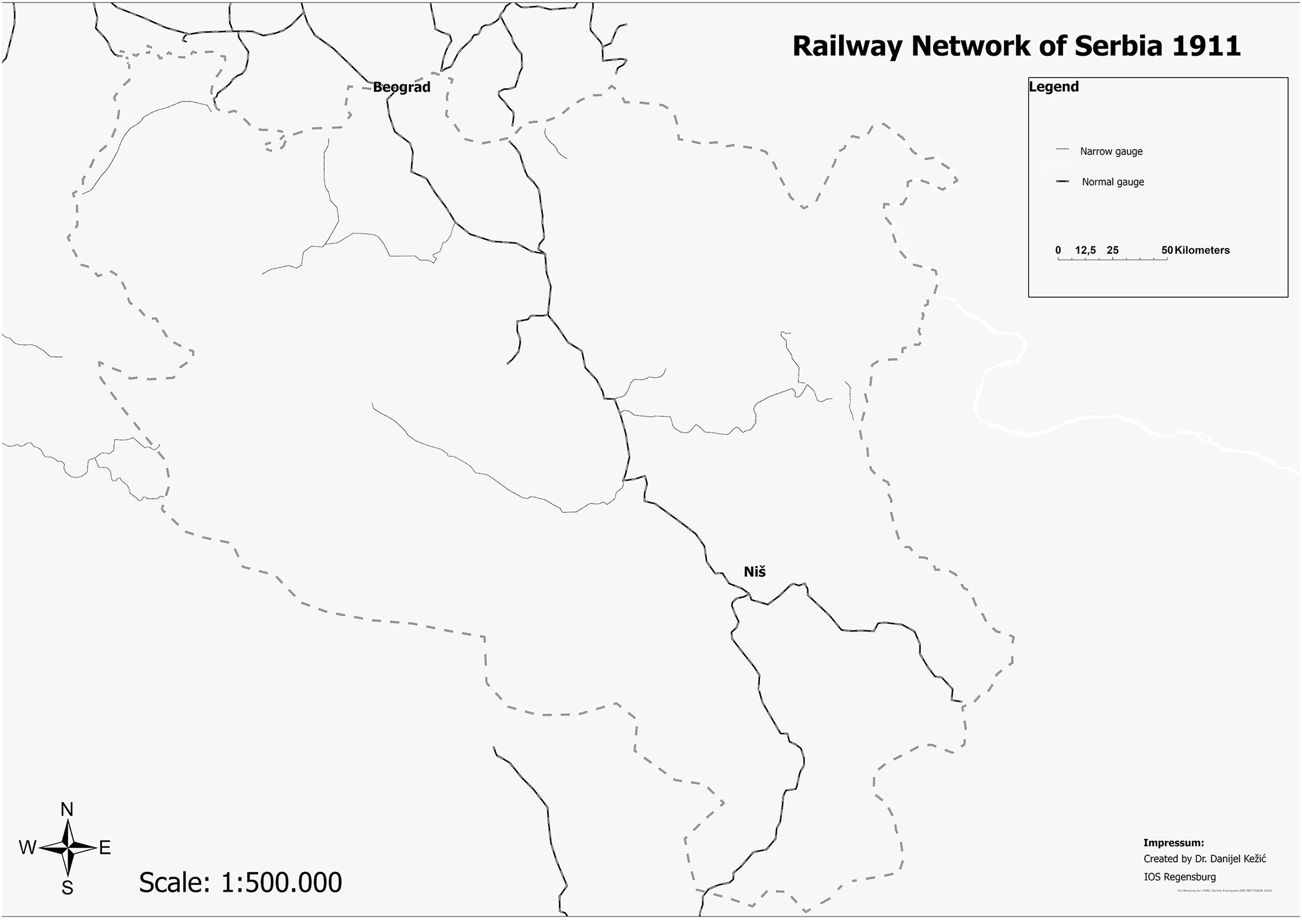
Railway Network of Serbia 1911 (elaboration by Danijel Kežić).
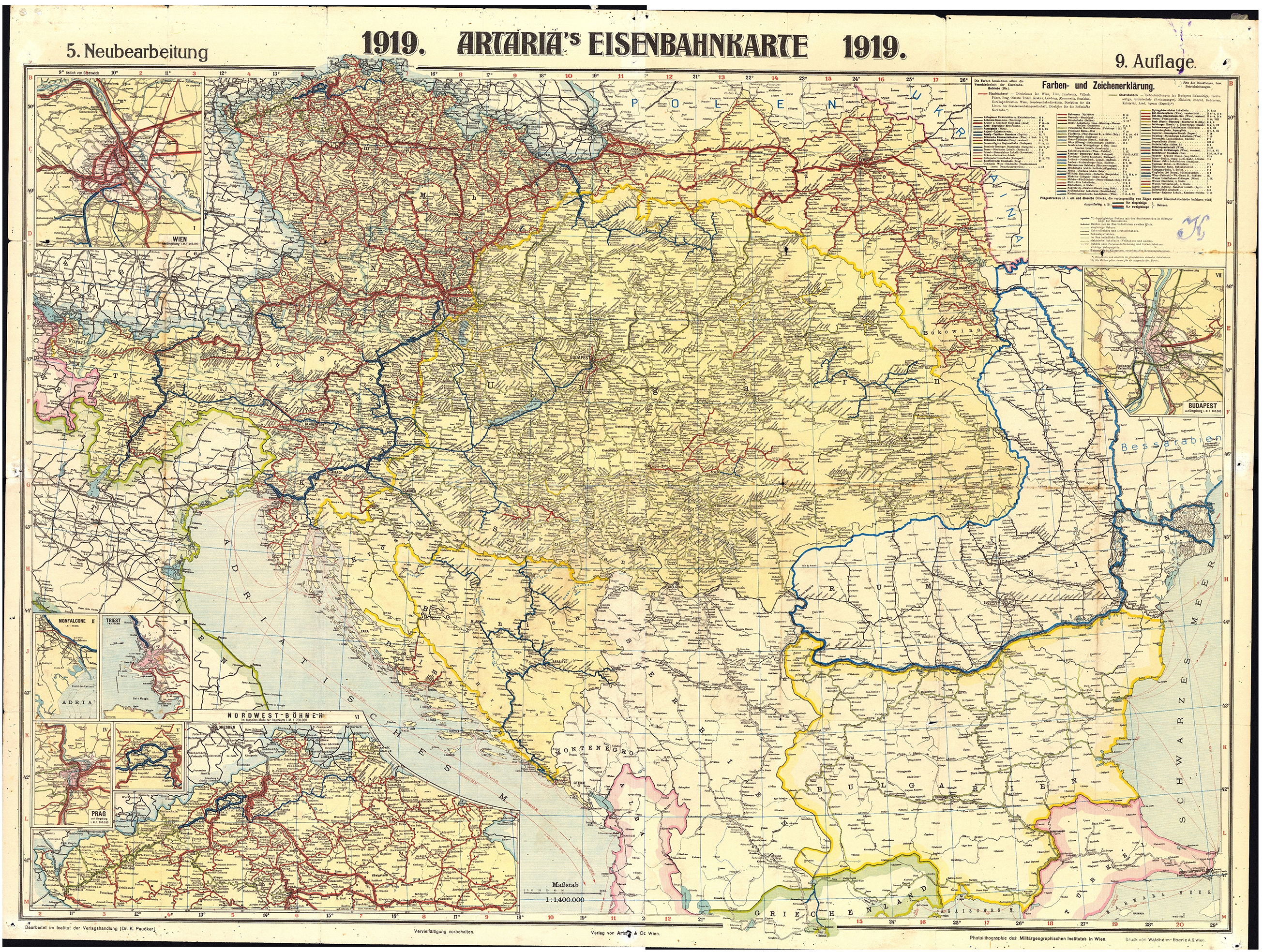
Peucker, Karl: Artaria’s Railway Map 1919. Courtesy of Biblioteka Matice Srpske (Novi Sad), GK IV 195.
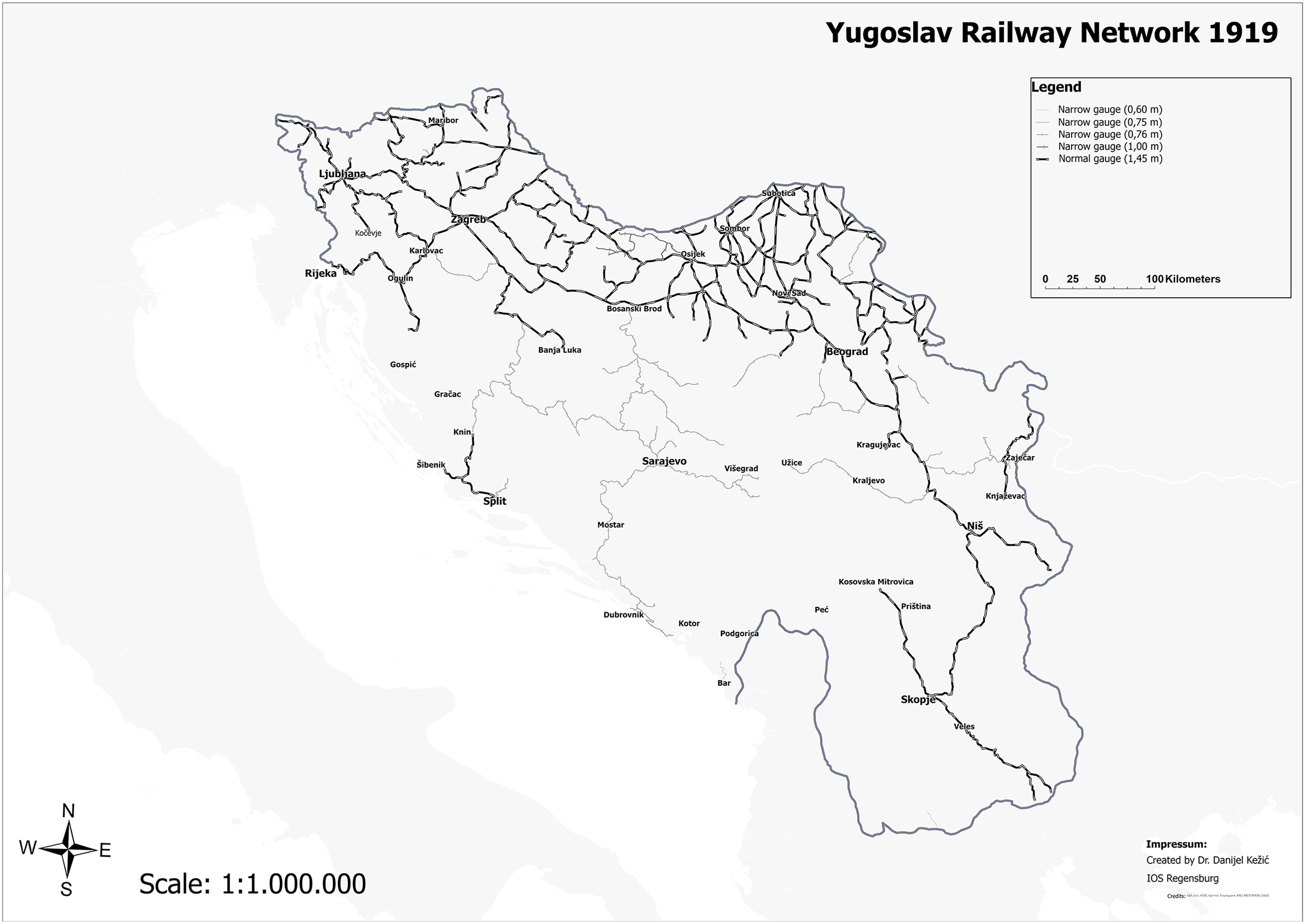
Yugoslav Railway Network 1919 (elaboration by Danijel Kežić).
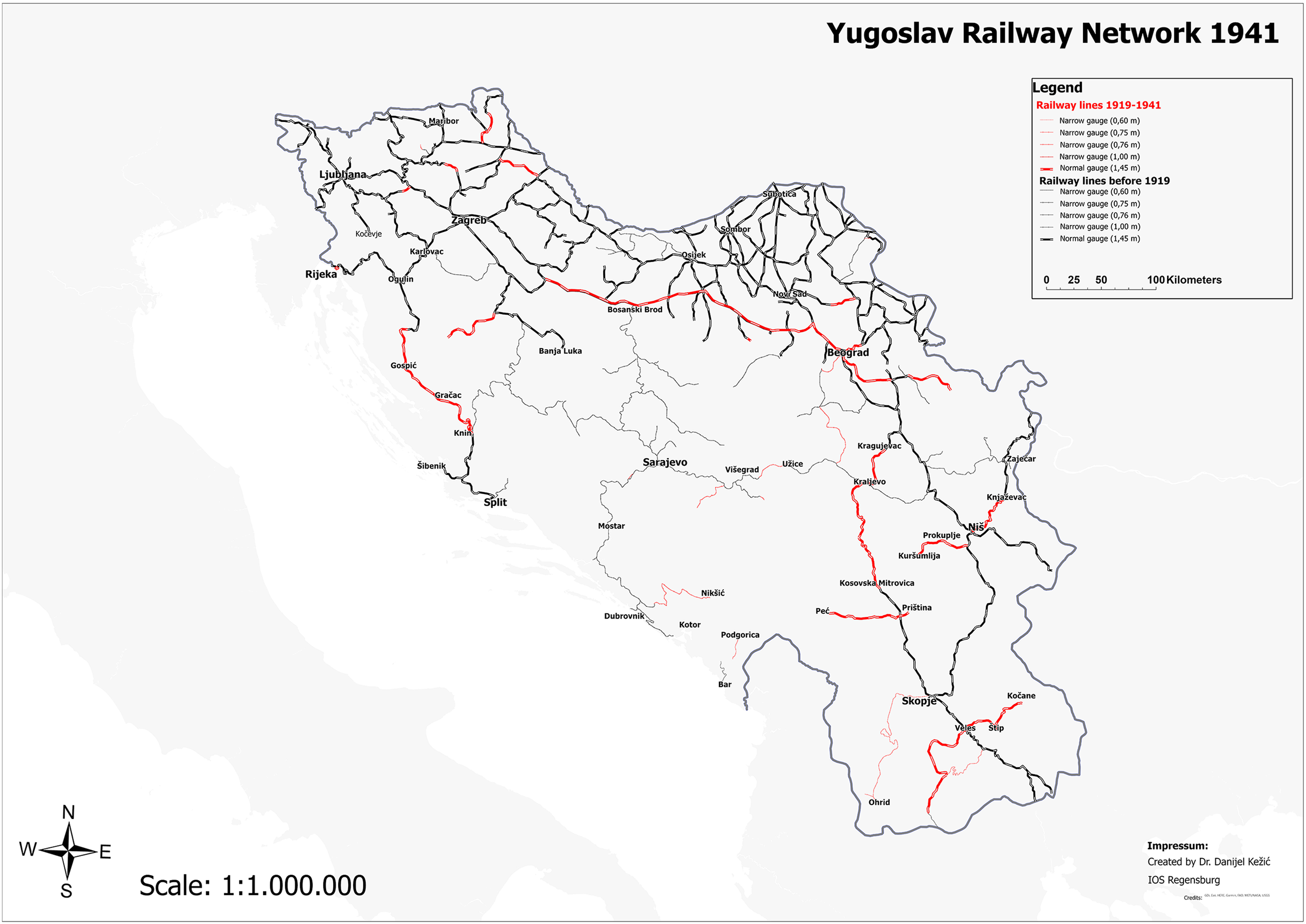
Yugoslav Railway Network 1941 (elaborated by Danijel Kežić).
Footnotes
Declaration of conflicting interests
The author declared no potential conflicts of interest with respect to the research, authorship, and/or publication of this article.
Funding
The author disclosed receipt of the following financial support for the research, authorship, and/or publication of this article: This work was supported by the Deutsche Forschungsgemeinschaft (grant number GZ: KE 2316/2-2).
