



Abstract
In the early 1920s, “Lady Bus Conductors” were recruited for the first time in Melbourne, Australia. They were employed by private companies, who entered into competition with the public-funded urban transport sector. Combining labour and cultural history approaches, this article draws on newspapers, photographs and union archives to develop an original gendered analysis of the interwar motorbus industry. It argues that women's labour underpinned the creation of feminised traits of service, safety and aesthetics on this new mode of transport. Such traits were successfully commercialised by private operators at the same time as they benefitted from “traditions” of women's lower wages. When the public sector reasserted control over metropolitan transport, they defined the buses as “men's work”, with long-lasting implications. Yet as this article reveals, some women continued to seek employment on private buses, claiming access to elements of the economic, social and cultural status of uniformed transport work.
Keywords
On Saturday 12 May 1923, eight “Lady Conductors” posed for a photograph (Figure 1) to mark the official opening of Trak Motors, a privately owned bus company, in Melbourne, Australia. Dressed in peaked caps and rather ill-fitting khaki jackets, the women appear to be relaxed and smiling, standing in close proximity to the large new motorbuses which would constitute their workplace.
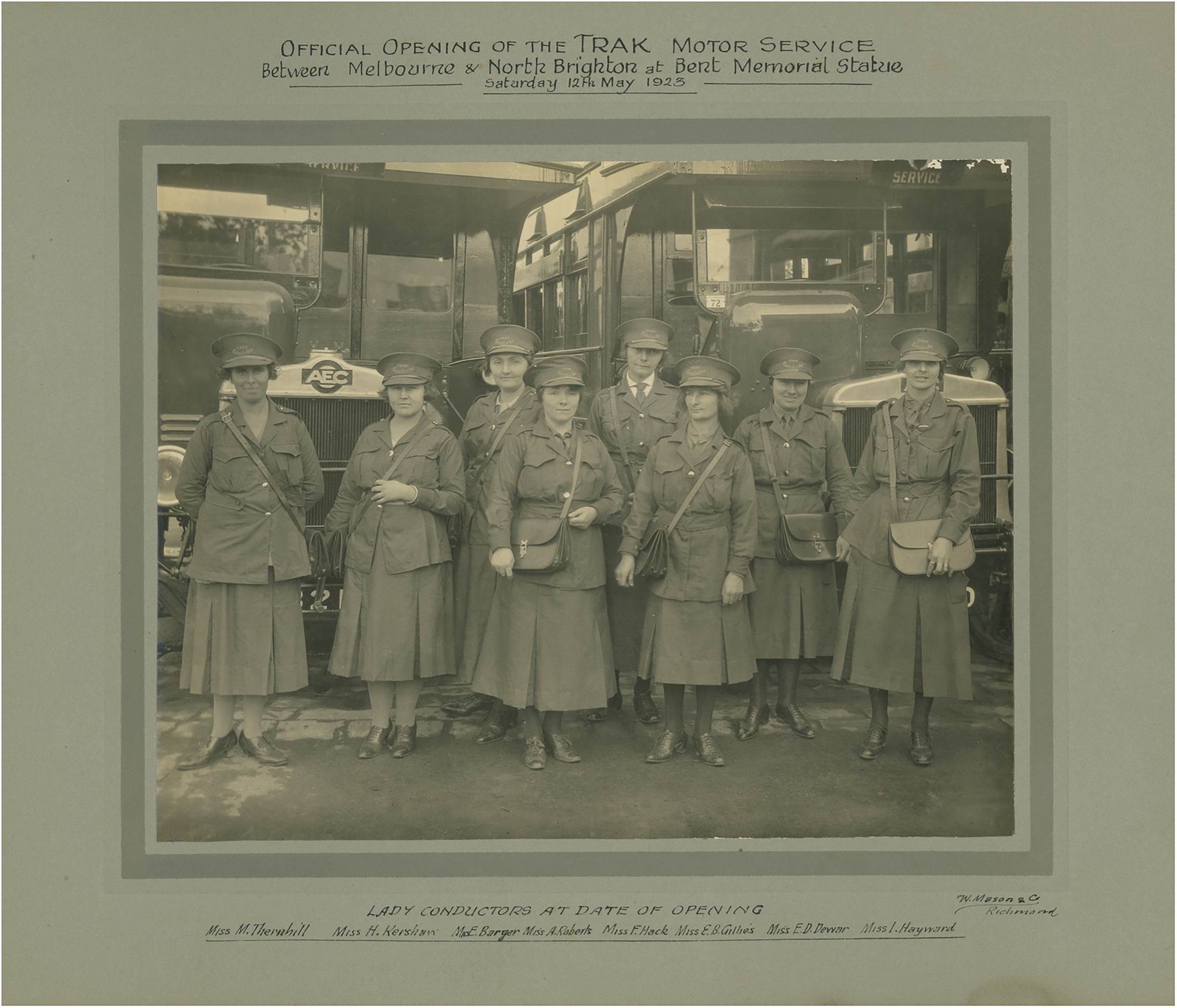
W. Mason & Co., “Official Opening of the Trak Motor Service”, 1923.
Such photographs of women transport workers are familiar to historians of Britain, where it was claimed nearly 5,000 women worked on the London buses alone during WW1. 1 In Australia, however, women had not been employed on the wartime buses. 2 Here, the camera has captured a moment when a change in transport technology (not a shortage in male labour), funded by private capital, made new modes of feminised employment possible. 3 According to Melbourne's Herald newspaper, these were the successful applicants from the many women “anxious to don a smart uniform and adopt the novel calling of lady bus conductor” [emphasis added]. They would be working the approximately 12 km route to the growing beach-side suburb of North Brighton. 4
The history of women's peacetime employment on land transport – in Australia and elsewhere – has been little studied, especially prior to Second Wave feminist interventions and legislative change from the 1970s. 5 Metropolitan public transport, outside “extraordinary times, such as wartime”, is typically understood to have been the preserve of men. 6 In one recent account of the Melbourne “bus wars” between (and amongst) private and public-funded transport operators (including the tramways), women conductors are tellingly absent. Instead, there is an emphasis on the “larrikinism” of male bus drivers and proprietors. 7 Assumptions about the masculine nature of transport work have had real-life implications for women, especially in operational roles, to the present day. 8 Where a 1924 report confidently proclaimed “[t]he girl conductor has come to stay” in Melbourne, women's place on the buses (and in transport history) was far from assured. 9 Nevertheless, the very conflict over women workers influenced gendered understandings and experiences of bus travel (especially the dynamics of comfort, service and safety) just as it was becoming established as a key enabler of urban and suburban mobility.
This article is the first detailed study of women bus workers in interwar Australia. It continues the project of scholars such as Jo Stanley and Margaret Walsh to not simply add women workers into transportation history, but to take a gendered approach to the sector. 10 It combines labour and cultural history approaches to focus on the circumstances (and contemporary understandings of those circumstances) surrounding women's waged employment as motorbus conductors. 11 Although small in number, Melbourne's women bus workers received the most extensive press coverage. Elsewhere in Australia, women conductors faced more entrenched resistance from public-sector employers, unions and the state. By May 1924, the Adelaide City Inspector and Licensing Officer was refusing licences to female conductors and drivers; a formal ban on women drivers was later justified by the city authorities on the grounds “that the employment of cheap female labour was not conducive to the safety of the travelling public”. 12 Queensland, too, instigated a ban on women bus drivers by the late 1930s; no evidence has been found of women conductors in the state. 13 In Sydney and Canberra, “cheap boy labour” was preferred to that of women on the buses. 14 Over in Western Australia, women were given roles as “fare collectors” from the later 1920s but were significantly denied conductor status. 15 Although this is a Melbourne case study, then, the debate over appropriate women's work on the motorbuses was being enacted on a national stage. Further research is needed into the dimensions of women's bus work overseas but it is possible to catch glimpses in the British press of “conductresses” in the 1920s and 1930s, despite post-WW1 demobilisation. 16
Piecing together the story of the “lady bus conductors” poses methodological challenges given the lack of extant corporate archives. Precise numbers of women employed in this role could not be traced, though at least 40 worked for the Kintrak company in 1925. 17 Union records have proved elusive: the minute books of the Motor Transport and Chauffeurs’ Association (MTCA; also referred to as Motor Transport Union) are missing key years; fortunately the Australian Tramways Employees’ Association (ATEA) journal, the Railway and Tramway Record, survives. 18 Digitised newspapers and photographs, read through a critical lens, have proved invaluable. Such sources provide insights into contemporary understandings of the gendered labour of conducting and offer rare glimpses of some key historical actors, including the women themselves. 19
This article illuminates how employers, unions, workers, the press and sometimes passengers constructed and contested gendered work in a new sector of public transport. It analyses, first, the circulating discourses of modernity and tradition used to debate women's employment. Second, it examines how feminised meanings were attached to bus travel and to conducting. Finally, the tactics of women defending their right to ongoing employment are explored. I argue that women's conducting work, even when rejected, was central to the gendering of Australian motorbuses as a mode of public transport. Women's labour was weaponised in the “war” between transport operators competing for passengers and space on the roads. The “lady conductor” was simultaneously a distinctive asset and a symbol of the exploitative practices of private capital. Women conductors, meanwhile, placed a high value on their work and fought to keep it. One hundred years on, the battle continues for women's equality of access to transport work. 20
A “novel calling”?: modernity, tradition and women's work on the buses
Interwar Australians lived through a period of rapid change in motor transport. When war broke out in 1914, motorbuses would have been a rare sight. Cable and electric trams, staffed by men, were already well-established in major cities but horse-drawn vehicles remained. 21 Experiments with steam and petrol-powered buses had been short-lived. 22 By contrast, the London Motor Omnibus Company was running 386 vehicles in 1908. 23 The exigencies of WW1 suddenly made buses more viable by accelerating improvements to petrol engines; the end of wartime restrictions, meanwhile, enabled the import of bus chassis – especially from the United Kingdom, where motorbus manufacturing was more advanced. 24 Returned military personnel also brought skills in driving and maintaining heavy vehicles; their war bonuses facilitated investment in this new business opportunity. 25 These developments were not unique to Australia. The UK and United States, for example, also witnessed the rise of private motorbus operators and each eventually moved to legislate the sector. 26 However, the relative newness of Australian cities (Canberra was still under construction), combined with a lower overall population and the isolated nature of major urban centres, did produce distinctive experiences of transportation. 27
Motorbuses heralded new modes of mobility. Not being dependent on the building of capital-intensive tram or rail lines, and unconstrained initially by any strict government licensing of routes, they were well suited to serve Australia's rapidly developing suburbs. 28 These buses synchronised with urban modernity, which brought greater public visibility, mobility and employment opportunities for women. 29 As a mode of public transport they also made such mobility accessible to those women who could never have afforded one of the new petrol motor cars. 30 A contemporary piece on the appeal of buses remarked “this is the age of the petrol-driven vehicle. The fair sex is fond of fast travelling. Next to a motor-car well, a motor ‘bus’”. Australian historian Georgine Clarsen has argued for an analysis of the “genealogy of efforts to inscribe fresh versions of masculinity and femininity” into the new domain of petrol cars. 31 This genealogy takes a distinctive shape when applied to motorbuses.
The newness of bus technology and the “innovation” of women transport workers became mutually constituting and emblematic of urban modernity. At war's end, in September 1918, three Sydney women bus “conductorettes” were “a distinctive novelty”. 32 Five years later, the “lady bus conductor” in Melbourne was still being described as “novel”. Pre-WW1 omnibuses had typically functioned without conductors: passengers paid fares directly to the driver. 33 The rapid post-war expansion of urban motorbus services, all jockeying for position on increasingly crowded streets, created a need for speedy efficiency in collecting fares and helped establish the new role of conductor. Reporting on the recruitment of “lady conductors”, some journalists turned eagerly to modern young women for comment: there was “lively protest” from a “flapper” at the contention that this was “essentially men's work”; an actress concurred this was “ridiculous”; and another retorted, “Bosh … Whether we girls turn to the left or right there are men ready to howl that we are invading some special province of theirs”. 34 These women derided attempts to associate conducting with existing traditions of men's work. As Clarsen asserts, white Australian women (already enfranchised) were “held up as models of advanced female citizenship” and “given a degree of latitude” when they moved into new enterprises. 35 Clarsen records, for example, how some sectors of the press “celebrated the ethic of experimentation and female independence” in Alice Anderson's women-only garage. 36 Mr Fred Knight, Trak General Manager, alluded to Anderson's “prosperous Melbourne hire garage”, employing “only female drivers”, to support his (expedient) contention that “the sexes should have equal choice in … employment”. 37
Transport was not the only field offering women new employment prospects. Where some historians have noted conservatism around gender roles in the UK and US post-WW1, Australian women seem to have benefitted from a limited degree of new opportunities, even if these were not universally celebrated and in some cases were quickly closed down. 38 Historian Raelene Frances, for example, noted concern over the “stability of sex roles” as women entered non-traditional manufacturing work, with an intensified “hostility” related to economic downturn in the late 1920s. 39 The available statistics reveal declining rates of white women's employment in domestic service and even (after 1911) manufacturing, with a steady increase in health, education, commerce and finance. More women were working in transport, with participation rates increasing from 0.38 per cent (1911) to 0.62 per cent (1921). 40 Although still a very minor sector of women's employment, transport work placed these women in very public view as they engaged in labour with typically masculine connotations of mobility. Whilst some women preferred the relative “freedom of the factory” over the long hours and constraints of service, conducting brought a different kind of freedom, through the capacity to travel and a relative lack of immediate supervision: some women professed they liked “the open air”. 41 Motorbus transport also carried symbolic weight, being intricately bound up with the “accelerated growth” and pace of metropolitan life in interwar Australia. 42 Women workers on the motorbuses thus took on cultural significance disproportionate to their small numbers.
With Federation only two decades old, Australia's desire to be recognised as a nation equal to other western nations (even if still not fully independent from Britain) infused interwar debates over appropriate women's work. 43 Alongside an appeal to newness, advocates of women conductors mobilised a discourse of historical precedent – tradition. Mr Thomas, Secretary of Trak Motors, argued that it would be “in error” to see this as “essentially men's work”, “since in most cities of the world … women have been employed as bus conductors”. 44 Lieutenant Fred Knight (General Manager of Trak and subsequent founder of Kintrak) would have been personally familiar with British industry practices, having spent 18 months in wartime Liverpool studying “the problem of transportation”. He could hardly have been unaware of the celebrated presence of women workers. 45 In the Australian press, direct comparisons were made with London, where, according to the Herald, women conductors had become “a mere commonplace”. 46 Clarsen emphasises how “British women's success in entering military service helped to foster a transnational climate for women's motoring ambitions”. 47 Whilst car ownership would likely have been out of reach of the working-class conductors, motorbuses offered an alternative avenue for ambitious mobility.
Figure 1 illustrates how private motorbus companies engaged with the idea and need for tradition in formulating a new workforce. Uniforms gestured towards a recent heroic wartime past, as well as to more distant pseudo-military traditions (alluded to in railway uniforms since the nineteenth century). 48 However, these companies simultaneously used the employment of women to position themselves as new and distinctive. By 1924, Kintrak's women conductors sported a more fitted uniform, which not only accentuated their women's bodies but also allowed masculine ties and trousers (see Figure 2). Trousers were more practical for moving around and on and off the buses in all weathers but could be interpreted as a worrying claim to masculine status. 49 The sight of women in trousers would have been unusual in interwar Melbourne. 50 A Scottish woman remembered being one of the first to “wear the breeks” on the buses. She had worn “trews” in her wartime job as a “conductress on the electric trams in Glasgow” so was not “shy” like her Australian colleagues. Nevertheless, she remembered feeling embarrassed on her first day in her new uniform when the streets “were lined two-deep for half a mile” with passengers. 51 Such contradictory sartorial meanings (captured in photographs) expose the tensions which manifested whenever women claimed the right to work at an occupation where male workers already had some traction.
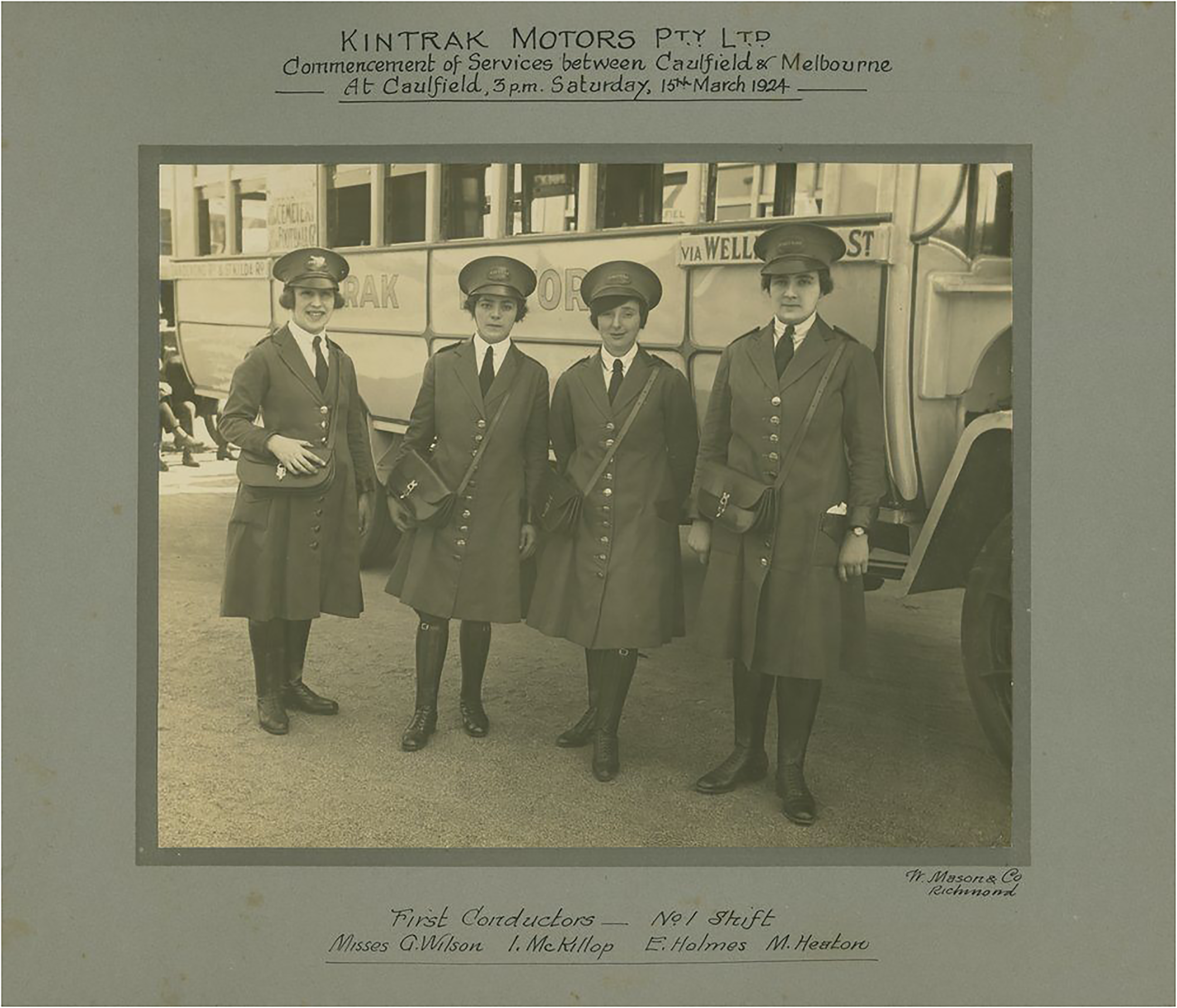
W. Mason & Co., “Kintrak Motors Pty Ltd, commencement of services between Caulfield & Melbourne”, 1924.
Discourses of tradition, precedent and custom were mobilised on both sides of the debate. One correspondent to the Herald was convinced that “‘Conductoring’ is not a woman's job” and was perplexed by the lack of protest from “unemployed diggers … against female employment”. 52 The author may have been aware of earlier violent protests by ex-servicemen in the UK, resulting in the dismissal of the last of the “tram girls” in 1920. 53 The MTCA secretary, Mr Owen McKenna, threatened that if Trak persisted in the “innovation” of recruiting women for “essentially men's work”, the union would take steps to prevent buses from running. McKenna clearly hoped to galvanise support from the ATEA, arguing that women on the buses set a dangerous precedent as “a forerunner to the employment of females as tram conductors, in place of men, at low rates of wages”. 54 Existing transport unions in Australia sought to transfer their industrial traditions to the new, as yet un-unionised, motorbus sector. Such traditions had developed to protect the pay and conditions of male members. 55 Even after accepting women into the union, McKenna claimed they could not take the “strain” of conducting, which was “men's work”. 56
The ATEA Executive recorded their “alarm” at women conducting in June 1923. 57 An article in the Record expressed “no enmity towards the girl ‘bus conductors’” but was “[s]orry that women should have to engage in tasks that wear out even strong men” and was “frightened” for wives depending on tramwaymen's wages. However, in October the tone changed, with accusations of “false gallantry” for those who said the work was “too tough” for women. 58 By December 1923, the emphasis shifted away from protecting women from (men's) transport work to an attack on exploitative capitalist “traditions”: such “rotten traditions” were behind the “abomination” of lower wages for women conductors (women were typically paid 50–66 per cent of the “foundation wage” established in 1920). 59 The ATEA had been “building up the wages and working conditions of its members” and was “disconcert[ed]” to see the Wages Board Award of just “£3/15/ - for female conductors, £4/10 - for males, and £5 a week for drivers, for 48 hours a week”, with no guarantees of annual holidays or uniform provisions. 60
For their part, the private companies contested accusations of exploitation. Mr Knight stressed that his female conductors, now union members, enjoyed one of the highest award rates for women in the country. 61 Their pay was higher than that of junior male tram conductors (aged 18–19 years), who received approximately £2/14/6 weekly in 1923. 62 For women, as for men, work in the operational side of the motorbus sector brought relatively good pay and conditions, as well as a degree of social and cultural capital associated with transport work. 63 Some women had previously worked in the expanding service sectors of health, education and commerce: in “such varied occupations as dental assistants, saleswomen, the stage and nursery”. 64 Although it is usually impossible to discern individual motivations for leaving such positions, one woman vividly recalled being paid just 35 s a week as a waitress: “And oh! It was hard work, too!”. In contrast, she received “£3 15 s a week and overtime” on the buses, with a uniform provided and “always tea for us”. She was still working, with a different bus company, in 1926. 65 By the end of 1923, the initial furore over women's employment had subsided. The next section explores how their day-to-day work was understood in gendered terms and the broader implications of this for motorbus transport.
“A most suitable occupation for a girl”: feminising service, safety and aesthetics on the buses
Motorbuses were similar to, but distinct from, trains and trams; their gendered meanings as spaces for both passengers and workers were evolving in the 1920s. Early buses were renowned for their “hard and uninviting” seats and were – in the words of contemporary journalist, C. A. Jeffries – even “more dangerous than they looked”. The import of motorbus chassis from England, Jeffries continued, brought a “new era”: these buses “ran smoothly”, “had cushioned seats” and “looked safe”. 66 In the context of concerns to “protect” women (as “mothers of the nation”) from unnecessary dangers or discomfort, such buses could better accommodate women workers and passengers. 67 When Trak initially advertised for “Lady Conductors”, their AEC Deluxe Buses were described in the very first sentence as “single deck, completely enclosed”. 68 Mr W. L. Thomas, Trak Secretary, later emphasised that such buses would “eliminat[e] all outside work” for women. 69 Melbourne trams, by contrast, still had some cars with open sides and conductors had to balance perilously on the footboards to collect fares during the journey. Fully enclosed buses protected workers (and their passengers) from the elements, whilst the single-deck removed any need for women (passengers or workers) to risk impropriety in being observed negotiating stairs. Thomas proclaimed that there was no danger of this being “a forerunner of female conductors on trams” as women on his buses would not be “moving from trailer to dummy, moving points at street intersections, [or doing] footboard work”. 70 In the tense atmosphere of the bus wars, Thomas was strategic in defining bus work as qualitatively different from that on the tramways and, therefore, suited to women. Even so, lady conductors were required to be “of good physique” to negotiate a moving bus. 71
With improvements such as upholstered seating and better lighting, bus interiors could accommodate feminised meanings of domestic comfort. Public transport technology, Schmucki argues, “produces a ‘semi-public space’”, which incorporates elements of feminine, private, domestic interiors. 72 In 1920s Melbourne, this applied more to buses than to trams. Women bus workers, through their feminine appearance and pseudo-domestic labour, enhanced such associations with private homely spaces. 73 According to Mr Knight of Kintrak, “girl” conductors would apply their nascent housekeeping skills to keep the buses “as they will some day keep their houses – spic and span. They … take a pride in them”. By contrast, “A man keeps his ‘bus as he would keep a house, and looks upon the cleaning of it as a necessary evil’”. 74 Those advocating for women conductors emphasised their attractive uniformed appearance as both improving the aesthetic of the buses and facilitating interactions with the public. One observer proclaimed of the “delectable conductress” on his regular service: “She is spic and span and captivating and good to look on”. 75 There is a telling echo of “spic and span” across descriptions of the bus interior and the female conductor, suggestive of the links being made between women's bodies and the neat, modern buses. Early motorbuses and the women who worked on them mutually reinforced more feminine meanings of bus travel in contrast to the trams. As Barry and others have argued, women's labour in maintaining their feminine appearance, commercialised by employers in the transport sector, has been unacknowledged and unpaid. 76
As well as creating an appealing, domesticated, space through their homemaking instincts, women conductors were expected to enact feminised traits of care. Such emotional labour would keep buses running smoothly and profitably: “She helps old ladies to their seats, and gentlemen too”. 77 Melbourne conductors would “hold the baby while the tired mother climbs in … all done with a smile and a kind word”. 78 The role of the lady bus conductor both included and went beyond the “nurturing” role of stewardesses on interwar passenger ships. 79 As well as handling cash, they had significant responsibility for passenger safety and the overall safe operation of the bus. One Melbourne journalist was impressed at the sheer range of duties: “She has to be … an accountant, a director of ceremonies, a housemaid, O.C. of the bus, and an encyclopaedia of information”. He was full of praise for “[t]hese girls” as “the last word in polite efficiency. Cool, competent and courteous”. His enthusiasm was infused throughout with a barely concealed sexual attraction for “the chic and charming lass … with her cheeky little cap set at a coquettish angle on her shingled curls”. 80 This account uses the language of “efficiency” and “chic” modernity to praise a worker who is nevertheless still both infantilised as a “lass” and sexualised as “coquettish”.
In the highly competitive atmosphere of the early 1920s, with so many buses and trams plying the streets, it was important to pick up passengers quickly and efficiently. Conductors facilitated this by collecting fares during the journey. One self-defined “connie” [conductor] in Melbourne astutely used the task of exchanging money for tickets to puncture any association with masculine labour: “Fancy a grown man wanting to take our jobs from us! Just handing out little slips of paper!”. 81 Given their responsibility for monetary transactions with passengers, Trak required women applicants to be “refined”, “intelligent” and “alert”. 82 Kintrak further specified that recruits should be between 20 and 30 years old – a very specific, older demographic no doubt intended to embody maturity and authority. Conductors’ responsibility for a substantial amount of cash could place them in danger. Miss Elsie Barger was finishing her shift just after midnight, in the Melbourne suburb of Gardenvale, when an armed man boarded the bus and stole the takings. 83 The necessity for night-shift work was regularly cited as excluding women from certain operational public transport roles (even as it was accepted for positions such as railway gatekeepers and cleaners). Banning night shifts had become a focus of broader moves to “protect” women since the passing of a 1919 International Labour Organisation convention. 84 Yet women's night work on buses was unquestioned in this article.
The necessity of dealing with (and extracting money from) badly behaved passengers, especially men, was one objection to the employment of women conductors. The secretary of the industrial section of the Young Women's Christian Association rejected this “dead-end job” as “a girl may be called upon to deal with a drunken man”. 85 Still, it was possible to position women as well suited to the pacification of potentially unruly male customers: who “stand in awe of her”. 86 One South Australian observer juxtaposed the sartorial femininity of the “petticoated conductors” with the “terror” they induced: “Their tongues snapped out a persistent command … Melbourne soon learned not to argue with a woman conductor”. 87 An experienced woman conductor was keen to stress, “I’ve never met any rudeness … Never once. No one is ever rude”. Her emphatic denial, accurate though it might have been, was tacticalin shoring up the appropriateness of women in this occupation and in sustaining good relationships with customers. She avowed this was “a most suitable occupation for a girl”. 88
Alongside handling individually “troublesome” passengers, conductors were held legally accountable for enforcing limits on the overall number of travellers. This task defied an easy gendered definition, as (according to one NSW incident) even a “big, burly man” could have trouble preventing passengers from boarding. 89 Both female and male conductors found themselves subject to fines. 90 From the perspective of the Melbourne bus companies, the spate of prosecutions by the City Council in the mid-1920s was an attempt to undermine them in favour of the trams – rather than any reflection of their conductors’ abilities. They complained that tram conductors were not facing fines even though there was “far more danger in people clinging to the stanchions of the dummies of trams”. 91 The court responded that the purpose of the law was to ensure comfort rather than safety, again hinting at constructions of motorbuses as distinct from the (masculine) utilitarian trams. 92 Nevertheless, the companies were right to be concerned as developments from the mid-1920s threatened their financial viability. The final section explores not only how bus conducting was being re-configured and re-claimed as men's work in this context but also how women conductors, enlisting the support of their passengers, actively resisted the threat to their ongoing employment.
“[L]ike a sailor leaving his ship”: laying claim to transport work
Melbourne's “lady conductors” had become emblematic of the contentious development of motorbuses through private capital. Their fate was correspondingly intertwined with that of the private companies, who were accused of undercutting the publicly funded tramways and damaging, with relative impunity, the publicly funded roads. The Victorian state government (led by Country-National Premier, John Allan), under pressure from the tramways and local councils, moved to regulate the industry in late 1924. 93 The first of the Motor Omnibus Acts restricted the routes available to the private companies (giving priority to trams and tramway-operated buses) and imposed higher taxes on their profits. Motorbuses were simultaneously facing increased competition from the expanding electrified rail system. 94 The proposals led Kintrak to threaten closure in late 1924; Trak was similarly affected. 95 By late January 1925, the situation for the bus workers was bleak as “about 250 members of the Motor Transport Union” were threatened with dismissal, including at least 40 Kintrak women. 96
Newspaper reporting on the plight of the “bus women” suggests an assumption of public sympathy and an understanding of bus work as feminised. 97 The Argus, in a patronising tone typical of the era, referred to the “girl employees” (these were adult women) as being “overcome with emotion” at Kintrak's farewell meeting: “the regret at losing employment was overshadowed by the sorrow of the dissolution of a band of people who had worked happily and harmoniously”. 98 The journalist, even if perpetuating assumptions of women as emotional creatures, captured the grief at the loss of workplace community. However, they downplayed the economic impact for women, as well as the specific attachment they had to their transport work.
Some women were reluctant to leave the transport sector, seeking assistance in finding new positions through the Commercial Motor Users’ Association (CMUA). 99 Press interviews reveal the conductors’ investment in their occupation, which included a sense of connection to the technology – a trait so often configured as masculine. Miss Billie Wilson was “heart-broken” at being forced to leave her “old bus”, which she had “grown to love”. Billie tellingly expressed her attachment to “my bus” in the language of the male-dominated maritime world: “I feel just like a sailor leaving his ship”. She was not optimistic of finding similar work, noting, “So far only one of us has found employment … as a cashier in a hotel”. 100
Faced with unemployment, some women protested vigorously against the new legislation. Deploying their occupational identity, they donned their uniforms and publicly petitioned their passengers for support: “conducting a house-to-house canvass for signatures on their old routes” and stationing themselves at tables around the city (see Figure 3). 101 Photography captured and reinforced their status as transport workers: one press image featured “girl conductors … leaving the offices of the CMUA … to obtain signatures to a monster petition”. 102 Two days later, a woman conductor was photographed holding “the first half-mile of signatures”. 103 State Premier Allan was openly cynical about public motives in dealing with these “very fine types of Australian womanhood”, arguing “[i]t is much more difficult to refuse to sign a petition when presented by a lady than a man”. 104 The Herald, however, emphasised the extent of public support, with the “girls … beseiged by crowds … who wished to enter their protests against the bus routes scandal”. 105 These women confidently took the authority and status conferred on them by their uniforms off the bus and onto the streets, expertly harnessing passenger support for cheap, convenient transport. 106 Such activism by uniformed women workers would have been a rare sight, though the story of British women transport workers taking industrial action in 1918 had been widely reported in the Australian press. 107
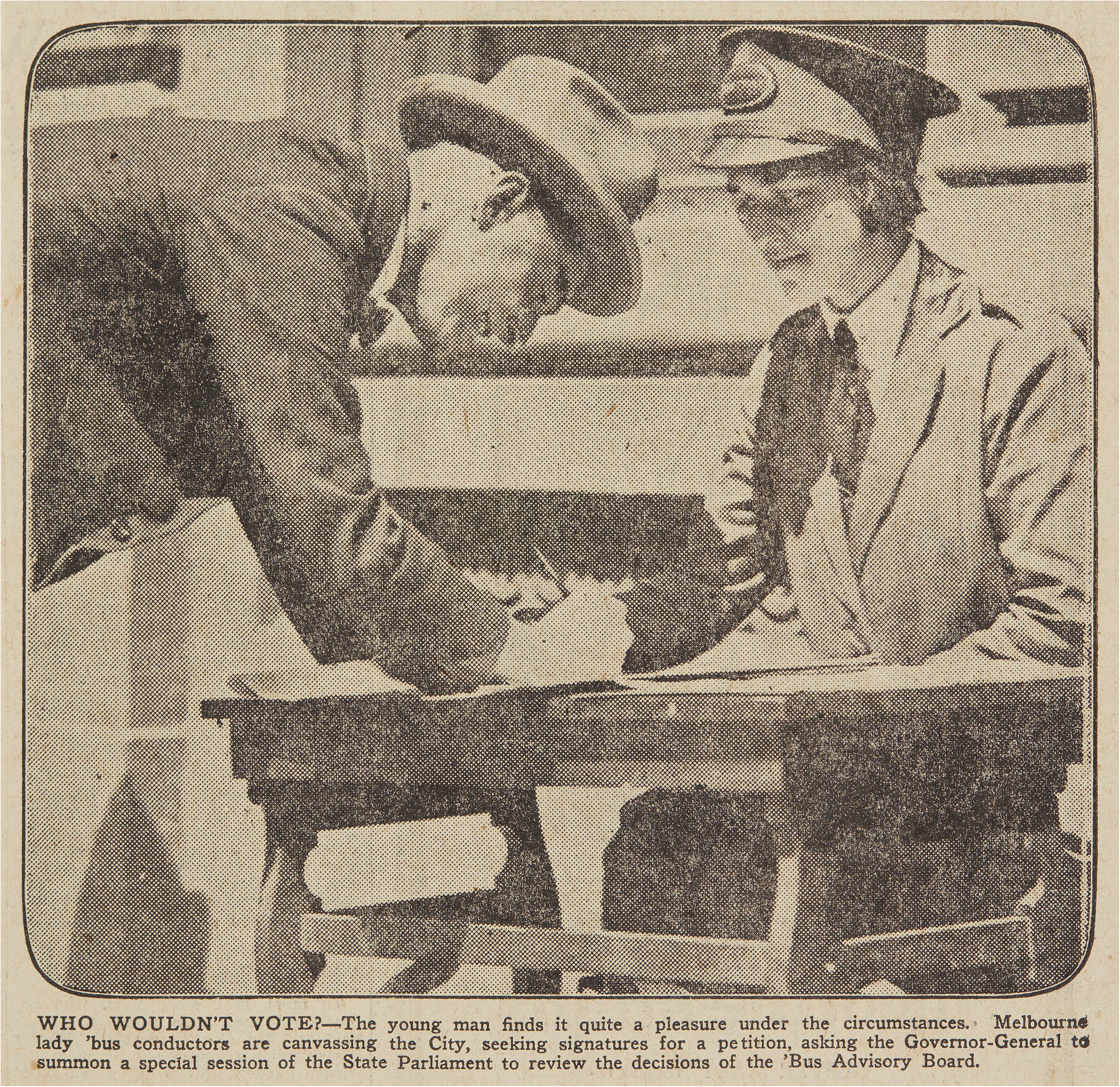
“Who wouldn’t vote?”, Evening News (Sydney), 6 February 1925, 14.
Despite public sympathy for the “bus women”, the feminising of the motorbus, and of motorbus conductors, was not assured. Although surviving companies were keen to engage female conductors, the MTCA positioned women (including their own members) as a threat to “men's jobs”. This came to a head when the Melbourne General Omnibus Company was reported to be taking on 12 Kintrak women by dismissing 12 men. 108 A strike was averted when the company agreed to retain all its present staff. 109 The following month, another alleged replacement of male conductors by cheaper female labour led to the Trades Hall Industrial Disputes Committee recommending that the union pursue “the principle of equal pay for equal work”. 110 A resolution was subsequently carried “to obtain equal pay for the sexes” “at the earliest possible moment”. 111 The ATEA journal challenged the “cynical people” who viewed this as an attempt simply to “create a monopoly of conducting for men”, arguing that “[s]entiment towards the fair sex still lives despite the onslaught upon jobs hitherto solely occupied by men”. 112 Whatever the motivation, no progress had been made by 1933, with women still on a lower rate. 113 However, the perception of an “onslaught” of women in men's jobs is revealing of a keen sense of masculine occupational identities under threat.
When the Melbourne Metropolitan Tramways Board finally started to run their own public-funded buses, they were to be “manned” by tram conductors, in “tram uniforms”. 114 Similarly, when the public sector started to wrest back control over Sydney's buses from 1926, the employers, with union backing, agreed to employ only men. The assertion of men's sole right to conducting work was accompanied by a rejection of any feminine associations: “no girl will dust a Sydney bus. She will never bedeck its walls with … a bunch of flowers”. Mr E. Campbell, secretary of the Sydney Bus Proprietors’ Association, asserted “pretty girls are distracting on buses” and they would not be “reliable in the lightning crises that develop in the day's traffic whirl”. 115 The potentially dangerous bus was not a space for titillation. A few months later, one Melbourne conductor was paraphrased as admitting “that they looked too good for the job”, though she added “but … that was because the men looked so bad”. 116 Her remarks, made in the context of the South Australian Royal Commission into public transport (which would confirm the existing ban on women drivers), highlight ongoing debate over the gendered nature of bus travel. 117 In Melbourne, one ATEA observer had contrasted the “comfort of the business girl” on buses operated by the tramways, with the discomfort of the “essential workman compelled to swing on the dummy of an overloaded tramcar”. 118 Even with both operated by men, this commentary sustained different gendered associations for the buses and trams.
The fall-out from the Melbourne “bus wars” forced Kintrak into liquidation in March 1925. 119 Other private companies regrouped and cooperated to keep a stake in the industry. Some women at least would keep their jobs. In both Victoria and Western Australia, women were being employed into the 1930s. 120 That they faded from the press suggests they had become an unremarkable feature of urban life in at least two Australian states as the perceived threat to traditions of men's work had subsided.
Conclusion
In the early 1920s, a convergence of women's agency, new technology and entrepreneurship created new employment opportunities for women on Australian motorbuses. Virginia Scharff has identified these same three elements accelerating change in the US motorcar sector. 121 However, a fourth element needs to be added to this nexus: the interwar growth of Australian cities. Women's work on the buses (even in cases where it was rejected) was intricately bound up with, and helped to define, the broader changing nature of public transport, which was in turn shaping and shaped by new (gendered) urban geographies. Transport historians cannot fully understand what was at stake in the Australian “bus wars” if they ignore contemporary debates over women's labour.
The women at the centre of this article were keen to seize, and to retain, the economic, social and cultural opportunities of uniformed motorbus work. Their labour underpinned feminised traits of service, safety and aesthetics on this new mode of transport. Private bus operators successfully commercialised these traits, at the same time as they benefitted from “traditions” of women's lower wages. To date, these women have gone unrecognised in labour and transport history scholarship.
The public-funded transport sector – tramways and railways – was slow to mobilise both the new motorbus technology and the economic and symbolic potential of women's labour. They did not embrace developing cultural meanings of motorbuses as modern, fast, efficient, comfortable and feminised. Instead, the employers and associated unions transferred existing masculine traditions of work and technology to the motorbuses – typically supported by the state. This effectively served to limit women's employment in urban public transport, perpetuating a male-dominated sector which is still being dismantled.
Footnotes
Acknowledgements
The author wishes to acknowledge that this paper draws extensively on original archival research conducted by Dr Lee-Ann Monk and is the result of collaboration with Professor Diane Kirkby and Dr Lee-Ann Monk on the ARC Discovery Project, “Breaking Down Tradition: Women in Male-Dominated Work” (DP160102764). The author wishes to thank the anonymous referees and colleagues in the La Trobe History Program for comments on this paper, especially Liz Conor, Kat Ellinghaus, Charles Fahey, Jennifer Jones, Tim Jones, and Nikita Vanderbyl. A version of this paper was presented at the conference of the Australian Society for the Study of Labour History in 2022.
Declaration of conflicting interests
The author declared no potential conflicts of interest with respect to the research, authorship, and/or publication of this article.
Funding
The author disclosed receipt of the following financial support for the research, authorship, and/or publication of this article: This work was supported by the Australian Research Council, (grant number DP160102764).
