




Abstract
This article seeks to tell an emotional history of car use through the genre of life-writing, a source whose use in historical mobility research has recently been advocated by Colin Pooley. It focuses on two diarists, Hugh Miller and Victor Klemperer, to uncover what automobility looked and felt like in interwar Britain and Germany, when modern mass motorisation was emerging. It highlights that experiences of automobility were heterogeneous and dependent on social position, combining the excitement and liberty popularly associated with interwar car use with the banal, frustrating and terrifying. Motorists like Miller and Klemperer felt conflicted about automobility and what it represented. Their inner ambivalence points to a unique emotional engagement with the car, which may help to explain its persistence in twentieth-century society and beyond.
Introduction
On 22 November 1935, German professor Victor Klemperer took his first driving lesson. In his diary he recorded a journey of mixed success: “At first it went terribly badly, I came home completely shattered and soaked through, then much better – the high point of my pride: a drive through the whole city”. 1 Eight days later, British doctor Hugh Miller recorded in his own diary a less eventful excursion by car: “Mileage 42,595. Mundesley to Osterley with John solo. Tea:- Lakeman's Newmarket (so-so)”. 2 These two men lived very different lives, but what they shared in common was that they were both motorists during a new phase of the car's history – a phase which, by transforming a nineteenth-century technology into the definitive twentieth-century consumer item, was to be the most enduring. The significance of what they wrote was implicit to the form: driving a car in 1930s Britain and Germany was, quite literally, a noteworthy occasion, and one loaded with feeling.
Scholarly literature on historical automobility has developed over the last two decades, to encompass the design, production and consumption of the car, as well as its intersections with myriad themes, not to mention its place in sociological systems of mobility. 3 Yet motorists like Klemperer and Miller are rarely front and centre of historical accounts. As Colin Pooley notes in his recent research into historical mobility and diaries, on which this paper seeks to build, “transport history has for the most part focused on the transport itself rather than on the people who travel”. 4 Not without good reason: records of sustained quotidian car use at an individual level are scarce compared to the published motor tour accounts and motoring press annals which necessarily catch historians’ attention. So quickly did the car become ubiquitous that to many its significance was unconscious.
Using the diaries of Klemperer and Miller, this paper seeks to contribute to the literature on historical automobility in two novel respects. The first is with a comparative approach, studying British and German motoring together. Such transnational studies of automobility are uncommon, Gijs Mom's recent worldwide histories of the automobile being noteworthy exceptions. 5 The second is by focusing on lived experiences of motoring to tell an emotional history of the car. The car is “perhaps the most successful innovation ever”, but it is also much more than a technological object, as Roland Barthes famously wrote in 1957. 6 Brian Ladd's study of love and hate towards the automobile testifies that this is not unchartered historiographical territory. 7 However, a binary distinction between love and hate belies the range of emotions tied to automobility. As sociologist Mimi Sheller reminds us, “cars are above all machines that move people, but they do so in many senses of the word.” 8 Not that emotions are only engendered by and towards the automobile. The “emotional turn” in recent research contends that emotions are not just a “biological ‘response’ to an external… stimulus”, but “an active component of experience and so something to be explained and which in turn helps us explain events”. 9 And if emotional history can enlighten automobility history, so is the reverse true. The intersection of emotion with material objects is one of many emergent themes in this flourishing field. 10 Furthermore, historians of emotion have called for greater interdisciplinary collaboration and the expansion of the field beyond academia. 11 In this respect, the topic of automobility – patently relevant, and rooted in sociology, politics, economics, and technology, as well as history – has much to offer.
The growth of personal motoring in the first half of the twentieth century coincided with a growth in diary keeping, and by the 1930s specialised diaries were marketed for motorists. 12 For some motorists a motoring diary was a travelogue; for others it served a practical purpose, to track expenditure and repairs. The diaries of Klemperer and Miller do both, and are exceptional, not just because they survive, but because they were maintained for a remarkably long time. These men are unlikely bedfellows. Klemperer was a motorist for less than three years; Miller for six decades. Even so, I argue that by taking their diaries together, we can better understand the lived emotional experience of automobility in Britain and Germany in the 1930s. This period has been called the “first era of mass motoring”, if not in terms of actual car ownership, at least in terms of popular aspirations for it. 13 From these diaries we can surmise not just who drove cars, and why (although this is important), but how they felt about them. Historians and contemporaries have stressed the freedom and excitement of interwar motoring, but I argue that car use was ambivalent, the relationship between driver and vehicle complex. This complexity was rooted in both the car's status as a novel technology, and the fact that it was much more than that. Understanding how people like Klemperer and Miller experienced automobility during the development of European mass motorisation allows us to reflect on the origins of modern car culture at a time when environmental concerns promise to transform the consumption of the automobile once more.
Mom has argued for “de-centring” the history of automobility, by which he means moving the discipline beyond the West and dispelling received notions of the car's inevitable supremacy over other mobilities. 14 This paper, while adopting a point of transnational comparison, does not decentre the car geographically in Mom's sense, but by uncovering the overlapping emotions associated with interwar automobility, it echoes the “layeredness” of which he writes. Moreover, Pooley has shown that in the Western context there is much to be learned about historical mobility from life writing, a source uniquely positioned to convey personal emotions. In short, the need to uncover transport histories around the world need not take us away from motorists like Klemperer and Miller, the diversity of whose lived experiences is itself obscured by the primacy of that Western mode of automobility which Mom seeks to dispute.
This article is divided into four sections. I begin by discussing the background of our diarists. Secondly, I reflect on what interwar automobility looked like. Thirdly, I examine the tension between the car's capacity for freedom and its frustrating ability to constrain it. From this we can trace a complex web of feelings attached to automobility, which, I argue in the fourth section, extended beyond motorists like Klemperer and Miller to account for the car's persistence in society.
A tale of two motorists
William “Hugh” Miller (1904–1990) was born in Isleworth, West London, and graduated as a doctor from Guy's Hospital in 1928. In 1930, he took over the doctor's practice in the rural coastal village of Mundesley, Norfolk, where he worked until his retirement in the 1970s. He bought his first car, a 1928 Swift 10, in June 1930, and started a diary, or “log book”, to record spending, repairs, mileage and journeys. These were succinct notes, but sometimes he attempted to synthesise them into a readable narrative by accompanying them with photographs, tickets and drawings. For example, when fuel rationing ended in May 1950, he included a page from his ration book alongside a page reference to the introduction of restrictions in September 1939. 15 His diaries were donated to the National Motor Museum Motoring Archives in Beaulieu, UK, in 2013.
Miller was well-respected in Mundesley, and is still remembered by many villagers as a sincere and proficient doctor, who was gently spoken but authoritative and could be called upon at all hours. His numerous hobbies reflected the dedication and eye for posterity displayed in his diaries: he was a member of Mundesley's amateur dramatics group; a self-taught pianist; a bee-keeper; an engineer and mechanical model maker; a photographer and cine enthusiast; and a collector of fossils, which he found on Mundesley beach and displayed in his surgery's waiting room. 16 His father's own photography collection shows that many of his interests were inherited and developed from an early age, not least his passion for motorised transport. 17 Remarkably, some Mundesley residents who shared their memories of Miller with me remembered him from the period we are concerned with, including one who believed himself to be the first baby that Miller helped to deliver upon moving to the village. It is testament to Miller's standing in the community, and the significance of his having a car, that another respondent still remembered the registration number of the Triumph he owned between 1937 and 1952. 18
Victor Klemperer (1881–1960) was a writer, philologist and professor of literature at the Technische Hochschule Dresden. He bought his first car, an Opel (Figure 1), in March 1936, at which time he lived in the village of Dölzschen, at Dresden's outskirts, and had been keeping a diary for many years. In contrast to Miller's diary, Klemperer's was a literary account of daily life, in which motoring was a conspicuous topic, but not the primary focus. Hans Reiss summaries Klemperer's style thusly: He avoids clichés and undue sentimentality, his observation is sharp, his characterisation of people economical but acute, his portraits memorable, and his descriptions impressive. His sharpness of vision, his single-mindedness and pertinacity in recording his experiences endow his writing with authenticity.
19
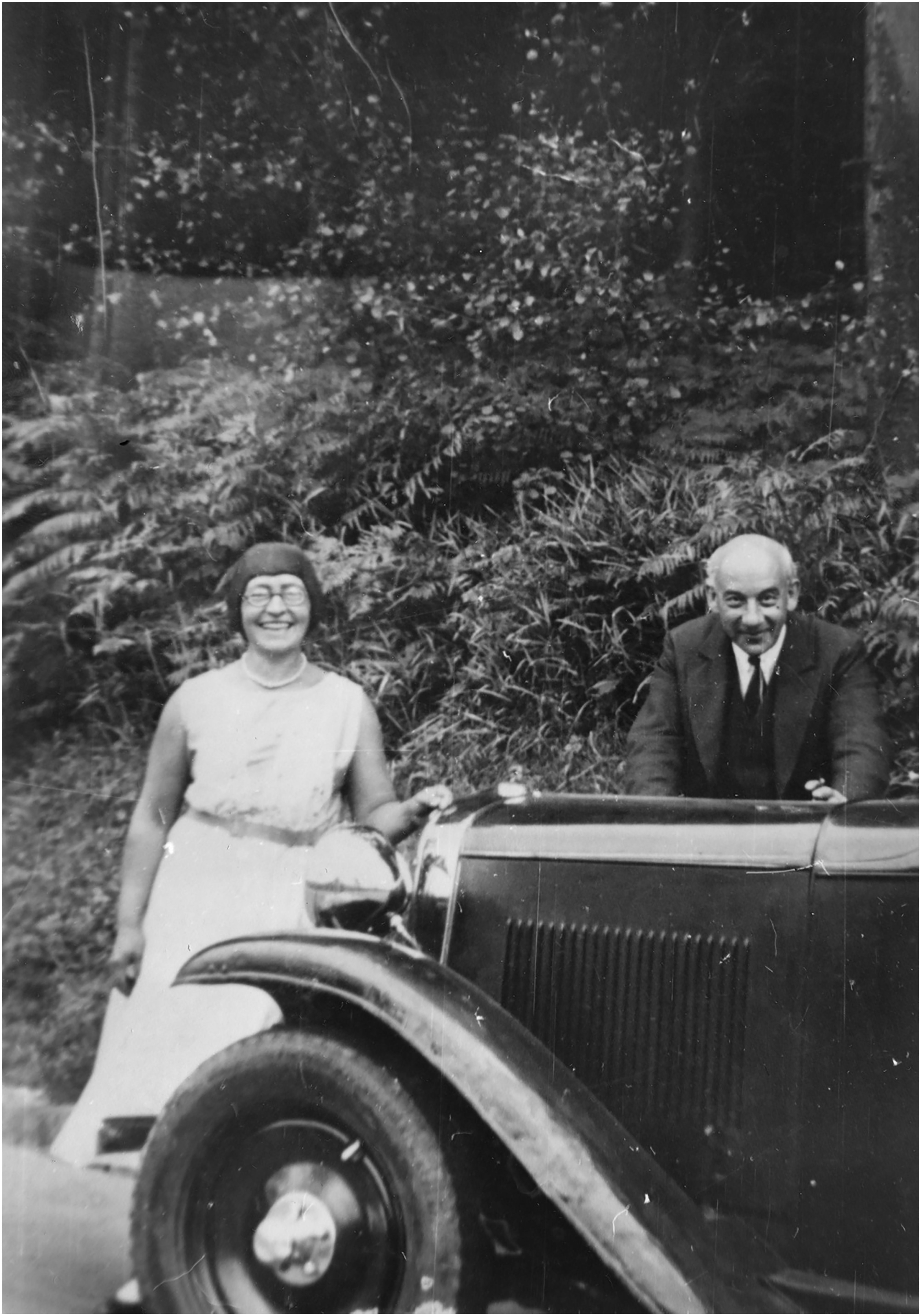
Victor Klemperer and his wife Eva with their car, 1936, unknown photographer. SLUB Dresden, Deutsche Fotothek.
I am working from Martin Chalmers’ abridged translation of Klemperer's diaries, which contains some subjective editorial choices. For example, Chalmers has been critiqued for omitting Klemperer's musings on cinema. 23 Fortunately it is clear that the car has been deemed “central to Victor Klemperer's life during this period”, as Chalmers sets out his editorial criteria, and therefore not subjected to the same cutting treatment. 24 For the diary form as a whole there are fundamental considerations to bear in mind. Scholars have noted the potentially problematic nature of the genre as a historical source. 25 Diaries force us to wrestle with conflicts between the private and public, literary and historical, spontaneous and deliberate. First-person narrative produces prose which is innately personal, and therefore reflective of an individual, that is, the diarist; yet this simultaneously suggests something singularly honest and authentic, which in turn tempts us to see the diary as being representative of those like the diarist. We are thus left to ponder whether the diaries of Miller and Klemperer constitute a tale of just two motorists, or of thousands.
Interwar automobility: users and uses
Before 1914, motoring belonged exclusively to the wealthy upper classes, for whom the car was an object of leisurely rather than quotidian use. However, during the First World War, people from all walks of life were exposed to motorised transport. A soldier transporting supplies by truck, or a nurse conveying patients by ambulance, could not help but be struck by the car's potential. This established popular aspirations for car ownership. In Britain, proponents of the car could tout by 1922 “the beginning of a new era, the age of petrol and automobility”. 26 By 1932 there were one million cars on British roads, up from only 100,000 in 1918. 27 In 1920s Germany, the growth of personal motoring was hindered by high purchasing costs, but from 1933 Nazi Motorisierung (motorisation) policy sought to change this. 28 By 1934 there were 661,773 registered private cars in Germany. 29 This figure more than doubled over the next four years, although it is worth noting that the number of motorcycles was still higher, something which made Germany unique amongst motorising nations. 30 At any rate, if we consider the incidence of shared car ownership, as identified in Britain by O’Connell, the number of actual motorists was perhaps even higher. 31 Miller and Klemperer thus became motorists in societies which, though motorised to different extents, had both embraced the vision of a motorised future.
Car critic Winfried Wolf suggests that mass motorisation is predicated on the false claim “that the car is for everyone”. 32 Qualifying this premise in respect of interwar Britain and Germany is an important contextual consideration. O’Connell argues from his sample of interwar motorists that as many as one in eight were from working-class backgrounds, representing a significant democratisation of motoring compared to before the First World War. 33 However, as O’Connell acknowledges, his sample is drawn disproportionately from workers in the motor trade, who were more inclined to own a car than the wider working-class population. David Thoms is correct in asserting that the majority of British drivers were middle-class. 34 In Germany, where hyperinflation had undermined the purchasing power of salaried professionals, the proportion if not the actual number of middle-class motorists was similar. 35 In both countries, most motorists were male. 36 Miller and Klemperer thus appear characteristic. Miller's profession was uniquely identified with the car, and Mundesley villagers remember his car being one of only a few in the village. 37 Similarly, while Klemperer had lost his job by the time he bought his car, his previous occupation was one associated with those privileged classes linked with motoring by the 1930s.
In other respects, Klemperer and Miller complicate our profile of the archetypal interwar motorist. Take the age at which they bought their first car: who was typical, the 26-year-old Miller, of a younger generation that we might expect to engage more willingly with new technology, or the 54-year-old Klemperer, of a generation theoretically better experienced and financed to do so? And what of location? Sales data tells us that car ownership was predominantly urban. For example, 3350 cars were sold in London during November 1938, and only 74 in predominantly rural Herefordshire. 38 Yet Miller used his car in rural Norfolk, an area associated with poor roads and low motoring uptake even decades later.
To be sure, we see in Klemperer and Miller's diaries evidence that personal motoring was reaching beyond the male middle-classes. Klemperer observed in December 1935 that “all the quite ordinary people on our new streets have their garage”, although “quite ordinary” may have meant middle-class to him.
39
His driving test cohort was noticeably diverse: A dozen people were sitting in the waiting room… Mostly young people, a girl among them, all younger than I, most of them working class or the like. Only one gentleman from my driving school, early forties, a war invalid who drives a specially constructed car.
40
Klemperer and Miller's wives, Eva and Dorothy, experienced automobility within these boundaries. Dorothy held a driving licence from the same time as her husband, and sometimes drove his car. 47 In 1940 Miller hired a second car, unusual for the time, which may have been for his wife's use. 48 That said, her agency as a motorist was tempered by her husband's ownership of the automotive domain. He recorded her journeys in his diary, and evidently left her out on many occasions too. Eva Klemperer did not drive but she played an instrumental role as navigator on her husband's excursions. 49 Moreover, Klemperer suggested that it was Eva who encouraged him to take up driving in the first place. 50 While Dorothy and Eva were not primary actors in the automotive domain, their experiences can be seen as moments of creeping change, laying the groundwork for greater female participation during the following decades.
In terms of uses as well as users this was an age of transition for the car. Clearly the Edwardian tradition of Sunday drives and motoring holidays persisted. Miller's diaries recount many motoring holidays through Britain (Figure 2), and even in the late 1930s he laid up the car and surrendered his driving licence during winter. Klemperer also used his car for long motor tours. For example, in May 1937 he drove from Dresden to Berlin, effusively describing his trip like an old-fashioned leisure excursion. 51 Sometimes he simply took in the countryside around Dresden: “In the late afternoon we went for a wonderful drive. Pesterwitz, Wurgwitz, Kesselsdorf, Grumbach, Tharandt. We stopped for a while at an especially beautiful view of meadows and woods”. 52 For both diarists the car was a coddled possession, always garaged and treated with the “reverence” that Peter Thorold has written about. 53 In this sense, car ownership was still more novel than normal, more hobby than habit.
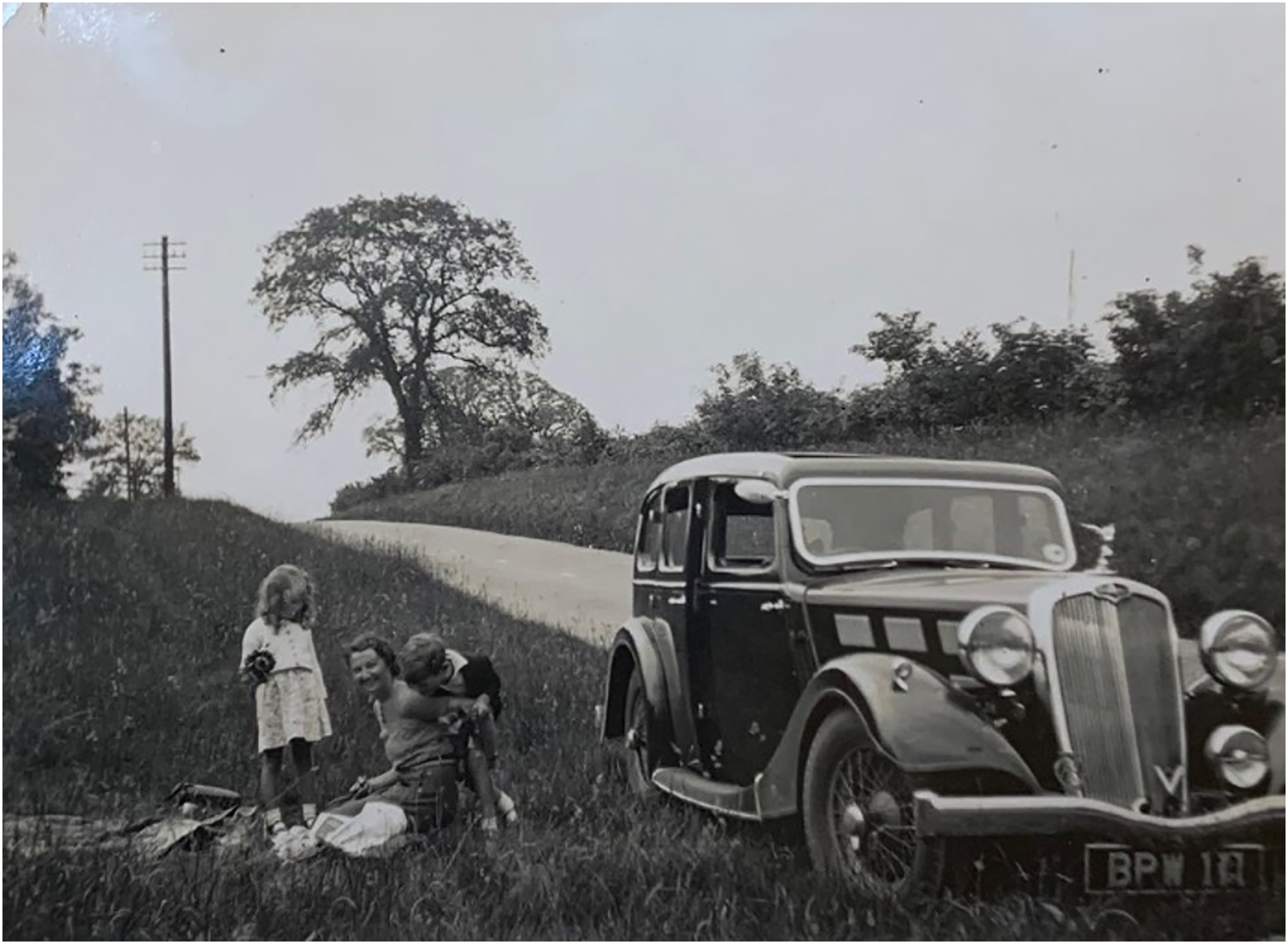
The Miller family on a motoring holiday, 1938. National Motor Museum Motoring Archives, GB 307 MIL:1:1.
Even so, quotidian driving practices were emerging. After replacing his first car with a closed-roof model in 1933, Miller drove in all weathers. He travelled frequently to Osterley, where he visited family, and normally made the return journey to Mundesley in the early morning, probably so that he was back in time to work at his surgery. 54 This was an early example of commuting by car, and helped Miller maintain close familial ties in spite of his physical distance. Never was this more acutely demonstrated than when he travelled from Wales (where he was holidaying) to Osterley when his mother passed away suddenly in September 1936, a journey he recorded simply as an “emergency overnight trip”. 55 This poignantly understated entry does not betray the significance of modern automobility for facilitating emergency travel, which was tragically reiterated when his father died only five weeks later. 56 Osterley's location on the Great West Road was significant here because this new arterial route boasted a unique range of garages, roadhouses, and filling stations which enabled such quotidian driving practices. 57 For local journeys in his surgery's rural catchment area Miller rode a bicycle, but here the car was undoubtedly used as well, even if it was not recorded in his diary. Certainly, the 18,300 miles he covered between March 1937 and March 1938 was no mean feat. 58 Klemperer also used the car for everyday tasks, such as visiting the dentist, shopping, or going to the cinema. 59 Reflecting changing perceptions of a car's purpose, he wrote here that “the car really provided what we had so much hoped it would”. 60
Conflicting emotions at the wheel
Whether driving to the shops or holidaying across the country, commanding the wheel of a car conferred a sense of freedom on the driver. As John Urry argues, car travel's appeal lies in its “timeless fashion”, requiring no inflexible timetables and connections.
61
Without his car, Miller could not have left West London at 4.30 am and be back in North Norfolk by 9.00 am as he regularly did by 1936. Cars also provided freedom in the form of what Wolfgang Sachs calls “little escapes”.
62
Klemperer's car offered an escape from the drudgery of daily life and, more importantly, the Nazi regime's increasing persecution: [31.12.35] The car will give us a little bit of life and of the world again.
[27.03.37] To give up the car would be to imprison Eva.
[06.08.37] Again and again we simply trundle away from the heat and the kitchen duty and the misery of the gloomiest thoughts, for just as long as the [financial] reserve lasts. 63
Historians and contemporaries alike have identified freedom with speed. Driving speedily along new highways empowered drivers and encouraged them to mimic upper-class motorsport pioneers of the early century. T. C. Bridges and H. Hessell-Tiltman's popular 1933 book The Romance of Speed reflected widespread reverence to the transcendental experience of travelling fast. 64 In Germany, popular emphasis on the synaesthetic thrill of driving (testified by the popularity of motorcycles) lead some people to lament how closed-body cars, while faster, produced a muted sensory experience. 65
While speed and freedom were indeed important, I believe that overstating them risks reproducing a deterministic narrative propagated by popular historians, namely one which credits linear technological developments (such as increased speed) for the diffusion of car ownership. 66 Miller and Klemperer's diaries show something more ambivalent. As Klemperer's above entries demonstrate, the emancipatory potential of the car ran much deeper than just travelling quickly. Moreover, motoring was as much a source of frustration and anxiety for our diarists as freedom and pleasure. Take for instance the cost of buying a car. Miller's first car was two years old, with 2607 miles on the clock, and cost £115, approximately half the price of a brand-new model. Klemperer's car was also second-hand and had 18,788 miles on the clock when he bought it. The decision to buy second-hand was clearly a financial one – Klemperer wrote that “a new one costs too much” – but we can also infer a reticence to over-commit to this novel technology, a new example of which would have made a bold financial and social status. 67 Klemperer was concerned because he had financed his car by borrowing 2,000 M against his life insurance policy. Miller was more socially and financially secure, so bought a new car every few years by part exchanging his old one and paying the difference. In both Britain and Germany, consumer credit carried a taboo which forced even relatively well-off consumers to spend modestly. 68
The initial buying cost was compounded by ongoing running expenses. An extract from Miller's expenditure account gives a flavour of annual costs equivalent to several thousand pounds when adjusted to modern values: Apr 1932 to Apr 1933
£ s d
Maintenance 69 – 6 – 2
Tax 10 – 0 – 0
Insurance
91 – 8 – 8 69
Miller's laconic prose means we can only guess how annoying he found these costs, but for Klemperer we are left in no doubt. Days after collecting his car, he complained that it would cost him 66 M per month. 70 Several months later he wrote “I do not dare undertake any further excursions with the car; 10 litres of petrol, 3.60 M, are too great an expenditure”. 71 By October 1936 the car was unused, but was “expensive even when it is not moving”. 72 The reality of motoring contrasted with the outward impression that a car owner must be “very well off”. 73 Klemperer recognised this, writing “I have a villa and a car, I have a monthly pension of 492 M, and we are poorer, more bound down, proletarianized than in our most miserable bohemian and destitute days”. 74 Klemperer's fatalist outlook could accommodate this state of affairs, but for many others it surely made car ownership a short-lived folly. Even the most banal costs caused grievance. Miller made a point of retaining toll tickets, accompanied by the annotation “scandal”. 75 Pooley points out that such “minor inconveniences” are rarely recorded in writing, so this eccentric habit brings into focus the ways that these diaries can enhance our understanding of historical car travel. 76
Klemperer and Miller found that motoring was most irritating when their cars required repair. The literature on historical automotive maintenance is relatively small, yet, as Stefan Krebs tells us, ongoing repair was a definitive experience in the consumption of the car. 77 Miller may have scoffed at The Autocar magazine's calculation in 1926 that drivers could keep their cars in good order with only eleven hours of maintenance per year. 78 As soon as he purchased his first car he had to repair it, and then again only five months later, entailing several months off the road. 79 Months after buying a brand-new car in 1933, he was forced to install a new engine, which itself failed just months later. 80 His next new car, bought in March 1937, was returned to the manufacturer for repairs only three months after purchase. 81 Klemperer fared no better. “Sometimes the engine is too cold, sometimes it is supposed to be the battery, sometimes the starter, sometimes the gaskets on the carburettor filter. The result is always the same: it doesn’t go, always expenses.” 82 In frustration he christened the car “the jalopy”. Miller was a skilled engineer who performed most car maintenance in his own garage, which included an inspection pit. 83 Klemperer, however, possessed no mechanical knowledge and instead relied on the services of a working-class mechanic, Michael. Here, at a time when, as we have seen, the majority of motorists were still middle-class, mechanical expertise challenged the primacy of social standing in the automotive domain, reproducing the early-century contest between owner and chauffeur between driver and mechanic. 84
It would be easy to disregard Miller and Klemperer's reservations given that they persevered with car ownership, but the cost and inconvenience of this upkeep formed a genuine barrier to use. Furthermore, driving was incredibly dangerous. No doubt this resonated deeply with Miller, who, as a doctor, was sometimes required to attend car accidents. For example, in 1933 he was called to a nearby village to jack up an overturned van and recover the deceased driver's body from beneath it. 85 Danger suffused his diaries. His second car was crashed and “smashed beyond repair” just two days after he sold it; and in 1934, he came across a serious accident while driving home from Osterley which necessitated him taking the injured party to hospital. 86 The latter incident shows that bad weather posed a barrier to the quotidian use of what were relatively primitive vehicles: “4.30 am Osterley to Mundesley. Heavy fog & mist nearly all the way. Very slow progress. Came across serious accident 7 am south of Newmarket. Took injured party to hospital in Newmarket”. Miller's nonchalant tone suggests that such incidents were not unusual. In fact, thousands of people were killed and hundreds of thousands injured on British and German roads every year during the 1930s. 87 He concluded his entry with an ironic reference to car repairs he had made the previous day: “Effected repairs to same [the injured driver] under general anaesthesia. Good breakfast as reward”. 88
While Miller faced all this with calmness and macabre humour, Klemperer was often frightened. During his driving lessons (which Miller was not required to take in Britain) he sweated profusely and could barely remember his left from his right when navigating steering and pedals.
89
He wrote of the physical toll driving took on him.
90
For months after he passed his test, he was frightened of driving alone: The constant worry that I as a driver must not cause any mischief… At first after the long gap of two months and with the fast car, to which I am not accustomed, I drove very badly, now it is going substantially better. But I am afraid of driving alone and of the responsibility for Eva. She comes on the drives now… When I am driving I see nothing of the landscape, my eyes are fixed on the road.
91
The combination of freedom and excitement on one hand and anxiety and danger on the other left motorists feeling conflicted about automobility. Klemperer lurched between eager automobilist and avowed disbeliever, reflecting his general mood, which was determined by how he perceived the present political situation. Driving was “senseless in every respect and contrary to nature”, he wrote in December 1935; yet by the following February he could concede that “perhaps it is after all not as senseless as it appears to me”. 99 Weeks later he was back to square one: “now I have the driving licence, the car, the garage – and feel even more depressed than before”. 100 He was fully conscious of his ambivalence, writing of the “joys and sorrows of driving”. 101 Miller's diligent note-keeping and mechanical knowledge suggest that he was more firmly invested, but even he must have recognised the contradictory experience of modern motoring, which plays out tacitly between his travelogue notes and business-like cost accounts. We should also remember that, like today, driving could be downright mundane. After running errands for Eva, Klemperer grumbled that he was “nothing but a taxi driver”. 102 We can only speculate how much Miller really enjoyed his early five-hour drives between Mundesley and Osterley in an open-top car.
Participating in modern automobility was socially symbolic and some of Klemperer's frustration stemmed from what his failure to fully enjoy this new technology represented. His hubris frequently showed through: Today we brought Frau Lehmann here in the car, and as I drove in I collided with the garden gate again for the first time in months. Bent bumper and a great blow to my pride… I had felt very sure of myself and believed I had now finally outgrown my swaddling clothes as a driver.
103
Motorised minds
It is striking that Miller and Klemperer stuck with their cars in spite of their conflicted emotions. Klemperer went to great length to accommodate the cost, for example by cutting back on food and a housemaid. 110 When he won 74 M on the lottery, he resolved to blow the lot on alcohol and petrol. 111 Maintaining the car was “madness really”, he wrote, “and yet whenever we reflect on it, the conclusion is to keep it and hold on. It is, in the fullest sense of the word, tragicomic”. 112 Why both men persevered is an important question to answer if we are to understand how the system of automobility became engrained in twentieth-century society.
One explanation may lay in the relationship owners established with their vehicles. Cars were imagined as people, even friends and family members. Miller invested individuality in his cars by using their registration numbers in the sense of given names. Klemperer's use of the word “jalopy” may likewise have been a term of endearment. The car was commonly perceived as female. German screenwriter Curt J. Braun wrote that “a car owner does not have one mistress like every other man, but two: the woman of his heart, and his car”. He continued: “every car has a character. There are stormy and passionate cars… there are cars that are tender… there are cars that are cold, sharp, and unfeeling”. 113 The image of mechanical mistress combined the intimacy, excitement, escapism, and sexual transgression popularly associated with automobility, even if this was not the owner's actual experience. Even mechanical unreliability could be endearing. Owners spoke affectionately of their cars as “sobbing, whining, rumbling, as well as stuttering, hammering, knocking, singing, howling, growling, ticking, hissing, and droning.” 114 As Joseph Corn notes, this was because cars were seen to suffer from human maladies which required “diagnosis” and “remedy” rather than mechanical repair. 115 Thus Klemperer referred to his mechanic Michael as his “chief nurse and adviser”. 116 It is irresistible to imagine Dr. Miller thinking of his car in similar terms.
We should also not underestimate the permeant appeal of automobility, which as Mom and Koshar have argued, extended beyond those who consumed the car first-hand.
117
To simply walk alongside a new road was to be immersed in a culture of mobility increasingly dominated by the car. Minds, if not bodies, were motorised. Journalist Philip Oakes, who grew up in rural northern England in the 1930s, recalled of a local family that “the[ir] car with its leather upholstery… spelled a way of life so prodigal… The Aarons affected me like loud music and bright colours. To ignore them was like walking away from a parade. I did not want to join in, but I wanted to watch.”
118
Similarly, in Germany Horst Krüger remembered that When one day the Ernsts went so far as to buy a car – a little black Opel P4 – the event, long before Hitler, was like a small revolution in Eichkamp. My parents watched enviously from behind the curtains as the Ernst family got into this odd vehicle on Sunday afternoons and drove off as if summoned by a higher power.
119
Miller and Klemperer's own world-views were increasingly defined by automobility. Klemperer could not help but notice the car wherever he went. In the village of Oberkipsdorf he remarked that the railway station now had “a place for cars to turn in front of it”, and that in Kamenz cars parked on the market place. 123 He was particularly struck by the motorised metropolis of Berlin. 124 These innocuous observations demonstrate not just the growth of personal motorisation and Klemperer's inward ambivalence about the change this represented, but how fully the car had occupied his psyche. To echo Peter Merriman, people like Miller and Klemperer did not simply motor, they became motorists. 125 Klemperer was fully aware of this. In May 1936 he wrote symbolically of his and Eva's “motorised wedding anniversary”. 126 Three days later he acknowledged that “the car eats me up”. 127 For good or for bad motorists and non-motorists alike were consumed by the image of the car. Miller may well have agreed with Klemperer's sober reflection: “car, car over all, it has taken a terrible hold of us, d’une passion dévorante”. 128
Conclusion
This paper seeks to sketch the lived experience of interwar motoring in Britain and Germany, and understand the emotions attached to automobility. Access to cars expanded in this period, but the process was protracted. Leisurely use persisted alongside emergent quotidian practices. The monopoly of male middle-class drivers was challenged only tacitly. Above all else, the dairies of Hugh Miller and Victor Klemperer offer a corrective to the assumption that Europeans, wearied by war and used to antiquated systems of local mobility, were suddenly emancipated by automotive travel. Quite the opposite: battling against costs and repairs, our diarists were financially and emotionally committed to what was still an experimental technology. For Klemperer this reflected a general fatalism fostered by Nazi terror; in Miller's case, the indulgence permitted by comfortable middle-class life. Both men were psychologically motorised by their ambivalent experience of the car, as were millions of other Britons and Germans. Automobility offered enough enjoyment yet enough frustration and anxiety to keep them invested in the pursuit of its full emancipatory potential. This was Ladd's automotive love and hate, but felt synchronously, intermittently and equivocally, not wholly and oppositely. Conflicted feelings about the car fostered a unique emotional response which may partly account for its endurance as the primary system of personal mobility. As Urry reminds us, the car is “simultaneously immensely flexible and wholly coercive”. 129 It is a pertinent time to reflect on this paradox, because studies suggest that, almost a century on from Klemperer and Miller's pioneering foray into motoring, an eco-conscious generation of Americans and Western Europeans may have reached “peak car”. 130 Emotional ambivalence was intrinsic to the advent of a car culture whose demise may be driven by rather more rational arguments.
The act of reading Miller and Klemperer's diaries evokes its own emotions. We inevitably feel the frustrations of interwar motoring. But these is also a sense of poignancy at the unrealised promises of automobility, the failure of this mechanical technology to fully deliver the freedom expected by our diarists. No doubt Klemperer envisaged in his car what he saw in his diary: a “balancing pole” against the terror of the Third Reich. 131 However, his status as a persecuted Jew was scarcely ameliorated by the automobile. The car pained him with its shortcomings, brought him into contact with the authorities, and ultimately became another part of his identity stolen by Nazi persecution. By climbing behind the steering wheel to be free, Klemperer was reminded that he was not. Miller did not need a “balancing pole” because his favourable social position was never challenged. In contrast to Klemperer, his life was stable and privileged, his experience of motoring shaped by dynamics of class but never compromised by them. This accounts for their different ways of writing about cars. Klemperer's compulsion to analyse everything and set it down in writing was a response to his liminality and a search for belonging in a changing world. Miller's contrastingly laconic prose reflected the stability he felt in a world which demanded no soul-searching. This difference in itself highlights that automotive history is not a history of mechanical objects, but of individual people, feelings and lived experiences.
The discovery of these lived experiences is an important and intended outcome of studying the genre of life writing. As sociologists have pointed out, the conception of car journeys as “lost” time between points A and B diverts focus from what people do and feel during them, which, as Klemperer and Miller show, is the very substance of being a motorist. 132 Diaries cannot give us a comprehensive or objectively faithful interpretation of the past because the diarist chooses what, when and how to write. Moreover, diarists are individuals who cannot be held as representative of society at large, even if they give us insights about it. To return to an earlier point, Klemperer and Miller's diaries are indeed tales of two motorists, not thousands. Even so, the experiences of motoring common to both, as elucidated in this paper, testify that there is good reason to build on Pooley's recent work by integrating life-writing into automotive history, especially if we want to tell an emotional history of the car.
What became of our diarists? Miller maintained his diary until 1989, just a few months before his death, his cost accounts having given way to doodles and notes which were increasingly idiosyncratic in an age when driving was no longer a novelty. Klemperer's automotive days ended more suddenly. Following the 1938 ban on Jews driving, in March 1941 he was forced to sell the forlorn Opel. Klemperer recounted in poignant detail how two young boys taunted him by shouting “the Jew's car, the Jew's car!” as the jalopy was retrieved from his garage, destined, as a fitting final humiliation, to be scrapped. 133 Casual anti-Semitism had once associated the Jewish stereotype with expensive new cars, but now Klemperer's old dilapidated vehicle spoke instead for the Jewish condition. 134 The “grief, real grief at the theft of the car” stuck with him during the war as he frequently reminisced about driving and longed for the return of his vehicle. 135 This was not to be. Thrust into the political limelight of the new German Democratic Republic (GDR), where a personal car would not be provided, Klemperer found himself instead chauffeured at will in a government vehicle. It was an ironic end to the motoring career of a man who so vividly brought to life his experiences in the coveted driver's seat.
Footnotes
Acknowledgements
The paper has benefitted greatly from the feedback of anonymous reviewers, to whom the author is thankful.
Author note
This paper originated from a thesis developed under the supervision of the late Richard Deswarte, who sadly did not see its completion. The author reflects here on his support and kindness.
Declaration of conflicting interests
The author declared no potential conflicts of interest with respect to the research, authorship, and/or publication of this article.
Funding
The author received no financial support for the research, authorship, and/or publication of this article.
