




Abstract
Photography has been recording different aspects of human activity since the early nineteenth century. Additional innovations since then have rendered it less expensive, less cumbersome and more accessible to users. Today, the universe of photographs is immense. In this paper, I offer a theoretical approach to the use of photography in mobility and transport history. I argue that photography is much more than a mere illustrative resource and that it can be used as a primary source that provides visual materiality to aspects of transportation in the past (subjects, objects and landscapes), which can complement information found in written sources. Moreover, I speculate that photography may have a double role: as a vehicle that transports observers to faraway locations and ideas and landscapes back to observers; and as a tool for territorial appropriation of peripheral territories by core regions.
Introduction
Since its invention in the 1830s, photography has been recording multiple facets of human activity, from social affairs to technoscientific modernisation, sports, or politics, amongst many others. Throughout the decades, technical developments in cameras, lenses, shutter speed, films, smartphones, and other technical paraphernalia made photography easier and more accessible to larger fringes of the population, by decreasing its cost and increasing its portability. 1 The consequence was the development of a huge visual universe available to historians, a large part of which is accessible online in different digital archives and repositoria or social media platforms, covering different geographies and timeframes.
For many years, photography was used as a mere graphic auxiliary for historical research, to illustrate the main argument of the texts, and not as a primary source. In the 1980s, Christraud Geary affirmed that academic research that used photographs as primary sources was rare. 2 This situation has been changing ever since. Different scholars have been using photography as main source to analyse assorted subjects in varied fields related with the study of colonialism and post-colonialism, 3 landscape 4 or urban studies. 5
In transport and mobility studies, sociologists Mimi Sheller and John Urry advocated for research methods that rely on photographs.
6
Photography is an invaluable asset in transport history in a quadruple perspective, considering that photographs:
depict practical and physical aspects of transport and mobility in its many dimensions (construction, occupation of space, operation, utilisation, etc.), even if the goal of the photographers was to capture something else;
7
illustrate the perceptions and representations about transportation systems in each geographical and chronological context, which may be useful, for instance, to analyse their sociotechnical construction;
8
contributes to the territorial appropriation of the land;
9
are vehicles that carry and move information, ideas, and representations between or amongst human communities, influencing its perception of a given reality. Transport historians often contend that the accessibility to transportation systems (railways, roads, ports, mass traffic systems, etc.) has important consequences on the development of a community or a region; I offer that the same can be said about the access to photography, either as a user (the power to take and publish photographs) and as a viewer (the capability to observe those or other photographic images).
10
In this paper, I offer a tentative methodological, albeit speculative, approach to photography and its usefulness for research in transport history in those dimensions: as a primary source that illustrates the material evolution and the symbolic meaning of transport and mobility; and as a vehicle that transports and promotes the mobility of ideas.
Photography as primary source: some brief methodological remarks
When photography was invented and throughout the decades that followed, it was considered a completely objective instrument that depicted reality as reality was, contrasting with paintings, drawings, or texts that were corrupted with the subjectivity of painters, engravers or writers. 11 Cameras came with a mechanical objectivity that responded to the nineteenth-century positivist “drive to repress the wilful intervention of the artist-author and to put in its stead a set of procedures that would […] move nature to the page through a strict protocol, if not automatically”. 12
Different historians and theorists of photography, like Roland Barthes, André Bazin, Gisèle Freund, Tom Gunning, W. J. Thomas Mitchell or Susan Sontag have countered that such objectivity is a fallacy, and that photography is a human subjective practice, embedded in a specific culture/ideology, that does not offer copies or substitutes of reality but adds something new to the “natural order of creation”. 13 On a more prosaic level, manipulating and tampering with original photographs could add or remove elements to the original images, especially (but not exclusively) when it was published in the press. 14
Although the photographic process itself obeys the strict laws of Physics and Optics, its results (the photographs) are affected by the goals sought by the photographer (or his/her commissioners) when he/she took the picture, which influence the choice of angle, exposition, lighting, objects and characters photographed. 15
Consequently, photographs conceal varied representations behind a misleading facade of transparency and should not be taken at face value. 16 To use the concepts of Barthes, behind the objects depicted in the picture (the signifier), there is a message that is carried out (signified) and a myth (sign) created by its repetition. 17
The historical analysis of photography requires the inclusion of different elements associated with the production of photographic images, like the author, the probable audience (a restricted group or a wider population), the caption (if it exists, it reveals what aspect of the image the photographer valued the most), 18 the context in which they were taken and written documents associated with them. 19
Depending on the goals of the research, the amount of information gathered may be larger or smaller. I will go back to this point in the following section.
What does photography say about transport and mobility? Moments, patterns, behaviours and representations
As I mentioned before the objectivity touted by the promoters of photography was nothing more than a fallacy, considering the degree of human interference in the photographic act that indeed added something to what the camera saw.
Nevertheless, it is undeniable that in photography, the persons, objects, or landscapes photographed had been there in each time and a space. 20 Even if the photograph is altered, by adding some elements or removing others, it still depicts, partially at least, a moment in the past.
Regardless of the choices of the photographer and his will to meet the goals of his commissioners, the crowd shown in Figure 1, for instance, truly gathered in the train station of Girona, Spain, somewhere around the late 1910s; the train did pass there at the same time, and a smiling officer did indeed stand happily and very dangerously close to the passing train.
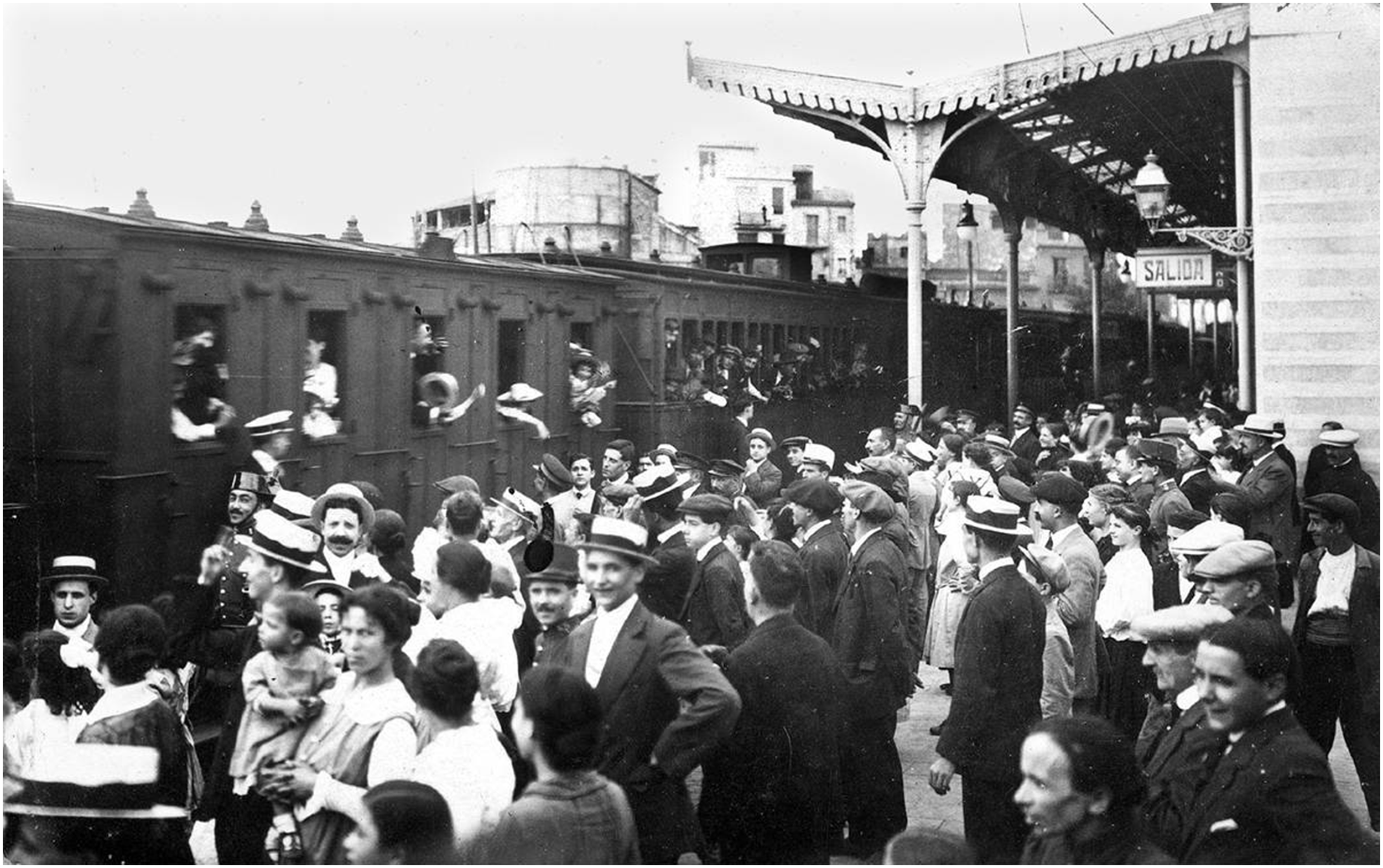
A crowd gathered in Girona, Spain, observes a train arriving in the station. Photography illustrates many different moments and aspects of transport and mobility history that are not detected in any other sources. Source: Girona City Council, Spain (Public Domain). Available in: www.europeana.eu/pt/item/2024914/photography_ProvidedCHO_Ajuntament_de_Girona_343059.
Through this image it is possible to analyse the rolling stock used in the Barcelona-Cerbère railway, the station architecture, the way passengers and bystanders interacted with the train, the safety procedures in the station (none, apparently!) and so forth.
In Figure 2, other central aspects in mobility (in this case related with air transport) may be examined, like, for instance the gender balance in air travel in mid-twentieth century or the waiting in transport and mobility. 21
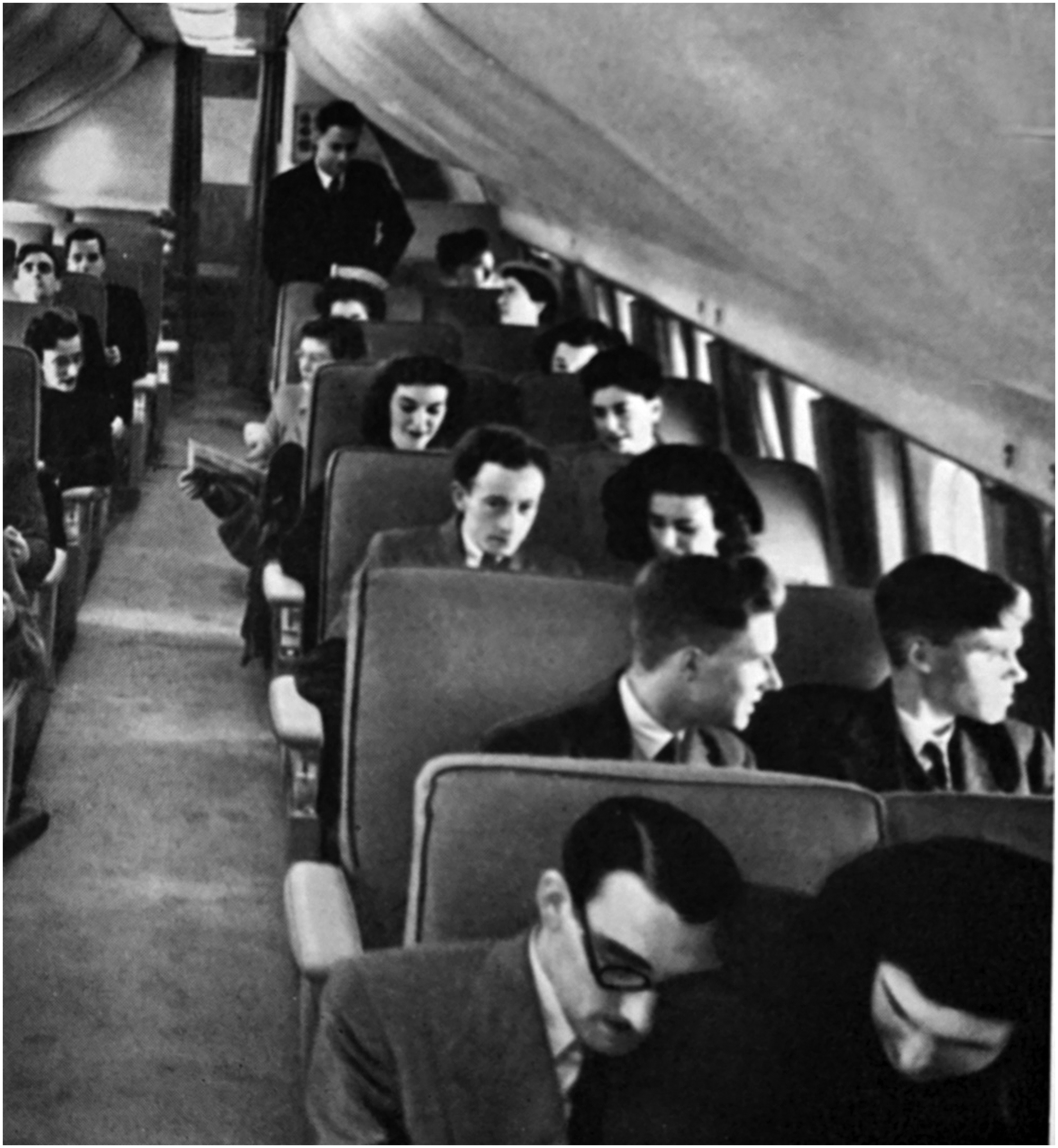
A group of passengers inside an aircraft of the Imperial Airways, one of the first British commercial long-range air transport company. Transport and mobility are usually associated with movement and speed, but there were also moments for idleness, like for example, waiting either for or in the transportation vehicles. Photography illustrates how travellers spent their waiting time, but also how vehicles were designed to address the wait. Source: WHA – United Archives/WHA, Germany (CC BY-SA). Available in: www.europeana.eu/pt/item/2024909/photography_ProvidedCHO_United_Archives___WHA_02405066.
Of course, one image alone could not mean much, but if the analysis includes a large enough corpus of similar photographs (of the same transportation system, or the same kind of users, for instance) it is possible to study behavioural mobility patterns of users, 22 the consequences on the use of land, 23 the technical evolution of a given transport system (vehicles and infrastructure) 24 and other key aspects of transport history, like the role of users, coexistence of different modes of mobility (pedestrianism, animal transportation, private vehicles, public transportation, individual transportation, mass transit systems, etc.), trans/inter-modality, the modal split, the occupation of public space by transportation systems, the presence (or absence) of historically discriminated groups (see Figure 3), amongst many others. What is more, some information regarding these issues can only be found in photography or it can complete or reinterpret the information gathered from written sources. 25
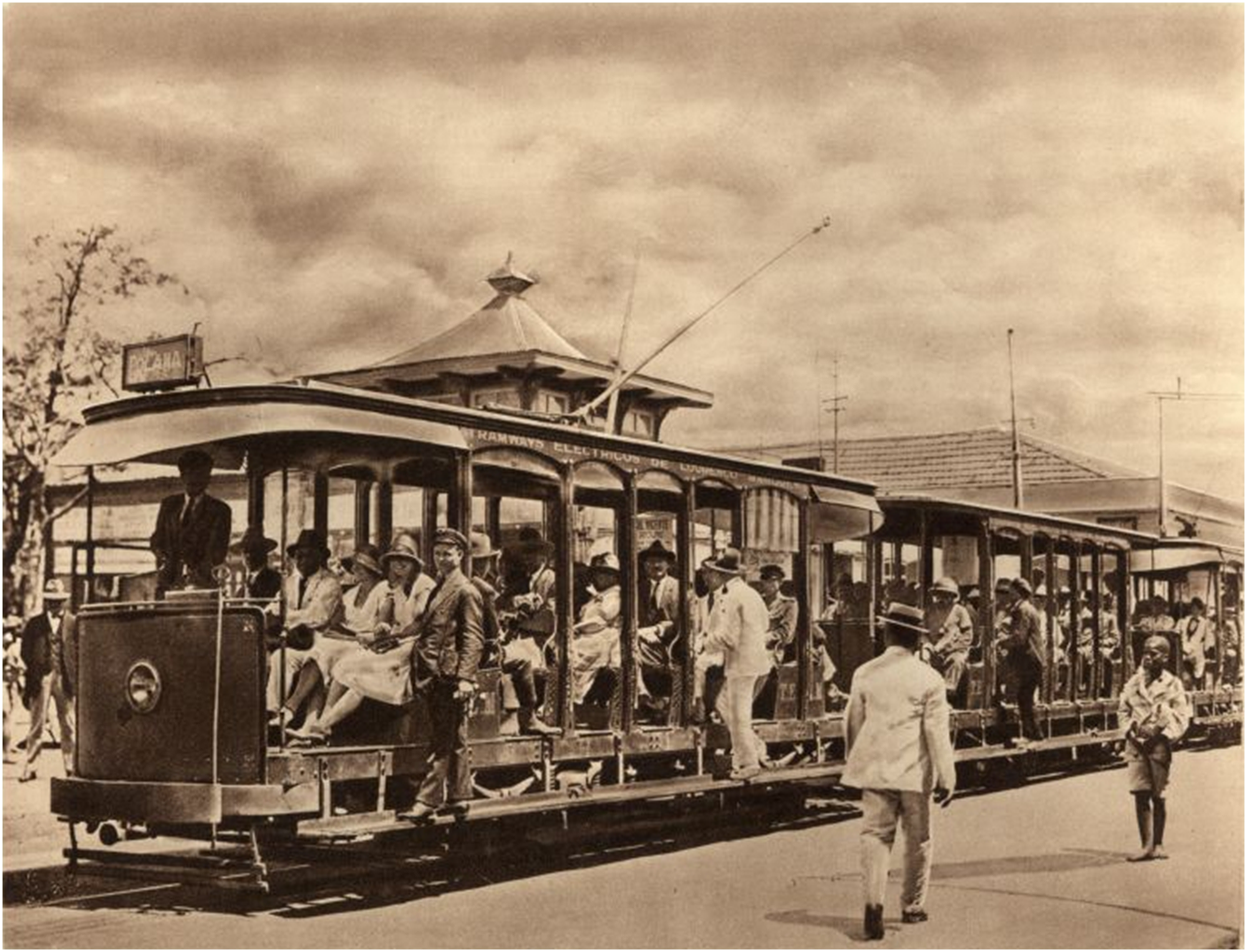
A tram in Lourenço Marques, in colonial Mozambique (present day Maputo), heading to the leisure area of Polana, is packed with white settlers, under the gaze of a barefoot black child standing in the street. This image illustrates an instance of apparent discrimination in the access to public transportation in a colonial setting. Analysing a larger universe of similar images can add to a debate about transport and mobility of colonisers and colonised. Source: José dos Santos Rufino, Álbuns Fotográficos e Descritivos da Colónia de Moçambique (Lourenço Marques: J. S. Rufino, 1929), vol. 3, 61 (Public Domain). Available in: memoria-africa.ua.pt/Library/ShowImage.aspx?q=/AFDCM/BNU_M_LM-03&p=76.
Considering that this kind of research favours a statistical approach (the frequency with which specific aspects of transport and mobility appear in a universe of photographs) and not so much the context and the other metadata mentioned previously, it can include in its analysis free-floating photographs – those images whose context of production, authors, goals are unknown, and therefore cannot be used as efficiently in studies about representations imbedded in photography. 26
Photography also has an enormous potential to analyse the dimensions of places (and the transportation and mobility fluxes associated) as relationships, placing of people and materials, and/or the hierarchies of difference that follows – as argued by Sheller and Urry. 27 In this vein, photography could be used as an instrument to create and convey pre-constructed and specific messages and representations, and to produce ideology, benefitting from its alleged, perceived, and socially accepted objectivity. 28 It provides historians with a source to analyse perceptions and sociocultural, sociotechnical or technopolitical representations about the implementation and use of past transport and mobility systems. From railways in the nineteenth century (in both peripheral and core nations), to cars in the 1930s, planes (or even Elon Musk’s SpaceX or Hyperloop).
If we look again at Figure 3, it is possible to speculate about the representations associated with the transport and mobility systems in colonial Lourenço Marques, as tokens of progress and evidence of Portugal’s imperial vocation, but that were restricted mostly to the European settlers – a detail that may resonate with scholars debating mobility justice. 29 Of course, this assertion would require the analysis of many more similar images, but my point is to illustrate how photographs create, carry, and publicise representations and ideology. This exercise is much more demanding than just identifying objects to determine patterns as mentioned before; it requires the identification of symbols (Barthes’ signifiers) in images that seeks symbolic forms that structure the depiction according to specific cultural demands. 30
Transport and mobility have three sociotechnical and historical dimensions that can be analysed in photographs: mobility-subjects (individual and collective actors that used or were affected by transport flows and mobility fluxes), mobility-objects (the vehicles and infrastructures they used for transportation and mobility purposes) and mobility-scapes (spatial and temporal frames in which transportation flows and mobility fluxes occur). 31
Here, it is important to underscore the intimate connection between photography and the creation of landscapes (and mobility-scapes). In the past, different authors have reflected on the notion of landscape and, as we know, concluded that it is not a natural phenomenon, but a humankind product, a socio-cultural construction that functions and evolves not according to natural laws but to the needs of a community. 32 The (re-)creation and (re-)interpretation of landscape depends on the eye of the beholders, who add more layers of cultural representations to generate or alter social subjective identities. 33 Therefore, it is possible to have urban landscapes, technological landscapes or mobility-scapes. In this process, photography played a crucial role in the formation of specific representations of landscapes, as social practices, and by turning landscapes into sites of historical conflict and moral reflection. 34
Photography, a tool of territorial appropriation
Another speculation I wish to engage with, relating photography with transport and mobility history, contends that photography was intimately intertwined with processes of territorial appropriation, a phenomenon defined as the “repetitive and consistent use of an area by a certain person or group who, at least to some extent, perceive this area as their own”. 35
It is obvious that transportation networks promoted the repetitive use of a territory (including the extension of the political and administrative grasp of central states) and therefore were key agents of territorial appropriation, integrating centres, peripheries, semi-peripheries and ultra-peripheries in the political, economic, social and cultural senses of those concepts.
I argue that photography was a powerful ally of mobility and transportation systems in the appropriation of territories by different communities, by opening windows to those who could not witness in person those processes and by showing the new territories that different transportation infrastructures and systems were including in larger territorial units (for instance, peripheral, unruly or autonomous territories being linked by railway) or seized by specific groups (like urban areas appropriated by tram networks).
I draw from the argument of Sheller and Urry that the rearrangement of the materiality of places influences mobility (and transportation). 36 In this respect, I offer that photography was crucial to illustrate those rearrangements and subsequent territorial appropriation to those people that did not use the transportation systems that promoted them and therefore did not witness them first-hand.
This was accomplished by the capacity of photography to transport material visualisations of the territories being appropriated by diverse mobility-subjects using new or improved mobility-objects. These images could depict infrastructures traversing rugged landscapes – inaccessible until then –, vehicles that allowed new forms of mobility, or people enjoying their newfound territory. This latter perspective focusing on people (commuters, drivers, pedestrians) emphasises the role of users in the co-construction of new transportation systems and new forms of mobility and their role in the territorial appropriation. 37
Figure 4 illustrates one engineering work that was central to the appropriation of the African hinterland by colonial authority: the bridge of Victoria Falls, in the railway between Cape Town, South Africa, and the border between North-western and Southern Rhodesia (present-day Zambia and Zimbabwe), part of the unfinished project of the Cape to Cairo line. The track was decisive to reduce the travel time between south Africa and Rhodesia from six months to a few days. 38 The bridge represented a huge triumph of human ingenuity over the River Zambezi that for eons had encumbered North-South trekking.
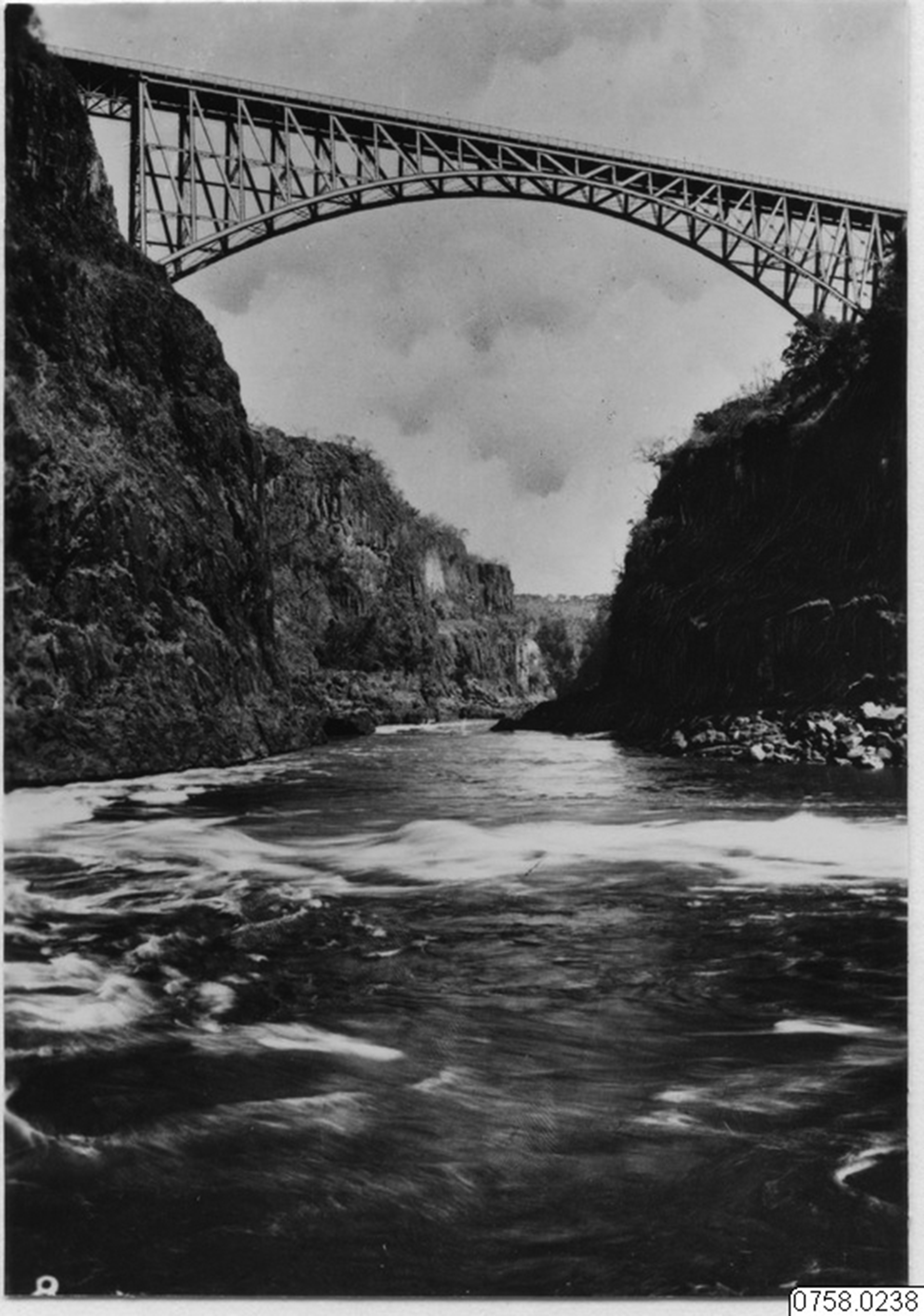
The railway bridge over Victoria Falls between the colonial provinces of North-western and Southern Rhodesia (present-day Zambia and Zimbabwe). Transportation systems like railways dramatically decreased the travelling time between regions. Those in the peripheries became much closer and could be placed under the control of those in the centre. In other words, they could be appropriated by the core regions. Source: Museum of Ethnography, Sweden (CC BY-NC-ND). Available in: www.europeana.eu/pt/item/91627/SMVK_EM_fotografi_3720486.
Photographic images of the construction and operation of long-distance transport infrastructure (like for instance the Central Pacific railway – see Figure 5 39 ) point in the same direction and hint at the same appropriation of faraway territories, considered wild and uncivilised by those who built and financed those structures. Tracks set in the wilderness, faraway from European settlements were now reachable and open for building new cities, mining, agriculture, commerce, business, state administration or military occupation, and in process of appropriation. In those areas outside Europe, the territorial appropriation promoted by transport systems in tandem with photography coincided with processes of Europeanisation or Westernisation.
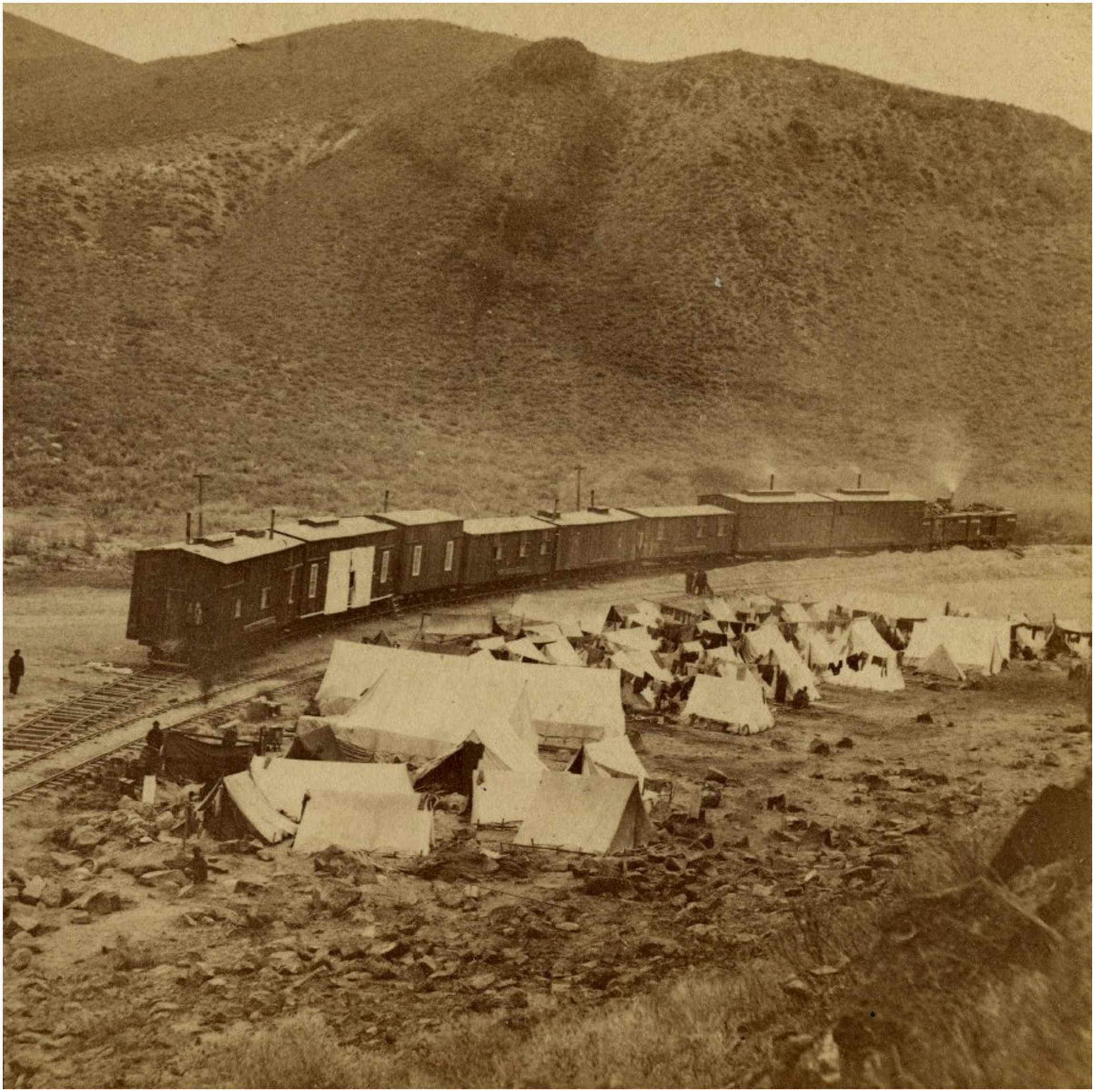
Photograph by Alfred Hart during the construction of the Central Pacific railway, showing a Chinese construction camp. The image is composed of three distinct, yet interwoven, elements: the train/railway, the surrounding rugged landscape, and an encampment of tents. Together, they illustrate the territorial appropriation of the western regions of North America into the United States. The railway could easily supply new settlements and put them in quick contact with larger economic and political centres in the seaboard. Source: Union Pacific Railroad Museum, United States of America (Public domain).
The repetition and accumulation of such images (mainly through the press or digital media) reiterating specific scenes of territories being appropriated by a group (either original photos from different authors or copies of the same image replicated in the press) contributes to the creation of a shared experience that bonds observers together and reassures them of the existence of new territories far beyond their immediate vicinity being joined with their own territory. 40
On a different level of territorial appropriation, photography, promoted the creation of renewed mobility-scapes, which included the newly appropriated territories, and encouraged new patterns of transportation and mobility towards them. Photography evidenced the territories that were once dangerous and that were now safe; those abandoned became utilisable; those that belonged to the Other now belonged to the Self. 41
In this approach, photography is seen as an auxiliary of territorial appropriation and as a promoter of that appropriation in those groups that did not actually use the appropriating transportation systems or infrastructures. Additionally, photography may also be used as a secondary source, in tandem with statistical and textual sources, providing the visual evidence of processes of territorial appropriation. Kärrholm used photography in his seminal book about this concept. I already mentioned a couple of studies by historian of technology Tiina Männistö-Funk (note 7) that combined visual and written sources to analyse the presence of women in pedestrianism and in the creation of streetscapes in Finland, which, to an extent resonate with the concept of territorial appropriation. Similar methodologies may be used to analyse other agents (including users, system-builders, those who govern and those who are governed) in other chronological and geographical settings. One of the most challenging is arguably the colonial context. Several authors have underscored the importance of transportation technologies and photography in European nations’ imperial projects, 42 but analysis that combine photography with studies of territorial appropriation are wanting. This perspective will add new knowledge to the field, including discrimination, racism and mobility justice when it comes to the access to transportation systems, which consequences are still felt today.
Photography as a vehicle
Photography has been seen as a vehicle almost since its inception. In the mid nineteenth century, it was labelled “the railway and telegraph of art” and considered capable of carrying people to points afar. 43 Photography transported people in the mainland to the colonies or those in the capital cities to the inland peripheries while gazing at pictures in an illustrated journal, reducing the distance between the place where the photograph was taken and that where it was observed. 44
Historian of architecture, Sibel Acar, argues that nineteenth century travellers used photography to capture far away landscapes, which were transported back to their homelands. 45 Similarly, some photographic albums act as vehicles by gathering images of journeys in a clear and logic succession, leading the observer across a territory, and unfurling a visual narrative of a voyage. 46 Figure 6 is part of one of such albums, the Reisalbum met 80 foto’s van Egypte (Travel Album with 80 photos from Egypt), edited by C. & G. Zangaki with photos by Bonfils, kept by the Rijksmuseum (Amsterdam). This album and the photos therein were vehicles in a double sense. Those who perused it were taken to Egypt where they journeyed across the remains of the days of the pharaohs; on the other hand, the album could transport that journey to other observers in other locations.
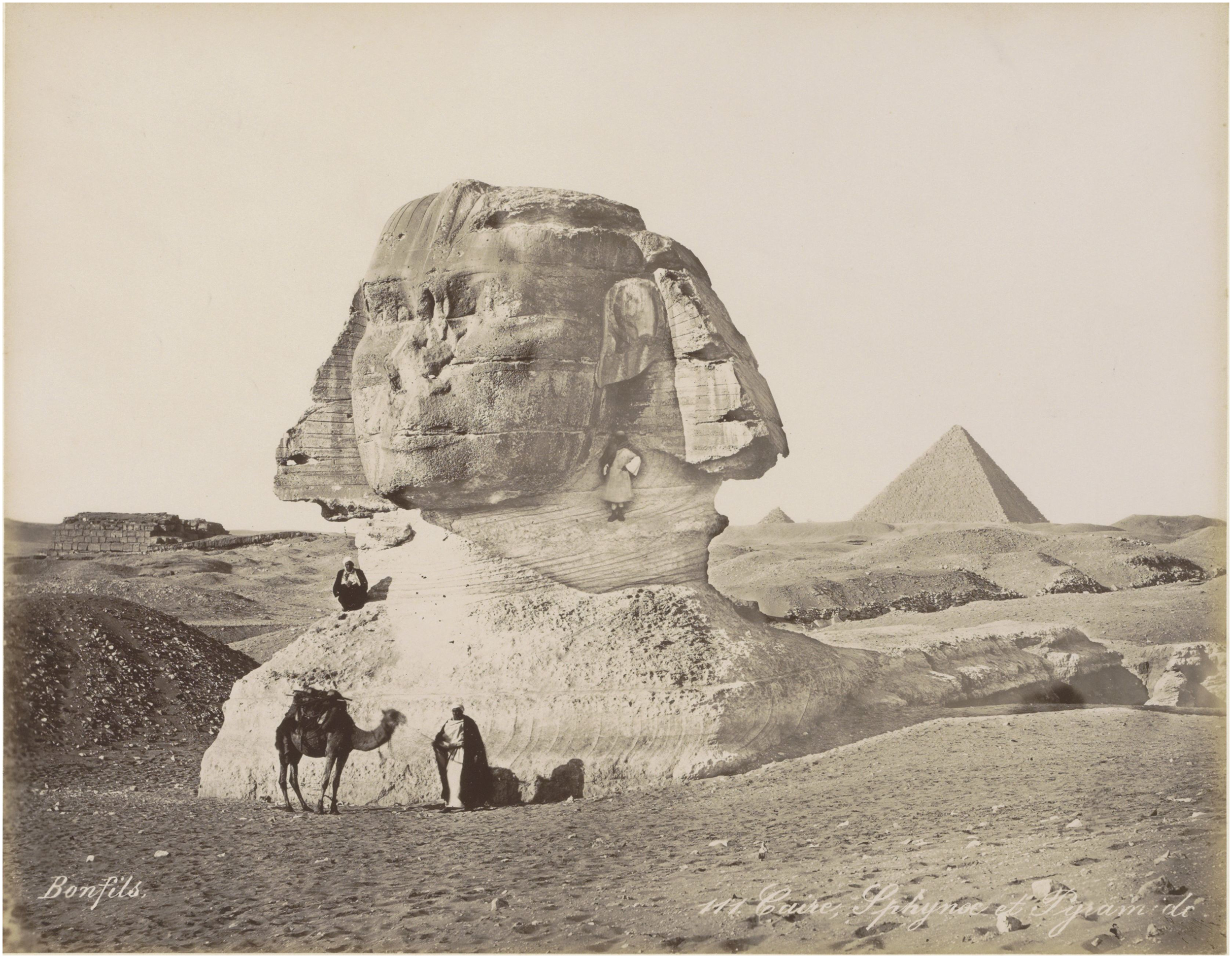
A view of the sphinx and the pyramids of Gizeh (c. 1870–c. 1898), included in the Reisalbum met 80 foto’s van Egypte. Albums like this one became popular shortly after Daguerre’s invention. 53 They assembled different images that took viewers to far away regions. These albums frequently travelled to other locations (namely World Fairs) carrying with them the same visual experiences for others to enjoy. 54 Source: Rijksmuseum, The Netherlands (Public Domain). Available in: https://www.rijksmuseum.nl/en/search?set=RP-F-F00992.
The idea that photography can act as a vehicle carrying information, knowledge, representations, landscapes and even emotions – just like trains, lorries or planes carry goods and people – has been debated mostly in media and photography studies. Sheller and Urry argue that mobility studies must consider that places themselves can travel (at different speeds or covering different distances). 47 Photography provides a new dimension to this argument. In this section, I offer it as a usable concept to transport and mobility historians as well, suitable to counter the neglect with which historiography of the field has been treating the movement of objects and the information circulating through objects. 48
Moreover, I emphasise that despite its numerous innovations and refinements (in terms of shutter speeds, quality and quantity of the images produced), photography has remained essentially the same since it was created in the early nineteenth century. 49 Therefore, transport historians may use it in its role of vehicle in an extended period, ranging from the 1830s to present day. In the digital age, photography’s ability to act as a vehicle grew exponentially, considering that as soon as an image is uploaded on the internet (especially on social media), it can share its cargo immediately with millions of people. This dimension promotes the sense of historical consciousness regarding photography as a vehicle that Cresswell advocates for mobility studies. 50
To this end, I follow the debate on the materiality of photography, that is, the notion that images are objects that are produced, distributed and consumed. 51 In this vein, intersectional historian, Debbie Lisle, and visual culture historian, Filipa Lowndes Vicente, underscore the importance of tracking the physical movements of photos to understand how interpretations are engendered and meanings are created and held. 52 Vicente adds that since the mid-nineteenth century, photography is one of the objects most prone to mobility, globalisation and transnationalism, and that most frequently traversed borders. This potential to cross borders was particularly relevant in those historical periods when the nation-states prevailed and restricted cross-border movements. 55 Vicente complements that photography’s mobility was achieved literally, by carrying photographs from one place to another, and immaterially, by taking a picture in one location and developing or publishing it elsewhere. 56
In this sense, I argue that photography, as a moving material object, turns into a vehicle that travels and transports information, representations, emotions 57 and ideology (of progress, of modernity, of the civilising mission in the European colonies of Africa and Asia, of criticism to the organisation of transport systems, etc.), within or between different sites or groups (peripheries to the centres, colonies to the mainland, capital cities to national countryside, elites to general population, etc.) in different geographies and timeframes. 58 Intersectional historian, Debbie Lisle, wonders how does meaning move between photographs and viewers, 59 but I am more interested in knowing how photography carries those meanings, weighing in the argument of geographer, Tim Cresswell, who claims that sociality and identity are formed by networks of things and ideas moving. 60
In this regard, the importance of knowing the range and transport capability of photography is crucial. An aeroplane and a bicycle are important means of transportation, at different scales: national/international/transcontinental and urban/regional, respectively. The same can be said about photography. Did it, like cars on the roads or ships in the ocean, reach a vast array of places? Or was it, like boats on rivers or trains on railways, restricted to certain routes and groups? Or, like pedestrians, animals or bikes, was its circulation restricted in range? The answers to these questions depend on whether photographs found their way to the press or other media outlets (and its impact is much greater, as the information is carried much further and to larger communities) or were limited to the eyes of the photographer and/or the people who commissioned their production.
Throughout the decades, reproduction of photographs underwent several evolutions from collotype to digitisation. In the nineteenth century, copying photographs was expensive and technically demanding. The invention of collotype permitted the edition of albums that circulated in exhibitions and within restricted circles. 61 The illustrated press quickened the circulation of photography, initially using wood engravings that copied original photos, and, starting in the late 1890s, with halftone screening. 62 At the same time, the production of illustrated postcards became easier and cheaper, and developed into an industry. In the twentieth century, improvements in printing and photomechanical processes and the diffusion of electronic means of transmitting information increased the publication and circulation of photographs. 63
These continuous innovations increased the performance of photography as a vehicle. Collotype can be considered the equivalent to steamboats that circulated in rivers, but only served riverside populations; halftone was the railway that shortened the distances between faraway regions; digitisation was the road and the automobile that ramified the network reaching almost every locale of a territory. In sum, as different technical innovations were being implemented in the industry, photos circulated faster, in wider distances, and reached larger number of people. By doing so, and by being duplicated and recirculated on a regular basis, photography gradually offered a feeling of shared experiences between clusters of individuals in larger groups, bonded together by the action of observing the same photographs. 64
At this point, it is important to underscore that more photography does not promote necessarily better knowledge and information; it may also favour the creation and legitimisation of biased or discriminatory narratives. We do well to remember historian of technology Melvin Kranzberg’s First Law of Technology, which states that technology is neither good, nor bad, nor neutral, meaning that technology often has consequences that go far further than the immediate goals it sought to achieve, especially when it is introduced in different socio-cultural contexts and circumstances. 65
One may be tempted to focus on photographs published in the press or in social media, which had a larger influence in the production and distribution of representations and ideology. To counter this, I propose another metaphor of the vehicular nature of photography: in the same way an historian may do research about slow and narrow-reach transportation systems, it is also legitimate to analyse photographs that did not reach large audiences, considering that even those photos that were not meant to be seen by many still carry the cultural representations of the class or group to which the photographer belonged to. 66 A good example is private albums or photo collections that were not meant for wider dissemination, but to circulate amongst limited circles of people. Despite their narrow mobility, they illustrate the representations, memoirs and emotions of those who made them. 67
To conclude this section, I offer that just like any other vehicle, photography deals with mobility justice at different levels. 68 Firstly, one should reflect whether a person has access to photography as a user or as an observer. In the latter case, it is important to know what kind and what amount of imagery a person or a group is subjected to; the former draws the attention to the issue of who can create visual narratives through photography. In this respect, one should consider the reflection of theorist of visual culture, Ariella Azoulay, who contends that the camera is an apparatus of power that can create hierarchies of dominance. 69 The colonial setting provides a good example, considering that for decades only the colonisers owned cameras, therefore the narrative carried by their photographs privileges their own agency, overshadowing that of the locals.
Conclusion
Recent years have witnessed the use of photography as a primary source in different fields of history, from social history to colonial studies or history of technology. Photography has proven its worth as a historical source and not just as a mere illustrative or decorative asset.
In this paper, I theorised the use of photography in transport and mobility historiography. I underscored the usefulness of photography to capture specific moments in time and space related with the construction, implementation, operation, use and decline of transportation services. These frames provide not only a visual, albeit subjective, materiality to past features of transport, but they can also add information to written and statistical sources. Furthermore, I suggested two additional instances where it could be used in that field of history: photography as a vehicle (for ideas and information) and as a tool for territorial appropriation. To illustrate these applications, I included some practical examples using selected photographs.
This reflection does not intend, by no means, to be exhaustive. Other approaches based on photography as main source for the study of transport history and mobility studies may be added, especially if research in this field intersects with others in history. Social historians, historians of culture, historians of technology or historians of specific transportation sectors (railways, roads, navigation, urban systems, etc.) can add other theoretical approaches to the use of photography on transport history, based upon the specific methodologies and concepts used in their own fields.
My goal with this paper was to offer an exploratory theoretical approach to the use of photography in the making of transport history and to kick-off the discussion. Considering my previous background as an historian of technology and as a railway historian, a fair criticism to this essay would be that it focuses too much on literature on history of technology. But as I argued in the previous paragraph, inputs from other fields that analyse features of transportation in the past are more than welcome. Regardless, I believe I was able to demonstrate that new avenues of research in transport history may be opened if we add photography to the theoretical and analytical frameworks of the field.
Footnotes
Acknowledgements
The author wishes to acknowledge the financial support provided by FCT -Fundação para a Ciência e a Tecnologia, I.P. and the institutional and academic support provided by CIUHCT - Interuniversity Research Centre for the History of Sciences and Technology, Almada, Portugal (UID/HIS/00286), and the Department of History of the University of York, York, United Kingdom.
Declaration of conflicting interests
The authors declared no potential conflicts of interest with respect to the research, authorship, and/or publication of this article.
Funding
This work was funded by national funds through FCT - Fundação para a Ciência e a Tecnologia, I.P. (PIDDAC/OE), within the Unit CIUHCT (UIDB/00286/2020).
