



Abstract
This article deals with the Nordic Council as a cooperation organ for building transnational roads outside of the E-road network during the period 1956–1966. The Nordic experience of planning and interconnecting transnational roads is related to the United Nations Economic Commission for Europe (ECE) and the development of the E-road network. It is noted that whereas the E-road network built on an ambition within the ECE to create mutual understanding and fraternity between the European nations, the Nordic Council viewed roads as instruments to deal with shared economic and social problems. Another difference is that while the member states of the ECE interacted with societal groups and expert organisations during the interconnection of the E-road network, such actors did not participate directly with the Nordic Council. The inter-Nordic stream of technical expertise was primarily channelled through the national road administrations which cooperated to interconnect the trans-Nordic network.
Introduction
The historical research on transnational road development in Europe during the post-war period has a strong focus on the transcontinental highways (the E-road network) established by the United Nations Economic Commission for Europe (ECE). 1 In this respect, Frank Schipper argues that there is potential to widen the research on transnational road cooperation in Europe by examining the transport cooperation between the Nordic countries. According to Schipper, the Nordic Council (Nordiska Rådet), established in 1952 as a cooperation organ for the Nordic countries, is an obvious place to investigate this area in-depth. 2
This article indeed deals with the Nordic Council as a cooperation organ for building transnational roads outside of the E-road network during the period 1956–1966. It focuses on two road projects: the Blue highway, which connected Umeå in Sweden with Mo i Rana in Norway, and the Graddis highway, which connected Arjeplog in Sweden with Storfjord in Norway. The coordination of these road projects demonstrates a crucial feature of the Nordic Council during the examined period. This was the capacity to embrace relatively complex ideas and projects raised by members of the Nordic Council and transform them into reality efficiently and in a relatively short period of time through an interaction with the governments of the member states. 3 The period covered in this article is generally regarded as a “golden age” of Nordic cooperation and the Blue highway and the Graddis highway exemplify how the accomplishments of this period have an impact on the integration and mobility between Sweden and Norway even today. 4
The aim is to relate the Nordic experience of building a transnational road network to the contemporary creation of the E-road network through the ECE as this has been described within previous research. In this respect, the history of the ECE has been framed within a general historical pattern of European organizations responsible for transnational infrastructure. Most often, such transnational networks have their origin in some type of vision or plan. However, the networks envisioned in such plans often have their basis in existing infrastructures first constructed within countries where each country has developed its own institutional frameworks and perhaps also specific technical standards and designs. The links of the network must therefore be transformed into a network through the cooperation of stakeholders, which often takes place within international organizations. 5 Previous research has recognised that while nation-states have been forceful actors in such organizations, they have also interacted with other actors such as companies, societal groups and expert organizations. This has made transnational infrastructure development a process of negotiation and juxtaposition of interests. 6 In the case of the UNECE, Schipper notes this was an organization with all nations of Europe as its members. It thereby had a strong emphasis on promoting east-west cooperation. The creation the E-road network was intended to increase mutual contact and interdependence, which eventually would result in increased mutual understanding and fraternity between the European nations. In 1948, the work on the E-road network begun in the Working Party on Highways within the ECE, leading up to the signing of the Declaration of the Construction of Main International Traffic Arteries (the E-road declaration) in 1950. Although it was the member states of the ECE which signed and committed to the E-road declaration, a set of international nongovernmental organisations also participated in the work of the ECE. The ECE expressed the wish that the composition of the working party should be a mix of economic experts and technical specialists trained in road building represented by organisations such as the Permanent International Association of Road Congresses (PIARC). 7 During the interconnection of the E-road system, the International Road Federation (IRF) became an important partner to the ECE as it worked to pursue the involved nation-states to fulfill the standards agreed in the E-road Declaration. 8
Through this article, I want to contrast this description with some general conclusions from the history of Nordic cooperation. Regarding visions and plans, I depart from the position of Sundelius and Wiklund that the main goal of Nordic cooperation was not to merge the Nordic countries into one political unit, but to facilitate constructive and mutually beneficial management of various problems in the Nordic area. 9 Andrén describes this aspect of the Nordic cooperation ideology as utilitarian-pragmatic. The utilitarian-pragmatic approach was built on the notion that the Nordic countries together constituted a linguistic, cultural, economic, social and political-ideological area of considerable homogeneity. All concerned parties could thereby take practical advantage of the possibilities created through cooperation arrangements such as the Nordic Council. Problems, which could not be solved effectively in each single country, could be given a common solution that yielded substantial material advantages to all involved parties. 10 Visions of infrastructure were thereby formulated in relation to and as a solution to specific problems and challenges shared by two or more Nordic countries. As for the interconnection of national links into transnational networks, two related issues are important to consider. In the Nordic Council, the participation from nongovernmental organisations appears to have been much more limited than in most international organisations dealing with the development of transnational infrastructure such as the ECE. In this respect, the Nordic Council did not reflect the political economy of the member states, where business-government relations were dominated by the institutionalised arrangements for interest group participation which commonly is described as Scandinavian corporatism. 11 Even though the establishment of the Nordic Council was preceded by a long tradition of cooperation among Nordic interest groups, the extent of such interest group participation at the Nordic level was limited during the examined period. To explain the absence of these interest groups within the Nordic cooperation organs, previous research has highlighted that the governmental collaboration, at least partially, emerged in response to such activities at the nongovernmental level and thereby took over their role. 12 It is therefore crucial to note that the interconnection of the national road links is a task that fits well with the tradition in the Nordic countries to coordinate Nordic issues through the national sector administrations. Experts and civil servants have been subordinated and loyal to the concept of Nordic cooperation. 13
The article is divided into three parts. The first part introduces the Nordic Council and the Nordic cooperation arrangements during the examined period. The second part gives an empirical account of how the examined road projects were dealt with and coordinated by the Nordic Council and its cooperation arrangements. Finally, these results are summarised and discussed in relation to the analytical framework of the paper.
This article builds on several types of source material. The main source type is the printed records from the annual sessions of the Nordic Council between 1957 and 1966. Those records are very useful since they, apart from information about the proceedings and deliberations in the Council, also include reprints of all communication that has taken place with societal actors on a given issue. The Nordic Council also published a report from a Swedish-Norwegian working group that was tasked to coordinate the examined road projects. Combined, these sources illustrate the coordination process from when the examined road projects became an issue for the Nordic Council until the coordination efforts had resulted in a proposal that enabled the Swedish and Norwegian road administrations to implement them. For in-depth studies of specific issues at the national and regional level of importance to the examined road projects, I have used records from the Swedish Parliament (the Riksdag) and the Norwegian Parliament (Stortinget) as well as source material from regional actors at the county level.
The Nordic Council and the Nordic cooperation arrangements
The representatives to the Nordic Council were appointed by the Nordic parliaments according to the prevailing political proportionality in each parliament. In the Nordic Council, it was the Committee for traffic and communications that was responsible for facilitating policy coordination between the Nordic countries on transport issues. When it was faced with a certain issue, the Committee for traffic and communications reviewed it and prepared a proposal on how the involved member states best should act to resolve it. Based on this proposal, the Nordic Council then made a policy recommendation to the national governments. 14
Despite this politicisation, previous research has recognised that the absence of partisan conflicts was a hallmark of Nordic cooperation during the post-war period. The Nordic Council was characterised by broad consensus-building, where multiparty solutions dominated the work. Proposals within the Nordic Council were thereby regularly initiated not only by representatives from different countries but also from different political affiliations. Since all political parties in the member countries emphasised the virtues, values and importance of continued Nordic cooperation, it was extremely difficult to oppose Nordic cooperation efforts. 15
The dominance of politicians in the Nordic council meant that it very rarely was concerned with the technical dimensions of implementing its recommendations. Instead, this task was delegated to networks of various government actors who were expected to act across national boundaries. One important characteristic of these trans-Nordic networks was that they functioned across the national sectoral administrations, involving civil servants and experts within both government ministries and agencies. Nordic issues were treated more as an extension of domestic policymaking than as relations with foreign powers. This bureaucratic interpenetration was both broad in scope and reached deep inside the separate national administrations. This involved long periods of deliberation on each issue by well-trained and experienced specialists characterised by a comprehensive review of possible alternatives, including an effort to obtain full information before decision-making. 16
In the road sector, this interaction was facilitated by the Nordic Road Association, which had been established in 1935. This association was created to promote advances within the road, road traffic and road transport sector through cooperation and dissemination among professionals in Nordic countries such as road and road traffic engineers employed with the national road administrations. 17
Overview of the Blue highway and the Graddis highway projects
The Blue highway and the Graddis highway are located in northern Scandinavia. 18 The Blue highway and the Graddis highway were part of a plan for a network of inter-Nordic roads drawn up between 1956 and 1959 through a collaboration between the Swedish road administration (Väg- och Vattenbyggnadsstyrelsen) and the Norwegian road administration (Statens vegvesen). Through the plan, the road administrations wanted to study the potential of routes between the peripheral, northern parts of the two countries. 19 This meant that the roads were built through the sparsely populated mountain terrain which characterises the border area between Sweden and Norway. The roads are located in an environment which to a large extent is dominated by a winter climate. In terms of temperature below zero degrees Celsius and snow depth, winters often last from November until April. 20
Figure 1 gives a detailed perspective of the scope of the two road projects. As for the Blue highway project, it focused on upgrading the existing route between Tärnaby in Sweden and Mo i Rana in Norway, which had been completed in 1939. The road administrations agreed that the technical standard on this route was insufficient since it was blocked for several months each winter due to snow conditions. The road also needed to be improved to allow denser traffic with modern vehicles. In Sweden, this upgrade would be complemented by a link to Storuman, located about 130 km west of Tärnaby. 21
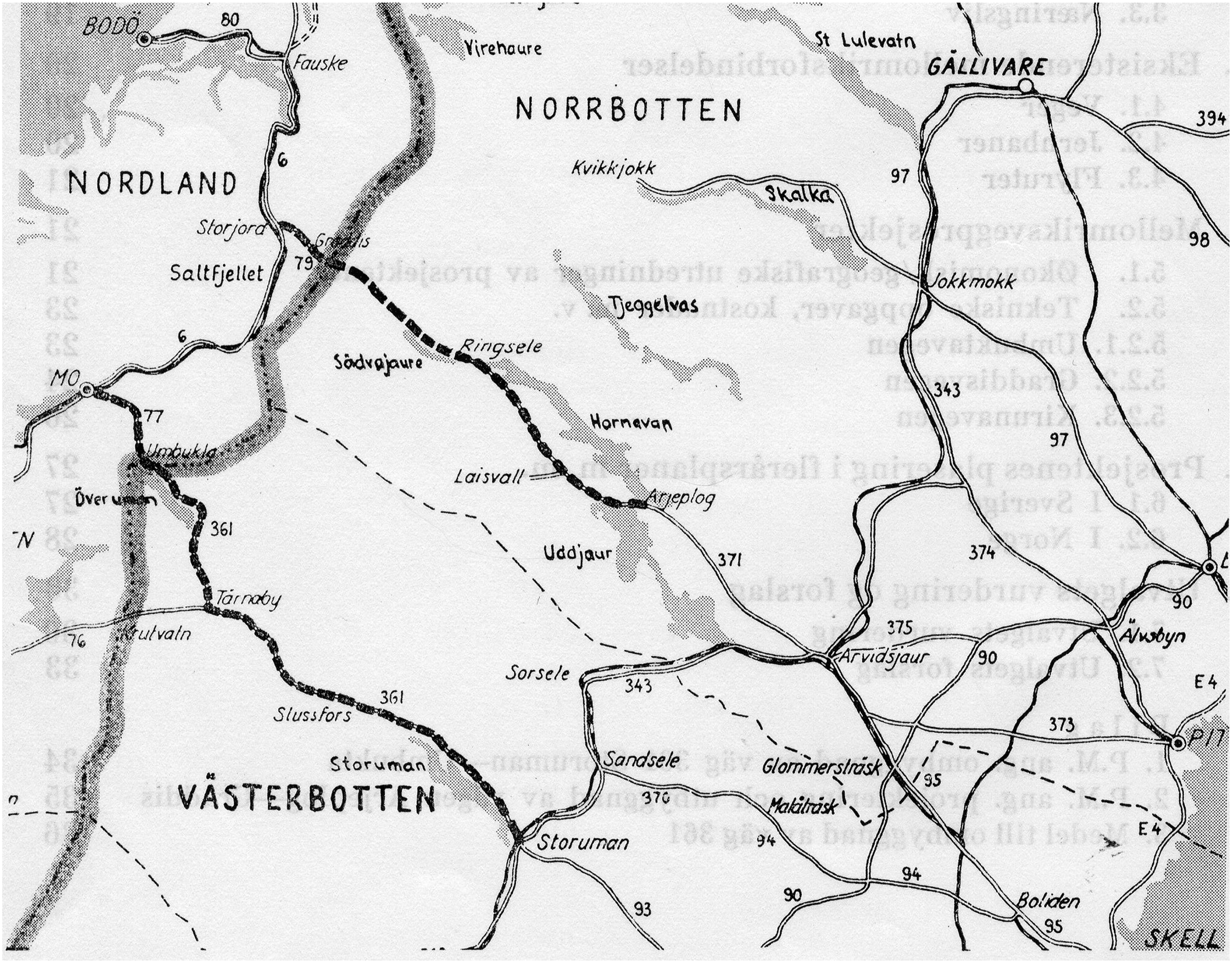
Existing and planned links of the Blue highway and the Graddis highway. Source: Nordisk Utredningsserie 1965:3, 4.
The Graddis highway project involved building a new road section between Sweden and Norway which would connect to existing links in the two countries. This would create a highway from Skellefteå on the Swedish northeastern coast to Bodø on the Norwegian Atlantic coast. In their report, the Swedish and Norwegian road administrations divided the project into the sections Arjeplog – Sädvaluspen – Graddis – Storfjord. The section between Arjeplog and Sädvaluspen was both national and transnational in character. It was already included in the regional road network (länsvägar). However, a completely new road, which was distinctively transnational in character, would have to be built through the mountain chain between Sädvaluspen and the Norwegian border from where it would converge at the Norwegian village of Graddis. In this respect, the Swedish road administration assumed that the Norwegian road administration would build the new sections from the border to Graddis and onward to Storfjord where the Graddis highway would connect to the Norwegian trunk road which linked the capital Oslo with Bodø. 22
The links between the road projects and societal ambitions
As the Blue highway and the Graddis highway were concepts that had developed over time and had attracted some enthusiastic stakeholders, both of those projects were established on the national political agendas before they were adopted by the Nordic Council. In Sweden, the Blue highway had become a prioritised project for the Swedish road administration due to its function as the main artery through Västerbotten County. These plans reflected how Sweden had started its transformation to a car society during the 1950s and was on the way to become one of the most motorised countries in Europe by the 1960s. 23 The Blue highway followed the Ume river valley where the population was concentrated to small towns or villages. As such, it integrated Västerbotten County by connecting the interior of the county with the central town of Umeå, located at the coast, where essential regional services such as administration and health care were located. The construction of the Blue highway also coincided with the building of hydroelectric power stations in the Ume River in the late 1950s and 1960s, which facilitated a reshaping and upgrading of the existing road through the Ume river valley, not least through the funding by the Swedish Power Board. 24 The Blue highway project was also attractive for the Swedish road administration since it had the potential to connect Norway, Finland and Sweden. In 1958, a car ferry service had been introduced between Umeå and Vaasa in Finland which coincided with a decision in the Nordic Council that passport control for all travelers was moved to the outer borders of the Nordic countries. This meant that Nordic motorists could move much more freely between the three countries than previously. 25
The Swedish road administration expected to finalise the building of the section between Storuman and Umbukta by 1971. 26 However, in Norway, there did not exist any plan to complete the road between Umbukta and Mo i Rana. Nevertheless, one section of the road, between Umskaret and Mo i Rana, was being upgraded as part of the building of a hydropower plant for the steel plant in Mo i Rana with the overall intention that this would be the foundation of an upgraded route to Umbukta. 27 Projects such as the steel plant in Mo i Rana have been described by Boge as forced industrialisation through politically governed investments in heavy manufacturing industries located in export enclaves that utilised cheap hydroelectric power. Such investments were usually not accompanied by investments in highways. 28 Instead, they are assumed to be a contributing factor to the Norwegian Labor party’s hesitation to take a position on mass motorisation and the car society which meant road investments were not a prioritised area in the national budget during the period 1945–1960. 29
However, the decision to combine road investments with the hydropower investments for the steel plant in Mo i Rana had been facilitated by an intervention from the Nordland County Council. Within Norway’s two tier-system of local government, the members of the Nordland County Council represented the municipalities of Nordland County through indirect representation. Before 1964, the members of the county council were appointed by the County Governor, but in 1964 the first indirect elections for the county council were held as each municipality council was granted the right to appoint members in proportion to their number of residents. 30 When the plans were drawn up for the hydropower investments in 1962, there were two competing options for the connecting road to the plant. The first option was to build a new road, leading directly from the steel plant to the hydropower plant. The second option was to improve and upgrade the existing road between Mo i Rana and Umskaret, which formed part of the road to the Swedish border. In this situation, the Nordland County Council requested that Parliament should work towards the upgrading the road between Mo i Rana and Umskaret. After deliberations between the Ministry of Communications, the Nordland County Council and the Norwegian Hydropower Board, it was finally decided that the funding the Norwegian Hydropower Board disposed to build a road to the hydropower plant should be used to upgrade the road between Mo i Rana and Umskaret. 31
As for the Graddis highway project, its stakeholders and their arguments reflected an awareness that the economies of the northern regions in the Nordic countries shared the same type of structural problems. Actors wanted to transform the regional economic structure from agriculture to industry. The small farms, fisheries and other agrarian production which traditionally had dominated employment were declining. However, non-agrarian sectors such as industry or services could not grow at a pace sufficient to employ the manpower released from agriculture. 32 As a response to these challenges, politicians from the northern areas launched an idea of economic development based on common exploitation of the natural resources in the so-called North Calotte region. The North Calotte region encompasses territories in three of the Nordic countries: Nordland County together with Troms og Finnmark County in Norway, the region of Lapland in Finland and Norrbotten County in Sweden. Due to the long distances within this remote area, politicians promoting the North Calotte perspective were aware that investments in infrastructure were crucial to open the vast natural resources in the region to the world markets. There were strong hopes to create production and transport chains across borders between locations in the different countries which would be mutually beneficial. Raw materials such as timber could be transported from the woods in one country to a refining plant in another country from where products could be transported to the world markets. One instrument to achieve this was to improve the road connections between the northern regions of Sweden, Norway and Finland. 33
In Sweden, the County administrative board in Norrbotten became one of the most active supporters of the Graddis highway and developed most of the arguments used by the Swedish stakeholders. The county administrative board (länsstyrelsen) is a central government agency with responsibility for the general state administration at the county level. In this role, it has also often looked after the interest of its county in relation to other state agencies. Reflecting the economic vision of the North Calotte, the County administrative board in Norrbotten argued that there existed great potential to export timber to the Salten district in Nordland without compromising the existing and future demand from the forestry industries in Norrbotten. 34 Another advantage of the Graddis highway was that exporting firms could use Norwegian ports for their shipments to world markets. Since these ports were open during the winter months, firms avoided the costs for storage and interest expenses they were forced to pay when winter conditions caused ports in northern Sweden to freeze over and sea trading routes were blocked for several months. In this respect, the County administrative board in Norrbotten noted that the Swedish road administration had failed to appreciate that such benefits increased, the more northern the location of a firm was. As an example, the County administrative board noted that the average difference in port closures between Umeå and Luleå was 50 days. 35
The County administrative board in Norrbotten also noted that the Graddis highway would benefit not only the connections between the northern parts of Sweden and Norway but also the connections between the northern and southern parts of Norway. Even if a national trunk road existed, this passed through the mountain Saltfjellet, which meant that the southward connection from the Salten district was blocked for around seven months each year due to snow conditions. If the Graddis highway was constructed, Norwegian road traffic could bypass this obstacle by using the roads on the Swedish territory. 36
As a final argument, the County administrative board in Norrbotten remarked that construction of the Graddis highway would make large areas of the Swedish mountains accessible to both winter and summer tourists. Under the current conditions, this was a remote area that only could be accessed by mountaineers with special skills. If the Graddis highway was built together with an improvement of existing infrastructure, this could create a whole new market for tours in the northern parts of Sweden and Norway. 37
In 1961, the issue reached parliament when a group of parliamentarians representing Norrbotten county submitted private members motions in both chambers of parliament where they demanded funding for the building of the Graddis highway. These parliamentarians used the same arguments as the County administrative board in Norrbotten had formulated in 1959. 38 Before deciding on those proposals, the Parliamentary Committee on Government Affairs (Statsutskottet) asked the County administrative board in Norrbotten and the Swedish road administration to submit written comments on the issue. The County administrative board in Norrbotten reiterated the comments it had submitted to the government in 1959. In this respect, it also added some examples to illustrate that its initial prognosis for the impact of the road was credible. For instance, it noted that since a board factory was established in Rognan in Nordland, there was good hope that the Graddis highway could serve as a link for timber deliveries to Norway. The county administrative board also observed that as car ferry traffic had been established between Kokkola (Gamla Karleby) in Finland and Skellefteå in Sweden, the Graddis highway would become a link in a greater inter-Nordic network. 39 In response to these arguments, parliament stated that there existed a societal need for the Graddis highway. However, it was not willing to grant any specific funding for the project before there was a binding commitment from the Norwegian government to build its part of the road. 40
This deliberation from Swedish Parliament caused a chain reaction in Norway as Nordland County Council requested that the Norwegian government should make a formal assurance to Sweden that it would build its part of the road. 41 The Graddis highway and the Blue highway were also debated in the Norwegian Parliament. From the statements in parliament, it is evident that the population in the Salten district of Nordland County and the counties north of the Salten district were frustrated about the slow progress of road building in northern Norway and the winter closures of the national trunk road. There was a sense of envy towards motorists in other districts of Norway which benefited from established road crossings into Sweden to bypass bottlenecks in the Norwegian road system. Norwegian parliamentarians also reiterated the arguments put forth by the actors from Norrbotten in the Swedish debate. There were high expectations that the wood processing industry in the Salten district of Nordland County would be able to benefit from an import of timber from Sweden. The building of the Graddis highway was also expected to open a new market for products from fisheries in northern Norway. 42
The response from the Nordic Council
After the joint report from the road administrations in Sweden and Norway had been submitted, the Nordic Council in 1959 recommended the Norwegian and Swedish government to explore the possibilities to pursue either the Blue highway project or the Graddis highway project. 43 This recommendation did, however, not lead to any direct contacts between Swedish and Norwegian road administrations. They did not continue their collaboration after the plans on the inter-Nordic network had been submitted in 1959 as developments were kept at the national level. 44 However, the intensified national debates on the Graddis highway put the issue on the agenda of the Nordic Council. In 1962, Jon Leirfall, who was the Norwegian chairperson of the Committee for traffic and communications within the Nordic Council, raised the issue. He stated that after following the Swedish debate, he had become convinced that it was necessary to build the Graddis highway. This would improve the prospects for dealing with the shared economic problems through industrial expansion as well as stimulating the tourism industry. Leirfall therefore urged the Nordic Council to issue a recommendation to the governments in Norway and Sweden to commence the building of the road as soon as possible. 45 In this respect, it is ironic to note that Leirfall – who represented Nord-Trøndelag for the Center Party in the Norwegian Parliament – previously had been praised by the Norwegian Minister of Communications for the fact that he was unbiased and thereby could report on the Graddis highway from a neutral and independent position. 46
The ensuing recommendation from the Nordic Council was however less radical than Leirfall’s statement. The Nordic Council recommended the governments of Norway and Sweden to coordinate the building of the Graddis highway to ensure that the parts built in each country crossed the border at the right time and at the right place. 47 During the 1963 session, the Nordic Council widened its ambitions as both the Blue highway and the Graddis highway were placed on the agenda. Three delegates reacted to the slow progress that had been made on these projects during the preceding years. Nils Jacobsen, Harry Klippenvåg och Sven Sundin stated that it was necessary to pursue the road administrations in Sweden and Norway to be more active. It was time for the Nordic Council to deal with the issue by activating a formal procedure through article 36 in the Helsinki Agreement, which is the main cooperation treaty for the Nordic Council. 48 Article 36 of the Helsinki Agreement regulates the dissemination of information about the Nordic countries and their cooperation within the Nordic Council. This meant that the Norwegian and Swedish governments were formally obliged to report on the progress of the cross-border Nordic highways to the Nordic Council. 49 These reports were submitted to the Committee for traffic and communications which assessed them critically. The Committee for traffic and communications concluded that the inter-Nordic highways were an important condition to create economic development in the northern regions of Sweden and Norway. For this to be realised, the Swedish and Norwegian governments needed to expand and deepen their coordination efforts. 50 The Nordic Council thereafter issued a recommendation to the Swedish and Norwegian governments to liaise and coordinate the work on the planned transborder highways. 51
The coordination of the building processes
After deliberations between the Norwegian and Swedish ministries of communication, the governments decided to form a working group with two members from each country. One member from each country represented the ministry of communications and one member from each country represented the road administration. The crucial coordination problem identified by the working group was that the roads built in the different countries needed to be completed according to a synchronised timetable so that the road could be opened for traffic at a certain point in time. 52
This problem was aggravated by the fact that the two countries had different systems for road funding. Sweden applied a top-down system. The road administration received lump sum allocations through the national budget and implemented the national road policy set by the government according to its own engineers’ scientific and professional standards. This process was decentralised to each county, which meant that the regional office in Västerbotten County dealt with the Blue highway and the regional office in Norrbotten County dealt with the Graddis highway. 53 The Norwegian system had a bottom-up character, with decentralised and local control of the road policy combined with state financing. This meant Parliament earmarked the grants to the road administration after proposals from local and regional actors, leading to a micro-management of individual road projects. 54 The Norwegian government declared that it expected that this would be the case also for the Blue highway and the Graddis highway. 55 Herein lie another crucial difference between the countries. Whereas investments on the Swedish sections would be undertaken by two regional offices, independent from each other and with separate budgets, the funding of both Norwegian sections was a concern for Nordland County.
When the Swedish-Norwegian expert group submitted its report in January 1965, it noted the coordination of both the Blue highway and the Graddis highway was dependent on how the Nordland County Council treated those projects in the communication plan which was under preparation at that time. 56 This plan was a proposal for the funding it wanted to receive from the national road budget. As for the section between Umbukta and Mo i Rana on the Blue highway, the Norwegian members of the expert group analysed the proposals in the communications plan. They wanted to ascertain whether the requested allocations in the plan was sufficient to match the existing Swedish plan to finalise the road at the border in 1971. The result of this analysis was that the requested allocation in the plan was realistic, but that an implementation of course was dependent on a decision by Norwegian parliament. 57 One reason for this optimism was that the Norwegian Government had abolished the previous budget restrictions for the road sector. Road building had become an area of considerable competition between opposing political parties such as the Labour party and Conservative party. 58 Furthermore, the 1963 road act promoted road building in remote areas with underdeveloped infrastructure through favourable joint funding conditions for the counties in northern Norway. 59 The state covered as much as 93 per cent of the cost for building highways in Nordland County, which meant that the county level only had to cover 7 per cent of the total cost. 60
As for the Graddis highway, the expert group was less concerned with the funding allocation in the communication plan, which it recognised was adapted to the declaration from the Norwegian government that it would not be able to fund two inter-Nordic roads simultaneously. The crucial problem identified by the working group for the Graddis highway was that the building times of the sections in the two countries were going to be different. While the Swedish road administration would build about 70 km of new road, the Norwegian road administration would only have to build 18 km of new road. It was therefore crucial to synchronise the different parts of the building process to ensure they were finalised at the same point in time. 61 If the Graddis highway was to be completed by 1974 as planned, the Norwegian Parliament needed to decide on the Graddis highway before the summer of 1965, even if the allocation of funds lie some time into the future. This decision would enable the Swedish road administration to start building of the road during the autumn of 1965 which was the latest point in time to start the building process for the Swedish section to be completed by 1974. 62
A decision by the Norwegian government was also identified as crucial to secure funding for the Swedish section of the road. The Swedish-Norwegian working group noted that while there was limited ordinary funding available for the building of the Graddis highway, these funds could be augmented by funds for unemployment measures through a special budgeting routine applied by the Swedish road administration’s regional office in Norrbotten. Through this procedure, projects with relatively low priority could be realised at a faster pace if they received funding through the budget of the Swedish Labour Market Board (Arbetsmarknadsstyrelsen) on the condition that unemployed workers were hired for the construction of the road. However, as the Swedish government promoted full employment and a return of unemployed to paid work as soon as possible, the availability of funds for unemployment measures varied with the business cycle. In this respect, the Swedish-Norwegian working group noted that a Norwegian decision on the Graddis highway would create a framework to secure an even stream of funding from the Swedish unemployment measure budget. By reserving these funds for the building of the Graddis highway, it was possible to create a detailed schedule for the building process. 63
The Norwegian-Swedish expert group therefore urged the Nordland County Council to finalise its communication plan and submit it to the Norwegian Parliament. On 27 April 1965, the Nordland County Council approved its communication plan and submitted it to the Norwegian Parliament. 64 On 30 April 1965, the Norwegian government introduced a bill to Parliament which dealt with the requests in the Nordland communication plan regarding the Norwegian sections of the Blue highway and the Graddis highway. This bill included the conclusions from the report submitted by the Norwegian-Swedish expert group, including the assessments of the communication plan. The bill also included a letter from the Swedish ministry of communications which supported the report from the expert group. 65 The minister of communications supported the proposals in the communication plan since it had taken into account that the government could not fund two inter-Nordic road projects simultaneously. The government recognised that as the building of the Swedish part of the road needed to begin in 1965, it was necessary to decide on the Graddis highway several years ahead of the construction of the Norwegian part of the road, which would start in 1971. This time gap was stated as the crucial factors behind the government’s decision to grant funding for the project. The government could thereby avoid a budget conflict between the Graddis highway and the Norwegian section of the Blue highway, which needed to start in the close future. 66 On 26 May 1965, the Norwegian Parliament passed the bill without changes or amendments. 67
The Nordic Council thereafter issued a new recommendation that the Graddis highway and the cross-border sections of the Blue highway should be built as soon as possible. 68 Table 1, which describes the composition of the Committee for traffic and communications that prepared the recommendation, indicates that the Blue highway and the Graddis highway were a multiparty undertaking. The notion that there existed a solid consensus around these projects is strengthened by the fact that the vote in favour of the recommendation was unanimous. Table 2, which provides a list of the Swedish and Norwegian representatives in the Nordic Council who voted in favour of the recommendation, supports the assertion that both road projects were supported by a broad coalition from all parties.
The members of the Committee for traffic and communications who prepared the 1966 recommendation on the Blue highway and the Graddis highway.
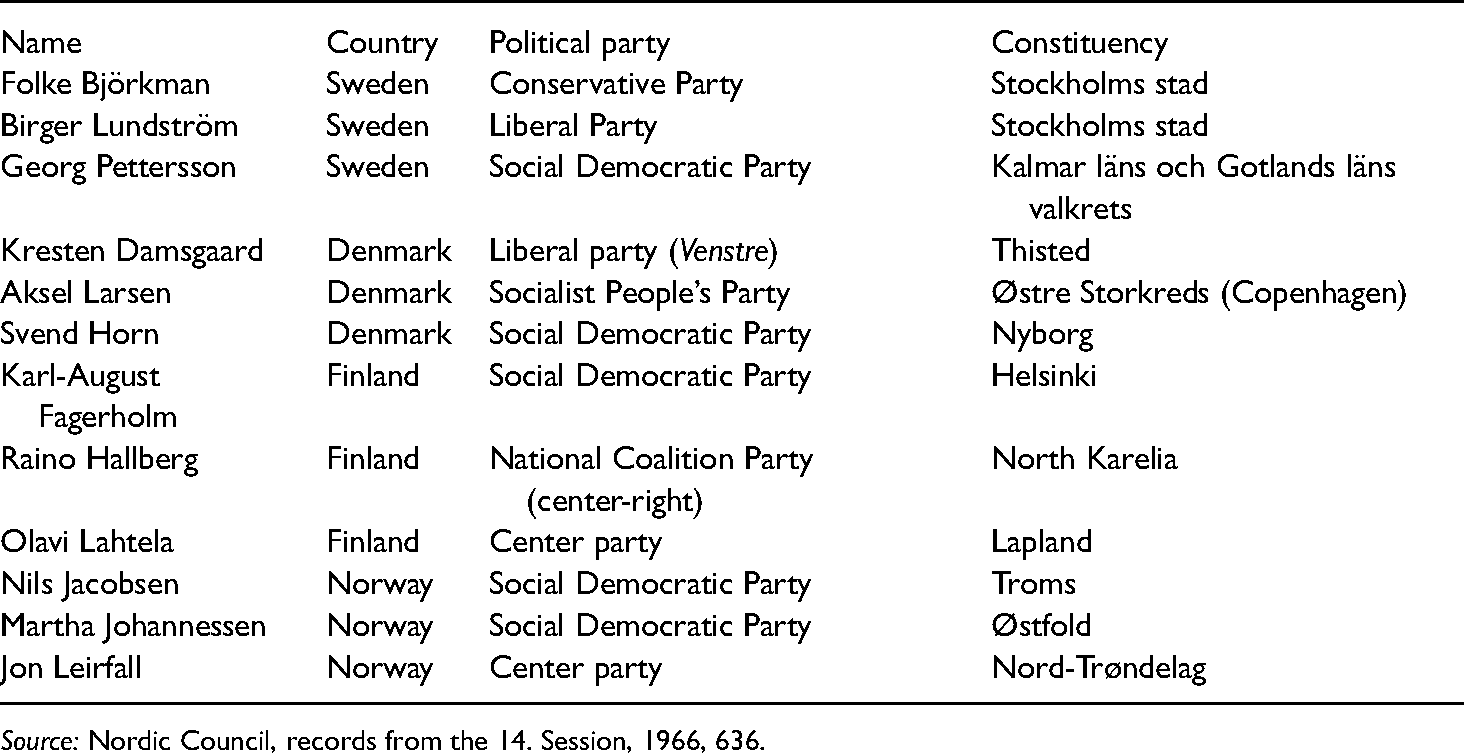
Source: Nordic Council, records from the 14. Session, 1966, 636.
The Swedish and Norwegian representatives of the Nordic Council who voted in favour of the 1966 recommendation on the Blue highway and the Graddis highway.
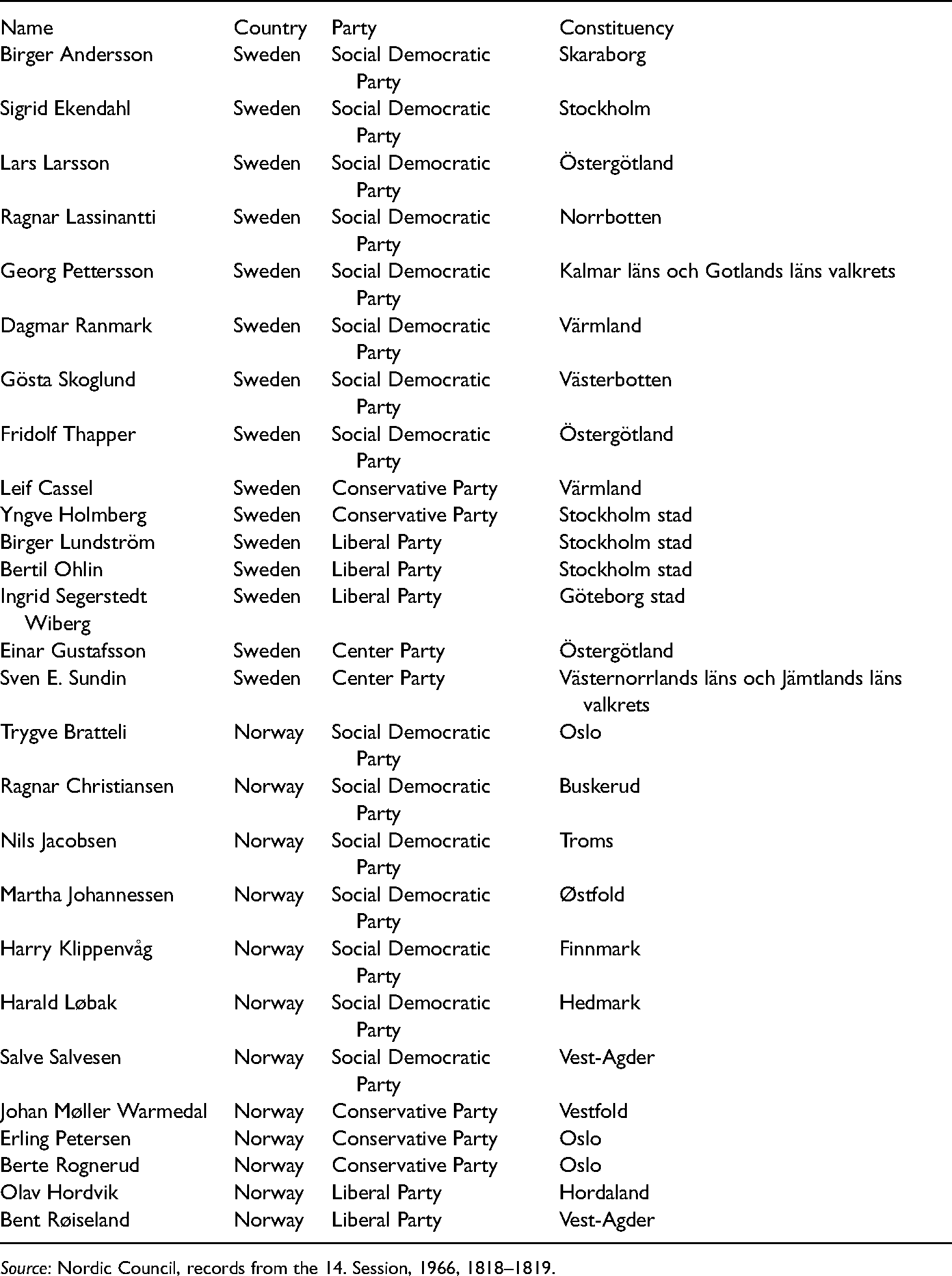
Source: Nordic Council, records from the 14. Session, 1966, 1818–1819.
Summary and concluding discussion
This article has demonstrated that the basis for cooperation around the Blue highway and the Graddis highway in the Nordic Council was the consideration that these roads were mutually beneficial to both Sweden and Norway from two interrelated perspectives. As for the first perspective, the Nordic Council framed the examined roads as instruments to deal with important issues in economy and society that politicians and planners in both countries were facing at the time. The Nordic Council expected the examined roads to contribute to more efficient exploitation of natural resources such as forests and hydropower and thereby to strengthen export industries. This would benefit existing national interests but also serve as a catalyst to realise the shared vision of a state-sponsored structural shift of the economy on North Calotte. Related to this, regional actors framed the examined roads as missing links in a larger network which was necessary to complete if the governments wanted to achieve a more spatially egalitarian society where citizens had access to all modes of transportation. Actors in the northern regions expected that the car society as part of a modernised economy would be available to every citizen. The second perspective was that the examined roads were necessary to improve the tourist industry in the surrounding areas of the examined roads. The Nordic Council shared the view of national stakeholders that many places which were attractive for tourists but could not be accessed due to their remote and isolated location should be available to motorised tourists. This reflected an emerging belief that the tourist industry could be one alternative to create new employment in areas where traditional agriculture and forestry was diminishing. During the post-war period, the fast-growing economy and the rise of the welfare state led to higher incomes for many groups in the population. There was also a dramatic increase in the amount of time off available to a broad spectrum of people across the population. In both Sweden and Norway, the average wage earner received three weeks of paid holiday during the 1950s. 69
I have also demonstrated how the experts and civil servants in the national sector administrations facilitated the construction of the examined roads. In this respect, the Nordic Council faced the same type of problem of interconnecting national links encountered by other organisations dealing with transnational infrastructure. Even if the Nordic cooperation ideology built on generating mutual benefits from existing similarities, and there was unanimous political support for the examined road projects, the institutional differences between the Swedish and Norwegian road sectors were still substantial. In this respect, the Norwegian-Swedish expert group commissioned by the Nordic Council represents an example of the type of expertise who by tradition were loyal to the cause of Nordic cooperation and worked to fulfil the intentions of the Nordic Council. To this end, the Norwegian-Swedish expert group functioned as a troubleshooter by identifying risks and pitfalls that could threaten the implementation of the examined road projects. In particular, the group identified the complex Norwegian road funding system as the major challenge. A Norwegian funding decision was crucial to achieve a synchronisation of the building process so that the roads could be opened for traffic at the agreed point in time. However, this depended on the successful completion of the Norwegian funding process which needed to undergo several steps within a relatively complex political system. The Norwegian-Swedish expert group therefore monitored each such step until all the necessary decisions had been made.
It is thereby possible to identify two main differences between/within the Nordic Council and the ECE in the field of transnational road building. The first difference concerns the character and direction of plans and visions. Whereas the E-road network built on an ambition to create mutual understanding and fraternity between the European nations, the inter-Nordic roads were connected to a more tangible material practise. Roads were expected to contribute towards solving shared economic and social problems. The second difference concerns the direction of influence from expert organisations. It has not been possible to identify an interaction between an expert organisation and the Nordic Council in the manner the IRF interacted with the ECE. Instead, the inter-Nordic stream of expertise was channelled between the national road administrations, where the Nordic Road Association was one important arena. In combination with other regular interactions, this created a foundation for the cooperation on the interconnection of the examined roads.
However, it is also important to remember that interest group access to the participating road administrations was not closed. There were several arrangements in place for consultations with external actors. With regard to the IRF, it should be noted that the plans for the inter-Nordic road network drawn up by the Swedish and Norwegian road administrations during the period 1956–59 built on a road engineering approach applied by the Swedish road administration when it prepared the national road plan (Vägplan 57). 70 Previous research has noted that the preparation of the national road plan was preceded by a substantial influence from the IRF on Swedish road engineers. 71 In Norway, experts such as traffic engineers with close connections to the international road community and organisations such as the IRF also had an influence on the process as they contributed to break the political deadlock regarding mass motorisation. 72 It might then be argued that while the IRF did not have any direct influence on the formation of the inter-Nordic road network as this was outlined by the Nordic Council, it certainly had a strong indirect influence due to its strong underlying relation to road engineers and other experts.
Footnotes
Acknowledgements
Funding for this research has been provided by Jan Wallanders och Tom Hedelius stiftelse samt Tore Browaldhs stiftelse under grant P19:0049.
Declaration of conflicting interests
The author(s) declared no potential conflicts of interest with respect to the research, authorship, and/or publication of this article.
Funding
The author(s) disclosed receipt of the following financial support for the research, authorship, and/or publication of this article: This work was supported by the Jan Wallanders och Tom Hedelius Stiftelse samt Tore Browaldhs Stiftelse, (grant number P19:0049).
