



Abstract
This article argues that mopeds played an ambivalent but ultimately positive role in the long-term success of Dutch cycling. Unlike in many other countries, Dutch cycling levels dropped but remained significant throughout the 1950s and 1960s, partly because cycling infrastructure continued to be constructed. One underexplored factor explaining this is the role of mopeds in the 1950s. The Netherlands constructed a significant network of cycle paths before the 1950s. When mopeds became popular, the existence of this network raised the question of where they should ride. Engineers and politicians classified mopeds as bicycles, assigning them to the cycle path. As a result, engineers decided to build more and wider cycle paths. Despite the danger and discomfort of sharing cycling paths, cyclists therefore also benefited in the long run from the decision to reframe cycle paths as cycle-and-moped paths.
Introduction
The number of cars on European roads rose so dramatically in the 1950s that constructing paths for cyclists was no longer a priority. Engineers widely believed that motorization would eventually make the bicycle obsolete. Cyclists were hardly ever included in traffic counts. Consequently, this group of road users became even less visible than they already were to policymakers and planners, who no longer found allotting scarce road space to cyclists a prudent investment. 1 As countries switched to actively promoting motorization for the middle class—and later for the working class—and neglected cycling, cyclists found the road network increasingly dangerous and unattractive. Additionally, increasing commuter distances and rising wages fostered the switch to automobility or public transit. Many gave up their bicycles and chose other travel modes, giving transport planners a good excuse to lower investments in cycling infrastructure. The situation in the Netherlands was somewhat different—traditionally engineers provided major roads outside cities with separated cycling infrastructure. Even in the Dutch context, however, policymakers devoted more resources to motorization. Yet, by the end of this car-centred planning period around 1970, cycling levels in the Netherlands were still significant enough to make a comeback.
I argue that one overlooked factor aiding this survival was Dutch residents’ widespread adoption of the moped in the 1950s. This ambiguous vehicle—motorized but resembling a bicycle—defied easy categorization. While mopeds were popular elsewhere, the impact of Dutch authorities’ decision to classify the moped legally as a bicycle meant moped riders had to share cycle paths. The subsequent—and in a European perspective rather unique—construction of cycle paths meant that cycling could survive alongside rising car levels, and as a result, cycling commuting in the Netherlands did not drop as far as elsewhere. This proved to be a fertile ground for cycling activism in the 1970s and led to a revival of urban cycling culture and planning. While cyclists generally objected to sharing paths with mopeds due to the speed difference, noise, and exhaust fumes, assigning mopeds to cycling paths rather than roads had an unintended, yet positive outcome on cycling’s long-term viability at a crucial time.
Theoretically, the concept of path dependency plays an important role here. 2 The theory uses the concept of paths metaphorically, although this article also deals with literal paths. Mobility and planning policies tend to produce mobility patterns and physical infrastructure such as cycle paths which are so deeply embedded that changing them is both difficult and expensive. 3 Initial choices, in themselves contingent and small, in the long run can have large and necessary consequences. 4 As historian James Mahoney argues, path dependency is often used loosely, becoming little more than the truism that “earlier events affect later possibilities and foreclose certain options.” 5 For a process to be called path-dependent, the possibility of change at a later stage has to almost non-existent because of earlier choices which reinforce the commitment to a certain path. In other words, positive feedback processes increase the cost of unmaking earlier decisions. 6 Once cycling was firmly entrenched in Dutch mobility, cyclists were simply there. Next, the question was whether to continue facilitating cycling in a partly segregated network or return to shared traffic spaces, which neither drivers nor cyclists wanted. 7 Conversely, where cycling levels are low, a vicious circle emerges: planners who believe cycling is on the decline, do not invest in it; cycling becomes less attractive and the number of cyclists drops, which justifies withholding further support. Put differently, a self-reinforcing process in both high and low cycling environments becomes so ingrained in existing institutions that it is too costly to change. This process explains both the Dutch moped solution and why cycling was still a viable practice in the Netherlands in the late 1960s, unlike many other countries.
In the historiography of Dutch mobility, the moped’s role has been understudied, despite constituting an important intermediary step (between bicycles and cars) in the motorization of the Netherlands, one of the last western countries to reach high levels of automobility. The true growth spurt began in the mid-1960s, a decade later than many surrounding countries—and much later than the USA. 8 In 1960, the Netherlands had 45 cars per 1000 inhabitants, only half of similar small European countries like Belgium (82) and Switzerland (89). The numbers in larger countries with their own car industry like France and the UK were over 100, and in the USA almost 350. The gap with small countries closed by 1970, when Dutch car ownership reached similar levels to Belgium and Switzerland (200 cars per 1000 inhabitants). 9 The rise in car ownership was partly because after the government had abandoned wage control policies in the early 1960s, the purchasing power of households increased. Partly as a result of late motorisation, Dutch cycling levels remained significant in the 1950s and 1960s. Still, a decline took place: the once high cycling levels in Dutch cities plummeted in the 1960s, reaching their lowest point around 1970. As cycling scholars Pucher and Buehler note, however, cycling levels did not fall as far as elsewhere. 10 One likely reason for late mass motorisation is the popularity of the moped in the Netherlands. In their handbook on Dutch mobility history, historians Gijs Mom and Ruud Filarski note the high levels of moped ownership and associated youth culture. 11 The emerging cycling historiography has mostly ignored the moped and its impact on cycling. 12
Before examining how the emergence and popularity of the moped in the 1950s presented policymakers with new issues such as whether mopeds should use the existing cycling paths and why the resulting legislation had both positive and negative effects on cycle path construction and cyclists, I revisit the decades to look back at why the cycle path network in the Netherlands was so extensive prior to the 1950s. These decades offer a way to understand its impact after the 1950s—and thus the path dependency of cycling in the Netherlands.
Dutch cycle paths before 1950
The origins of the Dutch cycling path network outside cities date back to the 1920s, when the state developed a clear policy regarding road construction and space distribution. It was a political compromise: every major road had to have good cycling facilities, preferably separated from motorized traffic. A compromise indeed, since from 1924 to 1941, the bicycle tax funded most road construction. Before the 1920s, a powerful non-governmental Dutch tourist organization, the Royal Dutch Touring Club ANWB (hereafter ANWB), had already lobbied for constructing cycle paths. Created in 1883 as a cycling club, this organization evolved to become a key player in shaping user behaviour as well as government policy and therefore had an important role in the 1950s moped debate. Historians portray the ANWB as a liberal, middle-class organization with nationalist ideas and claiming a ‘civilizing role’ in educating traffic participants. 13 With its large membership and broad range of activities, the ANWB strove to be seen as representing all road users, much more so than in other countries with multiple competing traffic associations. 14 Another powerful side to the tourist organization ANWB was its extensive in-house engineering expertise, which significantly helped shape Dutch cycling and driving. The ANWB has been described as “the main system builder […] of the Dutch automobile system.” 15 It was also involved in almost all the initiatives to build cycle paths in the Netherlands. 16 When traffic engineering became a more clearly delineated discipline in the 1950s, the ANWB again took up a key role in promoting traffic safety and the scientific study of transport. 17
In the mid-1920s, concerned that motorized traffic would need better roads, the national government created a Road Fund and voted to have it financed partly by the significant revenue from the bicycle tax. 18 An earlier tax on bicycles had been abolished in 1919, but was reinstated in 1924 as a crisis measure to help balance the budget. From 1926 until 1941, despite fierce opposition from the social-democrats, the bicycle tax became permanently dedicated to road improvement. Historians Adri Albert de la Bruhèze and Ruth Oldenziel have calculated that in the interbellum period, 95 percent of the proceeds from cyclists went to constructing car roads. 19 They document how an elite group of car enthusiasts sought to transform the nation’s roads into uninterrupted flows for drivers and show that Dutch cyclists paid for their own banishment because there were not enough drivers to fund their own roads. 20 Many of the large cycling population were working-class, who lived in cities and for whom the annual tax was a real burden. Furthermore, urban cyclists received few benefits from this tax since cycle tracks were constructed almost exclusively in rural areas alongside major thoroughfares, while urban traffic remained mixed.
From a Dutch-German comparative perspective, historian Anne-Katrin Ebert, by contrast, stressed the positive impact of the bicycle tax on developing Dutch cycling infrastructure. 21 Focusing less on the class dimensions of the tax debate, she praises its legacy: “The bicycle tax put cyclists on the political map and helped to create a tradition of traffic engineering devoted to cycling tracks and regulation. This would form an important basis for the ‘survival’ of the Netherlands as a cycling nation in the second half of the twentieth century,” she argues. 22 She emphasizes how paying tax gave advocates of cycling, especially the ANWB, a good argument with national representative bodies to make better provision for cycling. Indeed, cycle paths were constructed from the late 1920s and this policy continued over the decades until most major roads had them. By the late 1930s, the cycle path network totalled 9,000 km. 23 Internationally, this was not unique: other Western European countries constructed cycle paths between the two World Wars. 24 The real divergence came in the 1950s.
These two seemingly contradictory perspectives on the bicycle tax reflect how it both helped and hindered cyclists: while arguably aimed at prioritizing the needs of upper class car drivers over working class cyclists, a bicycle tax linked to roadbuilding had unintended, positive long-term consequences. The moped debate displays the same paradoxical character, as I argue in this article.
The contingent decision to levy a bicycle tax in the 1920s put Dutch mobility policy on a unique path. The commitment to traffic separation led to a material infrastructure of suburban commuter cycle paths which supported cycling as a practice even as levels of driving started to rise on roads. For one, the material costs of going back to mixed traffic were high, requiring demolishing cycle paths or turning them into car lanes. Institutionally, engineers would have to change road norms and roadbuilding practices at high costs. And most importantly, drivers who had roads “free” of cyclists would not accept the return of cyclists to main roads. This is one of the positive feedback processes which drive path dependent processes. Once traffic separation was firmly embedded, therefore, and as long as cycling levels were high, it was nearly impossible to change this pattern. Only a dramatic decrease in cycling levels might have uprooted this path dependent process. At the moment that cycling levels started to decline in the Netherlands, the moped debate formed a critical juncture: its framing as a type of bicycle reinforced the traffic separation system and its commitment to constructing cycle tracks. 25
The rise of mopeds
Mopeds became popular in many European countries in the early 1950s and throughout the 1960s. Beginning as bicycles with a small engine attached to the front wheel, mopeds soon resembled light motorcycles. 26 The moped is part of a larger mid-twentieth century development to provide cheap individual motorized transport to the lower and middle classes and became very popular in the Netherlands. Mobility historians Mom and Filarski note that the first mopeds appeared in the Netherlands in 1947; between 1952 and 1966, there were more mopeds than cars and at the high point of its popularity (in 1969) two million were registered. Journalist Jan Meijer called the moped the “car-of-the-little-man” (auto-van-de-kleine-man) in 1950 and expected it to rapidly replace the bicycle. 27 Car ownership only rose sharply after 1963 when the government ended wage control policies and encouraged consumer spending. 28 As table 1 shows, the proportion of Dutch residents owning a moped in the 1950s was one of the highest in Western Europe. 29
Moped ownership in Europe in 1958.
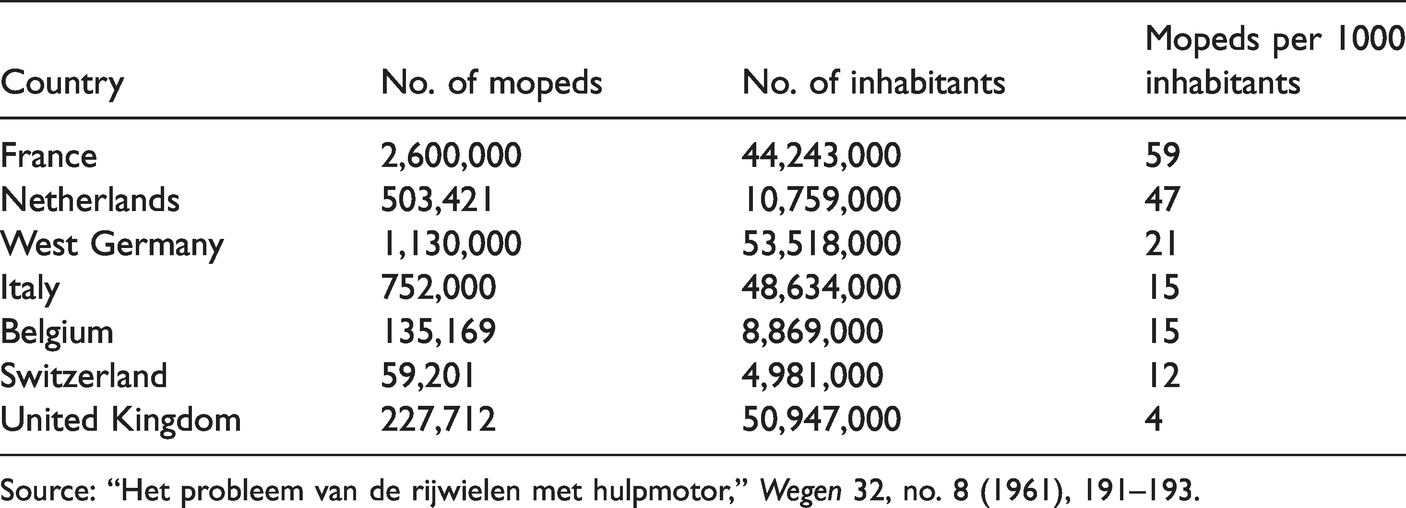
Source: “Het probleem van de rijwielen met hulpmotor,” Wegen 32, no. 8 (1961), 191–193.
At the same time, however, cycling had not disappeared. In the 1950s and 1960s, bicycles substantially outnumbered both cars and mopeds. In the early 1950s, there were still only 500,000 mopeds versus 5 to 7 million bicycles. 30 Ownership grew until the late 1960s and traffic counts show mopeds’ use increased throughout the 1950s and 1960s, although their use did not outnumber bicycle trips. 31 At the height of the moped’s popularity in 1968, as many mopeds as cyclists crossed the Nieuwe Maas river on their daily commute in the harbour city of Rotterdam. 32 Traffic counts focused on commuters in the province Gelderland in 1973 showed almost 4,000 mopeds riders compared to 4,750 cyclists. 33 Given the larger distances mopeds travelled, they likely show up more often in traffic counts than cyclists. These numbers do therefore not mean that the moped was as popular as the bicycle. They do however show that the moped’s share in traffic was significant. Policymakers and experts were aware of this. They expected moped ownership to rise rapidly: in 1956, the Dutch Traffic Institute (NVI) estimated one million mopeds in the Netherlands by 1960. 34 This milestone was reached in 1959 already.
In short, the moped was important and widespread in the Netherlands. This has not been sufficiently acknowledged. German and French historians have claimed the moped’s role in the motorization of their countries. Frank Steinbeck describes the moped or light motorcycle as an important intermediate step in the 1930s to full motorization in Germany. 35 Historian Frédéric Héran asserts that France is the only country “to have had a considerable amount of moped trips” in the immediate post-war years. 36 We can now say that mopeds were also popular in the Netherlands, but crucially in a context where cycling also remained more popular than in many other European countries. 37 Mopeds became deeply embedded in the Dutch mobility system, with 65 percent of moped riders using them to go to school or work. 38 From being primarily a working-class transport mode for commuters in the 1950s, mopeds increasingly became part of youth culture in the 1960s. Moped types like the Austrian and German Puch, Kreidler, and Zündapp were popular with rival youth cultures. 39 The Dutch bought almost a million French Solex mopeds, which were slower and initially marketed as the workman’s moped before becoming popular with women. Dutch women adopted the moped in large numbers in the 1960s, buying as many as men (see Figure 1). 40
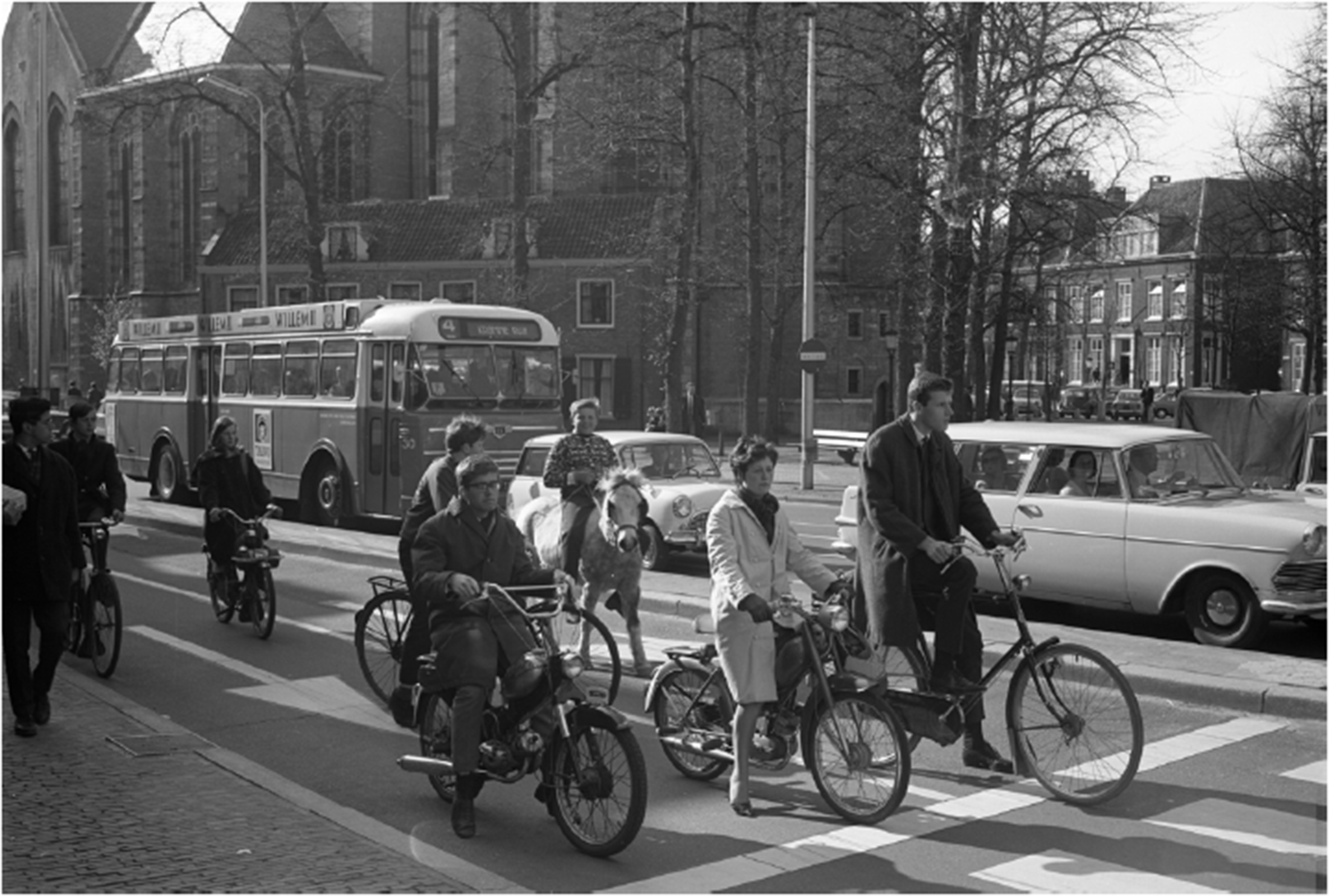
In the 1960s, mopeds became popular with women in the Netherlands. Here, two of the three moped riders among cyclists in Utrecht, 1967, are women. Source: Photographer Utrecht Municipal Archives, Collection Het Utrechts Archief, no. 810884.
Classifying the moped as a bicycle
As a new type of vehicle, engineers had to decide where the moped belonged on the road, especially in the Dutch system built on the separation of cars and bicycles on separate paths. At the Convention on Road Traffic adopted at a 1949 UN meeting in Geneva, experts classified the moped as a type of bicycle rather than a motorized vehicle. The Netherlands ratified this convention, stating: “Cycles fitted with an auxiliary combustion engine having a maximum cylinder capacity of 50 cm3 (3.05 cu. in.) shall not be considered as motor vehicles, provided that they retain all the normal characteristics of cycles with respect to their structure.” 41 The Netherlands retained the ambiguous term “normal characteristics” of the UN convention in the amended 1953 Dutch Road Traffic Regulation. Bicycles with an auxiliary engine were added as a category. 42 Neither document specified the standard characteristics of a bicycle, nor more importantly the speeds these mopeds could achieve, the major point of contention in determining a moped. Only when the UN renewed the convention in 1968 did it stipulate that to count as a moped, a vehicle had to have a maximum design speed of 50 km/h. 43 However, this international legislation left it to national states whether they allowed mopeds to use their road system—not a real option, as many countries had very few cycle paths.
The Netherlands did have extensive suburban cycling infrastructure, however, and therefore faced a decision. In line with international legislation, in 1953 the Dutch Ministry of Public Works decided mopeds were indeed a type of bicycle and should use existing cycle paths. 44 The leading Ministry and ANWB experts agreed that to justify this decision, they had to frame the moped as more bicycle than car-like and so used (speculative) safety arguments. Public Works Minister Spitzen argued in a 1949 report that it was too dangerous for relatively slow mopeds to share the road with cars. It would be safer to treat them as bicycles. 45 He also acknowledged, however, the problematic space issue: there were “certain objections in admitting a large number of these ambiguous [tweeslachtige] vehicles on the cycling tracks which are often already overcrowded.” 46 However, this safety argument often masked the prioritization of car traffic.
Having established close ties to state engineers, the ANWB’s position in the debate was significant, despite its non-official status. J. Koolhaas Revers, editor of the ANWB’s new journal Moped Champion (Bromfietskampioen), opened the first issue in 1951 by boldly asserting that new moped riders would “instinctively search for the support of the largest traffic federation in the Netherlands.” As former cyclist organization, the ANWB protected moped riders: it defended their interests and gave them advice. Koolhaas Revers found this self-evident: “the A.N.W.B. is the federation in which the motorized cyclist belongs.” 47 As a veteran in car related publishing, Koolhaas Revers sought an argument that satisfied all the organization’s members. 48 While he stressed the moped’s resemblance to the (old-fashioned) bicycle by evoking moped riders’ previous cycling experience, he also emphasized the moped’s modernity. He asserted that the ANWB “adjusts immediately to present-day circumstances” and framed the moped as a modern transport mode. 49
The progress in transport modes also led editor Koolhaas Revers to muse about the bicycle’s disappearance. He foresaw “our old faithful pedal bicycle” becoming a “tiny national minority,” that might end up in the Rijksmuseum as a curiosity—quite a striking statement for 1951, when cycling still made up 70 to 80 percent of the modal split in Dutch cities, although this is excluding pedestrians who were not counted. The moped, he asserted, was a “conqueror, who imposes his will, against which there is nothing to be done.” 50 According to Koolhaas Revers and the ANWB, technology’s progress was unstoppable. It was best to facilitate it—though not without a certain nostalgia for the loss of the old. But not everyone believed cycling would disappear. A 1955 ANWB survey among 12,000 bicycle dealers in the Netherlands showed only 22 percent believed the moped would eclipse the bicycle. Others believed the bicycle would remain the most popular two-wheeled vehicle. 51
The ANWB repeatedly argued that in theory, the proper place for mopeds was a parallel moped track. 52 Due to excessive costs and space demands, this option was deemed unfeasible. The next best solution was shared cyclist and moped paths. An anonymous 1951 memorandum said it would be dangerous if mopeds shared the road with cars because of the speed difference, while sharing the cycle track would be unpleasant and dangerous for cyclists. The ANWB, although “aware this is not the most pleasant solution,” defended its seemingly neutral, technical decision thus: “the mentality of the really fast traffic is simply less receptive to the presence of other road users, who are hard to notice and slower in speed.” 53 This position absolved drivers of any responsibility to take other road users into account—a critique cyclists levelled against the ANWB. By framing the moped as a bicycle, not a motorized vehicle, the ANWB argued that it was less dangerous to have it share the cycle track than the road.
Complicating the issue, however, was recreational infrastructure. The moped was an ambiguous vehicle and the ANWB made use of this fact: to convince people of its bike-like qualities for shared paths along major roads, and its motorcycle-like character for recreational cycle paths. These were unpaved paths in nature, intended for recreation, and not connected to the major road network. In practice, paths in the densely populated Netherlands often also served utilitarian purposes for people living in the countryside. Even so, the ANWB wanted to ban mopeds from predominantly recreational routes because the sound and smell of mopeds would spoil cyclists’ experience of nature. There was no acknowledgement that these same motor-like characteristics could be a nuisance to cycling commuters on non-recreational routes. The moped characteristics minimalized in the discourse on utilitarian mobility came to the fore when discussing recreation.
Dutch cycling policymakers often differentiated recreational and utilitarian (or ‘traffic’) cycling. For example, in 1949, liberal member of parliament Roelof Zegering Hadders opposed allowing mopeds on rural cycle tracks. 54 In 1950, he asked the Minister whether he distinguished “cycling tracks, constructed to improve traffic safety, and those cycling tracks which have been constructed to quietly enjoy the most scenic spots of our country.” 55 Zegering, like most, agreed with the Minister’s plan of separating mopeds and bicycles from cars, but objected to the moped’s noise pollution on recreational routes.
The Minister responded by distinguishing parallel and separate cycle tracks. 56 Moped riders were obliged to use the cycle track parallel to roads, but on separate cycle tracks not following the road network they had to switch off the auxiliary engine. 57 This final stipulation implied that policymaker considered the moped more as a motorized vehicle than a bicycle—it was too fast and noisy and had to become more ‘bike-like’ by turning off the engine. After much legal fine-tuning, this has led to the current different legal types of cycle paths in the Netherlands, some specifically excluding mopeds. In practice, policymakers have found the distinction between recreational and utilitarian cycling tracks hard to apply. For example, a 1951 survey in the province of Drenthe asked municipalities to distinguish recreational and utilitarian tracks. Each municipality gave widely different answers because there was no standard definition. 58 The power to exempt rural cycling tracks from banning mopeds was ultimately left to local authorities. These discussions show how the definition of what constituted car space, bicycle space, and moped space has always been fluid, depending on the framing of the vehicles as well as the expectations for their future development.
Implications for cycle path construction
The decision to see moped riders as cyclists, coupled with the moped’s real and perceived popularity, led to calls for creating new cycle paths and widening existing ones. Social democrat member of parliament Siep Posthumus argued in 1951 that the moped issue required a “radical solution” like “the construction or improvement of cycling tracks” to make them “suitable to both the slower moped riders and ordinary cyclists.” 59 While he agreed in principle with framing the moped as a bicycle, Posthumus also complained about the “tensions” and “problems of a psychological character” that resulted from mixing cyclists and moped riders. In 1953, he insisted the Minister of Public Works should “rapidly widen existing cycling tracks and construct new ones with a greater width than has been the case up to this point.” 60 In 1962, Christian democrat Cor van der Peijl also demanded more and wider cycle paths. 61 Communist member of parliament Jan Haken even suggested dedicated moped tracks, while acknowledging this proposal was probably too expensive. 62 Christian democrat Tjeerd Krol and others argued that framing the moped as a bicycle was a mistake. He found it “no longer responsible to equate this vehicle with a normal bicycle.” 63 Despite being established legally as a bicycle, the moped’s status remained controversial in public debates. 64
Parliamentary calls for more cycle paths were echoed by the executive branch in the form of provincial state engineers. Working in provincial public works departments, these civil engineers were responsible for the construction and maintenance of most roads outside cities, giving them considerable power to distribute road space. They agreed that cycle tracks needed widening to accommodate mopeds. At a meeting in 1956, an engineer from the province of Utrecht’s public works department, C. de Groot, and another engineer, S.J. Faber from Gelderland, agreed on this, if little else. De Groot called the moped “the transport mode of the future” because cycling would only remain useful for travelling within towns and villages. 65 Faber, in contrast, did not see the modal share as a zero-sum game: mopeds may have dominated longer-distance travel and partly replaced cars, busses, and bicycles, but “one should not state that the normal bicycle is about to disappear. It is not like that: traffic has become more intensive.” 66 Both civil servants, however, believed cycle paths were important and necessary, while the non-governmental tourist organization ANWB played a key role in offering advice. Employing its own experts, this organization possessed both considerable road engineering expertise. Dutch state officials saw the ANWB as a legitimate knowledge partner therefore, and took its advice seriously.
In line with Dutch decentralized administrative tradition, the national public works department Rijkswaterstaat gave provincial engineers a great deal of autonomy and relatively little guidance. As a non-governmental organization, the ANWB filled this knowledge gap by publishing traffic memoranda and organizing traffic courses. 67 Its brochure on cycle tracks stated that the design norms for cyclists and mopeds differed: cyclists needed at least 0.75–0.80 m width, mopeds 1 m. To allow cyclists to overtake each other, the minimum for a cycling-only track was 1.50 m, so wherever mopeds were allowed, the width had to be at least 2 m. The ANWB advised 2.50 m as a minimum so that two cyclists could ride abreast and a moped could still overtake them. 68 It spread this advice about wider cycling tracks to all the traffic-related authorities and organizations in the country. 69 The ANWB organized courses for traffic engineers, also to promote its vision with civil servants. 70 In 1954, it invited provincial engineer D. Mathlener to present his vision on cycle tracks. Mathlener explained that 2.50 m was a minimum width for unidirectional cycling tracks. If many mopeds used the route, another 0.50 m was needed. 71
Through such presentations and correspondence, the new norm soon reached all roadbuilders in the Netherlands. According to the engineer Faber, his province Gelderland had adopted the policy of constructing cycle tracks that would be “2.40 m wide on each side of the road. So, in the long run, all the roads of Gelderland’s roads plan will have two cycle tracks dedicated to traffic on two wheels.” 72 Similarly, in 1959, another province (Drenthe) changed the norms for its cycle track plan. Engineers believed it was “the logical consequence” of moped riders’ “stormy development” that cycle tracks “that had been initially designed with a hardening width of 1.50 m, will now be given a width of 2 m.” 73 In the 1950s, the province Zuid Holland’s recreational cycle track plan included 3 m-wide tracks, so that mopeds could easily overtake cyclists. 74 With the enduring relevance of cycling and spectacular increase in moped traffic, the Zuid Holland engineers also considered the wide cycle tracks along the major traffic arteries simply indispensable (see Figure 2). 75
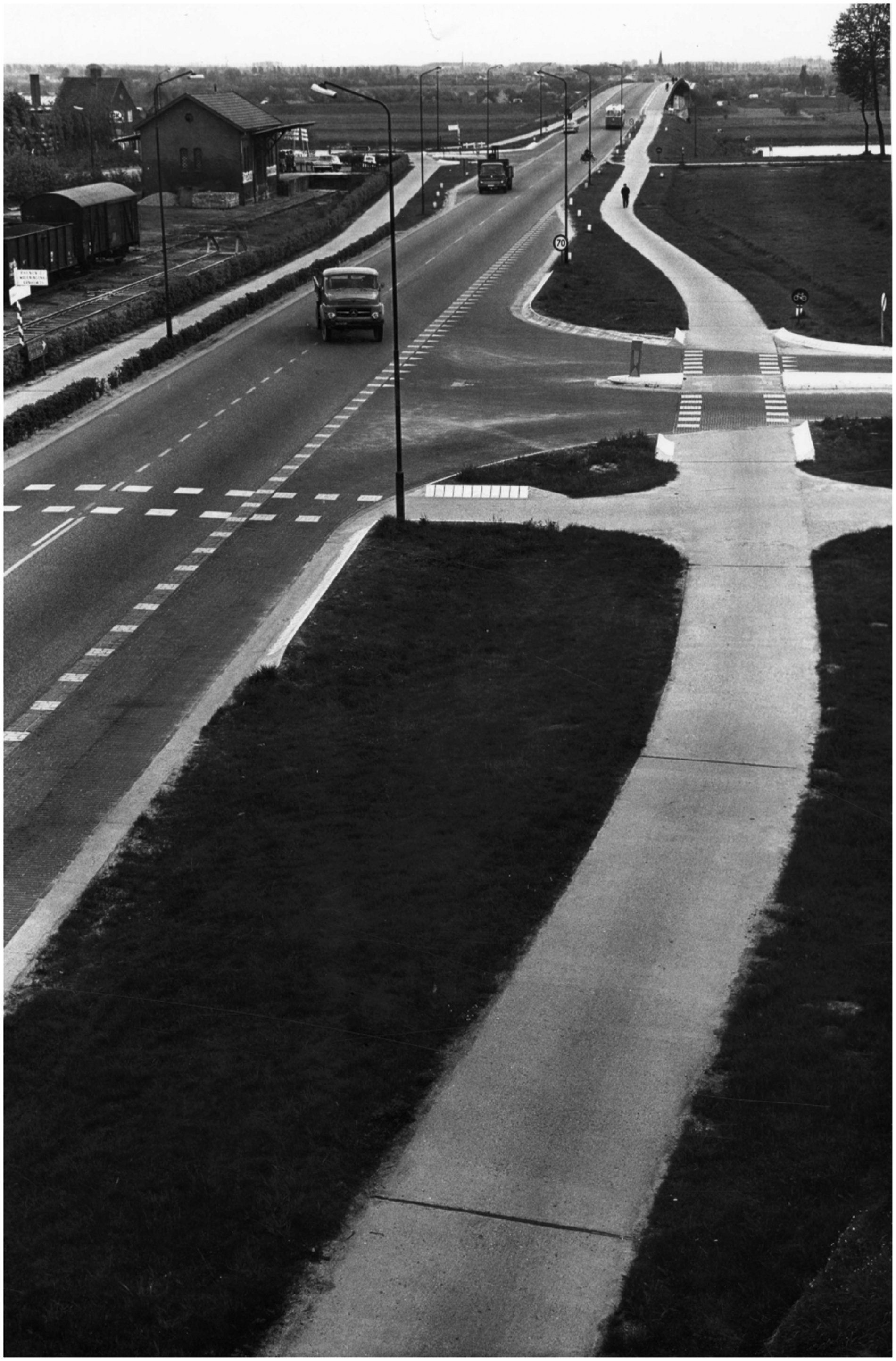
This provincial road near Rhenen in Utrecht province, built in the late 1950s, has wide cycle tracks on both sides of the road. Source: Collection Het Utrechts Archief, no. 837959.
These were not just plans—cycle track construction continued over the 1950s and 1960s, unlike in other countries. Despite a lack of comprehensive data on the exact growth of the cycle path network between 1950 and 1970, evidence suggests it was substantial. Writing in 1951 in the ANWB-edited roadbuilding journal Wegen (Roads), public works engineer H.B. Bakker described recently opened cycle paths in his province Zuid Holland: “Taking into account the possibility that cycling paths will become more important due to the motorized bicycle, the width of them has been designed spaciously […] at 2.30 m.” 76 The ANWB traffic journal reported on all road construction work in 1956: (re)construction of cycle paths on no fewer than 34 national or provincial routes. The report specifically mentions that in Zeeland, the far South-west of the Netherlands, “a separate cycling path has been constructed between the built-up areas of Oostburg and Aardenburg […] The path is 2.40 m wide and in total 7.1 km long.” 77 This overview of road works shows the same pattern in other years and cycle paths were 2.50 or 3 m, considerably wider than before. The changes to accommodate mopeds—first classified as bicycle in the UN convention and later in the Dutch road code—help explain why Dutch engineers kept constructing cycling infrastructure at a time when it was rapidly disappearing in many other countries. To be sure, the decision to assign mopeds to cycle paths gave cars more space. It also forced engineers to create more space for cyclists. The growing and extraordinary popularity of mopeds on these paths was a key reason.
Controversy
Despite benefitting from sharing their paths with mopeds, cyclists saw mopeds as source of both irritation and danger. And policymakers were not oblivious of the issues. Road users wrote to newspapers or the Road Traffic Safety Committee, an advisory body that the ministry of Public Works created in 1954. 78 A sales representative and moped rider from the province North Brabant admitted in a letter that the increase in mopeds made it “hopeless for cyclists on the cycling track because of the mopeds whirring past.” 79 A 1970s survey showed that the greatest annoyance for cyclists was the presence of mopeds (see Figure 3). 80
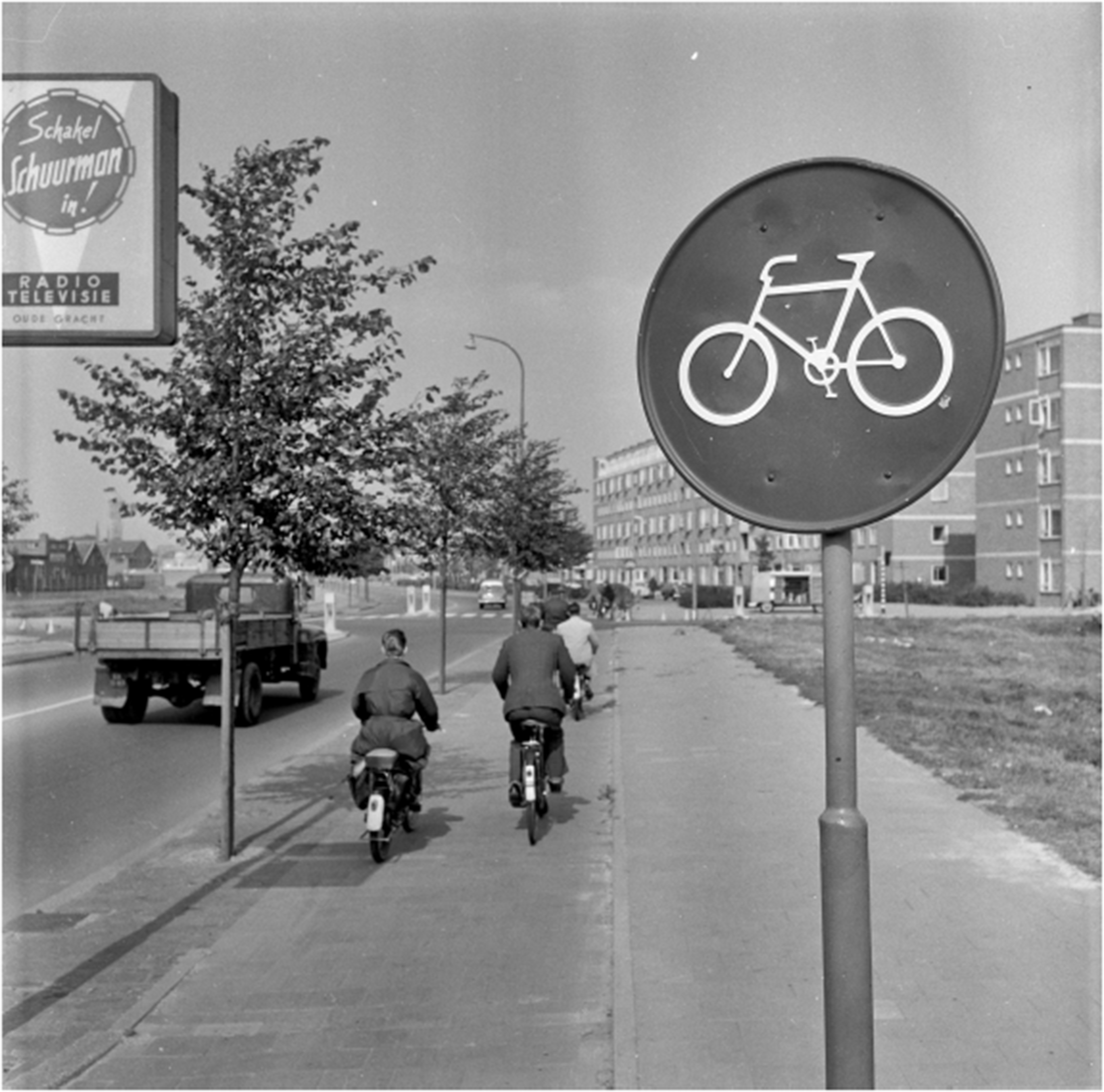
A moped rider (on the left) overtaking a cyclist on a cycle path in Utrecht, 1962. Source: L.H. Hofland, Collection Het Utrechts Archief, no. 125585.
Many cyclists found the official state as well as the non-governmental organization ANWB supported position unfairly favourable to drivers. Forcing the much larger number of cyclists and moped riders to share narrow cycle paths resulted in an extremely skewed distribution of space as well as risk. One reader of the ANWB’s Moped Champion, realizing its editors had backgrounds in car journalism, asked: “How would you like it if the 2,00,000 moped riders—possibly half a million in two years—would decide where cars had to drive?” 81 Another correspondent who was both a cyclist and moped rider protested that car drivers caused accidents. It was therefore their responsibility to behave more carefully rather than remove all other road users from car lanes. “If we continue to let drivers have their way, little would remain of the public character of the roads.” 82 In the 1960s and 1970s, legislators introduced some measures to limit the speed and danger of mopeds, such as mandatory third party insurance and a helmet obligation. Checking maximum speeds became a common police task (see Figure 4). The privileged position of motorized vehicles became only more controversial however. In 1975, in a decade when urban cyclists everywhere demanded more space, a former ANWB member sarcastically would write to the new activist group Cyclists’ Union that ‘slow traffic’ was a seemingly neutral technical term that “had clearly been thought up from behind a car window.” Drivers and their interest groups considered “everything that is slower than us” as “inconvenient stuff (lastige spul) that we have to overtake all the time.” For these drivers, this traffic “has to leave our fast lane, we’ll throw it out altogether.” 83 And the controversy continues. Since the 1970s, spurred on by activists, cities have increasingly also built cycle paths. Growing ever busier, support is mounting to ban all types of mopeds from those. The rising popularity of electrically assisted bicycles also presents a new challenge for bicycle lanes in the Netherlands: they introduce another two-wheeled vehicle going faster than ordinary cyclists. This has reopened the debate about the design standards and width of cycling paths. The questions of who should or should not be able to use cycle paths, and what defines a cycle path, remain at the core of that discussion. However, the need for a fine-grained network of high-quality cycle paths is less controversial than before. Paradoxically, the moped’s popularity has contributed to that.
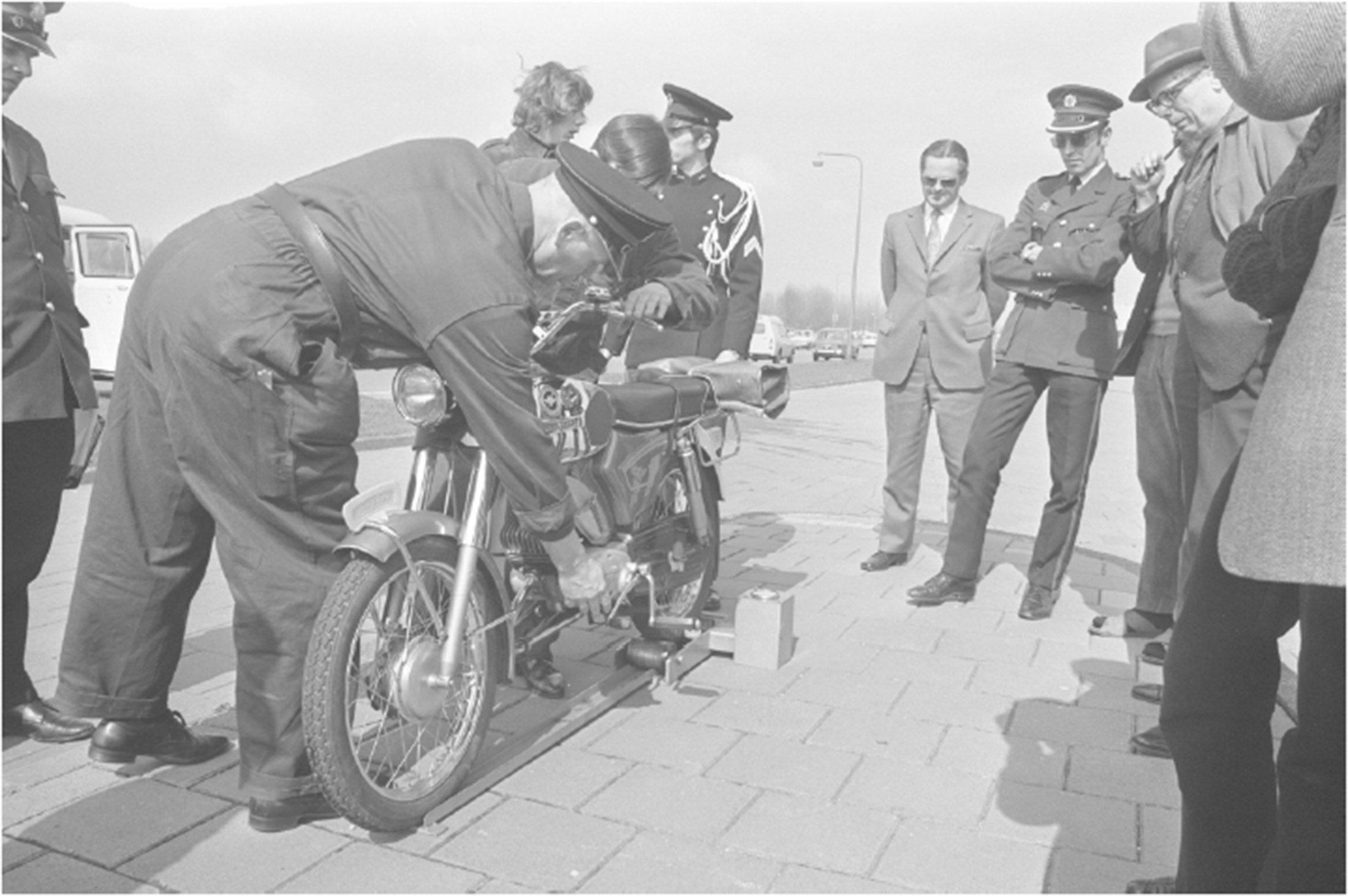
Amsterdam policeman tests the speed of a moped using a so-called curvometer (chassis dynamometer) in 1972. Source: Bert Verhoeff, Nationaal Archief/Anefo no. 925-5202.
Conclusion
Many factors explain Dutch cycling rates remaining high in the 1950s and 1960s—cultural normalization and embeddedness, institutional (engineering) traditions, and user practices. It may not feature on this list of factors, but the moped controversy does help explain why Dutch engineers looked at cycle paths differently than their European counterparts. Historiography has largely overlooked the moped’s major role in shaping Dutch cycling culture and mobility as an intermediate step between cycling and driving. In that role, it impacted the comparatively late adoption of the car. I have shown how engineers placed the moped spatially in the Dutch system of bicycle-car traffic separation.
The Dutch population’s enthusiastic adoption of the moped between the late 1940s and the late 1960s posed a traffic separation dilemma: this motorized bicycle was not fast enough to use the road, but too fast for the cycle track. Ultimately, cyclists had to make way for those who abandoned the bicycle for the moped. Engineers justified their decision by arguing that the danger posed by moped riders and cyclists sharing the same track was less than the danger of car drivers and mopeds sharing the road. Over time, however, this became less and less true, for engineering improvements enabled increasingly higher speeds while remaining legally classified as a moped. Cyclists had to adapt to this new mode, whereas engineers chose to exempt drivers from having to deal with this potential obstruction to car traffic.
A key finding of this article is that the negative consequences of allowing mopeds to use cycle tracks had unintended positive consequences for cyclists, because it changed the discourse on cycle tracks. Road builders outside the Netherlands paved over existing cycle tracks for car infrastructure, inspired by a vision of the future when everyone would be able to afford and therefore own a car. In this vision there was no place for cyclists and consequently no reason to build new cycle lanes nor maintain existing ones. Cycling was much more embedded in Dutch culture and mobility institutions than elsewhere. Without speculating about the development of Dutch cycling had mopeds been less popular, it is fair to say that engineers regarded the construction of cycling infrastructure as more justified because of this popularity. The need to accommodate a growing set of moped owners clearly resulted in the expansion and widening of cycle tracks—that would not have occurred without mopeds being allowed on the cycle tracks.
Path dependency plays a key part in this story. Firstly, the decision to assign mopeds to cycle tracks was shaped by the particular path Dutch politicians and engineers had chosen in the 1920s. The commitment to separating cycling and motorized traffic on major roads led to the construction of cycle paths. Without these, the question of the moped’s place on the road would not have even been a significant issue. Secondly, the moped decision reinforced engineers’ commitment to the path they were on. Given the popularity of cycling it is not very likely they could have gone back from a system of traffic separation to mixed traffic, but the developments around Western Europe at this time do suggest cycling was in peril. The reinforced vigour with which engineers started to construct more and wider cycle paths meant the system of traffic separation remained strong throughout the car-centred decade of the 1960s. Finally, this article has not studied moped drivers’ experience of the cycle paths. While speculative, therefore, it is possible to suggest that moped riders were also ‘path dependent’ in the sense that separate paths gave them safer and more comfortable options than moped riders who had to share the roads with cars. While not at its 1960s levels anymore, the continuing popularity of mopeds in the Netherlands, as with bicycles, might have something to do with its place on cycle lanes.
This article also shows that not only multiple stakeholders, but also many levels of government shaped everyday mobility in the Netherlands, from the international UN Convention on Road Traffic, to national legislation, and local implementation. Politicians, engineers, and influential non-governmental actors like the ANWB pleaded for widening existing cycling tracks and accelerating the construction of new ones. These actors saw dedicated moped tracks were unviable and settled on a combined track that was wider, smoother, and more extensive than the infrastructure for cyclists alone. Admittedly, having to share their separated infrastructure with faster, noisier, and smellier vehicles was not pleasant for unconfident or less skilled cyclists. But for cyclists willing to share the track or forced to through a lack of other mobility options—the infrastructure enabled both moped users and cyclists to ride alongside major roads in the Netherlands while safely separated from the rapidly increasing car traffic of the 1960s. Paradoxically, because so many Dutch people owned a moped before owning a car, the process of motorization and accompanying car-centred planning improved the bicycle network that remains an important part of the Dutch cycling system today.
Footnotes
Acknowledgements
The author is grateful to Frank Veraart, Ruth Oldenziel, Adri Albert de la Bruhèze and Peter Norton for their comments which were invaluable in improving the text. He would also like to thank the anonymous reviewers and Massimo Moraglio for their comments and assistance and Patrick Bek, Matthew Bruno, George Liu, Brett Petzer, Jan Ploeger, Frank Schipper and Sun Qi for their comments on an earlier version of this article. Eric Berkers and Martin Emanuel kindly gave me access to sources or unpublished manuscripts. This article has benefitted from Matthew Bruno’s help in editing the text. The research for this article was conducted in a project sponsored by Eindhoven University of Technology, the Dutch Public Works agency Rijkswaterstaat and Pon Holdings.
Declaration of conflicting interests
The author(s) declared no potential conflicts of interest with respect to the research, authorship, and/or publication of this article.
Funding
The author(s) received no financial support for the research, authorship, and/or publication of this article.
1
For instance in Germany and the UK: Thomas Fläschner, “Stahlroß auf dem Aussterbe-Etat: zur Geschichte des Fahrrades und seiner Verdrängung in den 50er-Jahren”, Eckstein – Journal für Geschichte 9 (2000), 13–4; Rorie Parsons and Geoff Vigar, “‘Resistance was Futile!’ Cycling’s Discourse of Resistance to UK Automobile Modernism 1950–1970”, Planning Perspectives 33:2 (2018), 167–8.
2
See for recent discussions Andre Sorensen, “Taking path dependence seriously: an historical institutionalist research agenda in planning history”, Planning Perspectives 30:1 (2015), 17–38; Andre Sorensen, “Planning History and Theory: Institutions, Comparison, and Temporal Processes”, in Carola Hein (ed.), The Routledge Handbook of Planning History (New York NY: Routledge, 2018), 35–45.
3
See Anique Hommels, Unbuilding Cities: Obduracy in Urban Sociotechnical Change (Cambridge MA: MIT Press, 2005); Anique Hommels, “Studying Obduracy in the City: Toward a Productive Fusion between Technology Studies and Urban Studies”, Science, Technology, & Human Values 30:3 (2005), 323–51.
4
The classic example is that of the QWERTY keyboard: once a contingent choice, changing it now is nearly impossible: Paul A. David, “Clio and the Economics of QWERTY”, American Economic Review 75:2 (1985), 332–7.
5
James Mahoney, “Path Dependence in Historical Sociology”, Theory and Society 29:4 (2000), 509.
6
Paul Pierson, Politics in Time: History, Institutions, and Social Analysis (Princeton NJ: Princeton University Press, 2004), 21.
7
See Martin Emanuel, “Moments of Unsustainability: Planning, Path Dependence, and Cycling in Stockholm”, in Ruth Oldenziel and Helmuth Trischler (eds), Cycling and Recycling: Histories of Sustainable Practices (New York NY & Oxford: Berghahn, 2016), 101–21.
8
Hanna Wolf, “Following America? Dutch geographical car diffusion, 1900 to 1980”, PhD Thesis, Eindhoven University of Technology, 2010, 3–4; Ruth Oldenziel and Adri Albert de la Bruhèze, “Contested Spaces: Bicycle Lanes in Urban Europe, 1900–1995”, Transfers: Interdisciplinary Journal of Mobility Studies 1:2 (2011), 29–49, here 32. Also Vincent van der Vinne, De autoproblematiek in Nederland (Zutphen: Siemes, 2010); Peter-Eloy Staal, Automobilisme in Nederland: een geschiedenis van gebruik, misbruik en nut (Zutphen: Walburg Pers, 2003).
9
Ruud Filarski in cooperation with Gijs Mom, Shaping Transport Policy: Two Centuries of Struggle between the Public and Private Sector: A Comparative Perspective (The Hague: SDU Uitgevers, 2011), 177. Numbers based on Wolf, “Following America?”.
10
John Pucher and Ralph Buehler, “Making Cycling Irresistible: Lessons from The Netherlands, Denmark and Germany”, Transport Reviews 28:4 (2008).
11
Gijs Mom and Ruud Filarski, Van transport naar mobiliteit: de mobiliteitsexplosie [1895–2005] (Zutphen: Walburg Pers/Stichting Historie der Techniek, 2008), 250–1.
12
Adri Albert de la Bruheze and Frank Veraart, Fietsverkeer in praktijk en beleid in de twintigste eeuw: overeenkomsten en verschillen in fietsgebruik in Amsterdam, Eindhoven, Enschede, Zuidoost-Limburg, Antwerpen, Manchester, Kopenhagen, Hannover en Basel (Den Haag: Ministerie van Verkeer en Waterstaat, Directoraat-Generaal Rijkswaterstaat, Hoofdkantoor van de Waterstaat, Directie Kennis/Stichting Historie der Techniek, 1999). The English version is Ruth Oldenziel et al. (eds), Cycling Cities: The European Experience (Eindhoven: Foundation for the History of Technology and Rachel Carson Center for Environment and Society, 2016).
13
Anne-Katrin Ebert, Radelnde Nationen: Die Geschichte des Fahrrads in Deutschland und den Niederlanden bis 1940 (Frankfurt: Campus Verlag, 2010); Gijs Mom, Johan Schot, and Peter-Eloy Staal, “Civilizing Motorized Adventure: Automotive Technology, User Culture, and the Dutch Touring Club as Mediator”, in Adri Albert de la Bruheze and Ruth Oldenziel (eds), Manufacturing Technology, Manufacturing Consumers: The Making of Dutch Consumer Society (Amsterdam: Aksant, 2009), 139–58. The organisational history: M.F.A. Linders-Rooijendijk, “Gebaande wegen voor mobiliteit en vrijetijdsbesteding: I. De ANWB als vrijwillige associatie 1883–1937”, PhD Thesis, Katholieke Universiteit Brabant, 1989; M.F.A. Linders-Rooijendijk, Gebaande wegen voor mobiliteit en vrijetijdsbesteding: II. De ANWB van vereniging naar instituut, 1937–1983 (Den Haag: ANWB, 1992).
14
Ebert, Radelnde Nationen, 359.
15
Mom, Schot, and Staal, “Civilizing Motorized Adventure”, 150–1.
16
Hans Buiter, “Als een spin in het web: de ANWB en de Nederlandse rijwielpadenverenigingen”, Tijdschrift voor historische geografie 1:2 (2016), 76–86; Ebert, Radelnde Nationen, 387–9.
17
Marcus Popkema, “Tussen techniek en planning: de opkomst van het vak Verkeerskunde in Nederland, 1950–1975”, PhD Thesis, TU Eindhoven, 2014.
18
See Mom and Filarski, De mobiliteitsexplosie, 83–105, 73–201; M.L. ten Horn-van Nispen, “Het Rijkswegenplan 1927. De aanpak van het verkeersvraagstuk in de jaren twintig”, Jaarboek voor de geschiedenis van bedrijf en techniek 9 (1992), 185–208.
19
Adri Albert de la Bruhèze and Ruth Oldenziel, “Who Pays, Who Benefits? Bicycle Taxes as Policy Tool, 1890–2012”, in Ruth Oldenziel and Helmuth Trischler (eds), Cycling and Recycling: Histories of Sustainable Practices (New York NY & London: Berghahn, 2015), 73–100, at 81.
20
Oldenziel and Albert de la Bruhèze, “Contested Spaces” 34–38.
21
Anne-Katrin Ebert, “When Cycling Gets Political: Building Cycling Paths in Germany and the Netherlands, 1910–40”, Journal of Transport History 33:1 (2012), 115–37.
22
Trine Agervig Carstensen and Anne-Katrin Ebert, “Cycling Cultures in Northern Europe: From ‘Golden Age’ to ‘Renaissance’”, in John Parkin (ed.), Cycling and Sustainability (Bingley: Emerald, 2012), 37–8. See also Ebert, Radelnde Nationen, 405.
23
Mom and Filarski, De mobiliteitsexplosie, 122.
24
See for the UK, Carlton Reid, Road Were not Built for Cars: How Cyclists Were the First to Push for Good Roads & Became the Pioneers of Motoring (Washington DC: Island Press, 2015). For Germany, see Volker Briese, Besondere Wege für Radfahrer. Zur Geschichte des Radwegebaus in Deutschland von den Anfangen bis 1940 (Unpublished manuscript, Paderborn, 1993); Ebert, Radelnde Nationen; Fläschner, “Stahlroß auf dem Aussterbe-Etat”, 4–22; Thomas Fläschner, “Zum Gebrauch des Rades gezwungen: Fahrradkultur in Saarbrücken zwischen 1885 und 1939”, in Hans-Christian Herrmann and Ruth Bauer (eds), Saarbrücken in Fahrt: 125 Jahre Automobil an der Saar (Marpingen-Alsweiler: Edition Schaumberg, 2011), 184–221; Burkhard Horn, “Vom Niedergang eines Massenverkehrsmittels – Zur Geschichte der Städtischen Radverkehrsplanung”, Master Thesis, Gesamthochschule Kassel, 1990.
25
Mahoney, “Path Dependence in Historical Sociology”, 512–3.
26
Experiments with light motorcycles were common in the 1930s, see Frank Steinbeck, Das Motorrad: ein deutscher Sonderweg in die automobile Gesellschaft (Stuttgart: Franz Steiner Verlag, 2012), 57–8; Frédéric Héran, Le retour de la bicyclette: Une histoire des déplacements urbains en Europe, de 1871 à 2050 (Paris: La Découverte, 2014).
27
Jan Meijer, “Spreeuwenpraat”, Het Vrije Volk 31 July 1950.
28
Mom and Filarski, De mobiliteitsexplosie, 268.
29
In 2013, the Netherlands had the highest moped share in Europe: Doreen Ewalds, Ger Moritz, and Michel Sijstermans, Bromfietsen in Nederland (Den Haag/Heerlen: Centraal Bureau voor Statistiek, 2013), 7.
30
ANWB archive, inv. no. 1241, minutes FNRV (Federation of Dutch Cycling Path Organizations) meeting 9 May 1956.
31
Provincial and Municipal Archives Utrecht (herafter HUA) 1210, inv. no. 1408 and 1409. Traffic counts on provincial roads in Utrecht province show increasing moped use throughout the 1950s and 1960s. Traffic counts on the provincial tracks in Zuid-Holland show a similar trend: see NA 3.02.27, inv. no. 1560, letter Provincial Public Works and Planological Office to Provincial Executive, 28 October 1969.
32
The author is grateful to Eric Berkers for this information.
34
“Miljoen bromfietsen in 1960?”, Algemeen Handelsblad 27 March 1956. See also “Bromfiets: op naar het miljoen … !”, Trouw 25 February 1959.
35
Frank Steinbeck, “Rückenwind für motorisierte Fahrräder”, Kultur & Technik 2 (2013), 34; Steinbeck, Das Motorrad, especially 132–70 and 239–55.
36
Héran, Le retour de la bicyclette, 60. Author’s translation.
37
Mopeds were popular in Sweden in the 1950s. See Pär Blomkvist and Martin Emanuel, “Regulating Innovation: Utility vs. Leisure in Swedish Moped History, 1952–1961”, Technology and Culture 61:3 (2020), 815–42.
38
Mom and Filarski, De mobiliteitsexplosie, 270.
39
Wim De Jong and Bas Van Kleef, De Puch-story en andere brommerverhalen (Bussum: Uitgeverij Thoth, 1994).
40
Stichting Wetenschappelijk Onderzoek Verkeersveiligheid SWOV, De bromfietser en de verkeersveiligheid: Een beschrijving van de groep bromfietsbezitters en van de onveiligheid van bromfietsers (Voorburg: SWOV, 1973), 11. Municipal Archives Amsterdam (hereafter GAA) 1302 (RAI Archive), inv. no. 401, document ‘Historische ontwikkeling,’ p. 16.
41
United Nations, “Convention on Road Traffic” (Geneva: United Nations, 1949), 35. For the full text:  (accessed 19 June 2019).
42
43
United Nations, “Convention on Road Traffic” (Vienna: United Nations, 1968), 3. (accessed 19 June 2019). The 1968 text left it to the discretion of member states to classify mopeds as bicycles or motorcycles.
44
Sweden made a similar decision in 1955. See Blomkvist and Emanuel, “Regulating a Freedom Machine”.
45
46
Kamerstukken II 1949/50, 1400 IX B, 11, p. 20. All translations of Dutch sources are the author’s.
47
J. Koolhaas Revers, “Bromfietsers van Nederland, de A.N.W.B. heet u welkom”, Bromfietskampioen 1:1 (1951), 3.
48
Koolhaas Revers was editor of several car journals, including ANWB’s Autokampioen from 1937. He saw the moped’s success as an indirect victory for his true love, the motorcycle, over the car: see Vic Sniekers, “Bekende auto-journalist J. Koolhaas Revers (75 jaar): Heimwee naar motorfiets”, De Tijd 19 February 1966, 7.
49
J. Koolhaas Revers, “Bromfietsers van Nederland, de A.N.W.B. heet u welkom”, 3.
50
J. Koolhaas Revers, “Bromfiets de ‘Veroveraar': Een beschouwing over het ontstaan van een nieuwe phase in ons gemotoriseerde verkeer”, Bromfietskampioen 1:1 (1951), 6. The term pedal bicycle (trapfiets) was used to distinguish from the motorized bicycle (bromfiets).
51
“Bromfiets zal rijwiel niet overvleugelen”, Bromfietskampioen 5:4 (1955), 285.
52
Koolhaas Revers, “Bromfiets de ‘Veroveraar’”, 6; “Een jaar ANWB geschiedenis”, Bromfietskampioen 5:7 (1955), 515.
53
ANWB archive, inv. no. 1241, Memo ‘De Bromfiets’ attached to letter ANWB (Boost) to FNRV, 30 October 1951.
54
Handelingen II 1949/50, meeting 34 (13 December 1949), p. 970.
55
Handelingen II 1950/51, 34 (19 December 1950), p. 956–7.
56
Unlike the round blue sign for cycle tracks alongside Dutch roads, prohibiting cycling on the road, the separate cycle tracks had a rectangular black sign that prohibited all non-cyclists. This was to protect the (basic) paving on these tracks against damage by horses, cattle, or motorized vehicles.
57
Handelingen II 1950/51, 35 (20 December 1950), p. 965.
58
Some municipalities called all their tracks recreational, others none: HUA 1201, inv. no. 25539, letter from province Drenthe to Ministry of Public Works, 15 August 1951. Drenthe had no fewer than 944 km of cycle tracks unconnected to a road, compared to Noord-Holland’s only 54.5 km.
59
Handelingen II 1951/52, 21 (27 November 1951), p. 634.
60
Handelingen II 1953/54, 42 (22 December 1953), p. 3629.
61
Handelingen II 1961/62, 40 (17 January1962), p. 3425.
62
Handelingen II 1951/52, 21 (27 November 1951), p. 637. Van der Peijl also called for these special moped paths in 1968: Handelingen II 1968/69, 2 (18 September 1968), p. 24.
63
Handelingen II 1954/55, 23 (1 December 1954), p. 3209.
64
The discussions on a driver’s license for mopeds suggest their motor-like construction—no discussion on a license for cyclists took place. See Handelingen II 1959/60, 41 (16 February 1960), p. 3594, 3618.
65
ANWB archive, inv. no. 1241, minutes FNRV meeting 9 May 1956.
66
Ibid.
67
ANWB archive, inv. no. 1241, letter Boost (ANWB) to FNRV, 7 May 1956 with ANWB Memorandum no. 4 Rijwielpaden langs verkeerswegen (Cycle tracks alongside traffic roads). First published in 1956, it was reissued in 1966 and 1970.
68
The ANWB argued that the cycle track surface had to be smoother because of the moped’s higher speed and therefore different road grip: “Vlakke rijwielpaden”, Berichten en beschouwingen van de verkeersafdeling van de ANWB 5:2 (1954), 6. An engineer on Zuid-Holland’s 1964 cycle track plan agreed: tile tracks were too light a construction for mopeds, basic asphalt paving was required. See J.C. Fekkes, “Provinciaal rijwielpadenplan voor Zuid-Holland”, Tijdschrift voor Verkeerstechniek 15:8 (1964), 362.
69
“Van en over de ANWB”, Bromfietskampioen 4:3 (1954), 118.
70
These courses filled a real need among traffic officials as Delft University’s training for traffic engineers was limited until the 1950s. See Popkema, “Tussen techniek en planning”.
71
“De bromfiets: het snelverkeer van het rijwielpad: Nationale Verkeerstechnische Leergang 1954”, Bromfietskampioen 4:3 (1954), 142–3.
72
ANWB archive, inv. no. 1241, minutes FNRV meeting 9 May 1956.
73
Drenthe Provincial Archives (hereafter DA), 0923, inv. no. 6258, letter Public Works Drenthe to Ministers of Education, Arts and Sciences, Minister of Economic Affairs and Minister of Social Affairs, 4 December 1959.
74
“Nieuwe rijwielpaden in Zuid-Holland”, Trouw 13 August 1959; J.C. Fekkes, “Provinciaal Rijwielpadenplan voor Zuid-Holland”, Wegen 30:1 (1956), 3.
75
ANWB archive, inv. no. 1241, minutes FNRV meeting 9 May 1956.
76
H.B. Bakker, “Over het saneren in het algemeen en over het saneren van een oud Rijkswegvak in het bijzonder”, Wegen 25:1 (1951), 4.
77
“De Rijkswegen in 1956”, Berichten en beschouwingen van de verkeersafdeling van de ANWB 8:1 (1957), 9–20.
78
Its subcommittee looked at whether moped riders should sit a test to improve traffic safety.
79
NA 2.16.11, inv. no. 1363, letter J. v.d. Zande to Road Traffic Safety Committee, 11 October 1954.
80
H. Katteler, W.F. de Heer, and J. Kropman, Het gebruik van de fiets in Nederland: een aanvullend onderzoek in de provincies Groningen, Friesland, Zuid-Holland, Zeeland, Noord-Brabant en Limburg (Nijmegen: Instituut voor Toegepaste Sociologie, ITS, 1978), 74.
81
“ANWB Hoe zit dat?”, Bromfietskampioen 1:11 (1951), 195.
82
“ANWB Hoe zit dat?”, Bromfietskampioen 1:12 (1951), 224.
83
International Institute for Social History (hereafter IISG), ARCH01969 (Fietsersbond Archive), inv. no. 1, letter H.D. Coster to Werkgroep 2000, 31 May 1975.