




Abstract
Autistic youth demonstrate an overestimation of competencies when compared with neurotypical (NT) peers. Research has also shown NT males/boys tend to overestimate their competencies more than NT females/girls. This study assessed sex differences in autistic youths’ overestimations on academic self-perception variables. Notably, 127 (70 male) autistic youth ages 9–18 years completed two academic tasks (one verbal and one mathematics) and estimated their performance pre- and post-task. Males overestimated their competencies to a higher degree than females on pre- and post-verbal task measures but not on mathematics measures. The results support the previous findings on sex differences in autistic self-perception patterns. Implications for special education are discussed.
The emergence of self-perception, defined here as the ability to estimate one’s own competencies, is an important factor in development that is intertwined with many aspects of behavior, including academic achievement (Harter, 2001). Young neurotypical (NT) children tend to overestimate their abilities across domains and tasks (Bjorklund & Green, 1992; Salley et al., 2010). In the NT literature, the accuracy of self-perception increases through childhood and adolescence as individuals gain experience and become more aware of their competencies, particularly in comparison to others (Harter, 2001; Portillo & Fernández-Baena, 2020).
When discussing autistic populations, we will be using identity-first language to align with research on preferred terminology within the autistic community (Bury et al., 2023). Within neurodivergent populations, different trajectories of self-perception development have been found to emerge. Although this research is more commonly seen in children with attention-deficit/hyperactivity disorder (ADHD, e.g. Owens et al., 2007), some research has been conducted with autistic youth. When compared with parent and teacher reports of competency, autistic youth have been found to overestimate social and emotional functioning, and underestimate their symptomatology (Johnson et al., 2009; Vickerstaff et al., 2007).
Research has also indicated that autistic youth tend to perceive their behavioral, emotional, and social functioning as similar to their NT peers, despite parent and teacher reports indicating heightened concern in these areas (Foley Nicpon et al., 2010). These findings suggest that autistic youth may experience challenges in making accurate self-assessments in areas of psychosocial development (Foley Nicpon et al., 2010). However, many findings in this area have been based on comparing child-report measures to parent-report measures, and it is possible that parents are not always completely accurate or objective in the reporting of their child’s behavior (Burrows et al., 2018). Self-perceptions should also be explored using objective measures to assess whether autistic youth overestimate their competencies compared with measures of actual performance.
Furlano et al. (2015) conducted a study of autistic and NT youth assessing self-perception of competency in the academic domain using objective measures. Autistic and NT youth were presented with one verbal and one mathematics task, and asked to estimate their performance on the tasks both before and after completion. This research found that while autistic and NT youth performed similarly on the academic tasks (as they were geared toward individual youths’ academic level), autistic youth overestimated their performance on both tasks before and after actual task completion. In contrast, their NT peers were found to estimate their performance on academic tasks quite accurately, only demonstrating an overestimation in performance on hypothetical future tasks (Furlano et al., 2015).
Extending this research, Furlano and Kelley (2019) conducted a similar study including a feedback condition to determine whether estimations of academic competency in autistic and NT youth would be influenced by receiving feedback on tasks in real time. Findings indicated that when feedback was provided, autistic youth estimated their academic competency at a similar accuracy level to their NT peers. Together, these findings indicate that autistic youth show differences in self-perception of academic tasks from their NT peers (Furlano et al., 2015; Furlano & Kelley, 2019).
Self-Perception Differences Between Sex and Gender
Different patterns of self-perception development have also been found between sexes and genders! However, to our knowledge, no research study to date has distinguished between sex and gender, as it relates to self-perception of academic competencies in autistic youth. Research on sex/gender differences in academic self-perception in autistic youth has important implications for early development and education. Examining patterns of self-perception in autistic youth may help future researchers to further explore and identify variables that affect self-perception development. Findings in this area may also help to identify youth who are particularly vulnerable to inaccurate self-perception, allowing educators to provide additional support where needed in the classroom.
Researchers assessing academic self-perception within the NT population have indicated that males/boys tend to overestimate their competency when compared with females/girls (Bobba & Frisancho, 2022; Preckel et al., 2008). This difference between sexes and genders has also been found to increase between the third- and eighth-grade levels (Preckel et al., 2008). Researchers have indicated that this difference may be mediated by internalizing disorders, which have been found to be more prevalent in female/girl samples within the late childhood and early adolescent periods (Cole et al., 1999). Martin et al. (2020) found that youth with ADHD who demonstrated higher overestimations of competence also experienced lower levels of depressive symptoms, pointing to a potential relationship between internalizing disorders and self-perception accuracy.
Some research involving youth with ADHD has found similar levels of overestimation of competency in both males/boys and females/girls (Evangelista et al., 2008). Conversely, some studies looking at ADHD samples have indicated a similar pattern to NT research, with males/boys overestimating their competencies to a higher degree than females/girls (Hoza et al., 2004). Hoza et al. (2004) assessed gender differences in ADHD and NT samples, and found that ADHD and NT males/boys tend to overestimate their abilities significantly more than ADHD and NT females/girls when compared with teacher reports. To our knowledge, no research has explored sex/gender differences in academic self-perception within autism spectrum disorder (ASD) samples.
Our research on this topic was started before the current focus on the differences between sex and gender. As a result, we mistakenly asked parents to identify the gender of their child as male or female. Because of the terminology male/female, we are reporting our findings as sex differences, although some parents may have truly thought of this as gender. Additionally, most research in this area has not distinguished between these two constructs.
Present Study
This study aimed to address this gap in current research by assessing sex differences in academic self-perception of competency in a sample of autistic youth. When compared with other domains, such as social functioning, basic academic abilities seem to be less affected and more comparable to NT peers in autistic samples with lower functional needs (Dickerson-Mayes & Calhoun, 2003). Assessing academic self-perception may thus allow for exploration of self-perceptual differences with diminished confounding influences in task performance differences. Assessing academic competency also allows for the comparison of estimations of one’s own competencies against actual performance on objective measures, increasing reliability (Furlano et al., 2015; Owens et al., 2007). Aligning with sex/gender patterns found in current research with NT and ADHD samples, it was hypothesized that autistic males would overestimate their competencies on both verbal and mathematics tasks during both pre- and post-task estimations to a higher degree than autistic females (Hoza et al., 2004).
Method
Participants
Participants included 127 youth formally diagnosed with ASD between the ages of 9 and 18 years (M = 13.95, SD = 2.91) and their caregivers. Clinical diagnosis by a medical professional was confirmed through parent report. Parents were asked to indicate the sex/gender of their child and reported 70 as male and 57 as female. A post hoc power analysis using G*Power 3.1 (Faul et al., 2007) was run to obtain a power estimation with our current sample size. The analysis suggested that the obtained sample size was sufficient, with a power of .87. There were no inclusion requirements related to IQ; however, the academic measures required participants to have at least a Grade 4 level of verbal and mathematics ability. Our study did not include any exclusion criteria related to comorbid conditions, such as developmental or psychiatric diagnoses, as high rates of comorbidities are known to exist between these diagnoses and autism (Lai et al., 2019; Mannion & Leader, 2013). Table 1 lists the descriptive statistics. Participants were recruited online through the ASD Studies Laboratory, social media, and through promotion from community organizations within the United States and Canada. Potential participants were provided with an email address to contact to express their interest in participating. Once interest was expressed, potential participants were provided with a Letter of Information and an anonymous link to complete the study should they wish to proceed.
General Descriptives of the Measures.
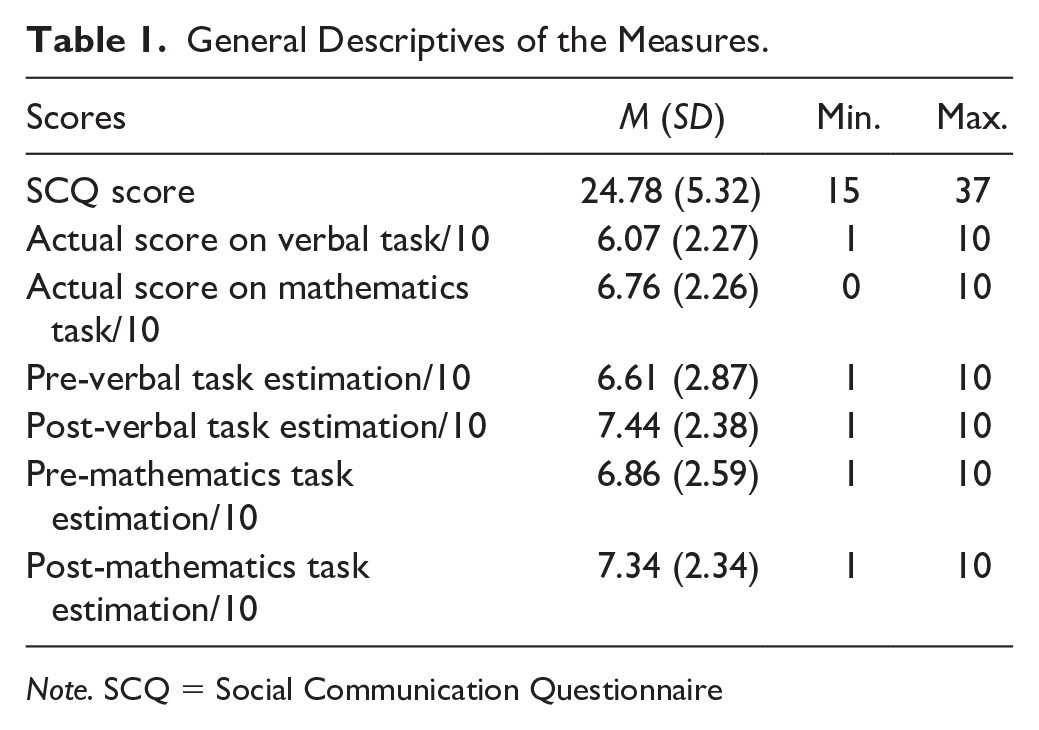
Note. SCQ = Social Communication Questionnaire
Additionally, no information was collected on the type of schooling children were enrolled in (e.g. public, private, or home schooling). Since this study was specifically interested in student’s self-perception of academic ability, their actual grade-level ability was not considered to be relevant. Accordingly, participants were provided with English and mathematics tasks that matched their performance grade level (as indicated by parents), rather than their actual grade level.
Materials and Design
General information was collected from the caregiver at the beginning of the study using a demographic questionnaire. The questionnaire included six questions indicating age, gender (male/female)2, clinical diagnosis, name of diagnosing clinician or institution, and the performance grade level of both English and mathematics. Autism traits were measured using the Social Communication Questionnaire (Rutter et al., 2003). This questionnaire was completed by caregivers to confirm an autism diagnosis. Research has shown that the SCQ is able to reliably discriminate between autistic children and children diagnosed with different developmental disorders (Chandler et al., 2007). Current research has indicated that the optimal cut-off point to confirm autism using the SCQ is a score greater than or equal to 11 (Rosenberg et al., 2018). Data from 20 participants who scored below 11 on the SCQ were excluded from this study.
Each youth participant was asked to complete an English and a mathematics task taken from the Woodcock–Johnson IV (WJ-IV) Tests of Cognitive Abilities (Woodcock-Johnson; Shrank et al., 2018) at their current performance grade level as indicated by their caregiver. The WJ-IV tests were selected because of the consensus within research regarding the reliability and validity of these measures, and their ability to accurately capture the cognitive abilities they aim to measure (McGill, 2023; Reynolds & Niileksela, 2015). Each task consisted of 10 questions. The English (verbal) task asked participants to provide a synonym for 10 words. The mathematics task asked participants to complete 10 mathematics equations. Tasks were categorized at the 4–6, 7–9, or 10–12+ grade levels. Participants were asked to indicate how many questions they believed they would answer correctly before completing each task, and how many questions they believed they had answered correctly after each task (see more details in “Procedure” section).
Procedure
Once participants opened the anonymous link to begin the study, the Letter of Information and Consent Form for the study were displayed, and consent was required to continue to the study questionnaires. Caregivers then completed a demographic questionnaire and the SCQ. After completing the SCQ, the Assent Form was displayed on screen and youth participants were required to confirm their assent before continuing to the English and mathematics tasks. All participants were presented with the verbal task first, followed by the mathematics task, corresponding to the current performance grade level that was indicated by caregivers in the demographic questionnaire.
Before each task, the youth were presented with a list of the questions included in the task and asked to read over the questions carefully. Questions were selectable, and participants were required to select each question after they had been reviewed. Participants were then asked to indicate how many of the 10 questions they believed they would answer correctly. Participants were then presented with a list of the 10 questions included in the task and asked to provide their answers in the textbox below each question. After each task was complete, participants were asked to indicate how many of the 10 questions they believed they had answered correctly. This study was approved by the General Research Ethics Board of the university. Participating families received a $20 Amazon gift card as compensation for their time.
Data Analysis
Data were analyzed using SPSS for Windows 11 statistical software package, version 27.0. To determine the magnitude of over- or underestimation of competency, difference scores were created for all pre- and post-task estimations. Difference scores for the verbal and mathematics tasks were calculated by subtracting actual performance task scores from pre- and post-task estimation scores.
Sex differences on self-perception variables were determined using independent samples t-tests. Six separate independent samples t-tests were conducted. Each independent samples t-test used sex as the grouping variable. The first t-test examined sex differences in actual scores on the verbal task while the second t-test examined sex differences in actual scores on the mathematics task. The third t-test examined sex differences in pre-verbal task estimation while the fourth t-test examined sex differences in post-verbal task estimations. The fifth t-test examined sex differences in pre-mathematics task estimations while the sixth t-test examined sex differences in post-mathematics task estimations. An alpha level of .05 was used in all analyses. Based on current research findings, it was hypothesized that males would be found to overestimate their competency to a higher degree than females on all variables. Due to the novelty and exploratory nature of our research questions, we did not correct for multiple comparisons (Althouse, 2016). Because of this, it is important to note that any significant findings from this study should be considered as purely preliminary, with tentative conclusions (Rubin, 2017). More research will be needed to replicate and validate our findings.
Results
No significant correlation was found between age and pre- and post-task difference scores for either the verbal or mathematics tasks. Based on these findings, we do not discuss the relationship between age and academic self-perception within this study.
The means, standard deviations, significance, and effect sizes for all self-perception dependent variables included in this study are listed in Table 2. The mean actual score on the verbal task for males in this sample was 5.52 (SD = 2.15), and 6.57 (SD = 2.27) for females. On the mathematics task, the mean actual score was 6.94 (SD = 2.57) for males and 6.58 (SD = 1.93) for females. To calculate difference scores, participants’ actual verbal and mathematics task scores were subtracted from their pre- and post-task estimation scores in each domain. The mean difference score for pre-verbal task estimations was 0.99 (SD = 2.38) for males and −0.23 (SD = 2.67) for females. For post-verbal task estimations, the mean difference score was 1.51 (SD = 2.10) for males and 0.51 (SD = 2.05) for females. The mean difference score on pre-mathematics task estimations was 0.13 (SD = 1.54) for males and 0.04 (SD = 1.87) for females. For post-mathematics task estimations, the mean difference score was 0.41 (SD = 1.36) for males and 0.54 (SD = 1.28) for females.
Means, Standard Deviations, and Significance of Self-Perception Variables by Sex.
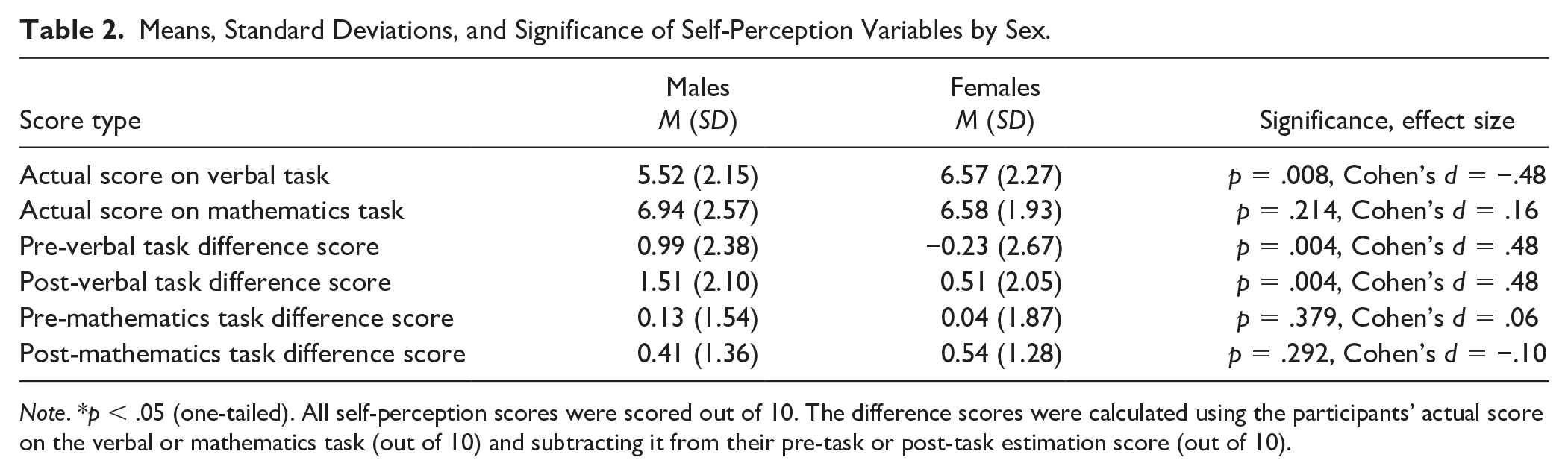
Note. *p < .05 (one-tailed). All self-perception scores were scored out of 10. The difference scores were calculated using the participants’ actual score on the verbal or mathematics task (out of 10) and subtracting it from their pre-task or post-task estimation score (out of 10).
These results demonstrated that male and female participants did not differ significantly in actual performance on mathematics tasks (p = .214) but did significantly differ in actual performance on verbal tasks (p = .008), with females scoring higher than males. Male and female groups also differed significantly on verbal pre- and post-task difference scores. Males were found to overestimate their competency significantly more than females on pre-verbal (p = .004) and post- verbal task performance estimations (p = .004). No significant difference was found between sexes on mathematics pre- and post-task difference scores.
Discussion
The goal of this study was to explore sex differences in performance estimation patterns. It was hypothesized that males would overestimate their competencies on both verbal and mathematics tasks during both pre- and post-task measures significantly more than females. Findings from the independent samples t-tests demonstrated that males did overestimate their competency to a significantly higher degree than females on pre- and post-verbal task measures. However, no significant differences were found between male and female performance estimation difference scores associated with pre- or post-mathematics task measures.
These findings provide some support for the original hypothesis and add to research demonstrating that, compared with females/girls, males/boys are more likely to display higher estimations of competency (Bobba & Frisancho, 2022; Hoza et al., 2004; Preckel et al., 2008). However, these findings also suggest that overestimation patterns within autistic youth may differ depending on the type of academic task. Some research within ADHD samples has indicated that overestimations of competency may be used as a self-protective mechanism in areas where individuals experience greater difficulties, demonstrated through findings that ADHD youth tend to overestimate the most during the tasks on which they perform the lowest and do not apply the same overestimation of competency when evaluating others (Evangelista et al., 2008; Hoza et al., 2004). If self-protection does influence overestimation of competency in autistic youth, overestimation may not map globally onto all academic tasks but may emerge in areas of greater difficulties.
It is important to note that females performed significantly better than males on the actual performance of verbal tasks, which may have influenced estimation patterns on this measure. Researchers have speculated that when objective criterion measures are used to study self-perception, samples who perform lower on tasks have a higher chance of overestimating their competency simply because there is more room for them to do so (Owens et al., 2007). This may have influenced the significant difference found between male and female verbal task difference scores in the current study. As males scored significantly lower than females on the verbal task, they had more room for errors of overestimation than their female counterparts during pre- and post-task performance estimation measures. It has also been proposed that individuals may overestimate their competence in a domain for which they experience higher levels of incompetence (Kruger & Dunning, 1999). If the lower performance on the verbal task shown by males indicates more incompetence in this domain within this group, it is possible that they may have overestimated their abilities as a direct result of this incompetence (Kruger & Dunning, 1999).
The current findings add to research in autism identifying differences in self-perception of competencies. Previous studies on self-perception in autistic youth have relied on comparisons with parent reports, which may not provide an accurate picture of the difference between estimations of competency and actual performance (e.g., Burrows et al., 2018; Johnson et al., 2009). Our study addresses this limitation and provides useful insight into sex differences in estimation patterns. This is particularly important in the autistic population where sex differences in symptom presentation have been well documented (de la Roche & Kelley, 2024). Research providing more information on sex/gender differences in autistic youth may help to reduce discrepancies in diagnosis rates between sexes and genders (Maenner et al., 2020). Research exploring sex/gender differences in estimation patterns will also help guide theories identifying potential mechanisms contributing to overestimation patterns found in neurodivergent groups, such as the influence of internalizing disorders (Hoza et al., 2004). Developing these theories is critical to address overestimation in special educational settings and ensure neurodivergent youth are receiving instruction that speaks to potential differences in their awareness of their strengths and weaknesses.
The findings that autistic males overestimate their academic self-competencies more so than females could have broader implications in instruction in the special education classroom. With the understanding that autistic individuals have a limited understanding into their difficulties regardless of cognitive ability (Foley Nicpon et al., 2010), this information could inform how educators go about providing feedback. The ability to provide more objective feedback could potentially aid educators in adjusting the perception of student’s abilities to be more aligned with actual performance (Furlano & Kelley, 2019; McCauley et al., 2018). If students were more aware of where or why they were making errors, could this inform the kind of assessment teachers are providing and the kind of feedback they provide.
Limitations
There are several limitations in this study that are important to address. There was no NT control group included in this study. Without an NT control group, it is difficult to definitively determine whether the estimation patterns found in this sample are specifically related to an autism diagnosis. Control group findings would have allowed for increased examination of all measures used within the study. However, numerous studies have found that males/boys tend to overestimate their academic competencies in comparison to females/girls in NT populations, and we are relatively confident the same pattern would have been found here (Bobba & Frisancho, 2022; Cole et al., 1999; Hoza et al., 2004; Preckel et al., 2008).
Participants were not asked to disclose their country of residence or their English proficiency level. All communications provided to participants and responses received were written in English. Parents were asked to identify their child’s performance grade level in English vocabulary in one of the three categories between grade levels 4 and 12+. Based on this information, it was assumed that the participants were proficient in English and received English instruction in school. However, this should be noted as a limitation, as this information was not explicitly collected and participants were anonymous and not monitored when competing the study.
All measures in this study were administered online and were unsupervised, which may have influenced responses. Once caregivers completed the demographic questionnaire and SCQ, caregivers were asked to have their child commence their portion of the study. Youth participants were instructed to complete the task to the best of their own ability, without the support of their caregiver or another third party. Previous research on self-perception of academic ability in NT populations has typically conducted academic testing in-person or has relied on teacher reports (e.g., Cole et al., 1999; Preckel et al., 2008). Most studies examining academic self-perception in neurodivergent samples have also used in-person measures or comparison with parent and teacher reports (e.g., Furlano et al., 2015; Furlano & Kelley, 2019; Hoza et al., 2002).
The unsupervised online administration of academic measures may have affected the effort expended by participants and may have allowed for third-party assistance on academic tasks. The inability to confirm that participants followed directions to complete tasks to the best of their ability without assistance should be noted as a limitation. Despite these types of concerns, research exploring the efficacy of studies using online measures in the field of developmental psychology has indicated that findings from studies using unmoderated measures are comparable with in-person administrations (Scott et al., 2017).
Measures were also presented in the same order for all participants, meaning that each participant first completed a verbal task followed by a mathematics task. It is possible that the order of presentation of these tasks affected the performance. Research has indicated that questions presented later in surveys may be negatively affected by participant fatigue (Jeong et al., 2023). Future research should alter the presentation order of tasks to control for the influence of external factors on participant responses.
The way that sex was identified may have also influenced how results can be interpreted. Gender/sex information was provided by parents when completing the demographic questionnaire at the beginning of the study. When this study was first created, the phrasing presented to parents in the demographic questionnaire asked them to identify their child’s gender as either male or female. Near the middle of data collection, the following additional options were added to this question: transgender male, transgender female, non-binary, and other with a text field to specify. No participants who took part in the study selected any of the additional gender identity options. Future research should explore the unique impacts of each of these constructs in greater detail to better understand how sex assigned at birth and gender identity influenced self-perception across domains.
At the time of this questionnaire’s original creation, much of the research that has been conducted on gender identity in autistic populations was not available. After reviewing this area of research in recent years, additional gender identity options were added to improve inclusivity and capture a more accurate representation of gender within the sample. It should be noted that the original formatting of the question, while phrased as assessing gender, would have more accurately captured assigned sex at birth. For this reason, terms relating to sex, rather than gender, are used when discussing gender differences found in this sample. Future studies may benefit from including a wider and more accurate range of gender identities to explore gender differences in self-perception of competencies more comprehensively within autistic samples. Finally, it is important to note that due to the exploratory nature of our research question, no correction was implemented for the multiple analyses used in this study. Thus, our findings are not conclusive and should be interpreted as preliminary results (Rubin, 2017). More research on this area is needed to validate these findings to make more concrete conclusions. Despite this, our study provided insight into the association of sex/gender differences in self-perception of autistic youth and laid out a foundation for future research on the topic.
Future Directions
Participants for this study ranged in age between 9 and 18 years, with a mean age of 13.95 years. The age range examined does span across the periods of late childhood and adolescence, which brings marked changes in development, academic and social functioning, and self-perception (Harter, 2001; Jacobs et al., 2002; Portillo & Fernández-Baena, 2020; Preckel et al., 2008). Although our study did not find a significant correlation between age and self-perception variables, it is possible that gender differences in self-perception of academic ability present differently at various stages of these developmental periods. Future research should further explore self-perception changes across age groups to better understand gender differences at a variety of age ranges.
Future research should further explore the positive and negative implications of overestimations of competency in academics, as current research demonstrates incongruous findings. Previous research indicating that younger children may experience a motivational or protective benefit from a positive bias in self-perception has led some researchers to propose that neurodivergent groups may experience similar benefits in later childhood and adolescence, allowing for increased task persistence despite functional difficulties (Bjorklund & Green, 1992; Hoza et al., 2000). Conversely, other researchers have indicated that overestimations of competency may in fact have a negative influence on task improvement in the long term (Milich & Okazaki, 1991). As research develops and our understanding of the positive and negative influences of positive biases in self-perception increases, it will be important to understand what groups are particularly affected by this bias to properly implement interventions. Understanding sex/gender differences in vulnerable populations during late childhood moving into adolescence, an important time in academic engagement, will be useful for these efforts.
Future studies should continue to expand knowledge within the area of self-perception in autism samples. Further exploration is required to understand the influence of depression on self-perception measures in autistic individuals. Research has indicated that the relationship between sex/gender and self-perception in adolescents with ADHD is mediated by internalizing disorders (Hoza et al., 2004). However, a study conducted by Furlano and Kelley (2019) found no significant relationship between depressive symptoms and estimations of academic competency in autistic children, despite finding a significant relationship in their NT peers. However, it should be noted that their sample size was relatively small. These contrasting findings indicate that more research is required to understand how depressive symptoms influence self-perception differently in NT and ASD youth.
Further exploration should also be done to understand the relationship between executive functioning and self-perception of academic competency in neurodivergent samples. Such studies may benefit from the inclusion of NT, ASD, and ADHD samples to determine whether a similar process underlies overestimation of competency patterns seen in neurodivergent youth. Some researchers believe that executive function difficulties drive overestimation of competency patterns in neurodivergent samples (Owens et al., 2007). Researchers have also indicated that sex/gender differences may exist in executive function abilities in autistic youth (Demetriou et al., 2018). Exploring sex/gender differences in executive functioning in future studies with autistic samples may provide useful insights into the mechanisms underlying heightened overestimation patterns demonstrated in autistic males/boys.
Conclusion
Findings from this study show that autistic males significantly overestimate their competency compared with autistic females on verbal pre- and post-task measures. No significant difference was found between males and females’ estimations of competency on mathematics pre- and post-task measures. These results replicate previous findings of overestimation of competency patterns in ASD samples (e.g., Furlano & Kelley, 2019); however, they also bring up important questions about how sex differences influence these patterns. Findings from this study provide support for previous research demonstrating that males/boys tend to overestimate their competencies more than females/girls across domains (Bobba & Frisancho, 2022; Cole et al., 1999; Preckel et al., 2008) and indicate that this pattern may extend to the autistic population. They also reveal that this sex/gender difference may not map globally across academic domains, but instead, may vary depending on the type of the task administered. More exploration is needed to understand sex and gender differences in self-perception patterns within ASD samples and promote the exploration of variables that may influence these differences, such as depression and executive functioning.
Footnotes
Declaration of Conflicting Interests
The author(s) declared no potential conflicts of interest with respect to the research, authorship, and/or publication of this article.
Funding
This work was supported in part by the Masonic Foundation of Ontario funding to Elizabeth Kelley (no grant #). The authors thank the families who participated in this study.
