



Abstract
The Zones of Regulation is a widely implemented program for social-emotional regulation, including for students with autism. To date, there is very little empirical evidence to show efficacy for the Zones of Regulation. According to standards published by the American Psychological Association, National Standards Project, and National Clearinghouse of Autism Evidence and Practice, the Zones of Regulation does not meet the standards for an evidence-based practice. The authors provide suggestions in support of additional empirical study of Zones of Regulation.
Behavioral disruption in school often presents a challenge to educators in terms of general classroom management (Ducharme & Schecter, 2011). Disruptive behaviors such as horseplay, swearing, bullying, harassment, refusal, defiance, and fighting are issues that can negatively impact the efficacy of teachers in their delivery of instruction and can have a negative impact on the learning of other students in the class (Conklin & Jairam, 2021; Osher et al., 2010; Weissberg & Cascarino, 2013). There is a range of proactive and consequence-based approaches that teachers have used to address behavioral disruption. Common approaches include, but are not limited to, school-wide initiatives such as Positive Behavioral Intervention and Supports (PBIS) (Bear et al., 2015; Horner et al., 2010; Ogulmus & Vuran, 2016). A recent review of the literature by Conradi et al. (2022) examined the application of PBIS in elementary and secondary school settings. Implementation of the Good Behavior Game, which although has been primarily examined in elementary, has also been evaluated in secondary school settings (Bowman-Perrott et al., 2016; Flower et al., 2014). Use of punitive approaches such as in-school and out-of-school suspensions (Blomberg, 2003; Noltemeyer et al., 2015; Osher et al., 2010) have been evaluated with students from primary through senior grades. Finally, meta-analyses of self-regulation programs (Durlak et al., 2011; Silkenbeumer et al., 2018; Taylor et al., 2017) have also indicated that this as a widely used strategy for students in the primary to senior grades.
Another common approach identified in the literature to address problematic behavior in schools is the provision of direct social-emotional instruction for students (Durlak et al., 2011; Taylor et al., 2017; Wiglesworth et al., 2016). Research in social-emotional learning (SEL) has shown support for universal strategies targeting the SEL skills that will enhance a student’s school experience (Greenberg et al., 2003). According to Elias et al. (1997), SEL is the acquisition of “core competencies to recognize and manage emotions, set and achieve positive goals, appreciate the perspective of others, establish and maintain positive relationships, make responsible decisions, and handle interpersonal situations constructively” (as cited in Durlak et al., 2011, p. 406). While it may be reasonable to expect dedicated classroom time to develop these competencies, studies have shown that a failure to address development of SEL skills can lead to poor academic, personal, and social outcomes (Bear et al., 2015; Durlak et al., 2011; Jones et al., 2015). SEL skills are generally considered important for children to acquire and are particularly desirable within a classroom as these skills appear to form the necessary foundation for student and teacher success (Durlak et al., 2011; Homel & Edwards, 2018).
Self-regulation can be defined as an individual’s ability to control their emotions, inhibit impulses for inappropriate actions, adjust their level of activity, engage appropriately with others, and generally adopt behavior that is appropriate for the context (Bronson, 2001; Kuypers, 2013; Pandey et al., 2018). There are indicators that a relationship exists between self-regulation and academic achievement (Taylor et al., 2017). Although self-regulation skills are generally taught, and modeled, throughout early development, some students require more explicit instruction (Reid et al., 2005) to acquire the ability to self-regulate (Durlak et al., 2010).
One social-emotional learning program that is widely implemented in classroom settings is the Zones of Regulation (Kuypers, 2013). The Zones of Regulation (Zones) curriculum is an instructional framework designed to teach self-regulation skills that can be applied in the context of real life (Kuypers, 2013). Zones consists of 18 lessons, sequentially organized, that are designed to develop self-regulation skills. Lessons are to be delivered in 30- to 60-min sessions through individual or small group (i.e., 2–4 students) instruction. The Zones of Regulation curriculum is broken into three sections. The first section (i.e., Lessons 1–9) is designed to teach students to recognize and understand their emotions using a color-coded system to categorize emotions and levels of alertness (Kuypers, 2013). The second section (i.e., Lessons 10–12) targets activities of physiological and emotional calming or alerting. Section 3 (i.e., Lessons 13–18) focuses on when, why, and how to use calming and alerting strategies. All lessons have accompanying worksheets that can be kept in a student file or sent home for additional practice at home. Color-coded Zones posters, charts, and reproducible materials are recommended to aide in lessons (Kuypers, 2011; 2013).
According to the developer of the program, the Zones of Regulation was formulated by drawing upon systematizing theory, central coherence, cognitive behavior management, and research in the fields of autism spectrum disorder (ASD) and attention-deficit/hyperactivity disorder (ADHD) (Zones of Regulation, n.d.). Kuypers further states that the program is influenced by trauma-informed approaches, positive mental health strategies, and a social-emotional learning framework (Zones of Regulation, n.d.). According to the Zones of Regulation curriculum, the program was originally developed for students with neurobiological and mental health disorders, including ASD, ADHD, Tourette Syndrome, and oppositional defiant disorder (ODD), but could also benefit a broad population of students (Kuypers, 2011, 2013). The Zones of Regulation curriculum has become a popular approach for schools, adopted for students in preschool, elementary, and secondary schools (Kuypers, 2013). There have been over 270,000 copies of the Zones of Regulation curriculum sold and it has been implemented in multiple U.S. states and Canadian provinces (Zones of Regulation, n.d.). According to the website socialthinking.com, Zones is a “best selling curriculum.”
When considering a program to address disruptive behavior and provide evidence of social-emotional learning, it is important to evaluate the research evidence in support of that approach. To that end, the authors reviewed the available research to determine the extent to which Zones of Regulation could be considered an evidence-based practice in the treatment of behavioral disruption with identifiable self-regulatory behaviors that are commensurate with a reduction in undesirable behavior. A significant consideration when identifying an effective program of intervention is whether the program is able to meet the standards for being labeled an evidence-based intervention (Hume et al., 2021). The sheer number of programs available for individuals with autism, those with intellectual and developmental disabilities, or other disorders, makes it important to select programs of intervention that are both well-established and evidence-based to protect families, caregivers, or educators from, and students exposed to, ineffective or harmful approaches. Several organizations have proposed detailed criteria for evidence-based practice, including the American Psychological Association (APA; 2005), the American Speech-Language-Hearing Association (2005), the National Autism Centre (2015), and University of North Carolina at Chapel Hill (Hume et al., 2021).
For the purposes of this article, the authors have opted for the APA definition of evidence-based: “integration of the best available research with clinical expertise in the context of patient characteristics, culture, and preferences” (APA Presidential Task Force on Evidence-Based Practice, 2006, p. 273). Our reasoning is that the APA definition closely aligns with those of other professional bodies practicing within human services, and further, the practice of psychology is closely related to that behavior analysis (Mayer et al., 2014; Sturmey, 1996).
The purpose of this article is to conduct a systematic review of the research on the Zones of Regulation program and evaluate the level of empirical support for the program. The Zones program will also be reviewed with respect to the criteria of an evidence-based practice. Finally, consideration will be given to possible future direction for the Zones program and more generally to social-emotional learning programs.
Method
Inclusion Criteria
A literature review was conducted using the following inclusion criteria: The article had to be (a) published in a peer reviewed journal, (b) written in English, and (c) published between 2011 to 2021. For the purpose of this review, the authors did not exclude articles as function of their methodology/experimental design such as single case design (Horner et al., 2005), group design (Kazdin, 2021), a literature review (Hanley et al., 2003), or a commentary (Leaf et al., 2021). In addition, we chose not to include any published master or doctoral theses or conference presentations (i.e., gray literature) following the guidelines established by the National Clearinghouse on Autism Evidence and Practice (Steinbrenner et al., 2020) and the National Standards Project (National Autism Center, 2015). These were excluded because the published peer review process allows for scrutiny by experts in the respective fields of study, provides a review of quality research where clear conclusions can be drawn, and demonstrates merit to further study of the subject (National Autism Center [NAC], 2015, pp. 11–12). As Hume et al. (2021) proposed, intervention research, such as dissertations, is only the beginning step that must lead to peer reviewed publication, and eventually lead to systematic review that will then allow translation to effective evidence-based practice. Finally, studies that relied on strictly qualitative or correlational analysis were not included due to the inability of this research to make causal determinations (Cook et al., 2014).
Search Procedure
A literature review of the Zones of Regulation program was undertaken using the PRISMA model (Preferred Reporting Items for Systematic reviews and Meta-Analyses). PRISMA provides a checklist of reporting items and a structured process when completing systematic reviews and meta-analyses. The following electronic databases were used: PsycINFO, ERIC, PubMed, and Google Scholar, with the search parameters of January 2011 to November, 2021. Keywords searched were “Zones of Regulation” with parentheses added. The Zones of Regulation website (www.zonesofregulation.com) was also included in the review. This resulted in 39 articles being initially identified. Two duplicates were removed. The remaining 37 articles were screened for inclusion. An additional 17 articles were excluded based upon lack of experimental design or the fact that they were a commentary or poster presentation. The remaining 20 full text articles were reviewed for eligibility. A further 17 articles were excluded as they were unpublished dissertations. The remaining three articles for further review were Ochocki et al. (2020), Romanowycz et al. (2021), and Conklin and Jairam (2021).
Measures
Type of Study and Design
We evaluated each article to determine if it was an experimental study or a literature review. For each of the experimental studies, we looked at the type of design utilized to evaluate the effects of Zones of Regulation. For example, we evaluated if the researchers used a single case design (Horner et al., 2005; Kazdin & Tuma, 1982) or a group design (Cooper et al., 2019). Single case designs were defined as the involvement of one or a small number of participants, with each serving as their own control, and performance is measured prior to, during, and/or after intervention (Horner et al., 2005). Group designs were defined as a pool of participants relevant to the research focus that are divided into experimental and control groups. Dependent variable scores are then combined within each group to obtain a mean score, which is then compared between groups (Cooper et al., 2019).
Participant Demographics
Three participant variables were evaluated within each of the studies. First was the number of students that were included within each study. Second was the grade level of the participants within each study. Third, the number of classrooms or number of schools in which Zones of Regulation was implemented was evaluated.
Zones of Regulation Implementation
We evaluated four variables in terms of how Zones of Regulation was implemented within each of the studies. First, we reviewed the total number of sessions per study. Second, we measured the total duration of each lesson. Third, we looked at the type of instruction (e.g., one-to-one or group instruction). The fourth variable was total duration of implementation of the Zones of Regulation.
Measures
For each of the studies we evaluated the types of measures used by the researchers. For experimental studies, we evaluated the measurement systems to determine the effectiveness of Zones of Regulation. For the literature review, we evaluated the type of measurement systems used to determine the effects of Zones of Regulation across studies.
Outcome and Synthesis
We provided a brief synopsis of the overall outcomes of each of the studies. In addition, given the low number of publications that met our criteria for inclusion, we also provide a brief synopsis of each of the studies.
Interobserver Reliability
Two of the authors independently evaluated all the included articles. Thus, interobserver reliability was taken on 100% of the measures described above. To calculate interobserver agreement, we took the number of agreements over the total number of agreements plus disagreements and multiplied by 100%. IOA was 100% across all measures and studies.
Results
Type of Studies and Design
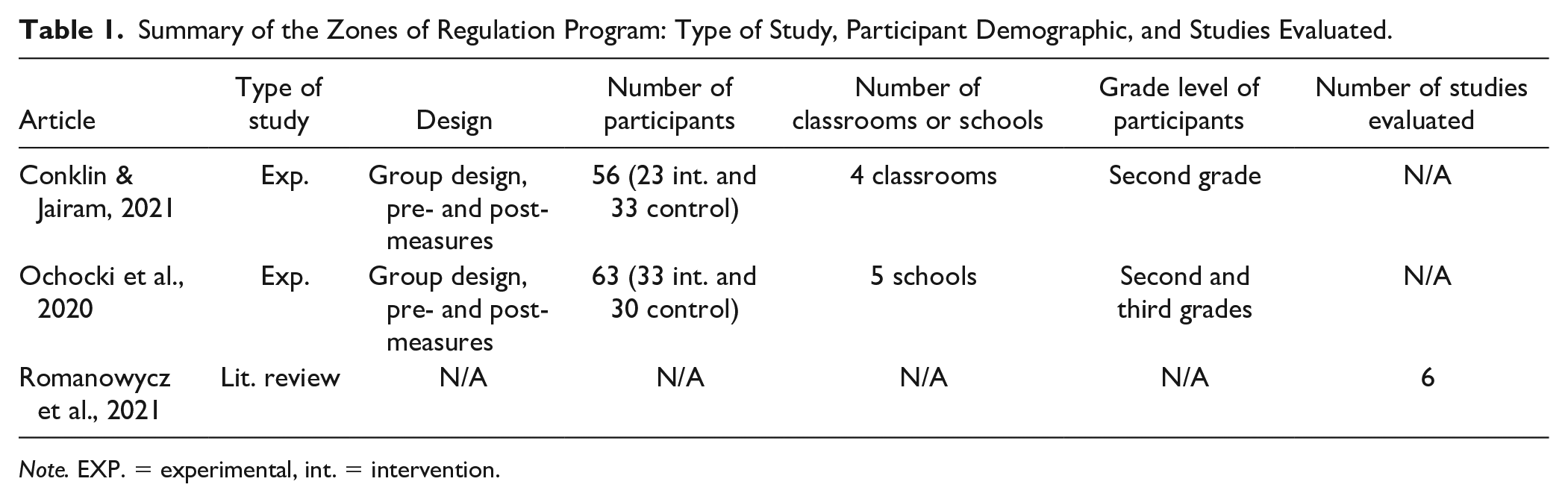
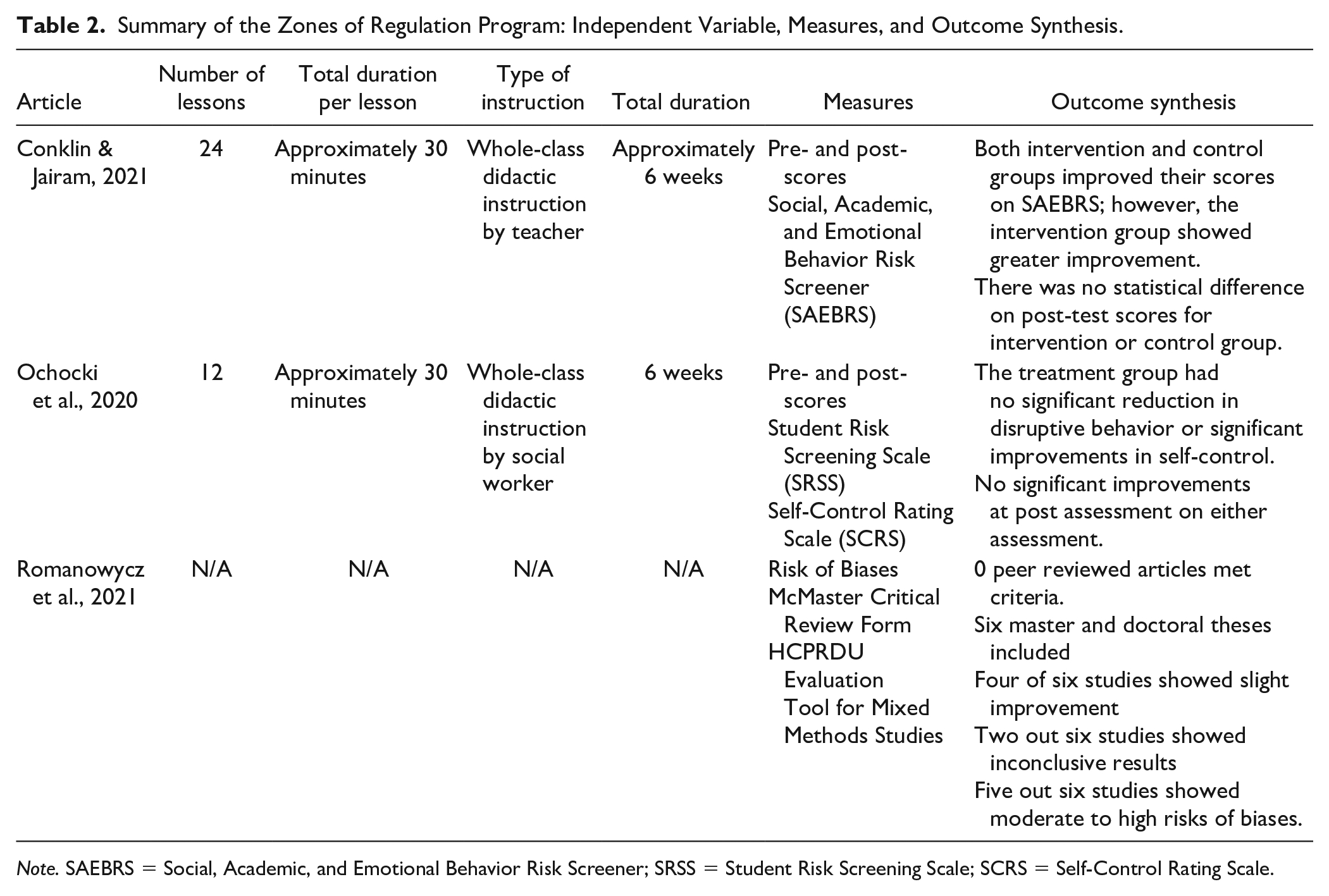
Of the three studies published in peer reviewed journals two were experimental (i.e., Conklin & Jairam, 2021; Ochocki et al., 2020) while the third was a systematic literature review (i.e., Romanowycz et al., 2021). It was decided that the literature review by Romanowycz and colleagues would be included in this review as it provided an analysis of six studies that was able to draw broad conclusions on the strength of evidence and risk of bias demonstrated in each, to help inform the discussion contained herein. Tables 1 and 2 depict the results of our analysis across the three studies. Across the two experimental studies, the type of design being used was a quasi-experimental between group design with pre- and postmeasures.
Summary of the Zones of Regulation Program: Type of Study, Participant Demographic, and Studies Evaluated.
Note. EXP. = experimental, int. = intervention.
Summary of the Zones of Regulation Program: Independent Variable, Measures, and Outcome Synthesis.
Note. SAEBRS = Social, Academic, and Emotional Behavior Risk Screener; SRSS = Student Risk Screening Scale; SCRS = Self-Control Rating Scale.
Participant Demographic
Across the two experimental studies (i.e., Conklin & Jairam, 2021; Ochocki et al., 2020), there were a total of 119 participants: 56 of these participants received Zones of Regulation intervention and 63 were control group participants. Both of these studies (Conklin & Jairam, 2021; Ochocki et al., 2020) were conducted in second- or third-grade classrooms. Furthermore, in one study the authors evaluated Zones of Regulation across four classrooms (i.e., Conklin & Jairam, 2021) and in another study the authors evaluated Zones of Regulation across five schools. In Ochocki et al. (2020), the delivery of Zones lessons was provided by school social workers, whereas in Conklin and Jairam (2021) teachers delivered all lessons.
Zones of Regulation Implementation
There was a range of 12 to 24 lessons across the two experimental studies (i.e., Conklin & Jairam, 2021; Ochocki et al., 2020). In both studies (i.e., Conklin & Jairam, 2021; Ochocki et al., 2020), each lesson took approximately 30 minutes to complete and both were implemented in a group instructional format. Finally, the total duration of intervention was approximately 6 weeks, with Conklin and Jairam providing a follow-up measure at approximately the 8-week point.
Measures
Across the three studies, a variety of assessments were utilized. The two implementation-based studies used responses to rating scale questionnaires, for student and/or teacher feedback. The review-based study examined bias measures and author-reported outcomes.
Outcome Synthesis
Ochocki et al. (2020)
Ochocki et al. (2020) completed an evaluation of the impact of Zones of Regulation on the self-control of elementary students. Using the framework of a Tier 2 intervention, for students who require slightly more intensive school supports, Ochocki et al. used a randomized group design with 63 students from five different school sites to study the effect of the Zones program. All students were provided instruction in a general education classroom. A total of 12 lessons, each approximately 30 minutes, were delivered over 6 weeks by school social workers. Measures were taken pre- and postintervention using the Student Risk Screening Scale (SRSS) (Drummond, 1994) and Self-Control Rating Scale (SCRS) (Fischer & Corcoran, 2007; Kendall & Wilcox, 1979). Ochocki et al. found that the intervention group did not show statistically significant reductions in disruptive behavior, nor did it show significant improvements in self-control as reported on the SRSS. The results from teacher SCRS ratings showed small improvements in student’s self-control; however, Ochocki et al. noted the risk of Type II errors (false negatives) that suggest there were no statistical differences in the pre- and post-scores between both groups. As noted in the paper, Ochocki et al. expressed the need for additional research to fill the gap between the extensive implementation of Zones and the research evidence to support its widespread use as an evidence-based intervention. A potential limitation of this study was the lack of fidelity by the social workers with the implementation of the Zones program and the reduced number of lessons presented.
Conklin and Jairam (2021)
Conklin and Jairam (2021) examined the effects of co-teaching Zones of Regulation on social and emotional behavior and the impact on academics. The purpose of the study was centered on two research questions: RQ1. Is co-teaching the Zones of Regulation effective? RQ2. Would students who received the Zones instruction score higher on the Social, Academic, and Emotional Behavior Risk Screener (SAEBRS) (Kilgus et al., 2016) compared with students who did not receive any Zones instruction? The SAEBRS is used to assess risk in four domains; social, academic, emotional behavior, and total behavior score. Lower scores on a SAEBRS mean the student is at greater risk of difficulty, whereas higher scores denote less risk. The study used a sample of 56 students attending second grade, divided among four classrooms—two experimental and two control. Only students receiving general education were included, and students accessing special education were eliminated from the study. Teachers were matched based on years of experience. Students in the experimental group were chosen based on at least one identified risk factor in the SAEBRS. This group received 30-minute lessons once a week, for a total of 24 Zones lessons. The control group was composed of students who did not participate in any Zones program lessons. For the experimental group the majority of the students were identified as being “at risk” in at least one category according to the SAEBRS screen. A pretest, posttest design was used to measure the effect of the Zones program. The baseline SAEBRS score was collected in the spring of the previous school year and then re-administered in the following fall to achieve a postscore rating. The results showed that although the experimental group had higher SAEBRS posttest scores compared with the control group, there was not a statistical significance between those co-taught the Zones curriculum and the control group. The individual domain scores showed the experimental group’s social and academic scores were slightly higher but the difference was not statistically significant. Conklin and Jairam (2021) summarized the overall results as showing that SAEBRS scores were not higher with students who received the Zones of Regulation when compared with students who did not receive instruction. However, the authors considered the results as partial confirmation of the hypothesis as results indicated the experimental group did show small improvement on posttest scores in all four SAEBRS subtests.
Romanowycz et al. (2021)
Romanowycz and colleagues (2021) used a comprehensive literature review to examine the literature base and evidence for the effectiveness of the Zones program. This was a review of the current evidence for Zones but Romanowycz et al. did not extensively review each article for methods, instead focusing on reported outcomes and risk of bias based on methodology. An initial search for peer-reviewed articles did not produce any results, but upon expanding the search to include published theses, Romanowycz et al. found six articles that met the criteria. These six articles were reviewed for outcomes and evaluated for the risk of biases. The McMaster Critical Review Form and HCPRDU Evaluation Tool for Mixed Methods were used to assess risk bias in studies. Romanowycz et al. showed one study with little risk of bias and five studies with moderate to high risk of bias. In summary, the reviewers found the thesis articles showed inconsistent but slightly positive results. Romanowycz et al. found discrepant results in their review, with the study by Dunn (2019) that reported medium to large effect sizes on the dependent measures in low poverty schools, based on teacher and student self-reported ratings, as showing greater social-emotional competence. In contrast, Romanowycz et al. showed that some outcomes reported an increase in problem behavior following the program (Karhoff, 2017), or no evidence of change in conflicts among third-grade students following the Zones program (Hoffman, 2018). A qualitative thesis included in Romanowycz et al. reported on the narrative recordings of the classroom teacher during implementation of the Zones program (Munro, 2017). The author reported student gains in self-awareness, empathy, acceptance, and influence and empowerment, but also noted that this research might be limited by the author’s subjective recordings and possibility of bias (Munro, 2017). A commonly reported finding among the included articles was the perception that participants could better identify their emotions, but there was not clear evidence of this in the study outcomes (Hoffman, 2018; Kisiel, 2019; Munro, 2017). Romanowycz et al. expressed several points of concern regarding the theses included in the review: only one of the six studies (Dunn, 2019) included a control group or any methods to control for internal validity, and sample sizes were generally small, in the range of one to 10 participants. Romanowycz et al. concluded with an expression of concern for a research to practice gap that exists for the Zones of Regulation intervention.
Discussion
The aim of this article was to examine the empirical support for the Zones of Regulation program. Based on a systematic review of the relevant literature, only three articles met the inclusion criteria. Two of the articles, Ochocki et al. (2020), and Conklin and Jairam (2021), used pre- and posttest scores as measures of impact with varying results. The third article, Romanowycz et al. (2021), summarized results of theses publications showing mixed outcomes and measured risk of bias as moderate to high in five of six studies. The remaining literature that focused on Zones was not included in this review as it was composed of non-peer-reviewed thesis projects, posters, presentations, or programmatic descriptions.
Is Zones of Regulation an Evidence-Based Practice?
With a current paucity of peer reviewed studies on the effectiveness of Zones of Regulation, and the high degree of variability in reported outcomes in the very small number of existing studies, it is difficult to consider Zones an evidence-based practice despite its widespread use. Romanowycz et al. (2021) and Ochocki et al. (2020) both expressed concerned that despite the popular use of Zones, there is a significant research to practice gap resulting in limited evidence in support of the program. According to the APA, evidence-based practice (EBP) is defined as “the integration of the best available research with clinical expertise in the context of patient characteristics, culture, and preferences” (APA Presidential Task Force on Evidence-Based Practice, 2006, p. 273). With regard to first part of the definition, research evidence, the Zones of Regulation has almost no peer-reviewed literature to support its utility. This also means that Zones does not meet the standards as defined by National Standards Project–Phase 2 (NAC, 2015), the National Clearinghouse for Autism Evidence and Practice (NCAEP) (Hume et al., 2021), or the definition provided by Horner and colleagues (2005). As such Zones of Regulation was not reviewed as part of the National Standards Project–Phase 2 (NAC, 2015) or the National Clearinghouse for Autism Evidence and Practice (NCAEP) (Hume et al., 2021).
The second part of APA’s definition requires expertise in the context of patient characteristics. The Zones of Regulation states that it is grounded in several theories and informed by research in ASD and ADHD but then suggests it has broad application to many student populations. The current lack of research does not allow for any empirical analysis of the Zones’ efficacy for students with any diagnosis label, let alone a broad “coalition” of labels. This is particularly true given that in Conklin and Jairam (2021) students receiving special education services were excluded from the study, and Ochocki et al. (2020), unfortunately, did not provide any specific participant demographics to allow for any informal between-group (e.g., autistic, ADHD, or OCD) comparison. This, in turn, makes it impossible to know for whom Zones of Regulation may be effective.
It is noteworthy to consider this review of two empirical studies and one literature review with respect to the minimum recommended standards of evidence-based practice; with at least five published studies that meet minimum methodological criteria, with a total of at least 20 participants, and a product of at least three different researchers (Cook et al., 2014; Horner et al., 2005). Although this may appear to be a premature review, the current widespread implementation of this program warrants immediate closer scrutiny. The temptation to wait for additional peer reviewed studies further runs the risk of continued use of the Zones program potentially at the expense of other established evidence-based programs. Therefore, one of the goals of this review is to highlight this gap and provide potential guidance for further study of Zones and social-emotional regulation programs in general (Leaf et al., 2018).
Kuypers notes that over 270,000 copies of the Zones program have been distributed, and this does not include adjunct materials (Zones of Regulation, n.d.). The developer’s literature promotes school-wide approaches, classroom-based implementation, and individual-focused programming with little empirical support for any these levels of intervention. Although the Zones of Regulation program is commonly used and referenced within schools, programs that are ubiquitous may naturally be seen as being valid without a further critical analysis implementation or outcomes. This is a point of concern, as any commercial program delivered in classrooms needs to be examined for efficacy and could be taking away instructional time that might, otherwise, be better used. Thus, the Zones of Regulation program should not be considered an evidence-based practice and caution should be used if a professional or parent elects to implement the program.
Future Areas of Research in Regards to Zones of Regulation
First, the Zones of Regulation program relies on visual categorization of four color-coded zones of alertness and emotional states. It would be worthwhile to investigate the level of stimulus control that is present with each of the Zones color categories and the impact this has on labeling private emotions. Furthermore, how might these color categories combine with other relevant stimuli for emotional regulation to be taught? This results in an interesting question about the stimuli that control responding. Is the most salient and influential stimuli the color, the context of responding, or potentially other preexisting contingencies such that responding in a specific way may result in positive or negative reinforcement from a teacher? It would also be beneficial to understand the level of stimulus control that the color categorization has in evoking appropriate social-emotional skills: for example, does a student demonstrate behavior that they would define as in a “green zone,” and therefore appropriate in the context? Does this response itself provide evidence of a change in skill level or evidence of growth in skills?
A second area of need in terms of research is the fidelity with which Zones in utilized. For example, the Zones of Regulation consists of 18 specific lessons (Kuypers, 2011). In this review we found that neither experimental study had 18 lessons; one provided 12 (Ochocki et al., 2020), while the other delivered 24 lessons (Conklin & Jairam, 2021). Furthermore, Romanowycz et al. (2021) reported that numerous studies in their review did not deliver all 18 specific lessons. It is, therefore, impossible to know how the lack of fidelity affects the outcomes associated with Zones of Regulation. Thus, it is unclear as to the effect of delivering a reduced set of lessons or when a teacher may determine that a student requires greater individualization of the program. Additional research is needed to determine who is best suited to provide Zones of Regulation and what level of training is needed to adequately implement the program. The Zones website (Zones of Regulation, n.d.) lists 15 “intended users,” including occupational therapists, speech and language therapists, social workers, marriage and family therapists, behavior therapists, and parents, which makes the question of fidelity particularly important.
Furthermore, it is important to examine the implementation and impact of the Zones of Regulation adjunct materials, such as games (The Road to Regulation), books (The Regulation Station), and cards (Tools to Try for Kids). Given that these additional materials are not formatted into a series of lessons like the Zones of Regulation curriculum, implementation may be poorly managed, while the impact of these materials remains unknown. This demonstrates the need for far more rigorous assessment of the original Zones of Regulation curriculum prior to the addition of an array of supplemental materials.
Finally, the Zones of Regulation program is reported to draw from many different theoretical underpinnings and notes that it “is consistent with the principles of Social Emotional Learning” (Kuypers, 2013). This statement should be closely examined to (a) better understand how the many theoretical underpinnings may align or misalign and (b) achieve better clarity on what principles of social-emotional learning are present and how this may practically translate into effective implementation for students. Furthermore, how might these social-emotional skills correspond to observable reduction of disruptive or undesirable behaviors?
Future Research in SEL
Teaching within a school can certainly be a rewarding experience, and having appropriate programs to help reduce behavioral disruption can further enrich a classroom. The focus on students acquiring competency in SEL is an important goal for the success of student learning and delivery of teaching with correlations to positive social and academic outcomes (Taylor et al., 2017). A common framework for the implementation of SEL programming is a tiered system of supports in schools that is often conceptualized as Tier 1 universal design that is good for all students, Tier 2 that is designed for a narrower group of students, and Tier 3 that is highly focused on a select set of students (Bear et al., 2015; Sugai & Horner, 2009). This system of supports is designed to provide a continuum of academic and social behavioral learning. Within this framework, there exists a wealth of research on programs, procedures, and curricula to deliver focused skill improvement that can achieve the aims of SEL.
Well-established behavior analytic practices may prove useful in the contribution of SEL and provide necessary structure to future study of the Zones of Regulation. A selection of evidence-based practices for students with ASD is provided in the National Standards Project–Phase 2, (NAC, 2015) and the National Clearinghouse for Autism Evidence and Practice (NCAEP) (Hume et al., 2021). It is these practices that should be relied upon to provide the foundation and structure for SEL instruction such as Zones. Direct delivery of SEL by a teacher is effective (Durlak et al., 2011); however, what is unclear are the specific components of this delivery that have impact. Further examination of this would prove helpful to identify critical features, for example, what impact is shown if feedback is delivered immediately or SEL skills are modeled by a teacher or instruction is given class-wide compared with individualized (Parsons et al., 2012). Although manualization of a program may provide greater fidelity of implementation, further research is required on the frequency, length, and overall number of lessons offered. To date, this has not been examined within studies of Zones of Regulation.
Finally, social-emotional instruction in schools provides a natural opportunity to gather students together for instruction and maintain learning over several grades (Greenberg et al., 2017; Zins & Elias, 2006). Effort should be made to develop systematic positive approaches to addressing problematic behavior rather than punitive measures (Taylor et al., 2017). An SEL program may be a part of these efforts, but it is important to assess the student for strengths and gaps in skills and target those areas for specific instruction instead of framing unwanted behavior as spiteful or inherent in the child. There are several published curricula that may be used as a guide for a skills-based approach to SEL, for example, the Preschool Life Skills curriculum (Hanley et al., 2007). Curricula can be used to teach defined and measurable component skills of SEL that will allow for a more sensitive measure of student response. In addition, this opportunity may align with establishing well researched school-based approaches such as the ‘Good Behavior Game’ (Bowman-Perrott et al., 2016; Flower et al., 2014), the Check-in/Checkout (CICO) procedure (Hawken & Horner, 2003; Majeika et al., 2020), and token economies (Soares et al., 2016). These practices are grounded in the principals of applied behavior analysis and positive behavior intervention supports (PBIS), and they can be used in coordination with other programs to promote prosocial behavior (Bowman-Perrott et al., 2016).
SEL Practice in Schools
Teachers will continue to rely upon social-emotional learning instruction to address student behavior in the classroom. This learning may provide reinforcement within a classroom in the form of improved teacher instruction and student outcomes (Durlak et al., 2011). Therefore, this requires ongoing empirical study of SEL programs to address the research to practice gap that exists (Romanowycz et al., 2021). Although prior meta-analyses have shown consistent results that students participating in SEL programs develop stronger SEL skills when compared with control groups, these findings cannot be extended to the Zones program until additional well-designed research provides those results. Furthermore, it is recommended that teaching discrete emotions without also teaching other social interaction skills may be shortsighted without a better understanding of how these skills may combine to improve student response (Durlak et al., 2011). There is valuable information provided in the behavior analytic literature, as noted above, as well as the SEL field of literature that can provide guidance in the assessment and delivery of programs. One such example in the SEL literature is the recommendation to use a SAFE matrix (Sequenced, Active, Focused, and Explicit) to follow recommended practice (Durlak et al., 2011). Finally, it is also recommended that specific student outcomes be analyzed to better understand the relationship between the SEL programming and other factors such as classroom norms, engaging approaches to learning, and reinforcement of maintaining a safe environment (Durlak et al., 2011). These suggestions may prove valuable to the future empirical analysis of the Zones program.
Conclusion
In this review, we found only three studies published in peer-reviewed literature on the Zones of Regulation program; only two of which were experimental. Thus, the Zones of Regulation program does not have a research foundation to be considered an EBP as outlined by the APA (APA Presidential Task Force on Evidence-Based Practice, 2006), nor does it follow best practice guidelines within the SEL literature for measurement of outcomes (Durlak et al., 2011). Despite a program’s popular appeal, it is critical that an examination be given to quality of evidence that supports it. Classrooms are an incredibly valuable place for academic and social learning, and the approaches to SEL must be examined closely to reflect value and only accept those that adhere to the highest standards of practice. Doing so will only help improve accountability and the overall quality of lives for students in general education and special education classrooms.
Footnotes
Declaration of Conflicting Interests
The author(s) declared no potential conflicts of interest with respect to the research, authorship, and/or publication of this article.
Funding
The author(s) received no financial support for the research, authorship, and/or publication of this article.