



Abstract
The purpose of this historical study was to examine the planning, implementation, participants, and activities associated with the Youth Music Institute (YMI) held at the University of Wisconsin from July 7 to August 1, 1969. Organizers hoped this event would bridge the communication gap between society, educational institutions, and youth through a collaborative learning environment involving students, music educators, guidance counselors, and professional recording artists. Participants used the term “youth music” to encompass multiple genres that captured the interest of young people, including various forms of rock, blues, soul, country western, jazz, and ethnic styles. The program consisted of lectures from leading scholars in multiple disciplines; working groups to discuss topics related to youth music, culture, and school curricula; and open rehearsal clinics with professional artists coaching student ensembles. The YMI also sponsored weekly public concerts where professionals and students appeared together, thereby creating authentic performance opportunities for the aspiring young musicians. Research into details surrounding the YMI may provide valuable insights for advocacy and professional development that will enable teachers to advance popular music education today.
Educators have debated values related to the music of youth culture since the early twentieth century. 1 Many teachers and societal leaders in the 1920s and 1930s, for example, believed that the syncopated rhythms and improvisational nature of jazz encouraged rebellion, alcohol use, and sexual promiscuity among adolescents. 2 They also argued that jazz was not a legitimate art form and lacked educational merit compared to classical repertoire. Nonetheless, some teachers supported jazz as vocational training for future professional musicians or as a means of leading students to appreciate Western art music. 3 A few teachers recognized the cultural significance of this genre. A professor in 1939 asked, “Wouldn’t it be odd if in our neglect of swing we are overlooking the most important musical development of our time?” 4
Despite the views of a few progressive educators, jazz did not begin to proliferate the school curriculum until the early 1960s, two decades after this style was popular among young people. 5 By this time, many teachers had begun to accept jazz as an important American art form that belonged in the curriculum. However, their attitudes toward the contemporary popular music of the time—rock and roll—mirrored those expressed by their predecessors about jazz forty years prior. Many teachers thought that rock was inferior to jazz and Western art music and that it too would encourage moral decay among adolescents through its association with drugs, sex, and rebellion. 6 Like educators from the previous era responding to jazz, some teachers believed that listening to and learning about “good music” would increase discrimination and lead teenagers to “no longer patronize the musical mediocrity of Rock ’n’ Roll.” 7 However, some music educators advocated for a more student-centered approach that included contemporary popular styles as a way to reach youth, especially those not already enrolled in the school music program. 8
The Tanglewood Symposium sponsored by Music Educators National Conference (MENC) in 1967 appeared to be a turning point for popular music education. Delegates discussed ways that school music instruction could be more useful to American society, including the aesthetic, intellectual, and functional values of currently popular idioms and the extent to which music teachers should further the interests of young people.
9
One writer contributing to the final report stated that
We should give [popular] music a hearing. We can include it in the recognized canon of music along with our great classics and world music, and contemporary art music. This is a very telling way to show our young people that we are concerned with the things that matter to them in this world. [W]e must give the word “music” a still further redefinition that will include such a vital force. We must inform ourselves and give this music an understanding rather than a censorious ear. Through it we may come to understand those who are our principal concern—our young people.
10
Participants also acknowledged that required music classes in secondary schools seldom challenged the “boundless energy, emotional resourcefulness, curiosity, idealism, and creative ability of teenagers.” They recommended that MENC form a commission focused on meeting the needs of adolescents by (a) evaluating effective teaching practices in music and other subjects, (b) organizing conference sessions, (c) conducting research studies or pilot projects, and (d) sharing the results with the professional community. Writers of the final report called for inclusion of all economic and ethnic groups in these efforts and said that “action must be initiated immediately.” 11
The Tanglewood Declaration written at the end of the conference summarized the beliefs of the participants. Article 2 stated that “Music of all periods, styles, forms, and cultures belongs in the curriculum . . . including currently popular teenage music.” 12 For the first time, music educators recognized contemporary popular music as equal to other genres and as a valuable component of student-centered school music curricula. MENC followed through on their support of popular music with several initiatives during the late 1960s and early 1970s, including a Youth Music Institute (YMI) in the summer of 1969, articles in Music Educators Journal (MEJ), and sessions on rock music at the 1970 MENC Convention. 13 Although enthusiasm soon diminished in favor of other initiatives within the organization, groundwork laid at Tanglewood in 1967 influenced efforts to integrate popular music in PK–12 curricula thirty years later. 14
The YMI met for four weeks and involved educators, young people, scholars, and professional musicians engaged in discussions and demonstrations related to current popular music. Like teachers from the jazz era and music specialists today, they debated the relationship between contemporary genres and Western art music, the need for a broader definition of music among educators, the place of popular music in youth culture and the school curriculum, the perceived detrimental effect of rock on youth morality, and the role of colleges and universities in preparing teachers in popular styles. 15
Purpose and Rationale
The purpose of this study was to examine the YMI held at the University of Wisconsin (UW) during the summer of 1969. The YMI represented a unique form of professional development and an early attempt by MENC to integrate popular music into the curriculum. However, researchers have not yet examined this event. The following questions guided this research:
Research Question 1: What were the primary goals of the YMI?
Research Question 2: What were the key details involved in the planning and organization of the YMI?
Research Question 3: Who were the participants in the YMI?
Research Question 4: What was the focus of activities and discussions during the YMI?
Recurring themes in discussions about popular music across different eras suggest that music educators often lack historical awareness. 16 For example, although teachers in the 1960s developed progressive attitudes toward jazz, they did not extend similar acceptance to the rock music embraced by young people at the time. 17 Similarly, although many music educators today have incorporated rock bands—a model that emerged in the 1960s—they have yet to embrace hip-hop, the dominant genre of contemporary youth culture. 18 In addition, many teachers still approach rock and similar styles using values and pedagogical methods rooted in Western art music despite a call from members of the Tanglewood Symposium for distinct paradigms emphasizing creativity and social connection. 19 Exploring the activities and discussions from the 1969 YMI may provide historical knowledge and insights that will enable preservice and in-service teachers to advance popular music education in modern classrooms.
Method
Methods for this study followed an empirical narrative framework, which included a rigorous examination of historical evidence verified by references, an inductive method of reasoning from an impartial perspective, and a narrative moving from specific observations to broader analyses. 20 Data collection involved immersion and saturation, a process in historical research that entails collecting and analyzing sources until no new information emerges. I accessed primary and secondary sources through the UW archives, various internet searches, and online databases, including ERIC, NewspaperArchive, GenealogyBank, and Sage Journals. Saturation occurred when additional searches yielded no new data. 21
All materials relevant to the YMI were collected and organized chronologically. Primary sources included articles from periodicals and newspapers, photographs, correspondence and other documents, and a semistructured oral history interview with one participant at the event. The interview occurred online over Zoom and followed best practices as described by the Oral History Association. 22 Secondary sources consisting of journal articles and books were used to establish historical context and provide supplementary information. Whenever possible, I consulted multiple sources to triangulate evidence and construct a reliable historical record. 23
The Youth Music Institute
The U.S. Office of Education, MENC, and the UW Extension Music Department sponsored the YMI at the UW in Madison from July 7 to August 1, 1969. The purpose of this event was “to bring educators and youth together in a common learning situation using the music of youth as the central theme.” Organizers hoped “to bridge the communication gap that exists between society, its educational institutions, and its youth . . . [by] introduc[ing] educators not only to the music of youth, but also to those who compose this music, perform it, appreciate it, and enjoy it.” 24 Participants used the term “youth music”—sometimes referred to as “now music”—to encompassed multiple genres that captured the interest of young people, including various forms of rock, blues, soul, country western, jazz, and ethnic styles. 25 This definition was not without controversy. Although some delegates believed that “youth music” should include jazz, others felt the term referred only to the music created specifically for youth at the time—namely, rock and soul. Eventually, attendees agreed that youth music was that which young people chose “to create and to become thoroughly absorbed with—a music of motion and energy, a celebration of the present, what someone has called ‘the sacred squeal of now.’” 26
Those attending the Institute included music supervisors, classroom music educators, school guidance counselors, and student ensembles. Scholars from the fields of sociology, anthropology, psychology, music, and music education and a representative from the recording industry lectured on various topics. Professional musicians provided instruction for the student ensembles and expertise in conversations with adult participants. 27 Emmett R. Sarig, a member at the Tanglewood Symposium, professor of music, and director of arts in the Extension Division of the UW, served as director of the four-week Institute. 28
Organizers had ambitious goals for the YMI. The primary objectives for music teachers were to deepen their understanding of contemporary popular music, explore connections between youth music and other genres, and promote the integration of this music into school curricula. Sponsors also hoped that work from the Institute would raise awareness among music supervisors about youth music in their school systems and act as a catalyst for future youth music programs at the local level. Goals for student musicians included building technical knowledge in composition and performance, peer relationships across cities, and communication with and support from music educators. Participants also explored how popular music could address social issues, impact society, influence the psychological and sociological development of adolescents, and enhance communication between youth and adults. 29
Planning
Planning for the YMI began in January 1969 with meetings that involved representatives of the sponsoring organizations and professors from various disciplines. MENC facilitated publicity by supplying members’ mailing addresses and publishing announcements in MEJ. In the spring, Institute staff attended the six regional meetings of MENC to encourage participation and learn about youth music in different parts of the country. 30 MENC president, Wiley E. Housewright, delivered a speech at each meeting titled, “Confrontation with Tomorrow,” in which he addressed the need for student-focused music curricula that included contemporary popular styles. 31
The U.S. Office of Education provided funding for the YMI through a grant connected with the Education Professions Development Act of 1967. The purpose of these grants was to encourage partnerships between colleges, school districts, and communities to plan and implement professional development programs that improved K–12 educational services. Grant administrators were especially interested in funding programs that served racial and ethnic minorities, students in poverty, and young people with physical or cognitive impairments. 32
Requests for information on the YMI were “almost overwhelming.” However, participation requirements likely resulted in fewer applications than expected. To apply, both a music teacher and a guidance counselor from the district had to commit to attending the entire Institute. They also had to identify, select, and fund travel for a youth music ensemble from their city. 33 Some districts held auditions to choose their student group. Fourteen bands in Seattle and forty-five ensembles in Philadelphia competed for the opportunity. 34
Organizers chose participants for the YMI from each region of the country and then notified superintendents of their intention to invite a team from their district. 35 Superintendents were generally enthusiastic because “they realized that music educators would be learning about youth music so that they would possess a means to reach one hundred percent of their students—instead of the usual twenty percent.” 36 In some cases, Institute staff found music supervisors “to be, by far, the largest stumbling block” and had to rely on the initial applicant to organize their team without the support of the supervisor. 37
YMI administrators planned to invite teams from forty urban school districts representing all regions of the country. They also hoped to include a group from Great Britan, “since many rock styles [had] been developed by English groups.” 38 However, failure to obtain funding resulted in the need to abandon this plan, reduce the budget, and invite teams from just twenty districts within the United States. Organizers provided fifty stipends and offered graduate credit for music educators and guidance counselors who attended the entire event. They also covered housing for student and professional musicians, all of whom attended on a rotating basis for one week. Ultimately, the UW assumed an expenditure of $10,000 to cover costs not funded through other sources. 39
Teams from eighteen school districts accepted the invitation to the YMI. An additional thirteen music educators were allowed to join on their own once organizers realized that they would not be able to fund any additional youth bands. 40 MENC organized a symposium on youth music that met July 23–25 during the third week to accommodate educators and administrators who were interested in the topic but unable to attend the entire Institute. The purpose of the symposium was to synthesize discussions and provide a summary of significant aspects of the project and generate enthusiasm for regional YMIs in the future. 41 This event attracted more than 100 additional music educators, administrators, critics, and journalists. 42 Attendees interacted with the student and professional musicians and listened to reports generated from conversations held during the previous weeks. Reaction panels consisting of Symposium participants responded to these reports and included several prominent critics and writers, including Allen Hughes of The New York Times, Tom Willis for the Chicago Tribune, Leonard Feather of The Los Angeles Times, and Charles Stuber, publisher of DownBeat magazine. 43
Format
The YMI began with an orientation meeting on the morning of Monday, July 7th. During the first few days, staff noticed that many delegates seemed uncertain about their role in the proceedings and decided to involve them in designing the program. At the end of the first week, participants met to evaluate progress, set objectives, and schedule activities for the following week. Organizers continued this process throughout the Institute to foster dialogue and maintain interest.
The program of the YMI included lectures and panel discussions by invited scholars; working groups to discuss topics related to youth music, culture, and school curricula; conversations between students and adults; and open rehearsals and workshops for student musicians by the professional artists (see Figures S1 and S2 in the supplemental document included with the online version of the article). 44 The Institute also provided adults and students opportunities to experiment with the latest electronic equipment used in contemporary popular music, including guitars, keyboards, amplifiers, and distortion boxes. 45
On Thursday evenings, the visiting youth and professional bands shared the stage in a ticketed public concert at Camp Randall Stadium on the UW campus. 46 Billed as the Madison Pop-Rock Festival, the first concert drew “more than 1,500 in the audience, most of them high school age.” 47 WHA-TV, the public television station at the UW, filmed these and other activities of the YMI using a $49,597 grant provided by the Corporation for Public Broadcasting 48 (see Figures S2, S3, and S4a–S4d in the supplemental document included with the online version of the article).
Lecturers
Several invited scholars lectured on topics related to music, adolescents, and society during the YMI. Edgar Z. Friedenberg (1921–2000), for example, specialized in education and gender studies at the State University of New York in Buffalo. 49 Jay Ruby (1935–2022), an anthropology professor at Temple University, was a leading ethnographer of visual culture. He also worked as a music critic and journalist for Jazz and Pop magazine, where he published articles, album reviews, and interviews with contemporary musicians. 50 Harry Morgan (1926–) was an advocate of early childhood education who taught at the Bank Street College of Education in New York City. 51 George L. Duerksen (1934–2019) served as chair of music education and music therapy at Kansas University. He was a prominent teacher and scholar and editor of the Journal of Research in Music Education from 1980 to 1981. 52 John Szwed (1935–) was a member of the anthropology faculty at Temple University when he participated in the YMI. His research focused on social anthropology, folk music, and jazz. He eventually served as the John M. Musser Professor of Anthropology, African American Studies, and Film Studies at Yale University and as professor of music and jazz studies at Columbia University. 53
Recording Artists
Four professional groups and one solo singer served as consultants and teaching staff at the YMI. According to Richard Zellner, assistant director of the Institute, these artists were selected “because they seemed to be the more sophisticated groups and [were] interested in the project.” 54 The New Colony Six appeared the first week of the Institute. This band originated in Chicago and took inspiration from the Beatles and British rock. 55 They recorded four albums and had ten singles listed on the Billboard Hot 100 between 1966 and 1971. 56
The Bob Seger System (week two) consisted of rock musicians from Detroit. In 1969, the band’s first national hit, “Ramblin’ Gamblin’ Man,” peaked at number 17 on the Billboard Top 100. Their album by the same title reached number 62 on the Billboard pop albums chart later that year. Seger, along with his backup group, the Silver Bullet Band, became leading artists in the 1970s and 1980s. 57
The Serfs (week three), a seven-member band from Lawrence, Kansas, performed music that blended psychedelic rock, soul, funk, and jazz. They released their only album, Early Bird Café, in 1969. 58 Sweetwater (week four), from Los Angeles, California, contributed to the development of the psychedelic rock/folk fusion style of the 1960s. The band appeared alongside numerous headliners, including the Doors, Jimi Hendrix, and the Grateful Dead, and was one of the first acts to perform at Woodstock in August 1969, two weeks after appearing at the YMI. 59
Pop singer (William) Oliver (Swofford; week three) from North Wilkesboro, North Carolina, began his career in a bluegrass band called The Virginians. His debut solo album, Good Morning Starshine, was released in 1969 and remained on Billboard’s album chart for thirty-eight weeks. Two singles from the album, “Good Morning Starshine,” from the musical Hair, and “Jean,” from the Oscar-winning film, The Prime of Miss Jean Brodie, reached the Billboard Top 10. 60
Youth Bands
The youth bands attending the Institute (see Table 1) consisted of three to eighteen members who ranged from thirteen to nineteen years of age. Although most musicians were current high school students, dropouts were not excluded from participating. The bands performed a variety of contemporary idioms, including rock, soul, jazz, and calypso. Most groups were organized outside of school, and many included self-taught musicians.
Student Bands at the Youth Music Institute.
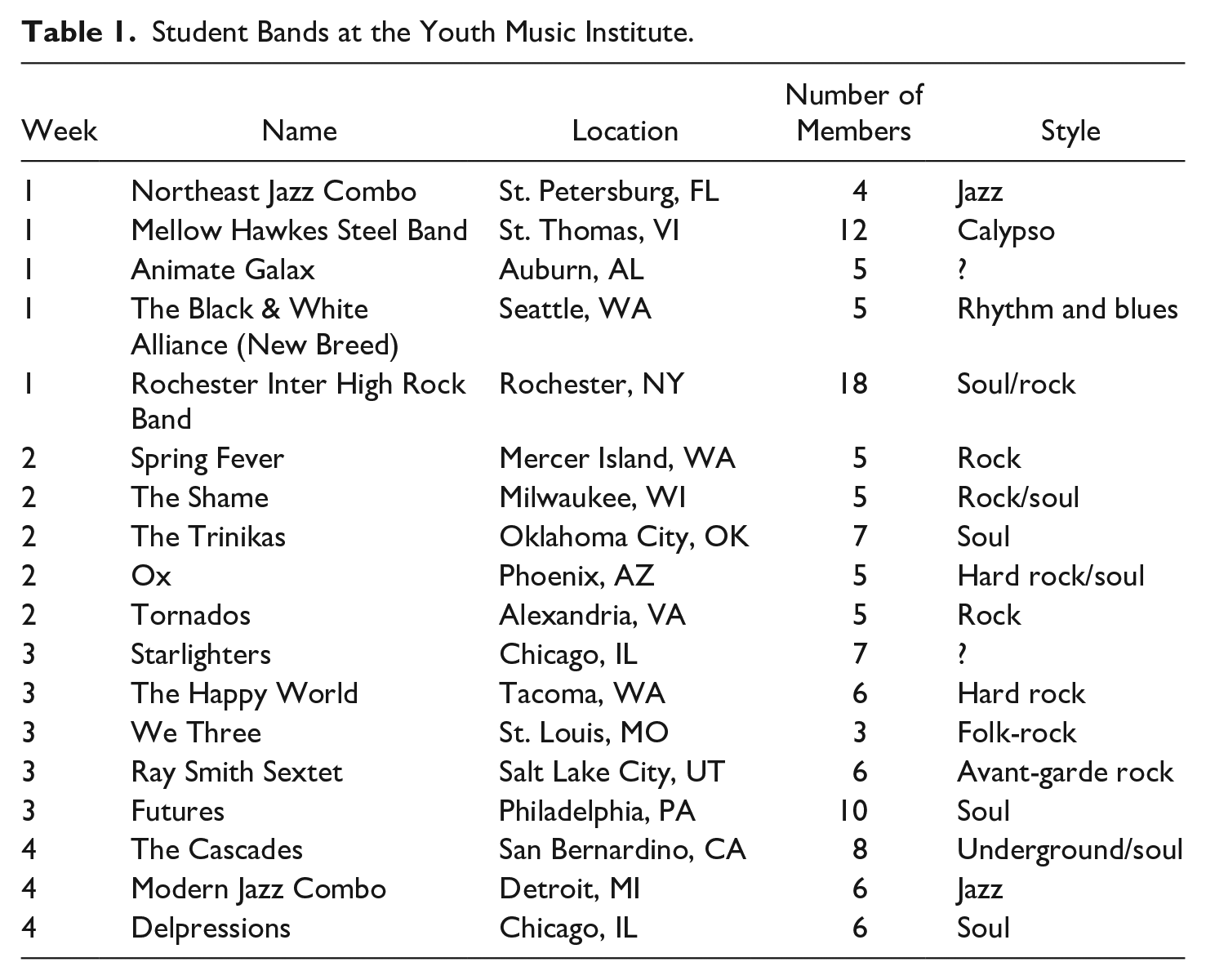
The Black and White Alliance, a soul band from Roosevelt High School in Seattle, Washington, consisted of two saxophones, electric piano, drums, and bass (see Figure S5 in the supplemental document included with the online version of the article). The group included two members who were White, two who were Black, and one who was Filipino. They originally called themselves New Breed before changing the name to better reflect their identity. The students of color in the band transferred to the predominantly White school the previous year and met other members while playing for a school drama. One member described how personal connections developed within the group, saying, “At first, we only had music in common, but this sort of tied us together. . . . At first, we didn’t hang around with each other outside of school but now we do.” The group played together for two months before participating in the YMI. The pianist had studied for ten years, and another member began just six months prior. The group played without music and adapted their own arrangements. One member said, “We just listen to a record and then we improve it. We make our own arrangements. . . . It’s all in our heads.” 61
The Cascades, a rock and soul band from San Bernardino, California, existed just six months prior to the Institute and included two saxophones, trumpet, bass guitar, organ, drums, and vocals. Their performance during the week featured an original ballad composed by the entire group titled “Song of Beauty” that spoke of “peace, love, and brotherhood.” The Delpressions from Chicago, Illinois, featured six African American musicians performing selections by James Brown, The Temptations, and a Taste of Honey.
62
The Ray Smith Sextet from Salt Lake City, Utah, were “a group of uncommonly wholesome-looking boys who talked about modal music, referred to rhythms in
The Rochester (New York) Inter High Rock Band was the largest group at the YMI and consisted of eighteen musicians from five different high schools in the city. Instrumentation included five saxophones, one clarinet, four trumpets, trombone, two guitars, organ, drums, and three vocalists. 65 The band performed at schools throughout the district and appeared at the New York State School Music Association conference in 1968–1969. David Hayden, a first-year teacher at Edison Technical High School, organized and directed the group (see Figures S7 and S8 in the supplemental document included with the online version of the article). 66
Organizers sought to engage students of color, especially those from underserved communities, as stipulated by the federal grant that funded the Institute. 67 Several of the youth bands attending the event included members who were Black. However, participants noted the absence of a professional soul band among the invited groups. Harry Morgan, a member of the teaching faculty and an African American scholar, stated that “popular . . . music of the Black community was inadequately covered and poorly focused.” There were a few professional musicians who were Black among the rock bands. However, Morgan thought that these individuals represented styles more associated with White culture and that they “found it difficult to connect with the young Black musicians.” He furthermore reported that working with the professional musicians was a highlight of the YMI for the White students but “somewhat disheartening for the Black kids; it felt like the tired old plantation dynamic was resurfacing—Whites teaching Blacks.” 68 The omission of professional soul artists may have been due to an oversight by predominantly White organizers or their inability to secure a group for the event. Regardless, the result was likely an inequitable experience for Black students in attendance.
Major Themes at the YMI
Participants at the YMI considered several topics related to popular music during lectures and panel discussions, conversations between adults and young people, and demonstrations by the student and professional musicians. In addition, the educators in attendance formed “area groups” to examine various topics related to youth music and culture. Fifteen area groups consisting of six to eight members met over the course of the Institute. Each group focused on a specific “critical issue,” such as the form, function, and elements of youth music; the relationship between youth music and youth behavior, attitude, and philosophy; the generation gap; and the extent to which K–12 schools should incorporate youth music in the curriculum. Despite the individual focus of each area group, discussions and subsequent conclusions often overlapped. 69 Organizers also invited all the educators to submit a personal “minority report” to share their own thoughts and reactions to the topics discussed at the Institute. Journalists in attendance responded through articles published nationwide and included in the final report. 70
Rock Music and Youth Culture
Several activities at the YMI involved participants learning about the nature and form of popular music. Members of the New Colony Six, for example, led a workshop on composing and arranging for the students and two sessions on “youth music structure” for all attendees at the Institute. 71 Szwed lectured on the connections between traditional Black music, rhythm and blues, and contemporary styles. 72 Area Group L determined that youth music consisted of a variety of sounds that were difficult to label or categorize and included “single-line melodic phrases with simple accompaniment to driving, pulsating, throbbing rhythmic beats and combinations of tone colors in which each player’s own improvisations are difficult to single out.” 73
The open rehearsals and clinics with the student bands were perhaps the most informative aspects of the YMI, especially for educators unfamiliar with popular idioms. However, teachers’ reactions to these sessions highlighted their lack of understanding regarding the music of youth culture. While observing a rehearsal of The Trinikas, a soul band from Oklahoma City, Oklahoma, one music teacher asked the rhythm section, “Could you please turn down your amps so I could hear the girls sing? Their voices are lovely.” During a break in another room, a member of the Ox from Phoenix, Arizona, said to a friend, “It’s really getting freaky in here. . . . A guy came in . . . and turned everything down and tuned the drums. It just doesn’t sound right. These people [music educators] don’t like anything loud. They just can’t understand the meanness of the amps and how the sound gets in your system.” A member of The Shame from Milwaukee, Wisconsin, elaborated, saying that “when it’s loud, we can put everything we feel into it. It’s relaxing that way. It’s just a feeling–we like it.” 74
Adult participants criticized the student bands for what they perceived as poor performances and a lack of musicianship. Ronald DeVillers, a high school band director from Milwaukee, Wisconsin, for example, stated that “poor intonation, bad meter, incorrect placement of chords, . . . the limited use of textural variations, failure to vary dynamic levels, limited technical facility, and little or no knowledge of harmony are some of the obvious flaws in the youth music groups’ performances.” 75 However, attendees acknowledged the accomplishments of the self-taught musicians and that “school music programs [had] failed to include musical activities which meet the special interests and needs of all students.” 76
Discussions also focused on youth music in relation to society and culture. Friedenberg’s lecture, for example, related different forms of rock to “the youth who feel the gnawing, piercing effects of their existence within and alienated society, controlled by old people.” 77 Waldo King, a band director from Seattle, Washington, said that “today’s ‘now’ music must be recognized as an expression of independent ideals, thoughts, and emotions, as they are experienced by youth—the sub-culture.”
The educators at the YMI were particularly interested in understanding the vocabulary often heard in song lyrics and in connection with young people in general. Area Group L learned that “acid, weeds, shit, grass, Mary Jane, speed, horse, smack, [and] blue cheer [were] some of the various names of drugs.” They also identified rock songs based on their connection to sex (e.g., “Let’s Spend the Night Together” by the Beatles), drugs (e.g., “Eight Miles High” by the Byrds), and political revolution (e.g., “Street Fighting” by the Rolling Stones). 78
Like teachers discussing jazz in the 1920s and 1930s, multiple participants at the Institute expressed concern for the suggestive themes in popular music and called on teachers to “be careful of implied sanction of such ideas through classroom use.” 79 Duane R. Burr, a music educator from Arizona, used stronger language, saying that “a teacher who does not have the propriety to [exclude inappropriate content] has no business in public school music or in the education of the youth of our nation.” Students viewed this issue differently. One young musician, for example, said, “Today we’re not hiding anything. Why hide it anymore? Just bring it out. Teachers shouldn’t get upset, saying we can’t have kids say things like ‘do it in the road’ and ‘sock it to me,’ and ‘Christ, it ain’t easy.’ . . . That happens to be the way rock is.” 80
Popular Music in the K–12 Curriculum
Participants at the YMI discussed the challenges and possibilities of incorporating popular music into the school curriculum. Although they agreed that “all ‘youth music’ is musical art,” 81 they debated what to do with it in the classroom. Paul Duerksen’s lecture addressed the relevance of youth music in the curriculum, stating that “Cultures develop formal education systems to teach important things which are not easily learned through informal institutions. [Youth music] is learned efficiently by students outside the music classroom, but it is not examined efficiently.” 82
Several discussions considered contemporary styles in relation to the philosophical tenants of aesthetic education and conceptual learning as they existed within the profession during the mid-twentieth century. 83 Harry Morgan’s lecture advocated for youth music in schools as a medium for affective and cognitive learning, saying, “We must make our teaching relate to the experience the child brings to school. . . . For at least 80 percent of the students, the music they bring with them is ‘rock’ not ‘Bach.’” 84 In alignment with aesthetic education, participants discussed ways to foster musical values, meaning, and experience and develop students’ intellectual, emotional, and physical response to music. From a conceptual standpoint, they referred to teaching musical elements, such as rhythm, form, and harmony. 85
Using rock music as a medium for analysis drew a negative response from some educators who felt that students wanted to listen and respond emotionally to their music rather than intellectually. 86 Others believed that music educators should not interfere in the development of the form. Willard Budnick, a music coordinator from Minnesota, said that “Youths [sic] ‘now’ music is a folk-art, a precious reflection of the sub-culture, and it should not be disturbed by structuring from bodies or institutions outside of its culture. . . . If it is to be a true folk-art expression the change should not be institutionally directed or influenced and those of the sub-culture who speak through music should have the freedom to do it in their own way, relevant to their society.” 87
The young musicians at the YMI agreed with this position and “specifically stated that they did not want music educators tampering with their music. . . . They felt that the music of youth was more or less an escape from something going on in school. They enjoyed the fact that it was outside of school and were not interested in having youth music, as they know it . . . brought into the school music program, tampered with, and possibly destroyed.” 88 However, the students wanted music teachers to support their aspirations by showing interest, being open minded, listening to them play, dialoging about their music, and helping them learn notation and theory so that they could compose, arrange, and improvise more effectively. They also believed that music specialists could help with technical knowledge related to tuning and other basic skills. 89
Several sessions throughout the Institute and at the Symposium during week three involved students talking to adults about their music, their lives, and their experiences with music educators.
90
According to Hughes, the young people were “impressively articulate” and demonstrated “remarkable grace poise, and generosity of spirit” in discussions with the adults.
91
The young musicians stated several concerns with music teachers, saying that they were not open to new genres, incapable of teaching electronic instruments, did not relate to modern students, and stifled individual creativity.
92
A teen musician from Tacoma, Washington, said,
[T]he teachers just . . . didn’t relate. Anything I wanted to do, the kinds of things I brought in, the kinds of pieces I liked—I was either put down for it or told, “Now, kid! What are you doing? You’re not educated.” The instruction was never aligned with what we were doing or with our tastes. There was no connection between the music that was taught and what we wanted to learn. We couldn’t even understand what they wanted us to understand. It seemed they were teaching to please themselves.
93
Music educators at the Symposium “exhibited a strong feeling of mea culpa” and admitted to a lack of knowledge in contemporary styles. 94 William Johnson, Illinois State Supervisor for Music, said, “As for rock, we better get with it if we want to survive. The time has passed when only our choices count.” 95 Thomas MacCluskey, music critic for Rocky Mountain News in Denver, Colorado, candidly recommended that music teachers who “can’t be convinced of the necessity of plugging into the Electronic Age . . . [and] balanc[ing] out their beloved two centuries of European music with much, much more . . . should get out of the profession!” 96
Recommendations by participants for supporting youth music in schools included allowing student rock bands to use school facilities and equipment; incorporating arrangements of current rock and pop songs into large ensembles; integrating popular idioms into appreciation and theory courses; teaching guitar, ukulele, and other instruments associated with poplar music; and offering rock band and similar ensembles as extracurricular activities before or after school. Participants also called for the purchase of guitars, rhythm instruments, and other equipment that could be used for several years by multiple students, saying “the music room could become a laboratory for those who wish to experiment musically in as many musical areas as possible.” However, they cautioned against buying the latest electronic devices due to their cost and tendency to become outdated. 97
Professional Development and Teacher Preparation
Several discussions at the YMI addressed professional development and the preparation of music teachers in relation to contemporary popular genres. A recurring theme was the responsibility of teacher educators to adapt to youth-oriented music. In a survey conducted during the Institute, thirty-one out of thirty-three participants agreed that “teacher training institutions should develop programs for teaching youth-oriented music.” 98 They also acknowledged “the universities’ failure to recognize the relationship of all 20th century music” and placed responsibility for “constant awareness of an ever-changing scene” on music educators. Attendees emphasized the need for teachers to familiarize themselves with “youngsters [sic] out-of-school music world” by listening to current songs; reading books, magazines, and the liner notes from record albums; and “personally play[ing] some of the ‘now’ music.” 99
The journalists in attendance at the Symposium expressed pointed criticism of teacher educators and questioned their relevance: “What about the music educators who teach the teachers? In some ways they’re the hardest to crack.” 100 “Serve notice on . . . those (ir)responsible for teaching teachers—that time is running out . . . [and] that relevancy is critical. Now!” 101 Professional musicians supported these critiques by sharing their own experiences with college music programs. The singer Oliver, for example, described the condescension expressed by faculty at the University of North Carolina at Chapel Hill toward popular music and the students who wanted to pursue these styles. 102
Conclusion
The YMI represented an early effort by music educators to understand teen culture and incorporate contemporary popular genres into the K–12 curriculum. Organizers hoped to open communication, dispel assumptions, and improve relationships between teachers and “the other eighty percent” of secondary students not involved in school music programs. They envisioned a major shift in music education whereby popular styles would gain equal footing with other idioms and school music programs would reach a broader segment of the student population. 103
To realize this vision, participants hoped to expand the four-week Institute into a permanent organization that promoted popular music education. They called for future YMIs at the regional and local levels taught by participants and staff from the UW event and for articles in MEJ and sessions at the 1970 MENC National Convention. 104 Early interest ran high. The November 1969 issue of MEJ featured articles related to the YMI and popular music in general. 105 The 1970 MENC National Convention in Chicago, Illinois, featured significant programming around the music of youth culture, including discussions on the elements of rock; performance of a one-act rock opera titled Electric Baby, by John Austin; a panel discussion labeled “Rock Shock,” led by Allen Hughes; and a performance by The Futures, the same high school rock group from Philadelphia that appeared at the YMI. 106 Sarig led seminars on youth music at the University of Missouri and three other institutions during the summer of 1970 and hoped to continue these workshops “until all universities [were] converted.” However, I found no evidence of similar events after 1970 and before Sarig’s retirement in 1973. 107
The YMI ultimately had little impact on the profession and was largely forgotten within a few years. The only recommendation implemented and sustained on a wide-scale basis was the publication of arrangements of current rock and pop songs for large ensembles that were inauthentic to the original versions. 108 Several circumstances likely contributed to the failure of the Institute’s goals, including (a) teachers’ lack of interest, experience, and preparation in popular genres; (b) a dominant and aesthetically based philosophy that viewed art music as superior to popular styles; (c) a shortage of pedagogical materials; and (d) the cost of implementing popular music into the curriculum. 109 In addition, some educators continued to believe that rock music was (e) morally and physically harmful for youth and (f) a waste of instructional resources on content easily acquired outside of school. 110
Other circumstances likely also contributed to the demise of the YMI, including the end of funding by the federal government and waning support from MENC. 111 By the early 1970s, MENC had turned its focus toward the Goals and Objectives Project (GOP), which sought to implement recommendations from the Tanglewood Symposium, including those related to cultural diversity, teacher education, and serving the needs of all students. Despite these goals and statements in the Tanglewood Declaration, rock and similar styles were not mentioned or incorporated into the GOP. 112
Likewise, participants at the Institute asked if popular idioms might be integrated into the MENC Contemporary Music Project (CMP). This program lasted from 1963 to 1973 and focused on student creativity and contemporary art music. Organizers of the CMP apparently rejected this idea given that no evidence of popular genres in this project exists. Reports published in MEJ on both the GOP and CMP claimed to uphold Article 2 of the Tanglewood Declaration that addressed the need for “music of all periods, styles, forms, and cultures . . . in the curriculum.” However, they omitted the phrase “including currently popular teenage music” from the quoted material. 113
Implications
Popular music has finally established a presence in PK–12 classrooms, with teachers and scholars actively working to advance the field. 114 However, despite increased use of contemporary genres, similar themes discussed at the YMI and by educators today suggest that some teachers’ philosophical and pedagogical approaches to this music have yet to evolve. For example, like participants at the Institute, many teachers today continue to approach contemporary popular styles through the perspective of Western art music and teacher-centered pedagogy, raise concerns about the appropriateness of some popular genres, and struggle to include music representative of all students in the classroom. 115 Perhaps in-service workshops and preservice preparation could include more content on the unique nature of popular styles compared to art music, including their focus on creativity, collaboration, informality, and social connection. 116 Additional topics might address navigating music with explicit content, maintaining authenticity when teaching popular forms, and incorporating a wider range of youth music, such as hip-hop, country and western, and idioms from non-Western traditions that are not yet widely embraced in the curriculum. 117
The YMI adopted an innovative approach to professional development that involved music educators, guidance counselors, scholars, high school students, and recording artists interacting and learning together. Most sessions fostered open dialogue, as evidenced through reports by area groups, individual participants, and journalists in attendance. 118 In-service activities related to popular genres today could follow a similar format. Roundtable sessions similar to area groups at the YMI would allow participants to discuss various topics related to popular music education. Presentations by experts from ethnomusicology, psychology, anthropology, poetry, dance, and the music industry may help music educators understand youth, identify trends, and contextualize contemporary music-making within cultures and society. Recording artists—who have frequently advocated for music education in the past—could now serve as consultants and clinicians for both teachers and students. 119 For example, popular music activities at the all-state level could involve well-known musicians providing professional development clinics for educators and coaching sessions for students involved in modern band, songwriting, or music production. 120 Such initiatives could help bridge the gap between music education and the music of youth culture and enrich the learning experience for all involved.
Like young people at the YMI, some students interested in contemporary music-making outside of school today may not wish to take a curricular class that requires assignments, homework, assessments, and grades. 121 They might, however, appreciate support from the school music program. Perhaps teachers could offer extracurricular opportunities—in addition to accredited classes—for these students to collaborate, use school facilities and equipment, and receive coaching. These initiatives might help increase the number of students participating in school music beyond the 20% generally involved in traditional ensembles. 122
Future Research
Future historical research should explore past efforts to implement jazz, rock, and other contemporary styles into the curriculum, which may suggest pedagogical strategies relevant for today’s educators. For instance, researchers could study youth-organized jazz and rock bands during the early and mid-twentieth century and efforts by some educators to teach these genres despite prevailing attitudes in the profession. 123 In addition, studies on the youth music workshops held by Sarig in the summer of 1970 and similar events over the past fifty years might reveal practices or activities relevant for modern professional development. 124
The voices of young people were an important source of information for educators at the YMI. The students freely shared their experiences with school music programs and what they wanted from music educators. 125 Researchers today should continue to study the attitudes and perceptions of PK–12 students toward music inside and outside of school through both qualitative (i.e., interviews) and quantitative (i.e., surveys) methods. 126 This continued line of research will enhance the effectiveness of music education and drive its evolution into the twenty-second century.
Supplemental Material
sj-pdf-1-jrm-10.1177_00224294251339801 – Supplemental material for The Youth Music Institute at the University of Wisconsin, Summer 1969
Supplemental material, sj-pdf-1-jrm-10.1177_00224294251339801 for The Youth Music Institute at the University of Wisconsin, Summer 1969 by Phillip M. Hash in Journal of Research in Music Education
Footnotes
Declaration of Conflicting Interests
The author declared no potential conflicts of interest with respect to the research, authorship, and/or publication of this article.
Funding
The author received no financial support for the research, authorship, and/or publication of this article.

Supplemental Material
Supplemental material for this article is available online.
Notes
Author Biography
Supplementary Material
Please find the following supplemental material available below.
For Open Access articles published under a Creative Commons License, all supplemental material carries the same license as the article it is associated with.
For non-Open Access articles published, all supplemental material carries a non-exclusive license, and permission requests for re-use of supplemental material or any part of supplemental material shall be sent directly to the copyright owner as specified in the copyright notice associated with the article.
