




Abstract
Objectives
This study examines how social embeddedness and multiplex social ties shape criminal collaboration in the Sinaloa Cartel. It investigates how different types of relationships—such as kinship, friendship, meetings, and compadre ties—influence participation in drug crimes and broader forms of collaboration.
Methods
Drawing on trial transcripts from Joaquín “El Chapo” Guzmán Loera's U.S. federal case, we reconstructed social networks among 188 actors. Using social network analysis and Logistic Regression Quadratic Assignment Procedure (LRQAP) models, we assessed the conditional associations of different social ties with drug crimes and criminal collaboration, controlling for demographic and organizational characteristics.
Results
Friendship and meeting ties exhibited the strongest associations with drug crimes and criminal collaboration. Familial ties were initially significant but lost their effect once shared cartel affiliation was considered, suggesting a mediating role of organizational membership. Compadre and prison ties showed no significant associations.
Conclusions
Trust-based relationships such as friendships and meetings play a pivotal role in fostering collaboration within organized crime groups. Familial ties may exert indirect effects through shared cartel affiliation. The findings underscore the importance of distinguishing between types of social ties and demonstrate the value of trial transcripts as a source for advancing empirical research on organized crime.
Keywords
Introduction
Organized crime groups are defined by their illicit operations and perhaps even more by their resilience in hostile environments. A key reason for this resilience lies in the web of social relationships that binds individuals in these organizations. Social ties—family ties, friendships, or long-standing acquaintances—facilitate recruitment, foster trust, and reduce the risk of betrayal (Calderoni, Comunale et al. 2022b). The notion of social embeddedness captures this reality, emphasizing that economic and criminal action is deeply rooted in social relationships (Granovetter 1985; Van de Bunt, Siegel and Zaitch 2014).
While the concept of embeddedness has become a dominant framework, important gaps remain in our understanding of how social ties influence illegal collaboration within large-scale, criminal organizations. Much of the literature tends to treat social ties in broad and undifferentiated terms, without examining whether specific types of relationships play distinct roles in shaping organized crime cooperation. This approach risks overlooking how overlapping or multiplex relationships—where individuals are connected through overlapping ties such as kinship, friendship, and criminal partnerships—affect trust, cooperation, and organizational resilience (Smith and Papachristos 2016; Verbrugge 1979). Moreover, existing research has largely focused on small, localized networks, mostly based in advanced economies. Conversely, major drug trafficking organizations—particularly those based in Latin America—are underexplored in empirical studies. Mexican drug trafficking organizations, in particular, play a central role in regional violence and illicit markets, while also influencing political and institutional dynamics. Examining cooperation and cohesion within criminal networks may help explain why large-scale and complex organizations, such as Mexican drug trafficking syndicates, persist despite sustained and heightened enforcement efforts. Yet, systematic empirical research on their internal social dynamics remains limited.
To address these gaps, this study examines how different social ties relate to criminal collaboration in a key portion of the Sinaloa Cartel, one of the largest and most influential drug-trafficking organizations in the Americas. Leveraging extensive trial transcripts from Joaquín “El Chapo” Guzmán Loera's U.S. federal case, we systematically reconstruct networks of 188 individuals connected through various relationships such as family, friendship, compadre (a tie between a child's parent and godparent—particularly significant in Mexican culture; see Gill-Hopple and Brage-Hudson 2012), joint meetings, and shared criminal activities, and assess how each type of tie influences criminal collaboration. While the dataset reflects the trial's focus on Guzmán and his closest associates, it offers an unusually detailed account of interpersonal dynamics within the core of the organization. Using social network analysis and Logistic Regression Quadratic Assignment Procedure (LRQAP) models, we quantify the impact of these multiplex social ties on both drug crimes and broader criminal cooperation. Our results show that friendship and meeting ties are the strongest predictors of criminal collaboration, while family ties lose significance when controlling for shared group membership, suggesting indirect effects through organizational affiliation. In contrast, other ties such as compadre relationships, prison connections, and joint violent crimes do not show significant associations. These findings underscore the pivotal role of trust-based relationships in fostering cooperation within organized crime and demonstrate the methodological value of trial transcripts for uncovering the social dynamics that sustain criminal enterprises.
By concentrating on the relational dimensions of criminal collaboration, our study offers a complementary perspective to existing scholarship on Mexican drug trafficking organizations. While political science and economics have highlighted the role of state responses, institutional dynamics, and market conditions in shaping organized crime, a criminological approach grounded in social network analysis provides fresh insights into how these organizations are built and sustained from within. This perspective underscores the importance of interpersonal ties and overlapping relationships as mechanisms of trust and cohesion in large-scale, high-risk criminal groups.
Background
The Embeddedness of Organized Crime
The concept of embeddedness, introduced by Polanyi ([1944] 2001) and redefined by Granovetter (1985, 1992), emphasizes that economic action is rooted in social relations. Notably, Granovetter specified that group offending relies on a level of internal trust “that usually follows preexisting lines of relationship” (1985:492)—a point that criminologists largely overlooked for years. 1
At the turn of the twenty-first century, criminologists revived embeddedness to explain how criminal organizations emerge and operate across different contexts (Kleemans and van de Bunt 2008; Kleemans and de Poot 2008; Kleemans and Van De Bunt 1999; Paoli 2002: 84; Van de Bunt et al. 2014; Von Lampe 2016). This revival aligned with classic organized crime studies, who showed how kinship, friendship, and community ties sustain trust, collaboration, and resilience criminal organizations (Albini 1971; Ianni and Reuss-Ianni 1972; Hess [1970] 1973; Blok 1974).
Over time, embeddedness has broadened to encompass the idea that all economic action holds social relevance, overlooking Granovetter's original focus on the direct interplay between social ties and economic behaviour (Joseph and Smith 2021; Krippner et al. 2004). Applied to organized crime, it highlights how criminal organizations are deeply embedded in overlapping social ties—family, kinship, friendship, and professional networks—that shape their structure and operations (Van de Bunt et al. 2014).
Empirical studies using social network analysis have demonstrated how relational embeddedness defines criminal group boundaries, exposes legal–illegal overlaps, and maps cross-border collaborations (Aziani, Berlusconi and Giommoni 2021; Bouchard 2020; Morselli 2009; Papachristos and Smith 2014; Waring 2002). Social ties also affect recruitment (Calderoni, Comunale et al. 2022a; Decker and Van Winkle 1996; Kleemans and Van De Bunt 1999), shape roles (Calderoni 2012; Calderoni and Superchi 2019; DellaPosta 2023; Morselli 2009; Morselli and Petit 2007), and career opportunities, persistence, and desistance (Morselli 2001, 2003, 2005; Pyrooz, Sweeten and Piquero 2013).
Overall, research has shown that diverse social ties serve both as the breeding ground and the binding force of criminal organizations. However, what often remains underexplored is how these ties intersect. A particularly revealing dimension of embeddedness lies in the multiplexity of relationships—when familial, social, and economic ties overlap within the same dyads. These multi-layered connections are especially relevant, as they amplify trust, facilitate coordination, and strengthen organizational resilience.
Multiplexity in Criminal Networks
Multiplexity refers to the phenomenon wherein individuals maintain overlapping types of relationships—familial, social, and economic—within the same network. Originating in broader sociological and anthropological discussions on role plurality and social organization (see Simmel 1950), the concept underscores how people can simultaneously inhabit multiple roles (e.g., relatives, friends, and business partners), thereby intensifying mutual obligations and norms of reciprocity. These layered relationships resonate with Granovetter's (1985) notion of embeddedness and with Coleman's (1988) conception of social capital, where dense, multiplex ties promote collaboration, trust, and information flow. Multiplexity has gained traction as a lens through which to understand how these entwined connections can bolster cooperation, trust, and group cohesion, particularly in contexts where formal legal institutions do not reliably enforce agreements (Smith and Papachristos 2016; Wippell and Haynie 2025).
Criminal collaboration unfolds in contexts where formal legal mechanisms—contracts, courts, and state enforcement—are weak or absent (Gambetta 2009; Paoli 2002; Reuter 1983). In such high-risk environments, trust and informal enforcement become essential to prevent defection. Scholars applying the concept of relational embeddedness to organized crime have shown that layered, multi-dimensional social bonds—such as kinship, friendship, or ritual obligations—are critical for fostering trust, internal cohesion, and resilience. These multiplex relationships unify offenders around shared norms and enable informal conflict resolution where legal institutions are lacking or distrusted. Yet despite highlighting the importance of these overlapping ties, prior research has rarely measured how specific types of social bonds interact and affect distinct dimensions of criminal collaboration—leaving their relative influence largely unexplored.
Few studies have empirically measured the effects of different types of relationships on criminal collaboration. Recent scholarship has advanced this area by describing multiplexity and assessing its impact on organized crime networks (Bright et al. 2015; Malm, Bichler and Van De Walle 2010). Campana and Varese (2013) tested whether kinship ties and the disclosure of past violent acts influenced the likelihood of criminal collaboration. They found that both significantly increased the probability of cooperation, demonstrating how overlapping relational dimensions—such as familial bonds and reciprocal trust—enhance collaboration within organized crime networks. Similarly, Smith and Papachristos (Papachristos and Smith 2014; Smith and Papachristos 2016) found that offenders with overlapping ties, such as familial connections, neighbourhood links, and joint criminal ventures, maintained more durable collaborations in Prohibition Era Chicago's organized crime networks. Diviák et al. (2019) demonstrated that diverse relational channels stabilize a high-risk Czech corruption network by providing redundant communication pathways and reinforcing trust. Together, these studies highlight how multiplex relationships deepen social embeddedness, promoting cooperation and enhancing resilience against both internal conflicts and external threats.
In conclusion, although more recent scholarship has begun to empirically probe multiplexity, existing research is still limited, and questions persist regarding how different social dimensions intersect to shape trust, cooperation, and resilience in criminal networks. Our current understanding lacks empirical, quantitative evidence into whether different relationships such as family, friendship, prior interactions, or joint violence affect criminal cooperation in general and drug trafficking collaborations more specifically.
The Current Study
In this study, we advance the examination of multiplexity in organized crime networks by systematically examining how different social relationships affect the commission of drug crimes and criminal collaboration in a large-scale, high-risk, criminal organization. More specifically, we aim to fill three gaps in the current knowledge.
First, there is a clear need for empirical research that directly examines how multiplex social relations affect criminal collaboration. While criminologists have embraced the concept of embeddedness—extending it beyond its original focus on purely economic exchanges (Joseph and Smith 2021)—much of this work remains theoretical or qualitative. In particular, many studies analysed the importance of layered social bonds (e.g., familial, economic, and community ties) in shaping offender decisions, yet relatively few systematically disentangled the influence of each type of network tie in networks of criminal collaboration outcomes such as trust, cooperation, and long-term partnership (Gambetta 2009; Granovetter 1985). This gap is significant because understanding the specific contributions of different social dimensions can illuminate the mechanisms that strengthen or undermine illicit ventures.
Second, although numerous studies investigate the role of social relations in criminal collaboration, few focus on large-scale drug trafficking syndicates. Existing criminal network research often centres on street gangs (Ouellet, Bouchard, and Charette 2019), mafias (Calderoni 2012; DellaPosta 2023), or outlaw motorcycle groups (Morselli 2009; Van Deuren, Diviák, and Blokland 2025), each of which has wide-ranging social and cultural objectives that may extend beyond profit-making. Even within studies of drug trafficking, the emphasis typically falls on small-scale networks (Bright, Hughes, and Chalmers 2012), leaving the organizational strategies and relational dynamics of high-level drug trafficking organizations relatively understudied. Some exceptions note that significant players in large-scale trafficking prefer indirect ties to limit exposure (Desroches 2005; Dorn, Oette, and White 1998; Gundur 2022), and that any direct connections often stem from long-term personal relations linked to kinship or ethnicity (Browne, Mason, and Murphy 2003; Reuter and Haaga 1989). These insights suggest that bigger, more diverse networks may face unique challenges in sustaining criminal cooperation—a phenomenon that warrants closer examination.
Third, to date, much of the literature on organized crime has concentrated on a small number of countries with advanced economies, often overlooking the diverse sociopolitical, economic, and cultural factors that shape criminal collaboration in other regions (Hosford et al. 2021). This narrow focus has limited the field's empirical base and constrained our understanding of how different institutional and social contexts influence the formation, structure, and operation of criminal networks (Pereda 2022).
Latin America exemplifies this gap. Despite the central role organized crime has played in driving violence across the region—making it the most violent globally (UNODC 2023)—research on organized crime in Latin America remains relatively sparse compared to studies conducted in wealthier regions. Yet, Latin America is not merely a geographic “blind spot” in the literature; it is a region where organized crime exhibits distinctive patterns and produces complex political, economic, and social effects that merit closer examination.
Mexico is a particularly significant case. The country's organized crime landscape is deeply intertwined with its historical processes of state formation (Pansters 2018; Smith 2021), the evolution of its political institutions (Durán-Martínez 2018; Snyder and Durán-Martínez 2009; Trejo and Ley 2020), and the development of specific illicit markets (Aguirre and Gomez 2020; Le Cour Grandmaison, Morris, and Smith 2019). These factors have contributed to the development of organized crime dynamics that reflect the particularities of Mexico's social, institutional, and economic environment (Correa-Cabrera 2017; Durán-Martínez 2015; Lessing 2015).
The consequences are far-reaching. Mexico continues to experience high levels of organized crime related violence, with a homicide rate of 24.86 per 100,000 inhabitants as of 2023 (UNODC 2023). Between 2000 and 2024, the Mexican government reported over 121,675 missing persons (San Juan Flores and Guillén 2025). Beyond the direct human toll, organized crime has weakened democratic institutions and the rule of law (Gutiérrez-Romero and Iturbe 2024; Ley 2018), constrained economic growth (Garriga and Phillips 2023), and contributed to the expansion of transnational drugs and firearms trafficking networks (Beittel 2022; Perez Esparza, Johnson, and Gill 2020).
Over the past two decades, political scientists and economists have made important contributions to the study of organized crime in Mexico. Their research has examined the effects of various state responses, including large-scale military deployments (Espinosa and Rubin 2015; Treviño-Rangel et al. 2022), kingpin strategies (Calderón et al. 2015; Estévez-Soto and Lecona Esteban 2024), drug-related arrests (Atuesta 2024), and alternative policing models, including indigenous and community-based approaches (Ley, Mattiace and Trejo 2019; Magaloni, Gosztonyi, and Thompson 2022).
However, criminology has yet to fully engage with these developments. We suggest that criminological approaches—particularly those grounded in social network analysis—can provide a valuable complement to existing research. By focusing on the relational dimensions of criminal collaboration, such approaches can deepen our understanding of how criminal networks are built and sustained over time. Specifically, a network perspective can shed light on which types of social ties—whether based on kinship, trust, or mutual obligation—are most effective in maintaining group cohesion and operational capacity within criminal organizations.
This article addresses these gaps by examining the intersection of social relationships and criminal collaboration in the context of the Sinaloa Cartel, a prominent, large-scale drug trafficking syndicate based in Mexico.
The Sinaloa Cartel emerged in the late 1980s and has gone on to become one of the most prolific drug-trafficking syndicates in the Americas (Valdés Castellanos 2013). The U.S. Drug Enforcement Administration characterizes the cartel as “one of the most violent and prolific polydrug-trafficking cartels in the world [at the heart] of the most dangerous and deadly drug crisis the U.S. has ever faced” (DEA 2024:4). 2 Estimates of the group's membership vary significantly, ranging from approximately 17,825 individuals (Prieto-Curiel, Campedelli and Hope 2023) to as many as 100,000 (Bunker 2010). Despite its prominence, the Sinaloa Cartel has, until recently, received scarce academic attention, especially in comparison to the Italian and American mafias.
Much of what is currently known about the Sinaloa Cartel derives from journalistic accounts rather than academic research. These accounts often concentrate upon the organization's historical evolution (Grillo 2011; Osorno 2012), explore specific aspects of individual members’ lives (Beith 2020; Hernández 2019), or analyse high-profile events, most notably the trial of former leader Guzmán Loera (Esquivel 2019; Ibarra Chaoul 2019). Whilst many journalistic accounts touch upon elements of the Sinaloa Cartel's social embeddedness, they typically do not do so from a systematic scholarly perspective.
The relatively scant academic literature on the Sinaloa Cartel has yet to examine it explicitly through a social embeddedness framework. Nevertheless, existing research offers expedient insights for exploring the cartel's structural and relational embeddedness. For example, historical analyses of the cartel (Astorga 2016; Enciso Higuera 2015; Smith 2020; Valdés Castellanos 2013) underscored the evolving interplay between drug-trafficking activities and shifts within Mexico's political institutions. Other scholars have investigated specific dimensions of the cartel's organizational functioning, including its reliance upon mechanisms of illegal governance (Felbab-Brown 2022; Pereda and Décary-Hetu 2023), the extent to which intergroup cooperation and internal fragmentation shape its patterns of violence (Atuesta and Pérez-Dávila 2018), and its similarities with and differences to traditional mafia organizations (Paoli, Peters, and Reuter 2023), including its reliance upon kinship for recruitment (Reuter and Paoli 2020). Whilst not all large-scale Mexican crime syndicates appear to rely predominantly on blood ties (e.g., Los Zetas) (Correa-Cabrera 2017), the Sinaloa crime syndicate, and other offshoots of the now-defunct Guadalajara Cartel (e.g., the Arellano Félix and Amado Carrillo organizations, commonly known as the Tijuana and Juárez cartels), exhibit a marked reliance upon familial and kinship networks (Astorga 2016; Paoli et al. 2023; Valdés Castellanos 2013).
However, no study to date has systematically and empirically examined how the Sinaloa Cartel's social relationships—particularly through quantitative network analyses of multiplexity—shape collaboration in drug trafficking activities. Addressing this gap is the principal aim of the present study.
Due to the scarce empirical research on how multiplex social ties shape collaboration in criminal networks—particularly in complex structures like Mexican drug trafficking cartels—no established theoretical or empirical baseline currently exists for evaluating the effects of multiplexity. Accordingly, we adopt a pragmatic and exploratory approach. Our analysis is informed by a limited but growing body of network-based studies specifically addressing multiplexity, as well as by broader theoretical and empirical contributions on the social embeddedness of gangs, mafias, and drug trafficking organizations. On this basis, we propose two simple, common-sense hypotheses to orient our analysis. H1: Ties associated with trust are positively associated with collaboration, while ties associated with distrust are negatively associated.
Specifically, we expect that personal or operational ties—such as family, friendship, prison, joint violence, and meetings—facilitate collaboration by building trust and reducing uncertainty. In contrast, ties characterized by conflict, such as violence and rivalry, are expected to hinder cooperation. H2: The strength of association between different social ties and criminal collaboration varies, with deeper, trust-based relationships exerting a stronger influence than more situational or transactional ties.
Not all social relationships equally foster cooperation within criminal networks. Ties rooted in long-term personal bonds—such as kinship, close friendship, and compadre relations—are typically embedded in shared histories, cultural norms, and affective obligations. These ties are more likely to generate enduring trust and informal mechanisms for resolving disputes or ensuring loyalty. In the case of the Sinaloa Cartel, available evidence highlights the strategic use of such relationships to manage internal cohesion, secure cooperation, and prevent defection. By contrast, situational or transactional ties—such as co-participation in violent acts, shared prison experiences, or meetings—may emerge from immediate operational needs rather than from enduring personal trust. While these ties may facilitate contact or coordination, they are less likely to produce the strong normative bonds that underpin sustained collaboration. Therefore, we expect trust-based ties to have a more robust and consistent association with criminal collaboration than ties formed through discrete or context-dependent interactions.
These hypotheses are intentionally simple. They reflect the exploratory nature of this study and the need to establish foundational empirical insights into how social relationships shape criminal collaboration in complex, high-risk networks like the Sinaloa Cartel.
Methodology
Data and Measures
Our principal data source was the official transcript from the U.S. federal criminal trial against Joaquín “El Chapo” Guzmán Loera, held before a jury in Brooklyn, New York, between November 2018 and February 2019. We accessed the hearing transcripts via the U.S. Public Access to Court Electronic Records (PACER) database. The complete set of transcripts includes 55 files from January 20, 2017, the day of the arraignment, to February 12, 2019, the day of the verdict. Our analysis focused upon the portion of the trial where evidence was presented to the jury, which covered hearings from November 13, 2018, to January 30, 2019, corresponding to 34 documents spanning over 6,800 pages.
Guzmán was put on trial for ten counts, including engaging in a Continuing Criminal Enterprise, international drug trafficking, use of firearms, and money laundering conspiracy. These charges covered activities spanning from the late 1980s through 2014, reflecting his leadership of the Sinaloa Cartel over more than two decades.
As is customary in U.S. federal trials, the evidence was primarily presented through live witness testimonies, including cooperating witnesses, law enforcement agents, and other individuals with direct or indirect knowledge of drug trafficking operations. These testimonies, delivered under oath in open court and transcribed verbatim, served as the primary source for extracting relational data. To strengthen reliability and contextualize the information, we complemented the transcripts academic studies and journalistic accounts of the trial, the Sinaloa Cartel, and biographies of the cartel's leaders (Beith 2020; Esquivel 2019; Hernández 2019; Ibarra Chaoul 2019; Smith 2021).
We manually extracted data on actors and their relationships from the transcripts into spreadsheets. One researcher performed the initial coding, another validated it, and a third conducted additional consistency checks, including additional online and archival searches to verify, correct, and supplement information such as exact names, dates of birth, kinship ties, and cartel affiliations, when available. For each actor, we recorded attributes such as name, surname, pseudonym, sex, year of birth, nationality, cartel affiliations and dates of affiliation, and role or function within drug trafficking organizations (Table 1). We coded eleven types of relationships. Drug crime captures joint involvement in drug-related activities such as production, transport, or distribution. Illegal transaction refers to the exchange of illicit goods or services for money, including acts of bribery. Worked together denotes collaboration on operational tasks not otherwise classified. Meeting ties are based on shared participation in events or gatherings. Family ties include close blood or marital relations, excluding indirect kinship. Friendship is recorded when one actor refers to another as a friend, distinct from family ties. Compadre ties reflect godparent relationships, typically established through events such as baptisms or weddings, where one actor serves as godparent to the other's child. We distinguish between Violence, where one actor targets another, and Joint violence, where both actors participate together in acts such as assault or murder. Finally, we identify ties based on Prison interactions and sustained Rivalry.
Summary of the Actor Attributes (n = 188).
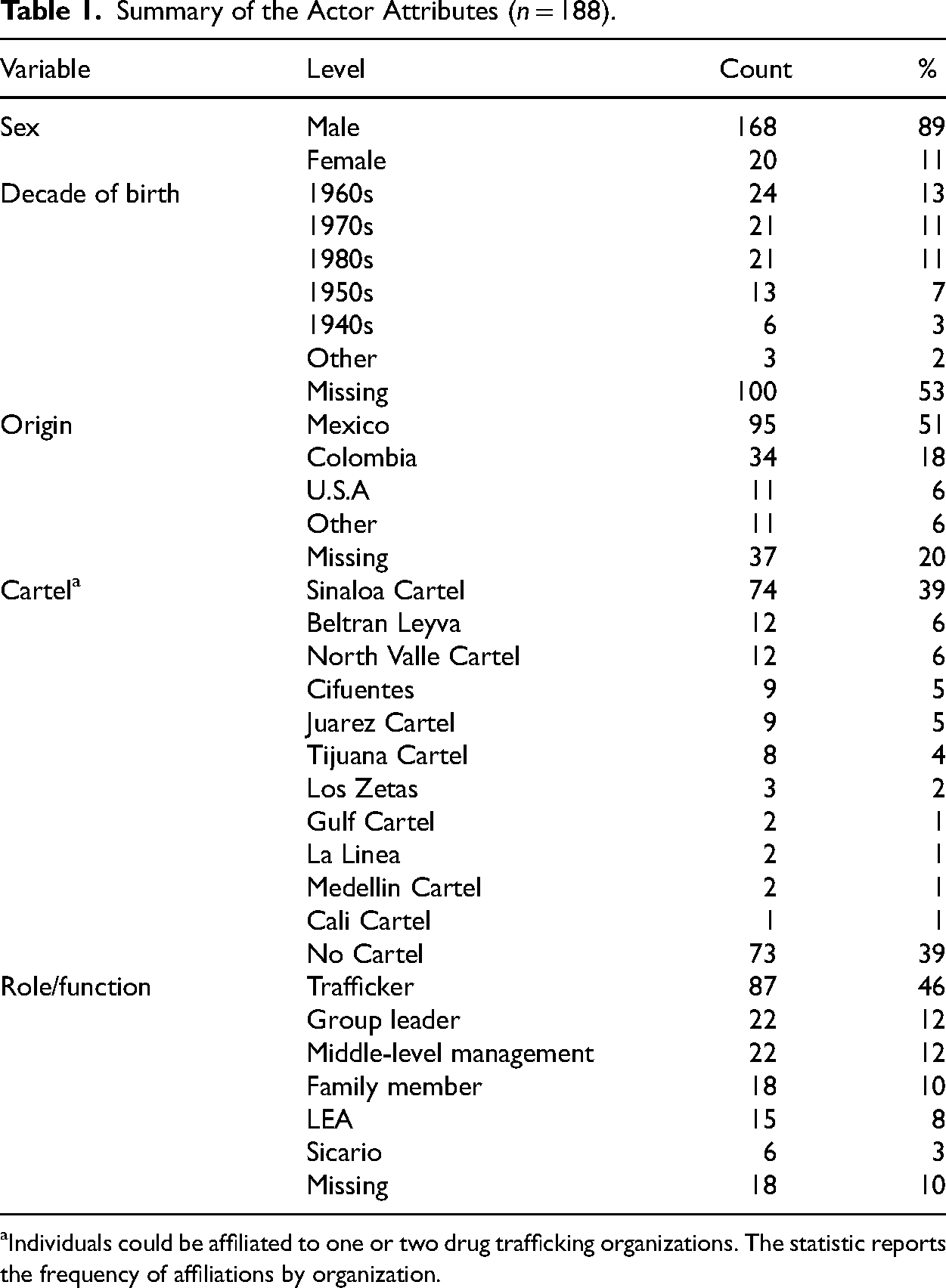
Individuals could be affiliated to one or two drug trafficking organizations. The statistic reports the frequency of affiliations by organization.
All relationships were documented as a tie list, which means they were recorded as connections between two actors. If a relationship involved more than two people, then we documented all possible actor combinations. The frequency of the recorded relationships varied significantly across types, and, except for engaging in violence against someone, all relationships were considered undirected. Overall, we identified at least one relationship for 188 actors. 3
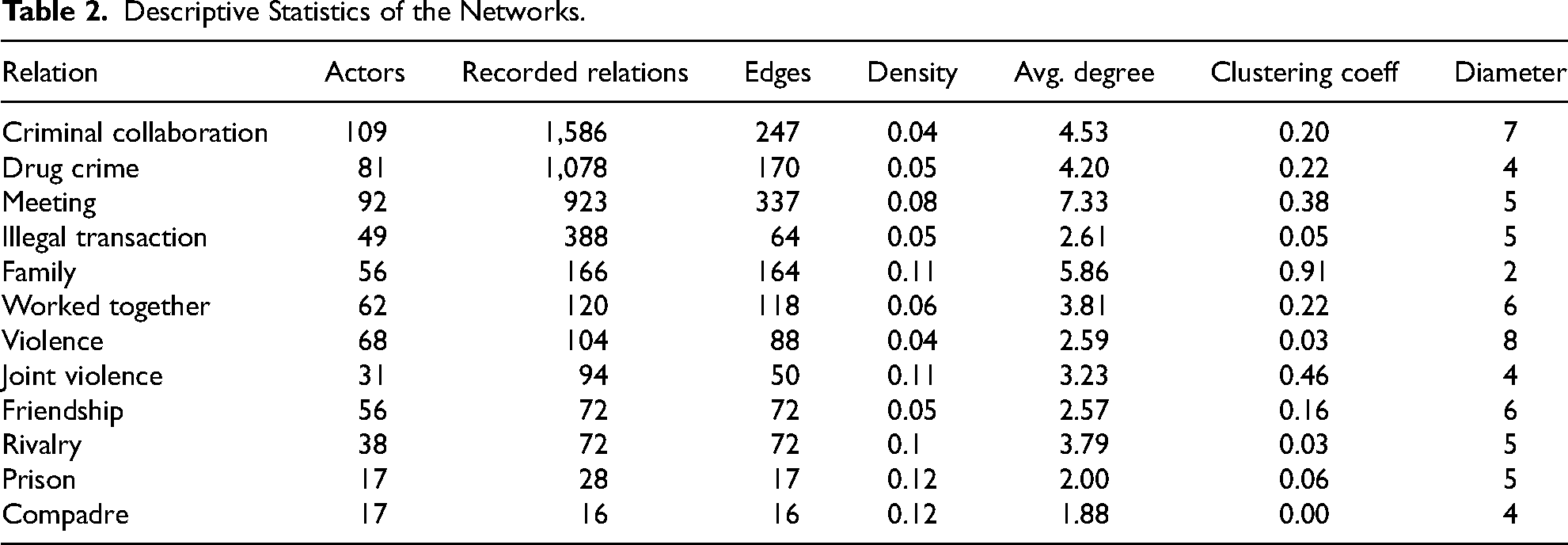
We constructed valued adjacency matrices that recorded the frequency with which two actors shared each type of relationship. Given the nature of the data sources as well as the potential bias towards a few specific individuals (such as the defendant and his closest associates), we binarized and reciprocated these matrices. This approach enabled us to capture whether any two actors shared at least one relationship, without indicating a specific direction. Additionally, we created a combined relationship category called “criminal collaboration” by merging instances of drug-related crime, illicit transactions, and collaborative activities. The matrices facilitated the analysis of binary undirected networks, each with distinct topological features and structural characteristics (Table 2 and Figure 1).
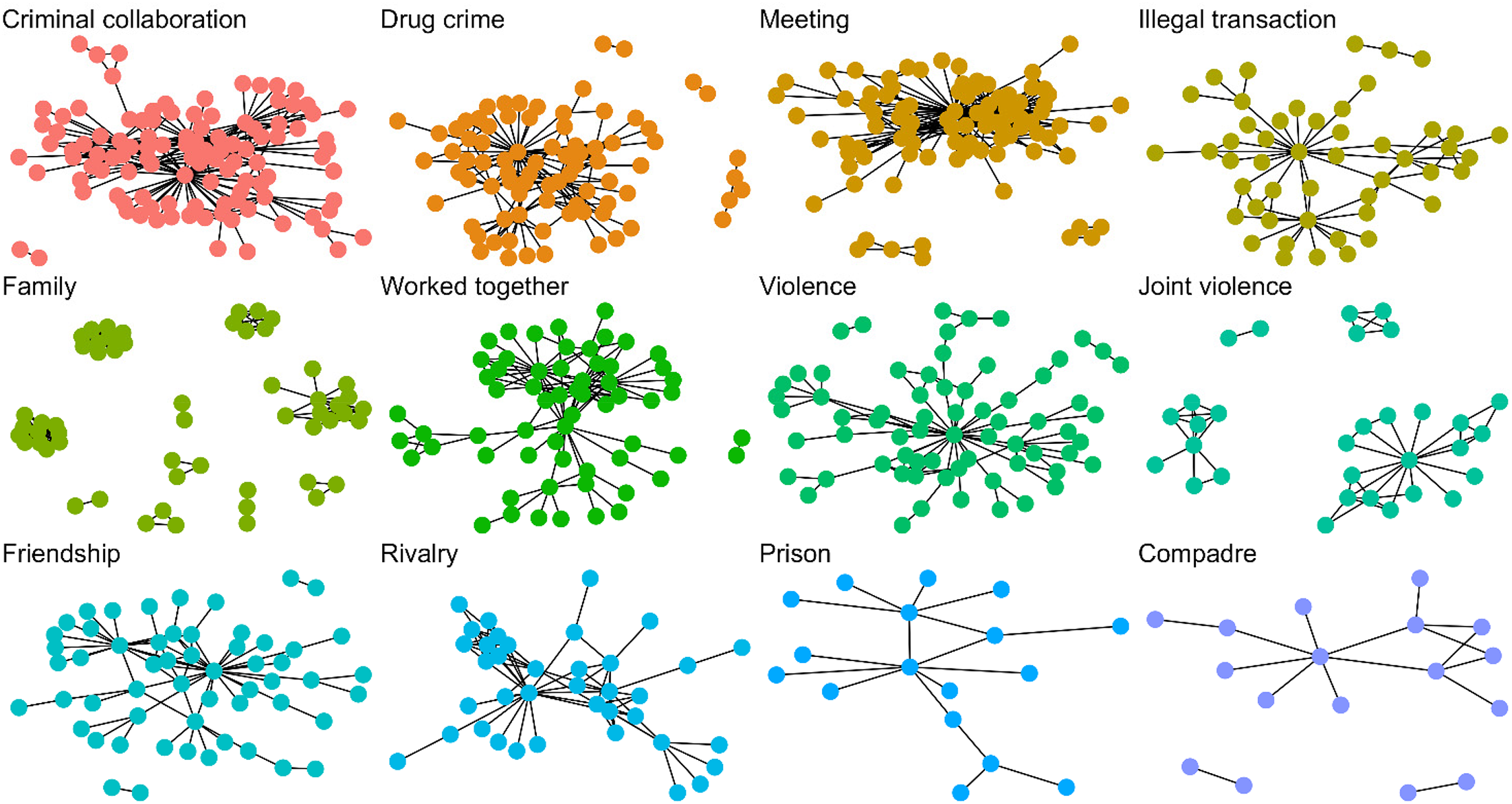
Graphs for the different networks.
Descriptive Statistics of the Networks.
The set of actors was mostly composed of men (89%), many of whom were in their forties, fifties and sixties (35%). Age was the least reliable and most difficult variable to capture, in as far as we could not ascertain the decade of birth for around half of the actors. Most actors originated from Mexico (51%), although actors from Columbia (origin of drugs) and the U.S. (destination of drugs) were also common (24%). As the trial centred around El Chapo and his connections, many of the actors (39%) were part of the Sinaloa Cartel. However, many other drug trafficking organizations were mentioned during the trial, thus highlighting the many collaborations and conflicting ties that bring these groups together. The data also stress the importance of non-affiliated actors (39%) who either facilitate the activities or try to impede them. This is consistent with other network research showing that non-affiliated actors can constitute a substantial share of criminal networks. For example, Morselli's study on Hells Angels’ involvement in drug trafficking found that up to 72% of actors were not members of biker gangs (Morselli 2009:123). Almost half of the actors were presented as traffickers of various levels. The leadership (12%) and middle-level management (12%) of drug trafficking organizations represented around a quarter of all the actors, suggesting comparable patterns of hierarchical concentration with other criminal networks. For example, Calderoni and Superchi (2019) studied four mafia networks and found that leaders made up 5–14% of members, while middle-level affiliates accounted for 6–11%.
The number of ties coded for each type varied greatly. During the trial, witnesses were primarily asked about their illicit activities in connection with El Chapo, and not so much about their rivalries, their time in prison or their friendship ties. This explains why a lot of information was collected about the drug crimes and illicit transactions, and not so much about who their compadres are. Violent ties were also surprisingly low, perhaps indicating that the prosecution focused more upon the drug crimes, and that El Chapo was too removed from the acts of violence to be connected to them directly beyond reasonable doubt.
Figure 1 and Table 2 present the topology and descriptive statistics of the different networks. They show marked differences in density, cohesion, and centralization across relationship types. Our main outcome variables, criminal collaboration and drug crime, generate large and connected networks, with over 1,000 recorded relations and average degrees around 4.5 and 4.2, respectively. Meeting ties exhibit the highest average degree (7.33) and a high clustering coefficient (0.38), indicating dense local connectivity, while family ties, though smaller in size, are highly cohesive with the highest clustering (0.91). In contrast, networks like compadre, prison, and rivalry are much smaller, sparser, and more fragmented, with lower edge counts, clustering, and average degrees. The joint violence network, while limited in scope, also shows moderate cohesion. These patterns—also visually evident in the network diagrams—underscore the substantial heterogeneity across types of ties, both in how they shape the overall connectivity and structure of the Sinaloa Cartel's relational landscape and in how they are captured and reported within the source material.
Analytical Strategy
To assess the impact of different relationships upon drug crimes and broader criminal collaboration, we conducted both descriptive and inferential analyses. The descriptive analyses encompassed not only the examination of the topological features of each of the networks reported above but also an assessment of the networks’ multiplexity. We measured the multiplexity of different relationships by calculating the Jaccard index for each pair of networks. This index quantifies the overlap between two networks, providing insights into how frequently actors share multiple types of relationships. The Jaccard index, commonly used to assess the degree of overlap between two sets, is calculated as the ratio of the intersection to the union of the two sets: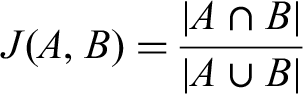
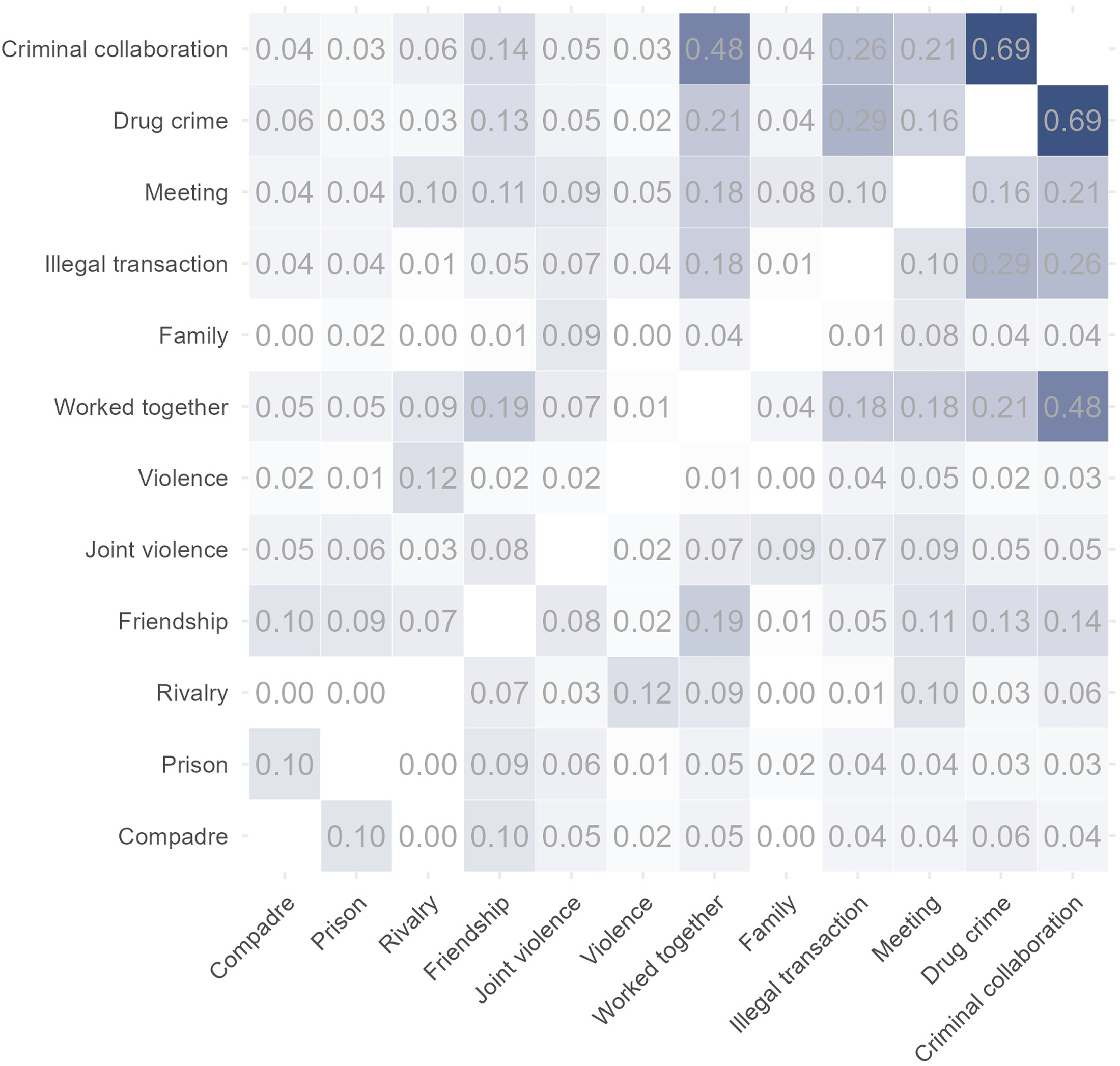
Heatmap of the Jaccard Indexes for each pair of networks.
To explore the factors influencing involvement in drug crimes and broader criminal collaboration, we conducted a series of Logistic Regression Quadratic Assignment Procedure (LRQAP) analyses. The LRQAP is a statistical method designed for analyzing relational data within networks, where observations are interdependent and non-independent by nature. Traditional regression techniques assume that observations are independent of one another. However, in network data, this assumption is violated because the presence or absence of a relationship between one pair of actors can be influenced by the relationships between other pairs. LRQAP addresses this issue by utilizing a permutation-based approach that accounts for the non-independence of network data. 4 LRQAP adapts the principles of linear regression to network data by using a matrix regression approach, where the dependent and independent variables are represented as adjacency matrices. These characteristics make LRQAP particularly well-suited for analyzing criminal networks, as evidenced by previous studies (Bichler and Norris 2024; Campana and Varese 2013; Carrington and Graham 2022; Grund and Densley 2012; Krajewski, DellaPosta and Felmlee 2022; Wippell and Haynie 2025). 5
We developed two LRQAP models to predict the most common tie type, drug crime, as well as the broader criminal collaboration network, which aggregates drug crimes, illegal transactions, and cooperative activities. We focus primarily on drug crimes as the dependent variable following both theoretical and empirical considerations. In line with the criminological literature on embeddedness, drug trafficking constitutes the most analytically meaningful and stable outcome for assessing the role of social ties in illicit economic activity. It was also the most frequently reported type of collaboration in the trial (1,078 ties), producing a denser and more balanced network for analysis. Other forms of cooperation, such as illegal transactions (388 ties) and “worked together” relations (120 ties), were mentioned less systematically and result in highly sparse networks that are less suitable for separate modelling. To account for potential measurement error and to ensure robustness, we also estimated models using a broader construct of criminal collaboration that aggregates drug crimes, illegal transactions, and cooperative activities. This allows us to test whether the observed patterns hold under a more inclusive definition of collaboration while maintaining analytical coherence.
The primary independent variables comprised the other relationship types that were not part of the criminal collaboration variable. To further account for potential confounding factors, we included variables that captured shared characteristics between actors: same sex, same nationality, same function or role within the cartels, and similar age (within ±3 years). These control variables were incorporated into the model to account for demographic and role-based homophily factors that might influence the likelihood of criminal connections independent of relational ties.
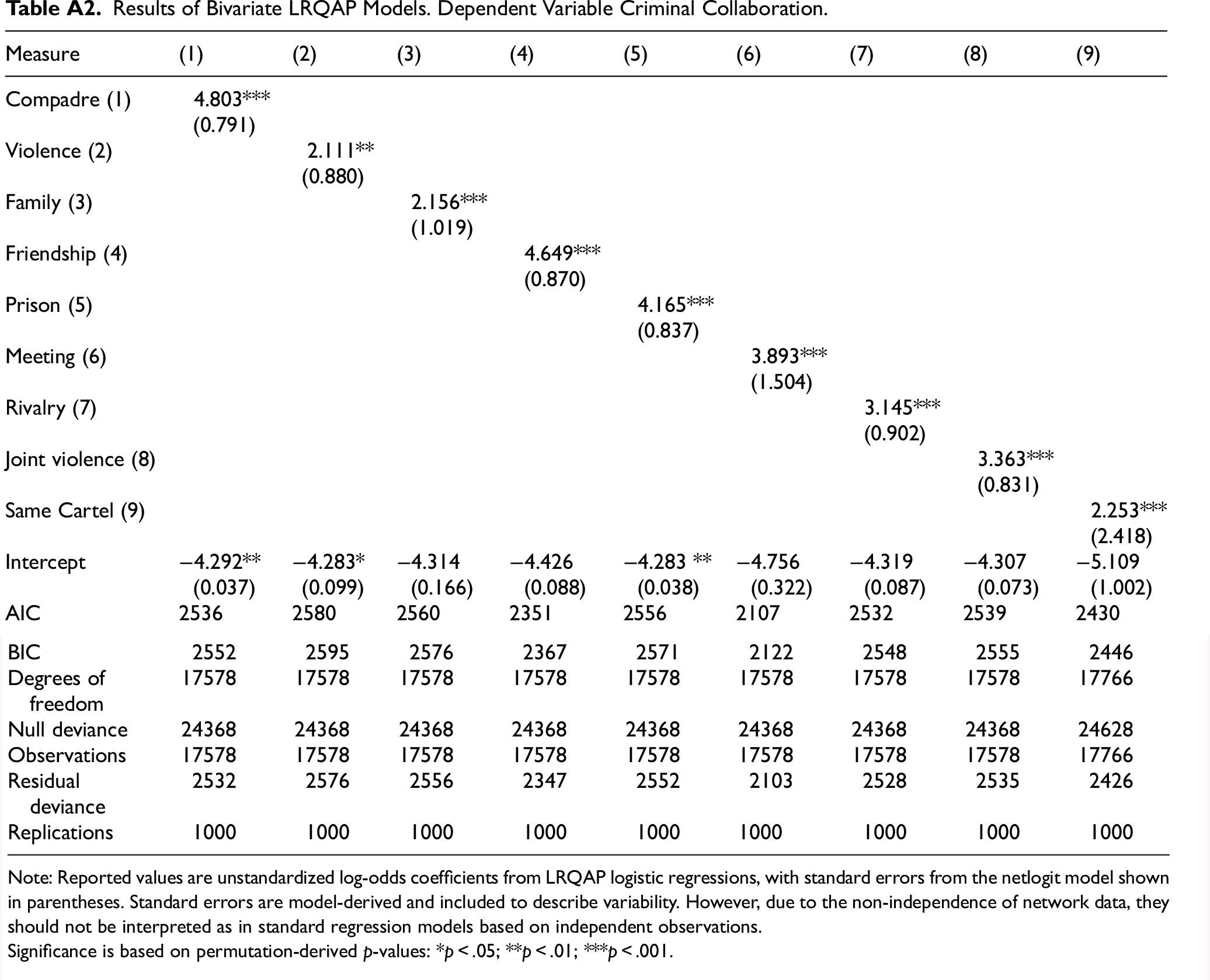
We conducted separate LRQAP analyses for each dependent variable, running 1,000 random permutations for each model to obtain robust significance levels. This permutation-based approach tested the null hypothesis that there is no association between the independent variables (relationship types and control variables) and the dependent variables (drug crime and criminal collaboration). The LRQAP analyses allowed us to determine whether actors who shared specific relationships or demographic characteristics were statistically more (or less) likely to engage in drug crimes or criminal collaborations together. In line with our focus on multiplexity, we estimated models that included multiple tie layers simultaneously, so that each coefficient reflected the contribution of a given relationship conditional on the others. 6 We first ran bivariate models, reported in the Appendix. Subsequently, we performed a step-by-step analysis in which we incorporated the independent variables in successive runs. In order, we incorporated: (1) distrust, the conflictual relationships (violence and rivalry); (2) trust relationships (compadre, family, friendship, prison, meeting, joint violence); (3) both conflictual and trust relationships; (4) same as the last, whilst controlling for same age, same country, same function and same sex and; (5) same as the last, whilst also controlling for same cartel. We interpreted the findings through each of these steps to identify when the significance and direction of the relationship changed. All analyses were conducted in R (R Core Team 2025) with packages igraph (Csárdi et al. 2024) and sna (Butts 2024).
Results
The analysis of the Jaccard Indexes revealed substantial overlap among specific networks, particularly those involving transactional and collaborative ties. For example, drug crime, illegal transaction and worked together show notable intersections, reflected in higher Jaccard values with one another. This indicates that the actors involved in these types of relationships often share multiple ties across these criminal activities. The overlap between these relations also justifies the creation of the criminal collaboration network that was obtained by merging these relations. Conversely, relationship types like family, compadre, and joint violence display lower Jaccard Index values across most of the pairings, thus suggesting that these networks are relatively distinct and less likely to co-occur with other relationship types. For example, the non-overlap between family and compadre relations was expected as godfathering relations are normally established with individuals outside of blood family. Still, the overall scores in most cases can be considered as modest or low given that they are under 0.30. This suggests that there is little overlap between the different networks that we collected, albeit this is possibly due to the context in which the data was collected.
The results of the LRQAP models with drug crimes as the dependent variable assessed the likelihood of the joint commission of drug crimes based on other social relationships (Table 3). With regards to model fit, the Akaike Information Criterion (AIC) and Bayesian Information Criterion (BIC) indicated that the fourth and fifth models provided the best fit to the data.
Results of LRQAP Models. Dependent Variable = Drug Crime.
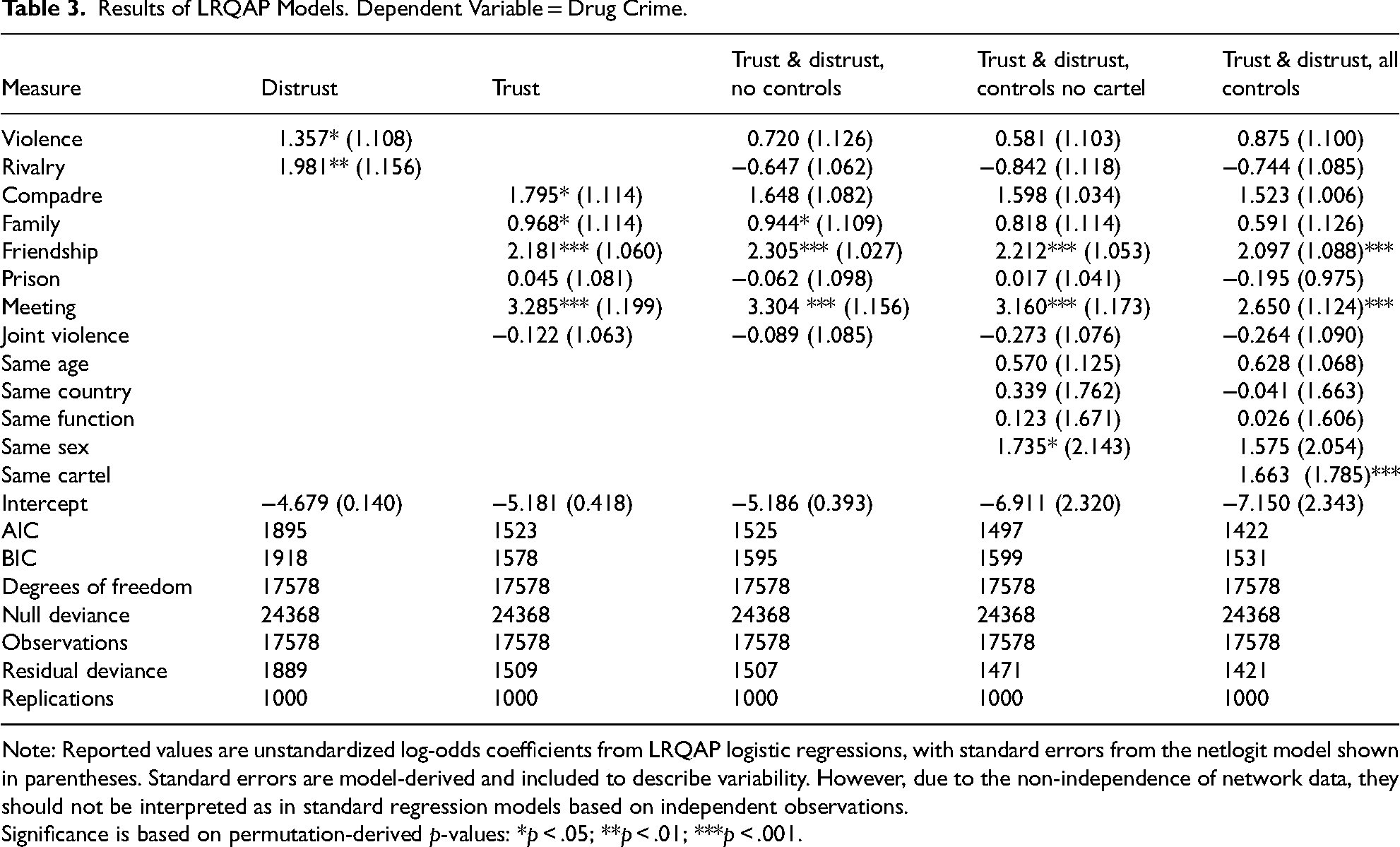
Note: Reported values are unstandardized log-odds coefficients from LRQAP logistic regressions, with standard errors from the netlogit model shown in parentheses. Standard errors are model-derived and included to describe variability. However, due to the non-independence of network data, they should not be interpreted as in standard regression models based on independent observations.
Significance is based on permutation-derived p-values: *p < .05; **p < .01; ***p < .001.
The first model showed that conflictual relationships (violence and rivalry) increased the likelihood of a drug crime tie. However, these associations disappeared in more complex models. The second model reported a positive and statistically significant association between drug crimes and compadre, family, friendship, and meeting ties, with the last two reporting the greatest effect. For instance, individuals connected through friendship ties were approximately nine times more likely (coefficient = 2.181, odds ratios, or OR = 8.85) to engage in drug crimes, whilst those with meeting ties were around 27 times more likely (coefficient = 3.285, OR = 26.76). Family ties and compadre ties also increased the likelihood of drug crimes, making individuals about 2.6 times (coefficient = 0.968, OR = 2.63) and six times (coefficient = 1.795, OR = 6.02) more likely, respectively, compared to those without such ties. However, in models 3 to 5, compadre and family relationship progressively lost their statistical significance whilst controlling for same age, country, function, sex, and cartel.
In the last and most complete model, friendship, meeting, same age, and same cartel ties best predicted drug crime ties, with all other variables not having a significant relationship with the drug crime network.
Prison ties and joint violence were not statistically significant across all the models.
The models with criminal collaboration as the dependent variable (Table 4) confirmed the results presented for drug crimes. Overall, the goodness-of-fit of these models were high, albeit slightly lower than those reported in Table 3.
Results of LRQAP Models. Dependent Variable = Criminal Collaboration.
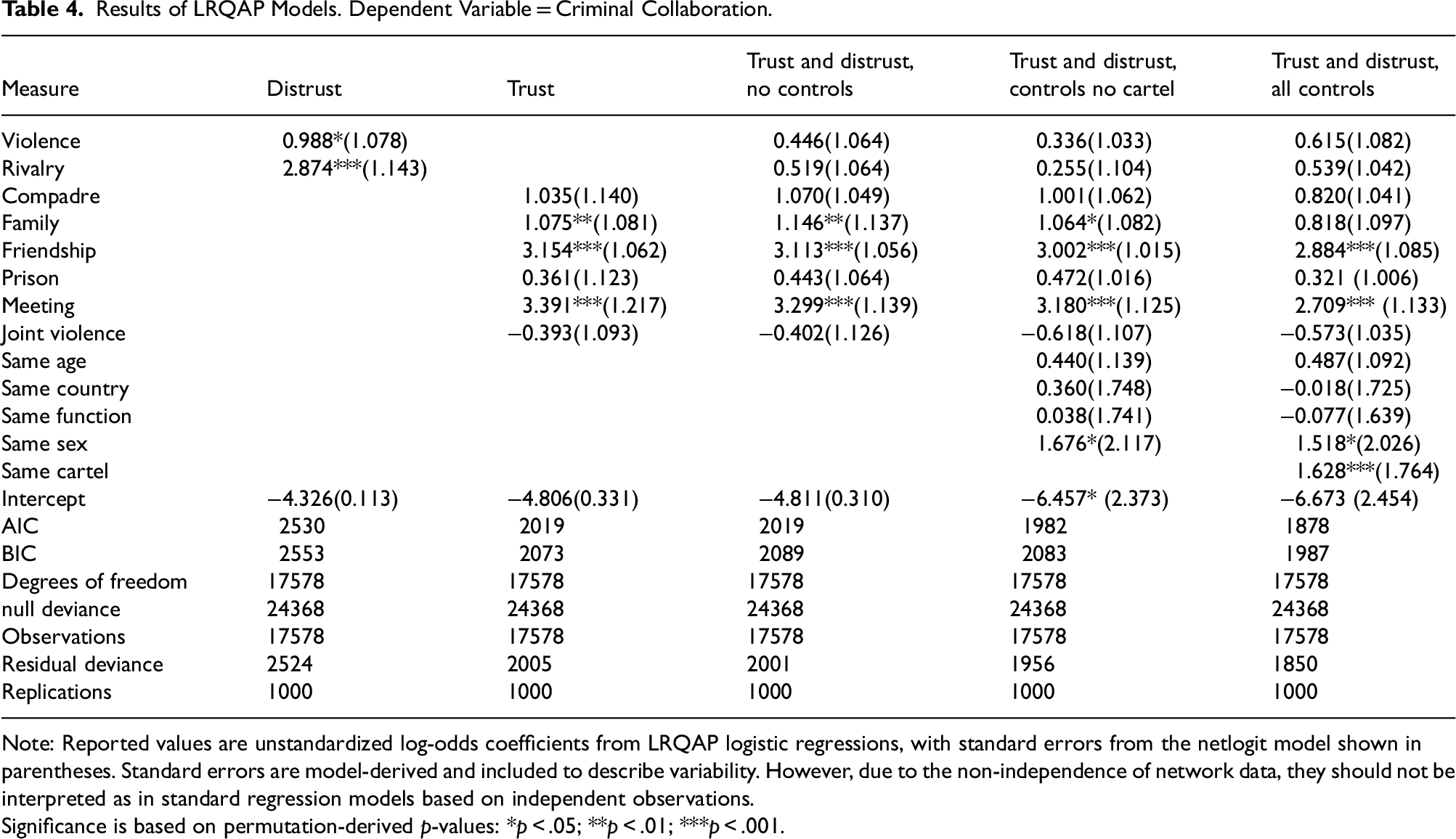
Note: Reported values are unstandardized log-odds coefficients from LRQAP logistic regressions, with standard errors from the netlogit model shown in parentheses. Standard errors are model-derived and included to describe variability. However, due to the non-independence of network data, they should not be interpreted as in standard regression models based on independent observations.
Significance is based on permutation-derived p-values: *p < .05; **p < .01; ***p < .001.
As in the previous models, distrust relationships became insignificant as the model complexity increased. Moreover, family, friendship, and meeting ties were consistently positively associated with the likelihood of a criminal collaboration tie. Friendship ties reported greater effect than in the models on drug crime alone. However, family ties lost their statistical significance in the most complex model, which included the same cartel control variable. Furthermore, prison and joint violence ties lacked significance in all the models. Contrary to the previous models, compadre relationships were never statistically significant across all the models. The final model indicated that friendship ties greatly increased the likelihood of criminal collaboration, making individuals approximately 18 times more likely to engage in such activities (coefficient = 2.913, OR = 18.4). Similarly, meeting ties were associated with a 19-fold increase in the likelihood of criminal collaboration (coefficient = 2.954, OR = 19.2). It also reported positive and statistically significant effects for same sex and same cartel.
Discussion and Conclusions
Our findings suggest that social relationships significantly increase the likelihood of both drug crime ties and broader criminal collaboration within the Sinaloa Cartel network, as reconstructed from El Chapo's trial transcripts. By modelling multiple relationships simultaneously, our analyses capture the multiplexity of actors’ connections and highlight which ties retain independent associations with collaboration. Yet not all ties exhibit the same impact t (Figure 3). Specifically, friendship and meeting relationships exhibited the strongest associations with drug-related ties, while compadre or family bonds diminished in significance once other relational and organizational factors were considered, suggesting that their effects are often absorbed by overlapping ties such as friendship or shared cartel membership. Conflictual relationships, including direct violence, similarly showed no impact on collaboration. These outcomes underscore that trust is vital in organized crime, yet different social ties may produce distinct pathways to cooperation.
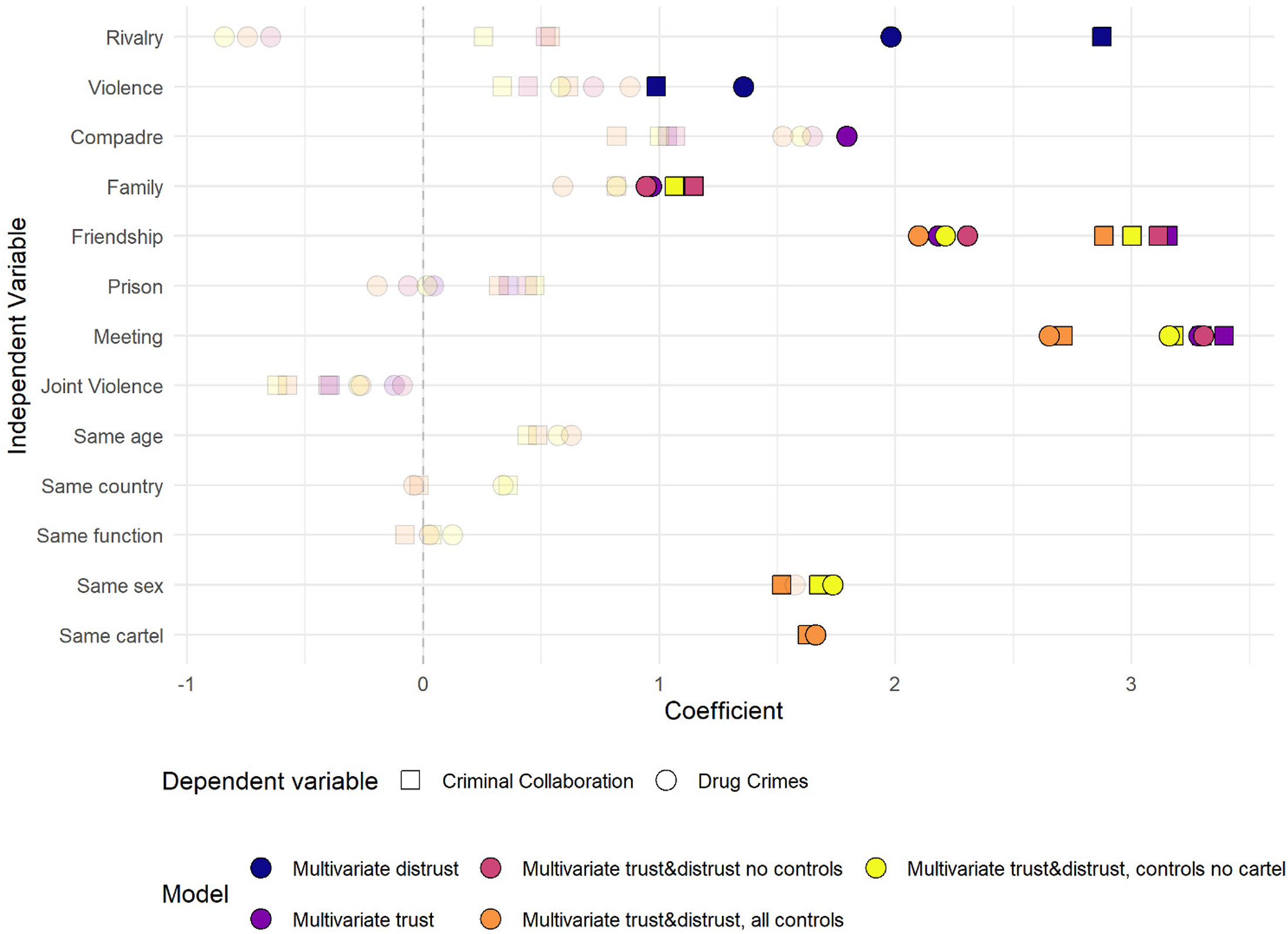
Coefficient estimates by model and dependent variable.
These results align with longstanding views on the pivotal role of trust in criminal organizations (Calderoni et al. 2020; Calderoni, Campedelli et al. 2022a; Decker and Van Winkle 1996; Ianni and Reuss-Ianni 1972; Kleemans and Van De Bunt 1999; Krebs 2002; Morselli 2003). Yet, they also highlight how certain social ties may be more effective than others in fostering collaboration within large-scale drug trafficking networks.
Friendship and meetings significantly impact the likelihood of drug crimes within the Sinaloa Cartel, aligning with studies showing economic activity rooted in social practices and relations, including organized crime (Joseph and Smith 2021). Social relations are instrumental in maintaining trust and criminal collaborations within hostile environments like those organized crime groups operate within (Campana and Varese 2013; Gambetta 1993). Meetings are often necessary and unavoidable for coordinating activities under heavy law enforcement surveillance. In large criminal organizations, social gatherings and recurring face-to-face interactions help preserve trust (Calderoni and Superchi 2019).
Family ties, although theoretically expected to bolster cooperation, showed weaker effects. This may be due to the mediating role of cartel affiliation: many males from the same blood family were affiliated with the same cartel (see Figure A1 in the Appendix), suggesting that the influence of family ties might be indirectly captured through shared cartel membership. 7 Qualitative evidence from the trial is abundant. El Chapo's brothers and sons occupied key leadership and operational roles; El Mayo Zambada's sons followed similar trajectories; and the Beltrán Leyva brothers, the Cifuentes family, and the Flores twins all exemplify how collaboration often follows familial or quasi-familial lines. As Paoli and colleagues (2023:168) note, the Sinaloa Cartel “should be understood as a loose, not formalized alliance of largely autonomous drug-selling enterprises, which are each run by the males of a blood family.” These dynamics help explain why family and compadre ties lose statistical significance once shared cartel membership is controlled for: they often signal the same organizational embeddedness. Lastly, we emphasize that the family network included a higher proportion of women (23%) than other networks (ranging between 3% and 5%). This disparity may reflect gendered patterns in the Sinaloa Cartel with women operating in critical yet less visible roles, such as financial and logistical tasks, resulting in fewer overt acts liable to prosecution and thus less ties in the drug crime network (Allum 2024; Bonello 2024; Selmini 2020).
We found weaker evidence for the roles of compadre relationships, prison, and joint violences. We suggest that the effects of these variables may have been absorbed by more general and frequently reported relations, such as meetings, friendship, and family. In particular, in the Sinaloa Cartel godparents were often chosen from friends or affiliates in the same organization. Evidence from Joaquín Guzmán Loera's trial shows compadre ties are formed between individuals who already work together (Esquivel, 2019). 8 Our findings may also reflect the sequencing of relationships: Sinaloa Cartel members often become compadres after engaging in joint criminal activities. Consequently, the positive effect of compadre relations on drug crimes in bivariate models was absorbed in multivariate models. Furthermore, we suggest that the limited impact of prison and joint violence ties may reflect the nature and scope of our data—these ties are likely underreported or underdocumented in our sources—so we urge caution in interpreting their marginal role in the models as evidence of substantive irrelevance.
With regards to the effect of co-participation in violence and kinship relations on criminal collaboration, we note that Campana and Varese found that sharing information about violence had a greater impact on the likelihood of criminal collaboration than kinship ties (Campana and Varese 2013:281–82). However, there were differences between their measure of sharing information and our measure of participating in violent actions jointly with someone. These differences testify to the complexity of interpreting the role of different social relations in fostering criminal collaborations and underscore the need for both additional studies and more granular measurements.
Our study highlights the untapped potential of trial transcripts from common law systems as rich data sources for analyzing criminal networks. Unlike civil law systems, where detailed judicial records are readily available, common-law systems rely on oral proceedings, limiting written documentation. However, extended jury trial transcripts provide detailed insights into social ties, surpassing the brevity of indictments, sentencing comments, or judge decisions used in prior studies (Bichler et al. 2019; Bichler, Norris and Ibarra 2020; Bright et al. 2012; Hughes, Bright and Chalmers 2017; Jones et al. 2018).
Our study has limitations. First, the manual data extraction process carries risks of oversight and interpretive bias, often requiring knowledge of Mexican drug trafficking and the Sinaloa Cartel. To enhance accuracy, we supplemented this process with academic and journalistic sources in Spanish and English, triangulating information on key details like birth dates, nationalities, cartel affiliations, and family ties. Multiple coders and researchers systematically checked and validated the data to ensure consistency and reliability.
Second, the adversarial nature of U.S. trials may raise concerns about the validity and reliability of the information, as most witnesses were called by the prosecution, some under cooperation agreements. However, key relationships, such as family and friendship ties, are difficult to fabricate or conceal, as they are often verifiable through multiple sources. Moreover, central issues like drug crimes and patterns of criminal collaboration were subject to rigorous scrutiny during the trial, with testimony delivered under oath, subject to cross-examination, and exposed to legal consequences for false statements. The trial's high-profile status also ensured extensive media coverage by experienced journalists, providing an additional layer of public oversight. While the possibility of errors or intentional misrepresentations cannot be entirely excluded, the consistency of the testimonies and external verification through media and legal records support the data's reliability, making it comparable to that of qualitative interviews.
Third, our data do not provide a comprehensive representation of the Sinaloa Cartel, which is impossible given its vast size and complexity. With tens of thousands of members operating across multiple countries and diverse roles—from low-level operatives to top leaders—capturing the full extent of the cartel's network is unfeasible (Paoli et al. 2023). Even well-informed criminals or law enforcement officials cannot fully account for all relationships within such an expansive structure. Moreover, mapping the Sinaloa Cartel's network would require detailed insights into its “upperworld” connections, involving individuals in legal spheres—such as bankers, lawyers, politicians, and law enforcement—who facilitate illicit activities without formal ties to the organization. Systemic deficiencies in Mexico's justice system further obscure these connections, complicating efforts to fully analyse the cartel's relational structure (Pereda 2023).
While the trial provided detailed insights, the evidence and testimonies primarily focused on “El Chapo,” highlighting his role, activities, and interactions within the Sinaloa Cartel. This defendant-centric perspective may underrepresent other key figures, regional dynamics, and the broader organizational structure. Additionally, the emphasis on Guzmán's leadership, struggles, escapes, and capture may skew the portrayal of the cartel's activities and networks toward those directly connected to him.
However, we argue that our data provides a reliable basis for examining the social structure, embeddedness, and multiplexity of a significant part of one of the largest drug trafficking organizations. The main challenge lies in the potential for false negatives—unreported relationships—rather than false positives, as the relationships documented are unlikely to have been fabricated. We believe that missing ties do not significantly affect our findings, as the trial offered extensive, often corroborated, testimony focused on Guzmán's central role, ensuring the documentation of many critical connections. Additionally, the presence of multiplex ties (e.g., family, friendship, criminal collaboration) strengthens the robustness of our analysis. Our findings align with existing research on criminal networks, highlighting well-documented dynamics such as the role of social ties in fostering trust and collaboration. Thus, even if some ties were overlooked, their absence is unlikely to alter the broader patterns observed.
In conclusion, our analyses provide four contributions. First, criminologists have expanded the concept of embeddedness to include the overlap of various social relationships within organized crime. Our findings demonstrate that multiplexity matters: by measuring both the overlap among different ties and their conditional contributions when included simultaneously in the models, we show that multiple social ties within El Chapo's network significantly influenced the likelihood of engaging in illegal economic activities. This aligns closely with the original notion of embeddedness (Joseph and Smith 2021). Second, our network-based approach to analyzing the Sinaloa Cartel offers a valuable complement to existing research focused on the effects of anti-crime strategies on Mexico's illegal markets. Various scholars have examined the outcomes of targeted enforcement measures, particularly the “kingpin strategy,” which aims to dismantle criminal organizations by capturing or killing their top leaders. A growing body of evidence suggests that this approach has been counterproductive in Mexico, often correlating with increased levels of violence (Calderón et al. 2015; Estévez-Soto and Lecona Esteban 2024; Jones 2013).
Our network perspective contributes to a broader understanding of why such strategies have failed. First, it shows that formal hierarchies and leadership titles within Mexican organized crime groups are not necessarily the glue that holds them together. Consequently, removing high-ranking individuals does not automatically sever the underlying social connections that sustain group cohesion. Second, in groups where members are linked through multiple, overlapping relationships—such as kinship, friendship, business ties, or shared rituals—targeting a single type of tie (e.g., business links) may have limited impact. Effective disruption, therefore, requires a nuanced understanding of which relational structures most strongly support cooperation within the group.
In the case of the Sinaloa Cartel, our findings indicate that interpersonal relationships—particularly friendships—and the physical spaces where these ties are cultivated and sustained play a key role in maintaining the group's internal cohesion. Identifying and monitoring these friendships and in-situ meeting points may offer a more effective strategy for disrupting the criminal networks that have emerged from the Sinaloa Cartel's fragmentation.
Third, much of the existing research on embeddedness in organized crime has relied heavily on qualitative data, which limits the ability to disentangle the effects of different relationship types and quantify their relative influence at the individual level. Our results show that specific social ties are differentially associated with the probability of criminal collaboration, which underscores that illegal economic activity is not embedded uniformly across all social relations but rather is strongly linked to certain key connections. Fourth, we have demonstrated that the transcripts from long-lasting and complex jury trials in common law jurisdictions can also serve as a valuable and underutilized source for network data collection, offering rich insights into the dynamics of organized crime.
Footnotes
Acknowledgements
All authors contributed to the overall design and writing of the article. FC and DDH conducted the analyses, while FC and VP wrote the introduction and background. FC and DDH prepared the methods section, and FC wrote the results and discussion. All authors reviewed and approved the final version of the manuscript. The authors gratefully acknowledges the contributions of Valeria Gerosa and Claire Bernandon to the data collection phase.
Declaration of Conflicting Interests
The authors declared no potential conflicts of interest with respect to the research, authorship, and/or publication of this article.
Funding
The authors received no financial support for the research, authorship, and/or publication of this article.

Notes
Author Biographies
Appendix
Results of Bivariate LRQAP Models. Dependent Variable Criminal Collaboration.
| Measure | (1) | (2) | (3) | (4) | (5) | (6) | (7) | (8) | (9) |
|---|---|---|---|---|---|---|---|---|---|
| Compadre (1) | 4.803*** (0.791) |
||||||||
| Violence (2) | 2.111** |
||||||||
| Family (3) | 2.156*** |
||||||||
| Friendship (4) | 4.649*** |
||||||||
| Prison (5) | 4.165*** |
||||||||
| Meeting (6) | 3.893*** |
||||||||
| Rivalry (7) | 3.145*** |
||||||||
| Joint violence (8) | 3.363*** |
||||||||
| Same Cartel (9) | 2.253*** |
||||||||
| Intercept | −4.292** |
−4.283* |
−4.314 |
−4.426 |
−4.283 ** |
−4.756 |
−4.319 |
−4.307 |
−5.109 |
| AIC | 2536 | 2580 | 2560 | 2351 | 2556 | 2107 | 2532 | 2539 | 2430 |
| BIC | 2552 | 2595 | 2576 | 2367 | 2571 | 2122 | 2548 | 2555 | 2446 |
| Degrees of freedom | 17578 | 17578 | 17578 | 17578 | 17578 | 17578 | 17578 | 17578 | 17766 |
| Null deviance | 24368 | 24368 | 24368 | 24368 | 24368 | 24368 | 24368 | 24368 | 24628 |
| Observations | 17578 | 17578 | 17578 | 17578 | 17578 | 17578 | 17578 | 17578 | 17766 |
| Residual deviance | 2532 | 2576 | 2556 | 2347 | 2552 | 2103 | 2528 | 2535 | 2426 |
| Replications | 1000 | 1000 | 1000 | 1000 | 1000 | 1000 | 1000 | 1000 | 1000 |
Note: Reported values are unstandardized log-odds coefficients from LRQAP logistic regressions, with standard errors from the netlogit model shown in parentheses. Standard errors are model-derived and included to describe variability. However, due to the non-independence of network data, they should not be interpreted as in standard regression models based on independent observations.
Significance is based on permutation-derived p-values: *p < .05; **p < .01; ***p < .001.