



Abstract
Objective
Police officers’ use of force (UoF) has traditionally been understood vis-à-vis subject resistance, but researchers have recently argued for a greater emphasis on subject threat. We examine the role of static and dynamic threat measures, consisting of indicators for ability, opportunity, and intent, in police UoF while accounting for subject resistance.
Data and Methods
We use data from a large multiagency sample of coded police force narratives and a series of multilevel models that nest temporally ordered force sequences (dyadic exchanges between officers and subjects) within their respective UoF incidents.
Results
Our results suggest that (1) police force incidents are dynamic with levels of force and resistance often fluctuating throughout the incident, (2) each element of subject threat significantly predicts force, net of resistance and other variables, and (3) the elements of threat interact with one another to explain force, but not completely as expected.
Conclusions
Our results suggest that subject threat, in addition to resistance, provides important insights for understanding when officers either use or escalate force. We conclude with suggestions for those interested in further exploring the intersection of threat, resistance, and police UoF.
Threat Dynamics and Police Use of Force
Police officers are allowed to use force to accomplish legitimate law enforcement goals, including securing compliance and protecting third parties, themselves, and subjects. At the same time, officers are not allowed to use force beyond what is necessary given the circumstances, nor are they permitted to use force to either “punish” or protect their reputations. An important question, then, is: What constitutes reasonable force? Force continua, in which levels of officer force are paired with levels of subject resistance, represent one prominent strategy researchers and practitioners have used to answer this question (e.g., Alpert and Dunham 1997; Garner et al. 1995; Terrill and Paoline 2012; Wolf et al. 2009). When force exceeds resistance by a wide enough margin, it may be considered excessive (e.g., Hine et al. 2018, 593).
Research suggests that officer force tends to be commensurate with subjects’ level of resistance; disproportionate use of force (UoF) is the exception rather than the rule (e.g., Terrill 2005, 123). Some scholars, however, have argued that a focus on officer force vis-à-vis subject resistance has no basis in law. As McLean, Alikhan, and Alpert (2022, 3) wrote, “considering only resistance neglects [the] totality of the circumstances and ignores factors that might indicate that force should (or should not) be used in a particular situation…” They called, instead, for a greater emphasis on subjects’ level of threat (see also McLean et al. 2019). Indeed, Stoughton, Noble, and Alpert (2020; see also, International Association of Chiefs of Police 2020) introduced a multidimensional conceptualization of subject threat, comprised of subjects’ ability to inflict harm, their willingness or intent to cause harm, and the opportunities available to cause harm. It was built, in part, on the 1989 Graham v. Connor decision in which the U.S. Supreme Court announced that claims of excessive force should be analyzed under the Fourth Amendment's reasonableness standard.
Numerous empirical studies have investigated the factors that contribute to UoF (e.g., Bazley, Lersch, and Mieczkowski 2007; Crawford and Burns 1998; Garner, Maxwell, and Heraux 2002; Gray and Parker 2019; Hine et al. 2018). Others have emphasized the relationship between subject resistance and force, both at single points (e.g., Alpert and Dunham 2000) and throughout (e.g., Terrill 2005; Tillyer 2022; Wolf et al. 2009) police encounters. However, research on the role of threat in the force context is in its infancy. In the first study of its kind, McLean, Alikhan, and Alpert (2022) employed an experimental design in which police officers viewed body camera footage and judged both the subjects’ level of resistance and threat. They found that officers were more likely to endorse UoF—and greater levels of force—against more threatening subjects. While their study was important, the field has lacked a study of threat in real force encounters. 1 How do the three dimensions of subject threat (Stoughton, Noble, and Alpert 2020) affect escalation and de-escalation throughout police-subject encounters? Answering this question will improve our understanding of the circumstances and dynamics that contribute to officers’ UoF.
We draw on a database of 11,597 quantified UoF incident narratives from 87 police departments spanning several U.S. states to investigate how subject threat (ability, opportunity, and intent) is associated with UoF in real police-subject encounters. We employ a multilevel modeling framework in which force “sequences,” the back-and-forth force/resistance interactions between police officers and subjects, are nested within their respective incidents. This strategy is different from most previous policing research which focuses on the average or maximum level of officer force used during UoF incidents. In doing so, we examine the relationship between subject threat and officer force across the sequences within an incident. Moreover, a multilevel framework lets us better account for static, incident-level characteristics (e.g., the presence of a gun, the nature of the incident) and for dynamic, sequence-level characteristics (e.g., resistance at a particular point in time).
What Makes Force “Excessive?”
Our understanding of whether force is excessive or unreasonable has been driven, in part, by a series of U.S. Supreme Court decisions. Prior to 1989, it was not clear which constitutional provisions should be used to evaluate excessive force claims. For example, in Rochin v. California (1952), the Supreme Court used a “shocks the conscience” standard, but it analyzed the officer's actions under the Due Process Clause of the Fourteenth Amendment. Then, in the 1989 Graham v. Connor decision, the U.S. Supreme Court ruled that police UoF must be evaluated via the Fourth Amendment to the U.S. constitution, particularly its prohibition against “unreasonable searches and seizures.” The question in police UoF cases is now whether the officer(s) acted in an “objectively reasonable” manner under the circumstances. This, the Court wrote, requires “a careful balancing of the nature and quality of the intrusion on the individual's…interests against the countervailing governmental interests at stake.”
Whether an officer's UoF can be considered “objectively reasonable” requires that their actions be evaluated under the “totality of circumstances,” which include the severity of the crime, whether the subject poses an immediate threat to the officer or others, and whether the subject is attempting to resist arrest or evade arrest. With these guidelines in mind, officers are not permitted to use very much force against subjects who neither pose a credible threat nor are resisting, but officers are allowed to use more force against subjects who both pose a threat and are actively resisting. Recognizing that officers often must make decisions with incomplete information and under time constraints, the Supreme Court also held that excessive force claims should be judged from the perspective of a reasonable officer on the scene—that is, from the perspective of a well-trained officer with the information available to them at the time of the incident. 2
Subject Resistance
Studies of police UoF have primarily relied on subject resistance to evaluate the appropriateness of officers’ actions (e.g., Terrill 2005; Wolf et al. 2009). Although subject resistance is sometimes used as a predictor of officer force, it is more common of late that researchers rely on force continua, and “force factor” scores derived from them (Alpert and Dunham 1997), to quantify the amount of force officers use relative to the level of subject resistance. “Force factor” scores are typically computed by standardizing both officer force and subject resistance so that the same numeric score refers to behavior of similar severity/magnitude, then subtracting the measure of subject resistance from the measure of officer force. If the difference is positive, it follows that officers used a disproportionate amount of force. Traditional force factor scores of −1, 0, and +1 are considered “commensurate,” whereas scores higher than one may be indicative of excessive force (e.g., Hine et al. 2018, 593). 3
Force continua have been adapted to account for the dynamic and sequential nature of officer-subject encounters. For example, Terrill's Resistance Force Comparative Scheme (RFCS) (Terrill 2001, 2005) considered whether the continuum was followed for each sequence in a police encounter, then with all sequences coded, a determination is made as to whether the continuum was followed “as a whole.” As Terrill described it, “[t]he underlying intent of the RFCS is to determine the extent to which officers respond to various levels of resistance with similar levels of force and whether an incremental approach is used when applying force” (p. 157). Wolf et al. (2009) proposed the “cumulative force factor,” which involved adding force factor scores across sequences (i.e., officer-subject interactions) within incidents.
Research suggests that officers are likely to escalate force as subjects become more resistant. This pattern is consistent across a variety of studies that adjust for many potential sources of confounding, including, among other things, subjects’ and officers’ demographic characteristics (e.g., gender, age, race, and ethnicity), subjects’ cognitive and emotional states, and the severity of the offenses involved (e.g., Hine et al. 2018; Johnson 2011; Kahn et al. 2017; Terrill and Mastrofski 2002). Research has also examined the commensurability of officer force (i.e., whether officers use force that is of comparable magnitude to subject's resistance). Terrill (2005), for example, found that, “…on the whole, officers rarely strayed far from the continuum, even in those cases where they did not follow it” (p. 123). Hine et al. (2018) recently reached a similar conclusion, namely that higher and lower relative force were atypical; nearly two-thirds of the incidents examined were characterized by commensurate force.
Subject Threat
Recent studies suggest threat deserves as much, or perhaps more attention than resistance when evaluating police UoF (e.g., McLean, Alikhan, and Alpert 2022; Stoughton, Noble, and Alpert 2020). Stoughton, Noble, and Alpert (2020), for example, argued that officer force should be understood in terms of the “immediacy or imminence of the threat” posed by subjects and not just their explicit use of resistance. Additionally, if police UoF is to be properly examined through the lens of the Fourth Amendment's reasonableness standard (Graham v. Connor 1989), officer force should be evaluated in terms of subject threat and the crime severity, in addition to resistance. In their view, subject resistance is an imperfect indicator of the “totality of circumstances”; although a subject's level of resistance may appear to justify force, with no immediate threat, any amount of force officers use may be considered excessive (emphasis added). 4
Interestingly, threat is not a new concept in the policing literature. Classic qualitative accounts illustrate how threat permeates officers’ decision making during police-citizen encounters. Skolnick (1966, 47–48) emphasized the role of danger and fear in encounters with citizens, and how officers may interpret some mannerisms (e.g., “manner of walking or ‘strutting’”) as communicating a threat of violence (see also, Binder and Scharf 1980). Likewise, Klinger (2004) described how subtle informational cues—the way individuals stand, the way they move, the words they speak, or the look on their faces—communicate to officers whether an encounter will become dangerous. In other words, officers use threat signals to estimate the probability that an encounter will become dangerous and thereby the extent to which intervention may be necessary (Binder and Scharf 1980; Klinger 2004; Klinger and Brunson 2009; Skolnick 1966; Sierra-Arévalo 2021).
A problem for quantitative researchers is that threat is neither self-evident nor easy to measure. Even the classic accounts just described portrayed subject threat as a somewhat amorphous and nebulous characteristic. Arguably, a subject who brandishes a firearm is more threatening than one who does not, ceteris paribus. But what of a subject who merely possesses a firearm compared to one who does not? Assessing subject threat becomes even more complicated when additional factors, such as intoxication or extreme emotionality, enter the equation. And it is almost certainly the case that these signals are highly contextualized; what signifies threat in one situation may not necessarily signify it in another. To some degree, the idea is reminiscent of the way individuals are hypothesized to weigh the anticipated costs and benefits of alternative courses of action under a rational choice framework (e.g., Becker 1968; Nagin 2013). Officers must identify various threat signals and integrate them to evaluate the immediacy of danger. They must do all of this, as the Supreme Court recognized in Graham v. Connor (1989), with incomplete information and under time constraints.
Stoughton, Noble, and Alpert (2020) recently proposed a multidimensional framework for understanding subject threat. It consists of three dimensions: (1) the subject's ability to inflict harm, (2) their overall opportunity to act, 5 and (3) their intent to cause harm. Subjects are said to have ability when they have the capacity to inflict harm. Opportunity refers to subjects’ proximity to potential victims (i.e., the officers themselves, third parties) and their capability to move about freely. For example, a subject in handcuffs has less opportunity than one who is not. Finally, Stoughton and colleagues define intent as subjects’ “…apparent desire to cause physical harm to the target or targets” (2020: 34); subjects who make violent threats communicate an intent to cause harm. Together, these three dimensions characterize a subject's level of threat, though it is not clear which of the three factors is most important, nor is it clear whether the effects are additive or interactive (though Stoughton et al. imply the effect is interactive). An additive effect suggests, for example, that subject ability has the same relationship with officer force regardless of the subject's level of intent or opportunity. In contrast, an interactive effect suggests that subject ability is only important to the extent that subjects communicate intent and/or have opportunity.
McLean, Alikhan, and Alpert (2022) were the first to empirically test Stoughton, Noble, and Alpert (2020) multidimensional conceptualization of subject threat. They presented officers with one of two body camera videos. One of the videos presented a Black male subject resisting arrest after a robbery, and the other video presented a Black male subject resisting arrest after disrupting traffic. The videos were selected to ensure it was “unclear and subject to reasonable debate” (p. 11) as to whether force should be used. They asked participants separate questions measuring the subject's ability, intent, and opportunity, then they averaged all three for a single threat measure. Finally, they asked the participants whether officers should use force, and if so, the level of force recommended. Their analyses revealed that officers’ perceptions of subject threat were positively associated with their recommendations regarding the UoF.
Although McLean, Alikhan, and Alpert (2022) provide the only empirical test of Stoughton and colleagues’ conceptualization thus far, other research provides indirect evidence for the importance of subject threat. Studies have repeatedly shown that police officers are more likely to use force, and use greater amounts of force, against subjects who possess firearms or some other form of weaponry (e.g., Crawford and Burns 1998). Officers are also more likely to use force against male subjects than female subjects (e.g., Bazley, Lersch, and Mieczkowski 2007). In addition, men tend to have greater ability to inflict harm because they are often physically stronger than women and have more fighting experience (e.g., Terrill and Mastrofski 2002). Still other evidence suggests officers attempt to gauge subjects’ violent intent. For example, in an experimental study, Taylor (2020) found that officers used more force when they were led to mistakenly believe that subjects possessed a firearm. Officers have also been found to use more force during incidents precipitated over violent offenses than nonviolent offenses (e.g., MacDonald et al. 2003). However, an important limitation of these studies is that it is not possible to directly relate them to Stoughton and colleagues’ conceptualization of subject threat; just as much as subject sex may refer to ability or capacity to cause harm, it may be correlated with differences in intentionality.
Another limitation of McLean, Alikhan, and Alpert (2022) study is that they did not account for the fact that police force encounters are complex and dynamic. In other words, they focused on the role of subject threat at one decision-making point. This shortcoming is not limited to McLean and colleagues, however. Most previous research has relied on summary measures of officer force (e.g., Tillyer 2022; Wolf et al. 2009), which capture all the variability and details of UoF incidents with singular post hoc measures, such as the level of force used at a single time point, the average level of force used throughout an encounter, or the maximum level of force used throughout an encounter. This can present problems, including equal scores for qualitatively different incidents. For example, using Wolf et al.'s (2009) cumulative force factor, the following incidents would result in the same cumulative force factor score:
A two-sequence incident in which, first, the officer used a compliance hold in response to a verbal threat (3–2 = 1), then second, the officer used a lateral vascular neck restraint in response to the subject pulling away (5–4 = 1) (cumulative force factor = 2). A one-sequence model in which an officer used deadly force in response to flight (cumulative force factor = 6–4 = 2).
Such treatments of police force encounters are sometimes inconsistent with reality. As far back as 1969, Toch found that violent police encounters typically started with verbal commands, then officers would escalate to physical force after subjects refused verbal requests, commands, and threats. Some years later, Binder and Scharf (1980) called the force encounter “…a developmental process in which successive decisions and behaviors by either police officer or civilian, or both, make a violent outcome more or less likely” (p. 111). And in 2004, Alpert and Dunham undertook one of the first attempts to “map” force sequences in the Miami-Dade Police Department, thus cementing the need for researchers to account for the multiple sequential exchanges that change and evolve over time.
One of the most advanced strategies for modeling the dynamic and sequential nature of police force encounters comes from a study conducted by Kahn et al. (2017) on the effect of subject race/ethnicity on officer UoF. Instead of using a single summary measure, they employed multilevel modeling in which sequences (i.e., police-subject interactions) were nested within their respective incidents. Additionally, they controlled for the sequence number, which allowed them to adjust for the duration of police incidents. Their analytic strategy was similar to growth curve modeling, a technique often employed in longitudinal research. Although force encounters span a much smaller timeframe than most longitudinal studies (i.e., minutes as opposed to years or decades), adopting a longitudinal framework allows researchers to examine the escalation and de-escalation of encounters as well as how previous sequences’ events contribute to the development of police force encounters.
Current Study
In this research, we examine the extent to which UoF can be explained by subjects’ level of threat and resistance. We base our measure of subject threat on Stoughton, Noble, and Alpert (2020) multidimensional conceptualization, which defines threat in terms of subjects’ ability to cause harm, their opportunity or freedom to cause harm, and their intent or willingness to cause harm. Our analyses are based on data from Police Strategies LLC, a Washington State-based company which uses “data science and technology to help police agencies implement effective policies, training programs, and accountability systems” (https://policestrategies.com).
We adapt Kahn and colleagues’ strategy to the topic of subject threat. We nest force sequences within their respective incidents to examine how officer force changes throughout force incidents resulting from incident-level and sequence-level indicators of subject threat. Incident-level indicators of threat are static signals or cues; they do not change across incidents. Whether the dispatch call was for a violent offense or for some other reason is one example. Subject age and sex are other examples. In contrast, sequence-level indicators of threat are dynamic; they do change across incidents. The extent to which subjects have the freedom to move around is one example. A subject's mobility is likely to change throughout each incident, increasing when, for example, successful flight occurs, and decreasing as officers begin to apply force. We argue that a closer consideration of static and dynamic indicators is imperative. On the one hand, although static indicators may increase the overall level of force used during an incident, they are unlikely to predict variation in force used throughout incidents. On the other hand, dynamic indicators may help to explain when and why officers increase or decrease their level of force. Our multilevel framework allows us to examine these issues. 6
Methods
Sample
The data came from 11,597 police force incident reports, 7 compiled by Police Strategies LLC as part of its work with 87 police agencies across several U.S. States from 2014 to 2018. Police Strategies’ data have been used in several recent studies of police UoF and related subjects (e.g., Hickman et al. 2021a; Hickman et al. 2021b; Strote et al. 2021). The data contain information on the circumstances surrounding incidents and their situational dynamics, such as the number of officers and subjects present, the behavior of the officers and subjects, and whether the subjects possessed any weaponry. Most important for the current research is the fact that Police Strategies separated and temporally ordered officer force and subject resistance into individual sequences (described further below). We can therefore examine how incidents developed; for example, we can compare the police officer's first action to their second action, or the subject's first action to their last action.
Coders hired and trained by Police Strategies recorded the information contained within police force reports and narratives. The training process was generally held via Zoom and included (a) an introduction and overview of Police Strategies’ codebook, which is used to quantify the force narratives and (b) several opportunities to practice coding incidents, followed by feedback and discussion. The majority of the coders were criminology/criminal justice graduate and undergraduate students in and around the cities/counties contracted with Police Strategies. Following successful completion of the training process, the coders’ first 200 to 300 incidents were closely reviewed to ensure that the narratives were quantified accurately and consistent with the Police Strategies codebook. Throughout the data collection process, the data were also routinely scanned and corrected for typos, missing information, and any other problems.
Several considerations regarding the data deserve mention. First, although the police agencies varied in their sizes and locations, they were not randomly sampled. The data therefore do not offer an accurate representation of police agencies across the United States or the states in which they are located. Our intent was not to estimate the prevalence of police force across a large geographical area, but rather to test research hypotheses with a sufficiently large sample of force reports from a reasonable number of police agencies. Nonrepresentative samples can be adequate for providing evidence for or against specific research hypotheses (e.g., Levay, Freese, and Druckman 2016; Lucas 2003; Zelditch 1969). The extent to which the results generalize to other settings or populations is a question for future research.
Second, and most importantly, the data are based on officers’ interpretation and are therefore subject to reporting problems. For example, the data for a particular incident is heavily dependent on the level of detail officers provide in their reports; whereas some officers are meticulous in their reporting, describing every specific detail on what transpired during the incident, other officers provide only a general description of what occurred. 8 In addition, the data may be subject to recollection errors, deception, and other biases (e.g., Hulse and Memon 2006; Lewinski et al. 2016; Vredeveldt and van Koppen 2016). It is unclear whether recollection error would lead officers to systematically overreport (or underreport) the subject's level of resistance. In addition, the literature suggests that recollection error can be mitigated with prompt recollection and/or report writing, a common requirement for force incident reports (e.g., Phillips et al. 2021; Porter, Ready, and Alpert 2019). Deception is perhaps a more significant problem (e.g., Barker and Carter 1990; Fisher 1993). While there are institutional mechanisms in place to encourage police report accuracy (e.g., officers sign their reports under penalty of perjury, and force incidents and reports are reviewed by supervisors and compared against body camera footage in many cases), deception and intentional misreporting still occur (e.g., Stinson 2022; for a recent example, see U.S. Department of Justice 2023). If there are negative consequences for excessive force, one may suspect that officers intentionally misreport their estimates of the subject's level of resistance as higher than what occurred. By falsely reporting that the subject was highly resistant or threatening, officers can make their UoF appear more justified.
Our data are unable to completely address misreporting (regardless of whether it is from recollection error, deception, or other response biases). This is not a problem unique to policing. Epidemiologists, political scientists, and other researchers have proposed various strategies to understand the robustness of their inferences to measurement error. We adapted one of these strategies (SIMEX; Stefanski and Cook 1995; Parveen, Moodie, and Brenner 2015) to understand the magnitude of misreporting that would be required to substantially affect our estimates and conclusions. We considered the subject's reported level of resistance as a combination of their true level of resistance and some amount of measurement error (e.g., recollection error and deception). We then re-conducted our analyses on a series of simulated datasets that increased the average amount of measurement error (i.e., officers overreported the subject's resistance by ½ level, 1 level, etc.). Our results suggest that even if officers heavily misrepresented subjects’ level of resistance (by approximately 3 levels), the direction and statistical significance of our estimates remain. We describe this analysis in detail in the Appendix.
Measures
Dependent Variable
Our dependent variable was the level of force officers used during a particular sequence. Officer force was measured on a seven-point scale: (1) verbal exchange, (2) lawful command, (3) threat of force, (4) physical control tactic, (5) physical strike or takedown, (6) less than lethal weapon, and (7) deadly force. These categories were created by Police Strategies and were informed by the legal criteria established in Graham v. Connor (1989) and in various prior UoF studies (e.g., Alpert and Dunham 1997, 2004; Hickman et al. 2015; Terrill 2001, 2003, 2005). For a force incident to be recorded in the Police Strategies database, the maximum force used throughout the incident must be at a level of 4 or higher (physical control tactic to deadly force). Although a particular sequence within an incident can have a level of force reflecting verbal exchanges, lawful commands, and the threat of force, the maximum level of force for the entire incident must be at least a physical control tactic. In addition, note that this variable represents the highest level of force used among the officers. If one officer is physically restraining the subject, but another is simultaneously physically striking him, the sequence would be scored an officer force level of 5, rather than 4. We find substantively similar results when we restrict our sample to incidents in which only a single officer used force (see Supplemental Material).
Independent Variables
Our primary independent variables concern subjects’ level of threat. Although we based our operationalization around Stoughton and colleagues’ multidimensional interpretation, their discussion of the concept was somewhat vague and suggests that the three dimensions overlap considerably. For example, per Stoughton, Noble, and Alpert (2020, 33), ability can include “the degree to which the subject has been effectively restrained,” but restraint also limits opportunity. They also list subject mental condition as an indicator of ability (e.g., a stumbling drunk is probably not as coordinated as a sober person), but ignore the influence of mental condition on intent. We point out these limitations not to critique Stoughton, Noble, and Alpert (2020), or by extension, the work of McLean, Alikhan, and Alpert (2022), but rather to illustrate the difficulty inherent in measuring each element of threat. Although we attempt to capture the essence of Stoughton and colleagues’ conceptualization, we recognize our attempt may not fully address the intricacies of each dimension.
Subject Ability was measured at the incident level using information about whether the subject was armed with a weapon or believed to be armed with a weapon during the incident. 9 Subjects who displayed or used a weapon at any point throughout the incident were treated as being armed. Coders also documented whether officers recounted in their narratives that the subject was possibly armed (i.e., the victim or witness somehow informed the officer; the officer observed from a distance an object that looked like a firearm). We treated subjects as armed if the subject was possibly armed, even if they were found to have not actually possessed a weapon. The relationship between subject threat and officer force is inherently a perceptual process—it is an officer's perceptions and working understanding of the situation that direct their decision making, not the objective facts of the situation. 10 We used additional information to describe what type of weapon the subject displayed/used or the weapon the officer thought the subject possessed. Our final variable therefore had three categories: unarmed and thought to be unarmed (reference); armed with or thought to be armed with a firearm; armed with or thought to be armed with other type of weapon. For the remainder of our paper, we describe subjects as armed if they either displayed/used a weapon or were thought to possess a weapon.
Subject Opportunity was based on an item that described the amount of control officers had over the subject during a particular sequence. When subjects are not controlled by officers, they necessarily have more opportunity and ability to resist arrest. The original officer control item was measured on a seven-point scale in which higher values referred to greater officer control. To create our measure of subject opportunity, we first reverse coded the officer control variable so that higher values refer to greater subject opportunity, specifically: (1) subject was hobbled; (2) the subject was handcuffed; (3) the subject was effectively tasered or pepper sprayed; (4) the officer had the subject pinned or multiple limbs controlled; (5) the officer had a physical hold or single limb control; (6) the subject was isolated or cornered; and (7) the subject had free movement. Second, we lagged the variable by one sequence, reasoning that the level of opportunity a subject has at the end of the previous sequence is influential for predicting subsequent force. Finally, we dichotomized the variable such that values of (5), (6), and (7) were coded with a one, while values (4) or lower were coded with a zero. 11 We considered subjects who had multiple limbs controlled as much more restrained than subjects who had, at most, only one limb controlled. For example, subjects who were merely isolated or cornered at the end of the previous sequence would be given a value of one per the coding scheme above (i.e., they can continue resisting the police officers’ commands going into the following sequence). Note that our measure of subject opportunity was coded for each of the sequences, so it could vary across the sequences within an incident.
Subject Intent was based on information about subjects’ previous level of resistance. We reason that the level that subjects resisted in the previous sequences can suggest their intent or willingness to continue resisting. Indeed, Stoughton, Noble, and Alpert (2020, 36) identified “[t]he nature of the subject's prior contacts with officers or any known violent history or known propensity for violence” as an indicator of intent, so our measure aligns with their conceptualization. The dataset coded subject resistance on a seven-point scale: (1) no resistance/verbal exchange, (2) passive resistance/noncompliance, (3) verbal threat/threatening movement, (4) physical noncompliance, (5) active physical resistance, (6) display or use of a less lethal weapon, and (7) display or use of deadly force. 12 , 13 The level of resistance at a particular numeric value was designed to closely correspond with the level of officer force at the same numeric value. This measure was coded for each of the sequences, so it varied within incidents. To capture previous resistance, we lagged the measure one sequence. For example, subjects who engaged in verbal resistance in one sequence (a value of 2) would be assigned a subject intent score of 2 for the following sequence. Put differently, if a subject verbally resists in one sequence, we take that as evidence that they have intent to resist in the next sequence.
Control Variables
We adjusted for several factors in our models to better examine the relationship between subject threat and office UoF. Most important was subject resistance at the observed sequence. Officers may use greater levels of force because subjects increase their level of resistance during a particular sequence. We used the same item that was used to capture subject intentionality to capture subject resistance, but, unlike subject intentionality, subject resistance was not lagged. 14
Sequence number refers to the specific timing of the observation during the incident (i.e., the first police-subject exchange was coded as 1, and the second police-subject exchange was coded as 2). Coders were trained to record a new sequence whenever either the level of officer force or subject resistance changed; for example, an officer and subject who are exchanging threats of force/resistance for half an hour would be treated as the same sequence until either the officer or subject changes their behavior. While pilot testing their coding system, Police Strategies found that only a minority of force incidents (less than 10 percent) exceeded six sequences. They made the decision to record a maximum of six dyadic exchanges. If an incident exceeded six sequences, only the most significant changes were recorded.
The remaining control variables were measured at the incident level and could not vary across the sequences within an incident. Dispatch type was treated as series of dummy variables and refers to the type of call that the officer originally observed or was dispatched for. The data allowed for a variety of incident-types, including violence-related, mental health/substance use-incidents (hereafter, wellness checks), property-related, warrant-related, and drug-related incidents, as well as disturbances/suspicious activity, and traffic/minor infractions. If there were multiple call types for a particular incident, the coders were instructed to record the most serious one. For example, if an incident involved stealing a vehicle and assaulting the driver, only the violent call type would be recorded. We simplify the measure: violence-related incidents, mental health or intoxicated-related incidents, and incidents for any other reason (reference). In sensitivity analyses, we used the original, more comprehensive measure. We found similar results (see Supplemental Material).
Number of officers was measured using information about the number of police officers present during the incident. The number of officers varied considerably across the incidents, from one officer all the way up to 100 officers, but 93 percent of incidents had at most five police officers present. We find similar results when we censored the variable at five officers and used a measure of the number of officers who used force (see Supplemental Material).
We also adjusted for a series of subject characteristics. Subject gender was measured as a dichotomous variable: male subject (reference) versus female subject. Subject race/ethnicity were measured with a series of dummy variables: non-Hispanic White (reference), Black, Hispanic, and other race/ethnicity. Subject age was a continuous variable. Finally, subject intoxication was a dichotomous indicator that described whether the subject was under the influence at the time of the incident. Subject intoxication was measured at the incident level, and therefore did not vary across sequences. It is important to reiterate that, because our data come from the information provided in incident reports, these variables are based on the officers’ perceptions. Officers may sometimes be inaccurate, which introduces measurement error and causes our estimates to be biased. We incorporate these variables in an attempt to adjust for potential sources of bias.
With our multilevel modeling approach, it was necessary to include two aggregate variables in the model: incident-level subject intentionality and incident-level subject opportunity were measured by computing each incident's mean across all their realized sequences. 15 This strategy is common in studies of multilevel modeling (e.g., Gelman and Hill 2006; Raudenbush and Bryk 2002). In longitudinal criminological studies, for example, it allows researchers to separate the effect of emotional traits (overall average for a person) from variability in emotional states (wave-specific observations). It is an important step because it allows us to separate within-incident and between-incident variation, which mitigates concerns about ecological fallacies (i.e., drawing conclusions about lower-level units from higher-level units).
Analytic Strategy
We begin with descriptive statistics. Next, we present a figure that depicts the different trajectories of officer force and subject resistance throughout incidents. We then use linear mixed-effects models, nesting officer-subject exchange sequences within their respective incidents to examine the relationship between officer force, subject threat, and subject resistance. 16
The level-1 equation consisted of variables at the sequence level. It was specified as:


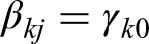
Our measure of subject ability, whether the subject possessed any weaponry, was measured at the incident level. Many of our control variables were also measured at the incident level, including subjects’ sex, race/ethnicity, and age.
We adopt a centering within cluster approach (CWC) for both subject intent and subject opportunity. We subtract the incident-level average from the sequence-level values (i.e., subject intent ij – subject intent j ). The centered variables are interpreted as deviations from the incident average; for example, the subject intent coefficient is interpreted as the change associated with a one unit increase from the incident's average. The coefficients associated with aggregations of each variable are interpreted as between-incident relationships. We use CWC because our primary focus is on variables and statistical interactions involving variables at the sequence-level (i.e., the Level-1; Enders and Tofighi 2007).
Our description of the multivariable results is organized as follows. We first examine the independent associations that subject ability, opportunity, and intentionality have with officer force. We then consider the three-way statistical interaction between weapon possession (our measure of subject ability), subject opportunity, and subject intent. This analysis empirically tests whether officers use more force against subjects who have greater ability, opportunity, and/or intent. The logic is that subjects may not be considered a threat if they do not have the opportunity to act, regardless of their willingness or ability to inflict harm. In theory, such subjects are those who pose the greatest threat to police officers. When we examine the statistical interaction, we plot and present the predicted values to make interpreting the interaction easier. Data preparation was performed in R and analyses were performed with R and Stata 17.0.
The complete dataset was comprised of 11,597 incidents of police UoF, but because we use lagged independent variables to measure subject opportunity and intent, we removed incidents that lasted for only a single sequence (668 incidents). We focus on incidents in which there was only one subject who resisted arrested, and therefore removed those with multiple resisting subjects (877 incidents). We finally removed sequences with missing data on either the dependent or the independent variables (1,138 sequences). A total of 449 incidents were removed because all of their sequences had missingness. Most of the missingness was in the subject age and subject race/ethnicity variables. 17 Our final sample consisted of 9,603 incidents with 26,532 sequences. The incidents in our sample lasted for an average of 3.77 sequences (SD = 1.35).
Results
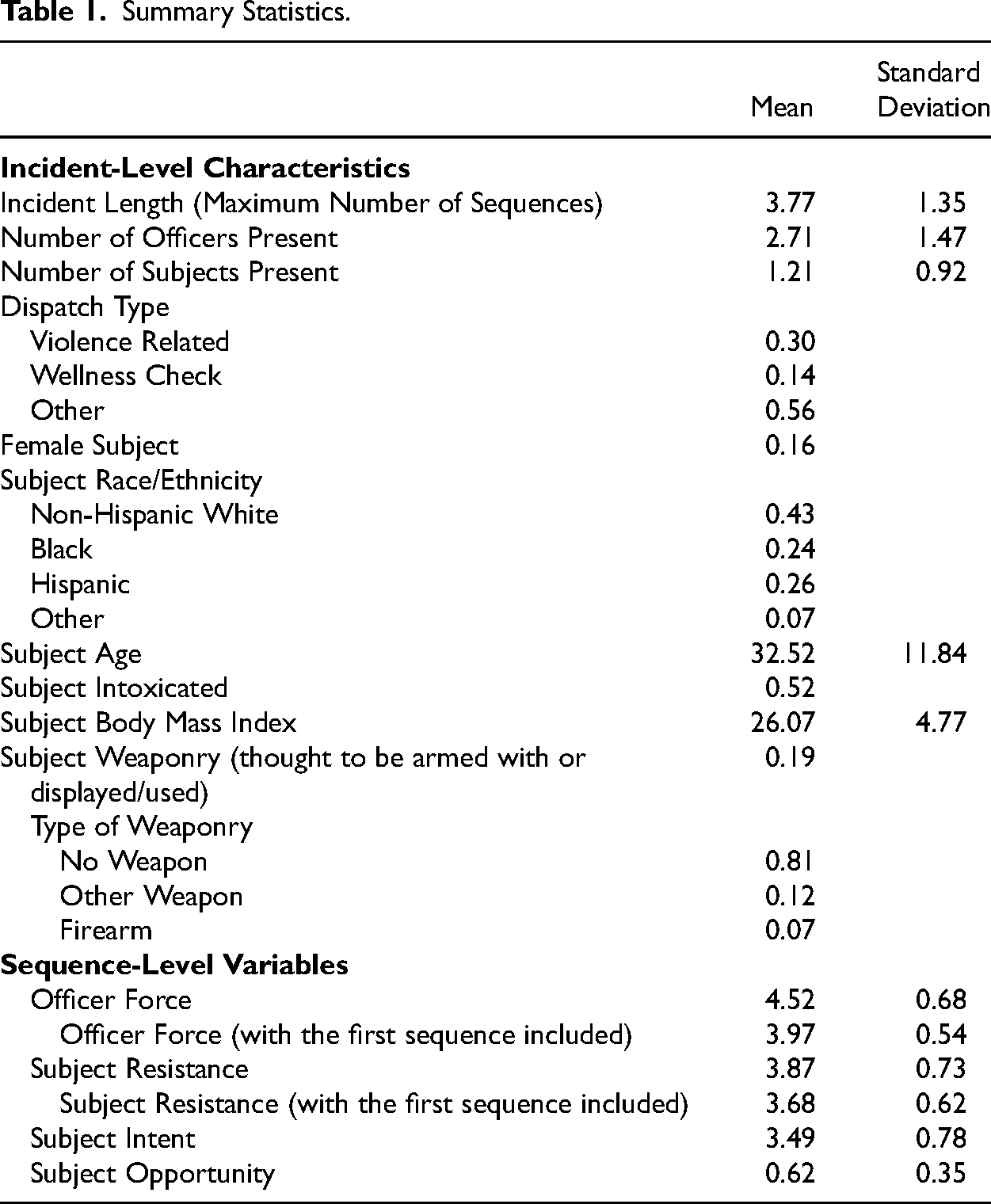
Descriptive statistics are presented in Table 1. The table first presents the statistics for incident-level variables. Most subjects were male (84%) and non-Hispanic White (43%). Police were responding to violent calls in about a third of the incidents (30%) and to mental distress or intoxication calls in just over an eighth of the incidents (14%). Subjects were armed (or believed to be armed) with a weapon in about 19 percent of incidents. The table then presents the statistics for the sequence-level variables. These values were calculated by averaging the values within each incident and then averaging across the incidents. When we do not drop the first sequence and consider all the sequences, it appears that officers and subjects used behaviors of similar severities (3.97 and 3.68, respectively). These values are equivalent to physical control tactics for officers and somewhere between verbal threat and physical noncompliance for subjects. When we remove the first sequence, we find that officers used somewhat higher levels of force than subjects (4.52 and 3.87, respectively). Subjects had the opportunity to act on their threats in about 62 percent of the sequences.
Summary Statistics.
There is considerable variation in how force incidents develop. We attempt to illustrate some of the various ways that incidents developed in Figure 1. We present three examples of how incidents with a cumulative force factor of +1 (the modal force factor in our data) developed. The bold line in Panel A depicts the most common trajectory for incidents with a cumulative force factor of +1. The modal trajectory contained three sequences, beginning with minor officer force and subject resistance (i.e., lawful commands and passive resistance) and ending with physical strikes/takedowns and physical noncompliance. Despite being the most common trajectory, this trajectory only represented about 7.7 percent of incidents with a cumulative force factor of +1. Panel B presents an incident with the same overall force factor but that unfolded over six sequences (the maximum number of sequences). There is very little variability within this trajectory; officers tended to use physical control tactics and subjects were physically noncompliant. The final panel of Figure 1 depicts the incident with the greatest amount of variation in sequence-level force factor scores, yet an overall force factor of +1. Unlike the previous trajectory, which was characterized by relatively uniform levels of force and resistance, the force factors associated with this trajectory vary wildly—a force factor of −2 in the first sequence and +3 in the second sequence.
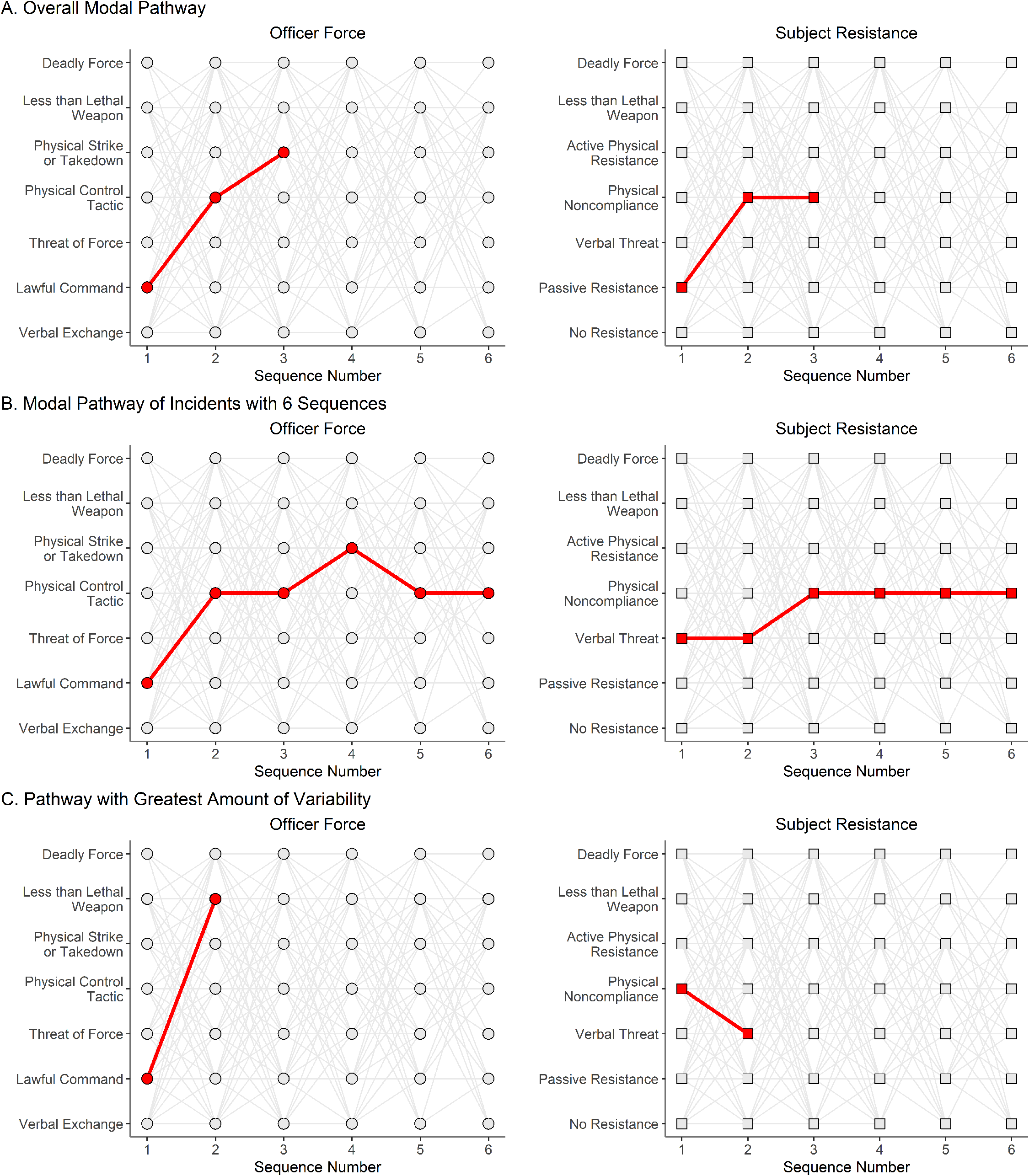
The development of officer force and subject resistance during incidents with a cumulative force factor of +1. The figure depicts three examples of the ways in which the incidents with a cumulative force factor of +1 in our data developed. Cumulative force factor was calculated by summing the difference between the subject's level of resistance and the officer's level of force at each sequence of the incident. For example, cumulative force factor in the first panel is calculated with the following equation:
Multivariable Analysis
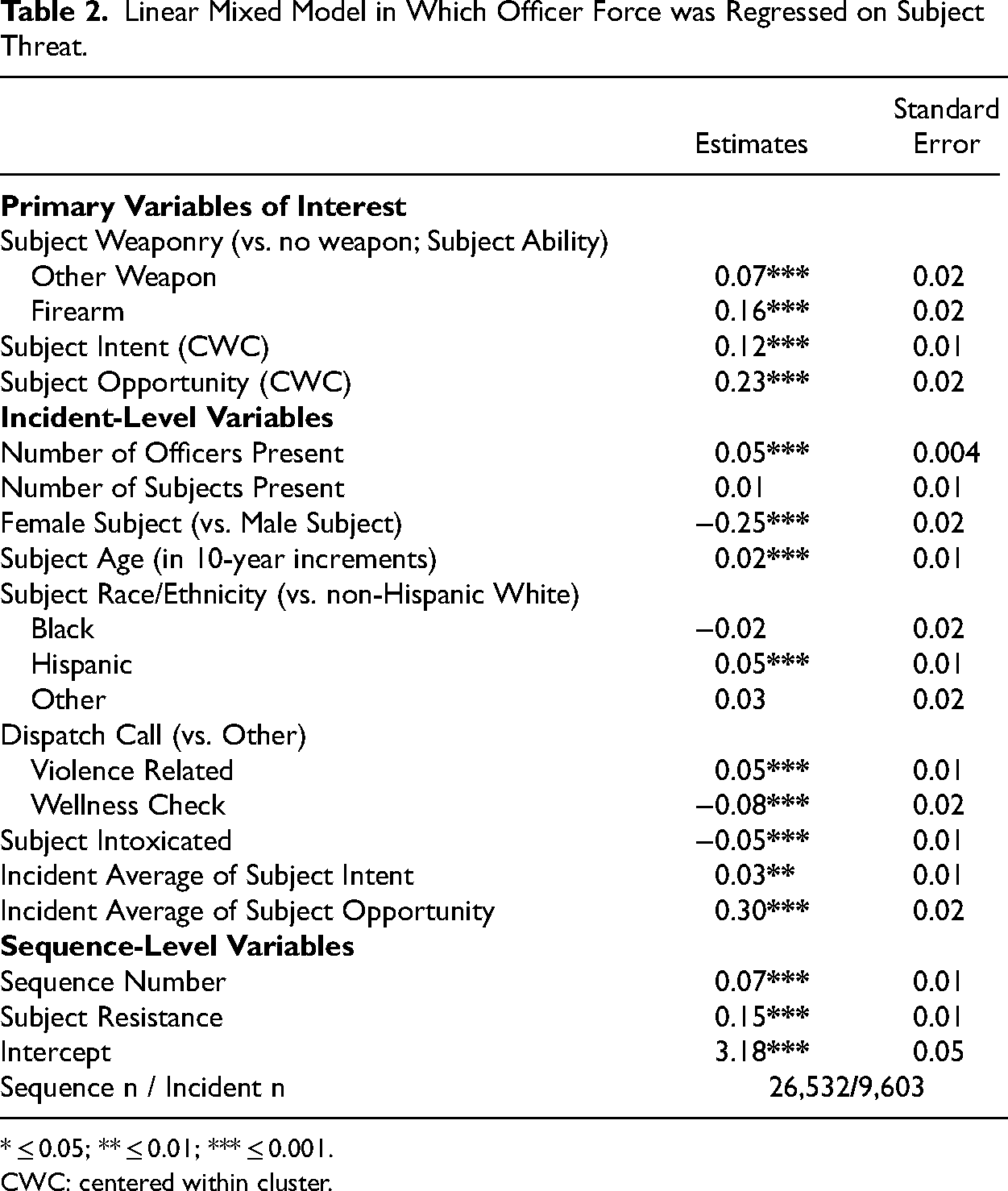
We display the results from our multilevel linear models in Table 2. These results concern the additive relationships between officer force and each of the three measures of subject threat. The model includes each of the control variables described above. Our results suggest that contemporaneous subject resistance is positively associated with officer force (b = 0.15, p < 0.001). When subjects are more resistant during a particular sequence, police officers use more force during that sequence. This finding is consistent with the broader police UoF literature (see above).
Linear Mixed Model in Which Officer Force was Regressed on Subject Threat.
* ≤ 0.05; ** ≤ 0.01; *** ≤ 0.001.
CWC: centered within cluster.
Subject resistance is not the only predictor of officer force, however. We find that officers use greater levels of force during incidents in which the subject is armed with a weapon (i.e., when the subject has greater ability to inflict harm). Police officers use 0.16 more units of force against subjects with a firearm compared to subjects with no weaponry (p < 0.001). They use 0.07 greater force against subjects who are armed with some other weapon (p < 0.001). Note that this latter category includes a combination of different weapons, such as knives, motor vehicles, hammers, and bottles, so it is not entirely clear how to interpret the dangerousness of this category. We also find support for the dynamic, sequence-level measures of subject opportunity and intent. Officers used 0.12 greater force for every unit of subject intent above the incident's average (p < 0.001). Officers used 0.23 more units of force during sequences where subjects had greater opportunity to move around compared to the incident's average (p < 0.001).
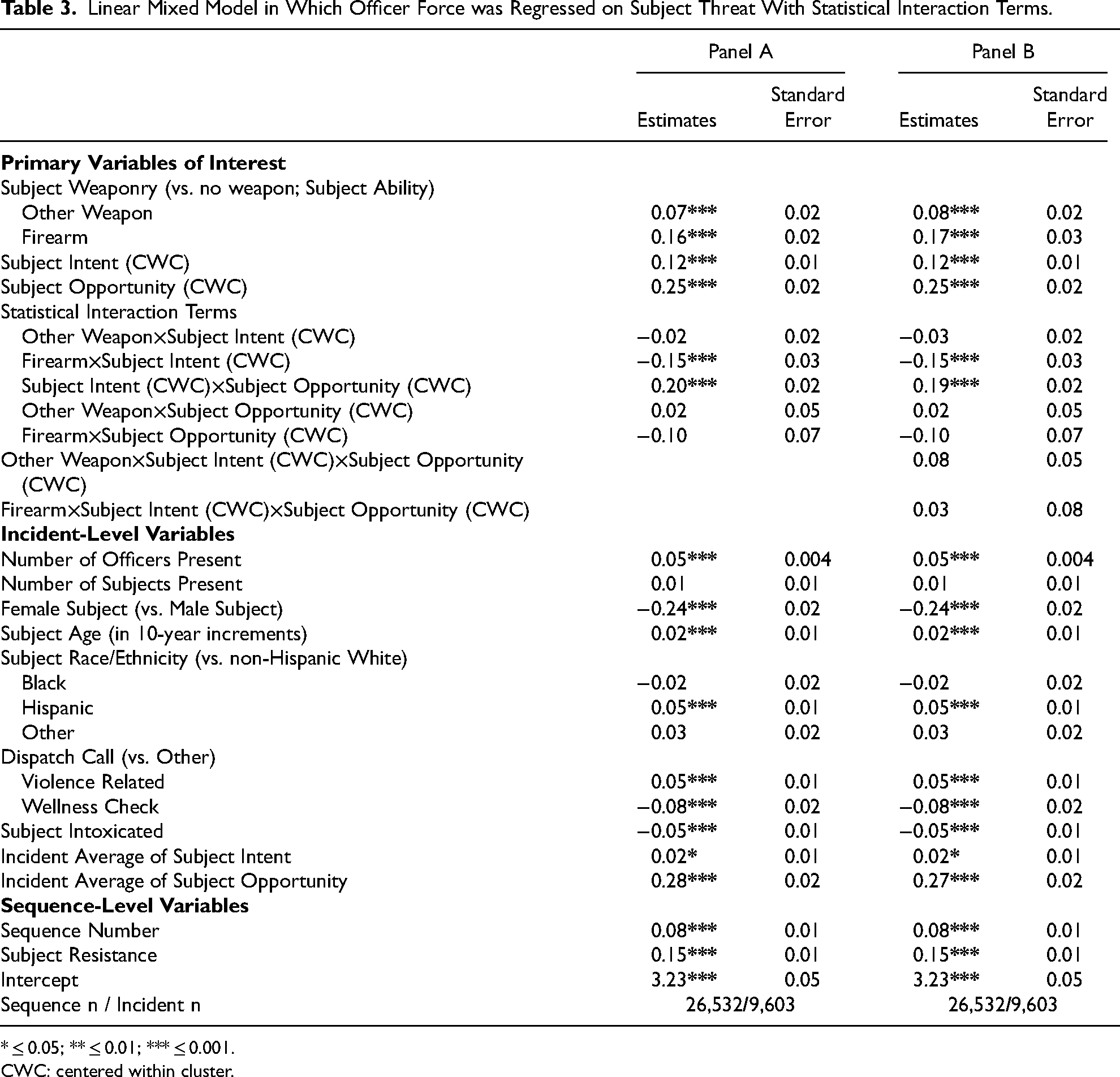
The results presented in Table 2 are consistent with our hypotheses. They suggest that each of the three subject threat dimensions is associated with greater levels of officer force. Recall, however, that we posited that the effects of subject ability, opportunity, and intent on officer force may be interactive rather than additive. Subjects who have greater ability, opportunity, and intent, are arguably the ones who should pose the greatest threat to police officers. If subjects do not have the opportunity to act, they may not be considered a threat even if they demonstrate the ability or intent to inflict harm or resist arrest. 18 This logic suggests a statistical interaction between subject ability, opportunity, and intent. We empirically examined this issue by estimating models that incorporated statistical interaction terms between the dimensions of subject threat. We present the results from these analyses in Table 3. Panel A contains the results from the model that incorporated each of the two-way statistical interaction terms (e.g., the interaction between subject intent and subject opportunity). Panel B contains the results from the model with the three-way interaction. The models adjusted for the control variables described above.
Linear Mixed Model in Which Officer Force was Regressed on Subject Threat With Statistical Interaction Terms.
* ≤ 0.05; ** ≤ 0.01; *** ≤ 0.001.
CWC: centered within cluster.
We focus our discussion on panel A because we do not find evidence for the three-way statistical interaction between subject ability, opportunity, and intent (p > 0.05). The results in panel A suggest that the effects of subject intent depend both on the subject's level of opportunity (p < 0.001) and whether they are thought to have a firearm (as opposed to some other weapon or no weapon; p < 0.001). To facilitate our interpretation, we plot the predicted values of officer force from both the statistical interactions in Figure 2. We hold the variables (other than the ones specified) constant. Panel A depicts the statistical interaction between subject intent and opportunity. Panel B depicts the interaction between subject intent and weaponry.
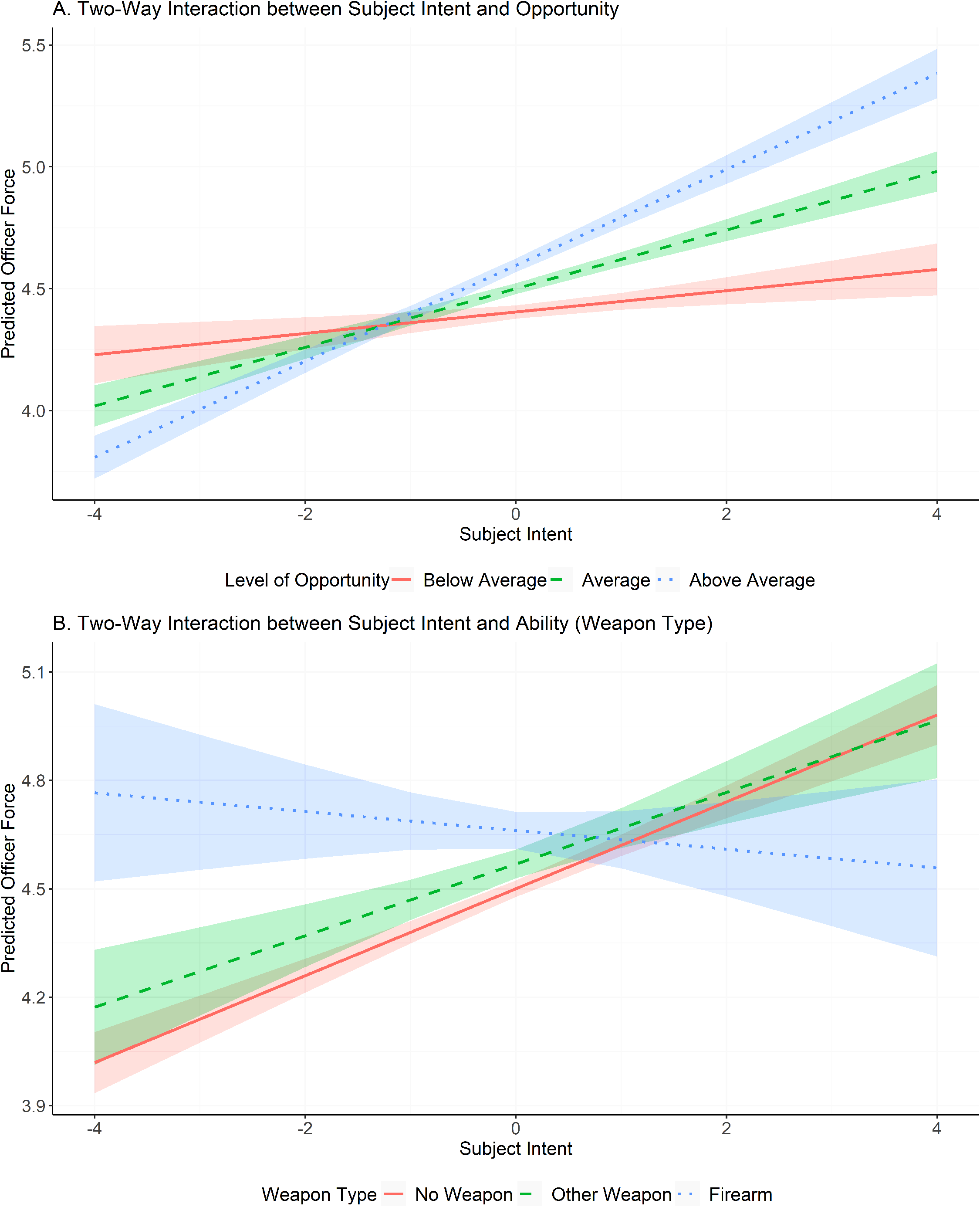
Two-way statistical interactions between subject intent and subject opportunity and subject intent and subject ability.
The results in panel A provide some evidence for our hypotheses. Within an incident, officers use greater levels of force during sequences when subjects show greater intentionality. However, the relationship is stronger during sequences when the subject has a greater relative opportunity. The results in panel B are not generally consistent with our hypotheses. When the subject did not have a firearm (either no weapon at all or some other weapon), we find that an increase in subject intent above the incident average is associated with higher levels of officer force. However, when the subject possessed a firearm, there was not a significant association between subject intent and officer force.
Our analyses also suggest that many of our control variables are associated with officer force. Officers, for example, use greater levels of force during incidents in which the subject has a greater amount of opportunity (b = 0.28, p < 0.001) and had a greater intent (b = 0.02, p < 0.05). Officers also use somewhat greater force during later sequences than in earlier sequences (b = 0.08; p < 0.001). Officers use lower levels of force against female subjects than male subjects (b = −0.24; p < 0.001). They used more force during incidents with a violent dispatch call as opposed to other types of call (b = 0.05, p < 0.001).
Subject Body Mass Index as an Indicator of Ability
Weapons, particularly firearms, are sometimes referred to as “equalizers” (Kleck and McElrath 1991; Tedeschi and Felson 1994). They can offset size disparities, allowing weaker individuals to overcome stronger individuals. Most incidents in our data did not involve weaponry; either the officers did not think the subject was armed or the subject did not display or use a weapon. When there are no weapons, a subject's physical strength and size may serve as an indicator of their level of threat. We consider this possibility in a series of supplemental analyses. We used data about the subjects’ height and weight to calculate their body mass index (BMI). We divided the subject's weight (in pounds) by the square of their height (in inches) and then multiplied the quotient by 703. 19 We then limited our sample to incidents where the subject was not armed (or thought to be armed) and re-estimated each of our models. We present these analyses in the Supplemental Material. The results from the additive model suggest that subject BMI is positively related to officer force; for every ten unit increase in body mass index, officer force is estimated to increase by about 0.05 (p < 0.001). We do not, however, find evidence for either the two-way interactions that incorporate subject body mass or the three-way statistical interaction (p > 0.05). Note that the statistical interaction between subject intent and opportunity remains statistically significant in the models with the two-way interaction terms.
Differences Between Incidents With a Single Sequence and Incidents With Multiple Sequences
One shortcoming of our analytic approach and measuring subject intent and opportunity using lagged variables is that the first sequence from every incident was removed from our analysis, and, as a result, any incident that lasted only a single sequence was eliminated. Almost six percent of incidents in our original dataset lasted only a single sequence. Our results may not generalize to these types of incidents if incidents comprised of multiple sequences differ dramatically from incidents with a single sequence.
We present the summary statistics for single-sequence incidents alongside the summary statistics for multisequence incidents in the Supplemental Material. Our objective is to understand some of the similarities and differences between these two types of incidents. We observe that the average level of officer force is higher in single-sequence incidents than in multisequence incidents (4.85 vs. 3.97, respectively). The average level of subject resistance is more comparable (3.61 vs. 3.68). A greater proportion of subjects are intoxicated in multisequence incidents than in single-sequence incidents (52 percent vs. 37 percent). Finally, there is a similar representation of subjects who are armed or thought to be armed with a weapon.
Discussion
Most of the prior research evaluating police UoF has emphasized subject resistance over nearly all other considerations (e.g., Terrill 2005; Tillyer 2022). Force continua, the force factor (Alpert and Dunham 1997), and recent modifications to the force factor (e.g., Wolf et al. 2009) further emphasize the centrality of subject resistance. Only recently have some researchers pointed out the flaws of this approach (e.g., McLean et al. 2019, 2022; Stoughton, Noble, and Alpert 2020). They argue that subject resistance does not capture the complexities of police-subject encounters, and that there may be situations where the amount that subjects resist officers does not correspond with their overall level of threat or dangerousness. They also argue that an emphasis on subject resistance is at odds with the U.S. Supreme Court's 1989 Graham v. Connor decision, which emphasized, the “totality of circumstances.” In this research, we used a multilevel framework to examine the relationships that subject threat and resistance have with officer UoF. Our framework allowed us to account for the complexity of police force encounters. It also allowed us to conceptualize subject threat as both a static and dynamic characteristic.
Several key findings emerged from our study. First, our research further demonstrates the fact that police UoF encounters are dynamic. In Figure 1, we observe that incidents with the same cumulative force factor could develop in dramatically different ways. Some incidents show similar intensity throughout the entire event (second row of plots in Figure 1). Others start off minor (i.e., minimal resistance and minimal force) and then escalate to higher levels of resistance or force (first row in Figure 1).
Second, our multivariate analyses suggest that while resistance is important, it is not the “be-all and end-all” for understanding officers’ UoF. Indeed, our analyses suggest that each of the three dimensions articulated by Stoughton and colleagues are important. Moreover, each is associated with officer force while controlling for resistance and other important theoretically derived predictors. Variations in subject intent and opportunity at the sequence level were associated with officer force across sequences. In addition, variations in subject ability and average subject intent and opportunity at the incident level were associated with officer force across incidents.
Third, although we did not find evidence of a three-way interaction, we found some evidence that the dimensions of subject threat may be dependent on one another. Officers, for example, used more force against subjects when they demonstrated greater intent, but especially when they had the opportunity to resist (panel A of Figure 2). When subjects were either unarmed or armed with a different weapon, officers used more force against subjects who showed greater intent. When subjects were armed with a firearm, however, officers used a consistent level of force irrespective of the subjects’ level of intent (panel B of Figure 2). The dangerousness of firearms appears to supersede subjects’ intentionality. We might have expected a similar, albeit weaker, pattern for any weaponry, but the category is comprised of weapons of differing dangerousness/lethality. Future research should further explore the interaction of the different dimensions of subject threat. Perhaps our variables and analytic strategy were not precise and sensitive enough to capture the complexities of UoF encounters where deadly force occurs. Future research should also explore whether subject threat has a nonlinear relationship with officer force. For example, perhaps officers use similar levels of force against subjects with nonlethal and lethal weapons, but much greater force against subjects who actively resist compared to physical noncompliance.
Subject Threat and Coercive Power
Our study is situated in the policing literature, but it is important to note that our results are consistent with the broader literature on aggression and interpersonal conflict. This literature views aggression as the result of a decision-making process in which the costs and benefits of aggression are weighed against those of alternative courses of action. One important input in this decision-making process is the adversary's coercive power—their physiological features, such as body size and mass; psychological features, such as daringness and boldness; and other features, such as fighting experience and weaponry (Archer and Benson 2008; Tedeschi and Felson 1994; Felson 2023). There is evidence that individuals are more likely to use weapons and allies against more powerful adversaries (Felson and Hullenaar 2021; Felson and Pare 2010 Felson and Messner 1996). Research also shows that individuals increase their aggression against more powerful adversaries or against adversaries that are expected to resist/retaliate (e.g., Luckenbill 1982; Jacobs, Topalli, and Wright 2000; Felson and Hullenaar 2021; Felson and Messner 1996; Benard, Berg, and Mize 2017). We find a similar pattern for police officers and their UoF—they use greater force against subjects who are armed with weapons, demonstrate an intention to resist, and have the opportunity to resist. It appears that people—both police officers and everyday individuals—are responsive to their adversaries’ dangerousness and formidability, resorting to greater levels of aggression when confronting powerful adversaries. Of course, it is important not to ignore the ways in which policing and officer–subject interactions are distinctive from ordinary interpersonal conflicts. Police officers are tasked with obtaining subjects’ compliance and are permitted to use force to accomplish this task. They do not necessarily have the privilege to deescalate or backdown from threatening subjects. As a result, the number and breadth of available behaviors from which officers can choose are constrained. The decision making of officers may, at least in some ways, be similar to the decision making of individuals confronted with a lesser-of-two-evils situation; when people expect greater costs for nonaggression than aggression, they may view aggression and conflict escalation as their only reasonable choice. This phenomenon has been documented in the behavior of bank robbers and suspects pulled over by the police (see Whichard and Felson 2016; Letkemann 1973). Future research would benefit from referring to the literature on aggression and interpersonal conflict for insight. This literature may provide insights into how officers may assess the threat and dangerousness of subjects (e.g., Sell et al. 2009; Durkee, Goetz, and Lukaszewski 2018), how officers make decisions under heightened arousal and ambiguity (e.g., Van Gelder et al. 2013; Barnum and Solomon 2019), and how individual differences between police officers may influence the decision-making process (e.g., Tuente, Bogaerts, and Veling 2019). Translating this literature to the unique social context of policing and officer decision making will be a challenging but beneficial endeavor for future research.
Limitations
Our study is not without limitations. The first and most obvious limitation concerns the fact that the dataset was built on incidents in which officers used force at least once throughout the incident. For a report to have been written about an incident (and therefore included in our data), at least physical control tactics must have been used (i.e., the maximum force used must have been at a level of 4 or higher). It is important to note that agencies can vary somewhat in their definition of officer force, and as a result, in which types of incidents require a force incident report. Some agencies, for example, may have a lower threshold for what level of physical force constitutes officer force, while other agencies have a higher threshold. The data thus do not include incidents that only amounted to verbal exchanges, lawful commands, and threats of force. Our analysis is therefore conditioned on the dependent variable, and we are unable to generalize our results to incidents where officers did not use force (or a force level below physical control tactics). It may be that the factors that lead officers to use force are distinct from the factors that lead them to escalate/deescalate their level of force. Future research should examine this possibility.
Second, we acknowledged in our description of the Police Strategies data some of the limitations inherent to data based on officers’ incident reports and narratives. The literature demonstrates that police officers possess varying idiosyncrasies and biases in how they interpret, react to, and ultimately report about their force encounters (see above). Police officers may learn from their own experiences and from their colleagues about what constitutes the appropriate UoF. They may focus their narrative on more severe uses of force and resistance, but neglect to provide as detailed of information on lower levels of officer force (i.e., verbal exchanges and lawful commands) because these actions are not considered to be as important for force incident reports. Officers may “play up” (and at an extreme, completely fabricate) the amount that subjects resisted and their overall threat in order to make their own force appear justified. These processes would ultimately lead officers’ reports about the incident to be inaccurate. Our sensitivity analysis suggests that our conclusions are quite robust to misreporting/deviations (see the Appendix), but the issue of misreporting requires further empirical consideration.
Our third and fourth limitations concern the measurement of subject threat. It was necessary for us to strike a balance between Stoughton, Noble, and Alpert (2020) conceptualization and our data. The Police Strategies data did not contain all possible static and dynamic indicators of threat (arguably, no data set contains such information). Because the data do not contain an adequate indicator of subject ability at the sequence level, for instance, we relied on indicators at the incident level (subject weaponry and body mass index). In addition, we used a one-sequence lag of subject resistance as an indicator of intent, because the data do not contain an express intent measure. Future research should consider other indicators of subject threat. Subject intent, for example, may be ascertained from body camera footage based on the subject's mannerisms and/or the content of the officer and subject's communications (Rho et al. 2023).
Our measurement of subject threat is more objective than subjective/perceptual. Although incident reports (and the reported levels of subject resistance) are based on officers’ interpretations of the incident (see also Hickman et al. 2015), their primary purpose is to document the incident and its development. This is potentially problematic because subject threat is ultimately determined by the officer and their perceptions. During an incident, officers must assess the threat level of subjects, and they must often make these assessments quickly and with incomplete information. Previous research suggests that police officers come to rely on a perceptual shorthand based on stereotypes and their previous experiences to deal with uncertainties (e.g., Tillyer and Hartley 2010; Klinger 2004; Ishoy and Dabney 2017; Skolnick 1966; see also Tedeschi and Felson 1994, and Steffensmeier, Ulmer and Kramer 1998). Officers may overestimate a subject's level of threat (and therefore use greater force) because of their perceptual shorthand. Stereotypes about the dangerousness and criminality of Black individuals, for example, may lead officers to perceive greater threat from Black subjects than White subjects, even when their behaviors are equivalent (Correll et al. 2014; Correll et al. 2002; Devine and Elliot 1995). An important area for future research is to examine whether police officers interpret subject threat differently and/or rely on different social cues and signals for subjects from different demographic groups. Another direction for future research is to examine the accuracy of officers’ perceptions and situational assessments. There is recent evidence that suggests officer force is viewed more positively against Black youth than White youth, at least in part, because Black youth are often mistakenly perceived as older and more adult-like (Perillo et al. 2023; Goff et al. 2014; but see, Cooke and Halberstadt 2021).
Conclusion
Police UoF research is important and timely. A full grasp of its correlates and predictors informs both policing research and policy. Subject resistance has been regarded as the foremost predictor of force, but a growing number of scholars have called for a greater consideration of subject threat (e.g., McLean et al. 2019; McLean, Alikhan, and Alpert 2022; Stoughton, Noble, and Alpert 2020). Before police departments plunge headlong into a threat-based “totality of circumstances” force policy approach, it is critical to ascertain the extent to which both resistance and threat matter in actual force encounters. Only one study has previously examined the role of subject threat, and it used an experimental approach and asked participants whether force should be used and, if so, how much of it (McLean, Alikhan, and Alpert 2022).
Our study examined the effects of subject threat on UoF across sequences in actual police incidents. It represents a small but important step to understanding subject threat as a predictor of UoF. Additional research is needed. Researchers should draw from the research on aggression and interpersonal conflict to advance the concept and measurement of subject threat. In addition, at present, most policing data focuses on subject resistance and officer force. Police researchers and police agencies would both benefit from requiring officers to expressly report their perceptions of the subject's level of threat at multiple points during the encounter. It would be particularly useful to complement officers’ incident reports with body camera footage for a more thorough understanding of the subject's level of threat. Only then will we be able to fully grasp just how important threat is in officers’ decision to use force.
Supplemental Material
sj-docx-1-jrc-10.1177_00224278231194711 - Supplemental material for Threat Dynamics and Police Use of Force
Supplemental material, sj-docx-1-jrc-10.1177_00224278231194711 for Threat Dynamics and Police Use of Force by Andrew T. Krajewski, John L. Worrall and Robert M. Scales in Journal of Research in Crime and Delinquency
Footnotes
Acknowledgments
The authors would like to thank Geoffrey Alpert, Kyle McLean, Michael Smith, Seth Stoughton, and Rob Tillyer for their comments and constructive feedback on an earlier version of this article.
Declaration of Conflicting Interests
The author(s) declared no potential conflicts of interest with respect to the research, authorship, and/or publication of this article.
Funding
The author(s) received no financial support for the research, authorship, and/or publication of this article.

Notes
Supplemental Material
Supplemental material for this article is available online.
Author Biographies
Appendix
The data from Police Strategies LLC are based on officer force incident reports and, as a result, may be subject to recollection errors, deception, and other reporting biases. If present, these biases would mean our data inaccurately describe force incidents. We conducted a sensitivity analysis to understand how misreporting of varying magnitudes would affect our results. We describe this analysis in this Appendix.
We begin by assuming that an officer's description of a subject's level of resistance is an imperfect indicator of their true level of resistance:
Other academic disciplines have carefully examined the consequences of measurement error and have developed strategies to account for it. We draw on one straightforward and widely implemented approach, the simulation extrapolation (SIMEX) method. The SIMEX method involves creating pseudo-datasets with successively greater amounts of measurement error; re-estimating the model within each pseudo-dataset; and then using the estimates to extrapolate to the case without measurement error (Stefanski and Cook 1995; see also, Apanasovich, Carroll, and Maity 2009; Guolo 2008).
The SIMEX method was initially developed for measurement error with a mean of zero. If officers are attempting to justify their use of force, we think that it is more reasonable to expect that officers will systematically overreport the amount that subjects resisted. This would suggest that the mean of the measurement error (δi) is not zero, but some value greater than zero. We rely on the work of Parveen, Moodie, and Brenner (2015, 2017), who adapted the SIMEX method to account for non-zero mean measurement error.
It is important to note that the SIMEX method requires knowledge about the distribution of the measurement error. When the distribution is incorrectly specified, the extrapolation process cannot adequately correct for measurement error. The use of force literature does not provide reasonable values for the mean and variance of officers’ misreporting. We therefore do not attempt extrapolation and focus instead on what our estimates would be given increasing amounts of measurement error.
In our sensitivity analysis, we generated pseudo-datasets that increased the average amount that officers overreported subjects’ level of resistance and then re-estimated our model and examined how our coefficients were affected. Drawing from Parveen, Moodie, and Brenner (2015), we added measurement error to the subject resistance variable with the following formula:
We made two modifications to the formula created by Parveen, Moodie, and Brenner (2015). First, Parveen and colleagues indexed
We examined how our estimates would be affected if officers overreported subject resistance from an average (
We present a summary of the results in the two tables that follow. The first table presents the average estimate at each value of average measurement error (
In the figures, the y-axis describes the average coefficient size across each of the 1,000 generated pseudo-datasets, and the x-axis refers to the true amount of average measurement error (
Combined, the table and the figures suggest that although some of our coefficients would be attenuated, the overall pattern would be substantively similar. If officers overstated respondents’ resistance by an average of 3, the subject intent coefficient would weaken from 0.12 to 0.03. Each of the subject intent coefficients remains in the same direction and almost all maintain their statistical significance. The one exception is when the average measurement error is set to 3—about 98 percent of the p-values are ≤0.05. Misreporting of this magnitude is quite extreme; for example, it would be as if officers reported that the subject used deadly force (value of 7) when the subject only exhibited physical noncompliance (value of 4). We also observe attenuation for subject opportunity, thought to a lesser degree.
It is important to recognize that our sensitivity analysis involves several assumptions about the nature of the measurement error. We assumed that a subject's reported level of resistance is based on their true level of resistance, and the that the error was additive rather than multiplicative. Our analysis also only considered how measurement error in one of the variables (subject resistance) would affect our conclusions. Officers may falsely describe details about the incident. We also assume that every officer has the same overreporting tendency. It may be that misreporting is more prevalent among some officers and not others. Perhaps officers with a history of use of force overstate the subject's level of resistance, but officers without a history make accurate reports. Our sensitivity analysis therefore cannot eliminate concerns about measurement error, merely evaluate the robustness of our inferences. In summary, our analysis suggests that our conclusions are quite robust to officers falsely claiming that subjects were highly resistant. Future research should further explore the issue of misreporting in officer incident reports.
References
Supplementary Material
Please find the following supplemental material available below.
For Open Access articles published under a Creative Commons License, all supplemental material carries the same license as the article it is associated with.
For non-Open Access articles published, all supplemental material carries a non-exclusive license, and permission requests for re-use of supplemental material or any part of supplemental material shall be sent directly to the copyright owner as specified in the copyright notice associated with the article.
