




Abstract
Objectives: Judgments about police procedural fairness consistently have a stronger influence on how the public ascribes legitimacy to the police than evaluations of police effectiveness. What remains largely underexplored, however, is the potential moderating effect of procedural justice on the relationship between effectiveness and legitimacy and whether this moderation varies by citizen race. Method: We administered two separate surveys to determine whether procedural justice's moderating effect on the relationship between police ineffectiveness and legitimacy varies by citizen race. The first was a mail survey of a random sample of citizens in a southern US city (N = 1,681) conducted in 2013; the second, a national survey of adults (N = 972) administered via Qualtrics in 2022. Results: We found that procedural justice could help protect against the harmful influence of perceived ineffectiveness on police legitimacy in Study 2. However, contrary to expectations, this moderation effect held only for White Americans. Conclusions: The effect of perceived ineffectiveness on legitimacy evaluations does not vary depending on citizens’ perceptions of procedural justice. Yet, police still do have control over how they treat people with whom they interact, which is one mechanism that can improve citizens’ views on police legitimacy.
While the Black Lives Matter (BLM) movement returned to national headlines due to the recent high-profile killings of African Americans by police officers, the tension between African-American communities and the police is nothing new (Walsh 2021). The Los Angeles riots in 1992 after the acquittal of police officers involved in the beating of Rodney King and the 1965 Watts riots after Marquette Frye was subjected to physical violence by the police are two well-known examples of the African-American community reaching a breaking point in their dissatisfaction with the police. Slave patrols are embedded in the history of American policing and helped pave the road for some forms of racially-biased policing we still see today (Hadden 2003). In short, tenuous and often violent police relations with African-American communities in the United States have spanned generations. While George Floyd's murder is a new chapter in that history, African Americans’ views of the police have always taken a different tone compared to their White counterparts.
Added to this reality has been an ongoing push in recent years to reimagine the role of American policing, which stems in part from the belief that they are ineffective at solving some of our problems (Vitale 2018; Meares and Tyler 2020). Local police agencies are responsible for maintaining public safety, and people view the police as ineffective when they fail to control crime and disorder (Sunshine and Tyler 2003). People's views of the effectiveness of the police largely hinge on whether they believe the police are doing a good job addressing crime and disorder and whether there are enough police to sufficiently perform their duties. Unfortunately, objective indicators sometimes call into question how effective the police are at addressing crime. (Pew Research Center 2020). For instance, according to the most recent available data, only 45% of violent crimes and 17% of property crimes were cleared by arrest (Uniform Crime Report 2020). Meanwhile, 2020 saw an unprecedented murder spike in large cities (McCarthy 2021; see also Rosenfeld and Lopez 2020), and agencies that were already short-staffed due to COVID-19 experienced a substantial increase in resignations and retirements as a result of the fallout from George Floyd's murder in Minneapolis police custody (see, e.g., Mourtgos, Adams, and Nix In press; Main and Spielman 2021). In response, several jurisdictions made significant cuts to their police budgets (McEvoy 2020; Munoz 2020; NYC 2020), and many more pledged to do so in the coming months and years (Kaur 2021; Redden 2021). This could potentially have dire consequences, as at least some studies have documented a significant, inverse relationship between police workforce and homicide rates (Chalfin et al. 2020). Moving forward, it appears officers are going to have to deal with the fact that many people view the institution of policing as ineffective (Pew Research Center 2020). This issue is particularly germane to members of African-American communities that, unfortunately, often bear the brunt of the violent crime problems faced in the United States.
The available evidence is clear: when people believe the police are ineffective, they are less likely to view the institution as a legitimate authority (Tyler 1990; Sunshine and Tyler 2003) and, in turn, less likely to accept police decisions (Tyler and Jackson 2014), comply with the law (Tyler 1990), cooperate in the form of reporting crimes (Tyler and Fagan 2006), or empower their local police departments to fight crime (Moule et al. 2019; Fox et al. 2021). Indeed, Americans’ confidence in the police just hit its lowest point in at least 27 years and has especially diminished among African Americans, who have always expressed less confidence in the police than Whites (Brenan 2020; Jones 2020; Ortiz 2020). Concurrently, the rate of unreported violent crime increased significantly from 2015 to 2019 (Morgan and Truman 2020:9). The critical question is: what, if anything, can officers do to enhance police legitimacy when many people view the institution itself as ineffective? On the one hand, the literature demonstrates that process-based concerns about fair treatment (i.e., procedural justice) usually outpace instrumental concerns about effectiveness in terms of predicting perceived legitimacy (Tyler 1990; Sunshine and Tyler 2003; Wolfe et al. 2016). On the other hand, it remains unclear whether procedural justice can mitigate the negative effect that perceived ineffectiveness has on police legitimacy.
This is an especially important question to consider as police agencies confront the challenging task of cultivating legitimacy in the eyes of African Americans. Historically, African Americans have had a much different relationship with the police than their White counterparts. Many African-American children are taught early on to be distrustful of the police and to anticipate being treated unfairly due to the color of their skin (Whitaker and Snell 2016; Maroney and Zuckerman 2018). To this end, Amanda Gorman – who recently became the youngest poet to recite her work at a presidential inauguration – recalled her first political memory: My first political memory? I would say it wouldn't be anything like being at a protest or anything like that. It would be: When I was really young my mother would read me my Miranda Rights and make sure I knew them. My mom was not playing around. When you are a Black child growing up in America, our parents have to have what's called “the talk” with us. Except it's not about the birds and the bees and our changing bodies, it's about the potential destruction of our bodies (Knox 2021: para. 8–9).
Her words reveal that for African Americans, concerns about fair treatment at the hands of police may be more salient than broader concerns about the effectiveness of policing. By comparison, White Americans have not lived in a world where they should be fearful of being treated unfairly by the police on the basis of their skin color. For them, the belief that police officers treat people fairly may not override their concerns regarding whether the police protect them against crime and disorder. From an empirical standpoint, this suggests that procedural justice may moderate the impact of police ineffectiveness on legitimacy evaluations for African Americans but not for Whites. Exploring moderation in this way will allow us to peel back the layers of potential complexity surrounding the relationships between procedural justice, ineffectiveness, legitimacy, and race.
It is important to empirically examine whether procedural justice moderates the effect of perceived ineffectiveness on police legitimacy evaluations. But, if we fail to center race in this discussion, we are likely to miss the mark completely. A lengthy line of research (Tyler and Wakslak 2004; Jackson, Bradford, Stanko, et al. 2012; Wolfe et al. 2016) has examined race as an important predictor of peoples’ legitimacy evaluations or as a moderator in the relationship between the key antecedents of legitimacy (i.e., procedural justice, effectiveness, and distributive justice). However, what remains largely underexplored is whether race is a decisive factor that determines how much of the effect of perceived police effectiveness on perceptions of police legitimacy is conditioned by peoples’ perceptions of procedural justice. By acknowledging the potential importance of race in this context, the current study advances the procedural justice and legitimacy literature by addressing the following research questions: (1) Does procedural justice moderate the effect of police ineffectiveness on police legitimacy and (2) Does the moderating effect of procedural justice vary by citizen race? To do so, we analyzed survey data from two studies: the first, a random sample of citizens in a mid-sized, southeastern city (N = 1,681), and the second, a national survey of adults administered via Qualtrics (N = 972). Before turning to our analysis and results, we review the literature and develop our hypotheses.
Police Legitimacy
In a democratic society, public perceptions of the police are foundational factors that shape the legitimacy of the criminal justice system. According to Jackson, Bradford, Hough, et al. (2012:1053), legitimacy “leads individuals to follow the rules not because they agree with each specific rule, nor because they expect punishment, but because they accept that it is morally right to abide by the law” which enables the government to exercise their satisfactory, justified, and lawful power within society (see also Hurd 1999; Braga et al. 2014).
The origin of legitimacy can be traced to research on legal socialization (Tapp and Levine 1974; Tyler and Trinkner 2017) and the pioneering work of Weber before that (McLean and Nix 2021). The focal point of this literature “is that children develop an orientation toward law and legal authorities early in life, and that this early orientation shapes both adolescent- and adult-law-related behavior” (Fagan and Tyler 2005:219). Of the three dimensions of legal socialization identified by Fagan and Tyler (2005)-- institutional legitimacy, legal cynicism, and moral disengagement—they argued that legitimation of legal authorities such as police and courts are the central component of the legal socialization process (see also Sampson and Bartusch 1998; Piquero et al. 2005; Tyler and Trinkner 2017). As an essential part of adolescent development that shapes their attitudes toward the legal actors and law-related behaviors, legitimation of legal authorities “is a developmental capacity that is the product of” both direct and vicarious experiences with legal authorities (Fagan and Tyler 2005: 220). A growing body of literature provides empirical evidence that attitudes and behaviors toward the law and legal authorities are indeed shaped directly and vicariously through interactions with criminal justice system agents (Reisig and Parks 2000; Jonathan-Zamir and Harpaz 2015; Wolfe, McLean, and Pratt 2016). Wolfe and McLean (2021) recently argued that a history of racial subjugation and mistreatment by the police has created a situation whereby African Americans may not even feel “American” like their White counterparts due to such adverse direct and vicarious legal socialization experiences (see also Epp et al. 2014).
An extensive line of research reveals that the perceived legitimacy of the police leads to an array of desirable public behaviors. Most importantly, legitimacy leads to compliance with the law (Walters and Bolger 2019). According to Tyler (2004), motivating legal compliance is best achieved by strengthening self-regulatory behavior (rather than relying solely on the threat of punishment). Self-regulation is most likely when people believe in the legitimacy of the law and the authority that represents it (Tyler and Huo 2002; Murphy, Hinds, and Fleming 2008). What is more, when people view the police as a legitimate authority, they are more likely to accept police decisions (Tyler 1990; 2006; Sunshine and Tyler 2003; Hough et al. 2010; Tyler and Jackson 2014), cooperate with formal and informal social control activities (Sunshine and Tyler 2003; Tyler, Jackson, and Mentovich 2015), and empower the police to use tactics they deem appropriate in pursuit of deterring crime (Moule et al. 2019; Fox et al. 2021). A connection between legitimacy and such beneficial outcomes has been observed in a variety of policing contexts, including in the U.K. (Hough et al. 2010; Tankebe 2013), Australia (Bradford, Murphy, and Jackson 2014), Trinidad and Tobago (Kochel, Parks, and Mastrofski 2013), Israel (Jonathan-Zamir and Harpaz 2015), and Hong Kong (Cheng 2017). Accordingly, it is critical to continue trying to understand the factors that lead people to view the police as a legitimate authority.
Predicting Police Legitimacy
The U.S. justice system is predicated on the idea that public safety is best achieved through deterrence (Nagin 1998; Chalfin and McCrary 2017; Pratt et al. 2006). In other words, swift, certain, and severe punishment is viewed as an effective way to encourage obedience to the law. For police, this means their job is to arrest lawbreakers and solve crimes. While the police certainly have at least some deterrent effects on crime (Chalfin et al. 2020), an added benefit of doing the job well is that the public is more likely to view them as a legitimate authority (Murphy, Hinds, and Fleming 2008; Tankebe 2009). Bradford and Jackson (2010) , for example, found that when community members perceive the police as effective, they are more likely to confer legitimacy to police and are more willing to report crime incidents and dangerous/suspicious activities to the police. This relationship also has been observed in non-western countries (Mishler and Rose 1997: Tankebe 2008; 2009; Bradford, Murphy, and Jackson 2014).
Tyler’s (1990; 2004; 2006) work shows us that legitimacy evaluations partially flow from utilitarian concerns about police effectiveness. However, as discussed earlier, people decide whether to afford the police legitimacy not only by considering how effective they are at their job (e.g., crime control) but also by evaluating how procedurally fair officers are during interactions with citizens. Other than simply being nice and polite to the people, procedural fairness involves the police taking actions that correspond to four fundamental principles – respect, neutrality, trustworthiness, and voice—during police-citizen interactions (Tyler 1990; Sunshine and Tyler 2003). Police act in a procedurally fair manner when they treat citizens with respect and dignity and when they make unbiased decisions. People also consider whether the police clearly explain the reasons for their decisions and provide citizens the opportunity to tell their side of the story (Tyler and Fagan 2006).
Although both procedural justice and perceived effectiveness are meaningful, the crux of Tyler's theory is that normative concerns about how fairly officers exercise their power is the primary antecedent of legitimacy evaluations. With a few exceptions (e.g., Murphy and Cherney 2011; Sargeant, Murphy, and Cherney 2014), most empirical studies support this claim by demonstrating that the effect of procedural justice on perceived legitimacy is larger than that of perceived (in)effectiveness (Tyler and Fagan 2006; Hough et al. 2010; Wolfe et al. 2016). Practically speaking, such findings show how important it is for the police to exercise procedural fairness when interacting with the public.
The problem is that, as a field, we have become hyper-focused on procedural justice as if it is the sole antecedent of legitimacy. Increasingly when studying police legitimacy, researchers either do not measure citizens’ perceptions of police effectiveness, or they use it as a control variable, almost as an afterthought. However, Tyler (1990; see also Tyler and Huo 2002) never suggested that instrumental concerns do not matter. Research is clear on this issue: police ineffectiveness is a critical factor in diminishing police legitimacy evaluations (Sunshine and Tyler 2003). Obviously, it would be quite difficult for police to be perceived as legitimate if they did not demonstrate some level of effectiveness (Jackson, Bradford, Hough, et al. 2012; Tankebe 2013; Tankebe, Reisig, and Wang 2016). Given this, public perceptions that the police lack effectiveness can lead to significant challenges to policing's claim to legitimate power (Tankebe 2008).
Accordingly, we cannot discount the role of perceived effectiveness in shaping peoples’ views of police legitimacy. This is especially important when external factors may limit law enforcement's ability to perform their job effectively. For example, in the face of an economic crisis caused by the COVID-19 pandemic and public protests stemming from the controversial use of force incidents in recent years, many agencies’ budgets have been or are going to be reduced (Johnson and Phillips 2020; Nix and Wolfe 2020; PERF 2020). For example, NYC's budget for Fiscal Year 2021 included a $1 billion (out of $6 billion) cut to the NYPD (NYC 2020). Additionally, the Los Angeles City Council voted to cut $150 million from its police department budget (Munoz 2020). These economic crises will change how law enforcement services can be delivered in the coming years (Mourtgos, Adams, and Nix In press).
Cities often make budget cuts by turning to furloughs and layoffs, which may limit the quality of services police can provide to combat crime and disorder (McFarland 2010; COPs 2011; Giblin and Nowacki 2018). Rushin and Michalski (2020) argue that defunding police departments are likely to increase crime rates, impede efforts to control officer misconduct, and reduce officer and citizen safety (see also Piza and Chillar 2021). Police departments facing budget shortfalls may ultimately lower officer salaries, which could reduce the motivation of young people to apply for jobs in law enforcement and limit the retention of personnel (Mourtgos, Adams, and Nix In press; Rushin and Michalski 2020). Taken together, the current economic problems facing American policing may negatively impact how effective the public believes the police are, which, in turn, may have a detrimental impact on perceptions of police legitimacy.
Procedural Justice, Ineffectiveness, and the Role of Race
While procedural justice typically is a stronger predictor of legitimacy than perceived police effectiveness (Tyler 1990; Tyler and Fagan 2006; Tankebe 2009; Hough et al. 2010; Bradford et al. 2014; Wolfe et al. 2016; Nalla and Nam 2021), is the procedural justice effect powerful enough to counteract the impact of perceived ineffectiveness on legitimacy evaluations? The group-value model of procedural justice (Lind and Tyler 1988) and the relational model of authority (Tyler and Lind 1992) speak to this possibility. Both models argue that “people are predisposed to belong to social groups and that they are very attentive to signs and symbols that communicate information about their status within their groups” (Tyler and Lind 1992:141). Authorities are often viewed as the people who speak for the group and are symbols of the group (Thibaut and Kelley 1959). Interpersonal interactions with the public provide the opportunity for authority figures like the police to recognize citizens’ status and membership in society. This provides citizens a basis for what can be expected in future interactions with the police. Tyler and Lind (1992) argue that people are motivated to legitimate police authority even when the police do not produce favorable outcomes so long as they have been treated in a procedurally fair manner. In this way, people's desire to be treated fairly by police underscores the importance they place on group identity. Procedurally fair treatment from the police communicates to citizens that they are valued members of society, which, in turn, cultivates perceptions of legitimacy.
In this respect, one of the clear advantages of the process-based model is that it counterbalances the inability of the police to always be perceived as effective (Tyler 2004). Employing a process-based strategy may help protect against the harmful effects of perceived police ineffectiveness on police legitimacy. From an empirical standpoint, this suggests that procedural justice perceptions should moderate (i.e., minimize) the negative effects of perceived police ineffectiveness on police legitimacy. Probing a moderation effect between procedural justice and ineffectiveness on police legitimacy helps advance our understanding of the mechanisms that tie procedural justice to beneficial outcomes and adds clarity to existing concerns about exactly why procedural justice matters.
This issue is especially important when we consider the race gap in perceptions of the police. Historically, African Americans have been less likely to view the police as effective (Reisig and Parks 2000; Hagan, Shedd, and Payne 2005; McNeeley and Grothoff 2016) or legitimate than Whites (Tyler and Huo 2002; Tyler and Wakslak 2004; Madon, Murphy, and Sargeant 2017; Jones 2020). The racial and legal socialization process typically involves “The Talk” with African-American children (Brunson and Weitzer 2011; Maroney and Zuckerman 2018; Thomas 2018). This conversation, practiced for generations, centers on teaching African-American children how to handle encounters with the police to avoid being harmed (Jamieson 2014; Malone Gonzalez 2019; 2020). Since White children have little worry about experiencing race-based hostility, exclusion, or violence at the hands of police, such a conversation is not part of their legal socialization process (Whitaker and Snell 2016). This process prepares African Americans to anticipate unfair treatment from the police and to be especially attentive to issues of procedural fairness (Tyler and Huo 2002; Murphy and Cherney 2011).
Bias and unfair treatment indicate that one's subgroup is less worthy than members of other subgroups that receive better treatment. According to Tyler and Lind (1992:142), this “implication has extremely powerful consequences for feelings of self-worth.” Empirical evidence reveals that procedural fairness may be more important in instances where people feel that their status within the group is a more salient issue. For example, van Prooijen and colleagues (2002) argued that procedural justice might mean little to people in a situation where they do not feel their status within the group is in question because the information it provides them is not related to their identity. Given the drastically different experiences that African Americans have with the police and the legal socialization processes they go through compared to Whites, it is possible that citizen race will matter in this regard (Brunson and Weitzer 2011; Whitaker and Snell 2016; Maroney and Zuckerman 2018). Based on the group-value model, we would expect procedural justice to moderate the relationship between perceived ineffectiveness and legitimacy to a larger degree for African Americans compared to Whites. We do not expect procedural justice to moderate the ineffectiveness-legitimacy relationship for Whites because, as a group, issues of fair treatment have historically been less salient to them.
The Present Study
The research presented here aims to advance the procedural justice and legitimacy literature in several ways. For one, we address a gap in the existing literature by exploring whether the perception of procedural justice can protect against the adverse effects of perceived police ineffectiveness. This is important considering that most prior process-based model studies have primarily focused on competing these predictors against one another and have spent much less time examining the extent to which they work together to explain police legitimacy evaluations. Doing so moves beyond simply exploring the additive effects of procedural justice and ineffectiveness, which could mask important symbiotic relationships between different facets of police evaluations. Second, and most importantly, we examine whether procedural justice's moderating effect on the relationship between police ineffectiveness and legitimacy varies by citizen race. These tests are conducted in two studies. Study 1 was based on a sample of residents living in an urban city in the southeastern U.S. in 2013. Study 2 used a national convenience sample of adults in the United States obtained through Qualtrics Labs, Inc.'s panel of participants in 2022.
Study 1
Methods and Data
The first study utilizes data that was collected from a random sample mail survey. Funded by the Bureau of Justice Assistance, the survey was part of a larger project that examined the effects of police operational changes on crime. Residents from four neighborhoods located in the largest patrol region of the mid-sized, urban city in the southeastern U.S. served as the sample frame. Three economically disadvantaged and high-crime communities were chosen to resemble each other. In these neighborhoods, 82.8 Part I offenses per 1,000 residents occurred on average, and the median household income was $27,700 in the year before the survey. In contrast to these three communities, a more affluent and safer neighborhood also was selected. This fourth neighborhood experienced lower crime (45.5 Part I crimes per 1,000 residents) and had a higher median household income of about $51,000.
In the summer of 2013, 1,000 households from each neighborhood were randomly selected to participate in the survey. While the survey was administered before the deaths of Michael Brown and George Floyd (among others), the tensions between African-American communities and police are nothing new, as we discussed earlier (Brunson and Miller 2005; Gau and Brunson 2015; Walsh 2021). African Americans have long been victims of racially-biased policing, which has created a long-lasting rift between their communities and the police (Hadden 2003). So, while the recent police killings of several African Americans have created a new wave of public pressure to reform policing, we have had similar conversations for many decades. In this way, African Americans’ perceptions of the police are necessary to explore from an empirical standpoint regardless of the period in which the data were collected.
Questionnaires were administered before the start of law enforcement initiatives that were part of the larger project. To encourage participation in the study, a modified Dillman survey method was used (Dillman et al. 2009). The first attempt to solicit participation in the study involved mailing survey packets to potential respondents, along with a cover letter detailing the purpose of the study. Respondents were given the option of completing the hard-copy questionnaire or a web-based version of the survey. Two weeks later, we mailed a reminder postcard to the potential respondents. Our final attempt to solicit participation involved mailing another full survey and cover letter to the potential respondents. This process produced a final sample of 1,681 completed surveys. This represents a response rate of 46% after 323 surveys were removed because they arrived at vacant or otherwise inaccessible addresses. Over 95% of respondents completed the mail version of the questionnaire. Compared with the population's official data, the sample comprised a larger proportion of female and older respondents but closely approximated the racial composition of the communities. 1
Dependent Variable
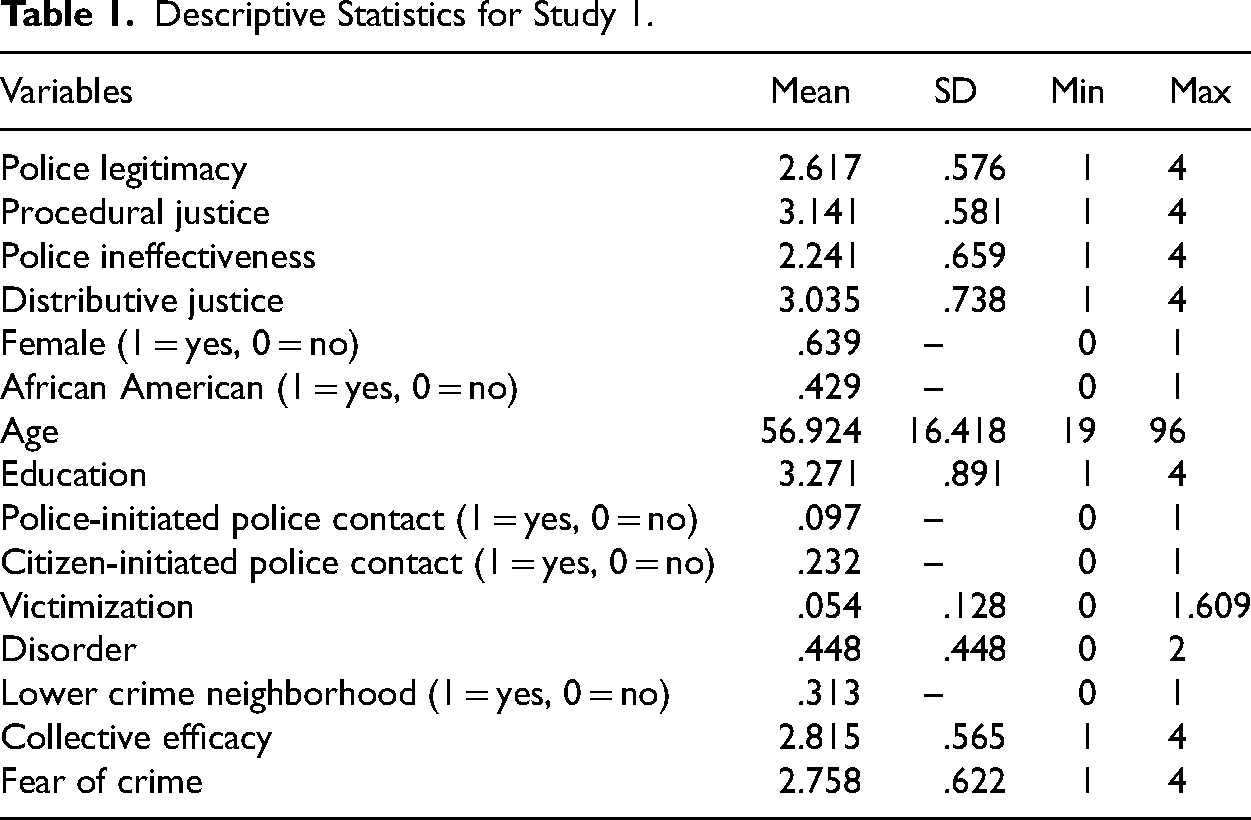
Our dependent variable tapped into two core elements of police legitimacy – obligation to obey and trust. Specifically, respondents were asked to indicate their level of agreement with three items (1 = strongly disagree to 4 = strongly agree): “You should do what the police tell you even if you disagree,” “You should accept police decisions even if you think they are wrong,” and “The police can be trusted to make decisions that are right for my community” (Tyler and Huo 2002; Gau et al. 2012; Tankebe 2013; Nix et al. 2015). Principal-axis factoring (PAF) showed the items loaded on single factor (eigenvalue = 1.132, loadings > .528) and, therefore, were combined into a mean index (α = .681). Higher scores on the police legitimacy scale correspond with more favorable views of police legitimacy. Table 1 presents descriptive statistics for all variables used in the analyses. Appendix A provides information about the prior studies from which we based our measures.
Descriptive Statistics for Study 1.
Independent Variables
Procedural Justice
The items used to operationalize procedural justice were adopted from the existing process-based literature and captured key aspects of Tyler’s (1990) conceptualization of procedural justice—the quality of decision making (e.g., neutrality) and quality of treatment (e.g., status recognition) (Sunshine and Tyler 2003; Gau et al. 2012). Respondents were asked to indicate how strongly they agree that the police in their neighborhoods “treat citizens with respect,” “take the time to listen to people,” “treat people fairly,” and “explain their decisions to the people they deal with” (1 = strongly disagree to 4 = strongly agree). PAF revealed the items loaded on one factor (eigenvalue = 3.071 loadings > .814). The items were combined into a mean index with higher scores reflecting more agreement that local police treat citizens in a procedurally fair manner (α = .936).
Police Ineffectiveness
Consistent with previous research (Priest and Carter 1999; Kubrin and Weitzer 2003; Wolfe et al. 2016), attitudes regarding police ineffectiveness were captured by asking respondents how strongly they agreed (1 = strongly disagree to 4 = strongly agree) that “the police are doing a good job in my neighborhood” and “there are enough police in my neighborhood” (items were reverse coded). The items were combined into a mean police ineffectiveness scale and coded so higher scores indicate local police are less effective (r = .535).
Respondent Race
We centered our attention on the potential differences between African Americans and Whites in this paper. Accordingly, we measured respondent race with a binary variable coded one if the respondent was African American (0 = White).
Control Variables
We controlled for several relevant predictors of police legitimacy evaluations. Similar to previous research, we asked respondents two questions to capture their perceptions regarding distributive justice (Tyler and Wakslak 2004; Reisig et al. 2021): “the police in my neighborhood gives minorities less help because of their race” and “the police in my neighborhood provide better services to wealthy citizens” (1 = strongly disagree to 4 = strongly agree). The items were combined into a mean distributive justice index, with higher scores representing stronger agreement that local police distribute services equally to the public (r = .734).
Next, we included several criminal justice-related experience variables as statistical controls. First, we used dummy variables to capture whether respondents had any officer-initiated contact (1 = yes, 0 = no) or citizen-initiated contact (1 = yes, 0 = no) in the six months leading up to the survey (no police contact served as the reference category). 2 Second, research demonstrates that people with victimization experience are more likely to have unfavorable perceptions of police compared to those without any experience (Brown and Benedict 2002). Accordingly, respondents were asked how many times (0 to 4 or more times) in the six months leading up to the survey they had experienced the following offenses: vehicle stolen, vehicle broken into, property vandalized, home broken into, whether physical assault (without a weapon), physical assault or threatened with a weapon or robbery. The items were combined into a mean prior victimization index (eigenvalue = 2.700, loadings >.410; α = .714). To address skewness, we used a logarithmic victimization scale.
Respondents’ perceptions of four measures of neighborhood context were also accounted for in our models. First, consistent with previous research, we asked respondents two sets of questions to capture their perceptions about the amount of collective efficacy in their neighborhood (Sampson, Raudenbush, and Earls 1997). Informal social control was captured by asking respondents how likely (1 = very unlikely to 4 = very likely) it would be that their neighbors could be counted on to intervene if “teenagers were skipping school and hanging out on a street corner,” “teenagers were spray-painting graffiti on a local building,” “teenagers were showing disrespect to an adult,” “a fight broke out near your home,” and “the fire station close to your home was threatened by budget cuts.” Social cohesion and trust was captured by asking respondents how strongly they agreed (1 = strongly disagree to 4 = strongly agree) that “people around here are willing to help their neighbors,” “this is a close-knit neighborhood,” “people in this neighborhood can be trusted,” “people in this neighborhood generally do not get along with each other,” (reverse coded) and “people in this neighborhood do not share the same values” (reverse coded). A ten-item mean index was constructed and coded so higher scores correspond with greater perceived neighborhood collective efficacy (eigenvalue = 4.099, loadings >.404; α = .862).
Second, fear of crime was measured by asking respondents how much they agreed with the following questions (1 = strongly disagree to 4 = strongly agree): “I generally feel safe walking alone at night in my neighborhood” (reverse coded), “I generally feel safe and secure in my home” (reverse coded), and “In the past month, fear of crime has prevented me from doing things I would like to do” (Gau and Pratt 2008). A three-item mean index was constructed and coded so higher scores represented greater fear for personal safety (eigenvalue = 1.070, loadings > .443; α = .645). Third, we also included a dummy variable—lower crime neighborhood—to control for the relative differences in the neighborhoods’ economic status and crime rate (coded as one if the respondent resided in the more affluent and safer neighborhood and 0 otherwise).
The final neighborhood context variable examined how much of a problem (1 = not a problem, 2 = somewhat of a problem, and 3 = serious problem) a series of eight social and physical incivilities are in their neighborhood (i.e., garbage, noise, vandalism, traffic, drink in public, drugs, loitering, and gangs) (Gau and Pratt 2008). The items were combined into a mean disorder index with higher scores representing more perceived incivilities in respondents’ neighborhoods (eigenvalue = 3.389, loadings > .487; α = .845).
Finally, several additional demographic control variables were included in the analyses. Respondent gender (1 = female, 0 = male) was dummy coded. Respondent age was measured in years, and education was captured using four ordered categories (1 = less than a high school diploma, 2 = high school diploma or GED, 3 = some college, and 4 = bachelor's degree or higher).
Analytic Strategy
Our analysis proceeded in a series of steps. First, ordinary least squares (OLS) regression models were used to estimate the simultaneous effects of perceived procedural justice and police ineffectiveness on perceptions of police legitimacy. The next step involved examining whether procedural justice moderated the relationship between perceived police ineffectiveness and legitimacy. To do so, we constructed an interaction term between procedural justice and ineffectiveness. Each variable was mean-centered before creating the interaction term (Aiken, West, and Reno 1991). The last step of the analysis examined whether the interaction effect holds true for all people, regardless of their race. We did this by estimating the regression equation with the interaction term separately for African Americans and Whites. This allowed us to determine if procedural justice only moderates the relationship between ineffectiveness and legitimacy for African Americans, as our earlier discussion suggested.
Results
Does Procedural Justice Protect Against the Adverse Effects of Ineffectiveness on Police Legitimacy?
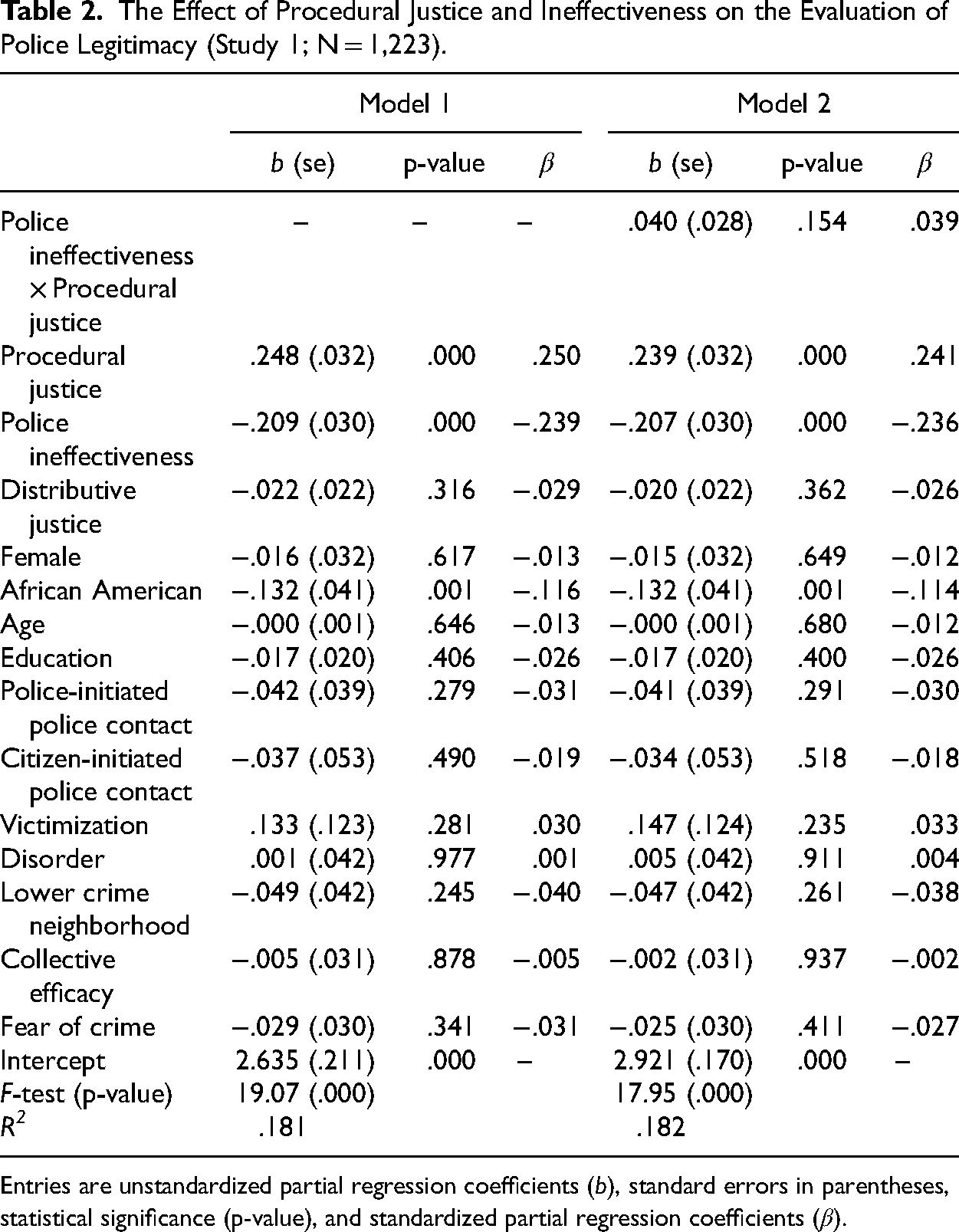
Model 1 in Table 2 examined the simultaneous effects of procedural justice and ineffectiveness on police legitimacy, and a few interesting findings emerged. 3 First, perceptions of procedural justice were significantly and positively associated with police legitimacy evaluations after accounting for perceived ineffectiveness and the control variables (b = .248, p < .001). Second, attitudes regarding the ineffectiveness of the police were a significant predictor of police legitimacy evaluations after accounting for procedural justice and the control variables (b = −.209, p < .001). The only other variable that reached statistical significance in the equation was African American (b = −.132, p < .01). With this baseline established, we now turn our attention to whether the experience of procedural justice can protect against the adverse effects of perceived police ineffectiveness.
The Effect of Procedural Justice and Ineffectiveness on the Evaluation of Police Legitimacy (Study 1; N = 1,223).
Entries are unstandardized partial regression coefficients (b), standard errors in parentheses, statistical significance (p-value), and standardized partial regression coefficients (
Model 2 in Table 2 includes the interaction effect between procedural justice and ineffectiveness. The interaction term was not significantly associated with police legitimacy. Accordingly, without considering the race of the respondent, procedural justice does not appear to serve as a protective factor against the effect of perceived ineffectiveness on legitimacy evaluations within this sample. Nonetheless, we provided a graphical depiction of the interaction between procedural justice and ineffectiveness in Figure 1. In line with what Hayes (2013) suggested, we graphed the interaction for one standard deviation below the mean, the mean, and one standard deviation above the mean. While we did not observe a difference between the slopes of the regression lines, we found that the intercept for high procedural justice (+1SD) was higher than that of low procedural justice (−1SD). This suggests that people's legitimacy evaluations depend on their perceptions of how fairly police treat citizens, regardless of perceived ineffectiveness. This finding is in line with prior research demonstrating procedural justice as a key predictor of police legitimacy evaluations.
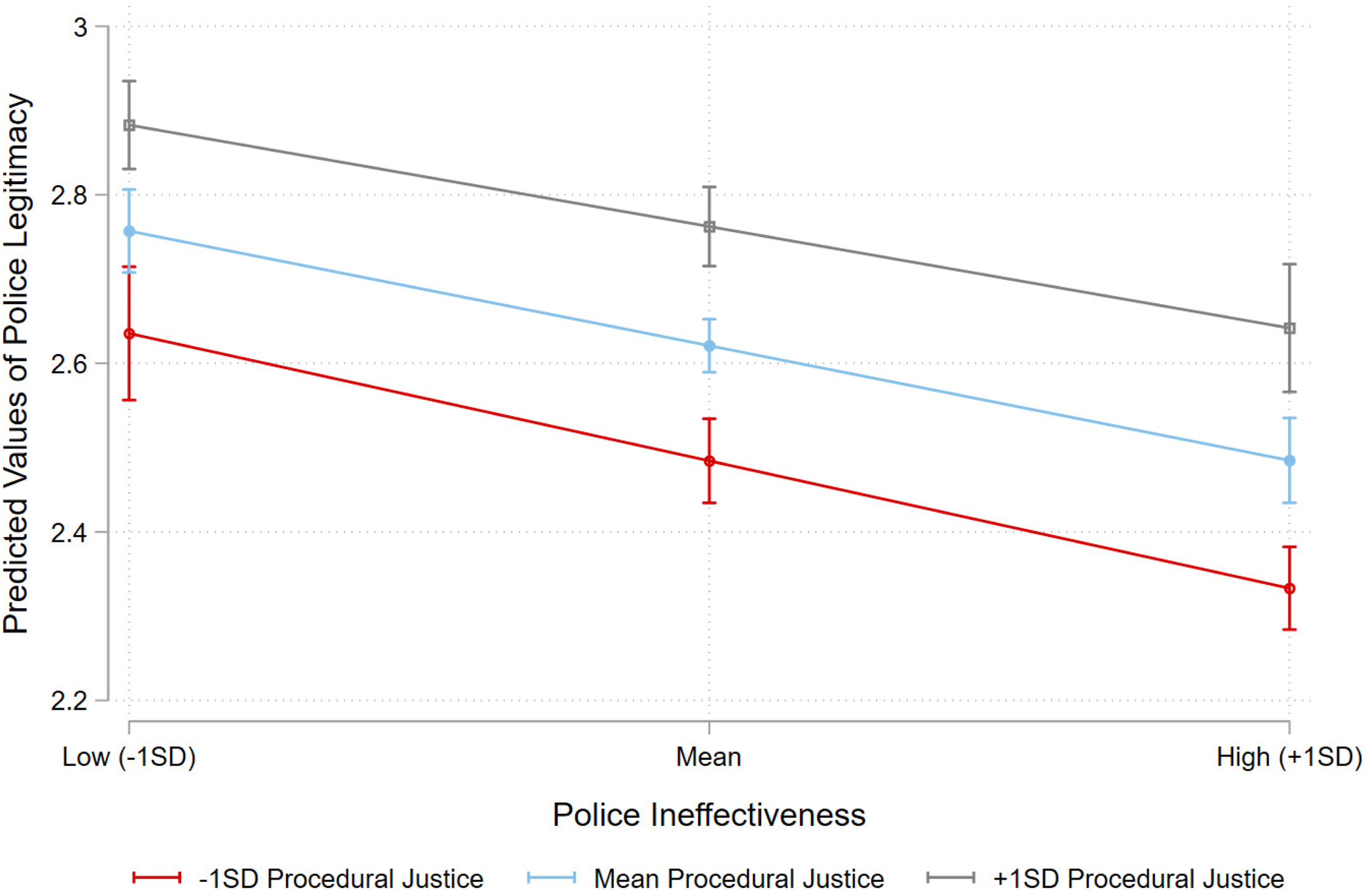
Interaction effect between ineffectiveness and procedural justice (Study 1).
Does Procedural Justice Moderate the Relationship Between Ineffectiveness and Police Legitimacy Only for African Americans?
Although the results from the full sample do not suggest there is a procedural justice moderation effect, it is possible that respondent race matters in this context. To assess whether the moderating effect of procedural justice on the relationship between police ineffectiveness and legitimacy varies by citizen race, we estimated the same equation as before but this time separately for African American and White respondents. Again, and counter to our expectations, the results revealed the interaction terms were not significantly associated with police legitimacy for either African-American or White respondents (see Table 3). Figure 2 provides a graphical depiction of the interaction effects for both groups. The graph demonstrates that for both African Americans and Whites, people who perceived police as procedurally fair viewed police as legitimate regardless of their perceived ineffectiveness. The intercepts for both White and African American respondents with high procedural justice (+1SD) were higher than those with low procedural justice (−1SD) regardless of perceived ineffectiveness. In this way, procedural justice matters for both African Americans and Whites despite any feelings that the police are ineffective at their job.
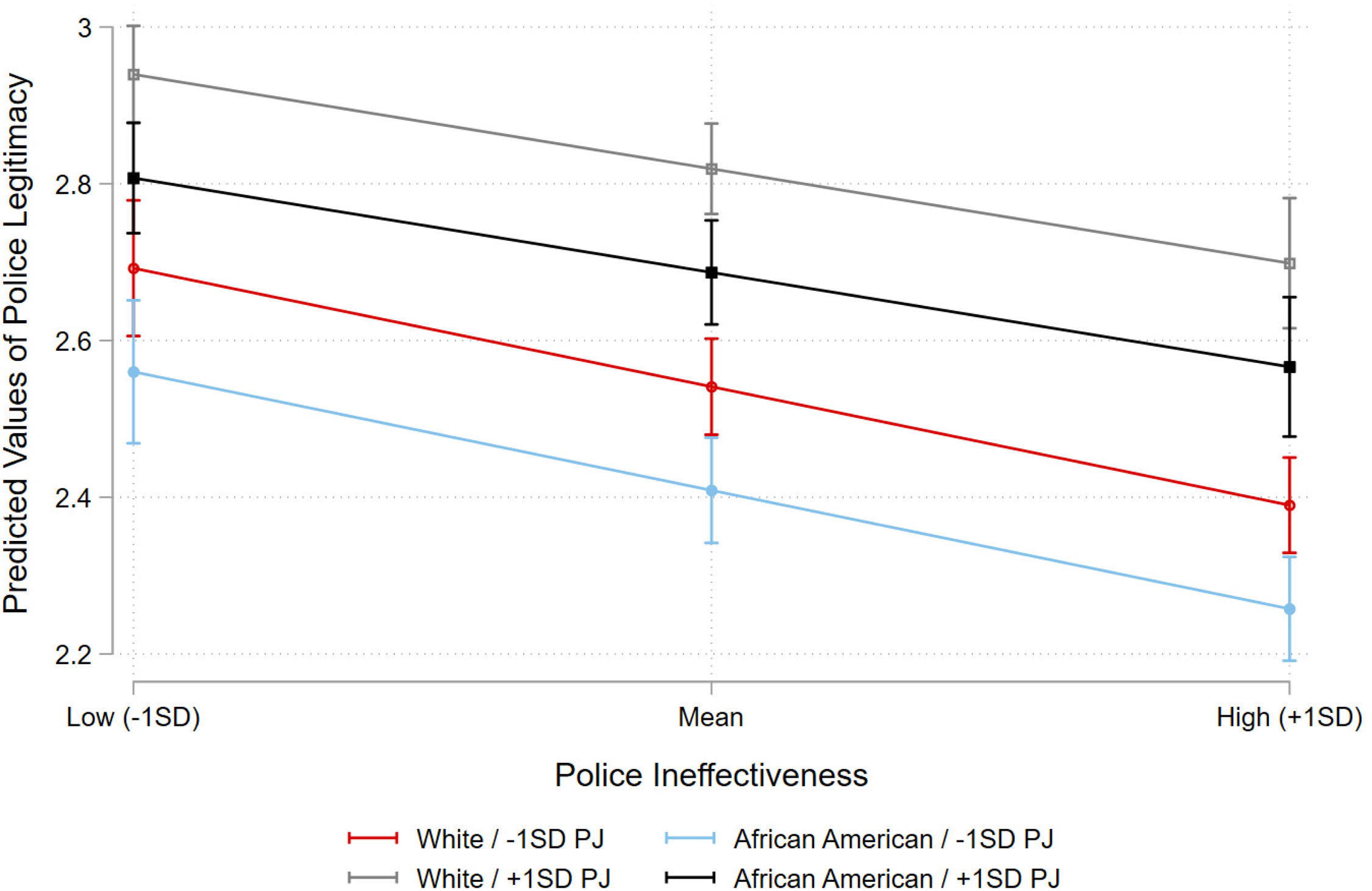
Interaction effect between ineffectiveness and procedural justice by race (Study 1).
Does Procedural Justice Moderate the Relationship Between Ineffectiveness and Police Legitimacy for African Americans and Whites? (Study 1).
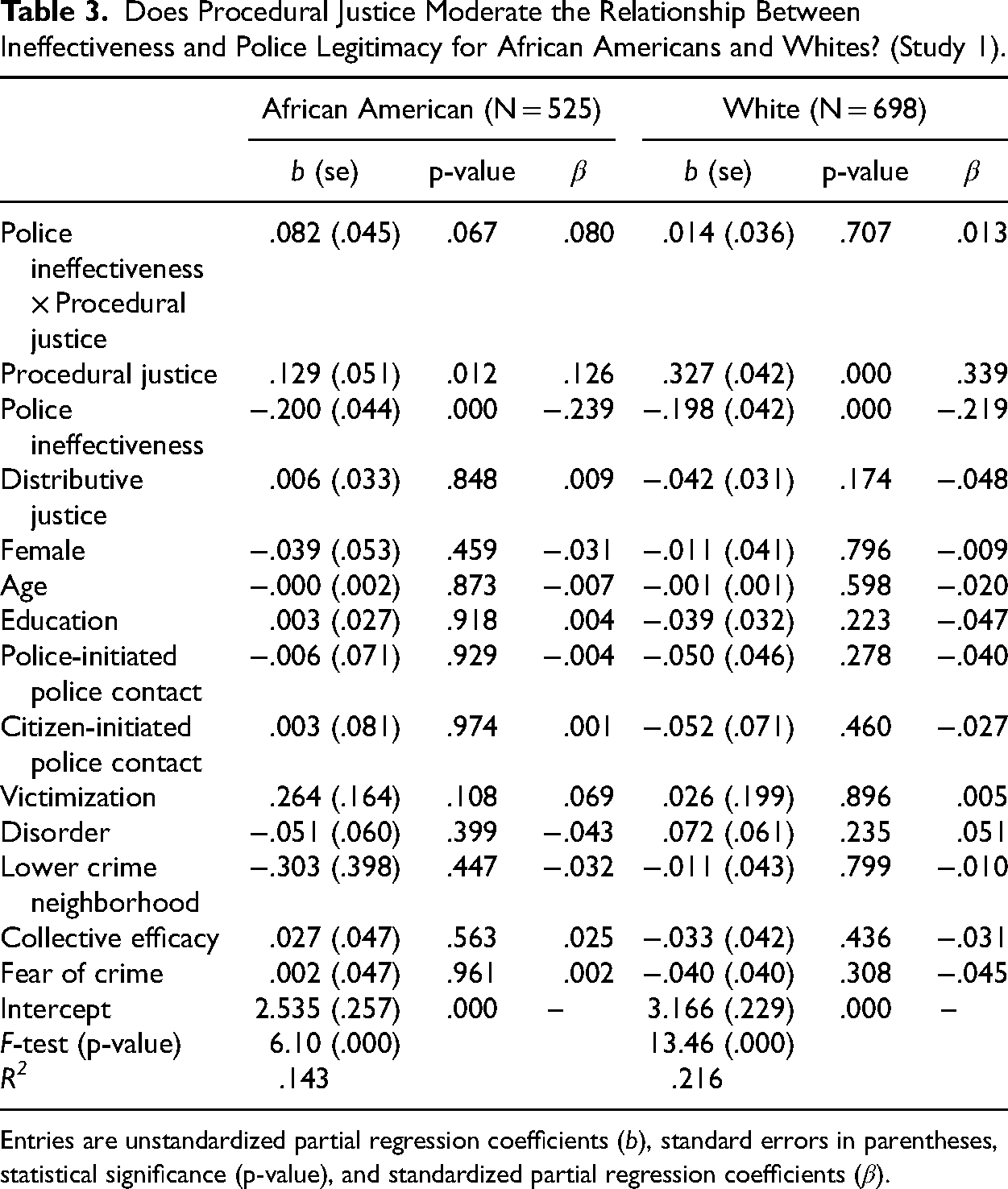
Entries are unstandardized partial regression coefficients (b), standard errors in parentheses, statistical significance (p-value), and standardized partial regression coefficients (
Study 2
Methods and Data
Given understandable concerns about the external validity of a single-city survey conducted prior to the police killings of Michael Brown and George Floyd, we did a replication study in the spring of 2022 with a national survey of adults administered via Qualtrics. Stratified sampling was used so that the sample would match national estimates of age and gender and would include approximately 50% White respondents and 50% Black respondents. The latter stratification was imposed in light of our research questions and in the interest of increasing statistical power to model race in multivariable analyses.
Consistent with best practices to ensure data quality in online surveys (Aronow et al. 2020; Peyton et al. 2021), we included an attention check at the beginning of the survey, which respondents were required to pass in order to complete the survey (Vaughn et al. 2022; see Appendix A). Of the 4,208 people who opened our survey, 1,074 (or 25.5%) passed the attention check. We dropped another 42 respondents who passed the attention check but who did not meet our inclusion criteria (18 or older, White or Black). After listwise deletion of 60 cases that had item-missing data, our resulting analytic sample was N = 972.
Dependent Variable
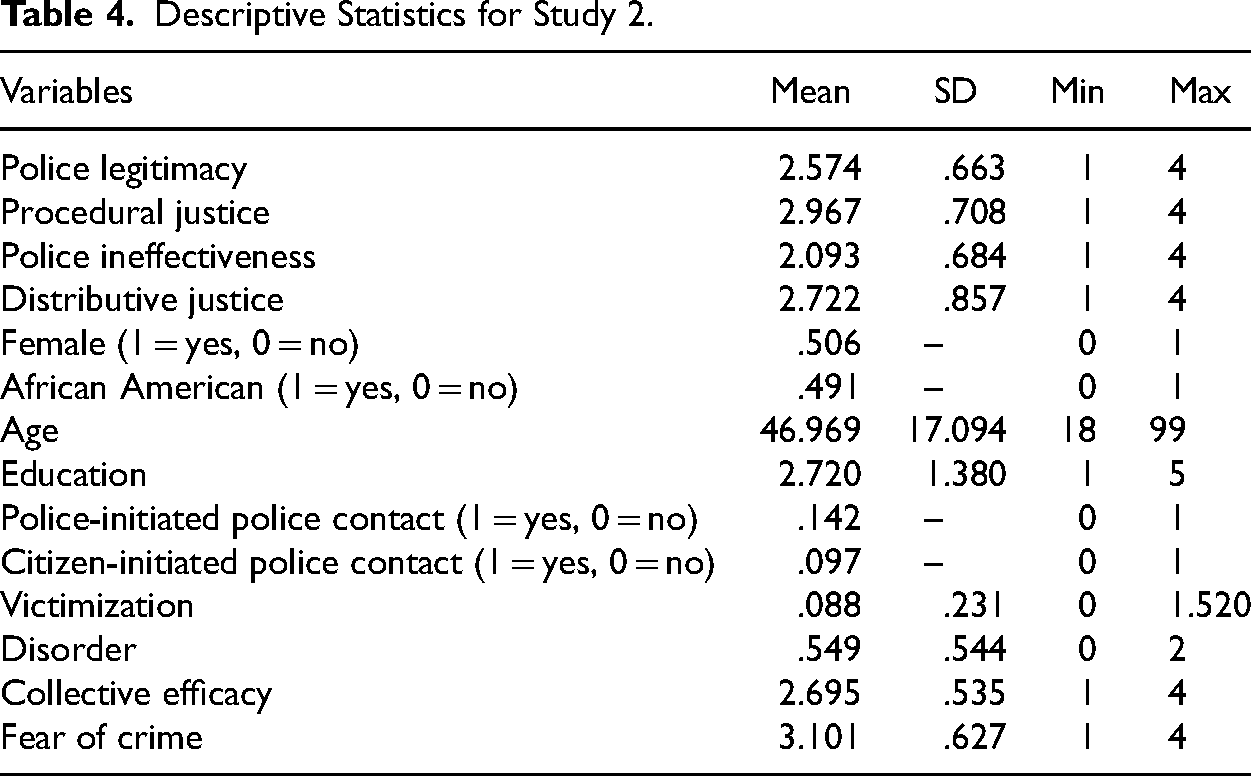
Our dependent variable tapped into two elements of police legitimacy (obligation to obey and trust) and was comprised of the same items that were used in Study 1. PAF showed the items loaded on single factor (eigenvalue = 1.121, loadings > .554) and, therefore, were combined into a mean index (α = .688). Table 4 presents descriptive statistics for all variables used in the analyses for Study 2.
Descriptive Statistics for Study 2.
Independent Variables
Independent variables used for Study 2 are the same as those used for Study 1, except for the lower crime neighborhood variable, which was not measured for Study 2. We used the same items and created the same scales as in Study 1: police ineffectiveness (r = .436), distributive justice (r = .668), victimization (eigenvalue = 4.016, loadings > .714; α = .902), collective efficacy (eigenvalue = 3.364, loadings > .114; α = .805), fear of crime (eigenvalue = 1.006, loadings > .392; α = .601), and disorder (eigenvalue = 4.177, loadings > .646; α = .898).
Results
Does Procedural Justice Protect Against the Adverse Effects of Ineffectiveness on Police Legitimacy?
The analyses for Study 2 proceeded in the same series of steps as Study 1. Model 1 in Table 5 examined the simultaneous effects of procedural justice and ineffectiveness on police legitimacy, and a few interesting findings emerged. First, perceptions of procedural justice were significantly and positively associated with police legitimacy evaluations after accounting for perceived ineffectiveness and the control variables (b = .392, p < .001). Second, attitudes regarding the ineffectiveness of the police were a significant predictor of police legitimacy evaluations after accounting for procedural justice and the control variables (b = −.220, p < .001). The other variables that reached statistical significance in the equation were female (b = −.123, p < .01), African American (b = −.132, p < .01), age (b = .004, p < .001), education (b = −.028, p < .05), citizen-initiated police contact (b = −.118, p < .05), disorder (b = .114, p < .01), and fear of crime (b = −.087, p < .01). With this baseline established, we now turn our attention to whether the perceptions of procedural justice protect against the adverse effects of perceived police ineffectiveness.
The Effect of Procedural Justice and Ineffectiveness on the Evaluation of Police Legitimacy (Study 2; N = 972).
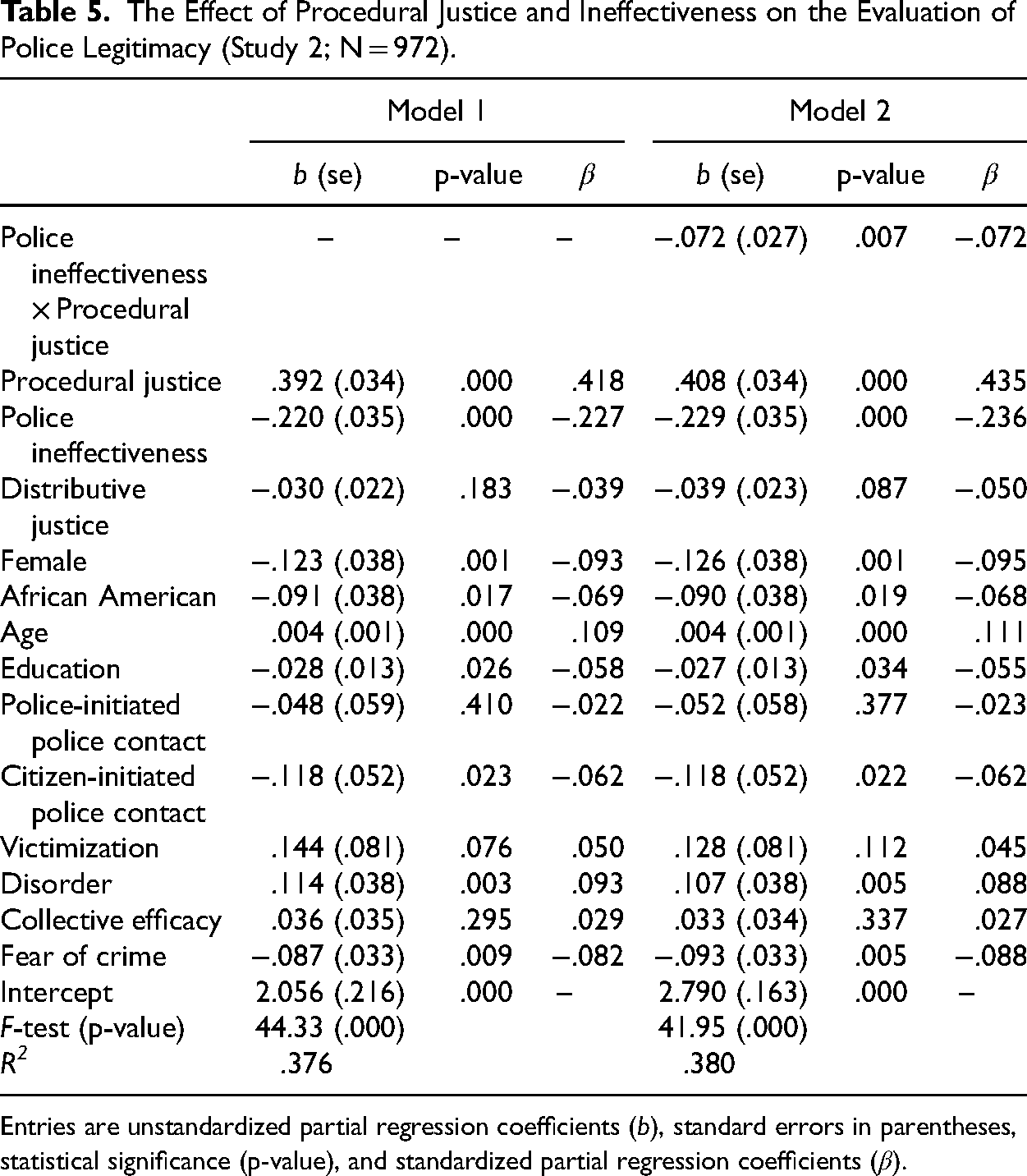
Entries are unstandardized partial regression coefficients (b), standard errors in parentheses, statistical significance (p-value), and standardized partial regression coefficients (
Model 2 in Table 5 includes the interaction effect between procedural justice and ineffectiveness. Unlike the results in Study 1, the interaction effect in Study 2 was significantly and negatively associated with police legitimacy (b = −.072, p < .01). Figure 3 provides a graphical depiction of the interaction between procedural justice and ineffectiveness. First, and similar to Study 1, the intercept for high procedural justice (+1SD) was higher than that of low procedural justice (−1SD), regardless of perceived ineffectiveness. This tells us that people are likely to hold more favorable views of police legitimacy when they evaluate police as procedurally fair regardless of perceived ineffectiveness. Second, and most importantly, within this graph, we see that there was a small procedural justice moderation effect. However, the interaction effect is different from what we expected. Specifically, for respondents who perceive a high level of police procedural justice (+1SD), perceived ineffectiveness has a stronger relationship on evaluations of police legitimacy. In other words, peoples’ views of police legitimacy are negatively impacted to a greater degree by perceived ineffectiveness if they also believe the police are procedurally fair. This finding was not expected, and we will discuss it more in the next section.
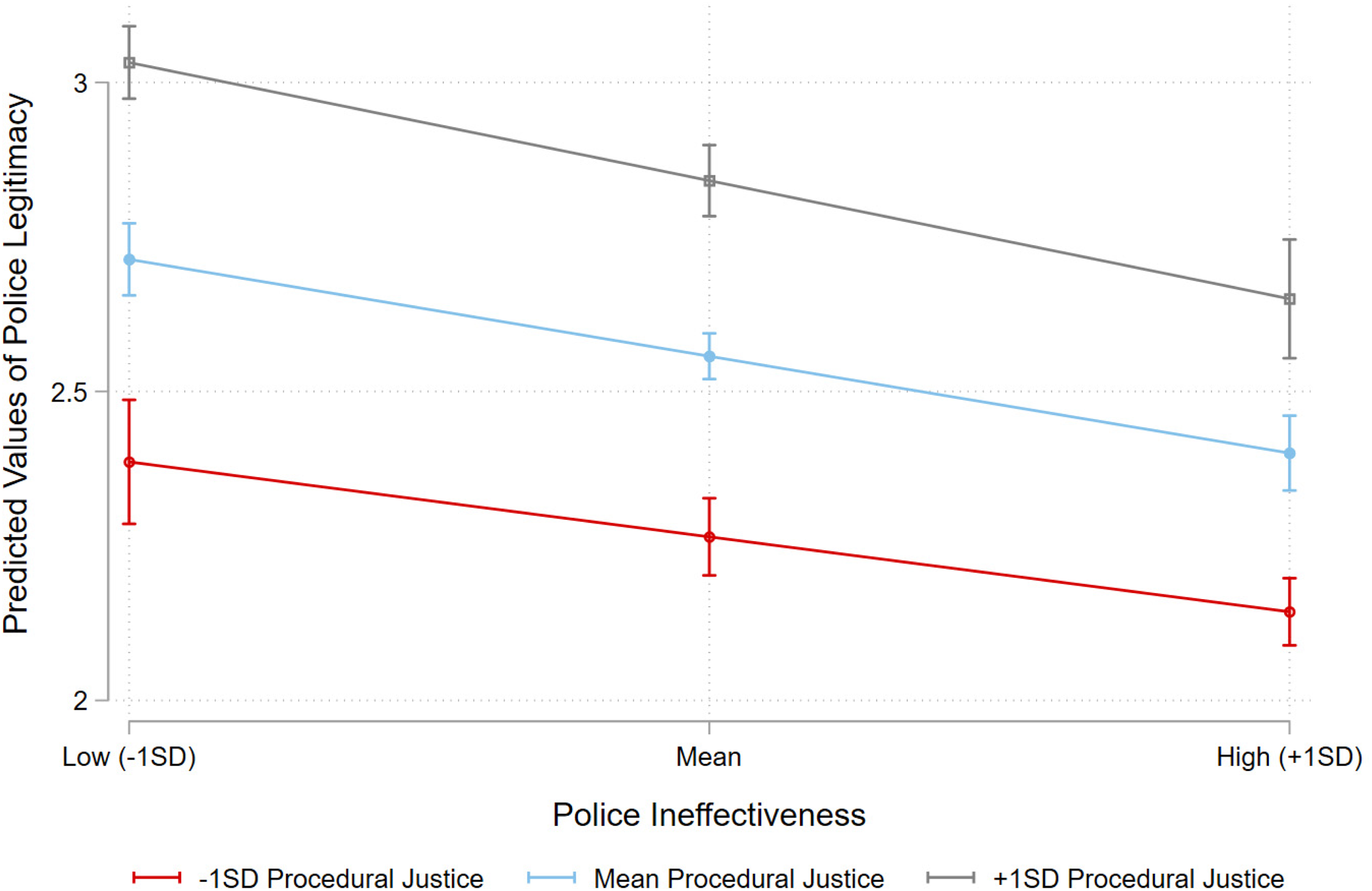
Interaction effect between ineffectiveness and procedural justice (Study 2).
Does Procedural Justice Moderate the Relationship Between Ineffectiveness and Police Legitimacy Only for African Americans?
As we did in Study 1, we estimated the same equation as before but this time separately for African American and White respondents. The results revealed the interaction effect was significantly and positively associated with police legitimacy for Whites (b = −.136, p < .01; see Table 6). However, the data revealed that procedural justice did not moderate the effect of ineffectiveness on police legitimacy for African-American respondents. What is more, a comparison of regression coefficients test revealed that the interaction coefficients for the African-American and White subgroups was not statistically significant (z = 1.374). This suggests the degree to which procedural justice moderates the relationship between perceived ineffectiveness and legitimacy evaluations does not vary between the racial groups.
Does Procedural Justice Moderate the Relationship Between Ineffectiveness and Police Legitimacy for African Americans and Whites? (Study 2).
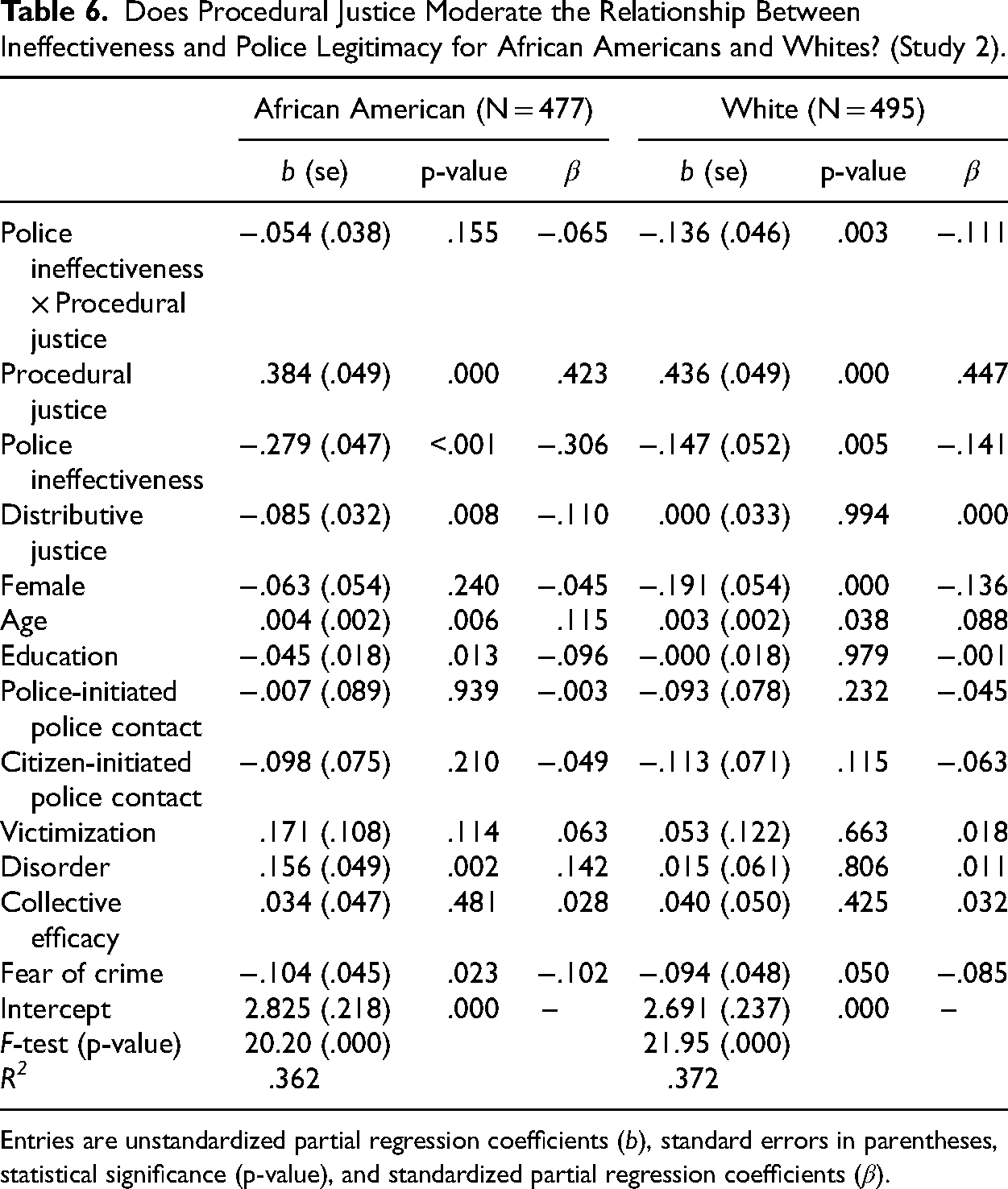
Entries are unstandardized partial regression coefficients (b), standard errors in parentheses, statistical significance (p-value), and standardized partial regression coefficients (
Figure 4 provides a graphical depiction of the interaction effects for both groups. Here we can visualize that, although the interaction coefficient for Whites is statistically significant, the regression slopes for both African Americans and Whites were virtually identical regardless of respondents’ perceptions of procedural justice. We will examine why this relationship may have emerged in the next section. Finally, it is worth pointing out that, similar to Study 1, the results from Study 2 reveal that people who perceived police as procedurally fair viewed them as a more legitimate authority regardless of their perceived ineffectiveness. For both African Americans and Whites, the average starting point of legitimacy evaluations (i.e., intercept) in Figure 4 was higher for those that perceived the police as procedurally fair regardless of whether they also believed the police were ineffective. In this way, procedural justice matters a great deal for both African Americans and Whites.
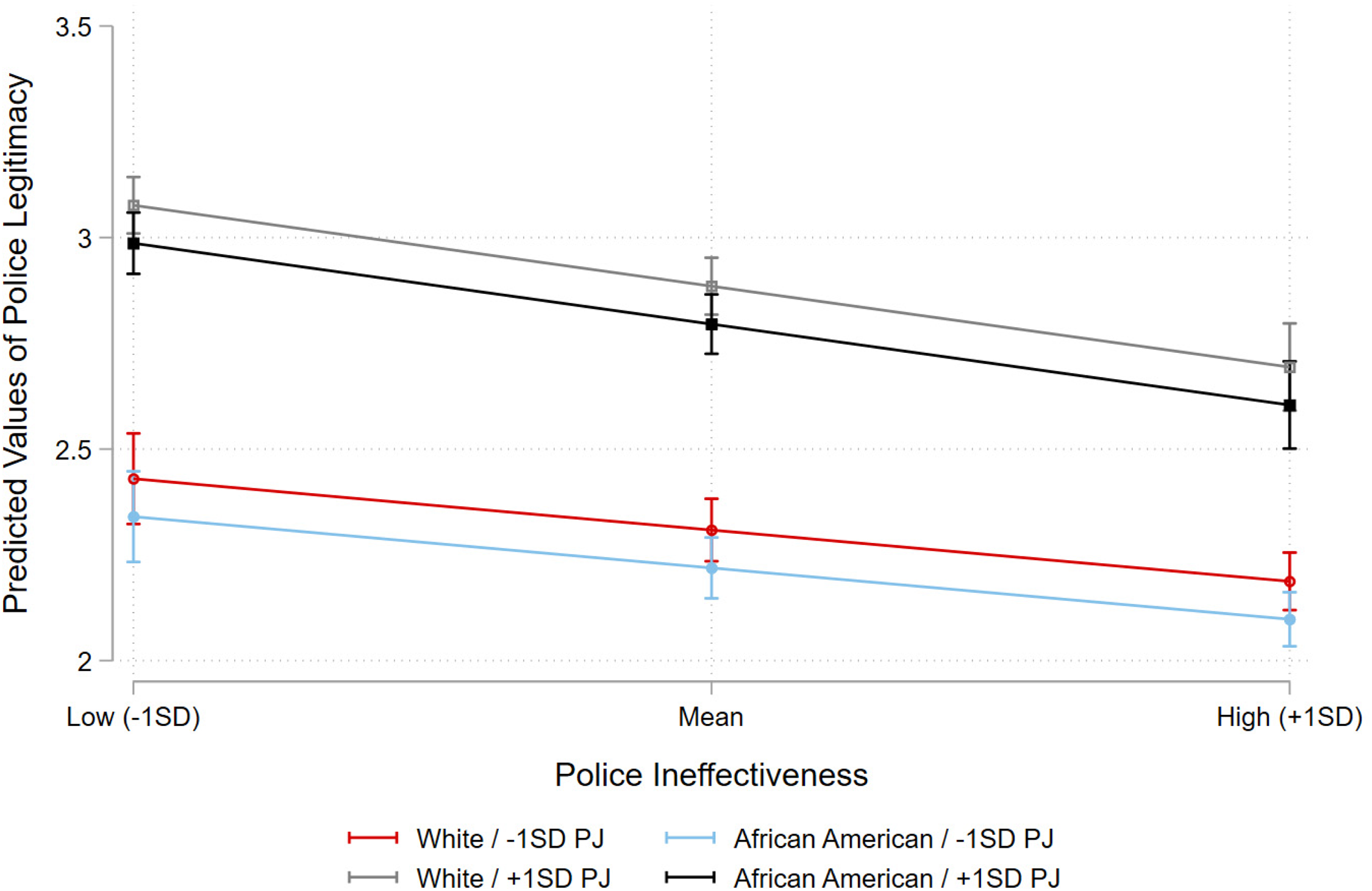
Interaction effect between ineffectiveness and procedural justice by race (Study 2).
Discussion
U.S. policing is at a community-relations crossroad. The public is fed up with excessive use of force, especially that which disproportionately impacts African Americans (Pew Research Center 2020). This is forcing police agencies to find innovative ways to improve training, community outreach, policies, and transparency. This is especially true when attempting to repair broken trust and legitimacy in minority communities. In fact, most ongoing efforts to reform policing revolve around the issue of race (Walsh 2021; Weber 2021). This is not surprising considering the long history of police mistreatment of minorities, particularly African Americans. As discussed earlier, the legal socialization process for African-American children is fundamentally different than that of White youth. Learning how to navigate police interactions and why to be suspicious of the police is part of the African-American experience but is not key to White identity (Wolfe and McLean 2021). In short, the police have lacked legitimacy in the eyes of many African Americans for a long time (Sherman 2018), and the George Floyd protests (and others before it) are a signal that the rent is due.
Criminology holds an important place at the table for these reform efforts. Tyler’s (1990; 1994; 2004) work on procedural justice has motivated hundreds of empirical studies, served as a cornerstone of President Obama's Taskforce on twenty-first Century Policing, and is playing a significant role in current police reform efforts. The literature suggests that procedural justice is a more important predictor of police legitimacy than police effectiveness (although studies like ours suggest they may be closer to equally important). This has caused criminology to become laser-focused on improving police legitimacy through procedural justice, especially in African-American communities. Indeed, procedural justice training has grown in recent years, and it shows promise for improving policing outcomes (Wheller et al. 2013; Skogan, Van Craen, and Hennessy 2015; Antrobus, Thompson, and Ariel 2019; McLean et al. 2020; Weisburd et al. 2022). Our study contributes to this literature by providing more evidence that procedural justice matters. However, our analyses attempted to provide additional nuance concerning how and why it matters. To do so, we used two samples to examine whether procedural justice moderates the relationship between perceived police ineffectiveness and legitimacy, and whether this moderation was observed for both African Americans and Whites.
Our studies add to the mountain of evidence that perceptions of police procedural justice are closely associated with people's trust in the police and the obligation they feel to obey them (Mazerolle et al. 2013). We also observed in both studies that when people believe the police lack effectiveness, they are less likely to trust the police or feel obligated to obey them. The similarity of findings across two different samples – one surveyed before and one after the “Second Great Awakening” brought on by the police shooting of Michael Brown in 2014 (Sherman 2018) – speaks to the robustness of procedural justice theory (Tyler 2006). As important, our findings serve as a reminder that, salient as normative concerns about police fairness are, they do not completely cast aside instrumental concerns about public safety.
With respect to the interaction effects, results from the two studies were inconsistent. In Study 1, procedural justice did not significantly moderate the harmful effect of perceived ineffectiveness on legitimacy, but in Study 2, it did. Further, in Study 2, analyses separated by race revealed that the interaction term was significant for Whites but not African Americans. Notably, however, a z-test showed that the two coefficients were not significantly different, and Figure 4 illustrated the similarity of slopes for each group's interaction term. This suggests a need for continued research on the roles of social identity and group engagement in explaining perceptions of policing in the current political and social climate (see, e.g., Jackson et al. 2022). Though these theoretical frameworks led us to hypothesize that procedural justice would reduce the harmful consequences of perceived ineffectiveness on police legitimacy – particularly among African Americans – the data failed to provide support. Instead, our findings support the generality of procedural justice (Jackson et al. 2012; Wolfe et al. 2016; Brown and Reisig 2019; Reisig et al. 2021), in that procedural justice did not seem to matter more or less for African Americans compared to Whites in the context of this research question and within our two samples.
This is not to say that African Americans’ experiences with the police are not different. They are. Consistent with prior studies (Tyler and Huo 2002; Tyler and Wakslak 2004; Madon, Murphy, and Sargeant 2017; Jones 2020), our analyses showed that, on average, African Americans viewed the police as less fair, less effective, and less legitimate than Whites in our samples. However, we found that procedural justice and ineffectiveness simultaneously predicted legitimacy, and these simultaneous effects were significant for both racial groups. This finding corroborates previous literature that suggests African Americans and Whites want the same things from their police. Regardless of race, we all seem to want to be treated respectfully, given a chance to tell our side of the story, and have the reasons for police actions clearly described to us. We also want an effective police force that strikes a balance between such procedurally fair policing and that which adequately addresses crime and disorder in our communities. This is good news from a practical standpoint because it underscores the importance of ensuring procedural fairness and effectiveness regardless of the racial group the police may be dealing with. The bad news, however, is that clearly, African Americans do not feel they are the beneficiaries of fair and effective policing to the same degree as White Americans. In this way, finding ways to train officers how to engage the public in procedurally fair and culturally sensitive ways may be a pinch point for improving community relations in minority communities.
It is necessary to further discuss police reform in the context of our findings – especially after 2020, a year in which we bore witness to both egregious abuses of police authority and the largest single-year homicide spike on record. Minimizing the “footprint” of policing to reduce racial disparities is at the heart of the ongoing movement to defund or reimagine the police, but it would be a shame if the success of this movement comes at the expense of public safety in the short term (Pyrooz, Nix, and Wolfe 2021). Public safety is still a concern for communities, and the police can play a key role in ensuring it (Braga, Weisburd, and Turchan 2018; National Academies of Sciences, Engineering, and Medicine 2018; Hinkle et al. 2020; Chalfin 2022). Even among our African-American respondents, people were more likely to believe the police were legitimate if they viewed the police as effective. Minorities residing in high-crime neighborhoods often indicate they do not want less policing but instead better and more humane policing (Braga, Brunson, and Drakulich 2019:542).
When it comes to reform efforts, we must be attentive to the decisions that are being made and the impacts they may have on the very communities that need the most protection. For example, violent crime units, gun task forces, and similar specialized units are being disbanded across the United States as the first cuts coming from the defund the police movement (Watkins 2020; Kavanaugh 2021). The problem is that many of these units engage in proactive, evidence-based policing strategies, get guns off the street (Hall 2021), and reduce violent crime (Ratcliffe 2018). Such moves may not only disproportionately harm African-American communities that bear the brunt of violent crime (Chalfin et al. 2020), but they also run the risk of harming residents’ views of police effectiveness over time. Given that effectiveness is a key predictor of legitimacy, and legitimacy is associated with self-regulatory behavior, voluntary compliance with the law, and cooperating with the police (e.g., calling 911 to report a crime), this could have deleterious long-term consequences. At the same time, however, aggressive policing strategies can sometimes lack procedural justice (or, at the very least, be perceived as such) and, thereby, harm community relations (Gau and Brunson 2010). The key is to implement policing strategies that are effective and procedurally fair—reform efforts should not sacrifice one for the other.
Moreover, the defund movement calls for money to be taken away from the police to fund other social services. While this is a worthwhile conversation in some respects, it is possible this process could further exacerbate marginalized community members’ views of the police and other social service programs if neither is adequately equipped to deal with complex social, economic, and mental health problems in our communities. When discussing the defund movement in marginalized communities, Cynthia (2021:23) put it nicely: The idea that these communities need resources to be shuffled around from one group to another to help them is frankly a privileged perspective. These communities need more resources across all services. The Pollyannaish belief that some other social service will suddenly care more about these communities and do so without disparity if given the responsibilities previously delivered by the police seems to be wishful thinking. Any police officer who has tried to get social services to respond to an abandoned or neglected child at three in the morning can attest to this directly.
In other words, shuffling resources and responsibility from one social service to another may only result in feelings of abandonment from the system as a whole. However, simply because other social service providers may not be fully prepared yet to take on responsibilities historically saddled on the police does not necessarily mean the police are best suited to handle such problems either. The point is that we need to carefully consider changes to how we respond to and address societal problems rather than assuming one social service is automatically better because of observed flaws in another.
This also means that criminologists need to start giving more credit to the role of perceived effectiveness in predicting legitimacy evaluations. As Beetham (1991) argued several decades ago, an authority figure like the police cannot be viewed as legitimate if they are not also effective at their job (see also Tankebe 2013). It is important that we do not forget that our findings suggest that both procedural justice and perceived effectiveness matter equally in predicting peoples’ police legitimacy evaluations. Other studies also have revealed that effectiveness is the primary antecedent of legitimacy evaluations (Murphy and Cherney 2011; Sargeant, Murphy, and Cherney 2014). Scholars and policymakers should not be so blinded by the allure of procedurally fair policing as to ignore the role of police effectiveness in cultivating police legitimacy.
In the move to reform policing, the public and politicians have called for improved police training. De-escalation, implicit bias, and racial reconciliation training are popular examples of training programs that may help improve policing (Engel, McManus, and Herold 2020). One of the problems at this point, however, is that there is a lack of empirical evidence concerning which programs are effective (Engel et al. 2020; McLean et al. 2020; Wolfe et al. 2020; Worden et al. 2020). For example, a recent evaluation of procedural justice training revealed that it could significantly reduce both the use of force and complaints against officers (Wood, Tyler, and Papachristos 2020), but a reanalysis of those data has tempered such conclusions (Wood et al. 2021). Other studies have shown that procedural justice-based training holds promise for improving police-related outcomes (Wheller et al. 2013; Skogan et al. 2015; Antrobus et al. 2019; Weisburd et al. 2022). So, while it may be tempting to conclude that studies such as ours underscore the importance of teaching officers how to better employ procedural justice when interacting with the public, there is still a lot of uncertainty concerning the conditions under which such training will be effective. For example, while survey-based studies like ours show that people are more likely to view the police as legitimate when they view the police as procedurally fair, are objectively measured improvements in procedural justice associated with changes in peoples’ views of the police? Do people from different communities interpret procedural justice in the same manner, or does context shape how people assess fairness? How do we ensure officers are receptive to such training programs and use the skills during citizen interactions (Wolfe et al. 2022; Wolfe and Lawson 2020)? Much more research is needed to help us understand how and why procedural justice training can improve the outcomes the public receives from the police.
Another practical implication of our study is that it underscores the importance of incentivizing procedural justice policing. Rather than relying solely on historical metrics of police productivity (e.g., crime rates, arrests, traffic stops), police agencies need to reward officers who interact with the public in a procedurally fair manner. This can be done through internal accolades, externally promoted awards systems, and by emphasizing it during promotion processes. Police departments around the country have begun rewarding officers for being restrained in the use of force (see, e.g., Whack 2017), and a similar process could be used to encourage the use of procedural justice. Of course, this requires collecting data and tracking procedurally-just policing. This is easier to do than it may first appear. Supervisors could look for procedurally fair (and unfair) interactions when randomly reviewing body-worn camera footage as part of regular audit procedures (assuming the agency uses body-worn cameras and such procedures exist). Regular citizen surveys could be conducted to gauge their perceptions of police procedural justice. This could be especially useful for rewarding top procedural justice performing districts, beats, squads, or other departmental units. The key here is not to wait for a citizen complaint to address problematic officer behavior. Rather, agencies need to make such tracking and review part of normal departmental processes to incentivize procedural justice and discourage unfair treatment. Reforms of this type stand a good chance of helping improve police relations with minority residents. The reality, however, is that we are currently in a climate where some portions of the public want to defund or abolish police departments (Graham and Jonson 2021). This will make it difficult for agencies to find the necessary resources to engage in this type of tracking activity. Moreover, currently we do not have any evidence on whether tracking and rewarding procedural fairness improves officer behavior or citizens’ perceptions of the police. Research that explores such issues would be valuable because it would allow us to understand whether such tracking and reward programs are worth their investment.
Our studies are not without limitations. First, both studies were cross-sectional. While many studies in this area have also adopted cross-sectional designs (Nagin and Telep 2020), experimental or longitudinal studies can more appropriately address the causal ordering of these observed relationships (see also Pósch 2021). Longitudinal analyses, in particular, would provide a deeper understanding of whether the relationships we observed are stable in people over time and throughout different experiences (e.g., interactions with the police). Second, the survey response rate for Study 1 (46%) was lower than what we hoped, though we note that it exceeds that of many procedural justice-based studies (see Mazerolle et al. 2013 with 13.16%; Gau 2015 with 19%; Merola et al. 2019 with 22.9%). Relatedly, research demonstrates that the correlation between survey response rates and nonresponse bias is weak (Pickett et al. 2018). Empirical studies concerned with nonresponse bias show it has a smaller effect on studies with multivariable analyses than univariate estimates, and “typically [does] not alter the inferences drawn from [multivariable] models” (Amaya and Presser 2017:1; see also Martikainen et al. 2007; Kano et al. 2008; Abraham, Helms, and Presser 2009; Nix et al. 2020). Third, previous studies have identified factors (i.e., small total sample size and cell sizes) that decrease power to detect moderation effects (Aguinis and Stone-Romero 1997; Shieh 2009; Heo and Leon 2010). There is a positive relationship between sample size and statistical power to detect moderator effects and a much larger sample size may be needed to detect the three-way interaction effects we examined in this study. For example, Heo and Leon (2010:800) argued that the sample size needed “to detect a three-way interaction effect is fourfold that required to detect a two-way interaction.” Considering that the purpose of this study was to examine the interaction between procedural justice and ineffectiveness and whether this interaction varies between racial groups, increasing sample size could be a way to boost the statistical power of detecting moderating effects. Next, our measure of police legitimacy captured two components—obligation to obey and trust. Although previous studies tend to use either obligation to obey or trust (or both) to capture police legitimacy (Tyler 2004; Tyler and Jackson 2014; Nix et al. 2015; Wolfe et al. 2016), a growing body of research shows the concept also represents issues such as lawfulness and moral alignment (Jackson, Bradford, Hough, et al. 2012, Jackson, Bradford, Stanko, et al. 2012; Tankebe et al. 2016). Thus, to explore the moderating effect of procedural justice on ineffectiveness and police legitimacy in greater detail, we encourage future research to consider capturing other dimensions of legitimacy.
In the end, the harmful effect of police ineffectiveness on police legitimacy does not appear to depend on how much a person perceives the police to act in a procedurally just manner. The value of the process-based model of policing is that, whereas individual officers have little control over external pressures to reform policing, they do have control over how they treat people with whom they interact. It is time for American policing to build public faith by pursuing lasting organizational transformation via the promotion of procedural justice through core values and reinforced actions, while also maintaining concern over how well they are addressing crime and disorder.
Footnotes
Declaration of Conflicting Interests
The author(s) declared no potential conflicts of interest with respect to the research, authorship, and/or publication of this article.
Funding
Study 1 of this research was supported in part by the Bureau of Justice Assistance, Office of Justice Programs, U.S. Department of Justice under Grant No. 2009-DG-BX-K021 and Study 2 of this research was supported in part by University of Nebraska Omaha College of Public Affairs and Community Service. The opinions, findings, and conclusions or recommendations expressed in this publication are those of the authors, and do not necessarily reflect those of the Department of Justice and University of Nebraska Omaha College of Public Affairs and Community Service.

Notes
Supplemental Material
Supplemental material for this article is available online.
Author Biographies
References
Supplementary Material
Please find the following supplemental material available below.
For Open Access articles published under a Creative Commons License, all supplemental material carries the same license as the article it is associated with.
For non-Open Access articles published, all supplemental material carries a non-exclusive license, and permission requests for re-use of supplemental material or any part of supplemental material shall be sent directly to the copyright owner as specified in the copyright notice associated with the article.
