



Abstract
Objectives: Bridge the gap between feminist scholarship and sociological literature on gun utility by examining the correlates of gun usage in heterosexual intimate partner homicide by offender gender. Methods: Using data on 7,588 incidents from the National Violent Death Reporting System (NVDRS) from 2003 to 2018, logistic regression models examined the odds of using a firearm during intimate partner homicide for both male and female offenders. Results: Men disproportionately employed guns to regain control when their dominance and/or masculinity was threatened, whereas women used firearms in self-defense against an armed partner. Conclusions: The results suggest that gender-based motivations distinguish whether or not a firearm is used in intimate partner homicide.
Intimate partner homicide (IPH) remains a key public health crisis in the United States: over 15% of all homicides and 40% of femicides were committed by intimate partners in 2019 (Federal Bureau of Investigation 2020). Guns play an indisputable role in escalating intimate partner violence (IPV) to homicide due to their increased lethality relative to other weapons. While only 3.5% of nonfatal IPV incidents involve firearms (Tjaden and Thoennes 2000; Truman and Morgan 2014), over 60% of IPH victims are killed with guns (Campbell et al. 2007; Federal Bureau of Investigation 2020; Zeoli, Malinski, and Turchan 2016). Indeed, perpetrator access to firearms is the single greatest risk factor for IPH, increasing the likelihood of IPV turning deadly between five and tenfold (Campbell et al. 2003; Matias et al. 2020; Spencer and Stith 2020).
Although the extant literature has identified access to firearms as a key risk factor for IPH, little is known about the types of victims, offenders, and circumstances most likely to involve guns during a domestic altercation. This is surprising, as identifying individuals most at risk for firearms offending and victimization is central to preventing IPV from escalating to IPH. These efforts are especially crucial in recent years, given that firearms IPH has increased by 26% since 2010, even as non-firearms IPH rates continue to decline (Fridel and Fox 2019).
Additionally, feminist scholars have long contended that men and women in heterosexual relationships utilize violence—and lethal violence in particular—against their partners under different circumstances: men typically seek to intimidate and control their partners when their dominance or masculinity is threatened, while women usually kill as a last resort to defend themselves against an abusive partner (Daly and Wilson 1988; Dobash and Dobash 1979; Johnson 2008; Serran and Firestone 2004). Given these distinct motivations, it is likely that the factors underlying firearms usage in IPH differ across heterosexual male and female offenders. Unfortunately, this issue remains relatively unexplored (Zeoli, Malinski, and Turchan 2016).
Motivated by feminist perspectives and the broader literature on gun ownership, this study examines the correlates underlying gun usage in heterosexual IPH, taking into account gender dynamics inherent to IPH. Specifically, we hypothesize that male IPH offenders are more likely to use firearms to regain control when their dominance or masculinity is threatened. Conversely, we posit that female IPH perpetrators are more likely to utilize guns for self-defense during potentially lethal encounters (Browne 1987). We begin by reviewing theoretical insights on male- and female-perpetrated IPH in heterosexual couples.
Literature Review
Research on IPH has been grounded in a feminist perspective, which posits that IPV is inherently gendered and that violence against women is a form of domination born from patriarchal attitudes (Dobash and Dobash 1979). Accordingly, two-thirds of IPH incidents in the U.S. involve men killing women (Federal Bureau of Investigation 2020), and women are seven times more likely to kill their partners in self-defense (Martin 1981). Acknowledging that “intimate partner homicide is not simply a dual phenomenon, with aggressive men and defenseless women driven under the worst of interpersonal circumstances to kill one another” (Titterington and Harper 2005, pp. 86), it is important to consider the gendered motivations that so often characterize the crime. As such, we situate our study within a feminist framework and review the theoretical underpinnings of IPH by gender before considering the role of firearms.
Theoretical Perspectives on IPH
Male-perpetrated IPH: violence as control
Despite heterogeneity among theories within the feminist perspective, nearly all explanations of men killing their female partners revolve around a singular concept: violence as the ultimate means of (re)establishing control (Graham et al. 2020). Since the 1970s, psychologists and counselors have documented the similarity in tactics used by domestic abusers and political terrorists, kidnapers, and hostage-takers in breaking down their victims and fostering a state of learned helplessness (Stark 2007). With respect to IPV, this kind of coercive control is defined by the systematic oppression of women by men accomplished through intimidation, social isolation, economic dependency, and violence against the victim or her children (Dobash and Dobash 1979; Pence and Paymar 1993). Johnson (1995, 2008) argues that coercive control is central to differentiating distinct types of IPV. Rooted in patriarchal attitudes, intimate terrorism is typically perpetrated by men to control “their” women, resulting in frequent and severe victimization; in contrast, situational couple violence is perpetrated equally across genders in response to situational triggers, and typically results in less severe injuries (Johnson and Leone 2005). While both types of IPV may turn lethal, intimate terrorism is much more likely to result in IPH than situational couple violence due to its escalating nature.
Scholars have extended this generalized framework of male-perpetrated IPH as an extreme manifestation of coercive control. Considering IPH through an evolutionary lens, Daly and Wilson (1988) contend that men think of women in proprietary terms, such that husbands “own” their wives and their reproductive capacities. Accordingly, male sexual proprietariness theory argues that men seek to control women in order to preserve their genetic lineage, and react violently when that control is threatened. Homicides by either spouse represent maladaptive “slips in this dangerous game” of brinksmanship (Daly and Wilson 1988 pp. 205). Empirical tests generally support the theory, as the risk of IPH over IPV dramatically increases when: the man is jealous or accuses his partner of infidelity (increasing fears of uncertain paternity); the victim leaves or threatens to leave, begins a new relationship, or refuses sex (threatening his exclusive sexual access); the victim has children from a previous relationship (functionally equivalent to cuckolding); or the victim is pregnant (increasing her power in the relationship) (Campbell et al. 2007; Johnson and Hotton 2003; Matias et al. 2020; McFarlane, Campbell, and Watson 2002).
While scholars generally agree that the desire to maintain control is central to male-perpetrated IPH, others argue that this need is socially constructed from patriarchal attitudes. Drawing upon general strain theory (Agnew 1992), Eriksson and Mazerolle (2013) argue that IPH risk factors represent unique sources of strain that prevent men from achieving dominance over their female partners, a traditional expectation in patriarchal societies. Infidelity, for example, represents a negatively-valued stimulus, while estrangement is the loss of a positively-valued one. Accordingly, men perpetrate IPH as an extreme coping mechanism to regain control and resolve the intense feelings of fear, rage, and jealousy that these strains engender. IPV/IPH can similarly be conceptualized as a situational accomplishment or way of “doing gender” to reestablish masculinity when threatened (Coster and Heimer 2021; Moore and Stuart 2005). Prior research suggests that men are more likely to engage in coercive control tactics and IPV/IPH when they espouse patriarchal beliefs and/or lack status relative to their female partners in terms of education, employment, or income (Macmillan and Gartner 1999; Zito 2020).
In sum, whether it be a maladaptive evolutionary response to protect reproductive interests, a coping mechanism in response to severe strain, or a way to prove masculinity, male-perpetrated IPH is inherently linked to power and control. Empirical research has consistently supported this relationship, as a recent meta-analysis found that controlling behaviors increase the odds of male-perpetrated IPH over IPV between four and five times (Spencer and Stith 2020).
Female-perpetrated IPH: violence as defense
In stark contrast to their male counterparts, women rarely kill and typically do so as a last resort to protect themselves and/or their children from an abusive partner (Belknap et al. 2012; Browne 1987; Caman et al. 2016; Felson and Messner 1998; Smith, Moracco, and Butts 1998; Wiezmann-Henelius et al. 2012). The theory of self-defense or violent resistance (Johnson 2008) is founded upon the concept of victim precipitation, in which the victim initiates or instigates the violent encounter that leads to their death (Wolfgang 1958). Qualitative accounts indicate that most women kill their male partners during a particularly violent or volatile encounter (the triggering event) after enduring long-term physical, emotional, and sexual abuse (Browne 1987; Johnson 2008). While estimates vary across samples, prior research suggests that male IPH victims act as the initial aggressors in over three-quarters of incidents (Campbell 1992; Jurik and Winn 1990; Smith, Moracco, and Butts 1998). For example, female IPH offenders experience higher rates of physical injury prior to the homicide (Swatt and He 2006) and their victims are more likely to have a history of violence (Felson and Messner 1998).
Aside from frequently being initiated by the victim, female-perpetrated IPH is unique in that it is typically a last resort or an act of desperation. Prior research consistently indicates that abused women actively engage in help-seeking and coping behaviors and frequently exhaust all other legal avenues before turning to violence (Johnson 2008). Homicide may therefore represent the ultimate means of self-help for women, especially those who feel that society is unable or unwilling to protect them (Peterson 1999; Smith, Moracco, and Butts 1998). For example, women are much less likely to kill their partners after leaving the relationship, suggesting that many choose separation over violence to protect themselves (Johnson and Hotton 2003). Similarly, female IPH offenders often contemplate or attempt suicide to escape their abusers before eventually committing homicide (Browne 1987). Women who kill their abusive partners are also more likely than battered women in shelters to either call the police eight or more times prior to the incident or never contact authorities (Grant and Curry 1993); these results suggest that some women may kill only after legal interventions have repeatedly failed, while others may not believe alternate options are viable due to the state of learned helplessness known as “battered woman syndrome” (Walker 1979).
Using Guns to “do Gender”
The dual nature of lethal force as a means to control or to defend in the IPH literature is mirrored in discussions on the symbolic—and gendered—meanings of firearms in American society. On one hand, guns represent the epitome of power and control due to their increased lethality relative to other weapons (Zimring 1972). Even when the goal is not to kill, guns assert dominance, force compliance, and make the possessor feel superior (Kleck and Hogan 1999). In many volatile encounters, the mere presence of a gun automatically grants its owner the power to escalate or mitigate the conflict. Prior work indicates that guns are psychologically linked to aggression and dominance (Anderson, Benjamin, and Bartholow 1998; Berkowitz and Lepage 1967), such that many gun owners agree or strongly agree that owning firearms makes them feel respected (42%) and more in control of their fate (28%) (Froese 2020).
Even further, the symbolic association between guns and power is inextricably linked to masculinity in America. Men use firearms: to defend their honor in the southern culture of violence; while hunting to prove their “frontier masculinity”; and as part of their daily lives in traditionally male-dominated professions (i.e., law enforcement and the military) (Mencken and Froese 2019). Carlson (2015) argues that men have embraced gun ownership to regain control and protect their manhood in the face of eroding gender roles and economic instability. In this way, guns become symbolic tools that allow men to renegotiate their gender identities by emphasizing their role as protectors when their status as breadwinners is threatened (Cassino and Besen-Cassino 2020). Accordingly, advertizers link firearms to traditional masculine stereotypes (O’Neill 2007), explicitly stating that guns can restore “the balance of power” and the “confidence to live your life” (Metzl 2019). Survey data similarly indicate that men are more likely than women to consider purchasing guns as a form of empowerment (Warner 2020).
At the same time, firearms are also deeply linked to the American ideals of freedom, self-sufficiency, and defense. Nearly 70% of Americans cite protection as the primary reason they own guns, a proportion that has increased over time relative to recreation or hunting (Pew Research Center 2017). As the “great equalizer,” guns empower smaller, weaker individuals to preempt victimization or defend themselves against aggressors whom they may not have been able to overpower otherwise (Kleck and Hogan 1999; Lott 2000).
While the symbol of guns as protection is one of many cultural frames that appeal to men—who emphasize protecting their wives and children over concerns of personal safety (Carlson 2015; O’Neill 2007)—it remains the only socially accepted narrative that applies to women. Since the 1980s, defensive gun use has been linked to traditional gender roles and motherhood, with ads encouraging women to “tip the odds in [their] favor” with guns to protect their virtue and their sleeping children from unknown prowlers (Browder 2006; Burke, Hopper, and Dunlap 1997). Women are over three times more likely than men to cite personal safety as their sole rationale for owning firearms (Pew Research Center 2017), and disproportionately consider purchasing guns to reduce their fear of victimization (Warner 2020).
In contrast, some scholars argue that female firearms ownership is actually a way to subvert traditional gender roles and engage in “pioneer” or “physical” feminism (McCaughey 1997; Stange and Oyster 2000). These perspectives posit that defensive gun use is a form of empowerment that allows women to embrace aggression and rewrite cultural scripts that define them as damsels in distress. Women who own guns, for example, are significantly more likely to engage in the political system, which may be due in part to enhanced personal confidence (Middlewood, Joslyn, and Haider-Markel 2019). Even further, researchers point to celebrated female sharpshooters and hunters like Annie Oakley as examples that women do not exclusively utilize guns for self-defense. Indeed, female participation in gun sports has increased since the 1990s, and currently 10% of hunters in the United States are women (U.S. Department of the Interior 2016).
Nevertheless, traditional feminist scholars view female gun ownership as a symptom of the patriarchy rather than a means to topple it. Female empowerment derived from firearms remains inherently rooted in fears of victimization, especially of sexual violence; National Rifle Association (NRA) ad campaigns for women, for example, make this connection explicit with the slogan “Choose to refuse to be a victim” (Blair and Hyatt 1995). Women are also punished from deviating from traditional gender norms, as female gun owners are perceived as less likeable, more masculine, and less feminine than their unarmed counterparts (Branscombe and Owen 1991). In sum, regardless of whether or not women view firearms as a source of power, self-defense remains the primary narrative for female gun usage.
Current Study
The current study integrates feminist theories with findings from the broader literature on gun ownership to examine the correlates of firearm use in heterosexual male- and female-perpetrated IPH. We posit that male IPH perpetrators are more likely to use firearms to regain control when their dominance and/or masculinity is threatened (hypothesis 1). Prior research indicates that men use violence against women primarily to cement their control over the relationship (Dobash and Dobash 1979; Johnson 2008). In turn, guns often symbolically function as the physical representation of power and masculinity in American society (Mencken and Froese 2019). We also contend that female IPH perpetrators disproportionately use firearms to kill their male partners in self-defense (hypothesis 2). Previous studies consistently indicate that women rarely use fatal force, and typically only do so in response to severe physical, emotional, and sexual abuse (intimate terrorism) (Browne 1987; Johnson 1995). As the “great equalizer,” guns enable battered women to protect themselves and their children from their physically stronger abusive partners (Kleck and Hogan 1999; Lott 2000).
Acknowledging the challenges in operationalizing complex behaviors like coercive control and self-defense (Hamberger, Larsen, and Lehrner 2017; Hardesty et al. 2015), we use several proxy measures identified by the extant literature to examine these hypotheses (Graham-Kevan and Archer 2005; Hamel et al. 2015). Specifically, we contend that the odds of firearms-related IPH relative to IPH committed with other weapons are increased when the male perpetrator’s control is threatened, measured by jealousy/fears of infidelity and the termination of the relationship. Conversely, we predict the odds of firearms-related IPH are decreased when the male offender retains control of his female partner, indicated by a history of physical abuse and economic dependency. For female offenders, we predict that the odds of firearms-related IPH are increased when the male victim uses a weapon or precipitates the incident.
Methods
Data and Sample
We test these hypotheses using a large sample of heterosexual IPH incidents in the United States from the National Violent Death Reporting System (NVDRS). The NVDRS was established by the Centers for Disease Control and Prevention (CDC) in 2003 as a state-based, active Web surveillance system of all victims of suicide, homicide, unintentional firearm fatality, and death from legal intervention or undetermined intent in the United States. The NVDRS is a pooled, cross-sectional time series. As of 2018, 41 states and the District of Columbia reported to the NVDRS, though most death records are from 17 states (see Appendix A for state reporting by year). 1
A major strength of the NVDRS is its integration of multiple, complementary data sources to ensure that case information is both valid and comprehensive. The NVDRS requires data from three primary sources, including death certificates (DC), coroner/medical examiner (CME) records, and law enforcement reports (LE); data from the CME and LE documents include information from the injury or death scene, ongoing investigations, and/or accounts of family members, friends, or witnesses. Secondary data sources are utilized to corroborate this information whenever possible, including but not limited to crime lab and toxicology results, hospital discharge data, court records, Child Fatality Review reports, Bureau of Alcohol, Tobacco, Firearms and Explosives (ATF) firearms trace data, Supplementary Homicide Reports (SHR), and National Incident-Based Reporting System records (NIBRS). The NVDRS tracks information provided by source to document and reconcile data differences across sources (see Appendix B for more information on the sources from which variables are derived).
Data collection is conducted by each state, either by abstracting records maintained by the primary sources at their offices or by transferring data from the primary sources to the health department’s NVDRS office. To protect against systematic data errors and ensure consistency in coding protocols across states, the CDC: requires training for all new state Violent Death Reporting System (VDRS) programs; uses automated software validation during data entry; conducts state blind re-abstractions with multiple coders; produces annual quality assurance reports; and provides coding support through email and regular conference calls. In sum, the NVDRS is currently the most comprehensive data source on homicide in the United States.
Our sample consists of all heterosexual, adult (aged 18 and older) intimate partner homicides committed in the United States from 2003 to 2018. This includes 5,842 incidents in which men killed their female partners and 1,746 incidents in which women killed their male partners. Although IPH also occurs within the LGBTQ + community, we were unable to examine this population due to their small sample size within the NVDRS (including 222 male homosexual couples and 76 female homosexual couples).
Measures 2
Firearms and non-firearms IPH
The NVDRS defines homicide as death resulting from the intentional use of force or power—threatened or actual—against another person, group, or community (ICD-10 codes X85–X99, U01– U03, Y00–Y09, and Y87.1). Homicide includes incidents with intent to injure but not kill; deaths induced by the threat of force (e.g., heart attack); self-defense or “justifiable homicides” (not by a law enforcement officer); and intentional abuse or neglect. Among all homicide cases, IPH incidents were identified by the victim-offender relationship, including all current or former spouses and dating partners (regardless of whether the couples engaged in sexual intimacy). 3 The NVDRS does not consider cases of mutual attraction or unrequited affection in which the individuals were not in an actual romantic relationship to be intimate partners. Incidents that were unsolved or in which the victim-offender relationship and/or weapon was unknown were excluded from the analysis. For perpetrators who committed suicide following the homicide, data is derived primarily from their suicide record in the NVDRS due to the greater amount of detail available at this level. The vast majority of IPH incidents involved a single perpetrator and victim (N = 6,910; 91.06%). For incidents with multiple offenders and/or victims, only information related to the actual intimate partners was included in the analysis, with two additional variables controlling for additional offenders and/or victims (see below).
Table 1 presents descriptive statistics for all study variables for the sample in totality as well as for male- and female-perpetrated incidents separately. Appendix C disaggregates the sample both by offender/victim gender and firearm usage.
Descriptive Statistics for Male-Perpetrated Intimate Partner Homicides (N = 5,842), Female-Perpetrated Intimate Partner Homicides (N = 1,746), and All Intimate Partner Homicides (N = 7,588).
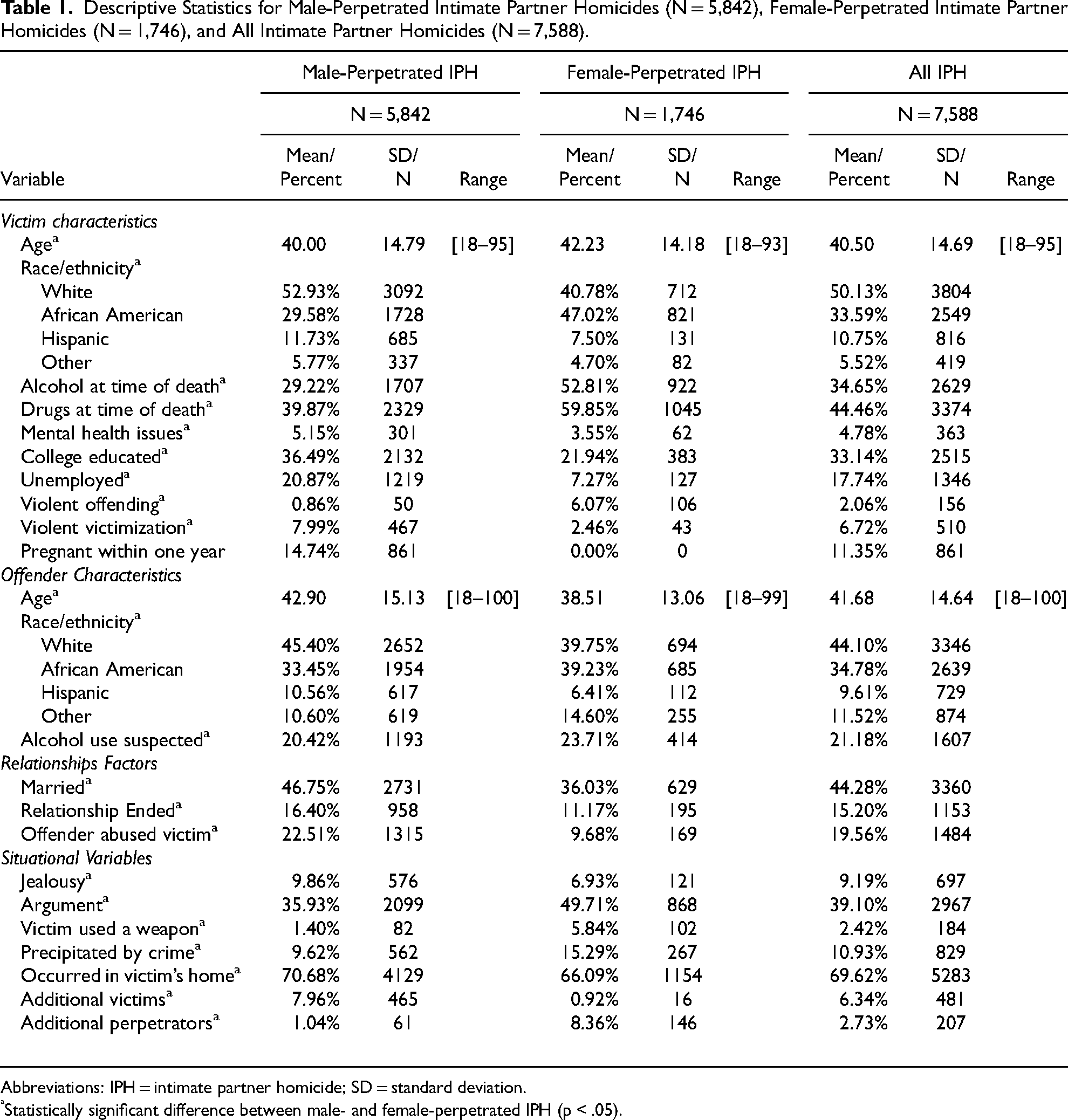
Abbreviations: IPH = intimate partner homicide; SD = standard deviation.
Statistically significant difference between male- and female-perpetrated IPH (p < .05).
Hierarchical Logistic Regression Models Predicting the Odds of Firearm Use as Method of Homicide in Intimate Partner Homicides, for Male-Perpetrated Intimate Partner Homicides (N = 5,842) and Female-Perpetrated Intimate Partner Homicides (N = 1,746).
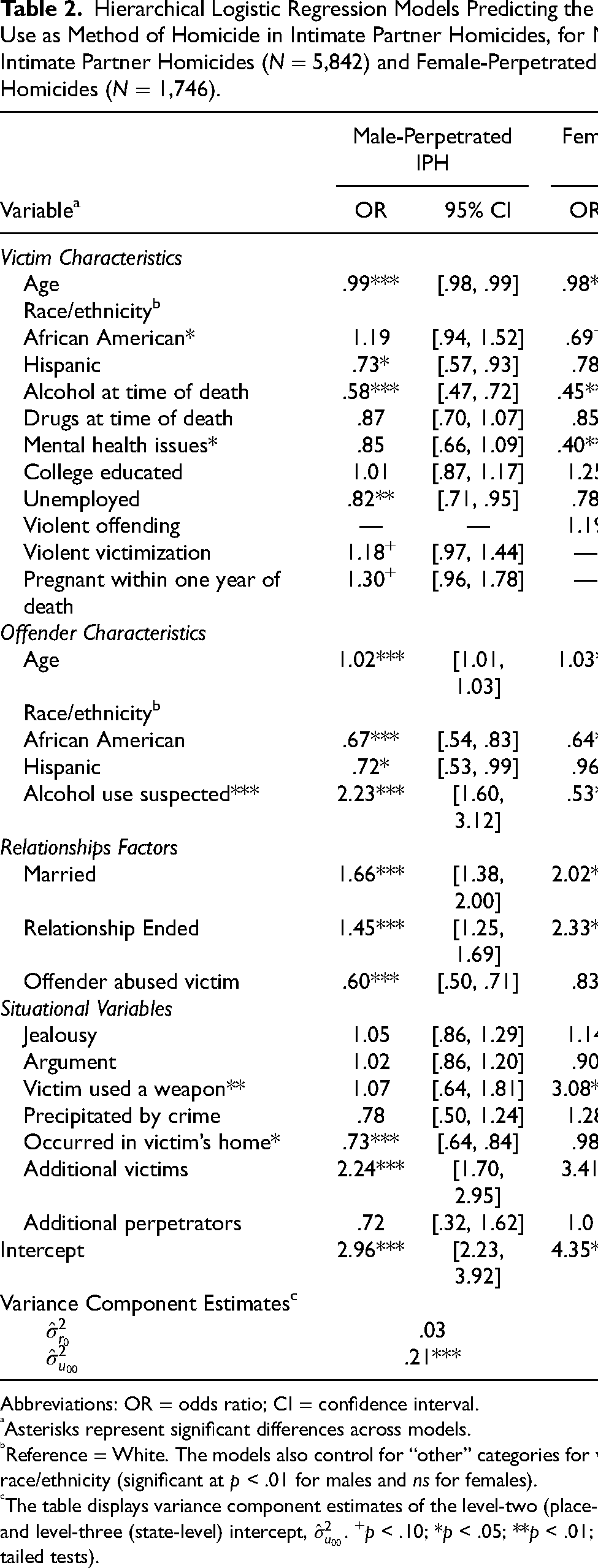
Abbreviations: OR = odds ratio; CI = confidence interval.
Asterisks represent significant differences across models.
Reference = White. The models also control for “other” categories for victim and offender race/ethnicity (significant at p < .01 for males and ns for females).
The table displays variance component estimates of the level-two (place-level) intercept,
Incident characteristics
The study’s two key constructs of interest were coercive control and self-defense, complex behaviors that are difficult to operationalize (Hamberger, Larsen, and Lehrner 2017; Hardesty et al. 2015) and are not directly measured by the NVDRS. In line with prior research and theory (Campbell et al. 2007), threats to the perpetrator’s control of the victim were measured by two binary indicators (0 = no; 1 = yes), including: whether jealousy or distress over a current or former intimate partner’s relationship or suspected relationship with another person led to the incident (9.19%); and whether the relationship had ended at the time of the incident (15.20%). Similarly, the perpetrator’s desire to control the victim was measured by two binary indicators, including: whether the offender had a history of abusing the victim (19.56%); and whether the victim was currently unemployed or economically dependent (17.74%). Self-defense was measured by whether the victim used a weapon or precipitated the incident (2.42%).
Following prior research on IPH (Campbell et al. 2003; Spencer and Stith 2020; Matias et al. 2020), we also controlled for a variety of victim and offender characteristics, relationship factors, and situational variables in the analyses. Demographic characteristics included the age and race/ethnicity (including white, black, Hispanic, and other) of both the victim and offender. We also controlled for the victim’s physical and mental health with a series of binary (0 = no; 1 = yes) variables, including whether the victim: had alcohol (34.65%) or drugs (44.46%) in their system at the time of death; had a history of mental health issues or treatment (4.78%); was a perpetrator (2.06%) or victim (6.72%) of interpersonal violence within the past month; and was pregnant within one year of death (14.74% of female victims). We also included a measure of the victim’s education, whether he or she had completed some college (33.14%) As the NVDRS is a victim-based dataset, little information is available on offenders. Aside from demographic characteristics, we included a binary measure of whether the offender was suspected of using alcohol prior to or during the incident (21.18%). Beyond relationship status and history of abuse, we also controlled for whether the partners were married (44.28%) or dating (55.72%).
We also measured several binary (0 = no; 1 = yes) indicators of situational characteristics, including: whether the homicide followed an argument (39.10%); whether the homicide was related to the commission of another crime (10.93%); whether the incident occurred in the victim’s home (69.62%); and whether additional victims (6.34%) and offenders (2.73%) were involved in the incident.
Analytical Strategy
First, we coded weapon of death (1 = firearm; 0 = no firearm) so as to use two logistic regression models to examine the factors that predict the odds of firearms-related IPH relative to IPH committed with another weapon for male and female offenders separately. To account for the clustered nature of the NVDRS, which nests victims within census-designated places 4 and states, we used generalized estimating equations with robust standard errors in HLM 8.00. 5 Sensitivity analyses using clustered standard errors instead of multilevel models yielded substantively identical results.
Second, we explored potential interaction effects between each of the study variables and perpetrator gender within the split sample approach by conducting significance tests for equality of coefficients across models. Accordingly, we jointly estimated both the male- and female-perpetrated models using the gsem command in Stata accounting for place-level variation to compare coefficients across models (see Canette 2014 and Mize, Doan, and Long 2019). 6 This procedure allows us to examine whether the effect of each study variable significantly differs in magnitude across the male- and female-perpetrated IPH models.
Missing data were imputed using chained equations in STATA 15. The original coding scheme of all variables (e.g., binary) was preserved during this process. Ten imputed datasets were imported into HLM, which averaged results across the datasets. Complete case analysis yielded results nearly identical to those described in the “Results” section. 7 All variance inflation factors were below three, easing concerns about multicollinearity.
Results
Table 2 presents odds ratios (or exponentiated log-odds regression coefficients) and 95% confidence intervals from the logistic regression models predicting the odds of firearm use as method of IPH for male- and female-perpetrated incidents.
The first model examines the victim and offender characteristics, victim-offender relationship factors, and situational variables that predict the odds of male-perpetrated firearm-related IPH relative to male-perpetrated IPH committed with another weapon. Regarding offender and victim demographic characteristics, male perpetrators were significantly more likely to use firearms when they were older or White (relative to African American and Hispanic), yet less likely to do so when their female victims were older or Hispanic (relative to White).
Beyond demographic characteristics, three of the four indicators of coercive control were significantly associated with firearm usage in male-perpetrated IPH, consistent with hypothesis 1. Specifically, the odds of male perpetrators utilizing guns were 45% higher when the relationship had ended (OR = 1.45, 95% CI = 1.25, 1.69). Conversely, the odds of firearm usage decreased by 40% when the offender had a history of abusing the victim (OR = 0.60, 95% CI = 0.50, 0.71) and by 18% when the victim was unemployed or economically dependent (OR = 0.82, 95% CI = 0.71, 0.95). Contrary to the study hypotheses, male perpetrators were not significantly more likely to use a firearm when jealousy contributed to the victim’s death (OR = 1.05, 95% CI = 0.86, 1.29).
Several other victim-offender relationship factors and situational variables were significantly associated with the odds of firearm usage in male-perpetrated IPH. Married men were significantly more likely to use a gun during the incident, as were offenders who killed additional victims. Conversely, incidents that occurred inside the victim’s home were less likely to be committed with firearms. Regarding alcohol use, male perpetrators were more likely to utilize a gun while using alcohol, yet less likely to do so when their victim had alcohol in her system at the time of death.
The second model examines the victim and offender characteristics, victim-offender relationship factors, and situational variables that predict the odds of female-perpetrated firearm-related IPH relative to female-perpetrated IPH committed with another weapon. Regarding offender and victim demographic characteristics, female perpetrators who were older and White (relative to African American) were more likely to utilize a firearm during incident, but were less likely to do so when their male victim was older.
Consistent with hypothesis 2, female perpetrators were over two times more likely to use guns when their male intimate partners precipitated the incident or used a weapon (OR = 3.08, 95% CI = 1.92, 4.94). Indeed, this was one of the strongest factors differentiating weapon use in female-perpetrated IPH.
Several other victim-offender relationship factors and situational variables were significantly associated with the odds of firearm usage in female-perpetrated IPH. Like their male counterparts, female perpetrators were significantly more likely to use a gun when they were married, the relationship had ended, and additional victims were killed in the incident. Additionally, female perpetrators were significantly less likely to use a firearm in cases where they were suspected of using alcohol, their male victims were intoxicated, or their male victims had a history of mental health problems.
Additionally, Table 2 indicates whether the magnitude of effects for all study variables was significantly different for male-perpetrated and female-perpetrated IPH (via asterisks on variable names). Most notably, the attenuating effect of victim mental health issues on the odds of firearm-related IPH was significantly stronger for female perpetrators than for male perpetrators. Similarly, there was a significant difference in the effect of offender alcohol use on the odds of firearm usage; while male perpetrators were significantly more likely to use firearms while intoxicated, female perpetrators were significantly less likely to do so. Pertaining to the situational variables, the positive effect of victim weapon use on the odds of firearm use in IPH was significantly stronger for female perpetrators than for male perpetrators; and the decreasing effect of incident location (in the victim’s home) was significantly stronger for male perpetrators than for women.
Sensitivity Analyses
Although our focus was on the individual-level factors underlying gun usage in IPH, previous research suggests that the crime cannot be fully understood without considering the broader social environment in which these incidents occur. Prior work at the macro level suggests that firearms IPH disproportionately occurs in areas with higher levels of gun availability (Diez et al. 2017; Stansfield, Semenza, and Steidley 2021; Stansfield and Semenza 2019). Other structural factors including concentrated disadvantage, low collective efficacy, rurality, and gender equality have similarly been shown to increase rates of IPH (Browning 2002; Gillespie and Reckdenwald 2017; Pinchevsky and Wright 2012; Voith 2019; Wright and Benson 2011).
Based on this body of literature, we also controlled for various structural correlates of violence and homicide at both the place and state levels of analysis, including: concentrated disadvantage; racial/ethnic heterogeneity; residential stability; gun ownership; the ratio of women to men with a college education; proportion of the population divorced; and the logged total population. As shown in Appendix D, the findings are virtually identical to those presented above, as context appears to play a minimal role in predicting the odds of firearm use in IPH, regardless of offender gender. Place-level characteristics were largely inconsequential, but the odds of firearms-related IPH increased for all perpetrators in states with higher levels of gun availability, an effect that was particularly salient for female offenders. These sensitivity analyses suggest that the vast majority of the variation in gun usage in IPH occurs at the individual level, providing justification for our modeling strategy.
Discussion
Although perpetrator access to a gun is a key risk factor for IPH, few studies have explored the factors underlying their usage (Campbell et al. 2003; Matias et al. 2020; Spencer and Stith 2020). Integrating feminist perspectives with findings from the broader literature on gun utility, we hypothesized that the nature and circumstances of gun usage differ across victim/offender gender dyads, such that: (1) male perpetrators use firearms against their partners in order to regain control and dominance; and (2) female perpetrators use firearms as a last resort in self-defense. Accordingly, we used data from the NVDRS on 7,588 heterosexual IPH cases from 2003 to 2018 to investigate the factors differentiating firearms-related IPH from incidents committed with other weapons.
Two key findings emerged from the analysis and provided strong support for the study hypotheses. First, three out of four indicators suggest that men were more likely to kill their female partners with guns when their power was threatened, but were less likely to use firearms in situations that reaffirmed their control. Specifically, the odds of firearm usage in male-perpetrated IPH increased when the relationship had already ended at the time of the incident, but decreased when the offender had a history of abusing the victim and the victim was unemployed. Second, female-perpetrated IPH with a firearm increased substantially when the victim used a weapon, suggesting that women are more likely to utilize guns in self-defense.
The study findings hold several key insights for theory and research. The results are consistent with prior scholarship on gender differences in IPV/IPH perpetration and gun usage more broadly. Just as guns symbolize power and masculinity in America, our results suggest that they are disproportionately used by male IPH offenders to regain control when their dominance is threatened. In line with feminist theorizing (Daly and Wilson 1988; Dobash and Dobash 1979; Johnson 1995, 2008), men were more likely to use guns when the relationship had already ended and less likely to use firearms when they had already established considerable control over their partners (e.g., the perpetrator had a history of abusing the victim and the victim was economically dependent). In contrast, women were more likely to use firearms when threatened by their partner, an effect consistent with the framing of guns as the ultimate means of protection.
Beyond the overt indicators of coercive control and self-defense, several additional predictor variables were consistent with this interpretation of results. Male offenders, for example, were more likely to use a firearm when: the victim was younger (and perhaps more attractive to other mates); additional victims were present (potentially intervening in the situation and undermining his dominance); and the perpetrator was using alcohol (and therefore acting impulsively and/or out of control). Similarly, female offenders were less likely to use firearms when their victims were incapacitated or less threatening, including when they were under the influence of alcohol or experienced mental health issues. Taken together, these findings suggest that men and women use firearms under different circumstances to achieve distinct goals during IPH incidents. Even further, these differences in gun usage during IPH are likely rooted in the gendered stereotypes surrounding firearms that are so pervasive in American society (Browder 2006; Mencken and Froese 2019; Metzl 2019).
Although largely consistent with the feminist perspective, the results were occasionally incongruous with previous studies. Male sexual proprietariness theory, for example, contends that jealousy/suspected infidelity is a key risk factor for male IPH perpetration as fears of cuckolding threaten a man’s genetic lineage (Daly and Wilson 1988). Contrary to prior empirical work (Campbell et al. 2003; Matias et al. 2020; McFarlane, Campbell, and Watson 2002; Spencer and Stith 2020), jealousy was not a significant predictor of gun usage in IPH for men. In the same vein, a history of interpersonal violence victimization (for female victims) and perpetration (for male victims) did not significantly impact the likelihood of gun usage in either model. Another unexpected finding surrounds the nature of the victim-offender relationship. Regardless of gender, IPH incidents between spouses and former partners were more likely to involve firearms than those between dating partners and individuals currently in a relationship. Prior research on female IPH offending, however, indicates that leaving the relationship is a protective factor (Johnson and Hotton 2003), and may be used as a self-defense strategy by abused women. It is possible, however, that women are more likely to use a gun during IPH (rather than commit IPH in general) if they are confronted by an ex partner and feel that there is no other way to escape.
Given these inconsistencies, an alternate explanation for the study findings is that both men and women use firearms to reassert control in a tumultuous relationship. Indeed, scholars in the family violence tradition support symmetry in IPV, such that both genders use violence as a tool to resolve conflict (Felson and Outlaw 2007; Gelles 1974; Straus 1973). Evolutionary studies similarly indicate that men and women both engage in controlling tactics and mate guarding behaviors (Archer 2013; Graham-Kevan and Archer 2009). Therefore, it is possible that female perpetrators also use firearms to reassert their dominance; this would explain the lack of significant gender differences in coefficients across models. This explanation is less plausible than the feminist perspective, however, for two reasons: (1) prior work supporting gender symmetry in using violence to establish control has focused on nonlethal IPV cases; and (2) the study findings indicate that women are significantly more likely to use firearms than men when their partners use a weapon.
The findings also have important implications for policy and practice. Firearms are used in 60% of IPH incidents (Campbell et al. 2007; Federal Bureau of Investigation 2020; Zeoli, Malinski, and Turchan 2016), and represent a key substrate for potential intervention (Campbell et al. 2003; Matias et al. 2020; Spencer and Stith 2020). The current study indicates that domestic violence prevention programs must consider the role of gender instead of utilizing a one-size-fits-all approach, as men and women use firearms under different circumstances during IPH incidents. Programs for abused women typically promote alternate means of self-defense, such as encouraging help-seeking behaviors, providing information on external resources (e.g., housing programs, battered women’s shelters, crisis hotlines, etc.), and fostering social support systems. Our results suggest, however, that the same strategies are unlikely to reduce male IPH perpetration; indeed, prior research suggests that increased access to traditional domestic violence prevention resources corresponds to a reduction in female IPH perpetration—particularly with firearms—but has a minimal effect on male offending (Fridel and Fox 2019). Instead, counseling services for male offenders should focus on reducing controlling behaviors and developing coping mechanisms to deal with emasculation and loss of power, as these are key correlates of firearms-related IPH for men. While some organizations like Men Stopping Violence in the Atlanta metro area and Shift: The Project to End Domestic Violence in Alberta, Canada have adopted such approaches with promising results, resources for men involved in IPV generally remain limited in comparison to those available for their female counterparts.
Another strategy to reduce firearms-related IPH is passing legislation that reduces firearms access for domestic abusers. The current study, for example, found that while spouses were more likely than dating partners to use firearms regardless of gender, a significant portion of firearms-related IPH offenders are unmarried: dating partners were victims in 46.95% of male-perpetrated and 51.67% of female-perpetrated IPH incidents committed with a gun. This suggests that current federal firearm prohibitions for domestic violence do not apply to approximately half of all firearms-related IPH offenders, as federal legislation defines “intimate partners” as individuals who are current or former spouses, persons who share a child in common, or persons who cohabitate or have previously cohabitated (see 18 U.S.C. § 922). Closing the “boyfriend loophole” is therefore crucial to reducing firearms-related IPH, yet as of 2020 only 20 states currently include dating partners for firearms prohibitions (Siegel 2021). Similarly relevant provisions include extending prohibitions to persons subject to temporary or ex parte domestic violence restraining orders and mandating firearm relinquishment for prohibited possessors; both measures are associated with reductions in IPH (Diez et al. 2017; Giffords Law Center to Prevent Gun Violence 2021), yet have only been implemented in ten and four states, respectively (Siegel 2021). While the current study was unable to directly test the impact of these laws on firearms-related IPH, its findings (as well as prior research) suggest that reducing gun availability is an effective way to prevent gun use—and therefore more deaths—in IPV.
The implications are tempered by several data constraints. First, although the NVDRS provides data on a large sample of IPH victims, it is not nationally representative and contains limited information on offender and relationship characteristics. As a result, we were unable to control for several key risk factors previously identified in the IPV/IPH literature, including the offender’s criminal history and employment status; the length of the romantic relationship; the recency of the breakup, if applicable; prior calls to law enforcement and restraining orders; and the couple’s cohabitation status and number of biological/step children (Campbell et al. 2007; Matias et al. 2020; Spencer and Stith 2020).
Second, the NVDRS does not include direct measures of controlling behaviors, coercion, or motivation (e.g., self-defense). Accordingly, we relied upon proxy indicators identified by the prior literature that tap into these latent constructs to test our hypotheses. While this indirect approach is not ideal, we note that there is no consensus on how to best operationalize coercive control (Hamberger, Larsen, and Lehrner 2017; Hardesty et al. 2015) and some of the measures suggested in the literature are only available using detailed survey data on relatively small samples.
Third, the NVDRS does not make the distinction between firearms access and actual usage, so it is unknown if offenders who used alternate weapons to kill their partners owned or otherwise had access to guns at the time of the incident. While certainly valuable, such information is typically only available for small samples from individual jurisdictions, such as in-depth interviews with residents of battered women’s shelters (Sorenson and Wiebe 2004).
Fourth, the NVDRS only includes information on fatalities, so we were unable to examine differences in gun usage across IPH and nonlethal IPV incidents. While the literature remains sparse in this area, some studies suggest that IPV and IPH have unique correlates (Matias et al. 2020; Spencer and Stith 2020), and therefore that research on IPH may not be generalizable to IPV as a whole. This limitation notwithstanding, we note that gun usage in nonfatal IPV is rare and accounts for less than 2% of all cases; even among those who use firearms during IPV, only 5% of offenders actually shoot the victim (as opposed to brandishing the weapon, pistol-whipping, or shooting adjacent to the victim) (Sorenson and Spear 2018).
Fifth, the NVDRS only includes information on a handful of homosexual intimate partner homicides (N = 222 male-male couples and N = 76 female-female couples), and no information on other gender and sexual identities. As such, the study findings are not generalizable to members of the LGBTQ + community, and more research is needed to examine IPV and homicide in this population.
With these limitations in mind, we conclude by reiterating that feminist scholarship and the broader research on gun ownership are not incompatible. Instead, bridging the gap between these literatures, the present study examined the correlates of firearm usage in IPH by gender. Consistent with prior work, the findings indicate that guns are used by male and female perpetrators under distinct circumstances to achieve unique goals: while men disproportionately use firearms to regain control when their dominance is threatened, women turn to guns for self-defense against an abusive partner. Taken together, the study findings strongly suggest that policies must consider the gender dynamics of the incident to effectively prevent firearms-related IPH.
Footnotes
Declaration of Conflicting Interests
The author(s) declared no potential conflicts of interest with respect to the research, authorship, and/or publication of this article.
Funding
The author(s) received no financial support for the research, authorship, and/or publication of this article.
