




Abstract
Objectives:
Redemption scholars estimate that after an average of 7-10 years pass without a new arrest or conviction, a person’s criminal record essentially loses its predictive value. This article provides the first labor market and recidivism estimates of implementing a criminal background check decision guideline based on this redemption research.
Methods:
The sample consists of provisionally hired job applicants in New York State’s healthcare industry with at least one prior conviction. A “10 years since last conviction” guideline situated within a highly formalized criminal background check process plausibly creates conditional random variation in clearance decisions, which allows for a regression model to estimate causal effects.
Results:
Individuals cleared to work because of the 10-year guideline experience meaningful improvements in employment and earnings, but not recidivism on average. However, men do experience reductions in subsequent arrests, which appears to be driven by more complex factors beyond simply time since last arrest.
Conclusions:
For some individuals, receiving clearance to work even a decade after their last conviction can have not only labor market benefits, but also important recidivism implications. Future research should explore the employment opportunity/recidivism trade-off in adjusting guideline threshold values and consider alternative redemption strategies.
Introduction
Criminal background inquiries and checks serve as a major barrier to Americans with criminal records who are pursuing employment (Holzer, Raphael, and Stoll 2002; Pager 2007; Uggen et al. 2014). Yet obtaining a job may reduce recidivism and induce positive change for individuals with criminal records for various theoretical reasons (e.g., Agnew 1992; Becker 1968; Laub and Sampson 1993, 2001). There is new evidence that passing a criminal background check to work in a job for which a person was provisionally hired reduces recidivism among some people with records (Denver, Siwach, and Bushway 2017), which provides policymakers with further motivation to increase clearance to work. However, policymakers currently have very little guidance on specifically how to increase criminal background check clearance in a way that reduces recidivism without increasing risk to employers, employees, or vulnerable populations.
A recent line of empirical research has laid the groundwork for one potential strategy. Researchers estimate that individuals with prior criminal records have similar probabilities of a new arrest or conviction as those without criminal records after an average of 7–10 years have passed without new criminal justice system involvement (Blumstein and Nakamura 2009; Kurlychek, Brame, and Bushway 2006, 2007; Soothill and Francis 2009). The Equal Employment Opportunity Commission (EEOC 2012) has emphasized the consideration of criminal conviction recency in its revised guidance to employers. As a result, policymakers can potentially experiment with different guideline boundaries to increase criminal background check clearance decisions without increasing the likelihood of recidivism. This idea can also be tested by generating empirical estimates of the causal impact of redemption guidelines on recidivism among a sample of people experiencing a criminal background check.
Improvements in employment but null recidivism findings at the cutoff would confirm that policymakers could, on average, utilize redemption guidelines to promote employment for “desisters,” or individuals with stable rates of low or zero criminal justice system involvement that make them statistically indistinguishable from people without criminal records (Bushway et al. 2001). The question would then become how recent the amount of time since the last conviction could be to extend employment benefits to the most number of people with criminal records.
On the other hand, if individuals still experience recidivism benefits from clearance driven by a “redemption” guideline, then the logic of the policy itself may be flawed. If clearance reduces recidivism among those past the redemption cutoff compared to their recidivism levels had they not been cleared by the guideline, the redemption guideline has not accurately identified desisters as anticipated. This conundrum highlights a catch-22 built into the criminal background check process: A job may play an important role in encouraging or maintaining abstinence from criminal justice system involvement, but applicants may need to demonstrate to employers that they do not pose an undue risk to safety or property before being able to secure a job (Maruna 2009). Evidence that the job itself helps to reduce recidivism can be taken as evidence that, depending on the job context and the employer’s risk tolerance, the probability of recidivism may have been too high before the clearance decision was made.
A finding that the guideline reduces recidivism would also present challenges to the notion of desistance as a static state, instead promoting a symbolic interaction approach to understanding desistance as a more dynamic process. Alternatively, it might also raise questions about the potential policy implications of relying on time since last conviction as a measure of desistance but using subsequent arrest as a measure of risk, as suggested by the EEOC. Many people with relatively long spans since a conviction have actually been arrested more recently. Existing policy choices about the types of information that can be used by employers may have implications for how desistance is conceptualized and future policy strategies.
In the current article, I estimate the effects of adopting a “10 years since last conviction” guideline on employment and recidivism in a particularly vulnerable employment setting for conducting criminal background checks—jobs with direct access to and responsibility for elderly individuals in health-care facilities in New York State. The sample consists of individuals with criminal records who are relatively active in the labor market and have received a provisional job offer, conditional on passing the New York State Department of Health’s (DOH) mandated criminal background check. Importantly, DOH incorporates a redemption guideline in a highly formalized and transparent decision context, which provides an opportunity to establish plausible causal estimates.
Furthermore, since the health-care sector in the current study context includes a large proportion of women and recent research finds important differences in recidivism outcomes for men and women undergoing criminal background checks (Denver et al. 2017), the study can also examine whether the impact of the 10-year guideline varies in meaningful ways by sex. Therefore, the current study has three main contributions: to provide an important policy extension to redemption research, which has established general guidelines for determining when criminal records lose predictive value but has not yet tested the use of such guidelines in practice, to provide further insight into the catch-22 desistance puzzle, and to contribute to the small existing literature on variations in desistance by sex.
Theoretical Expectations
Time since last conviction guidelines are a unique “treatment” for individuals with criminal records because researchers were not originally attempting to change behavior. Instead, redemption researchers were responding to a call from the courts ( El v. Southeastern Pennsylvania Transportation Authority 2007) 1 inquiring how much time would need to pass before an employer could reasonably assume a person with a criminal record had sufficiently “low risk” to be hired. Researchers then calculated redemption points by estimating when the hazard rate for a sample of individuals with prior criminal records starts to look comparable to the hazard rate for a sample of individuals without a criminal record. As Blumstein and Nakamura (2009:340) note, while some hazards converge, other hazards might not, so instead researchers may need to make a judgment call on when the two groups appear “close enough.” The overall consensus is that after 7 to 10 years have passed without new arrests or convictions, on average individuals with prior criminal records reach the point of redemption.
While prior empirical evidence focuses on prior arrests (Blumstein and Nakamura 2009; Kurlychek et al. 2006) and police contacts (Kurlychek et al. 2007), using prior conviction records to differentiate record/no record samples is less common. Yet as Blumstein and Nakamura (2009) caution, for decision makers in some employment contexts, it may be inappropriate or illegal to consider closed arrests that did not result in a conviction. And importantly, the calculated point of redemption may differ when considering prior conviction records compared to prior police contact or arrest groups. For example, in Soothill and Francis’s (2009) study, the three criminal record hazard groups (no convictions at ages 10–16 but one or more convictions between ages 17 and 20, convictions at ages 10–16 but no convictions between 17 and 20, and convictions in both groups) never technically converge with the no record group, and the overall estimated redemption points are closer to 10 to 15 years. In addition to natural delays in criminal justice system processing between an arrest event and the subsequent conviction, age at the time of the record, current age, and record type all appear to play an important role and can shift the point of redemption. Although there are variations, Soothill and Francis (2009:385) ultimately agree with Kurlychek and colleagues that after approximately 10 years, “it is time to wipe the slate clean for most offenders.” As a result, this particular redemption strategy is not intended to intervene in the traditional sense to reduce recidivism but may reduce stigmatization for individuals with “stale” criminal records and improve their employment opportunities.
Whether a redemption employment strategy improves labor market and recidivism outcomes is currently untested. On the one hand, because so much time has passed, individuals cleared to work due to the time since last conviction guideline may be no better off in the labor market than individuals who otherwise look similar but are denied employment under a particular guideline threshold. Similarly, a redemption strategy may not influence recidivism. Skardhamar and Savolainen’s (2014) examination of a sample of individuals with felony convictions suggests stable employment is a response to desistance, not the initiating factor. In their review of maturation, social control/life course, and motivation theories, Kurlychek, Bushway, and Denver (2016:255) also conclude that theoretically, time since last guidelines “will have little to no direct impact…under most theories of desistance.” From a redemption perspective, the purpose is to identify individuals who have already experienced change (or “desisted”), not to induce change in criminal justice system involvement.
Alternatively, passing a criminal background check due to a 10-year guideline might be expected to have small or moderate improvements in employment and/or earnings simply because individuals who are actively seeking work secure the job. In general, a job may theoretically influence recidivism outcomes by increasing the ability to obtain desired material goods and attain cultural goals (Merton 1938), reduce incentives to commit crime (Becker 1968), and function as a way to develop positive social bonds that serve as informal social controls and restrict the inclination to engage in crime (Laub and Sampson 1993). Obtaining a job might also provide an individual with a new master status (Becker 1963), which in turn might overpower the potentially crime-inducing stigma and labels typically attached to a criminal record (Lemert 1951). From a symbolic interaction perspective, identities and self-perceptions are continuously shaped by interactions with social environments (Maruna 2012; Maruna et al. 2004). An individual’s level of “risk” is the result of or reaction to these social interactions rather than an intrinsic characteristic of a person (Lemert 1951; Maruna 2012), which may help to explain why episodic derailments (Giordano, Schroeder, and Cernkovich 2007) sometimes occur. In a dynamic framework, a denial decision for employment on the basis of a criminal background check (and specifically here, falling under a particular threshold guideline) may be an influential negative event even years after an individual’s last conviction occurred. This may be particularly true if local labor market conditions are poor and/or alternative employers also conduct criminal background checks and have adverse reactions to criminal records.
In light of these competing theoretical perspectives, the next section details the study context, which guides the methodological approach used to estimate the effects of implementing a redemption guideline. Specifically, I examine DOH’s “10 years since last conviction” guideline, which is a component of a formalized criminal background check conducted on individuals provisionally hired to work with patients or residents in the health-care industry. Due to the nature of the industry type, a large number of women undergo the criminal background check, and, in turn, a sizable proportion of the final conviction sample consists of women. Prior work examining the impact of a criminal background check decision on recidivism outcomes points to meaningful variations by age and sex, which provides evidence that desistance paths may differ in important ways (Denver et al. 2017). While age is notably correlated with time since last conviction (with individuals under 26 being automatically ineligible for a 10-year guideline), differences between men and women can be explored in the current study. After estimating the average sample effects, I examine heterogeneous treatment effects by sex and consider potential explanations for the findings, which leads to a discussion about policy implications and future areas for research.
Study Context and Analytic Approach
The study sample consists of individuals required to undergo a mandated criminal background check instituted in the health-care sector in New York State in 2006 through Public Health Law Article 28-E. Specifically, the law applies to all individuals provisionally hired to work in low-skill, nonlicensed positions that involve direct access to patients or residents (e.g., home health-care aides) in licensed facilities such as nursing homes or licensed home care services agencies. Volunteers, employees without direct access or contact (such as employees preparing food or maintaining the grounds), and employees licensed under Article 8 of the New York State Education law (university affiliated positions) are exempt from this background check.
It is important to emphasize that the sample is comprised of individuals who are provisionally hired to work; that is, everyone in this sample has applied for a job and has been deemed qualified by an employer. The only remaining barrier to obtaining the job is a state-mandated criminal background check conducted by an independent unit that is external to the employer. Compared to broader samples of individuals with criminal records, many of the unobservable characteristics researchers may be concerned about measuring and including in a model (e.g., motivation to work, how the person presents himself to an employer, etc.) are less applicable to this particular criminal background decision context.
After individuals are provisionally hired to work in a facility, they submit fingerprints to the Division of Criminal Justice Services (DCJS). DCJS collects in-state information and requests a national background check search from the Federal Bureau of Investigations (FBI). DCJS then provides all unsealed conviction and open arrest information to DOH. Individuals without criminal records are automatically cleared to work, and attorneys in DOH’s Criminal History Record Check Legal Unit review all cases containing criminal records. While individuals wait for the criminal background check results, they are allowed to work in either direct access care under supervision or nondirect access care positions. Most individuals (∼80 percent) do work during this provisional hire period.
DOH has a two-stage decision-making process. In the first stage, DOH makes an initial determination—clearance or proposed denial—based exclusively on criminal record information. In the second stage, everyone receiving a proposed denial has an opportunity to submit evidence of rehabilitation within 30 days to attempt to alter the proposed denial. Then DOH reevaluates all contested decisions and makes a final decision. If an individual does not contest the proposed denial, the final decision converts to a denial. For most individuals (approximately 80 percent), the final decision is equivalent to the initial determination.
The focus of the current study is the initial determination stage, which only considers criminal record information and is strongly influenced by the 10 years since last conviction guideline. To be considered a true threshold guideline, individuals at or above 10 years must be disproportionately more likely to receive clearance than individuals under 10 years. If this is true, there may plausibly be no difference between individuals on either side of the threshold except for receiving clearance due to the 10-year treatment, conditional on controlling for the other components of the criminal record that may be correlated with both the treatment and outcomes of interest. In other words, under the correct model specifications, receiving the treatment is essentially random.
A strength of the current study context, which provides a convincing platform for meeting this assumption, is the ability to largely predict DOH’s initial determination. The predictable nature of the initial decision is guided by both state law and internal practice. The jobs examined here require interaction with an elderly and vulnerable population, and New York State law classifies certain crime types as “automatic disqualifiers” (i.e., automatic denials) for this particular background check. Under Public Health Law 28-E, the most severe crime types (e.g., murder, kidnapping in the first degree, terrorism) are considered automatic disqualifiers regardless of when the offense(s) occurred. Other felonies, which are still severe and include (but are not limited to 2 ) offenses such as attempted murder in the second degree or rape, robbery, burglary, or grand larceny in the first or second degree, are considered automatic disqualifiers if the offense(s) occurred within 10 years. On the other end of the spectrum, there are certain misdemeanor offenses that DOH has predetermined are not directly related to the job in question and should warrant an automatic clearance decision under certain conditions. The list of misdemeanor crime types and the conditions 3 under which they apply are detailed in a list by DOH and are observable to our research team.
Even within the discretionary cases that do not qualify as automatic disqualifiers or automatic clearance cases, the initial determination is heavily guided by New York State’s Correction Law Article 23-A. Article 23-A requires decision makers conducting criminal history background checks for employment purposes to consider a set of eight factors. Two of the factors are broad (to encourage employment for individuals previously convicted of a crime and to protect public safety), one factor is related to DOH’s second-stage process (the ability to provide evidence of rehabilitation), and two factors are related to the job type, which does not meaningfully vary within the DOH context. The three remaining factors, which can vary across DOH cases and are relevant to the initial decision phase—age at the time of the offense(s), seriousness of the offense(s), and time since last offense(s)—are also observable to researchers.
Although not required by law for discretionary cases, the 10-year threshold value from Public Health Law 28-E has carried over more generally into DOH’s decision-making practices. It should be noted that the 10-year guideline is not a concrete rule or the only consideration in making a clearance decision, and the guideline is not applied in every case. Yet as depicted descriptively in Figure 1, time since last conviction is highly influential in the initial decision right at the 10-year threshold. Specifically, individuals in this sample experience over a 40 percentage point increase in clearance to work at the 10-year mark.
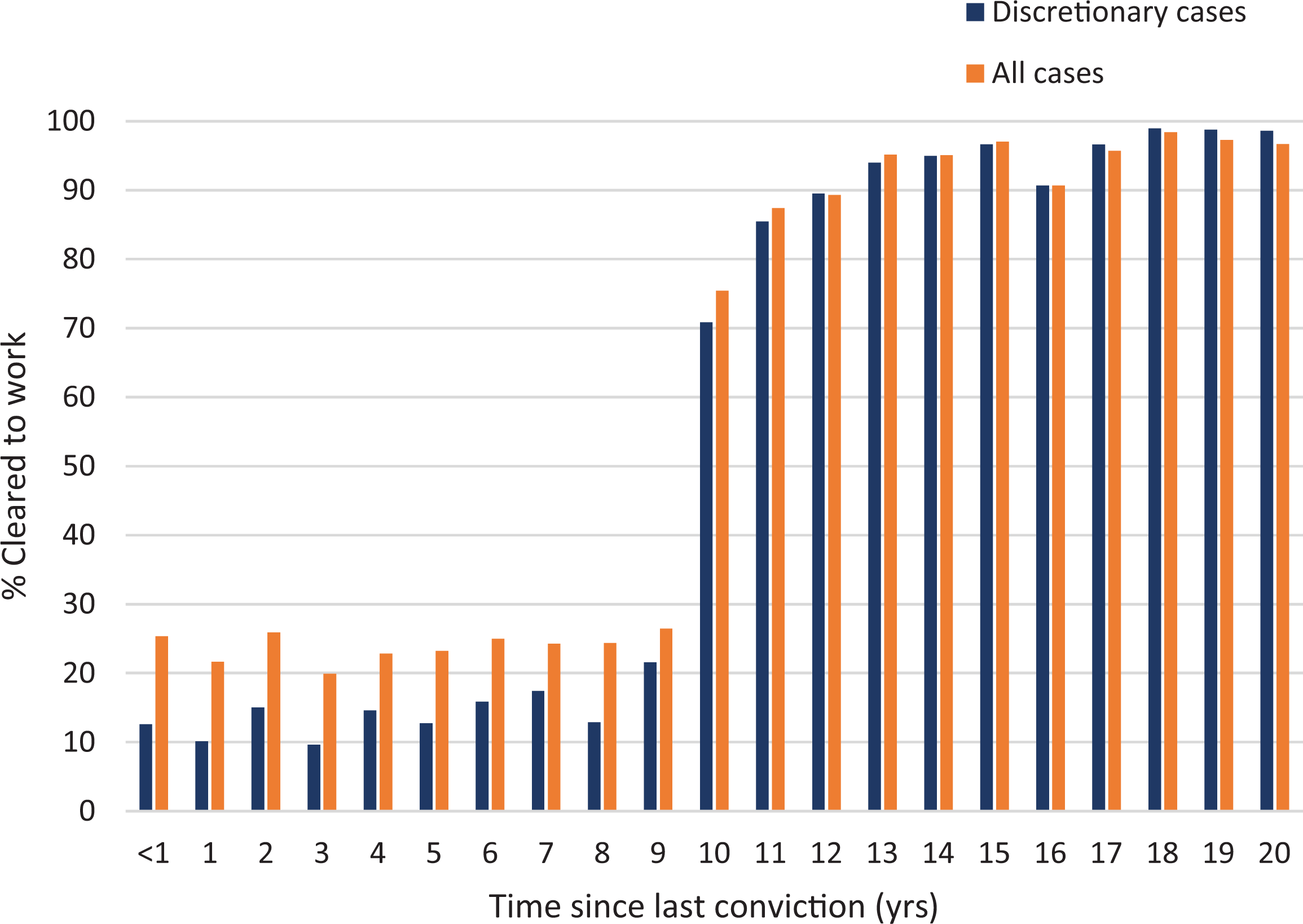
Descriptive relationship between initial clearance decision and 10-year guideline. The full sample and the discretionary sample (i.e., removing autodisqualifying or autoclearance cases) are both plotted but only the first 20 years since last conviction are displayed here. The percentage cleared does not drop below 91 percent in subsequent years, and the maximum time since last conviction value is 52 years.
After incorporating detailed criminal history controls, the 10-year guideline is still a strong predictor of the initial clearance decision (Kurlychek, Bushway, Siwach, and Denver, Forthcoming). In addition, subsequent arrest patterns do not have the same discontinuity at the 10-year threshold; instead, there is a general declining trend for both the overall sample and those initially cleared to work (Figure 2).
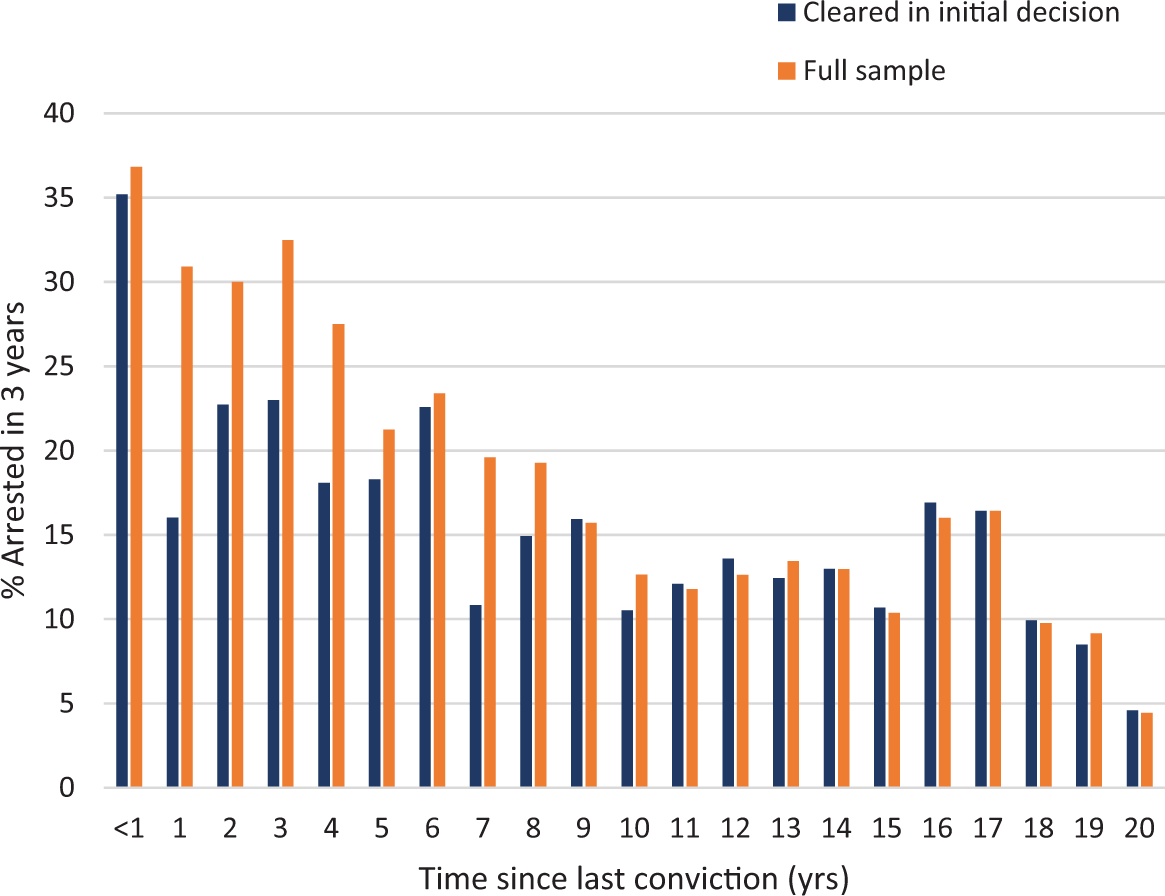
Descriptive relationship between recidivism and 10-year guideline. Only the first 20 years since last conviction are displayed here.
Based on the influential nature of the decision guideline and highly formalized criminal background check process, the current study employs a selection on observables (or conditional independence assumption) approach to causal inference. Although we are only ever able to observe one outcome for each person, we can use a potential outcomes framework, where y 0i represents a person’s recidivism status had he or she been ineligible for the 10-year guideline Ti (i.e., had a “younger” conviction record) and y 1i represents the person’s recidivism status had the conviction record been at least 10 years old. (Both y 0 and y 1i are irrespective of whether the person was actually eligible for the 10-year guideline.) If key factors are unaccounted for in the model, the average of y 1i – y 0i will produce a biased estimate. However, by conditioning on critical covariates Xi , we can remove selection bias:

The charge/conviction report that DOH uses and provides to employers and prospective employees includes arrest/conviction dates, criminal statute and codes, and crime severity, all of which are visible to our research team. The 10-year guideline only applies to convictions in both guidelines and practice, and unless a case is automatically disqualified as described above (which is also observable), the guideline is not conditional on any other explicit rules or situations.
While in lieu of a randomized experiment it is always possible that there are unmeasured characteristics for which the treated and comparison group differ, I include an extensive and rich set of covariates to reduce this potential problem. In addition to demographic, prior employment, and contextual controls, I extensively control for criminal history, including continuous measures for time since last arrest and last conviction, in an attempt to absorb any theoretical or empirical meaning the 10-year guideline might have. This leaves the 10-year guideline as simply a <10 or 10+ dummy indicator. While there are rarely research situations in which a multivariate regression model is a plausibly causal model, this unique study context provides an important potential exception. The following ordinary least squares (OLS) model 4 is used to estimate the key relationships of interest:

Here, Si represents the following outcomes of interest: employment (0/1), health-care industry employment (0/1), earnings, and in-state subsequent arrests (0/1) within one year and three years postdecision. The number of quarters employed in the three-year postperiod is also included as an outcome of interest since most of the sample works in some capacity in at least one quarter in the postperiod. Ti is the 10-year dummy guideline indicator measured as under 10 years (0) or 10+ years (1). Di , Ei , and Hi represent individual vectors for demographics, prior employment, and criminal history record information prior to the initial decision, respectively.
Each model includes clustered standard errors based on the 10 regions in New York State. Due to the low number of clusters, I estimate clustered wild bootstrap standard errors as a robustness check, as recommended by an anonymous reviewer. The wild bootstrap is similar to the residual cluster bootstrap, which holds the regressors constant while resampling the residuals, but relaxes assumptions related to cluster size and variance (Cameron, Gelbach, and Miller 2008). Following Cameron et al. (2008), I conduct 1,000 bootstrap replications and impose the null hypothesis, which generates similar, albeit slightly more conservative, estimates.
Data
The data are part of a research partnership with three New York State agencies: the DOH, DCJS, and Department of Labor (DOL). Everyone in the current sample underwent their first mandated DOH criminal background check in 2008 or 2009. The DOH data are supplemented with 6 years of DOL employment and earnings data (three pre and three post) and DCJS criminal record data (all prior arrest and conviction records available to DCJS and three years postclearance decision). 5
The sample is comprised of individuals with at least one criminal conviction prior to the initial DOH decision. Of 7,541 individuals with at least one prior conviction, 6,989 cases have matches in the DOL data file. 6 Of these cases, 343 cases are missing criminal record information and are removed from the analysis. Most of the cases missing criminal record information involve missing prior disposition information (n = 274), 7 although 37 cases are missing arrest information in DCJS’ files and 32 cases are missing a full three-year follow-up window after the initial decision. The final analysis sample includes 6,646 individuals.
Approximately 48 percent of individuals are cleared to work in the initial determination. Nine percent of the sample is arrested within one year of the decision and 22 percent within three years. Over 70 percent of individuals in this sample are women, and the sample is 39 years old on average. Most of the individuals are Black (50 percent) or White (48 percent). Contextually, approximately half of the individuals are provisionally hired to work in licensed home care services agencies and the other half in nursing homes, and geographically, around a third of individuals are provisionally employed in New York City.
The criminal records observed in this sample are older and less severe than typical samples of individuals returning from prison. This aligns with expectations from prior research, which differentiates “offender-based samples,” such as the current study, from “event-based samples,” or cohorts undergoing a shared event such as release from prison (Rhodes et al. 2016). In this sample, individuals have a little over two prior convictions on average, typically for misdemeanor crimes. Individuals experience their first arrest around age 26, and average time since last conviction is approximately 8.8 years. Overall, 36 percent (n = 2,374) of the sample was “eligible” for the guideline (i.e., the person’s last conviction was at least 10 years ago). Of those ineligible for the guideline, only 24 percent were cleared to work in the initial or proposed clearance decision, compared to 92 percent of those eligible for the 10 year guideline. 8
The sample is fairly active in the labor market; around three quarters worked to some degree in the year before the DOH criminal background check, with close to half working in the health-care sector at some point in the three years prior to the decision. On average, this sample earned less than US$10,000 in the year prior to the DOH decision from in-state employment that reports to the unemployment insurance program (i.e., pay stub jobs). Table 1 reports additional descriptive statistics.
Descriptive Statistics.
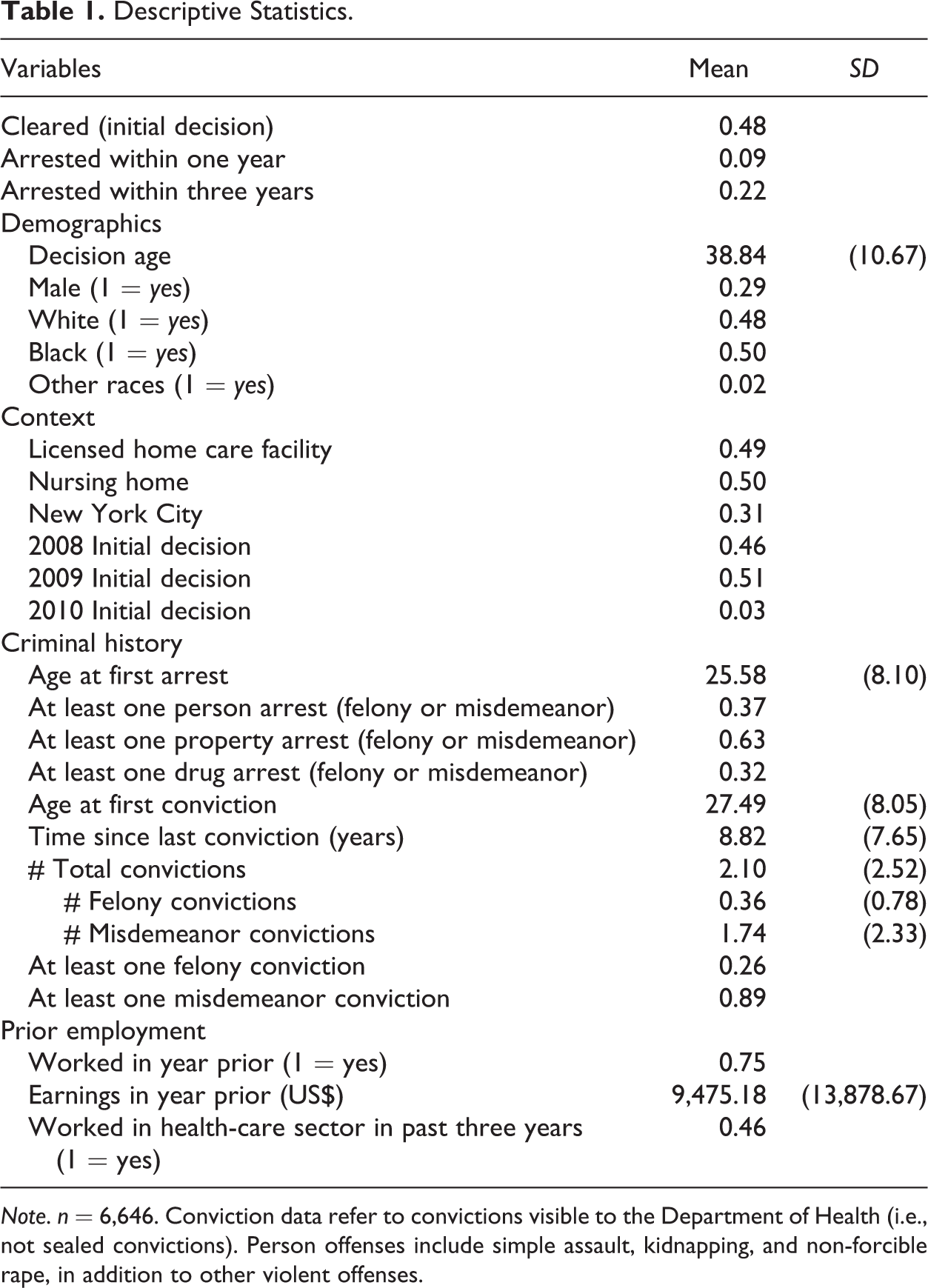
Note. n = 6,646. Conviction data refer to convictions visible to the Department of Health (i.e., not sealed convictions). Person offenses include simple assault, kidnapping, and non-forcible rape, in addition to other violent offenses.
As controls in the models, I include demographic information (a continuous measure for age at the initial clearance decision, age squared, whether the individual is Black, and whether the individual is a man) and contextual factors (whether the health-care facility is a licensed home care facility [1] or a nursing home [0], 10 facility location region dummies based on the Regional Office Network classification system DCJS uses, and time dummy variables for the year the DOH decision occurred). I also include controls for the number of quarters employed and average total earnings three years prior to the initial clearance decision. Arrest controls include years since last arrest, logged age at first arrest, number of felony arrests, number of misdemeanor arrests, dummy indicators for whether the individual ever had a particular felony class (A, B, C, D, or E) and dummy indicators for crime type (person, property, drug, and other). Conviction controls include years since last conviction, logged age at first conviction, number of felony convictions, number of misdemeanor convictions, felony class dummy variables, and the same four crime type dummy indicators used in the arrest controls. An individual can have more than one arrest crime type and more than one conviction crime type in the models. Finally, dummy indicators were included for whether the person was eligible for the automatic disqualifier policy or automatic clearance guideline.
The outcome variables in this study include employment, health-care employment, earnings, and subsequent arrest. To be considered “employed,” the individual needs to earn at least US$1 in the outcome period, and available employment information is restricted to in-state employment. Informal jobs where state taxes are not collected are excluded here. Health-care employment is defined as a position with the two digit North American Industry Classification System value “62” (health-care and social assistance). This encompasses a range of jobs in the health-care sector, including all jobs that fall within DOH’s criminal background check mandate. Employment and health-care employment are coded as dummy variables (0/1) for whether the person worked, and earnings are presented as total dollars. Subsequent arrest (or “subarrest”) includes any in-state misdemeanor or felony arrest charge but excludes technical violations and infractions. Each outcome is measured as the year after the initial clearance decision and three years postdecision. An additional outcome variable for the number of quarters worked in the three-year postperiod (which ranges from 0 to 12) is also included.
Results
The short- (one year) and longer-term (three-year) main effects of the 10-year guideline on labor market and recidivism outcomes are presented in Tables 2 and 3, respectively. It should be noted that while the full set of arrest and conviction variables is necessary for the assumptions underlying this model, since the criminal history control variables are highly collinear and should not be individually interpreted, most are not included in the tables. Most notably, time since last arrest and time since last conviction are highly correlated (ρ = .86). While many of the controls are not meaningfully correlated with the outcomes of interest in the regression model, White individuals and those with more preperiod employment experiences work more in the postperiod on average, while men, older individuals, those with higher preperiod earnings, and those with longer time since last arrest earn more on average. As anticipated, men and younger individuals experience more subarrests than women or older individuals.
Ordinary Least Squares Outcomes in Year 1.
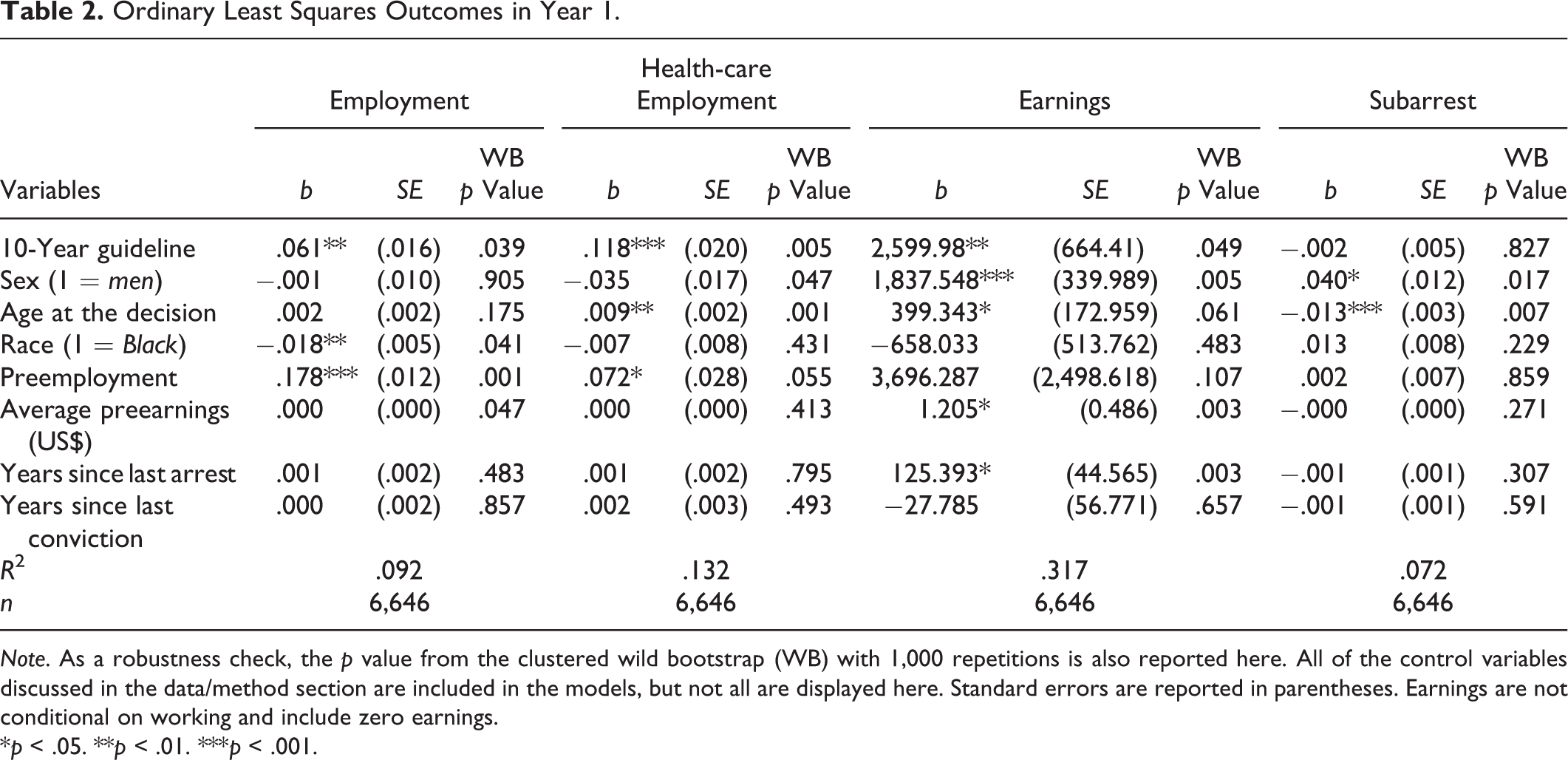
Note. As a robustness check, the p value from the clustered wild bootstrap (WB) with 1,000 repetitions is also reported here. All of the control variables discussed in the data/method section are included in the models, but not all are displayed here. Standard errors are reported in parentheses. Earnings are not conditional on working and include zero earnings.
*p < .05. **p < .01. ***p < .001.
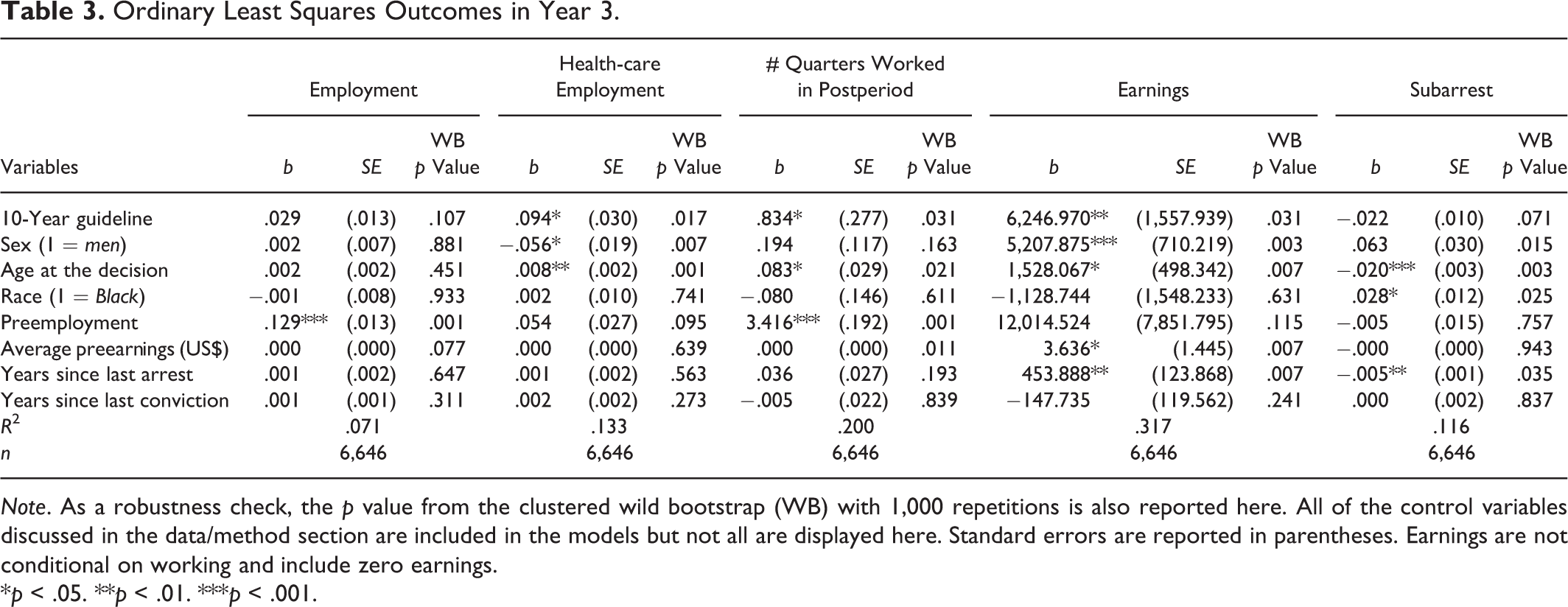
Ordinary Least Squares Outcomes in Year 3.
Note. As a robustness check, the p value from the clustered wild bootstrap (WB) with 1,000 repetitions is also reported here. All of the control variables discussed in the data/method section are included in the models but not all are displayed here. Standard errors are reported in parentheses. Earnings are not conditional on working and include zero earnings.
*p < .05. **p < .01. ***p < .001.
The results from Table 2 suggest the 10-year guideline leads to a 6 percentage point increase in general employment (on a base rate of 81 percent). This effect is primarily driven by employment in the health-care sector. Over 70 percent of those employed in both postperiods (one year and three years) were employed in health-care, and the health-care employment outcome model indicates there is almost a 12 percentage point improvement due to the 10-year guideline (base rate of 53 percent). Furthermore, if only those completely employed outside of the health-care sector in year 1 or year 3 are included in the model, the effects are smaller—2.6 and 0.2 percentage points, respectively—and nonsignificant (results not presented here but available upon request). In terms of earnings, the guideline leads to an additional US$2,600 in the first year postdecision. All of the results retain statistical significance at the .05 α level even with the more conservative clustered wild bootstrap.
However, the subarrest effect size is essentially zero. Therefore, while the 10-year guideline contributes to the employment and earnings of individuals with criminal conviction records through clearance to work, the guideline has a null effect on subsequent arrest events in the first year postdecision.
The three-year postdecision outcomes are presented in Table 3. The 10-year guideline has a smaller magnitude over this longer period of time, with a 3 percentage point (nonstatistically significant) effect for employment and 9.4 percentage point improvement in health-care employment (base rates of 89 percent and 59 percent, respectively). It is important to note that these variables are coded as working at any point within the three-year period (1) or not (0), which covers a long period of time. Another way to examine the influence of the 10-year guideline on employment over the longer term is to replace the dichotomous employment outcome with a measure of how many quarters (of the 12 postperiod quarters) individuals worked. In this model (middle column in Table 3), the guideline increases employment in the three-year postperiod by approximately 0.83 quarters. In other words, the 10-year guideline led to an additional 2.5 months of employment over a three-year period.
The individuals in this sample underwent the criminal background check in 2008 or 2009, at the height of an economic recession in New York State. Therefore, even a few extra months of employment might have important financial implications. Average earnings seem to slightly decrease over time from that initial postyear effect (US$6,250 is a little less than US$2,100 per year on average over the three years), but the effect sizes are still large several years after the DOH decision. Similar to the one year postperiod results, the 10-year guideline retains a null effect for subarrests in the three-year postdecision period.
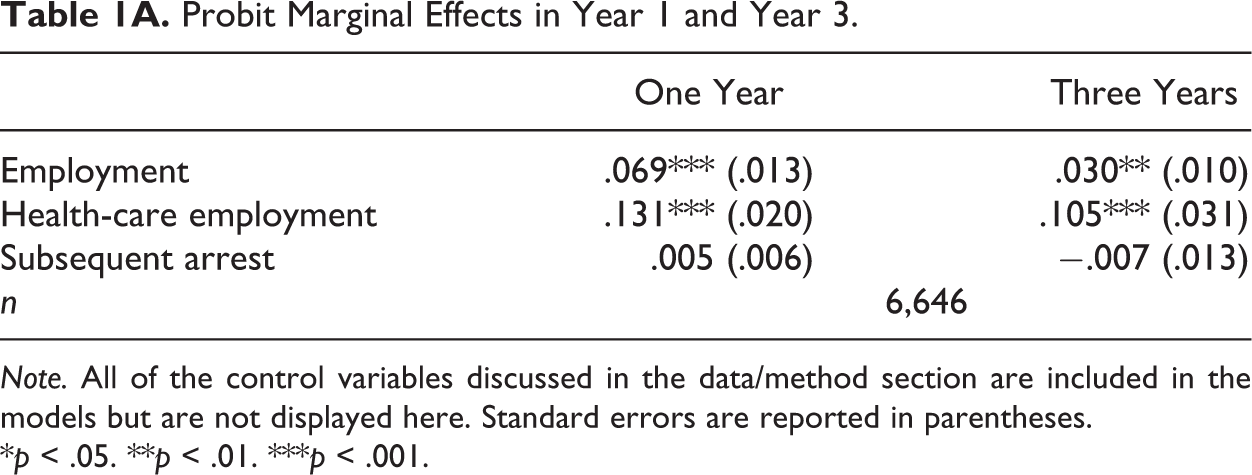
I estimate probit models for the dichotomous dependent variables as a robustness check (see Appendix for the marginal effects at the means of the covariates). The employment, health-care employment, and subarrest probit models all have very similar magnitudes for the one year and three-year postoutcomes, and the main OLS results appear slightly more conservative in terms of statistical significance. Overall the results indicate that employment and earnings are strongly influenced by a criminal background check clearance decision in a 10 years since last conviction guideline setting, but recidivism outcomes are not.
I also conduct several robustness checks related to specific features of the study context. First, I test whether treatment manipulation may be occurring. Although informal conversations with local advocates focusing on employment for individuals with criminal records suggest they are unaware of the 10-year guideline and it may not be strategic for individuals to wait to apply to become eligible for the 10-year guideline, it is possible that decision makers could hold cases that are near the threshold value for a few weeks or months until the person crosses over. To test this idea, I examine the factors correlated with application processing time (measured as the difference between the criminal background check fingerprint date, which initiates the process, and the initial letter date/correspondence from DOH). In the analysis, I control for the same criminal history (to capture case severity), demographics, and employment variables as the other analyses. I also include month/year dummy variables to control for caseload and staffing variations, and an indicator for 10-year threshold proximity. Specifically, I consider proximity to be month 120 since the person’s last conviction (right at the 10-year threshold). If the treatment is being manipulated, the cases that fall on the 10-year threshold at the time the initial decision is released should have longer decision processing time (i.e., people should be given extra time to cross over the threshold). Compared to other cases, those cases that just cross over to 10 years actually take less time to process, although the results are nonsignificant (results available upon request). Older criminal record cases may be generally easier to process, and therefore, faster. 9
As a second robustness check, since I only have access to in-state information for subarrests, I explore whether removing individuals with only out of state prior criminal record information (∼14 percent of the sample) influences the results. The employment and earnings effects are robust to removing these cases, and the subarrest effect remains null in both the short- and longer-term postperiods. In addition, New York City is often analyzed separately, since the context is very different than Upstate New York. The results are also robust when New York City is analyzed or removed. All of these results are available upon request.
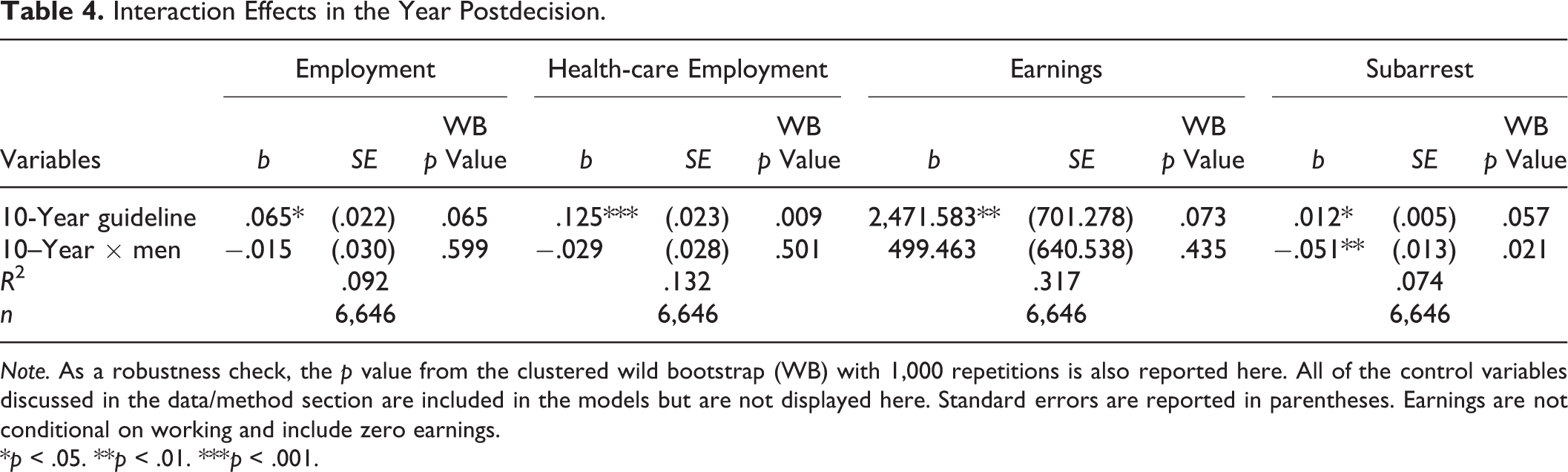
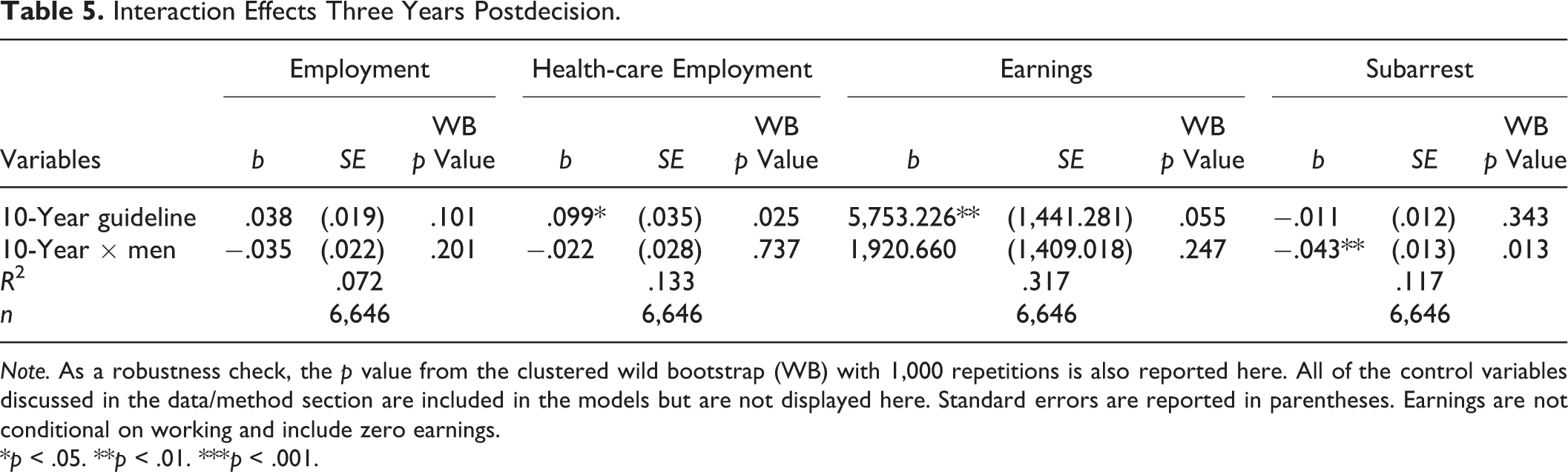
However, it is important to note that the sample examined here is predominantly (∼70 percent) women, and prior research finds differential effects of clearance to work on recidivism for men and women (Denver et al. 2017). Descriptively, while 22 percent of the overall sample was arrested within three years, 19 percent of women and 29 percent of men experienced an arrest event. To determine whether the 10-year guideline has differential effects by sex, I include a sex × treatment interaction effect in the model. Although the 10-year guideline does not have a meaningful added impact on any of the labor market outcomes for men, there is an additional significant, substantively meaningful effect on recidivism for men. Specifically, the effect of the 10-year guideline on subsequent arrests for men is −3.9 percentage points in the first year (compared to 1.2 for women; see Table 4) and −5.4 percentages points in the three-year period postdecision (compared to −1.1 for women; see Table 5). The surprising decline in subarrests for men raises interesting questions, given that there does not appear to be a differential effect of the guideline on employment for men relative to women.
Interaction Effects in the Year Postdecision.
Note. As a robustness check, the p value from the clustered wild bootstrap (WB) with 1,000 repetitions is also reported here. All of the control variables discussed in the data/method section are included in the models but are not displayed here. Standard errors are reported in parentheses. Earnings are not conditional on working and include zero earnings.
*p < .05. **p < .01. ***p < .001.
Interaction Effects Three Years Postdecision.
Note. As a robustness check, the p value from the clustered wild bootstrap (WB) with 1,000 repetitions is also reported here. All of the control variables discussed in the data/method section are included in the models but are not displayed here. Standard errors are reported in parentheses. Earnings are not conditional on working and include zero earnings.
*p < .05. **p < .01. ***p < .001.
One possibility is that the “offense” in prior “time since last offense” research matters and is not fully captured in the specified model. The literature surrounding time since last police contact or arrest (which is often preferable from a criminologist’s perspective) might not directly translate to time since last conviction (preferable from the EEOC’s perspective). Comparing the men and women in this sample, the two groups have statistically similar average amounts of time since last conviction (8.6 years for men; 8.9 years for women), ages at the time of DOH’s decision (38.8 for both), and are comparable in terms of race (49 percent of men are White, compared to 47 percent of women). However, men and women’s criminal records diverge in notable ways. In particular, women in this sample have a longer time since last arrest on average (eight years) compared to men (seven years). It may be that people who are “more active” in the sense that they experienced a more recent arrest—even if they are considered desisted or low risk from a time since last conviction guideline—are driving the finding for men.
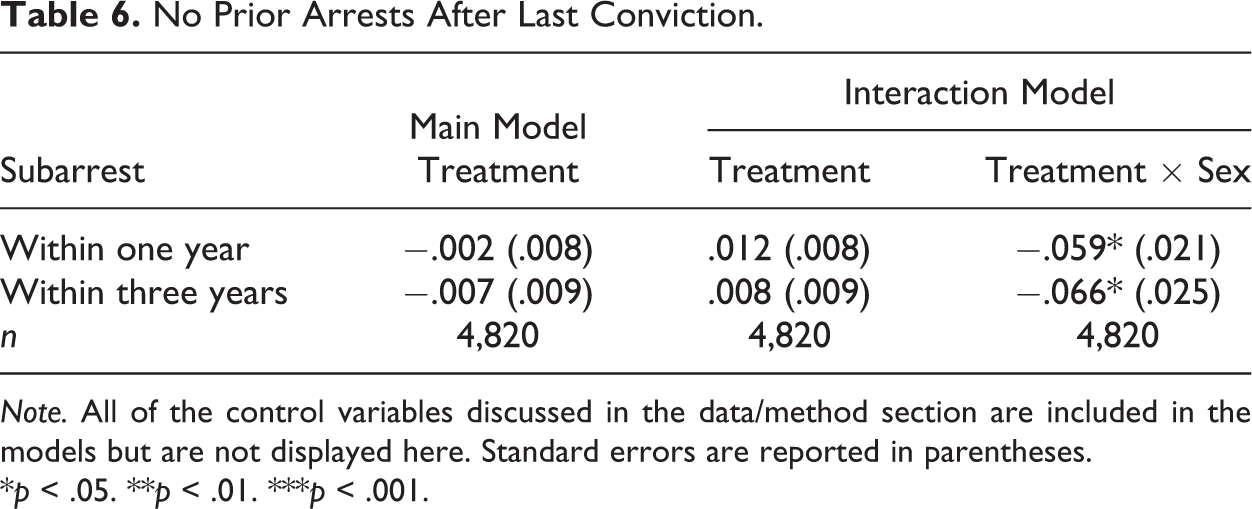
To explore the time since last arrest/conviction relationship, Table 6 removes everyone with a recorded arrest after the person’s last conviction but before DOH’s criminal background check decision. In other words, no one can have an arrest event that is more recent than the conviction information DOH decision makers observe and use. The first column is the main model and reflects the overall null subarrest finding in the original models. The second column then displays the model with the interaction effect. Here, the effect of the 10-year guideline on subsequent arrests for men is −4.7 percentage points in the first year (compared to 1.2 for women) and −5.8 percentage points three years postdecision (compared to 0.8 for women). Instead of reducing in magnitude, the differences in recidivism between men and women are actually slightly larger in this model compared to the main interaction effects in Tables 4 and 5.
No Prior Arrests After Last Conviction.
Note. All of the control variables discussed in the data/method section are included in the models but are not displayed here. Standard errors are reported in parentheses.
*p < .05. **p < .01. ***p < .001.
The results indicate that while men may experience disproportionate recidivism benefits from DOH’s time since last conviction guideline on average, the effect is not driven solely by time since last arrest. Women are arrested less often and for less severe offenses on average (e.g., 1.5 prior felony arrests compared to 2.4 for men) and also first acquire arrest records two years later (at age 26) on average in the preperiod. The heterogeneous treatment effect may be driven by more complex combinations of the criminal record and/or other unobservable factors that vary between men and women. While the underlying mechanism is unclear, the results suggest that men have not desisted in the manner anticipated by redemption researchers and still experience a reduction in subsequent arrests from this redemption strategy.
Discussion
Criminal background check decision processes provide a unique platform for integrating desistance theory into practice. While definitions of desistance vary, some researchers conceptualize desistance in terms of when individuals with criminal records have similar probabilities of arrests or convictions as those without prior records (Blumstein and Nakamura 2009; Kurlychek et al. 2006, 2007; Soothill and Francis 2009). By increasing the probability of passing a criminal background check for individuals with predetermined “old” records, policymakers are providing a formal recognition of desistance to individuals with criminal records and, in doing so, policymakers are completing the redemption process. The question examined in the current study is what effects, if any, such a redemption guideline has on subsequent labor market and recidivism outcomes and the implications from a theoretical and policy perspective.
In terms of employment outcomes, incorporating “time since last” information as a threshold guideline can provide increased formalization in the decision process, which has previously been found to help reduce uncertainties and disparities in the criminal background check process and increase hiring opportunities for individuals with minor criminal records (Lageson, Vuolo, and Uggen 2015). The present study finds vast increases in clearance due to the 10-year guideline, and in addition, longer-term implications past the immediate decision. Individuals cleared to work because of the 10-year guideline experience meaningful employment and earnings improvements in both the short- (one year) and longer-term (three-year) postdecision periods, with large gains in the health-care sector in particular.
Identifying an increase in employment raises the theoretical possibility that the 10-year guideline also impacts recidivism. Prior research suggests a single clearance decision can have large recidivism impacts, which is driven by increased employment (Denver et al. 2017). Yet there is not a theoretical consensus on the role of “late” employment policy opportunities in the desistance process. A symbolic interaction framework posits that even individuals with old criminal records may experience dynamic change in response to an employment opportunity, while other theoretical perspectives suggest this type of employment guideline may encourage a natural “aging out” process to occur in the meantime (Hirschi and Gottfredson 1983; Matza 1964) and is not theoretically expected to change behavior (Kurlychek et al. 2016). As expected from a redemption perspective, in the present study, the 10-year guideline does not affect subsequent arrests for the sample on average.
However, similar to prior criminal background check research (Denver et al. 2017), men eligible for the 10-year guideline experienced reductions in subarrests in the year and three years after the 10-year guideline took effect. The robustness check confirms that the original model adequately captures the influence of prior arrests, and variations for men and women cannot be simply explained by recent prior arrest events that are not visible to DOH. Prior research has suggested that the effects of particular life events within the life-course tradition can vary by sex (Rodermond et al. 2016), and the effect of employment on recidivism appears to be stronger for men than for women (Benda 2005; De Li and MacKenzie 2003; Simons et al. 2002; Verbruggen, Blokland, and van der Geest 2012). In this sense, symbolic interactionism or dynamic change in response to treatments or incentives may be a plausible explanation for men with criminal records, even if those records are quite old. It is also possible that men experience derailment (Giordano et al. 2007) differently than women among the group of individuals falling under the 10-year guideline threshold. The policy problem is that by definition, the only people who can truly benefit from a redemption strategy in terms of recidivism are those individuals who are still “active” in some way.
Even if policymakers are attempting to identify only the “true desisters,” that is, stable, very-low-risk individuals who would not benefit in terms of recidivism, early studies of desistance have included the caveat that even “a five-year or ten-year crime-free period is no guarantee that offending has terminated” (Farrington 1986:201; see also Barnett, Blumstein, and Farrington 1989). Determining an average threshold guideline can be challenging, and there are notable variations within prior time since last event study samples based on age and criminal history information (Blumstein and Nakamura 2009; Bushway, Nieuwbeerta, and Blokland 2011; Kurlychek et al. 2006; Soothill and Francis 2009). The type of job and the level of risk tolerance for certain employment environments may further add layers of complexity in identifying the most appropriate threshold value. Currently, there are not any time since last offense studies that identify the criminal record group by measuring prior convictions while also estimating the point of redemption based on a subsequent arrest hazard; it is possible that the 7 to 10 year estimates might also vary for this specific policy question.
Although DOH based their decision guideline on the best available empirical research, comparing different contexts and different time since last conviction threshold guidelines would further our understanding of who might benefit from redemption policies and under which conditions. While the current study was able to examine a time since last conviction guideline that systematically influenced all positions involving direct access to patients or residents within the entire health-care sector in New York State, it is important to note that the employment gains may not generalize to other industries in New York State or the health-care sector in other states. The current study context is also interesting because DOH conducted the criminal background check decisions examined here during an economic recession. Health-care and education were the only two sectors in New York State to continue to add jobs during the study period (Office of the State Comptroller 2010), which may have contributed in part to the observed labor market benefits due to the 10-year guideline. Future research exploring whether this type of clearance strategy has similar labor market effects during times of economic growth would serve as a useful comparison for policymakers.
Given the benefits from implementing a time since last conviction guideline in the criminal background check process and the complications in using this type of redemption strategy, there are two major potential areas for future research. The first involves further examining how far a general guideline threshold can reasonably be lowered to maximize employment and earnings benefits while minimizing potential costs in terms of heightened probabilities of subsequent arrests. The current study observes an active guideline (or treatment) in practice and is limited in estimating what would have happened if the 10-year guideline had been a nine-year or seven-year guideline. It is likely employment and earnings effects would continue to increase for individuals with criminal records if the threshold value were lowered, since the guideline opens up clearance opportunities. Yet while more people may also experience a reduction in subarrest events with a lowered threshold value (at least to a certain point), the potential exposure to new opportunities for crime in some employment settings, such as those with elderly or vulnerable individuals, creates a difficult trade-off.
Another option involves incorporating different or additional information into redemption strategies. Some researchers have critiqued the retrospective and passive nature of simply waiting for years to pass to identify desistance (Maruna 2009), particularly since a decade is a long time to wait for an employment opportunity. Furthermore, the prior time since last offense literature has predominately considered young individuals encountering the criminal justice system for the first time, but individuals with multiple prior offenses may never really be comparable to those with zero prior criminal records (Bushway et al. 2011). This is particularly problematic when considering, as Bushway et al. (2011:34) suggest, that some individuals “…might never be redeemed, if redemption means that they have the same level of risk as those people of the same age with no criminal history record.” Future research should reassess what “desistance” and “redemption” mean to employers or other actors conducting criminal background checks for noncriminal justice purposes, and how these concepts fit into broader notions of risk. In addition, researchers should explore the utility of alternative or complementary redemption strategies, such as incorporating rehabilitative information into the decision process. By combining different meaningful pieces of redemption information, decision makers may be able to further minimize public safety costs while simultaneously expanding employment opportunities for individuals with criminal records.
Footnotes
Appendix
Probit Marginal Effects in Year 1 and Year 3.
| One Year | Three Years | |
|---|---|---|
| Employment | .069*** (.013) | .030** (.010) |
| Health-care employment | .131*** (.020) | .105*** (.031) |
| Subsequent arrest | .005 (.006) | −.007 (.013) |
| n | 6,646 | |
Note. All of the control variables discussed in the data/method section are included in the models but are not displayed here. Standard errors are reported in parentheses.
*p < .05. **p < .01. ***p < .001.
Author’s Note
The data were provided by the New York State Division of Criminal Justice Services (DCJS) and the Department of Health (DOH). The opinions, findings, and conclusions expressed in this publication are those of the authors and not those of DCJS or DOH. Neither New York State nor DCJS nor DOH assumes liability for its contents or use thereof.
Acknowledgments
The author is grateful to several New York State partners who made this project possible. I would like to thank Terry Salo, Leslie Kellam, and their team at the Division of Criminal Justice Services; Daryl Barra and his team at the Department of Health; and the research staff at the Department of Labor for their encouragement, access to data, and support. Shawn Bushway, Megan Kurlychek, and Garima Siwach provided valuable insights and feedback and Sarah Tahamont provided helpful advice on an earlier draft of this article. All errors remain my own.
Declaration of Conflicting Interests
The author(s) declared no potential conflicts of interest with respect to the research, authorship, and/or publication of this article.
Funding
The author(s) disclosed receipt of the following financial support for the research, authorship, and/or publication of this article: This research was supported by award 2012-MU-MU-0048 from the National Institute of Justice, Office of Justice Programs, U.S. Department of Justice. The opinions, findings, and conclusions expressed in this publication are those of the authors and do not necessarily reflect the views of the Department of Justice.