



Abstract
Countries can deliberately create, manipulate and exploit cross-border population movements to induce concessions from a target. Such ‘coercive engineered migrations’ are more likely to be successful when targeting domestically unstable states. I argue that environmental stress can add to this instability and ‘swamp’ a target’s ability to cope with cross-border population movements. Ultimately, the chances of migration-driven coercion to be successful should increase when target countries are both domestically unstable and suffer from environmental shocks. This claim is tested using quantitative data on the outcomes of coercive engineered migrations since the 1950s, which I combine with information on environmental extremes, as measured by the number of environmental disasters. Controlling for several other influences that may affect the outcome and employing sample-selection estimators that account for the non-random assignment of coercive engineered migration, the results support the argument as I show that the likelihood of successful migration-related coercion increases when domestically unstable target countries also face environmental disasters. This finding contributes to our understanding of migration as a foreign-policy instrument, it sheds new light on the role of environmental stress in international bargaining, and there are direct implications for conflict as a driver of cross-border population movements.
Introduction
This article examines how environmental stress is related to the outcomes of ‘coercive engineered migrations,’ that is, countries deliberately exploiting cross-border population movements to induce concessions from a target (Greenhill, 2010a, 2010b, 2016, 2022). Is such ‘migration-driven coercion’ more likely to be successful when target countries suffer from environmental disasters?
Greenhill was the first to systematically study coercive engineered migration and she defines this as ‘cross-border population movements that are deliberately created or manipulated in order to induce political, military and/or economic concessions from a target state or states’ (Greenhill, 2010b: 13). According to a World Bank (2023) report, about 184 million people live outside of their country of nationality, and there were more than 40 million refugees worldwide at the end of 2023 as estimated by the United Nations High Commissioner for Refugees. Cross-border population movements are linked to several ‘positive externalities’ as, for example, they do contribute to the economic growth of destination countries (Böhmelt and Bove, 2020; Bove et al., 2021). However, issues over the means to support migrants and refugees, for instance, may emerge between them and native populations or between immigrant-sending countries and receiving states, particularly when resources are scarce (Dancygier, 2010).
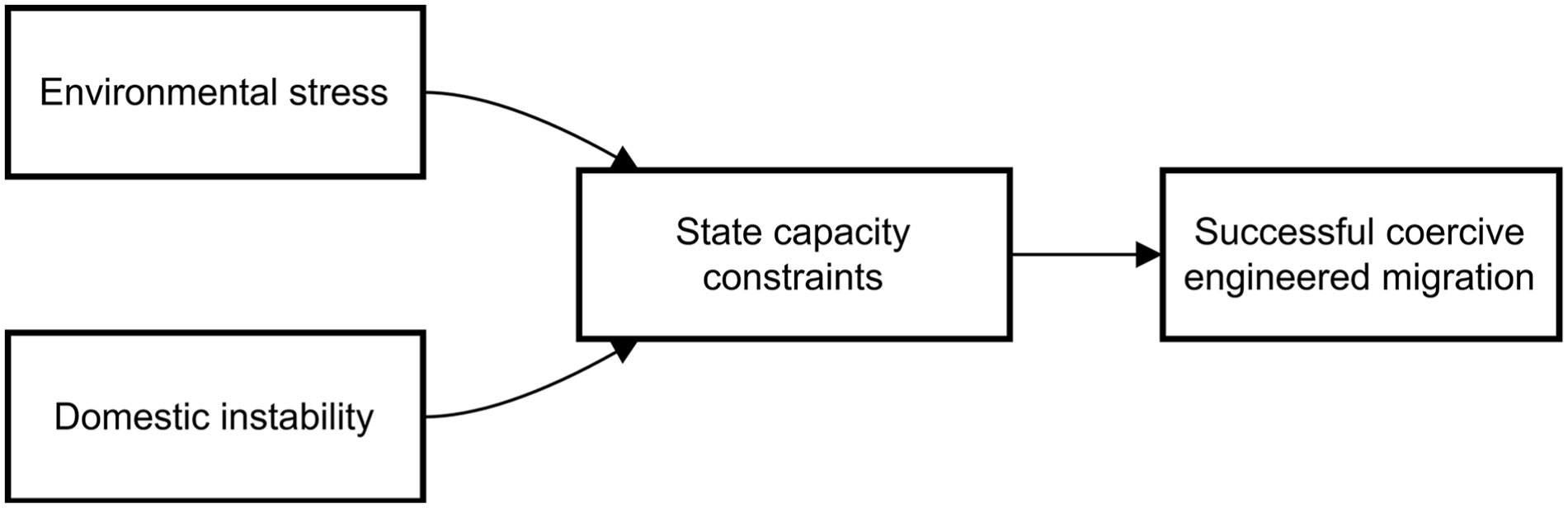
I examine the role of environmental shocks in this context, which have far-reaching repercussions on ecological and economic systems, and addressing them effectively is costly, too. 1 States’ capabilities are challenged as a result (see Köberle et al., 2021) and all these factors combined potentially fuel domestic instability (see Koubi et al., 2021; Rudolfsen, 2020; Von Uexkull et al., 2024). As summarized in Figure 1, I ultimately contend that environmental stress can be crucial here and, eventually, shapes the chances of coercive engineered migrations’ success, particularly for domestically unstable targets, since environmental shocks could add to lowering countries’ capacity to deal with changing environmental circumstances and population inflows at the same time.
Theoretical mechanism.
Greenhill (2010a, 2010b, 2016, 2022) argues that a ‘capacity swamping’ mechanism can make migration-related coercion more likely to succeed. Capacity swamping increases targets’ costs by ‘manipulating [their] ability to accept/accommodate/assimilate a given group of migrants or refugees’ (Greenhill, 2010b: 38). Targets are likely to concede to coercers’ demands if the anticipated costs are sufficiently high. A mass influx of migrants and refugees poses significant challenges to countries’ capacity, while domestic instability is a facilitating factor in this context, which makes countries particularly vulnerable to migration-related coercion. State capacity, however, is a necessary requirement for dealing with both population inflows and environmental stress. 2 Coping with environmental extremes requires resources, which cannot be spent elsewhere. Combining this with domestic instability, potential resource constraints due to cross-border population movements, and, ultimately, lower state capacity contribute to the success of migration-driven coercion (Greenhill, 2010a, 2010b, 2016, 2022). Eventually, I advance the hypothesis that states will be more likely to concede to migration-related coercion when they are domestically unstable and face environmental shocks.
Empirically, I analyse quantitatively all cases of coercive engineered migrations as defined by Greenhill (2010a, 2010b, 2016, 2022). I combine her data with information on environmental extremes, which I measure by the number of environmental disasters as taken from the International Disaster Database (IDD). Controlling for several other influences that may affect the outcome and employing sample-selection estimators that account for the non-random assignment of coercive engineered migration (Greenhill, 2010a, 2010b, 2016, 2022), I report that environmental disasters are associated with a higher likelihood of successful migration-related coercion in states that also suffer from domestic instability.
The article makes three central contributions to the literature. First, it improves our knowledge about population movements as a foreign-policy instrument. Greenhill (2010a, 2010b, 2016, 2022) was the first to provide a systematic account of this phenomenon, though the underlying conditions for the effectiveness of coercive engineered migration remain not fully explored thus far. I address this by focusing on environmental stress and combining this with domestic instability.
Second, the findings shed new light on the role of environmental shocks in international bargaining. Existing research, naturally, explores countries’ environmental vulnerability and their success in, most prominently, negotiations of the global climate regime (e.g., Rotillon and Tazdaït, 1996). This research demonstrates that domestic-level environmental stress also shapes how countries interact with each other and bargain in other, seemingly quite remote, and unrelated policy fields: coercion over cross-country population movements.
Third, environmental stress is increasingly linked to population movements, also across countries (Bakaki, 2021; Helbling et al., 2023), since migration is a common adaptation strategy for people facing adverse climatic conditions (McLeman, 2014). In addition, Koubi (2019) concludes that ‘countries with high levels of poverty and high dependence on renewable resources, e.g., agriculture, are more susceptible to climate-related adverse economic conditions, which in turn are often associated with higher likelihood of conflict’ (see also Ide et al., 2014). Hence, there is a link between environmental stress and migration, there likely is a conflict-enhancing impact (if only indirectly) of environmental extremes, and with conflict being a key driver behind cross-country population flows (Böhmelt et al., 2019), my research with its focus on environmental stress and coercive engineered migrations provides new direct implications for our understanding of the environment−conflict nexus and conflict as a driver of cross-border population movements.
Migration-driven coercion outcomes, domestic instability and environmental stress
Cross-country population movements must be (largely) orchestrated, strategic and coercive to be defined as ‘coercive engineered migration’ (Greenhill, 2010b: 13ff). It involves actors at two levels, while the power structures are generally distributed asymmetrically (Greenhill, 2010a, 2010b, 2016, 2022). To this end, migration-related coercion comprises an outside actor at the international level, which seeks to ‘influence the behavior of their targets by exploiting the existence of competing domestic interests within the target state(s) and by manipulating the costs or risks imposed on the civilian population’ (Greenhill, 2010b: 3). A coercer thus seeks to exploit the transnational movement of people (for threatening) to impose costs on the target. The goal is some form of concession granted by the latter.
Assessing the chances of success of coercive engineered migrations, when the costs imposed on the target population are higher than the stakes in dispute, the target’s government is more inclined to back down and meet the demands of the coercer (see Greenhill, 2010a, 2010b, 2016, 2022). Hence, ‘challengers will prevail only if targets deem the costs of concession lower than the costs of continued resistance’ (Greenhill, 2010b: 4). State capacity seems crucial for shaping the costs and benefits of concessions as well as continued resistance, respectively, and therefore the ultimate outcome of coercive engineered migrations. The corresponding ‘capacity swamping’ mechanism (Greenhill, 2010b: 38) manipulates the ability of targets to ‘accept, accommodate, or assimilate a given group of migrants or refugees’ (Greenhill, 2010b: 38). That is, coercers exploit and use cross-border population movements to ‘overwhelm the physical or political capacity of a target state to accommodate an influx’ (Greenhill, 2010b: 3). 3
Having said that, a facilitating factor in this context is the target’s degree of domestic instability. It is well known from the literature on sanctions and coercive diplomacy (see, e.g., Major, 2012) that domestically unstable states are particularly vulnerable to outside demands. As Drezner (1999: 14) summarizes, ‘coercion is likely to generate concessions if the target regime is domestically unstable.’ Greenhill (2010b: 39) combines domestic instability with the capacity-swamping mechanism when concluding that ‘[i]n locations where ethnic tensions may already be elevated, where the extension of central government control may be compromised even at the best of times, and where essential resources are limited and consensus on the legitimacy of the political regime is shaky at best, a large influx can present a real and persuasive threat.’ The chances that these states will consider granting concessions to make a ‘real or threatened crisis dissipate or disappear’ (Greenhill, 2010b: 4) are more strongly pronounced than for countries with more capabilities and higher domestic stability.
Against this background, I develop the argument in three steps. First, cross-country population inflows are costly for targets, especially domestically unstable ones, and can impose significant challenges on their capacity. Second, environmental stress is also costly, and related adaptation efforts will require significant amounts of state resources. Third, if a target country simultaneously suffers from domestic instability and environmental stress and, hence, resource and capacity constraints, its government likely has strong incentives to avoid further challenges – including those from migration-related coercion. Correspondingly, the likelihood of a successful coercion attempt increases with the environmental stress in a domestically unstable target country.
First, an influx of refugees and migrants can pose significant challenges to host states. Indeed, population inflows may ‘overwhelm a state’s capacity to provide public services and can lead to conflicts over resources’ (Adamson, 2006: 176). When migrants and refugees arrive, they require jobs, health care, education, or social services – and a substantial number of resources is necessary for providing these effectively. 4 But state capacity can help in addressing resource shortages and providing (public) goods (Böhmelt et al., 2019). Low-capacity states have a limited ability to provide services or ensure sustainable livelihoods, and they are particularly poorly suited to manage pressures arising from refugees. Conversely, states ‘with high levels of institutional capacity are in a much better position to adapt to this new environment [of large population inflows] than are weak or failing states’ (Adamson, 2006: 176).
Second, not only does the inflow of refugees and migrants, which potential coercers might want to exploit, pose challenges to a country’s state capacity, but resources are also necessary to deal with environmental stress and implement adaptation measures (Haddad, 2005; Meckling and Nahm, 2018; Tompkins and Adger, 2005). On the one hand, environmental shocks are costly for states. There are direct (e.g., Stern 2008; see also Nordhaus, 2007) and indirect costs. Regarding the latter, for instance, the Intergovernmental Panel on Climate Change’s Fourth Assessment Report points to implications for conflict and resource scarcity, for example, when it emphasizes according to Koubi (2019) that environmental changes ‘could become a major contributing factor to conflicts by exacerbating the scarcity of important natural resources, such as freshwater, and by triggering mass population dislocations (migration) due to extreme weather events.’ On the other hand, while environmental stress is costly, addressing it via, for example, adaption measures, poses significant challenges to states’ capacities as well. 5 Countries that are more vulnerable to environmental challenges will likely have to bear more of those costs. Higher state capacity enables countries to develop, implement and enforce adaptation policies more effectively (Hanson and Sigman, 2021). It also allows countries to compensate the ‘losers’ of environmental protection (Bakaki et al., 2022). Meckling and Nahm (2018: 741) stress accordingly that ‘state capacity is central to the provision of public goods, including environmental protection.’ States with a lower capacity will find it more difficult to address environmental extremes through effective adaptation.
Third, when combining the two previous arguments within the framework of the ‘capacity swamping’ mechanism and domestic instability (Greenhill, 2010b: 38), I conclude that particularly domestically unstable states facing environmental stress will be more likely to make concessions in the wake of migration-driven coercion. Countries will have to deal with environmental extremes, which poses constraints on their resources and capacity. Governments may want to provide the public good ‘environmental protection’ due to political (Bueno de Mesquita et al., 2005) or economic (Nordhaus, 2007; Stern, 2008) reasons. Clearly, lower-income countries are more negatively affected than higher-income countries (Edmonds et al., 2020), but even the latter will experience substantial costs. When subscribing to the cost implications of fighting environmental changes, ‘leaders may face strong domestic-level incentives to concede to coercers’ international-level demands’ (Greenhill, 2010b: 41) when encountering coercive engineered migrations. Meeting the demands of a coercer who exploits transnational population movements could eliminate that threat, and since it is plausible to assume that the costs of granting concessions are lower than the resources required for dealing with an influx of refugees and migrants, state governments will have more state capacity available to deal with environmental shocks and address domestic-level instability. Concessions are not cost-free, 6 ‘only that in the face of a threatened or mounting crisis the anticipation of future pain and mounting costs has to be weighed against the costs and opportunities associated with ending the crisis now, by conceding to the challenger’s demands’ (Greenhill, 2010b: 50). Against this background, I hypothesize that the chances of successful migration-related coercion increase when domestically unstable target countries face environmental stress.
Research design
For the empirical analysis, I created a quantitative data set on coercive engineered migrations based on the cases presented in Greenhill (2010a, 2010b, 2016, 2022). Codings are given as of 1951 – the advent of the United Nations Refugee Convention. Instances of coercive engineered migration are defined by Greenhill (2010b: 13) as ‘cross-border population movements that are deliberately created or manipulated in order to induce political, military and/or economic concessions from a target state or states.’ Each case must thus meet three criteria to be classified as an instance of migration-related coercion (Greenhill, 2010b: 21): a cross-country population movement has been (largely) orchestrated; it was strategic; and it was coercive. Greenhill (2010a, 2010b, 2016, 2022) identifies 64 cases in total, but I disaggregate some of these events by target states. This leads to 72 coercive engineered migrations between 1951 and 2006.
I combine this information with country-level (monadic) time-series cross-section data in 1951−2006. Out of 7,673 cases (country-years) in this data set, 51 country-years (0.66%) have seen at least one coercive migration attempt per year. I do not code multiple coercive engineered migrations per country-year, which avoids the duplication of country-year observations. In the Online Appendix, I provide a list of the 20 target states and the years of coercive migration attempts covered by my sample. The dependent variable captures the outcomes of migration-related coercions and is also taken from Greenhill (2010a, 2010b, 2016, 2022). In a binary fashion, it is coded whether a coercer was effective in achieving their goals (1) or not (0). Specifically, ‘success’ is defined as ‘persuading a target to change a policy, stop or reverse an action already undertaken, or disburse side-payments, in line with a challenger’s demands; in other words, most [or all] of a challenger’s demands were met’ (Greenhill, 2010b: 32). Partial successes or failures, that is, when a coercer achieved only some, a few, or none of their objectives, are coded as 0. About half of the 51 coercive migration country-years (26 out of 51) are coded as successful in my sample.
Countries that have been targeted by migration-related coercion are unlikely to be a random sample (Greenhill, 2010a, 2010b, 2016, 2022). What is more, some of those factors leading to the onset of coercive migrations may also be related to their outcome. This points to a two-stage decision-making process, which must be considered jointly in the empirical analysis (see also Böhmelt, 2010). The first stage (selection equation) is the selection into coercive engineered migrations, while the second stage (outcome or regression equation) pertains to the success of these attempts. To deal with this selection process adequately, I employ a Heckman selection model. Here, the estimated mean function in the outcome stage is conditioned on the first-stage selection process and thereby provides a consistent estimate for the truncated distribution of the second-stage sample (Heckman, 1979). This estimator is more robust than competing estimators. Its selection equation must include at least one regressor that is not part of the outcome equation. I present the results of a ‘regular’ Heckman selection model, where the regression equation (outcome stage) is based on a linear model. Hence, this part of the model is essentially a linear probability model due to the binary dependent variable, and coefficients can be interpreted directly. I also report the coefficients and substantive quantities of interest based on a Heckman probit model, that is, a probit model with sample selection. To capture intra-state dependencies, I cluster the standard errors by country in all models.
The main explanatory variables are located at the outcome stage and comprise an indicator for domestic instability, a variable on environmental stress, and the multiplicative interaction of these two items. First, I capture domestic instability via the index in Banks (2001) on assassinations, strikes, terrorism, government crises, purges, riots, revolutions and anti-government demonstrations. I log-transform this item with higher values pertaining to more domestic-level instability. For the 51 country-years in the outcome equation, the domestic instability variable has a mean value of 4.949 (standard deviation of 3.320) and ranges between 0 and about 10.
Second, I operationalize environmental stress via the occurrence of environmental disasters. The data are taken from the IDD of the Center for Research on the Epidemiology of Disasters (2025) , which defines disasters as a ‘situation or event, which overwhelms local capacity, necessitating a request to national or international level for external assistance; an unforeseen and often sudden event that causes great damage, destruction and human suffering. Though often caused by nature, disasters can have human origins.’ I focus on environmental disasters, which comprise droughts, earthquakes, epidemics, extreme temperatures, floods, landslides, mass movements (dry), storms, volcanic activity and wildfires. The disaster variable has a mean value of 7.765 (standard deviation of 9.781) for the 51 country-years at the regression stage. I expect the term Domestic instability × disasters to be positively signed and statistically significant.
I consider several control variables at the outcome stage, which pertain to alternative drivers of coercive migrations’ outcomes or temporal and spatial dependencies. First, Greenhill (2010a, 2010b, 2016, 2022) argues that liberal democracies may be more willing to grant concessions. Democracy, which ranges between -9 (almost perfect autocracy) and 10 (perfect democracy) in my sample, is taken from the Polity IV data set. Second, there is the initial gross domestic product (GDP) based on data by Gleditsch (2002). GDP is defined as the sum of gross value added by all resident producers in the economy plus any product taxes and minus any subsidies not included in the value of the products. Country wealth likely correlates with the success of migration-related coercions. Third, I include a time variable and a spatial item in the outcome equation. The former is a linear time trend as both the outcome variable in the regression equation and the disaster variable seem to trend over time. The latter variable addresses spatial clustering in the data. As Greenhill (2010b: 19) observes, ‘past vulnerabilities make a target more susceptible to future predation.’ I thus include an identification variable for independent coercive migration attempts: if two or more attempts are related to each other, for example, there are repeated challenges by the same coercer (see Sechser, 2018), the United States and other countries are repeatedly targeted by other countries, or several cases seem to refer to earlier instances of migration-related coercion, I assign the same value for this variable.
For the selection equation, I also consider Democracy and Initial GDP as control variables. In addition, there are variables pertaining to civil conflicts, economic growth, GDP per capita, population and temporal dependencies. First, following Carter and Signorino (2010), I control for temporal dependencies via the cubic polynomial approximation of the number of years elapsed since the last attempt against the same target. Second, more populous states may be at a higher risk of being targeted by migration-related coercions. I incorporate log-transformed population data from Gleditsch (2002). Third, the items for GDP per capita (also logged) and economic growth capture a similar rationale as Initial GDP. The economic growth item is taken from the Penn World Tables Version 6.2, while the GDP per capita data are from Gleditsch (2002). The latter variable captures a country’s wealth standardized by population, while Economic growth measures short-term, rapid changes in the strength of the economy. Finally, there is a binary variable on whether there is a civil conflict each country-year. The information is taken from the Uppsala Conflict Data Program data set, and I employ the 25 battle-related deaths threshold for coding conflict incidence.
Findings
Model 1 is a regular Heckman (1979) selection model, but I leave out the controls in the outcome equation. These are included in Model 2. Comparing the results across the first two estimations shows that my core findings are not driven by the inclusion or exclusion of the confounding factors in the regression equation – demonstrating this seems even more important in my context as the outcome stage is based on 51 country-years only. Finally, Model 3 is a Heckman probit model. The coefficients in the outcome equation of Model 3 can thus not be interpreted as marginal effects, but only the variables’ signs and levels of statistical significance allow for direct reading. Having said that, due to focus on a multiplicative interaction in my models, interpreting Models 1−2 is also not without difficulty (see Brambor et al., 2006). I present the substantive quantities of interest in Figure 2.
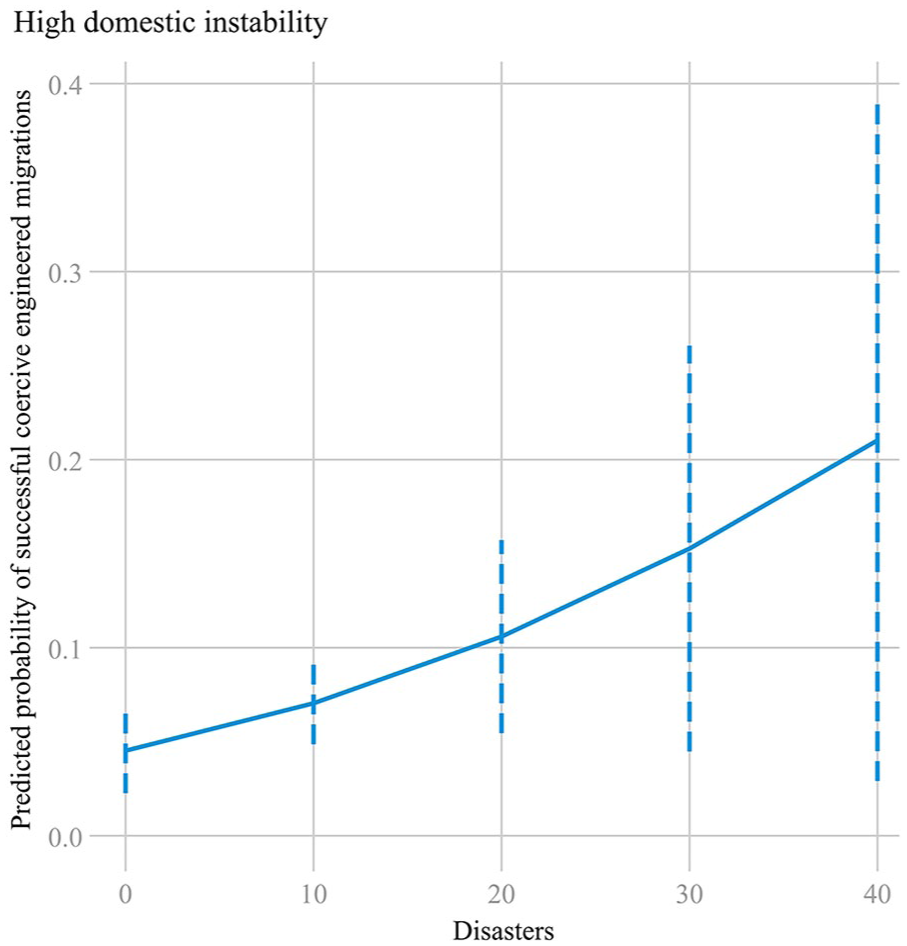
Predicted probabilities of successful coercive engineered migrations.
Disasters and Domestic instability have negative signs and are statistically significant at conventional levels across Models 1−3. Due to the inclusion of the multiplicative term, however, the individual variables only capture the effect on the outcome of coercive migrations when the other constituent term is set to 0. For example, in Model 1, when Domestic instability is set to 0 (i.e., no domestic unrest), the likelihood of a successful coercive migration attempt decreases by about 3.7 percentage points with every disaster occurrence. Similarly, the chances of a successful migration-related coercion go down by about 9.1 percentage points (Model 1) for every unit-increase in Domestic instability when Disasters are set to 0. However, these patterns do not fully capture the joint effect of disasters and domestic instability. This is done with the interaction term Domestic instability × disasters.
Regardless of model specifications, I obtain evidence for a positive interaction effect, which is also statistically significant at conventional levels in Table 1. This suggests that, when considering the joint impact of environmental stress and domestic unrest, the chances of successful coercion attempts increase with more disasters and instability – as argued in the theory section above. Figure 2 plots the substantive quantities of interest for interaction term. The predicted probability of a successful engineered migration coercion increases with disasters and is statistically significant when a country is characterized by high domestic instability. Specifically, holding Domestic instability at high values, the predicted probability of a successful coercive migration outcome is only around 4.5% when there were no environmental disasters. This probability increases to more than 7% with up to 10 environmental shocks – if at least one environmental disaster occurred, most states in my sample have seen 10 such events or fewer. With 40 environmental disasters in a country-year, which is close to the sample’s maximum, the predicted probability of a successful coercive migration attempt is at around 21%. These findings support the argument that migration-related coercion is successful if both domestic unrest and environmental stress are present.
Empirical models – The outcome of coercive engineered migrations.
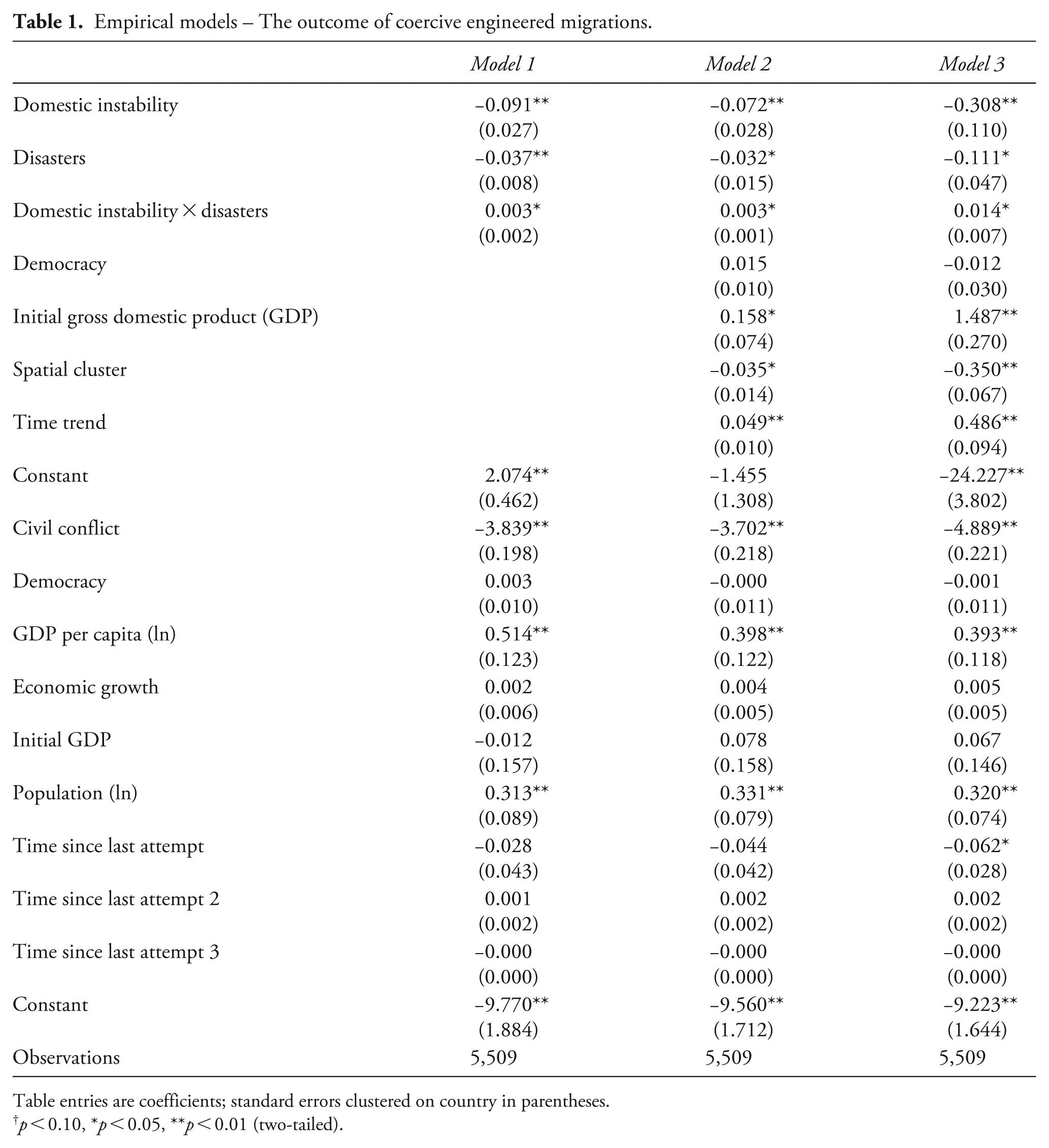
Table entries are coefficients; standard errors clustered on country in parentheses.
p < 0.10, *p < 0.05, **p < 0.01 (two-tailed).
Briefly discussing the control variables, Initial GDP is positively signed in the regression equation of Models 2−3, which shows that coercion outcomes are more likely to be successful when targeting richer countries. The spatial cluster item is negatively signed and significant, emphasizing that success becomes less likely when targeting the same country repeatedly. Possibly, this is related to a learning effect at the target’s end. Finally, the temporal-trend control is positively signed and significant, which is expected given the trending in the data. In terms of the selection equation, the variables for civil conflict, income and population are statistically significant and not dependent on model specifications or estimation procedures. Countries that are in the middle of a civil conflict are unlikely to be targeted, as the chances of them making any concessions are less strongly pronounced. Yet, richer countries and more populous ones are more likely to be targeted for migration-related coercions.
In the Online Appendix, I summarize several additional analyses. First, I temporally lag the variables in the selection stage. Second, I model the influence of governmental ideology on the interaction of disasters and domestic unrest and find that there is no significant effect with centre-right executives in power. Third, I control for the influence of the Al Qaeda 9/11 terrorist attacks on New York in 2001 and the empirical observation that particularly the United States are a target of migration-related coercion. Fourth, I control for polarization and governmental censorship of the media, although none of the two added items achieves conventional levels of statistical significance. Fifth, I focus on the damage caused by environmental disasters. Sixth, I control for the post-1992 period and I disaggregate political instability by distinguishing between elite-level instability and social unrest. Finally, I present a list of countries that were targets of coercion attempts. All these robustness checks further support the argument and findings presented above.
Conclusion
Countries may orchestrate, use and exploit cross-country population movements for their own foreign-policy goals. This article sought to add to our understanding of such coercive engineered migrations by arguing that domestically unstable target states are more likely to grant concessions when facing environmental stress. I tested the theoretical expectation by analysing quantitative data on migration-driven coercion attempts since the 1950s. The results presented above and in the Online Appendix consistently and robustly show that environmental stress in the form of environmental disasters is positively associated with successful coercion attempts when targets are domestically unstable.
Several avenues for future research exist, and I outline two of them. First, there is the need to update the data on migration-related coercion. The data in Greenhill (2010a, 2010b, 2016, 2022) are fully coded until 2006 only. While my results are unlikely to change qualitatively by adding more recent years of data to the analysis, I likely underestimate the effect of environmental stress as the post-2006 period has seen steep increases in the frequency of environmental shocks and several additional, potentially quite effective cases of migration-driven coercion, for example, Türkiye and European Union member states in 2015−2016 or Belarus under Lukashenko in 2021.
Second, it will be an effort worth making to clearly identify the causal pathways and their direct as well as indirect substantive effects: my focus has been on the influence of environmental stress on the outcome of coercive engineered migration in countries that suffer from domestic instability, but we also know that environmental stress directly or indirectly (via conflict) shapes migration patterns (Bakaki, 2021; Helbling et al., 2023; Koubi, 2019). Disentangling these relationships and estimating causal influences with precision is not without difficulty, but it seems necessary to further inform scholarly and policy debates about how environmental stress is related to states’ interaction, their bargaining and attempts of coercion at the international level.
Footnotes
Acknowledgements
I thank the editor and the anonymous reviewers for their comments. A version of this paper has been presented at the Berlin Social Science Center 10th Annual Conference on Migration and Diversity. I am grateful to Ruud Koopmans, Daniel Meierrieks, Kristina Petrova, Barbora Šedová, Gabriele Spilker and Julian Wucherpfennig who provided valuable feedback there.
Replication data

Funding
The author received no financial support for the research, authorship, and/or publication of this article.
Notes
TOBIAS BÖHMELT, PhD in International Relations (University of Essex, 2010), Habilitation in Political Science (ETH Zürich, 2013); Professor at the University of Essex (2013–present); current research interests: comparative politics and international relations.