



Abstract
The TJET project offers a comprehensive database for exploring the supply of transitional justice (TJ) in every country of the world. TJET provides detailed descriptive information on domestic, foreign, and international prosecutions; truth commissions; reparations policies; vetting policies; amnesty laws and offers; and UN investigations. This article describes TJET’s quantitative dataset, consisting of longitudinal data from 1970 to 2020, with over 400 measures related to the design and operation of TJ mechanisms. Because TJ has become integral to discussions related to democracy and rule of law promotion, as well as peacebuilding, it is necessary that researchers and practitioners use the most comprehensive information possible for grounding their analysis and advocacy. The TJET dataset is unique not only in its global coverage, but also in its custom sampling feature, allowing users to select which types of cases to compare. This article provides descriptive data on TJ attributes, analysis of new trends, and an examination of the temporal relationship between different TJ mechanisms.
Introduction
Transitional justice (TJ) is everywhere. Foreign ministries, multilateral agencies, and transnational NGOs face innumerable demands to support TJ initiatives around the world – like human rights prosecutions, truth commissions, and reparations. The goal is most often to promote democratic rule of law and the non-recurrence of mass violence; however, little consensus has emerged that TJ contributes to these aims. Indeed, ‘there is an urgent need for the field of transitional justice [. . .] to develop evidence-based policies and programs that achieve their intended objectives’ (Revkin et al., 2024: 1582).
Time and again, stakeholders pose questions about TJ design and impact that can only be answered through comparative evidence: How can TJ mechanisms be configured to enhance inclusivity and outreach? Do TJ mechanisms promote trust and political engagement? And which mechanisms, if any, are associated with sustainable peace following war? Since the late 2000s, several cross-national data projects have been developed to address such questions (Dancy and Sikkink, 2023; Mallinder and O’Rourke, 2016). Yet the field still lacks a dataset that combines both nuance and global coverage of TJ mechanisms that varies over time.
The TJET database addresses this need. The project offers 50 years of data on the design and outputs of TJ mechanisms in every country of the world, compiled by over three dozen project affiliates and research assistants since 2021. Though it is not the whole of TJET’s work – the project’s website (http://transitionaljusticedata.org) also includes policy briefs, original population-based surveys on attitudes relating to TJ, and case narratives on select countries – one of the primary outputs of the project is a panel dataset that presents information at the country-year unit of observation. In its current version, the TJET dataset provides more than 400 quantitative indicators related to TJ across contexts. This article describes that dataset.
Overview
The TJET project defines TJ broadly as judicial and non-judicial institutions designed to reckon with past human rights violations. Our definition is intentionally minimal, making as few assumptions as possible about what qualifies as ‘transitional’ or ‘justice’. Instead of presuming to know what counts as true TJ, we follow an events-based approach, wherein we record and catalogue information on mechanisms publicly authorized to address accountability for human rights violations. Restrictive definitions of TJ unnecessarily exclude phenomena of interest. For example, one common approach is to count as transitional only those initiatives that take place within five years of a democratization or conflict termination. But this leaves out hundreds of ‘post-transitional’ truth and justice mechanisms pursued more than five years after regime change, as in Chile or South Korea, as well as mechanisms that take place before or well after the end of a war, as in Colombia or Sri Lanka. Another approach is to count as TJ only those mechanisms that meet strict criteria of fairness and impartiality. However, doing so excludes all TJ initiatives that do not conform to observers’ normative preferences, which are often insensitive to context. Rather than imposing our own rigid standards, TJET promotes flexibility, allowing users to choose what should count as TJ and what should not (on fairness, see Online Appendix).
The TJET dataset contains descriptive data on the following mechanisms established worldwide between 1970 and 2020: 1 (1) domestic, foreign, and international prosecutions for human rights and conflict-related crimes; (2) truth commissions (TCs); (3) reparations policies; (4) vetting policies, including those that dismiss or ban public office holders; (5) amnesty offers and laws; and (6) United Nations human rights investigations. 2 The database does not include state apologies, memorialization projects, the use of traditional forms of justice, or non-governmental truth-telling projects. Further, all the mechanisms in the TJET dataset address violations to physical integrity.
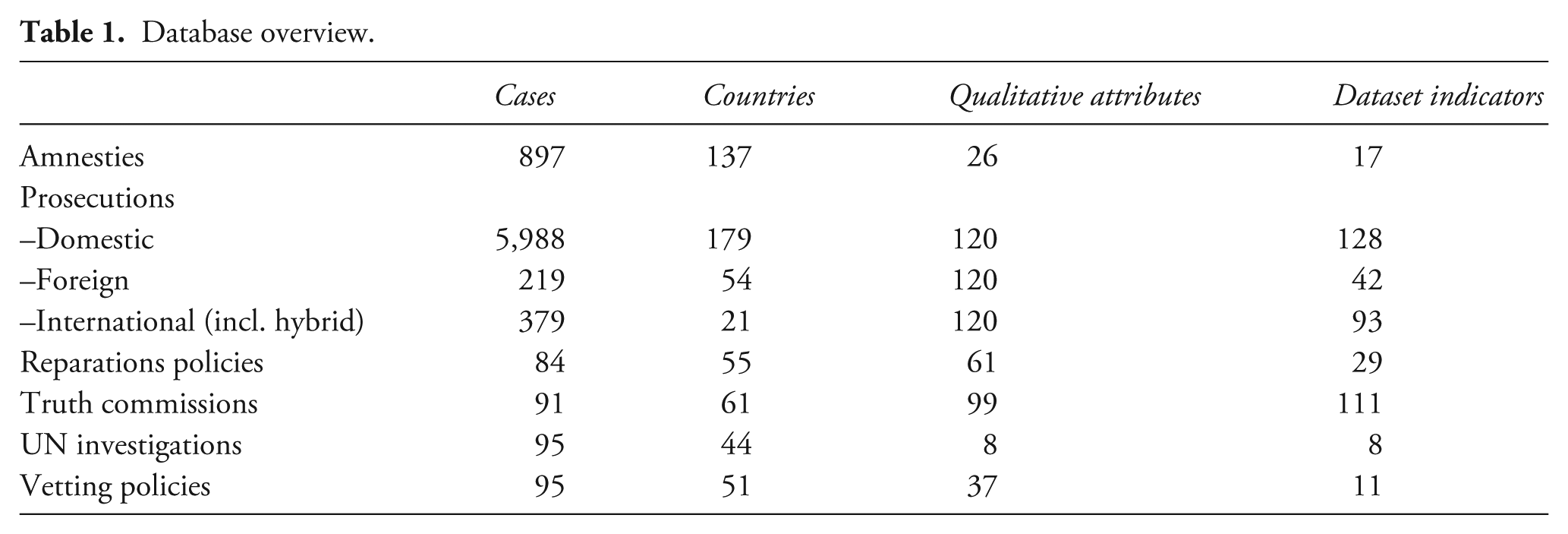
The TJET project generates qualitative and quantitative data. In total, the database includes more than 7,500 detailed mechanism case records (see Table 1). Each record includes 8–120 attributes describing case characteristics, scope, and output. 3 These mechanism-level attributes are then used to produce country-year quantitative indicators. 4
Database overview.
Contributions
TJET offers measures related to six types of TJ mechanisms in all countries, making it the most comprehensive dataset to date. Several projects have captured granular detail on single mechanisms, including the presence or quantity of domestic criminal prosecutions (Kim and Sikkink, 2010); legal cases initiated under principles of universal jurisdiction (Langer and Eason, 2019); prosecutions and other actions undertaken by international courts (Balkan Insight, 2022; Broache and Kore, 2023; Hillebrecht and Read, 2023); the design and implementation of TCs (Dancy et al., 2010; Hayner, 2001; Zvobgo, 2020); the properties of amnesties within and outside of peace agreements (Mallinder, 2008; Mallinder and Shaw, 2024); the administration of personnel reforms, including vetting and lustration (Bates et al., 2020; Horne, 2017); case law and legislation related to reparations (Moffett et al., 2019); and the operation of inquiries established by international organizations (Becker, 2022). Single-mechanism data sources are very useful for their depth of focus, and TJET has benefited enormously from their information. However, by combining all six mechanisms into a country-year structure, TJET allows for a more complex and context-sensitive examination of relationships between mechanisms and outcomes over time.
TJET is the fifth major longitudinal TJ dataset (Bates et al., 2020; Binningsbø et al., 2012; Dancy et al., 2019; Olsen et al., 2010), and it makes three major advancements (see Online Appendix for an analysis of prior datasets). The first is custom sampling. Contrary to other projects, TJET is not tied to either democratic transitions or conflict transitions, and it does not make assumptions about the temporality or sequencing of justice policies. The TJET database supports analysis of any combination of cases in Figure 1. If, on the one hand, a user wants to compare TJ in all democratic transition cases across regions (Set A), they can select that specific subsample to analyze. We base our coding of democratic transitions on three prominent democracy datasets (Boix et al., 2013; Maerz et al., 2024; Marshall et al., 2020). If, on the other hand, the user wants to examine TJ in only state featuring intrastate conflict (Set B), as defined by the Uppsala Conflict Data Project (UCDP) database, that too is possible (Davies et al., 2023). For example, users could analyze the effect of mechanisms initiated during conflict, like in Colombia in the early 2000s, or those mechanisms established after conflict, as in Bosnia and Herzegovina. Likewise, one can choose a subsample of cases that only includes states that have undergone both democratic and post-conflict transitions (Set C), like South Africa, or one can choose a subsample of cases with neither regime change nor intrastate conflict (Set D), like Canada or Bahrain. In this way, the TJET data are flexible and responsive to the researcher’s needs.
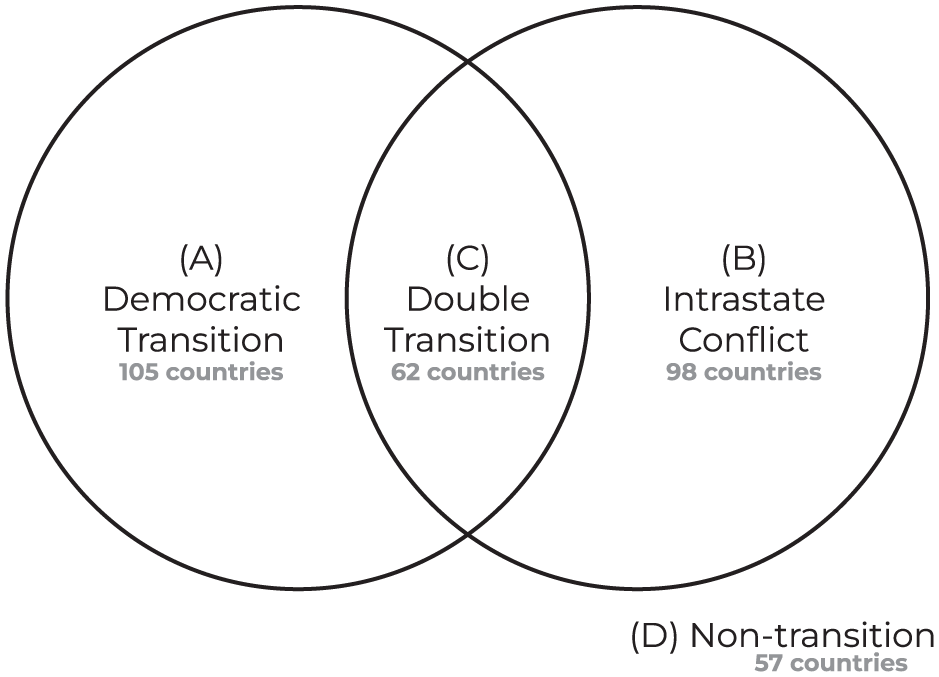
Venn diagram of samples.
Second, TJET data are free, ungated, transparent, and replicable. The website makes available the project’s coding manuals, raw data tables, code for assembling and cleaning data in a Github repository, and a bibliography of over 14,000 verifiable sources on TJ. The project website provides a corrections form for users to suggest revisions. The initial version of the quantitative dataset is not the only one imaginable, and the attributes we have coded across all mechanisms (see Table 1) could be combined in various ways to generate hundreds of indicators. Simply by altering the code we make available, users could create their own alternative datasets using our raw attributes data.
A third distinguishing feature of the TJET dataset is the sheer variety of variables that capture substantive distinctions in TJ practice. In addition to state-level characteristics of countries – including country and region identifiers, and regime type and conflict sample indicators – the dataset offers over 400 quantitative indicators that capture the process and outcomes of TJ mechanisms. For example, the dataset not only provides index measures of TJ processes and outcomes, but also provides event-count measures of phenomena, including, for instance, how many human rights prosecutions began in a given year or how many convictions occurred. In the next section, we briefly define and describe the mechanism-specific data.
Data description
Amnesties
Amnesties are any legislative, constitutional, or executive provisions granting immunity for criminal activity. The TJET dataset includes 17 count and binary measures of legal offers and legal acts preventing prosecutions for activities ranging from crimes against the state to terrorism, treason or human rights violations (see codebook in Online Appendix). Though pardons are distinct from amnesties, we also include data on the mass release of political prisoners and pardons for previous human rights violations. Amnesties in our dataset vary considerably on a number of dimensions, most notably on the establishing actor, inclusion within peace agreement, type of crimes amnestied, and targeted recipients. Amnesties can be used to shield abusive state agents from justice, but they can also be used to show mercy to political prisoners and violent opposition groups. Conflict mediators have often promoted amnesties that immunize rebels who have committed violations of international law in exchange for commitments to peace settlements. However, we find that only roughly 24% of amnesties forgive human rights violations, and only 1 in 9 is embedded in a peace agreement. Amnesties also vary significantly by the targeted recipients. As Figure 2 demonstrates, most amnesties are intended for armed opposition groups (554) and protesters and political prisoners (491), but quite a few are also extended to state agents (205).
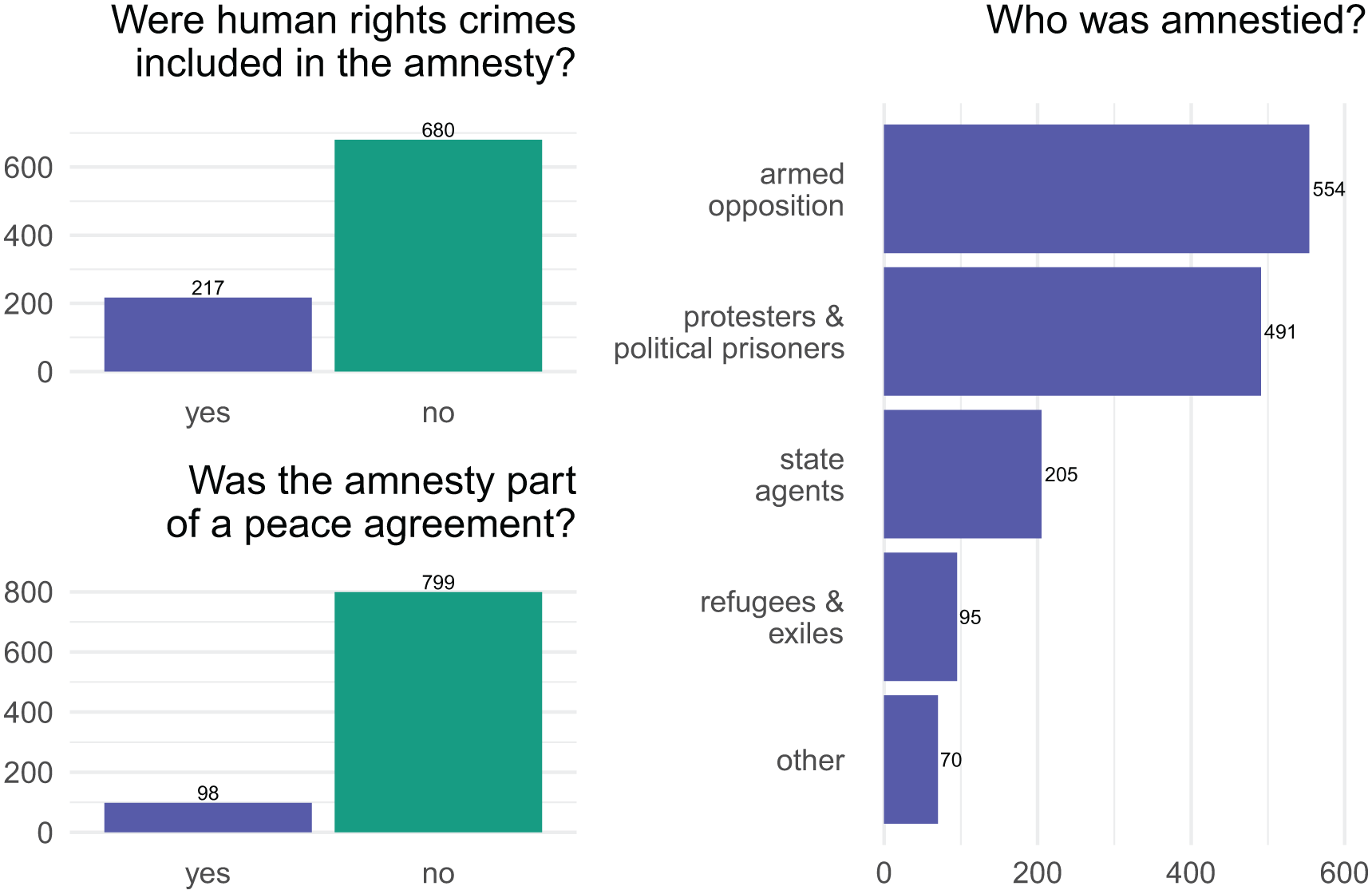
Amnesty attributes.
Prosecutions
TJET possesses the most extensive data on criminal prosecutions of any single project, covering over 6,000 cases (see Table 1). It distinguishes between domestic, foreign, and international prosecutions. Domestic prosecutions are criminal indictments and proceedings in a state’s civilian or military justice system for accused who are nationals of that state. These include trials like that of Guatemala’s former president Efrain Rios Montt for genocide. Foreign prosecutions are those wherein nationals of one country are tried by domestic courts in another country, as in Spain’s case against Augusto Pinochet. Finally, international prosecutions are proceedings that occur in hybrid tribunals, ad hoc tribunals, or the International Criminal Court (ICC). These include the trial of Charles Taylor conducted by the Special Court for Sierra Leone, the Slobodan Milosevic trial at the International Criminal Tribunal for the former Yugoslavia (ICTY), and the Dominic Ongwen trial at the ICC.
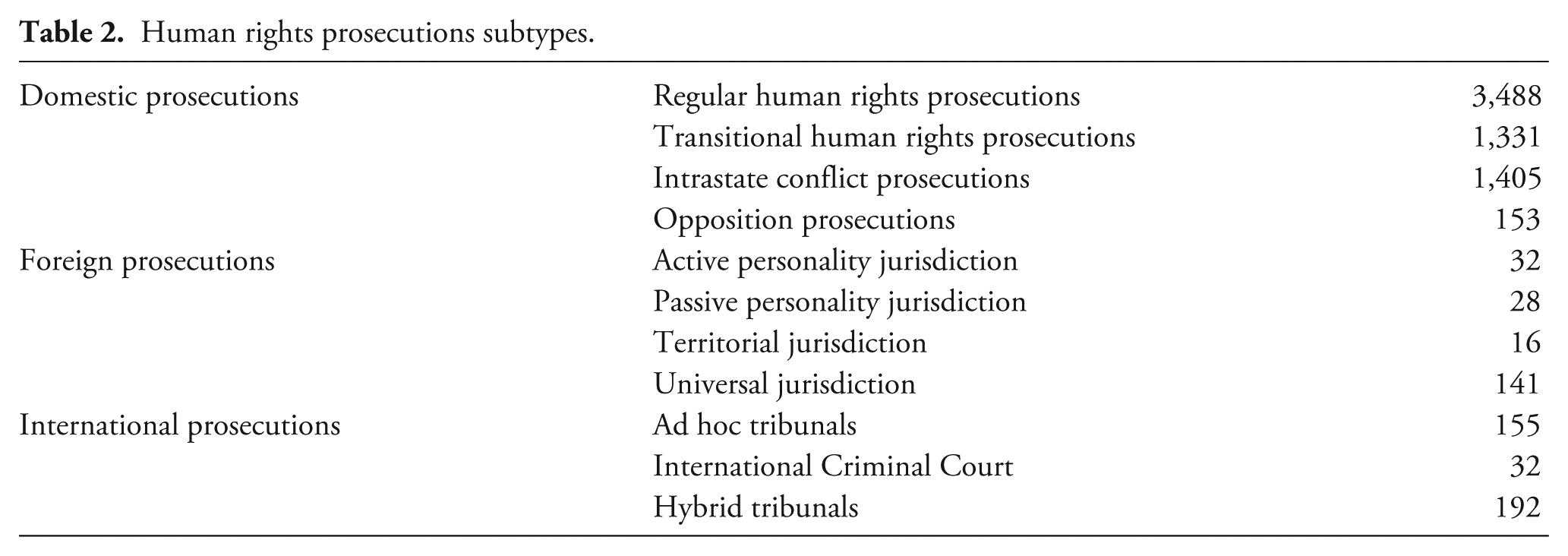
Table 2 shows our classification of trials. Domestic prosecutions are by far the most numerous type of trial in the TJET database. In reviewing thousands of event records from around the world, TJET has identified four common subtypes of domestic prosecutions, which are classified based on their nexus to regime change or intrastate conflict, as well as the charges against the accused. Regular human rights prosecutions are trials of state agents – most often police or military forces – for human rights violations they committed in the routine execution of their security or custodial functions. These often involve physical integrity violations committed by state agents, including torture, killing, sexual violence, or excessive force. When state agents are put on trial during or after a democratic transition for harms they committed prior to that transition, we classify these events as transitional human rights prosecutions. Included in this category are the paradigmatic cases of post-autocratic criminal justice, like the Trial of the Juntas in Argentina (TJET Trial ID 427).
Human rights prosecutions subtypes.
Sometimes conflict actors, including members of state armed forces or their rebel counterparts, are tried in domestic courts for their actions in the context of intrastate conflict. These are intrastate conflict prosecutions, and they may occur during or after conflict episodes. TJET relies on UCDP data to match prosecutions to the relevant conflict contexts. When targeting state agents, conflict prosecutions could involve planned and unplanned abuses, excessive use of force, or crimes of opportunity by government forces. Intrastate conflict prosecutions can also target rebel forces for violence against civilians, crimes against the state, terrorism, and other crimes. Some prosecutions in our database involve state agents and/or opposition members who are put on trial for successful or unsuccessful coups, or for trying to launch an insurrection that failed. When the context does not reach a threshold of violence necessary to be coded as intrastate conflict by UCDP, we call these opposition prosecutions.
Foreign prosecutions have four subtypes, based on the nature of the jurisdiction they exercise. Most of the time these involve the application of universal jurisdiction, which is ‘a legal principle allowing or requiring a state to bring criminal proceedings in respect of certain crimes irrespective of the location of the crime and the nationality of the perpetrator or the victim’. 5 Some foreign cases involve a state’s prosecution of foreign nationals for human rights and conflict-related crimes, either under passive personality or territorial jurisdiction, and others try permanent residents or new citizens for crimes they committed abroad prior to immigration (see Online Appendix). Whenever domestic prosecutions involve foreigners, or touch on the foreign relations between states, they are coded as foreign prosecutions.
Finally, international prosecutions have three subtypes, distinguished by the kind of court in which they are initiated. The first are prosecutions that occurred in ad hoc tribunals, those established in the mid-1990s for the former Yugoslavia (ICTY) and Rwanda (ICTR). The second subtype of international prosecution are those undertaken by the International Criminal Court, which was established by the Rome Statute in 1998 and began operating in 2002. The third subtype are hybrid tribunals, which undertake prosecutions in domestic jurisdictions, but with the support of international personnel, resources, and bodies of law. These include, among others, the Special Court for Sierra Leone and the Extraordinary Chambers in the Courts of Cambodia.
Across all types and subtypes of human rights prosecutions, TJET captures 117 qualitative attributes, including start and end year of the prosecution, the rank of the accused, conviction status, and sentencing details. 6 We then convert these attributes into 116 quantitative indicators (see Table 1). The large number of indicators is a function of the wide variety of trial types and outcomes. For every type of prosecution – domestic, foreign, and international – we count how many trials started, how many were ongoing, average trial duration, how many produced any conviction, and how many produced final convictions that were never overturned – in any given country year. We also calculate yearly counts of individual convictions, as well as conviction rates, which equal the number of convicted individuals divided by total number of accused. Finally, we use sentencing information to calculate a scale of total sentences. The number of indicators balloons when we produce the same counts, rates, and scales for prosecution subtypes. For example, we reproduce the same variables for each type of domestic prosecution: regular, transitional, intrastate conflict, and opposition. We also further break these down by whether accused were heads of state, otherwise high-ranking, or rank-and-file members of government or opposition. All prosecution indicators are listed in the codebook in the Online Appendix.
Reparation policies
The TJET project provides 29 reparations indicators reflecting policies that aim to provide restitution, compensation, or rehabilitation. These policies may be created by a state through executive action, domestic law, a domestic truth commission, or a domestic peace agreement to repair a population for human rights violations committed by state or armed opposition actors. Excluded are reparations provided by court order in criminal or civil judgments. Crucial distinctions between reparations policies include whether they are individual (81, or 96.4%) and/or collective (26, or 31%) and whether they are meant to compensate victims (77, or 91.7%) or to provide public services (48, or 57.1%) or symbolic reparations (19, or 22.6%). These categories are not mutually exclusive, and are often combined in unique ways. There is wide variation in the scope of policies, including the number of harms that qualify victims for reparations (ranging from 1 to 7), or the estimated number of beneficiaries (measured on a 0 to 2 scale). 7
Truth commissions
We operationalize a truth commission (TC) as a formal, state-sanctioned, temporary body that investigates a pattern of past human rights abuses and aims to issue a final report of its findings. Lack of a public final report does not disqualify a TC from our database; instead, it indicates an important qualitative difference in TC output. There are numerous additional distinctions in practice, which TJET groups into nine categories: basics, timing, nexus to transition, mandate, operations, powers, testimony, report, and implementation. If one were curious about how many TCs include ‘reconciliation’ in their mission, TJET provides that information in mandate. Powers include whether TCs can compel testimony, access official documents, support prosecutions, or allocate reparations, among other legal authorizations. Report is where details on the final TC report, including date of issuance and public availability, as well as what kinds of recommendations it makes, are recorded. Building from combinations of these features, the TJET dataset makes available 111 measures related to variations in TC processes and outputs (see codebook in Online Appendix). Among other indicators, TJET offers an index of how victims-centered TCs were, based on whether they consulted victims groups and took survivor testimony, as well as whether they made recommendations that are specifically focused on providing repair for victims.
Figure 3 plots the number of TC reports by decade, as well as decadal trends in final report recommendations. The stacked bars in the top panel represent both the number of reports TCs have issued over time, and how many of those are publicly available. Overall, the number of reports was higher in the 2000s at 27, but only two-thirds were made publicly available (18). By comparison, there were fewer reports in the 2010s (19), but 18 (95%) of these reports were made public. It is now unusual to produce TC reports that are hidden from public view. The bottom six panels show that, over the last five decades, report recommendations have become more extensive. The decadal percentage of reports that recommend future prosecutions, reparations, various legal or legislative reforms, judicial reforms, and gender-based reforms have all increased. Of these categories in Figure 3, only the percentage of reports that recommend security sector reform has remained steady, perhaps because this type of reform has always received attention from commissioners.
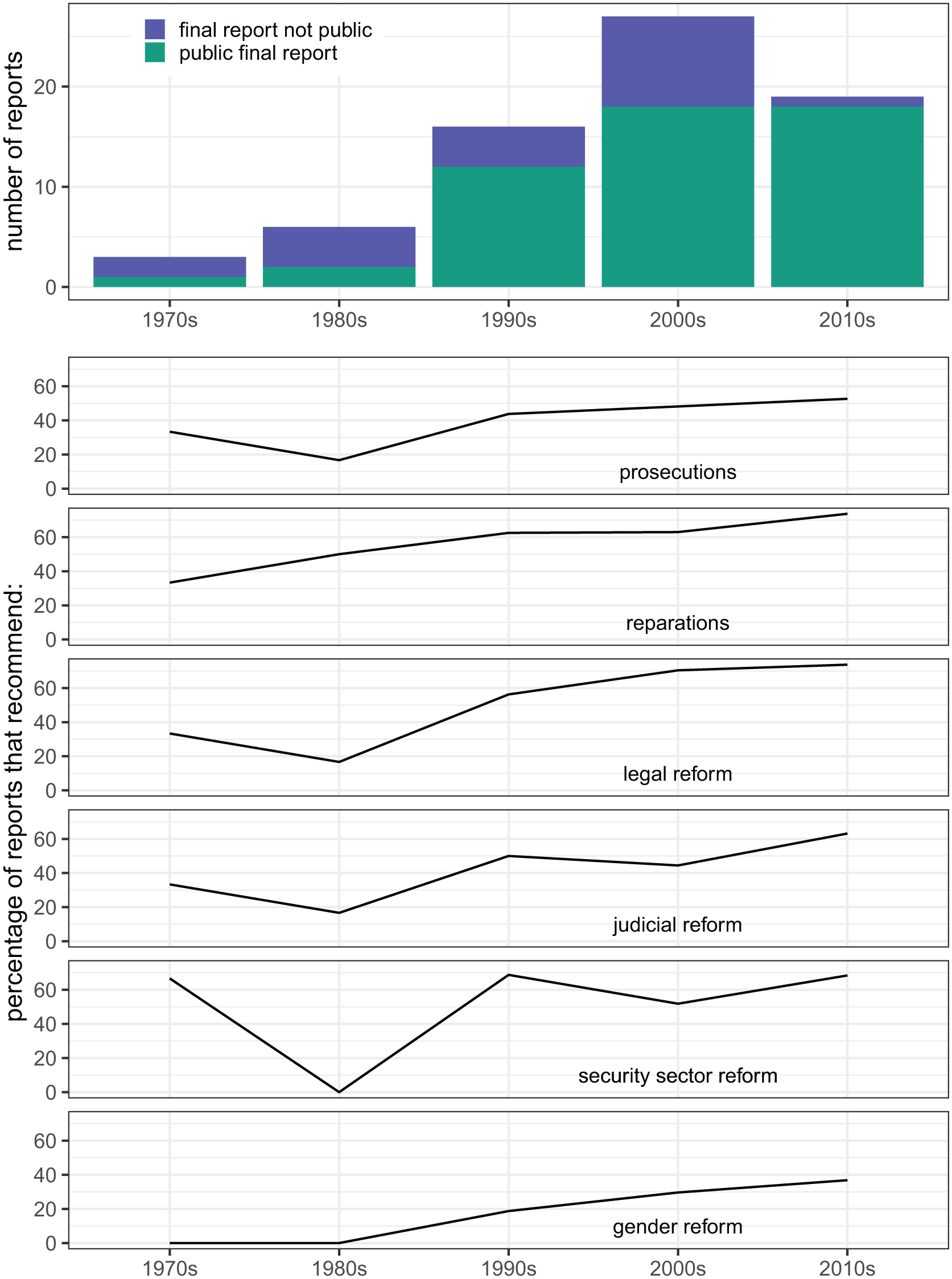
Truth commission reports.
UN investigations
UN investigations (UNI) include commissions of inquiry, ad hoc working groups, fact-finding missions, and groups of experts convened by organs of the United Nation to collect information on situations involving serious human rights violations. To maintain a distinction between UNIs and internationalized TCs, we exclude from this category all truth-seeking bodies that are established by domestic legislation or peace agreements, even if those bodies involve UN-affiliated or international actors (e.g. the Guatemalan Historical Clarification Commission). For UNIs listed in archival material, we recorded the UN mandating body. In addition, we also coded, based on the mandating language and any reports, whether the UN investigation encouraged domestic prosecutions (35, or 26.8%), or aimed to support international prosecutions with fact-finding and evidence collection (7, or 7.4%). These attributes are then converted into eight binary variables in in the dataset.
Vetting policies
We include official vetting policies that deprive categories of individuals access to public sector jobs on either a temporary or permanent basis as the result of past human rights abuse. For our project, vetting policies are operationalized as dismissal from existing employment; ban from future employment; declassification of secret files; or some combination thereof. We use the term ‘vetting’ because it is often employed to describe similar processes in different regions and because ‘vetting’ refers to a narrow set of policies with specific sanctions. In contrast, the term ‘lustration’ usually refers to vetting and declassification processes in Eastern Europe. TJET captures important details, including which government institutions were targeted and whether individuals were vetted for their actions or for their affiliation with a group, as well as approximately how many people were vetted and whether there were any meaningful legal challenges to the policy. 8 Overall, the 37 qualitative attributes we code are converted into a count of policies, ten binary variables and one index in our dataset (see codebook in Online Appendix), a list that may expand in the future.
Trends in TJ
What are overall trends in TJ practice in the last 50 years? Figure 4 plots the yearly frequency with which each mechanism was adopted between 1970 and 2020. First, amnesties have declined over a 30-year span, after upticks in 2003 and 2010, and prosecutions have also decreased following a peak in 2010. These trends may be related, with prior research suggesting that a higher probability of criminal accountability actually encourages the passage of more amnesties (Mallinder, 2012). Second, efforts at investigation have increased in the last decade, both at the domestic and international levels. Truth commissions have witnessed a resurgence since 2015, as have UNIs. Though we can only speculate at this point, there may be a substitution effect at play. State leaders are seldom willing to put their agents of coercion on trial, and they may find the resort to TCs to be a convenient alternative. Third, reparations policies have also increased over the last decade, perhaps in response to more calls for restitution and economic justice following severe periods of repression and war. In the next section, we investigate relationships between these trends.
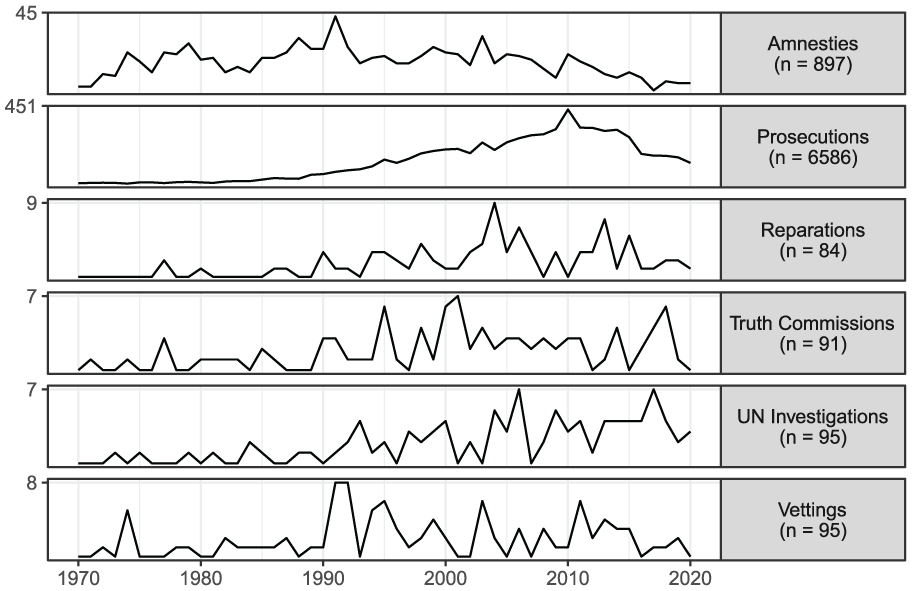
Trends in TJ mechanisms.
How are TJ mechanisms related?
Some theorists have suggested that different mechanisms might be sequenced to generate a holistic and impactful approach to TJ (Dancy and Wiebelhaus-Brahm, 2015; Fletcher et al., 2009). For instance, TCs often make recommendations for other types of TJ to be implemented. Others claim that different TJ mechanisms conflict with one another, forcing difficult trade-offs (Leebaw, 2008). Many rights advocates have grown critical of the pursuit of criminal prosecutions, worrying that the ‘laser focus on anti-impunity’ (Engle et al., 2016: 2) crowds out alternative forms of justice. We examine these holistic and trade-off hypotheses by studying basic correlations in our dataset.
Table 3 reports the results of statistical models predicting new adoption of each mechanism, based on prior adoption of other mechanisms. For example, the first column predicts new amnesties, based on countries’ prior experience with prosecutions, reparations, or other mechanisms. There are four takeaways from the results. First, amnesties and vetting policies are not regularly preceded by other mechanisms. This makes sense. Amnesties are very often the first mechanism used directly following political transition, which is why they are also associated with the later occurrence of prosecutions and TCs. And formal vetting policies were in large part isolated to Eastern Europe, which relied on this type of TJ first and foremost. Second, prosecutions do not seem to monopolize the TJ space. In the models predicting prosecutions counts, all but one type of TJ mechanism (TCs) are statistically significant predictors, meaning that prosecutions are often pursued in combination with other kinds of justice. Furthermore, prior prosecutions are not negatively correlated with any other mechanism, meaning that they do not seem to decrease the likelihood that TCs or reparations policies are later adopted. A third takeaway is that UN investigations, a portion of which recommend criminal accountability, are often followed by more domestic prosecutions. This finding suggests a possible relationship between external monitoring and domestic TJ. Finally, TCs are a significant predictor of future reparations policies, which is evidence of a suspected linkage between TC recommendations and the implementation of victim-oriented compensation and repair. Taken together, this simple analysis suggests there are some synergies between different types of TJ, and very few apparent trade-offs.
Models predicting new TJ mechanisms, based on past TJ experience.
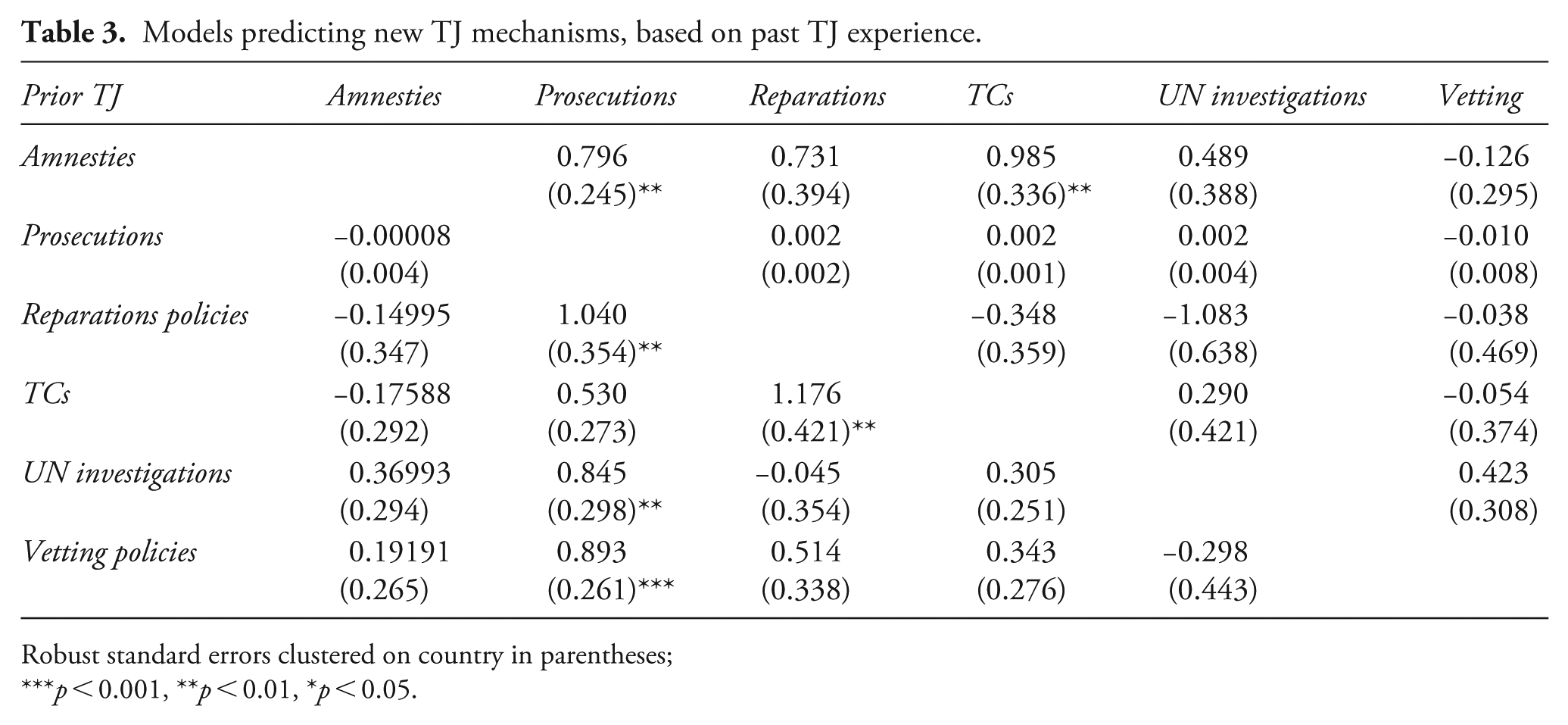
Robust standard errors clustered on country in parentheses;
p < 0.001, **p < 0.01, *p < 0.05.
Next steps
The TJET project’s purpose is to assist where comparison across cases might prove useful for practitioners or for theorists thinking through the supply of TJ and its impact on democracy or peace (e.g. Dancy and Thoms, 2025). To be clear, there are limitations to our database. For instance, we do not systematically incorporate measures of fairness into our mechanisms data, nor do we exclude processes that may be deemed unfair. Furthermore, we cannot independently validate every one of the nearly 14,000 sources we have drawn on to code the data (see Online Appendix). With these and other limitations in mind, the TJET project will aim to improve on three dimensions.
First, TJET is moving toward a greater degree of macro-level generalization through production of global accountability indices using Bayesian techniques. We are in the final stages of preparing three measures that capture the supply of TJ: a criminal accountability index, a truth index, and a reparations index. Using numerous TJ mechanism attributes from the TJET database, these indices assign values to countries based on the robustness of their provision of each of these TJ pillars.
Second, we intend to add more indicators in response to researchers’ needs. Not all of the TJET database’s measures on the substantive qualities of justice mechanisms have corresponding dataset indicators yet. For instance, attentiveness to gender – meaning the socially constructed roles, status, and identities of girls, women, boys, men, and gender-diverse people in society (Sikkink et al., 2024) – is a critical component of recent TJ captured in the TJET qualitative database that can be explored further.
Third, TJET is devising a strategy for systematically crowd-sourcing the correction of errors and assessment of TJ quality. We already vetted our data on Argentina, Chile, Guatemala, and the former Yugoslavia with the help of country experts. In the future, we aspire to broaden expert-driven error checks and survey-based quality evaluations to encompass all countries in the database.
The goal for the TJ field should be to bridge the macro and the micro levels of analysis. In an interconnected world, those who pursue progressive change must attend both to baseline tendencies across cases and to the particularities of any given case. Human rights and peace advocates may attempt to repair harms and prevent future violence in Bosnia or Sudan or Israel–Palestine, but they likely also share a devotion to promoting these aims everywhere. The question that will continue to animate the work of TJET is whether TJ, as a collection of norms and practices, can improve people’s lives, both locally and globally. We hope our data are used for this purpose and beyond.
Footnotes
Acknowledgements
The TJET team thanks Helen Clapp for her invaluable research and leadership over the course of the project. We also thank Sarah Guggemos for her directorship in the project’s early stages. And we deeply appreciate comments from Avery Schmidt and Chris Shay on earlier versions of this article.
Replication data

Funding
This research is funded by Global Affairs Canada Grant no. 211298.
Notes
PHUONG PHAM, PhD in International Social Epidemiology (Tulane University, 2001); Associate Professor, Department of Emergency Medicine, Harvard Medical School, and Department of Global Health and Population, Harvard T.H. Chan School of Public Health (2016–present).
KATHRYN SIKKINK, PhD in Political Science (Columbia University, 1988); Ryan Family Professor, Harvard Kennedy School (2013–present).
PATRICK VINCK, PhD in International Development (Tulane University, 2006); Associate Professor, Department of Emergency Medicine, Harvard Medical School, and Department of Global Health and Population, Harvard T.H. Chan School of Public Health (2024–present).