



Abstract
How do nonviolent alternatives affect international support for violent rebel groups? Armed rebellions are often sustained by outside sympathy and support, which conditions global coordination to end intrastate conflict. Studies on reducing such support largely neglect how the emergence of alternative, nonviolent resistance groups impacts international support for violent resistance. Nonviolent alternatives could plausibly increase support for armed rebellion by legitimizing the cause of resistance or reduce support by delegitimizing the means of violent rebellion relative to nonviolent alternatives. To examine this puzzle, we conducted two online survey experiments across more than 30 countries using a pre-post design to capture changes in attitudes toward a hypothetical violent rebel group before and after the emergence of an alternative resistance group. We randomly vary both the presence and features of the alternative group, including explicitly nonviolent rhetoric, government repression and concessions, and short descriptors meant to signal the alternative group’s capacity to fill psychological needs for agency, justice, and belonging. We find that alternative resistance options consistently reduce support for armed rebellion, including among those originally most supportive of it, and that respondents strongly prefer explicitly nonviolent alternatives, yet neither the material efficacy nor the emotional resonance of those alternatives have a substantial additional effect.
Why do Western audiences support violent rebel groups in foreign countries? And what factors change such support? Rebellion in the 21st century is inescapably transnational. Rebel groups vigorously compete in the court of international public opinion (Bob, 2005; Huang, 2016), attempting to sway both governments and mass audiences towards their cause in a crowded international information space. Such support can shape how governments respond to armed rebellions, including their willingness to provide funding, resources, and even foreign fighters needed to sustain insurgencies.
It is therefore critical to understand how armed conflict is perceived by global audiences. Existing studies primarily emphasize how ethnic or religious ties motivate international audiences to support violent rebellions in other countries (Salehyan et al., 2011). Yet international public support for insurgency goes well beyond cross-border identity linkages. For example, during the Syrian Civil War, anti-Assad rebels – particularly the Kurdish ‘People’s Defense Forces’ – enjoyed broad support across the ideological spectrum in the United States and Europe. Western nations provided substantial material support to the Kurds, while hundreds, if not thousands of Western foreign fighters with no ethnic or religious ties to the Kurds joined their ranks (Koch, 2021).
In this article, we examine a previously unexplored determinant of international public support for armed rebellion: the presence of other dissident groups that seek the same goals as rebel groups, but without violence. Contemporary intrastate conflicts often feature multiple dissidents pursuing violent and nonviolent strategies. Chenoweth and Schock (2015: 434) find roughly 45% of nonviolent campaigns from 1900 to 2006 had a simultaneous armed challenge in the same country, either as a violent flank within the nonviolent movement or as a separate violent organization. Cunningham et al. (2020) show that most self-determination struggles are pursued by multiple organizations, with different organizations employing violent tactics, nonviolent tactics, or both.
Our guiding motivation is that the presence or absence of nonviolent resistance options may impact how external audiences perceive violent rebellion – violence cannot be understood without reference to possible nonviolent alternatives. To our knowledge, no studies have directly examined this question. Still, existing observational research about violent and nonviolent struggle suggests conflicting implications about the impacts of alternative dissident groups on public support for armed rebellion. On the one hand, the presence of additional, nonviolent resistance groups could legitimize the cause of resistance by signaling widespread opposition to an unpopular or illegitimate opponent, thereby increasing international audience support for violent rebellion. On the other hand, the presence of alternative nonviolent groups could delegitimize the means of violent resistance by demonstrating that alternative, peaceful options were available, thereby decreasing external support for violent rebellion.
We argue for the latter approach: the presence of a nonviolent alternative should reduce the international audience’s support for violent insurgents by shaping views about the legitimacy of political violence. Most citizens of developed democracies believe political violence to be legitimate only when no nonviolent options are possible. However, international audiences have imperfect information about the possibility of nonviolent resistance in repressive autocracies, which sometimes impose prohibitively high costs on nonviolent collective action. In these circumstances, international audiences may infer that the rebels chose armed resistance only because nonviolence is infeasible, with corresponding implications for their support for armed rebellions. But if international audiences simultaneously observe alternative resistance groups that do not use violence, they may be less willing to countenance armed resistance as a measure of last resort, depressing their support for violence.
We tested this theory using two pre-registered cross-national survey experiments with respondents across 30 countries, primarily Western developed democracies. In both experiments, respondents read a vignette describing a rebel group fighting an authoritarian regime. We then randomized them into a control group or various treatment conditions that introduced an alternative resistance group with varying characteristics. In the first experiment, we manipulated this alternative group’s explicit use of nonviolent rhetoric as well as whether the authoritarian regime responded to this group with repression or concessions (a treatment intended to alter rationalist calculations about the efficacy of nonviolent resistance). In the second experiment, we again manipulated nonviolent rhetoric, but also added psychological cues – specifically, feelings of agency, justice, and belonging – to test whether these non-material factors influenced the appeal of the nonviolent alternative. Across both experiments, we measured respondent support for the violent rebel group both pre- and post-treatment to generate a within-subject measure of changing support for violence.
In both experiments, we find significant reductions in support for the rebel group in the presence of any alternative resistance group. We observe the strongest effects among respondents who expressed the highest pre-treatment support for the rebel group. However, in contrast to our expectations, the size of this effect is invariant with respect to the features of the alternative – nonviolent rhetoric, state responses, and psychological cues did not significantly reduce support for the violent group beyond the effect of a generic alternative. Yet, explicit nonviolent rhetoric significantly increased support for the alternative group, and respondents preferred nonviolent alternatives even though they deemed them less likely to succeed than violent rebellion. We examine potential explanations for these surprising patterns in the discussion.
Literature review
International support for insurgencies is a prominent factor in explaining the dynamics and outcomes of contemporary civil wars. Rebel groups invest significant time and energy in shaping their international image (Bob, 2005; Huang, 2016), including through social media (Jones and Mattiacci, 2019; Walter, 2017), in order to attract various forms of support from global audiences.
Much of the literature on transnational support for rebel groups has focused on the determinants of state support. A key contribution to this literature has been evidence that shared ideological, ethnic, and religious links predict external support for rebel groups (Cederman et al., 2013; Ives, 2019; Koga, 2011). But external states support rebel groups for a variety of other reasons, including factors such as international rivalries, whether opposing governments are also receiving external aid, and the characteristics of rebel leaders (Huang et al., 2022; Maoz and San-Akca, 2012; Salehyan et al., 2011).
Other scholars explore how rebel groups seek to sway both governments and global audiences to their cause. For instance, Stanton (2016) shows that both rebels and governments who rely on international support avoid attacking civilians to prevent losing that support. Jo (2015) finds that many rebel groups comply with international law to maintain legitimacy and Cunningham et al. (2021) argue that rebel groups hold elections in territory under their control in part to generate international legitimacy as democratic actors ready to lead a new state.
A smaller survey experimental literature has traced the micro-foundations of international support for rebel groups. Paralleling the studies just mentioned, a key finding in this literature is that international audiences tend to support rebels who behave in normatively appealing ways. Flynn and Stewart (2018) find that international audiences view secessionist rebels who avoid civilian killings and provide social services as more legitimate. Manekin and Wood (2020) find that rebel groups with female fighters gain increased international support and Arves et al. (2019) find that rebel groups who use specific nonviolent tactics of demonstrations and hunger strikes gain reputational benefits.
However, we are aware of no experimental studies that examine how the emergence and behavior of alternative groups that employ nonviolent resistance affects international support for rebel groups. This gap is surprising, considering the extensive literature demonstrating consequential effects of rebel group fragmentation. Such fragmentation is common – only half of civil wars have been fought by a single rebel group (Cunningham et al., 2012; Walter, 2019). The number of combatant groups has numerous consequential effects, including on rebel ideology and demands (Tokdemir et al., 2021), rebel group effectiveness (Krause, 2014), the feasibility of ceasefires (Braithwaite and Butcher, 2023), and external state support (Berlin and Malone, 2023).
Rebel group fragmentation goes beyond the sheer number of conflict parties – it includes divisions over violent versus nonviolent tactical choices. Nonviolent contention in civil conflicts has historically been understudied, in part due to the difficulty of collecting data on nonviolent action during violent conflict (Day et al., 2015). However, more recent systematic data collection efforts have shown nonviolent campaigns frequently emerge in violent conflicts (Braithwaite et al., 2022; Chenoweth et al., 2019). Nonviolent action is sometimes used to resist rebel groups (Kaplan, 2017; van Baalen, 2021), but is often also used by groups pursuing similar or the same goals as rebels (Chenoweth and Schock, 2015; Cunningham et al., 2017; van Baalen, 2024). As Pearlman and Cunningham (2012: 4) state, ‘the norm in more recent civil conflicts is not coherent antagonists as much as shifting coalitions of groups with malleable allegiances and at times divergent interests, only some of whom actually engage in violence at any given point in time.’
Given the complicated multiparty reality of contemporary intrastate conflict, existing studies may be neglecting a consequential determinant of international support for rebel groups. Rebels do not act in isolation – they are one part of a broader conflict context that may include alternative, nonviolent modes of resistance. Later in this article, we argue that the presence or absence of such alternatives holds significant implications for international support for armed rebellion.
Theory
Our argument begins from the premise that audiences in Western developed democracies generally disapprove of political violence. Democracy is inherently a rejection of violence to resolve political disagreements. Most democratic societies are far from ideal adherents to this rule – liberal democracies have fought major external wars, and many have had their own internal struggles with political violence. Nevertheless, opposition to violence is grounded in decades, if not centuries of democratic practice, and generally enjoys broad popular support (Westwood et al., 2022). Along these lines, a growing body of scholarship demonstrates that publics across many democracies are more supportive of nonviolent resistance than violent resistance for the same goals (Dahlum et al., 2023; Manekin and Mitts, 2022; Muñoz and Anduiza, 2019; Wasow, 2020).
Yet most democrats are not absolute pacifists. Few people, even in longstanding democracies, categorically deny the legitimacy of violence. For instance, violence in self-defense is a widely accepted civil right. Democratic audiences may also acknowledge the legitimacy of violent resistance to systematic political oppression, where neither inaction nor alternative strategies are perceived to be viable. The American Revolutionary War is one prominent example; a more recent instance is the previously mentioned Western support for an armed rebellion against Syria’s tyrannical President Bashar al-Assad, following Assad’s brutal repression of the 2011 nonviolent uprising.
This suggests at least two key factors that condition whether international audiences will support violent rebellion: Is the rebels’ cause just; and are other, nonviolent alternatives available? Both can be uncertain and subject to debate. On the former, justness of purpose is relatively transparent in at least one instance – cases where mass publics fight for the right of democratic self-determination against oppressive dictatorships. Self-determination and democratization campaigns are ideologically aligned with Western democratic values and are therefore likely to attract sympathy from democratic audiences. Even still, the narrative is not always neatly cut and dried, as it is often unclear whether armed groups calling for regime change actually enjoy broad popular support (i.e. that they represent truly democratic aspirations).
Moreover, even if a rebellion’s cause is laudable, it is difficult for international audiences to determine whether alternatives to violent rebellion are available. It is a common misconception that nonviolent resistance cannot work in violent contexts, as nonviolent campaigns have succeeded even against repressive authoritarian regimes (Chenoweth and Stephan, 2011; Roberts and Ash, 2009; Summy, 1994). However, severe and sustained violent repression certainly makes nonviolent resistance far more difficult – in the most challenging cases, extreme repression renders overt nonviolent resistance essentially unworkable (Chenoweth et al., 2017).
Given these complexities, distinguishing when nonviolent resistance is feasible in another country constitutes a fundamental problem of incomplete information – most observers lack the knowledge required to determine whether nonviolent alternatives are or are not realistically available in a repressive context. Thus, international audiences may defer to the judgment of local actors, inferring that dissidents chose to accept the high personal costs of armed rebellion because alternative, peaceful options were unviable – in other words that there was ‘no other way out’ (Goodwin, 2001). This assumption – that violent rebellions emerge because nonviolent options are foreclosed – may be further heightened by media tendencies to focus exclusively on violence during civil conflict (Day et al., 2015), magnifying the purported severity of violence and thus the necessity of violence in self-defense. As a result, international audiences may express support for armed groups even if they prefer nonviolent alternatives, because they believe nonviolent methods are unavailable.
So far, this discussion considers international audience perceptions of a violent rebel group in isolation. How would the emergence of an alternative group that does not endorse violence influence these perceptual dynamics? We see two possibilities.
First, the alternative group could legitimize the cause of violent rebellion. The presence of more than one resistance group reveals that opposition to the government is widespread. Observing widespread popular support signals to international observers that resistance enjoys domestic legitimacy, which can in turn increase their own confidence in the appropriateness of rebellion. In other words, additional resistance groups act as a rising tide that lifts all boats – greater group participation increases international support for resistance in general, irrespective of each group’s tactical choices.
A related possibility is that international observers do not cleanly distinguish between multiple resistance groups, such that the emergence of nonviolent alternative groups improves their perception of all groups resisting. Experimental studies show that violent groups earn greater foreign support when they are described as also using nonviolent tactics, which increases their perceived reasonableness (Arves et al., 2019; Huff and Kruszewska, 2016). Similarly, the extensive literature on ‘radical flank effects’ (both positive and negative) indicates numerous ways in which perceptions of one group bleed over into the movement as a whole (Farrer and Klein, 2022; Simpson et al., 2022). Given that external observers are often insensitive to the fine distinctions between various conflict sub-groups, it is plausible that the emergence of an alternative nonviolent group may lead to increased positive perceptions of armed groups as well. International support for the ongoing rebellion in Myanmar, which features both violent and nonviolent groups, shows this dynamic at work.
Second, an alternative nonviolent group could delegitimize the means of armed resistance. The presence of an alternative, nonviolent group partially resolves the incomplete information problem we described earlier by demonstrating that at least some dissidents do not believe violence to be the only available option. Providing this alternative resolves the tension between ends and means underlying international audiences’ support for violent rebel groups, allowing democratic observers to think they can have their peaceful self-determination cake, and eat it too. If this relationship obtains, the emergence of alternative resistance groups would decrease international audiences’ support for armed groups.
Notably, this causal mechanism could hold even if the nonviolent resistance group does not succeed in the long run – once possible alternatives to violence appear, international audiences may seek clear evidence that they are actually unworkable before accepting the necessity of armed rebellion. This mechanism is also complicated by the fact that some resistance groups use both violence and nonviolence simultaneously, claiming that both are necessary (Krtsch, 2021). If rebel groups and nonviolent resistance groups justify their activities jointly, then the presence of nonviolent groups may not depress international support for violence. But nonviolent alternative groups often take great pains to distinguish themselves from their violent counterparts, as they have principled disagreements on tactics even as they pursue similar goals. In these cases, we would expect the rise of alternative resistance groups to decrease support for armed rebel groups.
Which of these effects proves stronger – either increased legitimacy of cause, or decreased legitimacy of means – is an unanswered empirical question. Our hypothesis is that the presence of alternative groups will decrease support for armed rebellion, as respondents substitute nonviolent forms of resistance for violent ones. We lean towards this negative effect in the light of the normative aversion to violence among democratic audiences.
Our primary hypothesis is thus as follows:
H1: The emergence of an alternative resistance group that does not use violence will reduce external support for a violent rebel group.
Specific features of an alternative resistance group might enhance or detract from any effect observed from H1. We theorize about three such characteristics: the alternative group’s explicit commitment to nonviolence; how the government responds to the alternative group; and the alternative group’s psychological appeal.
First, as discussed earlier, nonviolent groups may or may not choose to clearly distinguish themselves from violent resistance groups based on their tactical differences, and they may be more or less committed to purely nonviolent methods. If a nonviolent group chooses to emphasize nonviolence as a core group attribute – both by explicitly committing to nonviolent methods and by disavowing other armed groups, even though they pursue similar goals – then we expect that tactical distinction to resonate more with international audiences, accentuating their belief that violence is unnecessary and even counterproductive in achieving political change. This implies an alternative group’s explicit commitment to nonviolence should magnify the (negative) effect of that group’s presence on external support for a violent rebel group.
H2: Explicitly framing a resistance group as committed to nonviolence will enhance the effects posited in H1.
Second, whether nonviolent resistance constitutes a viable alternative to armed rebellion depends in part on whether the state accommodates or opposes it. If the state responds to nonviolent mobilization with repression, international audiences may infer that nonviolence is likely to fail or that violence in the name of self-defense is necessary, undermining the substitution mechanism proposed in H1. The reverse should occur if the state instead responds by conciliating the nonviolent group, which signals that nonviolence is likely to succeed.
H3: Repressive/Concessionary state responses to nonviolent alternatives will attenuate/enhance the substitution effects posited in H1.
Third, a growing literature shows that attitudes towards both violent and nonviolent resistance are shaped by more than rational calculations about their material efficacy – how people feel about resistance groups matters too (Van Zomeren et al., 2012). We have already discussed the moral valence of nonviolent resistance, which people generally prefer to violence. But there are other emotional and psychological determinants of support for resistance groups. For instance, emotions like anger prompt protest participation (Jasper, 2018) whereas fear discourages it (Young, 2019).
Another way to put this is that support for and participation in resistance can satisfy certain emotional or psychological needs, beyond the expectation of material gains. Along these lines, resistance groups may try to generate additional popular support, if not active participation, by emphasizing certain emotional or psychological characteristics of their activities or of group membership.
We focus on three psychological factors. The first is the sense of self-efficacy or ‘pleasure in agency’ that manifests when people choose to engage in public dissent, breaking through the ‘barrier of fear’ to restore control over their lives and make positive changes (Pearlman, 2013; Wood, 2003).
The second is a desire for justice, both in terms of the satisfaction that comes from punishing those who violate accepted norms, and in the desire to behave righteously (for some, this may mean violently) as an agent of justice in such circumstances. Considerations about justice underpin feelings of moral outrage, which plays an especially important role in nonviolent action campaigns, as it is an underlying motivator of backlash protests (Aytaç et al., 2018; Hess and Martin, 2006; Lewis and Ives, 2025).
Lastly, a core psychological motivator for resistance is the need for belonging: a desire to be a valued part of a community and to contribute to a group purpose beyond the self. Belonging is a fundamental human need that can be satisfied by various forms of group membership (Baumeister and Leary, 1995). Thwarted belonging or disconnection is therefore thought to increase the risk of individual participation in violent extremist groups, which can provide their members with the close-knit communities and camaraderie that they lack (Charkawi et al., 2021).
This discussion of psychological motivations leaves us with the following hypothesis:
H4: Framing alternative nonviolent groups as satisfying a need for agency/justice/belonging will heighten the substitution effects posited in H1
Research design
To test these hypotheses, we conducted two pre-registered online survey experiments using Prolific. 1 Prolific recruits online survey respondents across 35 countries, and is known for improved data reliability over comparable platforms (Palan and Schitter, 2018).
Pre-post design
To more directly simulate the emergence of an alternative group in the presence of a violent rebellion, and to increase measurement precision, both our experiments follow a pre-post design (Clifford et al., 2021). We measure respondent attitudes towards a hypothetical rebel group once before and once after treatment. This allows us to control for respondents’ baseline support for the rebel group and then analyze how those attitudes shift in the presence of an alternative resistance group.
Sample
We sought to exclude from our sample individuals with strong aversions to violence or ideological views that categorically eschewed violence, whom we expected would have low levels of stated support for violent rebels regardless of the presence or absence of an alternative.
To accomplish this, we fielded a short screener survey available to all English-speaking Prolific users except those in the United States, per restrictions from our funding source. The survey filtered respondents based on a single question: ‘how much do you agree with the following statement? “I would never use violence against another person even if they threatened me or my family”.’ Responses were measured on a 7-point Likert scale. Only those respondents who did not select the top two levels of ‘Strongly Agree’ or ‘Agree’ were eligible to participate in the experiments. 2
We conducted our first experiment with a sample of 2,000 respondents, and our second experiment with a sample of 2,500 respondents. These sample sizes were specified in our pre-analysis plan, based on a simulated power analysis.
Baseline scenario
Both surveys shared the same front end and baseline scenario. After giving informed consent, all respondents answered demographics and completed several standard psychological indexes. We sought to explore whether these might have interaction effects with our psychological needs treatments, but only in exploratory analysis, thus we discuss them in more detail later in our exploratory analysis section.
Respondents were then presented with a vignette describing an authoritarian regime in a fictional country (‘Bravia’), and a violent rebel group (‘The Bravian Armed Liberation Front’) fighting that regime. The baseline scenario was as follows:
For many years, the country of Bravia has suffered under the oppressive rule of President Y. Y has rigged elections and used emergency powers to imprison and kill opponents without trial. Y’s corrupt economic policies have also pushed many Bravians into extreme poverty. President Y’s failures have sparked resistance. Some Bravians began a violent resistance campaign, stating that armed rebellion is necessary to overthrow President Y and empower a legitimate democratic government. This group, the Bravian Armed Liberation Front, has attacked soldiers and police and has promised that these attacks will continue until President Y resigns and a democratic government is elected.
We sought to ensure both information equivalence and respondent attention by providing a detailed but brief vignette (Dafoe et al., 2018). Given concerns over social desirability bias in expressing support for the rebel group, and to capture the means vs ends dynamic described in our theory we also described the goals of the rebel group in very positive terms.
After reading the baseline scenario, respondents then answered three questions to give pre-treatment measures of our outcome variables (described later) before being randomized into control and treatment arms.
Experiment 1
Participants in Experiment 1 were randomly assigned with equal probability to five experimental conditions: a control condition, generic alternative, explicit nonviolent alternative, explicit nonviolent alternative + repression, and explicit nonviolent alternative + concessions. In each condition, respondents read another vignette and then answered our outcome variable questions. The full text of the five conditions is as follows:
Experiment 2
Experiment 2 directly replicated the baseline scenario, outcome questions, and text of the control, generic alternative, and explicit nonviolent alternative conditions from Experiment 1. The sole difference between the experiments was that, in Experiment 2, we replaced the explicit nonviolent alternative + repression and explicit nonviolent alternative + concessions treatment arms with three treatments invoking our three psychological needs: agency, justice, and belonging. The three treatments unique to Experiment 2 replicate the text of the Explicit Nonviolent Alternative condition, followed by a short secondary description, provided here:
We pre-tested numerous variations on the text to identify treatments that best triggered the desired themes. We then selected the variant pre-test respondents most closely associated with the underlying concept. 3
Outcome measures
Our key outcome of interest is support for the violent rebel group. We measured support using two questions, one which asked respondents for their level of approval for the Bravian Armed Liberation Front and one which asked for their willingness to join the group if they were a citizen of Bravia. We used multiple measures to ensure that any findings were not dependent on a single way of asking the question but reliably tapped into more consistent attitude shifts.
Note that there is a large psychological literature demonstrating that people are poor predictors of their own future behavior, particularly when the behavior in question is high-risk or abnormal (see e.g. Van Boven et al., 2012). Responses on ‘willingness to join’ should therefore not be directly interpreted as indicating actual likelihood of joining a violent rebel group, but rather as an evocative way of gauging respondents’ hypothetical support for the rebel group. We report outcomes for both questions.
We were also interested in whether the treatments impacted perceptions of the efficacy of the violent rebel group. Thus, we asked respondents a question about their belief that the Bravian Armed Liberation Front would succeed. We also sought to measure respondent attitudes towards the alternative resistance group (approval, willingness to join, and likelihood of success), which could also vary across treatment conditions. 4 Since our studies focused on how alternatives affected support for rebel groups, we did not pre-register hypotheses on attitudes to the alternative, but generally expected that factors decreasing support for the violent rebel group would increase support for the alternative group.
Findings
We begin with descriptive statistics. Figure 1 displays histograms of respondents’ average pre-treatment approval of and stated willingness to join the rebel group across both experiments. Respondents show considerable support. Roughly half of respondents either ‘Approved’ or ‘Strongly Approved’ of the rebel group, while roughly a quarter indicated that they would be ‘Willing’ or ‘Very Willing’ to join. The median value for both variables in both experiments was a 5 on a 7-point Likert scale, while standard deviations ranged from 1.37 to 1.65. We provide other descriptive statistics in the Online Appendix.
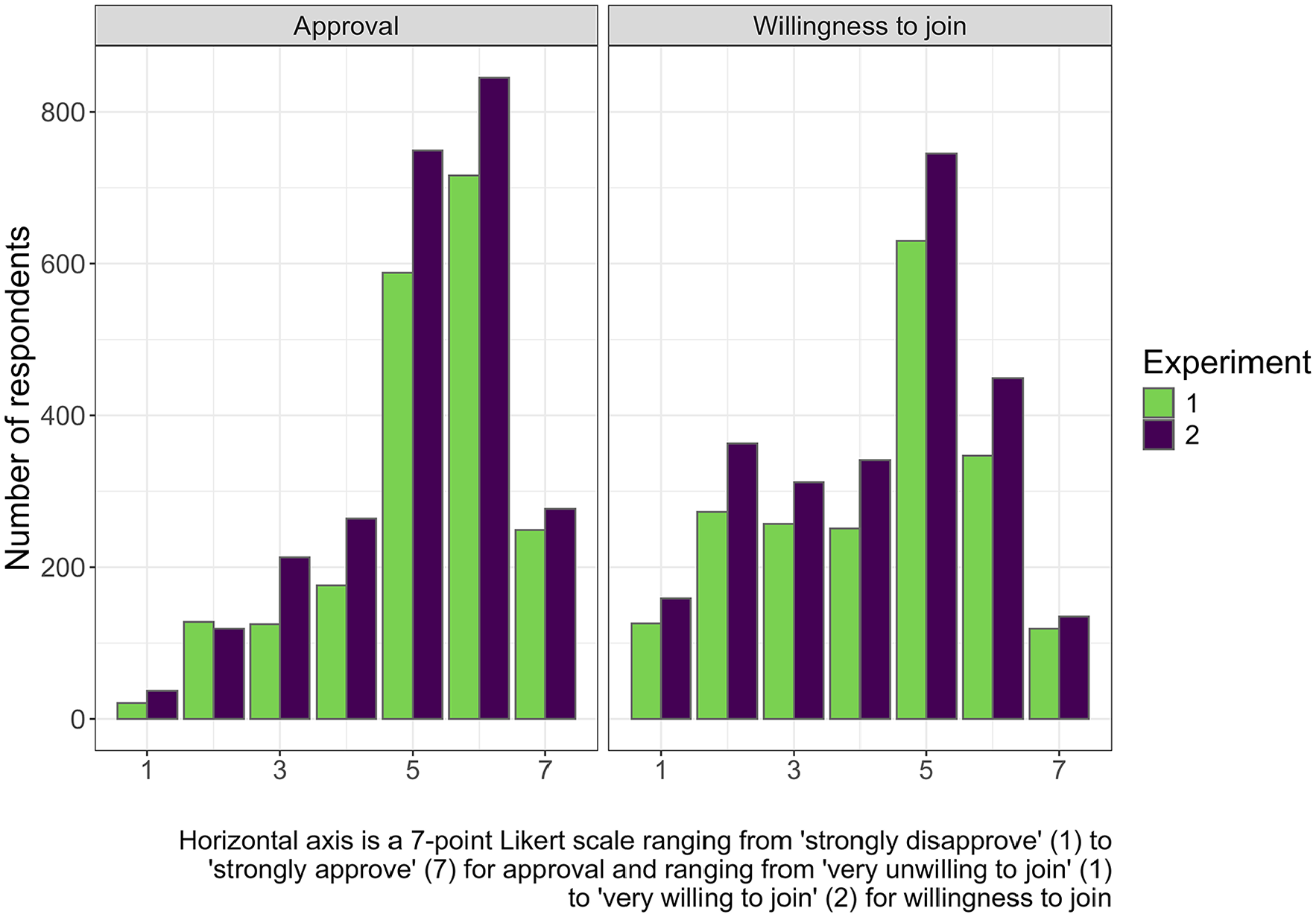
Pre-treatment attitudes towards the rebel group.
Simple pre-post differences in means provide initial indications of consistent but modest treatment effects. As Table 1 shows, while the control group shows differences in means close to zero, all treatments show reductions in mean levels of approval or willingness to join, with reductions ranging from −0.045 to −0.297 (expressed in terms of raw differences in our 7-point Likert scale). Differences in means are roughly in the order expected by our hypotheses as well, with the largest reductions in approval and willingness to join in Experiment 1 occurring in the NV + Concessions treatment, and the largest reductions in Experiment 2 occurring in the NV + Belonging treatment. However, the small differences highlight the importance of increasing precision through controlling for the pre-treatment level of the dependent variable.
Difference in means across dependent variables and experiments.
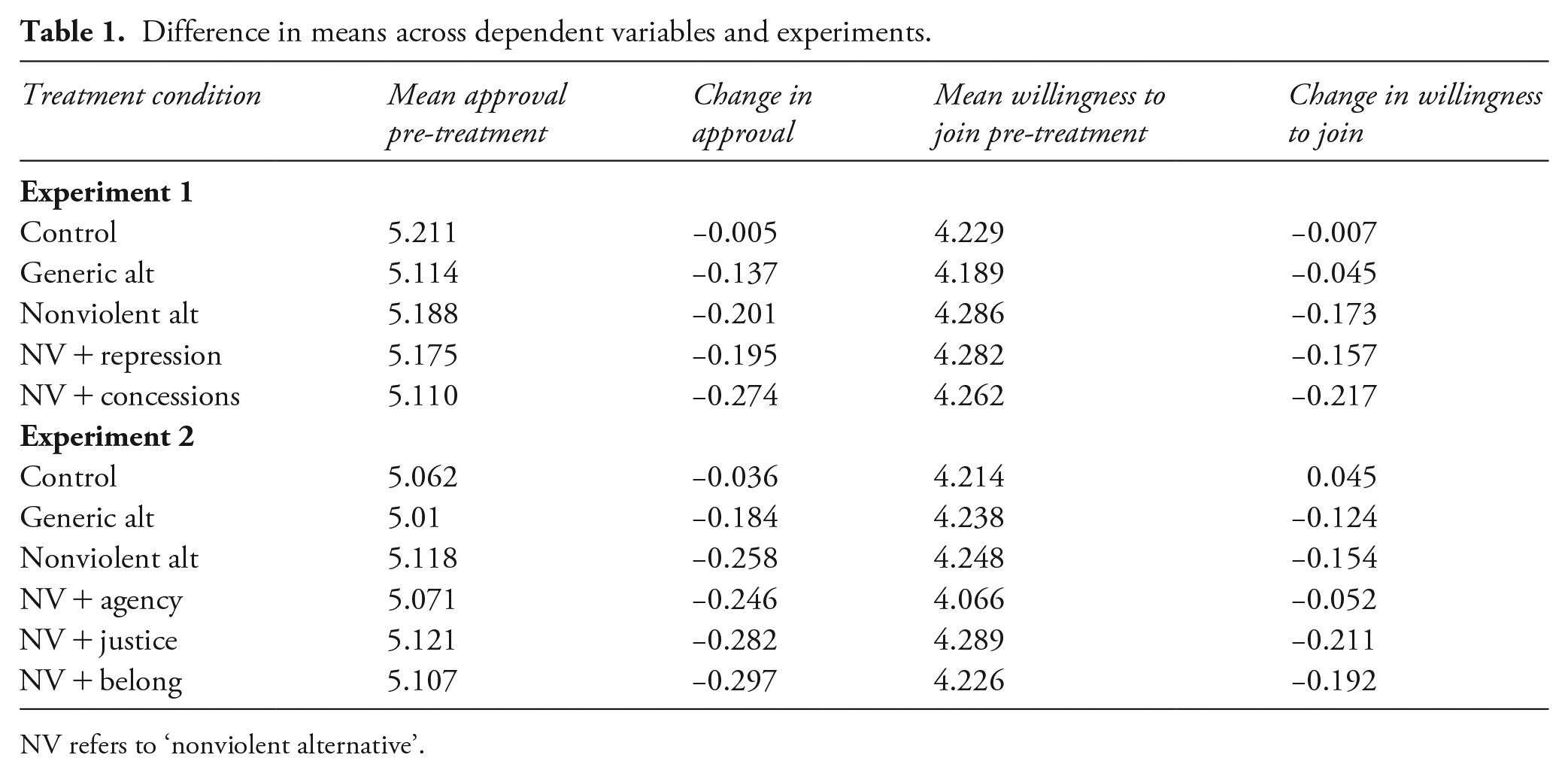
NV refers to ‘nonviolent alternative’.
Moving to regression analysis, we analyze the effects of our treatments using a pre–post design model that controls for the baseline level of our dependent variables. We accomplish this using a series of multivariate linear regression models according to the following equation:

Yit2 is the value of the outcome variable for respondent i post-treatment; TREAT is an indicator of the treatment condition, with the control as reference category; Yit1 is the outcome variable for respondent i pre-treatment; and Xi represents a vector of covariates. We run separate models with three sets of control variables: only Yit1 and a binary indicator of failing a pre-randomization attention check, adding psychological indexes, and finally adding background demographics. 5
Figures 2 and 3 report coefficient plots of this analysis. 6 In Experiment 1, all treatment conditions significantly reduce stated approval of the rebel group. Three out of the four treatments significantly reduce stated willingness to join the rebel group – the generic alternative has a negative sign but is not significant at p < 0.05. In Experiment 2, all treatments significantly reduce approval, and four out of the five treatments reduce willingness to join across all models. The ‘agency’ alternative significantly reduces willingness to support in two models but narrowly misses statistical significance at p < 0.05 in the model including the full set of control variables.
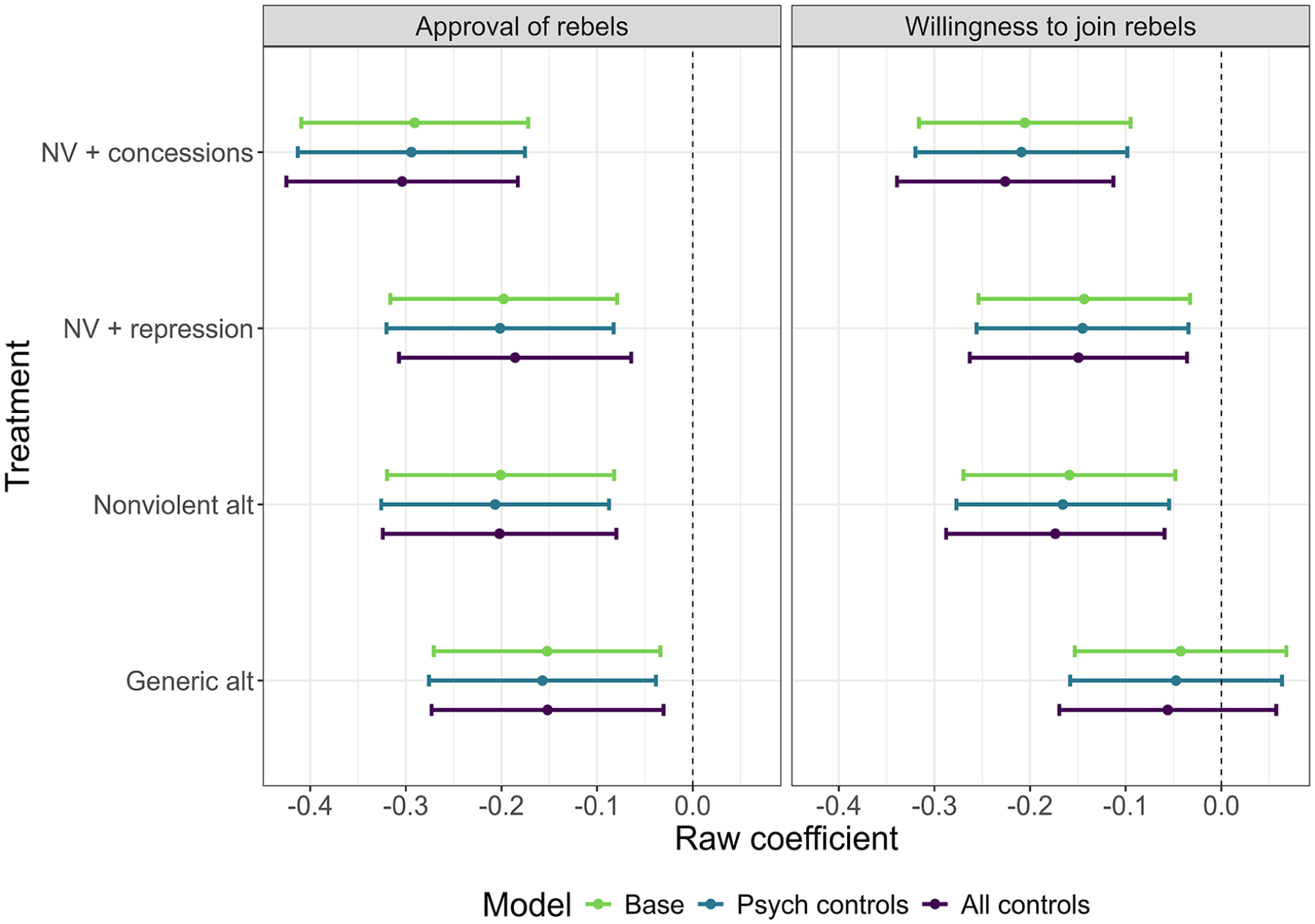
Experiment 1 main treatment effects.
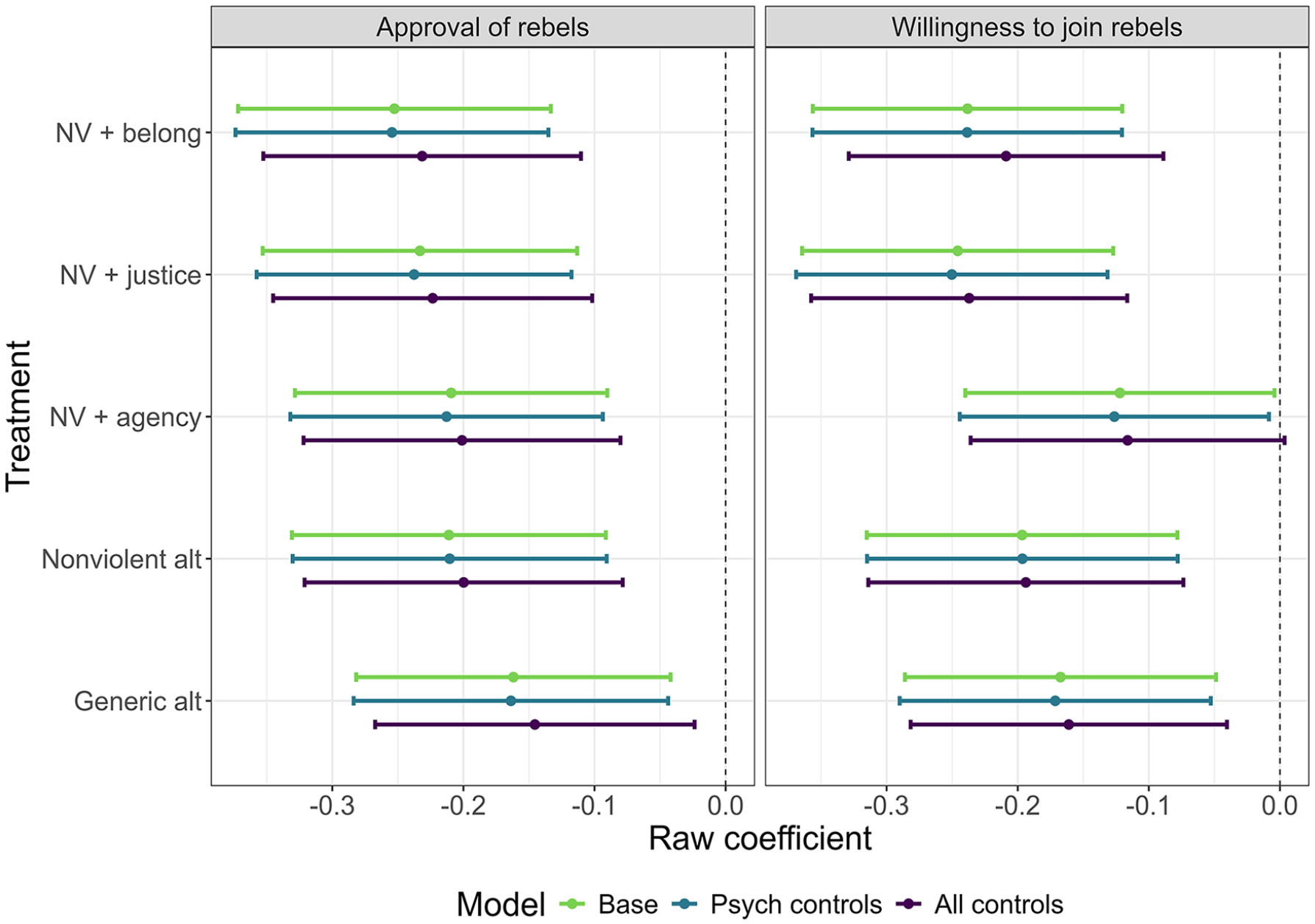
Experiment 2 main treatment effects.
These results indicate strong support for H1: providing an alternative reduces approval of and willingness to join a violent rebel group. Effect sizes are modest, ranging from −0.22 to −0.03 in terms of Cohen’s d.
While almost all treatments are significantly different from the control group, they all have widely overlapping confidence intervals. F tests for equality of coefficients, and an alternative model specification combining elements of treatment conditions, also reveal no significant differences between treatments (results reported in the Online Appendix). Thus, we are unable to reject the null for H2 through H4: neither explicit nonviolent framing, nor state responses, nor rhetoric indicating capacity for the alternative to meet psychological needs, appears to have a stronger direct effect on support for the rebel group than a generic alternative. In the next section, we conduct exploratory analysis to better understand these null effects.
Exploratory analysis
We first considered whether our results might be driven by respondents who already had low support for the rebel group. Thus, we re-ran our primary regression models with the subset of respondents who expressed pre-treatment that they were at least ‘a little willing’ to hypothetically join the rebel group (Experiment 1 n = 1,096, Experiment 2 n = 1,329). Our treatment effects were both larger and more significant in this sub-sample (See Online Appendix Figures A3 and A4), indicating that our treatment effects are being driven by the group with the highest pre-treatment levels of support.
We next consider the null results on the impact of nonviolent framing. We intended our generic alternative to present respondents with an alternative group with no explicit information on that alternative’s violent or nonviolent character. However, after examining the Experiment 1 data, we suspected respondents were inferring that the ‘generic’ alternative was nonviolent. To test this, we added a supplemental post-treatment question to Experiment 2 asking respondents who received the generic alternative treatment how violent or nonviolent they believed the generic alternative to be, on a 10-point sliding scale from ‘Completely Violent’ to ‘Completely Nonviolent’. Figure 4 shows a histogram of these results.
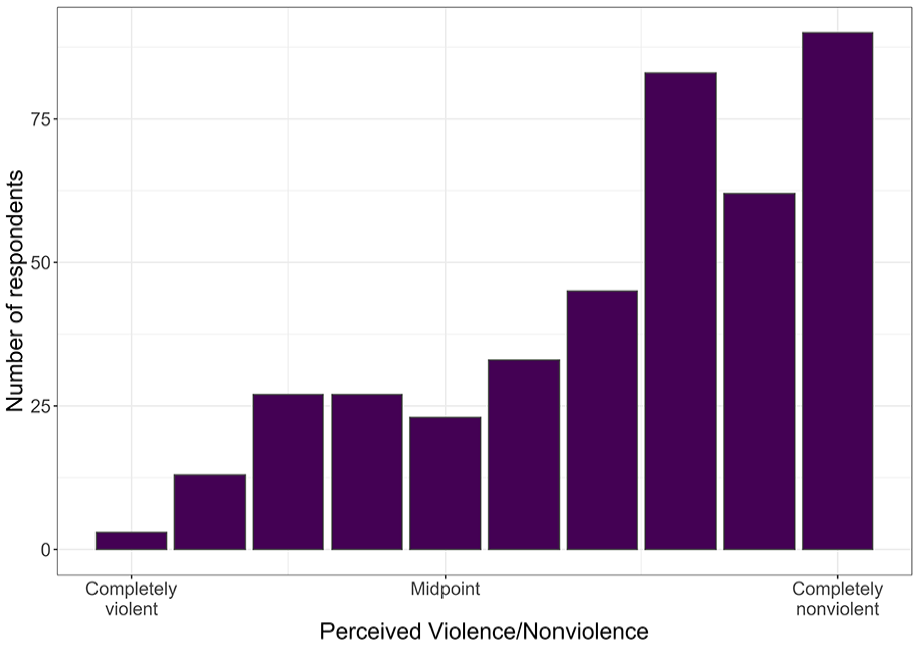
Perceptions of nonviolence in generic alternative, Experiment 2.
Most respondents inferred that the generic alternative was completely or near completely nonviolent. This strong association between the generic alternative and perceived nonviolence likely explains why the explicit nonviolent prime did not have a significant additional effect relative to the generic alternative.
We next considered whether null effects for the repression and concession treatments in Experiment 1 might be due to weak treatments. To examine this possibility, we analyzed respondents’ evaluation of the alternative movement’s likelihood of success. 7 Since our control condition did not describe an alternative movement, we compare respondent beliefs about our generic alternative and the various versions of our explicitly nonviolent treatments. In Table 2, we regress the various aspects of our treatment conditions in Experiment 1 on this measure of alternative movement likelihood of success.
Treatment characteristics’ effects on alternative movement likelihood of success.
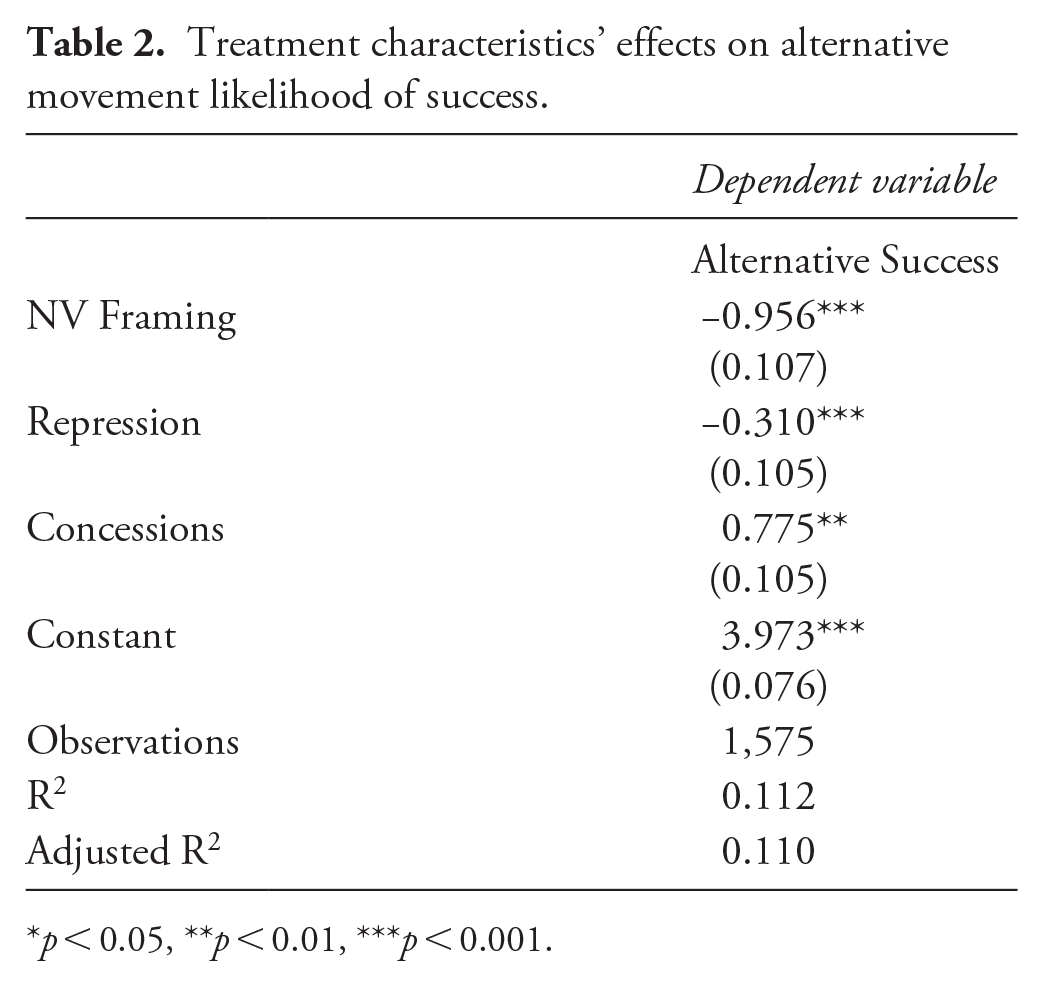
p < 0.05, **p < 0.01, ***p < 0.001.
Respondents clearly distinguished between the different alternatives’ likelihood of success. Repression decreases expectations for success, whereas concessions strongly increase them. Yet these beliefs do not meaningfully influence respondent attitudes towards the violent rebel group.
Explicit nonviolent rhetoric has a significant and substantive negative effect on the anticipated likelihood of success – respondents believe that explicit nonviolence is unlikely to succeed. Despite this, as shown in Figures 2 and 3 earlier, presenting respondents with explicitly nonviolent alternatives still decreases their approval of and hypothetical willingness to join the violent rebel group. In other words, when presented with nonviolent alternatives, respondents grow less supportive of a rebel group in spite of their general belief that nonviolent alternatives are less efficacious. Respondents recognize that government responses meaningfully shape the likelihood of nonviolent campaign success, but these cost/benefit calculations do not alter their approval of or hypothetical willingness to join a violent rebel group.
We draw several inferences from this. Consistent with existing literature on audience preferences over nonviolence and violence, nonviolent framing does appear to increase support for resistance movements. Though we lack the evidence to definitively illustrate that the presence of expressly nonviolent alternatives depresses support for armed rebellion, we suspect that this null effect is more an artifact of the inferred nonviolent character of the generic alternative than a strong empirical result. We also demonstrate that respondents’ preferences for nonviolence appears to be independent of their beliefs about its material efficacy, an important finding that corresponds with recent work on the normative value of nonviolence (Dahlum et al., 2023).
Non-material factors and psychological dispositions
Finally, we explored interactions between respondents’ psychological dispositions and the psychological treatments in Experiment 2. We suspected the psychological factors described in H4 might have heterogeneous effects depending on respondents’ psychological make-up. We examined four psychological characteristics that might interact with these factors.
The first is past trauma, a life experience commonly associated with aggression and susceptibility to violent extremism (Rasche et al., 2016). We are not aware of any research linking trauma with mobilization for nonviolent resistance, though some studies indicate the opportunities for increased self-efficacy and agency provided by participation in protest may help participants overcome past traumas (Basch, 2023), while others highlight how protest (and repression) can be major traumatic events (Çelebi et al., 2022). We measured past trauma with a compressed four-item index designed to efficiently capture trauma experiences in a brief survey (Rasche et al., 2016).
The second is perceived victimization. Narratives of victimization, in which an individual believes that they or their group are targets of intentional harm (Pemberton and Aarten, 2018), are central to many individual pathways into violent extremism (Decety et al., 2018), While the perception of victimization is shaped by real-world circumstances, a tendency to victimhood is also a stable personality construct that shapes real-world perceptions (Gabay et al., 2020). We measured perceived victimization using a four-item index of the Tendency for Interpersonal Victimhood, which has been shown to have sound psychometric properties(Gabay et al., 2020), and has been used in studies on political violence (Hameiri et al., 2024).
The third is a sense of low social status (van Zomeren et al., 2008; Walker and Smith, 2002). Perceptions of low social status have a long pedigree as a factor in motivating various forms of both violent and nonviolent contention. We expected that our ‘justice’ treatment might be a particularly potent prime for individuals with high feelings of status resentment. We measured perceived social status using the MacArthur Scale of Subjective Social Status (Adler et al., 2000), one of the most commonly used measures of social status across cultures and research fields.
The final psychological characteristic is respondents’ feelings of ‘thwarted belonging’, a concept mentioned earlier in reference to one of our three psychological need hypotheses. Given the importance of belonging as a motivator for participation in any form of collective action, we expected that respondents’ baseline feelings of need or lack of need for belonging would impact how they perceived both violent rebellion and nonviolent alternatives, and in particular would shape how they perceived a nonviolent group intentionally framed as satisfying a need for belonging. We measured thwarted belonging using a nine-item index from the Interpersonal Needs Questionnaire, which is the standard measure used in the psychological literature (Van Orden et al., 2012).
We examined relationships between these four psychological characteristics (trauma, victimization, status, and belonging) and support for the rebel group and nonviolent alternatives, as well as interactions between these indexes and the psychological primes. 8 Regression models interacting the four psychological indexes with our treatments for the most part yielded null or unstable results, thus we do not discuss them further.
Thwarted belonging was the only psychological disposition displaying a consistent direct relationship with any of our outcomes. It is associated with an increased willingness to join the rebel group in Experiment 2, and with approval of and willingness to join the alternative resistance group in both studies (see Online Appendix Table A9). Regression models interacting the thwarted belonging index with our belonging prime also yielded interesting results. We find that the positive association between thwarted belonging and hypothetical willingness to join the rebel group is eliminated when interacted with our belonging prime (see Figure 5). However, the significant effect of the belonging index in the absence of the belonging prime is small (0.02 in terms of Cohen’s d).
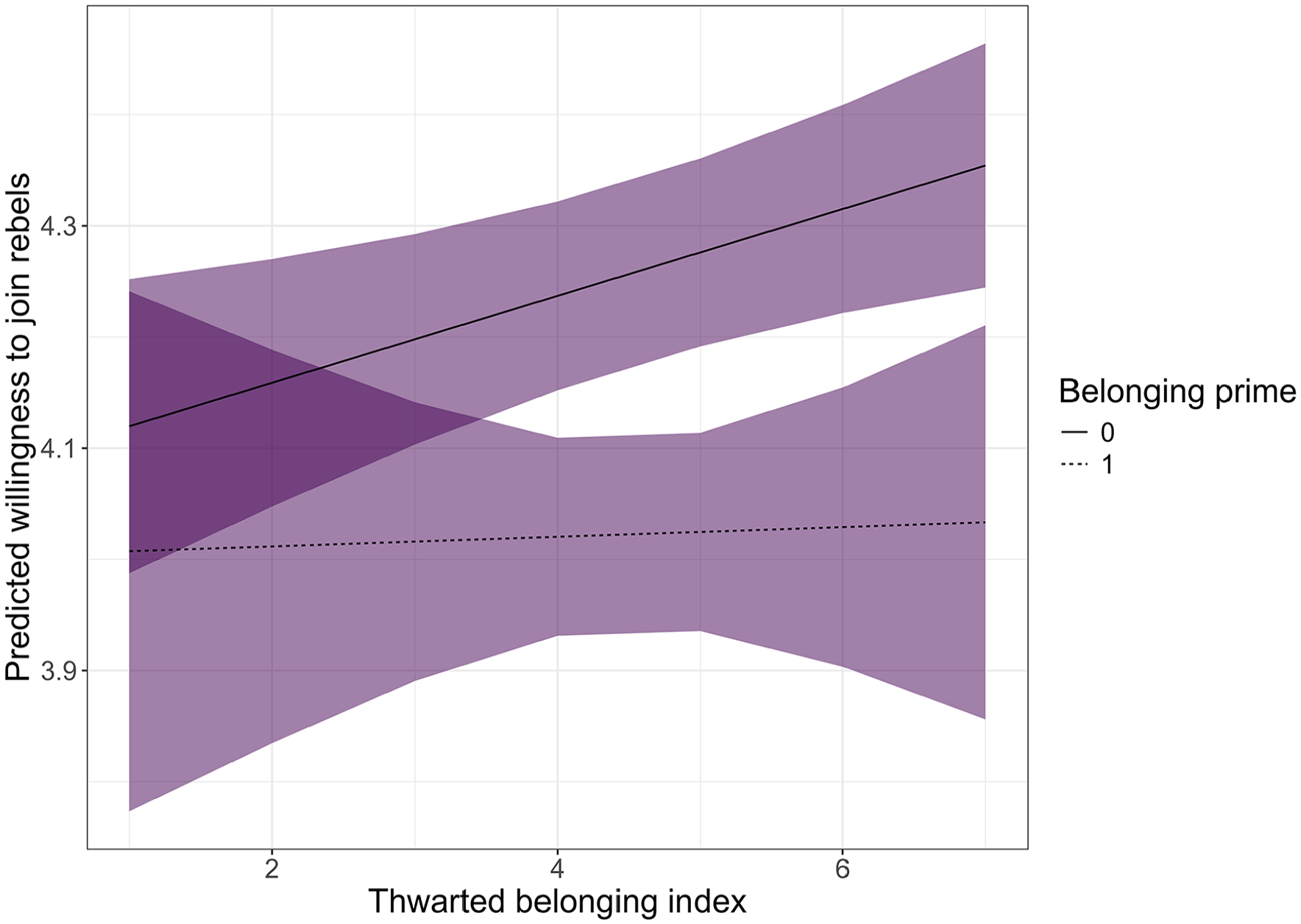
Thwarted belonging and willingness to join violent extremist group.
Additionally, the effect of the belonging treatment on hypothetical willingness to join nonviolent alternatives, while statistically insignificant overall, is enhanced by feelings of thwarted belonging. Figure 6 shows that individuals that scored highly on the thwarted belonging index responded positively to the belonging prime, stating higher willingness to join the alternative nonviolent movement.
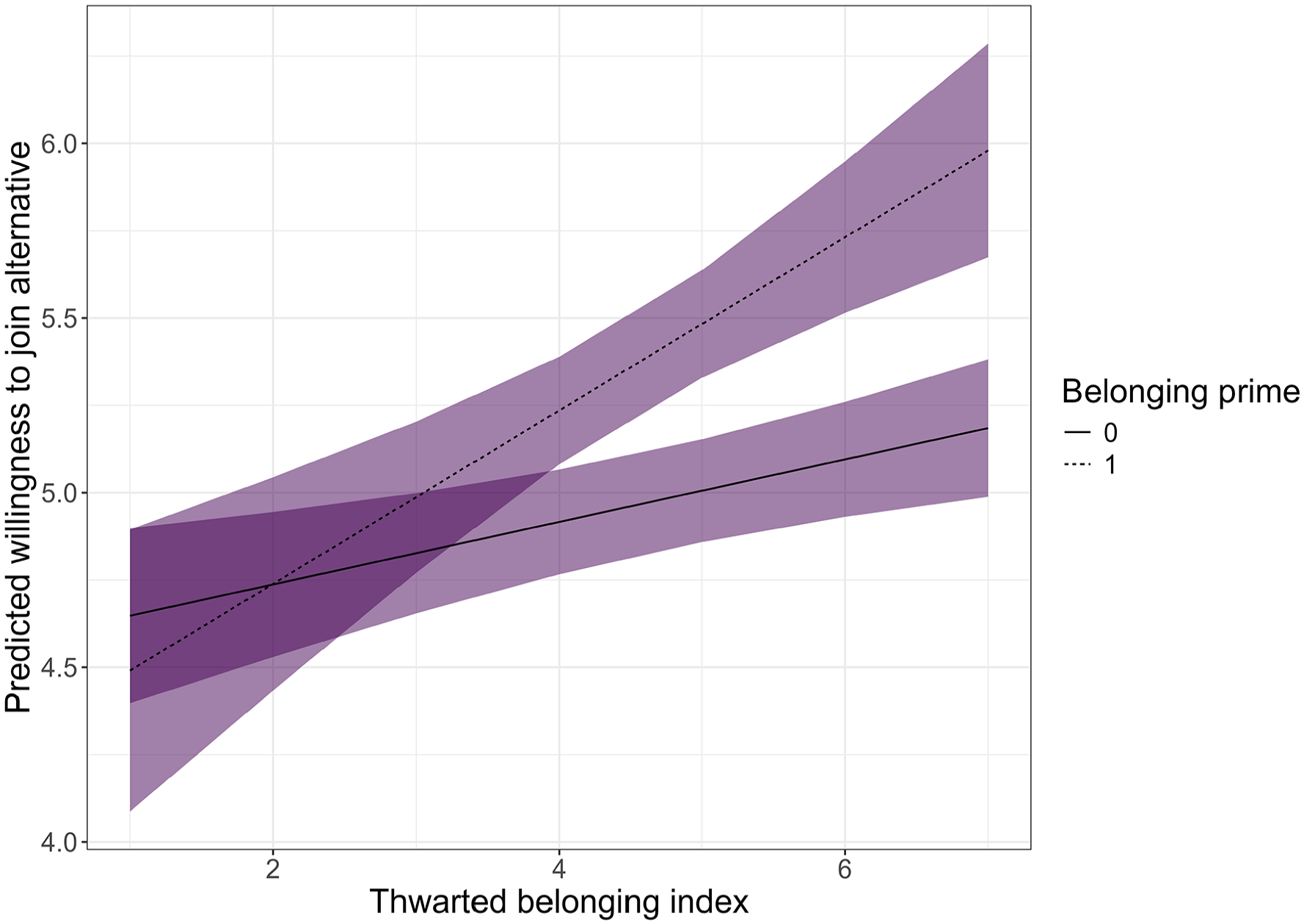
Thwarted belonging and willingness to join nonviolent alternative.
Taken together, these findings suggest the heretofore underappreciated importance of a lack of belonging as a motivator for supporting movements in other countries that international observers imagine would provide them with feelings of belonging. However, because of their exploratory nature, these results should only be interpreted as suggestive spurs for future research.
Conclusion/discussion
We find that nonviolent alternatives reduce international support for rebel groups. This effect is consistent regardless of these alternatives’ features. Perhaps most surprisingly, this reduction in support occurs regardless of the material costs and benefits of the nonviolent alternative – levels of support for the rebel group were unaffected by repression or concessions for the nonviolent alternative, and while respondents generally anticipated nonviolent alternatives to be less effective than violent rebellion, they still preferred it. Our results thus speak to the impact of nonviolence on violent conflict: other characteristics of nonviolent alternatives may matter at the margins, but providing any nonviolent alternative whatsoever appears to be a powerful mechanism for reducing support for rebel groups.
These findings make several contributions to the field. First, they build on the literature on how rebel group behavior affects international perceptions. This literature has previously shown that normative behaviors by rebels, including engaging in nonviolent resistance, increases international support (Arves et al., 2019). We show that such effects depend on which groups engage in these behaviors. While nonviolent activities may increase support for rebels when the rebels themselves conduct them, they appear to have the opposite effect when they are conducted by alternative groups.
Second, these findings build on prior literature on ‘radical flank effects’ in external perceptions of resistance movements. This literature has previously focused almost exclusively on how the emergence of a violent group changes perceptions of a nonviolent group. We show that ‘moderate flank effects’ may also shape external perceptions of resistance movements. The emergence of nonviolent alternatives does not appear to legitimize the ends but rather to delegitimize the means of violent rebellion.
Third, our research advances an important corrective to a common narrative about how individuals evaluate nonviolent resistance. Civil resistance scholarship has generally focused on demonstrating the relative efficacy of nonviolent resistance. Yet we find evidence of reduced support for rebellion when nonviolent alternatives are present in spite of respondents’ belief that nonviolent resistance is less effective. In addition, our exploratory analysis suggests that non-material motivations like belonging may also play a role in motivating individuals to embrace nonviolent action. This suggests a need for civil resistance scholars to pay greater attention to non-material factors, and for nonviolent activists and practitioners to couple persuasive appeals about the efficacy of nonviolent action with narratives about these non-material benefits of participation.
Our studies also open several areas for future research. First, our examination of interactions between psychological dispositions and substitution was exploratory, and as is to be expected with exploratory research, most results were null. The fascinating exception is thwarted belonging. Even in an artificial survey experimental environment, a modest statement of acceptance and community resonated among respondents that otherwise had the highest support for violent rebellion. Might more immersive interventions, either in survey or field experiments, yield more impactful results? What practices by nonviolent movements most effectively trigger feelings of community and belonging? And does the appeal of those practices differ for populations that are high or low in thwarted belonging? These are all fruitful avenues of further exploration with potentially transformative implications for applied practice.
Second, our experiments focused on how features of an alternative group might affect support for a violent rebel group. We did not examine how similar variation in features of the violent rebel group might affect these dynamics. Future studies, for instance in a conjoint design, could jointly vary violence/nonviolence, repression/concessions, psychological primes such as belonging, and any other number of relevant factors to better understand how resistance group characteristics affect the support of external audiences. 9
Third, international support for rebellion affects conflict dynamics in large part through shaping how international audiences pressure their governments to behave. Future research could explicitly examine how the emergence of alternative movements with various features affects international audiences’ opinions on how their governments should respond, for instance asking whether the presence of a nonviolent alternative increases support for economic sanctions or military intervention.
We conclude with thoughts on policy implications. Simply stated, our experiments show the importance of highlighting the alternatives to violent rebellion. Even in contexts of brutally repressive political regimes or violent civil conflict, nonviolent alternatives are often present and play critical roles in reshaping conflicts (Chenoweth and Stephan, 2011; Chenoweth et al., 2019). Yet the stories of such nonviolent struggles are often ignored or obscured, particularly by international media. This critically reshapes international audiences’ perceptions of what forms of resistance are possible, and in turn may increase support for violence. To paraphrase a famous quotation from John F. Kennedy: those who make peaceful revolution seem impossible will make violent revolution seem inevitable.
Footnotes
Acknowledgements
The authors are ordering their names alphabetically. Equal authorship implied. We are grateful for helpful feedback on this article from Marianne Dahl, Christoph Dworschak, Leanne Erdberg Steadman, Vivian Khedari, Diah Kusumaningrum, Cecile Mouly, Michael Niconchuk, Matthew Simonson, Maria Stephan, David Yang, the Nonviolent Action and Violent Extremism teams at the United States Institute of Peace, three anonymous reviewers, and all participants and attendees at our panel at the 2022 meeting of the International Studies Association.
Replication data

Funding
The authors disclosed receipt of the following financial support for the research, authorship, and/or publication of this article: This research received generous financial support from the United States Institute of Peace.
Notes
MATTHEW CEBUL, b. 1991, PhD in Political Science (Yale University, 2019), Research Officer, United States Institute of Peace (2021–Present); research interests: civil resistance, democratization and democratic erosion, US support for pro-democracy movements.
JONATHAN PINCKNEY, b. 1986, PhD in International Studies (University of Denver, 2018); Senior Researcher, United States Institute of Peace (2019–2022); Assistant Professor, University of Texas at Dallas (2023–present); author of From Dissent to Democracy: The Promise and Peril of Civil Resistance Transitions (Oxford University Press, 2020); research interests: civil resistance, democratization, peacebuilding.