



Abstract
Rebel leaders can prolong civil wars. Although past research has examined how rebel groups have shaped civil wars, little attention has been paid to rebel leaders. I argue that civil wars last longer and are less likely to be terminated in government-favorable outcomes when rebel leaders with training in a nonstate armed group are in charge, in contrast to leaders with no training or state military service. Nonstate training makes leaders more capable of continuing the conflict with few weapons and resources and more willing to persevere because of their combatant socialization. The rebel leaders trained in creativity and perseverance are more likely to make strategic choices that heighten bargaining challenges and the risk of bargaining failure thus leading to longer wars. I test propositions through a quantitative analysis of all rebel leaders in civil conflicts from 1989 to 2015. The analysis is supplemented with a qualitative discussion based on personal interviews with top-level leaders of the Fuerzas Armadas Revolucionarias de Colombia.
Introduction
Andrew Kayiira, the rebel leader of the Uganda Freedom Movement, openly competed with Yoweri Museveni, the leader of the National Resistance Movement (NRM), against the Milton Obote and Tito Okello governments between 1980 and 1986. Both rebel leaders were highly educated but had different military backgrounds. In 1967, Museveni trained with and received logistical support from the Frente de Libertação de Moçambique (FRELIMO), whereas Kayiira had no military background. Museveni’s military tactic was to rally popular support because he had learned in his training that the strategy of pursuing a protracted people’s war had been used with remarkable success in other countries (Museveni, 1981). Kayiira did not understand the importance of civilians and used surgical strikes to attack military targets, such as the army barracks in Lubiri (Oloka-Onyango, 2004). Museveni’s military strategy ultimately led to the success of his rebellion in 1986. His nonstate training played a decisive role in turning him into a strategist who knew how to wage and win war as the leader of the NRM.
Divergent levels of rebel leaders’ military experience present an interesting variation. Some rebel leaders are purely religious or political figures, whereas others are known for their military expertise and wartime experience. What influence do these experiences have on civil conflict? Research suggests that rebel leaders with significant prior international experience, such as military formation abroad, receive more external support for their activities (Huang et al., 2022). Others have suggested that rebel leaders with combat experience are more likely to engage in terrorism (Doctor et al., 2023) or that conflict outcomes depend on rebel leaders’ ages (Silverman et al., 2024).
Building on these divergent findings, I propose that one element of a long-lasting insurgency is the nonstate training of leaders. I argue that rebel leaders who have received training in a nonstate armed group are much more likely to fight long wars in which the government is unlikely to win compared with those without training or who served in the state military. Nonstate training comes with special challenges and a unique level of socialization. I maintain that rebel leaders who have undergone training in a domestic or foreign nonstate armed group before taking the lead are more capable of continuing conflict with minimal weapons and resources. They will be involved in longer civil wars because they are trained in creativity and perseverance to make strategic choices that increase bargaining challenges.
To evaluate these assertions, I quantitatively examine whether rebel leaders’ military experience influences the duration and outcome of all intrastate conflicts from 1989 to 2015. For this purpose, I build on the Rebel Leaders in Civil War dataset (RLCW) (Doctor, 2020) and the Rebel Organization Leaders (ROLE) database (Acosta et al., 2023). For the empirical discussion, I use a case study of the Fuerzas Armadas Revolucionarias de Colombia (FARC) to complement the quantitative analysis with original interviews with high-level rebel leaders. Results demonstrate that civil wars last longer and are less likely to end with government-favorable outcomes when those with nonstate training are in charge of a rebel group. FARC rebel leaders report that their training made them perseverant, flexible in their decision-making, and deeply committed to their group.
This article contributes to existing civil war scholarship on rebel leaders (Doctor, 2021; Huang et al., 2022; Keels et al., 2021). I demonstrate that considering rebel leaders provides new insights into conflict duration and enriches existing explanations. This burgeoning research agenda shows that variations in rebel leaders’ military experience – not only leadership fluctuations (Tiernay, 2015) – and their fear of punishment (Prorok, 2016, 2018) also influence conflict duration and outcome. This study first briefly examines research on rebel leaders and civil wars. Then, I present a theory on rebel leaders’ military experience and civil war duration before introducing the research design and empirical results, which are complemented by interviews with the FARC. I conclude by examining the project’s implications for scholarship on civil war leaders.
Previous research on rebel leaders
In the bargaining literature on the duration of civil war, incomplete information about your opponent’s resolve is a main cause of bargaining challenges and failures (Fearon, 1994, 1995; Walter, 2009). However, much remains unknown about the individual who leads the opposing group that most states face, the rebel leader.
Despite a growing body of research on rebel leaders in civil wars, the literature on how leadership affects the probability that civil wars continue differs between the institutional and the sociological school. The institutional-leadership school highlights that leadership turnover positively affects the probability that civil wars will end. New leaders increase the likelihood of the latter, and conflicts led by the founder(s) of a rebel group are less likely to end (Tiernay, 2015). Founders are known to hold on to their rebel group and fear that they might be punished for inciting rebellion. Hence, founders decrease the probability that conflicts will end (Prorok, 2016, 2018) even though rebel leaders who successfully negotiated peace agreements rarely faced punishment in the past (Tappe Ortiz, 2024a).
In this context, side-switching could play a crucial role. Though mostly connected to entire rebel groups (Otto, 2018), leaders who shift allegiances or integrate into government forces could shorten the duration of civil conflicts because their leaving weakens the group internally (Doctor, 2020). Additionally, the presence of a new rebel leader elected through a selection procedure indicates group cohesion which could motivate tightly knit groups to become more willing to end the conflict via negotiations (Cunningham and Sawyer, 2019).
The sociological approach on rebel leaders and conflict duration focuses on their prior experiences and ages (Silverman et al., 2024), and on how their followers perceive them. Leaders who have credibility and charisma can decrease motivations to defect and inspire their followers to continue fighting (Lidow, 2016: 38). There is increasing evidence that personal experiences influence rebel leaders’ beliefs and actions once in power (Acosta et al., 2023; Haer, 2015: 177–179; Martin, 2021). Rebel leaders who have previously studied abroad (Huang et al., 2022), have been trained by formerly successful rebels (Keels et al., 2021), or have political experience (Doctor, 2020, 2021) have become a common explanation for intrastate conflict dynamics.
Rebel leadership is often connected to military experience. Some scholars argue that rebel leaders trained abroad can leverage international networks to secure foreign-state support for their movements (Huang et al., 2022; Nepstad and Bob, 2006). Others emphasize that battlefield experience enhances leaders’ ability to maintain cohesion within their groups, with those having formal military backgrounds more capable of sustaining prolonged conflict (Doctor, 2020).
However, findings diverge regarding the effects of different types of military training. Leaders trained outside national armies are seen as more likely to initiate expert operations (Doctor, 2021) and reduce terrorist violence (Doctor et al., 2023). Contrarily, Acosta et al. (2023) offer findings that those with military training but no battlefield experience tend to be more aggressive. Additionally, nonstate training has been linked to higher rates of group splintering (Doctor, 2020), underscoring the complex relationship between leadership experience and rebel dynamics.
Research on rebel groups’ military experience highlights its mixed impact on conflict outcomes. Some studies suggest that external military training increases the likelihood of rebel victories or negotiated settlements (Keels et al., 2021). However, integrating rebels with military experience into national armies does not necessarily increase the chances of peace agreements (Glassmyer and Sambanis, 2008), and former state military personnel may even contribute to greater militarization within rebel movements (Baaz and Verweijen, 2013).
Additionally, nonstate training not only hardens rebels but also reshapes their socialization by distancing them from prior networks and instilling new conflict-related ideologies (Haer et al., 2011; Hoover Green, 2018). While military experience clearly influences conflict dynamics, the broader implications of rebel leaders’ backgrounds – whether trained in nonstate operations, military service, or combat – remain debated in terms of whether they help or hinder conflict resolution.
Theory: Rebel leaders’ military experiences and conflict duration
Recent studies have suggested that rebel leaders’ biographical characteristics and experiences affect rebel governance and civil conflict, and the findings are multifold (Doctor et al., 2023; Huang et al., 2022; Silverman et al., 2024). This theory advances the nascent literature by including rebel leaders’ military experiences and their effects on conflict duration and outcome. I assume that depending on whether and what military experience the rebel leaders had before their leadership, they would make different decisions that affect the course of the conflict. I focus here exclusively on the person at the top of the rebel group organization.
Rebel leaders are those who mobilize and manage rebel groups. On the basis of Acosta et al. (2023), Doctor (2020), and Prorok (2018), leaders are primarily responsible for exercising power in rebel organizations, considering both command operations and political factors. They must make strategic and tactical decisions to end or continue the conflict, considering external and organizational constraints (Heger et al., 2012; Lujala, 2010). Assuming there are no leadership problems, they decide whether to attack civilians, execute terrorist attacks, or respond to repression. They influence political ideologies (Keels and Wiegand, 2020) and the goals that rebel groups should pursue (Sullivan, 2012). Their decisions are constrained by the desire to survive and gain public support and political legitimacy (Abrahms, 2018; Acosta, 2016; Bueno de Mesquita, 2013).
Political psychology and sociology suggest that individuals make decisions based on past experiences and consider the potential costs and benefits of different strategies (Caspi et al., 2005). These experiences have a lasting effect on leaders’ willingness to take risks and their belief in their ability to achieve their goals (Horowitz et al., 2015; Huang et al., 2022). If leaders have had relevant experiences in the past, such as military experience, they are more likely to feel confident and capable in making decisions when others would feel doubtful (Britt et al., 2006; Tappe Ortiz, 2024b; Sechser, 2004). Next, I outline how prior military experience differs from a civilian past regarding the ability and willingness to prolong civil conflicts.
Military experience vis-à-vis no military experience
I first turn to rebel leaders with military experience compared with those without military experience who were mostly activists and teachers before becoming rebel leaders. 1
Rebel leaders with prior military experience in both nonstate and state armies can mobilize, structure, and manage their rebel groups based on the challenges and lessons they experienced during their erstwhile formation. They can fight longer conflicts because they can create expert rebel operations (Doctor, 2021). Conflicts can last longer if these rebel leaders are in charge because they can build organizations with a higher degree of centralized command, cohesion, discipline, and order, which tend to be associated with greater strength of rebel groups (Hazen, 2013: 588–590).
From the onset of a rebellion, only rebel leaders who believe in themselves and manage to sell their abilities well are successful in mobilizing people (Lewis, 2020). A key aspect from Political Sociology is that rebels with a similar social identity or level of charisma can capture and maintain legitimacy within their own movements (Lidow, 2016: 32–52; Nepstad and Bob, 2006). If rebel leaders manage to convey to their followers that they have mastered a military strategy, their insurgent orders remain stable (Brenner, 2017). Rebels may follow this leader and remain loyal even when they are not paid and exhibit hunger, disease, and sleep deprivation or face intense combat. Rebel leaders with military experience will have confidence in themselves, which increases the groups’ resolve over longer periods of conflict.
Similarly, research on masculinity suggests that military experience creates a strong collective identity that motivates men to stick together. Rebel leaders with experience of fratriarchy, a system in which power is exercised by brothers in arms (Dietrich Ortega, 2012; Riley, 2022), are likely to be able to convince civilian men to join and remain in their rebel group. They also incorporate a charisma of masculine strength that can hold groups together and motivate them to fight for weapons and military victory. A rebel leader who can hold up the ideals of masculine confidence can fight longer conflicts because his group will follow his leadership. Rebel leaders with military experience can thus fight longer conflicts because they are confident in their abilities to lead an armed group and can convince their followers of their respective ability to achieve objectives despite setbacks.
In contrast, rebel leaders with a civilian past, such as civil society leaders, have less experience in building cohesive military organizations. They have no experience in using weapons or leading military attacks. Rebel leaders with a civilian past must carefully hide their lack of military knowledge when attracting and maintaining their followers. Conflicts could quickly dissolve if these rebel leaders suffer tactical defeats that make their supporters realize that their military knowledge is just cheap talk. Religious rebel leaders could be more credible in inspiring their followers to maintain support than military rebel leaders, but even religious extremists must prove their dedication to the armed group despite significant losses if they do not want to lose their followers (Walter, 2017). If they fail to do so, they cannot compete with the confidence that a leader’s prior military experience inspires in his followers.
Therefore, I hypothesize that the past military experience of rebel leaders generally contributes to the continuation of the conflict because, first, this experience enables them to build strong insurgencies that are difficult to defeat. Second, rebel leaders’ military past gives them confidence in their abilities to continue the fight, and this belief in themselves encourages their followers to trust their leader’s military capabilities compared with rebel leaders with no military background. The level of analysis is key here. Rebel leaders with military experience are responsible for longer conflicts because they have the leadership qualities and the charisma to inspire their followers to continue fighting.
Hypothesis 1: Civil wars are less likely to end when a rebel leader with military experience is in charge than when a rebel leader without military experience.
Nonstate training vis-à-vis military service
Military experience can vary from witnessing atrocities in combat, to serving in the army, and attending a military academy. Thus, not all military experiences lead to the same expectations of rebel leaders’ behavior during civil wars. I now turn from rebel leaders with military experience versus those without military experience to a more fine-grained conceptualization of military experience. 2 I differentiate between rebel leaders who had nonstate training and those who served in the state military prior to their leadership. Again, I focus on their ability and willingness to prolong conflicts.
There are two distinct types of rebel military experience: serving as part of a regular military service and serving as part of a paramilitary organization or a militant liberation movement. Such training is defined as military strategy and tactics in a nonstate armed group, whereas military service is a formation in a state military (Acosta et al., 2023). In both cases, those concerned may also have experienced direct combat. 3 Nonstate training should be the first used to explain the duration and outcome of civil wars because these are by nature armed conflicts between two or more parties in which at least one of the parties is a nonstate actor.
Many rebel groups tend to lack the means to pose an immediate threat to the incumbent government and strive to survive (Acosta, 2019; Lewis, 2020). The key assumption here is that nonstate training in these groups is often characterized by low chances of survival (Keels et al., 2021; Linebarger, 2016: 635). Of course, nonstate training varies in its duration, 4 quality, location, intensity, and methods, but it is associated with a lack of resources and a specific socialization process that is different from that in national armies (Hoover Green, 2017). In the following sections, I describe how the effect of rebel leaders’ prior nonstate training vis-à-vis military service affects the duration and outcome of civil conflict by heightening both information and commitment problems in bargaining interactions.
First, rebels who are trained in a nonstate armed group before becoming leaders can fight longer conflicts because they know how to make do with the fact that there are often not enough weapons to train well. For instance, the Tigray People’s Liberation Front (TPLF) had to pretend that large sticks painted black were their guns because there were not enough weapons (Berhe, 2009: 138). The Sendero Luminoso (Shining Path) quickly began sporadic acts of sabotage and trained its rebels to attack with devices made from stolen explosives because they had no firearms. Their training, thus, made them creative and flexible vis-à-vis quickly changing weapons and tactics.
This flexibility exacerbates information problems in bargaining, as rebel leaders trained in nonstate tactics are adept at misrepresenting their capabilities. They know that their operations in remote or inaccessible areas such as the mountains or forests make it difficult for the state to assess their true capabilities. By using unconventional methods like guerilla warfare, small arms, or improvised weapons, they know how to make their forces appear tougher or more unpredictable, further complicating the state’s ability to accurately assess rebel strength and resolve (Walter, 2009). Leaders who were trained in nonstate tactics before becoming leaders know how to exploit these ambiguities. Their strategic decisions to train in certain remote locations or to use certain weapons contribute to prolonged civil wars due to information problems about the true capabilities of the rebel group.
Second, rebel leaders with prior training in a nonstate group can also fight longer conflicts because they are accustomed to harsh living and training conditions during their nonstate military experience. Rebels often lack proper clothing and access to water, food, medicine, and shelter during their nonstate training. The latter often occurs close to war zones, where constant air strikes and heavy artillery fire make it difficult to concentrate on the actual training units. For instance, Israeli airstrikes often interrupt training in Lebanon and Syria, even in highly professionalized rebel groups such as the Palestinian Islamic Jihad (PIJ). The lack of resources also means that rebels are rarely paid, and they must contend with only what little the group can offer.
Rebel leaders who have received nonstate training are trained in small units (Keels et al., 2021). In these small groups, rebels are often quickly introduced to actual combat or concrete military tactics. They are used to training under stress, because it occurs in war zones and in difficult terrains, such as jungles or deserts. These experiences contribute to commitment problems in bargaining when these rebels become leaders. For rebel leaders accustomed to fighting under constant pressure and resource scarcity, disarming or trusting a more powerful state actor often feels like a risk they cannot afford to take. Their flexibility and tactical creativity help them continue fighting despite setbacks, but these very traits also mean they are less likely to accept military defeats or peace deals, contributing to longer conflicts.
Individuals who received state military training often did not have to endure the same level of resource scarcity and stress during these formative experiences. Conventional military men tend to be less successful at fostering rebellions given their lack of experience with fighting in small units, in difficult terrain, and under continuous air raids (Keels et al., 2021). Rebel leaders trained in national armies may not have the flexibility to use other methods and weapons to continue the conflict that are not part of the ‘traditional’ military school. These rebel leaders might not even consider using sticks like the TPLF, and they may be less accustomed to enduring years of resource scarcity and deprivation. Hence, leaders who served in a state military might not exploit information problems as effectively. Without the experience of misrepresentation tactics observed in nonstate environments, these leaders are less likely to prolong conflicts by confusing the state about their true strength and intentions.
The ability to fight longer wars requires the will to do so. During nonstate training, leaders received constant instructions and political education on the purpose and goal(s) of war. Nonstate training often promotes long-term identification with group goals and the will to continue fighting for them. 5 For instance, Frente Farabundo Martí para la Liberación Nacional (FMLN) fighters reported that their training was strict and hard but perceived it as just and necessary (Hoover Green, 2017: 694). Rebels from the Uganda People’s Army (UPA) reported that the secrecy surrounding their combatant socialization created a strong sense of belonging (Lewis, 2020: 44).
Additionally, nonstate training is often characterized by a costly signal during formation. This can range from breaking up relationships with family and friends to publicly renouncing one’s own name, to particular forms of violence such as rape and torture (Walter, 2017). Rebel leaders who have undergone such training are themselves more willing to fight and can better socialize their fighters strategically using the methods they themselves have experienced in their training. The political and ideological conditioning of nonstate training also feeds into commitment problems in bargaining. Rebel leaders with such training are often deeply invested in the group’s long-term goals and, knowing that ending the conflict might mean compromising these goals, are even more reluctant to settle with the state.
In contrast, rebel leaders who were trained in state armies might be less willing to continue fighting because they were not trained in using combatant socialization as a strategic tool in their training. They also became less ideologized and did not have to send out costly signals to join the army. In El Salvador, for example, fighters in national armies remembered mistreatment and demotivation during their training but not overarching group goals (Hoover Green, 2017). Therefore, I hypothesize that rebel leaders who served in the army will be less willing to continue fighting than those who were trained in a nonstate armed group for two reasons that heighten bargaining challenges and the risk of bargaining failure. First, nonstate trained rebel leaders can continue fighting with creativity and flexibility in harsh circumstances with limited resources. Second, rebel leaders who trained in a nonstate armed group are willing to continue fighting because they were molded by a specific combatant socialization that they use to inspire this willingness in others.
Hypothesis 2: Civil wars are less likely to end when a rebel leader with training in a nonstate armed group is in charge than when a rebel leader without training or who served in the state military.
Nonstate training and civil war outcomes
If prior nonstate training of rebel leaders leads to prolonged conflict, the chances of a successful insurgency defeating the incumbent government may also be higher. If rebels have demonstrated that they can conduct military operations over a large geographic area, then the chances of government-favorable outcomes, i.e. victory or downfall of the rebellion, are rather slim (Greig et al., 2018). Rebel leaders with nonstate training might struggle less with leading strong and flexible insurgencies compared with peers with no military or state army experience and they will know how to misrepresent their capabilities. Additionally, they could benefit from higher levels of confidence in their leadership, increasing their chances of leading a united group to victory.
During nonstate training, rebels are taught that the continuation of conflict is already a form of victory because it tends to signal weakness on the part of the state (Linebarger, 2016). They will often learn that talking about the modest chances of victory or the possibility of a peace agreement is seen as treason and that pretending to be tougher is an asset. 6 Refusal to use violence, willingness to give up weapons, or admitting defeat will be interpreted as weakness and often punished by the group or at least ignored (Hoover Green, 2018: 33). Rebel leaders with such a past have developed a strong will to persevere, simply not to lose, which endures even despite setbacks and can motivate their followers. In turn, rebel leaders who served in the state military might show less resolve when military pressure increases, or their chances of winning are low because they were not trained to perceive the continuation of conflict as victory or to pretend to have more capabilities to confuse the state.
Conversely, governments should expect that it will be difficult to win outright or force rebels to scale back their activities when the latter’s leaders can continue the conflict with few weapons and resources, are more willing to persevere due to their combatant socialization, and can transmit these values and experiences to their followers. For instance, the head of Gerakan Aceh Merdeka (GAM), Hasan di Tiro, created a rebel group prepared to fight indefinitely for Aceh’s independence from Indonesia. Hence, rebel leaders’ nonstate training should significantly reduce the chances that governments will triumph in intrastate conflicts; however, they should also not increase the chances of a rebel victory because the continuation of conflict is already a form of victory for those trained in nonstate groups. I describe the expectations of conflict outcomes as follows:
Hypothesis 3a: Civil wars are less likely to end in rebel victories when a rebel leader with training in a nonstate armed group is in charge than when a rebel leader without training or who served in a state military.
Hypothesis 3b: Civil wars are less likely to end in government-favorable outcomes when a rebel leader with training in a nonstate armed group is in charge than when a rebel leader without training or who served in a state military.
Research design
To evaluate these hypotheses, I used data on rebel leaders in all instances of intrastate conflict termination between 1989 and 2015. The data were drawn from the Uppsala Conflict Data Program (UCDP) Conflict Termination dataset (Kreutz, 2010). The UCDP Conflict Termination dataset includes dyadic-level data on the start and end dates and outcomes of all intrastate conflicts in which at least 25 battle-related deaths occurred within one year of fighting. The unit of analysis is the civil conflict-year dyad, meaning that each conflict between a state and a rebel group in a given year is coded separately.
To investigate whether leaders’ military experience influences conflict duration, I used the RLCW dataset (Doctor, 2020) and ROLE database (Acosta et al., 2023) and original research. Both datasets did not include all rebel leaders until 2015. Missing entries were identified through extensive research in different languages, using newspaper articles, genealogical databases, and military archives. In most cases, identifying the individuals who had the power to make decisions was uncomplicated. Some coding decisions were difficult when rebel groups split or merged. The Online Appendix provides a comprehensive discussion of the coding rules and sources. On the basis of this extensive research, 356 such rebel leaders were identified. 7 I focus on rebel leaders and not on the group because it is they who are responsible for inspiring long-lasting confidence in their followers to fight longer conflicts.
To operationalize the primary independent variable, I define nonstate training as that in a nonstate armed group not part of a regular national military service. For example, the leader of the Allied Democratic Forces (ADF) in Uganda, known as Jamil Mukulu, was trained by Al-Qaeda in Sudan in the early 1990s and is coded as having had nonstate training. 8 He joined the rebel movement National Army for the Liberation of Uganda (NALU) in 1995 before he became the leader of the ADF in 1996 (Prunier, 2004). In the coding process, rebel leaders’ background had to be checked in detail because many call themselves ‘Colonel’ or ‘General’ without having ever served in a state military. Although nonstate training is a constant variable, the frequency of leadership changes allows me to use it in a temporal way. 9
To evaluate H1 and H2, a Cox proportional hazard model was used, and the effect of nonstate training on the duration of civil wars was estimated. Cox proportional hazard models were chosen for two reasons: first, given the hypotheses, the results must be interpreted relative to the baseline category (i.e. the war continues), and second, testing and correcting for non-proportionate hazards is straightforward in the Cox model (Brandt et al., 2008).
For H1, a variable is used when the rebel leader has a military past, which is coded as 1 and 0 otherwise. For H2, two variables are created: a rebel leader’s nonstate training and military service. Nonstate training takes the value of 1 if a rebel leader received military strategy and tactics training from a nonstate armed group and 0 otherwise. Military service is coded as 1 when the leader is trained in the state military and 0 otherwise. Table 1 shows that approximately 21%–22% of the rebel leaders either received nonstate training or underwent formation in the state military. Some 57% did not have military experience. Most of the leaders without military experience were, inter alia, activists, teachers, or politicians before becoming heads of armed insurgencies (for detailed descriptive statistics, see the Online Appendix). Leaders who received training in a nonstate armed group and a state military were coded as having one or the other, depending on the training they received before assuming leadership.
Rebel leaders between 1989 and 2015.
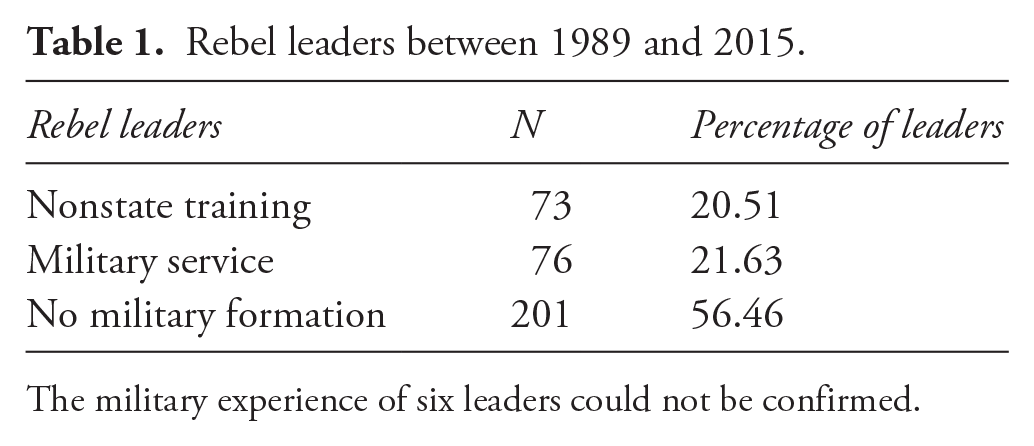
The military experience of six leaders could not be confirmed.
For H3a and H3b, I use a competing risk model that predicts the relative risk of an event occurring versus a rival event. I first compete for rebel victory, followed by government-favorable outcomes against other forms of conflict termination. A conflict is coded as ending in a government-favorable outcome when the state defeats the rebel group through outright victory or when the insurgency ceases through a significant drop-off in activity (Greig et al., 2018; Keels et al., 2021). Ongoing conflicts since 2015 are being censored.
The analysis includes a battery of controls that influence the duration of a conflict in the existing literature (see Online Appendix for a short discussion of the control variables). 10 Although this statistical analysis is useful for identifying general patterns in individual countries, it is only of limited use for specifying causal processes in more detail. I use the case of FARC to complement the research design with a qualitative empirical discussion. The case study consists of interviews conducted in December 2021, archival data, and secondary sources.
Results and discussion
H1 and H2 are evaluated using a Cox model that estimates the time until an event’s occurrence, in this case conflict termination, without assumptions about the shape of the baseline hazard. Hazard ratios are reported: values higher than 1 indicate that the variable increases the hazard of termination, whereas values lower than 1 indicate that the variable decreases the hazard of termination, meaning that conflicts tend to last longer when the risk of termination declines. Robust standard errors are clustered on the basis of the dyadic conflict episode. 11 The average duration of intrastate conflict is approximately 5 years (5.6 years), with a maximum length of 42 years. Violations of the proportional hazard assumption were evaluated. 12 I evaluated H3a and H3b with a competing risk model that estimates the relative risk of an event occurring versus a rival outcome. Subhazard ratios are reported. If a rebel leader’s nonstate training increases group strength and cohesion, we should expect that a given civil war will not only be longer but also more likely to end in rebel victory and less so in government-favorable outcomes.
Nonstate training and conflict duration
The results for Model 1 in Table 2 indicate that rebel leaders with a military past fight longer civil conflict (H1). Conflicts involving a rebel leader who underwent nonstate training and was in power are less likely to be terminated than conflicts with people in charge who were not trained in this way (H2).
Cox proportional hazards results.
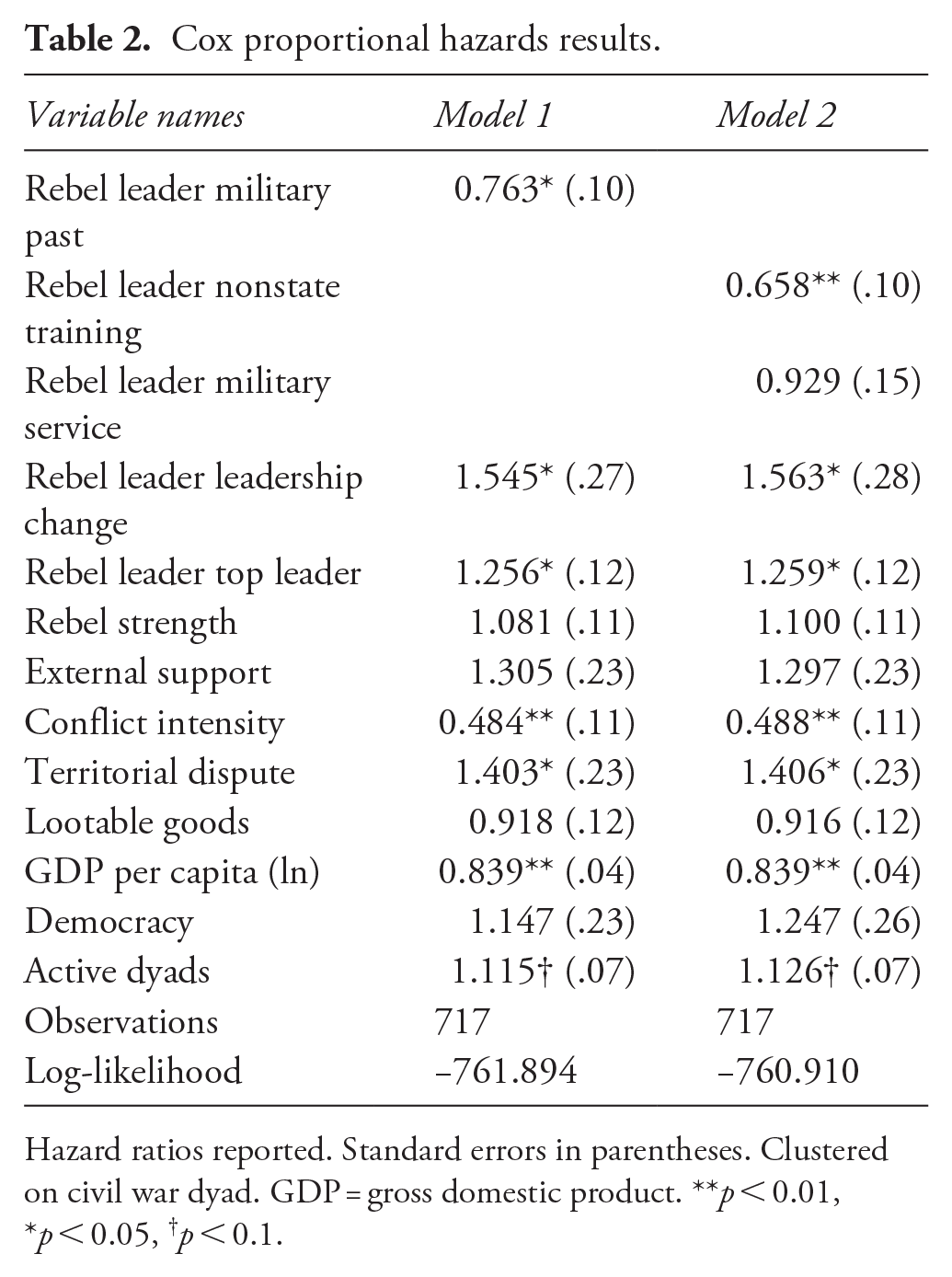
Hazard ratios reported. Standard errors in parentheses. Clustered on civil war dyad. GDP = gross domestic product. **p < 0.01, *p < 0.05, †p < 0.1.
The hazard ratio of 0.763 indicates that transitioning from non-military-trained rebel leaders to military-trained leaders decreased the likelihood of termination by approximately 24% relative to the baseline. The overall effect is motivated by rebels who received training in a nonstate armed group, and if these rebels are in charge, civil wars tend to last approximately 1.7 years longer. 13
To demonstrate the substantive effect of leaders’ nonstate training, Figure 1 presents a graph of the predicted survival of civil wars in conflicts with leaders who either underwent nonstate training or received formation in a state army. Figure 2 is based on Table 2, Model 2, and is calculated using all control variables as means. Steeper curves indicate a decreased civil war duration, indicating shorter conflicts.
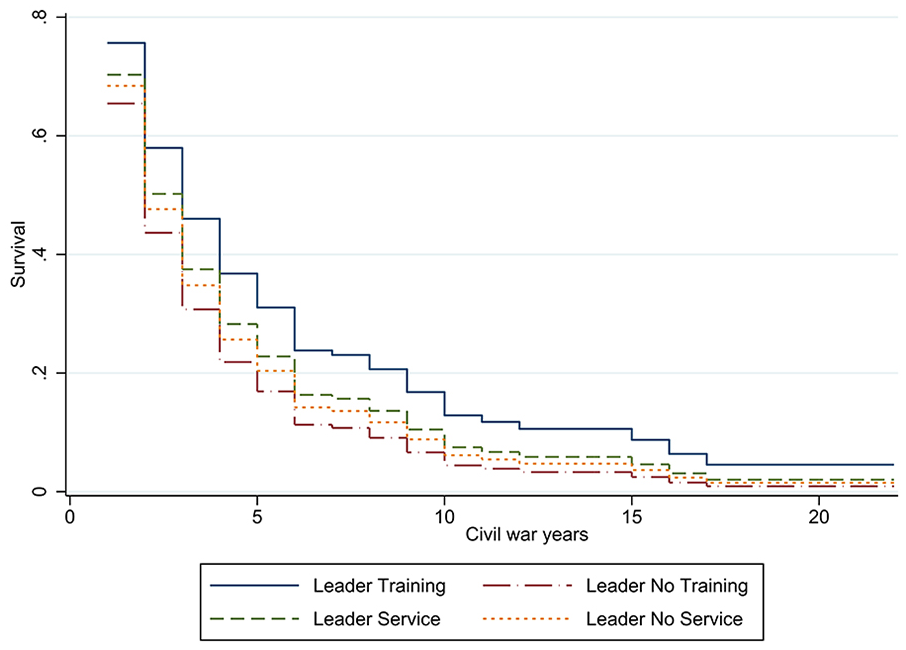
Risk of civil war termination.
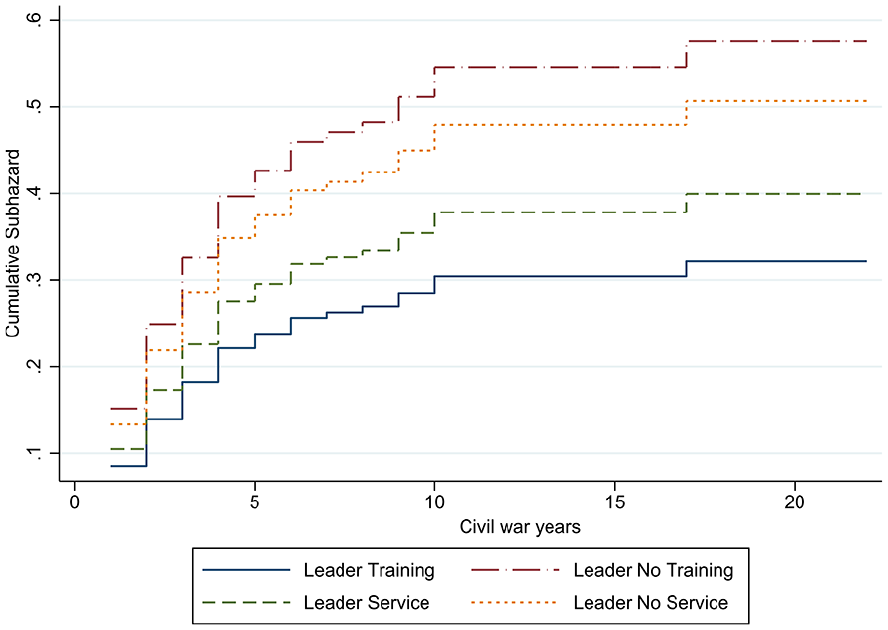
Risk of government-favorable outcomes versus other termination outcomes.
The survival curve illustrates the significant differences between the predicted continuance of civil wars when rebel leaders with nonstate training and those in a national army and without such formation are in charge. It suggests that the effect of nonstate training on conflict duration may be greater at earlier stages and decrease over time. Yet, also for long-lasting groups, we observe as indicated by the curve that conflicts appeared to persist when the rebel leader underwent nonstate training prior to assuming leadership.
Nonstate training and conflict outcomes
The second round of analysis uses competing risk models to estimate the relative risk of rebel victory and government-favorable outcomes. The subhazard ratio for nonstate training was calculated to assess the marginal effects of the variables of interest. Similar to hazard ratios, values above and below 1 indicate a percentage increase and decrease in the predicted risk of an event, respectively.
The results in Table 3, Model 1, show that a rebel victory does not become more likely when rebel leaders have prior military experience in either a state or nonstate military (H3a). This indicates that nonstate military-trained rebel leaders are not more likely to lead successful armed insurgencies. Yet Table 3, Model 2 shows that government-favorable outcomes are significantly less likely to occur when the rebel leader in charge undergoes nonstate training (H3b). This confirms that rebel leaders’ pronounced capability and willingness only influence their stamina not their success rate in winning, or their risk of being defeated. Their willingness could make them blind to whether a rebel victory is a possible outcome, causing them to continue fighting in conflicts in which rebels never win.
Competing risk models versus other termination types.
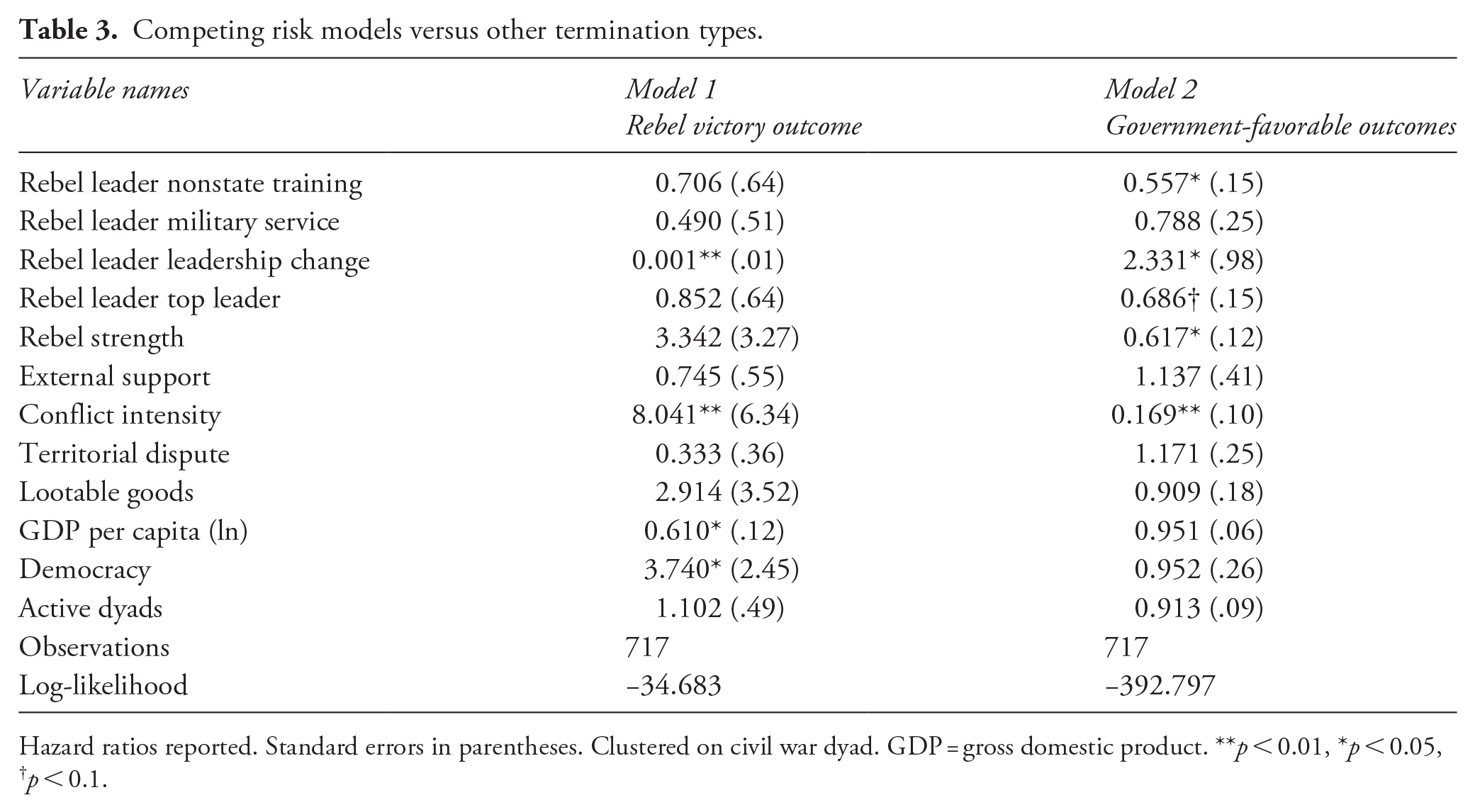
Hazard ratios reported. Standard errors in parentheses. Clustered on civil war dyad. GDP = gross domestic product. **p < 0.01, *p < 0.05, †p < 0.1.
This could explain why Jonas Savimbi – the leader of União Nacional para a Independência Total de Angola (UNITA), known as ‘Africa’s most enduring bush fighter’ (Wren, 1991) was not capable of leading his group to victory. Savimbi underestimated the regime’s willingness to stay in power and failed to position UNITA as a natural political alternative to the Movimento Popular para Libertacão de Angola (MPLA). UNITA’s relationship with the domestic population grew increasingly hostile, and victory became unattainable. Similar patterns were observed among rebel leaders who had received state military training. For example, Mobutu Sese Seko, President of Zaire from 1971 to 1997, took power in a coup d’état and was trained in the Force Publique in what is now known as the Democratic Republic of Congo. He was convinced that the Rwandan-backed rebels would not defeat his government, despite early military losses.
Even if leaders with a military past are not more likely to win, they are more willing and more capable of making it difficult for the government to win, which contributes to the theoretical assumption that their nonstate training heightens bargaining challenges and the risk of bargaining failure. The results in Table 3, Model 2, indicate that government-favorable outcomes are 45% less likely when rebel leaders with nonstate training are in charge than those who had no training or those who trained or did not train in a state military. To further illustrate this finding, Figure 2 shows the cumulative hazard of government-favorable outcomes for each variable.
Over time, steeper curves indicate governments can expect victory or the rebel group ceases to exist when the leader(s) in charge has no military past in both state and nonstate armies. When rebel leaders receive nonstate training, government-favorable outcomes are unlikely. For instance, the Philippine government frequently tried to dismantle the Moro Islamic Liberation Front (MILF), but its leader, Hashim Salamat (1939–2003), did not give up. These results provide strong initial support for H1, H2, and H3b. Civil wars featuring rebel leaders who received training in a nonstate armed group are less likely to end. Chances are also lower here that a government either wins outright or forces the rebel group to scale back its actions when the rebel leader in charge is trained to be willing and capable of fighting long wars.
Several robustness checks provide additional support for the main results presented in the Online Appendix. I estimate an additional model accounting for any potential bias through the inclusion of leaders with combat experience, which could drive the distribution of rebels with prior nonstate training. 14 Military-trained rebel leaders with combat experience have a significant negative effect on conflict duration, and combat experience alone is not influential in this regard (Table A6). I also evaluate for endogeneity considering a rebel leader’s age, level of education and prior work experience abroad, finding no indication that these rebel leaders have had more chances of having had nonstate training (Table A7).
I have added more details on the type of nonstate training, the foundational origin of the rebel group, and whether the rebel leaders were the founders of a rebel group. Rebel leaders’ nonstate training affects the outcome of conflict duration only when it is not specified as only rebel leaders who received nonstate training abroad (Huang et al., 2022) or only those rebel groups who received nonstate training from those themselves once successful rebels, as posited by Keels et al. (2021). This indicates how important nonstate training is independent of where and by whom it was received (Table A8). 15 Adding whether rebel leaders were the founders of a rebel group (Prorok, 2018) shows that the willingness to continue fighting among those who received nonstate training was stronger than their fear of punishment (Table A9).
Rebel leaders’ previous occupations (i.e. teachers, religious leaders, politicians, and similar) do not affect the relevance of nonstate training (Acosta et al., 2023). I divide rebel leaders into those with a military, civil, or political past before leadership and find that those with a military past, and to a lesser extent those with a political past, prolonged conflict duration, whereas former civilian leaders have no effect (Table A10). For instance, structural conditions favored terminating conflict during the Eritrean War of Independence, yet Mengistu Mariam, who had received nonstate training in Ethiopia, rejected negotiations with the Eritrean People’s Liberation Front (EPLF) (Milkias, 1994). In contrast, the successor regime of Meles Zenawi, a civilian with no military experience, signed the armistice with the EPLF and subsequently organized an independence referendum for Eritrea.
I included controls for the foundational origin of rebel organizations based on the FORGE dataset (Braithwaite and Cunningham, 2020), demonstrating that the future efficacy of groups might depend more on rebel leaders’ nonstate training when rebel groups do not have a parent organization behind them (Tables A11 and A12). Adding more breadth to rebel leaders’ nonstate training is difficult because the type of trainers of most rebel leaders cannot be known with certainty. The inclusion of contrasting ideologies indicates that in protracted religious conflicts, rebel groups fight longer wars when a rebel leader trained in a nonstate group is in charge (Table A13).
The results remain robust with different model specifications regarding coups d’état (Thyne, 2017), indicating that the effect of leaders’ nonstate training is not conditional on coup dynamics (Table A14). Additional models were constructed for population size, the organizational size of rebel groups, and the troop ratio of the state army (Table A15). I also re-estimated the competing risk model for conflict outcomes with regard to other dependent variables (Table A16). The results demonstrate that nonstate training does not affect the likelihood of rebel-favorable outcomes when operationalized, as in Greig et al. (2018) and Keels et al. (2021). 16 I observed that leaders’ willingness and capability to continue fighting, associated with prior nonstate training, only affected conflict duration and no other positive outcomes for rebel groups (Table A17). 17
Rebel leaders do not fight alone. An inclusion of state leaders’ military past does not indicate that those who underwent nonstate training fight longer conflicts (Table A18). When nonstate military-trained leaders are head-to-head, this does not give either side an advantage when seeking to counter the actions of their rival and hence regarding premature victory (e.g. José Eduardo Dos Santos, President of Angola, versus Savimbi). 18
Testing the theorized mechanisms that rebel leaders with nonstate training prior to their leadership invoke norms of masculinity can be tentatively tested by including the gender composition of the rebel groups taken from Loken and Matfess (2024). I find that conflicts exhibit a longer duration of fighting when women did not participate as combatants (Table A20). Additional results indicate that when women’s frontline participation in armed groups is low, conflicts tend to last longer, especially when the rebel leaders in charge had previous nonstate training (see Table A21). This connects well with the theoretical assumption that a rebel leader who can hold up the ideals of masculine confidence, which should be appealing to predominantly male armed groups, can fight longer conflicts.
Finally, I show that non-state training is not merely a proxy for group strength but may equip leaders with strategic competencies that increase bargaining challenges. Including a factor for three levels of rebel group strength indicates that rebels with prior nonstate training tend to engage in longer conflicts when they become leaders of weaker groups compared to their untrained counterparts (see Table A22). These additional analyses and robustness checks offer substantial additional support for the main findings concerning the effect of nonstate training of rebel leaders for the duration of civil conflicts.
Empirical discussion: The case of the FARC leaders
The results indicate that civil wars lasted longer when the rebel leader(s) in charge had nonstate training because this enabled them to be able and willing to endure. I specify this process in more detail through a discussion of FARC. This case was selected because the conflict between the Colombian government and FARC was one of the longest civil wars to date worldwide. The main objective was to describe the peculiarities of the nonstate training FARC leaders received and to discuss how exactly this type of formation contributed to bargaining challenges that prolonged the conflict.
Training consisted of political and military formation for 1.5 or 2 months under FARC auspices. During their political formation, rebels had to learn theoretical concepts of war from the classics – from Clausewitz, Marx, Engels, and Mao to Bolívar. They analyzed the clandestine movements of guerrillas and partisans during the Second World War. Military formation, meanwhile, consisted of basic training; however, special instructions were given to squadron commanders, and training sessions focused on intelligence, explosives, and cartography (Pécaut, 2008).
The FARC’s last commander-in-chief, Timochenko, also called Timoleón Jiménez (now known under Rodrigo Londoño), was trained as a guard and nurse for Jacobo Arenas – the ideological figurehead of and an operations leader in FARC. Timochenko also attended a mobile leadership training school with Manuel Marulanda, founder of FARC, which lasted approximately three or four years. In 2011, Timochenko became the main rebel leader of FARC because he had the longest track record and had received military leadership training from the group’s founders. 19
Taking a closer look at the training that Timochenko received, it becomes clear that it taught him and those who had preceded him how to build strong and flexible armed forces. Timochenko was known for his creativity in forming and leading the so-called Magdalena Medio, which became one of FARC’s most successful insurgent blocs. In it, Timochenko proposed fighting in very small units, concentrating, and acting immediately before dispersal. These decisions gave Timochenko a reputation for intelligent leadership and earned him the trust of fellow combatants. His training at FARC was also characterized by limited resources. He described how he was impressed by fellow combatants managing to endure hardship:
In the middle of the mountain and in the midst of the difficulties we went through, we went hungry and [saw] the sacrifice, the physical effort, and everything for the group. That had a very big impact on me. (Interview, 2021)
Timochenko emphasized that the rebels had to contend with hunger, illness, injury, aerial bombardment, lack of shelter, separation from their families, and harsh physical training. He claims that they always had to find quick solutions for the most complex decisions related to resource scarcity.
His nonstate training not only made him capable of fighting in creative and flexible ways with limited resources but also had a strong effect on his determination to continue fighting. The hardships that Timochenko witnessed reinforced his attachment to the group. All FARC leaders were strong ideologues who had political will and a conviction that they were fighting for the right cause (Chernick, 2017; Pécaut, 2008: 67). As such, Pastor Alape, a member of the higher command of FARC, claimed that his training and living conditions had shaped his sense of belonging to the guerilla group:
We created a kind of closed community in which money did not circulate and other kinds of values were generated. In the midst of combat and the harshness of guerrilla life, camaraderie and comradeship emerged. (Interview, 2021)
Another member of the higher command of FARC, Carlos Lozada, described in detail the emotional cut that all new FARC members had to undergo during their training and that he himself supervised when he was the leader of specific divisions.
There were people who broke down for good and [. . .] asked to leave. Others of us ended up assuming that as a necessary condition to be able to be there in the guerrilla. [. . .] The old guerrilla was very hard and difficult and our people were very hard on that kind of thing. [One had to] put up a barrier to one’s personal life [. . .] because it was forbidden to talk about one’s personal life. (Interview, 2021)
These statements show that FARC leaders were molded by a strong combatant socialization that made them willing to continue fighting for their group and capable of inspiring that willingness in others through training that cut off all personal ties with the past.
According to Timochenko, the leaders who preceded him preferred the status quo – that is, the continuation of the conflict – rather than risking the future of their followers by entering peace negotiations or capitulating. This might, inter alia, explain why every Colombian president since 1978 initiated a peace process with the FARC and failed. FARC leaders kept the group fighting beyond the rational point and rejected, for instance, a peace proposal by President Andres Pastrana (1998–2002) with better conditions than the 2016 peace agreement. It is likely that Timochenko would have continued the conflict because he had been trained to persevere and socialized into fighting. He knew how to misrepresent the FARC’s capabilities and would have continued to inspire a willingness to fight among his followers, one because he had that charisma and two because the FARC was an extremely hierarchical group that would have followed the order from its leader. In all my interviews, it was evident that the other high-level commanders held Timochenko’s leadership in high regard.
However, under President Álvaro Uribe (2002–2010), many circumstances around Colombia’s conflict changed – most importantly, the weakening of the FARC along with the strengthening of the national armed forces (Pizarro Leongómez, 2018). The turning point occurred approximately in 2008, when investment in military intelligence and the army proved its worth (Pécaut, 2008: 114). FARC suffered from not only a decrease in manpower but also reduced financial income. Additionally, their communication channels and leadership structures were debilitated. ‘Plan Colombia’ fulfilled its main goal, reducing the FARC’s strength through an effective military strategy and by attacking its main source of revenue, the cocaine industry, through aerial eradication of coca plantations (Chernick, 2017: 209–210). These circumstances left the FARC with little choice but to disarm and later sign a peace agreement in 2016.
The case of FARC highlights the importance of structural conditions for conflict termination. However, leadership factors are equally relevant since its leaders would have continued the conflict beyond any rational point. Therefore, one should not underestimate the influence of rebel leaders’ socialization and the difficulties they experienced during nonstate training on their subsequent decision-making.
Conclusions
This study has argued that nonstate training significantly affects rebel leaders’ attitudes toward terminating or continuing an ongoing conflict. Having prior nonstate training as a rebel leader may be insufficient to ensure that your forces are equipped to defeat an adversary, but the results are robust with regard to conflict duration. Prior experience in nonstate training allows rebel leaders to persist, which is itself a victory.
The empirical analyses provided strong support for rebel leaders with nonstate training, prolonging the duration of civil wars, in contrast to the effects of those with no training or those serving in a state military. Additionally, government-favorable outcomes are less likely when rebel leaders with nonstate training are in charge compared with those who had no training, who trained, or who did not train in a state military. The results are robust to alternative measures for nonstate training and structural conditions. In a qualitative section on FARC leaders and their training, I discussed how nonstate training enabled rebel leaders to become more willing and capable of leading longer conflicts.
This study has several implications and demonstrates that civil war dynamics theories should consider rebel leaders’ military past as a factor in conflict duration. Future studies on civil war outcomes should include leaders as independent actors who can heighten bargaining challenges in ways different from those predicted by existing structural theories. Policymakers can also gain from the insights generated. When seeking to better understand conflicts and contemplate how to resolve them, mediators and politicians should take rebel leaders’ profiles and backgrounds more seriously. Leaders with a military past may be prone to fighting the longest wars.
Future studies should investigate whether the relevance of nonstate training changes over time. It should also be examined whether the length and quality of the nonstate training that rebel leaders received are important. It may also be interesting to explore if ‘side-switchers’, rebel leaders with both nonstate and state military experience, fight longer conflicts. The influence of rebel leaders may also depend on more collective elements of leadership that could be considered in future studies. Extending these endeavors to the dyadic level (military training aside) could reveal how rebels and leaders interact, how they view each other through formative experiences, and how they assess their adversaries.
Regarding the effect of leaders’ military experience, more work is required to understand how previous experiences lead to certain convictions and judgments (Horowitz and Fuhrmann, 2018). Ultimately, this study has demonstrated that the course of a civil war not only depends on factors such as the strength of the fighters and economic conditions but is also significantly influenced by the military experience of the rebel leaders involved.
Footnotes
Acknowledgements
Special thanks are due to Matthias Basedau, Sabine Carey and the Women Publication Support Group, Austin Doctor, Anastasia Shesterinina, Margit Bussmann, and Christian von Soest.
Replication data

Funding
The author(s) received no financial support for the research, authorship, and/or publication of this article.
Notes
JULIANA TAPPE ORTIZ, b. 1994, PhD in Political Science (University of Hamburg, 2023); Postdoctoral Researcher, University of Tübingen (2025–present); current main interests: the consequences of violence for wo(men) civilians and leaders in Latin America.