



Abstract
Since 2001, the United Nations Security Council has increasingly authorized interventions in support of a government. However, the potential impact of this trend on civil war processes is underexamined. I argue that biased peacekeeping interventions can undermine social order when replacing rebel territorial control. Interventions become associated with weak and predatory client governments, fail to build trust within communities, and create power vacuums. In the absence of a perceived impartial arbiter, mobilized groups turn to violence over disputes previously solved by the rebels. I test this theory by examining the impact of offensive operations by the African Union Mission in Somalia (AMISOM). Using novel data and a mixed-methods approach, I demonstrate AMISOM operations displacing rebel rule produced a significant increase in intercommunal conflict. These findings highlight the potential unintended consequences of multilateral interventions explicitly supporting one side. They further suggest biased interventions should focus on first improving governance before extending government control or prioritize shaping conditions for negotiated settlements.
Introduction
Since 2001, multilateral interventions sanctioned by the United Nations have increasingly taken sides during conflicts. Rather than deploying peacekeepers to observe ceasefires or negotiated settlements, the Security Council has turned towards greater use of authorizations explicitly supporting a government against rebels. 1 In high profile authorizations of interventions by regional organizations in Afghanistan and Somalia, or mixed missions including Western military forces and blue-helmeted peacekeepers in Mali, the Security Council has explicitly outlined defeating Islamist insurgencies as key objectives. The impact of this shift towards biased interventions, defined as supporting a particular side in a conflict, has received limited attention within peacekeeping literature, but carries significant implications in understanding the role of peacekeeping interventions in reducing violence in civil wars. In contrast to impartial interventions, which provide an unbiased external arbiter to encourage cooperation (Doyle and Sambanis, 2006; Fortna, 2004; Walter, 2002), biased interventions seek to expand the reach of weak states and overcome violent resistance. Where rebel groups govern territory, biased interventions sanctioned by the Security Council provide external military forces to retake territory and replace rebel-imposed social order. This approach potentially introduces significant unintended consequences through undermining the ability of peacekeepers to build social trust or order within conflict-affected communities and creating power vacuums by introducing weak state authority. What are the local effects of these biased multilateral interventions displacing rebel-imposed social order?
I examine this question by focusing on intercommunal conflict as an indicator of breakdowns in social order. Intercommunal conflict is defined by violence between mobilized groups organized along ethnic, ideological, or sectarian divisions. The micro-foundations of peacekeeping interventions have received increased attention with important findings on the presence of peacekeepers in limiting the duration of violence (Ruggeri et al., 2017), targeting of civilians (Fjelde et al., 2019; Kjeksrud, 2023), and increasing confidence in government institutions (Blair, 2019). Literature on the micro-foundations of violence in civil war has focused on the effect of rebel or government control over territory in predicting violence against civilians (Kalyvas, 2006). However, violence within civil wars is rarely confined to the rebel–government dyad. Territorial control and social order also have implications for violence within and between communities.
Biased interventions that displace rebel control must also replace rebel-imposed social order. However, through backing a predatory government, interveners potentially lose their ability to present as impartial arbiters (Nomikos, 2022) and face difficulty in rebuilding social order. Replacing rebel-imposed orders but failing to restore social order provides a mechanism for expanded violence through exacerbating existing cleavages within society or introducing new divisions. The shocks to communities produced through transitions in territorial control can introduce a new set of mobilized violent actors pursuing ends separate from the combatants in the larger conflict. These local conflicts may be subsumed by the struggle between the government and rebels or remain entirely parochial. In both cases they present a novel challenge for constructing social order and larger peace-building efforts.
I argue transitions in control resulting from biased multilateral interventions will often lead to increases in intercommunal violence through breakdowns in social order. I theorize this occurs through the inability of peacekeepers to restrain government abuses, resulting in erosion of property rights, exacerbated grievances between groups and reduced social trust. In the absence of an impartial or fully capable external arbiter and enforcer, communities will mobilize against one another in contests over property rights or reordering economic and political hierarchies within a power vacuum. I focus on biased interventions in weak states like Somalia, Afghanistan, or Mali, where rebel groups control and govern territory and governments possess limited coercive and governing capacity. 2 Within this context, communities with social cohesion eroded through years of violence can be particularly sensitive to externally imposed forms of order. Rebel groups with ties to communities they govern often impose a form of direct rule combining coercion with provision of public goods like security and justice (Arjona, 2016; Mampilly, 2011; Stewart, 2018). By contrast, external interveners introduce indirect forms of rule where interveners provide coercive military and police capability, but rely on local agents to govern and establish a social contract. Interveners possess limited ability to control local agents, but provide military protection, inviting rent-seeking and contests for control of productive assets within communities. Absent the ability to coerce communities from mobilizing and failing to adjudicate disputes between groups, the theory predicts that shifts from direct forms of rebel rule can produce breakdowns in social order producing an increase in intercommunal violence.
I test the core predictions of the theory empirically in the case of the conflict between the al-Shabaab insurgency and the Federal Government of Somalia (FGS) and its external backers in Somalia. I examine the local effect of African Union Mission to Somalia (AMISOM) offensive operations to recover territory on intercommunal violence. I employ a multimethod empirical strategy including process-tracing based on interviews with AMISOM, Somali, and UN officials and a difference-in-difference estimator to measure the effect of AMISOM operations on intercommunal conflict with novel data on AMISOM operations.
I find that AMISOM operations displacing al-Shabaab control of a district lead to a significant spike in intercommunal violence. The results indicate that the transition from rebel direct control of a district to AMISOM control can upend social order and trigger renewed or novel conflicts between communities. The narrow, military-oriented posture of AMISOM and reliance on indirect control through local agents, which AMISOM proved unable to restrain, provide a causal mechanism to explain the effect.
My argument and findings have significant implications for understanding the effects of biased interventions on curtailing violence and ending civil wars. Most importantly, I highlight the unintended consequences of peacekeeping operations. Even interventions that effectively reduce violence against civilians, as observed in existing literature (e.g. Fjelde et al., 2019; Hultman et al., 2013), can potentially trigger negative downstream effects through biased application of force. Most acutely, in cases where interventions expand the reach of weak states, interveners may subsequently create power vacuums. In these cases, replacing rebel with government control can actually produce violence between community groups. Obviously, significant levels of intercommunal violence following transitions in control can undermine and delegitimize interveners and the government. The comparison of intercommunal violence between periods of rebel and intervener control also points to some of the strengths of rebel-imposed order, particularly in maintaining relative peace, and contributes to the growing literature on the effects of rebel social orders (e.g. Arjona, 2016; Stewart, 2018; Revkin, 2021). Even remarkably coercive and brutal groups like al-Shabaab can establish stable orders. Although Somalia is a uniquely violent case, it is also a crucial case as one of the largest and longest running regional peace operations and has been offered as a template for future partnership between the United Nations and African Union (United Nations Security Council (UNSC), 2023a). Given the limited number of ongoing peacekeeping operations at any given time, it is crucial to understand the performance of large missions. Major shortcomings in the intervention in Somalia should countenance reconsideration of existing approaches to biased interventions.
Additionally, I explain the inability of biased interventions to overcome the persistent strength of rebel groups even after they are displaced from overt control of territory through evidence drawn from the micro-foundations of conflict. Intercommunal violence can spur new grievances and dramatically reduce trust in peacekeepers, limiting future cooperation in communities, and drive mobilized groups to ally with the rebels. In these cases, peacekeeping interventions become a form of armed state-building and mire interveners in many of the problems experienced in counter-insurgency, particularly between interveners and client governments and problems with government-aligned militias (Branch and Wood, 2010; Carey et al., 2015; Elias, 2018). Here, the argument can be extended into literature on counter-insurgency where even well-intentioned efforts to build inclusive governance can be undermined through the negative effects of violence between communities following seizure of territory from rebel groups. This point is particularly relevant to debates around whether peacekeeping operations should orient more towards war-fighting (Cruz et al., 2017). In reality, taking sides in a conflict can undermine the very source of strength of many peacekeeping interventions derived from the perception of impartiality.
The adverse effects of biased intervention on behalf of weak governments suggests the need for serious reflection on approaches to intervention. Particularly within the arena of competitive governance in civil wars, peacekeeping interventions must contend seriously with sources of stability in rebel-imposed order they seek to supplant. Inability to reproduce or create alternative conditions for order through effective governance, coercion, or provision of impartial external arbitration create conditions for new dimensions of violence through intercommunal conflict, which can ultimately further strengthen brutal and repressive groups like al-Shabaab. Evidence from Somalia indicates that in one alternative approach, peacekeepers should focus first on supporting a viable government capable of extending a social contract before considering violently extending the reach of a weak state. In another alternative approach, recognizing that the unintended consequences of biased intervention can produce high levels of intercommunal conflict and persistent rebel strength even after robust intervention, peacekeepers could instead focus on building conditions for negotiations. This approach would call for a reconsideration of the normative shift away from negotiated settlements to end civil wars and re-center peacekeeping as a collaborative and consensus-based process.
The dilemmas of biased intervention
In the aftermath of the US War on Terror, the rates of negotiated settlements to end civil wars has dramatically decreased (Howard and Stark, 2017). The reduced rates of negotiated settlements have also seen an increasing shift towards biased multilateral interventions meant to defeat Islamic insurgent groups and extend the reach of weak states. This shift stands in contrast to peacekeeping operations in the immediate aftermath of the Cold War as the United Nations increased the number of peacekeeping interventions and provided an impartial arbiter to support negotiated settlements (Fortna, 2004). The logic of impartial intervention rests on provision of an external arbiter to reduce fear among combatants that they would be exploited after demobilizing (Walter, 2002) and persuade or induce combatants to embrace negotiations (Howard, 2019). UN peacekeeping has been demonstrated to reduce the duration (Ruggeri et al., 2017) and intensity of conflict (Hultman et al., 2014) and limit targeting of civilians (Hultman et al., 2013; Kjeksrud, 2023). Peacekeeping can also be effective in maintaining the peace and supporting participatory peace processes (Doyle and Sambanis, 2006). However, the literature on peacekeeping devotes relatively limited attention to the observed role of bias and largely focuses on the normative implications for the shift towards biased interventions (Karlsrud, 2018). Addressing this oversight is particularly important in light of the shift away from negotiated settlements to terminate civil wars.
Table 1 lists contemporary peacekeeping operations authorized or endorsed by the Security Council. In total, between 2001 and 2020, the Security Council authorized UN peacekeeping operations in 13 missions (not including restructured missions) and further authorized or offered implicit support for 13 regional organization missions. The table further distinguishes between interventions during ongoing conflicts and missions designed to uphold peace agreements or provide stabilization support. Overwhelmingly, regional missions intervened during ongoing conflicts, often in direct support of the government. Of the ongoing or recently concluded missions (ending after 2020), rebel groups controlled substantial swathes of territory in Somalia, Mali, the Democratic Republic of the Congo (DRC), South Sudan, and across the Sahel. In these conflicts, UN or regional missions either provided direct support to the government or were instructed by resolution to coordinate with the government, offering implicit support.
UNSC-Sanctioned Peace Enforcement Operations, 2001–2020.
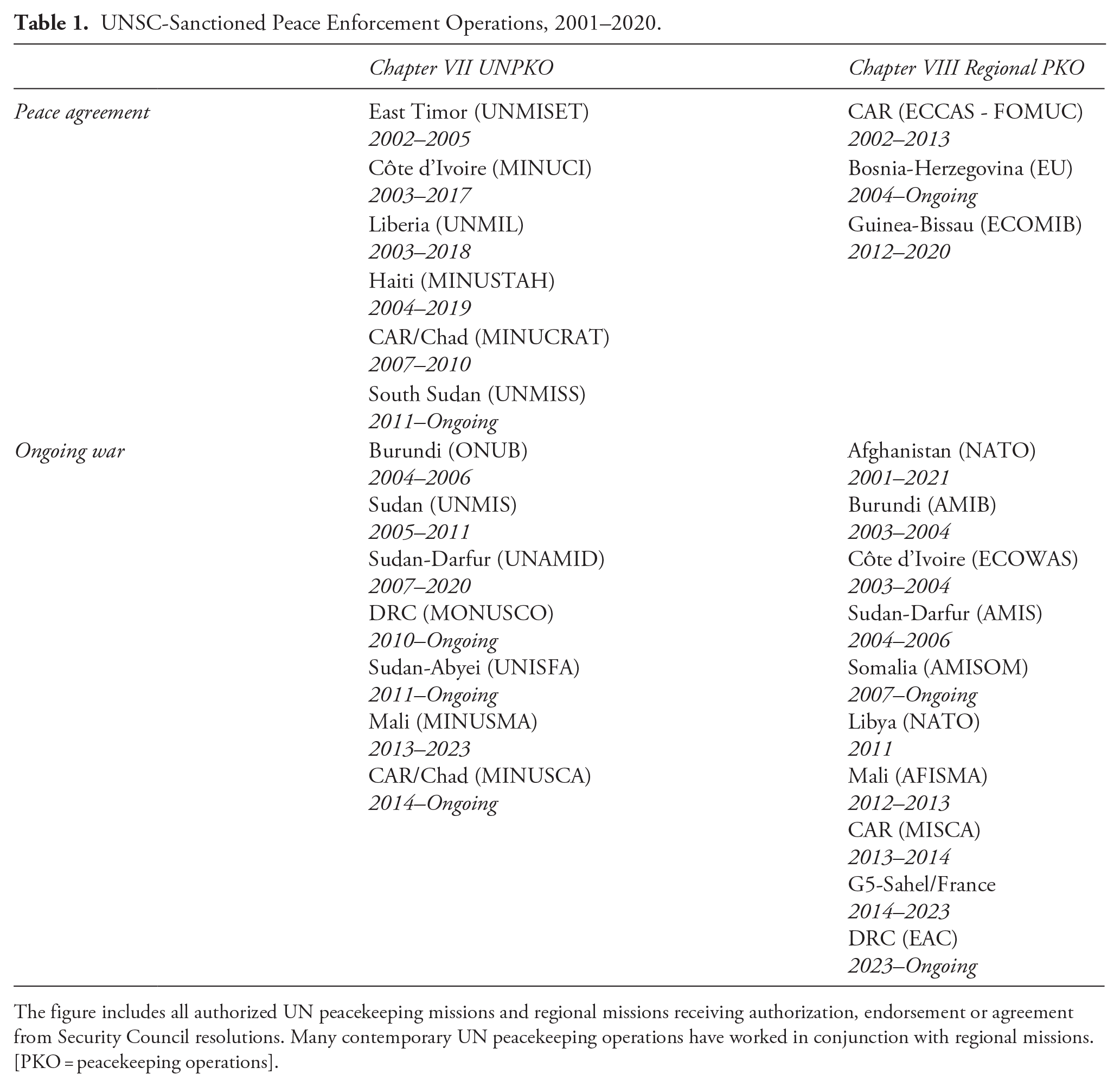
The figure includes all authorized UN peacekeeping missions and regional missions receiving authorization, endorsement or agreement from Security Council resolutions. Many contemporary UN peacekeeping operations have worked in conjunction with regional missions. [PKO = peacekeeping operations].
In contrast to peacekeeping interventions, biased interventions in civil wars are generally associated with increasing duration and intensity of civil wars (Regan, 2002). Despite the uneven success of biased intervention in terminating civil wars, some argue biased UN peacekeeping interventions could have positive effects. Bias within the Security Council towards particular factions in a conflict is associated with devoting more resources to interventions, implying greater chances of success (Benson and Kathman, 2014). Biased interventions have also been theorized to demonstrate more credible commitments (Favretto, 2009). These arguments make an important assumption that resources and commitment signaling can achieve positive outcomes through peacekeeping interventions. However, they do not address how implementation of biased mandates may alter the actual mechanisms through which peacekeeping works on the ground.
A burgeoning literature has attempted to identify the precise mechanisms through which peacekeeping works by examining the micro-foundations of civil war and peacekeeping interventions. This research has focused on the local effects of peacekeepers in limiting violence (Ruggeri et al., 2017), targeting of civilians (Fjelde et al., 2019), and building trust in formal justice institutions (Blair, 2019). Peacekeeping is most fundamentally a tool to facilitate trust-building between combatants and among civilian populations. Impartial intervention potentially plays an underappreciated role in helping rebuild social trust within communities following exposure to violence. Experimental findings on peacekeeping efficacy point strongly towards the role of impartiality in encouraging individuals to cooperate with members of outgroups, with no evidence that biased interveners similarly build social trust (Nomikos, 2022). Further, peacekeepers are well equipped to facilitate dialogue between communities and can restore cooperation between groups and reduce intercommunal violence (Smidt, 2020). However, where impartial peacekeepers can potentially address the challenge of restoring cooperation across communities, UN-sanctioned interventions on behalf of the government may not be able to achieve similar results, requiring further investigation.
Civil wars create multiple forms of order ranging from disorder to more stable orders (Arjona, 2010; Staniland, 2012). Within cases of biased interventions, peacekeeping forces are often replacing one form of social order with another. Through effective institutional arrangements, combatants can establish stable social orders, creating predictable interactions within communities and with combatants (Arjona, 2010). While impartial interventions are tasked with enforcing an agreement and incentivizing cooperation, biased interventions seek to expand the reach of the state and overcome competing forms of order. This dynamic is particularly important as rebel groups controlling territory may impose stable social orders in civil war. Groups facing limited competition from the state and with disciplined membership are more likely to build governance institutions promoting order (Arjona, 2016) as are groups seeking external or domestic legitimacy to support sovereignty claims (Stewart, 2018) or with close ethnic affiliations to populations and transformational ideologies (Mampilly, 2011). These types of actions can serve to legitimize rebel rule, often despite quite brutal employment of violence and repression (Duyvesteyn, 2017). In these specific cases rebels can create a stable order, often by imposing direct forms of rule, relying on cadres rather than local agents. Direct forms of rule can address the risk of breakdowns in order and intercommunal violence through coercion and establishing a basic social contract. Under direct forms of rule, rebel governance often prioritizes establishing a monopoly of force, justice mechanisms to coopt or control the population and protect property rights (Loyle, 2021), and institute extraction through taxes (Mampilly, 2021). Rebel judicial rulings can be particularly important in adjudicating disputed property rights that often provide a key driver to local conflicts and feature as a popular element in the appeal of rebel groups (Ginsburg, 2019). Protection of property rights through justice mechanisms can reduce the potential for conflict over resources and provide a key service to increase legitimacy (Revkin, 2021; Sivakumaran, 2009). Direct rebel rule crucially incorporates the ability to enforce rulings and agreements through co-optation or coercion.
In the aftermath of driving rebel groups out of territory during biased interventions, peacekeeping forces must assist in replacing social orders imposed by rebels. This creates a dilemma for peacekeepers where biased intervention undermines the benefits of perceived impartiality, while restrictive mandates and ties to partner governments constrain the ability of peacekeepers to replicate the inputs of rebel rule through coercion and a social contract. Under the logic of impartial interventions, peacekeepers would be seeking to incentivize cooperation and building social trust through a consent-based and participatory process. This logic of impartiality can potentially circumvent the violence often associated with transitions in territorial control or particular forms of social order. By contrast, biased interventions are intrinsically part of a violent state-building process, providing the coercive force to augment a weak government. Yet, by mandate, peacekeepers are also constrained in their ability to deploy coercion to compel acquiescence to new forms of order where governments or rebel groups during insurgencies often wield violence against civilians and suspected opponents to gain compliance (Kalyvas, 2006; Oswald et al., 2013).
Where rebels linked coercion to a social contract, interveners rely on a partner government. This creates a form of indirect control where the government ostensibly builds a social contract and the intervener provides coercive power. This division of labor introduces significant principal–agent problems that commonly arise in cases of counter-insurgency when interests diverge, particularly when the government must rely on local agents – either specialists in violence or customary leaders – who prefer to maximize their own autonomy and pursue local wealth accumulation (Barnett and Zürcher, 2009; Elias, 2018). Alliance with local militias can be particularly problematic in low cohesion communities as evidenced by the decidedly uneven success of the Afghan Local Police program (International Crisis Group (ICG), 2015). Should local government agents receiving support from external interveners pursue parochial interests, affiliation with the state can decrease community trust in peacekeepers to offer protection or restrain government forces pursuing ethnic or sectarian agendas.
Communities with low social cohesion through past grievances or degradation through conflict processes are particularly sensitive to externally imposed forms of order. Rebel groups imposing direct control often deliberately dismantle traditional forms of authority to generate compliance (Wood, 2008). In the aftermath of supplanting rebel rule, misbehavior of local government agents, combined with failure to replace dispute resolution mechanisms or provide property rights protections previously offered by rebels can exacerbate or produce serious grievances between groups. In the absence of a trusted arbiter or coercive power tied to governance, groups in low cohesion communities with limited social trust seek to retain military capabilities for defense (Bates et al., 2002) and resolve communal disputes through violence.
The scope conditions for the theorized impact of biased multilateral interventions include a variety of interventions in terms of organization and mandate. The theory captures a dynamic where a multilateral intervention provides support to the government and assumes at least some responsibility for employing force against a rebel group controlling and governing territory. This includes the growing number of UN stabilization missions, which, over the past two decades, increasingly moved peacekeeping operations towards counter-insurgency (Curran and Hunt, 2020; Karlsrud, 2018) and UN-authorizations of missions led by regional organizations like the African Union (AU). In recognition of this shift, in 2023, the Security Council acceded to long-standing requests from the AU to fund regional missions through assessed contributions to the UN (UNSC, 2023b). Further, as bias can operate on a continuum rather than binary dichotomy, the scope includes any intervention partnering with or working through a host government and employing force against a rebel group as either a direct or indirect implementation of a mandate. This would include missions like the AU intervention in Somalia, explicitly supporting the Somali government and seizing territory from rebel groups, or peace enforcement operations in the DRC, which were not explicitly stated to aid the government, but clearly indicated that employment of force by peacekeepers would benefit the government.
The empirical focus of the paper on Somalia represents a case at the more extreme end of biased multilateral interventions, but rests within a broader structural context that can accommodate less robust interventions. Further, because the theory is designed to capture the often unintended consequences of intervention, a mission’s mandate does not require explicit directions to defeat rebel groups or extend state authority – what is important is the actual actions taken on the ground. Thus missions designed to protect civilians and allowing use of force against armed groups could produce instances where peacekeepers displace rebel groups, upending existing social order and producing violence between groups (Bellamy and Hunt, 2021). The theory does not extend to more traditional peacekeeping interventions with strict mandates to avoid taking sides in a conflict. This includes observation missions and the peacekeeping mission in South Sudan to protect civilians and uphold a peace agreement. Finally, the theory is scoped to cases where rebel groups exert direct control over territory and communities are receptive to rebel governance. In these cases, rebels are frequently ruling over low cohesion communities with limited ability to bargain directly with combatants and generating demand for external arbitration of disputes (Breslawski, 2021; Florea and Malejacq, 2024; Kaplan, 2017). Conflict has often destroyed or degraded local institutions, limiting civilian capacity to self-govern through local or customary means identified in literature on civilian agency during wartime (Krause, 2018; Murtazashvili, 2016). The theoretical scope conditions are distinct from traditional cases of counter-insurgency as the goal of peacekeeping operations is restoration of peace and protection of civilians, ostensibly through a participatory process, rather than eliminating an insurgent threat to a government. Further, counter-insurgents unconstrained by peacekeeping mandates could potentially employ brutal coercion in a similarly effective manner to rebel groups to impose a coercive peace (Hazelton, 2021). Biased peacekeeping interventions obviously blur this distinction as rebel groups become targets of intervention due to their perceived threat to the peace and peacekeepers may be directed to conduct counter-insurgency. In this sense, the implications of the theory regarding replacement of rebel- with government-imposed order in cases of weak states backed by intervention could be extended into the study of counter-insurgency.
The Somali context
I test the core predictions of the theory by analyzing the effect of UN-sanctioned operations in Somalia from 2010 to 2018. Although the intervention in Somalia authorizes a regional organization to execute the mission, the case carries important similarities to peacekeeping interventions like Mali by including foreign military intervention and explicitly supporting the government. The contemporary conflict in Somalia is a useful case for testing a theory of biased intervention as the rebel group, al-Shabaab, held large swathes of territory prior to intervention and then rather uniformly lost that territory during a series of concerted offensives. Further, at its height, AMISOM fielded over 20,000 troops supported by robust US military capabilities and UN logistics support, making it one of the more powerful UN-sanctioned interventions of the recent past and an important test case for advocates of biased interventions.
Throughout this and the remaining empirical sections, I make use of interviews of AMISOM and Somali officials and diplomats. Individuals were recruited through convenience sampling from a network of contacts I built while working professionally in Somalia from 2016 to 2018. Interviews were conducted by phone in 2021 in a semi-structured format and responses were anonymized for identity protection. The interviews focused on operational planning of AMISOM offensive operations and details on the transition period following AMISOM seizure of districts from al-Shabaab. The individuals interviewed offered insights on the internal workings of AMISOM and relationships between AMISOM and Somali interlocutors.
Al-Shabaab emerged in the aftermath of Ethiopian intervention into Somalia in 2006, driving out Ethiopian forces and overrunning most of southern Somalia and the majority of Mogadishu by the end of 2009 (Hansen, 2016). The AU supported the flailing Transitional Federal Government of Somalia with a small force under a UN mandate to maintain a foothold of government control in Mogadishu. AMISOM expanded from its initial deployment of Ugandan and Burundian forces to include troop contingents from Kenya, Ethiopia, Sierra Leone, and Djibouti. AMISOM’s mission focused on recovering territory controlled by the al-Shabaab insurgency. Following years of intense urban combat in defying al-Shabaab control of Mogadishu, AMISOM recovered large swaths of territory from 2011 to 2016 in major offensive operations (Maruf and Joseph, 2018; Williams, 2018).
In the aftermath of warlord rule prevailing since 1991, al-Shabaab and its predecessor, the Islamic Courts Union, legitimated its rule in Somalia on the grounds of conservative religious ideology and the ability to establish social order through a direct form of control that provided brutal, but predictable security and rule of law (Ahmad, 2014). Al-Shabaab governance was built upon district courts, policing, and tax collection, supported by a robust intelligence network and highly capable military forces to suppress dissent and maintain coercion through terror (Maruf and Joseph, 2018). Al-Shabaab eliminated predatory checkpoints manned by warlord-controlled militias and standardized revenue collection, ultimately dwarfing the revenues collected by the FGS (Hiraal, 2018). In exchange, the group provided a relatively popular justice system based on Islamist jurisprudence (ICG, 2014). Al-Shabaab brokered agreements between clans on property and water rights (Maruf and Joseph, 2018: 93). Al-Shabaab governance largely ended at the district level, outside of the presence of small numbers of fighters or intelligence agents in villages (Hansen, 2016: 85–87). Stern discipline allowed the group to control its members and tightly wield coercive violence in rapidly consolidating control over districts (AMISOM official #2, interview with author, February, 2021).
Although intrinsically coercive and brutal, al-Shabaab’s direct system of rule proved effective in building order and limiting interclan conflict (ICG, 2011: 22). After driving al-Shabaab out of districts, AMISOM could not replicate al-Shabaab’s direct form of rule linking coercion to a basic social contract. AMISOM instead relied on local agents appointed by the FGS to govern recovered territory and build a social contract while AMISOM wielded constrained coercive power. In practice, elites in Mogadishu failed to agree on what local governance should look like in the aftermath of liberation (UNSC, 2014: 3). AMISOM’s presence in a district allowed local specialists in violence in the Somali National Army (SNA) – built out of a collection of warlord militias (Williams, 2020) – to emerge as local agents of the government, focused on advancing their parochial interests (UNSC, 2016: 13).
Liberation from al-Shabaab control offered a respite from a vicious form of religious rule, but conflict between clans became a prominent issue in many newly recovered areas (Crouch and Ali, 2019). Figure 1 indicates a possible relationship between the transition from al-Shabaab control and subsequent increase in intercommunal conflict. After the transition in control at T0, violence levels in districts liberated from al-Shabaab diverge sharply from districts not experiencing transitions. Al-Shabaab prevented clans from mobilizing for conflict through coercion and offered protection to marginalized clans, particularly in areas of contested land ownership. By contrast, AMISOM possessed limited knowledge of communities before liberating a district and lacked political or community engagement resources (Williams, 2018; Diplomat #1, interview with author, February 2021; AMISOM official #1 interview with author, January 2021). The disruption of overt al-Shabaab governance over a district created a transition in control where neither AMISOM or the FGS could coerce clans from mobilizing militarily. The FGS relied on local specialists of violence, often in the SNA, who upended establish patterns of property rights in pursuit of rent-seeking extraction. AMISOM proved incapable of restraining rent-seeking behavior from local agents of the FGS. Although driven from control, al-Shabaab remained on the margins, offering mobilized clan militias powerful potential allies. This transition period presaged a reordering of the balance of power between clans and a spike in conflict as communities sought to establish a new social order.
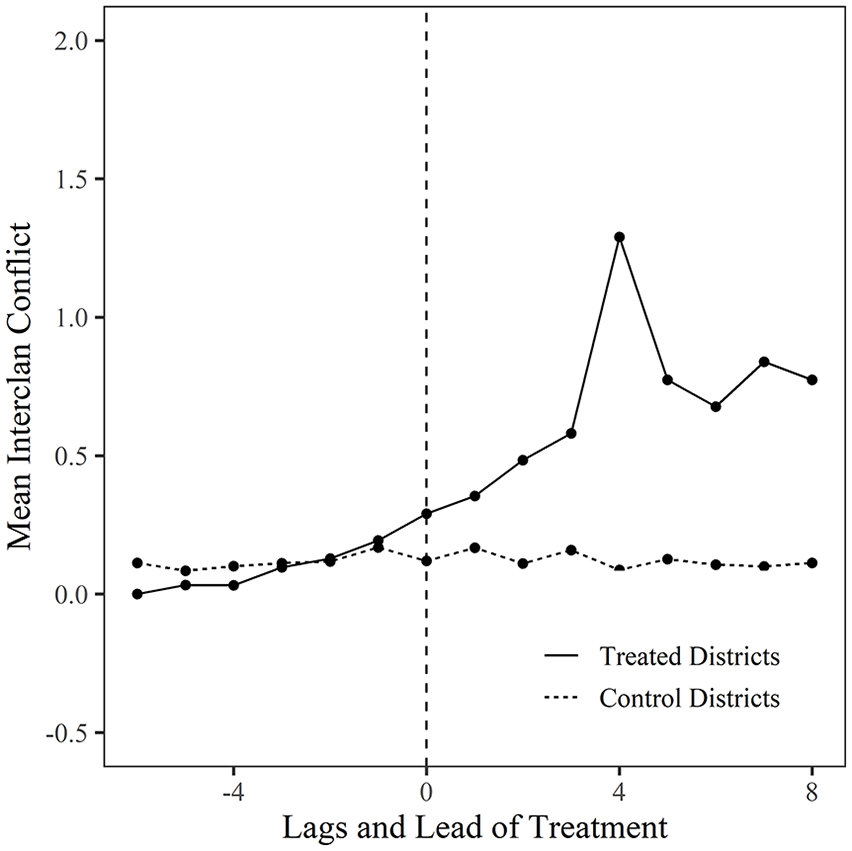
The plot compares mean intercommunal violence levels by year-quarter in the lead-up to and following transitions in control at the district level with districts that never transitioned in control.
Transition from rebel rule at the district level
To better illustrate the theoretical mechanism producing the increased level of intercommunal conflict in communities transitioning from overt al-Shabaab control to sustained government presence, I trace the process of transition within a specific district. The Marka district is approximately 90 kilometers south of Mogadishu. Marka was been among the most violent districts in Somalia and the focus of extensive attention in externally supported reconciliation efforts. The district provides a helpful case to identify the process through which transitions in control produced increased intercommunal violence and is representative of the riverine regions that saw the highest levels of violence following AMISOM operations. Marka and the entire surrounding region along the Shabelle River possesses some of the best agricultural land in Somalia. Marka became the scene of intense conflict in the aftermath of the collapse of the Barre Regime from 1991 to 1994, between the native Dir/Bimaal clan and interlopers from the more powerful Hawiye/Haber Gidir clan. This conflict reignited after al-Shabaab’s expulsion from control of the district. Although not a direct test of the theory, the case study clearly illustrates the theorized role al-Shabaab rule played in maintaining social order and the effects of AMISOM offensive operations.
Al-Shabaab seized Marka and expelled Haber Gidir warlords in 2009, ruling the district until 2012. The group exerted control over the local Haber Gidir through intimidating clan leaders and suppressing the clan militia (Marchal, 2009: 398, Lower Shabelle Official #1, interview with author, February 2021). Al-Shabaab abolished the infamous warlord checkpoints and established a local judiciary in the city of Marka, supported by a police force. In light of the historical contests over land ownership, al-Shabaab established a commission to address property rights and restored land rights to weaker clans, including the Bimaal (Landinfo, 2013: 15). As indicated in Figure 2, al-Shabaab effectively suppressed conflict between competing clans in Marka and the district experienced no reported instances of intercommunal violence while under al-Shabaab rule. One Western official who accompanied AMISOM forces in the liberation of Marka remarked that the city appeared ‘pristine’ compared to Mogadishu (Diplomat #1 interview, 2021).
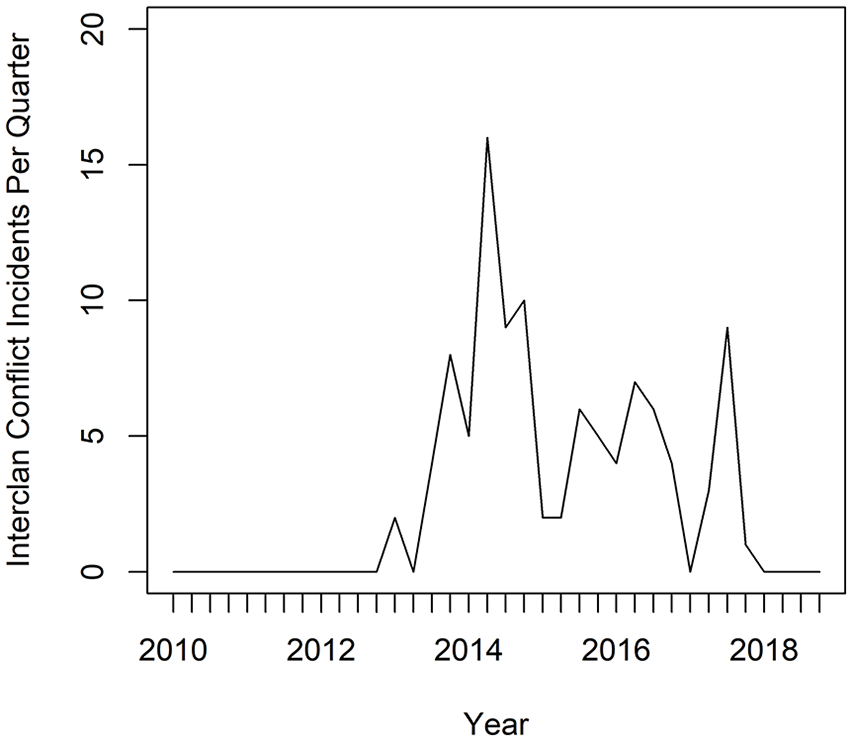
Interclan conflict incidents in Marka District, 2010–2019.
The Ugandan AMISOM contingent seized Marka in August 2012 as al-Shabaab’s military position collapsed after being defeated in Mogadishu (Williams, 2018). AMISOM established a base outside the city as al-Shabaab retreated to the south and west. In planning the offensive to liberate Marka, AMISOM planners recognized the need to address the rivalry between the Bimaal and Habar Gidir. However, the civilian component of AMISOM remained based in Nairobi, with limited ability to exert influence on the ground and Ugandan requests for resources to support community outreach and future stabilization activities went unmet.
AMISOM’s primary focus was Marka’s military utility to al-Shabaab as a command and control and revenue center, leading to less prioritization of stabilization issues after liberation (AMISOM Civilian Official #1 interview, 2021). The FGS possessed little to offer in supporting the offensive or managing the aftermath of liberation beyond appointing a District Governor (Lower Shabelle Official #1, 2021; AMISOM Civilian Official #1, 2021; Diplomat #2, interview with author, February 2021). Most importantly, unknown to AMISOM officers, the Ugandan forces advancing on Marka were accompanied by SNA units largely drawn from the militia of the notorious warlord, Yusuf Mohamed Siyad ‘Indha’de’, who controlled Marka before being driven out by al-Shabaab (AMISOM Civilian Official #1, 2021).
With the protection of AMISOM forces, the newly arrived Haber Gidir militia within the SNA seized control of property in the district. AMISOM officials admitted that they had never foreseen that the SNA would so brazenly advance Haber Gidir interests (AMISOM Civilian Official #1, 2021). AMISOM officers remained aware of the rising tensions between the Bimaal and Haber Gidir, but declared to local officials that they would not become a party to local clan conflict and their primary mission remained combating al-Shabaab (Lower Shabelle Official #1, 2022). In July 2013, almost a year after the district had been liberated, violence levels exploded as Bimaal and Haber Gidir members of the SNA openly clashed with one another and turned towards supporting their respective local clan militias. This initial clash was followed by intensifying retaliatory attacks through the remainder of 2013 and into 2014 that drove hundreds and perhaps thousands of Bimaal from their homes (UNSC, 2014: 85–89). Local efforts at mediation received limited support from the FGS, which sought to avoid alienating powerful Haber Gidir interests that could threaten the government in Mogadishu (Lower Shabelle Official #1, 2021; AMISOM Civilian Official #1, 2021). In the midst of renewed conflict, al-Shabaab exploited the cleavage between the Bimaal and Haber Gidir to re-establish itself within the district through offering alliance, which proved particularly attractive to the Bimaal to offset the Haber Gidir dominated SNA (AMISOM Official #2, interview with author, February 2021; Barnes and Khalif, 2016).
The Marka case elucidates key mechanisms that manifested throughout Somalia as clans mobilized militarily in the aftermath of transitions from al-Shabaab to AMISOM control. First, as a contested agricultural riverine region, Marka possessed high potential for conflict based on low social cohesion, previous conflict and mobilization capacity. Al-Shabaab coercion had maintained peace between rival clans along with a basic social contract. The eruption of conflict between clans in Marka proved to be an entirely unintended consequence of an otherwise effectively executed AMISOM operation to drive al-Shabaab from the district. Second, with insufficient stabilization planning and limited government apparatus, AMISOM and the FGS imposed indirect forms of rule on liberated districts and relied on local specialists of violence within the SNA. Resulting conflict emerged over control of lucrative farms and commercial properties around Marka, highlighting the importance of property rights protections and dispute arbitration provided by al-Shabaab, but lacking in the new order introduced by AMISOM. Third, mobilized communities only turned to widespread violence after it became clear that a new military balance existed in the district and after agents of the FGS acted in favor of one clan over another and AMISOM failed to intervene. Throughout Lower Shabelle, these militias emerged in the aftermath of AMISOM’s arrival, casting themselves as self-defense forces (UNSC, 2015: 228). Thus, violence would not begin immediately following al-Shabaab expulsion from a district, but build over time as AMISOM and the FGS failed to consolidate control over the district.
Statistical analysis
To systematically measure the effect of transitions in control on social order, I employ a difference-in-difference design to estimate the effect of transitions in control from al-Shabaab to AMISOM at the district level from 2010 to 2018. AMISOM expanded its presence in south-central Somalia in multiple waves from the end of 2012 through 2016. My unit of analysis is the district-fiscal quarter. The district is the smallest political unit in Somalia for which standardized administrative data are available and the sample includes 57 out of the 63 districts in southern Somalia. 3 Further, both al-Shabaab and the FGS structured their local governance around the district as a political unit. AMISOM offensives first targeted the district capital when moving to eject al-Shabaab from control of a district.
My dependent variable, interclan conflict, is drawn from the Armed Conflict Location Event Data dataset and represents the total number of violent events between clans in a quarter (Raleigh et al., 2010). The events within the variable include battles between clan militias and violence against civilians perpetrated by clan militias, creating a high threshold of violence for inclusion. Acts of intimidation, vandalization, or riots are not included as riots within the sample only targeted the government, while vandalization and intimidation are much more likely to be under-reported (Weidmann, 2016). Although the theory predicts mobilized communities potentially attacking government agents involved in intercommunal conflicts, I only include conflicts explicitly coded as involving militias. The SNA is largely composed of clan militias that frequently act in the interest of their clan, but due to the difficulties in establishing which SNA units in the data carried local militia ties, I do not include SNA violence. This decision likely produces a significant undercount of intercommunal violence by omitting cases when SNA units participated in interclan violence. However, this undercount would bias findings against my theoretical predictions as SNA violence only occurred after transitions in control.
The treatment variable, ‘AMISOM base’, is drawn from an original dataset with the location and timing of offensive operations and base placements established through a combination of AMISOM press releases, AMISOM operational planning documents, and local news reporting. The binary indicator takes on the value of 1 in the first quarter that AMISOM captured the district capital and established a base in the district and remains 1 for every following quarter that a base remained in the district. For the purpose of testing the theory, the variable ‘AMISOM base’ denotes transition in control over the district. The sustained presence of AMISOM ended al-Shabaab’s overt ability to exercise governance in the district as the rebels based their local governance in district capitals. Functionally, al-Shabaab courts could no longer operate in the open, taxation was disrupted, and the rebels no longer maintained a monopoly of force within the district. In every district outside of Mogadishu, with one exception, AMISOM first captured the district capital and established a base in or near the capital before expanding its footprint. 4 Within an insurgency, capturing a district center can be relatively poor proxy for territorial control if insurgents continue to control the surrounding countryside. However, the speed of AMISOM advances and heavy al-Shabaab losses in battles around Mogadishu contributed to a military collapse between 2012 and 2014 as retreating al-Shabaab forces largely left districts uncontested (ICG, 2014). Al-Shabaab’s resurgence in districts captured by AMISOM occurred between 2016 and 2018 in a dynamic that the Marka case study indicates was connected to intercommunal conflict within AMISOM-controlled districts. Anecdotal reporting of initially limited al-Shabaab resistance to shifts in control is supported by recorded violent acts initiated by al-Shabaab, which steeply declined during this period before surging again in 2018.
AMISOM’s expansion across south-central Somalia was manifest in 13 quarterly waves of treatment with the largest concentrations of districts receiving treatment in 2012 and 2014. Overall, the sample includes 36 quarterly periods of observation in 57 separate districts in a balanced panel. In all, 31 of 57 districts in the sample eventually received treatment of varying lengths, which are depicted in Figure 3. A full table of descriptive statistics for sampled districts is included in the Online Appendix.
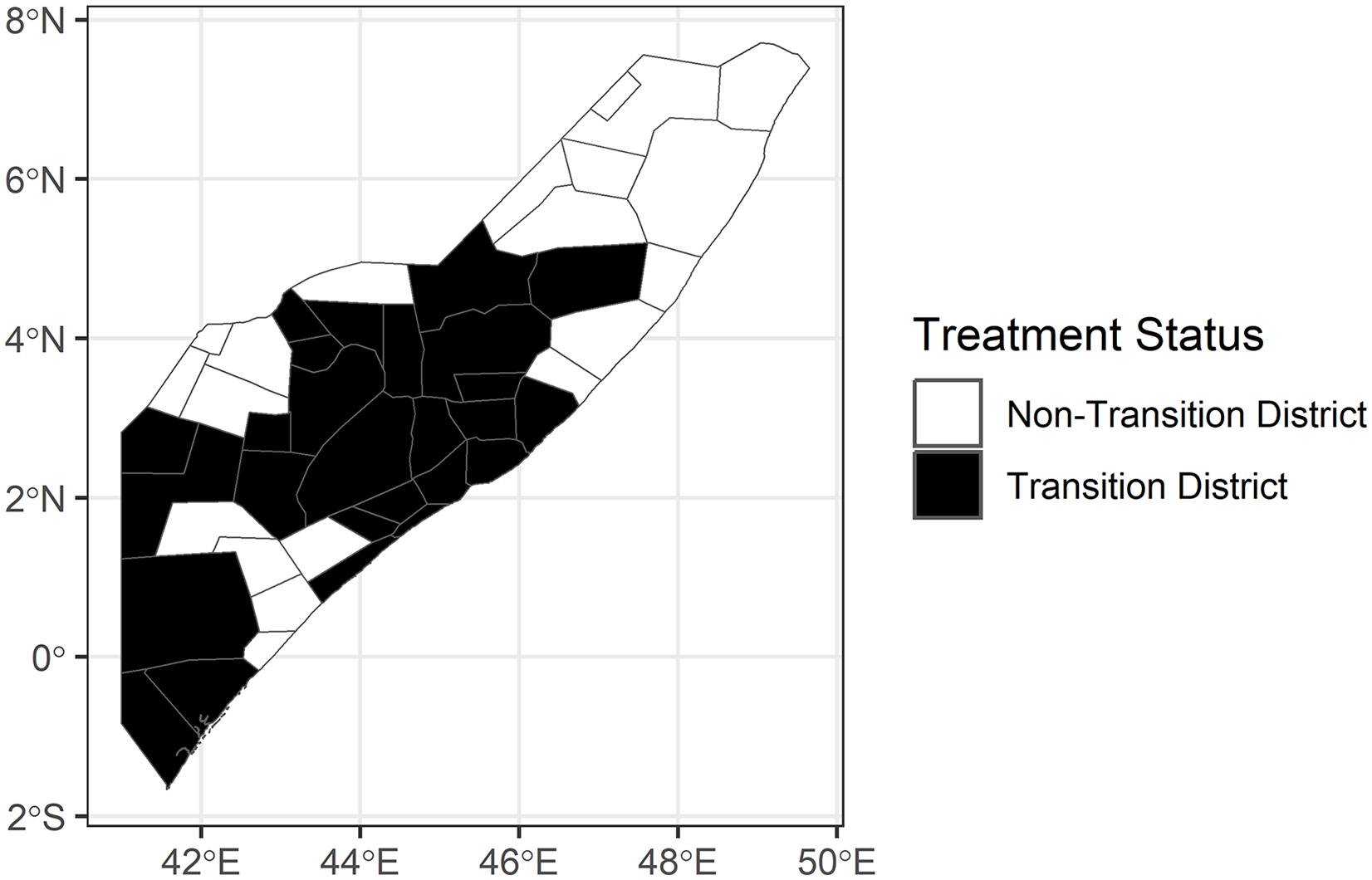
The map depicts districts experiencing transitions from al-Shabaab rule in southern Somalia from 2010 to 2018.
I employ a two-way fixed effect model to estimate treatment effects staggered across multiple time periods (Goodman-Bacon, 2021). The model represented in its equation form is:

where the dependent variable is the predicted number of conflict episodes between clans, αi is the district fixed effect and δt represents time fixed effects. AMISOM Base it is the treatment variable and takes the value of 1 if the district possesses an AMISOM base during a given observation and 0 otherwise. β1 captures the estimated average treatment effect of transitions in control on interclan conflict; Xit represents a matrix of covariates.
Statistical results
AMISOM did not decide to target al-Shabaab-controlled districts at random and chose targets for specific military and political reasons. These included imperatives to recapture population centers, deprive al-Shabaab of revenue collection, and re-establish control over major road networks. AMISOM, however, did not decide to target districts based on expectations of intercommunal conflict (AMISOM Civilian Official #1 interview, 2021). AMISOM targeting focused on liberating the population centers that sat astride the three major roadways connecting Mogadishu to the interior of the country. Therefore, while timing and precise districts targeted varied, AMISOM offensive operations always advanced sequentially along one of the three major roads or from the Kenyan or Ethiopian borders. Ultimately, these offensives reclaimed all territory held by al-Shabaab with the exception of a stronghold in the Juba River Valley, encompassing four districts, and a stretch of coast along the Indian Ocean, north of Mogadishu.
Predictive analysis does not indicate any relationship between intercommunal conflict and eventual transitions in district control. However, as a result of AMISOM planning priorities seeking to recapture population centers along the major interior roads, districts that experienced transitions from al-Shabaab rule tended, on average, to be slightly more populous. Table 2 provides a comparison of observable characteristics for key variables between districts that experienced transitions and those that did not. Treated districts experienced roughly the same level of violence as control districts, both in terms of interclan conflict and al-Shabaab violence. The full results of predictive tests and comparisons between treated and control districts are included in the Online Appendix.
Comparison between treated and control districts prior to 2012.
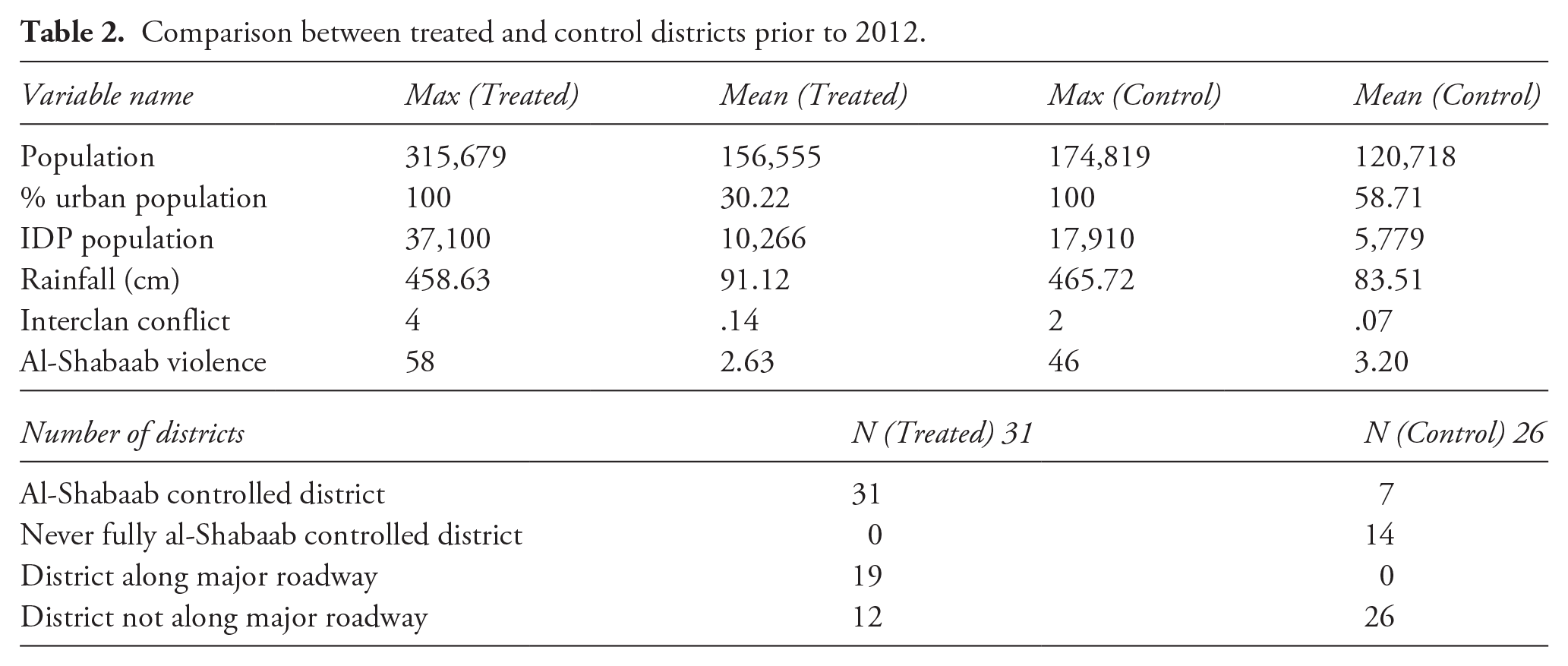
Table 3 presents the estimated effects of transition in control on the level of interclan conflict in a district. The introduction of an AMISOM base into a district leads to an increase in the level of intercommunal violence by approximately 0.5 events per quarter. Given that the mean level of intercommunal conflict within a non-treated district in any given quarter is 0.10, this represents a substantial effect. The models include robust errors, clustered on district to account for autocorrelation in panel data. Model 2 includes al-Shabaab violence lagged by one quarter to account for the potential effect of past al-Shabaab violence. The model also includes a variable measuring rainfall 5 as a proxy for the possibility of local famine conditions, which could be a local conflict driver (Levy et al., 2017). The inclusion of these covariates have no effect on the results. Difference-in-difference designs assume non-interference across units and spatial dependence between districts could be a concern. To account for the possibility of spatial dependence, I construct a variable measuring the number of adjacent districts that are treated during the observed quarter. Model 3 demonstrates this variable does not appreciably shift the main result. In additional analysis, I examine the effect of treatment intensity by interacting the estimated maximum number of AMISOM troops in a transition district within the first year of treatment with no indication that more troops exerted a pacifying effect.
Transitions in district control and intercommunal conflict.
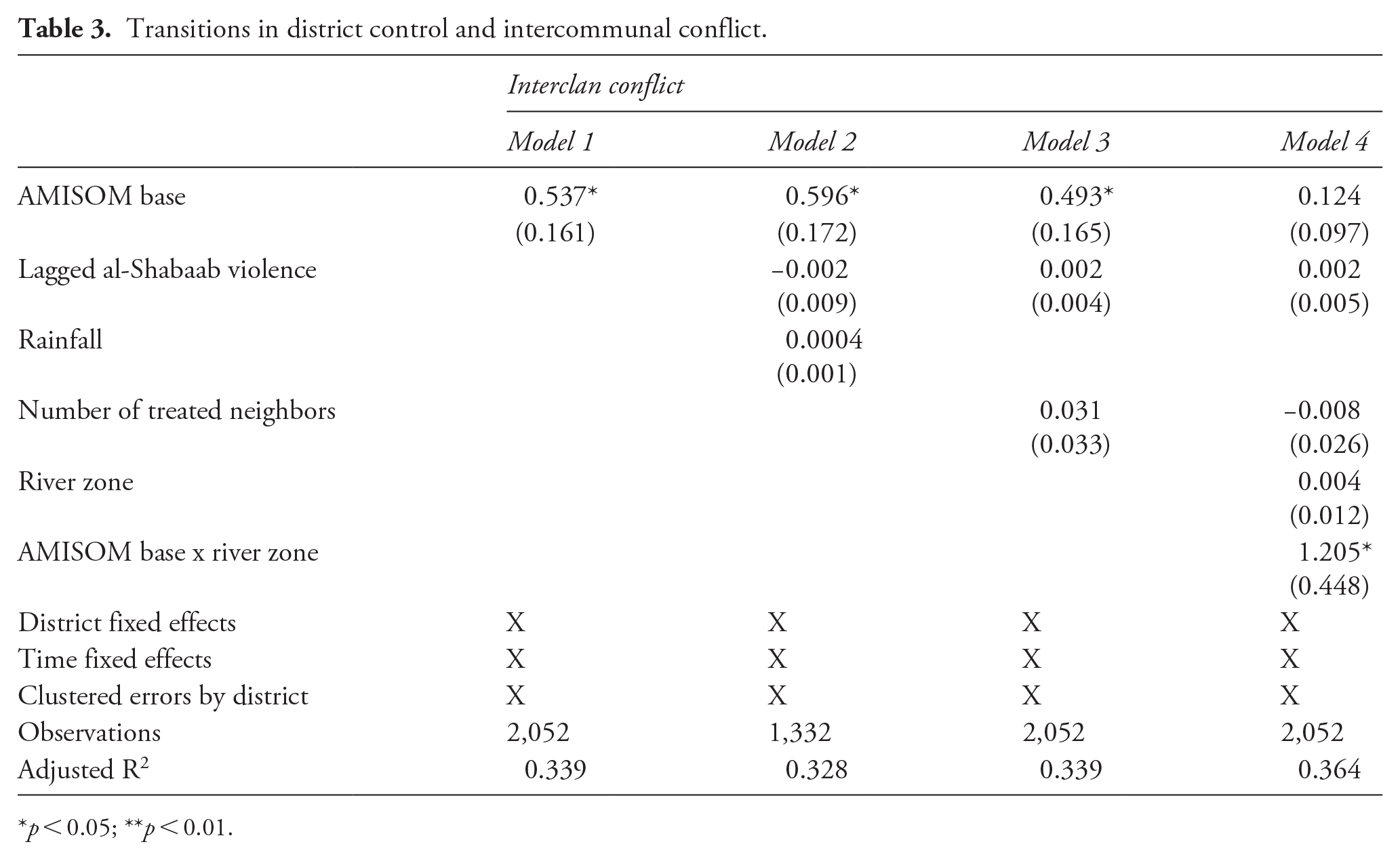
p < 0.05; **p < 0.01.
Absent quality data on district demographics, I employ an indicator variable for districts in river agricultural zones as a proxy to test for the effects of transition in agrarian communities with a history of intercommunal conflict. These agricultural districts are generally considered to possess higher clan diversity, producing lower social cohesion, and greater likelihood of property rights disputes in a manner similar to the processes described in the Marka case study (Besteman and Cassanelli, 1996). To capture the effect of transition in these districts, I interact the treatment variable with the River Zone indicator in Model 4. The interaction term indicates that virtually all of the treatment effects are being driven by AMISOM operations in these districts. Although an imperfect test, when combined with the illustration of conflict processes in Marka, the model highlights the potential importance of displacing al-Shabaab dispute resolution mechanisms and renewed contests over property rights.
To address concerns with the standard two-way fixed effects model and examine if the parallel trends assumption holds, I take a number of additional steps to identify the effect of a staggered treatment application. I conducted an event study where the treatment effects are estimated in a dynamic form as represented below:
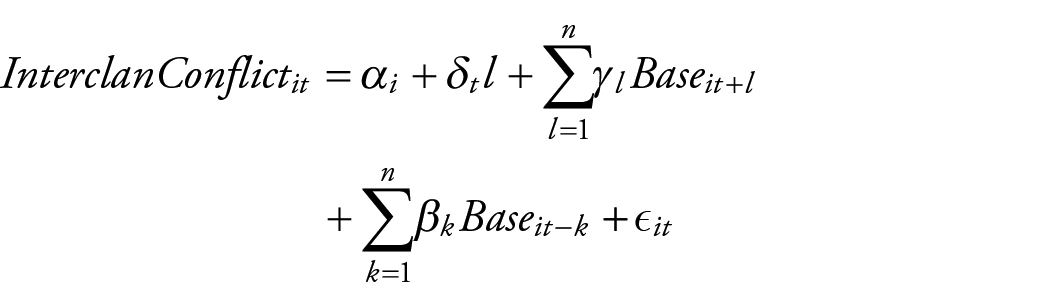
where γl represents the treatment indicator and its leads, measuring the effect of treatment over time. βk represents the lags of the treatment variable, acting as a form of placebo test to measure any potential differences between treatment and control unit prior to receiving treatment. For the parallel trends assumption to hold, the coefficients for βk should not demonstrate clear patterns.
Figure 4 presents the results of the event study with lags and leads of treatment for two years (eight quarters). The model uses units not yet treated and never treated units as controls. Time periods after 0 represent the dynamic effects of each period following treatment. Following standard practice, the quarter prior to treatment is excluded to avoid multicollinearity. The results indicate that prior to treatment, control and treatment groups followed similar trajectories, building confidence in the assumption of parallel trends. The effects of treatment show that estimated violence levels began climbing slowly following treatment with a spike at one year following transition of control in a district. This trend matches descriptive statistics from Figure 1, where violence levels increase after treatment, but dramatically spike in the fourth quarter. The dynamic specification indicates that much of the overall treatment effect in the two-way effects model is actually coming from the effect of violence spikes at the one-year mark following treatment where estimated violence levels in a district rise by over one episode per quarter. Looking at specific districts, this pattern is largely borne out in descriptive statistics as violence tended to increase most significantly between T3 and T6. The long-term trends in the dynamic analysis, included in the Online Appendix, point to elevated levels of violence through the end of 2018. This offers potential evidence of a path dependency from initial spikes in violence, resulting in retaliatory attacks in conflicts that AMISOM and the FGS were unable to resolve through failure to foster social trust within communities or provide external arbitration.
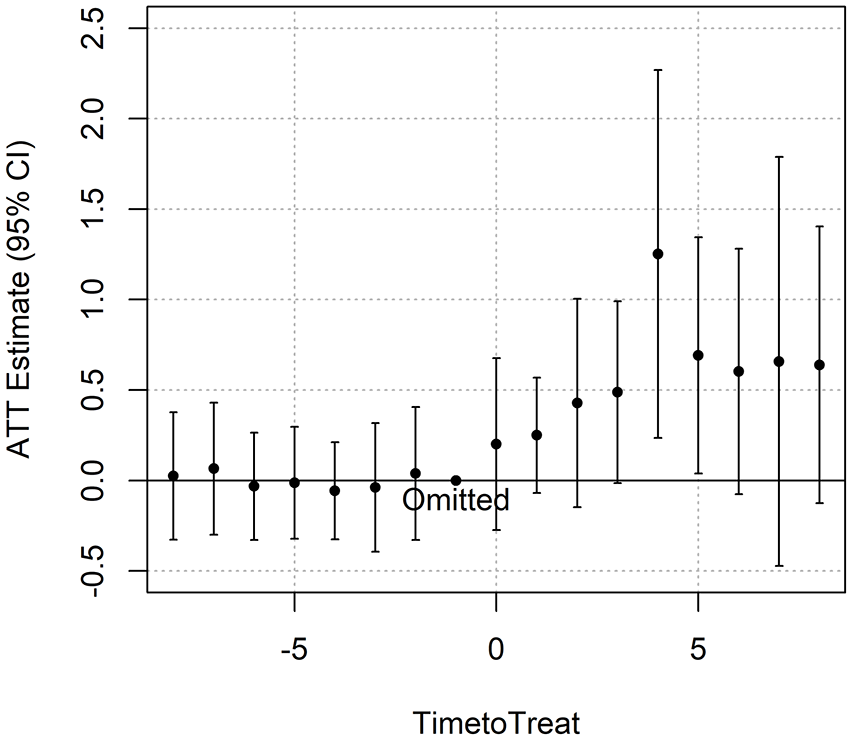
Estimated effects of transition on districts by quarters following treatment
Any quantitative analysis of conflict in Somalia must acknowledge the intrinsic limitations to the quality of data emerging from a conflict zone. The potential for increased reporting of intercommunal conflict following transitions to AMISOM control could raise concerns of biased data. To address these concerns, I conducted predictive testing if the geo-precision of ACLED’s estimates or type of source reporting improved following transitions in control, with null results. ACLED data on Somalia relies primarily on an independent set of contacts with limited reliance on news reporting and has provided robust data on conflict in Somalia well before the establishment of AMISOM. In total, 1,002 of the 1,124 reported events in the sample came from ACLED local partners. 6
Shifts in territorial control could introduce a bundle of potential mechanisms driving violence and omitted variable bias is a potential concern. I address these concerns through first conducting a sensitivity check for selection on unobservables, finding the results are robust to omitted variable bias. I additionally test for alternative mechanisms through the impact of internally displaced persons, development assistance, and prior al-Shabaab violence, with no effect on the results. Another explanation for violence could be the inevitable result of transitions in control during insurgencies, but the initial ascendancy of the Islamic Courts Union and al-Shabaab did not witness similar violence based on anecdotes and the limited violence reported in the dataset during that period. Instead, as demonstrated in the Marka case, intercommunal violence contributed to the resurgence of al-Shabaab. Section A2 in the Online Appendix shows decreases in al-Shabaab violence following transitions in control, but then increasing violence after escalations in intercommunal violence. The five most violent districts in terms of intercommunal violence post-transitions in control accounted for five of the six most violent districts in terms of al-Shabaab violence over the same period after temporary declines in al-Shabaab violence following transitions in control. Renewed intercommunal conflicts were inextricably linked to the resurgence of al-Shabaab violence.
Conclusion
Peacekeeping operations intended to displace rebel territorial control can carry unintended consequences with significant implications for social order. The failure to coerce, resolve disputes, or rebuild social trust in biased interventions can spur military mobilization and violence between communities. As demonstrated in Somalia, shifts from direct rebel rule to indirect control by AMISOM and the FGS produced significant levels of intercommunal conflict. AMISOM sought to establish military control of districts, and relied on local agents appointed from the FGS to govern, but then failed to restrain excessive rent-seeking behavior by these agents. In contrast, although al-Shabaab ruthlessly exploited populations and instituted a brutal form of rule, it reliably provided a coercive apparatus that prevented clans from mobilizing militarily and effective protection of property rights. These aspects of al-Shabaab rule appear to have been critical in suppressing intercommunal conflict.
While levels of interclan conflict never rose to the levels of violence perpetrated by al-Shabaab, the escalation of intercommunal conflict is nonetheless critically important to understand. Focusing on intercommunal violence during civil wars encourages a return to first principles in theories of state-building where protection of property rights and security guarantees to communities is the basic building-block of state legitimacy (Bates et al., 2002). Intercommunal conflict delegitimizes the government and can spur new grievances, driving groups to support rebels. Conflicts between clans provided al-Shabaab a means to remain relevant in newly liberated districts by offering alliances to weaker clans on the losing side of coalitions emerging to ally with the government. Planners in peace-keeping and counter-insurgency missions must focus hard on the sequencing of military and stabilization activities, recognizing that the window to replace features of rebel governance is much smaller than often assumed.
The spikes in intercommunal conflict following AMISOM offensive operations provide additional evidence of the risks of biased interventions in civil war. The inability of AMISOM peacekeepers to restrain oppressive or rent-seeking behavior from local FGS agents undermined social trust and convinced communities of the need to defend themselves. The concentration of violence within agricultural areas following transitions in control offers evidence that protection of property rights and dispute resolution mechanisms are critical first steps in establishing social order following transitions in control. An impartial intervener could potentially provide these services if communities perceived peacekeepers as unbiased arbiters. As al-Shabaab demonstrated, these services could also be provided in a coercive form of direct rule. However, it is unlikely peacekeeping forces could similarly establish direct forms of control in a biased intervention. The resources for such an approach would be enormous. More importantly, as external interveners increasingly take over responsibilities from partner governments, they crowd out local government and undermine building sustainable governance institutions (Russell and Sambanis, 2022).
Somalia is a particularly hard case for external intervention and could lead to generalizability concerns. However, the conflict in Somalia carries important similarities to contemporary civil wars. Long-duration civil wars and state failure similar to Somalia feature in conflicts like Afghanistan, Syria, South Sudan, or northern Mali. Multilateral interventions using a combination of United Nations peacekeepers, regional, and Western militaries have engaged in UN-sanctioned missions across sub-Saharan Africa. Many current Security Council authorized missions are either solely composed of regional forces or rely heavily on non-blue helmeted forces. The AU and regional organizations like Economic Community of Western African States and the South African Development Community have called for an increased role in maintaining regional peace through Ad Hoc Security Initiatives (Dobbins et al., 2019). Within the UN, prominent figures have called for increasing the war-fighting capability of peacekeeping operations in light of peace enforcement operations in Mali and the DRC (Cruz et al., 2017). As Islamist rebels continue to spread through weak states, the problem of reclaiming territory and extending governance remains a key issue. These interventions are better analyzed as forms of violent, externally supported state-building. To overcome resistance to the state, peacekeeping forces are waging counter-insurgency campaigns on behalf of weak states. In future missions where UN mandated peacekeepers assist in extending the reach of weak governments in the face of territory holding rebels, we should expect to see similar results to Somalia.
An alternative approach to intervention would focus on building a government capable of establishing a social contract before driving out rebels. Certain aspects of security provision and governance are far more important than others and the window to build social trust is quite narrow. If a partner government cannot provide these services, then interveners must carefully weigh the short- and long-term risks of extending the pathologies of weak governance to rebel held territory. The risk extends beyond only episodes of intercommunal violence. As demonstrated in Somalia, this violence can further strengthen rebel groups playing to new grievances.
The inability of biased peacekeeping interventions to reduce violence and rebuild social order should also force a reconsideration of the normative shift away from negotiated settlements to end civil wars. Following the example of US negotiations with the Taliban, many in Somalia have started to advocate for similar bargaining with al-Shabaab (Shire, 2020). Alternative approaches to intervention could employ force to shape conditions for a negotiated settlement rather than outright defeat of rebel groups. Restoring an emphasis on negotiated settlements to end civil wars, even with groups that have adopted brutal tactics, offers a means of restoring impartiality to peacekeeping interventions. Such an approach would undoubtedly be difficult and carry a number of risks. However, the grinding insurgencies across sub-Saharan Africa fought between Islamist groups and external interveners supporting weak governments have exceeded a decade of war. Evidence from Somalia indicates that current approaches have not worked and civilians continue to pay the price.
Footnotes
Acknowledgements
The author thanks Nicholas Sambanis, Alex Weisiger, Dan Hopkins, Melissa Lee, Guy Grossman, Dorothy Kronick, Christopher Blair, Nicolás Idrobo and anonymous reviewers for their helpful comments.
Replication data

Funding
The author received no financial support for the research, authorship, and/or publication of this article.
Notes
JASON HARTWIG, b. 1983, PhD Candidate in Political Science (University of Pennsylvania).