




Abstract
Fairness of domestic war crimes trials matters for promoting justice and peace. Scholars have studied public perceptions of war crimes trials to assess their fairness, but little is known about whether post-conflict states conduct them fairly. Bias, as a matter of procedural fairness, can manifest as a tendency to favour certain groups over others. Leveraging the theories of judicial decisionmaking, this article investigates two types of bias. The first is in-group bias, which is associated with protection of in-group members and punishment of out-group members. The second is conflict actor bias, which is associated with deflecting responsibility for wrongdoing from state agents to non-state agents of violence. We test for bias in domestic war crimes trials in Serbia with statistical modelling and quantitative text analysis of judicial decisions delivered to Serb and non-Serb defendants (1999–2019). While we do not find evidence of ethnic bias, our results indicate conflict actor bias. Serb paramilitaries received harsher sentences than Serb state agents of violence. Furthermore, we observe bias in the textual content of judgements. Judges depict violence committed by paramilitaries more extensively and graphically than violence by state actors. By revealing these judicial strategies, we demonstrate how a state can use domestic war crimes trials to diminish state wrongdoing and attribute the responsibility for violence to paramilitaries. The conflict actor bias we identify shows how deniability of accountability operates after conflict, complementing existing explanations of states’ collusion with paramilitaries before and during conflict.
Introduction
Domestic prosecutions of war crimes can indicate a state’s readiness to confront the legacy of violence and wrongdoing. Trials examine ‘alleged wrongdoing through judicial proceedings within a legal structure’ (Binningsbø et al., 2012: 734). They also embody the ultimate conception of justice sought by victims of war crimes (Minow, 1998: 26). Such delegitimization of past violence marks the dawn of a new moral political order (Carmody, 2017; Teitel, 1997). It acknowledges the suffering of victims, contributing to the repair of intergroup relations (Kritz, 1996: 128) and improving human rights (Sikkink and Walling, 2007). However, authorities can also use human rights prosecutions to further their own political ends (Encarnación, 2012), settle scores with regime opponents (Snyder and Vinjamuri, 2003) or facilitate state repression and entrench authoritarian rule (Kitagawa and Bell, 2022; Labuda 2022). When human rights trials are ‘a mockery of justice’ (David and Choi, 2009: 182), they undermine the peace they are envisaged to promote (Bassiouni, 1996: 23–25; Kerr and Mobekk, 2007: 104–127). Varied political, societal, and security effects of human rights trials are directly related to the way they are conducted, which, paradoxically, is a major gap in the existing research.
When studying domestic human rights prosecutions, scholars have mostly focused on why states opt for trials rather than other mechanisms of transitional justice (Aloyo et al., 2023; Grodsky, 2008; Nobles, 2010; Pion-Berlin, 1994). Such a narrow focus contrasts sharply with the large body of work on international criminal courts that epitomize the global norm of accountability. Scholars have been ‘pondering the[ir] smallest details’ (Holá et al., 2019: 2) along with their positive and negative effects on justice in post-conflict societies (Clark, 2018; Dancy and Montal, 2017; Dancy et al., 2020; Labuda, 2022; Meernik and King, 2003; Redwood, 2021). 1 Ideological underpinnings of criminal justice have also been criticized for leaving structural causes of violence in place, despite sanctioning its perpetrators (Krever, 2013). The easy accessibility and good quality of data on trial proceedings conducted by international criminal courts explain the discrepancy in knowledge about international and domestic trials. Obtaining data on war crimes prosecutions in post-conflict countries presents a significant and often insurmountable challenge. Using publicly accessible information on domestic war crimes trials in Serbia from 1999 to 2019 and leveraging theories of judicial decision-making (Aiken and Wizner, 2013; Meernik and Barron, 2018; Posner, 2008), we investigate bias in human rights proceedings in the domestic courts.
Domestic human rights prosecutions in Serbia have followed Croatian, Bosnian and Kosovo conflicts in which the Serbs have fought in the 1990s. As an integral part of post-conflict democratic transition, these prosecutions signal endorsement of the global norm of non-impunity. In Serbia, the trials have been taking place in the context of domestic resistance against accepting Serbs’ responsibility for committing war crimes (Gordy, 2013; Ristić, 2016). A denial of in-group wrongdoing is typical of states and societies recovering from intergroup conflict (Cohen, 2001; Lawther, 2014). Such normative environments can affect fair administration of justice for war crimes and manifest as bias in judicial decision-making.
Bias is a pitfall of judicial practice in post-conflict contexts where justice is used strategically to advance political ends (Kaminski et al., 2006; Loyle and Davenport, 2016; Weill, 2014). We approach bias as a matter of ‘procedural fairness’ manifested in judicial decision-making (Aiken and Wizner, 2013: 98), as opposed to bias as a matter of perception by local societies, including specific groups, such as ethnic groups, whose members are on trial for war crimes (Dancy et al., 2020; Meernik and King, 2003). Bias can be observed in sentencing, which – we propose – reflects the encroachment of politics into law in two ways. First, judicial partiality can be associated with identity politics in a post-conflict state, where accountability for past wrongs, like any other issue, ‘turns ethnic’ (Horowitz, 2000: 8). Sentencing will then reflect exclusive dynamics of in-group solidarity (Malešević, 2010: 191–200). Second, judicial partiality can be associated with the legacy left behind by ‘multiactor conflict(s)’ (Gilbert, 2022: 1231), the term denoting involvement of a range of state and non-state actors in conflicts, historically and contemporaneously (Kaldor, 1999; Kalyvas, 2001). From this perspective, partial judicial decision-making will reflect the political price a state is willing to pay for participation in violence through mobilization of a state army and other state security actors and, alternatively, through collusion with non-state actors in conflict, such as paramilitaries (Aliyev, 2016; Carey and Mitchell, 2017; Carey et al., 2022; Üngör, 2020). Therefore, sentencing can serve to protect state security actors by shifting a larger share of responsibility for violence to non-state actors. We contend that ethnic bias will manifest as differential sentencing of in-group perpetrators compared to out-group perpetrators. Conflict actor bias will manifest as differential sentencing of state and non-state agents of violence for the same type of human rights violations, even when all belong to an in-group, such as an ethnic group.
To systematically evaluate bias in domestic war crimes trials, we apply statistical modelling and a text-as-data approach to two original datasets based on the judgements of Serbia’s war crimes prosecutions. One dataset was created by granular coding of attributes related to the characteristics of trials, plaintiffs, crimes and defendants; the other is a corpus comprising the texts of these judgements. Contrary to expectations, we do not find evidence of ethnic bias in sentencing practices. 2 However, we do find evidence of conflict actor bias: state agents of violence received shorter sentences than paramilitaries for analogous crimes, holding other variables equal. In addition, we identify bias manifested in different lexical treatment of state and non-state conflict actors in the judgements’ textual content. We find that judges’ accounts of the rationale for their sentencing decisions for paramilitaries are longer and feature more implicatory language, including graphic descriptions of violence, as opposed to their accounts referring to state agents of violence, which are shorter and more neutral in tone.
This article makes several theoretical and empirical contributions to evaluating the practice of transitional justice in post-atrocity contexts and beyond. We identify a new way in which authorities in post-conflict states use human rights prosecutions to promote their own interests, subverting transitional justice. Scholars have commonly focused on in-group and out-group bias both in domestic and international human rights prosecutions, while neglecting differences among in-group defendants. Our research demonstrates the analytical benefits of addressing conflict dynamics in transitional justice research and the benefits of fine-grained disaggregation and evaluation of different types of in-group perpetrators. We thus advance discussions about plausible deniability, which focus on explaining states’ alignment with non-state actors during conflict (Carey and Mitchell, 2017; Carey et al., 2022; Üngör, 2020). We show that states do not deny their wrongdoing tout court after a conflict. Given the global norm of non-impunity and the expectations it places on post-atrocity states to prosecute citizens who committed human rights violations (Sikkink and Walling, 2007; Teitel, 1999), absolute denial of wrongdoing by state security forces and delegation of all responsibility for violence to non-state actors are undesirable because they may damage the state’s international reputation. Nevertheless, a state can diminish its responsibility for violence while holding all perpetrators, both state and non-state, to account – but with unequal outcomes. Our findings have broader implications for the analysis of the growing practice of humanitarian law prosecutions in consolidated democracies, pointing to a need for comparative evaluation of judicial practices involving private military contractors as opposed to members of state armies, for example, in the United Kingdom and the United States for alleged transgressions in the wars in Iraq and Afghanistan (Kerr, 2018; Peltz, 2021).
Law, politics and bias in domestic war crimes trials
War crimes trials are ‘a form of legalistic politics’ (Simpson, 2007: 14), which denotes the inseparability of law from politics. States in transition to democracy are particularly susceptible to encroachment of politics on law (Abdulhak, 2009; Garbett, 2012; Meernik and Barron, 2018). Considering that judicial processes operate under the constraints of the political environment, the normative application of the law, defined by the impartiality of trial proceedings, will be particularly challenging in human rights prosecutions (Fiss, 2009: 66–67; Weill, 2014: 2).
Post-conflict states are typically dominated by ethnic politics, where ethnic parties representing interests of identity group(s) involved in the conflict are legitimized in post-conflict elections (Hadzic et al., 2020; Horowitz, 2000: 291–364). The judiciary often reflects different partial interests of these groups, undermining the rule of law, institution-building and transitional justice (Vajda, 2019). Although public airing and condemnation of crimes are considered the best way to draw ‘a bright line’ between the old and new regimes (Teitel, 1999: 7), positive effects of domestic trials can be expected only ‘if domestic legal systems are sound’ (Alvarez, 1999: 393–395; Snyder and Vinjamuri, 2003: 17). Even in non-conflict contexts, judges’ decisions have been found to reflect prevailing societal norms (Dougherty et al., 2006: 177). As strategic actors who aim to ensure their own political survival, judges are susceptible to aligning with governments’ political agendas (Helmke, 2002; Shen-Bayh, 2018). The ‘great contestation over the framework within which justice is done’ in post-conflict societies (Webber, 2012: 108) makes human rights prosecutions particularly vulnerable to politicization (Snyder and Vinjamuri, 2003: 27).
For retributive justice to promote transitional justice goals, all aspects of a trial process must be fair and ‘the sentences imposed must be consistent and free from arbitrary influences’ (Dana, 2004: 323), such as those related to the broader political and normative environment. Alternatively, judicial decision-making will deviate from ‘a (stipulated) impartial outcome’ (Posner, 2008: 858), which is sentencing that is not sensitive either to the ethnicity of perpetrators or the category of conflict actors. Next, we discuss the theoretical justification for these suppositions.
The in-group bias
In intergroup conflicts, dominant political discourses construct in-group members as victims and out-group members as perpetrators (Zambelli, 2010: 1664). Domestic war crimes trials can reflect these attitudes because they are constrained by the political environment in which they operate (Fiss, 2009). They favour in-group members in different ways; for example, the prosecution can enact favour through selective politics of indictments that target out-group members (Vajda, 2019). Likewise, in-group favouritism can be present during the trial proceedings and in their outcomes. In the aftermath of conflicts fought along ethnic lines, partiality of judicial decision-making will then manifest itself as ethnic bias (Meernik and Barron, 2018).
Yet, empirical evidence of ethnic bias in trials conducted both in conflict and non-conflict contexts is ambiguous. Scholars argue that if judges have an in-group bias that compels them to protect members of their group, then they will punish perpetrators who harm that in-group (Chen and Li, 2009; Depew et al., 2017: 212). In-group bias has been observed in Chinese (Hou and Truex, 2022), Kenyan (Choi et al., 2022), US (Lim et al., 2016) and other courts. For example, in Israeli small claims courts, claims were found more likely to be accepted if they were assigned to a judge of the same ethnicity as the claimant (Jewish or Arab) (Gazal-Ayal and Sulitzeanu-Kenan, 2010; Shayo and Zussman, 2011). Conversely, other studies have found that in-group members are punished more severely when they violate a social norm of their group (Depew et al., 2017; Mendoza et al., 2014). However, to our knowledge, none of these studies have examined in-group bias in war crimes prosecutions in a post-conflict country, where the normative environment encroaches on judicial decision-making, amplifying the effect of judges’ ethnicity (Harris and Sen, 2019). There, the effect, predicated on co-membership in a group between a judge and a defendant, will be additionally moderated by the victims’ identity. Dehumanization of the out-group, as an enabling mechanism of egregious violence (Kelman, 2014), also plays a role in attempts to reckon with past wrongs when violence ends. Victims from the opposing side often continue to be demeaned, which will be reflected in lenient sentencing of their perpetrators.
The presence and degree of in-group bias in courts is likely to be culture- and context-specific (Depew et al., 2017: 212) and should not be over-generalized (Woolcock, 2014). Although bias is likely to be more prevalent in the aftermath of an identity conflict (Abdulhak, 2009; Meernik and Barron, 2018), its manifestation will depend on the nature of a post-conflict state and its governance, e.g. a power-sharing arrangement involving two or more identity groups, as in Northern Ireland or Bosnia and Herzegovina, or domination by a majority identity group, as in Sri Lanka and Serbia. In the former case, we may observe contestation in national courts where different groups vie for control. In the latter, the state will be interested in protecting the in-group’s interests and be largely unhindered in doing so.
Existing empirical studies of ethnic bias consistently point to the absence of ethnic bias in international criminal trials (Meernik and Barron, 2018; Meernik and King, 2003). However, international prosecutions are an institutional response to the weaknesses related to the ‘power–political interests’ (Krever, 2013: 702) of domestic trials, including their presumed vulnerability to in-group bias. Therefore, the findings from international war crimes trials will not necessarily be replicated in domestic prosecutions, which are vulnerable to the normative pressure to safeguard official exculpatory narratives of the conflict (Vinjamuri and Snyder, 2015; Weill, 2014). The ethnic identity of defendants in the dock for war crimes committed in an intergroup conflict is likely to be consequential for their sentencing, adversely affecting defendants from the opposing side (Garbett, 2012: 69; Vajda, 2019).
In-group bias hypothesis: Members of the in-group will receive more lenient sentences than members of the out-group.
The conflict actor bias
The consideration of conflict actor bias is grounded in scholarly debates about the nature of violent conflicts (Malešević, 2010: 311–331; Strachan and Scheipers, 2011), particularly when addressing the question of who perpetrates violence. Reflecting critically on the traditional Weberian view of the state as having a monopoly on the legitimate use of violence, scholars have shifted attention to instances in which a government delegates violence to other actors, entirely or in part (Avant and de Nevers, 2011; Carey and Mitchell, 2017). These reflections have brought into sharp relief the diversity of agents of violence in armed conflicts, highlighting the relationship between governments and non-state actors (Kaldor, 1999; Üngör, 2020). For example, recent conflicts have involved regular armies, police forces, paramilitary units, local warlords, criminal gangs, mercenary groups and private contractors in different geographic contexts: in Colombia in Latin America (Gilbert, 2022), Sierra Leone in Africa (Wai, 2023) and the Balkans or Ukraine in Europe (Kaldor, 1999; Fedorenko and Umland, 2022). Alongside questions about why and when states opt to delegate violence to other actors, such as paramilitaries, and the effect this has on the character of the violence perpetrated (Carey et al., 2022; Carey et al., 2015), the question of implications for accountability for human rights abuse looms large.
Avoiding accountability for violence and establishing plausible deniability create a powerful incentive for governments to rely on non-state actors during conflict. These non-state groups cannot be ‘lumped together’ under one overarching definition since they can be linked to the state or operate outside state control (Aliyev, 2016: 500) and the nature of their connection may also vary (Kalyvas, 2001). By implication, ‘some types of militias deflect blame better than others’ (Carey and Mitchell, 2017: 134). The informality of a government’s ties to certain non-state groups facilitates maintaining deniability of a government’s involvement in the actions those groups take (Campbell and Brenner, 2002). The efficacy of deniability claims is put to the test when a state faces accountability after the end of a conflict.
As an exercise in accountability, domestic war crimes trials pose a particular challenge to post-conflict states. A lack of political will for trials is a common obstacle (Chehtman, 2013: 313), due to the state’s involvement in violence (Davis, 2009; Wesche, 2019) or political implications of putting state army soldiers, seen as patriots, in the dock (Krebs et al., 2021). However, in the era of the norm of non-impunity, where states are expected to demonstrate compliance with global norms, post-conflict states may be unable or even unwilling to deflect responsibility for wrongdoing entirely onto non-state actors. At the same time, the potential political costs associated with the revelations of the full scope of state actors’ participation in violence will motivate the state to protect its agents of violence. We contend that a state, faced with internal and external pressures, will treat state and non-state agents of violence differently in court.
Conflict actor bias hypothesis: Members of state security forces will receive more lenient sentences than members of paramilitary units.
Research design
The case: War crimes trials in Serbia
We conduct a case study of domestic war crimes trials in Serbia, initiated in response to the involvement of Serbs in the wars in Croatia (1991
At the start of the democratic transition following the ouster of nationalist leader Slobodan Milošević in 2000, Serbia’s leadership gave the go-ahead to domestic war crimes trials in consideration of Serbia’s return to the community of democratic nations. 4 A presumed readiness to hold Serbs to account for wrongdoing was used to signal Serbia’s commitment to democratization to the international community (Ellis, 2004). However, domestically, the trials were also sold as an opportunity to go after the ‘real war criminals’, that is, Albanians, Bosniaks and Croats who committed violence against Serbs (Ristić, 2016: 170). The trials have been taking place in special war crimes chambers and district courts (Dimitrijevic, 2009; Weill, 2014). Cases have also been referred to Serbian courts from the ICTY and from Bosnia and Herzegovina. In the period of our study, Serbian courts have prosecuted both Serbs and non-Serbs and both state and non-state agents of violence (paramilitaries) charged with war crimes and human rights violations (Figures 1 and A8–9 in the Online Appendix). 5
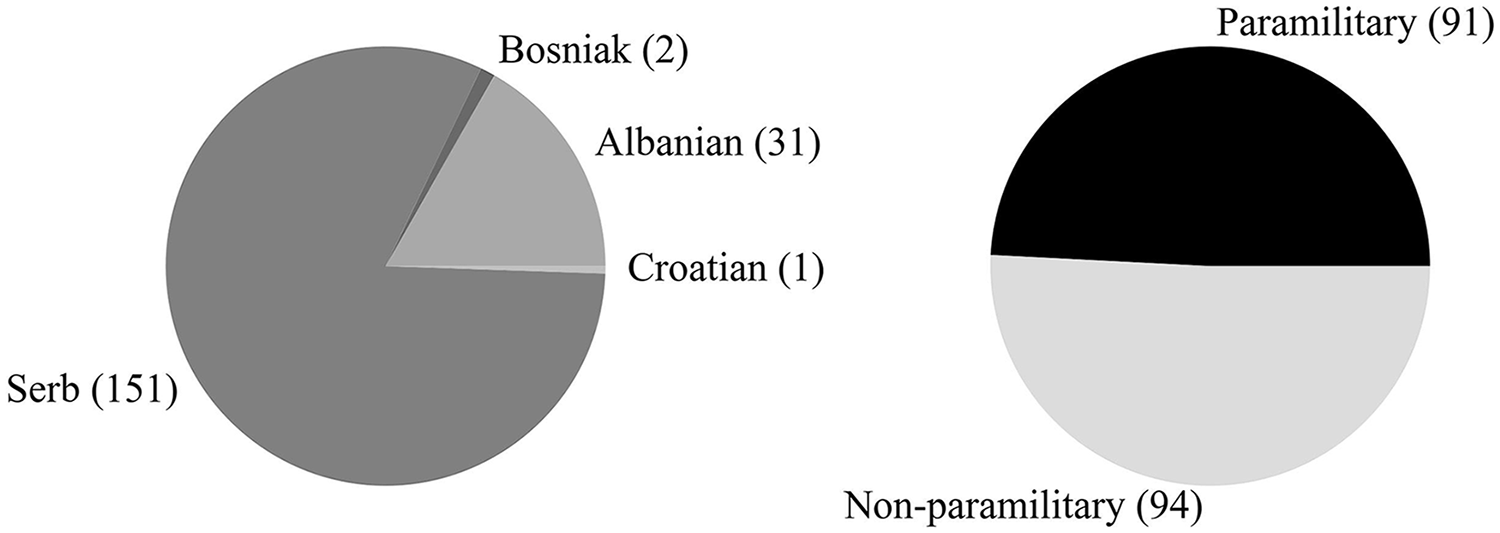
Ethnicity and armed groups of defendants.
Observers from international organizations, such as the EU and OSCE, as well as international and domestic human rights nongovernmental organizations, have criticized the Serbian war crimes trials for a number of reasons, including a lack of professionalism, inadequate witness protection and unnecessary delays in issuing indictments (Brković et al., 2015; Fond za humanitarno pravo, 2020; Humanitarian Law Centre, 2021). Qualitative and descriptive studies of the trials have pointed to their political use, steeped in Serbian wartime nationalism that has rejected any state responsibility for war crimes after violence ended (Ristić, 2016: 184; cf. Weill, 2014).
Serbia’s domestic prosecutions have been taking place amid a pervasive culture of contesting and denying Serbs’ responsibility for war crimes (Gordy, 2013). According to the European Commission (2020) and Freedom House (2020) reports, the Serbian judiciary has been under political pressure. Moreover, additional indirect pressure has come from the broader normative environment, where political elites have publicly celebrated convicted Serb war criminals sentenced by the ICTY (Humanitarian Law Centre, 2021). Serbian President Aleksandar Vučić’s coming to power in 2012 marked the start of democratic backsliding towards authoritarianism (Bieber, 2018). Such regression was accompanied by ever more prominent political resistance to holding Serbs accountable for human rights violations committed in the conflicts in the 1990s (European Commission, 2020; Fond za humanitarno pravo, 2020; Ristić, 2016).
Thoms et al. (2010: 335) point out that ‘single-country studies that examine one instance of transitional justice in one context cannot support strong general assertions about cause and effect’, although they are suited to generating hypotheses. We approach the case of Serbia’s domestic war crimes trials with this logic in mind. Obtaining fine-grained data for quantitative analysis of conflict and peace processes (Hadzic and Tavits, 2021: 1028), and especially for the conduct of war crimes trials, poses a challenge. Serbian war crimes judgements provide an opportune data source to test theoretical insights about post-conflict transitional justice that may be consequential beyond the examined case.
Measuring bias in war crimes trials: Data and methods
The data in this article are drawn from the judgements of all domestic war crimes trials held in Serbia from 1999 until 2019 (Figure 2). The judgements are accessible publicly, and we downloaded them from the website of the Humanitarian Law Centre, a Belgrade-based NGO. 6 The documents encompassed all first and second instance judgements, as well as all associated court decisions. 7 This included 164 judgements delivered to 185 individuals, resulting in our first dataset comprised of 555 observations, with one observation referring to the individual- and case-level information on a single defendant in one case.
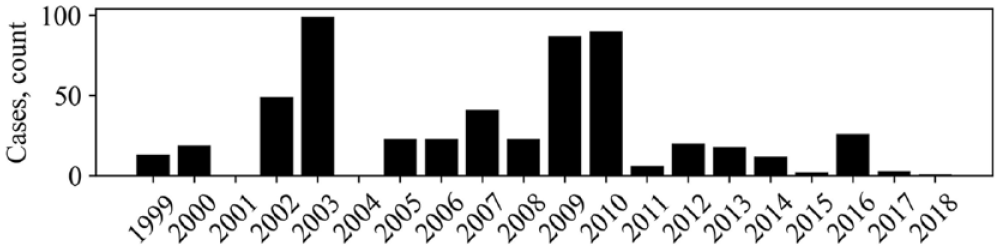
Years when the trials were initiated.
Our first dataset that is built following the practice applied in existing studies of international and hybrid war crimes trials (Meernik, 2011; Meernik and Barron, 2018; Meernik and King, 2003) comprehensively captures all relevant characteristics of trial proceedings. We coded a total of 33 attributes of trial proceedings (court location, type of court, trial chamber composition, crime location, etc.), defendants and plaintiffs (ethnicity, gender, rank, state vs. non-state), crimes (type of crime as charged) and sentences (conviction, sentence length, mitigating and aggravating circumstances). 8 A sentence length is a tangible measure of ‘judicial autonomy’, that is, of a judge’s ability to develop opinions independent of the preferences of other political actors or external pressures (Staton and Moore, 2011: 559). To evaluate the fairness of the trials, we examine the relationships between these attributes and sentence length using linear regression modelling. We employ sentence length measured in months as a dependent variable (Figure 3), which allows us not only to account for zero-length sentences but also to incorporate the variation in sentencing practices into our modelling.

Sentence length.
In addition to analysing the correlates of sentence length, we build on the empirical ‘corpus linguistics’ approach to criminal law in non-conflict contexts (Hessick, 2017: 1506) and scrutinize the judgements’ textual content. Following Rice et al. (2019: 2; Choi et al., 2022), who show that bias is manifested and ‘entrenched’ in the language of judicial opinions, we conduct a textual analysis of judges’ rationales for their decisions, which constitute a part of the judgement (Meernik, 2011: 589–590) in the first-instance judgements (Dana, 2004: 323). 9 Using LIWCser (Bjekić et al., 2014), a validated Serbian version of the Linguistic Inquiry and Word Count (LIWC) dictionary (Pennebaker et al., 2001), we estimate 60 psycholinguistic dimensions of each discussion, which allow us to statistically capture the lexical differences between them. 10 The application of LIWCser dictionary to our textual data is a particularly practical way of information retrieval, as it allows us to take advantage of an already validated and straightforward mechanism for sentiment analysis without applying more complex natural language processing tools, which are typically trained on significantly larger corpora.
Results and analysis
Below, we present the results of our tests for the in-group and conflict actor bias hypotheses and contextualize the discussion in relation to the extant scholarship on sentencing in international war crimes trials.
We do not find evidence of ethnic bias in Serbian war crimes trials, having conducted a series of tests of the hypothesis and controlled for the ethnicity of the defendants, plaintiffs, victims, judges, the location of a crime as well as other individual-level and case-level characteristics. 11 For example, the categorical variable that equals 1 if a defendant is Serb does not show a statistically significant link to the sentence length at any conventional level. In other words, our results produce no evidence that non-Serbs received longer sentences than Serbs, controlling for all potentially important factors and their combinations. Importantly, this finding remains robust when we control for the ethnicity of perpetrators’ targets (which are both Serb and non-Serb), as well as for the interaction between the ethnicity of a perpetrator and a target (see Tables I and A14 in the Online Appendix). Our findings align with evidence marshalled in the case of international war crimes trials, which suggests that ethnicity does not drive bias behind sentencing (Holá et al., 2011; King and Greening, 2007; Meernik, 2011; Meernik and Barron, 2018; Meernik and King, 2003; Onderco et al., 2013). Notably, our focus is on ethnic bias in sentencing, but there are other aspects of trials, both before or during the trial proceedings, that may indicate in-group bias. These can include selectively indicting out-group as opposed to in-group members, as in Croatia (Vajda, 2019), or a differential treatment of in-group and out-group witnesses that impacts their availability or testimonies. While similar concerns have been raised in Serbia’s case, there is no sufficient data available for a systematic analysis of their relationship with sentencing (Human Rights Watch, 2004). 12 Even with these caveats, sentencing is an important indicator of the trials’ conduct and basis of inference for politicization of trials and the form it takes in a specific context. 13 In Serbia’s case, we do not find grounds for ethnic bias.
Correlates of the sentence length in months.

p < 0.05, ** p < 0.01, ***p < 0.001. Standard errors clustered on defendant level in parentheses. The outcome variable for each model is the length of the sentence measured in months. SRJ: Yugoslav criminal code; Sr: Serbian criminal code. The coefficients for the variables for instances are significant at 0.05 level.
Next, we test for the conflict actor bias. We find that the sentence length displays a robust (over various specifications) and statistically significant (at 0.01 level) link with the type of conflict actor. Being a member of a paramilitary group brings more than a year of additional sentence length, holding other variables constant. 14 Importantly, we find that the observed relationship also holds when all the perpetrators belong only to the in-group. 15
Differential sentencing of state and non-state agents of violence indicates that the Serbian state, which had colluded clandestinely with paramilitary groups, creates the conditions for deniability of its involvement in war crimes and human rights violations. By punishing paramilitaries more harshly, the state effectively deflects responsibility for violence onto these ostensibly rogue actors. Sentencing also serves as a form of public dissociation from covert links that the state had with paramilitaries. Scholars and human rights observers have overlooked this strategy of avoidance of accountability, having been preoccupied with the Serbian state’s efforts to prevent army and police top brass from being held accountable (Ristić, 2016). Intense international scrutiny of a state’s strategy towards war crimes in post-conflict transitional states like Serbia explains why state agents of violence are not, or rather cannot, be exonerated from wrongdoing. In sum, Serbs have been prosecuting Serbs, which is ‘still politically and emotionally sensitive’ (Weill, 2014: 54). However, as we show, the exercise has been marked by a diversionary tactic of attributing a larger share of responsibility for violence to paramilitaries.
Below, we discuss further correlates of the sentence length, which are standard checks in the existing scholarship on sentencing of war crimes in international and hybrid trials (Tables 1 and A12–14 in the Online Appendix). Our results indicate that being found guilty of a war crime is associated with 7–8 years (more than 90 months) of additional sentence length, holding other variables constant. 16 For instance, we find that being found guilty as charged of war crimes against humanity or of war crimes against prisoners of war is associated with a more than 90-month increase in sentence length and being found guilty of terrorism is linked to a 100-month increase in sentence length, holding other variables constant (see Table 1). This finding adds to studies of the Yugoslavia and Rwanda international tribunals, which have identified an ordinal ranking among categories of crimes, whereby genocide is punished most harshly, followed by crimes against humanity and then war crimes (Holá et al., 2011). In Serbia, no sentences were handed out for genocide, 17 while war crimes against humanity and against prisoners of war, and terrorism, are most harshly punished.
Further, we find that at the appeals stage, the courts handed out shorter sentences, holding other variables constant. 18 A higher court instance is typically associated with more than a year’s reduction in sentence length, indicating that judges are systematically disagreeing over sentencing determinants. Meernik (2011: 604) offers two plausible explanations for nearly identical findings at the ICTY and the International Criminal Tribunal for Rwanda (ICTR): new evidence may emerge that can exonerate or diminish responsibility of the defendant; or judges in the first trial may be intellectually and emotionally more closely connected to victims, witnesses and evidence than their counterparts are at the appeals stage. The closer connection may be reflected in more severe sentences.
Next, we follow the existing practice in coding for an individual having a commander role as binary (having had a commander role or not). 19 Again, our findings align with analyses of the ICTY and ICTR, which indicate that the defendant’s rank affects the sentence length (Holá et al., 2011: 432). Domestic courts did not process any generals or high-ranking officers (unlike international courts). However, the judgements allowed us to account for a commander role among both state actors and paramilitaries. Having a commander role is associated with an approximately one-and-a-half-year increase in sentence length. This suggests that those seen as responsible for organizing the crimes are treated as most culpable, which is in line with the norms regarding culpability in international trials (Del Ponte, 2004: 516; Holá et al., 2011: 438).
In addition, we find strong evidence that aggravating circumstances are associated with longer sentences and weaker evidence that mitigating circumstances are associated with shorter sentences. 20 Each additional aggravating circumstance is linked to more than a year of additional sentence length, while each mitigating circumstance is linked to an approximately four-month reduction in sentence length. This is to be expected, as reflected in the literature on the ICTY (Meernik and King, 2003: 741) and hybrid war crimes trials in Bosnia and Herzegovina (Meernik and Barron, 2018: 729). Lower values of absolute coefficients and a less stable relationship between mitigating circumstances and sentence length may be attributed to a higher incidence of guilty pleas in international courts, since a guilty plea can lead to a significant reduction in sentencing. Courts often view guilty pleas favourably since they reduce costs and time, as well as incentivize others to step forward and confess their crimes. They can also reduce denial of crimes by politicians and the media (Carlson, 2016; Meernik and Barron, 2018: 728). Domestic trials take place in a different political and normative context, where a guilty plea can be seen as a threat to the state and even as treason against the nation. Additionally, this variation in sentence length may also be a function of inconsistent acknowledgment of mitigating circumstances in Serbian trials, which has been observed by scholars and practitioners. For example, family circumstances, such as marriage or children, have been treated as mitigating and aggravating circumstances in different cases.
Lastly, we find that the link between the sentencing practices and the standard variables described in this section is sensitive to the domestic normative environment in which courts operate. Judgements issued after July 2012, which marks the beginning of democratic backsliding in Serbia, are more than two years shorter than those issued before then, holding all the other variables constant and controlling for instances (Model 3 in Table 1). After mid-2012, the conflict actor bias still persisted, and state security actors continued to receive shorter sentences than paramilitaries. This is the time when the political will to support trials diminished significantly, as evidenced in the public discourse contesting crimes committed by Serbs. Our findings, therefore, indicate the link between the law and politics and demonstrate that the nature of this link can change along a country’s transitional path, reflected in laxer sentences all around in the post-2012 environment, during which war crimes denial became widespread.
We complement our statistical modelling with quantitative text analysis of the judgements. We analysed 164 textual documents obtained via optical recognition of the judgements in portable document format (pdf) in Serbian, following the manual re-entry of sections that optical recognition technology could not accurately interpret due to poor quality. The average document length was 19,190 words (with standard deviation of 28,358), and the total corpus consisted of 3,147,192 words. We observe that, besides paramilitaries receiving longer sentences, the judgements pertaining to them are longer in terms of text length. We roughly estimate that the judgements of paramilitary fighters are 12,500 words longer than the judgements of members of other armed groups (the difference is significant at 0.05 level). As shown in Figure 4, we also find that the judges’ discussion sections (parts of the judgement which justify sentencing decisions) were sparser and consistently shorter for non-paramilitary actors, while the length of text varied for paramilitary actors. The relationship holds when we control for all other important potential correlates. 21 In other words, we observe the reduction in the volume of text related to state agents of violence as compared to paramilitary actors, which compromises their function as a public record of crimes committed by all, including state agents of violence.
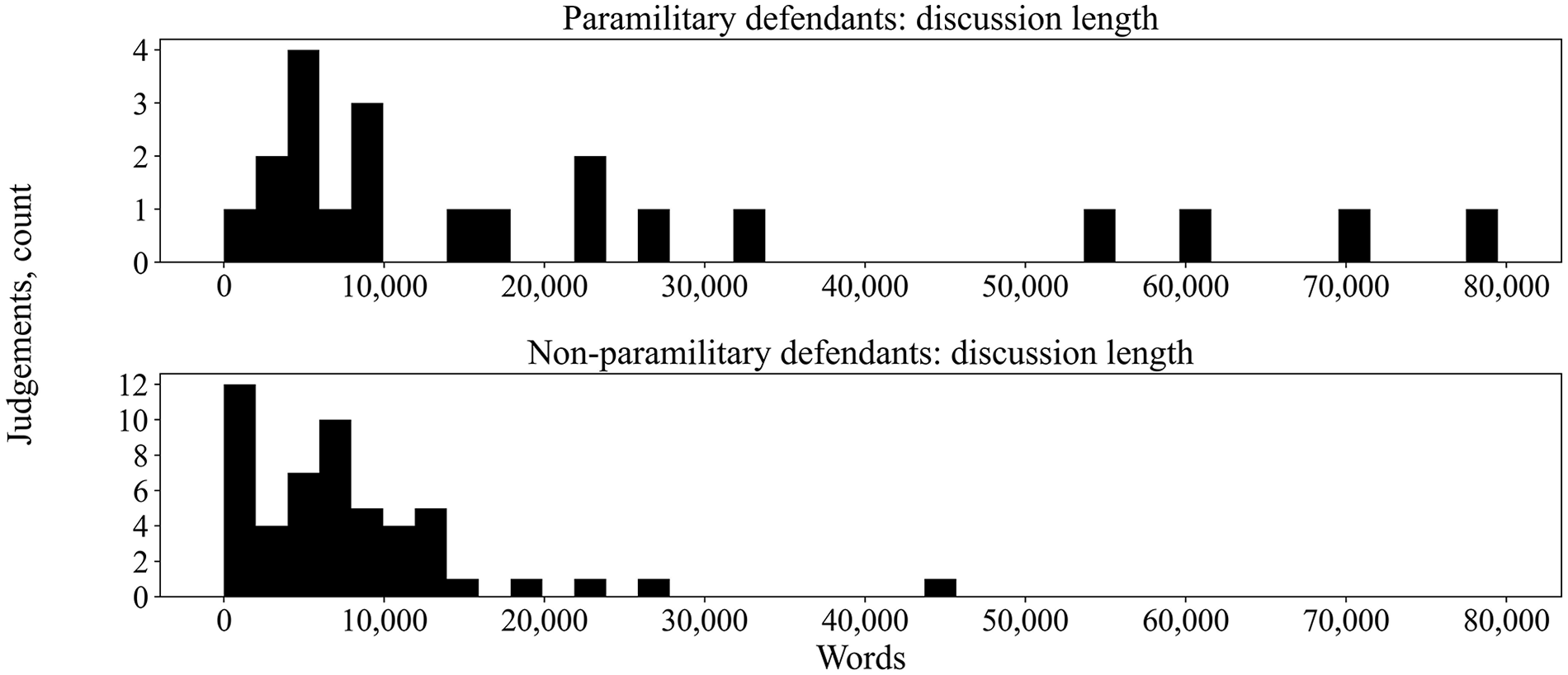
Word count distributions of discussion sections in the judgements.
In addition, using a validated Serbian version of the LIWC dictionary (Bjekić et al. 2014; Pennebaker et al., 2001), we estimated 60 psycholinguistic dimensions of each discussion section in the first-instance judgements. Relying on t-tests, we identified the dimensions that exhibit the highest differences when the judgements for paramilitary and non-paramilitary actors are compared. 22 Our results suggest that the dimensions of ‘body’ (telo), ‘space’ (prostor), ‘anger’ (bes), ‘see’ (vid), ‘hear’ (sluh), among others, are noticeably higher in the judgements for paramilitary actors. 23 This test offers quantifiable evidence of the implicatory language used by judges and indicates that the conflict actor bias that we detect in the sentencing practice in domestic war crimes trials is consistent with the different textual content of the judgements.
Two examples from our corpus of judgements illustrate this finding qualitatively. Both are taken from the 2010 Lovas case judgements, in which a number of members of the JNA – the former Yugoslav army that was at that point under the control of the Serbian state (Gow, 2003) – and of Serbian paramilitary units were found guilty of war crimes committed in 1991 against 62 civilians in the Croatian town of Lovas. 24 The case documents the brutal violence Serbs committed against Croat civilians, who were tortured, forced into a mined field to find landmines with their feet and killed, including one person from an explosion caused by stepping on a landmine. The lexical content that portrays participation of state actors in violence, as opposed to paramilitary actors, is starkly different. The segment referring to JNA (non-paramilitary) soldiers is short and factual: ‘[the accused non-paramilitary actors] came to an agreement that the combined forces composed of [lists a number of units], will search the terrain in the region of the vineyard, and that whilst doing that they should bring and use the locals – civilians being held captive, as protection from possible attacks by Croatian armed forces (‘human shields’) and from their mine fields’. The passage continues in this manner, listing what the JNA members did, briefly and factually.
The segment referring to paramilitaries, in contrast, is longer and uses more implicatory language manifested in how graphic it is: ‘[the accused] separated out about 20 civilians, [victims are listed], who were members of [lists a number of units], then beat them all over their bodies with their fists, legs, cables, metal poles, bats, hydraulic pipes, and other items. They were joined by [a further accused paramilitary] who beat the civilians with the butt of his weapon, as well as [a further accused paramilitary] who beat the civilians with his fists, while [a further accused paramilitary] stabbed a large number of civilians – [six victims are listed] – who were brought later by order of [their commander] and a volunteer, after which they were beaten, so that the whole garden and surrounding walls were marked with a visible trail of the blood of helpless civilians’. Graphic details of paramilitary crimes are consistently expanded on and brought to life, while those of non-paramilitary crimes are glossed over in the judgements, even when paramilitary actors and state agents of violence are involved in the commission of the same act of violence. 25
Based on the above, we can infer that both the sentencing practice and the lexical construction of the judgements, which are public documents, serve the purpose of advancing specific political aims in a state not entirely willing to address wrongdoing. Sentence length and the graphic language of judgements shield state agents of violence from full accountability for wrongdoing that is, instead, largely attributed to paramilitary groups. The high number of judges involved in these processes (outlined in A7 in the Online Appendix) and the infrequent recycling of judges (judges rarely sit on different war crimes trials) indicate that this judicial decision-making is not driven by a single judge or a handful of judges. Instead, it reflects the normative environment in which they operate.
Conclusion
In the international system, where accountability for human rights violations has become a norm, we are currently witnessing a shift towards domestic war crimes trials – an instrument of transitional justice about which little is known in comparison to international prosecutions. We have systematically analysed the legal practice of accountability in a post-conflict state with the aim of evaluating how domestic war crimes trials promote justice. Prosecution of war crimes domestically is a true indication of a country’s transformation from conflict to peace. However, this indication reflects the interplay between law and politics, which defines legal practice in times of transition and results in the law’s ambivalent directionality (Teitel, 1997).
Although we do not observe ethnic bias in Serbia’s war crimes trials, we do find evidence of conflict actor bias, a previously unrecognized form of bias that reflects the politicization of law and the subversion of justice. Specifically, we show that paramilitary actors are punished more harshly than state agents of violence for the same violations of international humanitarian law. Conflict actor bias results in diminished culpability of state actors, allowing the state to evade responsibility for past human rights abuses. In addition to revealing bias in sentencing, we identify a lexical strategy in the texts of the judgements through which the state deflects responsibility for wrongdoing by explicitly associating paramilitary actors with egregious violence but not doing the same with state actors. Such scapegoating of paramilitary groups, with whom the state is informally linked, accomplishes two goals: the state that puts on the trials can demonstrate to the wider international society that it is complying with the global norm of accountability by prosecuting war criminals; however, at the same time, by diminishing the severity of the portrayal of crimes committed by its agents, the state achieves a form of impunity and constructs a distorted and self-serving historical record of the state’s involvement in the conflict.
According to Carey and Mitchell (2017: 135), the next question for scholars investigating collusion between state and non-state actors in relation to violence concerns ‘the effectiveness of domestic and international institutions in holding governments and members of militias accountable for war crimes and human rights violations’. Our study advances scholarly discussions that consider deniability in relation to governments’ incentives to align with non-state actors before and during a conflict and shows how deniability operates in practice after conflict. Under the scrutiny of the international community, when addressing widely documented participation by state agents in violence, post-conflict governments will, arguably, be hesitant to grant amnesty to perpetrators or conduct openly sham or bogus trials. Such trials are ‘bent on vengeance instead of justice’, as Alvarez (1999: 370) puts it. Moreover, complete deniability may not be feasible, even if desired by a government. Nonetheless, a government that is intent on distancing itself from its own war crimes will find subtler ways to achieve deniability, given global normative constraints. We demonstrate this with evidence of harsher treatment of paramilitary actors compared to state security actors in Serbia’s war crimes trials.
Domestic war crimes trials remain an important instrument in the transitional justice toolkit, despite their recognized weaknesses. As critics of the primacy of international criminal courts in addressing mass atrocity crimes have argued, domestic trials are best placed to promote multiple transitional justice goals by virtue of their proximity both to the location of atrocities and to the affected publics (Alvarez, 1999; cf. Fiss, 2009). While prosecuting suspected war criminals, especially in domestic courts, may be ‘a morally good thing to do’, empirical evidence is required to go ‘beyond scruples and hunches about their effects’ (Bass, 2014: 284–285). The practical aspects of the endeavour continue to pose a challenge to researchers. As Voeten (2008) notes, primary data sources needed to study judicial behaviour are often either not publicly available or have too few court judgements to allow for viable statistical inquiries. Our empirical approach to Serbia’s war crime trials, including data collection and dataset construction, overcomes this obstacle. However, aware of a limited potential for generalization beyond this single case, we approach our theoretical insights about bias in domestic war crimes trials with a consideration of what a single case study can do: to suggest ‘plausible focus’ for future explorations in other contexts (Dougherty et al., 2006: 177).
Lastly, to evaluate judicial impartiality, our study has focused on sentence length. This is only one indicator of many possible ways of politicizing justice, as multidisciplinary qualitative empirical analyses of war crimes prosecutions have shown (Waters, 2014; Weill et al., 2020). Future studies of domestic war crimes trials need to pay closer attention to opportunities to avoid accountability that governments have (Carey et al., 2015: 861), especially when the time comes for reckoning with war crimes post-conflict. Future research needs to pay attention to various aspects of trial proceedings, such as the treatment of witnesses, the use of evidence and the release of documents. It should also interrogate how the procedural dimensions of domestic humanitarian law prosecutions interact with macro-level processes, including the quality of democracy, rule of law, media freedom and ethnic divisions. If ‘the willingness of a regime to punish human rights abuses reveals – to its own citizens and to all the world – its true character’ (Fiss, 2009: 66), this study offers a preliminary caution that ‘willingness’ is not a uniform quality. Distinguishing between different types of agents of violence and discerning whom exactly a government is more or less willing to punish will reveal the true character of a regime along with the political role of law and of war crimes trials in post-conflict transformation.
Footnotes
Acknowledgements
We thank Vesna Popovski for research assistance and Devika Hovell for valuable comments.
Replication data

Funding
This research was funded by the European Research Council (ERC) Consolidator Grant, ‘Justice Interactions and Peacebuilding: From Static to Dynamic Discourses across National, Ethnic, Gender and Age Groups’ (JUSTINT), no. 772354.
Notes
IVOR SOKOLIĆ, PhD in Political Science (University College London, 2016); Lecturer in Politics and International Relations, University of Hertfordshire. Visiting Fellow, European Institute, London School of Economics and Political Science. Current research interests: transitional justice, post-conflict reconciliation, former Yugoslavia.
DENISA KOSTOVICOVA, PhD in Geography (University of Cambridge, 2002); Professor of Global Politics, European Institute, London School of Economics and Political Science. Current research interests: post-conflict reconstruction, transitional justice, communication.
LANABI LA LOVA, PhD in International Relations (London School of Economics and Political Science (LSE), 2024); Postdoctoral Researcher, LSE. Current research interests: transitional justice, post-conflict reconciliation, autocracies, text as data, data science.
SANJA VICO, PhD in Media and Communications (Goldsmiths, University of London, 2019); Lecturer in Communications and Digital Media, University of Exeter. Current research interests: digital media in contexts of migration, identity, nationalism, and post-conflict justice and reconciliation.