




Abstract
What explains the variation in combatant socialization and resocialization outcomes? Why do some combatants adopt the intended norms of their organization while others resist them? Combatants regularly undergo intensive socialization and ‘resocialization’ processes within total institutions – regimented environments like armed organizations and re-education programs that seek to alter their norms. Total institutions profoundly shape the behaviors and attitudes of combatants during and after conflict. However, even within these controlled environments, combats develop norms differently, and it is still not clear what factors drive this variation in combatant preference formation. This article presents and tests a framework that combatant socialization is in part driven by subgroups – the smaller social units within total institutions that form the informal structure and environment of combatants. Specifically, subgroup leaders moderate socialization processes by reinforcing or undermining the official norms of the organization. To test this expectation, I leverage archival data from the British re-education program for German POWs (1946–1948) which sought to ‘democratize’ them. To facilitate re-education, British officials installed pro-democratic POWs into subgroup leadership positions in select camps. Using a novel dataset constructed from hand-coded administrative reports, I measure the effect of subgroup leadership type on socialization outcomes. The results suggest that subgroup leaders moderate socialization outcomes.
States invest significant resources into shaping the behaviours and attitudes of combatants through formal socialization and resocialization processes. The norms instilled in combatants through socialization directly impact their repertoires of violence and can lead to variation in indiscriminate violence (Kalyvas and Balcells, 2010; Oppenheim and Weintraub, 2017), sexual violence (Cohen, 2017; Wood, 2009) and levels of restraint (Bell, 2022; Hoover Green, 2018). 1 State-operated resocialization initiatives such as re-education (Robin, 1995; Smith, 1996), de-radicalization (Koehler, 2016), and certain disarmament, demobilization, and reintegration programs (DDR) (Muggah and O’Donnell, 2015) can also significantly impact combatant norms. Combatants are often subjected to intensive socialization or resocialization processes within total institutions – enclosed, regimented environments like armed organizations and re-education programs whose primary objective is to change the norms of its participants (Scott, 2011). However, even within these tightly controlled settings, not all combatants socialize into the intended norms of their organization and can instead establish different, sometimes divergent subcultures and practices. What explains the variation in combatant preference formation? Why do some combatants adopt the intended norms of their organization while others resist them?
Existing research has focused on the institutions (Hoover Green, 2017) and ideologies (Gutiérrez-Sanín and Wood, 2014; Leader Maynard, 2019; Thaler, 2012) of armed organizations for explaining the formation of combatant preferences. Other studies have unpacked intra-organizational dynamics, acknowledging that armed organizations are complex and hierarchical, featuring multiple interacting networks where combatants are embedded in both a formal military command structure and within their immediate unit which forms its own informal subgroup (Hundman and Parkinson, 2019; Lyall, 2020). Within these overlapping social networks, combatants experience multiple sources of socialization, vertically from official institutions and agents and horizontally from fellow combatants (Bateson, 2017; Checkel, 2017). Similarly, research on resocialization initiatives notes the complex social structures and conflicting influences within deradicalization (Gunaratna and Hussin, 2019) and re-education programs (Krammer, 1979). These studies have advanced our understanding of how combatants form and reform their preferences; however, ‘significant theoretical and empirical gaps remain in scholarship on socialization’ (Bell and Terry, 2021: 830), and it is still not clear why combatants within the same environment develop norms differently.
I address this gap in the literature by focusing on the subgroup dynamics of combatants within total institutions – the within-group subcultures that develop at the rank-and-file level that can align with or diverge from the expected practices of the wider organization. I argue that the task of socialization is ultimately delegated to subgroup leaders – the small-unit, junior and mid-level commanders of an organization who can either reinforce or undermine the official socialization or resocialization process. Subgroup leaders occupy a unique position of authority within both formal and informal social networks that enables them to control the normative environment of combatants. As lower-ranking commanders with close ties and frequent interactions with rank-and-file combatants, they influence both vertical and horizontal socialization which allows them to shape the expected norms of their immediate social environment. Subgroup leaders choose which practices to introduce and reinforce that eventually permeate the content of horizontal socialization between combatants.
In developing my theory on combatant preference formation, I draw insights from the prison (Jacobs, 1974; Lessing, 2021) and organizational socialization literatures (Ashforth and Saks, 1996; Feldman, 1981) to supplement findings from military socialization and sociology studies (Guimond, 1995; Manekin, 2020; Shils and Janowitz, 1948). 2 These different yet overlapping literatures emerged from the early concept of total institutions (Goffman, 1961) and share a theoretical foundation that discusses environments with similar conditions, subgroup dynamics, and mechanisms of identity reformation (Decker and Pyrooz, 2019; Hoover Green, 2018: 28; Scott, 2011). Synthesizing these literatures, I argue that combatant preferences within total institutions are shaped by subgroup leaders who moderate norms and socialization and resocialization outcomes. I test this expectation by leveraging previously unused archival data from one of the largest yet overlooked cases of combatant resocialization – the British re-education program for German prisoners of war (POWs) after the Second World War.
From 1946 to 1948, British officials implemented a comprehensive ‘democratization’ program for the massive population of German POWs in the UK, which at its peak in September 1946, numbered 402,177 POWs spread across approximately 220 camps (‘Progress Reports,’ FO 939/419; ‘Strength Lists’, FO 939/245). To track the progress of re-education, British officials regularly visited POW camps to compile reports on the overall state of re-education. These reports provide exceptional quantitative and qualitative data for tracking the changing attitudes of German POWs and present information on the German leadership of the camps. In select camps, British officials altered the subgroup leadership of POWs by replacing Nazi leaders with pro-democratic leaders. Leveraging this variation in subgroup leadership types, I compare the socialization outcomes of camps with pro-re-education subgroup leaders to camps with Nazi subgroup leaders. Specifically, I pair two case studies, POW camps 118 and 70, with a large-N analysis of 64 POW camps that uses monthly re-education reports (n = 489). The results lend strong support for my argument that subgroup leaders moderate socialization outcomes, finding that camps with democratic leaders were more likely to develop pro-democratic norms compared to those with Nazi leaders.
The article proceeds in six sections: the first section briefly reviews the literature on total institutions, outlining key concepts from the military and prison socialization literatures. The second section presents my theoretical framework and mechanisms that inform my main expectations. The next section provides case background on the British re-education program and the key variables leveraged from the archival data. The fourth section turns to the case studies of Camp 118 and Camp 70. The fifth section tests the role of subgroup leaders on socialization using panel data from 64 POW camps, and the conclusion discusses theoretical and policy implications.
Combatant socialization and resocialization in total institutions
Armed organizations and prison environments are archetypical total institutions. They are settings where individuals live in a well-defined environment with a regimented routine, clear goals, and expectations (Goffman, 1961). Within them, ‘members are immersed and enclosed’ in an environment that aims to ‘fundamentally change their identities’ (Scott, 2011: 2) through ‘collective socialization’ (Ashforth and Saks, 1996: 150). All aspects of a total institution are directed ‘towards a single rational plan or goal – namely that of resocialization’ (Scott, 2011: 9), the process ‘by which a person learns the values, norms, and required behaviors’ of an organization while ‘relinquishing’ some of their previous attitudes (Mortimer and Simmons, 1978; Van Maanen, 1976: 56, 65). Similarly, in armed organizations, military socialization processes ‘strip away pre-military norms and identities’ of recruits (Hoover Green, 2016: 621) and ‘rebuild[s] them in the organizational image’ (Manekin, 2017: 607). Given the overlapping goals of identity reformation and characteristics of total institutions, socialization scholars often interchangeably apply key mechanisms between different ‘totalist’ groups and settings (Hoover Green, 2018: 28; Scott, 2011). Following socialization scholars, I outline existing research from the military and prison socialization literatures that inform my theoretical framework on the role of subgroups in combatant preference formation.
Conflict researchers are increasingly interested in the internal dynamics of armed organizations, particularly how norms and behaviors develop and impact conflict and post-conflict outcomes. These scholars generally examine formal military socialization processes delivered through institutions and practices such as recruitment, training, ideological instruction, isolation, and disciplinary measures which reward conformity and punish contradictory norms (Hoover Green 2017, 2018; Manekin, 2017). Intensive socialization through repeated training and political re-education can reshape the normative preferences of combatants and impact their patterns of violence (Cantin, 2021). 3
Military socialization is a process closely linked to the structure of armed groups. In armed groups, combatants are simultaneously nested in overlapping formal and informal social networks (Hundman and Parkinson, 2019). Formal networks are structured around the official institutions and hierarchies of an organization that are administered from the top down by agents of socialization who seek to maintain adherence to the norms of the group (Hoover Green, 2017; Manekin, 2020). Informal networks are the immediate social groups of combatants at the small-unit level (Shils and Janowitz, 1948; Stouffer, 1949). Combatants associate with both the official goals of the wider group and the distinct norms of their immediate unit which can have its own rules and rituals (Kellett, 1982).
Interactions between formal and informal networks extend directly to the socialization process. Within this overlapping social network, combatants are managing multiple sources of socialization, or ‘layered socialization’, from both organization officials (vertical) and group members (horizontal) (Bateson, 2017; Checkel, 2017). When the norms of a combatant’s informal social system diverge from the official norms of the group, it can lead to contradictory behaviors that disrupt the intended socialization process (Manekin, 2020; Parkinson, 2021). However, informal networks can also actively reinforce formal socialization by ‘exercising mutual surveillance – monitoring each other’s levels of conformity and obedience’ (Scott, 2011: 89). While scholars acknowledge that the interactions between these networks are important, it is still unclear which one is driving the process (Bell and Terry, 2021: 830; Parkinson, 2021: 8).
Recent studies on the micro-level dynamics of armed organizations demonstrate the importance of informal networks. Breakdowns in unit cohesion, such as desertion, defection, and surrender, can be explained by the ethnic and socio-economic compositions of armed organizations that often define its informal networks (Lyall, 2020). The micro-level linkages between combatants ‘create norms of cooperation’ and ‘social rules’ that motivate them to fight or desert (McLauchlin, 2020: 2). Resistance to formal authority in armed groups is often a subgroup phenomenon that develops when there is a normative conflict with the expected practices of the wider organization (Manekin, 2017, 2020). Additionally, while the goals of an armed organization are established by formal leadership and maintained through institutions, they are interpreted and reinforced through everyday interactions between combatants (Parkinson, 2021).
Turning to the prison, organizational socialization, and de-radicalization literatures, layered socialization also unfolds in penitentiary-like settings which are influenced by subgroups that can reinforce or disrupt socialization processes (Decker and Pyrooz, 2019; Lyman, 1989). Just as in armed organizations, subgroups in prison environments have observable behaviors, norms, and leaders that are in support of or against socialization (Jacobs, 1974; McGuire, 2018). Prisons are also complex social environments with overlapping formal and informal networks (Wheeler, 1961) and governance structures (Lessing, 2021) that align or diverge in their preferences. They can feature multiple subgroups led by influential leaders that shape expected behaviors and undermine official socialization programs (Jacobs, 1974: 402; Lyman, 1989). In de-radicalization or re-education programs, resistant subgroups can continue to radicalize other combatants (Koehler, 2016).
Synthesizing these different total institution literatures, I argue that socialization is primarily carried out by informal networks, specifically at the small-unit, subgroup level. Individuals in new social environments rely on fellow group members to learn expected norms (Ostroff and Kozlowski, 1992). After basic training, recruits are no longer supervised by official agents and join their unit which becomes their primary group (Shils and Janowitz, 1948). Primary groups form larger subgroups that vary in size and can exist at the squad, platoon, or company levels and have their own mechanisms of socialization based on unique ‘norms and habits’ unsanctioned by the wider military organization (Siebold, 2007: 289). These subgroups can use peer-pressure, hazing, and initiation rituals to impose ‘their own set of norms and values that soldiers must learn and follow’ (Manekin, 2020: 83). I advance that horizontal socialization at the micro-level is guided by small-unit commanders who wield significant influence and represent the prototypical identity of their subgroup. Subgroup leaders act as moderators who filter and interpret norms that flow down to the subgroup level, which makes their role in socialization processes pivotal.
Theoretical approach: The role of subgroup leaders in socialization and resocialization
Subgroup leaders are agents of socialization that occupy small-unit officer positions within the command structure of totalist organizations, for example as squad, platoon, or company leaders. As junior commanders, they are leaders in both formal and informal social networks, interacting with rank-and-file combatants often outside the direct control of formal institutions (Bell and Terry, 2021; Hundman and Parkinson, 2019). Outside of formal supervision, ‘centralized control decreases considerably, and the control and leadership exercised by small-unit commanders begin to play a much larger role’ (Manekin, 2020: 83). The task of socialization and maintaining conformity to the norms of the organization is delegated to them, where they can choose to reinforce or undermine official socialization processes.
Subgroup leaders can shape the prevailing norms of a social environment by leveraging their authority and proximity to combatants. I posit that subgroup leaders use three mechanisms of control to influence social environments: (1) participation and emulation, by displaying and encouraging the prototypical behaviors and attitudes that are mimicked by combatants, (2) empowerment and protection, by supporting combatants adhering to sanctioned norms, and (3) suppression, by minimizing combatants who hold divergent norms. Subgroup leaders can effectively monitor and exert control over environments because they are embedded in the formal and informal social networks of combatants which gives them reliable information on subgroup dynamics. Using these mechanisms of control, subgroup leaders can create a stable, normatively cohesive environment that increases horizontal socialization between combatants.
A key condition for effective socialization is a stable environment where ‘learning opportunities’ are consistently administered and the influence of contradictory norms are limited (McGuire, 2018: 8). Conflicting norms can lead to resistance against socialization which can make the environment of identity formation unstable (Long and Hadden, 1985). Environments that lack a ‘normative consensus’ because of diverging norms can cause ‘strain, confusion, and social disorganization’ and trigger a normative contest between opposing subgroups that disrupts the official objectives of socialization (Feldman, 1981; Mortimer and Simmons, 1978: 432). Unsanctioned norms that conflict with expected behaviors can complicate a combatant’s socialization by presenting unclear or rival norms to adopt. Subgroup leaders can destabilize or create a normatively cohesive environment through different mechanisms of control.
Whether an individual is an active member of a subgroup, or an opportunist seeking material benefits, their surrounding environment influences their rational calculations and how they navigate socialization (Feldman, 1981; Mortimer and Simmons, 1978). While few combatants fully internalize the norms of the group (Leader Maynard, 2019: 643), their social environment, particularly peer-pressure from fellow combatants, impacts their behaviors which can lead to positive associations and eventually attitudinal changes (Guimond, 1995). Peer-pressure from ‘hardliners’ is ‘particularly influential in socializing their moderate peers [. . .] incentivizing even initially moderate members to adopt views that are more radical’ (Cantin, 2021: 1577). In short, individuals are more likely to adopt norms if they are reinforced by their surrounding subgroup.
Subgroup leaders aligned with the official norms of an organization control environments by suppressing individuals with divergent norms and by supporting individuals propagating sanctioned norms. Subgroup leaders themselves can act as agents of socialization, reinforcing sanctioned norms through their own behavior that combatants can emulate. They can act as mentors, ‘informally induct[ing]’ combatants ‘to the normative and behavioral expectations of the group’ (Cantin, 2021: 1578), or they can support political entrepreneurs within the subgroup that spread ‘shared conceptions of priorities and political meaning [. . .] translat[ing] ideas into practice’ (Costalli and Ruggeri, 2017: 925). Combatants supported by subgroup leaders are allowed to influence social environments unimpeded.
Conversely, combatants that contradict the norms of their subgroup leaders can be suppressed through methods of ‘coercive persuasion’ such as peer-pressure, hazing, isolation, and disciplinary procedures (Hoover Green, 2017; Kellett, 1982). By minimizing exposure to contradictory norms and increasing the influence of individuals spreading sanctioned norms, subgroup leaders can create a stable social environment with a normative consensus that establishes prevailing attitudes and behaviors which increase the intensity of horizontal socialization – when combatants themselves exert social pressures on each other to conform. Horizontal socialization through informal interactions can form a ‘practical ideology’ between combatants that ‘shape[s] social relations’ and ‘collective practices’ (Parkinson, 2021: 9).
Building on this framework of informal and horizontal socialization, I argue that subgroup leaders moderate socialization processes and outcomes. Their proximity as mid-level and junior commanders to the average combatant allows them to participate, monitor, and shape the environment of socialization. Using mechanisms of social control, subgroup leaders promote certain norms while suppressing others, which can create a normative consensus that influences the content of an environment’s practical ideology, which in turn impacts horizontal socialization and socialization outcomes (see Figure 1).
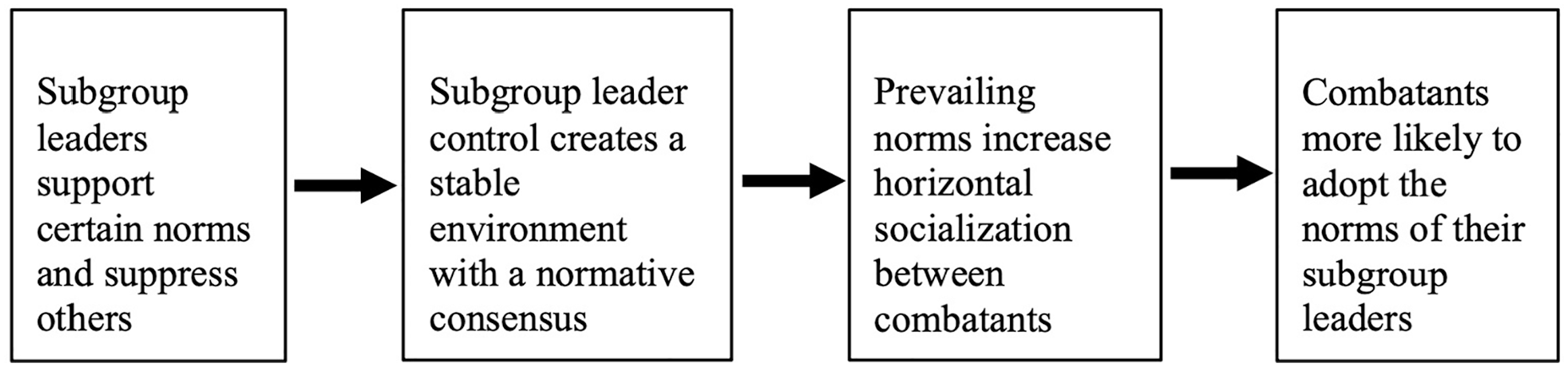
The potential impact of subgroup leaders on socialization.
I theorize two distinct subgroup leadership types – aligned and divergent – that can produce different socialization outcomes (see Figure 2). Aligned subgroup leaders support the norms of the organization and choose to reinforce them, making it more likely that an individual within that subgroup will adopt the prescribed norms of the organization. Conversely, divergent subgroup leaders are unsupportive of organizational norms and can undermine official socialization efforts, making individuals within that subgroup less likely to adopt the norms of the organization. These assumptions lead to the expectations of this study:
Hypothesis 1: (A) Combatants in subgroups with aligned leaders are more likely to adopt the official norms of an organization; and (B) Combatants in subgroups with divergent leaders are less likely to adopt the official norms of an organization.
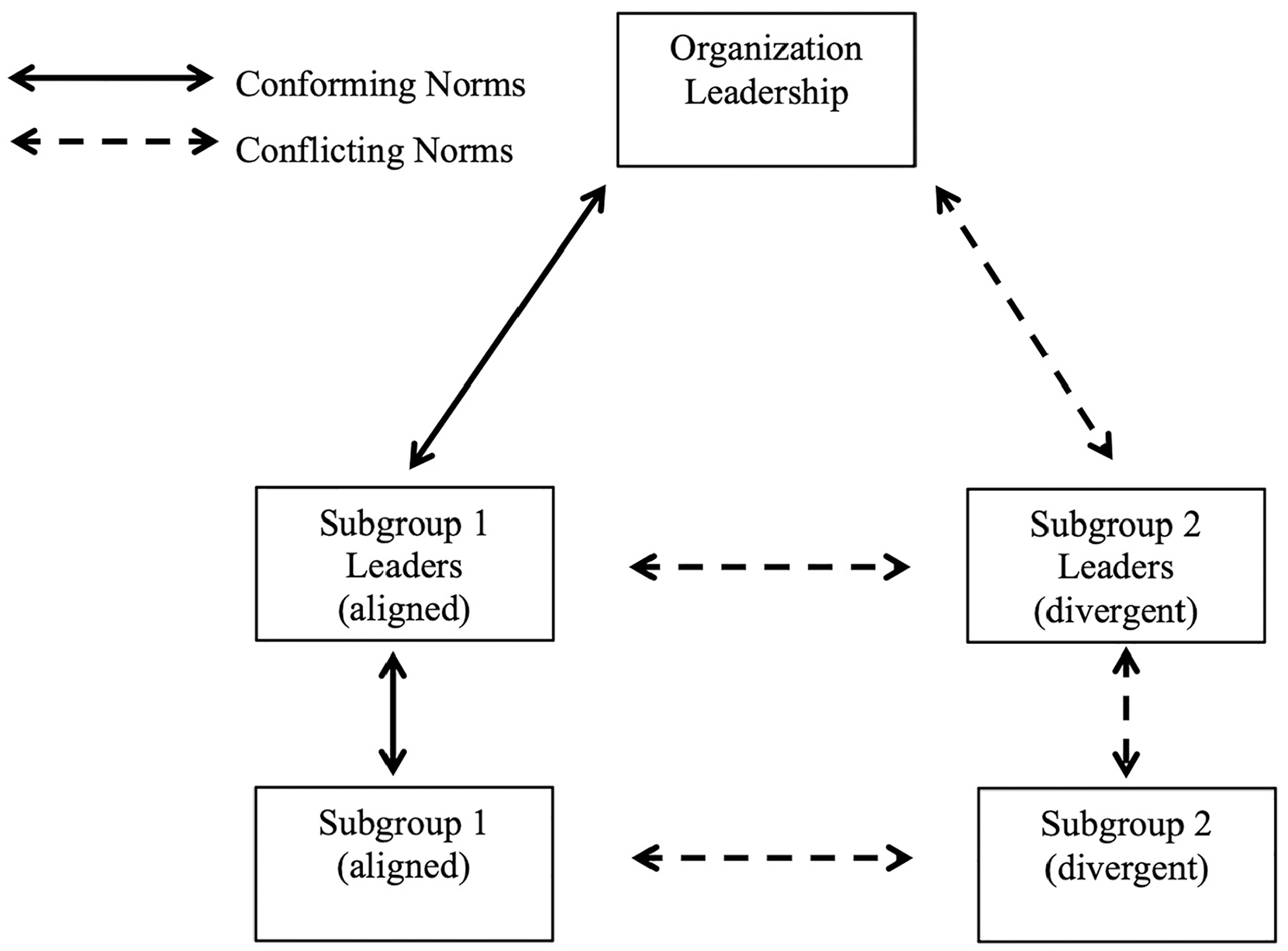
The role of subgroup leaders in layered socialization.
This theoretical argument suggests several observable implications. First, if subgroup leaders control and shape the norms of a social environment, then they require sufficient resources and institutional authority to monitor, support, and suppress the norms of combatants. Next, if subgroup leaders are aligned with their organization, we would observe that they are active in socialization – leading socialization initiatives and propagating official norms. Aligned leaders can support combatants that conform to official norms by elevating them to leadership positions and disrupting the influence of combatants with contradictory norms. If aligned subgroup leaders form a normative consensus, then it should be observed that divergent norms are limited and there is no significant resistance to official socialization initiatives. Environments with an aligned normative consensus feature attitudinal and behavioral cohesion which is observed through widespread participation and support for socialization initiatives.
Meanwhile, divergent subgroup leaders are unsupportive of official socialization, potentially undermining processes and espousing their own distinct norms that contradict the goals of the wider organization. Similarly, divergent leaders empower combatants holding divergent norms and can form their own normative consensus – signalled by a distinct, visible subculture that contradicts the expected practices of the organization. Divergent subgroups are marked by a lack of participation or widespread resistance to official socialization and/or a normative contest with aligned subgroups that destabilize the social environment.
The British re-education program for German POWs (1945–1948)
Case selection
The British re-education program for German POWs is an ideal case to analyze the effects of subgroup leadership on combatant preference formation within total institutions. POW camps are ‘consistent with Erving Goffman’s assessment of “Total Institutions” in that all phases of the day’s activities are tightly scheduled’ (Wilkinson, 2017: 78). In the typology of total institutions (see Scott, 2011), POW camps are most similar to armed organizations as individuals within them are treated as combatants. POWs experience a social environment comparable to an armed organization and are again ‘a member of a closely organized, supervised, and regimented group’ (Smith, 1996: 59). Under the Hague and Geneva Conventions, POWs are ‘subject to the laws, regulations, and orders enforced in the army’ (Moore, 2010: 111–121; Wilkinson, 2017: 95) and are legally considered ‘captured enemy combatants’ (Wallace, 2015: 2). 4
In accordance with the Geneva Convention, British officials during the Second World War allowed German POWs to administer their own camps and re-education activities. By design, German combatants occupied key leadership positions under the generally loose supervision of British camp officials (Faulk, 1977). Within these camps, POWs ‘were subject to a regimen that was every bit as strict as in the [German military]’ (Quinn, 2015: 89–90). POWs ‘were treated as soldiers [. . .] as such, their camp social structure duplicated the military hierarchy of the German Army’, and the authority of German officers was restored (Krammer, 1979: 49–50). As a result, combatant subgroup dynamics recreated themselves in the POW camps.
State-operated re-education programs for POWs are a specific type of total institution where the socializer and the socialized are former enemies and the goals of socialization are centred around norms that were previously viewed as negative (e.g. democratizing Nazis). This fundamental difference between socialization within armed organizations and resocialization in POW camps and its empirical implications is partially mitigated by the case selection, as the re-education initiatives in the German POW camps were largely voluntary and directed by the POWs themselves. Another important difference is the absence of combat. While the conditions of POW camps can be life threatening, POWs are typically moved away from combat zones. Wartime experiences are important factors in accelerating bonds between combatants (Kellett, 1982). The absence of combat in POW camps may impact the intensity or trajectory of socialization outcomes within them. Lastly, combatants in POW camps with re-education programs are no longer training for combat and are instead learning new ideological norms.
However, as the next sections demonstrate, camp conditions produced the social structures and subgroup dynamics of combatants navigating preference formation in a total institution. Empirically, this case offers exceptional data for evaluating the relationship between subgroup leaders and the changing attitudes of combatants. The selection of pro-re-education German leaders by British officials in certain camps and the fine-grained data on their normative preferences enables the comparison between camps with divergent and aligned subgroup leadership types.
Finally, the camps were largely isolated from one another, meaning that there are few spillover effects, leading each camp to have its own distinct social environment (Faulk, 1977: 33).
Case background
From 1944 to 1948 hundreds of thousands of German POWs were detained in camps across the UK. At its peak in September 1946, the British Prisoner of War Division (POWD) was responsible for 402,177 German POWs spread across roughly 220 camps (FO 939/419; FO 939/245). The majority of German POWs were deployed as laborers to meet postwar manpower shortages in economic sectors across the UK. As illustrated by Figure 3, the German POW population increased in the first half of 1946 due to large transfers of POWs from North America and Europe and then decreased towards the end of 1946 because of gradual repatriations back to Germany. While the primary goal of the POWD was to rebuild the British economy, a secondary objective was to ‘de-nazify’ and ‘democratize’ German POWs through re-education, which was carried out by the Political Intelligence Department (PID).

German POWs in the UK, 1945–1948.
In alignment with the aims of denazification and democratization for postwar Germany declared at the Potsdam Conference, the PID formulated a re-education program for German POWs which was developed in 1944 and 1945 and implemented across most camps during the summer of 1946. The goals of the re-education program were to first ‘eradicate National Socialist ideology and German militarism from the minds’ of German combatants and to then ‘inculcate [. . .] the principles and practice of democracy’ to ensure that ‘prisoners shall return to Germany [. . .] as pro-Allied advocates of democratic ideals’ (‘Re-education of German POWs,’ FO 939/214: 1; ‘The Re-education of Prisoners,’ 26 May 1944, FO 939/445: 1). In practice, re-education was deployed in the camps through a combination of exposure to pro-democratic media in newspapers, radio broadcasts, books and films, and through lectures from visiting professors, discussion groups, English courses, and participation in political activities like camp parliamentary elections (FO 939/445). While British officials supplied the materials and framework for re-education, the activities were administered by the German POWs themselves.
The strategy of the PID was to take an indirect approach through ‘self-re-education’ – believing that it would be more effective if ‘the pace of re-education was governed [. . .] [by the POWs] themselves and not by any forceful means’ (Activities of the PS/W Division,’ 2, FO 939/454: 2). This meant that German POWs were responsible for organizing re-educational activities, which led to high variation in the administration of re-education across camps. The intention was that these activities, often led by a small minority of active anti-Nazis, would gradually shift the wider attitudes of the entire camp. As noted by Colonel Henry Faulk (1977), the head of the re-education program: It was not necessary that every man should join in active [. . .] nor was it necessary that every member of the group should be persuaded and converted. But it was necessary that all should be sufficiently conscious of discussion to become aware of attitudes [. . .] in the relaxed informality of barrack-room gossip, barrack room-discussion, and barrack-room argument. (Faulk, 1977: 75)
While ostensibly taking a ‘hands-off’ approach, British officials often meddled in the internal dynamics of the camps by installing pro-democratic, anti-Nazi leaders into influential camp positions to spur re-educational activity (Clarke, 2006; Faulk, 1977). Potential pro-democratic leaders were identified by British re-education agents – known as Segregators and Training Advisers (TAs) – through a series of screening processes that ‘graded’ each POW based on their political attitudes.
The PID implemented a political grading system to categorize POWs as Nazis or anti-Nazis. Those graded as an ‘A+’, ‘A’, or ‘B+’ were considered anti-Nazis with pro-democratic attitudes, while those graded a ‘C+’, ‘C’, or ‘B–’ were deemed ‘steeped in Nazi ideology [. . .] with no intention of helping’ in re-education (‘Meeting of Segregation Section’, FO 939/457: 2). British officials also interchangeably used a ‘colour’ grading system to refer to the political attitudes of POWs – ‘black’ was considered Nazi, ‘grey’ politically neutral, and ‘white’ anti-Nazi. The initial grading of a POW was determined by specialists known as Segregators who interviewed prisoners in the camps. Segregators consulted the political profiles of each POW, which often contained detailed information on their background (e.g. Nazi Party membership, enlistment date, prewar profession) and were used during screenings to help determine political gradings (Sullivan, 1979: 41–59). TAs then used these gradings to identify potential pro-democratic Germans to select for leadership positions in the camps (see Online Appendix Section 2 for the description of political grading system, official classifications, and screening questions).
German leadership selection
Once selected as potential pro-democratic leaders that could assist re-education, POWs were inserted into key positions within the camps. As shown in Figure 4, camp positions ranged from administrative roles like Camp Leader to those more involved in the daily lives of POWs such as Hostel and Study leaders. POWs in these positions influenced the social environment of camps and could ‘produce new norms that gradually permeated the group’ (Faulk, 1977: 66). They were often the leading personalities of the camps and wielded influence in the smaller hostels at the subgroup level. However, this strategy of leadership replacement did not occur in every camp due to a limited pool of candidates dwindled by the priority repatriation of anti-Nazis and because some British Commandants were against re-education interventions. Additionally, there was limited time and resources for implementing leadership changes. For example, a fuel shortage in the winter of 1947 limited TA camp visits and there was an average of 1 TA per 12,000 POWs (Faulk, 1977: 71). These uneven leadership interventions meant that in some camps, the subgroup leadership remained controlled by Nazis against the objectives of re-education.
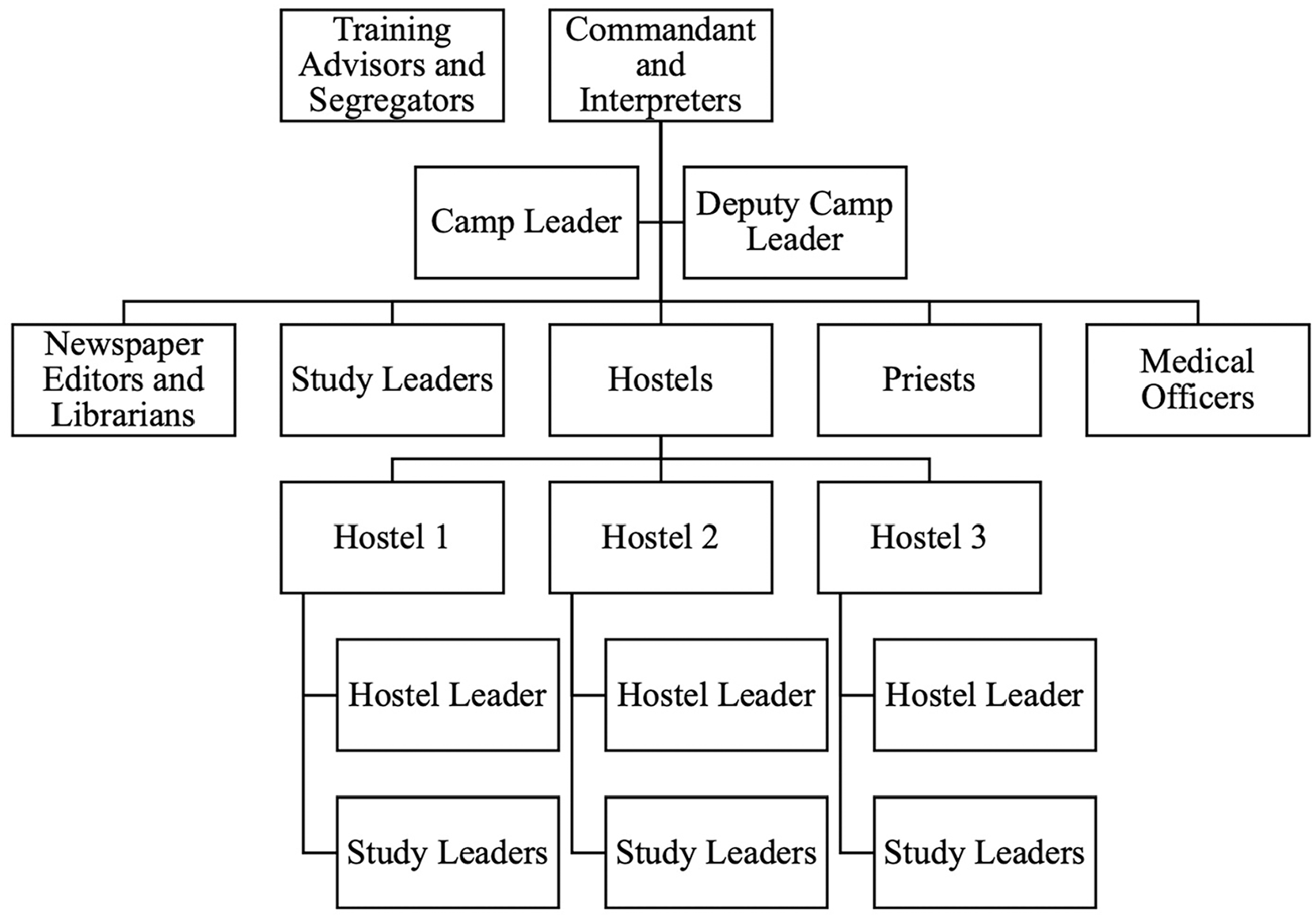
Structure of POW camp leadership.
Figure 4 illustrates the typical leadership structure of POW camps and the various positions where TAs could intervene. Leadership changes by TAs were not limited to main camps and occurred in the smaller hostels surrounding them. Hostel leaders administered smaller compounds of around 50 POWs and operated closest to the subgroup level. TAs also selected leaders directly involved in re-education such as the study leaders, camp newspaper editors, and librarians.
German camp leaders were selected by two distinct sets of actors: by British Commandants and by TAs who made recommendations on who was suitable or unsuitable for leading re-educational efforts. The level of cooperation between TAs and British camp officials on selecting leaders varied, as a primary goal of Commandants was to maintain order and a steady output of labor which could contradict the leadership recommendations of TAs. While some Commandants supported re-education and implemented the leadership recommendations of TAs, others viewed re-education as a secondary objective and instead appointed German leaders that maintained discipline rather than lead re-educational efforts. The qualitative data available from TA reports makes it possible to determine how leaders were selected and the level of cooperation from Commandants. This variation in camp leadership selection created a distinct subgroup leadership within each camp that differed in its support for re-education, which informs the general approach to testing the effects of subgroup leaders on socialization (see Online Appendix Section 3 for examples of leadership selections).
Research design
To empirically test my argument that subgroup leaders moderate socialization outcomes, I pair two case studies, Camp 118 and Camp 70, with a large-N statistical analysis of 64 POW camps. In both analyses, the research design is to compare the socialization processes and outcomes of German POW camps with variation on the key explanatory variable, subgroup leadership type. The expectation is that POWs in camps with pro-re-education German leaders will on average have more positive attitudes towards democratic principles and the British ‘way of life’. First, the case studies expand on the theoretical mechanisms and process-trace the sequence of subgroup leadership influence on combatant norms by comparing two similar camps with different subgroup leadership types. Next, the statistical analysis compares the socialization outcomes of all camps by subgroup leadership type and engages with three alternative explanations – contact with civilians, opportunism, and pre-existing political attitudes.
The data
I leverage monthly administrative reports written by re-education officials to measure the effect of subgroup leadership type on the political attitudes and social environments of POWs. To monitor the progress of re-education, the PID sent TAs into the camps to make ‘thorough investigations into the situation with regard to re-education, the general state of the camp, its political complexion’ and to note ‘the effect of [re-education] measures’ (‘Re-education of German POWs,’ FO 939/214: 10). TAs presented ‘a report following [their] visit to a camp’ which gave ‘a clear and concise picture’ of re-education (‘Report Writing,’ FO 939/449: 1). TAs typically spent two to four days in a camp per visit, interviewing German leaders and regular POWs and observing camp activities. These reports maintain a similar rubric and provide updates on the overall state of re-education and changing attitudes in the camps. These reports were collected from two locations – the National Archives of the UK (TNA) and the Imperial War Museum Collections (IWM). Importantly, the reports provide reliable information as the camps were often visited by different TAs who rotated their inspections and operated independently of the British military officers operating the camps. 5
Outcome variables: Political progress, political outlook, and socialization outcomes
To test the expectation that subgroup leaders moderate socialization outcomes, it is necessary to track the attitudes of POWs over time. I leverage data from TA reports to operationalize the changing political attitudes of each camp. The dependent variable Political progress measures a camp’s attitudes towards the intended pro-democratic and pro-British attitudes of the re-education program. This variable is derived from the qualitative sections of monthly reports, where re-education officials record the political attitudes of each camp based on observations and interviews with POWs.
TAs recorded the progress or lack of progress in re-education since the time of the last report, which was seen as the level of democratization that had occurred since their previous visit. Leveraging these data, the Political progress variable measures if there has been a decline, no change, or an improvement in pro-democratic attitudes since a TA’s previous visit. This variable measures attitudes at the camp level, as TAs recorded the trends of each camp.
Political outlook measures the cumulative political progress and socialization trends of each camp. It translates changing attitudes into a measurable numerical value by triangulating the initial political attitudes (‘colour’) of each camp as a starting value which then changes with the Political progress variable. For example, a ‘grey-black’ camp containing some anti-British or Nazi elements is initially scored a 2. If this camp makes an improvement in Political progress in the next reporting period, then its Political outlook increases to a 3 or decreases to a 1 if there has been a decline. The Socialization outcome variable leverages the final reports on each camp to determine if it had improved, declined, or remained the same in its democratic attitudes compared to its starting political attitudes (i.e. positive, negative, or mixed socialization outcomes). These variables enable the testing of the relationship between changing political attitudes and the key explanatory variable, Subgroup leadership type.
Explanatory variables: Subgroup leadership type, leader activity and re-educational activity
Subgroup leadership type
The first key independent variable, Subgroup leadership type, measures the extent that the subgroup leadership of a camp is aligned with or diverges from the goals of the re-education program. This variable approximates the degree to which German leaders were supportive of re-education, enabling me to test if subgroup leadership preferences predict socialization outcomes. The Subgroup leadership type variable operationalizes three types of subgroup leaders – divergent, mixed, and aligned – which is determined by how the German leaders of each camp were selected.
How German leaders came to power and who selected them is used to approximate the subgroup leadership type of each camp and their level of support for re-education (see Table 1). The assumption is that camps with more interventions by British officials to install pro-re-education German leaders, particularly those where camp Commandants and TAs cooperated, have an aligned subgroup leadership type with high support for re-education. Conversely, camps under the administration of Commandants who selected Nazi leaders to maintain discipline and did not have interventions by TAs feature divergent subgroup leaders with low support for re-education. Camps that either had leaders selected by a pro-re-education Commandant or at some point received an intervention by a TA are expected to have a mixed subgroup leadership type with partial support for re-education. Mixed camps featured fewer leadership interventions or had inconsistent support from British Commandants and re-education officials. TAs sent some POWs to Wilton Park, an intensive re-education course, where after ‘graduating’ they were installed in camp leadership positions.
Expected socialization outcomes by leadership selection.

It is important to note that within all camps, including those without pro-re-education leadership interventions, there was a baseline of re-educational activity such as exposure to pro-democratic media, opportunities to attend lectures, and information rooms to organize discussions. Furthermore, every camp had POW(s) responsible for organizing re-education. While British Commandants and TAs were responsible for selecting camp leaders, once in leadership positions, intracamp dynamics and socialization processes were primarily directed by POWs.
Re-educational and leader activity
The second independent variable, Re-educational activity, is a proxy for measuring the normative consensus of a camp. I argue that subgroup leader control forms a stable environment with cohesive norms that can increase horizontal socialization among fellow combatants. Re-educational activity measures how much of the camp was participating in re-education initiatives at the time of a report and ranges from 1 (no activity) to 5 (widespread activity). The assumption is that the overall levels of participation in re-education can serve as a proxy for measuring collective preferences – low or mixed activity signalling a lack of a normative consensus and resistance towards re-education and high activity signalling conformity to pro-re-education norms. The theory anticipates that the higher the proportion of subgroup leaders supportive of re-education, the more likely there will be a pro-re-education normative consensus. Lastly, Leader activity measures the proportion of German camp leaders active in re-education at the time of a monthly report. This provides a more precise indicator for linking the impact of subgroup leaders to socialization outcomes because it measures the direct involvement of camp leaders in re-education over time, regardless of how they were selected. The theory anticipates that the higher the proportion of camp leaders involved in re-education, the more likely combatants will achieve political progress.
Subgroup leaders in Camp 118 and Camp 70
Camp 118 and Camp 70 offer variation on subgroup leadership type and expand on the theoretical mechanisms and sequence of socialization, demonstrating the influence of aligned and divergent subgroup leaders on the environment and process of socialization. Both camps feature similar characteristics, populations, and starting political attitudes, but differ significantly on the involvement of German leadership within the smaller hostels at the subgroup level. Both camps were categorized as ‘grey-black’ for featuring combatants with predominantly Nazi attitudes, which presents a ‘tough’ test for my theory. In Camp 118, interventions to install pro-re-education leadership in the hostels gradually formed a normative consensus that led to a positive socialization outcome. Conversely, in Camp 70, the environment of socialization remained unstable, and re-education was not supported by subgroup leaders within the hostels, which led most POWs to retain their Nazi attitudes (see Online Appendix Section 5 for case study on Camp 239 which features a mixed subgroup leadership and engagement with alternative explanations).
POW Camp 118
Camp 118 located in Mardy, Abergavenny, Wales was initially categorized as a ‘grey-black’ camp by re-education officials for its prevailing Nazi attitudes and leadership that was largely unsupportive of re-education. Out of the population of 1,802 POWs screened in October 1946, 603 were given a ‘C’ political grading, POWs who ‘still think that National Socialism was the best thing for Germany’ and there was a ‘large proportion of minor [Nazi] Party Officials and many members of the Allgemeine SS’ in the camp (FO 1120/227: 3–4). The first Camp Leader, Julius Etzien, a 41-year-old professional soldier, was a ‘poor personality with no initiative’ and the leaders at Wonastow and Bwlch hostels were still openly Nazis, one of them, Rudolf Kramer, admitted ‘being an opportunist [. . .] and makes no effort to further re-education’ (FO 1120/227: 2). The initial social environment was dominated by the ‘black’ Nazi elements of the camp who ‘hold the upper hand in political thought and [. . .] blame democracy for every[thing] [. . .] and few [anti-Nazis] make any effort to propagate their ideas, finding the task too difficult under the circumstances’ (FO 1120/227: 3). In response to the camp’s prevailing Nazi attitudes, British TAs made numerous leadership changes which dramatically shifted the environment and then political attitudes of the camp.
In January 1947, the Camp Leader was deposed and replaced with Hans Hlawan who recently attended a pro-democracy course at Wilton Park and immediately took ‘an active part in re-education’, leading discussion groups at the main camp ‘pressing home wherever possible, tolerance in politics’ and offering re-educational support to Hostel Leaders (FO 1120/227: 1–4). At Chepstow Hostel, the previously ‘black’ leadership was removed and replaced with a ‘new white camp staff’, including Gerhard Zimmer, who ‘takes an active part in camp life’ (FO 1120/227: 2). There were now political discussion groups in half the hostels and the black elements in the camp were ‘gradually and slowly beginning to show an upward trend [. . .] although it is evident that the majority do not yet comprehend the fundamentals of Democracy’ (FO 1120/227: 3). These new pro-re-education leaders introduced and supported democratic norms which slowly began to permeate the ‘barracks talk’ of the main camp and hostels.
By September 1947, more Wilton Park graduates had been installed throughout the hostels to lead discussion groups and 70% of Camp 118’s leadership was actively involved in re-education (FO 1120/227: 2–5). There was now widespread participation in re-educational activities and high normative cohesion within the camp. As noted by TA A. Heron, ‘this camp can hardly be characterised as “Black” nowadays [. . .] the habit of tolerance in discussion has been learned by the great majority [. . .] [and] re-educational activities have been carried on at a remarkably intensive level’ (FO 1120/227: 3). Camp 118, which only a year before held a small minority of anti-Nazi POWs and was run by Nazi leaders, now featured robust re-education initiatives that approximately half of the camp’s POWs participated in (FO 1120/227: 4). Support for re-education persisted into January 1948, when in most camps activity began to decline considerably, in large part because ‘the leaders in the individual hostels are keen and active [. . .] [and] have achieved a measure of success’ (FO 1120/227: 4–5).
In a final screening of Camp 118 in March 1948, 75% of POWs: show[ed] a much better understanding of the reasons behind the English outlook on life and are appreciative of the value of many things about which they were previously sceptical – freedom of speech, the power of the vote, intercourse between nations, etc. [. . .] re-education in this camp has achieved a very considerable amount of success [. . .] the constant efforts of good type [POWs] in camp activities has resulted in a great step forward. (FO 1120/227: 2–5)
The pro-re-education leadership gradually installed across Camp 118 changed the trajectory of socialization by supporting and propagating democratic norms and suppressing Nazi influence. These aligned camp leaders, particularly at the subgroup level within the hostels, introduced and sustained democratic norms which became the dominant attitudes of the camp. This normative consensus, as evidenced by the mass participation in re-educational activity and changing attitudes, formed the ‘practical ideology’ of the camp which led to a positive socialization outcome, providing initial support for Hypothesis 1A.
POW Camp 70
Camp 70, also located in Wales and originally categorized as ‘grey-black’ with a similarly large contingent of former SS and Nazi officials instead had a negative socialization outcome. Unlike in Camp 118, the subgroup leadership of Camp 70, particularly within the hostels, remained largely unchanged and unsupportive of re-education. The first reports on Camp 70 in late 1946 and in early 1947 detail an unstable environment of socialization that lacked normative cohesion. There was a small faction of POWs, ‘about 10% limited interest in re-education’ and another faction of roughly 10% that ‘still nourish [. . .] the Nazi spirit’ (January 1947, FO 1120/218: 2). While similar in size, the Nazi POWs received considerable support from the ‘SS and “black” Hostel Leaders’ who were ‘bad political influences’ that ‘swamps the small white element which has been trying to build up the anti-Nazi spirit and develop the Democratic spirit’(January 1947, FO 1120/218: 5; February 1947, 1120/218). As later reports outline, the small pro-democratic element was unable to overcome dominant Nazi norms and influence the wider camp.
When the camp was screened in February 1947, the political gradings revealed that over half of the hostel leaders were still ardent Nazis. For example, the leaders of Penycoed and Eglwyswrw hostels, Manfred Huellemann and Willy Beckmann, were categorized as ‘C+s’, the most extreme grading reserved for fanatical Nazis. Because of the hands-off approach of the British, these Nazi leaders were allowed to select the Study Leaders in their respective hostels and appointed active Nazis. In Penycoed hostel, the Study Leader in charge of administering pro-democratic re-education was graded a ‘C+’ and had been a member of the SA since 1933. While the two ‘C+’ hostel leaders were eventually removed, their replacements were also unsupportive of re-education and by July 1947 the general state of re-education remained poor. Except for Portfield hostel, whose leader Heinrich Gummels was actively involved in re-education, and sporadic activity in the main camp, pro-democratic norms received almost no support from German leaders within the other hostels.
By September 1947, re-educational activities were still ‘practically non-existent’ and by January 1948 any ‘active participation in camp political activities [was] on the decline [. . .] due largely to the shortage of good POW political leaders’ (FO 1120/218: 2). Ultimately, Camp 70 was considered a failed socialization outcome by the British, as the final screening report on Camp 70 conducted in April 1948 noted widespread dislike and distrust of the British ‘way of life’ and there was ‘still a hankering after the good life in Germany under the Nazis’ (April 1948, FO 1120/218: 4). Despite interventions by British TAs to change certain leaders and introduce Wilton Park graduates to spur re-education, these changes were made primarily in the main camp and the hostels remained against re-education. When examining the leadership closest to the subgroup level, only 34% of hostel leaders from Camp 70 were involved in re-education compared to Camp 118 where 67% of hostel leadership supported re-education. Pro-democratic norms failed to become the ‘practical ideology’ of Camp 70 because they were unsupported by the divergent subgroup leadership within the hostels who empowered and protected other Nazis, lending support for Hypothesis 1B.
Statistical results
This section tests the expectation that subgroup leadership type moderates socialization outcomes using a dataset of 64 POW camps. The data are leveraged from monthly TA reports (n = 489) with an average of seven reports per camp. The 64 camps in the analysis are a purposive sample, featuring the best available data on the selection and composition of camp leaders and socialization outcomes (see Online Appendix Section 6 for descriptive statistics and discussion on camp populations). First, patterns of re-educational activity (Figure 5) and socialization outcomes based on the subgroup leadership type of each camp (Figure 6) are presented. Second, the direct involvement of German camp leaders in re-education is analyzed (Tables 3 and 4). Three alternative explanations – contact with British civilians, opportunism, and predetermined outcomes based on starting camp attitudes – are addressed in Online Appendix Section 9 to consider other factors that could be driving socialization outcomes.
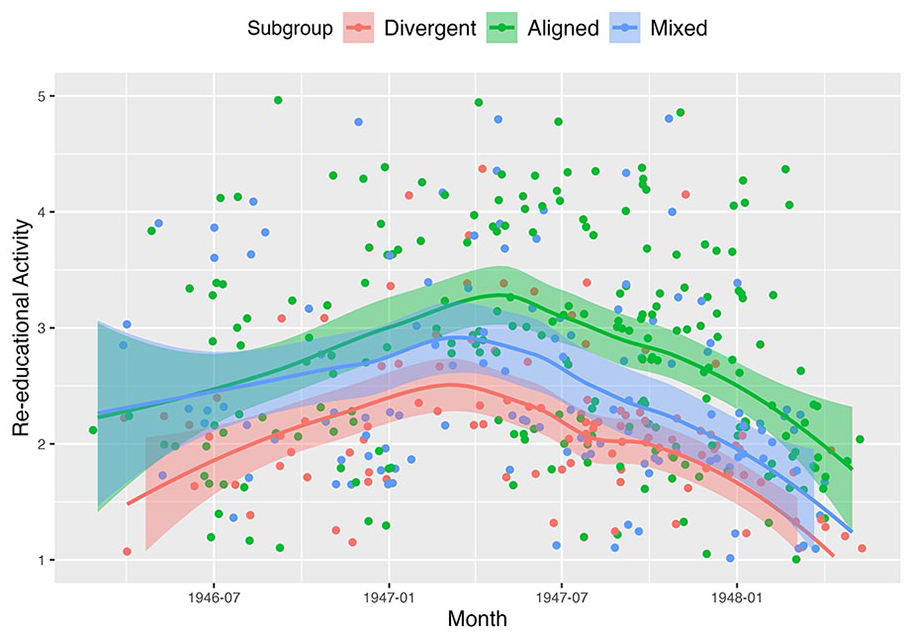
Re-educational activity by subgroup leadership type.
First, it is useful to visualize re-educational activity and socialization outcomes by the subgroup leadership type of each camp. There are three subgroup leadership types – divergent (low support), mixed (partial support), and aligned (high support) – which vary in their support for re-education and are based on how the leaders of each camp were selected (see Table 1). The first step of the theoretical argument anticipates that the normative preferences of subgroup leaders will shape the prevailing norms of their social environment. The Re-educational activity variable scores the collective pro-democratic behaviors of a camp and serves as a proxy for measuring normative consensus.
Figure 5 compares the average level of Re-educational activity by subgroup leadership type and shows that on average there was more participation in re-education in camps with aligned and mixed subgroup leadership types. Put differently, camps with more pro-democratic German leaders were on average more cohesive in their collective participation and support for re-education. Conversely, camps with divergent subgroup leaders on average featured limited re-educational activity isolated to small groups of POWs.
The next step in the theoretical argument predicts that the normative consensus engendered and sustained by subgroup leaders will shape socialization outcomes. Figure 6 compares the average Political outlook of camps, their overall changes in democratic attitudes, grouped by subgroup leadership type. As expected, Figure 6 illustrates that on average, camps with aligned and mixed subgroup leadership types have a higher democratic political outlook than camps with divergent subgroup leaders and were more likely to have periods of political progress and positive socialization outcomes. The difference in means in Political outlook between camps with aligned and divergent subgroup leaders is 1.34 and becomes more pronounced in the final five months of reporting at 2.38. On average, the Political outlook of divergent camps remains relatively static throughout 1946 and 1947 then declines considerably in 1948, suggesting that anti-democratic norms persisted or intensified in camps with divergent subgroup leaders.
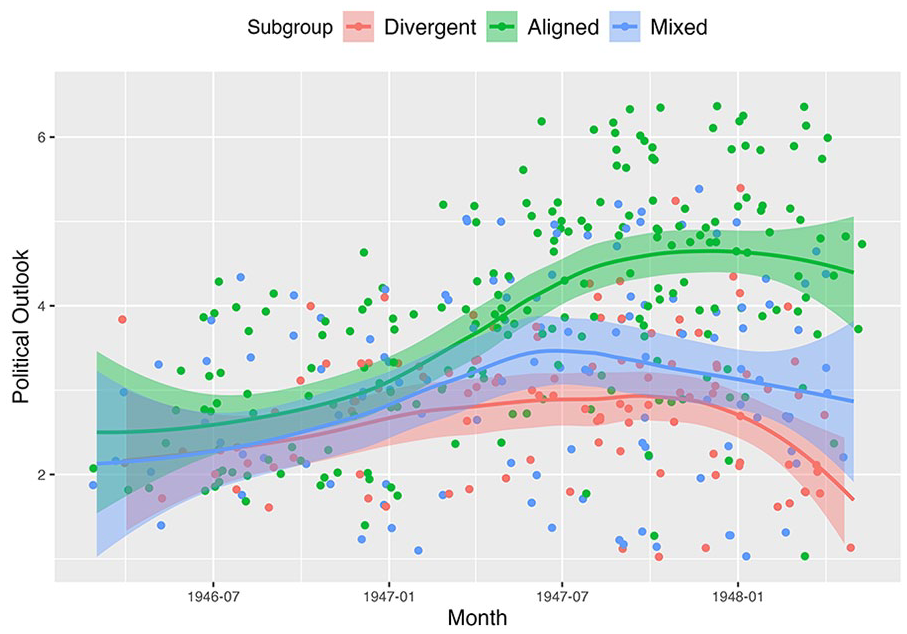
Political outlook by subgroup leadership type.
Table 2 shows the socialization outcomes of all 64 camps grouped by subgroup leadership type. While the groups are imbalanced, Table 2 makes clear that most positive socialization outcomes occurred within camps with aligned subgroup leaders. Conversely, nine out of 13 negative socialization outcomes occurred within camps with divergent subgroup leaders. The role of subgroup leader involvement in socialization is further reinforced when examining the proportion of leaders active in re-education by subgroup leadership type. Camps with divergent subgroup leaders had the lowest proportion of leaders active in re-education and the most negative socialization outcomes.
Distribution of socialization outcomes by subgroup leadership type.

Together, Figures 5 and 6 and Table 2 demonstrate that on average, camps administered by pro-re-education German leadership were more likely to experience periods of political progress, positive socialization outcomes, and have higher levels of re-educational activity compared to camps with divergent leaders. This lends support for Hypothesis 1A and 1B, that subgroup leadership type moderates socialization outcomes, and supports the plausibility of the theoretical argument that combatants are more likely to change their attitudes in normatively cohesive environments.
Re-educational activity and German leaders
This section estimates a series of logistic regressions that test the relationship between German subgroup leaders and socialization outcomes. These models examine the direct role of German leaders and their composition. Beyond aggregate data at the camp level, re-education reports also provide information on German camp leaders. This includes the camp position of the individual and their support for re-education. There are a total of 2,803 unique German POW leaders in the dataset. This information enables the tracking of leaders within the camps and their involvement in re-education over time. Each observation in the dataset is a monthly report which corresponds to a specific camp, enabling the estimation of two-way fixed effects models to control for both within-camp and over-time confounders linked to the political attitudes of POWs, such as news on the status of repatriation, the relaxing of restrictions on POWs, recovery from wartime trauma, and conditions in postwar Germany.
Several important control variables are also leveraged from the monthly reports. The population size (Population) and the youth population (Youth population) of the camp are included, as it is possible that re-education was more difficult to administer in larger camps and in camps with younger POWs (aged 20–25) with presumably more exposure to Nazi ideology. The number of hostels (Hostels) attached to each camp measures potential geographic dispersity, with more hostels signalling a more dispersed camp population. The quality of re-education materials – books, radios, classrooms – controls for access to resources for implementing a re-education program (Re-education materials). Lastly, contact with British civilians is controlled for (Civilian contact), as they were a potential source of pro-democratic norms outside of the camps and subgroup leader control (see Online Appendix Section 9.1).
Leveraging these data, the Leader activity variable measures the proportion of leaders directly involved in re-education activities at the time of a monthly report. The ‘Progress Models’ in Table 3 estimate the effect of Leadership activity in re-education initiatives on Political progress and the ‘Outlook Models’ estimate the effect on Political outlook while controlling for time and camp fixed effects. Across all estimated models, an increase in the proportion of camp leaders involved in re-education results in a statistically significant positive increase in both Political progress and Political outlook at standard levels of significance (p < 0.01). Substantively, increased involvement of German camp leaders in re-education is strongly associated with periods of Political progress and the likelihood of positive socialization outcomes. Both results remain significant when clustering for standard errors at the camp level and including controls. Importantly, Table 3 provides evidence for participation as a mechanism of subgroup leader control, demonstrating their role as ‘political entrepreneurs’ that can significantly influence social norms. 6
Effect of leader activity on political progress and political outlook (logit).

The dependent variable for Progress models 1 and 2 is ‘political progress’. The dependent variable for Outlook models 1 and 2 is ‘political outlook’.
p < 0.05; **p < 0.01; †p < 0.1.
Table 4 estimates the effect of two different levels of pro-re-education leadership on political progress – camp and hostel leaders (Camp leader and Hostel leader). Pro-re-education leadership interventions varied by position and time, sometimes occurring only at the camp or hostel leader positions or gradually across positions. Both are dummy variables that code if the leaders at these different camp positions were selected by British officials to support re-education. The theory anticipates that leaders closest to the subgroup level, in this case hostel leaders, will have more influence on moderating norms.
Effect of camp position on political progress (logit).

The dependent variable is ‘political progress’. *p < 0.05; **p < 0.01; †p < 0.1.
Model 1 in Table 4 reports a statistically significant positive increase in Political progress when a camp’s hostel leaders were selected by a pro-re-education official and a positive but statistically insignificant increase when camp leaders are installed. The results of Model 1 suggest that on average, hostel leaders played a more important role in spreading pro-democratic norms. Interestingly, the interaction between camp and hostel leaders, if both levels were handpicked by re-education officials, is statistically insignificant and negative, suggesting that socialization was primarily moderated by hostel leaders. The comparative case study and additional qualitative evidence (see Online Appendix Section 7) demonstrate that hostel leaders were generally more effective at deploying mechanisms of social control. The results of Tables 3 and 4 lend support for Hypothesis 1A, that the involvement and attitude of aligned camp leaders towards re-education, particularly at the subgroup level, impacted positive socialization outcomes within the camps. These results remain significant when controlling for potential TA bias and uncertainty in the data (see Tables III and IV in Online Appendix Section 8).
Discussion and future research
Combatant socialization is typically framed as a process driven by the top leadership and institutions of armed organizations. However, by synthesizing different socialization literatures to develop a theory on combatant preference reformation within total institutions and leveraging original archival data, this article shows how subgroups and their leadership play a critical role in combatant socialization and resocialization. Case studies on Camps 118 and 70, coupled with comparative evidence from the socialization outcomes of 64 POW camps, lends support for my argument that subgroup leaders moderate socialization processes and outcomes. Specifically, the results suggest that the norms of combatants are developed and sustained through the informal social networks and interactions at the small-unit level which are influenced by subgroup leaders. In most POW camps, the support or opposition of German camp leaders to re-education shaped the social environment of POWs and how they interpreted democratic norms and their overall participation in re-education.
These findings make two contributions to the combatant socialization and resocialization literatures. First, this article contributes to studies that unpack the internal dynamics of armed organizations to explain conflict processes and outcomes, moving away from studying ‘variation among armed groups’ to ‘the patterns of participation within these groups’ (Manekin, 2020: 3, emphasis in original). Shifting the focus to the subgroup level enables the examination of how norms promoted at the top of an organization are interpreted and reinforced by combatants at the rank-and-file level. Second, this article highlights the influence of subgroup leaders. Despite their important role, their involvement in socialization has remained understudied, as most research focuses on organizational elites (Leader Maynard, 2022: 7–20) or simplifies ‘the relationships between “commanders” and combatants, eliminating the mediating role of mid-level officers’ (Hoover Green, 2016: 629). Evidence from this article demonstrates how subgroup leaders can shape conformity and resistance within total institutions. Researchers examining intra-organizational factors for understanding conflict processes should account for the importance of subgroup dynamics and their leaders.
Subgroup dynamics and the role of small-unit commanders can also enhance explanations of other conflict processes. For scholars of deviant behaviors within state militaries, divergent subgroups and their leaders could help explain patterns of defection, desertion, indiscriminate violence, and active resistance. While this article focuses on total institutions, the theoretical framework is informed by research on both state and non-state armed groups, and subgroup dynamics could travel to rebel organizations. Future research could test if the role of subgroup leaders in socialization remains significant in non-state armed groups. These findings also have important policy implications for post-conflict research, specifically for DDR programs. Wartime socialization can continue to affect former combatants after conflict, posing barriers to postwar peace programs (Daly et al., 2020). Applying understandings of combatant socialization and subgroup dynamics to postwar settings could provide insights for effective reintegration policies that utilize subgroup leaders.
Footnotes
Acknowledgements
I thank the members of the Conflict and Change research cluster at University College London and the Institute for Security and Conflict Studies at George Washington University for their invaluable feedback and support on this project.
Replication data

Notes
References
Supplementary Material
Please find the following supplemental material available below.
For Open Access articles published under a Creative Commons License, all supplemental material carries the same license as the article it is associated with.
For non-Open Access articles published, all supplemental material carries a non-exclusive license, and permission requests for re-use of supplemental material or any part of supplemental material shall be sent directly to the copyright owner as specified in the copyright notice associated with the article.
