




Abstract
Creating a stable peace is now the key puzzle to resolve in ending civil wars. To date, research has focused on ‘hard’ political and military reforms included in peace agreements, and the impact of ‘soft’ concessions such as language rights, cultural rights or the right to religion have been largely ignored. When do states give these concessions and do they make a difference to peace outcomes? The article argues that the state grants these concessions to dilute ethnic grievances and accommodate the group, bypassing political demands, but gives them strategically to ethnic groups that are politically weak. The concessions have effects through the expressive, demarcating and relational impacts on the receiving group. The article uses original data on identity concessions in a comparison of conflicts with ethnic aims that ended in a peace agreement from 1989 to 2013. The findings show that concessions are given to larger ethnic groups that lack political power. If granted, identity concessions only make peace more durable when fully implemented. The article thus brings a novel contribution to the role of grievances in civil wars and to the settlement of civil conflicts.
Introduction
The Good Friday Agreement of 1998 ended 30 years of sectarian armed conflict in Northern Ireland. Alongside new political institutions were concessions on a range of elements that addressed the more symbolic aspects of the conflict. These included provisions on the use of languages, recognition of the importance of flags and emblems and cultural activities such as commemorative marches and celebrations. These provisions were focused not on political power-sharing, but rather the social status of the two identity groups in Northern Ireland.
To date, much literature on peacebuilding has focused on ‘hard’ issues such as political and security reforms, for example, political power-sharing (Graham et al., 2017; Hartzell and Hoddie, 2007; Roeder and Rothchild, 2005) and military power-sharing (De Rouen et al., 2009; Hoddie and Hartzell, 2003). However, grievances underlying a conflict, particularly an ethnic conflict, can also relate to ‘softer’ cultural and symbolic identity aspects. Groups may fight, at least in part, to achieve recognition and the right to their culture, language or religion. This article focuses on concessions that are markers of identity, such as language, religion, cultural activities, or group emblems such as flags and anthems. The article asks when states grant these concessions and whether they have an impact on peace outcomes.
Such an examination is important because the benefits of granting identity concessions are still debated. Normatively, some scholars advise against the ‘Balkanization’ of ethnicity to avoid continued ethnic tensions (Horowitz, 1985; Rothchild and Roeder, 2005). The argument is that the granting of identity rights reifies ethnicity, which can lead to a self-reinforcing recognition, a greater sense of ‘otherness’ and an increased desire for more separation (Brancati, 2006). More broadly, such accommodation can create sub-national minorities within a nation-building project (Mylonas, 2013). An alternative view is that the inclusion of identity concessions can be a costly signal of intent to manage majority/minority relations in a different way (Lake and Rothchild, 2005). Inclusion of such concessions wins the hearts and minds of the public (King and Samii, 2020). Group recognition satisfies emotional requirements such as dignity and respect and develops a sense of inclusion essential for democratic legitimacy.
This article first examines the circumstances under which the state grants identity concessions. The argument presented here is that states use these concessions to accommodate groups and dilute ethnic grievances, but strategically targeted at ethnic groups that are politically weak. Thus, a state can gain benefits without the cost of increasing the ethnic threat and can potentially drive a wedge between groups in multi-group conflicts (Cunningham, 2011). The second question is whether such concessions have an impact on peace outcomes. The impact of identity concessions is theorized in three reinforcing dimensions – expressive, demarcating and relational. The receiving group feels its place in society is more secure, which reduces the risk of a return to conflict. The article compiles data on identity concessions in peace agreements in a comparison of conflicts with ethnic aims from 1989–2013. The findings show that such concessions are more often given to politically weaker ethnic groups. Accounting for the endogenous effects of receiving these concessions, the findings offer some evidence that identity concessions have an impact on peace duration, conditional on implementation. Inclusion of identity concessions with no implementation may increase the risk of a return to conflict. Inclusion in such a situation can be interpreted as a cynical action by the state and the lack of implementation means the ethnic group’s lower status is perpetuated, which might engender frustration and support for violence as a means of change. If granted, fully implemented identity concessions increase the likelihood of longer lasting peace.
The article makes three contributions. The first is to look separately at identity concessions as an aspect of peace settlements. Such ‘soft’ concessions deserve more consideration in their own right. The article therefore theorizes why they might be given and what effects they might have and compiles data on such concessions. The findings indicate that identity concessions should be taken seriously. The second contribution is to peacebuilding theory more broadly as the findings show that processes that would normally be seen as ‘positive peace’ – equality for groups, recognition – can affect ‘negative’ peace, or the absence of conflict (Galtung, 1969, 2011), suggesting that there are spillovers between these categories. The third contribution is to policy-making on conflict resolution. There is a gap in our understanding of the circumstances under which peace and social stability after conflict can endure and a return to violence be avoided. This research shows that identity concessions such as language rights and cultural rights may have impacts on peace consequences, conditional on full implementation. Negotiators should aim to include such identity concessions in peace agreements, but only if they have confidence that the state is sincere in its intentions to enact the changes promised; those involved in peace implementation should push to ensure that these rights are fully implemented.
Literature review
Much recent literature has focused on understanding how identity interacts with conflict. One branch looks at why conflicts over identity and particularly ethnic conflicts occur. The literature has focused on grievances, with a key finding that ethnic grievances increase the risk of civil war (Buhaug et al., 2008; Cederman et al., 2011, 2013; Stewart, 2008; Wimmer et al., 2009; Wucherpfennig et al., 2012). The argument runs that deprivation leads to grievances, and grievances (in the presence of opportunity) lead to violence. The risk of conflict is highest when the horizontal inequality between groups is greatest (Buhaug et al., 2014; Murer, 2012; Ostby, 2008; Stewart, 2008) and when grievances arise from systematic discrimination, for example, exclusion from political power (Cederman et al., 2013).
Another branch of this research agenda has turned to the post-conflict period. The problems of accommodating ethnic differences following violence have long been known (Gurr, 2000; Horowitz, 1985; Lijphart, 1977). Violence reifies identity because protagonists have been mobilized or targeted along group lines (Fearon and Laitin, 2000; Kaufmann, 1996; Posen, 1993). The post-conflict situation, therefore, presents a unique case of resolving ethnic grievances.
Research has shown that a negotiated settlement brings more durable peace, even though it may be fragile in the first few years (Mason et al., 2011). To date, proposed policies aimed at mitigating these tensions have concentrated on ‘hard’ concessions, which can include security solutions, such as disarmament, demobilization and reintegration of ex-combatants, or military reform/ power-sharing (Hoddie and Hartzell, 2003; Humphreys and Weinstein, 2007) and political reforms, such as access to political power (Cammett and Malesky, 2012; De Rouen et al., 2009; Hartzell and Hoddie, 2007; Rothchild and Roeder, 2005). There has been extensive debate on the merits of extreme measures such as ethnic partition (Fearon, 2004; Johnson, 2008; Kaufmann, 1996; Sambanis, 2000) compared to autonomy or federalism (Anderson, 2016; Erk and Anderson, 2009; Roeder, 2009; Toft, 2003), or of the different forms of power-sharing, ethnic quotas and ethnic vetoes (Cammett and Malesky, 2012; Finlay, 2010; Horowitz, 2014; Lijphart, 1977; McGarry et al., 2008).
The literature on conflict recurrence shows us that inclusion matters. Inclusion for the former warring parties or social groups (here into politics) has a more robust impact on peace duration than economic factors or natural resource dependency (Call, 2012; Mattes and Savun, 2009). Likewise, elections that enable former rebel fighters to compete alongside government parties bring a more durable peace (Matanock, 2017). Furthermore, power-sharing prevents conflict through the inclusive effects of power-sharing activities (Bormann et al., 2019).
However, identity concessions have been relatively underexplored. This is surprising, as Kaufman claims ‘what make ethnic wars intractable are the intangibles’ and he argues that reconciliation actions that address symbolic politics are essential in resolving ethnic conflicts (Kaufman, 2006: 214). Atran and Axelrod (2008) find that symbolic concessions of no apparent material benefit can unlock even seemingly irresolvable conflicts because ‘sacred values’ are involved. This finding challenges the view that actors in a negotiation are rational; those who hold ‘sacred values’ are even insulted when offered material benefits in exchange. A comprehensive treatment by King and Samii (2020) looks at institutional recognition of ethnic groups and shows that ethnically preferential policies, privileges based on ethnicity, or ethnic quotas lead to more positive peace outcomes. Fontana and Masiero (2023) examine reforms of cultural institutions in peace agreements and, focusing on the impact on group leaders, find that such inclusion reduces levels of post-conflict violence. To my knowledge, there has been no examination of when identity and symbolic concessions are included in peace agreements and the impacts of such concessions on a return to conflict. This article addresses this gap in the literature, and turns now to the argument of how identity concessions can impact on peace in post-conflict settings.
Theoretical argument
Identity concessions are settlements on those identity markers that resonate with social groups. These are issues such as cultural rights, language rights, and control over education. They can range from the symbolic, such as the right to fly a specific flag, to more substantive, such as the ability to use a language, to practice a religion, and preserve the cultural heritage.
The first question is why identity concessions are granted by the state when any form of concession can be seen as a loss by the state (Fearon, 1995; Reiter, 2003; Walter, 2009). However, I argue that identity concessions can subvert this dynamic in two ways. First, states can use identity concessions strategically to appeal to the ethnic population (since identity concessions are experienced by all members of the group). Svensson and Harding (2011) examine the negotiation procedures for a number of conflicts that were mobilized around religion and found that the religious demands were untouchable. None of the religious wars that ended included the group reducing its religious demands, but rather increased concessions were given on other ‘elastic’ issues (Denny and Walter, 2014). With this in mind, the state can grant identity concessions as a trade-off instead of granting political powers that might be more threatening to the state, such as formal power-sharing, which could lead to further demands (Erk and Anderson, 2009; Roeder, 2009; Rothchild and Roeder, 2005). Identity concessions can also be a way to accommodate the ethnic population within the existing political structures. If groups accept identity concessions, they are accepting accommodation within the state and therefore shift away from their maximalist demands.
The rebel armed group also wins, because identity concessions appeal to and have value for the ethnic population. By successfully negotiating for identity concessions, the rebel group can show it is able to fulfil the ethnic group’s demands, gets an advantage as being best placed to deliver these goals, and so gains a supply of public support and political advantage in the future (Fontana and Masiero, 2023; Ishiyama and Widmeier, 2019). Identity concessions are also harder for rebel groups to refuse, because they touch on group grievances, and are also likely to endurebecause the population will be satisfied.
However, the state does not want identity concessions to encourage further ethnic mobilization (Horowitz, 1985). Where an ethnic group is already politically powerful, the state will avoid granting identity concessions as they will increase recognition and exacerbate the cleavage (King and Samii, 2018). The state prioritizes giving concessions to ethnic groups that are weak politically, in order to contain the threat of future contention. An example is Bangladesh, where a peace agreement was reached with the Bangladesh Chittagong Hill Tracts in 1997. This agreement provided for the protection of tribal culture, but did not significantly empower the groups with relation to the state.
A second way in which identity concessions can deliver more benefits than costs is in situations where there are multiple groups in the conflict. Walter (2006) argues that governments are less likely to give concessions when there are multiple groups, to avoid moral hazard by encouraging groups to continue fighting for rewards. However, this logic may be somewhat different when thinking about identity concessions that accommodate the ethnic group within the state. Such a settlement can serve as an example for other such groups and set expectations (Cunningham, 2014). It is therefore advantageous for the state to give identity concessions in order to drive an ethnic wedge between groups, using a strategy of divide and concede, to buy off some groups, and to lower expectations (Cunningham, 2011, 2014). In Mali, one rebel group represented the Tuarag and another group represented Islamic demands. The peace agreement of 1992 affected the groups differently and brought peace with the Tuareg group but not the Islamic rebel group. If the state can settle with some groups, this leaves state forces better able to focus on the remaining groups (Cunningham, 2011; Driscoll, 2012). Other examples are the Bodoland and Tripura conflicts in India. 1
The second question is how such concessions have an impact on the receiving group and what impact this can have on peace outcomes. I start by theorizing the importance of identity concessions, which I organize into three interacting dimensions: expressive, demarcating and relational. Identity indicates a ‘shared culture’ (Vogt et al., 2015). Thus, being able to practice your religion, have traditional legal structures, or be able to carry out certain cultural activities are ways to express a group identity. For example, there is a communicative value in using the language of the group and this makes language instrumentally important (Robichaud and De Schutter, 2012). When groups are banned from using their language or religion, they lose the content of their identity. Including identity concessions in peace agreements grants the ethnic group access to and authorizes the ethnic markers that define it. For example, in Aceh in Indonesia, the 2005 peace agreement included the figure of the Wali Nanggroe, a historical but defunct institution that had served as an advisor to the Sultan. The role was reimagined as an emblematic figurehead for Aceh who could act as peacemaker, arbitrator and cultural glue. In this way, Aceh created a link with its past history that would be relevant into its future.
Identity markers such as language, religion and culture can also serve to demarcate inter-group boundaries, used to establish membership of the group. The markers are particularly important in situations of armed conflict. A key mechanism of conflict is support for one’s ethnic group (Sambanis et al., 2012), driven by in-group/out-group discrimination (Tajfel and Turner, 1979). Since group membership denotes in-group or out-group status, inter-group boundaries are controlled and markers of membership such as religion and language have increased importance (Barth, 1969; Bormann et al., 2017; Eifert et al., 2010). Identity concessions establish those boundaries and clarify membership of the group.
The third dimension is relational, where status is conceived in relation to the ‘Other’ and you need to ‘secure recognition [. . .] from significant others’ (Browning and Joenniemi, 2017: 42) and recognition brings dignity (Fukuyama, 2018). A perceived lower status can induce increased ethnic loyalty (Sambanis et al., 2012) and conflict (Horowitz, 1985), so ensuring recognition is a way of reducing the risk of a return to conflict. A large body of literature argues both normatively and empirically that institutions that recognize and accommodate ethnic differences can contribute to peace (Bell, 2000; Finlay, 2010; Fontana and Masiero, 2023; Lijphart, 1977; McGarry et al., 2008). Including identity concessions within a peace agreement, a formal document, is an indication that the state recognizes the distinction of the ethnic group and is prepared to respect it. Official recognition of the ethnic group’s markers ensures that these aspects are placed on a par with other national languages, religions, and so on, and can show that the group is considered part of the ‘demos’ (Themnér and Ohlson, 2014). Such recognition confers an increase in the status of these issues.
I argue that these three dimensions are interacting and bring security to the receiving group. In conflict, ethnic groups can fear being overwhelmed and extinguished. Policies of assimilation can also eliminate the unique identity of an ethnic group. Having a recognized and respected identity allows the receiving group to feel ‘whole [and] continuous . . . in order to realize a sense of agency’, in other words, to have ontological security (Mitzen, 2006: 342). Taken together, these concessions bring security for the receiving group.
The impact is dependent on change taking place. While the demarcation mechanism may have an effect simply from the change in recognition, the expressive and relational have little meaning without an alteration in intergroup status. Overall, merely granting the concessions is unlikely to be sufficient for an effect. 2 Implementation of the concessions is likely to be necessary to reduce the risk of a return to conflict (Hoddie and Hartzell, 2003; Jarstad and Nilsson, 2008; Joshi and Darby, 2013).
In summary, identity provisions ensure the survival of the receiving group’s distinctiveness while basing this identity on a newly constructed positive relationship and narrative vis-à-vis the granting group. The receiving group therefore does not need to resort to violence in order to achieve respect for its identity. The state also benefits because it has accommodated the group within the state. Polarized identities are transformed from enmity to non-violent co-existence. The expectation is therefore that identity concessions mean a conflict is less likely to recur and peace is more durable.
Data and descriptives
I examine the inclusion of identity concessions in peace agreements and take the information from the Uppsala Conflict Data Program (UCDP)peace agreements dataset (Högbladh, 2012), the Peace Agreement Database (PA-X) (Political Settlements, 2018), supplemented by texts of the individual peace agreements, taken from the UN Peacemaker website. 3 The specific search items are language rights or official language reform, control over education or educational reform, ethnic relations reform, rights for indigenous minorities or rights for minorities, cultural rights or cultural heritage, religious rights and traditional/religious laws, and symbolic rights, such as flags or anthems. I establish whether the topic relates to identity – for example, I do not include educational reform where it means schooling as part of a disarmament, demobilization and reintegration process for ex-combatants, but I do include it if it means reform of the schooling system to allow Islamic schools. The variable of identity concessions is coded 1 if any of these provisions are included in the peace agreement, and 0 otherwise.
According to my database of peace agreements, identity concessions are given in almost half of the peace agreements, 29 cases. As may be expected, identity concessions are common in conflicts fought for increased territorial autonomy or secession, such as those of Aceh in Indonesia, 4 and the Chittagong Hill Tracts in Bangladesh. 5 More than two-thirds of ethnic groups fighting in territorial conflicts (70%) receive a peace agreement that includes identity concessions. However, identity concessions are not exclusively given in conflicts over territory (see Figure 1). More than half (55%) of the peace agreements that include identity concessions are for conflicts that were fought over government, including the peace settlement in South Africa, 6 or the 1996 peace agreement in Guatemala. 7
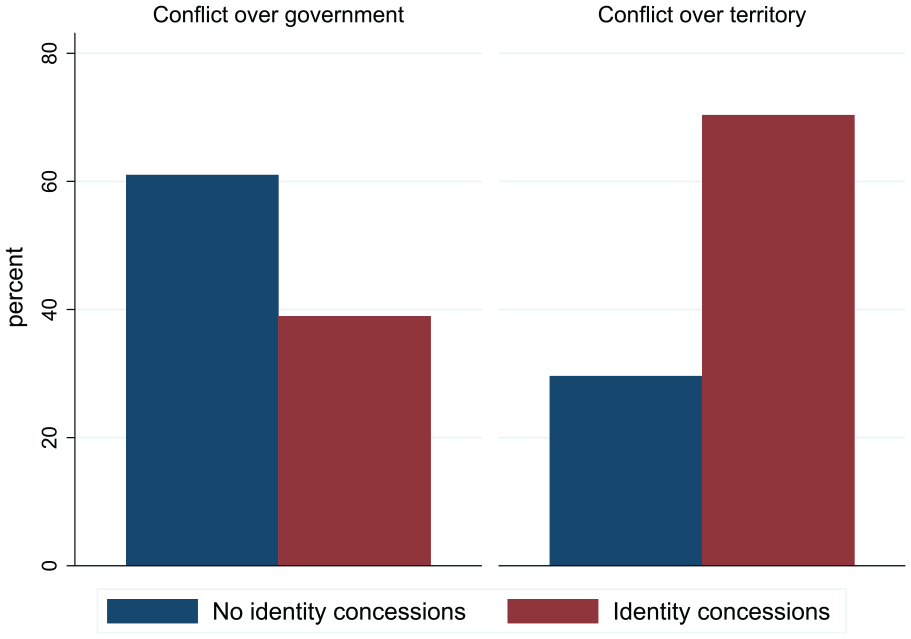
Distribution of identity concessions to ethnic groups by incompatibility of conflict.
Identity concessions are always included as part of a package along with other concessions, as expected. Peace agreements are primarily political or military settlements and no peace agreement includes identity concessions without a political settlement.
I then measure whether these concessions are implemented. Achieving a peace agreement does not necessarily mean a conflict is resolved. Rather, the process of actually putting the elements agreed into practice can be disputed (Jarstad and Nilsson, 2008; Joshi and Quinn, 2017; Joshi et al., 2017; Kirschner and Von Stein, 2009). For example, the 2012 peace agreement in Mindanao in the Philippines included cultural rights and minority rights, such as practicing sharia law. However, no progress was made on these measures in the following years and the conflict continued. The data on implementation are taken from the Peace Accords Matrix (Joshi and Darby, 2013), the Implementation of Pacts (IMPACT)data (Jarstad and Nilsson, 2008), and updated using the Ethnic Power Relations (EPR) data atlas (Vogt et al., 2015) and with Lexis-Nexis and academic sources of case studies. The coding distinguishes between minimal or intermediate implementation, coded 1, and full (or almost full) implementation, coded 2. For cases where identity concessions are included in the peace agreement, some degree of implementation has taken place in 74% of cases within two years.
Universe of cases
The universe of cases is ethnic groups that are affected by peace agreements in ethnic dyadic conflicts. The definition of armed conflict is ‘a contested incompatibility where the use of armed force between two parties, at least one of whom is the state, results in 25 deaths’ (UCDP, 2015). Scope conditions are set as conflicts in which identity could be a cause for grievance and so I look at ethnic conflicts, defined as those fought with ethnic aims (Vogt et al., 2015). I want to capture concessions to ethnic groups, and so include a separate observation for each ethnic group that fought in the conflict. Therefore, I am not looking at the dyadic conflict but rather each ethnic group, using the EPR dataset to link ethnic groups to conflict groups (ACD2EPR) (Vogt et al., 2015). In sum, my universe of cases are ethnic groups that are affected by peace agreements in ethnic dyadic conflicts. There are 60 ethnic groups included in the database.
I also need to distinguish the status of the peace agreements to be included, since treating all peace agreements as equal would bring a distorted universe of cases. In one conflict there might be a single peace agreement that attempts to settle all the contentious aspects, whereas in another conflict the settlement might be made up of five or six agreements each agreeing a different issue of the conflict, of which identity rights is only one. The list of peace agreements is taken from UCDP (Högbladh, 2012) starting in 1989 and updated to 2013 using the UN peacemaker dataset of peace agreements, 8 and cross-checked with the PA-X dataset for peace agreements that are coded as either framework-substantive partial or framework-substantive comprehensive (Political Settlements, 2018). I do not include peace agreements that are little more than a place-marker for future talks and take only the peace agreements at the end of a conflict (Kreutz, 2010). I deal with the issue of separate agreements for separate issue areas by accumulating the agreements into one (dated as the last agreement). Defining scope conditions in this way results in 65 peace agreements. Given that the same peace agreement can apply to different ethnic groups within the same conflict, the universe of cases is the ethnic group-peace agreement and there are 86 observations. 9
Representative case description
The case of Northern Ireland is a good example of the importance and impact of symbolic concessions. Northern Ireland as a political entity was born out of communal differences with the rest of Ireland, since it was due to the Protestant predominance in the north-east corner of Ireland that this area stayed within the United Kingdom when the rest of Ireland gained independence in 1922 (O’Leary, 2019a). The 30-year conflict was sparked by discrimination against Catholics, and the years of violence increased sectarian division (Anderson and Shuttleworth, 1998). These identity and political differences remain today.
Traditionally, unionists, who are mostly but not exclusively Protestant, support a future as part of the United Kingdom, while nationalists, who are mostly but not exclusively Catholics, would prefer Northern Ireland to unite with the Republic of Ireland. The Good Friday (Belfast) Agreement of 10 April 1998, which ended the 30-year conflict in Northern Ireland, was in large part a document that dealt with those two competing aspirations (O’Leary, 2019b). It established both aims as valid and this accommodationist solution was brought in at the institutional and cultural level.
The institutional changes included a new devolved government, with election through proportional representation by each ethnic community and some of the functioning of the institutions controlled by ethnic community affiliations.
In terms of cultural accommodation, the Good Friday Agreement aimed to recognize the minority culture and thus diminish a sense of a monolithic majoritarian culture and bring ‘parity of esteem’. Anyone born in Northern Ireland is entitled to either one or both of British and Irish citizenship. Both the Irish language and Ulster Scots are recognized alongside English. There are also rules around the flying of flags and parades, traditionally used as a way to mark territory (Hayward and Mitchell, 2010).
Not all of these commitments have been satisfactorily fulfilled. For example, there was a lack of progress on the Irish language, which was one of the sticking points in restoring the regional government, which collapsed between January 2017 and January 2020 and again from February 2022 to February 2024. While the conflict has not restarted in Northern Ireland, there have been intermittent low-level attacks by disaffected Republican breakaway groups, low-level sectarian attacks, and disrupted political rule (Balcells et al., 2016; MacGinty et al., 2007). Yet, among the public, there is satisfaction around issues of recognition, being able to express one’s identity, and of changed relations between the groups, as shown in a survey in 2018. In response to the statement ‘I feel that my own cultural identity is respected by society’, 65% of those brought up as Catholics answered ‘Agree’ or ‘Strongly agree’, the same proportion as Protestants (ARK Life and Times Survey, 2018).
Research design
The first step of the analysis is to test the determinants of identity concessions in peace agreements, with a binary variable of whether identity concessions are included in the peace agreement or not.
The first expectation is that governments would be more likely to give identity concessions to politically weaker ethnic groups. The status of the ethnic group is measured using data on the relative political status of the ethnic group from the EPR dataset (Vogt et al., 2015). The data code the group based on whether they have a monopoly of power, dominance, are a senior partner, junior partner, powerless or discriminated against. As this is a time-varying measurement, I look at the political strength of the group in the year prior to the peace agreement.
I also control for the size of the ethnic group, which is the demographic size relative to the total population (Vogt et al., 2015). As another measure of the strength of the group, I look at the military might relative to the government forces of the non-state armed group representing the ethnic group, using data from Cunningham et al. (2013). Military strength is relevant to peace agreement provision as it is an indication of potential future costs to the government should the peace agreement break down and conflict return.
A further expectation is that governments will give concessions when there are multiple groups, as a means to settle with groups prepared to accommodate. I therefore include a measure of the number of armed groups in a conflict (Cunningham et al., 2013). I then include factors frequently examined in the literature on the content of peace agreements (Hartzell et al., 2001). I include the incompatibility of the conflict, given the correlation between identity concessions and conflicts over territory. I measure the severity of the conflict using the duration of the dyadic conflict and a binary variable of the cumulative intensity of deaths, using data from UCDP (2015). I introduce country-level data that have been shown to be important as determinants for conflict, specifically, the ethnic fractionalization of the country and a measure of mountainous terrain (Fearon and Laitin, 2003). The latter is a particularly important factor for peripheral groups. The binary outcome is analyzed with logistic regression.
The second step in the analysis is to examine the impact of identity concessions. As with any observational data, there are likely to be endogeneity problems. Common causes of endogeneity include omitted variables, such as self-selection, or unobservable factors, such as motivation. Therefore, it is important to consider and integrate the possible effects of a case entering into the set of those that receive identity concessions, i.e., those that receive the ‘treatment’ of identity concessions. Identity concessions may be overrepresented in those situations where peace would have been more successful anyway, which would lead to the overestimation of the effect of concessions on the stability of peace. Therefore, the design incorporates consideration that the provision of identity concessions is not randomly distributed. Clearly, identity concessions cannot have an impact if they are not in the peace agreement in the first place. 10
I use a treatment effects model to test the outcome (the likelihood of a return to conflict with that ethnic group), taking into account the likelihood of cases being in the ‘treatment’ of including identity concessions in the peace agreement. 11 The treatment equation takes the binary outcome of concessions (included or not) along with the determinant variables from the analysis(ethnic group size and political status, rebel group size, incompatibility, duration and death intensity of the conflict, number of armed groups active in the conflict, ethnic diversity and mountainous terrain). In a treatment effects model we need an exclusion restriction and the covariates must include at least one variable that affects treatment status but has no direct effect on the outcome of interest. I use the intensity of deaths, which is significant in the equation on the granting of identity concessions. There is evidence that this factor does not predict conflict reigniting. Gurses and Rost (2013: 482) show that measures of war costs (casualties, displacements and genocide) are not significant in predicting a return to violence in ethnic conflicts.
The research design attempts to deal with the endogeneity of observational data but does not intend to overclaim causality. In the absence of a pure experimental treatment, claims of causality are necessarily limited. The results should be considered as supportive or not of the arguments put forward. However, further work on identity concessions is warranted, particularly given the novelty of the research topic and as more data becomes available.
I test the risks of a return to conflict with a duration analysis that measures the likelihood of a return to conflict while controlling for time since the conflict ended. 12 Note that this is a return to conflict with this ethnic group, not the armed rebel group. An armed rebel group can make peace and yet another armed group, representing the same ethnic group, starts fighting. For example, in the Mindanao region in the Philippines, the Moro National Liberation Front (MNLF) fought a separatist struggle for the Moro region from the 1970s. In 1996, this armed group signed a peace agreement with the Philippine government. However, a breakaway armed group representing the Moros, called the Moro Islamic Liberation Front (MILF), rejected peace talks and continued fighting. Thus, although there is an end to the dyadic conflict between MNLF and the government and this armed group does not return to conflict, the 1996 peace agreement is not coded as an end to conflict since fighting with the Moros continues with another armed group.
I test whether the inclusion of identity concessions in the peace agreement has an impact on peace duration, and then whether the implementation of these concessions reduces the risk of a return to conflict. I include the other forms of settlement – political, territorial and military power-sharing – to separate the effects of identity settlements from other concessions since this article argues that identity concessions should have a separate effect. I take the coding of other forms of settlement from the IMPACT dataset (Jarstad and Nilsson, 2008). This dataset measures political power-sharing as ‘a stipulated guarantee that offers the combatants seats in a new government at the cabinet level or above, or a specific quota of political power in at least one of the main branches of government’; territorial power-sharing as ‘a provision for some form of regional autonomy’; and military power-sharing as ‘a stipulated guarantee that offers the combatants guaranteed integration into the national armed forces and/or command structures, or a provision that allows the rebels to retain their own separate armed forces’. All the implementation variables are lagged and are measured as 1 for low implementation and 2 for high. I include the covariates included in the treatment equation (except for the exclusion variable of intensity of conflict). 13 I account for temporal dependence within ethnic groups by a cubic polynomial of peace years (Carter and Signorino, 2010).
Results
The first step of the analysis is to test the determinants of the granting of identity concessions and the results are shown in Table 1.
Determinants of granting identity concessions.

Logistic regression analysis; robust standard errors clustered on ethnic group-peace agreement in brackets.
p < 0.1, *p < 0.05, **p < 0.01, ***p < 0.001.
The results show that states are significantly less likely to give identity concessions to politically strong groups, in other words, more likely to prioritize politically weak groups, in line with the first expectation. The demographic size of the ethnic group is also significant in making identity concessions more likely. Larger groups are harder to ignore or have a more obvious source of grievance, and bringing a larger group into an accommodation arrangement with the state is more attractive. However, the military strength of the armed group representing that ethnic group does not have an impact, which suggests that identity concessions are not driven by military considerations. The overall message from these results is that the state may take an instrumental approach to identity concessions, using them to placate larger ethnic groups, but not in circumstances where the group already has political power and could constitute a political threat.
The second expectation was over the number of armed groups in the conflict. The results show mild support that governments are more likely to give identity concessions when there are many armed groups, but this result is not significant. Therefore, the expectation that governments would be keen to use accommodation measures directed at the ethnic group to settle with one group in order to set an example for other groups is not fulfilled (though the evidence also does not support the argument from Walter (2006) that governments will avoid accommodation if there are multiple groups, for fear of establishing a reputation for weakness).
As we would expect, identity concessions are more likely in conflicts over territory, as there is a high correlation between such conflicts and ethnically distinct groups. The duration of the conflict is only a mildly significant factor in granting identity concessions, but such concessions are significantly less likely in high intensity conflict. The latter is important as it is the exclusion variable in the treatment effects model. Taken together, these results suggest that identity concessions are given to groups that were previously marginalized but are not a threat to the state. These results support the claim that identity concessions are granted as a rational choice by states, with identity concessions used as a low-cost concession in order to settle with groups that are less threatening.
The second step of the analysis tests the impact of identity concessions. Table 2 shows the reduced results for inclusion (Model 1) and implementation (Model 2) of identity concessions. 14
Likelihood of a return to conflict, accounting for the granting of identity concessions.

Linear regression with endogenous treatment effects; robust standard errors clustered on ethnic group-peace agreement in brackets.
p < 0.1, *p < 0.05, **p < 0.01, ***p < 0.001.
In Model 1, the inclusion of identity concessions has no significant impact on the likelihood of a return to conflict, while accounting for the determinants of those concessions having been included. This suggests that the proposed mechanisms – expressing the group’s identity, demarcating the difference and changing the relations – are not fulfilled by the granting of these concessions, with even the recognition of the group (demarcation) not sufficient. Actions speak louder than words, and so Model 2 looks at the impact of the implementation of identity concessions.
The results of Model 2 show that identity concessions that are not implemented make a return to conflict more likely (though with only mild significance). Remembering that these concessions are more likely to be given to weak groups as a strategic move by the government, the results from Model 2 suggest that such a strategy might be misguided if the government has acted only cynically and is not prepared to implement these concessions. The results show that implementation of identity concessions significantly reduces the likelihood of a return to conflict, taking into account the ‘treatment’ of receiving identity concessions. Yet partial implementation is not sufficient to overcome the increased likelihood of conflict with the granting of identity concessions. Only full implementation reduces the likelihood of conflict to below the baseline. The different probabilities of Model 2 are shown in Figure 2, 15 which shows that only high implementation has an impact on the risk of a return to conflict, which is 20 percentage points less likely than those where identity concessions are not implemented.
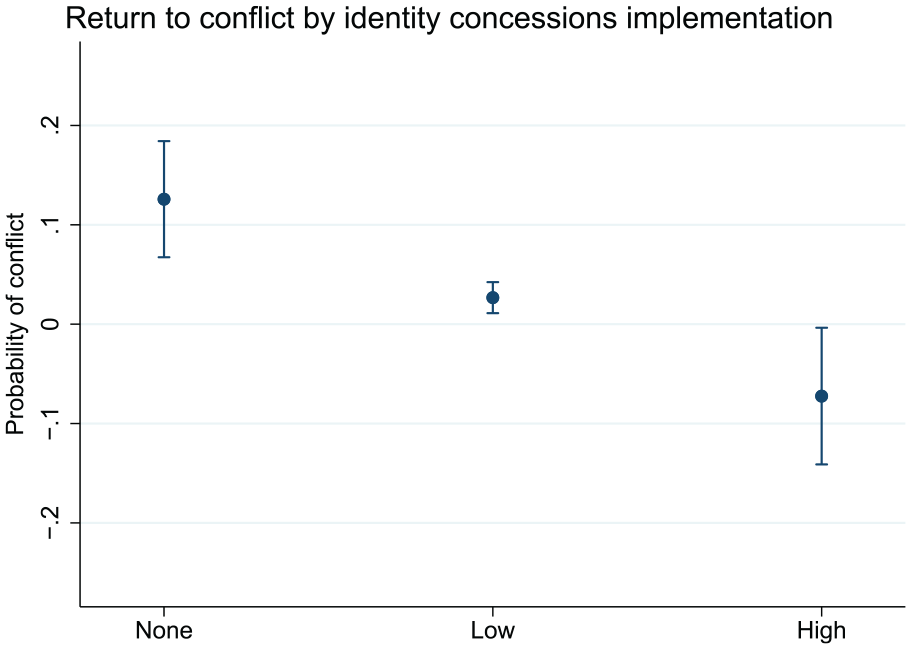
Predicted probability of a return to conflict by identity concession implementation.
Political and territorial power-sharing concessions have no significant effects, which seems surprising, given the literature that shows that the implementation of these concessions positively impacts on peace duration (Jarstad and Nilsson, 2008). The results may show that when these aspects are identified more distinctly by including identity concessions, the impact of political and territorial concessions changes, illustrating that part of the effect of these concessions is the expressive and relational significance of these power-sharing concessions. 16 Military power-sharing concessions make a return to conflict significantly more likely, which indicates the difference between the interests of the ethnic population and the armed group.
The results show that it may not have been necessary to take treatment into account, since the measure of the correlation between the error terms of the treatment and duration models (athrho) is not significant, which suggests endogenous selection is not a serious problem. However, the balance tests (Table A1 in the Online Appendix) and theoretical considerations encourage the use of a treatment model for a more accurate specification.
In sum, the results show that the implementation of identity concessions are associated with more durable peace (though only with full implementation). These results go against the claims in the literature that such concessions will add fuel to the fire of ethnic expansion (Downes, 2004; Horowitz, 1985; Kaufmann, 1996; Rothchild and Roeder, 2005; Simonsen, 2005). Three mechanisms were proposed to link identity concessions to a reduced likelihood to return to conflict – recognizing the identity, demarcating the boundaries with other groups, and changing relations with the main ethnic group. Recognition and respect make the receiving group feel more secure and less likely to return to conflict, but these come only from actual change. Qualitative findings from case studies also support this. For example, in Aceh, the 30-year armed conflict for independence from Indonesia ended in 2005 with a peace agreement that included provision for expressions of the distinct identity of Aceh (languages, religion and religious education). A female activist in the post-conflict period in Aceh captures how these concessions showed a change in the relationship with the state, ‘Identity is very important but it is also a reward from the state.’ 17
Interpreting all the results together, analysis of the determinants of identity concessions supports the argument that they are given to weak ethnic groups, and conversely that ethnic groups that already have some political status are less likely to receive these concessions. In the second part of the analysis, the inclusion of identity concessions in a peace agreement does not seem to affect the return to conflict, once we take into account the reasons for receiving identity concessions in the first place. However, when implementation is also considered, concessions that are granted and not implemented may provoke a return to conflict. The results suggest only fully implemented concessions reduce the risk of conflict.
Conclusion
Identity concessions, such as language rights, cultural rights or the right to religion, are often included in peace agreements, yet we have little knowledge of their effects. Previous literature has proposed two opposing expectations: that these concessions can lead to future conflict by creating a stronger sense of identity or, alternatively, they can defuse conflict by fulfilling claims for recognition and respect. In line with the latter approach, this article shows the positive impact of identity concessions in peace agreements ending ethnic conflicts, if given sincerely and fully implemented. Including identity concessions in the form of concrete and unambiguous policies reassures the receiving group of the survival of their distinct cultural, religious, ethnic, or linguistic identity. The group feels secure in its right to exist, be different from the majority, and be recognized and respected.
These findings have implications for the peace-building literature. Equality, recognition and respect are often seen as aspects of positive peace, which are treated as secondary to the more urgent priority of ensuring an end to violence or negative peace. The results presented here suggest that these two aspects need not be positioned as separate categories and potential spillovers should be more closely investigated. Future research could explore in more depth the causal mechanisms that connect the implementation of identity concessions with more durable peace, to understand better the conditions under which these concessions make a difference. The dynamics between rebel groups and ethnic groups also be explored. A variety of constellations is possible; for example, Burundi where one rebel group represents multiple ethnic groups, or the Philippines where the Moros have been represented by different rebel groups. In these contexts, the fragmentation of rebel groups is important (Cunningham, 2011, 2014). A further profitable area could be to apply ethnic outbidding to the actions of rebel groups to win the loyalty of the ethnic population (Stewart and McGauvran, 2020).
These findings have policy implications for peace negotiations where symbolic changes such as identity concessions are often resisted because they are a concession that is very visible to the population and for fear that they will encourage further rebellion. The findings from the research presented here do not find support for this argument and show that this fear is often not justified. The circumstances within which these measures are given suggest that states see them as a low-cost concession (military considerations are not important, they are never given alone but always alongside a political or territorial settlement). If given cynically, with little or no implementation, these concessions might generate a return to conflict, but if given in good faith and fully implemented, identity concessions may help embed peace. Identity concessions can therefore be supported for both normative and pragmatic reasons. Peace-oriented identity provisions ensure the survival of a group’s identity while basing this identity on a newly constructed positive relationship and narrative vis-à-vis the other. Negotiators should push for identity concessions to be included in the peace settlement, so long as these concessions are included sincerely with the intention to effect a genuine change in societal relations, while those overseeing the peace implementation must ensure that the measures are fully enacted.
Supplemental Material
sj-docx-1-jpr-10.1177_00223433241289813 – Supplemental material for Identity concessions in ethnic civil wars: When are they given and with what outcomes for peace?
Supplemental material, sj-docx-1-jpr-10.1177_00223433241289813 for Identity concessions in ethnic civil wars: When are they given and with what outcomes for peace? by Lesley-Ann Daniels in Journal of Peace Research
Footnotes
Acknowledgements
The author would like to thank Scott Gates, Felix Haass, Edward Morgan-Jones, Jeremy Spater, Manuel Vogt, the editor and reviewers for helpful comments, and to thank Jack Drumm, Nikole Erikson, Athanasios Kouliopoulos, Jana Muller, and Mateu Tomi for research assistance.
Replication data statement
The dataset, codebook, and do-files for the empirical analysis in this article, along with the Online Appendix, are available at  . All analyses were conducted using stata 17.
Funding
The author disclosed receipt of the following financial support for the research, authorship, and/or publication of this article: The author gratefully acknowledges support from the AXA Research Fund, grant number 2016-SOC-PDOC and from the European Union’s Horizon 2020 research and innovation programme under grant agreement No 101027912.
Notes
LESLEY-ANN DANIELS, PhD in Political Science (Pompeu Fabra University, Barcelona, 2016); Marie Curie Post-doctoral Fellow, University of Oslo (2022–2024), previously at the Institut Barcelona d’Estudis Internacionals; current research interests: post-conflict peace-building and transitional justice.
References
Supplementary Material
Please find the following supplemental material available below.
For Open Access articles published under a Creative Commons License, all supplemental material carries the same license as the article it is associated with.
For non-Open Access articles published, all supplemental material carries a non-exclusive license, and permission requests for re-use of supplemental material or any part of supplemental material shall be sent directly to the copyright owner as specified in the copyright notice associated with the article.
