




Abstract
Does environmental displacement provoke political instability? Though migration has long been considered an intermediary in the causal path between environmental change and political upheaval, the relationship remains theoretically underdeveloped and evidence has been limited. This article examines the impact of displacement caused by sudden-onset natural hazards on disruptive antigovernment events including armed conflict, protests and violent riots. It leverages the new Environmental Displacement Dataset (EnDis), an original dataset that identifies quantities of human movement in response to six types of sudden-onset natural hazards in Africa from 1990 to 2017, including floods, storms, wildfires, landslides, earthquakes and volcanic activity. The results of the analyses show that while environmental displacement is not associated with civil war onset or protests, it does increase the incidence of attacks by armed non-state actors and violent riots. Importantly, these destabilizing effects occurr primarily (1) in the context of displacement driven by floods and storms, and (2) when levels of displacement are well above average. Collectively, these findings portend deepening security crises and violent political upheaval as climate change drives more frequent episodes of extreme weather and excessive environmental displacement.
Introduction
Does environmental displacement cause political instability? When natural hazards threaten food and water security, physical safety, and economic prosperity, relocation to a more hospitable environment serves as an adaptation strategy that allows people to avoid and minimize hardship (e.g. Black et al., 2011; McLeman and Smit, 2006). Worldwide, natural hazards displace more people every year than war, the majority of whom are dislocated internally. The alarming intensity of environmental displacement has generated significant speculation about its security consequences, with many arguing that large-scale environmental displacement has the potential to upend order and trigger political uprisings (e.g. Homer-Dixon, 1999; Reuveny, 2008). Concurrently, startling projections of accelerated natural hazards and dislocations due to impending climate change have brought environmental displacement to the dockets of government security programs around the globe and nearly every major intergovernmental organization (Rigaud et al., 2018).
Displacements caused by sudden-onset natural hazards provide a crucial context for examining the destabilizing effects of environmental dislocations. Sudden-onset natural hazards comprise a distinct category of environmental events that are defined by their abrupt time horizons and rapid impacts. Short-term events such as floods and tropical storms materialize with little advanced notice as opposed to slow-onset natural hazards such as drought, which unfold gradually as an accumulation of incremental environmental changes. The discrete nature of sudden-onset natural hazards and their immediate physical impacts yield direct observable migratory responses that tend to be short in distance and duration (Adger et al., 2018). These events are among the most destructive in the world, dislocating over 25 million people a year globally, more than three times the number of people displaced annually by war (IDMC, 2019). Moreover, because climate change is expected to affect the frequency, intensity and geographic distribution of certain types of sudden-onset natural hazards, understanding the potential destabilizing impacts of displacement caused by these events informs contemporary scholarly and policy debates at the climate–conflict nexus.
This article examines the extent to which environmental displacement caused by sudden-onset natural hazards fuels different formats of political upheaval. I analyze the effects of environmental displacement on four events associated with antigovernment political uprisings: civil war onset, armed attacks by non-state actors, nonviolent protests and violent riots. While political strife can produce opportunities for beneficial change, conflict outside the realm of institutionally circumscribed politics can also be highly disruptive. Indeed, both violent and nonviolent uprisings have been known to dismantle political orders and trigger domestic feedbacks of instability and spillover effects across international borders (e.g. Branch and Mampilly, 2015; Hale, 2013; Stephan and Chenoweth, 2008).
I employ a quantitative cross-national analysis to examine the impact of displacement caused by sudden-onset natural hazards on antigovernment upheaval in Africa from 1990 to 2017. The article draws on the Environmental Displacement Dataset (EnDis), an original dataset that quantifies internal dislocations caused by all sudden-onset natural hazards in Africa including floods, storms, wildfires, earthquakes, volcanic activity and landslides. This new dataset responds to growing scholarly demand for improved comparative data on environmental migration (e.g. Mitchell and Pizzi, 2021) and offers an important contribution for the systematic study of environmental displacement and political instability. Data on outcomes of political upheaval are drawn from the UCDP/PRIO Armed Conflict Dataset and the Social Conflict Analysis Database. The results of the analyses show that while environmental displacement is not associated with civil war onset or protests, it increases the incidence of attacks by armed non-state actors and violent riots. Importantly, these destabilizing effects erupt primarily in the context of floods and storms and occurr when levels of environmental displacement are well above average. Collectively, these findings suggest that state resilience to environmental shocks falters when large-scale dislocations overwhelm systems of preparedness, and attest to a threat-multiplier effect of climate change.
This article proceeds as follows. In the following section, I briefly survey the existing research focusing on the relationship between sudden-onset natural hazards, displacement and conflict. Next, I draw on the extant literature on migration, demography and political instability to develop a set of theoretical expectations linking sudden-onset hazard displacement and civil war onset, armed attacks by non-state actors, nonviolent protests and violent riots. I then explain the sample, data and method employed in the analysis, including an introduction to the new Environmental Displacement Dataset. The subsequent section presents the analyses and discusses key findings. The article concludes with summary remarks.
Environmental displacement, sudden-onset natural hazards and political instability
Environmental displacement occurs when individuals relocate in response to adverse impacts of environmental shocks. Unlike conflict refugees, which are strategically displaced by violent actors and are widely regarded as conduits of instability (Salehyan and Gleditsch, 2006), environmentally displaced persons (EDPs) have been historically considered exogeneous to political conflict. However, the last few decades have seen a sharp increase in scholarly interest in the relationship between environmental displacement and political instability. Attention to the matter has been amplified by growing concern about the evolving patterns of human movement in response to climate change and related environmental hazards (IPCC, 2021). Concurrently, nearly every scholarly publication examining the climate–conflict nexus mentions migration as a possible intermediary in the causal path between environmental change and domestic political strife (e.g. Barnett, 2003; Fjelde and Von Uexkull, 2012; Hendrix and Salehyan, 2012; Nordås and Gleditsch, 2007; Theisen et al., 2012, 2013).
Even so, relatively few studies have focused theoretical and empirical investigations on how environmental displacement affects political instability (but see Ghimire et al., 2015; Kelley et al., 2015; Raleigh et al., 2008; Reuveny, 2007). Even fewer have attended to the specific displacement challenges posed by sudden-onset natural hazards as opposed to gradual events. Among those that focus on short-term hazards, research approaches span macro- (Ghimire et al., 2015; Reuveny, 2007), meso- (Bhavnani and Lacina, 2015; Petrova, 2021) and microlevels of analysis (Koubi et al., 2018, 2021; see also Petrova, 2021). However, evidence has been limited in geographical coverage and/or the types of sudden-onset events under investigation. For instance, Ghimire et al. (2015) assess the relationship between flood displacement and armed conflict across 126 countries, but omit dislocations caused by other types of sudden-onset hazards. Disaggregated research designs exploiting subnational variation in environmental displacement and instability are country-specific and also focus on hydrological events (e.g. Bhavnani and Lacina, 2015; Petrova, 2021). Other research generates rich insights by exploiting survey data to examine a wider range of sudden-onset hazards, though evidence remains concentrated in a handful of developing countries (Koubi et al., 2018, 2021). Evidentiary bias toward hydrological events and unequal geographic coverage are highly consequential, as they may lead to incomplete or skewed conclusions (e.g. Hendrix, 2017).
Moreover, existing evidence on the destabilizing effects of sudden-onset hazard displacement yields diverse findings. Reuveny (2007) analyzes 13 episodes of environmental displacement associated with sudden-onset hazards and finds that those occurring in developing contexts are likely to lead to conflict. Bhavnani and Lacina’s (2015) subnational analysis of India concludes that displacement caused by weather shocks increases rioting in migrant-receiving areas. Ghimire et al.’s (2015) cross-national study shows that flood displacement does not typically provoke new armed conflict but can fuel the continuation of existing armed conflict. Examining urban centers in Kenya, Koubi et al. (2021) show that individuals migrating in response to sudden-onset hazards are significantly more willing to participate in protests. In contrast, other studies conclude that sudden-onset hazard displacement has no effect on political instability. For instance, Petrova (2021) show that in Bangladesh, districts receiving higher quantities of flood migrants do not experience more frequent protests, while Koubi et al. (2018) present survey evidence that environmental migrants driven by sudden-onset events do not have heightened perceptions of conflict in their new location.
Thus, despite the growing number of studies, the relationship between environmental displacement and political instability remains unclear. Reconciling the findings is essential, because inferences from research could influence policy, disaster response, adaptation assistance and other decisions about where to put efforts to prevent conflict.
Linking environmental displacement and political instability
Political unrest manifests in a variety of ways, ranging from organized nonviolent demonstrations to violent uprisings. While different types of uprisings exhibit unique qualities with varying tactics and degrees of organization, all formats of antigovernment dissent involve situations where individuals coordinate action to express shared grievances and demand redress from the state.
At the extreme end of the spectrum, environmental displacement may increase a country’s risk of civil war by providing a supply of economically vulnerable and politically aggrieved individuals that can be more easily recruited into a bourgeoning rebellion. Civil wars are rare events that erupt under exceptional conditions of acute grievances and opening windows of opportunity (e.g. Bara, 2014). Dominant models of civil war onset emphasize the feasibility of rebellion as a critical determinant of civil war onset (Hoeffler and Rohner, 2013), as aspiring rebel leaders must be able to raise a contingent of supporters despite the high individual costs and risks of participating in civil war. Therefore, overcoming the collective action problem through rebel recruitment presents a critical obstacle to initiating hostilities (Blattman and Miguel, 2010). Mobilizing the fighters and collaborators needed to get an incipient movement off the ground is made easier when armed non-state actors have access to a large population of people that are motivated to enlist.
The literature on civil war mobilization shows that economic incentives and political grievances (i.e. desire for political change) often motivate individuals to join a burgeoning rebellion. 1 Along these lines, EDPs are particularly promising targets for rebel recruitment. EDPs are economically disadvantaged and have a lower opportunity cost of joining a rebellion. Individuals displaced by natural disasters often arrive in new communities homeless, unemployed and dispossessed, and they face the daunting costs of rehabilitating demolished homes and rebuilding livelihoods. The financial burdens of dislocation are further aggravated by inadequate economic prospects in receiving areas, where employment opportunities are nearly always insufficient to meet the needs of a rapid influx of migrants. As a result, EDPs are forced into abject poverty and settle into makeshift camps that are under-resourced and characterized by poor sanitation, lack of security and disease (Adger et al., 2021). Faced with the prospect of languishing indefinitely in squalid settlements, EDPs may be tempted to enlist when the rebels come knocking. Extant research on rebel recruitment shows that armed non-state actors deliberately target individuals they perceive to be economically disadvantaged and use the promise of material rewards to lure these civilians into their ranks (e.g. Soules, 2023). Cash payments, housing, financial loans and war loot are just a few examples of the types of materials rewards armed non-state actors offer in exchange for participation, and these resources are particularly attractive for those displaced by environmental shocks. With hundreds of thousands of people displaced annually by environmental shocks in West Africa, material-based recruitment targeting the dislocated has played a critical role in the evolution of rebel movements in the region. For instance, Boko Haram appealed to the unique economic vulnerabilities of those displaced by natural disasters by rolling out a financial loan program that – in exchange for loyalty and collaboration – allowed individuals to rebuild property, rehabilitate businesses and replant crops that had been destroyed in catastrophic flooding (Chason, 2023). For EDPs facing an uncertain economic future, the possibility of gainful employment and financial security through enlistment may be an enticing prospect.
In addition, EDPs are particularly likely to harbor animosity toward the government, which also makes them more vulnerable to militarization. Research shows that antigovernment grievances fueled by existential hardships and acute inequalities often motivate individuals to participate in rebellion (Humphreys and Weinstein, 2008; Nanes, 2021). Environmental displacement corresponds to unemployment, homelessness and breakdowns in security, sanitation and food and water accessibility (Ware, 2005) – hardships that have long been recognized as a source of antigovernment discontent and a rallying point of rebellion (Gurr, 1970). Historically, migrant-dominated slums have provided fruitful breeding grounds for antigovernment animosity (Kelley et al., 2015), which can be exploited and militarized by aspiring rebel leaders. Targeting displaced communities, armed non-state actors strategically deploy ideological appeals, injustice frames and promises of a better future to attract aggrieved civilians into their ranks (Parkinson, 2021; Soules, 2023; Tokdemir et al., 2021). 2 Thus, in the aftermath of sudden-onset environmental shocks, violent political entrepreneurs leverage antigovernment refrains to politicize and militarize EDPs, which in turn provide armed non-state actors with the prerequisites to launch a civil war.
While providing a pool of high-risk targets for rebel recruitment based on economic and political vulnerabilities, large-scale environmental displacement creates a set of conditions that facilitates the collective recruitment of EDPs for rebellion. Individuals displaced by environmental shocks tend to migrate together, cluster in geographic proximity and share kinship ties, which makes it logistically easier for rebel leaders to recruit from these populations (Gates, 2002; Larson and Lewis, 2018; Schaub and Auer, 2022). Moreover, because rapid, large-scale population movements constrain state capacity and fuel an atmosphere of chaos and confusion, armed non-state actors are able to move and recruit more freely. Thus, in the wake of rapid-onset environmental shocks, displaced populations provide a new pool of high-risk individuals that are easy targets for rebel mobilization. EDPs are particularly likely to be economically disenfranchised and politically aggrieved, and recruitment from among these populations can provide nascent opposition movements with the strength and capacity to initiate hostilities against the state.
Hypothesis 1: Higher levels of displacement caused by sudden-onset natural hazards increases the likelihood of civil war onset.
Environmental displacement may also affect political instability by increasing the intensity of existing armed conflicts. Where armed non-state actors are already engaged in a violent struggle with the government, displacement crises caused by sudden-onset natural hazards create new incentives and opportunities to accelerate violent campaigns. Disaster displacement attracts humanitarian aid operations that provide strategically valuable targets for armed groups. Disaster relief often brings a surge of material goods to migrant-receiving areas, such as food, cash, medical supplies, communication gear and transportation equipment provided by both government and non-government actors. Violent raids increase where humanitarian support is concentrated as armed groups seek to expropriate aid materials (Choi and Salehyan, 2013; Lischer, 2003; Wood and Molfino, 2016; Wood and Sullivan, 2015). Aid workers themselves can even be targets of strategic significance, and non-state actors often seek to kill or kidnap relief operatives to undermine the government’s legitimacy in public goods provision (Hoelscher et al., 2017; Narang and Stanton, 2017). Environmental displacement caused by sudden-onset natural hazards triggers an increase in violent attacks by armed groups as these actors engage in predatory looting and seek to exploit humanitarian aid for strategic gain.
Environmental displacement crises also enable armed actors to more effectively launch violent campaigns at a lower cost and risk. The abrupt and often large-scale character of displacement caused by rapid-onset natural hazards contributes to an atmosphere of chaos in which armed non-state actors move more freely and expand their operations. Similar to conflict refugees, armed groups can blend in with civilian movements fleeing from and returning to disaster-affected areas at a lower risk of detection (Salehyan and Gleditsch, 2006). In so doing, environmental displacement facilitates the flow of weapons and combatants, allowing armed groups to penetrate and target new areas of the state. At the same time, state-led humanitarian missions preoccupy government attention and resources, further diminishing the government’s capacity to monitor and combat internal security threats. Moreover, as militaries are increasingly mobilized to support relief operations (Eastin, 2016; Michaud et al., 2019), armed groups can launch attacks with a lower chance of military confrontation and retaliation.
In other words, environmental displacement creates a set of conditions that armed groups can readily exploit for strategic gain in their struggle against the government. Humanitarian assistance, though intended to ameliorate the hardships associated with disaster displacement, drives an increase in violent raids by armed groups seeking to capture aid resources. In addition, the disruptive nature of abrupt population movements and the redirection of government attention toward disaster response ushers in a window of vulnerability in which armed groups can maximize the impact of violent campaigns at a lower cost and risk. Environmental displacement caused by sudden-onset natural hazards is therefore expected to increase violent attacks by armed opposition groups as these actors capitalize on emerging incentives and opportunities favorable to strategic conflict escalation.
Hypothesis 2: Higher levels of displacement caused by sudden-onset natural hazards increases the incidence of government-targeted attacks by armed non-state actors.
Environmental displacement may also lead to instability short of civil war. Protests are public nonviolent demonstrations that form when people organize to express a shared grievance against the government and demand redress. After environmental shocks, EDPs may organize protests to demand improved disaster mitigation and prevention measures. When individuals are uprooted by natural disasters, they move in response to life threats, loss of property and loss of livelihoods. However, these damages do not occur in a political vacuum. Rather, the destruction caused by environmental shocks depends critically on disaster planning and risk mitigation measures and can therefore be compounded – or prevented – by government action (Homer-Dixon, 1999; McLeman et al., 2016). In Pakistan, 2010 marked a year of unusually high temperatures and excessive rainfall that concatenated to fuel record flooding in the Indus Riven Basin and destroyed over 2 million homes. In part, flooding was exacerbated by government shortfalls related to infrastructural deficits and inadequate planning: the federal government had long delayed plans to raise levees in the region, which could have significantly mitigated flooding. However, the catastrophic impact of flooding was equally a product of environmental and economic discrimination embedded in Pakistani state structures. Government disaster prevention efforts had been historically concentrated in communities affiliated with political elites, meaning that the country’s marginalized populations were more vulnerable to flooding and disproportionately suffered losses (e.g. Baechler, 2013). Thus, when EDPs took to the streets of Pakistan in the aftermath of flooding, antigovernment protests not only demanded improved infrastructure and technical preparation, but more equitable resource distribution (Climate Diplomacy, 2011).
After natural disasters, protests may also emerge to counter inadequate disaster response and humanitarian assistance for EDPs. Like other public services, governments are responsible for the distribution of disaster relief and can channel resources into shelter, food, water and financial support for the displaced. However, most governments are unable or unwilling to meet the challenges posed by mass dislocations due to routine underinvestment in disaster relief (Desportes and Hilhorst, 2020; Mahmud and Prowse, 2012; Neumayer et al., 2014; Plümper et al., 2017). As a result, displacement camps are often under-resourced and marred by crime, insecurity, hunger and disease, leading occupants to form protests demanding improved service provision. For instance, after two cyclones hit Mozambique in 2019 within a matter of weeks, protests erupted as the government struggled to provide thousands of EDPs with adequate cash subsidies, shelter, medical support and food. As malnutrition and outbreaks of cholera spread across hundreds of makeshift camps, EDP-led protests accused the government of corruption and aid misallocation (Al Jazeera, 2019).
Environmental displacement can also trigger mobilization among incumbent residents protesting the arrival of migrants. A rapid influx of migrants imposes population pressures on host communities and causes difficulties for natives (Reuveny, 2007). All communities are endowed with finite pools of resources on which residents rely for survival and quality of life maintenance, including jobs, housing, food, potable water, electricity, infrastructure and security (Cohen, 1995; Rees, 1996). Rapid, large-scale population growth strains these resources, diminishes the quality and quantity available to natives, and overwhelms the built-in resilience of state provisional structures that enable resources to expand alongside population growth. As a result, natives often perceive migrants as squatters infringing on the entitlements of incumbent residents, and associate EDPs with hardships such as crime, resource shortages and insecurity (Benjaminsen, 2008; Meier et al., 2007; Reuveny, 2007; Swain, 1998; Theisen et al., 2013). In turn, antimigrant sentiment can trigger protests against the state, with natives mobilizing to demand the containment or removal of EDPs.
Hypothesis 3: Higher levels of displacement caused by sudden-onset natural hazards increases the incidence of antigovernment protests.
Accumulated grievances associated with environmental displacement can also trigger more dangerous and potentially disruptive episodes of dissent. Riots are collective, violent demonstrations against state authorities that press the government for change (Wilkinson, 2009). While riots are generally driven by many of the same overarching grievances and demands as protests – such as poverty, food shortages and inequality (De Juan and Wegenast, 2020; Hendrix and Salehyan, 2012; Heslin, 2021; Smith, 2014) – riots are comparatively more costly and tend to emerge in response to more existential threats, when dissidents determine that the immediacy of their claims necessitates violent tactics (Bhavnani and Lacina, 2015; Gustafson, 2020). Compared to protests, riots are associated with more intense grievances, anger and urgent demands for redress. When the dislocated experience desolate, life-threatening conditions, desperation among EDPs may trigger violent rioting as a means of demanding government attention and immediate action. For instance, monsoons in South Asia triggered riots across the region as governments routinely failed to deliver adequate food, shelter and medical aid to hundreds of thousands of displaced persons. In India, where over 250,000 people were uprooted by flooding, food shortages in EDP encampments drove rioters to target and ransack local government offices, leading to deaths of public officials (Pradhan, 2008).
Grievances linked to antimigrant sentiment may also escalate to riots, especially when identity politics are involved. Natives are particularly likely to perceive migrants as an existential threat when newcomers and incumbent residents belong to distinct social groups with unequal socio-economic status and legacies of tension between them (Fjelde and Østby, 2014). In receiving areas, competition may trigger nativist claims, harden identities between groups and accelerate the cycle of negative othering between migrants and incumbents, giving rise to ‘sons-of-the-soil’ disputes (Bhavnani and Lacina, 2015; Fearon and Laitin, 2011; Swain, 1998; Weiner, 1978). The shifting balance of ethnic demographics may also exacerbate perceptions of insecurity where groups have a history of conflict and mistrust (Posen, 1993; Roe, 1999). Flood-driven population movements have often been linked to rioting in India, particularly when there are acute political inequalities between EDPs and natives (Bhavnani and Lacina, 2015). In Assam – a poor agricultural region with a history of violent interethnic clashes – more severe flooding has increasingly pushed members of different ethnic groups into conflict with one another, as they compete over scarce resources such as undamaged land and disaster relief (Manuvie, 2017). In recent years, riots have been primarily concentrated among the Bodos, accusing the government of colluding with Bengali flood migrants and allowing them to occupy traditional Bodo homelands.
In sum, environmental displacement fuels existential hardships and antimigrant sentiment that can lead to rioting in receiving areas. Governments can become targets of public animosity when they are unable to provide sufficient disaster preparation and relief, and rioting is a particularly likely response when EDPs face irrecoverable losses and life-threatening conditions in migrant camps. Rioting may also revolve around intergroup conflict, erupting when environmental migration is perceived as an existential threat to native residents.
Hypothesis 4: Higher levels of displacement caused by sudden-onset natural hazards increases the incidence of antigovernment riots.
However, there are also theoretical reasons why environmental displacement may not significantly impact political instability. Because displacement caused by sudden-onset hazards tends to be short in duration and distance (Adger et al., 2018; Bohra-Mishra et al., 2014; Gray and Mueller, 2012), it may be too temporary to generate the political grievances and mobilization opportunities needed for organized antigovernment dissent (Brzoska and Fröhlich, 2016). In addition, research shows that displaced persons often experience an increase in solidarity and pro-social behavior in receiving areas, which may be instrumental in mitigating the hardships associated with displacement (Koubi et al., 2021). Alternatively, the disruption of dislocation may impair organizational capacity, meaning that aggrieved EDPs lack the resources and networks for collective mobilization. Thus, it may be the case that displacement driven by sudden-onset environmental shocks does not, on average, trigger political dissent. Considering that the prevailing discourse approaches environmental displacement as a destabilizing force – and the implications this has for policy in a warming world – the relationship between environmental displacement and unrest deserves further empirical scrutiny.
Data and method
Empirical research on the relationship between environmental displacement and political instability has been limited and produced mixed findings. I advance this research agenda with a cross-national analysis of the effects of environmental displacement on different formats of political dissent in Africa from 1989 to 2017, with data refined to the monthly level. Africa is a substantively important region of study due to its limited adaptive capacity and projected increases in exposure to natural hazards as a result of climate change (Brooks et al., 2005). Moreover, Africa is well-suited for testing theories related to environmental displacement and violent conflict. With its immense geographical area, climatological multiformity and geological diversity, Africa experiences the gamut of natural hazards. In addition, Africa is socially and politically diverse in terms of governing systems, political regimes, economic composition, salience of ethnicity in politics, and legacies of violent instability. Thus, while focusing on Africa allows for leveraging meaningful sociopolitical and economic variation for generalizability, selecting on the region also controls for region-specific factors, minimizing the possibility of omitted variable bias (Rosenbaum, 1999).
Environmental displacement: An original dataset
The key independent variable is internal environmental displacement caused by sudden-onset natural hazards, drawn from the Environmental Displacement Dataset. EnDis is an original dataset that captures quantities of intrastate relocation in response to sudden-onset natural hazards in Africa from 1990 to 2017. There are six types of events covered in the dataset: floods, storms, wildfires, landslides, earthquakes and volcanic activity. The geospatial coverage spans all 54 countries on the African continent and Madagascar, including North and sub-Saharan Africa. Environmental displacement in this study refers to human relocation in response to anticipated or lived negative impacts caused by a sudden-onset natural hazard, including evacuation in anticipation of a visibly advancing event and relocation in response to harm, destruction and hazardous conditions associated with an event. Because most environmental displacement occurs internally, the dataset focuses on relocations in which displaced persons remain within the territorial boundaries of the country of impact.
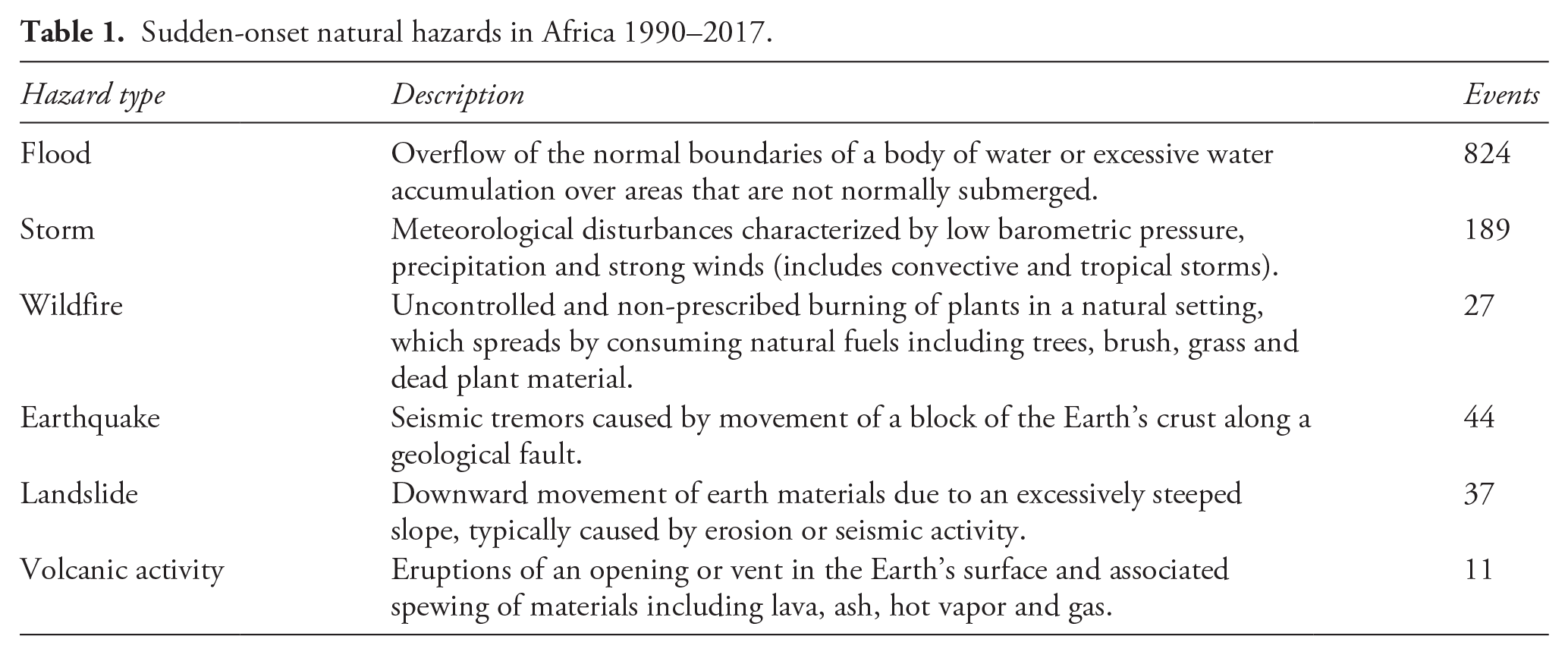
The operational definitions and frequencies of the sudden-onset natural hazards are detailed in Table 1 below. These events were first identified from the Emergency Events Database (EM-DAT), which identifies 1,132 total events, including 824 floods, 189 storms, 27 wildfires, 44 earthquakes, 37 landslides and 11 episodes of volcanic activity (CRED, 2019). For each of these events identified, information on quantities of disaster displacement was scrutinized and compiled from 14 newswires as well as non- and intergovernmental organization reports collected from the United Nations Office for the Coordination of Humanitarian Affairs. Due to EnDis’s breadth of sources consulted and systematic coding procedures, its displacement estimates are more valid and consistent than available alternatives. 3
Sudden-onset natural hazards in Africa 1990–2017.
As illustrated in Figure 1, Africa evinces significant variation in hazard exposure, vulnerability, intensity and corresponding displacement across time and space. By far, flooding is responsible for more displacement than any other sudden-onset hazard. Floods are both frequent and high-displacing events, dislocating an average of 24,404 people per event. Flooding in 2012 displaced a record number of over 3.8 million people, mostly due to catastrophic inundations in West and Central Africa caused by heavy rains. Storms also drive significant quantities of displacement in Africa, dislocating 48,810 people per event. 4 The majority of storm-driven relocation occurs in response to tropical cyclones, particularly in East and Southern Africa. Wildfires, erupting primarily during droughts in Central and Southern Africa, are comparatively infrequent and the least impactful, displacing 1,517 people on average. Earthquakes caused by seismic activity displace a mean of 14,873 people per event, though some high-intensity earthquakes have displaced upwards of 200,000 people, as in Algeria in 2003. Landslides are similarly infrequent and produce roughly 8,713 displaced persons on average. Finally, though volcanic eruptions are extremely rare – Africa has only experienced 11 such events from 1990 to 2017 – they are the most destructive on average. Displacing roughly 38,589 people per event, the continent’s most damaging episode uprooted over 250,000 people in a series of eruptions of Mount Nyiragongo in the Democratic Republic of the Congo spanning 2001 and 2002.
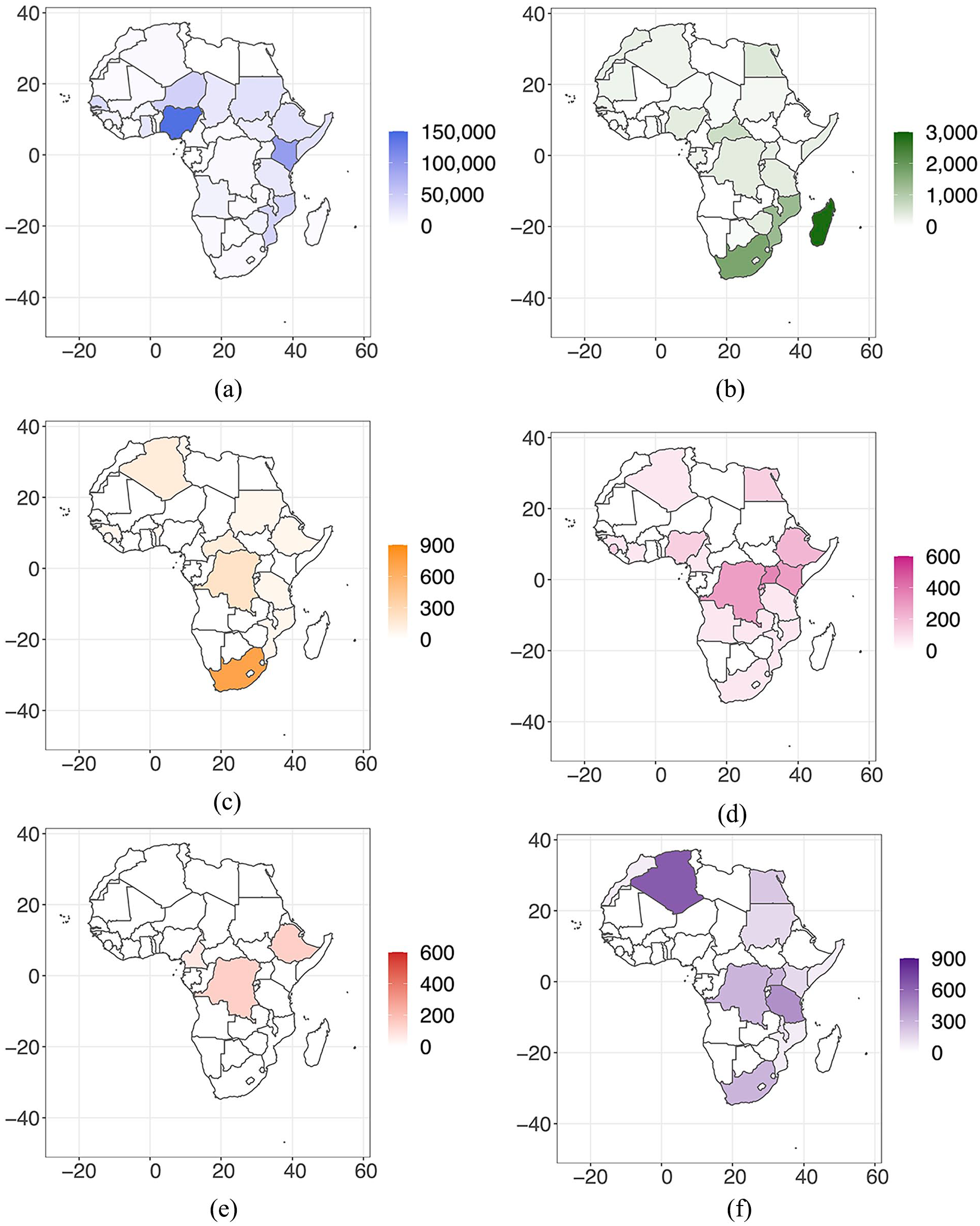
Average annual displacement by sudden-onset natural hazards in Africa 1990–2017: (a) floods, (b) storms, (c) wildfires, (d) landslides, (e) volcanic activity, and (f) earthquakes.
The independent variable of interest, Total environmental displacement, reflects the sum of all relocation driven by floods, storms, wildfires, earthquakes, landslides and volcanic activity for each country at the monthly level over the time period 1990–2017 (in thousands of people). Displacement for each hazard was also analyzed independently, providing the variables Flood displacement, Storm displacement, Wildfire displacement, Earthquake displacement, Landslide displacement, and Volcano displacement. Dislocation caused by sudden-onset natural disasters tends to be temporary, peaking in the immediate aftermath but declining over time as residents return home to rebuild and resume normalcy (Adger et al., 2018; Burton, 1993; Ionesco et al., 2016; Laczko and Aghazarm, 2009; Raleigh et al., 2008). In order to account for displacement that persists beyond the initial onset and return over time, an exponential decay function was applied to the displacement variables, assuming a rate of 75% of persons returning monthly. This approximate repatriation rate is informed by recent research from Africa finding that the majority of displaced persons tend to return home within days or weeks of a rapid-onset disaster, while a minority remain dislocated for months or are unable to return (UNDRR, 2019). 5 There are well-known limitations to analyzing aggregated data (see Buhaug and Lujala, 2005); nonetheless, in the present study, country-level data allow for assessing the independent impact of environmental displacement across a wide range of cases, and thus offers a valuable contribution.
Antigovernment upheaval
The outcomes of interest for testing the hypotheses are Civil war onset, Antigovernment armed attacks, Nonviolent protests, and Violent riots. Civil war onset is a dichotomous variable indicating the initiation of armed conflict by an organized non-state actor against the central government (exceeding 25 battle-related deaths). Antigovernment armed attacks is a count variable indicating the number of events in which militarized non-state actors launch violent assaults against government targets. Protests is the quantity of nonviolent protests making a demand on the government. Violent riots is measured as the quantity of distinct attacks by members of unarmed social or political groups that target the government and intend to cause physical or property harm. The Civil war onset variable is collected from the UCDP/PRIO Armed Conflict Dataset (Gleditsch et al., 2002; Pettersson et al., 2019), while data for armed attacks, protests and violent riots come from the Social Conflict Analysis Database (Salehyan et al., 2012).
Controls
Data are also collected for a host of control variables to account for possible confounders, including GDP per capita (World Bank, 2019), Regime type, measured by the Varieties of Democracy (V-Dem) Polyarchy Index (Coppedge et al., 2020), Ethnic exclusion and Ethnic heterogeneity (Cederman et al., 2011; Raleigh et al., 2008; Vogt et al., 2015), Population density and Population growth (Goldstone, 2002), Prior armed conflict (Raleigh, 2011; Walter, 2004) and Natural hazards (lagged) (Chang and Berdiev, 2015; Flores and Smith, 2013; Nel and Righarts, 2008; Omelicheva, 2011). 6
Method
To test the relationship between environmental displacement and antigovernment political conflict, a generalized linear model is specified for each of the aforementioned dependent variables. Logistic regression is used to analyze the binary outcome of Civil war onset. For the other dependent variables, which represent counts of armed attacks by non-state actors, protests, and violent riots, Poisson regression is employed. Each analysis estimates the impact of environmental displacement with the control variables described and reports country-clustered robust standard errors. A battery of robustness checks are completed to ensure the findings are not sensitive to model specification.
Analysis and results
Civil war onset
Does environmental displacement caused by sudden-onset natural hazards fuel political upheaval? Hypothesis 1 posits that higher levels of environmental displacement increase a country’s risk of civil war. Because EDPs are particularly likely to be economically disenfranchised and politically aggrieved, they theoretically provide a new pool of high-risk individuals that could be more easily mobilized for rebellion, which in turn could facilitate the initiation of hostilities. In Table 2, Models 1 and 2 employ logistic regression analysis to test whether environmental displacement increases the likelihood of civil war onset. The unit of analysis is the country-month and coefficients are presented in log odds with country-clustered robust standard errors in parentheses. The results indicate that contrary to Hypothesis 1, countries experiencing displacement related to sudden-onset natural hazards do not have an elevated risk of experiencing armed conflict onset.
Effects of environmental displacement on civil war onset in Africa 1990–2017 (logit).
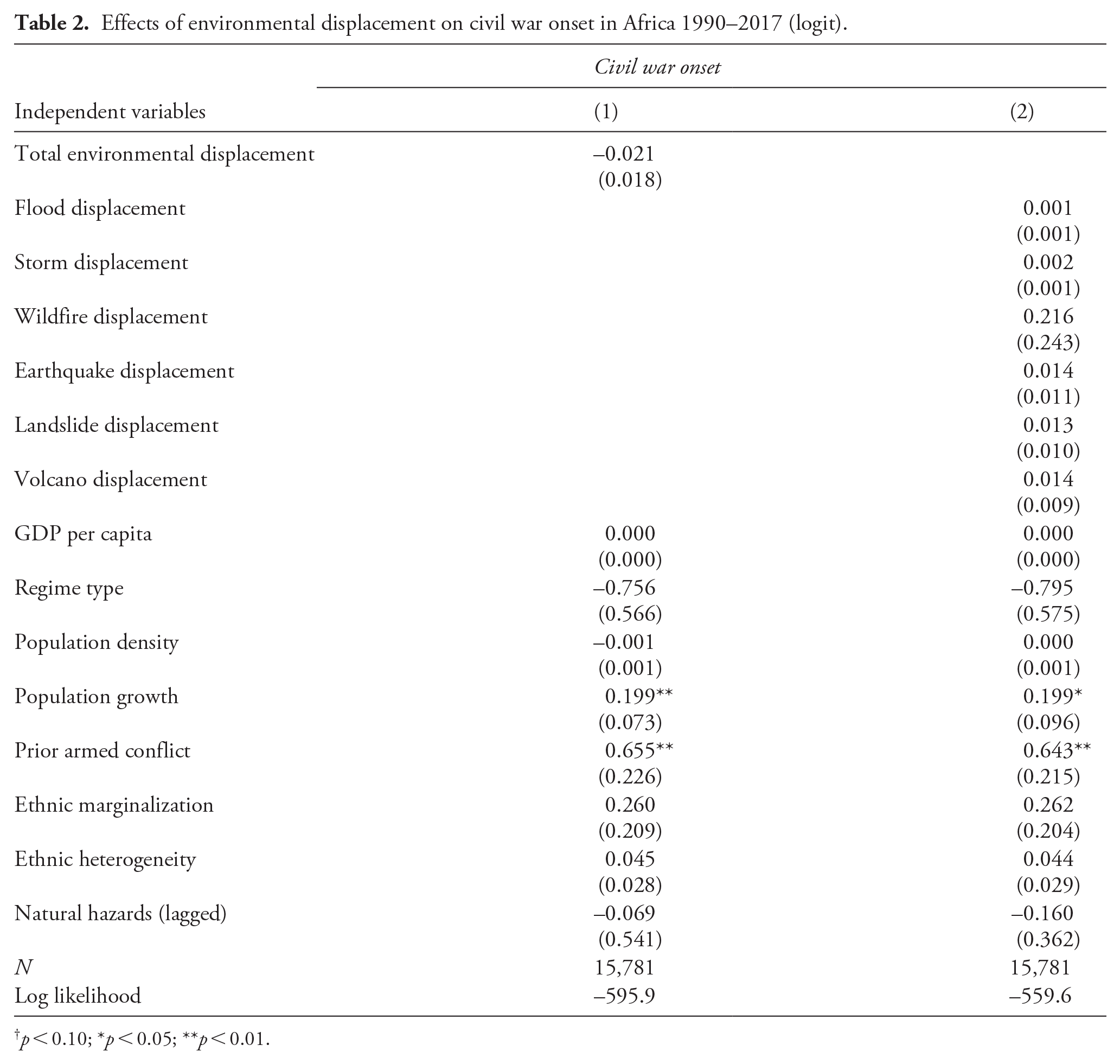
p < 0.10; *p < 0.05; **p < 0.01.
What explains the irrelevance of environmental displacement for civil war onset? One answer may lie in the patterns of human movement caused by sudden-onset events. Displacement resulting from sudden-onset hazards tends to be relatively short in duration and distance (e.g. Adger et al., 2018; Bohra-Mishra et al., 2014; Gray and Mueller, 2012). It may be the case that dislocations caused by these particular types of events are, on average, too temporary to generate the recruitment opportunities needed to facilitate civil war onset. In contrast, events like droughts tend to fuel more permanent dislocations leading to demographic upsets and population pressures that fuel long-term unemployment, financial precarity and food insecurity. Migrations caused by slow-onset events may therefore generate a population that is more susceptible to militarization. Along these lines, evidence from existing studies suggests that drought-driven migration has played an instigating role in some of the world’s most intractable civil wars, such as in Sudan and Syria (e.g. Kelley et al., 2015; Reuveny, 2007).
Attacks by armed non-state actors
Does environmental displacement increase the intensity of ongoing civil war? Hypothesis 2 posits that environmental displacement creates new opportunities and incentives for existing armed groups to intensify their antigovernment military struggles, leading to an increase in armed attacks by non-state actors. Models 1 and 2 (Table 3) employ Poisson regression analysis to estimate the impact of environmental displacement on the incidence of violent attacks by armed non-state actors. Again, the unit of analysis is the country-month and coefficients are presented as log odds with country-clustered robust standard errors in parentheses. The results show that dislocations driven by sudden-onset natural hazards correspond to higher incidences of violent attacks by non-state actors. Supporting Hypothesis 2, the coefficient on Total environmental displacement is statistically significant and positive, indicating that a 1,000-person increase in displacement corresponds to a 0.001-increase in the log count of violent assaults against government targets. The disaggregated examination of displacement, reflected in Model 2, reveals that this destabilizing effect is driven primarily by movements in response to floods and storms. A 1,000-person increase in flood and storm displacement increases the log count of armed attacks by non-state actors by 0.001. Displacements caused by wildfires, earthquakes, landslides and volcanic activity have no significant effect on armed attacks.
Effects of environmental displacement on antigovernment political upheaval in Africa 1990–2017 (Poisson).
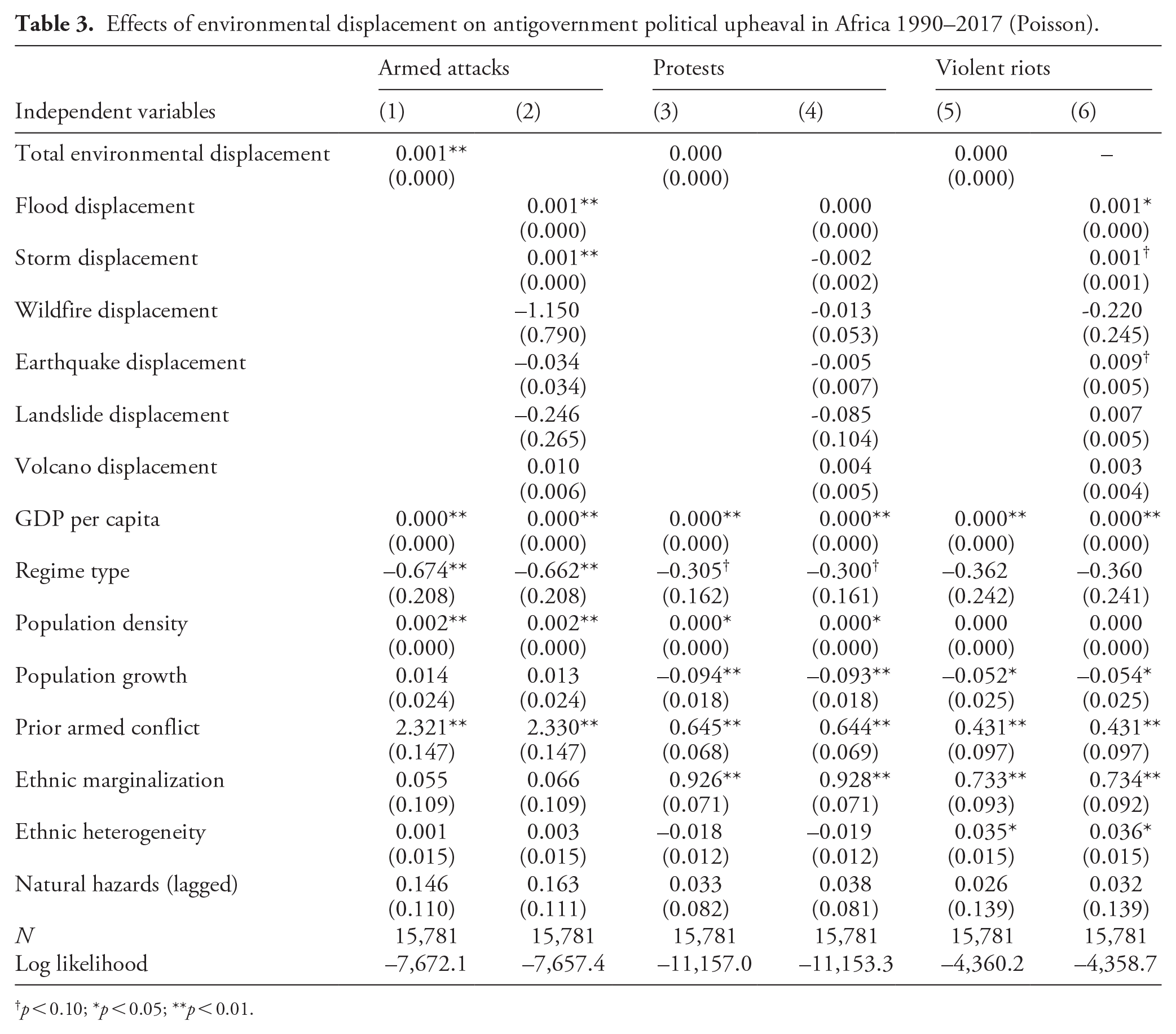
p < 0.10; *p < 0.05; **p < 0.01.
These findings support Hypothesis 2 and suggest that when countries experience displacement crises as a result of sudden-onset natural hazards, armed groups seek to capitalize on the proliferation of humanitarian relief and constrained state capacity by accelerating their violent campaigns for strategic gain. Because log odds are difficult to interpret in substantive terms, Figure 2 illustrates how the incidence of violent attacks by armed non-state actors changes as environmental displacement increases, with all control variables held constant at their means. In each plot, the continuous line indicates the expected quantity of armed attacks (y-axis) at different quantities of environmental displacement (x-axis), with shaded areas representing confidence intervals. Evident in Figure 2a, Total environmental displacement increases violent assaults by armed non-state actors. The impact is fairly small around average levels of displacement, but increases more steeply as hazard displacement exceedes 1 million. Armed attacks are expected to increase from 0 to 1 as sudden-onset hazard displacement approaches 1.4 million, and armed attacks are expected to double when displacement reaches 2.3 million. As Figure 2b and c show, a similar pattern is produced by flood and storm displacement.
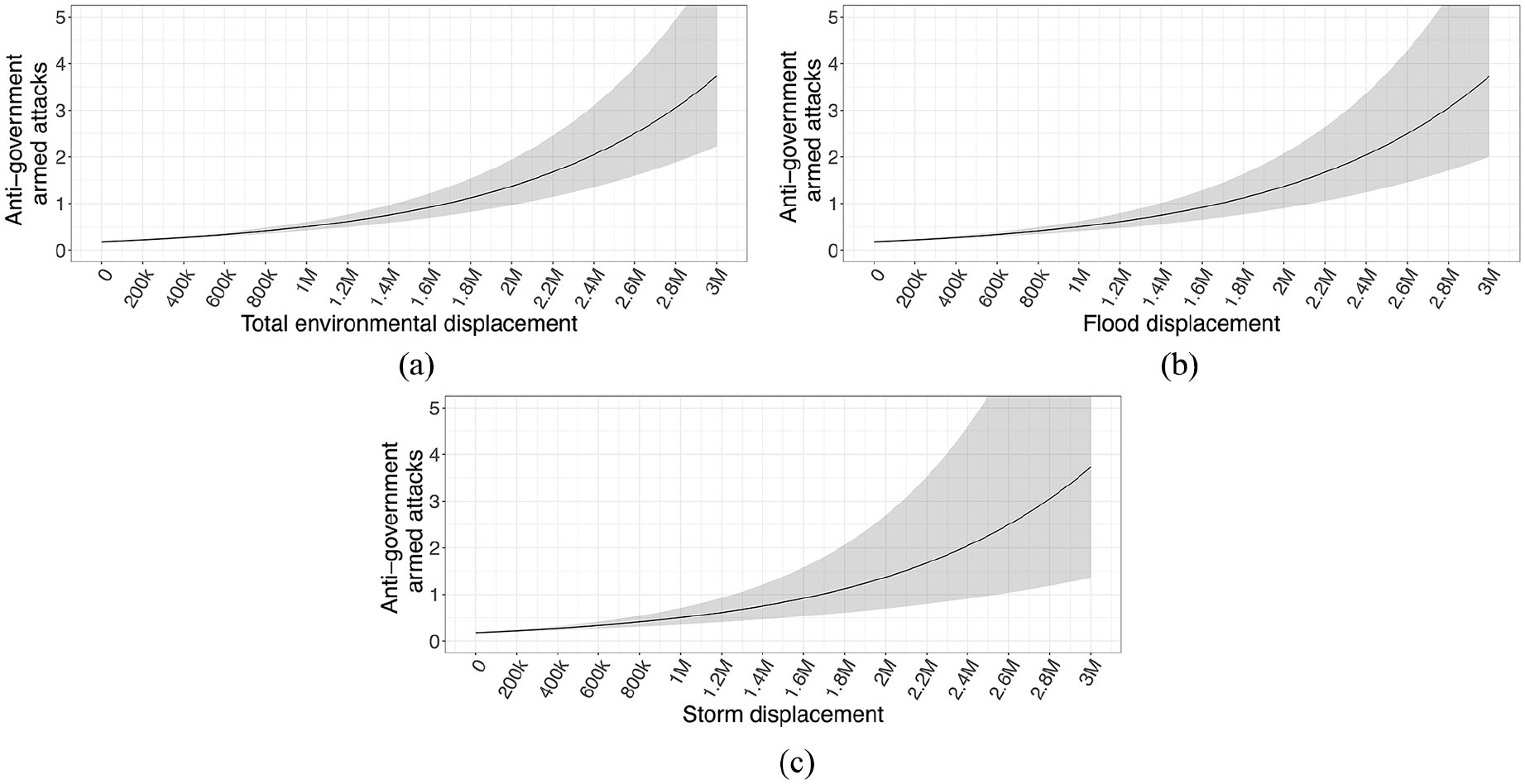
Predicted count of armed attacks by non-state actors in a given country-month at increasing quantities of environmental displacement for total environmental displacement (a), flood displacement (b) and storm displacement (c).
Collectively, these results suggest that a threshold effect governs the relationship between environmental displacement and conflict intensity. Governments may effectively manage displacement at routine levels but falter when dislocations exceed a certain threshold and push systems of disaster preparedness and response beyond their limits. The logic of the threshold effect suggests that when government capacity to maintain order is overwhelmed by excessive environmental displacement, it activates armed groups’ incentives and opportunities to escalate their military activity (e.g. Homer-Dixon, 1991). The threshold effect may also explain why flood and storm displacements impact armed conflict while other hazards have no effect. Floods and storms displace several orders of magnitude more people than other types of hazard, which may not be sufficiently disruptive to generate enticing incentives or opportunities for armed actors.
The finding that flood and storm displacements increase the intensity of armed conflict also attests to a threat-multiplier effect of climate change and adds to the evidence from prior research demonstrating that sudden-onset natural hazards fuel conflict longevity (e.g. Eastin, 2016; Ghimire et al., 2015). For governments already in the throes of violent conflict, this portends deepening security crises and potential conflict traps as climate change accompanies more frequent episodes of increasingly extreme weather. The exacerbating effect of environmental displacement highlights the need for more integrative frameworks of disaster preparedness, response and recovery that incorporate elements of stabilization, security and peacebuilding.
Protests
To test Hypothesis 3, Models 3 and 4 in Table 3 employ Poisson regression to evaluate the extent to which sudden-onset hazard displacement increase the incidence of antigovernment protests. The results show that these nonviolent manifestations of political dissent are, on average, unaffected by these dislocations. Evident in Model 3, Total environmental displacement has no discernible impact on the incidence of antigovernment demonstrations. Model 4 shows that this null effect is consistent for all short-term hazards: migrations caused by floods, storms, wildfires, earthquakes, landslides and volcanic activity do not correspond to significant changes in antigovernment protests.
Violent riots
Finally, Models 5 and 6 in Table 3 evaluate the effect of environmental displacement on the incidence of violent riots. The analyses reveal some support for the hypothesis that environmental displacement caused by sudden-onset natural hazards provokes antigovernment violent riots (Hypothesis 4). Evident in Model 5, aggregated environmental displacement does not significantly affect the incidence of violent riots. However, Model 6 reveals that the relationship varies depending on the type of hazard driving relocation. Displacements caused by floods have a positive and statistically significant impact on antigovernment violent riots. A 1,000-person increase in flood-driven displacement increases the expected log count of violent riots by approximately 0.001. Storm and earthquake displacement straddle the standard threshold of statistical significance, and displacements caused by wildfires, landslides and volcanic activity have no discernible effect on the incidence of violent riots.
Figure 3 illustrates how the predicted level of violent riots changes at different levels of environmental displacement, holding control variables constant at their means. The effect of Total environmental displacement is presented alongside the three statistically significant variables of Flood displacement, Storm displacement and Earthquake displacement. The null effect of aggregated displacement is evident in Figure 3a: the predicted quantity of violent riots remains near 0 and does not change regardless of how many people are displaced. Figure 3b to d show that, though positive and significant, displacements driven by floods, storms and earthquakes have only a weak effect on violent riots. Figure 3b and c indicate that an increase in flood or storm displacement from 0 to over 2 million is needed to increase the incidence of violent riots from 0 to 1, a tall order considering that the average flood in Africa displaces 24,400 people. Earthquake displacement, evident in Figure 3d, increases the expected incidence of violent riots more sharply, but violent riots are still only detected as displacement surpasses 200,000 – well above the average quantity of people displaced for these events (14,873 for earthquakes). One interpretation of this result is that while the risk of violent riots is fairly low for routine levels of displacement, these dislocations can become destabilizing at exceptionally high levels. This finding should not be discounted given the present era of global warming, in which climate-related hazards are increasingly producing extreme levels of displacement (IPCC, 2021).
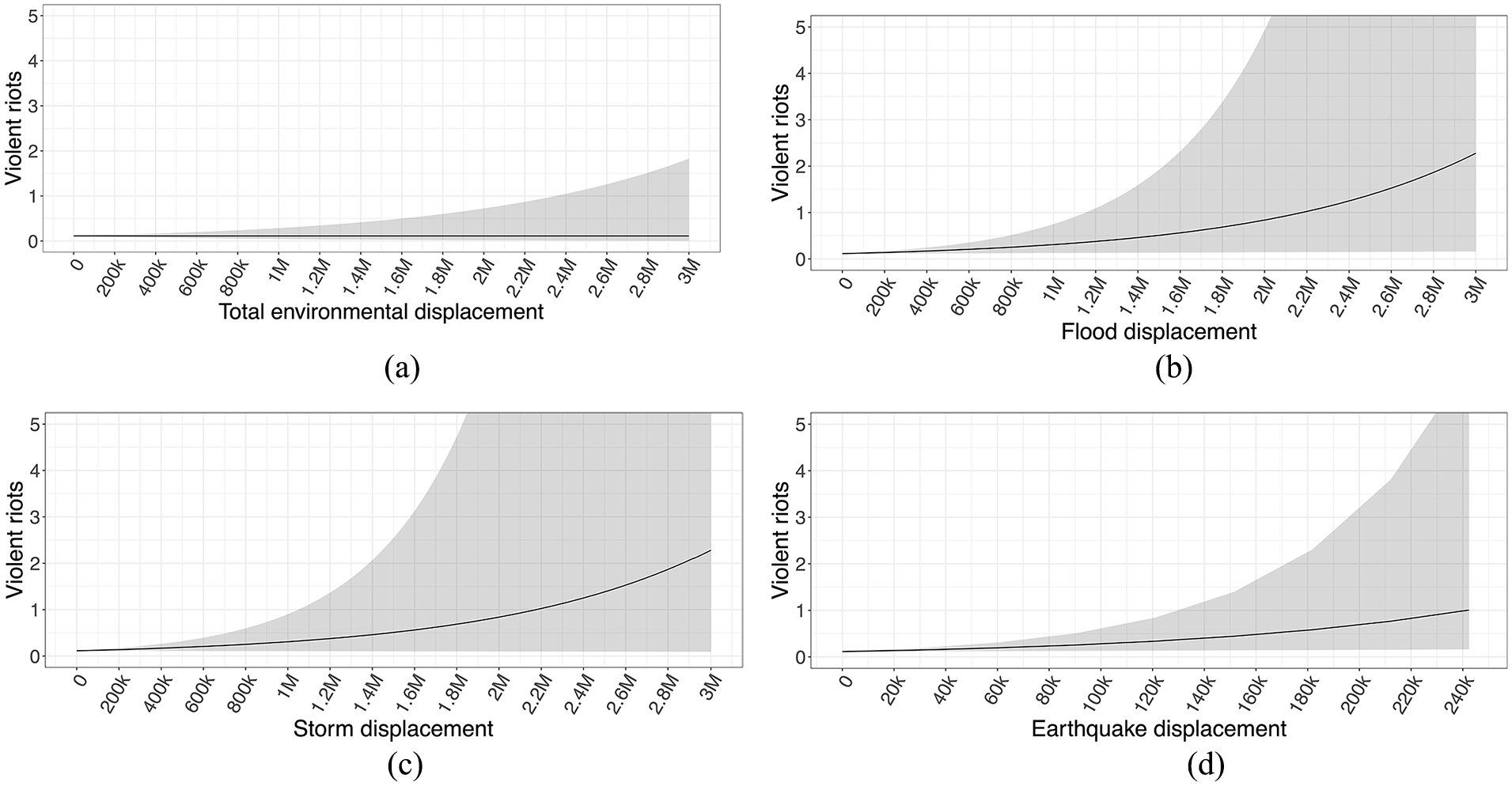
Predicted count of antigovernment violent riots in a given country-month at increasing quantities of environmental displacement for total environmental displacement (a), flood displacement (b), storm displacement (c) and earthquake displacement (d).
Why do high levels of environmental displacement trigger violent riots but not nonviolent protests? While there is considerable overlap in the motivations and opportunity structures that facilitate both protests and riots, these outcomes entail distinct costs and dynamics, and thus emerge under different conditions. Because participation in violent movements is a comparatively high-risk and high-cost activity, riots are generally associated with more intense, existential distress caused by more extreme economic disparities and sociopolitical inequalities. High levels of environmental displacement lead to more acute, life-threatening hardships that require urgent action, and dissidents may doubt the efficacy of peaceful measures to effectively resolve these issues. At the same time, while scholars generally agree that the individual costs of participating in a violent riot are higher than those associated with nonviolent protests, dissidents may perceive lower costs of violence in the wake of rapid-onset environmental shocks. These events overwhelm state capacity and cultivate an atmosphere of disorder in which the government has more difficulty identifying and repressing antigovernment movements. Perceiving a lower likelihood of state sanctions, dissidents may be more inclined to participate in violent riots.
Robustness checks
As a precaution against drawing erroneous inferences about the destabilizing effects of environmental displacement, a number of robustness checks are executed.
The impact of sudden-onset hazard displacement on political upheaval may vary with contextual factors, and failure to test for relevant interactive effects can lead to flawed conclusions. For instance, a country’s regime type may play an important role in shaping the extent to which displacement caused by sudden-onset natural hazards fuels unrest, as electoral incentives to provide public goods in democracies may translate to improved disaster prevention and relief that mitigate dissent-inducing grievances (Persson and Povitkina, 2017). To test the potential moderating effect of regime type, the analyses are repeated for each outcome including an interaction between a country’s level of sudden-onset hazard displacement and its type of political regime. Robustness checks are also completed for other contextual factors that may condition the effect of environmental displacement on political instability, such as economic development and inequality. The results, available in Online Appendix B, remained unchanged.
The findings also remained robust to the inclusion of additional control variables that may confound the relationship between environmental displacement and political upheaval. The results do not change when accounting for lagged versions of each dependent variable (Wilkins, 2018), Ongoing armed conflict (Omelicheva, 2011), Economic growth (GDP growth per capita) (Bergholt and Lujala, 2012) and State repression (see Online Appendix C).
A final robustness check is completed to ensure that the findings are not sensitive to variation in repatriation rates. In the above analyses, the effects of environmental displacement on outcomes of political upheaval were estimated assuming that 75% of displaced persons return to their origin each month, based on extant research demonstrating that most people repatriate within a month of a short-term hazard (UNDRR, 2019). To ensure that the results are not specific to the assumed 75% return rate, the analyses are repeated with simulated return rates at increments ranging from 50% to 90%. Adjusting the rate of repatriation does not alter the results (see Online Appendix D).
Conclusion
Policymakers and scholars alike have raised the alarm about the possibility of impending security crises and instability caused by environmental displacement. However, existing empirical research has been scant and produced mixed findings. This article aims to advance our understanding of the security consequences of environmental displacement with a cross-national analysis of sudden-onset natural hazards in Africa.
The empirical investigation herein provides broad evidence that displacement caused by sudden-onset natural hazards triggers political instability by increasing the incidence of armed attacks by non-state actors and violent riots. These findings are highly consequential given the context of evolving climatic change. Global warming is increasing the frequency and intensity of extreme climate-related natural hazards, even under conditions of limited warming, with direct implications for environmental displacement (IPCC, 2021). Floods and tropical storms that displace hundreds of thousands of people in a matter of days are becoming significantly more common. Events like landslides and wildfires that have historically produced low levels of displacement have the potential to become high-displacing events. Dislocations by accelerated climate-related risks will continue to accumulate with those driven by other events, such as geological hazards. Overall, these findings confirm that environmental displacement precipitates political instability and portends worsening security crises as the effects of climate change unfold.
Nonetheless, political upheaval is not an inevitable consequence of environmental displacement. Governments can intervene in a variety of ways to limit displacement-related instability (Brzoska and Fröhlich, 2016; Mitchell and Pizzi, 2021). Managed retreat from hazard prone areas, regulatory action on construction and settlement, investment in climate-resilient infrastructure, risk-informed land planning and economic diversification are just a few strategies that can limit displacement (IPCC, 2021). Effective disaster response and humanitarian aid are also important for quelling grievances and discontent in migrant-receiving areas, but steps should be taken to secure disaster relief from predatory looting by armed non-state actors. Where governments lack sufficient resources to implement these measures, support from the international community will be critical in filling in the gaps to mitigate displacement crises and ensuing political instability.
Footnotes
Replication data

Funding
The author received no financial support for the research, authorship, and/or publication of this article.
Notes
ANGELA CHESLER, b. 1991, PhD in Political Science (University of Notre Dame, 2023-2025); Postdoctoral Fellow, University of Pennsylvania (2023–present).