




Abstract
Can armed conflict amplify the societal impacts and humanitarian consequences of natural hazards? Given that these hazards affect millions of people worldwide and that climate change is expected to increase the frequency and intensity of extreme weather events, it is paramount that we advance our understanding of what makes societies vulnerable to these hazards. Existing research has focused mainly on political violence as a consequence of natural hazard-related disasters but has neglected that conflict can also be an underlying factor that shapes the impact of these events. Consequently, we know little about whether and how exposure to violent armed conflict increases vulnerability to natural hazards. This study argues that the local dynamics of conflict can have a significant effect on vulnerability and empirically investigates how periods of high-intensity conflict can affect the humanitarian consequences of natural hazards in the context of tropical cyclones in the Philippines. By combining data on physical storm exposure with highly detailed subnational data on disaster fatalities and conflict events, the empirical analysis allows the identification of the independent effect of conflict on hazard impacts. Results show that local periods of high-intensity conflict significantly increase the humanitarian consequences of natural hazards. These results have important implications for research investigating the impacts of disasters on peace and conflict, as they show that the consequences of natural disasters depend fundamentally on pre-existing conflict dynamics.
Introduction
Can armed conflict increase the risk that natural hazards become natural disasters? We know that natural disasters and armed conflict often go hand-in-hand. Examples of the close relationship between the two phenomena are numerous, from droughts and other natural hazards that threaten the food security and lives of millions in Afghanistan (OCHA, 2018) to cyclones causing major flooding and displacing thousands in conflict-ridden Yemen (UNICEF, 2015). This observed association between conflict and disaster has sparked a burgeoning research agenda investigating whether and how disasters can impact the dynamics of conflict and peace (Brzoska, 2018). However, little is known about the reverse relationship, that is, the effects of armed conflict on the impacts of natural hazard-related disasters. This study aims to add to our understanding of the conflict–disaster nexus by investigating how the dynamics of ongoing state-based conflict can drive disaster risk.
Of course, armed conflicts alone cannot cause natural disasters. Disasters arise when vulnerable populations are exposed to natural hazards such as earthquakes or extreme weather events. These events, however, only result in calamities when they strike people that are ill-prepared. This point is easily illustrated by considering the case of Japan, a country routinely hit by earthquakes of magnitudes that cause widespread devastation in other countries. However, since Japan has successfully reduced its vulnerability to this particular hazard, even formidable earthquakes there seldom have disastrous consequences. Disaster risk science has long pointed out that vulnerability is the main factor in determining the consequences of disasters. As vulnerability, understood as the susceptibility to suffer harm or damage from a natural hazard, is determined mainly by socioeconomic and political processes, so-called ‘natural’ disasters are, in fact, not natural but the results of human choices made at the individual and the societal level (Hewitt, 1983; Kelman, 2020; O’Keefe et al., 1976; Tennant and Gilmore, 2020; Wisner et al., 2014). While this research agenda has pointed to conflict as an important condition of vulnerability (Siddiqi, 2018; Walch, 2018a; Wisner, 2012), quantitative empirical evidence for a potential causal link from armed conflict to disaster risk and hazard impact is still rare.
To see why armed conflict might be blamed as one of the culprits when natural hazard events have disastrous consequences, consider Typhoon Yolanda (internationally known as Haiyan) that made landfall on 8 November 2013 on the Philippine islands of Samar and Leyte. Yolanda was one of the strongest typhoons ever recorded with wind speeds exceeding 300km/h and storm surges reaching up to 6m in height (Ide, 2023b). The storm significantly exceeded the preparation and coping capacity of the exposed communities and caused more than 6,000 fatalities. The high death toll was quickly attributed, in part, to the ongoing armed conflict in the region (Walch, 2013). Both islands are strongholds of the communist insurgency of the New People’s Army (NPA) and experience regular fighting between the government and the NPA (Ide, 2023b). The conflict displaced a large number of people who sought refuge in the area of Tacloban, the city hit hardest by the storm and that alone saw over 2,200 casualties (Meniano, 2022). There, migrants often ended up in illegal settlements that were exposed to storm-related hazards like floods and landslides. These migrants were particularly hesitant to follow evacuation orders ahead of the storm because they suspected a ploy by the government to evict them from their homes (Walch, 2018b). In fact, according to government reports, only 3,105 people of the ca. 220,000 inhabitants of the city responded to early warnings and evacuated pre-emptively. The conflict had eroded the trust not only in public officials but also the confidence that the public evacuation centers were safe refuges (Walch, 2018b). Post-disaster aid was also hampered by the ongoing conflict when the NPA attacked aid convoys claiming that these were, in fact, counterinsurgency measures by the military (Rappler, 2013). In response, the Philippine military established checkpoints that further slowed relief operations (Walch, 2013).
By investigating the effects of armed conflict on hazard impact, this study aims to bring together the disaster and the conflict literature, which so far have seldom engaged with each other’s fundamentals (Peters and Kelman, 2020). That both research strands have comparatively neglected armed conflict as a root cause of vulnerability is surprising and potentially problematic. It is surprising because the effect of disasters on either peace or conflict seems to be largely dependent on fairly specific context conditions (Brzoska, 2018; Scheffran, 2020). Conversely, the opposite effect of conflict on disaster risk appears to be much more robust – at least at first glance (Hilhorst et al., 2019; Peters and Budimir, 2016). Neglecting conflict as a driver for disaster risk is also problematic from an inference point of view. Studies investigating the conflict-related consequences of disasters are often based on the tacit assumption that disasters are largely exogenously determined events unrelated to conflict dynamics or pre-existing social vulnerabilities. If conflict, however, does influence disaster risk, any uncovered relationship from disaster to peace or conflict outcomes might be spurious.
This study seeks to contribute to our understanding of the conflict–disaster relationship by investigating how the dynamics of ongoing state-based conflict can drive disaster risk and hazard impact. Specifically, I argue that local periods of high-intensity fighting during ongoing armed conflicts can affect the vulnerability to natural hazards in meaningful ways. Regions that experience particularly intense periods of fighting should have a significantly higher disaster risk and hence see more disaster-related fatalities. Furthermore, the adverse effects of conflict might also spill over into the immediate vicinity of the fighting. People fleeing from conflict events into neighboring areas are significantly more vulnerable to natural hazards because they lack the necessary resources that can provide protection against extreme weather events. Additionally, military forces stationed in the area – often important actors during the disaster response – will be occupied fighting insurgents and thus less able to assist in disaster relief.
Empirically, I concentrate on one type of hazard in one specific country: tropical cyclones in the Philippines. The Philippines is not only one of the most hazard-prone countries in the world but is also beset by two ongoing civil conflicts, which make it both a relevant and suitable case to study. Compared to other natural hazards, such as floods, storms are particularly interesting from causal inference perspective. Exactly when and where tropical cyclones will hit can be forecast only in the relatively short period after they have formed, making them plausibly exogenous events. I collected province-level fatalities data from government reports for all major tropical storms that made landfall in the Philippines from 2009 to 2019. I account for different levels in physical storm exposure by interacting highly disaggregated wind speed and rainfall data with detailed subnational population estimates. Conflict data come from the UCDP Georeferenced Event Dataset (GED), and I employ a state-of-the-art two-way fixed effects estimator to test whether periods of high-intensity conflict lead to higher disaster fatalities. Results show that Philippine provinces that experienced an unusually high number of armed conflict events preceding major tropical storms tend to suffer more storm-related fatalities compared to provinces that saw no or below average conflict intensity. Furthermore, there seems to be a contagion effect where adjacent provinces are also adversely affected by the conflict.
By highlighting that armed conflict is a significant driver of disaster vulnerability, this study also has important implications for disaster risk reduction policies that so far have often ignored conflict contexts (Peters and Budimir, 2016; Siddiqi, 2018; Walch, 2018a). Neglecting conflict areas when designing disaster risk reduction policies can have especially grave humanitarian consequences as the adverse effects of armed conflict and natural hazards can compound. However, this also means that peace-building and disaster risk reduction can reinforce each other – something that should be kept in mind in the face of climate change.
Conflict and natural disasters: Existing literature
Most studies have approached the conflict–disaster nexus by investigating the effect of natural hazards on conflict. Motivated by the fact that global warming has the potential to increase the intensity and frequency of extreme weather events (IPCC, 2018), various mechanisms and scope conditions connecting natural disasters on the one hand, and conflict and peace, on the other hand, have been empirically scrutinized (Brzoska, 2018; Koubi, 2019; Mach et al., 2019; Von Uexkull and Buhaug, 2021).
With a few exceptions, these studies conceptualize natural disasters primarily as exogenously determined and discrete events. The general assumption is that disasters can be seen as external shocks that occur more or less randomly. These shocks might manifest as resource scarcity, grievances from inadequate post-disaster aid delivery, migration, or changes in battlefield capabilities that, in turn, impact conflict dynamics (Ide, 2023a). However, this approach has been criticized as ignoring the central insight from the field of disaster risk science, namely that disasters are not discrete events but processes deeply embedded in socioeconomic contexts and that an appreciation of these contexts is crucial in understanding disasters (Peters, 2022; Peters and Kelman, 2020).
Ignoring the inherent endogeneity of disaster may lead to biased inferences about the impact of disasters on conflict. Pre-existing, underlying societal characteristics that might be responsible for both the disaster and the conflict outcome are confounders that should be accounted for (Peters and Kelman, 2020; Reinhardt and Lutmar, 2022).This study takes the endogeneity of disasters as a starting point and asks whether armed conflict exposure itself can be identified as a driver of disaster risk and disaster losses. It thus seeks to answer the growing number of calls from both conflict and disaster scholars for research that goes beyond a simple unidirectional relationship from disaster to conflict (Buhaug and Von Uexkull, 2021; Olson and Gawronski, 2017; Peters and Kelman, 2020; Reinhardt and Lutmar, 2022).
The dominant paradigm in disaster risk science has long been that disasters are ultimately the result of human (in-)actions (Gaillard et al., 2014; Hewitt, 1983; Kelman, 2018, 2020; O’Keefe et al., 1976; Wisner et al., 2014). Even when they arise partly from natural hazards, such as extreme weather events, earthquakes, or volcanoes, disasters are fundamentally influenced by human actions, making them anthropogenic rather than solely natural occurrences. Disasters arise only when humans do not take the necessary precautions to deal with such hazardous events. Thus, it is useful to think of disaster risk as a function of hazard, exposure, and vulnerability (UNDRR, 2020). The natural hazards that most people associate with the term ‘natural disaster’ have disastrous consequences only when populations and assets are located in the hazard area (the exposure) and are simultaneously susceptible to suffering harm (the vulnerability) from the hazard. Hence, disaster risk science has emphasized that vulnerability is the crucial part of the
To understand the impacts of disasters, therefore, we need to understand the root causes of vulnerability (Wisner et al., 2014). A rich literature has investigated various structural socioeconomic conditions that contribute to vulnerability, ranging from economic development (Jongman et al., 2015) to institutional capacity and public sector corruption (Kahn, 2005; Keefer et al., 2011) to inequality (Cappelli et al., 2021) and poverty (Peduzzi et al., 2012).
However, the specific role of armed conflict in driving disaster risk and hazard impact has been comparatively neglected. Only recently have scholars called for more attention to how the dynamics of already ongoing conflicts can affect hazard impacts (Barnett, 2006; Buhaug and Von Uexkull, 2021; Peters and Kelman, 2020; Siddiqi, 2018). While a handful of existing studies have illuminated the pathways through which conflict exposure can not only increase vulnerability but also create new hazards and contribute to exposure (Desportes and Hilhorst, 2020; Hilhorst et al., 2019; Peters, 2021), we have only minimal quantitative empirical evidence for this effect. So far, only a few studies have taken this angle. In their cross-country analysis, Marktanner et al. (2015) estimate that disaster fatalities are, on average, 40% higher when a country experiences at least one major episode of political violence in the preceding five years. In a similar study, Caso et al. (2023) also document a strong cross-country correlation between armed conflict and disasters. Finally, Vestby et al. (2024) show that floods lead to significantly higher displacement numbers in contexts of prevalent armed conflict. However, these studies struggle with identifying any causal effects. Hence, we need further empirical evidence to better understand how the precise dynamics of armed conflict affect hazard impact.
How armed conflict leaves a legacy of disaster risk
There are several mechanisms through which state-based armed conflict can potentially contribute to the adverse impacts of disasters. This section outlines the broader and more structural channels that have been identified in the literature before the next section details how the dynamics of ongoing conflicts might affect disaster hazard. Figure 1 illustrates these mechanisms and groups them into more general, structural channels and more sudden channels that relate more specifically to the effects of periods of high-intensity conflict. It is worth noting, however, that this distinction primarily serves to guide the discussion and the difference is not always clear-cut, for example when the displacement of populations becomes a more protracted situation.
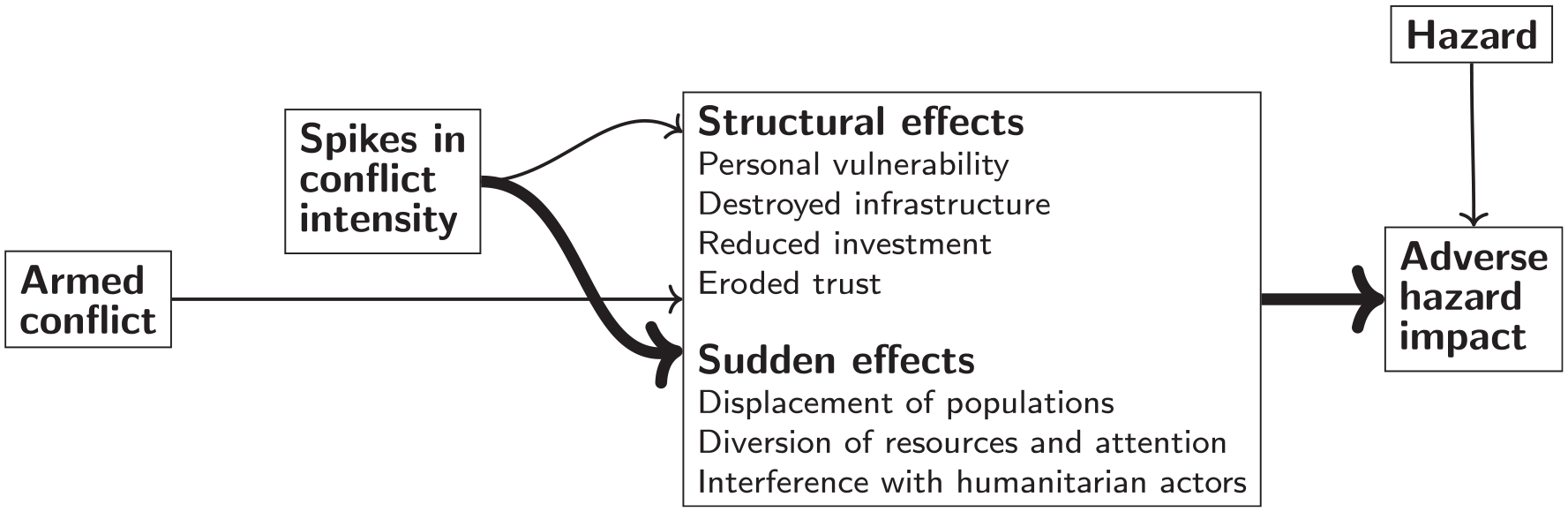
Mechanisms connecting armed conflict and disaster impact.
First, exposure to armed conflict can increase personal vulnerability. Experiences of violence can lead to physical disabilities and mental traumata that might leave individuals less able to address and deal with hazards by themselves (Peters, 2021). Conflict can also cause the loss of income and livelihoods, reducing the ability of individuals to invest in costly disaster preparation and mitigation efforts, such as storm-proofing homes and other buildings (Barnett, 2006; Buhaug and Von Uexkull, 2021).
More generally, a fragmented society will likely see lower levels of cooperation and trust. Consequently, it might be less likely to undertake the collective actions that are particularly important for reducing disaster risk (Desportes and Hilhorst, 2020). A lack of trust between citizens and public officials might also prove fatal when evacuation orders by official channels are not being followed (Walch, 2018b).
Furthermore, armed conflict can negatively affect public disaster risk management practices and capabilities. Critical protective infrastructure such as roads, dams, and evacuation shelters might be destroyed during fighting, either accidentally or deliberately, to gain a tactical advantage. Public services such as early warning systems might be disrupted, and stockpiled supplies might become inaccessible (Marktanner et al., 2015; Mitchell and Pizzi, 2021). Societies and states affected by conflicts will also have other priorities than dealing with the abstract and uncertain risk of future natural hazards (Barnett, 2006). Putting down an insurgency tends to be perceived as more pressing than reducing disaster risk.
Conflict also undermines the ability of the state to collect taxes and revenues, thus limiting the resources available for disaster risk management (Buhaug and Von Uexkull, 2021). This may lead to under-investment in protective infrastructure. Early warning systems, evacuation centers, roads, and dams all need to be built and maintained – otherwise, they might become hazards themselves. Finally, even when governments have the will and the resources to invest in disaster risk reduction policies, they might choose to prioritize peaceful regions rather than investing in areas where hostile insurgents are active.
In short, armed conflict can affect disaster risk by increasing personal vulnerability, eroding social trust, and adversely impacting public disaster risk management by destroying infrastructure and reducing investment. These mechanisms all point to rather long-lingering effects of armed conflict. Personal experiences of violence, corroded trust, and destroyed or unbuilt infrastructure will increase the vulnerability to natural hazards for years or even decades. Other mechanisms that are related to the precise dynamics of armed conflict point to more local and sudden effects.
How conflict dynamics affect disaster risk
Next to these lasting legacies of armed conflict, I argue that the precise temporal and geographic dynamics of ongoing armed conflicts can also exacerbate the adverse impacts of disasters. Armed conflict consists of localized events that are rarely distributed uniformly over a country. Instead, specific areas are often hotbeds of conflict and see a disproportional amount of fighting action. Furthermore, fighting intensity is not static but tends to shift between regions and over time. Locally confined periods of high-intensity conflict may have more temporary but nonetheless significant effects on hazard impact via three distinct mechanisms: displacement, diversion, and determent.
The first mechanism concerns the role of displaced people. Armed conflict and intense fighting, in particular, can force people to abandon their homes and temporarily settle in new, unfamiliar locations. In these new locations, displaced populations are especially vulnerable to natural hazards (Barnett, 2006; Siddiqi et al., 2019). Often, they have to leave most of their belongings and assets behind, making them dependent on the goodwill of host communities and other actors, such as external humanitarian organizations. Being unfamiliar with the local conditions, they might settle in dangerous locations, such as ravines prone to flash floods or hillsides prone to landslides (Zaman et al., 2020). Even when the potential danger of such locations is known, displaced people may be unable to afford to settle in safer areas (Peters, 2021).
Furthermore, their typically temporary dwellings are often ill-suited to withstand heavy winds or intense rainfall (Wisner, 2012). Being sometimes little more than makeshift emergency shelters, such housing provides little protection against environmental hazards. Refugees also often lack the social networks and ties that can be helpful during a disaster (Walch, 2018b). Having fewer social contacts that can spread information about hazards and provide assistance in the case of emergency further increases their susceptibility to harmful impacts. Finally, displaced people are often excluded from planning and preparation efforts; hence their needs might be little reflected in disaster risk reduction strategies (Peters, 2021).
The second mechanism operates by diverting attention and resources away from hazardous and disastrous events and toward the armed conflict (Collier, 1999). When a natural hazard event occurs during intense periods of fighting, actors willing to provide humanitarian support face a choice between two crises: the conflict or the hazard (Field, 2018). Being engaged in both simultaneously is often not feasible. The military is an actor that deserves particular attention in this regard. Because of its logistical capabilities, effective organizational structure, and ability to quickly muster large amounts of human resources and materials, militaries worldwide are often involved in disaster response (Heaslip and Barber, 2014). In the crucial hours and days immediately after a hazard strikes, military support can play an essential role in providing disaster relief as quickly as possible. The chaotic, confusing, and sometimes warlike post-disaster contexts make trained armed forces particularly effective in disaster situations (Barber, 2012).
However, the essential task for the military remains fighting against insurgents. As Eastin (2016) argues, the military faces a trade-off where it has to choose to allocate its resources to fighting or providing disaster relief. It stands to reason that providing humanitarian assistance loses importance for armed forces when they are occupied with battle-related operations during intense periods of fighting. Resources are limited, and when personnel, material, and attention are occupied with fighting insurgents, these resources cannot be used for disaster relief.
The third channel relates to the role of external actors in reducing disaster risk and providing disaster relief in the aftermath. Sometimes, insurgents might be unwilling to let international humanitarian actors inside their territory, as happened in Somalia during the 2011 famine (Gumucio et al., 2022). Intergovernmental organizations and international NGOs themselves have to prioritize the safety and well-being of their employees. Since sending them into areas of active and intense conflict might put them at serious risk, they will likely prioritize other regions, given limited resources (Healy and Tiller, 2014; Hilhorst et al., 2019).
Furthermore, there is reason to suspect that the adverse effects of conflict are not just confined to the conflict region itself but that the three mechanisms can also cause spillovers into neighboring areas. First, depending on the length of the migration journey, displaced people might end up not in the same but in a neighboring province. If the latter is the case, the increased vulnerability to natural hazards should also be observable in the neighboring regions. Second, when assuming that the military is only willing to relocate its forces within reasonable geographic boundaries for conflict- and disaster-related activities, the diversion effect should be most pronounced in the immediate surroundings of the increased conflict activity. Resources from the neighboring regions will be moved to the conflict locations first and this then might leave these areas especially vulnerable to natural hazards. Third, external humanitarian actors might also be hesitant to engage not just in the acute conflict zone but also in neighboring regions. Such organizations tend to operate on precautionary principles and might be reluctant to send their employees in the vicinity of active conflicts (Mena and Hilhorst, 2022).
Two separate hypotheses emerge from this discussion. First, intense periods of fighting should increase hazard impact in the fighting zone itself and, second, the regions in the immediate vicinity might also see a higher hazard impact.
Hypothesis 1: Periods of high-intensity conflict increase hazard impact in the conflict zone.
Hypothesis 2: Periods of high-intensity conflict increase hazard impact in regions neighboring the conflict zone.
Empirical strategy
Tropical cyclones in the Philippines
To investigate the effect of state-based armed conflict on natural hazard impact, I present and analyze an original dataset of storm-related fatalities across provinces of the Philippines. The Philippines is an important case to study concerning the interrelationship between conflict and disasters. Located along the Pacific Typhoon Belt and the Ring of Fire, the country is regularly exposed to various natural hazards like tropical storms, floods, earthquakes, and volcanoes, making it one of the most hazard-prone countries in the world. While Philippine society has developed extensive capacities and skills to deal with these hazards, two protracted intrastate conflicts between the government and communist insurgents and Muslim separatists, respectively, continue to contribute significantly to vulnerability (Bankoff, 2002; Kelman, 2020). This combination between hazard-proneness and ongoing armed conflict makes the Philippines both a suitable and substantially relevant case to investigate the relationship between conflict and disaster empirically.
Focusing on one specific type of hazard in one country allows me to hold many potentially confounding factors constant that might otherwise bias results in a cross-country analysis. Societies prone to armed conflict are usually also particularly vulnerable to natural hazards. The root causes of both phenomena overlap – levels of socioeconomic development, state capacity, population density, and social cohesion can all affect both the likelihood of armed conflict and the vulnerability to natural hazards (Peters and Kelman, 2020). Simply put, armed conflict is anything but randomly distributed, but its determinants are correlated with vulnerability. Restricting the analysis to one country holds many of these factors constant – or at least limits their variation substantially.
This study focuses on tropical cyclones. This allows me to account for the physical intensity of and the exposure to the hazard – something that is difficult to do when pooling different hazard types in one analysis. Accounting for hazard intensity and exposure is important because it increases the precision of the estimates and prevents potential bias that could arise when hazard exposure is correlated with conflict (Tennant and Gilmore, 2020). Furthermore, tropical cyclones are of particular substantive importance, given that climate change is expected to increase the intensity of this kind of hazard (Knutson et al., 2020). For each cyclone, I interact detailed measures of wind speed and rainfall with disaggregated population estimates to obtain measures of hazard exposure. This gives me a way to standardize fatalities across storms with respect to their objective strength and with respect to how many people are affected by them.
Identification strategy
Empirically identifying the independent effect of armed conflict on disaster risk poses a significant challenge. Structural root causes like low levels of socioeconomic development, weak states, or low levels of interpersonal trust can make societies vulnerable to both phenomena risking omitted variable bias. The particularly devastating impacts of Typhoon Yolanda in 2013, for example, might well have been entirely caused by the persistent poverty, a lack of state institutions, and the marginalization of the rural population in the area and not by the ongoing conflict between the government and the NPA (Walch, 2013).
To disentangle these conflating pathways, I employ a novel two-stage, two-way fixed effects (TWFE) regression approach (Gardner, 2021) that leverages periods of high-intensity conflict preceding the arrival of a storm. Crucially, the TWFE design allows me to account for all unobserved province-specific but time-invariant and time-specific but province-invariant confounding factors. This is a substantial advantage over alternative strategies, such as matching, which would require observed data on all these potential confounders.
The critical identifying assumption is that, conditional on covariates and fixed effects, the treatment is as good as randomly distributed so that in the absence of the treatment, the outcome of treated and untreated units would have evolved in parallel. The assumption that conflict can be seen as randomly distributed is, of course, problematic because there are good reasons to think that conflict-experiencing provinces differ quite fundamentally from provinces that do not experience conflict – again, conflict is linked to many vital aspects like socioeconomic development and state capacity that also affect disaster vulnerability.
I deal with this in two ways. First, I introduce several important control variables in addition to the unit and time fixed effects. Second, I confine the analysis to provinces that belong to the upper tercile with regard to their conflict intensity, as measured over the entire time-span by the sum of battle-related deaths. This ensures that only provinces already prone to conflict events are compared with each other, making the parallel trends assumption significantly more plausible. Intuitively, I argue that the treatment assignment based on short-lived periods of high-intensity conflict within conflict-prone provinces is much closer to an as-if random assignment than conflict in itself. While the theoretical mechanisms pertain to the effects of armed conflict in general, empirically, only the effect of periods of high-intensity conflict can be credibly identified. As a robustness check, I also repeat the analyses using all Philippine provinces. Additionally, I also empirically scrutinize the identifying assumptions by checking for pre-trends in the data.
Spikes in conflict intensity do not occur simultaneously but happen at different times in different provinces. Recent literature has shown that in the presence of such staggered treatment adoption and heterogeneous treatment effects, the canonical two-way fixed effect estimator can lead to substantially biased treatment effects (for a recent literature review, see see Roth et al. (2023)). The fundamental problem of the estimator is that it identifies a weighted average of all possible two-group, two-period comparisons and that the assigned weights do not always result in a good representation of the average treatment effect (De Chaisemartin and D’Haultfœuille, 2020; Goodman-Bacon, 2021).
To overcome this problem, various authors suggested an imputation approach that relies on imputing the counterfactual outcomes of the treated observations by fitting the data using only the control observations (Borusyak et al., 2024; Gardner, 2021; Liu et al., 2022). Specifically, I employ the two-stage regression approach proposed by Gardner (2021) and implemented by Butts and Gardner (2022). Instead of trying to estimate the treatment effect simultaneously with the unit and period fixed effects, the two-stage estimator first estimates the unit and period fixed effects using only the subsample of untreated observations. These estimated unit and period fixed effects are then subtracted from the observed outcomes. Finally, these adjusted outcomes are regressed on the treatment indicator to obtain the unbiased average treatment effect, with the standard errors being adjusted to reflect that the dependent variable was estimated in the first stage (Butts and Gardner, 2022).
In short, any attempt to empirically investigate the independent effect of conflict must consider that an association between conflict and disasters might result from structural conditions that cause both phenomena or a conflict-inducing effect of natural hazards. I, therefore, propose an identification strategy that uses a two-stage TWFE estimator that leverages between-province variation in conflict intensity spikes as treatment. In combination with a highly disaggregated disaster severity measure that incorporates physical hazard exposure, this strategy hopes to minimize the described endogeneity concerns, even if it cannot completely solve them.
Data and operationalizations
Disaster fatalities
To test the proposed hypotheses, detailed data about hazard impact at a subnational level is necessary. Hence, I constructed an original panel dataset of province-level disaster fatalities in the Philippines from 2009 to 2019. I first identified a sample of major cyclones that made landfall in or passed by the Philippines in those years. I then collected all available official situation reports from the National Disaster Risk Reduction and Management Council of the Philippines (NDRRMC) for all storms and coded the number of fatalities that occurred in each province. As mentioned, measuring disaster severity is challenging, and I focus on the number of dead as the statistic that should be the most reliable and least prone to under- or over-reporting (Quarantelli, 2001). The map in Figure 2 plots the geographic distribution of overall fatalities across provinces (fatalities are logged for clearer visualization) and the Online Appendix, which can be accessed at https://www.prio.org/jpr/datasets/, provides further information about the collection and the distribution of the data and also compares it to other available subnational disaster data.
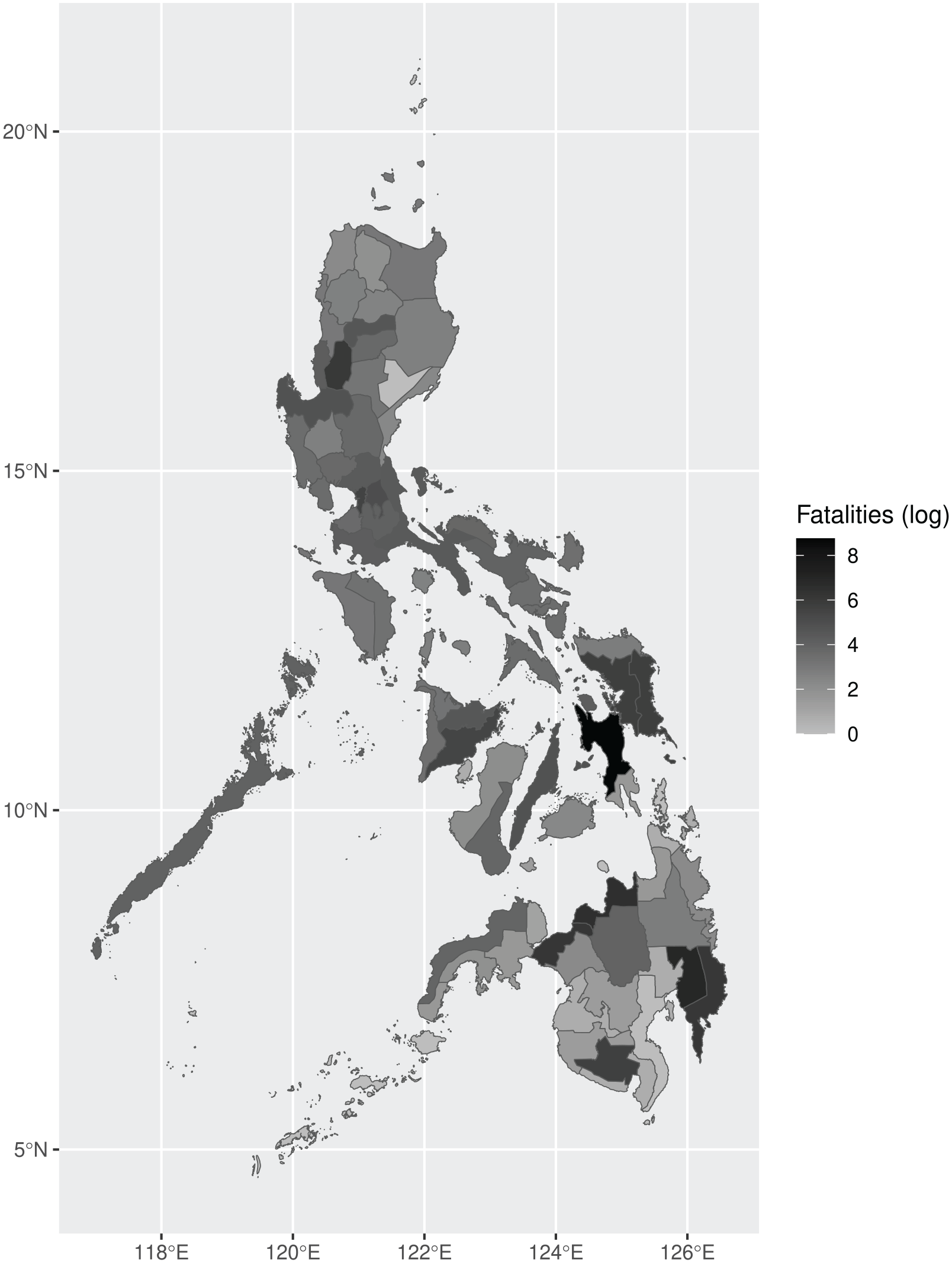
Geographic distribution of tropical cyclone fatalities in the Philippines (2009-2019).
As a next step, I normalized the storm-related fatalities per hazard exposure, as the number of fatalities caused is, of course, closely related to the physical intensity of the storm and to how many people are exposed to it. To increase precision and reduce potential bias, I follow the approach of Tennant and Gilmore (2020) and calculate fine-grained measures of population-weighted hazard exposure for both wind speed and rainfall for each storm. I use these measures to normalize the number of storm-related fatalities which allows me to compare disaster severity at a constant level of exposure. The Online Appendix provides detailed information about the data sources used and the exact procedure to calculate the normalized disaster fatalities. Intuitively, I normalize the number of fatalities to both the physical intensity of the storms (wind speed and rainfall) and the number of people living in the storm’s path. This then allows for a fair comparison in the number of fatalities between powerful storms that hit densely populated areas and weak storms that only affect sparsely settled land. Finally, I aggregate the normalized fatality count for each year and take the natural logarithm as even after normalizing per exposed population, storm-related fatalities are still highly skewed. In the robustness section, I also investigate how far these extreme observations drive the results.
I aggregate the normalized storm-related fatalities to each year and employ yearly fixed effects to account for time trends and other shocks that affect all provinces simultaneously. In addition to the fact that the included control variables are only available on an annual basis, the yearly aggregation has further significant advantages compared to conducting the analysis on the level of months or individual storms. First, looking at entire calendar years removes any concerns about seasonality acting as a confounding variable. Potentially, tactical considerations on the battlefield might lead to increased fighting in certain seasons of the year that are correlated with cyclone activity. Looking at storm-related fatalities and conflict events over the entire year circumvents this issue.
Second, and more importantly, aggregating the disaster fatalities to yearly observations lends further analytical leverage to the analysis, as it directly compares the storm-related fatalities of different cyclones that occur within the same year. Storm-related fatalities and armed conflict are rare events, and treating too many different storms as incomparable with each other leaves little variation in the data. Crucially, the assumption that different storms from the same year are indeed comparable is made possible because I do directly account for the physical intensity and exposure of each storm. Restricting the analysis to within-month or within-storm comparisons would discard the main advantages gained by accounting for the physical hazard exposure. In any case, I also report results from a monthly-level analysis as a robustness check.
Finally, the theoretical mechanisms through which I expect periods of high-intensity conflict to affect disaster risk unfold over a longer time horizon. The decision to leave, the migration journey, and the temporary settlement in a new place can take weeks to months. Similarly, the decision to deploy and potentially relocate military personnel and equipment in response to changing conflict dynamics is also a potentially major operation. Using annual observations allows these events to unfurl.
Armed conflict
Armed conflict data come from the Georeferenced Event Dataset from the Uppsala Conflict Data Program (UCDP GED) (Sundberg and Melander, 2013). I only consider events where at least the province is known and aggregate the data to the province-year level. The data contain events from conflicts with at least 25 battle-related deaths in a calendar year. An individual event enters the data when at least one direct death is reported (Högbladh, 2021). To alleviate some concerns about reverse causality, where the storms cause the spike in conflict intensity, I lag the treatment indicator by one year.
The threshold for what counts as a spike in conflict intensity needs to be chosen carefully. On the one hand, it must be high enough to represent a significant deviation from the norm. Setting it too high, on the other hand, might leave barely any treated units, making inference difficult. On average, there are 4.99 conflict events per year in the conflict-experiencing subsample, and I count a province-year as treated when it experiences five or more conflict events. This reflects the consideration that periods of high-intensity need to be interpreted relative to the context. Out of 297 conflict-prone province-years, 82 are assigned to the treatment group. Figure 3 depicts the distribution of the treatment status. It shows how there are both provinces that continually see a fair amount of conflict and provinces that never meet the threshold.
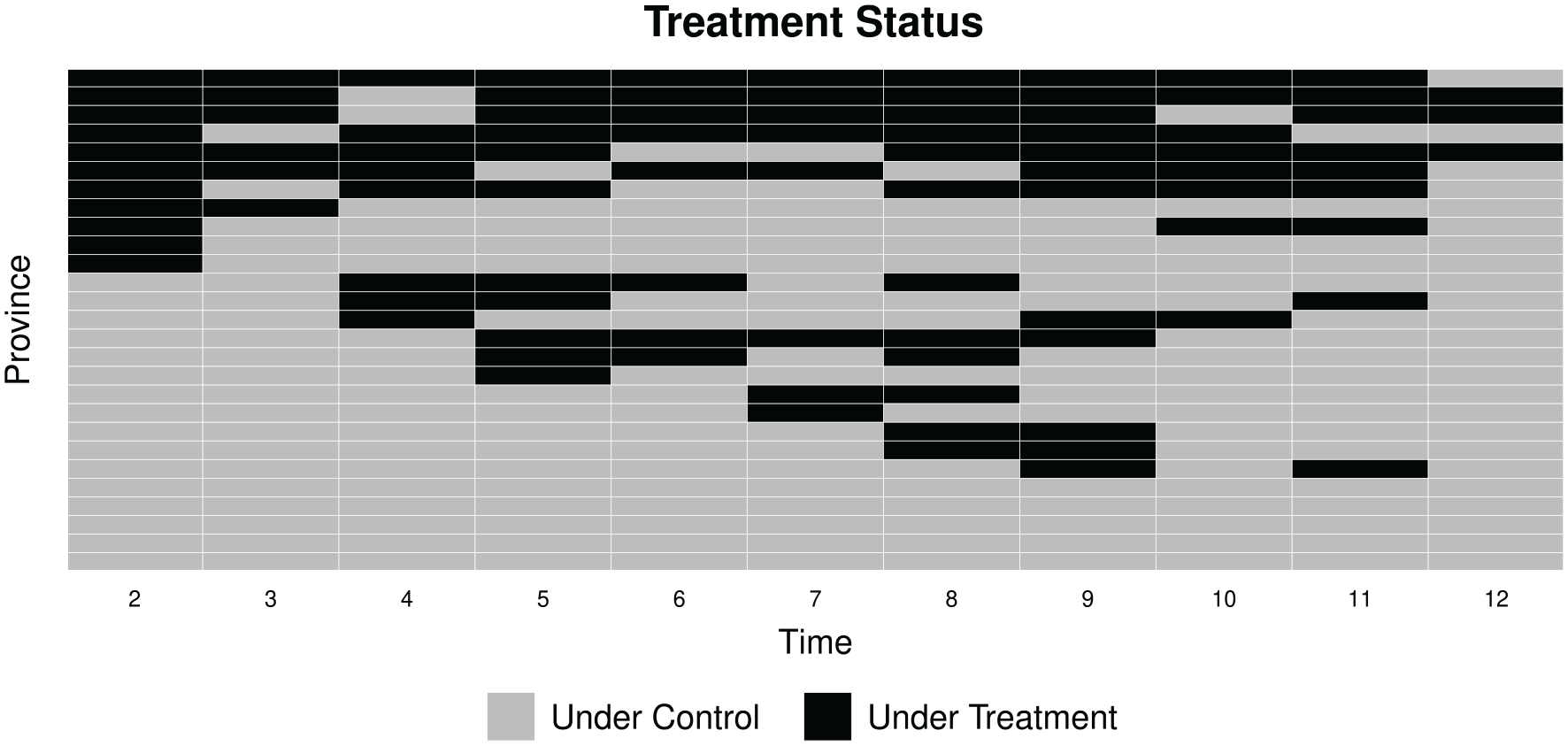
Treatment status.
I explicitly assume that the effect of periods of high-intensity conflict does not persist indefinitely and restrict the treatment effect to one year in the primary analysis. This also reflects that the overall conflict intensity in the Philippines is comparatively low. Precisely because the treatment is a spike in conflict intensity compared to a baseline of lower-intensity fighting, I expect this effect to be smaller and shorter-lived than a more general effect of conflict. However, I also check the robustness of the findings when assuming that the effect carries on for longer.
Control variables
The empirical analyses also account for the most important confounders related to both the vulnerability to natural hazards and the propensity of armed conflict. While data availability at the level of the 81 Philippine provinces is a challenge, I control for the level of socioeconomic development by including poverty, GDP per capita, a subnational human development index (HDI), and local state capacity. Poverty is operationalized as poverty severity, and local state capacity is measured as the share of the total income of each provincial government that is coming from tax revenue. Poverty data come from the Philippine Statistics Authority and are available for 2009, 2012, 2015, and 2018. I use linear interpolation for the missing years. Local tax revenue data come from the Philippine Bureau of Local Government Finance. Both GDP per capita and the subnational HDI come from Kummu et al. (2018). Since these data are only available until 2015, I carry forward the last observed value for each province. While further confounding factors may exist, these four should account for the most critical shared root causes of armed conflict and disaster risk. It is important to note that the TWFE design already controls for province-specific, time-invariant factors and time-varying shocks that affect all provinces simultaneously. Table AI in the Online Appendix displays descriptive statistics for all variables.
Findings
Before reporting the results of the TWFE regression analyses, I empirically scrutinize the plausibility of the identifying assumptions. Following the suggestions of Liu et al. (2022), I conduct both a placebo test and a global F-test for pre-trends. The idea of the placebo test is to assume that the treatment starts a few periods before its actual onset and to see whether the average treatment effect in these periods is statistically different from zero. If future treatments affect past outcomes, this would cast doubt on the identifying assumptions. For the placebo test, I assume that the treatment starts two periods earlier than it actually does. Reassuringly, the estimated treatment effect is statistically indistinguishable from zero (p-value of 0.246). Furthermore, I also implement an F-test where I test whether the averages of the residuals in the pre-treatment periods are different from zero (Liu et al., 2022). If there are no pre-trends, the outcomes predicted by the fixed effects should be close to zero for all pre-treatment periods. Encouragingly, the null hypothesis that all residuals are simultaneously zero cannot be rejected (p-value of 0.606). The fact that both tests not fail is reassuring.
Table 1 depicts the results from the two-stage TWFE regression analyses. All models contain the complete set of controls (results for the controls are reported in Table AII in the Online Appendix). Standard errors are clustered at the province level and are adjusted to reflect that the dependent variable itself is the result of the first-stage estimations (Butts and Gardner, 2022). Model 1 reports the result from a base model without any spatial effects. The coefficient of the treatment indicator is positive and statistically significant at the 1% level. On average, storms that follow spikes in conflict intensity result in more deaths than other storms. Substantively, they cause roughly 7.9% more fatalities than storms which take place in an area without intense conflict events. Given that this is the effect of a spike in armed conflict intensity compared to a baseline of lower-intensity conflict, this is a sizable effect.
Results from two-stage TWFE models.
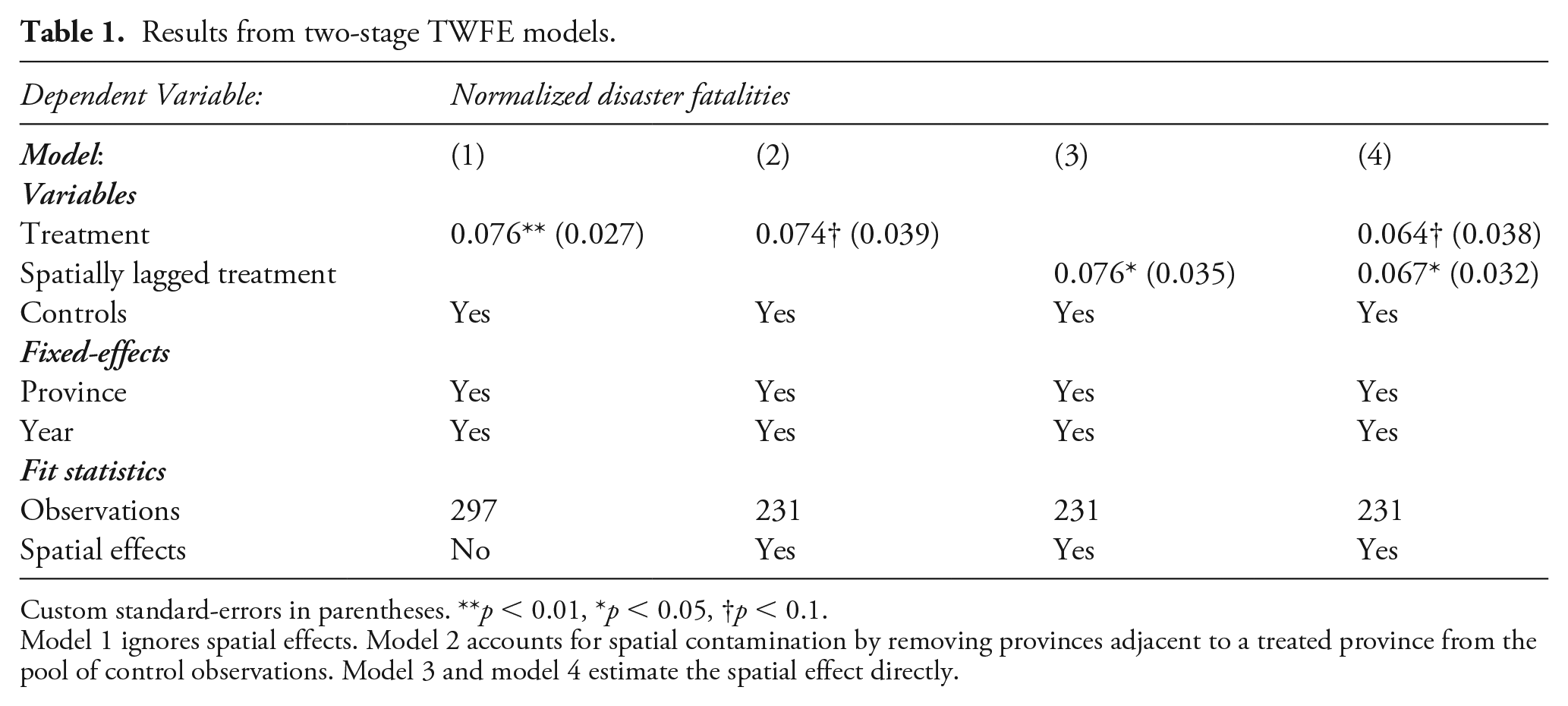
Custom standard-errors in parentheses. **p < 0.01, *p < 0.05, †p < 0.1.
Model 1 ignores spatial effects. Model 2 accounts for spatial contamination by removing provinces adjacent to a treated province from the pool of control observations. Model 3 and model 4 estimate the spatial effect directly.
Next, I investigated the potential spillover effects of armed conflict. I probed this relationship by constructing a spatial matrix connecting all Philippine provinces that share a land border. Island provinces are not connected to other provinces since I assume the proposed mechanisms operate mainly through shared land borders. Using this matrix, I created a spatially lagged treatment variable that takes the value of 1 if any neighboring provinces are treated in a given year. As a robustness check, I also report results using a 3-k nearest neighbor matrix.
Utilizing the flexibility of the two-stage approach, I proceeded in three steps. First, I estimated Model 1 again but used only the provinces that experienced neither the treatment nor the spatially lagged treatment in the first stage to obtain the unit and period fixed effects. If there are spatial spillovers, provinces next to a treated unit cannot serve as valid counterfactuals, as this would violate the stable unit treatment value assumption (SUTVA). Model 2 in Table 1 shows that even when accounting for spatial contamination, the results from Model 1 remain robust.
Second, I regressed the adjusted outcomes on the spatially lagged treatment to directly test whether the effect of conflict can spread to neighboring provinces. Model 3 indicates that this is the case. Third and finally, I introduced the original and spatially lagged treatments simultaneously. In Model 4, both treatment indicators remain statistically significant, bolstering the confidence that the effects of conflict can indeed spill over into neighboring provinces. Interestingly, the effect size is similar to the effect in Model 1, indicating that the adverse consequences of periods of high-intensity conflict affect a rather large area and are not just confined to the province they occur in. Overall, Hypothesis 2 receives strong support from the data. Note that the number of observations in the spatial lag models is reduced compared to Model 1 due to the fact that always-treated provinces provide no information for the estimator.
Robustness checks
I also conduct a battery of robustness checks to see how far the findings are driven by certain modeling decisions. Specifically, I run models without control variables, models using the full sample of provinces, models where I remove outliers, models with a different spatial connectivity matrix, models using monthly observations, models that include a temporally lagged dependent variable, models that include a temporally and spatially lagged dependent variable, models that exclude treated observations from the pool of controls for one period longer, models where the treatment indicator stays on permanently, models where the treatment indicator is based on the number of battle-related deaths, and models where periods of high-intensity conflict are measured as a standard deviation above the mean. An elaborate discussion of the rationale and of the results for each of these robustness checks can be found in the Supplemental Appendix. With one notable exception, these robustness checks largely confirm the findings of the main specification. The results, however, appear to be somewhat sensitive to basing the treatment on the number of conflict events as compared to the number of battle-related deaths. In the Supplemental Appendix, I discuss how this might be a combination of the fact that there are substantially fewer treated units and that the number of conflict fatalities is conceptually distinct from the number of conflict events.
Displacement, diversion, and determent in the Philippines
While the results appear robust to a host of robustness checks, can we also corroborate the hypothesized mechanisms of how armed conflict affects disaster risk and hazard impact? Above, I argued that three mechanisms are most likely to be responsible. First, people displaced by the conflict are especially vulnerable to natural hazards. Second, armed conflict binds materials, human resources, and attention from the military and from humanitarian actors, which is then unavailable in the disaster response. Third, external humanitarian actors might either be unwilling to engage in regions of ongoing conflict due to safety concerns or be explicitly stopped from entering the conflict zone. This section presents anecdotal evidence that some of these mechanisms are also likely the driving force behind the increased disaster risk in the Philippines.
First, the number of people displaced by armed conflicts in the Philippines is substantial. For the period of this study from 2009 to 2019, the Internal Displacement Monitoring Centre reports 2.8 million displacement due to conflict and violence (IDMC, 2023). A report by the United Nations High Commissioner for Refugees about the situation of displaced persons on the Philippine island of Mindanao details how families live in ‘spontaneous settlements such as shanties and [. . .] houses without proper roofing and walling’ (UNHCR, 2022). Such dwellings offer little protection against tropical storms and might become a source of danger when they collapse or gusts carry away parts of the buildings. Another report details how the intense fighting in Marawi City in 2017 between the Islamist Maute group caused the majority of the citizens to flee and seek refuge in transitory sites in neighboring towns and provinces. These temporary shelters are not only plagued by poor sanitary conditions, but some are also located in areas prone to landslides and flooding, making these people particularly vulnerable to heavy rains caused by cyclones (UNHCR, 2017, 2021).
Second, the Philippine Armed Forces play a prominent role in the disaster risk reduction strategy of the country. Due to its widespread presence and logistical capabilities, the military is a significant actor in providing relief in the aftermath of a natural disaster. It helps coordinate efforts with NGOs and UN agencies, provides security briefings, and assists them in logistics (Walch, 2018c). In fact, the military even uses disaster relief as a deliberate strategy to win over civilians in contested areas. There is evidence that battle-related military operations increase in pace in the conflict zone during cyclone events as the military uses storms as an opportunity to gain tactical advantages (Eastin, 2018). Since even military resources are limited, however, when the military is occupied on the battlefield during intense periods of fighting, it will have fewer resources available for disaster relief. Humanitarian actors also face the same trade-off, where a crisis in one part of the country leaves fewer resources for disaster response. Analyzing the disaster response with regard to Typhoon Yolanda, Field (2018) argues that humanitarian actors like Refugees International, the Philippine Red Cross, and the United Nations Office for the Coordination of Humanitarian Affairs were stretched so thin by being occupied with helping refugees displaced by battles on the island of Mindanao that it adversely impacted their ability to respond to Typhoon Yolanda.
Finally, there is also some evidence of humanitarian actors being actively obstructed by insurgents. In the aftermath of Typhoon Yolanda, UN agencies and NGOs not only had trouble getting disaster aid to more remote areas in the conflict-affected areas (The Economist, 2013), but there were also reports of the NPA deliberately attacking aid convoys (Rappler, 2013).
Taken together, the results provide evidence that the the precise dynamics of armed conflict can negatively affect hazard impact. Years following a spike in conflict intensity tend to suffer more storm-related fatalities. Furthermore, such periods of high-intensity conflict seem to not just drive hazard impact in the immediate vicinity of the conflict location but also in neighboring regions. Illustrative evidence suggests that displaced persons fleeing from the fighting and diversions of resources by the military and external humanitarian actors are the most likely drivers behind this effect.
Conclusion
This study has analyzed whether the dynamics of state-based armed conflict can adversely affect the humanitarian consequences of natural hazards – a question that has largely been neglected by existing research. While previous literature has concentrated on the link from natural hazards to the onset and dynamics of armed conflict, I present evidence for the reverse effect: the dynamics of armed conflict can also drive hazard impact. I collected original, highly disaggregated data on storm-related fatalities in the Philippines and account for different levels of cyclone exposure using detailed wind speed and rainfall measures for each storm. Results from two-stage two-way fixed effect regression models, that can account for much of the potential endogeneity between conflicts and disasters, show that Philippine provinces suffer more storm-related fatalities after intense periods of fighting. Furthermore, there is evidence that the adverse effects of armed conflict can also spill over into neighboring provinces.
While armed conflict can generally leave a legacy of vulnerability to natural hazards by adversely impacting public disaster risk management and eroding social trust, this study contributes to the literature by arguing that the precise dynamics of armed conflict can also significantly increase hazard impact more suddenly and in the shorter term. Periods of intense fighting displace people and divert attention and resources away from natural hazards, thereby raising the likelihood that hazardous events become disasters. Displaced people are particularly vulnerable to natural hazards due to insecure dwellings, insufficient knowledge of local dangers, and missing social ties. Additionally, humanitarian actors, among them the military which often plays an essential role in disaster relief, will be less able and willing to provide disaster aid in the vicinity of the fighting. Illustrative evidence corroborates these mechanisms.
This study brings together conflict research and disaster risk science, two research traditions that have so far seldom engaged with each other. The results carry significant implications for studies that investigate the conflict-related consequences of natural hazards, as it shows that hazard impacts themselves are shaped by pre-existing conflict dynamics. Accounting for this endogenous relationship is thus crucial for any empirical investigation into the political effects of natural disasters (Reinhardt and Lutmar, 2022). The results of this study also provide evidence for the hypothesized vicious circle between armed conflict, vulnerability, and hazard impacts (Buhaug and Von Uexkull, 2021). However, the findings also imply that peace-building can have the additional benefit of reducing the vulnerability towards natural hazards, and lesser disaster impacts, in turn, can alleviate societal conflicts. The question of how such a vicious circle might be broken in these intricate contexts is more ambiguous because providing aid during ongoing conflicts can also lead to unintended consequences and actually increase conflict fatalities (Findley et al., 2023).
One noteworthy caveat concerns the external validity of the findings. While there is no obvious reason why the mechanisms should not be generalizable to other state-based armed conflicts and other types of hazard, it is worth pointing out that the overall conflict intensity in the Philippines is relatively low. While I argue that the results thus should represent a lower bound of the effect of armed conflict, it remains an open question how the dynamics of armed conflict play out in different conflicts.
Footnotes
Acknowledgements
The author thanks Gabriele Spilker, Viktoria Jansesberger, Roman Krtsch, and Tobias Ide for valuable comments. The author also thanks three anonymous reviewers as well as the JPR Editors for providing constructive criticism.
Replication data

Funding
This research was funded by the Deutsche Forschungsgemeinschaft (DFG – German Research Foundation) under Germany’s Excellence Strategy – EXC-2035/1 – 390681379.
NIKLAS HÄNZE, b. 1995, MA in Politics and Public Administration (University of Konstanz, 2022); Independent Doctoral Fellow, University of Konstanz – Cluster of Excellence: The Politics of Inequality (2022–present).