



Abstract
Conflicts involving pastoralists have been on the rise in the past two decades in West, Central and East Africa. This article argues that land alienation is a major source of this type of violence. We employ a narrow identification strategy of relevant pastoral conflicts based on the Armed Conflict Location Event Dataset and create a unique indicator of land alienation comprised of three types of land use changes (conversion of land into conservation areas, crop farms, and industrial mining projects). Relying on a disaggregated quantitative comparative design of 50 km-by-50 km cells covering the Sahelian region from 2002 to 2019, we find that land alienation is an underlying cause of pastoral conflicts. Moreover, we show that the impact of land alienation on pastoralist violence spreads over long distances and is influenced by state presence and climatic conditions. Our analysis further reveals an overlap between pastoralist violence and armed conflict. Bridging a gap between macro- and micro-level studies, we contribute to shed more light on the determinants of pastoral conflicts, a type of violence that has received scant attention in the geospatial quantitative literature.
Introduction
In December 2021, unsolved disputes over access to water banks between farmers and herders escalated dramatically, leading to the death of 22 people in Northern Cameroon (Kouagheu and Ramadane, 2021). The tit-for-tat violence prompted hundreds of residents to flee to Chad, which has also witnessed deadly clashes between nomadic Arab herders and sedentary indigenous farmers over the last years (Africanews, 2022). In fact, conflicts involving pastoralists (or pastoral conflicts) like these have been on the rise in West and Central Africa, where more than 15,000 deaths can be linked to farmer–herder violence between 2010 and 2021 (Brottem, 2021). Most pastoral conflicts occurred in Nigeria, creating the country’s deadliest security crisis (Akinwotu, 2021).
With this unprecedented surge of violence involving pastoralists across Africa, peace and conflict researchers need to focus more intensively on common explanatory factors across these different contexts. Looking at the history of pastoral conflicts over the last years, we maintain that land alienation 1 deriving from various forms of land use changes (conversion of land into conservation areas, crop farms, or industrial mines) is a major determinant of this type of violence across large parts of Africa. We argue that land alienation increases the risk of pastoral conflict by intensifying ecological pressures (competition over scarce resources) and disrupting traditional social relations and local authority structures. To test our claims, we employ a disaggregated quantitative comparative design based on 50 km-by-50 km grid cells covering West, Central and East African countries over the period 2002 to 2019 and rely on the Armed Conflict Event Dataset (Raleigh et al., 2010) to record events of violence involving pastoralists. We complement our analysis by focusing on additional important explanatory factors, including the proximity to armed conflicts, state infrastructures, local governance, and climatic conditions.
Our geospatial statistical analysis shows that land alienation is an underlying cause of pastoral conflicts and that its effects can spill over large distances. We further find evidence that the impact of land alienation is dependent on the local ecological conditions and state reach. More rain seems to mitigate the pervasive impact of land alienation on pastoralist violence, corroborating the hypothesis that competition over scarce resources may partly explain the alienation’s conflict-enhancing effect. At the same time, state presence seems to aggravate the positive relationship between land use changes and pastoralist violence. We also demonstrate that pastoral conflict is more likely in border areas and regions affected by armed conflict.
To the best of our knowledge, this article is the first quantitative paper to concentrate on violence involving pastoralist groups using a narrow identification strategy of relevant events rather than intercommunal violence in general (e.g. McGuirk and Nunn, 2020). By doing so, it uncovers violence involving pastoralists across the subcontinent and its different determinants, lending external validity to previous qualitative research. Considering that pastoralists and their herds move across subnational and national borders (Homewood, 2008) and that land alienations affect Africa at large (Peters, 2013), a subcontinent scale approach is particularly warranted. Using different units or weight matrices, we further delve into the spatiality of the dependency between land alienation and pastoral conflicts.
Our investigation contributes to the literature on peace and conflict, pastoralism, land use changes, and African rural development. We stress the importance of the concept of land alienation and its inclusion in the analysis of communal conflicts. In addition, we further our understanding of various explanatory factors that have been stressed by qualitative research but have yet to be tested in a systematic manner.
Contemporary challenges to pastoralism
Pastoralist societies often inhabit remote arid and semi-arid regions at the margins of the modern state (Homewood, 2008: 50). Unless they have acquired property rights of enough land, they rely on movement (seasonal transhumance) and entitlement to the use of common-pool resources to keep their herds well-fed all year round (Basupi et al., 2017). Contingent on proper climatic conditions to feed their cattle, pastoral societies’ viability and longevity depend on mobility, flexibility, negotiations, and exchanges with surrounding communities (McPeak and Little, 2018: 120; see also: Moritz, 2010; Turner, 2004). They have developed cultural rules regulating the use and share of communally held resources and have elaborated norms around the practice of cattle raiding, notably as a ‘time-honored pathway for young men to establish themselves as herdowners and household heads, under the blessing of elders’ (Homewood, 2008: 74).
Recent institutional, economic, and ecological changes have put enormous constraints on pastoralists’ livelihoods. The literature review by Basupi et al. (2017: 88) found that 77% of papers on pastoralism identified land tenure insecurity and land expropriation as main problems in pastoral land development in sub-Saharan Africa. Climatic changes have also affected their livelihoods (Brottem, 2016). Despite co-existence strategies and coping mechanisms (e.g. Opiyo et al., 2015), pastoralists are increasingly victims and perpetrators of violence across West, Central and East Africa (Krätli and Toulmin, 2020). Pastoralist groups have been co-opted as militias by some states or drawn into civil wars, notably in South Sudan and the Horn of Africa (Homewood, 2008: 106–130; Wild et al., 2018). Traditional cattle raids have also shifted from redistributive to predatory practices: rebels and/or powerful pastoralist groups now use violent thefts of cattle at a commercial scale for enrichment and political power (Homewood, 2008: 74). States’ (lack of) action is often pivotal in these conflicts. Further contributing to previous findings, we argue that land alienation can fuel conflicts while concurrently weakening the institutions and norms that used to regulate them.
Land alienation in sub-Saharan Africa
Considering the prevalence of customary regimes in sub-Saharan Africa and pastoralists’ territoriality of access to resources (Yembilah and Grant, 2014), a theory of access (Ribot and Peluso, 2003), rather than property rights, is most appropriate to understand the effects that different types of land use changes can have on pastoralists’ livelihoods and their relations with neighboring communities. We follow Ribot and Peluso’s (2003: 153) definition of access as ‘the ability to benefit from things’, determined by different bundles of powers that various people or groups hold within societies. The concept of alienation, recently used by Bluwstein et al. (2018), helps to explain the extent to which groups may ‘benefit from things’. It captures the separation of people from resources they traditionally had access to. We consider alienation from the perspective of pastoralist societies, i.e., the removal of access they previously had.
We identify three different types of land use change that alienate pastoralists from material and social resources in rural Africa, and subsequently impact social relations that governed access to these resources. 2 First, we single out industrial mines, i.e., complexes for the extraction of mineral resources. Mitchell (2016: 1119) notably states that ‘the sheer volume of concessions in many countries means that there are significant overlaps between concessions and areas of customary tenure’, and thus overlaps with smaller-scale economic activities. Next, we select protected areas (PAs), which are geographical spaces managed to achieve specific conservation objectives (IUCN WCPA, 2019). The setting up of protected areas on customary land and associated problems are well-documented issues that we discuss later in this article (Butt, 2012; Dowie, 2011). Finally, we consider crop expansion. Between the years 2003 and 2019, the continent witnessed a cropland expansion of 34%, the largest increase worldwide (Potapov et al. 2022: 19–21). Medium-scale farms are notably on the rise, spurred by investments from urban dwellers (Jayne et al., 2016). This gradual transition within Africa’s rural landscapes has been accompanied by large-scale land acquisitions that have encouraged land concentration, the enclosure of common land, substantive land-use changes, a shift from smallholder agriculture to commercial farming and competition over water access (Dell’Angelo et al., 2021).
All three types of land use changes have, in one way or another, led to conflicts that differ in scale, scope, determinants, and goals. 3 Hence, our specific focus is on these types of alienation. In the following paragraphs, we argue that, while their effects can differ in strength and size, all three types of land use changes deny access, increase pressures on the local environment and communities, and affect local authority structures and norms of dispute resolution. Consequently, they can be taken together in an analysis of the impact of land alienation on conflicts involving pastoralists.
From alienation to pastoral conflicts
The following paragraphs present intertwined pathways linking land alienation to pastoral conflict. Our conceptualization of land alienation is that of an underlying cause more than a proximate one. 4 Unless in exceptional cases, land alienation increases the likelihood of conflict through its effects on local ecological, demographic, economic and social environments, as we argue below.
Ecological pressure
We argue that all three types of land alienation promote pastoral conflicts by intensifying competition over scarce resources (in particular land and water) and furthering environmental pollution and degradation. Protected areas may intuitively sound like the least problematic of the three types of land alienation we are studying. However, the fencing of protected areas to keep wildlife inside, preserve local biodiversity and prevent trespassing means that pastoralists need to negotiate entry with park authorities and often lose access to land (Toutain et al., 2004). The extent to which local communities are integrated into park management determines how well pastoralists’ interests are accommodated (Oldekop et al., 2016). Unfortunately, community-led protected areas make up only 16% of reserves set up in Africa since 2002, 5 and native peoples are thus often considered as trespassers and poachers on their ancestral lands and traditional grazing routes (Butt, 2012; Dowie, 2011; Toutain et al., 2004). Notably, the acts of ransoming or killing trespassing cattle degrade relations between park managers, rangers, and herders and make encounters prone to escalation into violence (Butt, 2012).
Agriculture and industrial mines also deny access while increasing pressures on local resources necessary for pastoral livelihoods. Several qualitative studies show that increasing mechanization, expansion of croplands, and the extension of land leases caused agricultural encroachment of pasturelands and traditional transhumance routes and fueled farmer–herder conflicts (Bukari and Kuusaana, 2018; Feldt et al., 2020; Penu and Paalo, 2021; Turner, 2004). Moreover, in a different way than protected areas, large-scale mining (Lange, 2011) and farming activities require a considerable amount of water. Investors therefore try to secure exclusive access to key water points in the area (Dell’Angelo et al., 2021). Besides hampering access to land and water, large-scale agricultural investments and particularly mining projects are a common cause of soil and water degradation, including contamination, erosion, and nutrient-leaching (Bekele et al., 2021; Timsina et al., 2022).
In summary, land alienation causes pastoralists to face the loss of good pastures and water to sustain their herds. They are also confronted with increasingly complicated transhumance routes, with more health hazards, risks of breaching the law, and encounters with people with whom they have not negotiated access to resources (Brottem, 2016). Land available for subsistence farming and grazing is reduced and gets concentrated in key zones where farmers and herders encounter each other more frequently. This can lead to cattle herds damaging farmers’ crops, or small-scale crops encroaching on land previously used for pastures (e.g. Yembilah and Grant, 2014). It also increases the opportunities for raiding and counterraiding between pastoralist groups as cattle are concentrated in smaller places, further exacerbating the risks that these events escalate into violence (Wild et al., 2018).
Disruption of social relations and overlapping authorities
Besides increasing competition over scarce resources, we claim that land alienation disrupts established social relationships, cultural norms, traditional exchange practices, and authority structures. The interdependence between farmers and herders has been the basis of a centuries-long symbiotic relationship. According to Moritz (2010: 139), these ‘host–client’ or ‘host–stranger’ relationships used to be characterized by complementarity of goals and livelihoods (see also Turner, 2004). Behavioral models of collective action show that trust, reciprocity, and communication are essential in communal resource governance (Agrawal, 2014). Contact theory has also demonstrated that intergroup positive contacts foster trust and forgiveness for transgressions and reduce prejudice (Pettigrew et al., 2011).
As previously outlined, PAs, farms and industrial mines put great pressure on affected groups and their ecological surroundings. Farmers tend to shift to more Western-style land leases to safeguard themselves from expropriation or encroachment, combine small-scale farming with herding, increase the relative size of their plots, and increasingly use pesticides and mechanization instead of manure (Moritz, 2010). Altogether, these shifts can render pastoralists’ presence less beneficial for farmers, reducing opportunities for positive contacts. In a similar vein, the undermining of pastoralists’ livelihoods propels predatory raids as viable, albeit dangerous, livelihood strategies, which itself affects how pastoralist groups perceive and interact with each other (George et al., 2021; Homewood, 2008: 74; Wild et al., 2018). In other words, positive contacts are less frequent, while negative contacts such as crop damage, disputes for access to water points, forest resources and grazing areas, and predatory cattle raiding are more frequent.
Land alienations also reconfigure authority structures and dispute resolution mechanisms. Decisions in pastoralist societies are made at the individual, household, or group level (Toutain et al., 2004), while in rural communities in sub-Saharan Africa, land-related decisions are most often the prerogatives of village or group-level customary chiefs (Logan, 2013). Land alienations introduce and legitimize new authorities governing land matters. For instance, the decision to switch land use to conservation most often stems from an agreement between international conservation actors and national governments (Toutain et al., 2004). Regarding industrial mines, Mitchell (2016: 1121) found that, by transforming communally managed resources into privately owned ones, companies profoundly affect the perceptions of authority over land as the company takes on the role of the chief land administrator. For transnational investments in agriculture, the literature has shown that they affect political orders and perceptions of authority and legitimacy, usually due to intense competition between the actors (i.e., investors, customary chiefs, local, regional, and national-level state representatives) that have some form of power in land regulation (Lavers and Boamah, 2016).
Consequently, authorities governing land-related resources multiply, and dispute resolution becomes increasingly more challenging. As Penu and Paalo (2021: 231) emphasize: ‘where different rules govern access to the same resources, forum shopping leads to conflict about legitimacy’. In other words, if opposing parties seek the help of different authorities that all claim to have legitimacy over land matters, the dispute has more risks of not being solved and then escalating into violent events.
Conflict prevention
A more optimistic view on the various sources of land alienation would claim that the creation of parks as well as mining and agricultural investments may contribute to local livelihoods and possibly reduce the risk of pastoral conflict. Studies covering a large number of African countries, however, reveal that large-scale land investments and industrial mines have mostly failed to generate local employment and income (Kotsadam and Tolonen, 2016; Nolte and Ostermeier, 2017; Wegenast et al., 2019). And, while pastoral societies frequently use small-scale agriculture as an income-generating diversification strategy, it never fully replaces pastoralism as a livelihood (Achiba, 2018; Opiyo et al., 2015).
Nonetheless, our study seeks to explore two potential moderating variables that may mitigate the conflict-enhancing effect of alienation. First, well-developed state infrastructures and state capacity may alleviate grievances and conflict by providing a single institutional arena for dispute settlement and thus preventing forum-shopping and violent rent-seeking behavior (Berman et al., 2017; Wig and Tollefsen, 2016). Yet, pastoralists and their host states often have conflicted relationships (Homewood, 2008: 106–130); previous research has highlighted the marginalization and eviction of pastoralists by the state (Bukari and Kuusaana, 2018) and has shown how the state may aggravate tensions between pastoralists and other societal groups (Brottem, 2020). It is thus uncertain whether pastoralists would seek or receive help from state institutions, even more so if they are on an international transhumance. Still, the presence of police forces could potentially prevent violence from escalating into full-fledged conflicts. Second, we believe that protected areas can provide employment opportunities and accommodate pastoral interests (for example in regard to the use of transhumance routes) if they are community-led (Toutain et al., 2004).
Diagram and hypotheses
In the last two sections, we identified plausible causal pathways linking land alienation to pastoral conflict and presented two factors that may moderate this relationship. The pathways linking land alienation to pastoral conflict are summarized in Figure 1. In addition, our readers can find a summary table of the single effects of each subtype of land alienation in Online Appendix 1, Table 1.

Diagram of theoretical pathways linking land alienation to pastoral conflict occurrence.
Descriptive statistics.

To facilitate table reading and interpretation: (a)Variables were rescaled by 10; (b)Variables were rescaled by 10,000.
With this diagram (Figure 1), we further reiterate that land alienation is an underlying rather than proximate cause of conflict occurrence. In other words, the immediate element catalyzing a conflict will not necessarily be the alienation per se, but rather the consequences that derive from it, such as crop damage, cattle trespassing, or forum shopping. Our main hypothesis can be formulated as:
H1: Land alienation increases the likelihood of pastoral conflicts.
We further test the plausibility of our argument that alienation promotes pastoralist violence through an ecological pressure channel (competition over scarce resources) by investigating whether alienation drives conflict particularly under water shortage situations:
H2: The effect of land alienation on pastoral conflicts is stronger when resources are scarcer (ecological pressure mechanism).
Finally, we formulate the following two hypotheses on the potential pacifying effect of state presence and communal park management:
H3a: The effect of land alienation on pastoral conflicts is weaker where state presence is stronger.
H3b: The effect of land alienation on pastoral conflicts is weaker where local communities participate in park governance.
Research design
Our analysis first evaluates whether land alienation increases the likelihood of pastoral conflicts (Hypothesis 1). To test one of our central theoretical mechanisms, we estimate whether alienation’s effect is stronger when there is less rainfall compared to historic levels (Hypothesis 2). We further test how the impact of land alienation changes when there are local state infrastructures (Hypothesis 3a) and when protected areas are led by local communities (Hypothesis 3b).
Sampled countries
Given data availability, our analysis spans over the period 2002–19. We focus on West, Central and East Africa for two main reasons. First, these regions have seen a sharp increase in violence in the past decade (Krätli and Toulmin, 2020) and thus deserve close attention. Social scientists have repeatedly identified the Sahelian region as an essential case study area for violence linked to pastoralism. This explains why our theoretical framework is mainly grounded on scientific works that study (cases within) these three regions. Second, in a quantitative setting, a certain number of occurrences of a rare event need to be available for statistical models to be reliable (King and Zeng, 2001). When focusing on West, Central and East Africa, only 1.82% of our units experience a conflict. If we extend our sample to cover all of Africa, 6 this number significantly drops to 1.14%. Notwithstanding, we also report results for a sample containing all African countries as a robustness check.
Event selection
Data on pastoral conflicts come from the Armed Conflict Location and Event Dataset (ACLED 2022; Raleigh et al., 2010), which contains ‘reported information on the exact location, date, and other characteristics of politically violent events in unstable and warring states’ (Raleigh and Dowd, 2015: 3). Reproducing Krätli and Toulmin’s (2020) strategy, we selected observations that involved pastoralists using the key terms herd* | nomad* | cattle | transhuman* | pastoral* in ACLED description of events. We set the following subevent categories: abduction/forced disappearance, armed clash, attack, looting/property destruction, mob violence, sexual violence, violent demonstration, peaceful protest, protest with intervention and others. Events were individually checked to ensure that they refer to intercommunal violence. Between 2002 and 2019, we identify 3,778 events that we call ‘incidents involving pastoralists’ (IIPs; Krätli and Toulmin, 2020).
Event description
Before proceeding with our quantitative investigation, we unpack the description of incidents to identify the main actors and proximate causes driving their occurrence. As land alienation is rather an underlying cause of conflict, it is unlikely to be directly identified in the event descriptions as such. Based on our reading of the descriptions, we created a classification to identify (1) the actors involved and (2) the proximate causes of the incidents. We also investigate whether events can be considered the results of an escalation of disputes. The full details can be found in Online Appendix 2. In brief, we uncover that, out of 3,778 events, non-state armed groups are involved in 790, farmers in 504, protected area workers in eight and mine workers also in eight of them. Pastoralists are the main actors in the rest of the events, indicating a predominance of herder-on-herder violence. We further find that the main focal point of incidents is cattle raids and counterraids (total of 1,704 events). While in smaller proportions, we also find that land (815 events) and movement (143 events) are drivers of incidents. Finally, about 17% of events are escalations from previous incidents. While this proportion is probably underestimated, it means that a considerable number of incidents are not adequately solved and actors resort to retaliation.
Quantitative empirical strategy
Unit of analysis
One of the major contributions of this article is the exploration of spatial characteristics of the relationship between land alienation and pastoral conflicts, which we explicitly model. There are two possible locations where IIPs caused by land alienation can manifest themselves: where alienation actually took place and at its margins. In our quantitative setting, this translates into effects within units and within neighboring units. Our main challenge is that the current quantitative literature on pastoral conflicts is very limited, which frustrates our choice for the appropriate size of a unit or of the spatial effects. In the most recent attempt, McGuirk and Nunn (2020) used 0.5° by 0.5° cells covering the continent for their analysis.
In our study, we rely on the PRIO-Grid (2021) cells, a ‘spatio-temporal grid structure constructed to aid the compilation, management and analysis of spatial data within a time-consistent framework’ (Tollefsen et al., 2012; Tollefsen et al., 2015: 364), as our units of analysis. The cell size is approximately 50 km-by-50 km at the Equator, for a mean area of 3,017 km2. A smaller unit did not seem appropriate, considering that pastoralists have yearly seasonal movements of at least 100 km (Homewood, 2008: 103). For West, Central and East Africa, it sums up to 6,010 cells
Dependent variable
We focus on explaining the occurrence of pastoral conflicts, so our dependent variable is binary. We matched the events’ GPS coordinates to a PRIO-Grid cell. Our dependent variable, Incidents involving pastoralists (IIP), is a binary indicator of whether the event(s) occurred in a cell-unit
Figure 2 visualizes the number of ACLED’s IIPs (black line) between 2002 and 2019 in the units in our main sample. It notably shows that, from 2011 onward, the number of events increases steeply. To ensure that the surge is not the result of a change in ACLED (2022) data collection, we plotted events from the Social Conflict Analysis Database (SCAD; Salehyan et al., 2012) and the geo-referenced Upsala Conflict Dataset Program (GEO-UCDP; Sundberg and Melander, 2013) on non-state violence. Both GEO-UCDP and SCAD show the same increase. Furthermore, according to ACLED’s (2022) methodology, when new sources are included, they are traced back in time to avoid artificial surges. Finally, the fixed effects in our models will account for country- and year-specific factors that influence ACLED data (Berman et al., 2017: 1570). Figure 3 visualizes the units affected by an IIP.
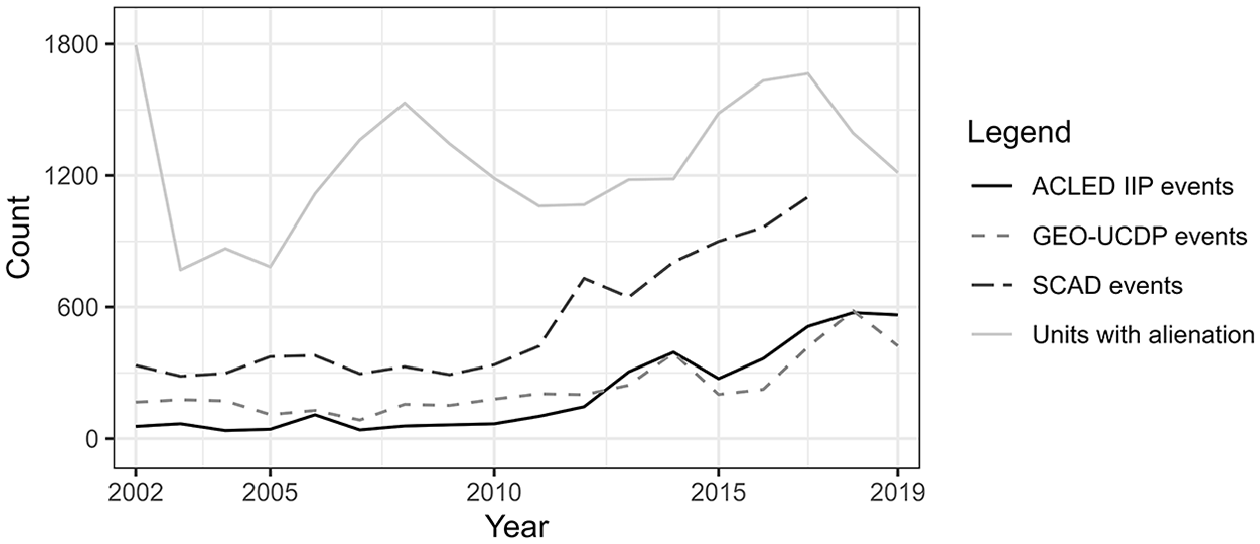
ACLED IIP events, SCAD events and UCDP events in the sampled countries.
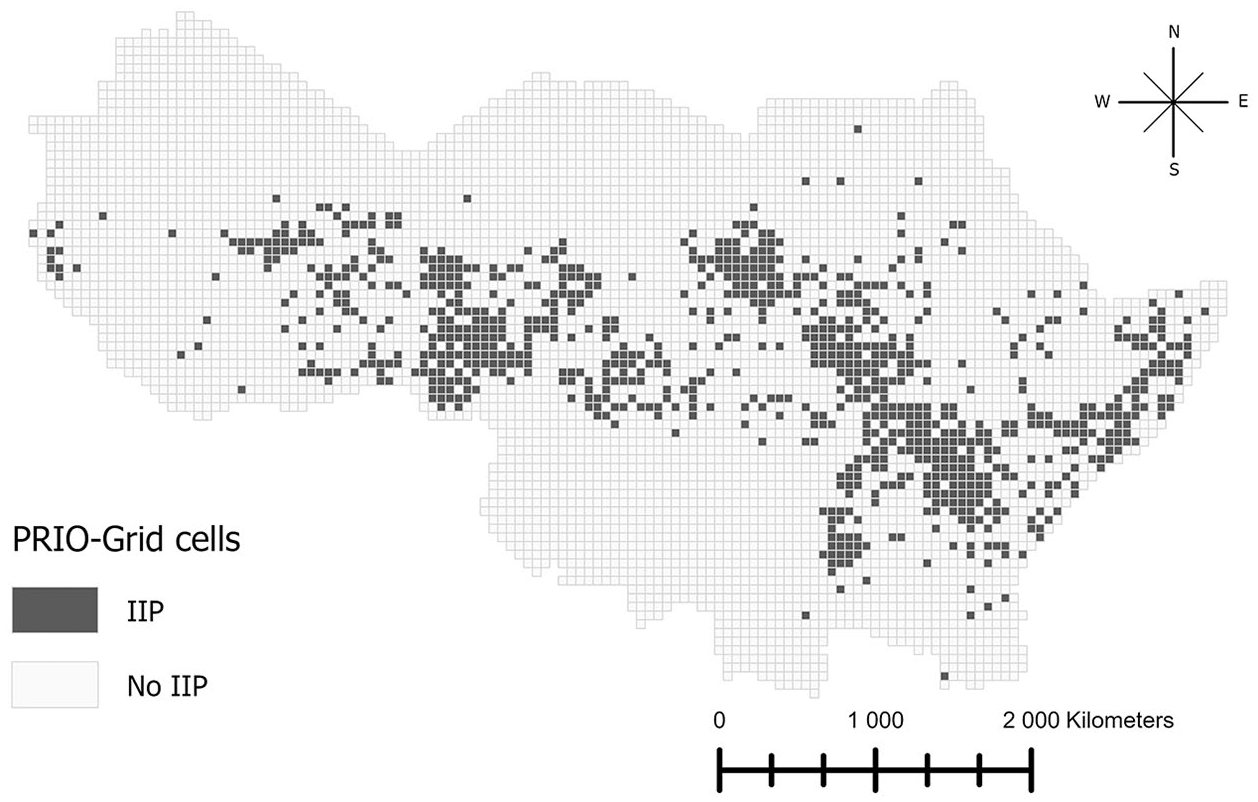
PRIO-Grid units that experience an incident involving pastoralists (IIP).
Independent variable
Our main independent variable Land alienation is operationalized based on the three subtypes of land alienation: Crop farm expansion (MODIS, 2024; Sulla-Menashe, 2019), a binary indicator that there is a positive difference between unit
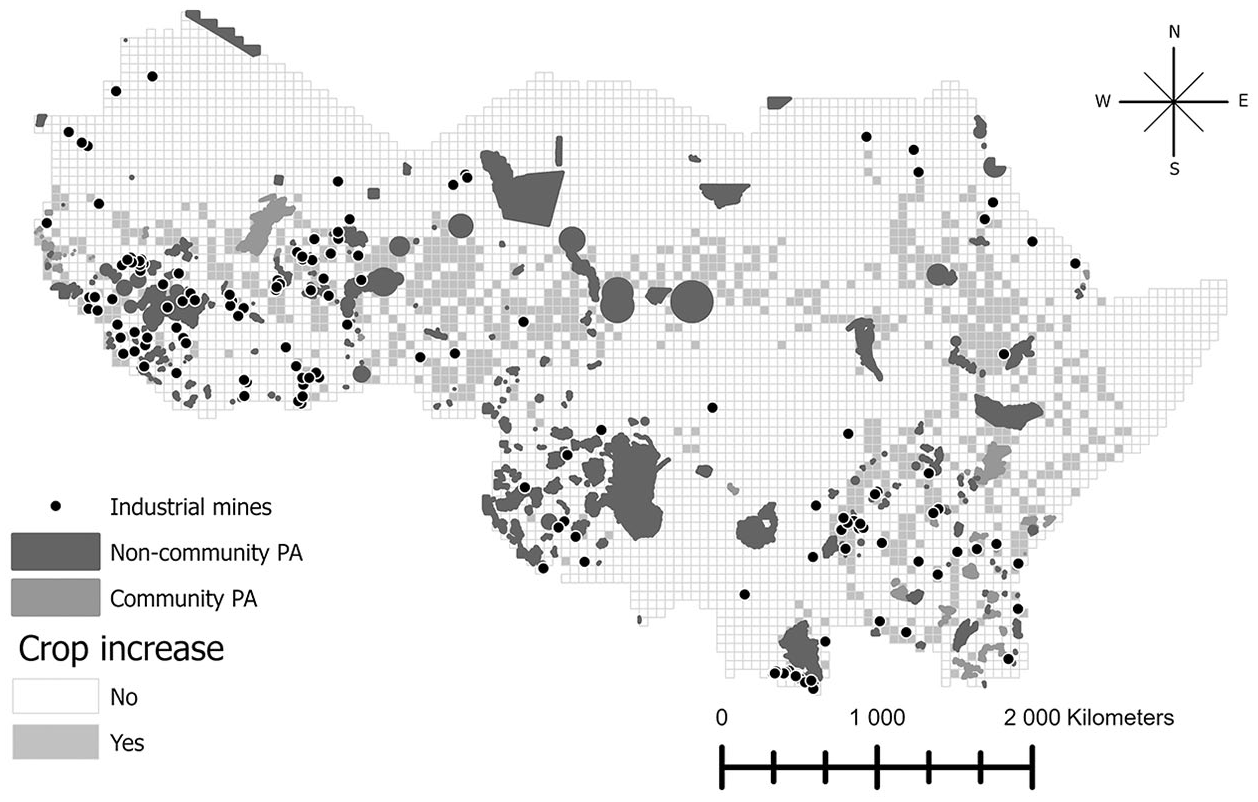
New mines, new protected areas, and units with average positive crop change over 2002–2019.
Figure 3 and Figure 4 reveal a considerable, but not absolute, spatial overlap between IIPs and Land alienation. Notably, West Africa and South-Central Africa experience land alienation with little to no incidents involving pastoral groups; this empirical puzzle deserves attention in future studies.
Mechanism variables
To test Hypotheses 2 and 3(a, b), we rely on three variables. Rainfall deviation is calculated from CHIRPS data (Funk et al., 2015) and measures rainfall deviation (in milliliters) from the mean of historical levels (1981 to 1999). Community Protected Area is a binary indicator of whether the protected area is under: collaborative; indigenous peoples’; joint; or local communities’ governance (UNEP-WCMC and IUCN, 2021). Finally, State presence is calculated with nighttime light emissions (Chen et al., 2021), and is used as a measure of state reach in the form of public good provisions (Koren and Sarbahi, 2018).
Control variables
To avoid using cell-level fixed effects and instead disentangle the various determinants of IIP, we rely on variables that can be operationalized at the subnational level. In our regressions, we include Population (Oak Ridge National Laboratory, 2023), Battles and violence against civilians (VAC) (Raleigh et al., 2010), Ethnic power (Vogt et al., 2015; Wucherpfennig et al., 2011), Permanent Water cover (MODIS, 2024) (all time-variant); Shared suitability index (Beck and Sieber, 2010), Historical Mines (Northern Miner Group, 2021), and Country Border (GADM, 2023) (all time-invariant). The justification and operationalization of our control variables is described in Online Appendix 3, Table 1.
Regression equations
We estimate five different models. First, we estimate the effect of land alienation on IIP with three different spatial relationships, based on a Spatial Autoregressive Model (SAR; Whitten et al., 2021):

Model 1(a) includes only a spatial lag of the outcome variable (with a



The equations include: our binary outcome variable
Next, starting from Model 1(c), we estimate the interaction effects between each moderating variable and Land alienation. In Model 2(a), we interact land alienation with the moderating variables (


Discussion of results
Land alienation and the occurrence of incidents involving pastoralists
The results of Models 1(a), 1(b) and 1(c) are reported in Table 2.
Estimated log odds of the occurrence of incidents involving pastoralists.

n = 6,010, T = 17, N = 102,170; †p < 0.1; *p < 0.05; **p < 0.01.
The models corroborate Hypothesis 1: All coefficients for Land alienation and its spatial lags are positive, indicating that land alienation increases the odds of an IIP. In Model 1(a), the p value of Land alienation indicates a 1.6% probability of seeing our observed values (or more extreme values) under a random process (null hypothesis). In Model 1(b), the p value of Land alienation’s spatial lag indicates a 0.01% probability of observing our current values under a random process. And finally, Model 1(c) shows a 3% probability of our observed values under a random process for Land alienation’s spatial lag. Since the neighboring effect of Land alienation in Model 1(c) predicts the occurrence of an IIP with more accuracy and strength compared to the within unit effect, our model provides empirical support that the impact of land alienation is stronger at its (spatial) margins.
8
With marginal effects, we estimate that on average Land alienation in
Moving on to the test of our mechanisms, we estimate equations 2(a) and 2(b); the results are reported in Table 3, Models 2(a) and 2(b).
Estimated log odds of the occurrence of incidents involving pastoralists: testing of the theoretical mechanisms.

n = 6,010, T = 17, N = 102,170; †p < 0.1; *p < 0.05; **p < 0.01; Community PA (t–1) does not have an independent effect because it is always zero when Land Alienation (t–1) is zero; for more information see the Research Design.
The interaction terms coefficients partially substantiate our hypotheses. In Model 2(a), we find no significant interaction effects. The probabilities of our dependent variable IIP predicted by Land alienation and the moderating variables are plotted in Figure 5, on the left panel.
9
The three figures clearly show a horizontal trend, with little to no differences in the predicted probabilities of an IIP occurring when there is Land alienation or not in the unit
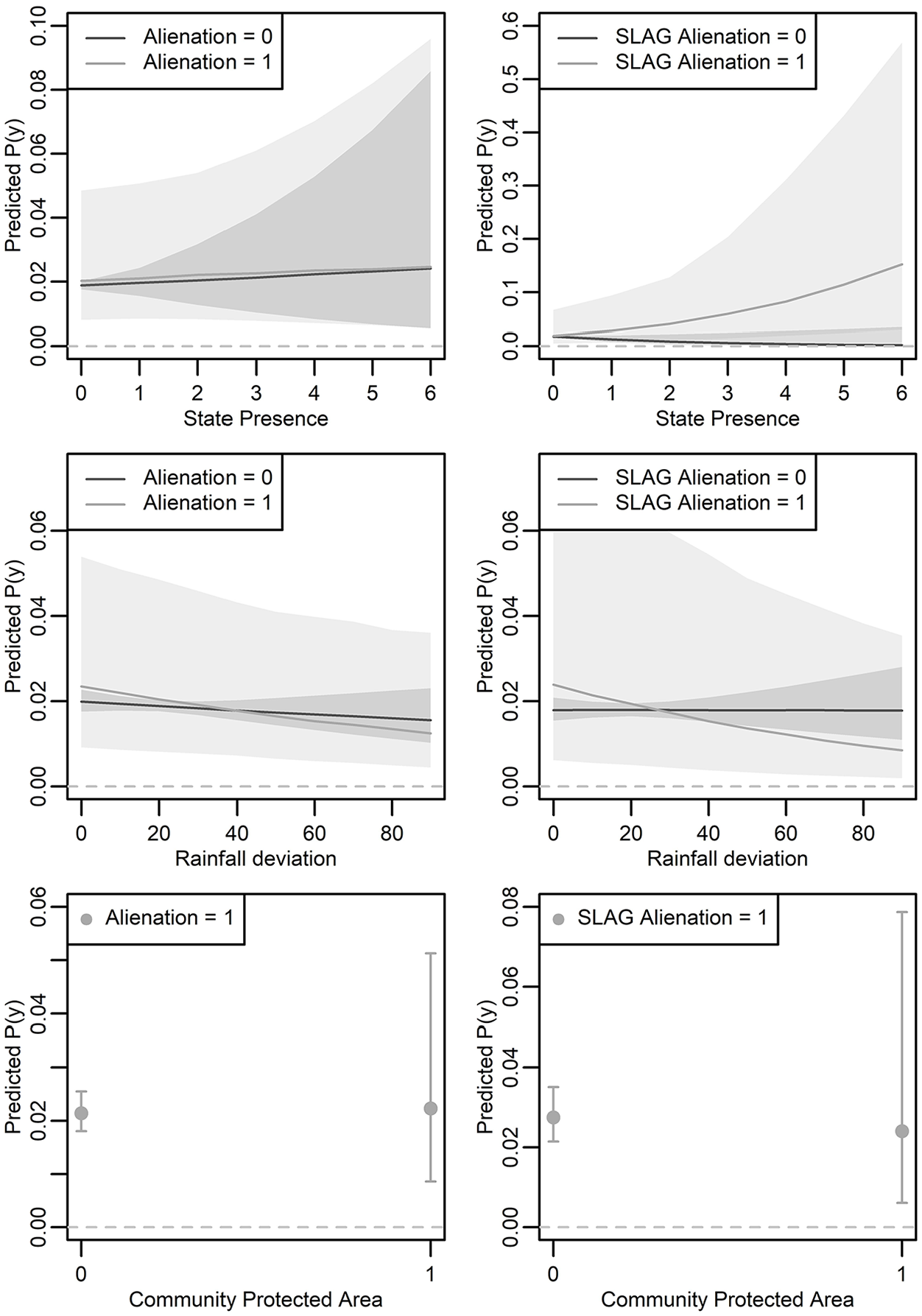
Predicted Probabilities of incident involving pastoralists (IIP).
In Model 2(b), we interact the spatial lag of Land alienation (i.e., alienation happening in
We notably find that the spatial lag of Land alienation has a positive and significant effect on IIP when State presence, Rainfall deviation, and Community PA are equal to zero (
Next, if we look at the coefficient of the interaction term SLAG Land alienation X Rainfall deviation (
Finally, looking at the interaction of SLAG Land alienation X Community PA, we find a negative non-significant effect (). The bottom right panel in Figure 5 evidences that the impact of land alienation on pastoralist violence does not seem to be contingent on a park being managed by the local community. While the coefficient shows the expected direction, the standard error is too large to allow substantial inference. Due to a lack of better data on local types of governance, we have to rely on this very coarse measure of bottom-up governance, which focuses solely on protected areas at their year of implementation.
Control variables
We finally find significant effects for some of our control variables that are consistent throughout our models. Battles and VAC is a positive and significant determinant of pastoral conflict, coherent with previous findings on the impact of geopolitical conflicts and automatic weaponry (Homewood, 2008; Wild et al., 2018), as well as terrorism (George et al., 2021; Krätli and Toulmin, 2020) on the intensity of pastoral conflict. We further find that Country border increases the odds of an incident occurring. This suggests that pastoralists seem most vulnerable to violence when crossing or being located near national borders, which is a worrisome finding considering the necessity for some of these groups to move across national frontiers. Alternatively, this could be due to the same mechanisms inherent to subnational communal borders (Detges, 2014: 61): cattle snatched during raids are more challenging to trace once they have crossed a border, raiders can share the booty with local corrupted officials and police to protect themselves, and finally herders might hesitate to cross borders to look for their stolen cattle out of fear of local communities’ reactions to seeing them, usually armed, roaming their territories. The final quite predictable finding is that Shared suitability, a variable indicating that land is appropriate for both agriculture and cattle grazing, increases the risk of pastoral violence. This is coherent with the growing evidence of farmer–herder conflicts we have reviewed, and the issue of competition over scarce resources.
Robustness checks
Readers interested in the disaggregated effects of each subtype of land alienation can refer to the relevant models in Online Appendix 3, Table 1. The models show that cells experiencing crop farm expansion and the creation of parks have a greater risk of experiencing pastoral conflicts, while new mining projects seem to reduce the conflict potential (within unit effects). All spatial lags have positive coefficients consistent with our main findings. However, only the effect of Crop Farm Expansion’s spatial lag is statistically significant. Again, we find the impact of land use change to be considerably larger in neighboring cells. Model 1(c) reveals that a unit
To ensure that our main finding on the effect of land alienation on pastoralist violence is robust to alternative specifications, we perform a series of additional robustness checks. The results can be found in Online Appendix 5, Table 1. We estimate the equivalent of Model 1(c) of Table 2: (1) with Firth’s (1993) biased reduced logistic regression; (2) with a 150 km inverse distance weight matrix; (3) with level-one administrative regions as units; (4) separating the two periods 2002–11 and 2012–19; (5) with Northern and Southern Africa included, excluding the Republic of South Africa; and finally (6) with SCAD intercommunal conflict events as our dependent variable.
Overall, these robustness checks confirm our main findings: in almost all specifications, Land alienation (and/or its spatial lag) systematically and significantly increases the odds of IIP. Two findings diverge from our main results. First, in the specification where we keep only the years 2002–11 (Online Appendix 5, Table 1, Model 4), we find positive coefficients for Land alienation and its spatial lag, but they are not significant. Therefore, it seems like Land alienation has become more problematic in the past decade. Second, we find that the spatial lag of Land alienation decreases the odds of an IIP when units are level-one administrative regions (the coefficient is non-significant; see Online Appendix 5, Table 1, Model 3). This, however, makes sense since units in this specification are about ten times the size of our PRIO grid-cells, and neighbors are drastically different in size depending on the country, so the coefficient is hardly interpretable. Altogether, these robustness checks, combined with our main results, support our argument that land alienation is a major predictor of conflicts involving pastoralists.
Concluding remarks
Relying on a narrow identification strategy for measuring conflicts involving pastoralists, our study is the first to quantitatively assess the geospatial effect of land encroachment on this type of violence. Our analysis demonstrates that land use changes driven by agricultural expansion, the establishment of conservation areas and the implementation of mining projects are an underlying driver of violence involving pastoralists. We thereby lend external validity to previous qualitative work linking land enclosure to the increasingly dire situation of pastoral livelihoods in the Sahelian region of Africa. Our geospatial examination further reveals that the effect of land alienation on pastoral violence seems to spread over long distances: conflicts often occur far away (up to 150 km) from the actual alienation source.
In addition to presenting evidence on the link between alienation and pastoralist violence, our study shows that competition over scarce resources may plausibly explain this relationship. Our statistical analysis demonstrates that pastoral conflicts become more likely in regions simultaneously affected by land use change and rain shortage. We also show that state presence increases the conflict potential of alienation. In areas with high state reach, pastoralists are more likely to become perpetrators or victims of violence when facing land use change. Instead of de-escalating conflict, the state seems to contribute to a spiral of violence by, for example, discriminating against pastoralists and promoting overlapping competencies that hamper more effective dispute resolution processes. Our indicator of state presence is, however, limited, since we cannot measure the quality of the local infrastructures. We could also not alleviate the possibility of a reverse effect, where the states invest more heavily in areas that are deemed problematic. Our finding thus deserves closer scientific attention, so we can untangle what is at play behind our coefficient.
Our analysis further contributes to the literature on the determinants of violence involving pastoralists by highlighting the intertwining of armed rebel movements with pastoralists. As described by the qualitative literature, local herders have been increasingly armed and instrumentalized by armed groups, leading to more cattle raiding and intercommunal violence in countries such as Sudan and Nigeria (George et al., 2021; Wild et al., 2018). Our quantitative results indicate that, in fact, the risk of pastoral conflict increases in areas hosting armed groups. We also provide evidence that countries’ border regions are more prone to experiencing pastoralist violence.
Some policy recommendations and venues for future research can be derived from the reported results. Our finding that state presence is a catalyst, rather than an inhibitor, of violence is daunting, considering that peace building is mainly contingent on the state and its institutions (e.g. for providing more tenure security and better land governance, protecting grazing routes and common land, guaranteeing judicial fairness). The positive impact of local peace committees in curbing pastoral conflicts reported by some authors (e.g. van Tongeren, 2013) may be a reason for hope and warrants more scholarly attention. Notwithstanding, we should further our understanding of when and how states may either prevent or promote this type of violence. More focus should be spent on state–pastoralist relations, which are often characterized by mutual suspicion and distrust.
Our results also point to the necessity of shedding light on how pastoralists are driven to armed struggle, particularly as part of transnational rebel and terrorist movements. Furthermore, considering that pressure on land and water will increase due to the climate crisis, it will be imperative to assess the effectiveness of particular adaptation strategies, including pastoral livelihood diversification, and explore meaningful recognition of pastoralist customary systems and the harmonization with statutory law. As pastoralist violence often occurs in border areas, we also highlight the need for more international and regional declarations to facilitate pastoralists’ cross-border movement. Our key finding further stresses the importance of better regulating the various sources of land alienation, for example, by more inclusive governance of protected areas or by better compliance with the Voluntary Guidelines on the Responsible Governance of Land, Fisheries and Forests (VGTT). Finally, as the effect of land alienation may spread over long distances, we need better theoretical and empirical models to more accurately predict the location of communal conflicts.
Footnotes
Acknowledgements
The authors thank Simon Hug, Ueli Staeger, Peter Morgan, Aya Kachi, Corinne Bara, Robert Huber, Viktoria Jansesberger and the participants of the workshop ‘Spatial Conflicts – Conflicts in Space’ at the Technische Universität Berlin for their excellent comments on previous manuscript versions. The authors further thank the anonymous reviewers and the editor for their valuable insights that greatly improved the quality of this article.
Replication data

Funding
Subscription by the corresponding author to the Mining Intelligence Database was funded by the Fondation Ernst et Lucie Schmidheiny, based in Geneva, Switzerland.