




Abstract
This article explores who is likely to benefit from Internet propaganda in civil wars. It argues that the global reach of the Internet, its lack of regulation and its filtering tools are more likely to help transnational rebel groups with external support and radical aims than local groups with home-grown support and moderate aims. The paper then introduces a new dataset on rebel propaganda that includes every available piece of public, downloadable Internet communication produced by every major rebel group in the Iraqi civil war between January 2011 and December 2015. A preliminary analysis of group-level Internet communication during the war revealed a number of striking patterns. Internet propaganda was not equally used by all rebel groups in Iraq during this time period. Groups with potentially larger international backing and low levels of local support were much more likely to produce Internet propaganda than those with strong in-country support. Ideologically extreme groups were also more likely to generate a higher volume of Internet propaganda than other types of groups. Finally, rebel groups that were new to a war tended to rely more heavily on Internet propaganda than more well-established groups. The article concludes by discussing the potential implications this new media environment could have for civil wars moving forward.
Most people assume that the Internet is a valuable organizational tool for armed groups involved in civil wars (Edwards and Gibbon, 2013; Federal Bureau of Investigation, 2021; Kaplan, 2009; Lieberman, 2017; Torok, 2013; Weimann, 2004). On the surface, this makes sense. The Internet is available to everyone with access to a computer or a smartphone. It is cheap. It is easy to use. It can disseminate information from almost any location, even remote hideaways. It has multiple ways of ensuring the anonymity of the people using it. It would seem, at first glance, to be the perfect tool for anyone trying to build a movement, advertise its principles and goals, recruit new members and raise money (Bloom et al., 2016; Hegghammer, 2010; Weimann, 2006; Winter, 2015; Zelin, 2014, 2015). But a closer analysis of the potential benefits of Internet propaganda suggests that it is likely to help some rebel groups more than others. Two unique features of the Internet – its global reach and its recommendation engines that curate social media feeds – are likely to help certain groups thrive in ways they have not before. We argue that these features can be expected to change the dynamics of civil wars in profound and potentially troubling ways (Zeitzoff, 2017).
This article has three goals. The first is to lay out a theory for what types of armed groups are well-positioned to benefit from Internet propaganda and why they are likely to gain more than others. 1 It argues that the global reach of the Internet, its lack of regulation and its filtering tools will shift the organizational advantage in war away from local groups with home-grown support and relatively moderate aims, to transnational groups with greater external support and more radical goals. It is these previously peripheral groups that are more apt to flourish in an Internet age. The second goal is to introduce a new dataset on rebel propaganda that includes every available piece of public, downloadable Internet communication produced by every major rebel group in the Iraqi civil war between January 2011 and December 2015. 2 These data comprise one of the most comprehensive collections of downloadable Internet propaganda across groups that we know of to date. 3 The third goal is to offer a preliminary analysis of group-level Internet activity during the Iraq civil war.
The data revealed two striking patterns. First, we found that rebel groups in Iraq did not generate Internet propaganda equally. Groups with a larger international base of support (for example, those with many co-sectarians outside the country) and low levels of local backing were far more likely to invest in Internet propaganda than those with strong in-country support. Groups on the ideological extreme were also more likely to generate a greater amount of Internet propaganda than those with more moderate aims. And groups that were new to the war tended to rely more heavily on this type of communication than more well-established groups. These patterns suggest that the Internet, as long as it remains relatively unregulated, will create distinct winners and losers and that the winners will be groups with less connection to a particular locale and its people.
Second, we found that groups that produced Internet propaganda did not generate content consistently during the period under study. Instead, they appeared to release their communications strategically: when they were new to a war and after they had conquered new territory. This suggests that the Internet may be lowering the barriers to entering a civil war, enabling more opportunistic players and interlopers to better compete against more indigenous actors. If this is true, then the new media environment is likely to lead to civil wars with a greater number of armed factions, greater external interference and more ideologically extreme actors.
Theory
We argue that the Internet and social media are likely to help a distinct set of rebel groups solve especially tough collective action problems (Weidmann, 2018; Zeitzoff, 2017). In order to survive, every nascent rebel faction must solve a number of organizational challenges (see Lichbach, 1995; Popkin, 1979; Sambanis, 2005; Tullock, 1971; Wood, 2003). At the very least, its leaders must convince individuals to fight for the group despite the risks and costs of injury and death. It must persuade local citizens to accept or tolerate the group’s presence even though such loyalty or quiescence could bring punishment from the government. And it must coax costly resources from those able to help finance the organization even though the returns on such an investment are not guaranteed and must be shared with all members of the group.
In a pre-Internet world, two types of budding rebel factions had an advantage in solving these problems. The first were factions led by individuals native to a particular region: people who spoke the local dialect, had deep ties to the community and had access to regional sources of revenue (see Denny and Walter, 2014; Kalyvas and Kocher, 2009; Loyle and Bestvater, 2019). These political entrepreneurs could leverage local networks, family connections and shared grievances to identify potential recruits. Home-grown groups were also more likely to enjoy the support, hospitality and loyalty of the local population, allowing them to mobilize more quickly and better evade government repression (Eck, 2010). They also knew what inducements were more likely to motivate the local population, were more trusted in terms of their promises to allocate future rewards and could more efficiently identify and sanction bad behavior (Hechter, 2012; Humphreys et al., 2006). They could also better exploit the territory’s material resources in the form of taxes, cash crops or donations, and offer protection and services to local populations (Humphreys, 2005; Ross, 2004). The same was not true of groups from outside a conflict region who had fewer links to the community and were, therefore, less able to compete and survive.
The second type of group with advantages in a pre-Internet age were those with more moderate aims (i.e. groups that sought political reform or regime change rather than revolutionary change). In a competitive war environment, choosing an ideology on the extreme end of societal preferences makes recruiting large number of soldiers and supporters more difficult because an insufficient number of citizens are likely to hold these views (Walter, 2017a). Radical groups, therefore, had a smaller base of support from which to draw recruits.
To date, the literature on rebel group mobilization has tended to focus on these home-grown advantages, emphasizing all the ways that local groups benefit from proximity to their base of support. The literature, however, has yet to analyze how social media, with its recommendation engines that favor more extreme material, and that rapidly disseminate information worldwide, have changed this. What if a number of organizational challenges could now be better resolved online? Staniland (2012) and Kilcullen (2011), for example, have argued that family, kin and community ties aided rebel recruitment because they provided the trust, social capital and shared norms among potential recruits. But what if social networks could now be crafted and managed more effectively online? Local advantages would disappear. Arjona (2016) has argued that rebels often prefer to recruit from communities with shared grievances against the state. But again, people with similar grievances can now be drawn from around the world via the Internet, and then be further ideologically indoctrinated on networking platforms. Control over territory or physical access to a community will no longer be an advantage or potentially even necessary.
What follows explains how Internet technology is likely to disrupt these traditional patterns of organization and change power dynamics in at least two ways. First, access to the Internet now gives any political entrepreneur instantaneous access to a global audience, releasing them from the need to connect with or cater to a local population. A small band of individuals, intent on building a rebel movement, can now attempt to recruit sympathetic individuals from other countries from a laptop in a rural village, and try to build support and solicit financing from organizations, alliance partners and enemy governments far from the conflict zone. Suddenly, outside groups can begin to compete – perhaps even outcompete – home-grown ones. In a study of rebel group activity on Twitter between 2006 and 2018, Loyle and Bestvater (2019) found that the primary audience that rebel groups hoped to reach on social media was international. 4
Second, the Internet gives a particular type of political entrepreneur – those willing to produce the most extreme, incendiary and attention-grabbing messages – the widest possible audience. Recommendation engines on social media sites such as Google, Facebook, YouTube and X (formerly known as Twitter) (as well as encrypted sites such as Telegram) not only identify individuals around the world who are receptive to a group’s message (no matter how outrageous), but also amplify the more radical content at the expense of more moderate messages (Harris, Center for Humane Technology, Podcast Episode 5; Pomerantsev, 2019). Social media algorithms then move the followers of these groups down an increasingly extreme ideological path, essentially creating a radicalization pipeline (Cohen-Almagor, 2012; Edwards and Gibbon, 2013; Jensen, 2014; Mitts et al., 2022; Thompson, 2011; Torok, 2013). If you are an extremist and you want to grow your movement, social media is the place to be.
These two unique features of the Internet – its global reach together with social media’s algorithms – benefit three types of groups that previously had a harder time competing in civil wars. The first are groups with limited local support but strong support outside a country; these include transnational ethnic and religious groups, groups with large diaspora communities, groups with ideologically sympathetic patrons around the world and foreign governments seeking alliance partners willing to attack an enemy regime. Suddenly, actors from outside a region or even a country can grow their ranks without relying heavily – or at all – on the local population. Al-Qaeda perfected this technique with its external recruitment efforts in Syria and the Arabian Peninsula where it was able to recruit tens of thousands of foreign soldiers.
The same is not true for native groups. Locally based groups may try to take advantage of the Internet’s reach and algorithms, but these benefits are less useful to them. Small, geographically concentrated ethnic groups, such as the Assamese in India, the indigenous population of Chiapas, Mexico, and the Shi’a in Iraq, gain far less from the Internet’s global audience than do groups whose population base or sympathizers lie predominantly outside their country (such as the Bengalis in India or Sunnis in Iraq). They, therefore, have fewer incentives to devote time and effort to such campaigns.
The second type of faction well-positioned to reap the benefits of these Internet features are groups on the extreme end of the ideological spectrum. Every city, region and country has a small number of individuals who embrace radical ideas. In the past, these individuals were geographically isolated from each other – physical space made it difficult for them to find each other and coordinate their activity. The Internet, however, has solved this problem, making it easy for them to communicate and coordinate. Moreover, recommendation engines are now designed to push content that keeps people engaged online as long as possible and this type of content tends to be more extreme. Walter Quattrociocchi, a computer scientist at Sapienza Universita di Roma, analyzed 54 million comments over four years in different Facebook groups. He found that the longer a discussion continued, the more extreme the comments became (Pomerantsev, 2019). In an Internet world, extremist voices will often drown out moderate voices, falsehoods will often drown out truth, and anger and hate will often silence calls for compromise.
The third beneficiaries of Internet propaganda are likely to be late entrants into a civil war. These could include new factions that split from existing ones, opportunistic groups that form as a war progresses or external actors seeking to exploit state weakness in the chaos of war. ISIS, for example, was a late entrant to the war in Iraq, organizing first in Syria before later returning to Iraq in the midst of an ongoing fight.
In a pre-Internet age, early entrants had at least three distinct advantages over those that formed later. Early groups had time to accumulate experience on the battlefield and to acquire more military hardware, both of which created high barriers to entry for late-forming groups. Early movers also had time to develop efficient ways of delivering protection and social services to the local population, gaining more credibility and legitimacy with citizens. Perhaps most importantly, early movers had more time to establish relationships with key local donors so that those donors were unavailable to fund new rebel groups. Each of these advantages made it more difficult for additional groups to mobilize and survive. This is no longer the case. The Internet gives later entrants into a war access to the same communication technology as even their strongest competitor, allowing them to quickly and cheaply promote themselves. Internet propaganda, for example, can be used as part of a ‘hearts-and-mind’ campaign, designed to convince the local population that the newcomers or outsiders deserve their support. Rebels can utilize real-time videos as evidence of their public works in different parts of the country. Finally, rebel groups can also use the Internet to provide reliable information about battlefield victories, potentially swaying public support in their favor, even if they are not well-known. The result is that it is now easier for unfamiliar, alien groups to compete with older, more familiar ones.
The implications of these Internet features give us three hypotheses for testing.
Hypothesis 1: Transnational rebel groups are likely to invest more heavily in Internet propaganda than rebel groups whose base of support is local.
Hypothesis 2: Ideologically extreme rebel groups are more likely to invest in Internet propaganda than more moderate rebel groups.
Hypothesis 3: Newer rebel groups are more likely to invest in Internet propaganda than older groups.
Data description
Scope and data collection 5
This article attempts to reveal patterns in rebels’ use of Internet propaganda by introducing a new dataset on rebel propaganda. Our dataset includes all rebel groups that operated in Iraq from 1 January 2011 until 31 December 2015; the unit of analysis is the rebel group/month. Rebel groups were identified based on their inclusion in Stanford’s Mapping Militant Organizations project (Stanford University Center for International Security and Cooperation, 2015), the most comprehensive list of rebel groups in this conflict to date. To be classified as a rebel group, an organization had to meet three criteria. It had to be (1) a militant organization, defined as one of ‘the most relevant and significant groups for a given conflict theater’, (2) actively opposed to the state for at least one month within the given time period and (3) be militarily or politically active during this time frame. Between 2011 and 2015, nine groups met these criteria in Iraq: the Shi’a groups Kita’ib Hezbollah, Asaib Ahl al-Haq (AAH) and al-Madhi Army, 6 and the Sunni groups the 1920s Revolution Brigades, Ansar al-Islam, ISIS, Jaysh Rijal al-Tariq al-Naqshabandi (JRTN), the Islamic Army of Iraq, and Jaysh al-Mujahideen. 7 Nine groups over 60 months gave us 540 rebel group/months. 8
Our main goal was to collect all the available downloadable Internet propaganda produced by these groups over this five-year period. Internet propaganda was measured in three ways. The first was a dummy variable – Internet propaganda – indicating whether the rebel group produced any official media in a given month in downloadable form. 9 We also measured the intensity of propaganda efforts. Propaganda intensity measured the number of pieces of downloadable Internet propaganda produced by a rebel group in a given month. We also created a third variable – Videos – in order to assess whether this visual form of communication is used differently than propaganda via print.
Data collection
Our data collection effort went through a four-step process in order to ensure the most comprehensive collection of downloadable Internet material as possible. First, we engaged in an exhaustive search for all media outlets used by these organizations. Our sources included past and present official websites, active X and Facebook pages, and archives documenting jihadist propaganda over time. Web forums friendly to the spread of rebel group media were also identified and catalogued. We then carefully identified any social media accounts associated with an organization through user-, official page-, and content-based queries on X (formerly Twitter), Facebook, Instagram, YouTube, Tumblr and Myspace. 10 Violent extremist organizations (then and now) tend to make initial contact with potential recruits on these open or ‘surface’ platforms where the reach is greatest, and then direct interested individuals to encrypted sites for more in-depth radicalization (Malik, 2018; Xu et al., 2006). Note that social media companies such as X, YouTube and Facebook did deactivate some accounts during this time, however, producers of propaganda simply opened new accounts in response. The authors recorded any discovery of a media channel and registered it to archive.org for posterity.
Second, we employed Crimson Hexagon’s ForSight social media analysis tool to track topic-specific issue trends likely to be posted by rebel organizations. This allowed us to validate the existence of some of the media outlets we discovered, to support the validity of any non-primary sources, and to verify the dates during which the media outlets were active. For example, we used Crimson Hexagon to track and analyze many variations of the Arabic phrase ‘قادمون يا بغداد’ (‘We are coming, Baghdad’), a phrase popularly incorporated into a hashtag used by ISIS temporary accounts to surge media releases without being shut down. Overall, Crimson Hexagon’s ForSight program made our results more robust to unidentified media outlets than simply relying on manual online searches or archival web-crawling programs. 11
Next, we performed an extensive analysis of each rebel organization’s web history via the Wayback Machine, a publicly available online archive tool that maintains a constantly updating corpus of material published online. We used this tool to ensure that all channels and types of media were accounted for at the time of analysis. This additional method of corroboration, however, is only available for organizations operating an official web page. For organizations like ISIS that rely on unofficial propaganda dissemination through methods such as ‘hashtag surges’ on social media outlets, this type of archive is unavailable.
After completing the search for potential media outlets, the authors conducted a month-by-month review of each source for each organization to determine whether a given organization released official media within the given month interval. This allowed us to measure whether an organization produced propaganda in a given month, and to count the number of unique pieces of media produced in a month (Propaganda intensity). Data collected from one outlet were cross-referenced with all other documented media outlets enumerated above for verification. For organizations without a consistently available official website or social media outlet, the authors turned to the third-party archiving projects such as www.jihadology.net. Organizations such as ISIS, which did not have an official website or social media outlet, were the subject of rigorous documentation on www.jihadology.net. The authors often deferred to this project for official releases by ISIS and Ansar al-Islam over time, and verified the approximate timing of release when possible with the broader-based automated archive system operated by archive.org. 12 If no information for a given period was available from any documented sources, the authors recorded the data as missing. 13
One of the challenges of collecting data on Internet propaganda is determining who produced the message. We limited our data collection to ‘official’ media output to ensure direct attribution to a group. To be included, each communication had to provide unique information, such as an organizational logo or connection to a known, reputable media outlet associated with a rebel organization. 14 We also limited our data collection to downloadable media. 15 Downloadable media are messages such as magazines or videos posted to websites or spread through social media that can easily be archived without the loss of information. Downloadable media are more likely to survive the loss of a web domain, or the deleting, suspension or removal of a social media page from which they originated, allowing us to go back in time to 2011. Limiting the data to downloadable content has the added benefit of allowing others to access the original data via the same sources to replicate the results.
A dataset that includes only public and downloadable material has limits in terms of its scope. First, it cannot reveal the ways in which rebel groups may utilize different forms of Internet communication for various objectives. That would require collecting data on every type of Internet message during this time – downloadable and non-downloadable – something that does not exist. Second, our dataset does not include clandestine networks of Internet communication that are also not available in any comprehensive and reliable way. Finally, it remains unknown (and unknowable) the proportion of non-downloadable to downloadable information disseminated during this time since much of the non-downloadable material has been lost. Conclusions about other types of Internet media, therefore, must be left for future study.
Independent variables
In order to test these hypotheses, we collected data on the characteristics of each of the rebel groups included in the dataset at the time when propaganda was produced.
We argued that three types of rebel groups are likely to be particularly advantaged by Internet propaganda. The first are groups whose main base of support lies outside a conflict theater. This could include groups with significant ethnic or sectarian kin living outside a particular country, such as the Sunni rebel groups in Syria, Iraq, Yemen, Libya, Somalia and Nigeria. To account for differences in local versus international support, we coded each rebel group in Iraq in two ways. The first was whether a group was Shi’a, Sunni, or Kurdish. Since Shi’a represent approximately two-thirds of the Iraqi population, Shi’a groups should have less difficulty recruiting soldiers domestically and thus less need to produce propaganda. 16 By contrast, Sunni rebel groups represent only 20% of the Iraqi population but represent approximately 90% of the world’s Muslims. Our theory asserts that Sunnis would, therefore, have greater incentive to invest in Internet propaganda to take advantage of this. We also coded whether a group had transnational versus local objectives. Internet campaigns are likely to be particularly attractive to rebel groups pursuing global rather than domestic war aims because they can now easily make appeals across international borders. Global Aims was coded based on whether a rebel group defined itself as a ‘global jihadist’ group that aspired to unite Muslim territory across national borders. 17 Groups that did not have global aims were further coded as either seeking regime change (to depose a government) or seeking more limited internal political reform. 18
The second type of group expected to benefit from Internet propaganda were those on the ideological extreme. The Internet allows factions on the political fringe to connect with radicals worldwide, thus expanding their potential recruitment and financing base. Social media’s algorithms also feed increasingly extreme content to followers, giving more radical groups an advantage in converting and enlisting recruits over more moderate groups. Ideological extremism was measured using two different dummy variables: Islamist group denotes whether a rebel group sought to integrate fundamentalist Islamic teachings into governance; Salafi group indicates whether a group adhered to Salafist principles. 19
The final hypothesis viewed propaganda as a form of advertising designed to publicize otherwise unknown or new rebel groups. We expected a rebel group to invest more heavily in propaganda when it was new to a civil war. The Age of a rebel group was measured in months since a group’s founding.
Data limitations
It is important to note that insights we draw from this study come from data with several limitations. First, our dataset contains only nine groups in a single conflict. This limits our ability to use well-known statistical tools such as group-level fixed effects in a multivariate regression framework without imposing a heavy statistical power burden on our data. Second, there is a high degree of collinearity across our measures. This is because several of these measures, such as support from Iran, Islamist ideology, or Salafist orientation, tend to be present together. For example, Iran only supported Shi’a groups with an Islamist agenda during this period. Third, our dataset contains missing values across groups, including a nearly 60-day period in which researchers from whom we drew were not able to collect data across four groups in our dataset (from the beginning of June to July of 2012).
These limitations forced us to restrict our analysis to a descriptive design that helped us establish the plausibility of our nascent theoretical framework. Our goal was not to establish any causal evidence for the hypotheses we put forward (which is not possible), but rather to see what patterns, if any, were emerging.
We also recognize that an analysis based on one conflict may not generalize in a predictable way across space and time. We chose to limit our analysis to Iraq’s second civil war despite this tradeoff for two reasons. First, it allowed us to focus on the within-country-context features of groups that we think are likely to matter most in determining their messaging strategy. Second, Internet data were available in an unusually accessible way in Iraq between 2011 and 2015. Unlike comparable civil wars in the region, such as the ongoing civil wars in Yemen and Syria, we were able to find a reasonably complete series of data on relatively well understood major rebel groups and their online propaganda. These features made this particular country, Iraq, and this time frame, 2011–2015, an ideal empirical case for deeper study.
Internet use is uneven across groups and over time
Table 1 provides descriptive statistics for propaganda output across rebel groups in Iraq from 2011 to 2015. We provide the mean, standard deviation and min–max values for each of our three dependent variables of interest (Internet propaganda, Propaganda intensity (i.e. releases) and Video releases) across monthly units for the nine groups included in our dataset. We drew two conclusions from these data. First, some rebel groups used Internet propaganda far more often – and more heavily – than others in this conflict, suggesting that they had greater incentives to do this. For example, the most active group in the war, ISIS, produced Internet propaganda in 92% of all months and averaged 11.6 total releases and 7.1 video releases per month, while the least active groups (like Jaysh al-Mujahideen and AAH) never produced Internet propaganda. Second, the groups that did produce Internet propaganda in Iraq did not produce it consistently. ISIS, our most active group, had a month in which it produced as many as 49 pieces of Internet propaganda and other months in which it produced no propaganda at all. Considerable variation existed across and within groups in terms of their online presence.
Propaganda output by group.

Exploratory tests
A slightly deeper look at the data suggests that local support plays a large role in determining who invests in the Internet and who does not. Given the unique features of the web, we expect that rebel groups with more extensive ties to the local population and thus less need to recruit soldiers and resources from outside the territory should be less likely to produce Internet propaganda and less likely to use videos when they do. In the Iraq case, this means that Shi’a rebel groups (AAH, for example), who represent a majority of the local population should, on average, be significantly less likely than Sunni groups (such as ISIS or JRTN), who are a minority of the local population, to invest in propaganda. As Table 2 reveals, this pattern holds. Sunni rebels used propaganda about 67.8% of the time while Shi’a rebels used it about 47.9% of the time. The gap between Sunni and Shi’a groups was almost as large when it came to propaganda intensity (3.7 releases vs. 2.5 releases per month) and the use of videos (1.8 video releases vs. 0.7 video releases per month). Groups in Iraq with weak local support but potentially heavy international backing put significantly more effort into their Internet campaigns. 20
Local versus international rebel groups and propaganda.

p < .10,
p < .05, **p < .01.
Table 2 also reveals that the goals of rebel groups helped shape the degree to which they utilized propaganda. As we theorized, rebel groups that seek global aims and may thus have a more international audience were significantly more likely to use propaganda than those seeking more limited goals. Self-professed global jihadists who aim to create a transnational caliphate employed propaganda 78.9% of the time compared with only 61.7% for groups who seek to topple the local government and 47.9% for groups who only seek internal political reform. Large differences also emerge if we focus on the intensity of propaganda or the medium being used. Global jihadists produced 6.6 pieces of propaganda each month compared to 1.9 and 2.5 releases for the other two types of groups, as well as significantly more videos. This suggests that groups require Internet propaganda less when they enjoy local support and when their aims do not extend beyond their borders.
Extremism and propaganda
Our theory also predicted that ideologically extreme rebel groups will have greater incentives to find believers around the world. Contrary to these expectations, Table 3 reveals that the most radical rebel groups – the Salafi groups – produced Internet propaganda in fewer months than non-Salafi groups (51.7% vs. 67.6% of months). However, the table also shows that when Salafi groups generated propaganda, they were more prolific than their non-Salafi counterparts. Salafi groups released an average of 4.3 downloadable messages and 2.5 videos per month compared to only 2.7 releases and 0.8 videos per month for non-Salafi groups. 21 In addition, while Islamist groups appeared to produce propaganda less frequently overall (against expectations), their average number of releases – including video releases – over this period was higher. In short, the data, while somewhat mixed, do suggest that more extreme groups may be using Internet propaganda more than more moderate groups.
Extremist versus moderate rebel groups and propaganda.

p < .10,
p < .05, **p < .01.
The age of rebel groups and propaganda
Finally, we anticipated that groups that are relatively new to a war and thus have a greater need to advertise both for supporters and for recruits should be more likely to rely on Internet propaganda than more established groups. Table 4 reveals that rebel groups that were relatively new to a war did, in fact, tend to invest more heavily in propaganda than existing ones. The differences were both substantively large and statistically significant. The age of a rebel group strongly affected the use of propaganda. Younger-than-average groups such as JRTN and ISIS used propaganda about 6% more often than older-than-average groups and did so with greater intensity (4.2 vs. 2.6 pieces per month).
Rebel group age and propaganda.

p < .10,
p < .05, **p < .01.
These results revealed that certain types of groups were more active on the Internet than others. Key features of Internet propaganda – its wide-ranging distribution and preference for shocking content – mean that groups with the least amount of local support (new groups, Sunni groups and global jihadist groups) relied the most on this technology.
The case of ISIS
Our theory explained why some rebel groups might rely more heavily on Internet propaganda than others, and the conditions under which they would probably be more active online. What we do not know is whether they invested in online media for the reasons outlined in the theory – to help overcome the collective action problems that made recruiting, fundraising and competing with local groups more difficult.
In what follows, we look more closely at ISIS’s use of propaganda to see if its production schedule and the content of its messages fit our theory. Did ISIS use Internet propaganda as a way to recruit soldiers, raise funds and be more competitive against local Iraqi factions? And did the timing of ISIS’s propaganda releases coincide with times when it was new to a region and attempting to capture a territory?
ISIS has invested more time and money into disseminating information on the Internet than any other group in Iraq and it had good reason to do so: it originated outside of Iraq, sought to bring Iraq under a transnational caliphate that represents the most extreme form of Islamic rule and entered the war approximately ten years after the war had started. Studying the content of ISIS’s propaganda more closely will help reveal whether its messages support the theory described above.
We found that ISIS’s messages between 2011 and 2015 focused heavily on the recruitment of soldiers, accounting for between one-third and one-half of all releases. During this time, ISIS convinced tens of thousands of individuals living outside of Iraq to travel to Iraq to join the group, something it needed to do in order to compete with existing local factions. ISIS’s messages tended to have three features in common that suggested their main purpose was recruitment. First, the language used often emphasized the material rewards of joining ISIS, a common tactic used by many organizations to gain adherents. Second, ISIS’s messages tended to include an individual or set of individuals detailing their history with the group as a guide for prospective recruits to follow. Individuals could watch these videos and understand exactly how they themselves could join ISIS. Third, these messages frequently laid out the additional moral or social rewards of fighting for ISIS, making volunteering even more attractive. Taken together, this content implied that prospective new recruits from anywhere could join the group and be as successful and satisfied as existing ISIS soldiers.
An example of a recruitment-oriented release comes from the video ‘Holders of the Wounds to their Nation, #5’ released online in July 2015. Within it, a Tunisian fighter named Abu Ahmed al-Tunisi outlines the bountiful rewards of jihad in Iraq, focusing on the physical and spiritual healing that he claims ISIS brings to the once-pristine caliphate. Brandishing an assault rifle, al-Tunisi explains in unaccented fusHa – the formal dialect of Arabic used to communicate across regional dialects – how his sense of duty as a Muslim motivates him to participate in the struggle of ‘true Muslims’ against the ‘Safavids’ (ISIS’s term for Shi’a Muslims). By bringing together a personal story of religious redemption told by a newly empowered foreign recruit, ISIS provides their version of a role model for Muslims around the world to follow. It also invites foreign Muslims to help restore their vision of the pristine beauty of a renewed caliphate. These types of fighter-reflections can be found across all groups included in the dataset, although testimonies of foreign fighters are far more limited to non-local groups like ISIS.
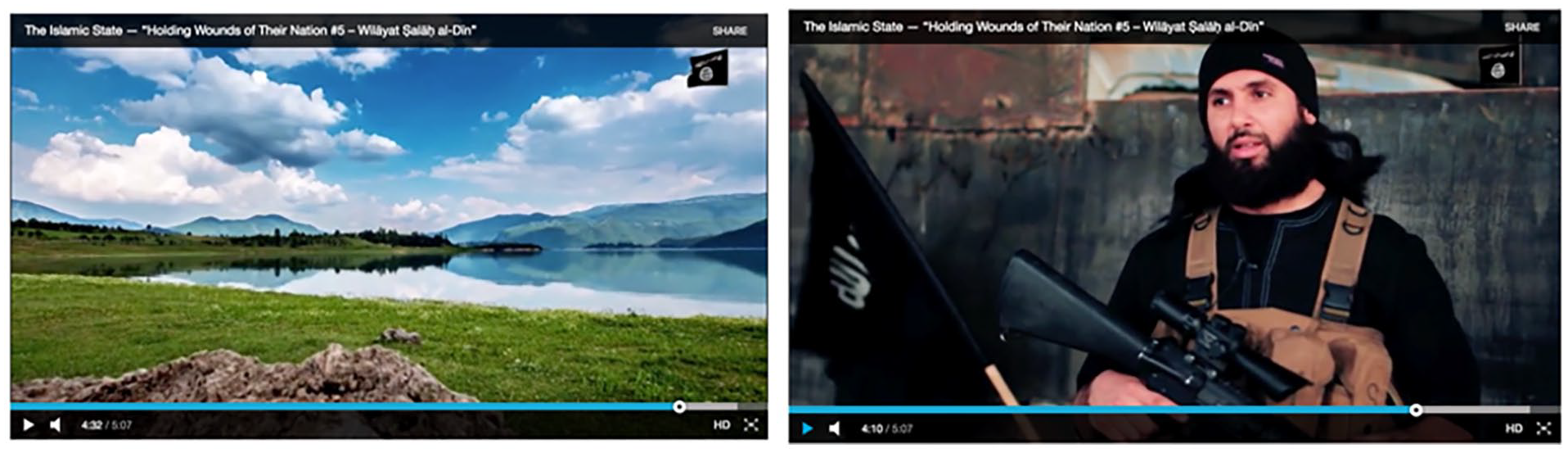
Shots from ‘Holders of the Wounds of Their Nation’. On the left, a depiction of a riverbank presumably along the Tigris river. On the right, Abu Ahmed al-Tunisi wielding an assault weapon and providing testimony (www.jihadology.net).
We also argued that groups have strong incentives to invest in Internet propaganda if they have limited sources of domestic resources. This latter condition characterized ISIS until mid-2014, when it captured significant amounts of territory, including lucrative oil fields, in northern Iraq. Between 2011 and 2015, ISIS released messages that appeared to be designed to solicit financial aid in four steps. The first highlighted ISIS-induced improvements in particular locations over time, such as the renovation or construction of a new mosque, the opening of a new city market or the distribution of food. The second linked these improvements to the dedicated labor of ISIS individuals, who provided a testimony to the improvement’s value. The third highlighted the cost of particular projects by appealing for the money needed for a particular operation. The final set of releases reminded the audience of the religious obligation Muslims had to contribute across the board to jihad.
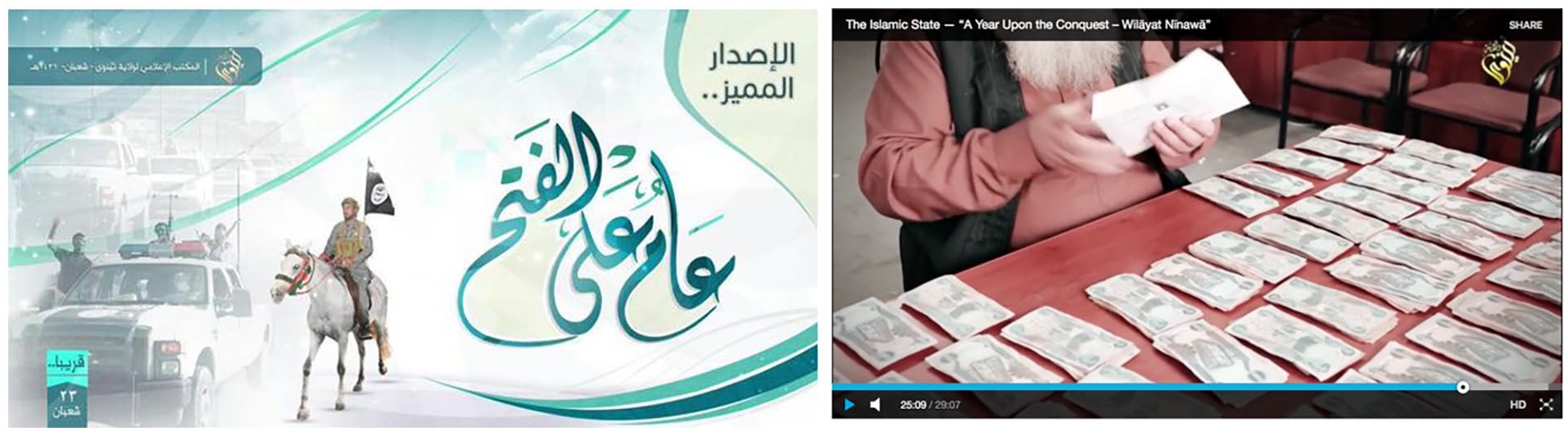
To the left, the trailer banner for a financing-oriented video release entitled ‘A Year Upon the Conquest’; to the right, a screenshot of an ISIS operative sorting cash into payments for ISIS soldiers (www.jihadology.net).
The case of ISIS does, however, illuminate a puzzle. Our data revealed that ISIS did not decrease its production of online propaganda during the time it controlled Iraqi oil fields. Instead, ISIS’s acquisition of oil corresponded with a large spike in the number of propaganda releases per month. Why would it do this? We suspect that ISIS increased its releases during this time because its acquisition of the oil fields triggered heavy military attacks from the United States. ISIS may have needed to invest more heavily in propaganda because it needed to recruit more individuals to replace those who were being killed, a factor not captured in our empirical analysis.
Finally, ISIS had all of the characteristics of a rebel group well-positioned to exploit the unique elements of the Internet. It was a relative latecomer to the war in Iraq and it faced competition from multiple existing Sunni factions; at times it engaged with groups like JRTN, Ansar al-Islam and more numerous local militias. A closer look at the content of ISIS downloadable propaganda revealed that ISIS did produce more material when it captured new territory, and that it was keen to differentiate itself from these existing rivals. Promotion-related releases shared three qualities. First, these releases emphasized the religious differences between ISIS and a competing group in a form of product differentiation. Members of these factions (who had all entered the war earlier than ISIS) were labeled apostates regardless of the similarity of their group’s sectarian identification. Second, these releases used words, images and actions to physically and psychologically undercut members of a rival group. Rival members were often portrayed as kneeling, bound or otherwise incapacitated in the presence of ISIS forces, and many videos featured executions alongside religious denunciations of the rival’s creed. Third, these releases tended to emphasize the broad popular support ISIS enjoyed relative to its rivals. ISIS often portrayed the execution of captured rival soldiers or officials as a public event attended by a large and supportive group of civilians and religious leaders, often with lengthy commentary from them.
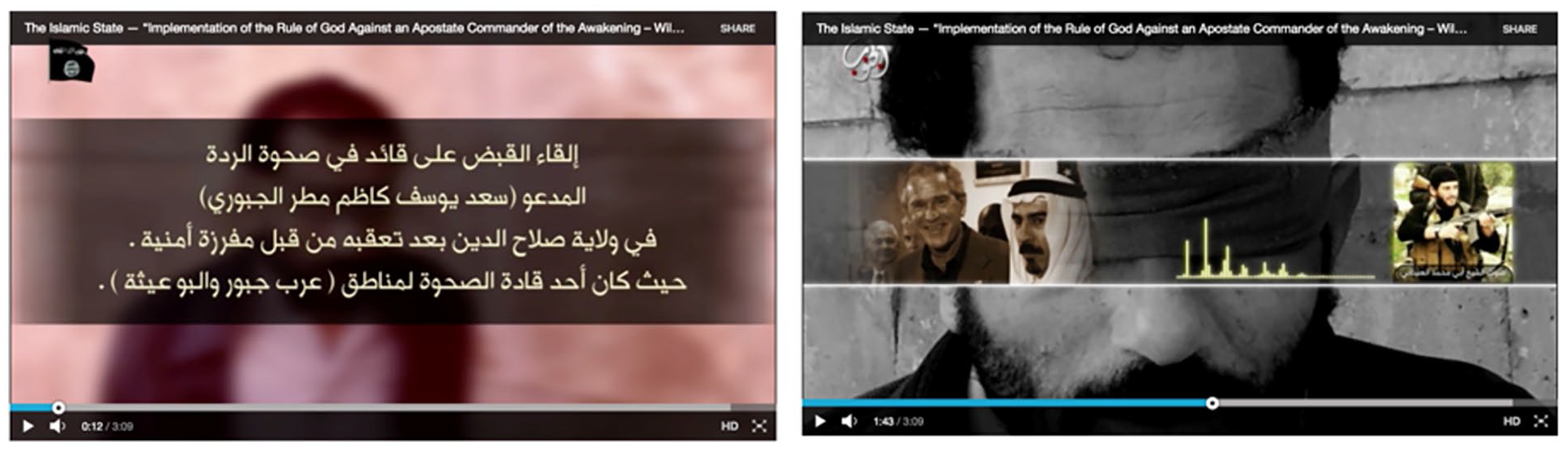
Images from the ISIS video ‘Implementation of the Rule of God Against an Apostate Commander of the Awakening’.
This brief look at the propaganda produced by ISIS between 2011 and 2015 showcases how the group used the Internet for all the reasons outlined above but that the main purpose was, in fact, the recruitment of foreign soldiers. A plurality of ISIS’s messages appeared devoted to this task and these messages continued to be produced even as ISIS became more well-known within Iraq and even after it gained control of profitable Iraqi oil fields. The case offers a window into the ways in which the Internet enabled a late-arriving transnational extremist group to compete and at times flourish in a war against more numerous local groups.
Conclusion
The Internet will change how resistance groups form, how they fundraise and who eventually wins wars. Thus, it is no surprise that a variety of armed actors are using it. This article is the first step in theorizing about who the winners and losers of this new media environment are likely to be. The results are preliminary but suggest a number of important patterns in Internet usage that are likely to shape civil wars to come.
The biggest discovery from this early analysis is that certain types of groups have embraced Internet propaganda more than others. We do not believe this is due to these groups having more resources (an Internet presence is cheap), or more skillful personnel (it is easy to create a website and use social media). Instead, we believe it is the result of features of the Internet that benefit some types of groups more than others. In Iraq, the groups that relied most heavily on this technology were those that had the least amount of local support: new groups, Sunni groups, and global jihadist groups. These are the groups that needed to reach a global audience in order to survive. The advent of instantaneous global communications, therefore, appears to be shifting power away from moderate, indigenous groups to more radical groups with an international base of support.
The implications of this are likely to be far-reaching. This study raised at least four ways in which Internet propaganda may be changing civil wars. First, it suggests that strong local support may no longer be critical for groups to compete effectively in civil wars and that the organizational advantages local groups have enjoyed may be at an end. The emergence and success of so many global Salafi-jihadist factions in the post-2003 civil wars could be the first sign of this new trend (Gleditsch and Rudolfson, 2016). Second, this research suggests that a greater number of rebel factions are likely to form in post-Internet civil wars. If it is true that the Internet offers groups a larger base from which to recruit soldiers and fundraise, then it should also be true that more factions will be able to form and persevere in the course of a war. As more and more groups enter a war, the duration of civil wars is likely to increase since negotiated settlements that are mutually agreeable to all parties will be harder to reach. An analysis of the average number of rebel groups in civil wars reveals that this number has been increasing over time (UCDP Dyadic Dataset, v.1-2015). In 1950 the average number of rebel groups in civil wars was eight; in 2010 it was 14.
This study also suggests that we are likely to see a greater number of extremist rebel groups emerge and thrive in civil wars. If more extreme groups gain a bullhorn from recommendation engines, then we should expect not only that radical groups are more likely to prosper, but that moderate groups might strategically move toward the ideological extreme in order to better compete. In fact, since the mid-1990s, the number of radical Islamist groups active worldwide has grown, with a particular surge in growth after the Arab Spring (data sources: Gleditsch and Rudolfson, 2016; UCDP/PRIO Armed Conflict Dataset, v.4). Political entrepreneurs appear to be increasingly recognizing the benefits of embracing a more radical and global interpretation of Islam, and progressively adopting it.
Finally, this research implies that we are likely to see greater international intervention in civil wars. If it is true that the Internet makes it cheaper and easier to solicit outside aid and backing, then it should also be true that a greater number of external actors will become involved in civil wars. Again, recent data appear to support this. In 1991, 4% of civil wars included military intervention by an outside state, but by 2015 40% of all civil wars did (Von Einsiedel et al., 2017).
The appearance of web 2.0 technology in the early 2000s coincided with an increase in the number of civil wars around the world, the number of factions fighting these wars (including an increase in radical Islamist groups) and the internationalization of civil wars (Walter, 2017b). These new trends may have nothing to do with the Internet, but it is also possible that they are directly related to this new media environment. This article has examined the ways in which the Internet could be used by different groups in civil wars to obtain a greater number of recruits, more financing and cheaper advertising than they could in a pre-Internet age. What we found was that groups that were disadvantaged in these areas in the past appear to have gravitated toward the Internet and have emerged as formidable forces as a result. The Internet’s effect on civil wars has not been neutral (Loyle and Bestvater, 2019). We may now have a better idea why.
Footnotes
Acknowledgements
The authors would like to thank Dotan Haim, Zackary Steinert-Threlkeld, Molly Roberts, Zoltan Hajnal and the participants of the UCSD IR Workshop for their valuable support and feedback at various stages in the project.
Replication data

Funding
The authors received no financial support for the research, authorship, and/or publication of this article.
Notes
BARBARA F WALTER, b. 1964, PhD in Political Science (University of Chicago, 1994); University of California, San Diego (1996–present); member of the Council on Foreign Relations, American Academy of Arts & Science, and the National Academy of Sciences. Most recent book: How Civil Wars Start and How to Stop Them (Penguin Random House, 2022).
GREGOIRE PHILIPPS, b. 1993, PhD in Political Science (University of California, San Diego, 2022); Senior Researcher, Ericsson Inc. (2022– present).