




Abstract
The military’s compliance with civilian control – a requisite of democracy – is believed to be a key determinant of public confidence in the military. However, this claim is empirically inconclusive, and its analytical framework is underdeveloped at an institutional and individual level. Furthermore, most extant studies focus on the USA, and its validity in other environments is unknown. Hence, this study examined the causal relationship via an online survey experiment using hypothetical scenarios in Japan, an established democracy with a considerable armed force and civil–military norms imported from the USA decades ago. The results showed that the Japanese participants significantly lost their trust in the military for incompliance with civilian control amid an armed conflict. However, the magnitude of the impact was context-dependent; it substantially differed per the directions of incompliance (arbitrary action or inaction), the actors involved in the control (the prime minister and legislature), and the respondents’ attributes (partisanship). These findings reduce empirical inconclusiveness regarding the mechanism of public confidence in the military and could help to detect ominous signs regarding public attitudes toward democratic principles in modern society. Moreover, this study provides clues to understanding what people in Japan think about the aspect of control of their de facto military and how they evaluate this organization. These findings have significant implications for understanding international security dynamics, particularly at a time when Japan is launching its largest arms build-up since World War II to make its defense budget the third-largest worldwide, after the USA and China.
Introduction
What makes citizens gain or lose confidence in the military? This question is worth discussing because trust in the military has profound implications, not only for its legitimacy but also in relation to individual policy preferences and behavior, military forms and functions, and national and international security (e.g. Burbach, 2019; Margulies and Blankshain, 2022; McKenney, 2012; Robinson, 2023). Scholars of civil–military relations suggest several determinants of public confidence in the military: their performance, non-partisanship and being the embodiment of social virtues (e.g. Feaver and Kohn, 2001; Hill et al., 2013; King and Karabell, 2003).
The military’s compliance with civilian control has attracted attention as another key explanatory factor (e.g. Burbach, 2017; McKenney, 2012); however, despite the normative implications and discordant empirical findings from prior studies, this claim has not yet been examined in depth. Civilian control is a requisite of democracy (e.g. Schmitter and Karl, 1991). Therefore, a study on this subject could offer insights into how much weight citizens place on this democratic principle and help to reflect on the stability of modern democracy. However, despite the normative significance of civilian control, the argument lacks sufficient empirical support. Moreover, some opinion surveys and survey experiments on civil–military relations cast doubt on its validity, thereby suggesting that citizens in modern democracies are not necessarily firm adherents of democratic principles (e.g. Feaver and Kohn, 2001; Golby et al., 2016; Horiuchi and Tago, 2022; Kawano and Hikotani, 2006; Krebs et al., 2018, 2023). Thus, whether citizens’ confidence assessment is based on the noted consideration is questionable. To summarize, the extant scholarship on this topic remains empirically inconclusive. Furthermore, most studies focus on the USA, thus, validity in other environments remains unknown.
Given the normative implications and empirical inconclusiveness, this study focuses on the military’s compliance with civilian control and investigates its impact on public confidence in the military. It also explores whether the impact of insubordination on confidence assessments is context-dependent, specifically, the directions of incompliance (arbitrary action or inaction), the actors involved in the control, and the respondents’ attributes. These additional explorations of a possible diversity of impacts make it possible to examine the consistency of the confidence assessments and could help detect ominous signs regarding public attitudes toward democratic principles in modern society more precisely.
For these investigations, the study conducted an online survey experiment in Japan. 1 Despite scant empirical attention to date, Japan was a suitable study setting for two reasons. First, the case of Japan is worth analyzing from a practical perspective. The Japanese government has recently stepped up activities and increased the size of the Japan Self-Defense Forces (JSDFs) in response to an increase in perceived threats from neighboring countries (MOD, 2022). Specifically, Japan is launching its largest arms build-up since World War II to make its defense budget the world’s third-largest, after the USA and China (Kelly and Murakami, 2022). Thus, it is important to investigate how people in Japan consider the control of their de facto military and how they evaluate this organization, as they can influence JSDF behavior, given the increasingly significant implications for domestic and international politics (Midford, 2011). Nevertheless, empirical scholarship of civil–military relations in major powers has exclusively focused on Western countries and, recently, China (e.g. Mattingly, 2024). Second, Japan is somewhat instrumental in testing the above argument’s validity. To begin with, Japan is an established democracy with a considerable armed force and civil–military norms that were imported from the USA decades ago. Moreover, Japanese people have a relatively strong preference for democratic governance and an exceptionally rigid understanding of civil–military relations (Haerpfer et al., 2020), and have traditionally been more skeptical of the armed forces’ behavior than many other nations, partly because of memories of the pre-1945 period (Feaver et al., 2005). Thus, it is conceivable that the impact of incompliance is likely to be observed more clearly in Japan than elsewhere. Conversely, if this is not evident in Japan, it would cast serious doubt on the argument’s validity.
The experiment presented study participants with hypothetical scenarios on the violation of civilian control by the JSDF amid an armed conflict. The content regarded the activities of a JSDF unit deployed to provide logistical support to US forces. In the treatment conditions, the commanding officer considered the mission unwise and chose to behave in a way that deviated from civilian control: arbitrary action or inaction. Further, this experiment included an additional treatment regarding the legislature’s involvement in JSDF control. The participants then indicated their level of confidence in the JSDF. Regression models were then run to test the hypotheses based on the experimental data.
The results showed that Japanese participants significantly lost confidence in the JSDF for its incompliance with civilian control. However, the results were complex or context-dependent. First, the magnitude of the impact differed strikingly per the direction of incompliance: arbitrary inaction of the JSDF unit induced a much smaller decline in trust than arbitrary action. Second, unlike the prime minister’s control, information regarding the involvement of the Diet (the national legislature of Japan) did not clearly affect confidence assessments. This result indicated that citizens in Japan may not attribute much importance to the legislature’s control. Third, the findings partially demonstrated the function of partisan rationalization, while not supporting ideological bias.
Overall, the study contributes to the literature on the mechanisms of public confidence in the military by reducing empirical inconclusiveness. Using a refined analytical framework, this study empirically suggested that citizens’ confidence assessments are far more context-dependent than previously discussed. Broadly, the study also contributes to scholarship on democracy (e.g. Diamond, 2021). The findings implied that even people in Japan – a (supposed) established democracy – are not necessarily strict adherents of civilian control and, in turn, democracy, which could be ominous regarding the stability of democracy in modern society. Last, this study provides insights into the dynamics of international security by providing clues that lead to an understanding of how people in Japan, a country that is rapidly building its defense capabilities, consider the control of their de facto military and how they evaluate this organization.
Public confidence
Many scholars have voiced concerns over the downward trend of public confidence in political institutions (in particular, the government and parliament) in many countries. Their claims are alarming because political trust is inseparably intertwined with political legitimacy and could have broader, more concrete implications for citizens’ policy preferences, political participation, vote choice and compliance (e.g. Citrin and Stoker, 2018; Dalton, 2004; Hetherington and Rudolph, 2015). Hence, many studies have explored its determinants, including performance, process, probity, partisanship and priming (e.g. Citrin and Stoker, 2018; Hetherington and Rudolph, 2015).
Regarding public confidence in the military, which somewhat accords with the general literature, scholars have proposed and examined several factors as determinants or predictors: performance, non-partisanship, being the embodiment of social virtues, contact or experience with the military, advertising, and citizens’ attributes (e.g. Burbach, 2017, 2019, 2021; Feaver and Kohn, 2001; Hill et al., 2013; King and Karabell, 2003; Margulies and Blankshain, 2022; McKenney, 2012; Robinson, 2023).
In addition to the aforementioned factors, some argue that ‘process’ is also an important explanatory factor (e.g. Burbach, 2017; McKenney, 2012). They propose that citizens place weight on the legitimate process within which the military operates, and the high confidence that the military enjoys today is rooted in its appropriate behavior, in particular, behavior that is consistent with democratic principles, such as civilian control. In line with these arguments, Katsutoshi Kawano, a former Chief of Staff, Joint Staff of the JSDF, attributed Japanese people’s high confidence in the JSDF not only to its performance in disaster relief missions but also a track record of subordination to civilian control (The Asahi Shimbun, 2019). Such arguments are pervasive and consonant with the findings of the general literature on political trust.
However, this explanation has not yet been investigated in depth, despite its normative implications and empirical inconclusiveness, as detailed below. Civilian control is a requisite of democracy (e.g. Schmitter and Karl, 1991). Therefore, a study on this subject can offer insights into how much weight citizens place on this democratic principle and help reflect on the stability of modern democracy. A violation of this principle by the military that is not accompanied by a significant decline in public confidence would cast serious doubt on the sustainability of sound democracy. It could also help to reconsider the appropriate triangular relationship between the military, political elites and citizens in modern democratic society.
Empirically, the claim lacks sufficient support. Furthermore, related studies present somewhat inconsistent findings. Such findings stem from an opinion survey conducted between 1998 and 1999 (Feaver and Kohn, 2001), and subsequent opinion surveys and survey experiments conducted in the USA (Golby et al., 2016; Krebs et al., 2018, 2023) and Japan (Horiuchi and Tago, 2022; Kawano and Hikotani, 2006). Such investigations indicate that civilians (mass and elites) in the USA and Japan are not necessarily adherents of the principles of democratic and legitimate procedures, in particular civilian control of the military. For example, Golby et al. (2016) report that a high number of US civilians seem to accept the idea that a military officer ought to resist direct orders from civilian political authorities if the officer thinks that the order is unwise. Kawano and Hikotani (2006) also show that some Japanese civilians accept such improper civil–military relations. Though these opinion surveys undoubtedly provide non-trivial findings, there remains room to complement their findings by clarifying the wording of questionnaires to allow respondents to answer based on a more comprehensive consideration of the questions’ context. Researchers could then extract in-depth insights. Extant survey experiments that have employed sophisticated techniques, such as that of Horiuchi and Tago (2022), do not treat confidence in the military as an outcome variable. Therefore, it was challenging to draw direct conclusions regarding the question of interest in the present study from these extant experiments. Considering these mixed arguments and challenges surrounding existing opinion surveys and survey experiments, it was therefore worth conducting a new empirical test to provide more refined results.
Moreover, there is potential to further develop the extant analytical framework. Prior studies have not seriously considered two relevant points. The first point is the variety of controlling actors. Civil actors that control the military not only include heads of government and the Cabinet but also the legislature, the judiciaries, and citizens (e.g. Bruneau and Tollefson, 2006; Smith, 1951). Given the variety of controlling actors’ functions and characters, it is conceivable that citizens will regard some types of civilian control highly and disregard others. Therefore, to fully address this consideration, a clearer organization of the institutional complexity of civilian control is necessary.
The second point is the possibility of heterogeneous effects at an individual level. The findings from political psychology and -behavior studies induce the question of whether individuals’ confidence in the military homogeneously increases or decreases per the same treatment (e.g. Bartels, 2002; Gaines et al., 2007). Examining such heterogeneous effects could reveal the extent to which confidence assessments are colored by other considerations and, in turn, infer how much importance each citizen places on democratic principles (e.g. Schmitter and Karl, 1991).
Therefore, this study analyzed the impacts of military behavior toward civilian control on citizens’ confidence assessments through an empirical examination in an established democracy, Japan. The following section discusses the reasons for this case selection.
Japan
Despite scant empirical attention, as outlined earlier, Japan was a suitable study setting. First, the case of Japan is worth analyzing from a practical perspective. The Japanese government has recently stepped up the activities and size of the JSDF in response to an increase in perceived threats from neighboring countries (MOD, 2022). For example, on 16 December 2022, Prime Minister Fumio Kishida’s Cabinet formally approved three national security documents that allow Japan to take bolder steps in security activities and build up its defense capabilities. In particular, Japan is stipulated to set aside a total of 43 trillion yen for defense spending over the next five years and double its defense-related budgets to 2% of GDP in fiscal 2027 (Matsuyama, 2022; The Mainichi Shimbun, 2022). It is the largest arms build-up since World War II, and makes Japan’s defense budget the world’s third-largest, behind only the USA and China (Kelly and Murakami, 2022). Thus, it is increasingly crucial to investigate how people in Japan consider the control of their de facto military and how they evaluate this organization, as they can influence JSDF behavior, given the significant implications for domestic and international politics (Midford, 2011). Even so, empirical studies on civil–military relations in major powers exclusively focus on the West and, recently, China (e.g., Mattingly, 2024).
Second, Japan is somewhat instrumental in testing the above argument’s validity. To begin with, Japan is an established democracy with a considerable armed force and civil–military norms imported from the USA at the beginning of the post-World War II period. Kenwick (2020) shows that Japan has maintained a high level of civilian control, estimated in terms of institutional features and its history, for an extended period (see Online appendix 14). Furthermore, Japanese people have a relatively strong preference for democratic governance with an exceptionally rigid understanding of civil–military relations (Haerpfer et al., 2020; see also Online appendix 15), and have traditionally been more skeptical of the armed forces’ behavior partly because many share a common understanding that the national and international catastrophes in the pre-1945 period were rooted in the uncontrolled Imperial Japanese Armed Forces (IJAF) (Feaver et al., 2005). Taken together, it is conceivable that the impact of incompliance is likely to be observed more clearly in Japan than elsewhere. Conversely, if this is not evident in Japan, it would cast serious doubt on the argument’s validity.
Additionally, it would be reasonable to suggest that a comprehensive examination should include both the USA and Japan to substantiate the above claim, considering the presence of conflicting arguments and findings on the USA, the predominant focus of related studies. Nevertheless, in practice, conducting a parallel verification of identical content across multiple nations poses significant challenges, because the forms of violation of civilian control that transpired or are perceived as likely to occur differ depending on the country. For instance, in the USA, although recent emphasis has been placed on the erosion of civilian control, instances of overt military insubordination to civilian authorities, which could be considered a quintessential civilian control violation, are rarely observed. Instead, concerns relating to civilian control revolve around military conduct thwarting or delaying political leaders’ decisions, as well as the politicization of military personnel and their proximity to partisan politics (e.g. Brooks et al., 2021; Robinson, 2023). In the USA, it would therefore be more arduous to conduct a precise analysis of the former phenomenon, overt insubordination, based on observational data or to verify it through a survey experiment using hypothetical scenarios due to the lack of realism. Conversely, the latter phenomena are somewhat unique to the USA, making it challenging to validate their impact in Japan or in several other democracies for the same reasons. In light of this dilemma, the decision was taken to analyze the impact of the former in Japan, leveraging the aforementioned empirically appealing features, while foregoing an analysis of the USA. This focus on the quintessential form was justified given the scarcity of empirical studies on the topic. The issue of realism in the experimental treatment in the context of Japan is detailed in the research design section.
Hypothesis development
Civilian control
Political process matters in various political scenes, especially in democracies (Dalton, 2004). Furthermore, several studies suggest that people place importance on the political processes as well as the performance when evaluating a political actor or policy (e.g. Ulbig, 2002; Van Ryzin, 2011). Although political processes have many facets in general, this study focused on one prominent aspect of the democratic process, participation: due involvement in policy formulation, implementation and review (Dellmuth et al., 2019). Some studies theorize that a sense of participation or ‘having a say’ in the political arena leads to political confidence because such a perception is linked to an expectation that co-created services result in greater public value and a perception that the political institution is an honest partner (Schmidthuber et al., 2021). This theory linking participation with some types of political trust is empirically supported (e.g. Dellmuth et al., 2019; Kweit and Kweit, 2007; Schmidthuber et al., 2021).
The present study applied this theory to the relationship between civilian control and public confidence in the military. Given that a major form of civilian control in a democracy is control by civilian politicians, which allows citizens to indirectly participate in security policy processes through democratically elected officials, thereby giving them a sense of having a say, the violation of this principle by the military could lead to a decline in public confidence in the military. Such theoretical reasoning is consistent with the more military-specific explanation offered by the extant studies (e.g. Burbach, 2017; McKenney, 2012). According to these studies, this decline can be attributed to citizens’ concerns that the military may become an interest group that operates according to its own needs and agenda against the backdrop of its military strength and power of physical coercion (Kohn, 2002), resulting in an undemocratic situation (ultimately, a military junta) in which citizens’ voices are neither heeded nor reflected in policy processes (McKenney, 2012).
In Japan, civilian control has been held as one of the fundamental principles since the beginning of the post-World War II period. It is prescribed by the Constitution of Japan and in JSDF law (Yamada, 2007). Further, the Defense of Japan, a defense white paper that is published annually by the Ministry of Defense (MOD), identifies ‘Securing Civilian Control’ as one of the components of ‘Basic Policy’ (MOD, 2022: 193–194). Moreover, various political actors, including the legislature, the judiciaries, civil bureaucrats, mass media and scholars, have monitored its observance and noted violations by the JSDF on several occasions (e.g. Koketsu, 2019). Given the existence and activities of such vigilant watchers (Eldridge, 2017), Japanese citizens, like people in other established democracies, could be informed about the condition of civilian control without any undue delay. Hence, the study formulated the first hypothesis as follows:
Whether Hypothesis 1, an extension of the general theory to the field of civil–military relations, would be empirically supported was not obvious for two reasons. First, the impact could be smaller, as the level or intensity of participation is lower (Jo and Nabatchi, 2021; Roberts, 2004). Specifically, in the primary form of civilian control, citizens only participate indirectly in security policy processes, in other words, through democratically elected politicians. Therefore, the degree to which citizens are aware of their voice could be low, and the impact of that perception of participation or voice (or its deprivation) on trust is expected to be small compared to more direct participation, such as public meetings or citizen juries, on which most extant studies have focused (Jo and Nabatchi, 2021). Second, the postmodern theory proposed by Moskos and Burk (1994) argues that citizens will become apathetic toward military and military matters in the post-Cold War period. Taken together, it was deemed worthwhile conducting an empirical test anew.
In addition, this study explores whether the impact of the deviation differs according to the controlling actors involved. The Diet, at least legally, has authority over the JSDF regarding some types of operations and the defense budget (Nakauchi, 2019; Yamada, 2007). Moreover, the involvement of the legislature in matters pertaining to security could have positive implications, such as accountability, transparency or democratic legitimacy, and provides one route for the public to participate indirectly (Cottey et al., 2002; Giraldo, 2006). Nevertheless, control by the legislature has frequently been disregarded in Japan (Hikotani, 2018) and in many other countries (e.g. Cottey et al., 2002; Ng and Kurniawan, 2022), partly because it is indirect and less visible than control by the head of government or the Cabinet. Thus, Japanese citizens may place less weight on the control of the Diet. Extant discussions regarding the implications of the involvement of multiple actors are inconclusive. The following aims to fill this gap empirically.
Ideological bias
The individual attributes of respondents, such as political ideology, could introduce bias to their evaluations of deviations by the JSDF. To begin with, ideology can function as a social identity (Mason and Wronski, 2018). Moreover, conservatives, for example, may have more ideological affinities for the military than liberals because the military explicitly epitomizes the ideals that typical conservatives cherish: in-group loyalty, integrity, self-sacrifice and obedience to authority (Krebs and Ralston, 2022; Krebs et al., 2023). As such, conservatives may be more likely than liberals to consider the military to be an in-group and therefore to tolerate misconduct, including deviations by the military from the fundamental principles (Billig and Tajfel, 1973; Tajfel et al., 1971). This relative tolerance might be reflected in their confidence assessment. Therefore, the second hypothesis was formulated as follows:
Partisan rationalization
Recent research suggests that people’s political evaluations are conditioned by congruence (incongruence) between their partisanship and the head of government’s or ruling party’s partisanship, especially in the USA (Burbach, 2019, 2021; Krebs et al., 2023; Urben, 2021). This implies that those who do not support the ruling party may be more skeptical about the prime minister’s, the Cabinet’s, or the government’s decisions than supporters of the ruling party. Accordingly, non-supporters of the ruling party may be more likely to condone the military’s deviation from such a questionable order. Moreover, such an attitude could lead to a lenient confidence assessment. Although these phenomena may be specific to the USA, a highly polarized society, it is worth examining this theoretical claim empirically in a non-US context to explore its generalizability. Hence, the study formulated the third hypothesis as follows:
Research design
Survey
The study tested the three hypotheses using an online survey experiment. Data were collected from Japanese nationals aged from 18 to 69 using Lancers (https://www.lancers.jp/), a crowd-sourcing company in Japan. Data collection was conducted between 8 and 23 November 2022. The study excluded participants who failed to complete the questionnaire, which left 3023 responses. Despite detecting potential satisficers based on an instructional manipulation check (IMC) (Miura and Kobayashi, 2021) and response time (Wood et al., 2017), they were not initially removed, but subsequently removed to test for robustness. The criteria for exclusion are specified later. See also the Online appendix for a further discussion on the sample (Online appendices 1–2, 16–18, 31–39).
The experiment had the following structure (for the questionnaire, see Online appendices 3–11). The survey initially presented the participants with a range of questions on their demographic attributes and socioeconomic status. Participants then provided responses on their political attitudes such as confidence in the JSDF (Confidence [pre-treatment], 11-point scale), ideology (Ideology, 11-point scale), and party support (Party support, see also Online appendices 12–13). On ideology, they responded to the degree to which they were liberal (0) or conservative (10).
Next, the participants read a series of hypothetical scenarios in which the JSDF was dispatched to the Middle East. These scenarios were familiar to many Japanese adults because similar topics had been discussed extensively in the nationwide controversy surrounding the 2015 security-related legislation (e.g. The Yomiuri Shimbun Seiji-bu, 2015). This element of the experiment proceeded as follows. 2 First, all the respondents read the introductory vignettes to help them grasp the hypothetical situation in which international tensions have escalated in the Middle East over Iran’s nuclear development; eventually, an armed conflict breaks out between the USA and Iran following Iran’s blockade of the Strait of Hormuz with mines (Online appendices 5–6).
Second, participants were randomly assigned to one of five groups (Groups 1–5) and asked to read their respective vignettes (Control 1, Treatment 1A, or Treatment 1B). Each vignette informed the respondents that the Liberal Democratic Party (LDP) prime minister had ordered the deployment of the JSDF to provide logistical support for US forces engaged in battle with Iranian forces. In response, the dispatched unit of the JSDF conducts logistical support in the Middle East. However, unlike Control 1’s scenario, where nothing happens beyond the common scenario described above, the commanding officer of dispatched unit of the JSDF deviates from civilian control during the logistical support mission in both Treatments 1A and 1B, with contrasting directions of violation. Those assigned to Group 1 read Control 1, those assigned to Groups 2 and 3 read Treatment 1A, and those assigned to Groups 4 and 5 read Treatment 1B. The three vignettes had a headline (boldface and underlined) and body, as follows. Respondents were required to stay on the respective vignette pages for at least 15 seconds for careful reading.
The LDP prime minister ordered the JSDF to be deployed to provide logistical support (supply and transportation) to US forces engaging Iranian forces. In response to the order, the JSDF conducted logistical support in the Middle East. (*You can proceed to the next page after 15 seconds.)
The LDP prime minister ordered the JSDF to be deployed to provide logistical support (supply and transportation) to US forces engaging Iranian forces. In response to the order, the JSDF conducted logistical support in the Middle East. However, the commanding officer of the JSDF dispatched unit considered this order overly aggressive and unwise. When this commanding officer refused to carry out his mission in the field, logistical support activities by the dispatched unit were temporarily suspended. (*You can proceed to the next page after 15 seconds.)
The LDP prime minister ordered the JSDF to be deployed to provide logistical support (supply and transportation) to US forces engaging Iranian forces. In response to the order, the JSDF conducted logistical support in the Middle East. However, the commanding officer of the JSDF dispatched unit considered this order overly passive and unwise. As a result of this commanding officer’s local command, the dispatched unit temporarily deviated from logistical support activities and directly participated in the battle. (*You can proceed to the next page after 15 seconds.)
The present study considered the above treatments to be sufficiently realistic to elicit meaningful responses from the participants. This is because numerous diligent watchers have publicly highlighted suspected breaches of civilian control by the JSDF on multiple occasions (e.g. Koketsu, 2019). Moreover, there was a prominent, well-publicized instance that added reality to the above vignettes. In a TV news program aired in August 2007, the former commander of the JSDF Iraq Reconstruction and Support Group stated that he had intended to return fire by intentionally creating a situation in which his unit would become involved if a friendly troop of another country was under attack in Iraq, despite his unit’s mission being humanitarian relief and reconstruction and being legally required to remain within non-combat areas. He also admitted that he was aware that such actions by the JSDF unit would probably be considered illegal and unconstitutional (e.g. The Mainichi Shimbun, 2007). In addition, the fact that in the discussions surrounding the 2015 security-related legislation, the risk that the JSDF could become involved in combat while providing logistical support was repeatedly highlighted (although what form this might take was not specifically discussed) added a certain realism to the current experiment (e.g. The Asahi Shimbun, 2015).
In the three vignettes (Control 1, Treatment 1A, and Treatment 1B), the LDP prime minister issues an order to dispatch a JSDF unit. It would have been possible to consider alternative scenarios where the prime minister belonging to another party gives the same order. However, it would be more challenging for the respondents to realistically envision such a situation, considering Japan’s current political environment, where the LDP has remained a long-dominant party. Thus, this experiment did not include such a scenario. This particular study limitation is discussed later.
Third, all the participants were asked about their level of confidence in political organizations, including the JSDF (11-point scale). Fourth, those assigned to Groups 2 through 5 read either Treatment 1A (Suspension) or 1B (Battle), as they had previously, as a refresher. Fifth, the participants assigned to Groups 2 and 4 read Control 2, and the participants assigned to Groups 3 and 5 read Treatment 2. Each respondent was required to stay on the page of their respective vignettes for at least five seconds for careful reading.
In the scenario you have just read, the LDP prime minister ordered the JSDF to conduct logistical support activities. Now, please assume the Diet had given its approval for this order. (*You can proceed to the next page after five seconds.) In the scenario you have just read, the LDP prime minister ordered the JSDF to conduct logistical support activities. Now, please assume the Diet had not given its approval for this order. (*You can proceed to the next page after five seconds.)
These two types of vignette (Control 2 and Treatment 2) are concerned with the presence or absence of the Diet’s approval for the JSDF’s mission. In Japan, the legislature has legal authority over the defense budget and major JSDF operations; it approves such missions. In many cases, the Diet’s approval is required in advance of a mission; however, ex post facto approval is permitted in an emergency (Nakauchi, 2019). Further, recalling the nationwide controversy in Japan over the 2015 security-related legislation, it is highly possible that a huge imbroglio, including constitutional arguments, would occur in the Diet’s proceedings pertaining to the logistical support mission presented in the hypothetical scenarios. Accordingly, at least in theory, a violation of civilian control, such as in Treatments 1A (Suspension) or 1B (Battle), could occur before the Diet provides its approval.
Sixth, the participants assigned to Groups 2 through 5 were asked about their level of confidence in political organizations, including the JSDF (11-point scale). Seventh, the study conducted a factual manipulation check (FMC) at the end of the survey (Kane and Barabas, 2019). However, it did not exclude respondents based on their responses to the question. The FMC was employed to interpret the effect magnitude, as a lower percentage of correct answers would mean the attenuation of treatment effects. Last, the questionnaire proceeded to the debriefing part to remind the respondents that the scenarios they had read were fictional.
Statistical method
The study ran ordinary least squares (OLS) regression to test whether and how much each treatment affected confidence in the JSDF. Each model used the treatment status – Control 1 (Not particular), Treatment 1A (Suspension), Treatment 1B (Battle), Control 2 (Approval), or Treatment 2 (Non-approval) – as the independent variable, and the confidence assessment in the JSDF (11-point scale) measured after each treatment – treating it as continuous – as the dependent variable. Furthermore, all the models included Confidence (pre-treatment) as a control variable (Clifford et al., 2021).
In the regression, the study employed the survey data in two ways. First, to test the effects of the two types of deviation – Treatments 1A (Suspension) and 1B (Battle) – and the possible heterogeneity of the effects at an individual level, the study ran OLS regression models (Models 1-1, 2-1 and 3-1) for pooled data (Groups 1–5). Second, it examined whether citizens considered the Diet’s involvement – Control 2 (Approval) and Treatment 2 (Non-approval) – by selecting four groups assigned either to Treatment 1A or 1B (Groups 2–5) and dividing them into two sets (Groups 2 and 3, Groups 4 and 5) per the type of incompliance presented in the scenarios: Suspension and Battle. OLS regression models for the two sets of data were then run respectively (Models 1-2, 1-3, 2-2, 2-3, 3-2 and 3-3). The study examined Hypothesis 1 in Models 1-1, 1-2 and 1-3; Hypothesis 2 in Models 2-1, 2-2 and 2-3; and Hypothesis 3 in Models 3-1, 3-2 and 3-3.
Results
This section presents the results of the hypothesis testing. Balance checks were conducted to confirm that all the groups (Groups 1–5) were almost identical at the aggregate level before undertaking statistical analyses to test the hypotheses. The collected data passed the tests (Online appendices 16–18, 33–39). Further, the FMC showed that 95.4% of the respondents answered the question correctly, hence, the participants were sufficiently attentive to the questionnaire.
Figure 1 illustrates the distribution of the respondents’ confidence in the JSDF, which was measured before randomly assigning the participants to the groups (Confidence [pre-treatment], 11-point scale). Few respondents had no confidence (0) or great confidence (10) in the JSDF; most had moderate trust in the JSDF (see also Online appendix 19). Although this survey was conducted through crowd-sourcing, the results are consistent with those of authoritative extant opinion surveys. For example, according to the World Values Survey Wave 7 in 2019, 56.5% of Japanese respondents reported ‘Quite a lot’ of confidence in the JSDF, 24.1% ‘A great deal’, 10.6% ‘Not very much’ and 1.4% ‘None at all’ (Haerpfer et al., 2020). Accordingly, this survey experiment is somewhat validated.
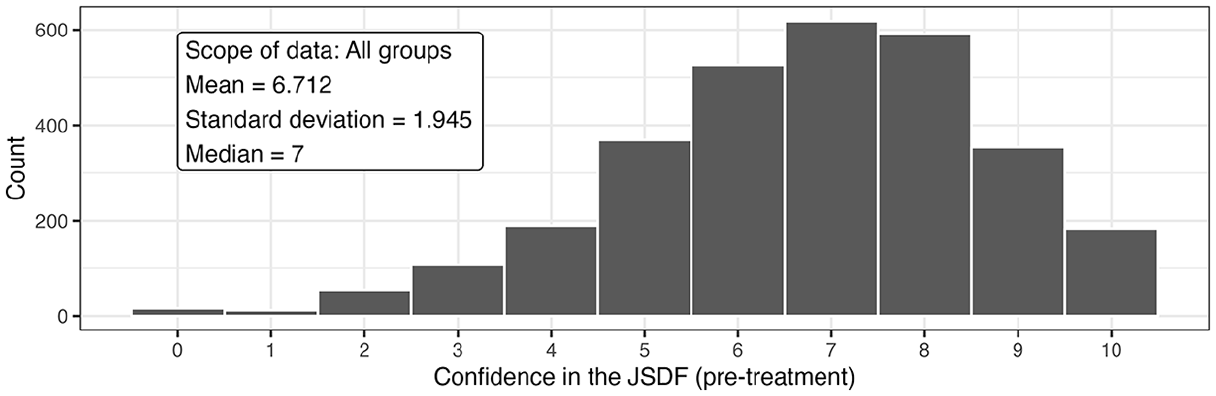
Distribution of confidence in the JSDF (pre-treatment).
Figure 2 depicts the outcomes of the regressions and highlights the three points relevant to Hypothesis 1 (see also Online appendix 40). First, the outcome of Model 1-1, an OLS regression applied to the pooled data (Groups 1–5) with the Battle and Suspension treatments serving as independent variables, showed that the respondents significantly lost trust in the scenarios involving violation of civilian control by the JSDF. This finding accorded with the expectation of Hypothesis 1. In particular, the participants lost much confidence in the JSDF when the commander of the dispatched JSDF unit deviated from civilian control and participated in the battle without authorization (Battle). Incidentally, the mean values of the respondents’ confidence in other organizations unrelated to the hypothetical scenarios (e.g. the police and the courts), which were measured after the experimental treatments, were similar across all the groups (Online appendices 20–24). Therefore, most of the participants were deemed sufficiently attentive to the content of the vignettes and answered the question related to their confidence in the JSDF after due consideration. However, as detailed below, the entire picture of the results was more complex.
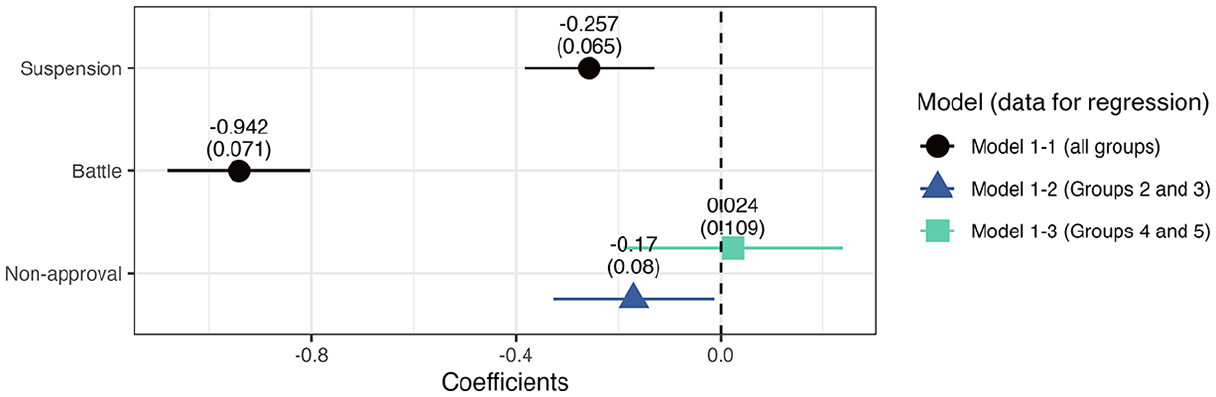
Results of regression analysis for Hypothesis 1.
Second, the impact of the deviation from civilian control differed depending on the scenario. In contrast to the result of Treatment 1B (Battle), the effect of Treatment 1A (Suspension) was quite small, although the coefficient value was significantly negative and supported Hypothesis 1. Thus, the participants’ stance on civilian control was not flawless, although there appeared to be a widely shared perception of what constituted a ‘taboo’ or ‘bottom line’. A possible explanation for why the evaluations differed substantially by scenario is that the participants will have repeatedly learned the history of the IJAF at school, specifically, how the IJAF was out of control in the 1930s, especially in the Manchurian Incident. A generally accepted interpretation is that these events opened the door to a highly militarized, undemocratic state and the quagmire of wars that lasted for many years. Hence, this history may have provoked many Japanese to imagine that such an uncontrolled military action could induce terrible consequences for the nation. Although this study could not empirically deconstruct the result and offer more detailed insights due to a limitation of the experimental design (discussed later), it is worth investigating this point further in future studies.
Third, the results of Model 1-2, which applied an OLS regression for Groups 2 and 3, and Model 1-3, which employed an OLS regression for Groups 4 and 5, with the Non-approval treatment as the independent variable in both of the models, indicated that the additional information regarding the involvement of the Diet did not significantly affect respondents’ confidence assessments. Given that the involvement of the Diet in the control of the JSDF was discussed extensively during heated debates on the 2015 security-related legislation (Nakauchi, 2019), the respondents’ indifference to such involvement by the Diet is surprising. If the legislature’s involvement in security-related matters can have positive implications, such as accountability, transparency and democratic legitimacy, and provide a route for the public to participate indirectly in them (e.g. Cottey et al., 2002; Giraldo, 2006), the results of this experiment indicated that people in Japan possibly do not place much weight on such elements or, at the very least, do not appear to want to maximize them. Or, potentially, they may not expect the Diet’s involvement to produce such benefits because they do not trust the legislature itself (e.g. Haerpfer et al., 2020). Overall, public perceptions toward civilian control are not straightforward, thus, future studies could examine perspectives of the controlling actors in greater detail.
Regarding the heterogeneity of a series of effects, Table 1 shows that none of the product terms between the series of treatments – Treatments 1A (Suspension), 1B (Battle) and 2 (Non-approval) – and Ideology (liberal–conservative, 11-point scale), measured before the treatments, were statistically significant. Thus, the results of the effect modification analysis (Keele and Stevenson, 2021) were not consistent with Hypothesis 2. Figure 3 shows the marginal effects. For example, in Treatment 1A (Suspension), respondents with a moderate ideology and conservatives significantly lost trust in the JSDF, while the marginal effect for the liberals was not significant. Regarding Treatment 1B (Battle), the marginal effect was significantly negative, regardless of ideology. The slope of the marginal effect was gentle, though positively sloped, as expected. Therefore, there was no in-group bias based on ideology, at least not in a way that accorded with Hypothesis 2. Furthermore, following Hainmueller et al. (2019), the study employed a more flexible estimation strategy that allowed for nonlinearity as a robustness check. This estimation strategy returned almost identical results (Online appendices 25–26, 41). One possible explanation for these outcomes is that political ideology is not sufficiently strong to be a social identity that generates in-group bias, at least in Japan. In addition, although statistically non-significant, the results for Suspension and Non-approval showed a negative slope, opposite to that proposed in Hypothesis 2, which may reflect differences in policy preferences for the former, and attitudes toward or opinions about the Diet, depending on ideology, for the latter (Online appendix 27).
Regression table for Hypothesis 2.
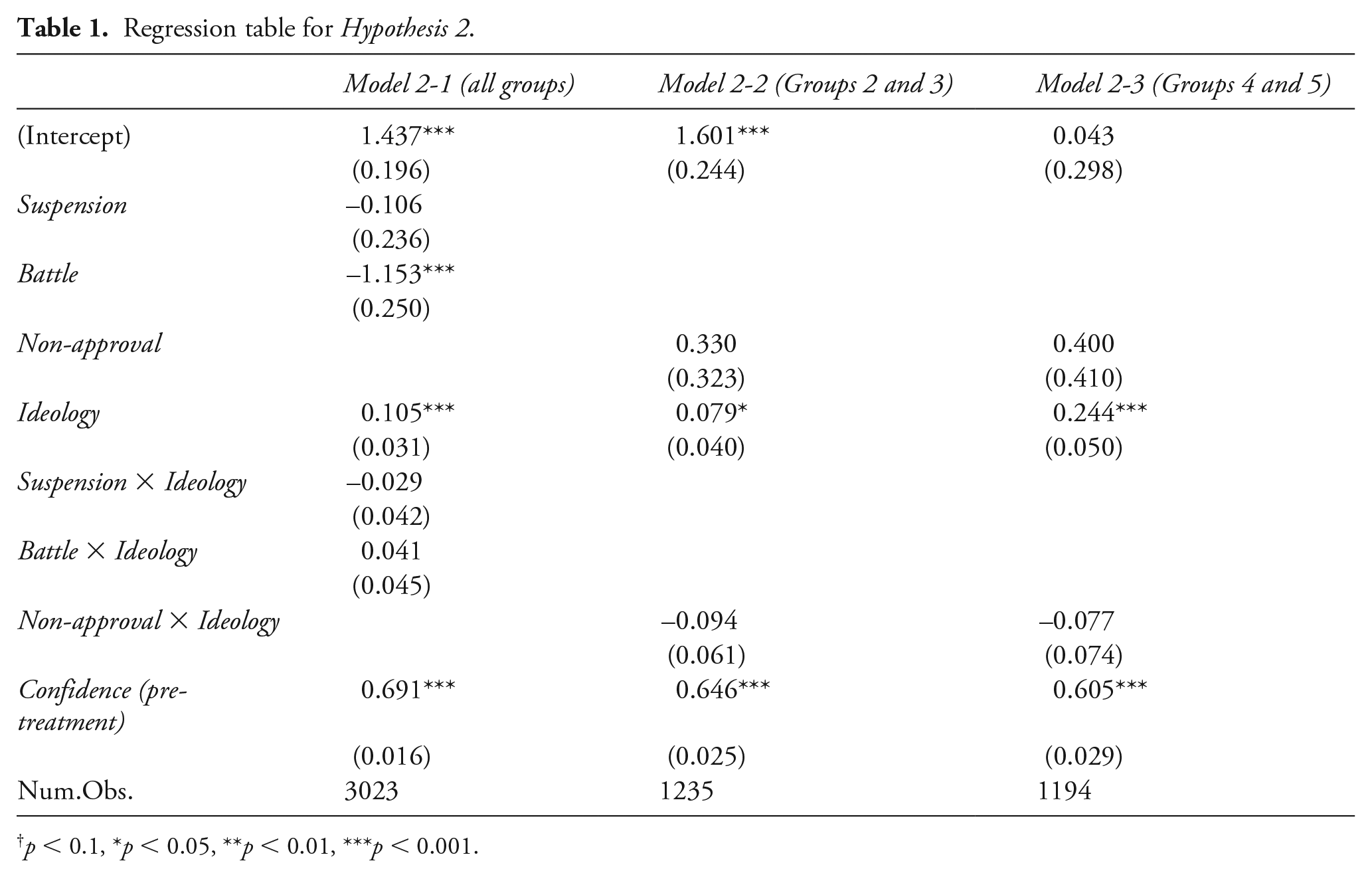
p < 0.1, *p < 0.05, **p < 0.01, ***p < 0.001.
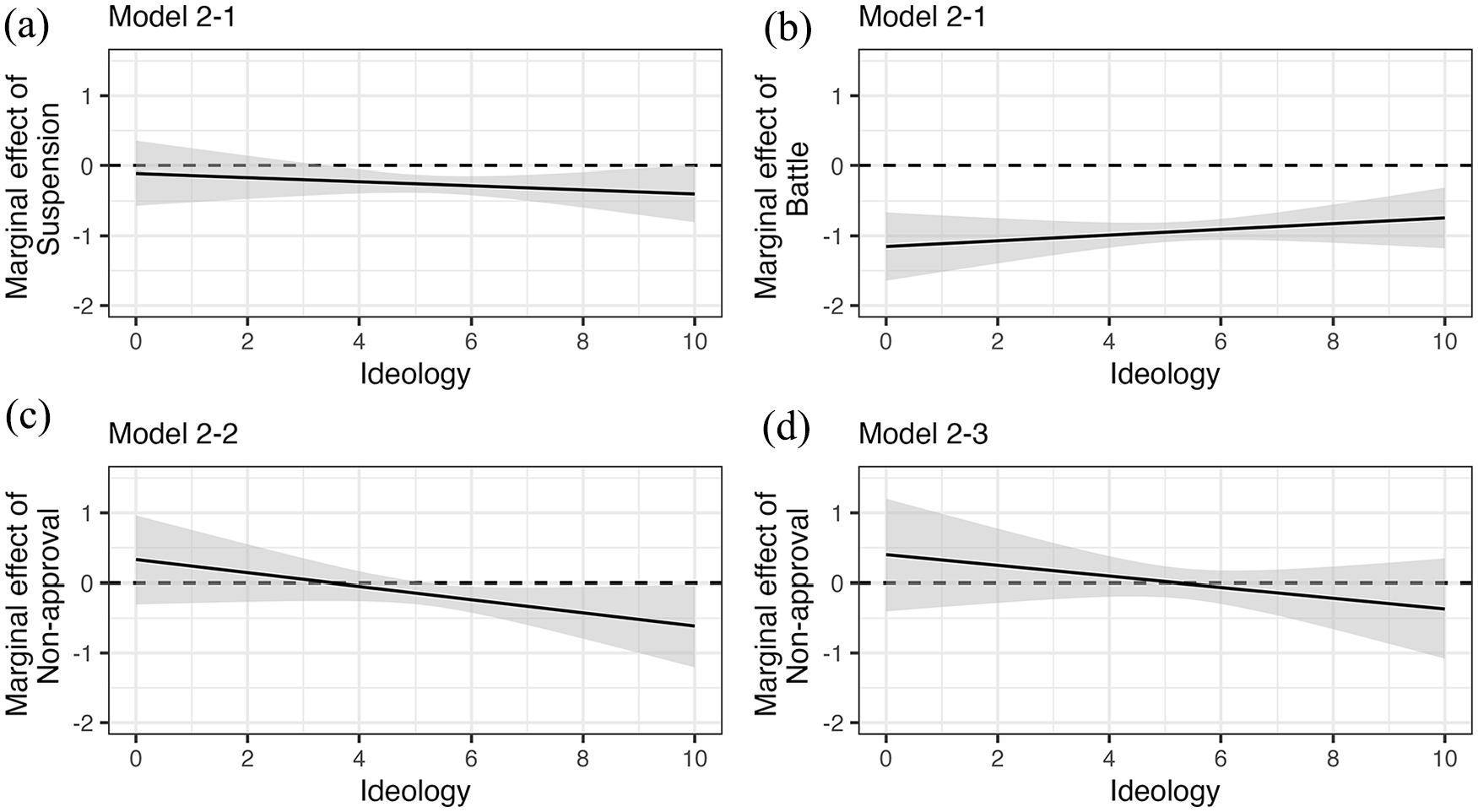
Marginal effects on confidence in the JSDF (moderator: Ideology).
The findings on Hypothesis 3 were more complex. Table 2 and Figure 4 show the results of the effect modification analysis between the treatments and Party support measured before the treatments. On the one hand, regarding Treatment 1A (Suspension), partisan rationalization was somewhat evident. 3 Facing the violation of civilian control, non-LDP supporters tended to tolerate it and lose less confidence in the JSDF than LDP supporters. On the other hand, Treatment 1B (Battle), in particular, affected people’s evaluations almost homogeneously, regardless of party support. These results were robust across a variety of measurements of ‘supporters of the ruling party’ (Online appendices 12–13, 28–30, 42–44). These asymmetrical results provided additional evidence of the widely shared taboo perception: most Japanese people feared arbitrary JSDF action (Battle) over arbitrary inaction (Suspension), as a violation of the taboo and lost confidence in the JSDF almost homogeneously. As such, these results imply that many Japanese are neither firm adherents of civilian control nor strong partisans who evaluate most political issues through partisan lenses.
Regression table for Hypothesis 3.
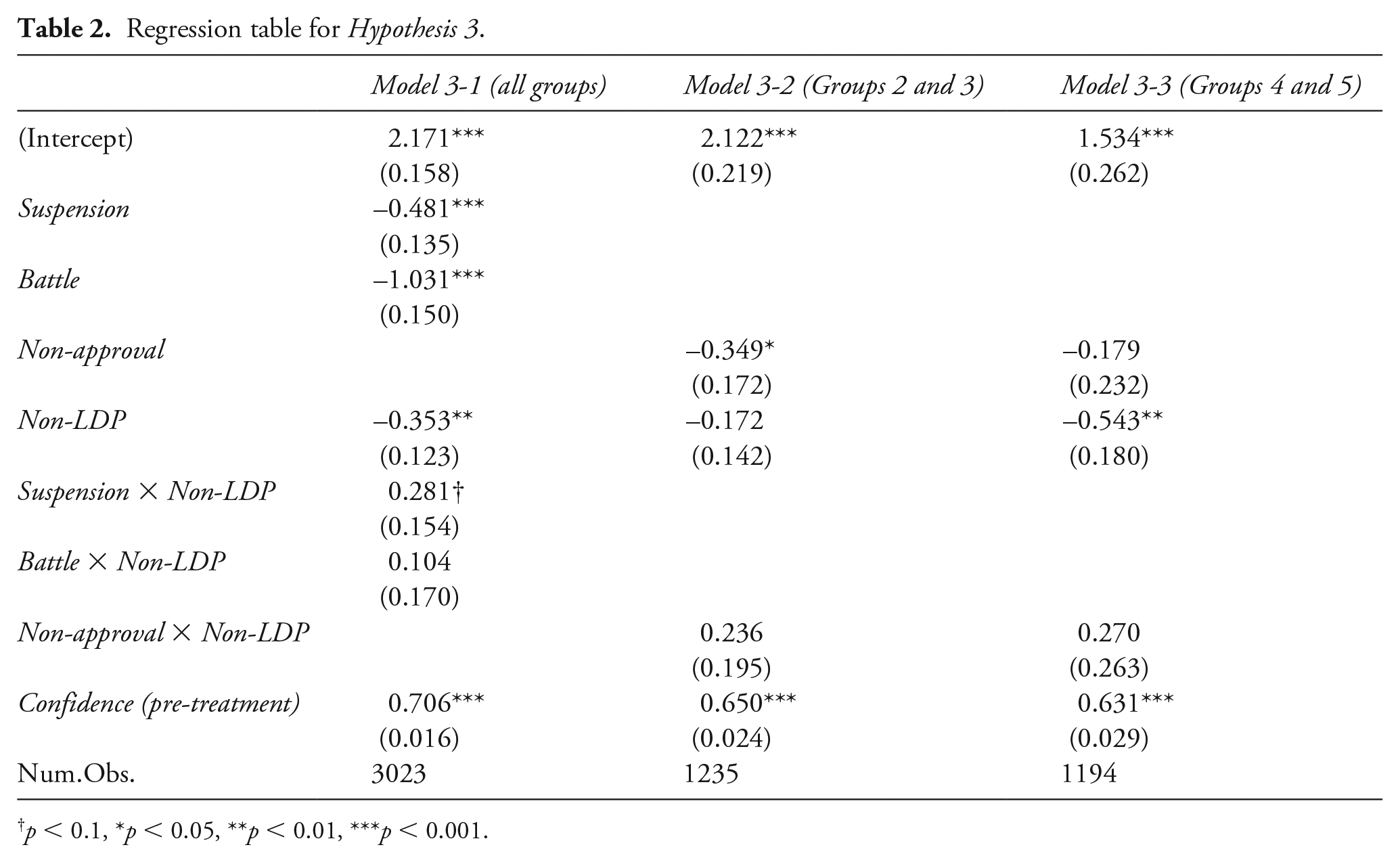
p < 0.1, *p < 0.05, **p < 0.01, ***p < 0.001.
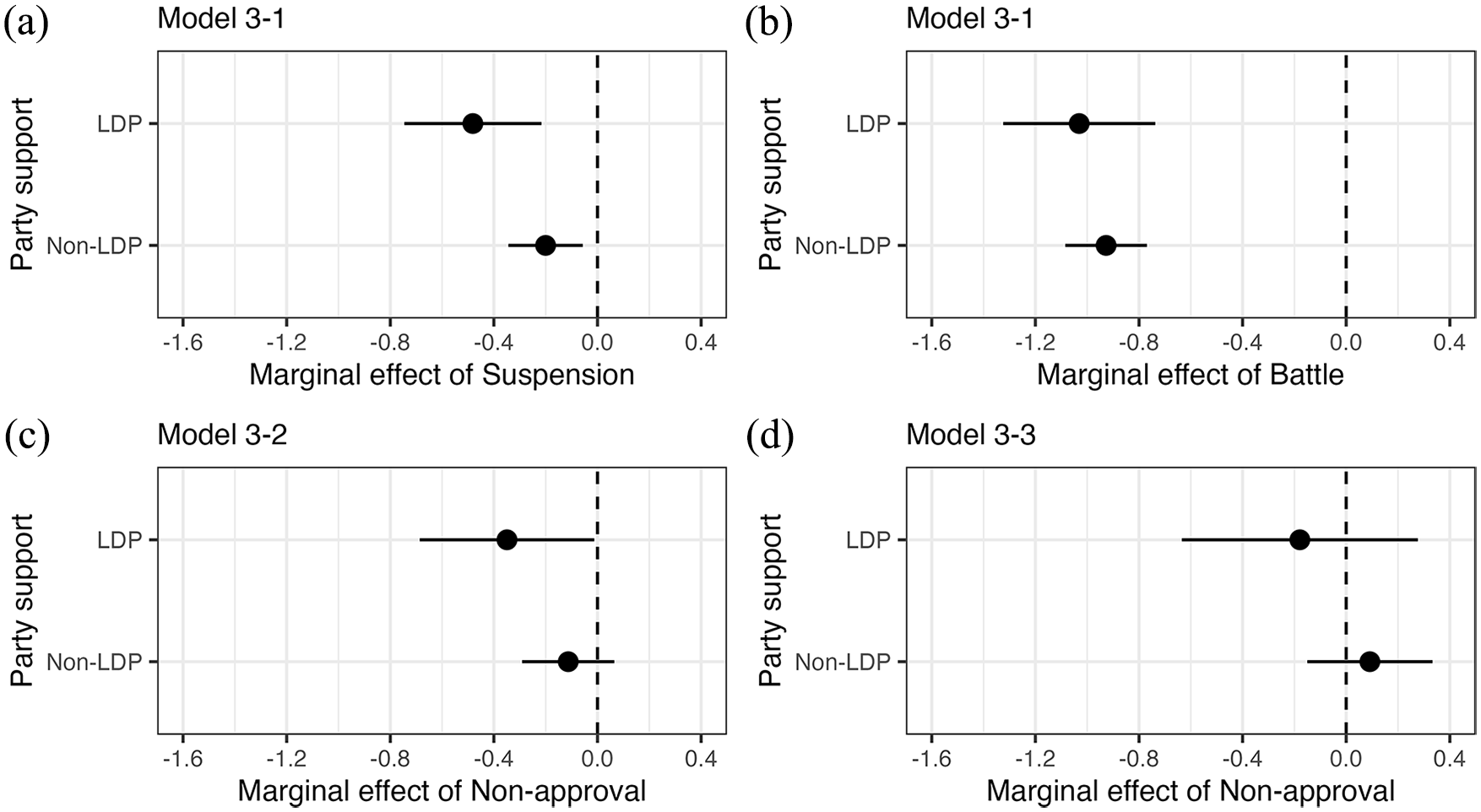
Marginal effects on confidence in the JSDF (moderator: Party support).
Robustness checks
Additional analyses were conducted to confirm the robustness of the results. Satisficers that were detected from the IMC (Miura and Kobayashi, 2021) and response time (Wood et al., 2017) were excluded from the data; OLS regressions were then undertaken with the same control variable, Confidence (pre-treatment). Specifically, the design of the IMC items followed IMC-A in Miura and Kobayashi (2021). Respondents whose response speed to a series of demographic questions was unusually high were also excluded from the original data. One second per demographic question was set as the threshold for exclusion. The results of the robustness check were in line with those of the main models described above (Online appendices 45–50).
Conclusion
Political trust is inseparably intertwined with modern political society and democratic systems. Given its broad significance, many scholars have explored why and how citizens have or lose confidence in political organizations, especially their government or parliament, with considerable progress. However, research on the determinants of public confidence in the military remains embryonic, despite its profound implications for national and international security.
Given this underdeveloped scholarship, this study delved into this subject, focusing on one possible determinant – the military’s compliance with civilian control – and examined potential causal relationships with public confidence via an online survey experiment in an established democracy with a considerable armed force, Japan. This experiment indicated that the Japanese participants regarded some kind of deviation from civilian control as taboo, and that their trust would decrease substantially if the JSDF were to break with compliance.
Nevertheless, there is a slight concern. First, the Suspension scenario, unlike Battle, did not affect respondents’ confidence assessment a great deal, though the result was consistent with Hypothesis 1. Second, participants almost disregarded the information on the involvement of the Diet in civilian control of the JSDF. Given that the legislature is the organization that represents the people and one of the institutional cores of civilian control, at least in theory, the participants’ indifference was surprising. Third, there was some evidence supporting partisan rationalization. Relative to studies conducted in the USA, a highly polarized society, the evidence obtained in this study remains tenuous. However, the outcomes unquestionably raise alarms about highly partisan politics and its repercussions on public confidence assessment.
These findings have significant implications. If public confidence in the JSDF does not decrease, despite the JSDF’s deviation from civilian control – whether due to unbiased evaluations, ideological bias or partisan rationalization – national and international security and democracy could deteriorate. This is because such blind, invariable faith or biased confidence assessments could sap politicians’ and civil bureaucrats’ motivation to monitor and curb the military at crucial moments, and accord the military dangerous feelings of superiority. Such an unchecked, over-confident military might abuse power, seek to intervene in civilian political arenas and, in the long run, unintentionally lose their effectiveness and discretion due to lacking multiple perspectives and failing to engage in introspection. By showing the potential for such blind faith and biased assessments with their serious pitfalls, this article contributes to earlier studies that have raised similar concerns.
Moreover, this study has indicated that there is the potential to develop a deeper understanding of civil–military relations by improving empirical strategies. Existing opinion surveys, especially surveys on the civil–military gap, have contributed to this subject significantly by comprehensively detailing actors’ attitudes and perspectives (e.g. Feaver and Kohn, 2001; Kawano and Hikotani, 2006; Schake and Mattis, 2016). However, the wording in the questionnaires employed can be somewhat ambiguous; therefore, it may be difficult for respondents to provide considered answers, and for researchers to build an in-depth understanding of the results. Furthermore, causal inference is difficult based on such survey data: a well-designed survey experiment can overcome such problems. This study is not a pioneer in this regard in the literature on civil–military relations; however, such studies remain scant. In this embryonic situation, this study provides further impetus to this desirable development.
Finally, it is necessary to note the study’s limitations. This analysis failed to establish a clear differentiation between the effects of incompliance by the military on public confidence and the effects of military aggressiveness. Therefore, future research should use a more elaborate experimental design that enables the distinction and comparison between these factors. The present study also did not examine how respondents’ personal views and knowledge of real-world issues related to the hypothetical scenarios presented in the experiment might have affected their reactions. For example, respondents who had a negative assessment of the 2015 security-related legislation, which enabled the logistical support described in the scenarios, may not have experienced a decrease in their confidence in the JSDF in response to the Suspension treatment. Figure 3a, which shows an outcome opposite to Hypothesis 2, although not statistically significant, seems to be consistent with the above thought. Also, those who are clearly aware of the principle of prior approval by the Diet may react more strongly to the Non-approval treatment than those who are not. Future studies could examine these aspects more thoroughly. Another limitation is derived from the asymmetrical content of the vignettes. The study did not create alternative hypothetical scenarios in which a non-LDP prime minister issued the same order, because such a scenario would not be adequately realistic for participants to envision, at least currently. Therefore, the results provide insufficient evidence for partisan rationalization. If the power relationships in the Diet were to change, it would be worth re-examining whether consistent results could be obtained using alternative scenarios.
Footnotes
Acknowledgements
The author is grateful to Atsushi Tago, Takuto Imoto, Hideo Ishima and Masanori Kikuchi for their valuable comments on this project.
Replication data

Funding
The author disclosed receipt of the following financial support for the research, authorship, and/or publication of this article: This work was supported by JSPS KAKENHI (grant no. JP 22K20110).
Notes
SOU SHINOMOTO, b. 1994, PhD in Law (Kyoto University, 2022); Junior Researcher, Waseda Institute of Political Economy, Waseda University (2023– ); Research Fellow, Japan Society for the Promotion of Science (2023–); current main interest: civil–military relations.