




Abstract
This article uses the case of Colombia to evaluate the gendered risks of social leadership and human rights activism in territories governed by armed groups. Existing data on Colombian human rights and social leader deaths reveals that men leaders are being killed at a much higher rate than women social leaders. In this article, we delve deeper into gendered patterns of violence against men and women leaders by focusing specifically on the content of the threats these leaders receive from armed groups. We analyzed 40 qualitative interviews with men and women social leaders who have worked in nine different conflict regions of Colombia to find that armed actors target men and women leaders with uniquely gender-specific threats. These findings tell us a great deal, not only about how armed groups govern those in the territories they control, but also about the gender biases they hold about men and women leaders who challenge their authority. Although women leader deaths are less common than those of their male counterparts, the threats and violence both receive are grounded in stereotypical gender norms, and thus merit gender-sensitive, context-specific analyses and responses.
Introduction
‘I feel that as women, as a minority, we are very exposed […] as a target for threats. Somehow [as women] we are seen as defenseless, helpless […] and this puts us at a disadvantage’ – Woman human rights and environmental activist in Putumayo (Interview, 11 February 2022).
Around the globe, war and armed conflict disrupt political and social processes, including civilian efforts to organize on the ground (Wood, 2008). Armed groups seeking social and territorial dominance frequently suppress civilian social organizing in order to establish control and order (Arjona et al., 2015; Wood, 2008). When armed groups aim for hegemony across territories, they may kill and threaten community leaders to destabilize and even destroy entire social movements (Avila, 2020; Gutiérrez-Sanín, 2015). Such groups use violence against community leaders and human rights defenders as ‘an example’ to teach others in society not to transgress the militarized social order they seek to impose (International Crisis Group, 2020; Sanchez Parra, 2020; Zulver, 2021). Although not all armed groups are interested in total hegemony and some opt for alliances with local populations (Arjona, 2016), threatening and murdering leaders is a common strategy to achieve the former, particularly in areas where terrain is contested and armed groups compete for dominance.
But while general studies exist on deaths of and threats against community leaders, such research has failed to assess the gendered dimensions of the risks people face as leaders. Instead, existing work has tended to assess women and men human rights defenders together (Albarracín et al., 2022; Prem et al., 2018), with studies differentiating by leadership type (i.e. participation in different kinds of organizations) rather than by gender. They have done so despite the fact that feminist scholars have long argued that the failure to analyze the gendered dimensions of violence leads to superficial and partial understandings of war and conflict (Cockburn, 2004; Moser, 2001).
In this article, we endeavor to provide a deeper and more comprehensive analysis of the targeting of human rights defenders by asking, what are the gendered risks of social leadership in Colombian armed conflict zones? In Colombia, community leaders and human rights defenders are often referred to as ‘social leaders’. A social leader, broadly, is defined as an activist who ‘represents the interests of local vulnerable communities’ (Prem et al., 2018: 8). Through an in-depth analysis of 40 interviews with men and women social leaders in Colombia’s reconfiguring armed conflict, we examined the gendered nature of threats by comparing the threat content received by male and female leaders in nine different conflict zones across the country. Our findings revealed that armed groups seeking social and territorial control held gendered biases about men and women leaders, who they saw as a challenge to their authority. We theorize that these biases and the resulting violent acts are rooted in a socially constructed binary between private and public spaces and armed actors’ antiquated perceptions of women’s and men’s places within them.
While all the men and women leaders we interviewed had received threats, unlike their male counterparts, the women social leaders we interviewed received threats that challenged and undermined their position in public space; they were told that as women they should not be participating in their communities and should instead be at home fulfilling their duties as mothers and wives. The women interviewed also received threats of sexual violence, accompanied by other warnings and ultimatums that drew on sexualized and derogatory language – none of which the men we interviewed received. These differences in targeting are rooted in socially ascribed gender roles, and bridge two streams of existing research: (1) feminist security studies literature that demonstrates that women experience conflict and post-conflict moments differently based on their gender, including in contexts of rebel governance (Cockburn, 2004; Enloe, 2014; United Nations Security Council, 2000), and (2) nascent violence against women in politics (VAWIP) literature that underscores that women in political roles face violence both for their political views (in this case, their social leadership) and for their identities (in this case, being women) (Krook, 2020; Krook and Restrepo Sanín, 2019; Restrepo Sanín, 2020).
Simply put, these findings tell us that gender matters when it comes to assessing the targeting and violence against social leaders. Even in contexts governed by armed actors who see both men and women as ‘enemies’, our findings revealed that perpetrators’ gendered views on the public/private divide – and accordingly, the appropriate spaces and roles that men and women should occupy – explained the variation in the types of violence and targeting social leaders face. Moreover, these findings tell us a great deal not only about how armed groups govern those in the territories they control, but also about the gender biases they hold about men and women leaders who challenge their authority. The purpose of this article is not to engage in normative assessments of who is more threatened, or which social leaders are more at risk, but rather to document the different and biased challenges that men and women social leaders face in their communities.
In what follows, we first review the literature on armed conflict and gendered stereotypes in war. We then provide background on the context of the Colombian civil war, before explaining our methods of data collection and our approach to data analysis. Next, we identify and discuss four patterns of how the content and style of threats against women and men leaders were found to be distinctly gendered. Finally, we conclude by considering future research directions and other cases of civil war where gender dynamics may influence armed actor governance.
Armed conflict and gendered stereotypes in war
There is broad recognition within feminist security studies that women experience conflict differently based on their gender. Some scholars choose to describe this reality along a gendered continuum of violence, where they illustrate that women’s experiences of violence during pre-conflict, conflict and post-conflict differ from those of their male counterparts (Cockburn, 2004). Cockburn, for example, outlines how men’s and women’s bodies suffer differently and ‘die different deaths’ in conflict (Cockburn, 2004: 34–35) due to the socially ascribed, hegemonic power dynamics within societies. The widespread use of sexual violence is often (but not exclusively, see Schulz 1 ) used as a weapon of war against women (Cohen, 2016; Wood, 2009); for instance, after the breakup of the former Yugoslavia, Serbian soldiers raped women to impregnate them and prevent future generations of Bosnians and Muslims from being born (Tompkins, 1995). Scholars have also written about women who are forced into marriage within rebel groups for the purpose of building a political project (Baines, 2014), regulating gender relations, and controlling sexual behavior within the group (Marks, 2014). Studies also reveal that women combatants are expected to take on the ‘burden of social reproduction’ (Giri, 2023) in a context where ‘heteropatriarchal and heteronormative values’ dominate (Giri, 2023: 10; see also Hedström, 2022).
In conflict, women also suffer forced displacement, economic hardship and ongoing risks of physical violence, often in relation to their roles as mothers and caregivers (Meertens, 2010, 2012). Scholars have shown that men, on the other hand, are more likely to suffer other types of specifically gendered targeting, such as sex-selective massacres (Carpenter, 2006), and have argued that men are largely overlooked as gendered beings in conflict situations (Myrttinen et al., 2017). In this article, we focus on how some of the aforementioned heteronormative gender norms are reflected in the violent control of men’s versus women’s participation in civil society.
In addition to the work above, there is ample research within gender and politics that reveals women’s active agency in conflict (Moser and Clark, 2001), including in high-risk mobilization to promote justice (Zulver, 2022) and feminist visions of peace (Cárdenas and Hedström, 2021; Paarlberg-Kvam, 2019). This work moves beyond a women-as-victims–men-as-perpetrators binary, and underscores that during conflict, women exert their agency in public-facing spaces. Building on this scholarship, we argue that when such women hold positions of social leadership, they transgress armed groups’ gendered visions of appropriate roles for men and women within society, and are threatened accordingly.
A parallel stream of literature moves beyond women’s civil society mobilization to focus on a phenomenon termed VAWIP. 2 Krook’s (2020) work demonstrates that while politics can be a violent space for all who participate in it, the role of gender and other identities are often overlooked, particularly with regard to how they ‘shap[e] incidents of violence’ (2020: 89; see also Bardall, 2011). She notes that women may face violence for their political views in ‘both gendered and non-gendered ways’ (Krook, 2020: 89), but that, worryingly, women also face violence because of their gender, ‘shaping its origins, manifestations, and outcomes’ (Krook, 2020: 89). For example, she categorizes the assassination of Benazir Bhutto in Pakistan as non-gendered, as gender did not play a substantive role in her murder and was instead based on her political opinions. On the other hand, she cites the impeachment of Dilma Rouseff as an example of when efforts to prevent people from participating are based on their gender; her case ‘illustrates the diversity of tools that may be mobilized to delegitimize women’s rights as women to serve as political leaders’ (Krook, 2020: 94, emphasis in original). Of course, these two logics can overlap, where women are both subject to violence due to their political opinions and their gender; the murder of Marielle Franco, a black bisexual woman politician who spoke out against police brutality in Brazil, is an example of this intersection. The latter – VAWIP – is particularly threatening, not only to democracy and human rights, but also to gender equality (Krook, 2020: 97).
Although men and women community leaders in conflict zones participate in similar activities and both suffer threats for their public-facing human rights and protection activism, there is also reason to expect that they receive gender-differentiated threats. Work on VAWIP looks at the varying ways in which women experience violence not only based on their gender, but also for their participation in what are traditionally considered male spaces (Krook, 2020; Krook and Restrepo Sanín, 2019; Restrepo Sanín, 2020). For instance, Bardall et al. (2019: 2) note that ‘gendered motives appear when perpetrators use violence to preserve hegemonic men’s control of the political system’. 3
Specifically in relation to women’s participation in peacebuilding, nascent research has also shown that women are liable to face ‘patriarchal backlash’, where they are punished for the empowerment or gains they made during moments of conflict and its aftermath (Berry, 2017; Zulver, 2021). Put differently, women are punished for their perceived transgression into public spaces that ‘don’t belong to them’. In the context of electoral politics in Sri Lanka, Bjarnegård et al. (2020) found that men and women candidates faced a similar extent of violent targeting, however women experienced more sexualized psychological and physical violence than their male counterparts (Bjarnegård et al., 2020). They suggest that women’s presence in elections is ‘associated with an enlarged, and gendered, “toolbox” of violence’ (Bjarnegård et al., 2020: 56), but note that they cannot fully discern whether women are targeted with sexualized violence because of their gender, or because this form of violence is seen as an effective way to specifically target women politicians.
In sum, even when women and men are able to overcome barriers to political mobilization – either within the political party space or the civil society space – their gender is fundamental to the types of violence they may experience. When women make demands on society, they may experience pushback, including violent pushback, not only based on the content of their demands but also based on their identities as women. Their activism breaks social norms around women’s idealized roles within the private space – accordingly, those women who participate as social leaders are seen as transgressive (Kreft, 2022; Zulver, 2022). Put differently, women receive gender-specific threats motivated by gendered prejudice about women’s roles in society (Bardall et al., 2019). On the other hand, while we would expect to see men threatened by armed actors for their social activism, the threats would not make reference to their gender; that is, being a man making a public demand for justice is not transgressive of the gendered social order, but rather represents a barrier to armed group hegemonic control. These patterns are reflected in Håkansson’s study of violence against female politicians in Sweden; she found that ‘challenging hegemonic power structures has higher costs for women than men’ (Håkansson, 2021: 516), which reflects the perpetrators’ biases against women.
Although the line between public and private is easy to deconstruct as a false binary (including when it comes to gendered violence in conflict; Swaine, 2015), we propose that in contexts of armed actor governance it is a logic upon which armed groups operate in their exertion of social and territorial control. Thus, by qualitatively examining threat content against men and women, we would expect to see how gendered logics of ‘militarized masculinity’ (see Theidon, 2009) take shape in practice. Furthermore, by studying the experiences of both men and women – that is, understanding gender to mean the social constructions of roles that both men and women are expected to occupy and play in society – we expect that these threats will be differentiated by ideas related not only to stopping activism, but also to reinforcing traditional gendered divisions of labor and occupying of public space. We have chosen to use empirical evidence from the case of Colombia’s ongoing armed conflict to illustrate the gendered dynamics of threats and violence we hypothesize above. In the following section, we detail the specificities of Colombia’s armed conflict and explain why it is a useful case study.
Brief overview of Colombian conflict
In 2016, the Colombian government signed an historic peace agreement with the Revolutionary Armed Forces of Colombia (Fuerzas Armadas Revolucionarias de Colombia, FARC). In doing so, it ended a 52-year armed conflict on paper – in reality, however, the conflict continues. Although the majority of the FARC – the oldest and largest armed group in Latin America – gave up their weapons and returned to civilian life, other non-FARC guerrilla groups like the ELN (Ejército de Liberación Nacional), FARC dissidents, paramilitaries, narcotraffickers, and the Colombian armed forces continue to wage war throughout the country today. Beyond a stymied implementation of the peace process itself, the country is embroiled in violent dynamics, as these multiple armed groups vie for control, including that related to the control of illicit economies. In 2021 alone, rates of forced displacement doubled when compared to 2020 (Peña Solano and Ríos, 2021).
One of the clearest illustrations of the increase in violence is the ongoing murders of thousands of Colombian social leaders (Albarracín et al., 2022; Albarracín et al., 2022; Prem et al., 2018). Social leaders in Colombia have continued to face extermination since the signing of the Peace Accords in the context of an ‘unfinished social contract’ (Rettberg, 2019). Indeed, in Colombia, social and human rights leaders are killed at the highest rate in the world (Front Line Defenders, 2020). INDEPAZ (2021), a Bogotá-based thinktank, has documented 1217 killings of leaders from November 2016 to July 2021. 4 The Colombian Prosecutor’s Office Special Investigative Unit for data on social leader deaths documents 551 homicides from 2016 to 2021. 5,6 Colombian social leaders have faced threats, torture, extortion, and other forms of persecution, and the majority of the murders have been perpetrated in regions most heavily hit by the armed conflict (Avila, 2020; International Crisis Group, 2020).
Analyses on the murder of social leaders explain the phenomenon by examining how non-state armed groups took advantage of territorial power vacuums after the demobilization of the FARC in 2016 (Prem et al., 2018). Others expand on this macro-level explanation to document how political competition plays out at the local level, for instance, Albarracín et al. make the claim that the killing of social leaders is an attempt to sustain ‘competitive authoritarian local orders in the face of bottom-up challenges’ (Albarracín et al., 2022: 239). Elsewhere, authors write that assessing the murders of social leaders is both a criminal and political phenomenon, but call for attention to be paid to how these logics manifest at the local level (Albarracín et al., 2022), which may not be universal. While these studies focus on the fairly unique setting of post-Accord Colombia, our present study hopes to be more universal in scope: by understanding the dynamics of violence against women in Colombian civil society politics in comparison to their male counterparts, we offer insights into the differential risks of social leadership based on the gender of the activist, findings that can be extended to other conflict contexts around the globe.
Due to the public nature of their activities, social leaders are much more likely to be targeted and even killed; as one social leader told the authors in an interview, ‘the easiest thing to do is threaten us’ (Interview, 10 February 2022). Armed groups see social leaders as shining a light on the illegal violence that they use, keeping historical memory alive and making justice-based demands that are at odds with their violent objectives (Orbegozo-Rodríguez, 2021; Stallone and Zulver, 2022). Social leaders represent, as one of our interviewees said, ‘a stone in the shoe’ of those who want to engage in their illegal activities without pushback. This has been true for all types of social leaders, but particularly applies to those activists who advocate for environmental and peacebuilding agendas (including illicit crop substitution) (Avila, 2020; International Crisis Group, 2020)
The quantitative data we requested from INDEPAZ on the murders of social leaders reveals that women social leaders are killed at a rate of 1:7 (173 women and 1044 men) when compared to men social leaders. It could be the case that there are simply more men than women leaders in Colombia, however this data is not available, as there is no registry of who constitutes a social leader. Based on our understanding of the country context, however, we do not believe that this 7:1 ratio represents a corresponding difference in terms of men versus women in leadership positions. We also requested data from the Colombian government, and the ratio was similar: approximately 1:7 (69 women and 468 men). 7 In this article, however, we contend that this violence becomes uniquely gendered when we look at how these activists are targeted, specifically via the content of the threats they receive. We argue that there are key differences when it comes to the targeting of women and men social leaders.
Based on the above, it is evident that Colombia represents an ongoing violent context; although the government signed a peace deal with one armed group, war wages on with and between other armed groups in the territory. This violence has direct impacts on social leaders and human rights defenders who lead their communities in the defense of their rights. Despite this violence, both men and women leaders are continuing to push forward with peacebuilding agendas across the country. These include engagement in peace activism; the defense of indigenous-, Afro-, peasant-, women’s-, victims’- and land rights; illicit crop-substitution programs; local council participation; and union membership, among others (INDEPAZ, 2021; Prem et al., 2018).
To be sure, previous research has highlighted women’s different experiences of the Colombian conflict. Studies have shown how civilian women in the Colombian conflict suffered conflict violence differently because of their condition ‘as women’ (Centro Nacional de Memoria Histórica, 2017; Lemaitre and Sandvik, 2015; Meertens, 2012); and women also participated and exerted their agency in multiple roles throughout the conflict, as rebels (Herrera and Porch, 2008), as peace negotiators (Phelan and True, 2022) and as civilians (Kreft, 2019; Paarlberg-Kvam, 2019; Restrepo, 2016; Stallone, 2021; Zulver, 2022). Our research here, however, provides a unique viewpoint by comparing men’s and women’s experiences to see how gender is operating in practice. Additionally, we expand on VAWIP studies to include women operating outside party politics who are involved in civil society organizations. Furthermore, we provide additional qualitative evidence to advance studies like that of Bjarnegård et al. (2020: 33) that see that men and women experience elections violence in equal proportion, but that women are more likely to face ‘intimidation of a sexual nature’. Such work reveals that women suffer specific types of violence in public-facing work when compared to men, and this study builds upon these findings.
Methodology
To date, most assessments of the risks of being a social leader in Colombia have relied on quantitative data related to murder (Prem et al., 2018). Within the country, different organizations in the international community and civil society – including INDEPAZ, Somos Defensores, and Pacifista – maintain publicly available records of the murders of social leaders; their websites and X (formerly Twitter) accounts are updated on a rolling basis, and reveal the ongoing phenomenon of social leader killings. A focus on those who die in the line of fire, however, obfuscates an understanding of those social leaders who are still living and luchando (in the struggle). While there is no easy way of measuring how many threats will result in attacks or murders, we argue that analyzing these threats and aggressions provides rich qualitative insights into the experiences of being a living social leader; when approached with a gender lens, we argue that they provide us with a unique ability to expand our understanding of gendered experiences in war and its so-called aftermath. Moreover, as already noted, simply looking at the murder statistics of Colombian social leaders quickly reveals that more men than women are killed, at approximately a 7:1 ratio. This yields an incomplete picture of peace and the risks of what it means to make high-risk demands in settings that continue to be marred by violence. We opt to look at the uniquely gendered threats that women and men face, which provides us further empirical evidence into what a more complete and even feminist peace looks like (Meger and Sachseder, 2020; Paarlberg-Kvam, 2019).
This article is based on qualitative interview data, the majority of which was collected remotely. We interviewed 40 social leaders (20 men and 20 women) between December 2021 and June 2022. The leaders interviewed mobilize and organize around a diverse array of issues, including women’s rights, the rights of Afro-Colombians, gender-based violence, youth rights, land and housing access, environmental protection, Indigenous rights, migrant rights and the rights of victims of armed conflict violence, among others. Many interviewees either did not know, or did not wish to reveal which perpetrators were behind the violence they faced. Indeed, killings often take place at the hands of hired gunmen, who can be difficult to link directly to broader armed group structures, and in a context of high impunity. Albarracín et al., citing INDEPAZ, confirm that perpetrators remain unknown in 78% of cases (Albarracín et al., 2022). Although we could not disaggregate our analysis by perpetrators, the social leaders we interviewed have worked in nine different departments impacted by Colombia’s armed conflict: Arauca, Bolívar, Cauca, Chocó, Cundinamarca, La Guajira, Norte de Santander, Putumayo, and Valle del Cauca. These are areas that are broadly known to be dominated by different (and sometimes multiple) armed actors, including neo-paramilitary groups, FARC dissidents, the ELN, narcotraffickers, and the Colombian armed forces.
We felt it important to interview leaders of both sexes in order to fully understand how gender operates by making comparisons between men and women. Scholars have critiqued VAWIP research that focuses only on women, arguing that such studies are one-sided and do not actually allow for the conclusion that women’s experiences are unique to them without the added comparison with men in similar positions (Bardall et al., 2019; Håkansson, 2021). While there are counter-arguments to be made that women’s experiences are unique to them, and that a study focusing on just women is good in and of itself, by including men, this study lends itself to understanding how gender is actually operating in the context at hand.
Given the ongoing Covid-19 context (including unequal access to vaccines) and the high-risk contexts in which our interlocutors participate, we decided to hold most interviews via phone call. 8 Between the two of us, we have over 16 years’ experience working with civil society organizations and social leaders in Colombia. We contacted other social leaders through our local and international networks; their phone numbers were shared with us by respected contacts who vouched for our trustworthiness. Although there are downsides to phone interviews (Block and Erskine, 2012) such as challenges assessing non-verbal cues, we felt that our longstanding knowledge of the conflict context in Colombia, as well as our established relationships of trust with the interlocutors or with their contacts, put us in a position where we would be able to speak openly about sensitive information like threats. Interviews were held in Spanish and lasted between 15 and 25 minutes. Interlocutors provided their informed consent to record the conversation, however we confirmed (according to our ethical protocols) that we would not use their names, organizations, or other identifying information in this article.
When collecting research in the Global South as researchers from privileged Global North institutions, questions related to race, ethnicity, class and geography (urban vs. rural) stand out as clear differences between us as researchers and our interlocutors. It is also important to acknowledge that our own positionality as two foreign women researchers may have shaped what our interviewees were willing to share with us. As noted above, however, the interviews were conducted with existing contacts and drawing on longstanding and established networks; selecting our sample in this way facilitated open communication that, while not necessarily able to alter power differentials, represented an effort not to exacerbate them.
To answer our research question about what the content of threats can tell us about gendered differences in controlled territories, we asked men and women leaders the same questions about their activism, a series of questions about the content of threats they had received and their views on protection. This facilitated our ability to compare between their answers and experiences. All respondents were informed about the goals of the article and knew that both men and women would be asked the same series of questions (both open and closed). Our initial questions were motivated by informal conversations during our work over many years with community leaders, and subsequently by piloted versions of what became the final questionnaire. During these conversations and early versions of the questionnaire, gender differences became evident, thus prompting us to ask more specific questions, such as the question about stay-at home threats.
The gendered nature of threats against Colombian social leaders
As discussed above, a purely quantitative assessment of social leader deaths revealed that more men than women were murdered between 2016 and 2021. Of 1217 murdered social leaders, 173 (14%) were women, while 1044 (86%) were men; official government data from the Colombian Fiscalía registered the deaths of 69 women (12.5%), 468 men (85%) and 14 LGBTI individuals (2.5%) (see endnote 8). These databases show that men leaders are being murdered in much greater numbers when compared to women leaders, revealing a clear gendered pattern of violence against male leaders.
To explain why men civilians face more lethal violence in war-affected settings than women civilians, existing research has argued that civilian men are perceived to be more threatening than women, who are broadly seen as subordinate and vulnerable victims (Carpenter, 2006; Olivius, 2016). While quantitative data reveals these numerical differences between men and women, empirical data is necessary to shed light on other gendered patterns. Using qualitative research findings, this project examines threats against social leaders. While all the men and women we interviewed received threats 9 from armed actors, our interviews showed that the content and style of the threats against women and men leaders were also gendered, thereby revealing another important gendered dimension of violence. From our qualitative interviews emerged four gendered patterns in relation to the content of the threats social leaders received. Patterns 1, 2 and 4 relate specifically to threats against women. Pattern 3 relates to both men and women, but in contrasting ways.
1. ‘Stay Home’: Threats to prevent women’s political empowerment
Unlike our male interviewees, many of our female respondents (13/20 women, 65%) related that they
Different types of threats received by social leaders, disaggregated by sex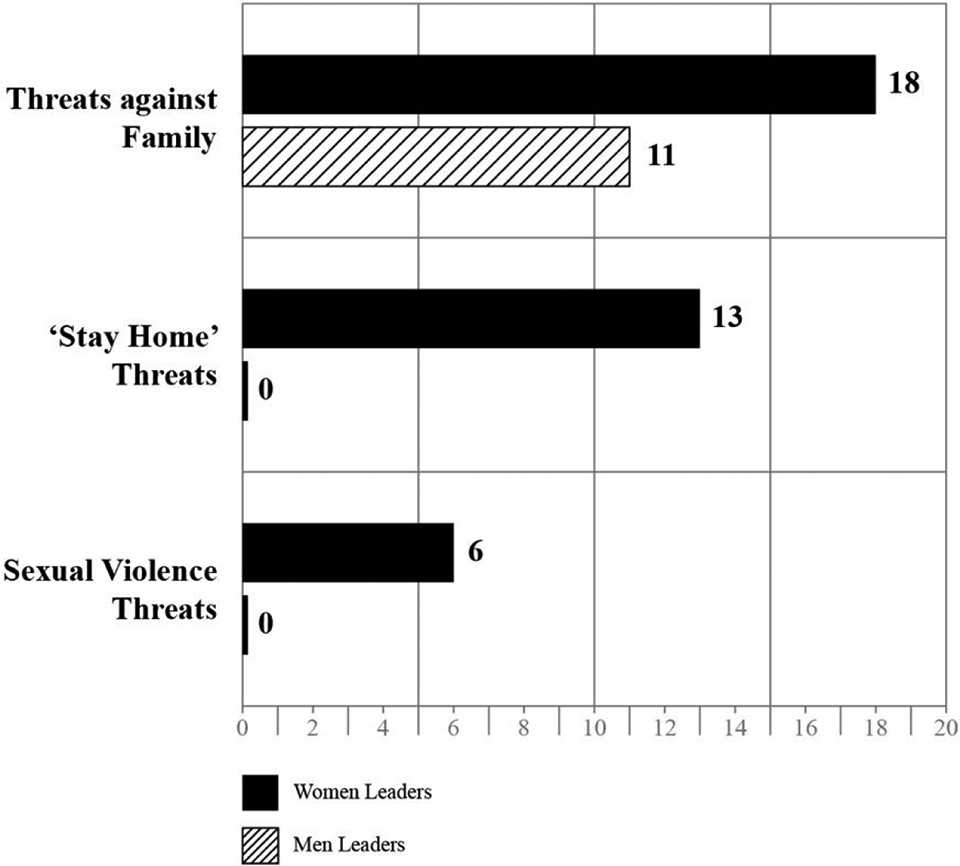
For instance, a woman activist living in Bogotá (but who travels frequently to rural regions) shared that she had received a total of 10 threats, and that ‘many of the threats are related to the roles that we exercise in the public sphere, [roles that are] different from the roles that we have traditionally been assigned as women, which are in the private sphere, taking care of the home, the children, the family, the house’ (Interview, 16 February 2022). She discussed one particular threatening phone call during which she was told that she should ‘dedicate [her] time to taking care of [her] children instead of being a snitch in places where [she] shouldn’t be, in the street’ (Interview, 16 February 2022). Another woman activist from Buenaventura, a port city on the Pacific Coast, received a threat telling her that instead of ‘being in the street fucking around, you should go and cook, go and clean’ (Interview, 1 February 2022). In La Guajira, a woman leader told us that she was threatened via phone, and was told that ‘women are only good for washing, ironing, and serving their husbands and that [social leadership] is not our role’ (Interview, 31 January 2022). Finally, a woman leader in Tumaco was told ‘these are men’s issues, and you should be in your house doing housework’ (Interview, 22 February 2022).
No men we interviewed were told to go home and dedicate themselves to cleaning the house, although, as will be discussed below, some were told (in the context of threats to their families) that they should be at home protecting their children. In this case, the threats were not rooted in assumptions that men should not be engaged in public space, and were instead premised upon stereotypical masculine roles as protectors and providers. Scholars have widely acknowledged such stereotypes about men’s traditional gendered roles and how these are upheld to subordinate women (Glicke and Fiske, 1997, 2001; Young, 2003). For instance, Young (2003: 13) writes that ‘[t]he logic of masculinist protection works to elevate the protector to a position of superior authority and to demote the rest of us to a position of grateful dependency’. Similarly, Glick and Fiske (1997) underscore a pattern of ‘protective paternalism’ that upholds the patriarchy and traditional gender roles in societies. They define this as a ‘paternalistic ideology, which states that because of their greater authority, power, and physical strength, men should serve as protectors and providers for women’ (Glicke and Fiske, 1997: 122). In the context of the Colombian armed conflict, our findings suggest that armed actors are attempting to uphold this ideology via threats.
2. Sexual violence threats
Four women leaders interviewed for the project shared that they had received threats of sexual violence (total: 6/20, 30%), and another said that while she had not received sexual violence threats, many of her women colleagues had. 10 No men leaders told us they had received such threats. 11 Rape is known to have been used widely in the Colombian conflict (Centro Nacional de Memoria Histórica, 2017), including as a way of punishing communities (Centro Nacional de Memoria Histórica, 2011; Zulver, 2021).
While sexual violence against men also takes place within the context of armed conflict (Schulz, 2020), in the interviews conducted for this article, rape was only reported to be used as a threat against women, suggesting that threat-makers saw this form of violence as gendered. That is, by using sexual violence as a threat against women, this pattern reveals power dynamics inherent to armed groups whereby women’s bodies are part of the territories they wish to control and force into submission. For example, one leader in Montes de María in the north of country was told, ‘we are going to rape you again, we are going to rape your daughter just to hurt you’ (Interview, 11 January 2022). Additionally, we saw in some interviews that threats of sexual violence were framed as a type of punishment (‘just to hurt you’, Interview, 10 February 2022) due to the transgression of established rules. That only women leaders (within our sample) were threatened with this particular punishment implies that (threats of) rape are used as tools to enforce compliance, particularly in terms of where armed groups understand a ‘woman’s place’ to be.
3. Threats against family
Threats against the family were widespread (29/40, 72.5%) between both men and women social leaders, although, importantly, with different implications. By threatening violence against social leaders’ family members to get them to stop their activism, threat-makers are drawing on family bonds and emotive ties to ensure compliance (i.e. non-action). Of the 20 women leaders interviewed, 18 said they had received threats against their family. Of the 20 men, 11 responded in the affirmative.
Of interest, some of the women leaders we spoke to identified that their role as mother represented a weakness for their activism and had sparked related threats. One woman in Tumaco said, ‘for us women it is much more difficult because we are mothers – we have children. […] When they can’t [get to you directly], they start with the weakest parts, where they know it will hurt the most’ (Interview, 22 February 2022). A man leader from Cauca made a similar remark when referring to his family: ‘Our weak points are always our families. They look for them, identify them, point them out, follow them home, watch them. This is a way of threatening [us]’ (Interview, 10 February 2022).
On the other hand, however, the threats men received about their home lives focused on the masculine roles of providing for or protecting the family. For example, a male social leader in Buenaventura was told that he should stop his activism and go home to provide for his children (Interview, 10 February 2022). While this threat was related to his duties as a father, it differed from similar threats received by women, which created a binary between the spaces where women ‘should be’ or ‘belong’ in the eyes of armed groups. Women were told to clean their houses, while men were encouraged to return to the jobs they held before they began their work as activists. For instance, a different man from Buenaventura (who had been a teacher prior to dedicating himself to human rights work) shared the following: ‘I’ve been told “You don’t value your family. Why don’t you dedicate yourself to your profession? Since you’re a teacher, you should stick to teaching, you son of a bitch!”‘ (Interview, 22 February 2022).
In sum, while men and women were both threatened in their roles as parents, and in terms of potential violence against their children, the implication for women social leaders is that they should be at home caring for children (as a socially ascribed and gendered role related to nurturing and maternal characteristics), while men leaders should be doing other work to provide for their children (as a socially ascribed and gendered role related to men as protectors and financial providers). That families and children are seen as a point of vulnerability for both men and women is of note, but how they are a vulnerability maps onto distinct, traditional gender roles.
4. Derogatory, sexualized, racist and gendered language
Of the women we interviewed, many reported that the threats they received used derogatory, sexualized and gendered language. Some women reported that the threats they received accused them of being lesbians, particularly if their activism centered on helping other women overcome sexual and domestic violence. No men interviewed for the project received such comments or threats related to their sexuality. 12 That homosexuality is used in a derogatory context within these threats implies that the threat-makers see being a lesbian as a form of deviance (Centro Nacional de Memoria Histórica, 2015; Ritholtz, 2023). 13 Furthermore, the fact that no men experienced these types of threats may further evidence the idea that social leadership is seen as a ‘manly’ activity, at least when constructed hegemonically. Thus, even while men are targeted and threatened for their social activism and the barriers they pose to armed group social and territorial control, they are not seen as behaving in a deviant manner.
In some cases, women were also called putas (whores). This language is clearly gendered; the threats women received implies they are sexually liberal (putas) or that their activism for women’s rights is a function of man-hating that derives from an unsatisfactory sexual experience (one woman leader from Norte de Santander was told by armed groups, ‘clearly you’ve been fucked wrong [in the past]’; Interview, 31 January 2022). The use of threats – against women, but not men – that rely on a heteronormative view of sexuality shines a light on how threat-makers conceptualize what or who a woman should be: in this case, not a whore and also not a lesbian.
Multiple leaders also reported racist and gendered language. Indeed, we spoke to Afro and Indigenous leaders whose activism centers on ensuring racial, ethnic and territorial rights for the communities. One man said that he was threatened as a ‘black son of a bitch’ (Interview, 22 February 2022), and the woman was called ‘a black son of a whore’ (Interview, 1 February 2022). 14 Violence in the context of the Colombian conflict has impacted Afro and Indigenous communities (see Paschel, 2016) and Afro and Indigenous women (Acosta et al., 2018; Gargallo Celentani, 2012; Marciales Montenegro, 2015) in intersecting ways. In the context of this article, we did not identify that gender, race and ethnicity intersected to impact threat content. Our broader work in the country, however, leads us to believe that the intersecting axes of gender and race/ethnicity inform dynamics of violence, and therefore future research could explore this dynamic more profoundly in the context of social leaders.
Conclusion
The previous section outlines the ways in which men and women social leaders are threatened by armed groups not only for their activism, but also for their gender identities. Another interesting set of findings that emerged from the interviews related to how these gendered binaries also map onto the activists’ interactions with government institutions. We found in interviews, for example, that men and women leaders are treated differently by the authorities when they try to report a threat. Yet if they eventually receive a government protection scheme, activists reported a lack of adequate provisions for the gendered differences in threats and violence. While it was not within the scope of this article to fully discuss all the findings that emerged around these gendered protection gaps, we think it is important to note that both when reporting violence to states authorities, and then when receiving this protection, women felt stigmatized and vulnerable. If women face gendered political violence – as we document in this article – they require adequate protection guarantees that take the nature of these threats into account.
In this article we have argued that when men and women social leaders are targeted and killed, the ways in which they are targeted and killed are not gender-neutral. Through a focus on Colombian human rights defenders, this article has used empirical evidence to demonstrate that violence against social leaders is gendered. Women social leaders received threats that directly challenged their right to exist and work in public spaces (as opposed to the private space of the home). Unlike men, they also received sexual violence threats and derogatory, gendered comments about their sexuality and sex lives. Conversely, men did not receive sexual violence threats.
Our analysis has highlighted that armed groups and those perpetrating acts of violence rely on traditionalist worldviews related to gender and women’s place in society. Women social leaders necessarily transgress those imposed boundaries in order to carry out their work as activists in public spaces, and as a result face gender-specific violence telling them to return ‘where they belong’. This work, therefore, sheds light on the discriminatory gendered mentalities that ‘motivate’ the armed actors who threaten human rights defenders.
Scholars who invite us to see women’s pre-conflict, conflict and post-conflict experiences along a gendered continuum of violence underscore that as long as underlying gendered power dynamics remain, the cessation of violent conflict will not necessarily bring about the end of gendered experiences of violence. Until the deeper beliefs about women’s roles in society – those that create the ‘motivations’ for the gender-specific threats we outline above – are dismantled, gains in gender equality remain at risk. That the government protection responses mirror the gendered stereotypes imposed by armed groups is of further concern when it comes to guaranteeing people’s right to safety.
Although we have focused on the specifically gendered content of threats received by men and women social leaders, our findings also provide additional evidence to support existing work on gendered killings, public displays of torture and the performative nature of violence more generally (Fujii, 2021). Work on femicide shows that women’s dead bodies are often mutilated and displayed in ways that suggest not only a desire to kill, but also a fundamental hatred of women (Fuentes, 2020). Ritholtz (forthcoming) relatedly looks at the gender-specific mutilations of the bodies of LGBT individuals in Colombia’s armed conflict, and how these displays shape societal views on queer communities. Our analysis builds upon this existing work by revealing the gender-specific nature of threat content, and calls for gender-sensitive protection measures as a result.
As noted in our methodology section, one of the limitations of our study is that we have not been able to disaggregate our findings based on armed group perpetrators of violence. This lack of information prevents a deeper understanding about what the gender-differentiated threats could tell us about the specific political agendas of different armed groups, and vice versa. For example, if such information were available, it might reveal differences between politically motivated groups (like the ELN) versus profit-motivated groups (like the Clan del Golfo). Historically, groups like the FARC maintained strong narratives about gender equality, although findings about violence used against both civilian women and women within the ranks paint a different picture of this reality, and underscore myriad acts of gender-based violence by FARC actors (Comisión de la Verdad, 2022). If future research finds a way to disaggregate the nature of threats based on perpetrators, it could provide insights into whether gendered views are a political agenda or a reflection of the personal biases of leadership and rank-and-file members of armed groups.
While this article examines the Colombian case, our findings are also relevant to other contexts where gender dynamics influence armed actor governance in cases of civil war. Around the world – from Afghanistan to Myanmar, Rwanda to Democratic Republic of the Congo – women are encouraged to participate as peacebuilders in their communities (United Nations Security Council, 2000), yet it is clear that being a woman peacebuilder can be dangerous work. By better understanding the ways in which armed groups may see women’s participation as transgressive, and how they are punished for this behavior, governments, international organizations and civil society groups can develop gendered security assessments that facilitate gendered protections for women leaders. Ultimately, effective gender protections will require further engaging in mixed methods research that centers and values leaders’ deep knowledge of their local security contexts.
Finally, we wish to situate these findings within emerging studies about the backlash to women’s empowerment, particularly in post-conflict moments (see Berry, 2017; Webster et al., 2019; Zulver, 2021). Our research adds to growing evidence that documents how political empowerment gains and backlash can co-exist. Indeed, despite the violence and the risks faced by the leaders we interviewed, we found it remarkable that many said they will not stop their activism. Thus, our findings highlight that even in contexts of (patriarchal) backlash, efforts to silence activists by using threats and violence are not always successful.
Footnotes
Acknowledgements
The authors would like to thank Jennifer Piscopo, Erin Baines, Samuel Ritholtz and the three anonymous reviewers for detailed and thoughtful comments at different stages of writing this article. They also express gratitude to the women and men leaders who kindly shared their time and experiences with us.
Replication data

Funding
The authors disclosed receipt of the following financial support for the research, authorship, and/or publication of this article: KS’s contribution was supported by the Soroptimist Founder Regional Fellowship. JMZ’s contribution was funded by the European Union’s Horizon 2020 research and innovation program under the Marie Skłodowska-Curie Grant Agreement No. 838513.