




Abstract
This article examines the interplay between nonviolent movements’ use of polarizing issues for mobilization and pro-regime countermobilization. Thailand has been chosen as an explanatory case study because it has a history of political polarization and pro-regime mass mobilization. I focus on polarizing frames that were incorporated into the 2020 nonviolent resistance campaigns, which addressed a taboo subject in the country: the monarchy. In response, the regime applied various forms of repression, including the mobilization of royalists. But the assumption that the regime single-handedly mobilized countermovements is only half of the story. Autonomous elements within countermovements also joined forces when there were sufficient social conditions. By juxtaposing protest event data with an analysis of mobilizing frames (through movements’ Twitter hashtags), I shed light on a two-pronged process that underpins the nexus between framing choice and countermobilization: (a) how a movement’s choice for polarizing frames sustains existing ideological and identity-based cleavages, antagonizing segments of society that perceive their collective identity to be under siege and; (b) how these ideological and identity-based cleavages also provide social sources for countermobilization. I conclude by addressing some implications of this framing choice–countermobilization nexus on repression dynamics and suggest how we can rethink the relationship between strategic framing and nonviolent resistance campaigns in divided societies.
Introduction
The increased no. of global protest events after 2010 markedly contrasts with the decreasing likelihood that nonviolent resistance campaigns will succeed, with the success rate dropping drastically from 65% in the 1990s to 34% in the 2010s (Chenoweth, 2020). Scholars identify several underlying drivers for this decline, including the elites’ wealth of resources, autocratic adaptation to nonviolent resistance repertoires, a changing global environment pertinent to international support for resistance campaigns, and internal dynamics of movements, including organizational fragmentation and shifting strategic approaches (e.g. Bramsen, 2018; Chenoweth, 2020; Chenoweth & Schock, 2015; Davies, 2014; Kirisci & Demirhan, 2019). This article builds on these debates to demonstrate an additional challenge that nonviolent resistance movements face: frames with ‘non-resonance problems.’ Frames reflect a movement’s embeddedness in its respective sociocultural context and shape the public perception of its agenda (Benford & Snow, 2000: 613). Although frames with ‘non-resonance problems’ may lower participation in campaigns (e.g. Benford, 1987), this article sheds light on the relationship between polarizing frames and countermobilization.
Research has shown the importance of strategic and tactical choices in galvanizing and sustaining mass mobilization (e.g. Cunningham et al., 2017) conducive to, among others, movement resilience in the face of repression (e.g. Chenoweth & Stephan, 2011; Nepstad, 2011). However, only a few existing studies (e.g. Schock, 2015: 97–101; MacLeod, 2012) explore the relevance of framing choices to nonviolent resistance campaigns; systematic analyses of what frames work and do not work in a given context remain scant. I contribute to this burgeoning literature by focusing on how movements’ use of polarizing frames encourages countermobilization. This focus does not exclude other drivers, especially regime orchestration and movement fragmentation, that foster countermobilization (see Hellmeier & Weidmann, 2020; Meyer & Staggenborg, 1996: 1641). Instead, I bring to attention the contribution of polarizing frames to countermobilization, an aspect that is still underanalysed. I show that a movement’s polarizing frames can bolster countermovements by deepening ideological and identity-based cleavages into which these movements similarly tap as a social source of mobilization (Bessinger, 2020). Through an inductive, case-based approach, I rely on evidence from Thailand’s 2020 online and offline protests to explore the framing choice–countermobilization nexus.
In what follows, I first situate my argument in the contemporary academic debates on nonviolent resistance, collective action frames, and countermobilization. The second section details explanatory case studies as the methodological approach, scope conditions that inform my case selection, and data collection strategies. Third, I describe patterns of framing by the 2020 anti-establishment movement, why the polarizing subject of the monarchy became the movement’s central frame, and how this framing choice aggravated parts of the public. In the fourth section, I analyse ways in which monarchy-related frames helped give ground to royalist mobilization on the streets and via Twitter. Although the regime apparatus orchestrated pro-monarchy activities on various occasions, the grassroots, a seemingly autonomous element was also present, with all denouncing the movement’s monarchy-centred agenda. I conclude by highlighting some implications of these insights for repression dynamics and strategic framing in nonviolent resistance campaigns.
Nonviolent resistance, polarizing frames, and countermobilization
I synthesize research on nonviolent resistance, collective action frames, and countermovements to analyse a linkage between a movement’s frames and countermobilization. Key to my analytical framework is: (a) how polarizing frames sustain or even deepen identity-based cleavages and harden opposition by those seeing their community under attack, and (b) how this framing approach carries a moral undertone that casts a movement’s opponents as morally wrong. Grassroots-organized and regime-organized countermovements base their activism on these ideological and identity-based schisms (Bessinger, 2020).
Nonviolent resistance
Following Dudouet (2008) and Schock (2015), I define nonviolent resistance as a form of collective action by organized civic groups who, while abstaining from the use of arms, actively pursue a political goal such as promoting democracy and resisting oppression or injustice. This works to shift power away from the bases of support that sustain the elites’ status quo while securing allies from these bases. This impact on power dynamics is mainly due to, among other factors, movements’ strategic planning and organizational structure that shape tactical diversity and sustain mobilization (Cunningham et al., 2017; Sharp, 1973). The nonviolent characteristics of resistance campaigns tend to lower physical risks and moral barriers compared to armed resistance, thus potentially increasing and diversifying participation in the campaigns (Chenoweth & Stephan, 2011: 39–41). Increased participation, in turn, enhances tactical creativity which is crucial for movement resilience in the face of repression (Chenoweth & Stephan, 2011: 39–51; Nepstad, 2011).
Despite the merits of these insights, current scholarly works assess the tangible impact of strategies and organizational structure on campaign successes at the expense of less tangible aspects such as framing choices. Existing explanations within Nonviolent Resistance Studies link a framing process with, for instance, ‘backfire dynamics.’ Martin (2007) argues that a backfire process can occur when violence against unarmed resistance is ‘framed’ in a way that generates widespread moral outrage against perpetrators. If this framing gains critical traction, movements may be able to expand their support bases (see also Edwards & Arnon, 2021; Martin & Varney, 2002). Other works in the field (e.g. MacLeod, 2012; Sombatpoonsiri, 2015; Sørensen & Vinthagen, 2012) examine how nonviolent movements make use of ‘cultural capital’ (e.g. symbols, language, and historical knowledge) to advance their communication strategies. These studies have not, however, comprehensively addressed the effects of mobilizing frames unpopular in the view of segments of society.
Collective action frames and polarizing frames
Research within Social Movement Studies discusses ‘unpopular frames’ through the lens of non-resonance. In a framing process, movement actors serve as signifying agents actively engaged in producing and maintaining ‘meanings for constituents, antagonists and bystanders or observers’ (Benford & Snow, 2000: 613). By defining their objectives, targets, and visions, movements give wider audiences an interpretative framework that activates the ‘participation of potential adherents and constituents […] and demobiliz[es] antagonists’ (Snow & Benford, 1988: 198). Collective action frames that resonate with ‘targets of mobilization’s beliefs, values, ideologies, and everyday experiences potentially can motivate onlookers to participate in the movement (Benford & Snow, 2000: 624). In contrast, frames with ‘non-resonance problems,’ including those misaligned, overused, and considered to be culturally and politically inappropriate, may ‘fall on deaf ears,’ resulting in limiting participation and activating opposition (Snow & Corrigall-Brown, 2005).
By focusing on the latter impact, I use the notion of polarizing framing as a subtype of frames with non-resonance problems. Two elements characterize polarizing framing; this article does not consider frames without these elements to be polarizing. The first element regards how polarizing framing prompts a movement’s attribution of a problem at stake to issues or persons that large segments of society consider sacred and a marker of their identity. Although a movement may point to a ‘right’ cause of the broader problem, it risks shaping the perception of these segments of society that their community is under threat (Edwards & Arnon, 2021: 493; Knight & Greenberg, 2011: 325). This threat perception deepens identity-based faultlines, making those seeing their community under attack unwilling to compromise their position (e.g. Satha-Anand, 2020). Such dynamics entail ‘affect and collective identity’ beyond ‘differences in opinion about policy’ (Shahin, 2022). The opposite of this trait are the frames such as Occupy Wall Street’s ‘We are the 99 percent,’ which employs the language of solidarity and highlights a common experience for the majority of the population, regardless of their religion, gender, or race.
Relatedly, the second element concerns the moral undertone of polarizing frames. Value-based activism relating to issues such as abortion, gun control, same-sex marriage, immigration, and national identity pits supporters against opponents (Carothers & O’Donohue, 2019). As positions toward these polarizing issues are often binary – pro or against – supporters of each stance tend to assume their position to be universally ‘objective’ while dismissing the opposing view as morally wrong. By embracing this approach to framing, a movement displays its commitment to a moral cause that is deemed a universal principle. For this reason, polarizing frames may mobilize passionate supporters whose ideology may coincide with that of the movement (e.g. Zaal et al., 2011). However, it comes at the cost of isolating undecided onlookers and, for our purpose, infuriating those on the other side of the aisle (Clifford, 2019; Gutting, 2019).
Countermovements and countermobilization
Ideological and social cleavages, on which polarizing frames are premised, are also a breeding ground for the regime-organized and grassroots-organized countermovements (Bessinger, 2020). The latter engage in activism against agenda or groups they deem a threat to the status quo these movements seek to uphold (Slater & Smith, 2016). The roles of state and nonstate actors in this effort are closely connected; governments sometimes create and incentivize civil society groups (Ekiert & Perry, 2020: 8–9), but autonomous elements may also be self-motivated to mobilize in defence of elite interests (e.g. Lorch, 2017; Sombatpoonsiri, 2020). Intending to ‘combat challengers and slow down or stop the threatening mobilization process’ (Ekiert & Perry, 2020: 9), these movements draw on a hegemonic ideology to rhetorically generate ‘counterframes’ (Nikolayenko, 2019). Practically, they engage in collective actions, especially to contest and drown out the agenda of anti-regime movements (Ayoub & Chetaille, 2020).
Drivers for countermobilization are fourfold. The first driver concerns governments and regime apparatus instrumentalizing pro-government rallies to display legitimacy and repress ongoing mobilization (Hellmeier & Weidmann, 2020). The second driver regards a movement’s success in advancing its agenda, for instance, through legislative gains (Meyer & Staggenborg, 1996: 1635–1637). The third driver, a movement’s repertoires, including the framing approach, can influence countermobilization (Knight & Greenberg, 2011; Nikolayenko, 2019). The fourth driver, a movement’s internal dynamics, includes organizational fragmentation and the failure to retain ‘nonviolent discipline’ (Meyer & Staggenborg, 1996: 1639).
Each driver has its merit but remains incomplete without considering rhetorical and tactical interactions between movements and countermovements (Edwards & Arnon, 2021). The attribution of countermobilization to governments and regimes downplays autonomous elements within countermovements, which can be mobilized upon the perception of existential threats (Bessinger, 2020: 142). A movement’s frames may shape this perception by targeting core markers of identity to which countermovements subscribe (Meyer & Staggenborg, 1996; Shahin, 2022). And while scholars (e.g. Meyer & Staggenborg, 1996: 1635–1637) argue that countermobilization can be an expected response to movement progress, this claim overlooks the movement’s strategic ability to limit public traction of countermobilization. One way to achieve this is, for instance, to rely on ‘consensus-building’ frames (Pellow, 1999) that avoid unnecessary ‘symbolic conflicts’ (Meyer & Staggenborg, 1996: 1640), thus hampering the broad-based mobilization of regime supporters.
The Thai case reveals how deriving frames from a polarizing subject – the monarchy – provided ground for organized and grassroots countermovements. I demonstrate how the 2020 movement’s polarizing frames that attributed the problem at stake to the monarchy – an institution still revered by large segments of Thai society as the marker of national identity – opened up an opportunity for royalist activism.
Methodology and research strategies
Process tracing
I rely on the inductive process tracing approach while using Thailand as an explanatory case to offer theoretical propositions about how polarizing frames encourage countermobilization. The qualitative, process tracing approach is particularly appropriate for researching a subject that has primarily been undertheorized, as it helps me determine how the process that interconnects polarizing frames with countermobilization took place and ‘whether and how it generated the outcome of interest’ (Bennett & Checkel, 2015: 7). The aim is to derive theoretical propositions from an explanatory case (see more below), and lay a foundation for further theory testing within and beyond the Thai case. With this focus, I consider polarizing framing as a driver contributing to countermobilization. While acknowledging other possible drivers, especially regime influence (Ekiert & Perry, 2020; Hellmeier &Weidmann, 2020) and high participation in movement activities that threaten the status quo (Meyer & Staggenborg, 1996: 1636–1638), I control these when scrutinizing a causal process of framing choices vis-à-vis countermobilization.
Thailand as an explanatory case
Thailand’s 2020 protests and counterprotests are chosen as a case to explain an interplay between polarizing frames and countermobilization. Following Saylor (2018), I employ an explanatory approach to case studies for two reasons. First, rather than claiming its representativeness, I use the Thai case to explain a possible relationship between polarizing frames and countermobilization. Exploratory case studies can broaden our theoretical horizon by pointing to a puzzle not many scholars have previously contemplated. Second, explanatory case studies highlight the importance of contexts and intervening factors to gauge a plausible ‘causal pathway’ (Saylor, 2018: 995). The case of Thailand demonstrates two important conditions for the framing choice–countermobilization nexus to occur: histories of polarization; and countermobilization. Thus, I consider that other cases without these conditions possibly have a different pathway from Thailand.
Two scope conditions
The first scope condition is a history of deep-rooted political polarization that informs movements’ framing choices while influencing countermovements to interpret these campaign messages as threatening, a pattern that has persisted in Thailand over the past decades. The genesis of the country’s polarization is ideological contradictions between supporters of two political orders: royal nationalism; and democracy (Ferrara, 2015). As the ideological foundation of the political establishment, royal nationalism associates Thai national identity with the supremacy of the monarchy and Buddhism (Sattayanurak, 2019). Based on historical and Buddhist myths, the king is depicted as possessing political legitimacy, and the integrity of the monarchy determines the nation’s well-being. As a world-view, royal nationalism places the king at the top of the social hierarchy as the nation’s soul (Tambiah, 1976). Being Thai is almost inseparable from one’s respect for the monarchy as a subject (Sattayanurak, 2019). Despite various episodes of political turmoil and military coups leading to frequent constitutional changes, the monarchy has retained its cultural status as sacred and thus inviolable (Eoseewong, 2013). 1 Effective official propaganda and the broadcasting of royal rituals ‘incite powerful feelings among the populace’ and ensure the pervasiveness of royal images in everyday life (Fong, 2009: 677). Especially under Rama IX’s reign (1946–2016), the benevolent and moral king was elevated to a god-like status who stayed above politics despite retaining enormous political influence (Handley, 2006). According to the 2014 Asian Barometer survey, 96.65% of a 69 million population are very proud of being Thai in the ‘kingdom,’ reflecting the interlocking between the monarchy and nationalism (Ricks, 2020).
Because of this politico-cultural entrenchment of royal nationalism, democratic challenges in support of popular sovereignty have faced pushbacks by the regime and its mass supporters, plunging the elite-driven conflict into society-wide polarization. Thailand’s 1990s democratic and economic opening saw the rise of new elites and a growing middle class in rural areas (Keyes, 2012). Under these circumstances, new political parties such as Thai Rak Thai gained 39% and 61.6% of the votes in the 2001 and 2006 elections, respectively. The political parties’ popularity and political visions were seen to rival those of the kings (McCargo, 2005). What is more, the emerging democratic order began to reconfigure social norms and values away from official traditions, thus eroding a popular basis of the monarchy’s legitimacy (Tejapira, 2016). The elites and royalist supporters have responded to this predicament through mass demonstrations in 2005, 2008, and 2013–2014 that paved the way for judicial and military coups. In most events, diverse forces unified and rallied behind ‘protecting the monarchy’ against internal threats (Winichakul, 2016). As supporters of the democratic order mobilized against the elites in 2009, 2010, and after the 2014 coup, perceptions and identifications of what it means to be Thai became bifurcated between supporters of the pro-establishment and anti-establishment camps (Hewison, 2015). Each side sees its preferred political order threatened by the existence of the order supported by the other side. This outlook largely shaped the 2020 movement’s frames attributing the monarchy to imperiling democracy.
The second scope condition regards the existing infrastructure that undergirds countermovements in the face of threats. In Thailand, royalist elites have historically devised royal nationalism to mobilize staunch supporters against challengers. This practice can be traced to the 1960s and 1970s campaigns against communism (Kongkirati, 2008). Although regime-sponsored countermobilization had waned after the 1990s democratic openings, it has been reactivated since the recent polarization taking place online and offline. On social media, various royalist groups such as the Rubbish Collection Organization (RCO) and the Thailand Help Center for Cyber Bullying Victims monitor anti-monarchy content and file lawsuits against those posting it (Sombatpoonsiri, 2022). On the streets, these groups have staged protests against their ideological opponents and the governments representing them (Sombatpoonsiri, 2020).
Beyond organized groups, grassroots-based countermovements have proliferated due to perceived threats against the monarchy. For instance, when King Rama IX was frail, many Thais self-organized against those sharing anti-monarchy content online because ‘they had no faith in the police or any established social institution’ to defend the monarchy (Kummetha, 2014). This euphoria reached the zenith in the aftermath of Rama IX’s demise when national grief was paramount (Meesuk, 2017: 8). Many mourners took matters into their own hands by reporting online offences against the king and physically attacking those they viewed as behaving inappropriately in times of grief (Buchanan, 2016). Although some analysts believe that the new King Rama X has not gained the same degree of ‘god-like’ reverence as his father (e.g. Chachavalpongpun, 2020), this does not stop fervent royalist groups from safeguarding the monarchy as an institution. In their opinion, there ‘are a lot of people who still love and worship the monarchy’ (Tostevin & Kuhakan, 2020).
Data collection strategies
I draw my empirical evidence from nonviolent resistance campaigns in Thailand from July to December 2020, a period in which anti-establishment and pro-establishment campaigns emerged and faded. 2 I analyse the interplay between opposition movements’ polarizing frames and countermobilization by drawing data from two primary sources and taking two analytical steps. First, by using protest event data compiled by international and domestic sources (Armed Conflict Location Events and Data and Amnesty International Thailand’s MobData), 3 I match timelines of protest events that these movements organized in parallel to identify whether the frequency and intensity of royalist countermobilization coincided with anti-establishment protests critical of the monarchy (Hellmeier & Weidmann, 2020: 79). One event is coded per activity, group, location, and date. Between July and December 2020, 652 nonviolent resistance events are coded for variables such as their frequency per month, ideological leanings of event organizers, whether their claims regarded the monarchy, and types of nonviolent resistance.
Second, I juxtapose protest event data with Twitter hashtag analytics to show the interlocking between: (a) mass mobilization events and mobilizing frames; and (b) polarizing frames and counterprotests. I focus on Twitter largely because it was the most prominent platform during the 2020 youth mobilization, despite being only the third most popular social media site in Thailand (Sinpeng, 2021). The Twitter hashtags are an appropriate proxy for collective action frames because contemporary mobilizing campaigns, including the Thai ones in 2020, often take place on social media platforms. Hashtags do not only generate the high connectivity necessary for mobilizing potential supporters, but viral hashtags also create movements’ visibility and ‘narrative capacity’ to spread their world-view (Tufekci, 2017: 192). For our purpose, hashtags may have ‘non-resonance problems,’ as with offline frames, that escalate conflicts instead of creating solidarity, trigger eruptions of counterframes, and set the stage for countermobilization (Nikolayenko, 2019; Shahin, 2022).
To assess whether the Thai movement’s polarizing frames set the scene for countermobilization, I retrieved a list of Thailand’s trending hashtags from Getdaytrends 4 to select the most retweeted Twitter hashtags that anti-establishment movements generated from July to December 2020. I use a social media data mining tool to derive the no. of public ‘mentions’ of the chosen hashtags that reportedly trended. 5 In addition, I cross-examined the traction of movements’ frames with national surveys conducted between July and November 2020. However, these surveys should be treated with scepticism as public criticisms about the monarchy in Thailand are criminalized. Moreover, the current regime has often instrumentalized polls to project their legitimacy (TCIJ, 2016).
The 2020 anti-establishment campaigns
The eruption of the 2020 anti-establishment campaigns demonstrated an emerging generational cleavage in addition to an ideological divide. The aftermath of the royalists-backed 2014 coup saw Thailand’s autocracy consolidated, repression intensifying, and economic inequality worsened (e.g. Pathmanand & Connors, 2019). Already before 2020, young people had expressed their frustration through Twitter hashtags that exposed royal privileges, with ‘viral’ ones including #RoyalMotorcade (#ขบวนเสด็จ) and IslandsShutdown (#ปิดเกาะ) (The Star, 2020). In contrast with the older generation’s performative reverence for the monarchy, this public display of contempt reveals a change of ‘heart’ among the younger generation, who grew up in the digital and globalized age with limited exposure to royal nationalism (Lertchoosakul, 2021). Many youngsters associate Thailand’s political progress with the oversight and modernization of the monarchy (Lertchoosakul, 2021: 145–146). This expectation probably explains why the 2020 young protesters concentrated their advocacy on reining in the monarchy. Meanwhile, the authorities and staunch royalists have been alarmed by this trend, thereby ramping up nationalist mobilization and state surveillance of ‘disloyal’ behaviours (Ricks, 2020).
The 2020 campaigns were primarily participated by high school and university students and those in their 30s (Nerd Next Door, 2020). They took to the streets after two incidents had occurred. The first was the regime-backed dissolution of the Future Forward Party (FFP) in February 2020. The party embodies a democratic change and a hopeful future for many youngsters. In the March 2019 election, the FFP attracted 6.3 million of a possible 53 million votes. The establishment was anxious that the FFP would threaten the status quo and decided that it had to go. The second trigger was the disappearance of Wanchalerm Satsaksit, an exiled dissident in Cambodia on 20 July 2020. Soon after the news of Wanchalerm’s disappearance broke out, social media campaigns rallied around #SaveWanchalerm and #AbolishArticle112 became widespread (Sombatpoonsiri, 2021).
Organizational components and resistance tactics
In terms of organization, the 2020 movement was ‘networked,’ that is, diverse civic groups were loosely coordinated while still retaining their autonomy vis-à-vis initiating and designing protest actions. ‘Free Youth,’ the umbrella movement hosting different university clubs from Bangkok and regional campuses, kicked off the campaigns in July 2020. By August 2020, diverse groups banded together in two movements: ‘Free People;’ and Thammasat university students operating under the United Front of Thammasat and Demonstration (UFTD). This period also saw broader participation from high school students, a lesbian, gay, bisexual, transgender, queer and intersex network, artists, and labour unions. From July to December 2020, there were altogether 683 nonviolent resistance events. The above-mentioned Numbers of anti-establishment protests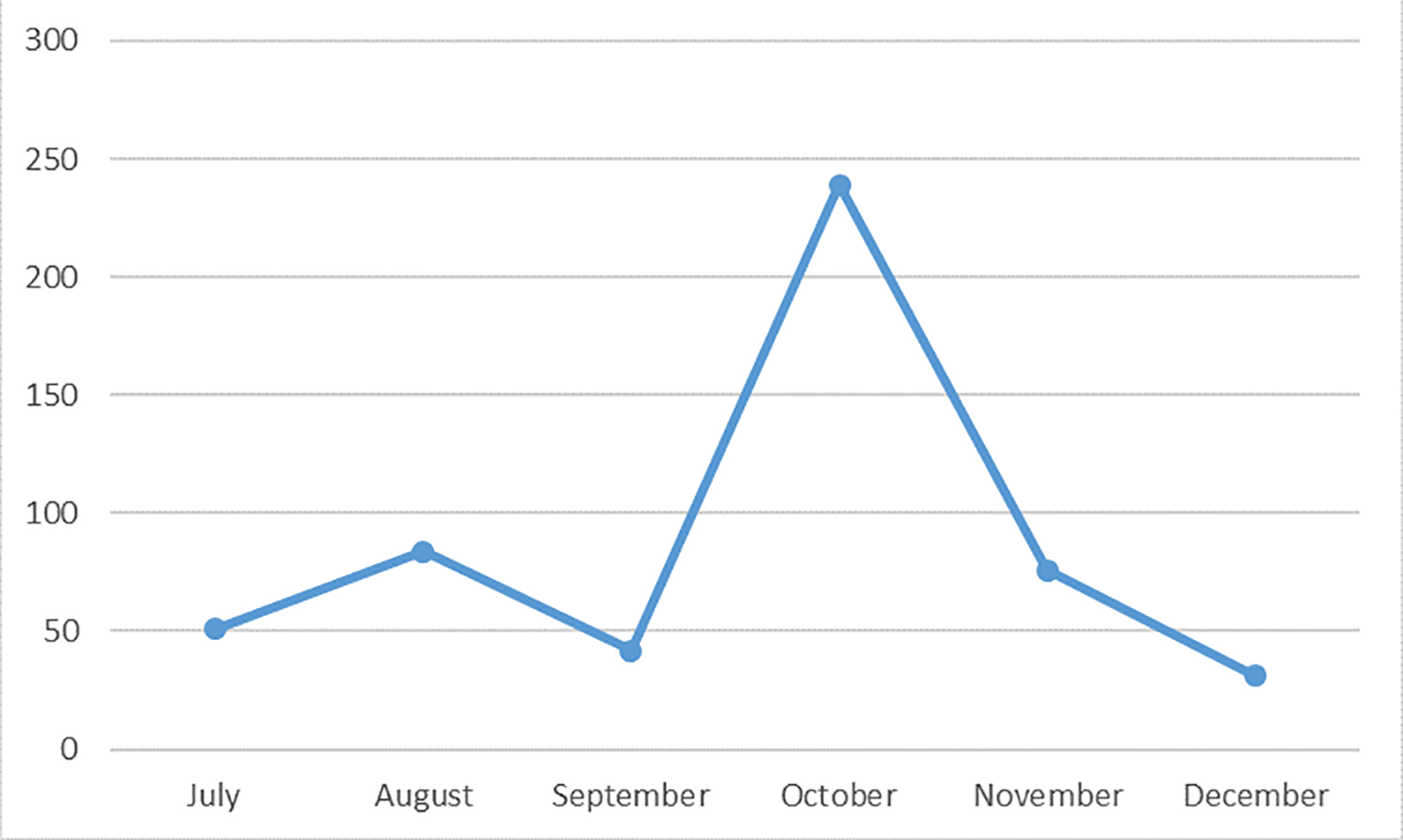
Based on Sharp’s (1973) typology of nonviolent action, protest and demonstration methods dominated the anti-establishment protests, accounting for 94.3% (514 out of 545 events) of coded activities, while only 5.9% (32 events) were identified as nonviolent noncooperation methods that involved economic, political, and social boycotts (e.g. student strikes and boycotts of pro-regime media), and 0.5% (three events) were categorized as nonviolent intervention activities in which activists disrupted established behaviour patterns, policies, and relationships (e.g. sit-ins and road blockades). These activities were most frequent in October before hitting a low in December 2020. Out of 255 anti-establishment activities with available data, the majority of the events gathered hundreds of participants. This reflects how activists prioritized public gatherings in the form of flash mobs with small nos of participants but highly visible, enabling participants to circumvent crackdowns. Only one activity in September reportedly attracted more than 100,000 participants, while in October, the largest six events had more than 10,000 but fewer than 100,000 participants.
As we shall see, countermobilization events were frequent in October, rather than in September, suggesting that the size of protests might not necessarily coincide with the mobilizing opportunities for countermovements. Meanwhile, the movement’s activity frequency partially explained the proliferation of royalist mobilization in October 2020. In 2021 when more than 600 youth protests resurged, royalist counterprotests amounted to merely 41 events, compared to 120 events in the preceding year. Monarchy-related frames that dominated the 2020 campaigns seemed to fade in 2021 (see Figure 1).
Collective action frames: ‘Monarchy reform’
A timeline of activists’ speeches delivered during major public gatherings highlights a shift from an initially politically moderate agenda to the polarizing subject of the monarchy. In July 2020, the Free Youth group proposed three demands for the constitution to be democratically altered, the government to stop harassing citizens, and the elite-controlled Parliament to be dissolved. The constitutional amendment proposal drew the most public support in mid-August 2020 (62% out of 197,029 samples). Fifty-three per cent of the surveyed population agreed with the three demands in principle, while 41% warned against offending the monarchy (Thaipost, 2020a).
However, from September 2020 on, the debate regarding the monarchy dominated other narratives, eventually constituting the movement’s mainframe. The first public speech focusing on the monarchy was aired during the Harry Potter-themed rally organized on 3 August 2020. The human rights lawyer Anon Nampa condemned autocratic abuses and restricted freedom of expression resulting from elites’ misuse of royal powers. Timeline of protest agenda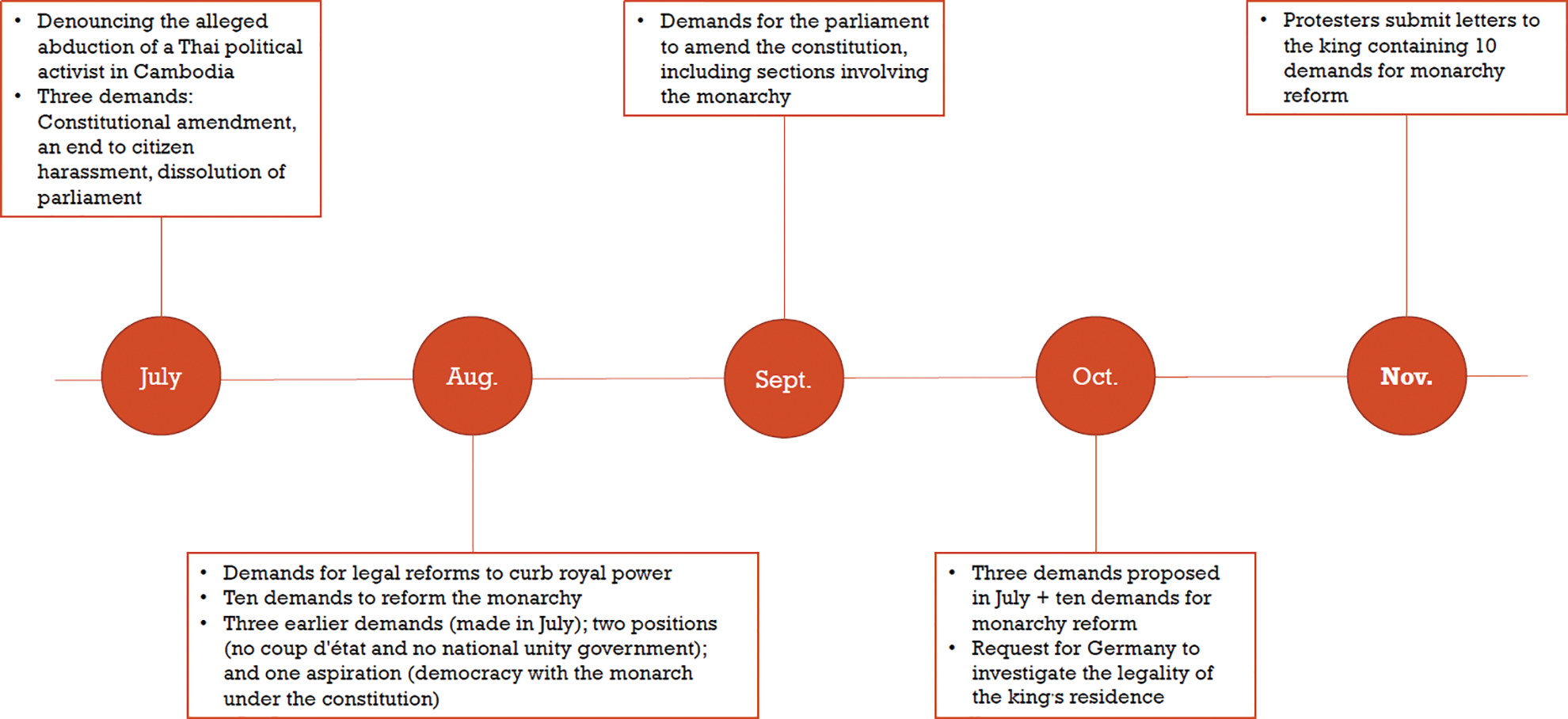
But it was the 10 August event that opened the floodgates for public criticisms, and in many cases insults, of the monarchy. The main organizer of this event was the UFTD, considered to be more radical than Free Youth (McCargo, 2021: 180). In this event, a leading activist made a passionate speech that ‘everyone was equal: nobody was born with purple blood in their veins….[and] people should have the right to express any view they wished, including questioning the need to have a monarchy’ (cited in McCargo, 2021: 180). Subsequently, the UFTD publicized ten demands, such as reducing the royal budget and barring the monarchy from expressing political opinions, providing a glimpse into the movement’s ‘cultural revolutionary’ outlook (iLaw, 2020). McCargo (2021: 180) notes that ‘the uncompromising tone of the protest, the utter lack of deference shown by the speakers [during the event], and the calls for desacralization of a royal institution that had long been considered beyond public reproach were shocking.’ In other words, in terms of content, protesters’ demands regarding the monarchy may sound reasonable in a constitutional monarchy. However, how this sensitive subject was addressed, that is, its framing, seemed to lack resonance in Thailand’s cultural context in which the monarchy is still regarded as a sacred institution.
From that point on, the youth movement concentrated its frames on the monarchy, demanding its overhaul and carrying out activities deemed to violate cultural norms about royal sacredness. On 14 October, activists scheduled their activities around the palace and government complex. On the same date, royal commemorations of the previous king’s death were held in a nearby spot. Protesters insisted that they ‘had no intention to disrupt the event’ (BBC, 2020a). But as a royal motorcade reportedly drove through the protest site, protesters reacted by chanting phrases such as ‘My Tax!,’ flashing the three-finger salute, and turning their backs to the convoy, unprecedented gestures considered by many Thais as ‘profane’ (BBC, 2020b). Despite the ambivalence surrounding this royal drive-through, pro-regime media were quick to frame the incident as protesters blocking the motorcade (Sanook, 2020). Using this incident as a pretext, the Prime Minister, General Prayut Chan-o-cha declared a state of severe emergency. Soon after, police quashed the remaining protests around the palace and arrested leading activists for high treason. Although this series of events can be considered the regime’s calculation to strike back, protesters could have expected this and opted for alternative tactics and frames that might have allowed for a change of protest site and effective responses to the regime rhetoric. Unfortunately, none of these events happened.
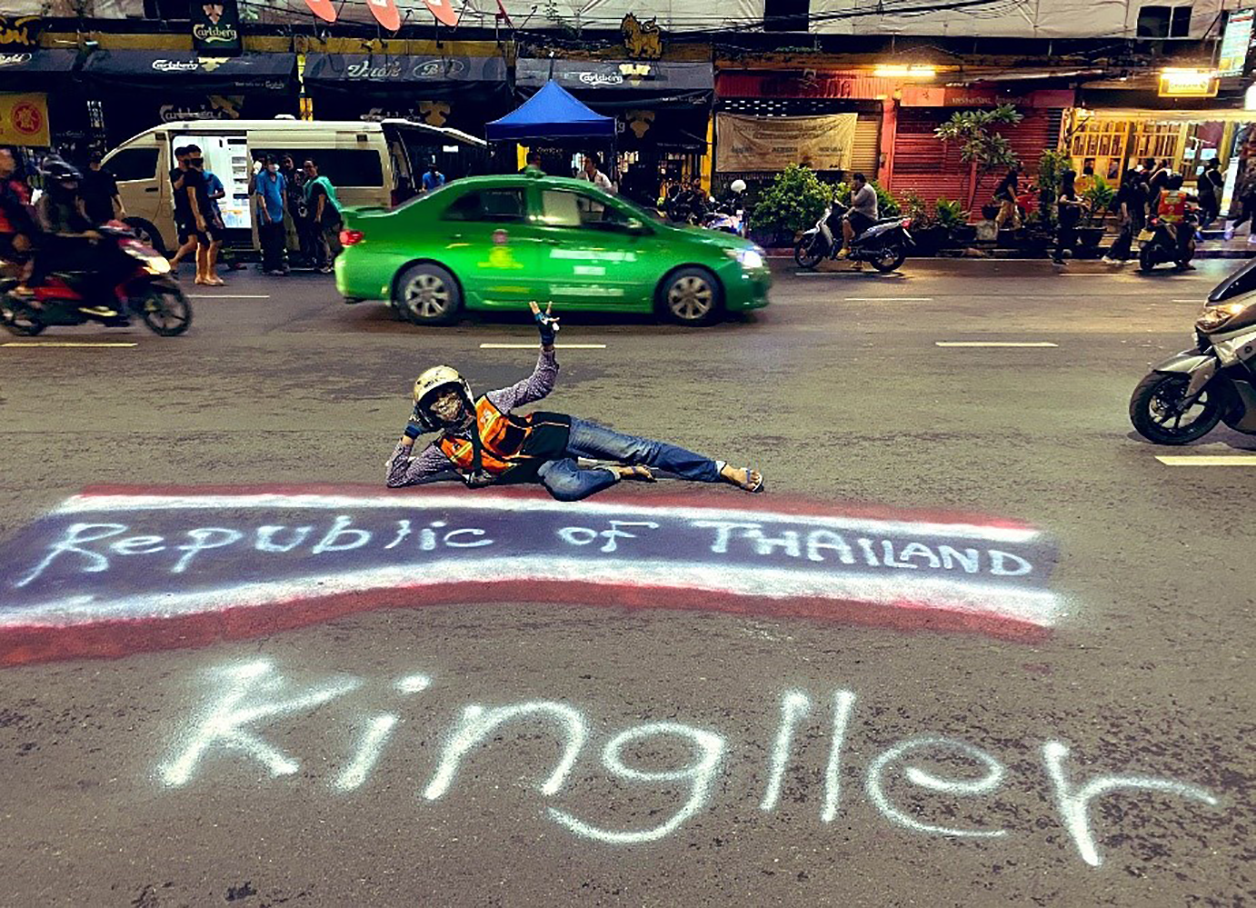
A graffito drawn on a street during the 18 October protest
In the aftermath of the October incident, intensifying arrests of leading activists and police crackdowns fuelled persistent resistance. But as protesters directed their anger at the monarchy, their activities and speeches in online and offline spaces became increasingly culturally transgressive. For instance, on 26 October, activists marched to the German Embassy in Bangkok, demanding an investigation into the legality of the king’s residence in Germany and claims of human rights abuses (Reed, 2020). On 8 November, protesters tried to reach the palace to submit reform proposals to the king (Thanthong-Knight, 2020). Specifically, the 18 November protest saw graffiti and banners with obscene language against the monarchy, which reportedly ‘infuriated citizens loyal to the monarchy’ (WorkPoint Today, 2020). When the protests subsided in December 2020, monarchy reform became the movement’s ‘core’ mobilizing frame. Hundreds were charged for violating the lèse majesté law (TLHR, 2022). Figure 2 shows the timeline of this development.
The movement’s Twitter hashtags show that monarchy-centric agendas are inseparable from the movement’s frames (Figure 3). The movement’s mobilizing hashtags (e.g. #15OctGoToRatchprasongIntersection) gained 10 to 20 million mentions. Comparatively, the number of mentions of hashtags offending the monarchy such as #Socially****King 7 , #****WronglyAccusesPeople, and #RepublicOfThailand are more moderate, receiving 5.4 million mentions altogether from July to December 2020. Regardless of the quantity, these hashtags symbolized public expressions of popular frustration about the palace – if not outright contempt against it – something rare in Thailand. 8 Hashtags such as #RepublicOfThailand received 900,000 mentions and trended on 25 September, following the parliamentary decision against constitutional changes that might curb royal power (see Figure 4). A closer look at tweets related to this hashtag reveals an unprecedented aspiration for ‘systemic change.’ For instance, by defining what ‘republic’ means, one Twitter user implicitly expresses his or her wish for a different form of governance.
Posts such as this are in line with leading activists’ analysis that ‘when people are desperate for reform, they are thinking of revolution’ (Tanakasempipat & Thepgumpanat, 2020). Similarly, during the palace–protester standoff in mid-October, #Socially****King and #****WronglyAccusesPeople reached 2.7 and 1.6 million mentions, respectively. #Socially****King encompassed a wide range of public criticisms of the A tweet with the tag #RepublicOfThailand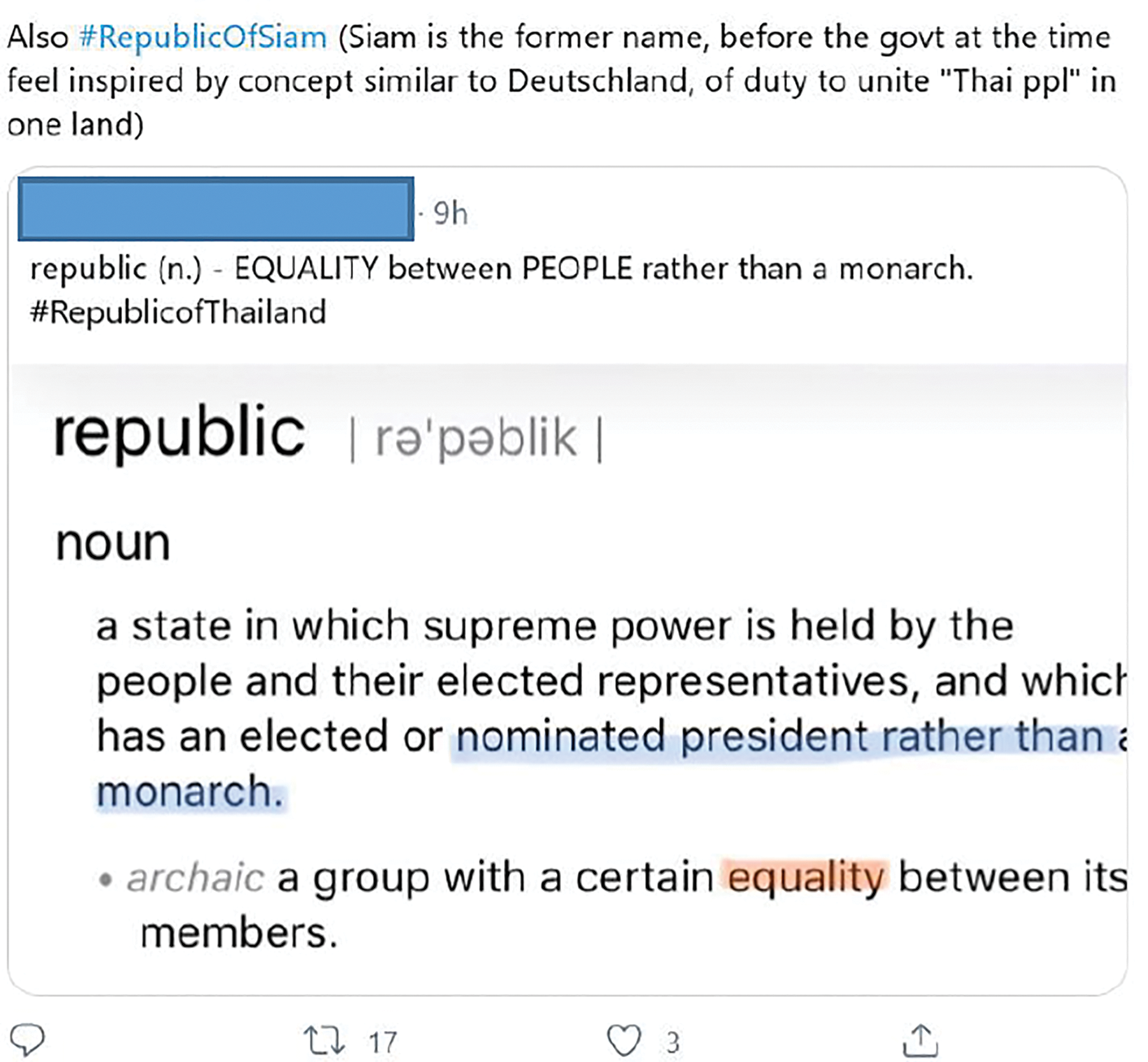
How polarizing framing triggers royalist countermobilization
These anti-establishment frames arose from the same ideological and identity-based cleavages that rendered royalist activism meaningful. While the 2020 movement proposed to reform the monarchy, royalist networks’ sole agenda was to contest this. Alternative explanations are either inapplicable in the Thai case or piecemeal without considering the movement’s framing choice. For instance, the data above show that the movement was largely nonviolent, diverging from the assumption that a nonviolent movement’s shift to violent tactics drives countermobilization (e.g. De Fazio, 2017). Movement fragmentation (e.g. Pearlman & Cunningham, 2012) may prompt the rise of a ‘radical flank’ (such as the UFTD) which influenced the use of polarizing frames (Meyer & Staggenborg, 1996: 1641). But this explanation demonstrates a different causal process from the impact of framing choices on countermobilization. Similarly, the attribution of countermobilization to only regime actors (e.g. Hellmeier & Weidmann, 2020) overlooks autonomous elements within countermovements, activated when there are sufficient social conditions (Bessinger, 2020). As we shall see, this latter point is relevant to the Thai case.
Characteristics of royalist mobilization and counterframes
Compared to anti-establishment activities, royalist mobilization from July to December 2020 was significantly less frequent, totalling 120 events. Royalist counterprotests had a slow start, with only three events from 24 June to 30 June. But as the anti-establishment movement’s frames increasingly focused on the monarchy, royalist mobilization on the streets and via Twitter picked up Anti-establishment mobilizing hashtags Numbers of royalist activities, compared with those of anti-establishment activities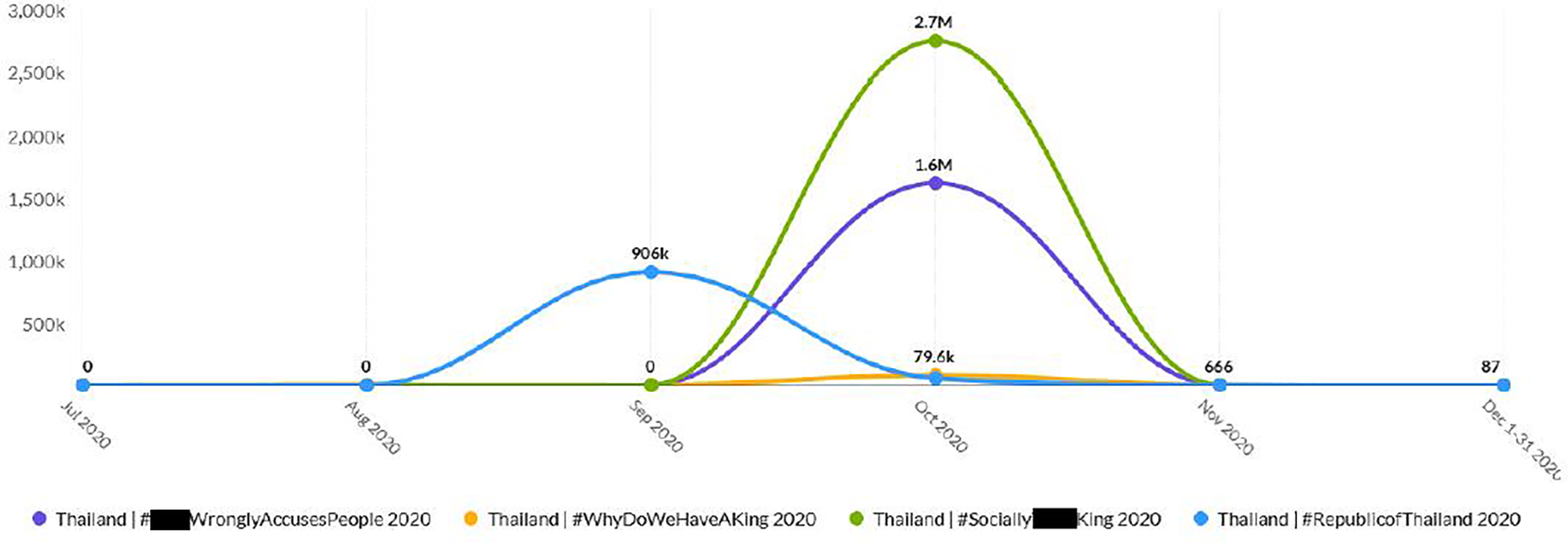
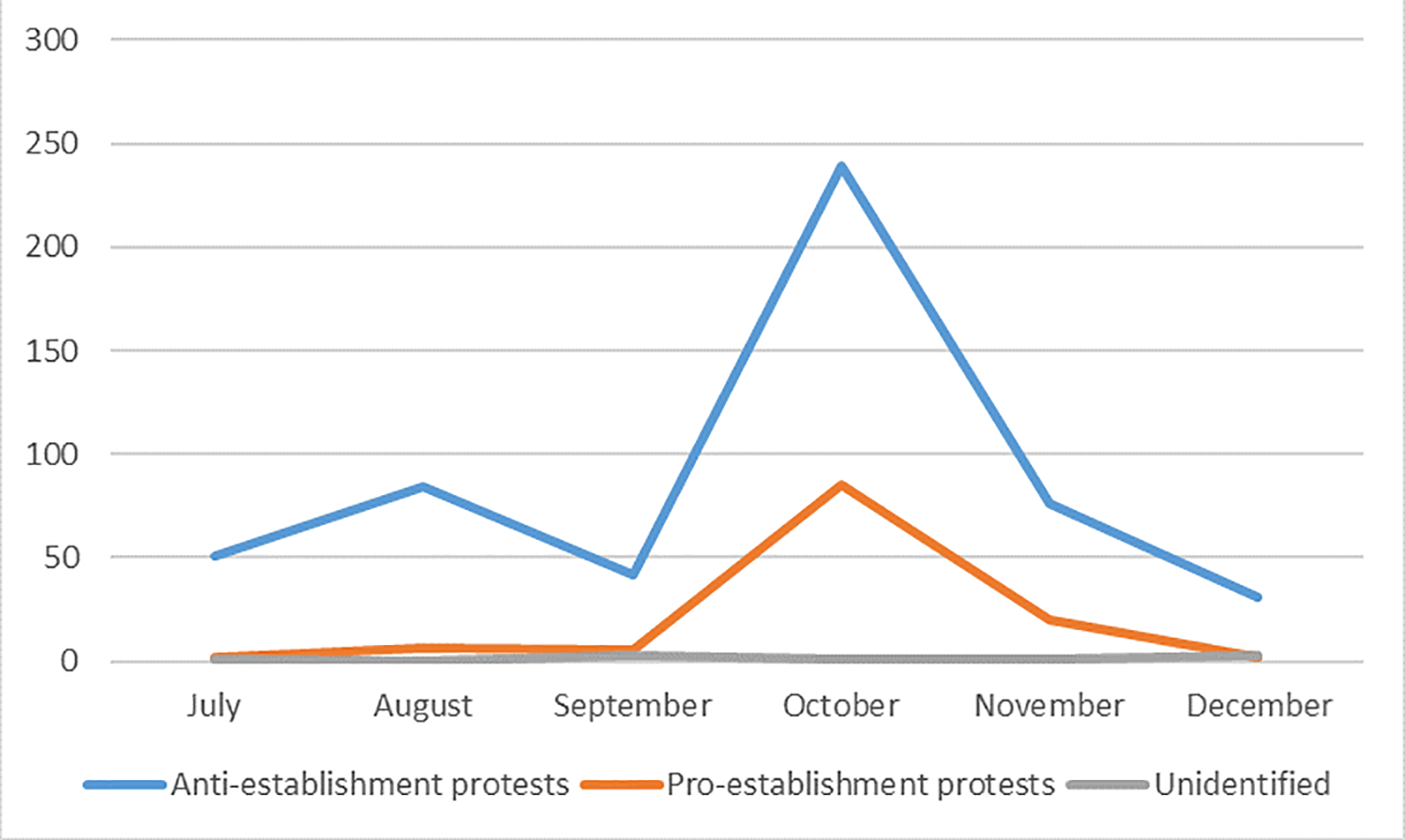
Beyond monolithic, royalist networks combined seemingly grassroots organizations – such as the Thai Bhakdi, Vocational Students Helping the Country Group, the Coordination Centre of Vocational Students for the Protection of National Institutions, and the Rubbish Collection Organization – with state organizations (e.g. those within the Interior Ministry) and ordinary citizens. Their common goal intertwined protecting the monarchy with ‘denouncing’ the anti-establishment movement’s monarchy reform proposal. Based on my content analysis of royalist groups’ protest statements, denouncing monarchy reform was mentioned in statements of 80 counterprotest events out of a total of 121 events. And ‘support of the monarchy’ was mentioned in statements of 96 protests. Concretely, for instance, the Thai Bhakdi group organized a rally on 30 August to oppose the anti-establishment movement’s demand for monarchy reform. Its leader explained that ‘the problem [Thais] face is not caused by the monarchy who is the national unifier, but rather corrupt politicians’ (Prachachat, 2020).
The anti-establishment movement’s monarchy-centric frames also influenced royalist counterframes. The turning point that created momentum for royalist protests was the palace–protester standoff on 14 October. On the same date, the RCO organized a protest action, in which its supporters were called upon to fight against ‘national scum’ (Thairath, 2020). After this encounter, royalist mobilization became regular. Of 85 events organized in October 2020, 48 of them were held from 20 to 31 October. The largest gatherings, attended by more than tens of thousands of people, were held on 21 and 25 October in Narathiwat province. 9 When anti-establishment protesters marched to the German Embassy on 26 October, royalist protesters rallied outside the United States Embassy on the following day, demanding that the United States government stop interfering with Thai domestic politics. This rhetoric alleges the United States backing of Thailand’s pro-democracy movement to overthrow the monarchy, a conspiracy theory popular in royalist media (Sombatpoonsiri, 2022). On 27 October, royalists gathered across at least six provinces. In his speech, Tul Sittisomwong, a royalist spearheader, contended that many Thais could not idly watch protesters insulting the monarchy: ‘we are here today to sing our national anthem to animate the love for the nation and the king.’ Furthermore, he suggested that the youth movement should only call for the prime minister’s resignation or constitutional amendments because demanding ‘the monarchy reform is not appropriate…please do not crush Thais’ heart and soul’ (Bangkokbiz, 2020).
Royalist counterframes reflect the mirroring between such rhetoric and anti-monarchy frames; without the latter, there would have been sufficient discursive ground for royalist activism. Regime authorities have been training their forces to manipulate online information against anti-establishment movements. These campaigns intensified during the 2020 protests, as regime-backed information operations converged with royalist supporters’ online activism (Thomas et al., 2020). One account, @jitarsa_school, belongs to the Royal Thai Volunteer School, which is connected to both the military and the palace under the Royal Security Command. Against the backdrop of criticisms against the monarchy, @jitarsa_school and other royalist accounts engaged in tweeting and retweeting pro-establishment hashtags. Between 13 and 22 October, when the palace–protester standoff escalated, there were up to 40,455 tweets and retweets of pro-establishment hashtags in total (Thomas et al., 2020: 7–8), including #WeLoveTheMonarchy, #ProtectTheMonarchy, #NextGenLoveTheEstablishment, and #ThaiCitizensUnderRoyalGaze.
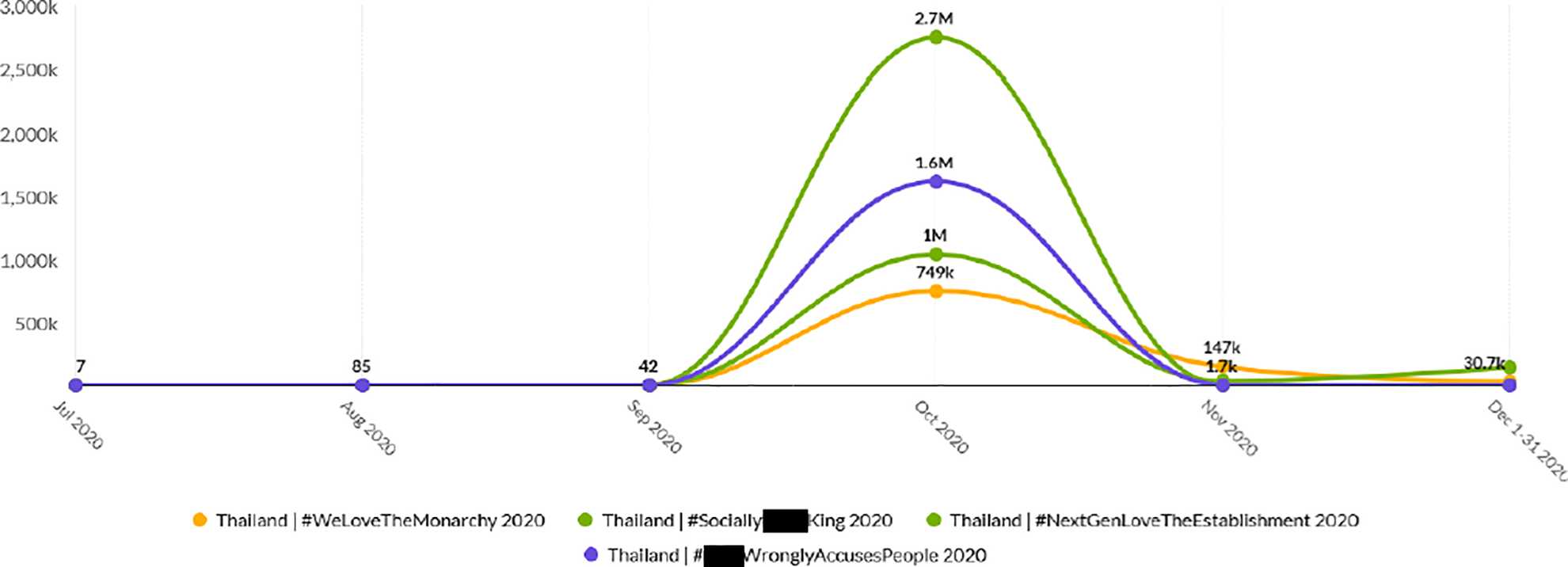
My Twitter analysis confirms the clash between pro-establshment and anti-establishment hashtags. #NextGenLoveTheEstablishment received 1.2 million mentions on 20 October, while #WeLoveTheMonarchy, #ProtectTheMonarchy, and #ThaiCitizensUnderRoyalGaze received hundreds and thousands of mentions. The four hashtags went viral from 20 to 28 October, one week after the anti-monarchy hashtags trended. Combined searches of the four most viral hashtags of pro-establishment and anti-establishment supporters show the concentration of mentions between late September and October when offline mobilizations by these two opposing forces peaked (see Figures 7 and 8).
Notably, royalist hashtags sought to contest the credibility of anti-establishment frames. Royalist hashtags and related tweets reinforced official ideologies regarding the sacrosanct monarchy, the kings’ sacrifices for the nation, and the centrality of the monarchy to Thai national identity. These hashtags branded Thais who do not express their gratitude towards the monarchy as ‘immoral’. In contrast, royalists saw their activism as a force of good (e.g. Manager Online, 2020). Specific royalist frames such as #MessageFromSubjects (#ประชาสาสน์) were designed to directly oppose the ideological underpinnings of anti-establishment hashtags, including #MessageFromCitizens (#ราษฎรสาสน์). And while anti-establishment frames such as #RepublicOfThailand called for a systemic overhaul for democratic development, royalist hashtags reaffirmed the importance of the monarchy for Thailand’s progress. Whereas anti-establishment frames emphasized freedom, democracy, and rights, royalist messages highlighted traditions and national unity. Ultimately, Royalist mobilizing hashtags Compared anti-establishment and royalist hashtags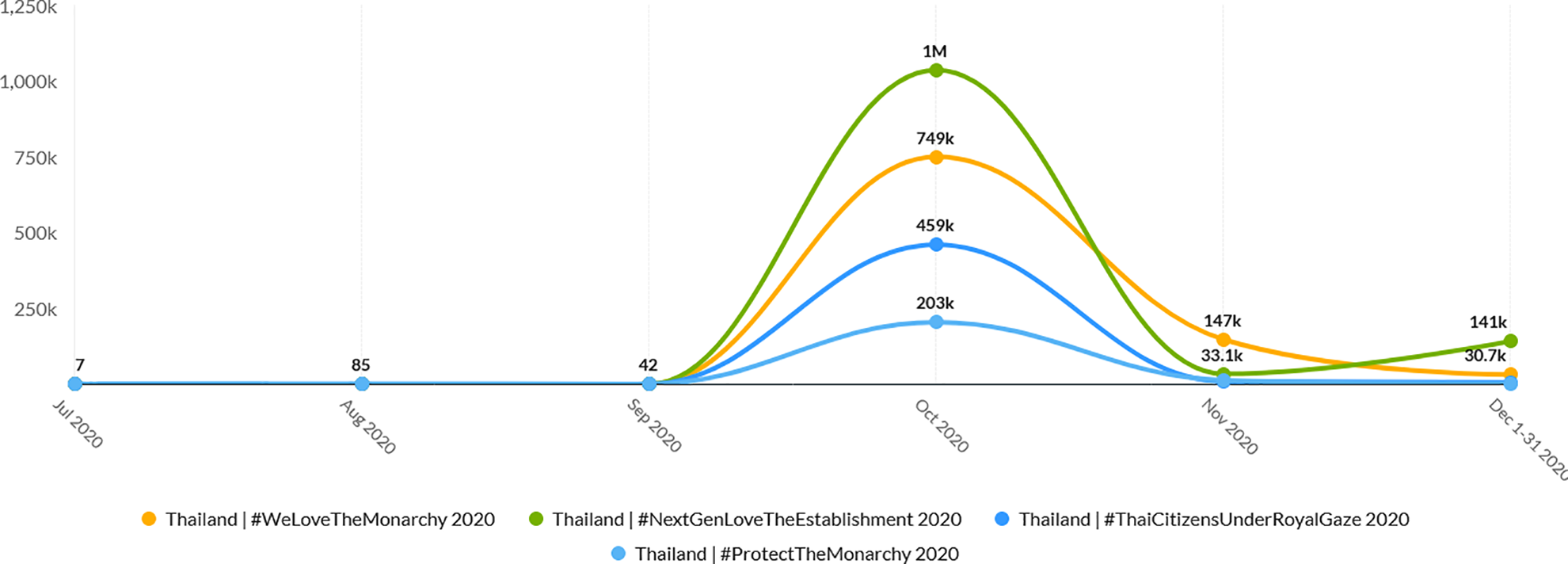
Observed mechanisms
Drawing on this wealth of evidence, a two-pronged mechanism that interlocks polarizing frames with countermobilization is observed. The first aspect regards polarizing frames premised on existing ideological and identity-based cleavages. The movement embracing these frames can be interpreted to attack core markers of a collective identity, something that makes those subscribing to it unwilling to compromise. In the Thai case, the 2020 activists might be convinced that the public increasingly supported its monarchy-related agenda (BBC, 2020a). But this outlook represented the voices of the younger generation, rather than a large segment of society that is still ideologically conservative. The survey, conducted in 2019 and published in an opposition media, showed that 74% of 1,262 Thais wanted the government to prioritize preserving the monarchy because it is ‘the nation’s soul, a source of its security, peace, and unity’ (Voice TV, 2019). Amidst the protests, in August 2020, public concerns about protesters ‘insulting’ the monarchy increased to 60% (of 5,738 online questionnaires) from just 41% earlier in that month (Infoquest, 2020). A pro-government poll conducted in early November 2020 went so far as to show that 98% of the surveyed population (1,831) disapproved of protesters’ ‘rude’ and hostile behaviours toward the monarchy. Regardless of attitudes about the protesters’ agenda, according to another poll, 22% of A royalist post on Twitter expressing her support of the king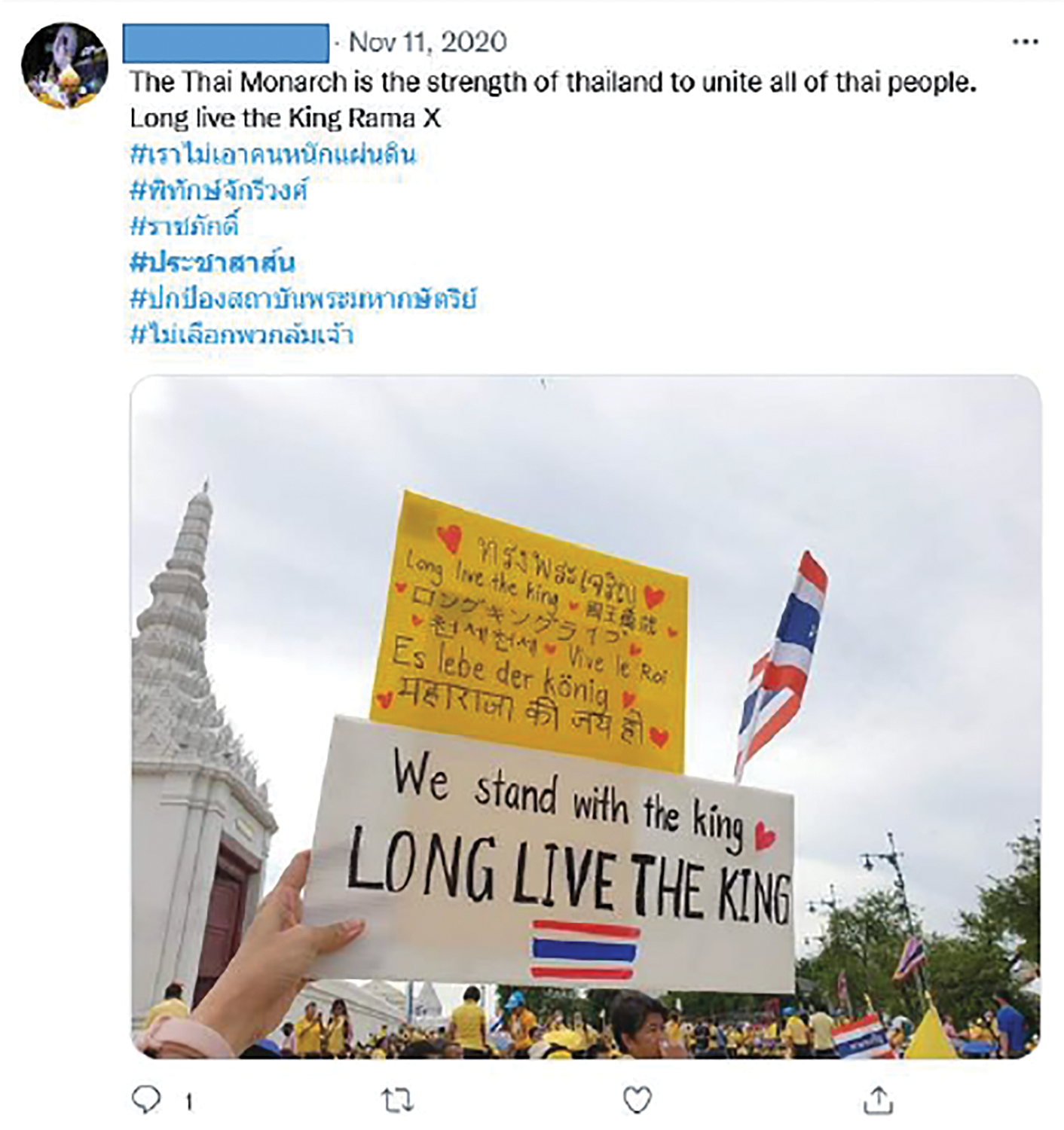
Considering that criminalization of speeches about the monarchy might influence these polling results, the public attitude at least reflects the palace’s enduring symbolic salience vis-à-vis the Thai national identity, especially among the older generation. Accordingly, it can then be expected that this segment of the population may be at odds with the movement’s ‘avant-garde’ agenda. For example, a movement participant admitted that ‘the monarchy is very sensitive to [his or her] mother.’ Whenever this participant brought up the subject, his or her mother cast him or her as a ‘nation-hater,’ rhetoric often used against critics of the monarchy (Thaitrakulpanich, 2020). Another senior citizen lamented that young protesters always held up vulgar signs against the monarchy, wondering ‘why kids these days are always crossing the line to touch the monarchy’ (Thaitrakulpanich, 2020). There are, however, some young people who disapproved of the movement’s monarchy-related frames because they are ‘definitely overstepping boundaries and touching on the [royal] institution’ (Thaitrakulpanich, 2020). Despite the movement’s claim to remain respectful toward the monarchy, many Thais felt that their dearly-held values and collective identity were under attack (Saokaew, 2020). Based on these observations, I propose that: (a) The movement’s choice for polarizing frames sustains existing ideological and identity-based cleavages, antagonizing segments of society that perceive their collective identity to be under attack. (b) Ideological and identity-based cleavages, on which polarizing frames are drawn, also provide social sources for countermolization.
Conclusion
In this article, I have demonstrated a linkage between a movement’s framing choices and countermobilization. By using Thailand’s 2020 anti-establishment campaigns as an explanatory case, I have proposed a two-pronged mechanism: (a) the movement’s choice for polarizing frames sustains existing ideological and identity-based cleavages, antagonizing segments of society that deem their collective identity under attack; and (b) these ideological and identity-based cleavages, on which polarizing frames are drawn, also provide social sources for countermobilization. These propositions are expected to serve as an entry point for further theoretical testing through large-n studies and case-based as well as comparative analyses beyond Thailand.
Understanding the relationship between a movement’s framing choice and countermobilization has critical implications for repression dynamics and strategic framing in divided societies. That is, countermobilization can disrupt and undermine a campaign, serving as an alternative, or a ‘vegetarian’ form of repression (Ekiert & Perry, 2020: 10). By relying on countermovements to do the job on its behalf, the regime may still deny its involvement in repression efforts (Hellmeier & Weidmann, 2020: 80). While this qualitative research cannot establish a causal relationship between the rise of royalist mobilization and the decline of the 2020 movement, it seems that traditional repression such as police use of force worked in tandem with countermobilization to drain the movement’s energy, resources and public legitimacy (Human Rights Watch, 2020; TLHR, 2022). For nonviolent resistance researchers, such dynamics compound the assumption that movements’ ‘nonviolent discipline’ in the face of a violent crackdown may help counter the detrimental effects of repression by generating further public support and instigating security force defection. But in light of countermobilization, the latter’s connection with regimes is blurred and its violent traits unclear. This begs the question as to how organized pushbacks against the ‘vegetarian’ form of repression could look like.
Lastly, lessons from Thailand remind us of how framing choices are important for making nonviolent campaigns effective (or not) in polarized societies. Contemporary studies on nonviolent resistance have primarily devoted attention to tactical choices in accordance with a broader strategy. However, designing effective frames with high resonance remains under the radar. Framing choices can make or break movements operating in societies divided between supporters of opposing ideologies and values. Thailand is not unique in this sense. From the United States to India, from Brazil to Turkey, resistance campaigns are not only about the ‘people’ vs. ‘dictators,’ but can also pit one side of the populace against the other side. The increasingly hardened fault lines between, for instance, the progressive/left and the conservative/right or the religious majority and minority, have prompted the tit-for-tat mass mobilization in many divided societies. Under these circumstances, the main task of nonviolent movements may be to create a broad-based coalition beyond one camp’s ‘echo chamber.’ This politics of engagement necessitates strategic framing that goes beyond speaking the truth to power. It is to develop a language that convinces those on the other side of the aisle to join a common course of struggle.
Footnotes
Replication data
The dataset and codebook for the empirical analysis in this article can be found at https://www.prio.org/journals/jpr/replicationdata and Mendeley Data, 
Acknowledgements
Heartfelt thanks go to my hardworking research assistant and former student, Thammachat Kri-aksork, for thorough data collection, coding and theoretical insights. I would also like to thank Chaiwat Satha-anand, Marina G Petrova, and Sooyeon Kang for their comments that helped sharpen this manuscript. Social media research was carried out during my fellowship at the ISEAS-Yusof Ishak Institute. I am grateful for their generous support.
Funding
The author received financial support for the research, authorship, and/or publication of this article: Part of the research is supported by the visiting fellowship at the ISEAS–Yusof Ishak Institute, Singapore.