




Abstract
Police reform implementation has been widespread in post-conflict transitions. Responding to conflict recurrence and past human rights violations, among other factors, motivate reforms. However, we know little about the effectiveness of reforms in reducing police propensity for violence. How does police reform affect police violence after armed conflict? I argue that the nature of reforms poses a challenge to peace and stability: police reform may aggravate the problems it seeks to resolve. Increasing deterrent capacity reinforces militarization, a logic of organization to produce violence that accountability mechanisms – the generation of information and the imposition of costs on abuses – are unlikely to curb. I test these propositions on a panel of 55 post-conflict countries between 1985 and 2015. My findings challenge research suggesting that security reforms lead to peace. Results support policies that reduce police’s propensity to use force. Implications are relevant for domestic and international actors engaged in police reform.
Introduction
Since the 1990s, Security Sector Reform (SSR) has been widely implemented in order to reduce violence in the aftermath of armed conflict and has become a critical feature of reconstruction efforts (Berg, 2022). Police reform is an important component of SSR efforts. In fact, 41% of peace agreements signed after 1989 incorporate provisions for police reforms (Ansorg, Haass & Strasheim, 2016). Nevertheless, even after extensive reforms deemed successful by the international community, high levels of police violence remain a key concern in many post-conflict countries, suggesting wide variation in the outcomes of reform efforts. Why does police reform not consistently result in the reduction of police violence after internal armed conflict? How does police reform affect police violence?
Post-conflict SSR has focused on strengthening capacity in order to provide the security apparatus with the ability to deter others from violence while exercising self-restraint (Lake, 2022). This approach typically involves technical components such as increasing training and weaponry, as well as a variety of accountability mechanisms. I argue that the nature of reforms poses a challenge to peace and stability: police reform may aggravate the problems it seeks to resolve. Increasing deterrent capacity reinforces militarization, a logic of organization to produce violence that accountability mechanisms – the generation of information and the imposition of costs on abuses – are unlikely to curb. This is especially problematic for police, who are expected to implement the rule of law post-conflict through regular interactions with populations.
By analyzing 55 post-conflict countries between 1989 and 2015, I show that accountability needs to be accompanied by a reduction in militarization to be effective. When the police are less militarized, they do not behave as if civilians are enemies and they are less prone to use violence. The imposition of high costs on police behavior alone is insufficient to modify it because it clashes with historical operational legacies that may be reinforced by the reform process itself.
Our current understanding of the relationship between SSR and security sector violence in post-conflict settings is mostly concerned with war recurrence. Research on conflict transitions shows that increasing the deterrent ability of the security apparatus is crucial to reducing violence post-conflict (Toft, 2010). The emphasis on war recurrence correlates with a focus on how the military influences politics in post-conflict transitions (Licklider, 2014) and the effect of disarmament, demobilization and reintegration processes (Muggah & Krause, 2009), paying less attention to the role of the police in the perpetuation of violence.
This project makes three contributions: first, it unpacks the security sector by focusing on the role of the police as a crucial actor for state legitimacy distinct from the military and comparatively less studied, either as a perpetrator or arbiter of violence. To do so, it connects existing research on civil-military relations, SSR and policing. Second, it develops theoretical mechanisms linking police reforms and police violence, central to understanding how such violence is experienced on the ground. Third, using original data, it demonstrates variation in the spectrum of police reforms, which allows me to test implications of the organizational architecture of the police for diverse violent outcomes. I built an original dataset of 55 post-conflict countries across different regions of the world that implemented reforms in their police forces between 1989 and 2015. This dataset improves upon others by disaggregating reforms in separate components and capturing changes in multiple dimensions to reveal additional variation in the spectrum of reforms.
Accounting for prevailing explanations of police violence, I find that low militarization and high accountability are important to reduce police violence. Reforms that increase police militarization, increase police violence. I also find that the effect of accountability is conditional on the level of militarization. Reforms that make police more accountable also make them less violent, but only at low levels of militarization.
Focusing on post-conflict contexts provides a stringent test for my argument, as war environments exacerbate exposure to violence and make high militarization and low accountability difficult to change. My findings extend to other cases where police militarization is high, in line with studies demonstrating the association between police militarization and police violence outside of war (Flores-Macías & Zarkin, 2021).
Police reform and police violence in the aftermath of armed conflict
Scholarship on civil wars finds that SSR is essential to achieve peace in post-conflict contexts (Toft, 2010). Its efficacy is attributed to a range of mechanisms, including raising the cost of engaging in more violence by increasing deterrence (Toft, 2010), or reducing information asymmetries regarding the intent to use violence on another group (Licklider, 2014). Essentially, reforming the security apparatus changes expectations about its behavior, altering incentives to engage in further violence.
Until recently, studies of post-conflict SSR focused on the military’s role in avoiding the repetition of conflict. Despite the fundamental role of the police in repression during conflict, studies of civil-military relations have centered on the negative consequences of militarizing internal security, without attention to the role of police (Eck, Conrad & Crabtree, 2021). This is partly because reforms in the military are viewed as central to providing a credible commitment to peace (Licklider, 1995). For example, reforms to increase military effectiveness aim at undoing coup-proofing strategies (Quinlivan, 1999; Pilster & Bohmelt, 2011), which can sometimes undermine the prospects for peace (Berg, 2020; Harkness, 2018: 10). Conversely, police reforms are usually approached as technical, rather than political processes, as police are seen as less autonomous and powerful (González, 2021). However, police are key to repressive practices pre-transition (González, 2021; Davenport, 2020) and are central to creating an effective rule of law post-transition (Blair, 2020).
Building on the finding that police reform affects violence, I focus on understanding how reforms affect police behavior to shed light on why some countries that implement reforms see a concomitant decrease in violence while others do not. Scholars of repression have addressed issues of violent law enforcement by focusing on state capacity. Research suggests that violent policing emerges from a lack of capacity and inadequate training (Bayley & Perito, 2010). Others contend that not all police forces within a country are equally violent; rather, levels of violence result from strategic choices (Greitens, 2016).
The structure of the police and policing styles affect the dynamics of police violence. Organizational dynamics within law enforcement, such as levels of fragmentation, can increase repression and conflict recurrence (Arriola et al., 2021). Contexts deeply affect policing styles, creating strong legacies for the future. Historically repressive police tend to be violent even after democratic transitions (Jaime-Jimenez & Reinares, 1998). Furthermore, the implementation of reforms aimed at harsher deterrence can reinforce these patterns and lead to increased violations of physical integrity rights and generalized violence by the police (Holland, 2013: 46–47). Akin to the link between repression and rebellion, how police are used has implications for their effectiveness and overall peace.
Most of these studies focus on one dimension of organizational dynamics, and those that consider several, center around why some countries are likely to adopt reforms (e.g. Karim, 2017). In contrast, I focus on the persistence and effects of reforms and propose their systematic characterization based on two dimensions that have been the focus of reforms: militarization and accountability (Schroder & Kode, 2012). I then show how changes in these dimensions affect organizational behavior.
I develop a theoretical argument positing that police reforms can increase police violence. Changes in accountability and militarization affect police use of force. Countries may introduce reforms that impact existing levels of accountability and militarization, increasing or decreasing one or both. The overall effect on police violence ultimately depends on the joint operation of these two dimensions.
State legitimacy and the logic behind police reform
In conflict transitions, state leaders need to be perceived as legitimate. State legitimacy is derived in part from the ability to create an effective rule of law post-conflict, which requires police for enforcement (Blair, 2020; Blair, Karim & Morse, 2019; Curtice & Behlendorf, 2021). Because of the government’s involvement in human rights violations during conflict, and/or because it is seen as ineffective in dealing with violent actors, the international community and domestic actors may pressure it to incorporate police reforms.
Police reforms – changes to ‘internal structures, rules and practices within the organization’ (González, 2021: 32) – are complex and all-encompassing (Ansorg, Haass & Strasheim, 2016; Karim, 2017). For example, they may involve creating an entirely new police force, such as in El Salvador, or disbanding old units and creating new ones, like in South Africa. They may also include purges, incorporating former combatants, or other forms of integration, for example, based on gender or ethnicity (Blair et al., 2022). Leaders may choose to pattern the police after the military to be seen as more legitimate (Kenwick, 2021) and to explicitly make police more prone to use force (Holland, 2013; Lawson, 2019). For instance, in Colombia, the police have been patterned after the military in hierarchy, training, uniforms and equipment (Rodriguez, 2018: 115).
Relative to the military, police rely more heavily on citizens’ cooperation for public security provision. Police is also the security organization most likely to repress citizens (Curtice & Behlendorf, 2021; Davenport, 2020). If they are too repressive, citizens may be less willing to provide information about crime, further undermining police effectiveness and state legitimacy (Tyler, 2004). If they enforce the law selectively, by repressing particular individuals or groups, they can exacerbate violence (Curtice & Behlendorf, 2021).
In efforts to counteract the prevalent operational practices during conflict, reformers prioritize two main organizing principles of good governance: accountability and effectiveness (Karim, 2017; González, 2021; Schroder & Kode, 2012). Accountability prioritizes changes connected with transparency, respect for human rights, and the rule of law (Bayley, 2006; Brzoska, 2006), whereas effectiveness is tied to concerns with war recurrence and high violence, which spark reforms to increase deterrent capacity (Toft, 2010; Karim, 2017). Reformers are usually concerned with equipping the police and making them more effective. However, in practice, militarization and effectiveness are often conflated. Effectiveness can entail the ability to violently control certain groups in the population, such as criminals or insurgents (Uildriks, 2010: 18). As a result, efforts to increase effectiveness increase militarization. Studies outside of conflict have shown that increased militarization is associated with increased police violence (Hills, 2009; Reiner & Newburn, 2007; Mummolo, 2018; Gunderson et al., 2020), but evidence for conflict cases is scant (for an exception see Lake, 2022).
Accountability and effectiveness are organizing principles for the wide variety of changes involved in police reforms. While the presumption is that these principles reinforce each other, some aspects are likely in tension with one another. For example, the South African police engaged in a centralization process, human rights training, and the integration of former combatants. While reducing fragmentation through centralization can reduce security sector violence (Greitens, 2016), the incorporation of former combatants can increase it, in the absence of proper vetting and retraining. In other contexts, the proliferation of community policing strategies occurs in tandem with increases in the use of force to address crime and public order disturbances (Hill & Beger, 2009: 30). Rather than assuming positive reinforcement, I propose characterizing police reforms based on the extent to which they affect accountability and militarization, and analyzing each dimension’s independent effect, as well as their interaction.
How police reform affects police violence
In post-conflict transitions the police exhibit militarized operational patterns and lack of accountability resulting from the dynamics of conflict. The extent of militarization and accountability are legacies from the pre-transition period, which reforms will affect. I propose that police propensity to use violence – how frequently and to what degree police use force – varies depending on how reforms affect these two legacies. Countries attempt to change the extent of militarization and accountability of police by increasing or decreasing one or both. Ultimately, the effect on police’s propensity for violence is contingent on the extent of militarization and accountability, and on their interaction.
Militarization is an organizational logic based on the preparation for the use of violence to eliminate enemies that develops as part of the dynamics of conflict. As such, it requires certain practices comprising symbolic, material, and organizational aspects, as well as patterns of socialization (Kraska, 2007; Mummolo, 2018; Flores- Macías & Zarkin, 2021). These aspects materialize in concrete policies: the use of military uniforms, ranks, training and tactics, the incorporation of military equipment (Kraska, 2007; Balko, 2013; Gunderson et al., 2020), increasingly blurring distinctions between internal and external security provision (Hills, 2009; Reiner & Newburn, 2007) by, for example, using the military for law enforcement functions (Flores-Macías & Zarkin, 2021), or using police for counterinsurgency (Eck, Conrad & Crabtree, 2021). Militarization does not require, however, that the police be under the control of the military. Organizationally, the police may be under the direct control of the military or have a military-like structure with respect to command, personnel and doctrine (Flores-Macías & Zarkin, 2021).
Militarization also requires a socialization process to function during war and become desensitized to violence (Paul & Birzer, 2008). Collaboration between police and the military reinforces this militarized socialization process. Common wisdom suggests that the military usually perpetrates abuses during civil war while the police are weak and play a secondary role (Davenport, 2020: 132). However, cases such as the Malay counterinsurgency operations, the Vietnam war (Sepp, 2005), the Iraq war (Bayley & Perito, 2010: 15), the wars in Bosnia and Croatia (Grillot & Hammer, 2012: 146–149) and in El Salvador and Guatemala (McAllister & Nelson, 2013: 19) consistently show that a division of labor between police and the military in fighting insurgencies is dominant, not exceptional. In fact, as recent data collection efforts have shown, police organizations are ubiquitous agents of the state repressive apparatus (De Bruin, 2021; Davenport, 2020) and responsible for most human rights violations in contexts of large-scale violence (Conrad, Haglund & Moore, 2013; Davenport, 2020: 125, 132). Reducing militarization requires changing socialization patterns as well as operational practices.
Lowering militarization affects police propensity to use force by changing its operational logic. During conflict, the prevalent logic is viewing others as enemies to be eliminated. After conflict, lowering militarization forces police to treat others as individuals with rights to be protected. This process requires modifying standard operating procedures, which involves changes in organization, structure and norms, leading to a reduction in the propensity to use force. In contrast, reforms that increase militarization, such as the creation of a military police, or the use of the military for policing functions, reinforce views of criminals – and anyone who is perceived as complicit – as enemies to defend against and eliminate. By taking the counterinsurgency logic from the conflict period beyond the transition to wage a ‘war on crime,’ high militarization justifies the use of high violence (Hill, Beger & Zanetti, 2007). The corresponding hypothesis is:
Internal security threats during conflict are associated with increased autonomy in the security apparatus (Desch, 1999). Although the use of violence during war is expected, it carries costs that states have incentives to avoid. Because of a need to preserve legitimacy, it is reasonable to expect high levels of impunity, or failure to prosecute (McCoy, 2012: 4–5), in the police. Failure to prosecute responds to the logic of war itself: sanctioned state violence requires the ability to kill without consequence. A byproduct of impunity in war environments is high levels of autonomy in the police and the proliferation of opportunities for abuses.
Varying degrees of impunity in the police define the status quo at the end of conflict, which reforms attempt to alter. To create conditions for reducing impunity, many reforms establish accountability mechanisms: institutions – norms, procedures, regulations and rules – that provide supervision, generate information and impose costs on police abuse. The judiciary, legislature, independent institutions such as complaints directorates, ombudsmen, advocacy groups and the media provide external accountability mechanisms to monitor police behavior. Internal accountability can come from an institution’s hierarchy, through supervision, disciplinary proceedings, or peers (Bayley, 1985). The more oversight mechanisms there are, within and outside government, the higher the expected overall level of accountability (González, 2021; Moncada, 2009).
Increasing accountability reduces the propensity to use force because it creates information about, and imposes costs on, abusive behavior. By increasing information, accountability structures increase the likelihood of getting caught. By increasing costs, they decrease incentives to abuse force. How easy it is to increase accountability is tied to its locus. Accountability can increase by creating new oversight institutions, or by sanctioning abuses. When systems lack oversight by executive and legislative bodies, or if they operate under military law (Flores-Macías & Zarkin, 2021), they tend to be opaque (Chevigny, 1995; González, 2021). Recommendations for police reforms in Chile, Colombia and Mexico have emphasized placing oversight structures outside the Ministry of Defense to increase accountability (Human Rights Watch, 2021; Moncada, 2009). Conversely, accountability is decreased by eliminating existing oversight agencies or limiting their reach, subsuming oversight within the armed forces, or devising mechanisms to increase police discretionary powers. Decreased accountability increases police propensity to use force by lowering the barriers that constrain them (Pino & Wiatrowski, 2006: 62). A hypothesis summarizing these arguments can be articulated as:
Because police forces are created to manage coercion, some degree of militarization is always likely to be present, making it easier to increase it (Kraska, 2007; Hill & Beger, 2009). A militarized logic of the use of violence can persist through individual and institutional mechanisms, even in the presence of costs for violating rules regulating police behavior (Tyler, Callahan & Frost, 2007). For example, psychological theories suggest that this persistence may be due to cognitive biases. Because learning new information proves challenging, individuals use cognitive shortcuts leading to ‘belief perseverance’ (Rathbun, 2007: 548). Police may think that using violence is justified to eliminate a threat and provide justice (Wahl, 2017). To be effective, institutional modifications demand changes in the perceptions of the individuals who are part of those institutions (Tyler, Callahan & Frost, 2007).
For accountability to be effective, it requires police officers’ desire to follow a set of rules predicated upon value judgments related to their belief systems. This is reinforced by the activity of policing itself, which requires high amounts of discretion in decision making (Tyler, Callahan & Frost, 2007: 464). Belief systems are a driving force behind actions, at least in the short term. Because high militarization is predicated on preexisting beliefs, it is difficult to change, undermining the premise that individuals change their behavior due to sanctions. Ultimately, high and low militarization alike require a system of rules that allows and protects certain behaviors and disincentivizes others (Steytler, 1993: 159).
To protect their reputation, highly militarized police monitor and sanction behavior internally (Sepúlveda & Albert, 2020). However, they may not see themselves as beholden to external accountability (Contreras, Montero & Salazar, 2020; Hidalgo & Lessing, 2014). At high levels of militarization, external accountability is perceived as a threat that can undermine institutional reputation. At lower levels of militarization, police institutions may be more open to external scrutiny.
This discussion suggests that reforms may have heterogeneous effects. At low levels of militarization, increasing accountability might have a major effect, either because belief systems are less entrenched, or because police see themselves as beholden to the rule of law. At high militarization levels, increasing accountability might have negligible consequences. The corresponding hypothesis can be expressed as:
In the next section, I perform a statistical test of this argument by analyzing the effect of police reforms on police propensity for violence.
Testing the impact of reforms on police violence
To evaluate my argument, I assess the effect of different levels of militarization and accountability on the extent of physical integrity rights violations. The results indicate that both militarization and accountability affect police propensity to use violence. More militarization is correlated with higher police violence, while increasing accountability is correlated with lower police violence. However, when they interact, accountability has a stronger effect at low levels of militarization.
I focus on the period between 1989 and 2015. With the end of the Cold War, many international development agencies shifted their funding priorities towards state building, security sector reform and democracy promotion projects (Ball & Hendrickson, 2006). The analysis includes countries involved in at least one internal armed conflict which ended within that time frame. To provide a baseline for conflicts ending in 1989, I include data starting in 1985. The resulting sample contains data for 55 countries from 1985 until 2015. The unit of observation is the country-year. To identify armed conflicts, I follow the definition and coding criteria from Uppsala University’s Conflict Data Program (UCDP) (Allansson, Melander & Themnér, 2017). 1
The dependent variable captures the extent to which police use excessive force. I operationalize it as physical integrity rights violations by the state. The index, taken from the Varieties of Democracy Project (V-Dem), is a continuous variable containing estimates from a Bayesian factor analysis model (Pemstein et al., 2022). 2 V-Dem is not the only data source compiling information on security sector abuses over time (see Gibney et al. (2020), Cingranelli, Richards & Clay (2014)). An important advantage of the V-Dem estimates is mitigation of bias from source materials or the coding process. V-Dem relies on multiple sources and includes measures of uncertainty in the estimates (Coppedge et al., 2017; Pemstein et al., 2022). An important limitation, currently not addressed by any of the available indices, is that security sector violence is not broken down by type of actor. Yet, recent research has demonstrated that police perpetrate the vast majority of security sector violence in authoritarian and conflict contexts (Conrad, Haglund & Moore, 2013; Davenport, 2020; González, 2021), validating the use of this measure as a proxy for police violence. 3
I test my hypotheses using OLS regression with random effects and robust standard errors clustered by country. 4 The main explanatory variables are the extent of militarization and accountability in a given country-year. Because I do not expect militarization and accountability to have an immediate effect on police violence, I use 1-year lags. As scholars have documented, changes in the justice system usually occur in the first or second year after the transition, when political pressure is higher (Blair, 2020: 91). Using lags also addresses possible endogeneity with police violence. Higher police violence may affect the extent of militarization and accountability. I incorporate an interaction between militarization and accountability to evaluate their joint effect.
To operationalize militarization and accountability, I constructed a dataset containing indicators of these two dimensions of police reform. Based on the theory, I identified the presence or absence of the indicators included in each index, in the 55 countries in my sample. Finally, I aggregated the indicators to construct two interval, additive indices. To build the indices, I systematically gathered descriptive information, contained in different documents (reports from non-governmental organizations, police encyclopedias, official government documents and legislation, and other country reports), about the structure and organization of police forces. I assess the validity and reliability of my indices theoretically and empirically: relying on how other research has defined militarization and accountability, and computing reliability measures.
Altering the nature of security institutions is a difficult task, demonstrated by the number of reforms that countries implement. In aggregating them, the indices provide a measure of the extent to which diverse changes make accountability and militarization higher or lower, thus incorporating greater variation in the spectrum of reforms. I constructed the indices following the family resemblance logic, based on the principle of substitutability (Goertz, 2006). Under this logic, no one indicator is a necessary condition for the presence of accountability or militarization. Rather, they are substitutable: different combinations can result in accountability and militarization. An advantage of additive indices is greater reliability and precision (Steenbergen, 2000). Although categories may not be equally relevant across cases, there is no specific set of guidelines to weigh attributes (Goertz, 2006). Other research has constructed similar concepts based on the same logic (e.g. Flores-Macías & Zarkin, 2021). Following González (2021: 3), I selected those indicators which affect ‘internal structures, rules and practices,’ as opposed to simply capturing ‘ad hoc actions.’ 5
Although reforms are dynamic processes, the indices provide static measures each year. Yet, to the extent that they capture presence or absence of certain features in a given year, the indices provide a plausible interpretation of reform, in line with other measurement strategies in the literature. For example, González (2021) constructs an index of police reforms by identifying the presence or absence of features pertaining to: the protection of citizens, adherence to the rule of law, and external accountability; Ansorg, Haass & Strasheim (2016) operationalize dimensions of police reform by counting the presence or absence of provisions in peace agreements; and Huber & Karim (2018) measure gender balancing reforms as the presence or absence of a variety of policies in a given country-year.
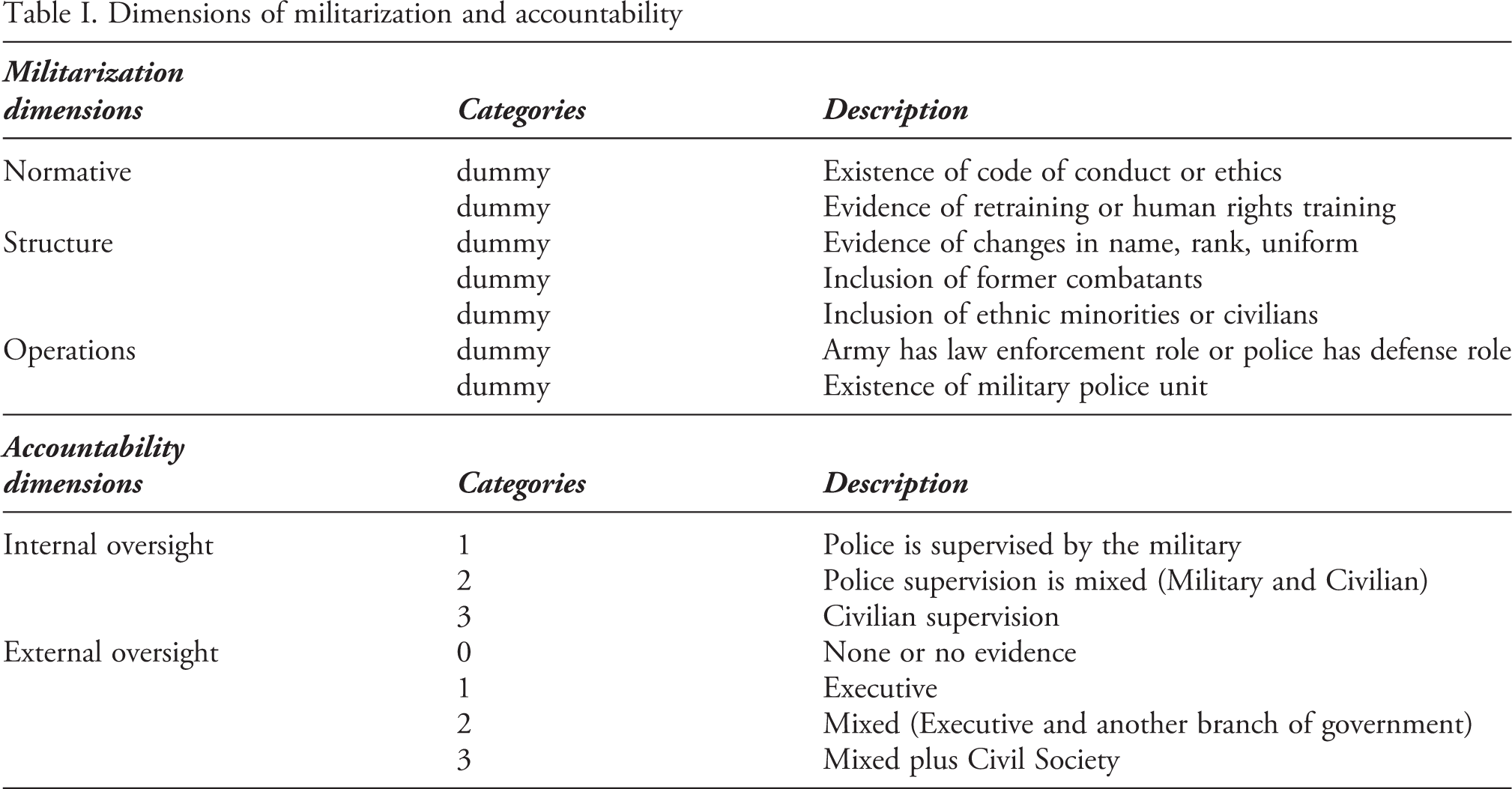
The militarization index ranges from 1 to 7, where higher values represent higher militarization. It has three dimensions: normative, operational and structural. The index distinguishes cases of lower and higher militarization based on whether the police have a civilian code of conduct, training in human rights, or retraining after conflict; whether there are changes in its name, rank structure and uniform; whether former combatants are included; whether there is a military police unit, and whether the army provides internal security, or the police has a defense role. I ranked a country as highly militarized when there is no specified code of conduct, no training in human rights, the name, rank structure and uniform resemble a military unit, whether former combatants are included, there is military police and there are blurred functions between the military and the police. For example, in recent years South Africa reincorporated military ranks and uniforms into the police structure. In present-day El Salvador the military oversees patrolling the streets, and in India a paramilitary force provides security to public buildings. Conversely, countries exhibit low militarization when there is no military police, there is a clear separation of functions between the military and the police, a code of conduct is in place to regulate police behavior, and the name, rank and uniform reflect civilian police.
The accountability index ranges from 1 to 6, where higher values represent higher accountability. It encompasses two dimensions: internal and external. The index discriminates between cases of higher and lower accountability by considering different sources of accountability. Internal sources of accountability are those institutions that oversee the police directly. In most cases, the police report either to a Ministry of Defense or to a Ministry of Interior, or both. At the same time, the head of those ministries can be a civilian or a military officer. The underlying assumption is that when the police report to the Ministry of Defense and the head of such Ministry is a military officer, there is a higher degree of opacity in reporting; therefore, accountability will be lower.
External accountability sources include additional government institutions that exercise checks on the police. For example, the Legislative and Judicial branches of government may have mechanisms to monitor police behavior. In South Africa, Parliament has a specific commission dedicated exclusively to monitoring police compliance with the law. A final source of external accountability lies in civil society groups, which can help the government monitor police behavior while remaining independent. The assumption is that the more diverse the number of sources, the greater the extent of accountability. The different dimensions and sub-dimensions of militarization and accountability are summarized in Table I. 6,7
Dimensions of militarization and accountability
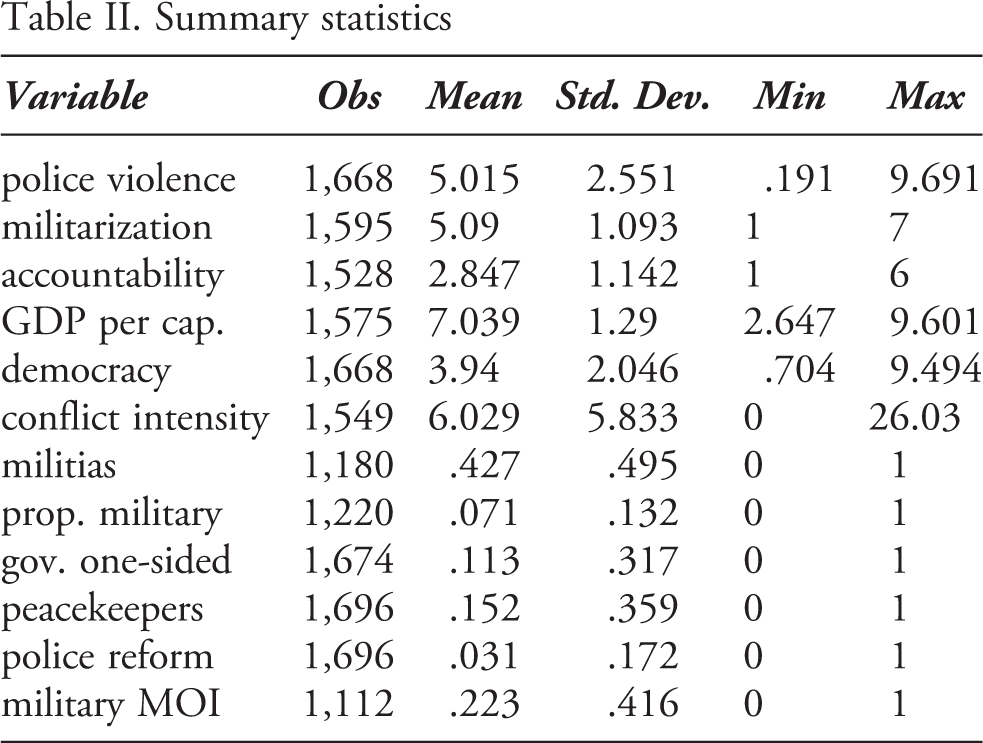
A second set of confounders relates to the structure of the security apparatus and how it might facilitate the use of violence. The strength of the military, and its influence over the government, could affect the extent to which police deploy violence. Research on civil-military relations suggests that military participation in government leads to increases in repression (Poe, Tate & Keith, 1999) and a higher probability of internal conflict initiation (Weeks, 2012). To account for this possibility, I include the proportion of active-duty military personnel in government, and whether an active-duty officer heads the Ministry of Interior (White, 2017).
Even under conditions of high capacity to repress, state leaders are concerned with preserving their legitimacy. The presence of pro-government militias allows states to continue exercising repression indirectly, which I account for with a dummy variable (Carey, Mitchell & Lowe, 2013). I also account for the extent of government one-sided violence using data from UCDP.
Summary statistics
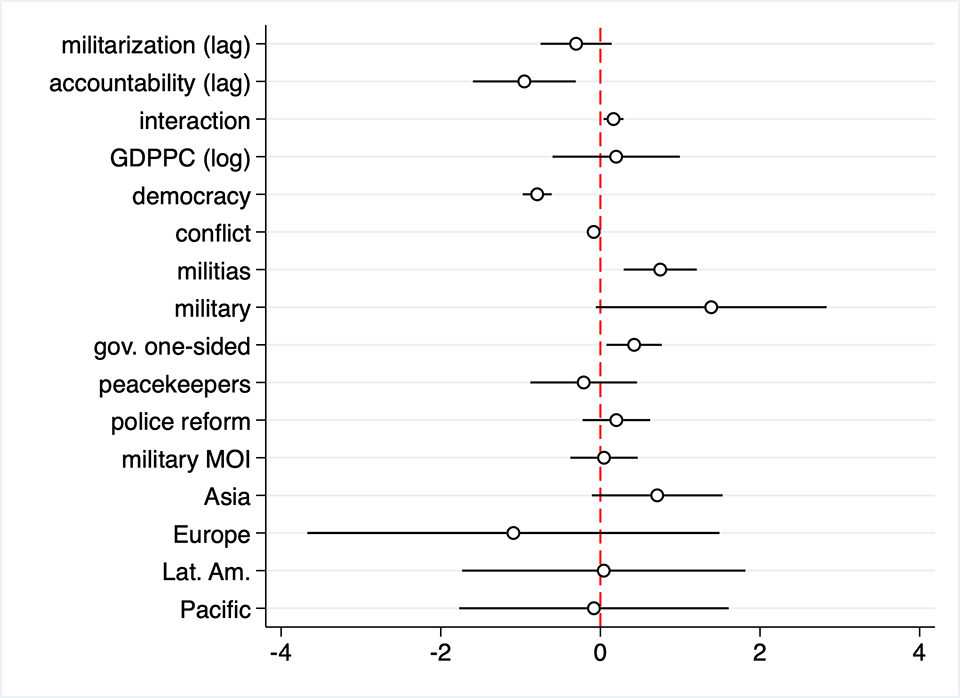
Regression results (95% CI)
Results
The statistical results for the determinants of police violence are summarized in Figure 1. Because an interaction term is included, the coefficients for militarization and accountability should be interpreted as partial effects, conditional on the relationship with one another. With respect to militarization, as expected by hypothesis 1, the persistence of practices and organizational structures leading to higher militarization increases police tendency to use force. In the interactive model, the coefficient for the partial effect is not statistically significant. However, this is not uncommon in the presence of an interaction effect, which is statistically significant and positive. As expected by the theory, higher accountability is negatively correlated with police violence. The negative and significant effect suggests that accountability mechanisms play an important role in reducing the extent of violence the police deploy. This is consistent with hypothesis 2.
A central aspect of this analysis is the interactive effect between militarization and accountability. The marginal effects of militarization and accountability indicate the effect of one unit increase in one variable conditional on the other. Consistent with hypothesis 3, the analysis reveals the presence of heterogeneous effects at different levels of militarization and accountability.
Figure 2 represents the marginal effect of accountability as militarization increases. As the figure shows, accountability has a negative effect on police violence at low levels of militarization and a positive effect at high levels. However, the effect is only significant at low levels of militarization, suggesting that accountability only contributes to reducing police violence when police violence is already lower.
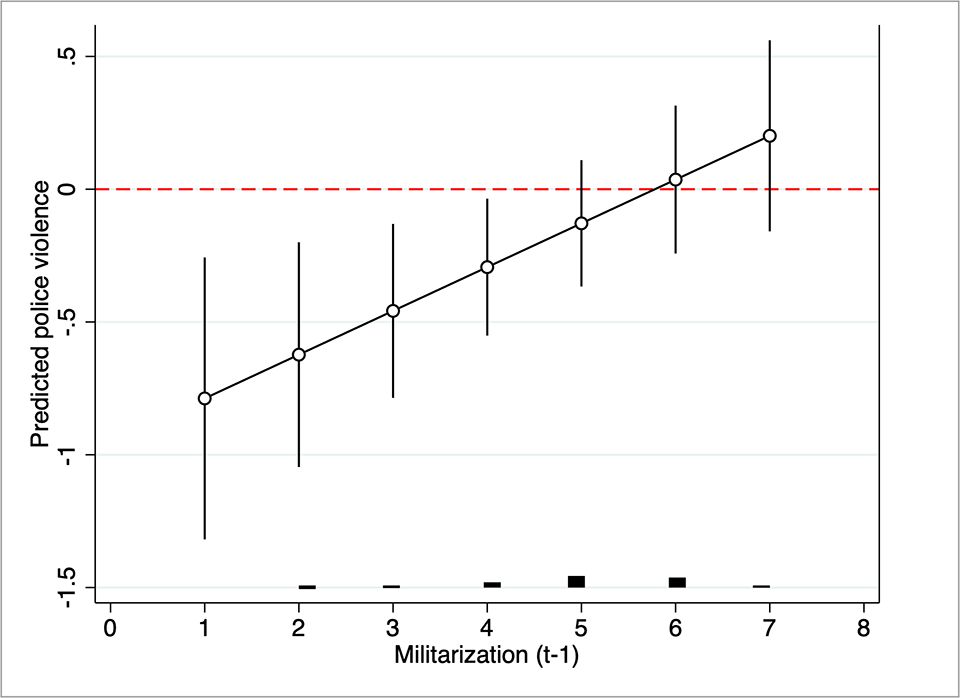
Marginal effect of accountability as militarization increases (95% CI)
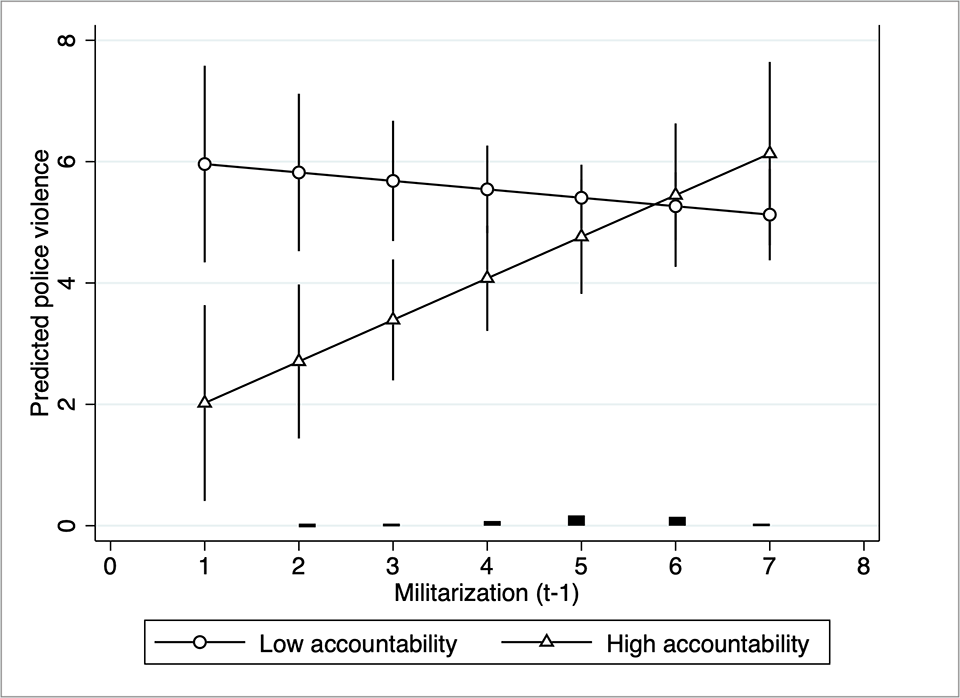
Predicted police violence at different accountability levels (95% CI)
To further explore the relationship between accountability and militarization, Figure 3 displays the predicted value of police violence as militarization increases, when accountability takes on different values. The results reveal a critical finding about the differential effect of accountability as militarization increases. As the graph shows, higher accountability contributes to decreasing police violence. But this is only the case at mid to lower levels of militarization. As expected, the graph also shows that low accountability has no effect on police violence, predicted police violence remains high. This result also provides empirical support for hypothesis 3.
As militarization increases, accountability does not make a difference when it comes to reducing police violence. This may be because, as proposed in the theory, when militarization is high the imposition of accountability mechanisms is perceived as a threat, filtered through existing beliefs about the role of police in society, and it does not deter police from engaging in violence. In a context of high militarization, police officers often feel justified in their use of excessive force. The existence of accountability mechanisms does not operate as an effective deterrent, even when there are high costs involved.
The importance of re-socializing members of the security sector to change their behavior has been highlighted in experiences in Sierra Leone, Colombia and South Africa. In Sierra Leone, the International Military Advisory and Training Team sought to change the Sierra Leonean military’s organizational culture by reforming mechanisms for socialization and training, among others (Neads, 2016). In Colombia, a course consisting of having soldiers write accounts of their worst experiences during war sought to give them tools to deconstruct and process the resentment that built up after decades of war fighting (Alvarado, 2017).
Taken together these results provide evidence that: 1) higher militarization is associated with higher levels of police violence; 2) lower accountability is always counterproductive; however, higher accountability is not always associated with lesser police violence; 3) higher accountability has a stronger effect when militarization decreases; in other words, militarization produces a ceiling effect – if it remains high, accountability has a negligible impact. These findings also have strong policy implications, suggesting that the order in which reforms are implemented matters for reducing police violence.
Robustness
I take several steps to assess the robustness of my findings. I replicate the analyses using alternative measures of human rights violations by the state (the political terror scale and Cingranelli-Richards measure of human rights violations) as dependent variables, and include additional lags, and country and year fixed effects, the results remain consistent (see Online appendix). Yet, the main threat to my results is bias resulting from selection, omitted variables, and post-treatment effects. Selection bias happens if, for example, countries with high militarization are very different from those with low militarization. Omitted variable bias is present when individual characteristics not included in the model are correlated with the independent variable of interest and the outcome. Post-treatment bias occurs if part of the effect of my independent variables of interest happens through other variables being controlled for.
Even though the inclusion of fixed effects is a common strategy to capture unobserved time-invariant confounders, recent research suggests that this strategy might be insufficient to identify causal effects in dynamic settings (Imai & Kim, 2021). In addition, although I consider multiple confounding factors to mitigate selection bias due to omitted variables in my original analyses, including controls to ameliorate omitted variable bias can reduce the effect of treatment in dynamic settings, creating post-treatment bias (Blackwell, 2013; Ladam, Harden & Windett, 2018). In this section, I reanalyze the data using inverse probability of treatment weighting (IPTW) as a mechanism to address the possibility of imbalances created by selection, and post-treatment bias (Leite, 2016). IPTW is a semi-parametric framework to balance treated and untreated observations based on known confounders (Blackwell, 2013).
I focus on high militarization as the treatment of interest. 8 As discussed previously, multiple factors can affect a country’s level of militarization. If, for example, countries with low militarization also happened to be more democratic, there would be selection bias. I can eliminate a source of confounding if democratic countries with low militarization weigh less, and authoritarian countries with low militarization weigh more. Reweighting the data achieves balance and allows militarization to be modeled without controlling for regime type directly, which avoids post-treatment bias. Because there is a trade-off between the number of confounders included and the ability to achieve good balance, I implement this procedure including all the significant confounders from the first set of regression models presented in Figure 1. 9,10
By using IPTW I can take advantage of the time-series data in estimating causal effects. The estimate of interest is the cumulative average treatment history effect (ATHE) (Blackwell, 2013), the cumulative effect of high militarization.
The results of the analysis with the reweighed data are presented in Table III. Consistent with the previous results, the model shows that the ATHE is significant and positive. The effect is larger than in the previous analyses, which did not include the full treatment history.
The effect of militarization history on police violence
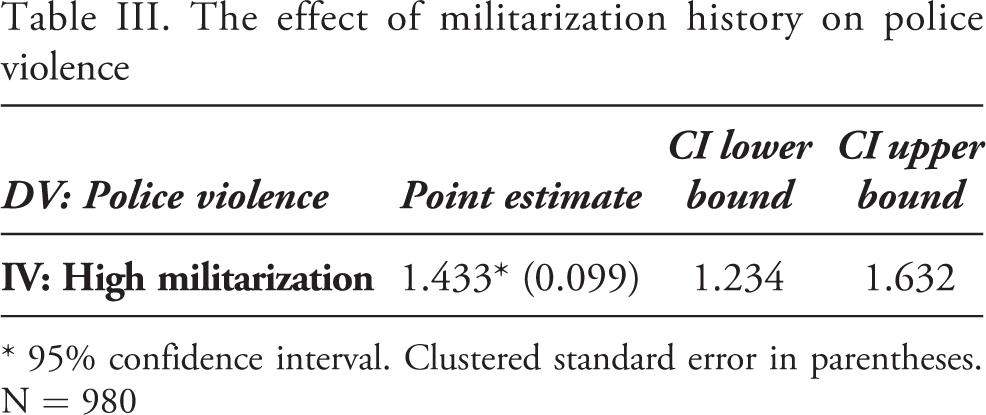
* 95% confidence interval. Clustered standard error in parentheses. N = 980
Sensitivity
The IPTW approach assumes no confounding after weighting. After accounting for the variables in the weighting model, high and low militarization are equally likely. However, because accounting for all possible confounding factors is difficult, it is important to have a sense of how much an unknown confounder could bias the results, potentially changing my conclusions. I follow Blackwell (2013), and Ladam, Harden & Windett (2018), and employ a graphical tool to evaluate a hypothetical confounder’s effect. Although the analysis cannot reveal the presence of an unmeasured confounder, it provides evidence of how much the estimates would change if there was one by re-estimating the effects varying the amount of hypothetical confounding (see Ladam, Harden & Windett (2018)’s supplementary material).
The results are in Figure 4. The horizontal axis contains the different degrees of confounding. Positive values represent positive correlation with treatment and increases in police violence. Conversely, negative values would decrease police violence. The vertical axis contains the treatment effect, represented by the dashed line. The shaded portions represent 95% confidence intervals and statistical significance. The estimate at α = 0 is the same as in Table III.
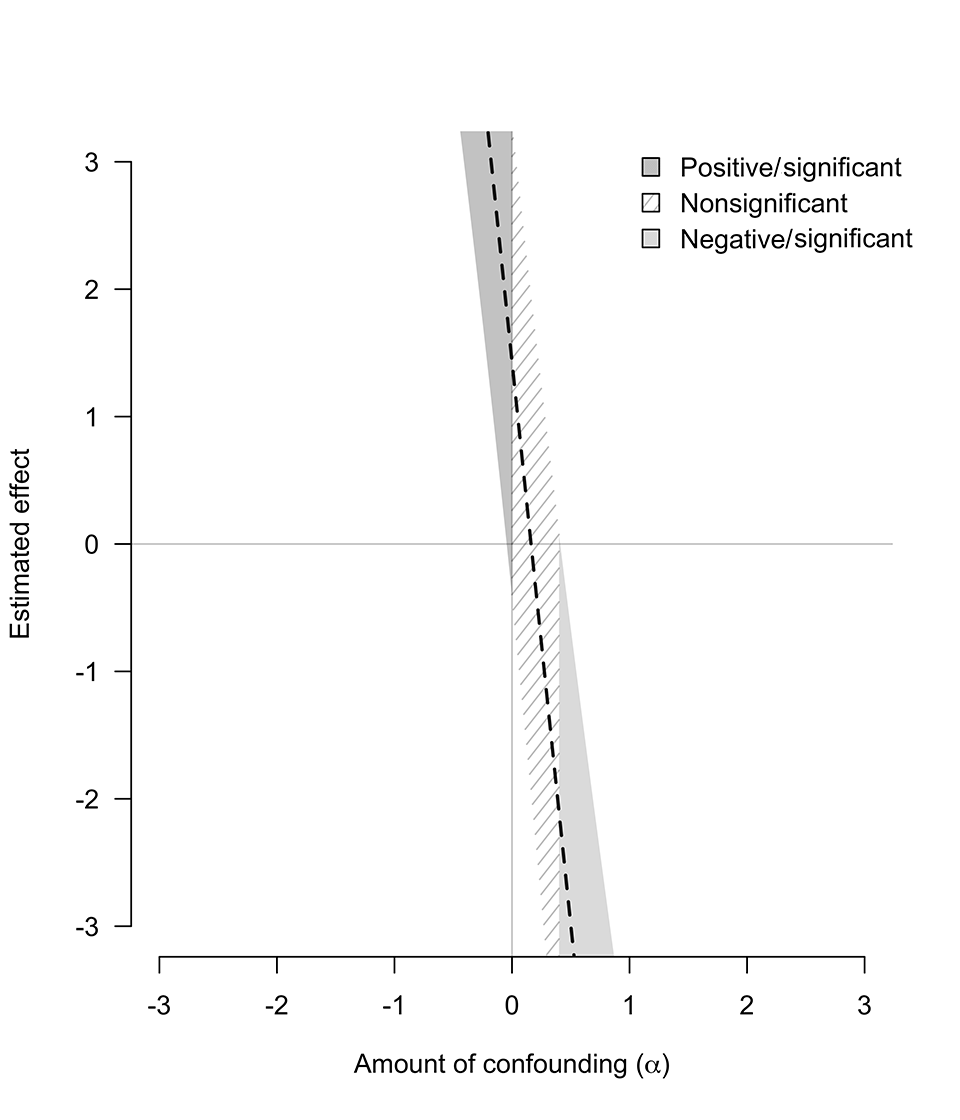
The effect of militarization history on police violence
According to Figure 4, if the confounder is negatively correlated with militarization and positively correlated with police violence, there is downward bias in the estimates. Yet, I would expect a missing variable to be positively associated with both militarization and police violence (values of α larger than zero). As the confounder gets larger, the estimated effect gets smaller. If a confounder adds about a point to the police violence index, the ATHE becomes not significant. When α is about 0.5, the effect is negative and significant.
To contextualize these results, I follow Ladam, Harden & Windett (2018) and I contrast the hypothetical effects with those of known confounders. Figure 5 presents the coefficients from bivariate regressions of the police violence index on standardized versions of the variables from the weighting model. The resulting estimates are not causal, but I can compare the size to the hypothetical unobserved confounder. Figure 5 shows that a standard deviation increase in one-sided violence by the government is positively associated with the outcome; it increases police violence by a point and a half.
According to this analysis, my results are sensitive to an unknown confounder of similar size as the variables I used. Therefore, I cannot entirely rule out the possibility that my results are due to bias. However, the number of possible confounders is not infinite (VanderWeele, 2019). In my analyses, I have incorporated the most
Bivariate associations between known confounders and police violence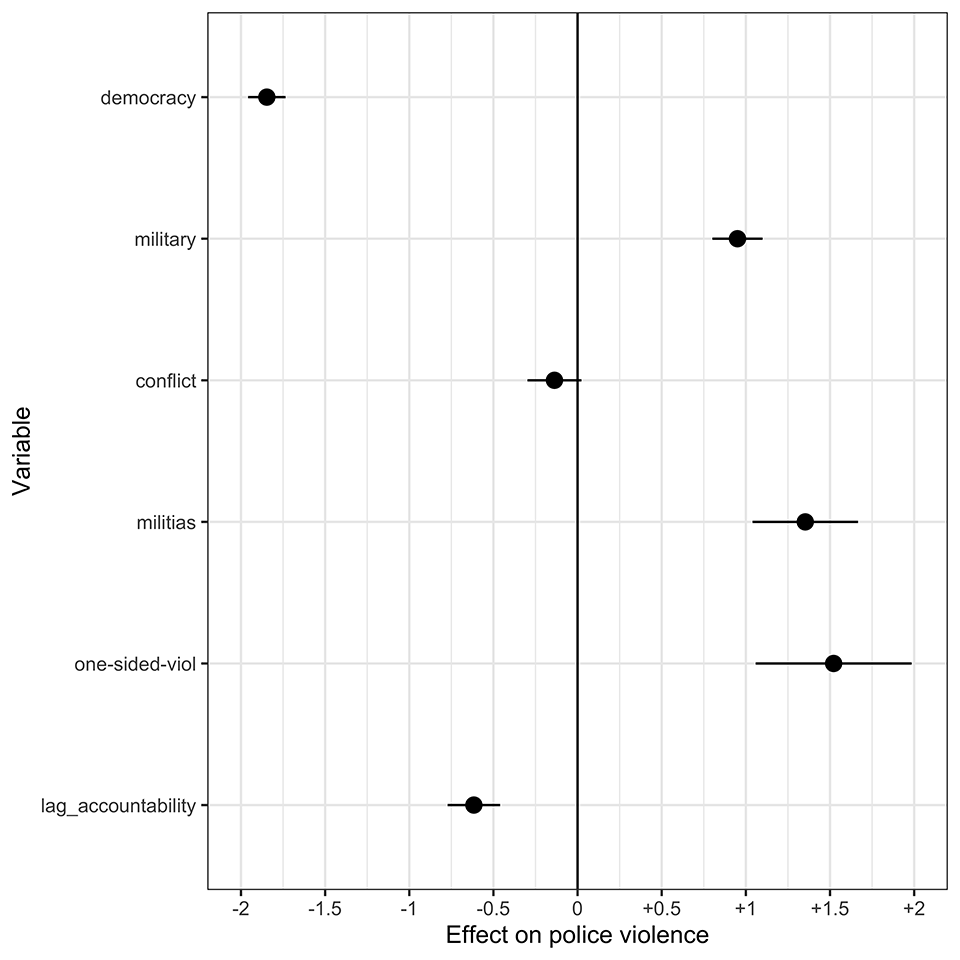
Conclusions
This article disaggregates the state security apparatus to shine a spotlight on the police, a comparatively less understood actor responsible for an important proportion of violence in civil conflict. In doing so, it expands our understanding of the relationship between the state security apparatus and its capacity for violence in three ways. First, it shows that police reforms may not have uniform effects on expected violence. Countries that implement reforms to make police more militarized also make it more violent. Although increasing police’s deterrent capabilities may contribute to the suppression of some types of violence, I show that increased deterrence in the form of high militarization also increases police propensity for violence. Accountability mechanisms are also relevant. Even in cases of low militarization, lack of accountability leads to higher police violence. The central finding is that the interaction between different levels of accountability and militarization produces a strong impact on police propensity to use violence. At high levels of militarization, high accountability does not lead to low police violence. Higher costs of violence do not counterbalance deeply ingrained beliefs justifying the use of force.
Second, these findings have relevant implications for the study of conflict transitions, state repression and violence. In line with other scholarly work on police reform (González, 2021: 53), my research suggests that police violence post-conflict is not simply the result of war legacies; rather, it can be a product of the process of reform itself. My findings also have policy implications for the implementation of police reforms. My research focuses on the dynamic nature of violence, in line with other work on post-conflict transitions (Muggah & Krause, 2009; Nussio & Howe, 2014). Direct confrontation might end, but the presence of actors with violent pasts is a strong vehicle for perpetuating violence, albeit in different forms. An additional contribution lies in highlighting that rising levels of violence do not equally accompany all post-conflict transitions. Whereas SSR focuses on increasing accountability mechanisms as a tool to reduce abuses, my study highlights the relevance of legacies of past police behavior to argue that reducing police militarization is essential to reduce their propensity to use force.
A final contribution lies in the implications for international organizations engaged in the implementation of SSR. The United Nations General Assembly as well as the Security Council have recognized SSR’s centrality as a tool for peace and security. My work shows that the type of reforms matters. Although increasing the costs for violating ethical norms is essential, it needs to be done in conjunction with reforms that change the fundamental standard operating procedures and the logic behind the use of violence by police.
My analysis strongly suggests that to change countries’ trajectories of violence, the direction and overall institutional architecture resulting from reforms to the state repressive apparatus matters. Building police institutions focused on protecting all citizens’ rights is an essential step towards the construction of safer and more democratic post-conflict societies.
Footnotes
Replication Data

Acknowledgments
I am grateful to Daniela Cortés and Pablo Parás for superb research assistance.
Declaration of Conflicting Interests
The author(s) declared no potential conflicts of interest with respect to the research, authorship, and/or publication of this article.
Funding
The author(s) received no financial support for the research, authorship, and/or publication of this article.