




Abstract
This article introduces the Women’s Activities in Armed Rebellion (WAAR) project, a multi-methods project that includes a cross-sectional dataset of women’s participation in more than 370 organizations fighting in civil conflicts between 1946 and 2015. The dataset features 22 measures of women’s participation in rebel organizations: it includes prevalence and presence measures of women’s participation in combat, non-combat and leadership roles; details on all-female units within groups (and their primary focus – combat or support activities); and presence measures for types of support work (disaggregated into clandestine work, outreach to civilian populations and logistical support) and types of leadership activities (military or non-military) that women contribute. The WAAR project also includes a detailed, qualitative assessment of women’s involvement in each organization, comprising an approximately 360-page handbook of female rebel participation in the post-WWII period. This article describes the WAAR project and suggests avenues for future research leveraging these data.
Introduction
Research on women’s participation in rebellion has proliferated in recent decades. Building on feminist progenitors’ work, rigorous scholarship explores why and how women join rebel organizations, which roles they take on, and how women experience conflict in uniquely gendered ways, or not (MacKenzie, 2012; Viterna, 2013; Parkinson, 2013; Matfess, 2017; Loken & Zelenz, 2018). A burgeoning field also examines the effects of female combatants’ presence on rebel behaviour and conflict outcomes (Cohen, 2013a; Thomas & Wood, 2018; Braithwaite & Ruiz, 2018; Szekely, 2020; Wood & Allemang, 2022; Giri & Haer, 2021). This research is supported by quantitative datasets assessing women’s presence and prevalence in rebel organizations (Thomas & Bond, 2015; Henshaw, 2016; Wood & Thomas, 2017; Henshaw et al., 2019). However, these data and research in this area are constrained in consequential ways. Existing prevalence assessments focus only on front-line combatants, and, relatedly, data on women in non-combat and leadership roles rely on binary measures of participation. We consequently know little about the robust and comparatively varied contributions that women make to rebel organizations off, and on, the front line.
This article introduces the Women’s Activities in Armed Rebellion (WAAR) project version 1.0, a multi-methods project that includes a cross-sectional dataset of women’s participation in more than 370 organizations fighting in civil conflicts between 1946 and 2015. The dataset features 22 measures of women’s participation in rebel organizations: it includes prevalence and presence measures of women’s participation in combat, non-combat and leadership roles; details on all-female units within groups (and their focus: combat or support activities); and presence measures for the types of support work (disaggregated into clandestine work, outreach to civilian populations and logistical support) and types of leadership activities (military or non-military) that women contribute. The WAAR project also includes a detailed, qualitative assessment of women’s involvement in each organization, comprising an approximately 360-page handbook of female rebel participation in the post-WWII period. 1 These data make clear that ‘participation’ in rebellion as a concept is complex and that focusing on women’s contributions in all roles can provide critical insight into civil conflicts’ gender dynamics. It lays the groundwork for research examining how different types and levels of women’s participation matter for rebel behaviour, viability, strategy and success.
Motivating the WAAR project: Roles in rebel organizations
While numerous studies examine the recruitment and effects of women combatants, this is a partial assessment of women’s contributions to non-state armed groups. The use of violence is one of many kinds of labour that rebels perform. Indeed, MacKenzie (2012: 54), writing on women’s participation in Sierra Leone’s civil war, argues that ‘the distinction between combatant and supporter is not useful’ because women often both fight and offer supportive labour such as weapons’ smuggling and intelligence gathering. Non-combatant, combatant and leader are therefore less mutually exclusive ‘participant types’ than they are categories of contributions individuals make to rebellion and experiences that people have during and after war. Still, rebel organizations vary widely in their inclusion of women. This is important, because how women participate in rebellion can affect group outcomes (Parkinson, 2013; Viterna, 2013).
The WAAR project dataset departs from existing work by estimating women’s prevalence along three dimensions: fighting on the front line; performing auxiliary tasks; and occupying leadership positions. 2 Moreover, these data uniquely disaggregate support and leadership roles by labour type and assess gendered organizational characteristics through the documentation of women’s units. This approach helps mitigate selection bias inherent in observing actors based on a specific or dominant participation type. 3 Here, we define and discuss each broad role in turn.
Women most often participate in non-combat roles, for example, medics, spies, weapons smugglers, planners, administrators, recruiters, mobilizers, radio or weapons operators and guards (Henshaw, 2016). Women in rebel groups also participate widely as fundraisers, recruiters, educators and propagandists – important public-facing roles that may help legitimize rebels to domestic and international observers (Matfess & Nagel, 2020; Hedström & Olivius, 2021). For example, women recruited for the National Liberation Front of South Vietnam: the group reportedly referred to this as ‘information soldiering’ (Taylor, 1998: 66). To this end, many organizations, such as the Moro Islamic Liberation Front in the Philippines, create women’s auxiliary organizations to support front-line engagements or to advance political agendas (Dwyer & Cagoco-Guiam, 2012). In the dataset we identify and assess three, non-mutually exclusive categories of auxiliary support: clandestine operations; outreach to civilians; and logistical support. Some auxiliary work can challenge pre-war gender hierarchies, whereas other auxiliary contributions reinforce traditional gendered divisions of labour.
Front-line roles are those where participants engage in combat in support of the organization or circumstances in which women undergo weapons and military training. In some groups, women comprise large proportions of front-line fighters. For example, an estimated 30% of fighters were women in Mexico’s Zapatista Army of National Liberation in the 1990s (Kampwirth, 2002). In other organizations, women’s front-line prevalence is limited – women in the Provisional Irish Republican Army (PIRA) likely never surpassed 10% of the group’s front line (Bloom, Gill & Horgan, 2012) – or consists of sporadic activities, as in the case of Al-Shabaab in Somalia and Kenya, where women very rarely participate in combat (Ndung’u, Salifu & Sigsworth, 2017).
Finally, women participate in leadership roles when they exercise direct control and provide oversight of other participants and/or exercise direct control over the strategy, policies and/or ideology of the group (Henshaw, 2016). The WAAR project dataset distinguishes between military and non-military leadership positions. For example, women held an estimated 20% of Farabundo Martí National Liberation Front (FMLN) military leadership positions, and all the front’s member organizations had senior women commanders (Viterna, 2013). In India, Communist Party of India (Maoist) women commanders outnumbered men in some areas (Shekhawat & Saxena, 2015).
In this project, we also consider whether women were organized within armed groups in all-female wings, either combat units or socio-political and auxiliary groups. To this end we unpack the significance of socialization and cultivation of community in all-women contexts, as such organizations may catalyse gender consciousness. These women’s units can be armed, as in the case of the Sothiya and the Malathi brigades in the Liberation Tigers of Tamil Eelam (Dissanayake, 2017) or engaged in auxiliary work, as in the case of the Cumann na mBan, the PIRA’s all-female auxiliary wing in which women smuggled weapons and messages, gathered intelligence, recruited and ran safehouses (Loken 2022). Other women’s wings engage in service provision. The Karen Women's Organization (KWO), for example, is the Karen National Union’s women’s wing. KWO women ‘primarily engaged in social work, such as care of orphans and war victims’ and mobilizing women’s participation (Israelsen, 2018: 392). All-female organizations are often important opportunities for female rebels to rise to leadership positions; after war, they may become autonomous civil society groups or retain their rebel affiliations.
The WAAR project
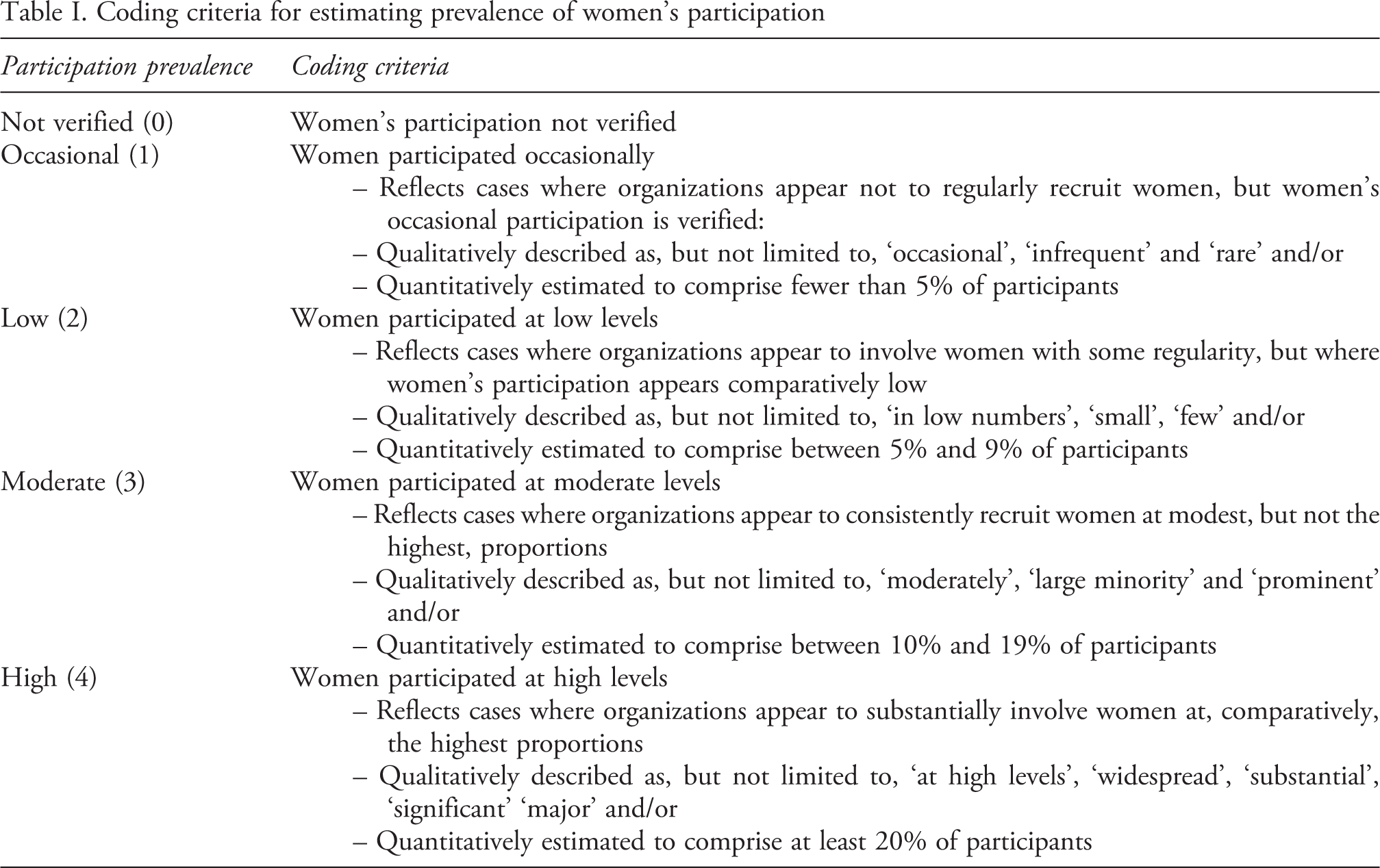
The WAAR project includes information on women’s presence and prevalence within 372 of the rebel groups listed in the Uppsala Conflict Data Program dyadic dataset v1-2015. 4 Prevalence is estimated using an ordinal scale that ranges from 0 to 4 for a measure of women’s participation in each of the three specified roles: non-combat; front line; and leadership. Table I summarizes the coding criteria for estimating prevalence.
We adopt these coding criteria based on common descriptors and quantitative estimates of women rebels in like-cases across sources and based on existing coding standards in this field. The WAAR project includes a best estimate prevalence measure, a liberal high estimate, and a conservative low estimate. This helps mitigate discrepancies in qualitative descriptors or quantitative estimates in source material. We also include binary presence measures of women’s participation. In a minority of cases, women’s presence is verified but prevalence cannot be determined due to data availability.
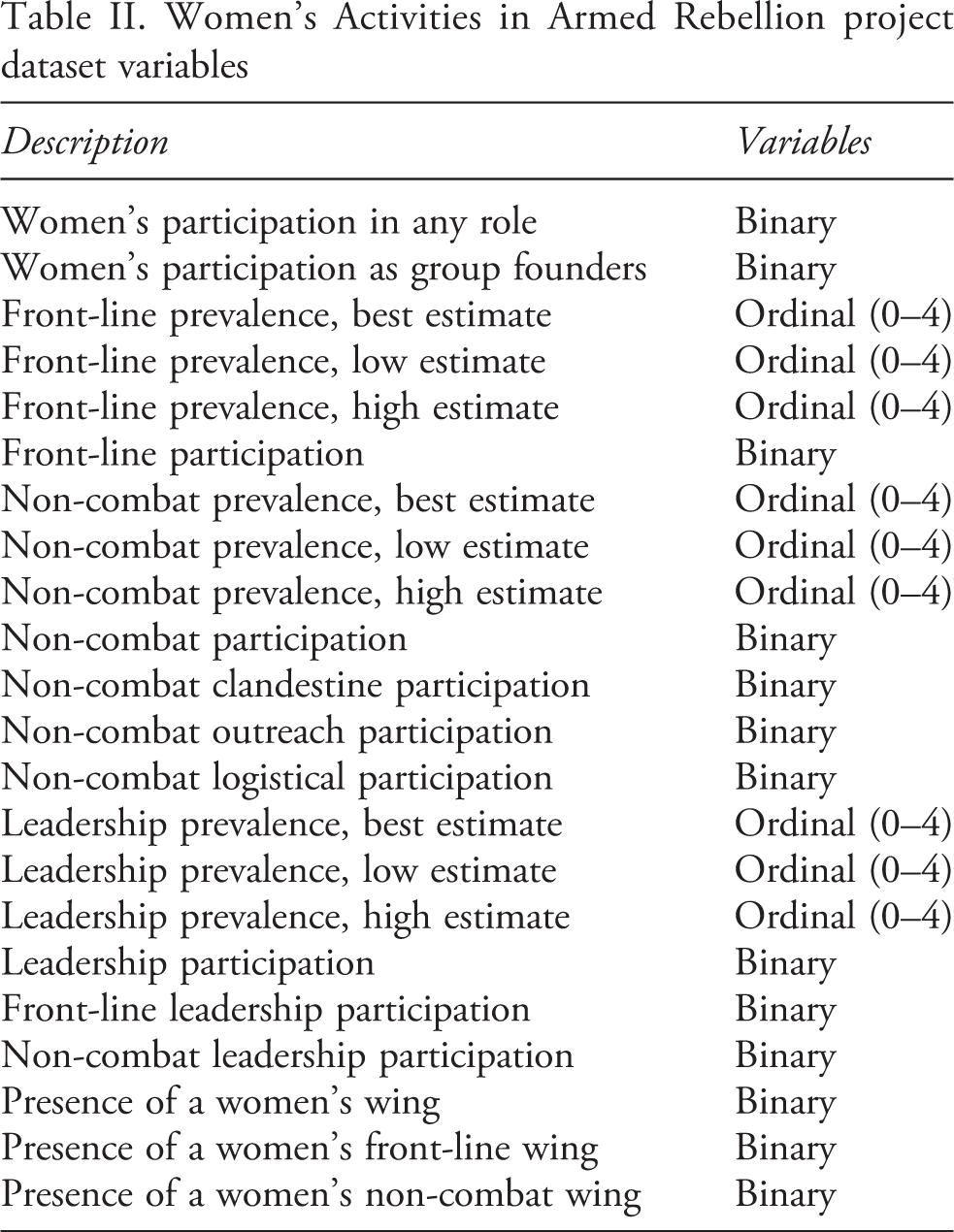
We include binary measures for disaggregated types of participation within these roles and in the organizations (see Table II). The dataset also includes a binary measure indicating if women participated in the organization’s founding 5 and whether the rebels are a part of a rebel coalition also included in the dataset (such as the FMLN and its constituent groups).
We gathered data using sources that detail rebel organizations, civil conflicts and the gender dynamics of political violence, as well as through systematic search strings. Sources include digitally archived resources from rebel groups; reports from international and non-governmental organizations including Human Rights Watch and the International Crisis Group; regional monitors such as the Congo Research Group and the South Asia Terrorism Portal; local news reporting; governmental research directorates; policy briefs; expert scholarship on rebellions and civil conflicts; and secondary ethnographic research and interviews with rebellion participants.
The quantitative dataset is accompanied by a qualitative handbook on women’s involvement in each of the organizations, available on the WAAR project website (waarproject.com) and in the Supplemental Materials. This offers context into how women participate in non-combat, front line and leadership roles; the presence and characteristics of women’s wings; and women’s reported experiences with upward mobility, sexism, incarceration, political organizing and other aspects of rebel participation not captured by quantitative measures. The WAAR project’s multi-method contributions uniquely enable cross-sectional trend analyses as well as case and comparative study.
Coding criteria for estimating prevalence of women’s participation
Women’s Activities in Armed Rebellion project dataset variables
The WAAR project builds on existing datasets that assess women’s rebel participation. Thomas & Bond’s (2015) study of women in armed groups focuses on ‘violent political organizations’ in Africa and uses two binary measures: one for women’s presence in each group overall; and one for women in combat roles. Henshaw’s (2016) data on women in rebel organizations include binary measures for women’s presence in front-line, auxiliary and leadership roles in 72 organizations. Henshaw et al. (2019) expands these data to assess women’s presence in leadership roles in 212 groups. Two existing datasets include ordinal prevalence measures of women’s participation in civil conflict: Loken (2017) estimates prevalence of women combatants by armed group type in civil wars, not by individual organization; and Wood & Thomas’ (2017) Women in Armed Rebellion Dataset (WARD) offers ordinal prevalence measures of women combatants in rebel organizations on a four-level scale (0–3) in over 400 groups.
The WAAR project complements and expands these efforts in three important ways. First, we correct for disproportionate focus on women’s participation in combat activities. Because women’s non-combat activities often mirror gendered labour divisions outside of conflict, prioritizing fighters can reinforce gender stereotypes about the non-political nature of women’s work. Moreover, women’s involvement off the front line varies significantly between organizations. This dataset expands on existing work by offering cross-sectional prevalence estimates of women’s participation in auxiliary roles and leadership positions, while also disaggregating the content of women’s non-combat and leadership contributions and assessing rebels’ incorporation of all-female units. These measures can support more robust analyses of how women’s involvement affects rebel behaviour and outcomes and of the conditions under which women are most likely to participate.
Second, the WAAR project considers prevalence on a wider scale than past efforts. Specifically, the dataset separates organizations that recruit women, even in small numbers, as part of their regular strategy (low) from those where women appear unintegrated but occasionally participate in group activities – often as suicide attackers – (occasional) when compared with WARD; this further separates low from moderate (coded as 5–20% prevalence in WARD) into comparatively concise categories providing more granularity than existing measures, thereby providing a clearer estimate of the relative levels of women’s participation in combat and other roles. Moreover, the WAAR project identifies female combatants in 68 organizations coded as 0 (no evidence for female combatants) in WARD’s best estimate. 6
Third, and finally, the WAAR project includes qualitative information about the scope and scale of women’s participation in each of the groups included in the dataset. This not only provides unprecedented research transparency in this subject-area but also offers new avenues for multi-method research on women in rebellion.
Challenges for the WAAR project
The WAAR project is an example of what Hoover Green & Cohen (2021: 2) identify as ‘desk research’, collated and coded from existing information ‘without direct contact between researchers and […] victims, perpetrators, and witnesses of political violence.’ Collecting and using desk data can have ethical benefits because it does not directly rely on emotional labour from individuals who have experienced violence. However, measures in desk data are ‘by their nature, very rough measures of complex phenomena’ because precise numbers are rarely reported (Hoover Green & Cohen, 2021: 8). This means that measures of women’s participation in rebel organizations are ultimately assessments of visibility in available sources, not exact measures. Relatedly, reliable and comparative time-series data are currently not possible to collect across such a broad universe of cases, despite qualitative accounts describing the shifts in the composition and degree of women’s participation in some rebel groups over time. Because static, holistic assessment is the predominant form of reporting on women’s participation in rebellion, our data collection efforts reflect the choices of much of our source material. We attempt to mitigate the limitations of quantification by including qualitative accounts of women’s participation.
Using visibility as an inclusion criterion introduces potential biases into data. Political violence data’s ‘uncertain relationship’ to true patterns is due in part to reporting organizations’ biases, data collectors’ access and interpretation biases, potential reporting risks and social stigmas that conflict actors may face (Hoover Green, 2016: n.p.). Organizations may have incentives to manipulate political violence information (Cohen & Hoover Green, 2012). For example, some organizations’ propagandic depictions of women members may not align with women’s actual contributions: Szekely (2020: 421) contends that the Free Syrian Army exaggerated and publicized female fighters ‘as a means of shaming men’ for not participating in combat, but there are ‘few accounts of these factions actually participating in battle.’ Third-party sources, such as disarmament, demobilization and reintegration programme records, can be also biased because of structural discrimination against women or women’s hesitancy to participate in the initiatives (Mazurana, Krystalli & Baaré, 2018). Civil society groups may also present inaccurate or incomplete information about women to generate support.
Reports of women’s rebel participation may also reflect uneven scholarly and media attention. For example, a significant body of scholarship and reporting documents women’s affiliations with left-wing Latin American rebels (Kampwirth, 2002; Gonzalez-Perez, 2006; Viterna, 2013; Gutiérrez Sanín & Franco, 2017) and Kurdish groups (Darden, Henshaw, & Szekely, 2019, Szekely, 2020). As a result, women’s participation in some organizations is well-documented and well-estimated through ethnographic, interview and archival research. In other cases, women’s activities are best identified through sporadic incident reports or otherwise superficial indicators of presence and prevalence. Similarly, where clear quantitative prevalence estimates are available for some organizations, coding in other cases is based on indicators such as ‘in small numbers’ or ‘widespread’. Documenters’ prior assumptions may shape how they interpret and describe women’s involvement.
Relatedly, there are significant documentation and reporting biases that favour women’s front-line activities relative to other positions. This is likely driven by the comparative visibility of combatants and a collective ‘captivation with violent women’ that stems from the nearly universal, gendered expectation that women are non-violent (Loken, 2017: 62). Moreover, women’s labour in rebellion may be ignored in conflict accounts as simply ‘women’s work’ or ‘not soldiering,’ and some auxiliary work is purposefully clandestine (MacKenzie, 2012; Niner, 2013).
We work to address potential biases in the data by systematically searching for, evaluating and aggregating qualitative and quantitative sources. This approach can help lessen subjectivity when translating qualitative reports into a quantitative dataset. This includes a structured coding scheme (see Table II) and qualitative handbook detailing our source material. Our process of collecting and searching for information on women’s participation in rebel groups may also introduce bias and perpetuate knowledge hierarchies: most, though not all, of our sources are English-language material. The maldistribution of resources and opportunities afforded Global North vis-à-vis researchers in the Global South and the authors’ and research assistants’ language limitations present formidable hurdles. When possible, WAAR project data are sourced from deeply researched field studies, local researchers and local and regional news reporting. Furthermore, by making our source material public through the publication of the handbook, future iterations of the dataset may benefit from feedback about relevant but overlooked sources.
Exploring women’s participation in rebellion
This section presents key descriptive statistics from the WAAR project on the presence and prevalence of women’s participation in rebel groups, including variation between roles, organizational structure and group characteristics. It then offers a brief overview of women’s participation in al-Shabaab, excerpted from the qualitative handbook, to highlight this dataset’s multi-method components before demonstrating its analytic capabilities through a replication and extension of Thomas & Wood (2018).
Descriptive statistics
The majority of rebel organizations (63%) in our sample include women in some capacity. Women’s participation in non-combat roles is verified in 59% of the organizations included in this dataset. 7 Moreover, at least 53% and 45% of groups include women in front-line and leadership roles, respectively. This suggests that women’s contributions to rebellion extend far beyond the combat zone: in a substantial proportion of organizations, women provide crucial infrastructure and participate in military and political decision-making.
The scope and prevalence of women’s involvement varies by organization, as Figure 1 illustrates.
Rebel organizations appear likelier to include women occasionally or in low levels in front-line positions than at these levels in auxiliary roles, though this may reflect uneven documentation across groups.
Furthermore, WAAR project data illustrates how women participate in rebellion. For example, women participated in over half of rebellions performing logistical tasks within non-combat roles. We identified female outreach workers within 46% of groups, and those taking on clandestine work – which is, by its nature, the most difficult to observe – in 30% of organizations. Disaggregating leadership positions, at least 26% of groups include women in military hierarchy while approximately 39% incorporate women into political or auxiliary leadership. Moreover, more than one-third of groups operate at least one women’s wing. These are overwhelmingly women’s political, auxiliary, or otherwise non-combat organizations: 32% of all groups in the dataset include a women’s non-combat wing, while 15% operate a women’s military unit.
Presence and prevalence also vary by organizational ideology, as defined by the Foundations of Rebel Governance (FORGE) dataset (Braithwaite & Cunningham, 2020). Considering the 323 groups appearing in both the WAAR project and FORGE, 76% of leftist organizations integrate women in at least one of the three roles.
8
Comparatively, 62% of religious groups include women. Disaggregating these data by role and prevalence reveals starker variation. More than two-thirds of leftist organizations incorporate women as leaders, as compared to 40% of religious groups and almost half of nationalist Distribution of women’s prevalence by role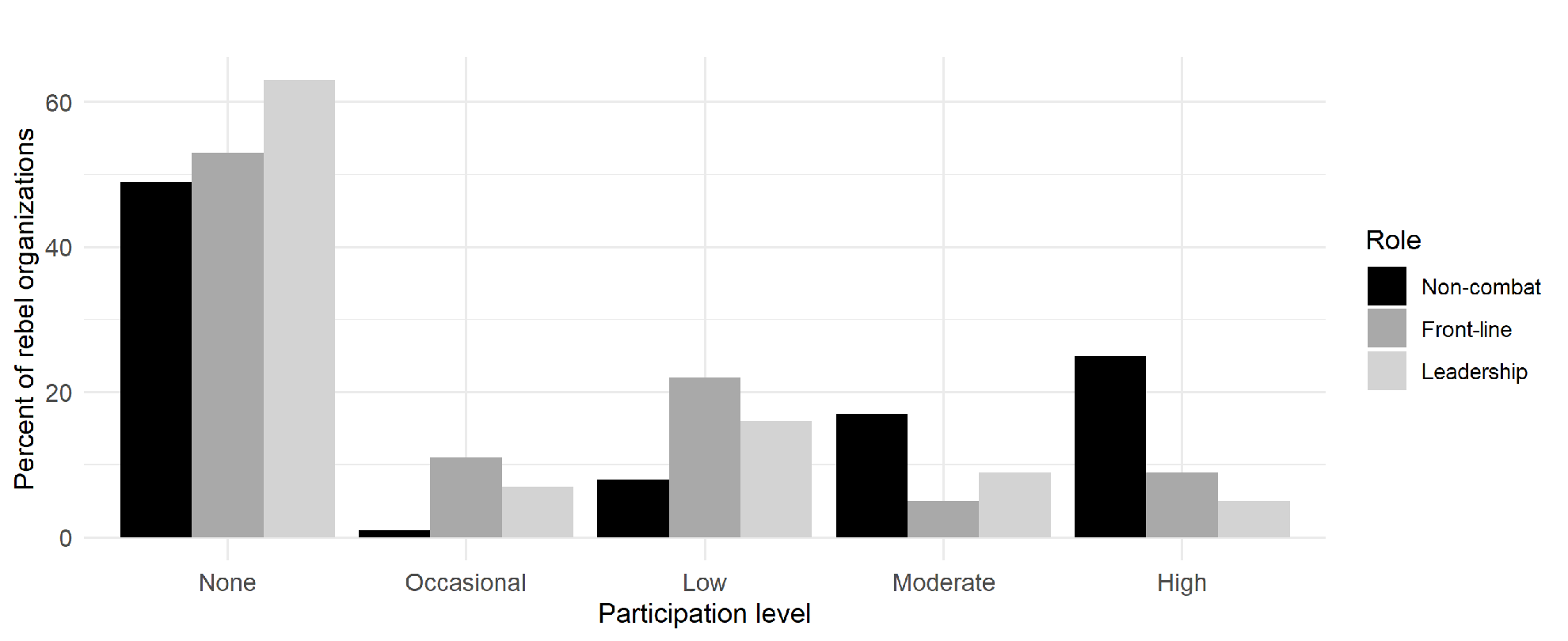
Qualitatively, the WAAR project provides a handbook of women’s involvement in sampled organizations. The following is excerpted from the handbook’s entry on al-Shabaab: Women are ‘far more actively involved’ in al-Shabaab in ‘non-combative or indirect roles’ than frontline fighting (Ndung’u, Salifu, & Sigsworth, 2017: 30). Ndung’u, Salifu & Sigsworth (2017: 30–31) conclude that women ‘provide the ‘invisible infrastructure’ for al-Shabaab by enabling, supporting and facilitating violent extremism through a number of roles and activities.’ Female members of the insurgency recruit, fundraise, carry explosives, smuggle weapons, do logistical work to help plan and carry out operations, provide health care, cook, mend clothing, nurse members, fundraise for the group and gather firewood (International Crisis Group, 2019; Donnelly, 2018; Badurdeen, 2018; Donnelly, 2019; Stern, 2019; Stern, 2021). Women are also actively involved in the rebels’ intelligence gathering (Ndung’u, Salifu & Sigsworth, 2017; Petrich & Donnelly, 2019; International Crisis Group, 2019). Al-Shabaab has reportedly formed an all-female policing unit (Stern, 2019). […] Al-Shabaab women occasionally participate in combat (c.f. Ngono & Duri, 2016). For example, in Kenya, three women carried out an attack at the Central Police Station in Mombasa (Badurdeen, 2018). In 2015, the Kenyan government identified Rukia Faraj Kufungwa as an al-Shabaab recruiter and fighter responsible for grenade attacks and assassinations (Ndung’u, Salifu & Sigsworth, 2017). Still, attacks perpetrated by female al-Shabaab combatants are ‘in the single digits’ (International Crisis Group, 2019: 13), constituting fewer than 5% of total attacks (Warner & Chapin, 2018: v).
Research uses of the dataset
Determinants of women’s prevalence in rebel organizations
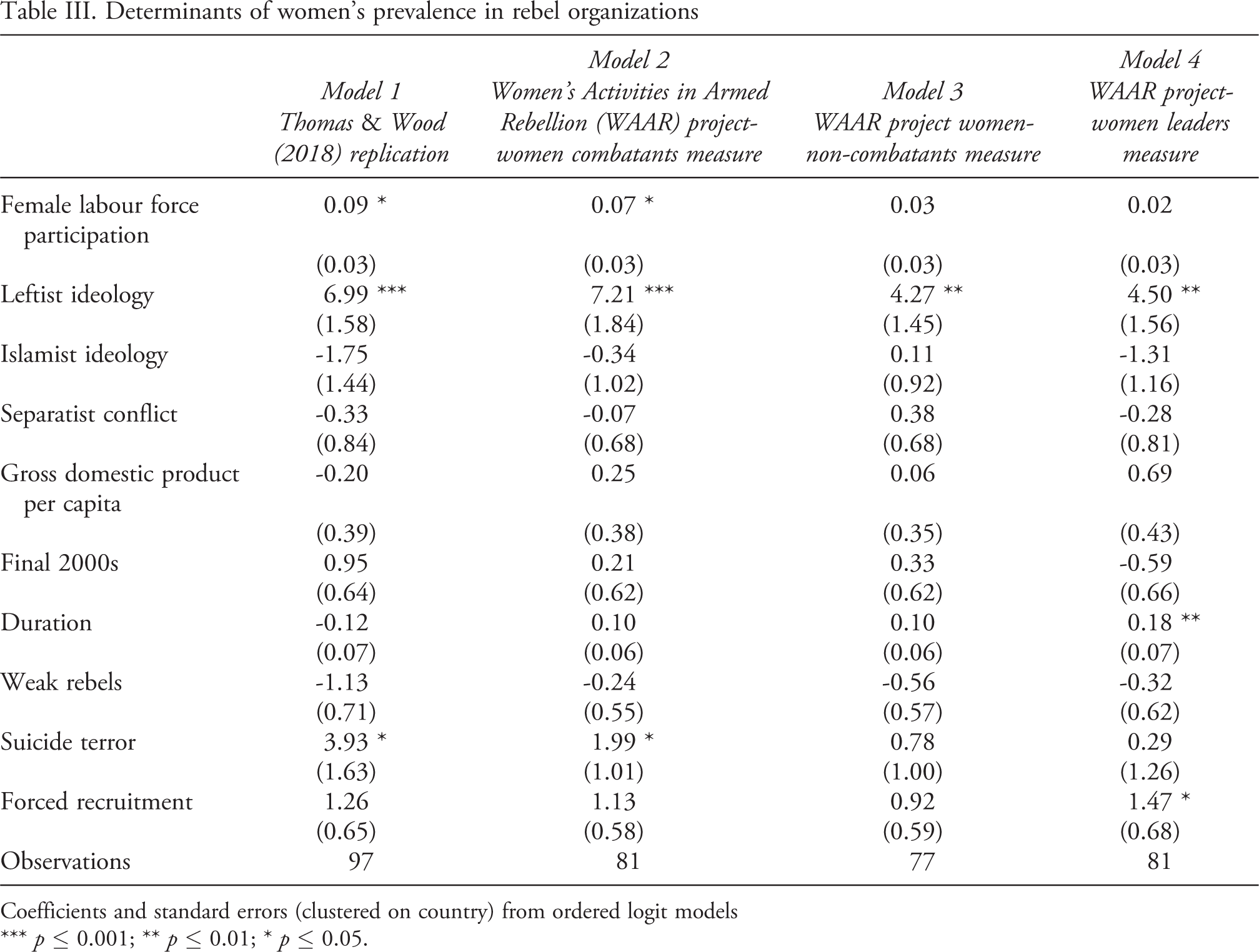
Coefficients and standard errors (clustered on country) from ordered logit models
*** p ≤ 0.001; ** p ≤ 0.01; * p ≤ 0.05.
Table III illustrates how the WAAR project dataset can be used to deepen our understanding of gender and rebel recruitment. Model 1 replicates Thomas & Wood’s (2018) finding regarding the relationship between female labour force participation and rebel participation using WARD’s ‘best’ female combatants variable from their replication dataset. 9 Models 2–4 (Table III) supplement Thomas & Wood’s (2018) dataset with the WAAR project data on women in combat, non-combat and leadership roles. These models illustrate that though female labour force participation may predict women’s participation in combat roles, it is not associated with women’s participation in auxiliary or leadership roles. This is surprising, as we might expect women’s leadership positions to both provide women avenues into political activity and reduce restrictive gender stereotypes among men. These findings demonstrate the complexity of women’s involvement in rebellion, highlight the differences between front-line fighting and other types of participation, and emphasize the importance of theoretically and empirically disaggregating role types.
More broadly, future research might use the WAAR project dataset to explore the causes, effects and variations of women’s participation in rebellion. How does women’s involvement affect rebel activities or conflict outcomes, and what role might the type of participation play? The combined quantitative and qualitative components also make the WAAR project a useful tool for studying specific or comparative cases. How might rebel group propaganda reflect, accurately or inaccurately, women’s prevalence and positions in their organizations? What explains impediments to leadership opportunities in some leftist groups compared with others? By identifying presence and prevalence patterns, the WAAR project can help elucidate the causes and consequences of women’s participation in rebellion.
Conclusion
The WAAR project dataset makes three contributions that will provide more robust and nuanced analyses of rebellion and of conflict’s gender dynamics. First, it contains prevalence measures of women’s participation in not only front-line but also non-combat and leadership roles. It also includes novel measures of all-female units associated with rebel groups and disaggregated measures of participation type. Second, it incorporates a broader prevalence scale than previous data collection efforts, capturing important variation in rebel groups’ employment of women. Third, the qualitative supplement provides encyclopaedic information about women’s participation in more than 370 rebel groups.
Footnotes
Replication data
The dataset, codebook, and files for the analysis in this article, along with the Online appendix, are available at https://www.prio.org/jpr/datasets/ and  .
.
Acknowledgements
Many thanks to Dara Kay Cohen, Robert U Nagel, Kathleen Gallagher Cunningham, Elisabeth Wood, Kate Baldwin, Sarah Bush, Frances Rosenbluth, Caroline Hartzell and Reed Wood; and the participants of the 2020 Peace Science Society’s Annual Meeting’s ‘New Directions in the Quantitative Study of Gender and Peace Science Workshop’ and the 2021 Peacekeeping, Human Security, and Violence Workshop at the University of Maryland for their feedback on this article. We are grateful to Jenna Norosky, Ketevan Chincharadze, Kelsey Easton, Catie Fowler, Saba Ismail, Sarala Pradhan and Shelby Shackelford for their research assistance.
The authors declared no potential conflicts of interest with respect to the research, authorship, and/or publication of this article.
Funding
The authors disclosed receipt of the following financial support for the research, authorship, and/or publication of this article: We gratefully acknowledge support from the United States Institute of Peace’s Peace Scholar Fellowship Program 2020–2021 (Matfess) and the American Political Science Association Women, Gender & Politics Research Section.