



Abstract
Can transparency enhance the legitimacy of international institutions? As transparency has become a widely applied procedural standard in international politics, a range of institutions have implemented transparency reforms under the presumption that increased transparency can elicit support among relevant audiences. This article evaluates whether increased transparency in the UN Security Council leads to enhanced legitimacy perceptions among UN member-states. The article first traces the history of Security Council reform since 1990 and draws on interviews with diplomats and observers to describe a transparency reform the Council enacted in 2006. Next, the article uses longitudinal content analysis to empirically probe the legitimation effects of that transparency reform. The empirical analysis is based on an original dataset of 4,303 legitimacy statements made by UN member-states in annual UN General Assembly debates over the periods 1990–2006 and 2006–18. The findings cast doubt over the potential of transparency reform to improve the Council’s legitimacy; instead they suggest that increasing the direct participation of the wider UN membership may be a more viable legitimation strategy. This article contributes to existing international legitimacy literature by providing empirical evidence on the relationship between transparency and legitimacy, and by demonstrating which institutional features that affect the perceived legitimacy of the Security Council.
Introduction
Transparency has become one of the most frequently discussed and applied legitimacy standards in international institutions: a range of institutions from the International Monetary Fund to NATO have adopted different types of transparency reforms (Tallberg et al., 2013). While often tailored to dissimilar audiences, a core feature of transparency reforms is that they reduce information asymmetries between actors participating directly in decisionmaking and non-participants that have an interest in the decisions that an institution reaches. From a legitimacy perspective, increased transparency can help international institutions elicit support among a given audience by providing more oversight over procedures, which is both a precondition for directly influencing decisionmaking and for holding those in power to account.
Hence, previous empirical literature has shown that transparency can enhance legitimacy across different political settings (De Fine Licht, 2014; Dickson et al., 2015). However, while normative theorists have argued that opening up international institutions is crucial for their legitimacy (Buchanan & Keohane, 2006; Scherz & Zyssets, 2020), existing literature offers scant empirical evidence on whether transparency reforms can lead to increased perceptions of legitimacy among relevant audiences in this context. This article contributes to the growing literature on international institutions’ legitimation strategies (Gronau & Schmidtke, 2016; Tallberg & Zürn, 2019; Rocabert et al., 2019) by assessing the relationship between transparency and legitimacy in the UN Security Council (UNSC). I trace discussions of UNSC reform in the UN General Assembly (UNGA) since 1990 and show how transparency has featured prominently in debates over the legitimacy of the Council. I then test empirically whether a transparency reform that was enacted in 2006 led to increased perceptions of the Council as a legitimate authority among UN member-states.
The main hypothesis of this article is that transparency reform leads to enhanced perceptions of the Council as a legitimate authority by UN member-states. The empirical analysis is based on an original dataset of 4,303 legitimacy statements made by UN members in annual UNGA debates over the periods 1990–2006 (pre-reform) and 2006–18 (post-reform). Contrary to my expectations, the data from these debates show that UN members’ perceptions of procedural legitimacy decreased after the introduction of the transparency reform. While the reform led to a substantial reduction in transparency criticism and a slight increase in states’ perceptions of participation, the increased salience of other procedural legitimacy issues in the post-reform period add up to a negative legitimacy effect overall. The results hold when controlling for the effect of institutional outcomes over time, which is the main alternative explanation. I suggest three explanations for why legitimacy decreased. First, transparency reform did not rectify the more fundamental legitimacy issues of the Council’s unrepresentative membership composition and the permanent members’ veto powers. Second, a set of procedural issues that emerged after the transparency reform generated new legitimacy challenges for the Council. Third, increasing the transparency of Council working methods generated procedural trade-offs such as posturing and decreased interactivity.
This article is structured as follows. Section two provides a theoretical argument on how transparency can generate legitimacy in international institutions. Section three describes the data and methods. Section four discusses the importance of transparency in the UNSC’s working methods and analyzes UN members’ perceptions of the legitimacy of the Council in the period 1990–2005. Section five describes the transparency reform that was implemented in 2006. Section six analyzes UN members’ perceptions of the legitimacy of the UNSC in the period 2006–18 and evaluates the effects of the reform. The alternative explanation that legitimacy is driven by institutional outcomes is then tested. Section seven concludes by summarizing the main findings and discusses their implications.
Transparency as a legitimation strategy
The literature on the legitimacy of international institutions can be divided into a normative and an empirical strand, as with the concept of legitimacy more generally. In the normative sense, an institution’s legitimacy is evaluated with reference to a set of external criteria and is said to be legitimate when it operates in a manner that corresponds with these (Scherz & Zysset, 2020). In the empirical sense, on the other hand, legitimacy refers to a (widely) shared perception among a relevant audience that an institution has the right to rule (Hurd, 2018).
This article focuses on empirical legitimacy and understands legitimacy as a quality an international institution obtains when it is perceived as a justified authority by its member-states (Hurd, 2018). While empirical legitimacy literature has predominantly examined the legitimacy perceptions of audiences other than states, for example citizens (Bernauer et al., 2019) or elites (Schmidtke, 2019), this analysis concentrates on states as the relevant audience because these are the actors that are most directly affected by the transparency reform examined here. 1
International institutions can presumably benefit in various ways from widespread legitimacy perceptions among their member-states: legitimacy can provide an institution with a ‘reservoir’ of support that can be drawn on in the absence of coercion and self-interest (Easton, 1975); it can generate a particularly strong compliance pull with the decisions of institutions (Franck, 1995); it can have consolidating effects on institutions by generating more stable and long-lasting rules (Hurd, 1999); and, finally, it can produce practical benefits in terms of financial and political cost reductions (Welsh & Zaum, 2013). Conversely, erosion of legitimacy can potentially reduce or hamper institutional authority and generate pressure for institutional reform (Lenz & Viola, 2017).
Perceptions of an institution as legitimate emanate from congruence between states’ expectations for how an institution is supposed to function, on one hand, and the institution’s actual organizational features and performance on the other (Lenz & Viola, 2017). Conversely, a discrepancy between states’ expectations and actual institutional functioning will lead to a decline or deficit in legitimacy. Since legitimacy deficits can potentially hamper the authority and performance of institutions, UNSC legitimacy literature has pinpointed various legitimacy deficits that this institution supposedly operates under, and proposed legitimation strategies for how these could be rectified (e.g. Johnstone, 2008; Scherz & Zyssets, 2020; Wilson, 2019). In general, these legitimation strategies can be understood as proposed institutional changes that are aimed at both improving the standing of institutions and making institutional authority more acceptable to institutional member-states (or other audiences) (Hurd, 2018).
Existing literature refers to myriad sources that international institutions can rely on to generate perceptions of legitimacy, giving rise to different legitimacy classifications and strategies (Dellmuth, Scholte & Tallberg, 2019). This article distinguishes between two main subcategories of legitimacy: procedural legitimacy and outcome legitimacy.
Procedural legitimacy refers to a perception that an institution is justified with reference to its decisionmaking structures, processes, or procedures. For example, in 2002, Ghana applauded the Council’s Counter-Terrorism Committee for showcasing a ‘shining example of transparency’ (UNGA, 2002), and in 2012 the Democratic People’s Republic of Korea commended the Council for having undertaken ‘notable efforts to enhance the participation of the wider membership in its work.’ (UNGA, 2012). Transparency and participation are two key principles in the procedural legitimacy literature (Keohane, 2011; Scherz & Zysset, 2020); others include (but are not limited to) deliberation, accountability, representation, impartiality, expertise, and voluntary consent in decisionmaking (Buchanan & Keohane, 2006; Caney, 2006; Johnstone, 2008; Scherz & Zyssets, 2020).
Outcome legitimacy emerges when an institution is viewed as justified by a given audience based on the outcome(s) it produces (Dellmuth et al., 2019). 2 Outcome legitimacy encapsulates the performance of an institution, including the content of policies adopted, their implementation trajectories, and their contribution to the underlying problem they are meant to address (Tallberg et al., 2016). Through a lens of outcome legitimacy, the Council can be viewed as legitimate or illegitimate based on whether it adopts resolutions and takes actions that effectively contribute toward its mandate of maintaining international peace and security. For example, the Council’s peacekeeping mission to Côte d’Ivoire can be perceived to be a success in that regard, while its lack of timely action to prevent the 1994 genocide in Rwanda is often described as one of its greatest failures (Bosco, 2009).
The two aforementioned legitimacy categories give rise to various legitimation strategies that international institutions can employ to enhance their legitimacy among a given audience. Strengthening the transparency of decisionmaking is one such strategy, which belongs to the procedural legitimation category. Transparency is a widely applied procedural standard, and in recent years numerous international institutions have implemented different transparency measures under the presumption that transparency can ameliorate their legitimacy (Tallberg et al., 2013).
In an ideal sense, institutional transparency can be understood as the timely access of stakeholders to all relevant information at low or no costs. The absence of this information is commonly portrayed as a principal–agent problem, wherein an actor (the principal) has entrusted another actor (the agent) to perform a given task (Hirschmann, 2020). The principal–agent relationship contains an information asymmetry to the agent’s advantage, relating to both how and why decisions are reached (De Fine Licht et al., 2014). Increasing transparency can reduce uncertainty about the agent’s intentions, reasons, and procedures, which in turn can enhance the principal’s confidence in delegating powers to the agent (De Fine Licht et al., 2014).
Under information asymmetry, increased transparency can enable both accountability and participation in decisionmaking. First, the provision of pertinent information enables principals to assess whether they are content with the way decisions are reached by agents (Hirschmann, 2020). By increasing their understanding of the reasons and processes behind decisions principals can more easily sanction agents for not conforming to expected standards of behavior. Transparency is thus widely regarded as a prerequisite for accountability (Buchanan & Keohane, 2006; Hirschmann, 2020). Second, increased transparency can empower uninformed principals to meaningfully participate in and exert influence over the decisionmaking of an institution. For example, open meetings can ensure that principals have a say in agenda-setting and formal consultations. Enhanced information provision also enables more effective lobbying and negotiations through informal channels. Hence, transparency can help secure a sense of participation even in the absence of formal voting powers or direct representation in an institution such as the Council (Hurd, 2008). Finally, normative international relations literature also posits that transparency can lead to enhanced deliberation and increased impartiality in debates (Caney, 2006).
While existing literature offers scant evidence on the empirical effects of transparency on states’ legitimacy perceptions, surveys and experiments on individuals have identified largely positive effects of transparent procedures, including on organizational performance, people’s perceptions of legitimacy, level of trust, willingness to accept decisions, participation in procedures, and general level of satisfaction (Cucciniello et al., 2017; De Fine Licht et al., 2014; Dickson et al., 2015; Van der Cruijsen & Eijffinger, 2010). Although the beneficial effects of transparency are likely to be contingent on institutional context, the salience of information for principals, and/or the type of transparency measures taken (Buchanan & Keohane, 2006; Lindstedt & Naurin, 2010), most existing transparency literature posits a positive relationship between transparency and perceptions of legitimacy (De Fine Licht et al., 2014).
If institutional transparency can generate enhanced legitimacy perceptions, there are two main reasons why the transparency measures that the Council enacted with Presidential Note 507 (UNSC, 2006) could lead to enhanced legitimacy perceptions among the wider UN membership. First, the relationship between the UNSC and the UNGA is characterized by high information asymmetry. The transparency of decisionmaking procedures is a uniquely salient factor in the UNSC because of the Council’s inegalitarian membership structure wherein 15 states (five permanent and ten elected members) are given the power to take decisions on issues of international security on behalf of all UN member-states. This structure produces significant information asymmetries between the Council members (the ‘agent’ in the principal–agent framework) and the UNGA membership (the ‘principal’), which a high number of UN member-states have consistently lamented over time. 3 Given that the limited membership structure of the Council prevents the general UN membership from directly partaking in Council decisionmaking, it is crucial for non-Council members that have an interest in the Council’s work to receive timely and relevant information about its decisionmaking. Increasing the transparency of the Council’s decisionmaking could both provide the general UN membership with enhanced understanding of the rationale behind Council decisions and—as the Note also includes several measures for enhanced interaction (UNSC, 2006)—allow non-Council members to exercise more influence over Council proceedings.
Second, the transparency measures enacted with Presidential Note 507 (UNSC, 2006) represent the most comprehensive reform of its kind that the Council has enacted. While the UNSC has occasionally also taken other incremental steps to improve its working methods (Sievers & Daws, 2014), Note 507 is unique in that it involved numerous procedural changes that were both accompanied by a high degree of implementation and affected all UN members with an interest in the Council. 4 In the UNSC context, therefore, Note 507 represents a ‘most-likely’ case (Levy, 2008), that is, a reform for which the posited impact of transparency on legitimacy perceptions is most likely to be observed.
Hence, if transparency reform is a viable legitimation strategy for the Council, we should observe positive changes in states’ legitimacy perceptions following implementation of the Note 507 transparency reform of 2006. Specifically, since transparency is a procedural legitimation strategy, I would expect that,
Hypothesis: The 2006 transparency reform of UNSC working methods leads to increased perceptions of procedural legitimacy among UN member-states.
Since transparency is theoretically linked to several principles of procedural legitimacy, I would expect transparency reform to affect not only perceptions of transparency, but also perceptions of procedural legitimacy more broadly. By testing whether increased transparency generates legitimacy in the UNSC, this article makes two distinct contributions. First, it contributes to existing accounts of the legitimacy of the UNSC. Empirical UNSC legitimacy literature has described the Council’s legitimation practices (Welsh & Zaum, 2013), examined the degree to which the Council is perceived as a legitimate authority among UN member-states (Binder & Heupel, 2015), and measured how the Council performs from an outcome-based perspective on legitimacy (Frederking & Patane, 2017). However, while normative legitimacy scholars have frequently made the case for Council reform (e.g. Scherz & Zysset, 2020), existing Council literature has not yet evaluated the empirical legitimacy effects of such a reform: that is, whether Council reform affects UN member-states’ perceptions of the Council as a rightful authority. Second, this article also contributes more generally to the growing literature on international institutions’ legitimation strategies (Gronau & Schmidtke, 2016; Tallberg & Zürn, 2019; Rocabert et al., 2019) by assessing the potential of transparency as a legitimation strategy in the context of a major international institution. While existing literature on international legitimacy has debated how international institutions could respond to legitimacy deficits, most of this literature’s normative prescriptions have hitherto not been empirically assessed.
Empirical strategy
This article uses longitudinal content analysis to assess whether there are systematic differences between UN member-states’ perceptions of the legitimacy of the UNSC before and after Presidential Note 507 was adopted. The empirical strategy follows the logic of an interrupted time-series design, wherein multiple observations (legitimacy statements) are collected before and after a treatment is introduced (Reichardt, 2019) – in this case, the 2006 transparency reform. I compare states’ perceptions of the legitimacy of the Council in the pre-reform period (1990–2005) to their legitimacy perceptions in the post-reform period (2006–18), and attribute differences in legitimacy perceptions to the transparency reform.
The internal validity of this research design rests on the assumption that the transparency of the UNSC’s decisionmaking procedures is the only legitimacy-related factor that changes from the pre- to the post-reform period (Morgan & Winship, 2015). While my design can not eliminate the risk of omitted-variable bias, I employ two main strategies to isolate the effect of the transparency reform. First, I use long time periods as control- and treatment groups, so as to minimize the likelihood that changes in legitimacy are caused by exogenous factors. The logic is that the effect of all exogenous factors that may affect states’ perceptions of legitimacy will average out over time. Using long time periods as control- and treatment groups helps to smooth out peaks and troughs in the UNSC’s legitimacy, including cyclical changes or natural variation (Reichardt, 2019), and ensures that one particular institutional crisis or success does not bias the results. Supplementary Material IV reports the findings of robustness tests on the choice of time periods, demonstrating that my findings hold under alternative time period specifications. Second, to minimize the risk that changes in legitimacy perceptions are caused by substantive Council outcomes – which existing literature has proposed to be the chief relevant alternative explanation (Dellmuth et al., 2019) – I evaluate the correlation between substantive Council outcomes and legitimacy over time (see subsection Alternative explanation: The effect of outcomes).
To establish states’ perceptions of the legitimacy of the UNSC, I conduct a manual content analysis of verbatim records of the annual UNGA debates of the UNSC’s report to the Assembly. In these debates – the only institutionalized forum for direct interaction between the UN membership and the UNSC – UN members evaluate the substantive work and procedures of the Council over the reporting period and express what aspects they are satisfied and concerned with. They also discuss the issue of Council reform. 5 I use the resulting evaluative statements as proxies of legitimacy perceptions: positive statements confer legitimacy, while negative statements withhold legitimacy (Binder & Heupel, 2015). Since, in these debates, a wide range of states express their evaluations of the UNSC in a similar context over time, analyzing the verbatim records of the debates is a useful method for generating data on UN member-states’ legitimacy perceptions of the Council (Binder & Heupel, 2015). I coded the records of all 27 debates that were held over the period 1990–18, a total of 80 documents. 6
The coding generated a database of 4,303 legitimacy statements, made by 117 UN members. The statements are categorized according to the source they refer to (procedural/outcome) and the sentiment they express (positive/negative). The full codebook, including coding instructions and subindicators, is provided in Supplementary Material I. Supplementary Material II provides additional details on how the codebook was developed, and discusses the measurement validity and reliability of the content analysis.
To allow longitudinal comparison, the same set of states are included in the analysis of change between the pre- and post-reform periods: the only selection criterion is that a state has expressed a legitimacy statement in both periods. The empirical analysis focuses on changes in legitimacy scores, computed as the proportion of positive legitimacy statements of total statements. I use two-
Yearly UNSC resolutions 1945–2018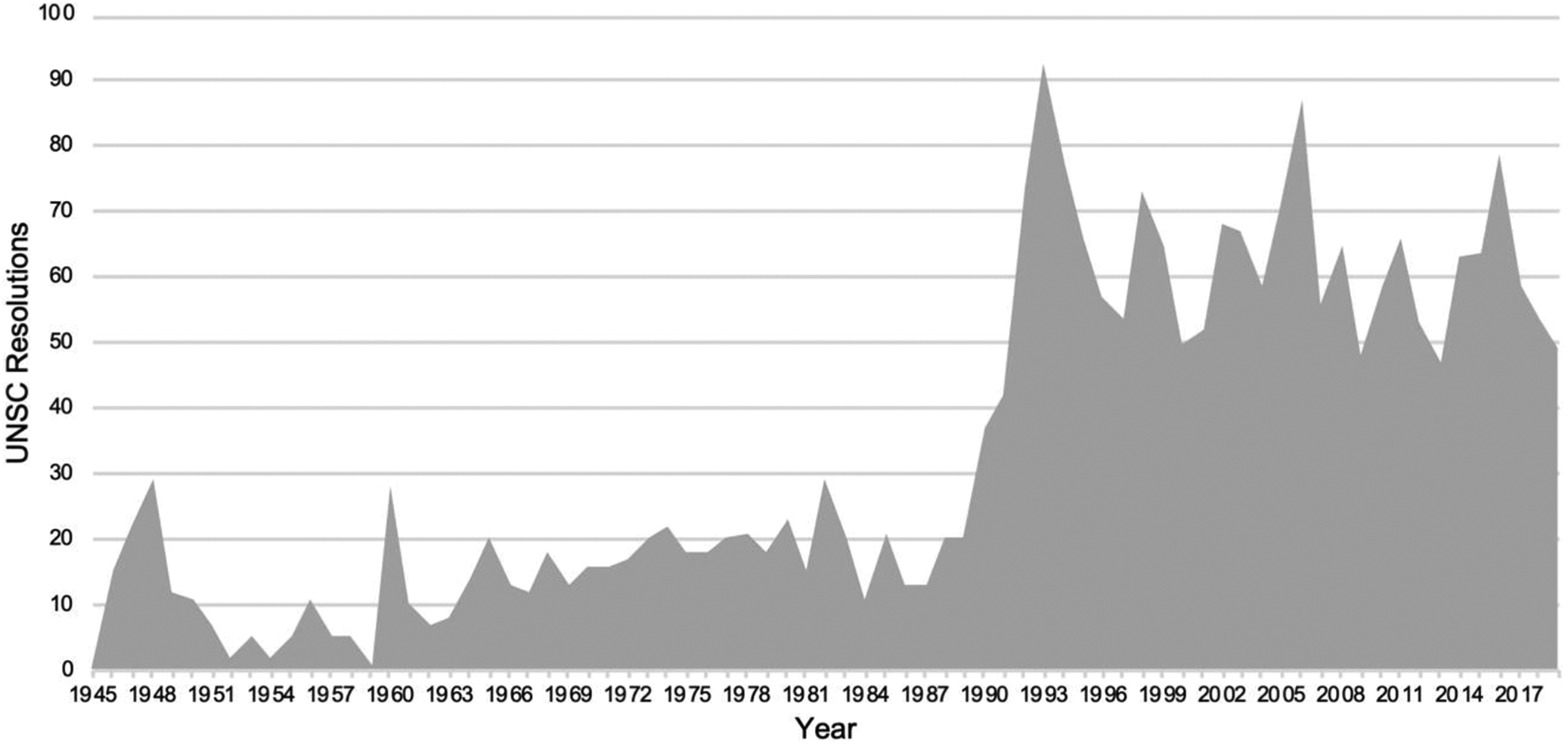
Finally, I also conducted semistructured interviews with 17 diplomats (representing different states), two observers, and one former long-time UN official involved in the work of the Council. The purpose of these interviews was twofold: first, to gain an in-depth understanding of how the transparency reform has changed the working methods of the Council, and, second, to collect a representative set of states’ views on Council working methods and on the issue of Council reform. Supplementary Material III provides the interview guide and additional information about the interviews.
The legitimacy of the UNSC 1990–2005
In 1945, the UN Charter established a General Assembly with universal membership and a mandate to discuss ‘any questions’ within its broad scope; and a Security Council with restricted membership and executive authority tasked with ‘maintaining international peace and security’. The five great victors of World War II – China, France, the Soviet Union, the UK, and the USA – were each given the prerogatives of permanent Council membership and the right to veto substantive Council decisions. These permanent five members were joined by six elected members until 1965, when the number of elected members was increased to ten. That 15-member structure (five permanent and ten elected members) persists to the present day.
This article analyzes the legitimacy of the post-Cold War Council, beginning in the year 1990. As Figure 1 shows, the post-Cold War Council is significantly more assertive than the Cold War Council in terms of passing resolutions. Prior to 1990 the strained relationship between Eastern and Western permanent members led to a difficult climate of cooperation: in the period 1946–89, the Council only passed 14.5 resolutions on average per year, and 20% of the proposed resolutions were vetoed. Subsequently, from 1990 to 2019 the Council quadrupled its output, producing on average 62 resolutions per year, with only 2% of resolutions vetoed.
Additionally, the post-Cold War Council has adopted an increasing share of Chapter VII decisions. Chapter VII of the Charter refers to the Council’s coercive measures – including sanctions (Art. 41) and the use of force (Art. 42) – and is generally invoked when Council members want to signal that a resolution is to be understood as mandatory to implement (Sievers & Daws, 2014). Hence, Chapter VII measures interfere more aggressively in domestic affairs than the other means at the Council’s disposal (e.g. the conciliatory measures listed in Chapter VI). While the Council only adopted 22 Chapter VII resolutions in total over the period 1946-1989, 42 such resolutions were passed in 2016 alone (UN, 2019).
In sum, the UNSC quickly took on a quantitatively and qualitatively more important role in maintaining international peace and security after 1990. Overall, my legitimacy data from annual UNGA debates suggest that most UN members viewed the more assertive UNSC procedural legitimacy score 1993–2005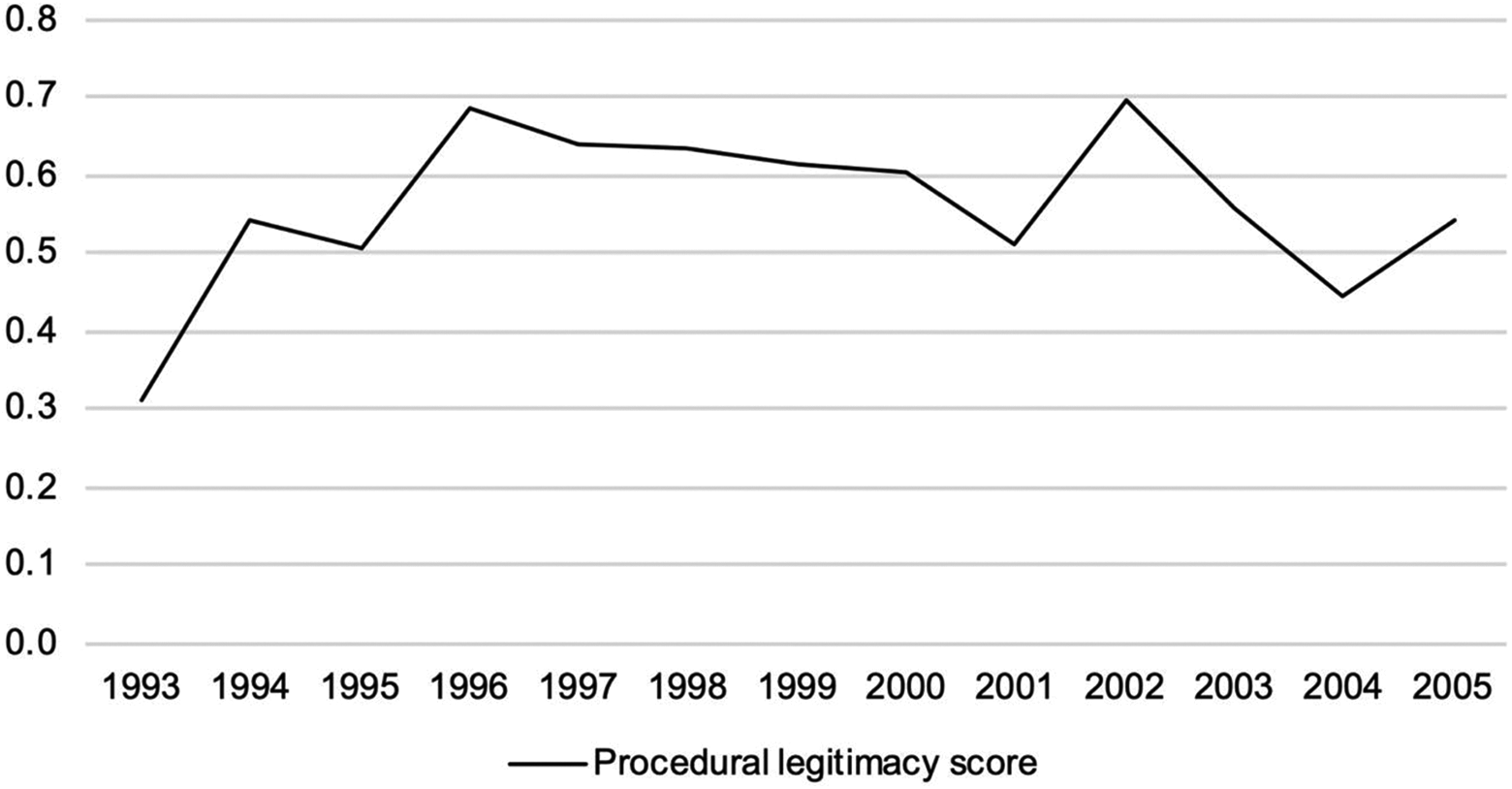
Diplomats convey that the early 1990s was a particularly frustrating period for the UN membership because of a negative transparency trend in the Council’s working methods. 9 As the Council transformed from a body that met occasionally into one that was nearly constantly in session, Council members resorted increasingly to informal consultations and private meetings (SCR, 2018a). While during the Cold War, the Council had largely deliberated and negotiated in public, now UN members suddenly had to work hard to find out what was going on in the Council (SCR, 2007). For example, when Kuwait was invaded by Iraq in 1990, Kuwaiti diplomats were not informed about how the Council planned to respond to the illegal invasion. One diplomat recalls trying to obtain information about the work of the Iraq Sanctions Committee: ‘When they met, we had to wait for them outside – wait two or three hours – and then beg them for information about what happened and what issues they discussed.’ 10
The Kuwaiti experience was not unique: the inverse trends of increased pervasiveness in the Council’s outputs and decreased transparency in its working methods led to grumbling among many UN members who felt that the principle of sovereign equality, as defined in Article 2 of the Charter, was being disavowed (Weiss, 2003). Further, Article 24 stipulates that the Council acts ‘on behalf’ of the UNGA; it could therefore be argued that UN member-states had a right to know what was going on behind closed doors in the Council, especially those states contributing with troops to the Council’s rising number of peacekeeping missions.
UNSC sources of legitimacy 1990–2005

Hence, pressure began accumulating for the Council to change both its working methods and composition. Resultingly, the formal process of reforming the post-Cold War Council was initiated in 1993, when the UNGA established the Open-Ended Working Group on the Question of Equal Representation on and Increase in the Membership of the Security Council charged with considering ‘all aspects of the question of increase in the members of the Security Council, and other matters related to the Security Council’ (UNGA, 1993). Concomitantly, the Council instituted its own Informal Working Group on Documentation and Other Procedural Questions. Since 1993, these have been the two most important fora for discussions of UNSC reform.
Reform of the Council is divided into the clusters of i) compositional reform, that is, changes to the Council’s membership structure, and ii) working methods reform, which relates to the Council’s day-to-day procedures. Since compositional reform requires an amendment of the UN Charter, UNGA’s Open-Ended Working Group has been the main forum for negotiations on compositional reform. Similarly, Article 30 of the Charter states that the Council is responsible for its own rules of procedure: the Informal Working Group has therefore dealt with working methods reform. Importantly, compositional reform needs to be adopted in the UNGA by two-thirds of all UN members and obtain a stamp of approval from the UNSC permanent members. Working methods reform, on the other hand, only needs to be adopted internally by 9 out of 15 Council members; it is hence the low-hanging fruit of the two reform types.
That point became clear throughout the 1990s, as negotiations in the Open-Ended Working Group proved extraordinarily difficult. While most UN members agreed that the Council’s composition was inadequate, no consensus could be achieved on possible remedies. From 1993 up until 2005, a range of reform proposals – for example, the 2+3 proposal, the Ezulwini Consensus, and the Razali plan – suggested various compositional formulas for a reformed Council (Bourantonis, 2005). Yet no proposal got close to securing the necessary two-thirds majority in the UNGA.
The combination of low institutional transparency and no compositional reform led to substantial procedural legitimacy criticism in the Council over the period 1990–2005. Table I, showing the number of legitimacy statements in the two legitimacy categories over the period, reveals that the Council’s outcomes were evaluated more positively than its procedures by UN members over the period. Further, the absolute numbers show that member-states referred significantly more to the Council’s procedures than outcomes when evaluating the legitimacy of the Council: procedural statements accounted for 75% of all legitimacy statements. While this finding to some degree reflects the structure of agenda items in the UNGA debates, 11 the high number of procedural statements nonetheless underscores the relative importance that member-states attach to the working methods and composition of the Council.
For the purposes of this article, Column four of Table I – showing the number of statements that evaluate the procedures of the Council negatively – is of particular relevance because it quantifies the procedural legitimacy deficit that motivated the Council to undertake transparency reform in 2006. Over the period 1990–2005, my data show that UN members criticized the procedures of the Council 942 times. To assess which specific aspects of the Council’s procedures were viewed most negatively, Figure 3 disaggregates the procedural criticism into subcategories that emerged in the data.
Figure 3 shows that lack of Council transparency was the most significant source of negative procedural legitimacy statements, accounting for close to 40% of all such statements. Other notable sources of negative procedural statements included lack of participation, the lack of Council cooperation with the General Assembly Distribution (%) of negative procedural legitimacy statements 1990–2005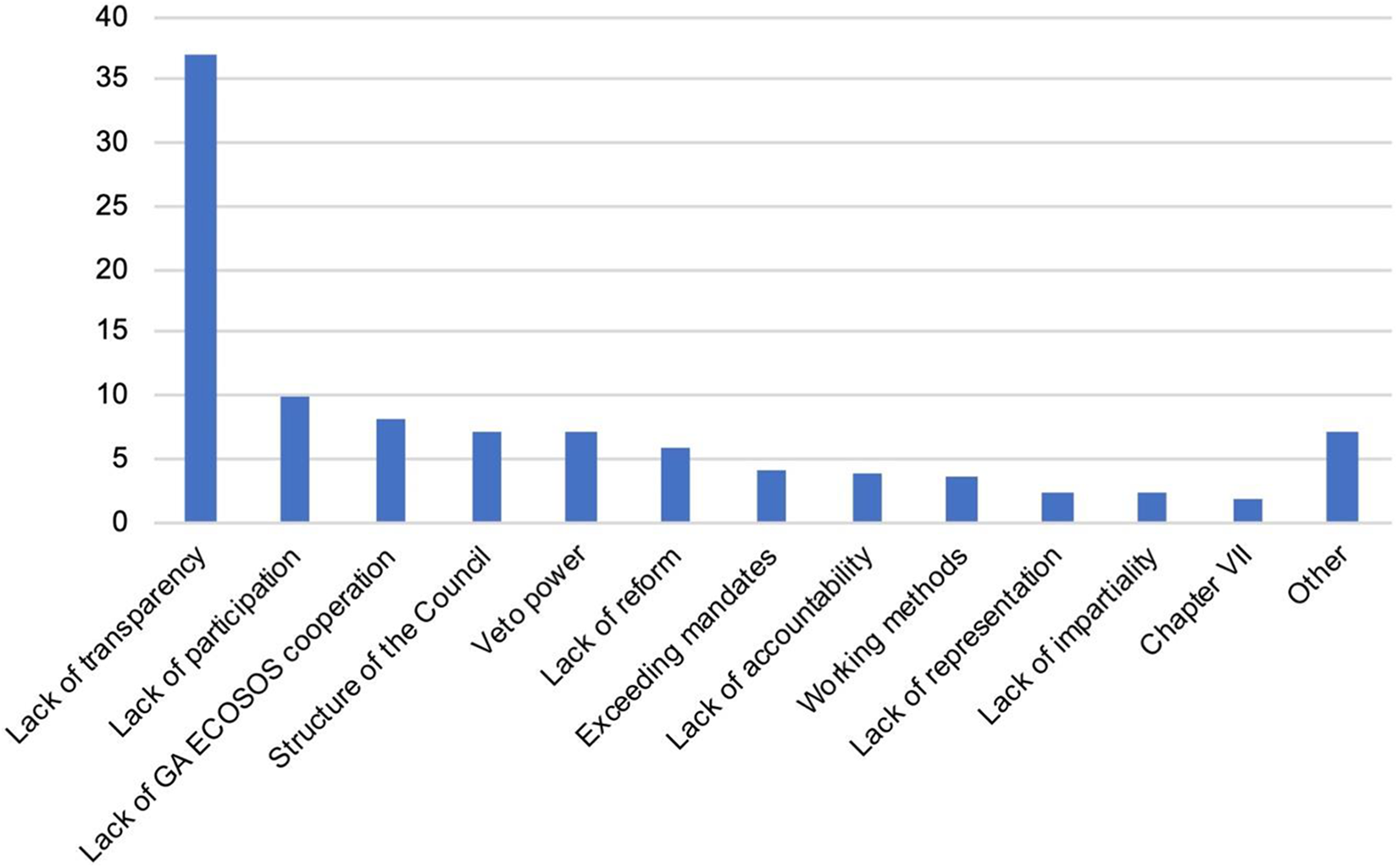
The transparency of the Council is a multifaceted issue because the Council has a wide repertoire of working methods and practices, the uses of which vary according to variables such as the issues being discussed, which states are serving, and who is leading the Council as its monthly President. However, one common frustration among diplomats during the 1990s was that they were not kept in the information loop when consequential Council decisions were taken. For non-Council members, the difficulty of obtaining elementary information such as what issues the Council was discussing effectively hindered such countries from influencing the decisionmaking of the Council (SCR, 2018a). One diplomat recalls that ‘even the agenda of the Council was not circulated on beforehand, so countries did not know what was going on.’ 13
The lack of information was particularly frustrating for non-Council members because of the Council’s increased sway after 1990. Council decisions are mandatory to implement for all UN members, and certain types of resolutions, for example, sanctions and counterterrorism resolutions, can be costly to enact. Non-Council members therefore increasingly took the stance that they should be entitled to follow the processes behind such decisions (Wenaweser, 2015).
Around the year 2000, negotiations in the Open-Ended Working Group were at a stalemate. In 1997, the Group’s work had culminated in the Razali proposal for comprehensive reform, which proposed five new permanent seats without veto powers, four new non-permanent seats, as well as myriad working methods improvements, including a limit on the use of the veto. However, while the plan was positioned as a compromise of the most promising reform proposals, it failed to garner the necessary support either in the UNGA or among all of the permanent members except France (Bourantonis, 2005; Nadin, 2016).
The Razali plan laid bare that the general UN membership had irreconcilable differences on the issue of compositional reform. Consequently, discussions on Council reform began to increasingly focus on working methods (Sievers & Daws, 2014). Given the compositional reform conundrum, working methods reform appeared as a promising ‘quick fix’ to the Council’s legitimacy challenges – at least for a number of states that were not heavily invested in changing the Council’s composition. Broadly, three different groups of states eyed the possibility of shifting the territory of reform debate from composition toward working methods: first, the permanent members, who had an interest in keeping the Council’s composition unchanged, and hoped that working methods reform could diffuse the pressure for compositional reform; second, medium-sized countries that could see regional rivals getting a permanent seat after compositional reform but were unlikely to get a seat themselves (e.g. Argentine, Italy, Pakistan); and third, small states that are so rarely elected to the Council that a compositional reform would not notably affect their chances of serving. A Liechtensteiner diplomat illustratively recalls that, I came to the conclusion that enlargement is […] for a small state like us, not that important. That […] the working methods are more important. Because it does not matter how the Council is enlarged […]. It is not going to increase our chances to serve on the Council significantly. Plus, […] if we were to serve every thirtieth year, it would not make a difference. So, what is interesting for us is the other twenty-eight years. Because we have to implement all decisions that the Council adopts, and we are very interested in an effective Security Council. And so, this is why we started working more on working methods issues.
14
Nonetheless, in the run-up to the 2005 Summit, compositional reform again proved unattainable. The three main reform groups opposed their counterparts’ proposals, effectively undermining each other’s chances of achieving their objectives (Bourantonis, 2005). Further, none of the proposals managed to secure the permanent members’ unanimous support. Nonetheless, although the UN membership had again failed to unite around a compositional reform formula, most UN members agreed on the necessity of working methods reform of the Council. Hence, world leaders formulated a recommendation in the Summit’s outcome document, that the Council ‘increase the involvement of States not members of the Council in its work, as appropriate, enhance its accountability to the membership and increase the transparency of its work’ (UNGA, 2005).
The transparency reform: Presidential Note 507 of 2006
The World Summit’s call for more transparency in the Council’s working methods gave impetus to proponents of working methods reform, and in 2006, the Council decided to charge its Informal Working Group with overhauling Council working methods (Sievers & Daws, 2014). After months of negotiations, the Group recommended several measures to the Council, which eventually adopted Presidential Note 507 (UNSC, 2006). The Note listed a number of measures for enhancing the transparency of working methods and improving interaction with the wider UN membership.
Prior to 2006, the Council’s Provisional Rules of Procedure from 1946 constituted the only written compilation of the UNSC’s working methods. In practice, however, the Council’s working methods had evolved significantly since 1946, without being codified in specific documents (SCR, 2018a). In general, the permanent members favor low codification, because it provides them with ‘flexibility to respond effectively’ to the relevant security conflicts of the day. 15 For elected members and non-Council members, however, the lack of codified working methods was perceived as a transparency problem, hindering them both from obtaining relevant information and effectively impacting Council decisionmaking (Wenaweser, 2015).
Note 507 is a transparency reform – in the sense that it reduces information asymmetries between principal and agent – in two distinct ways. First, the Note compensates for the discrepancy between the Provisional Rules of Procedure and the actual practice of the Council. 16 It provides non-members and elected Council members with a set of codified rules of procedure, which helps these countries navigate how the Council works and enables them to effectively participate in and take advantage of the various practices available. Hence, compiling and codifying the Council’s working procedures is a significant transparency measure in itself. 17
Changes in UNSC working methods resulting from Note 507
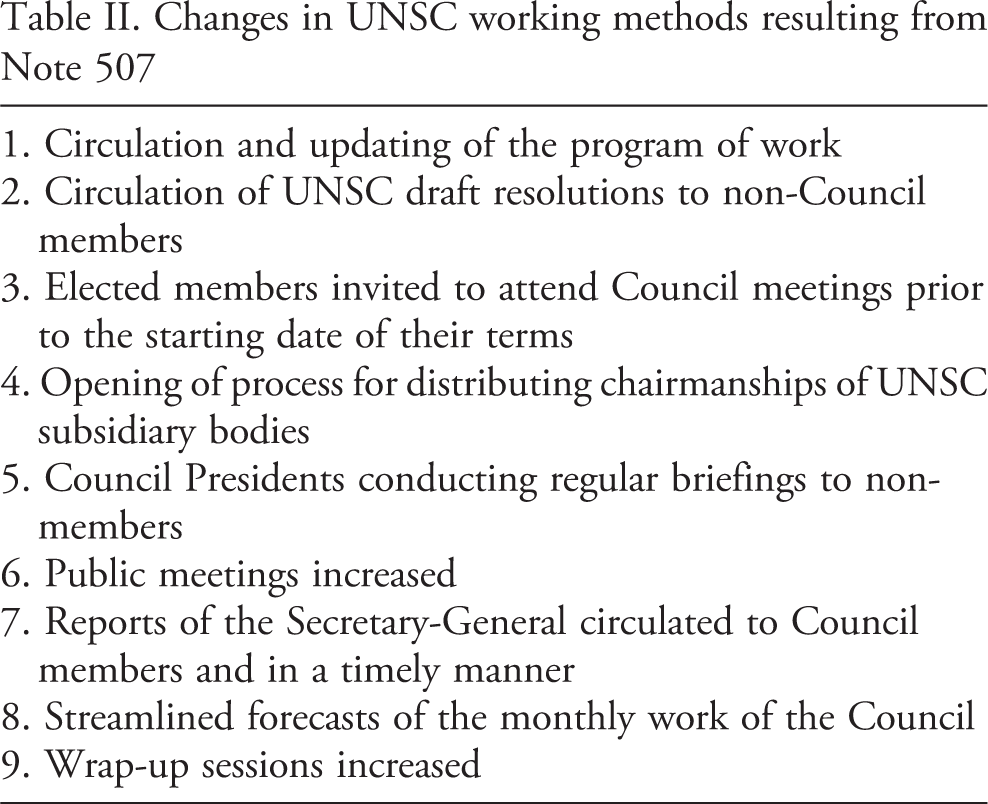
Second, the Note contains 63 measures for improving the Council’s working methods, and a high share of the measures are related to the accessibility of information from the Council. For example, the Note calls for increased recourse to open meetings; increased numbers of briefings by Council members to non-members; improved documentation, including streamlined nomenclature; publication of activities, decisions, and circulation of reports; and publicizing the agenda of the Council on its website (UNSC, 2006). Hence, a long-time UN official credits Note 507 with bringing about a ‘huge increase in transparency’ of the Council. 18 More specifically, my interviews suggested that the Note served to introduce at least nine specific changes in working methods, listed in Table II 19 :
Legitimation effects of the transparency reform in the UNSC
Notably, most of the changes outlined are directly related to the transparency of Council working methods. Given that the lack of Council transparency constituted the largest source of procedural legitimacy criticism among UN member-states in the pre-reform period (see Figure 3), Presidential Note 507 emerges as a potentially promising legitimacy-enhancing strategy based on the data. Yet, over the post-reform period, I find that the overall legitimacy score (procedural and outcome) of the Council decreased 10 percentage points on average compared with the period 1990–2005. Beyond the average score, however, Figure 4 reveals that the 2006 transparency reform was associated with a positive procedural legitimacy trend that subsided over time: the procedural legitimacy score increased markedly from 2007 to 2011, before decreasing again. 20
Table III shows that both legitimacy categories decreased in the post-reform period: procedural legitimacy decreased by 7 percentage points (p = 0.00) and outcome legitimacy by 16 (p = 0.03). Importantly for this article, the decline in the Council’s procedural legitimacy contradicts the hypothesis that transparency reform increases the procedural legitimacy of the Council.
Why did procedural legitimacy decrease in the post-reform period? To examine which procedural subcategories produce the negative procedural legitimacy effect, Figure 5 plots the distribution of negative procedural legitimacy statements on subcategories in the pre- and post-reform periods (Supplementary Material V provides the corresponding distribution for positive statements). The figure shows that the relative importance of the category ‘lack of transparency’ decreases substantially (–17 percentage points) over the post-reform period. In other words, the reform led to a significant decline in transparency criticism. However, the corresponding figure for positive statements shows a similar substantial decline in positive transparency statements (–19 percentage points; see Supplementary Material V). On balance, perceptions of transparency did not significantly change from the pre- to the post-reform period (Supplementary Material VI); which means that changes in perceptions of transparency did not cause the overall negative effect.
Instead, the overall decrease in procedural legitimacy score results from other procedural issues growing in relative importance after the reform. I propose three main explanations for why the procedural legitimacy score decreases. The first explanation is that the delegitimating effects of no compositional and veto reform overshadows the legitimating effects of transparency reform. Figure 5 shows that negative statements concerning the structure of the Council, the permanent members’ veto powers, and ‘lack of representation’, become relatively more important negative procedural legitimacy sources in the post-reform period. Changes in these categories all contribute to the decline in procedural legitimacy. For one German diplomat, working methods The UNSC’s procedural legitimacy score 1993–2015 The UNSC’s sources of legitimacy 2006–18 Distribution (%) of negative procedural legitimacy statements 1990–2005 and 2006–18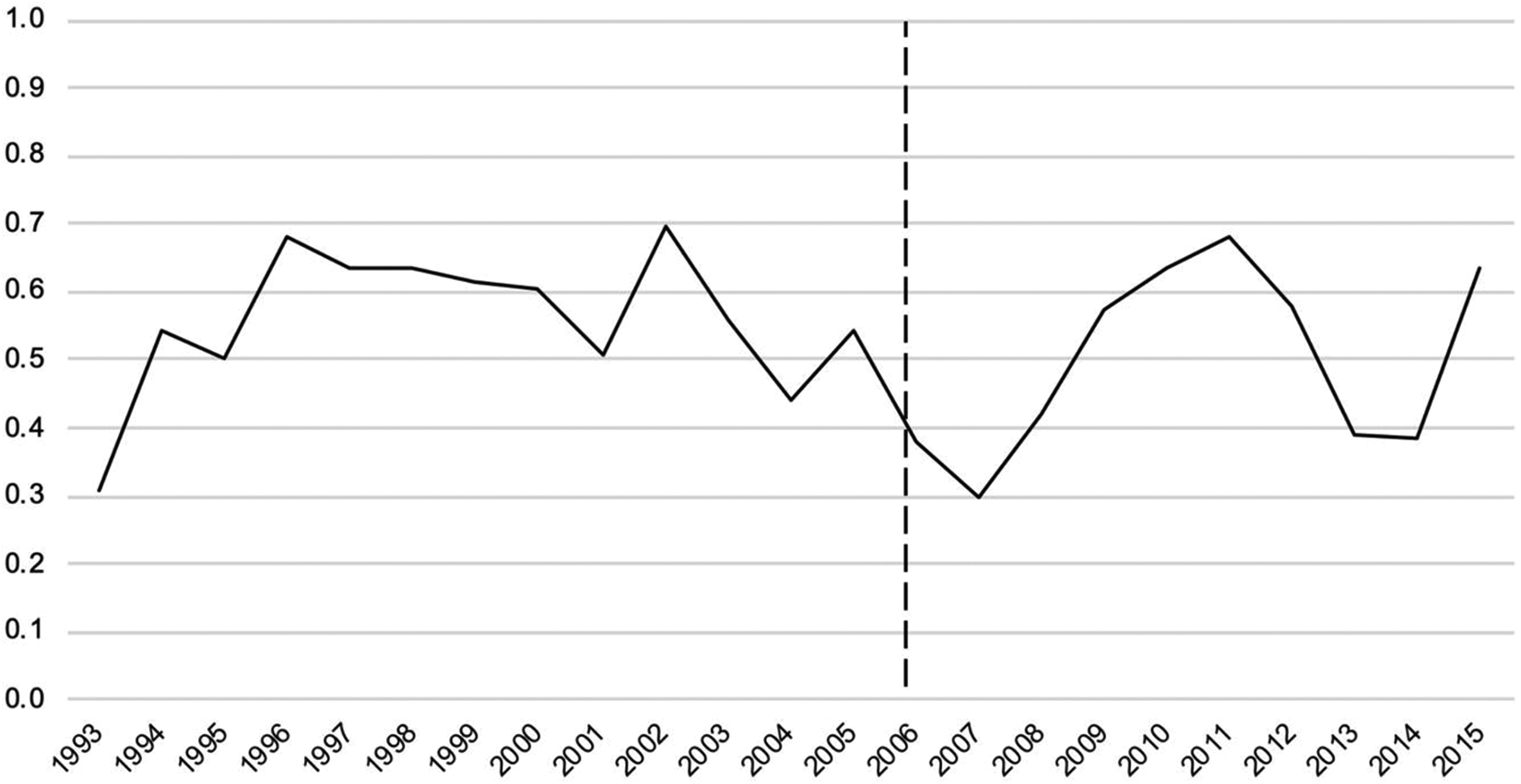

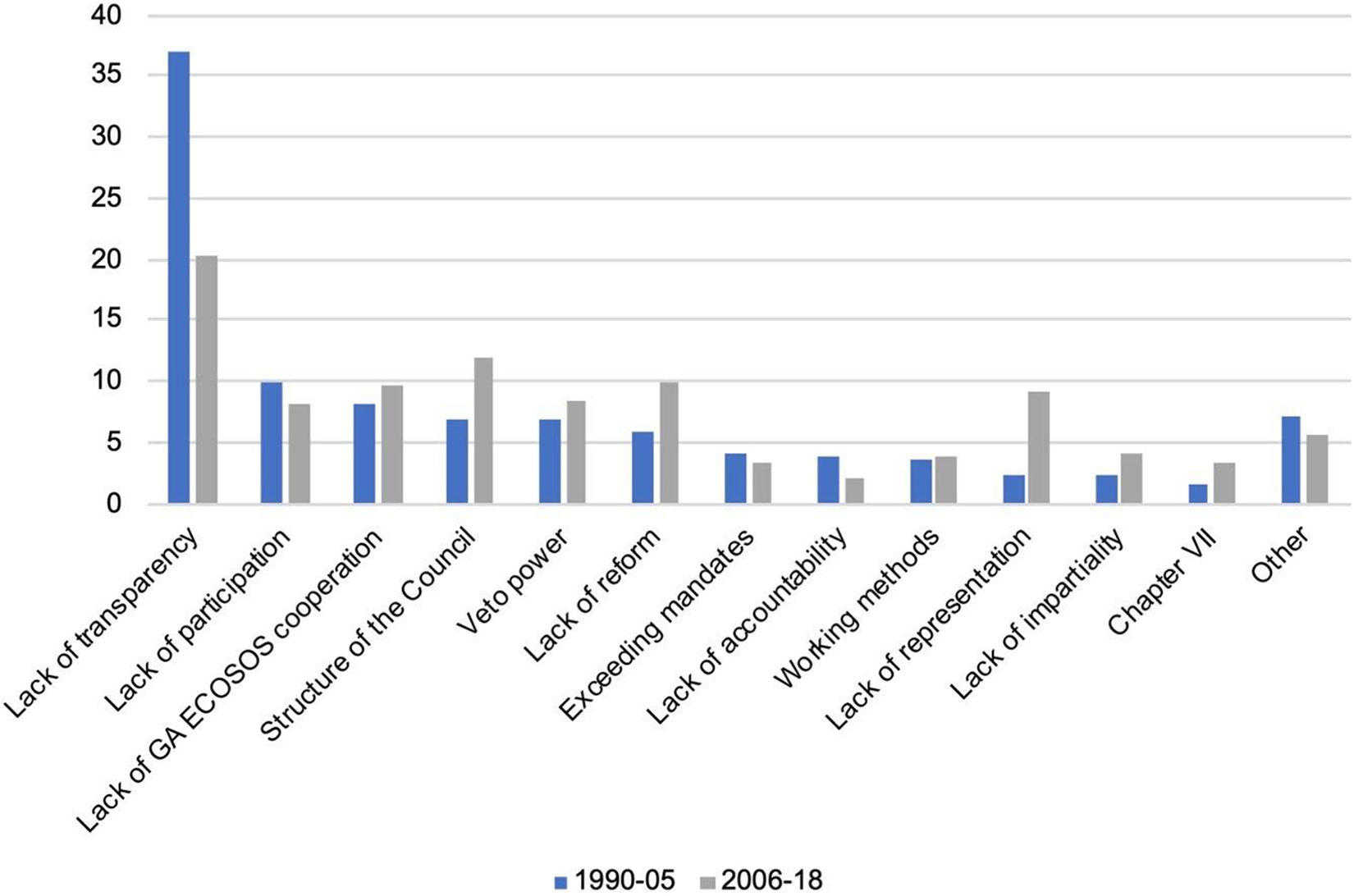
Yet if we exclude all negative statements pertaining to the composition of the Council, the veto power, and lack of representation in the pre- and post-reform periods, my data still show a 4% decrease in the procedural legitimacy score. 22 A second explanation for the negative effect is the increased importance of workings methods issues that were not addressed in Note 507. My interviews indicate that two such issues were particularly important for a wide range of UN member-states. 23 First, the balance between the Council and other UN organs (particularly the UNGA), which is a longstanding issue. The main criticism here is that the Council has taken on an increasingly wider range of tasks, leaving the other main UN organs to diminish in importance. Second, the penholding system, which refers to the practice of which states ‘hold the pen’ when drafting UNSC outcomes. Whereas elected members often have an interest in drafting decisions on specific issues, an informal practice emerged around 2010 whereby nearly all Council outcomes on specific conflict-related situations have been penned by either France, the UK, or the USA (see SCR, 2018b).
Third, in line with Stasavage (2004), some interviewees indicate that the increased transparency of the Council has engendered posturing and decreased interactivity. 24 For example, in public meetings, representatives often read out pre-prepared statements and restate positions that are already common knowledge. Nevertheless, not all transparency measures necessarily generate trade-offs. When interviewed, diplomats state that they generally appreciated efforts that increased the internal transparency of the Council vis-à-vis the UN membership, such as briefings by the Council President and the circulation of draft resolutions. On the other hand, transparency measures that were more geared toward external audiences, such as public meetings and the broadcasting of sessions, generated more opposition. For some diplomats, external transparency measures entail time-consuming preparations for meetings in which everyone reads out pre-written statements that are primarily meant to satisfy domestic audiences. 25
Finally, the only clear legitimacy-enhancing effect of the reform is its leading to a slight improvement in perceptions of participation (see Figures 5 and S1), in line with the theoretical expectation that transparency can enable principals to have a greater say in decisionmaking, even in the absence of changes to direct control mechanisms such as formal representation or voting powers.
Alternative explanation: The effect of outcomes
Can the negative relationship between transparency reform and legitimacy be explained by differences in substantive UNSC outcomes over time? While this article has focused on the relationship between procedures and legitimacy, theories of outcome legitimacy would suggest that variation in substantive outcomes – that is, the performance of an institution in relation to its mandate – is a more significant factor than procedures for explaining changes in states’ legitimacy perceptions (Dellmuth et al., 2019). In the current context, the negative legitimacy trend may have been caused by differences in substantive UNSC outcomes over the two time periods analyzed. If the relationship between outcomes and legitimacy differs between the pre- and post-reform periods, the findings in the empirical analysis may be biased by differences in outcomes.
The Council’s outcome performance can be understood as the degree to which it succeeds in its mandate of maintaining international peace and security (Cronin & Hurd, 2008). In that sense, the Council both produced important outcomes and failed to do so in the pre- and post-reform periods (see e.g. Bosco, 2009). If the UNSC’s performance in managing international peace and security – or lack thereof – affects states’ legitimacy perceptions, variations in substantive outcomes over the time periods may have influenced the results. Specifically, if the negative procedural legitimacy effect identified in the analysis is caused by variations in Council outcomes, we would expect the effect of UNSC outcomes on states’ procedural legitimacy perceptions to be stronger in the post- than in the pre-reform period.
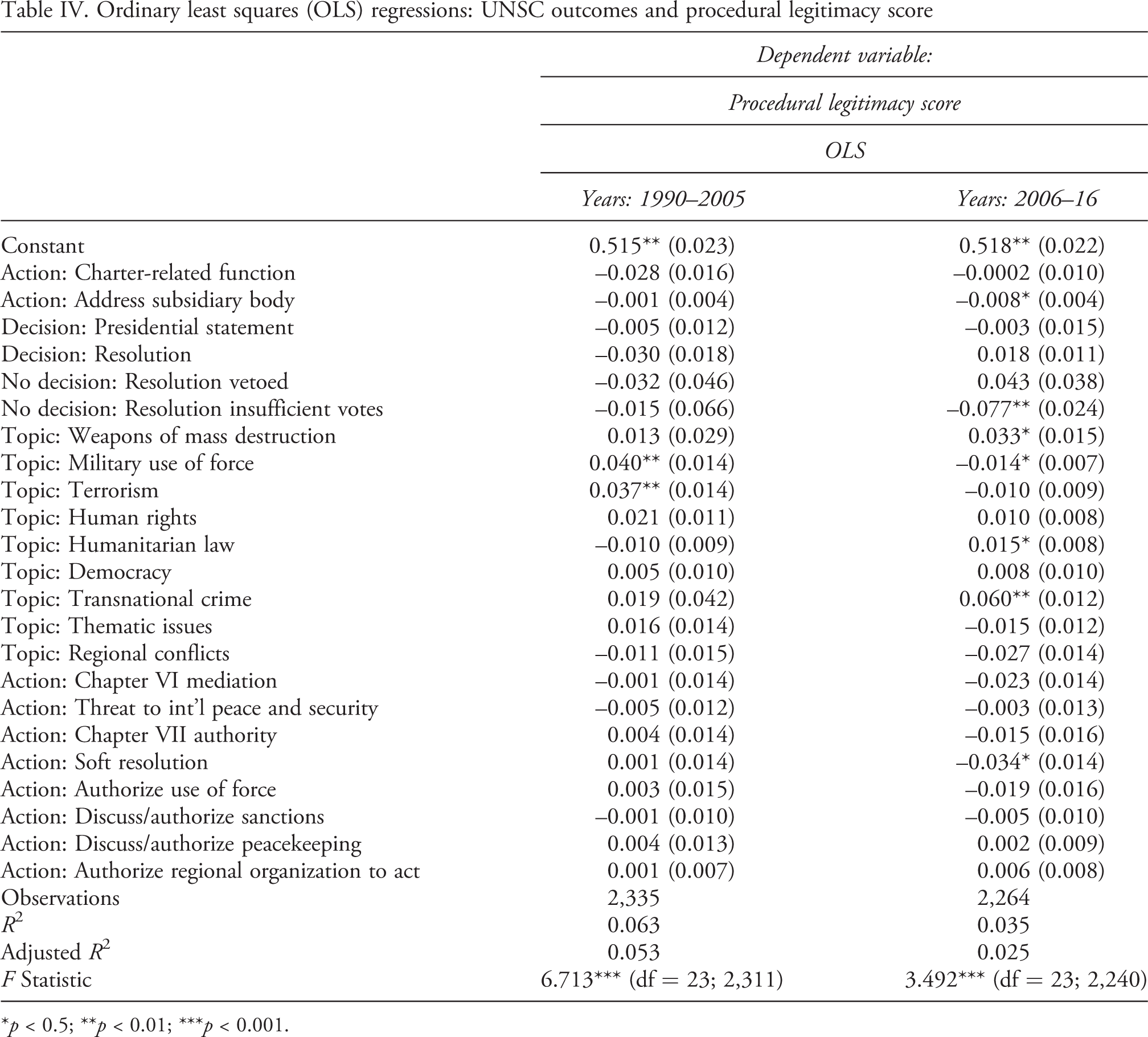
Ordinary least squares (OLS) regressions: UNSC outcomes and procedural legitimacy score
* p < 0.5; ** p < 0.01; *** p < 0.001.
To test the alternative explanation, I regress the outcomes of UNSC meetings on the procedural legitimacy scores of the Council in each year the Council met. While analyzing the outcomes of Council meetings has clear limitations, for example, the approach does not consider the implementation or impact of policy decisions, these outcomes (or ‘policy outputs’) nonetheless constitute one dimension of performance (Tallberg et al., 2016). In the following, I use the outcomes of meetings as the unit of analysis, and pair these outcomes with the legitimacy score of the Council in the year of a given meeting. Frederking & Patane (2017) provide a database on the outcomes of all Council meetings in the period 1989–2016 (N = 5,057), with variables covering, inter alia, decisions produced, topics discussed, and actions taken by the Council. The ordinary least squares models presented here (Table IV) regress 23 of these outcome variables on the UNSC’s procedural legitimacy score. 26 For a description of the independent variables, see Frederking & Patane (2017). The first model covers the pre-reform period 1990–2005. The second model covers the post-reform period, 2006–16. 27 The dependent variable is the Council’s procedural legitimacy score of the year that a given meeting was held. Since the data are longitudinal, I adjust standard errors for heteroskedasticity and autocorrelation.
The models show that several outcome factors are significantly associated with the Council’s procedural legitimacy score, and that the correlates of the procedural legitimacy score differ between the two periods. However, as outlined in the empirical strategy section, the logic of using long time periods for the content analysis is that the effects of different exogenous factors on legitimacy should average out over time. While the regressions show that different outcomes are correlated with procedural legitimacy in different ways over the two periods, the important question for the validity of the analysis is whether the total effect of the different outcomes differs between the two periods. Hence, the central metric is the coefficient of determination (R 2) in the two models. Importantly, although several outcomes correlate with procedural legitimacy, all the outcomes included here only account for ≈6% of the variation in the procedural legitimacy score in the pre-reform period and ≈3.5% in the post-reform period. In sum, this result indicates that the total effect of outcomes on procedural legitimacy is slightly weaker in the post-reform period. If the alternative explanation were true, we would have observed the opposite tendency – that outcomes accounted for more of the variation in the dependent variable in the post-reform period. In sum, while this analysis is merely correlational and only captures the output dimension of UNSC outcome performance, the slightly weaker association between meeting outcomes and procedural legitimacy in the post-reform period indicates that the negative procedural legitimacy effect was not caused by changes in this dimension of UNSC outcome performance.
Conclusion
The UNSC has been one of the most influential and potent international institutions since the end of the Cold War. However, its broad powers have generated controversy, and the legitimacy of the Council has consistently been contested among different audiences. Consequently, a sizable literature has proposed various ways in which the Council should reform. Moreover, the Council itself has proactively sought to enhance its own legitimacy through the reform efforts of groups of states.
There are two main channels for reforming the Council: compositional reform and working methods reform. This article has analyzed the effects of a transparency reform of the Council’s working methods on UN member-states’ legitimacy perceptions. While working methods reform proponents have argued that increasing the transparency of working methods could be a more feasible solution to enhance the legitimacy of the Council than compositional reform (e.g. Scherz & Zysset, 2020; Sievers & Daws, 2014; Wilson, 2019), my data from UNGA debates 1990–2018 show that the 2006 transparency reform enacted with Note 507 has led to an overall decline in UN member-states’ perceptions of procedural legitimacy. On the upside, the reform has led to a substantial decrease in transparency criticism and a slight increase in states’ perceptions of participation. However, the UNSC’s failure to address a range of other procedural legitimacy issues – including the Council’s composition and the permanent members’ veto powers – adds up to a negative legitimacy effect in sum.
Overall, these findings indicate that transparency reforms can positively affect perceptions of legitimacy, but also that increased transparency is not a panacea to procedural legitimacy deficits. Importantly, increased transparency does not in itself alter the distribution of direct procedural control over an institution. In the current case, this mattered for legitimacy perceptions because a wide range of UN member-states sought a reform that would give them increased direct influence, compared to which the transparency reform that was implemented contained relatively weak changes to the Council’s procedures. The finding that states increasingly lament the Council’s unrepresentative composition in the post-reform period speaks to the importance of the fundamental principle of sovereign equality for states, which includes the idea that all states are entitled to participate in the generation of international rules and laws (Reus-Smit, 1999).
Since the transparency reform examined here is the most comprehensive of its kind that the Council has undertaken, the findings most likely represent the upper bounds of what transparency can do for the legitimacy of the Council. Notably, the reform both contained a high number of salient transparency measures that had previously been demanded by UN members, and saw a high degree of implementation; it hence complied with central scope conditions for effective transparency (Buchanan & Keohane, 2006; Lindstedt & Naurin, 2010). Yet, the increased salience of the unrepresentative design of the Council precluded overall positive effects. If transparency cannot compensate for fundamentally unrepresentative design structures, the negative effect of the transparency reform examined here may travel to other institutions with formal or semiformal great power dominance, such as the International Monetary Fund, G20, World Bank, or World Trade Organization. On the other hand, institutions wherein direct control is more equally distributed a priori – such as the UN climate negotiations – may exhibit more positive effects of transparency reforms.
Finally, it is important to acknowledge that the current analysis is unable to compare the effects of reform with the counterfactual state of affairs. In other words, the negative legitimacy effects of reform do not preclude the possibility that the reform prevented a deeper legitimacy crisis that could have occurred in its absence. At the 2005 World Summit, state leaders pledged to reform both the composition and working methods of the Council. What would have happened if the Council had failed to deliver on both of these fronts? Given the impasse of compositional reform negotiations, proponents of the 2006 transparency reform may have achieved what they hoped for.
Footnotes
Replication data

Acknowledgements
I am grateful to Laura von Allwoerden, Jeffrey Checkel, Maria Debre, Hylke Dijkstra, Tim Heinkelmann-Wild, Phillip Genschel, Monika Heupel, Daniel Naurin, Antoinette Scherz, Henning Schmidtke, Leonard Schuette, Jonas Tallberg, Felicity Vabulas, Jennifer Welsh, Vegard Wiborg, Giuseppe Zaccaria, three anonymous reviewers, and audiences at the 2020 ECPR General Conference and 2021 APSA Annual Meeting for their helpful comments; and Ellen Emilie Henriksen for excellent research assistance.
Funding
The author disclosed receipt of the following financial support for the research, authorship, and/or publication of this article: This work was supported by Research Council of Norway, projects no. 261491 and 223274.