




Abstract
The successful closure of arms control negotiations today is conditional on the commitment of many more states than during the Cold War. The question of what determines states’ positions on arms control has therefore become increasingly relevant. Multiple scholars have identified external security threats by other states as the key explanatory factor of opposition to arms control, but empirical evidence hereof is so far limited to a small set of cases. Against this backdrop, this article carries out a global examination of the effect of external threats in the form of interstate disputes and rivalries on state support for arms control. This analysis is facilitated by a novel measure of arms control support that combines United Nations General Assembly voting data with manual coding of 1,178 resolutions. Across a variety of model specifications, the results do not show any significant effect of external threats on support for arms control. This article argues that this means either that the two variables are not related at all, or that two opposing mechanisms cancel out each other: arms control not only entails costs, but also benefits for states that face external threats, as it limits both states involved in a rivalry or dispute. Either way, this study challenges the notion that there is a strictly negative relationship between external threats and arms control support and thus contributes to our understanding of arms control and foreign policy making in general.
Keywords
Introduction
Despite the end of the Cold War, many governments spend ever larger shares of their budgets on arms (Tan, 2010: 3). This trend could be hindered or even reversed through stricter rules and regulations (Bauer, 2010: 306). Yet, due to a ‘multilateralization’ of security after the Cold War (Krause, 1998: 1), the successful adoption and implementation of arms control agreements today is conditional on the commitment of many more states than before. This means that both perspectives and positions have diversified (Gallagher, 1997; Sands, 1997: 130) and we need an updated, systematic assessment of what determines whether states embrace or reject arms control.
In this study, I examine the effect of external threats on state support for arms control. Arms control scholars have denoted external threats, that is, threats by other states, as the main explanatory factor driving opposition to arms control (see e.g. Rosert, 2011: 257; Sagan, 1996: 54). Threatened states have an increased demand for armaments and thus reject international agreements that restrict their weapons acquisition (Glaser, 1994; Jervis, 1978; Sagan, 1996). In its most ‘hawkish’ form, this relationship has been labelled the arms control paradox: Arms control is irrelevant when it is possible, and impossible when it is needed – because states will oppose arms control when they are in dispute with each other (Gray, 1992; see also Kydd, 2000).
Due to a lack of data for more thorough cross-country analyses, contemporary empirical research is mostly limited to case studies of the Middle East (Jones, 1998; Steinberg, 1994; 2005). Extant quantitative analyses focus on actual arms acquisition rather than position-taking on arms control (e.g. Collier & Hoeffler, 2007; Jo & Gartzke, 2007; Singh & Way, 2004) and therefore only tell us little about the prospects of cooperative measures between states: while armaments and arms control are certainly linked, they are not equivalent. If an external threat leads to arms acquisition, it does not necessarily follow that it also causes opposition to arms control.
To examine the relationship between external threats and support for arms control quantitatively, I introduce a novel measure of the latter variable, combining United Nations General Assembly (UNGA) voting data with manual coding of 1,178 resolutions introduced between the 49th and 71st sessions (1994/1995 to 2016/2017). First, I assess on a five-point coding scheme whether a resolution strengthens or weakens arms control and whether divergences in voting behaviour might be driven by other conflict dimensions than the one under consideration. Afterwards, every vote by a state is assigned a position depending on the respective resolution’s categorization. This approach has the advantage that it constitutes a variance-based and more generalizable theory test than the aforementioned case studies that goes beyond a specific state or region with distinctive characteristics.
Across a variety of model specifications, I find no significant effect of external threats on arms control support. I argue that this might reflect two opposing mechanisms that cancel out each other in the event of external threats: external threats increase not only the costs, but also the benefits of arms control, as arms limitations restrict both sides of a rivalry or a dispute. While involvement in an interstate rivalry or dispute still increases the adversaries’ demand for armament, this does not translate into less support for arms control.
An alternative interpretation of the empirical results is that external threats simply do not matter for states’ position-taking on arms control. For instance, states might not perceive interstate disputes and rivalries as severe enough to alter their foreign policy preferences or they might view arms restrictions in the form of international agreements as ineffective and thus irrelevant. Either way, the findings of this study challenge realist accounts of a strictly negative effect and thus shed new light on the relationship between external security threats and arms control. Moreover, they indicate that one cannot simply derive states’ stance toward arms control from their armament decisions, which illustrates the added value of my measure.
In the second section, I first review the extant literature on the effect of external threats on position-taking on arms control and expound why the study of that relationship requires a new quantitative approach. In the third section, I describe my data, including the coding procedure for the dependent variable, as well as the research design. In the fourth section, I present and discuss the empirical results. The fifth section reflects on the implications of my empirical results and points toward directions for future research.
The effect of external threats on state support for arms control
As arms control is a contested concept that has been used in many different ways, it is necessary first to clarify what I refer to in this study. I follow Goldblat (2002: 3) in defining arms control as measures that are intended to: (a) freeze, limit, reduce or abolish certain categories of weapons; (b) ban the testing of certain weapons; (c) prevent certain military activities; (d) regulate the deployment of armed forces; (e) proscribe transfers of some militarily important items; (f) reduce the risk of accidental war; (g) constrain or prohibit the use of certain weapons or methods of war; and (h) build up confidence among states through greater openness in military matters.
The paramount role of external threats in arms control theory is mostly derived from (structural) realism (Glaser, 1994; Sagan, 1996). The basic assumption here is that in an anarchical international system, states are primarily driven by their need for security. With regard to their armaments policy, they mainly face two options: cooperation, that is, arms control; or defection, that is, arms build-up (see e.g. Glaser, 1994; Jervis, 1978; Kydd, 2000). This decision mainly follows from their threat perceptions: if another state is perceived as hostile, they will prefer defection to cooperation, arm themselves, and reject arms control measures (Glaser, 1994; Jervis, 1978; Sagan, 1996). This is due to two reasons: first, as states are security-seeking, the threat imposed by another state causes the need for self-defence; and second, the distrust in the adversary state will impose fear of being cheated on in potential agreements, which leads to the rejection of arms control.
This argument provides the basis for two related concepts: the security dilemma; and the aforementioned arms control paradox. The security dilemma postulates that states that feel threatened by each other might engage in a costly arms race, although it would be more beneficial for both of them to cooperate (Jervis, 1978). In a similar vein, Gray (1992) argues that arms control only has added value – that is, it could decrease armaments and prevent arms races – when states threaten each other. Yet, when threatened, states will oppose arms control, making it impossible whenever it is needed.
In line with this rationale, Steinberg (1994; 2005) traces the failure of arms control negotiations in the Middle East back to the unstable security environment and the states’ hostility toward each other. For instance, Steinberg argues that Israel’s nuclear armament and refusal to join the Treaty on the Non-Proliferation of Nuclear Weapons (NPT) is, at least in parts, a result of its need to deter its enemies in the region (Steinberg, 1994). Similarly, Jones (1998) attributes Iran’s negative stance toward arms control to its threat perceptions and the North Korean regime justified its pursuit of nuclear weapons and NPT withdrawal with the United States nuclear threat (Wunderlich et al., 2013: 276).
Contrary to this, Glaser (1994) argues that even from a realist point of view, it should be highly context-specific whether states prefer an arms build-up to cooperation when faced with external threats. Security-maximizing states might respond to threats by refraining from armaments and seeking cooperation with their adversaries in certain situations in order to avoid a costly and risky arms race that they could lose (Glaser, 1994). If the benefits of restricting opponents’ armaments outweigh the costs of imposing these restrictions on oneself, it is perfectly rational to respond to a threat by embracing arms control.
A number of quantitative studies have examined the first part of the causal mechanism, that is, the effect of external threats on armaments. While some of them provide ambiguous results (Dunne & Perlo-Freeman, 2003; Jo & Gartzke, 2007), most identify a positive relationship between external threats and different variables related to arms acquisition. These include, inter alia, military spending (Collier & Hoeffler, 2007), arms imports (Blomberg & Tocoian, 2016), and nuclear proliferation (Fuhrmann & Horowitz, 2015; Singh & Way, 2004). Although these studies do not claim to provide any evidence for the relationship between external threats and support for arms control, they appear to speak against Glaser’s (1994) argument at first glance.
This is due to the fact that Glaser’s study as well as previous studies with a realist perspective (e.g. Jervis, 1978; Kydd, 2000) equate the decision to build up arms with defection and opposition to arms control. I argue that this is not necessarily the case. A state’s decision to cooperate or defect is certainly linked to its decision to acquire weapons or not. Nevertheless, states might reject arms control while not pursuing armaments, and, more importantly, they can build up arms and still support arms control. Kreps, Saunders & Schultz (2018) argue that, in certain situations, governments might even decide to strengthen their military capabilities precisely because they support arms control. 2
The latter argument suggests that armament and arms control support are not mutually exclusive. Empirical evidence for a positive relationship between external threats and armaments does not necessarily entail a negative effect of external threats on support for arms control. To test this relationship, one thus needs to identify arms control support through other means.
Data and method
Dependent variable
As outlined above, it is not possible to derive states’ positions toward arms control from their levels of armaments. I have therefore developed an alternative approach, which relies on UNGA voting data instead to measure support for arms control. First, with the help of a student assistant, I manually code all UNGA resolutions that were drafted in the First Committee 3 as well as disarmament resolutions in the plenary 4 and adopted between the 49th and 71st UNGA sessions (1994/1995 to 2016/2017). This leads to a set of 1,178 resolutions. By means of the manual coding, which I will further describe below, I then derive states’ positions from their votes on these resolutions. 5
This approach has several advantages in comparison to the small set of previous studies that have quantitatively measured positions on arms control. Knopf (1998) measures preferences for arms control through participation in negotiations, but his analysis focuses only on the Cold War period, the United States and its bilateral talks with the Soviet Union. Thus, it covers neither multilateral arms control nor variation across countries.
Other studies have analysed arms control treaty signature or ratification (Brender, 2018; Vaynman, 2014), arguing that this reflects states’ commitment to arms control (Brender, 2018: 16). Although treaty ratification indeed depends on policy preferences and positions to a certain extent, it is also determined by a number of other factors, such as institutional constraints (e.g. Hug & König, 2002; Kreps, Saunders & Schultz, 2018). Moreover, it only measures support for existing treaties and thus suffers from severe selection bias.
Efrat (2010) conducted a survey among officials from 118 countries to assess the respective governments’ preferences on controlling the trade of small arms and light weapons. While this is undoubtedly a useful measure, the survey was only implemented once, and does not capture variation over time. In addition, it focuses on a very specific issue and not support for arms control in general.
Instead, I measure arms control support through UNGA voting behaviour, which has become the standard data source for measuring foreign policy positions (Bailey, Strezhnev & Voeten, 2017: 430). As the UNGA plays a significant role in international arms control negotiations and covers the entire spectrum of arms control issues (Müller, Below & Wisotzki, 2013; Thakur, 2017), it constitutes a useful forum for studying positions on arms control. In contrast to speeches or co-sponsorships, voting allows for the comparison of all states’ positions on the same issues (Finke, 2021: 6–7). This data source seems to better reflect the overall topic of arms control and states’ preferences thereon. 6
That said, most existing methods for deriving foreign policy preferences from UNGA voting merely measure the states’ proximity to each other, not their stance toward the subject under consideration. They indicate, for instance, whether a government votes more with the states of the Global North (e.g. Kim & Russett, 1996), the Western states (e.g. Voeten, 2000), or specific countries, particularly the United States (e.g. Carter & Stone, 2014; Dreher & Jensen, 2013) and China (e.g. Carmody, Dasandi & Mikhaylov, 2019; Flores-Macías & Kreps, 2013). Accordingly, the analysis of support for arms control requires a different measurement technique.
This poses two challenges. First, not every resolution unrestrictedly strengthens arms control. For instance, resolution A/RES/57/54 criticizes ‘the growing proliferation of ad hoc and exclusive export control regimes and arrangements for dual-use goods and technologies’ and demands that the transfer of dual-use goods be less restricted (United Nations General Assembly, 2002: 1). Hence, states that are in favour of arms control might sometimes vote against resolutions.
To solve a similar problem in their study on human rights resolutions, Boockmann & Dreher (2011) use the votes of four states that are known to be very supportive of human rights as a benchmark for the ‘pro human rights’ vote. In other words, they define the voting option that reflects one extreme position on their conflict dimension, and assess other states’ positions through their agreement with this benchmark.
7
Yet, their
Coding procedure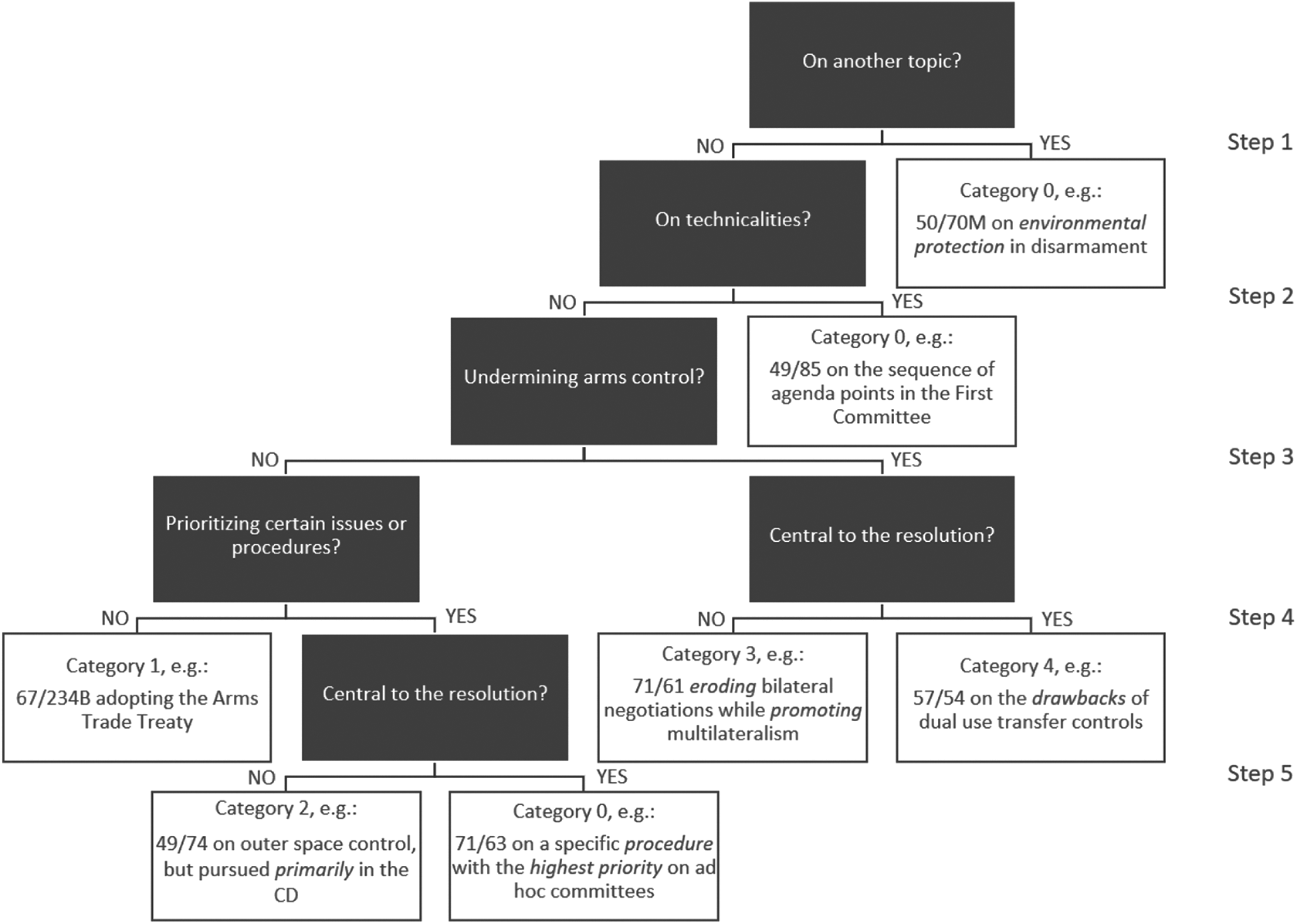
Moreover, it needs all disagreements to reflect the conflict dimension under consideration. Divergences in votes on arms control resolutions might not only originate from dissent over support or non-support for arms control. This constitutes the second challenge. For instance, states also disagree on which issues should be given priority: non-proliferation or disarmament (Barnum & Lo, 2020), multilateral or bilateral agreements (Krause, 1998: 17), nuclear or conventional arms control (Meyer, 2016), vertical or horizontal non-proliferation (Schörnig, 2017: 966), and so on.
To address these challenges, all 1,178 resolutions are manually coded. I assess on a five-point manual coding scheme whether the resolution strengthens or weakens arms control, and whether divergences in votes might result from other conflict dimensions than the one I aim to measure. The coding procedure can be regarded as a decision tree with up to five steps (see Figure 1; for a detailed description of the coding procedure, see Online appendix A).
Categories
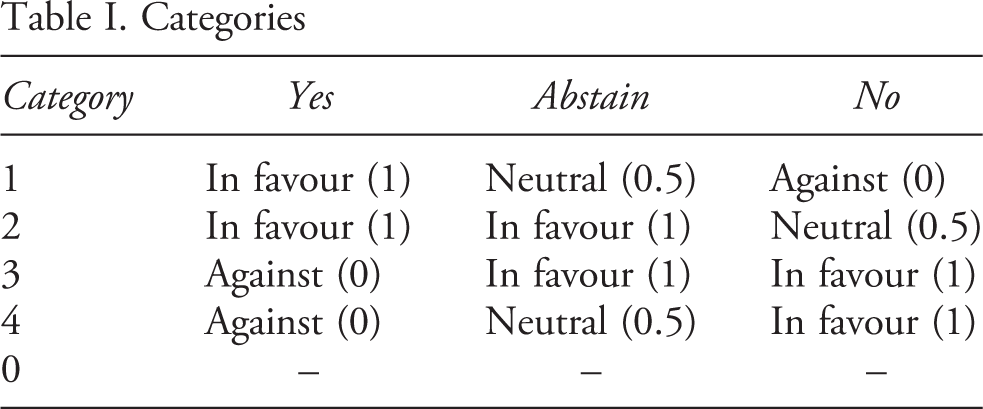
After categorizing every resolution, all votes are given a value depending on how the respective resolution is coded: 1 (91.8%), 9 0.5 (4.1%), or 0 (4.1%). This reflects the voting state’s position toward arms control. 10 I have run a variety of validation checks, which can be found in Online appendix C. For instance, I demonstrate that scores at the country and country–year levels reflect conventional wisdom. States that are known to be very favourable toward arms control such as Japan, 11 Ireland, Austria and Sweden lead the ranking. The nuclear weapon states (NWS) are ranked at the bottom, similar to states such as Syria, Egypt and Iran that have frequently voiced their opposition to arms restrictions (Crail, 2011; Jones, 1998; Trapp, 2014; Wunderlich et al., 2013). The measure also captures changes over time, for instance Russia’s decline in support after 2010 and the United States’ positional shifts related to changes of leadership.
On top of that, the variable relates to existing indicators as expected. It is barely correlated with measures that aim to measure other conflict dimensions. This includes, for example, the ideal point estimators introduced by Bailey, Strezhnev & Voeten (2017) that are also based on UNGA voting and capture alignment with the Western liberal order. In contrast, comparing my measure to indicators that are more closely related to arms control support yields higher levels of correlation. This indicates that the variable indeed captures support for arms control in its entirety, while at the same time eliminating other conflict dimensions that might bias the scores.
Independent variable
As my first measure of external threats, I use a binary variable indicating whether a state was involved in a militarized interstate dispute (MID) (Palmer et al., 2020) in a given year or not. The MID data includes militarized conflicts between states ranging from threats to use force to full-scale interstate war. For my second measure of external threats, I rely on the peace data (PD) (Diehl, Goertz & Gallegos, 2021; Goertz, Diehl & Balas, 2016). This dataset codes interstate rivalries through a number of different indicators, such as conflicting issues, a history of MIDs and the absence of diplomatic relations and communication (Diehl, Goertz & Gallegos, 2021). Again, I use a binary indicator measuring whether a state was involved in a rivalry in a given year or not. Previous studies have used both variables to measure external threats (e.g. Arbatli & Arbatli, 2014; Thies, 2007).
The first variable captures actual behaviour, including minor incidents and short-term hostilities, whereas the second variable identifies latent rivalries, that is, long-lasting hostile relationships that do not necessitate militarized action every year. Comparing both measures yields a moderate correlation of around 0.47, which indicates that there is some overlap, but they do differ to a substantial degree. By using both data sources, I capture different types of threats that might induce different kinds of reactions and hence vary in their effect on arms control support.
Empirical model
Studies of UNGA voting behaviour have pursued different approaches, treating the dependent variable as continuous, binary, 12 or ordinal with either the country–year or the single vote as the unit of analysis (e.g. Boockmann & Dreher, 2011; Dreher & Jensen, 2013; Wang, 1999). My main model is on the vote level, as this allows me to include resolution-specific controls, and linear, due to its simplicity and more straightforward interpretability. Yet, ordered and binary logit models on the vote level as well as a linear model on the country–year level are included as robustness checks and yield the same results as the main analysis.
The data are clustered on country, year and (repeated) resolution levels. 13 Therefore, I include random effects on these three levels and thus run a linear mixed-effects model. The independent variables, especially interstate rivalries, mostly vary across rather than within countries. Hence, fixed effects would largely cancel out meaningful variation. Nevertheless, a model with fixed effects for country and year is included as a robustness check and reproduces the findings from the random-effects model. 14
To avoid omitted variable bias, 15 I introduce a number of control variables that could affect the likelihood of external threats and which are prevalent in the literature on arms control and armaments. On the country–year level, I control for the level of electoral democracy (Coppedge et al., 2021), gross domestic product per capita (United Nations Statistics Division, 2020), trade openness (Feenstra, Inklaar & Timmer, 2015), government ideology (Cruz, Keefer & Scartascini, 2021), national material capabilities (CINC) (Singer, 1988; Singer, Bremer & Stuckey, 1972), and intrastate conflict (Gleditsch et al., 2002; Pettersson et al., 2021).
As the main model not only incorporates variation over time but also across countries, I further include a number of (mostly) time-constant controls. These include region (Gleditsch et al., 2002; Pettersson et al., 2021), European Union membership and North Atlantic Treaty Organization (NATO) membership, and nuclear weapons possession.
To account for agenda changes and enhance statistical efficiency, I also include four variables on the resolution level: topic, category, and global relevance, all of them assigned in the coding procedure, as well as salience, measured through the number of UNGA speeches mentioning a resolution (Finke, forthcoming). 16
Empirical analysis
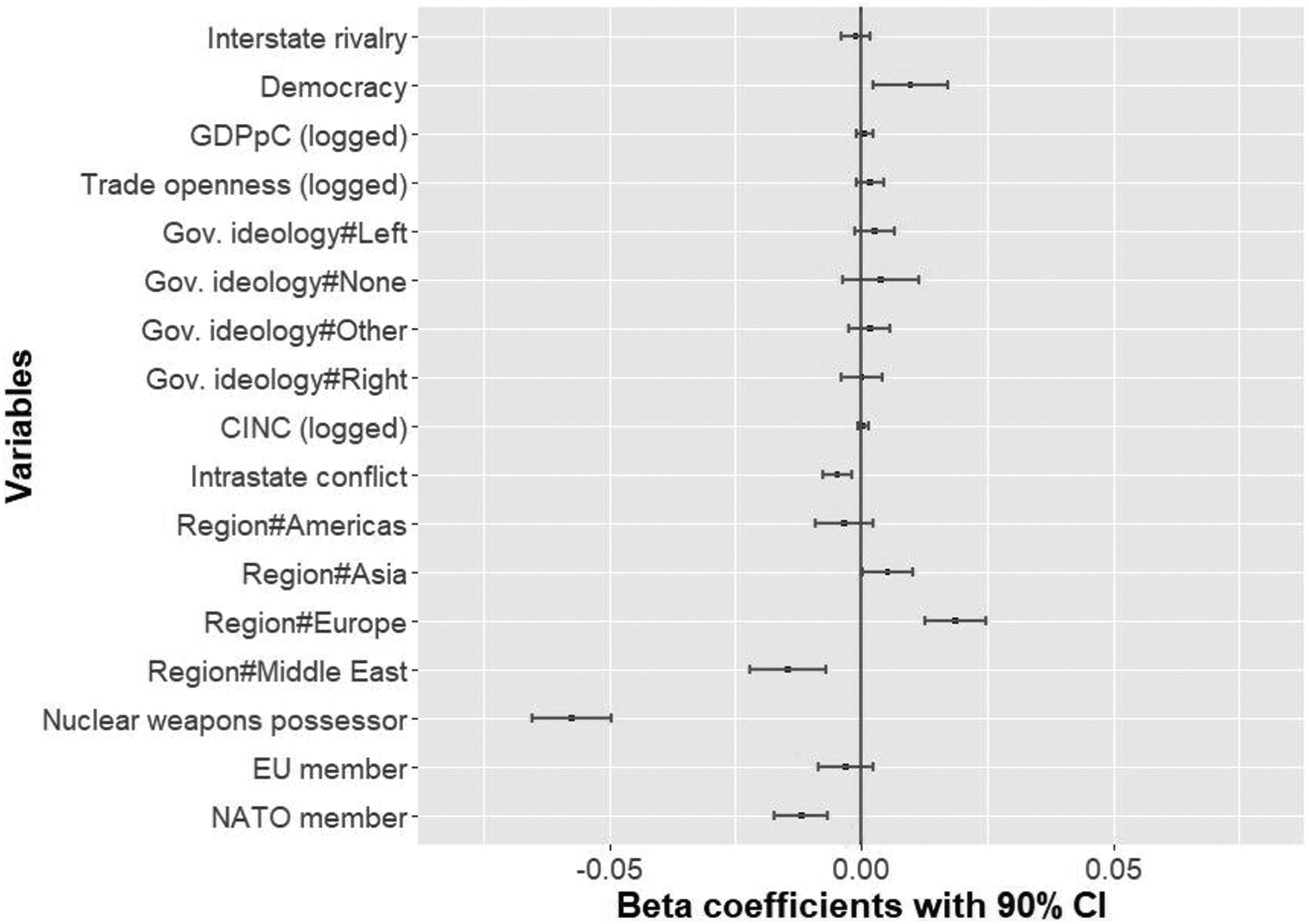
As a first step, I run bivariate analyses with both threat measures (see Online appendix F for all regression tables, including a stepwise introduction of control variables). They show a negative and highly significant relationship between interstate disputes as well as rivalries and state support for arms control. However, this relationship disappears when including random effects and control variables. In the main model (see Figures 2 and 3), the dummies for interstate disputes and rivalries yield extremely small coefficients that remain far from significant (p ≈ 0.74; p ≈ 0.52). This indicates that the negative relationship between external threats and arms control support in the bivariate model is induced by omitted variable bias. In other words, I do not find any effect of external threats on support for arms control, in the form of neither actual militarized action nor latent rivalries. Thus, the analysis contradicts the realist notion that external threats are the main factor leading states to oppose arms control.
Following Rainey (2014), I will not only discuss the results’ significance levels but also their confidence intervals to assess whether this is a true null finding or whether the results are consistent with meaningful effects. First, I define an effect size of -0.005 as meaningful, which corresponds to a negative vote shift in one out of 100 resolutions. While this might not appear to be a substantial decrease, one should keep in mind that more than half of the resolutions are adopted by consensus, and all resolutions are supported by large majorities. Accordingly, such an effect size would, on average, move a country between five and six positions downwards in the country level ranking.
Then, I examine whether the independent variables’ confidence intervals include the value of -0.005. This is neither the case for the MID dummy (-0.002; 0.002) nor for the rivalry variable (-0.004; 0.002). Thus, not
Main analysis – militarized interstate dispute data (showing country and country–year level variables only) Main analysis – peace data (showing country and country–year level variables only)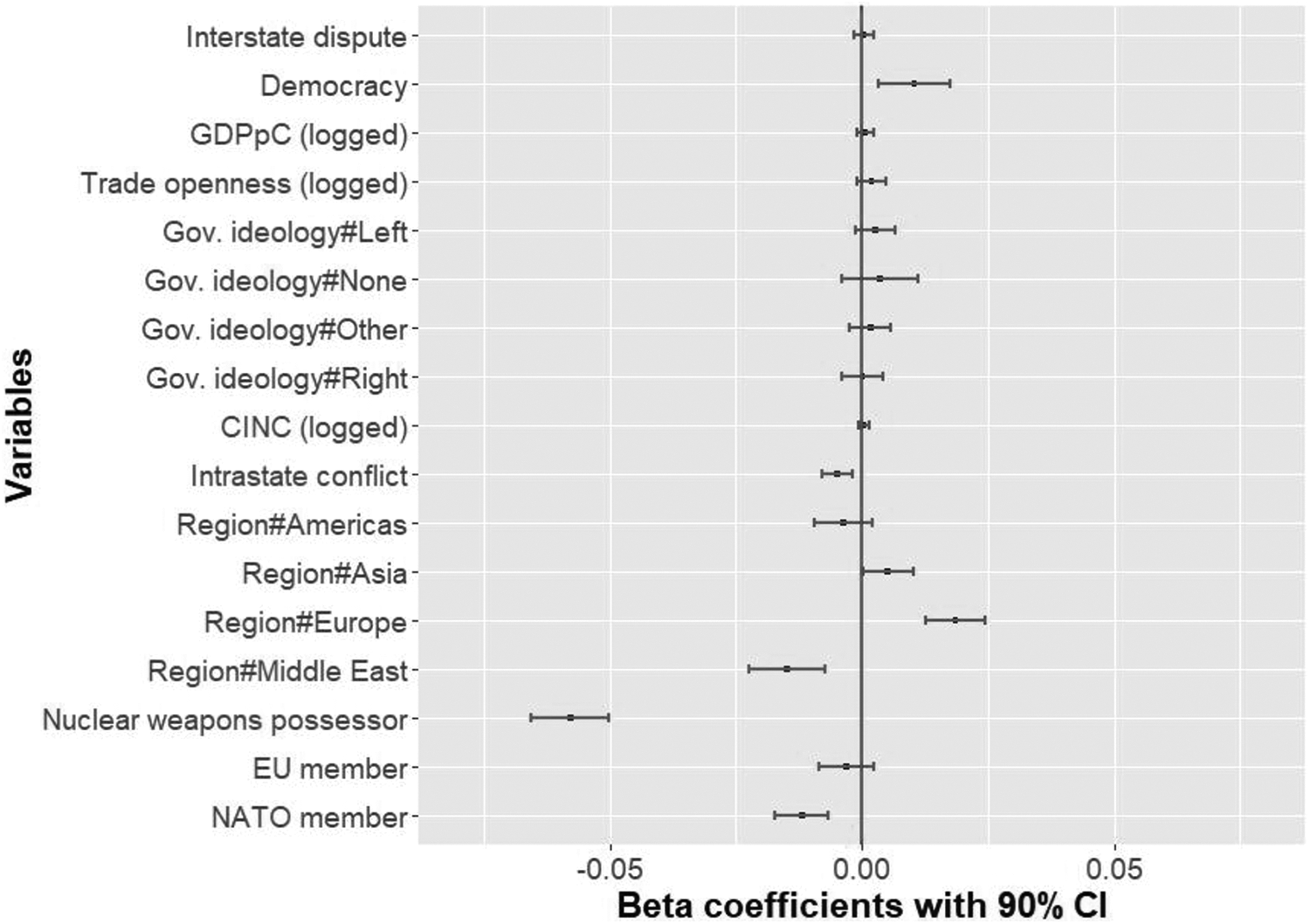
The null findings remain robust across a large variety of robustness checks. First, as indicated above, nuclear weapons possession and CINC score are related to armaments and could thus not only confound, but also mediate the relationship between external threats and arms control support. Excluding them from the analysis also yields insignificant results. Thus, the null findings are not caused by the introduction of control variables that could potentially suppress the mechanism connecting external threats and opposition to arms control.
Next, instead of binary variables, I rely on two alternative threat measures derived from the MID and PD. First, both datasets contain ordinal measures that indicate different levels of threat severity. 17 Second, I use count variables identifying the number of threats a country experiences in a given year. Moreover, I replace the independent variables with measures from other data sources. These include the continuous interstate hostility measure introduced by Terechshenko (2020) as well as binary indicators of international rivalries identified by Thompson & Dreyer (2011) and of interstate conflicts (Gleditsch et al., 2002; Pettersson et al., 2021). None of the alternative measures of external threats produce significant results. This indicates that the effect, or rather the lack thereof, holds irrespective of the operationalization of external threats.
The same holds true when running ordered logit or binary logit instead of linear models and when analysing the data on the country–year level. Using country-fixed and year-fixed instead of random effects also leads to insignificant results. So does lagging the independent and control variables – except for those on the resolution level – by one year and removing consensus votes from the analysis.
Furthermore, I run additional regression models that include only resolutions in the first category or the first two categories, respectively. Thus, I assess whether external threats only have an effect on voting with regard to those resolutions that actually strengthen arms control. Both analyses reproduce the insignificant results. This is also the case with regard to analyses that exclude nuclear weapons possessors and NATO members, respectively (i.e. states that cast a large proportion of the negative votes).
Finally, I run separate regression models for nuclear and non-nuclear votes. Although scholars have argued that the negative effect of external threats on arms control support should hold regardless of the type of weapons under consideration (Gray, 1992), most realist analyses focus on nuclear arms control (e.g. Glaser, 1994; Jervis, 1978; Kydd, 2000). Interestingly, this yields results that are less clear-cut. Both independent variables remain insignificant in the non-nuclear model, and there is no significant association between interstate rivalries and support for nuclear arms control. Yet, the MID dummy is significant and positive in the analysis of nuclear votes.
A closer look at the data indicates, however, that one should not interpret this association in causal terms. Some states are involved in an MID in several isolated years with a large number of positive votes on nuclear arms control, while voting more negatively in the preceding and following years. Lagging the independent variables in this model by one year supports this caveat, as it does not reproduce the significant result. I therefore refrain from interpreting this finding in depth. Nevertheless, it certainly speaks against a negative relationship between external threats and arms control support. Moreover, it might indicate that states do not behave the same regardless of the type of arms control under consideration, providing a promising starting point for future studies.
While not all model specifications definitely rule out a meaningful effect (see Online appendix F), the large majority, including the main models, do. More importantly though, none of them yield a significant negative association between external threats and support for arms control. In sum, the robustness checks thus confirm the findings from the main model and contradict the realist argument that the involvement in interstate disputes and rivalries decreases states’ arms control support.
There could be several reasons for the lack of a significant negative relationship. External threats might simply not affect support for arms control at all. Arms control in its current form has been criticized repeatedly for its ineffectiveness (see e.g. Krause, 2018; Schörnig, 2017). States might not regard arms control instruments as effective constraints to their armaments and, as a consequence, do not adapt their positions when faced with external threats. 18 Yet, a closer look at the control variables suggests the opposite: for instance, nuclear weapons possession and NATO membership are negatively related to arms control support. This indicates that states do consider arms control to be a relevant topic that can indeed affect their armament policies.
Another possibility is that not all interstate disputes, rivalries and conflicts constitute severe security threats. This notion runs counter to structural realist ideas: Gray (1992) claims that the arms control paradox should hold for both major powers and developing countries and for severe conflicts as well as ‘international rivalry “as usual”’ (Gray, 1992: 19). It also seems doubtful that, as previous studies have shown, such external threats raise armaments’ levels, but are not grave enough to translate into changes of arms control preferences.
I argue instead that the empirical analysis does not necessarily speak against the causal mechanism postulated above. A security threat by another state does increase the need for armaments and thus the costs of arms control. However, arms control not only restricts one state, but both states threatening each other. As Glaser (1994) has already argued, an external threat also creates a demand for restricting the adversary state’s armaments, which raises the benefits of arms control.
Even if the rival state rejects cooperative measures or is expected to do so, arms control can be a useful tool for exerting pressure and fostering cooperation through norm diffusion (Gibbons, 2018: 11–12). Moreover, many arms control measures have effective consequences for all states, even those that have not signed or ratified the respective agreement. 19 Whether these benefits or the aforementioned costs of arms control then predominate in the face of an external threat depends on the context. In the aggregate, both mechanisms cancel out each other, which causes the null findings.
The results thus speak against a strictly negative relationship between the two variables. This holds regardless of whether there are indeed two opposing mechanisms at play or whether, as described above, external threats simply do not affect arms control support. Accordingly, this study speaks against the structural realist argument that external threats are the key factor explaining states’ opposition to arms control.
Moreover, if one equates armament and opposition to arms control, the null findings appear to contradict previous studies that have identified a significant effect of external threats on the former variable. I argue that the results rather indicate that arms build-up and a preference for cooperative measures are not mutually exclusive. Armaments constitute a response to security threats that, unless it violates existing agreements, does not necessarily run counter to a supportive position toward arms control. Arms build-up could even be a strategy to create incentives for the adversary state to agree to arms restrictions. Thus, the empirical results illustrate that armaments decisions and positions toward arms control should not be conflated and that it is worthwhile studying the latter variable.
Conclusion
The aim of this article was to investigate whether external threats affect state support for arms control. To assess this relationship quantitatively, I introduced a novel measure of the latter variable that combines UNGA voting data with manual coding of 1,178 UNGA resolutions. The empirical analysis has shown that neither interstate disputes nor interstate rivalries, two common measures of external threats, are significantly related to arms control support. This finding remains robust across a large variety of model specifications.
This study contributes to the academic literature on arms control in several important ways. Given that previous studies mostly identify a positive effect of external threats on weapons acquisition, the analysis illustrates that a decision to build up arms does not always induce opposition to cooperative and restrictive measures. States might reject or embrace arms control irrespective of their own level of armaments. Hence, one cannot simply derive their arms control preferences from their armaments decisions, which demonstrates the added value of the indicator introduced here.
Moreover, the null findings speak against the argument that external threats are the main explanatory factor of opposition to arms control. This is good news for proponents of arms control, as it contradicts the arms control paradox: if external threats do not inevitably decrease support for cooperative measures, then arms control might not be impossible to achieve – even when it is needed.
Yet, one needs to consider a couple of limitations. First, this study only examines support for and not advocacy or salience of arms control. The importance that states attach to arms control, and how it is affected by external threats, is something that future studies could address – for instance relying on UNGA speeches or co-sponsorships (Finke, 2021, forthcoming). Still, although I do not measure the importance attached to arms control, I illustrate that external threats do not change states’ substantive positions on this topic. This constitutes an important first step in the study of their policy agendas toward arms control.
Second, the null findings could point toward two different theoretical explanations. They might indicate that external threats do not affect arms control support, for instance because states regard arms control as ineffective in restricting their own armaments. However, the results could also reflect an effect that is not strictly negative, but context-specific. An external threat not only raises the costs, but also the benefits of arms control, as restrictions on armaments do not only restrain the threatened state, but both sides of a dispute or rivalry.
Future research should further examine the circumstances under which external threats affect support for arms control and in which ways. Analyses should, inter alia, take into account characteristics of the adversary states or the specific form of arms control under consideration. This will shed further light on whether the empirical results are driven by two contrasting mechanisms or whether external threats and arms control support are in fact not related at all. Either way, this study contradicts the notion of a strictly negative relationship between external threats and state support for arms control. This implies that external threats alone do not explain states’ positions on arms control.
Returning to the initial puzzle of what determines state support for arms control, this begs the question of which factors play a role instead. While the analysis suggests that armaments and arms control support are not equivalent, regression results as well as country level scores indicate that the two variables are related. Beyond this, states’ alliances, for instance with NWS, can also shape their views on the necessity of controlling these weapons. Thus, membership in international organizations, such as NATO, might also affect states’ position-taking on arms control.
Moving away from structural realist ideas, which largely ignore the domestic arena, the data suggest that one should also take into account developments within states: democratic states seem to be more favourable toward arms control. Moreover, it could also be worthwhile investigating internal threats, given that most arms are used in intrastate instead of interstate conflicts. Future studies should thus investigate these as well as other potential determinants. In this regard, the position measurement introduced in this study provides a useful tool.
Footnotes
Replication data

Acknowledgements
I thank Ida Braad Albek for valuable research assistance. I also thank Laurits Florang Aarslew, Troy Saghaug Broderstad, Valentin Daur, Daniel Finke, Kristian Vrede Skaaning Frederiksen, Lasse Egendal Leipziger, Casper Sakstrup, Svend-Erik Skaaning, Jakob Tolstrup, the Comparative Politics Section at Aarhus University’s Department of Political Science, panel members at the Jan Tinbergen Peace Science Conference and the European Consortium for Political Research General Conference as well as two anonymous reviewers for their excellent comments and suggestions.
Funding
The author disclosed receipt of the following financial support for the research, authorship, and/or publication of this article: This research was supported by the Department of Political Science, Aarhus University.