




Abstract
The protection of civilians from human rights violations has increasingly become a global priority. The wars in Bosnia and Rwanda in the 1990s, and the development of the Women, Peace and Security framework have placed conflict-related sexual violence on the global protection agenda. Prior research has found that international attention to, and intervention in, conflicts is in fact more likely when there are reports of widespread sexual violence, regardless of overall conflict intensity. This article theorizes and empirically examines the micro-level underpinnings of these patterns. We hypothesize that individuals are more likely to support military intervention in conflicts with prevalent sexual violence as opposed to other types of conflict violence. The reason lies in gendered protection norms, based in benevolent sexism, that continue to have traction also in Western societies. In equivalent survey experiments carried out in the United States, the United Kingdom and Sweden, we find that support for international intervention is highest in sexual violence conflicts. In the United States and the United Kingdom, the responsibility to protect and gendered perceptions of victimhood mediate this effect. A follow-up experiment in the United States provides further evidence of a gendered protection norm as a core mechanism driving our results.
Introduction
Internal armed conflicts pose severe danger to civilians, who for ideological, economic or tactical reasons are targeted by armed actors in both lethal and non-lethal violence (Eck & Hultman, 2007; Balcells, 2010; Cohen & Nordås, 2014; Fjelde & Hultman, 2014; Meger, 2016b). In 2005, the United Nations General Assembly (UNGA) codified the responsibility to protect (R2P) civilians from genocide, ethnic cleansing, war crimes and crimes against humanity, with military force justified as the ultima ratio if the government in question perpetrates or fails to prevent these violations. While prior research has found that international intervention is more likely where conflict lethality is higher (Gilligan & Stedman, 2003; Townsen & Reeder, 2014), it is in particular conflicts with prevalent conflict-related sexual violence (CRSV) that attract international attention and peacekeeping missions (Hultman & Johansson, 2017; Kreft, 2017; Kreutz & Cardenas, 2017; Benson & Gizelis, 2020). This suggests that not all types of conflict violence are alike in activating civilian protection norms. Why is that the case?
We know little about the micro-level processes underlying macro-level intervention patterns. How do different types of conflict violence affect individuals’ support for intervention? This is the question this article seeks to answer, by examining public opinion in three Western democracies. Using international intervention patterns as our point of departure, we hypothesize that individuals are more likely to perceive the need to intervene in armed conflicts and protect civilians from harm if the latter are targeted in sexual violence as opposed to other types of violence. The reason, we theorize, is the salience of gendered protection norms anchored in benevolent sexist notions of women as harmless, innocent and non-agentic civilians in need of protection (Glick & Fiske, 1996; Glick et al., 2000; Young, 2003; Carpenter, 2005, 2006; Kronsell, 2016). As a distinctly gendered violence – in terms of its structural origins in gender inequality, gendered perpetration and victimization patterns, and discursive tropes about sexual violence as a violence people associate with women (Davies & True, 2015; Boesten, 2017; Kreft, 2020; Schulz, 2020) – we propose that sexual violence is particularly likely to activate these gendered protection norms.
We test our theoretical expectations by means of: (1) equivalent survey experiments carried out in the United States, the United Kingdom and Sweden, including a robustness study in the United States; and (2) a follow-up mechanism study in the United States. We focus on democratic states because in political systems in which leaders rely on popular support, that is, where leaders are (un-)elected in free, fair and competitive elections, public opinion has direct relevance for policy-making (Baum & Potter, 2008; Hildebrandt et al., 2013; Tomz, Weeks & Yarhi-Milo, 2020). Our results offer strong support for our hypothesis: across the three countries, individuals are significantly more likely to support a national troop contribution to an intervention in an armed conflict with widespread sexual violence, compared with widespread ethnic violence and widespread violence overall. In terms of the theorized mechanism, we obtain robust evidence that gendered protection is a core factor explaining our results in the United States and the United Kingdom, albeit not in Sweden.
These results contribute to a growing literature on public opinion, foreign policy and armed conflict, which has found individuals in Western democracies to be responsive to human rights violations and civilian protection imperatives (Kreps & Maxey, 2018; Tomz & Weeks, 2020; Tomz, Weeks & Yarhi-Milo, 2020). In showing that different types of conflict violence elicit different levels of intervention support, a process in which gendered perceptions play an important role, this study enhances our understanding of how public opinion towards the use of force is shaped. We thereby broaden the empirical scope of research on public opinion towards intervention, identifying also interesting cross-national variation.
Civilian targeting and intervention in armed conflict
Even though internal conflicts are fought between state and non-state armed actors, civilian targeting in violence, such as killings or sexual violence, is common (Eck & Hultman, 2007; Cohen & Nordås, 2014), most frequently in the form of ‘a fairly constant level of low-intensity violence’ (Eck & Hultman, 2007: 234). Since the end of the Cold War, humanitarian intervention with the goal of protecting civilians from such harms has become more of a global priority.
United Nations (UN) peace operations are equipped with increasingly multidimensional mandates that have moved beyond just ‘keeping the peace’ between armed actors. In 2005, the UNGA committed to the Responsibility to Protect (R2P) civilians from genocide, ethnic cleansing, war crimes and crimes against humanity (United Nations General Assembly, 2005). Research shows that violence against civilians in war indeed motivates international responses: peacekeeping is more likely the more deadly conflicts are in terms of both military and civilian casualties (Gilligan & Stedman, 2003). Within conflicts, peacekeepers likewise tend to deploy where violence against civilians is most severe (Townsen & Reeder, 2014).
The advent of quantitative data on CRSV has sparked research indicating that the R2P norms are activated at even higher rates in armed conflicts with prevalent sexual violence (Hultman & Johansson, 2017; Kreft, 2017; Kreutz & Cardenas, 2017; Benson & Gizelis, 2020). Thus, peacekeeping by the UN, but also by regional organizations, becomes more likely in conflicts with increasing reports of sexual violence in a given conflict-year, even when battle and civilian deaths are taken into account (Hultman & Johansson, 2017; Kreutz & Cardenas, 2017). Likewise, international actors – in particular the UN – take greater note of armed conflicts if there are reports of prevalent sexual violence. Thus, the UN Security Council authorizes more resolutions (Benson & Gizelis, 2020) and includes more references to women’s protection and gender concerns in UN peace operation mandates (Kreft, 2017) in these cases.
In sum, existing research suggests that all conflicts – and all forms of violence – are not the same when it comes to international responses. Widespread sexual violence elicits intervention where other conflict violence is less likely to do so. In this article, we examine the micro-level foundations of these patterns, that is, how different (gendered) forms of violence shape individuals’ propensity for supporting intervention. We do so by exploring public opinion in the United States, the United Kingdom and Sweden. The question guiding our study is: How does the type of conflict violence, and who is (perceived to be) targeted in this violence, shape support for intervention?
Support for intervention: examining the micro-level patterns
We hypothesize that individuals are more likely to support intervention when there is prevalent sexual violence compared with other forms of conflict violence. Our theoretical story centers on the gendered underpinnings of this violence: explicitly evoking the stereotypical notion of women as innocent victims in war, in need of protection, sexual violence elicits a commitment to R2P that other forms of violence do not. To test our hypothesis and explore the causal mechanisms, we examine perceptions and attitudes of publics in three Western democracies.
Why focus on public opinion? Can public opinion really help elucidate the micro-level dynamics of patterns observed at the macro-level, in the international sphere? Norms surrounding the protection of civilians in war are held not only by politicians, diplomats and international organization staff at the global level. These decision-makers are embedded in societies in which protection of the vulnerable and human rights are salient. Rather than emerging in a vacuum, UN resolutions both reflect norms and values that are salient in many of its member states’ societies, and further sharpen and formalize these. These institutionalized norms, in turn, then reach citizens via (social) media, political debates and public discourse. Prior research finds support for linkages between global normative developments and public opinion: R2P is a primary concern for ordinary citizens supporting intervention in armed conflict (Kreps & Maxey, 2018). These norm diffusion processes are arguably most pronounced in democracies, which rely on open political discourse and debate, and which are more likely to guarantee citizens’ access to uncensored media than authoritarian regimes.
Nor is the study of public opinion as it pertains to matters of conflict and intervention futile. Leaders in democracies have strong reasons to pay close attention to public opinion. Although the public in general pays less attention to foreign policy than domestic issues, decisions regarding the use of military force can substantively impact the outcome of elections (Baum & Potter, 2008). For instance, people’s opinion about the Iraq War strongly affected how they voted in the 2004 US presidential election (Gelpi & Feaver, 2007), while candidates and parties are severely punished at the ballot box when they appear dovish in a threatening environment (Gadarian, 2010; Croco & Weeks, 2016). Moreover, foreign policy decisions not only matter for voters’ retrospective considerations. Tomz, Weeks & Yarhi-Milo (2020) argue that leaders have strong incentives to be responsive to current public opinion on foreign policy, in particular when it comes to military interventions. Democratic leaders face institutional constraints on their powers to use military force, such as the need for legislative approval. Such constraints are more likely to bind when leaders face public opposition (Hildebrandt et al., 2013; Morgan & Campbell, 1991). In an experiment with Israeli members of parliament (MPs), Tomz, Weeks & Yarhi-Milo (2020) test politicians' responsiveness to public opinion directly. The MPs were asked to consider whether to deploy military force in a crisis and given randomized information about public opinion. The results show that the politicians were more willing to use military force when this option was favored by the public and believed that going against the public would entail heavy political costs.
Democratic leaders faced with decisions about military intervention are thus incentivized to consider public opinion both for prospective reasons – to increase their chance of reelection – and for more direct reasons, to increase their room for maneuver in dealing with an immediate crisis. Accordingly, plenty of research shows that democratic leaders pay close attention to public opinion when it comes to decisions about using military force (Baum & Potter, 2008, 2015; Sobel, 2001; Chapman, 2011).
Of central relevance to our argument, recent studies show that human rights violations play a decisive role in public opinion towards military intervention. US respondents are thus much more likely to support even risky military interventions when these come as a response to a humanitarian crisis where civilians are targeted in violence (Kreps & Maxey, 2018). Similarly, Tomz & Weeks (2020) show that respondents in both the United Kingdom and the United States are significantly more supportive of an intervention against a country described as violating human rights, even when the dispute mainly concerns military security. However, previous studies do not consider the gendered dimensions of these dynamics. We expand on existing research by: (1) examining the role of different types of conflict violence in driving support for intervention; and (2) linking these different types of conflict violence to gendered notions of victimhood and protection.
Theory: sexual violence elicits support for intervention
Our core theoretical premise is that CRSV elicits support for intervention because it activates gendered protection norms grounded in benevolent sexist notions of women as innocent, vulnerable victims. Men, the primary victims of massacres and killings in armed conflicts – even as civilians – are not similarly seen as inherently innocent, vulnerable and worthy of protection (Carpenter, 2005, 2006). Hence, forms of violence that are perceived as particularly gendered – because of their sociopolitical significance, because of patterns in perpetration and victimization, but also because of discursive tropes – are more likely to activate R2P and spark support for intervention.
Arguably, there is no form of violence more strongly gendered in these senses than sexual violence – as it is often understood as a violent manifestation of the devaluation of women and gender inequalities existing in societies (Davies & True, 2015; Boesten, 2017; Kreft, 2020). In the following, we lay out our theoretical argument about how CRSV evokes stronger, and more gendered, reactions than other types of violence.
Sexual violence and protection
After the widely reported rape of women in the wars in Bosnia and Rwanda in the 1990s, CRSV started to be understood and confronted as a weapon of war (Crawford, 2017). International organizations, aid agencies, states, diplomats, international non-governmental organizations and humanitarian organizations have mobilized around and against CRSV since the 1990s (Meger, 2016a). Since 2008, the UN Security Council has passed five resolutions specifically on CRSV, its prevention, monitoring and handling (1820, 1888, 1960, 2106 and 2467) within the evolving Women, Peace and Security (WPS) framework. These resolutions also set up the office of the United Nations Special Representative of the Secretary-General on Sexual Violence in Conflict in 2009. States such as the United Kingdom have likewise made the fight against sexual violence in conflict a priority (Davies & True, 2017), inter alia by organizing the Global Summit to End Sexual Violence in Conflict in 2014.
This unprecedented attention to CRSV has left its mark on the global protection agenda. R2P legitimizes outside intervention in situations in which civilians face the most egregious forms of violence: genocide; ethnic cleansing; war crimes; and crimes against humanity (United Nations General Assembly, 2005). The Rome Statute of the International Criminal Court, which entered into force in 2002, formally classified sexual violence in conflict as a war crime and a crime against humanity. Prevalent CRSV thus becomes cause for activation of R2P.
Simultaneously, protection from human rights violations is one of the core pillars of the WPS framework. In fact, the protection of women – centered narrowly on CRSV – has become disproportionately emphasized within WPS to the detriment of women’s participation norms (Barrow, 2010; Puechguirbal, 2010; Ellerby, 2015; Kreft, 2017). As a New York-based UN Women employee 1 stated with some despair, many bureaucrats’ and diplomats’ minds immediately jump to rape when talk turns to women in war. In short, CRSV – and protection from it – has become the most visible gender issue in war.
Sexual violence, then, is where WPS and R2P converge and create the space for a gendered protection norm: the moral obligation to protect women from sexual violations perpetrated by armed actors. As outlined above, this is reflected in international intervention patterns (Hultman & Johansson, 2017; Kreft, 2017; Kreutz & Cardenas, 2017). But the notion that wartime sexual violence poses a fundamental threat to civilians, and in particular women, we argue, trickles down also to publics in Western democracies, through news, public discourse, celebrity-populated social media campaigns such as the UN’s Stop Rape Now campaign and the 2018 Nobel Peace Prize to Nadia Murad and Dr. Denis Mukwege. Citizens are exposed to news reporting on the sexual violence perpetrated by armed actors ranging from the Democratic Republic Congo, via ISIS to the Myanmar military.
While prior research confirms that the R2P norm is salient for regular citizens and plays a central role in support for intervention in armed conflict (Kreps & Maxey, 2018), how this norm relates to different types of conflict violence, and in gendered ways, remains unexplored. Curiously, Kreps & Maxey’s depiction of a humanitarian crisis as a ‘massacre of civilians, including innocent women and children’ (Kreps & Maxey, 2018: 1827) and of the moral obligation to protect ‘civilians, many of whom are women and children’ is distinctly gendered. While certainly realistic in terms of how vulnerability, victimhood and worthiness of protection tend to be portrayed in essentialized ways in humanitarian crises (Carpenter, 2005), the authors do not problematize the gendered nature of these humanitarian and protection frames. This is the gap we seek to fill with this article.
Gender, victimhood and protection
Gender is particularly central to the reality of CRSV. Not only are the majority of its perpetrators men and the majority of its victims women. 2 Scholars (Davies & True, 2015; Meger, 2016b; Boesten, 2017) and civil society activists in conflict-affected settings (Kreft, 2020) have highlighted that CRSV is anchored in, emerges from and reinforces gendered hierarchies that exist not only in war itself but also in the larger socio-political context in which war occurs.
As discussed in the previous section, the narrowing of the WPS framework to a focus on CRSV has made sexual violence the foremost gender concern in armed conflict. This has severe ramifications for the way policy-makers and observers perceive gender, conflict violence and protection. Feminist scholars have expressed concern that as international organizations, states, aid and humanitarian agencies prioritize CRSV in their allocation of resources, other forms of gender-based violence targeting women, whether they occur in war or in ‘everyday life’, are ignored (Douma & Hilhorst, 2012; Henry, 2014; Meger, 2016a; Mertens & Pardy, 2017).
But why does sexual violence capture such disproportionate attention and elicit intervention at higher levels than other forms of violence? What micro-level factors drive this pattern? We suggest a central role for gendered protection norms, based in benevolent sexism, that is, ‘a set of interrelated attitudes toward women that are sexist in terms of viewing women stereotypically and in restricted roles but that are subjectively positive in feeling tone (for the perceiver) and also tend to elicit behaviors typically categorized as prosocial (e.g. helping)’ (Glick & Fiske, 1996: 491). What Glick & Fiske call protective paternalism entails the notion of men as providers for, and protectors of, women as the ‘weaker sex’: even though this paternalism is well-intentioned, it idealizes women, has patronizing overtones, and shares with hostile sexism a base in traditional gender roles and a view of women’s roles in society as agentically limited (Glick & Fiske, 1996: 492–493; Glick et al., 2000). Both men and women have been found to exhibit benevolent sexist attitudes (Glick et al., 2000), and many women have (at least to an extent) internalized these (Moya et al., 2007). Because benevolent sexism is less likely to be recognized as sexism – by women and men – than outright hostile sexism, it can be harder to eradicate as a driving force in gender inequality (Barreto & Ellemers, 2005).
Especially in situations of crisis, views of innocent, non-agentic and helpless women in need of protection, even infantilized as ‘womenandchildren’
The stereotypical notions of man as the Just Warrior, embroiled in battle, and woman as the Beautiful Soul, the innocent and peaceful civilian (Elshtain, 1995) also operate in the processes of ‘gendering the state’: in discourse and popular imaginaries, the state as protector is coded masculine while civilians are feminized (Peet & Sjoberg, 2019: 8–12). Accordingly, Nagel (2019: 1836–1838) conceives of rebel-perpetrated sexual violence as ‘emasculating’ – that is, weakening in reputation – the masculine protector state in whose territory non-state actors brutalize civilians, who are symbolically conceptualized as the feminine counterpart (and, we might add, the majority of whom in the case of CRSV are women). We extend Nagel’s argument to other states in the international system, whose failure to meet their obligations under R2P can similarly be perceived as ‘emasculating’ in this sense. The conception of women as paradigmatic victims, as beautiful souls, as vaguely grouped together with underage children, we posit, only reinforces the notion of masculinist protection in the particular case of CRSV, which primarily targets women.
We contend, therefore, that benevolently sexist notions of women in need of protection are particularly salient in the case of sexual violence. This violence, moreover, is often construed also as an attack on women’s purity as mothers and nurturers (Glick & Fiske, 1997: 122) and their honor (Kreft, 2020: 473), concepts that are idolized in benevolent sexism (Glick & Fiske, 1996, 1997). This may further contribute to sexual violence being perceived as particularly, or even uniquely, gendered. Simultaneously, the failure of masculinist protection will likely loom larger than for other, less gendered, forms of violence. Based on these considerations we formulate the following hypotheses:
Here, considering support for intervention in a high-CRSV conflict compared with a conflict with widespread ethnic violence constitutes a hard test of our theory. Many of the conflicts covered most in the media have had an ethnic dimension, such as the wars in Bosnia, Rwanda, Myanmar or Iraq (ISIS). These conflicts have been on the news for being very violent, with civilians specifically targeted in violence, including massacres, and displaced en masse. Just like sexual violence, ethnic violence is thus likely to evoke a graphic form of conflict violence. To further ensure that it is not the graphic nature of CRSV that increases support for intervention among respondents, we run additional experiments (on US samples) where we replace the ethnic violence scenario with a torture scenario.
The flipside of our argument is that male victims of violence do not elicit the protection norm to the same extent as women victims. To further probe this notion, we examine in supplementary analyses to what extent individuals perceive different types of conflict violence as gendered in terms of its victims, and how support for intervention varies if the victims are described (or perceived) as primarily female or male.
Study 1: Three-country study
Experimental design
Study 1 tests our theoretical expectations through a vignette experiment based on the description of a hypothetical but credible conflict scenario (see Tomz & Weeks, 2013 for a comparable design). To increase generalizability and explore scope conditions for the effects, we fielded the study in three different countries: the United States; United Kingdom; and Sweden. The United States is the most powerful and significant military actor globally and of immense importance when it comes to potential military intervention. The United Kingdom is a major player in Europe and globally and, with direct relevance to our theoretical framework, initiated the Preventing Sexual Violence in Conflict Initiative in 2012. Both the United States and United Kingdom are permanent members of the UN Security Council and North Atlantic Treaty Organization member states. Sweden is a middle power, but prioritizes gender equality in its feminist foreign policy.
The experimental design was pre-registered (prior to access to outcome data) on Evidence in Governance and Politics platform on 1 September 2017.
3
The conflict scenario was described as follows (for minor modifications to adjust to different national contexts, see the Online appendix):
A poor country has been ravaged by an increasingly violent civil war for the last seven years. After the president refused to step down following his defeat in the presidential election, rebel groups started challenging the government. The conflict soon spiraled out of control,
The outcome question asks about support for a national troop contribution to international intervention: ‘How likely would you be to support [the United States/ United Kingdom/Sweden] providing troops to an international military intervention in the described conflict
Predicted support for military intervention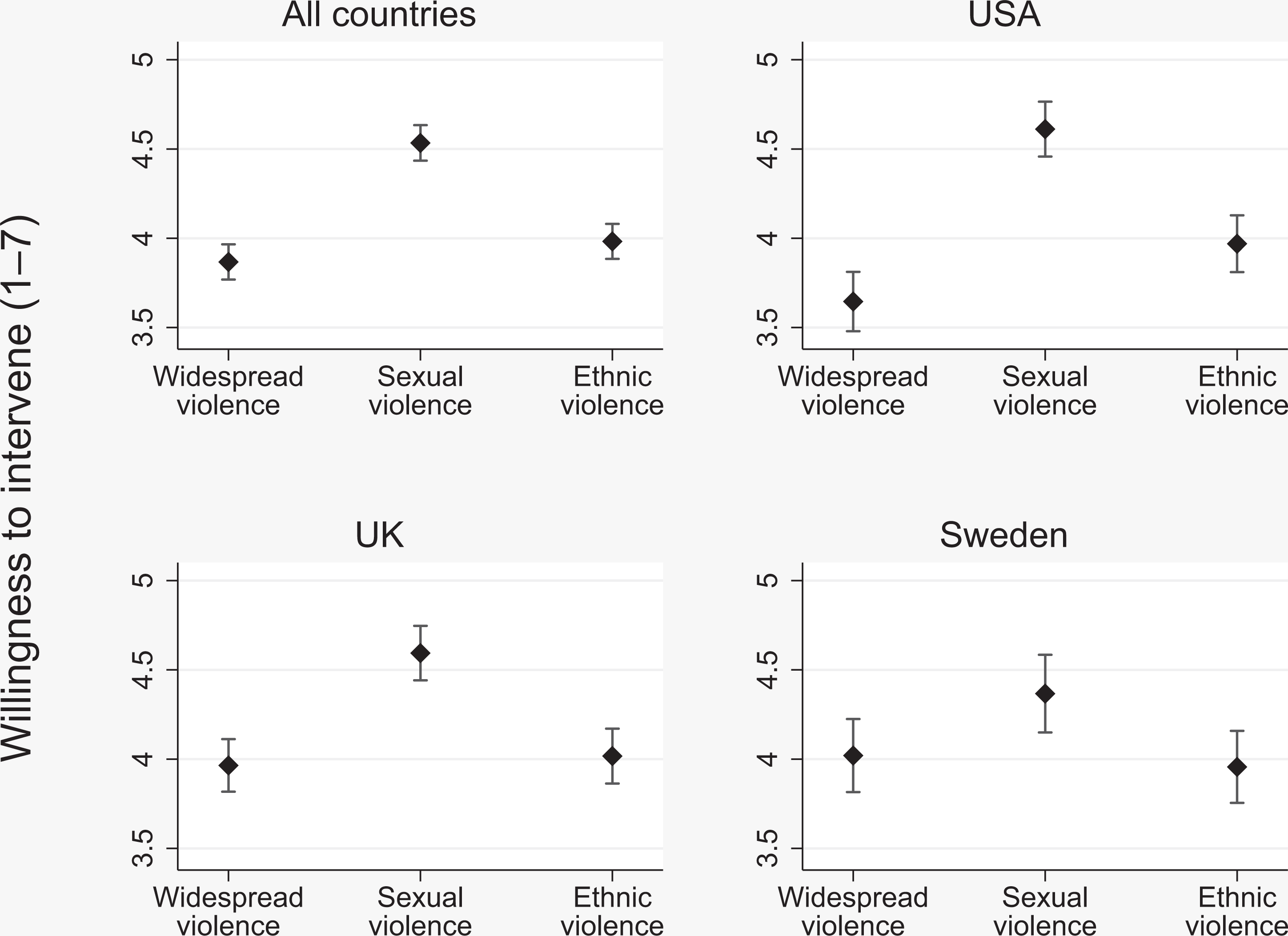
Sampling
The survey was administered to 1,244 US and 1,231 UK respondents using the online platform Prolific (Palan & Schitter, 2018). A slightly reduced version of the experiment was administered to 1,019 respondents in Sweden in the context of the European Values Studies survey in 2017 and 2018. Due to some irregularities in the data collection process for the Swedish sample, and to field the full experiment in Sweden, we ran a replication study in Sweden (see Online appendix E). In general, the Swedish replication closely matched the original results. Descriptive statistics for all included samples can be found in Online appendix F.
Results
We hypothesized that respondents are more likely to support military intervention in a conflict with widespread sexual violence compared with a conflict with general widespread violence (H1a) and widespread ethnic violence (H1b). To test these hypotheses, we first regressed the outcome variable (support for military intervention) on a treatment indicator variable. We estimated this model using ordinary least squares (OLS) and allowed the treatment effect to vary by country, and then used the estimates to compute the predicted support for military intervention under the three conflict scenarios. We display the main results graphically in the article; full estimates and a detailed description of the statistical model can be found in Online appendix G.
Effect sizes for the intervention outcome: all countries

* Cohen’s d estimate. 95% confidence intervals based on bootstrap standard errors (2,000 replications) in parentheses.
For the United States and United Kingdom, the effect sizes when comparing sexual with widespread violence should be considered substantial (see Lakens, 2013). For Sweden, the corresponding effect is about half the size. When comparing sexual and ethnic violence, the effect sizes are slightly smaller for the United Kingdom and United States, but still in the realm of what is often considered a medium effect size (see Table I). A different way of conceptualizing the meaningfulness of these results is to consider the likely effect on public opinion. To do this, we recoded the outcome variable into a binary variable indicating whether a respondent supports intervention (answering above 4) or not (4 or below). We then estimated the original model but with the modified outcome, thus predicting the probability of supporting intervention. The results (for all three countries), reported in Online appendix F, show that the sexual violence treatment is estimated to move public opinion from being against intervention (about 40% support for the widespread and ethnic treatments), to supporting intervention (about 60% support for the sexual violence treatment). These opinion effects are even more pronounced in the United States sample. Such a shift is obviously highly consequential in a democracy and speaks to the overall relevance of the results in Study 1. In line with both H1a and H1b, we thus estimate a strong positive effect of the sexual violence treatment compared with the other treatment groups. The effects for the United States and United Kingdom are stronger than for Sweden. 4
Our argument holds that (gendered) protection norms are a plausible driver of the results reported above. Supplementary analyses reveal that – as predicted by our theoretical discussion – respondents are particularly likely to view a conflict with sexual violence as highly gendered in terms of victimization; and to view women as less agentic than men in all conflict scenarios, but mostly so in sexual violence conflicts (see Online appendix D). We also incorporated an additional outcome variable in the survey experiments, asking respondents to rank-order post-conflict priorities in the described conflict scenario (for full details see Online appendix B). We find that US and UK respondents are more likely to prioritize the inclusion and empowerment of women in the peace process if they are presented with the widespread sexual violence scenario. These results lend further support to our theoretical contention that conflicts with widespread sexual violence are perceived as more gendered, thus also necessitating a ‘gendered response’.
To further probe if a gendered protection norm may be at play, we explore if a felt responsibility to protect civilians is a plausible mechanism connecting sexual violence to higher support for military intervention. We first regressed the R2P question on the treatment variable. As hypothesized, we found that the treatment variable was significantly related to the R2P question, but only in the UK and US experiments. We then proceeded with the samples from the United Kingdom and United States and estimated a mediation model, using the intervention question as the outcome, the R2P question as the mediator and the treatment variable as the main independent variable (controlling for the two other mechanism variables). We used the algorithm in Imai et al. (2011) to estimate the model.
As shown in Table II, a substantial part of the total effect is mediated by the R2P variable in the US and UK experiments. We do not find evidence for this mediation effect in the Swedish experiments (original or replication). While the results from this analysis are in line with our ‘gendered protection norm’ argument (for the US and UK samples), they should mainly be viewed as suggestive, given the known difficulties in estimating mediation effects (Green, Ha & Bullock, 2010).
Mediation analysis: percentage of the effect mediated by responsibility to protect (R2P)
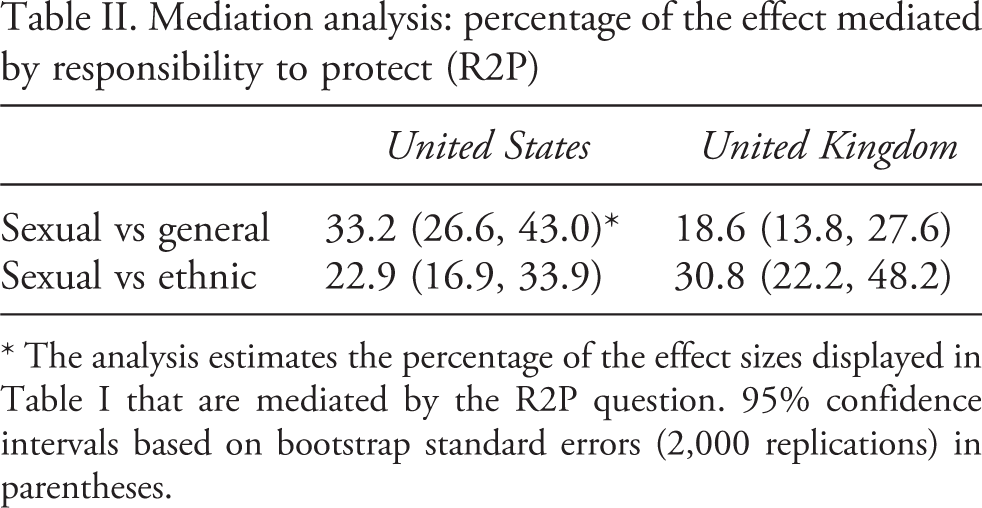
* The analysis estimates the percentage of the effect sizes displayed in Table I that are mediated by the R2P question. 95% confidence intervals based on bootstrap standard errors (2,000 replications) in parentheses.
Overall, we find strong evidence in favor of our hypotheses in the US and UK experiments. The analysis also provides suggestive evidence in favor of our proposed R2P mechanism. The results from the Swedish sample go in the expected direction for H1a and H1b, but the effect sizes are smaller, and we find no evidence that R2P mediates this effect. Our theoretical expectations are thus only partially supported in the Swedish case.
Robustness study
We conducted a robustness study in the United States to address three specific concerns about potential confounding factors. First, it is possible that respondents associate our sexual violence treatment with violence against ‘civilians’ in general, while this association may be less strong in the other two treatments. Given that this is the main mechanism proposed in Kreps & Maxey (2018), it is important to disentangle the gendered dimension of sexual violence from this more general response. Second, prompting respondents to think about sexual violence simply might elicit more graphic mental images than widespread (ethnic) violence. Third, in particular in light of global discourses surrounding the use of sexual violence as a weapon of war, sexual violence may be perceived as containing a tactical element that the other forms of violence do not, and that it is therefore viewed as more policeable. In sum, this would constitute a violation of what Dafoe, Zhang & Caughey (2018) term ‘information equivalence’ between the treatment conditions. To address these concerns, we replicated the experiment in the United States with slightly altered treatment conditions.
Respondents read the same basic vignette, but with the treatment changed to: resulting in widespread violence against civilians/ with widespread use of sexual violence against civilians/ resulting in widespread use of torture against civilians. We thus hold the mention of ‘civilians’ constant across conditions and introduce a torture condition that, like sexual violence, is likely to elicit graphic mental images and could be described as more clearly ‘tactical’ than widespread ethnic or overall violence. Even in this altered setup, we find very similar results. These are reported and discussed in more detail in Online appendix C. While the results are slightly weaker, all patterns presented in the main results replicate: respondents given the sexual violence treatment are the most likely to be in favor of intervention and to view women as the most likely victims of violence. We also find the same patterns with regard to the mediation analysis. Our results are thus robust to modifications of the vignette that provide a tougher test of our theory and the results are not significantly confounded by the aforementioned variables.
Study 2: Mechanism study
Experimental design
We designed Study 2 to further test the robustness of our results and to provide a more thorough analysis of gendered protection as the mechanism driving the results. We focus on only the US population since the results for the UK and US samples were very similar in Study 1. The design of the study resembles the original design with a description of a hypothetical but credible conflict scenario. In the scenario we contrast a sexual violence treatment with a torture treatment since we believe this comparison constitutes a harder test for our theory. However, we also made some modifications to the experiment. First, we added details to the description of the conflict scenario to be able to hold more factors constant across treatments. This is to alleviate the concern that some respondents might infer information based on the treatments and that this therefore would violate the assumption of information equivalence between treatment conditions (Dafoe, Zhang & Caughey, 2018). Specifically, we hold the following factors constant in the new conflict scenario: the region of the country; the scale of the violence (number of victims); the cost of the intervention (number of troops being deployed); and the expected success of the intervention. We also specify that all armed actors perpetrate violence against civilians. The full scenario can be found in the Online appendix.
Second, we use the framework described in Acharya, Blackwell & Sen (2018) to analyze direct and indirect effects. Specifically, we are interested in how much of the observed treatment effect is mediated by respondents having a gendered perception of the scenario. While the R2P question and the question on victimization in Study 1 explore this indirectly, we chose here a more direct test that involves randomly fixing the assumed mediator, that most victims are women, in some scenarios (Acharya, Blackwell & Sen, 2018). This allows us to estimate to what extent the mediator contributes to the overall effect of sexual violence.
The experiment consists of two different main-treatment arms (sexual violence/torture). For each main-treatment arm we add a manipulated-mediator arm where we fix the gender-mediator in the conflict scenario, telling respondents that most victims are women. This lets us estimate the total average effect of sexual violence (compared with torture), the controlled direct effect of sexual violence (the effect when the mediator is held constant in the manipulated-mediator arm) and how much of the total effect can be attributed to the mediator. Finally, we also added a variation to the mediator arm for the sexual violence scenario where we state that most victims are male. This allows us to estimate the effect of gender conditional on sexual violence.
The study was pre-registered on the Open Science Framework 5 with three hypotheses: that there is a main effect of sexual violence (H1); that part of this effect is explained by the gender mediator (H2); and that there is a direct effect of gender, conditional on sexual violence (H3). See Online appendix D for formal statements of the hypotheses and additional details about the study.
Sampling
We fielded the follow-up study on Prolific between 25 and 28 September 2020 to 2,406 US respondents.
Results
To estimate the overall treatment effect, as well as the treatment effect in the manipulated-mediator arm, we estimated a basic model where we regressed the intervention outcome on a sexual violence-dummy, a dummy for the manipulated-mediator arm and the interaction between the two variables. The model was estimated with OLS and robust standard errors (see Online appendix D). We then computed predicted values based on the results which are presented in Figure 2.
First, the left-hand panel of Figure 2 shows that we again find a main effect of the sexual violence treatment when contrasted with the torture treatment, even in the modified scenario with more details added. The effect is highly significant (p < 0.001) with an effect size (Cohen’s d) of 0.27 (0.14–0.40). The right-hand panel of Figure 2 shows the same contrast where we fix the gender mediator by telling respondents that most victims are women. This effect is – in line with our theoretical expectations – considerably smaller (d = 0.12, p = 0.06). It should be noted that the difference between these two effects does not reach conventional levels of statistical significance (p = 0.096), probably because the study lacks some statistical power to estimate this difference.
Overall, we interpret these results as suggesting that the gender mechanism is important in explaining the observed pattern. A plausible interpretation, in line with our theoretical argument, is that people in the main treatment arm assume that most victims are women when they get the sexual violence treatment and support intervention to a higher degree because of this. Simultaneously, there is some evidence of a direct effect of sexual violence when comparing treatments when the mediator is fixed (right-hand panel of Figure 2). Moreover, we also find a direct effect of gender (H3) when conditioning on sexual violence and comparing the treatments saying that most victims are female versus male (this result is reported in Online appendix D). The support for intervention is about 0.2 steps higher in the ‘female victims’ scenario (d = 0.13, p = 0.047). Likewise, support for intervention in the torture scenario increases when victims are described as primarily female, compared with when no description of the victims is provided. These results lend further support to our theoretical story of the salience of gendered protection norms, regardless of the type of violence. Finally, we also included two questions tapping into benevolent sexism for exploratory purposes, taken from Glick & Fiske (1996). The data suggest that the sexual violence treatment effect is strongest for respondents scoring higher on an index based on the two questions. This interaction effect, while not significant at conventional levels, thus provides additional suggestive evidence in favor of our theoretical argument (see Online appendix D for details).
The results of the follow-up study are insightful for two reasons. First, they show that the observed effect of sexual violence in the main experiments is unlikely to be confounded by respondents inferring additional information from the treatment. Second, they provide further evidence in favor of gendered protection norms as an important mechanism driving our results.
Discussion and conclusion
We have hypothesized that sexual violence in armed conflict elicits support for international intervention in armed conflicts, at higher levels than other types of conflict violence. Corroborating macro-level studies finding a higher likelihood of (military) intervention in conflicts
Predicted support for military intervention (US study 3)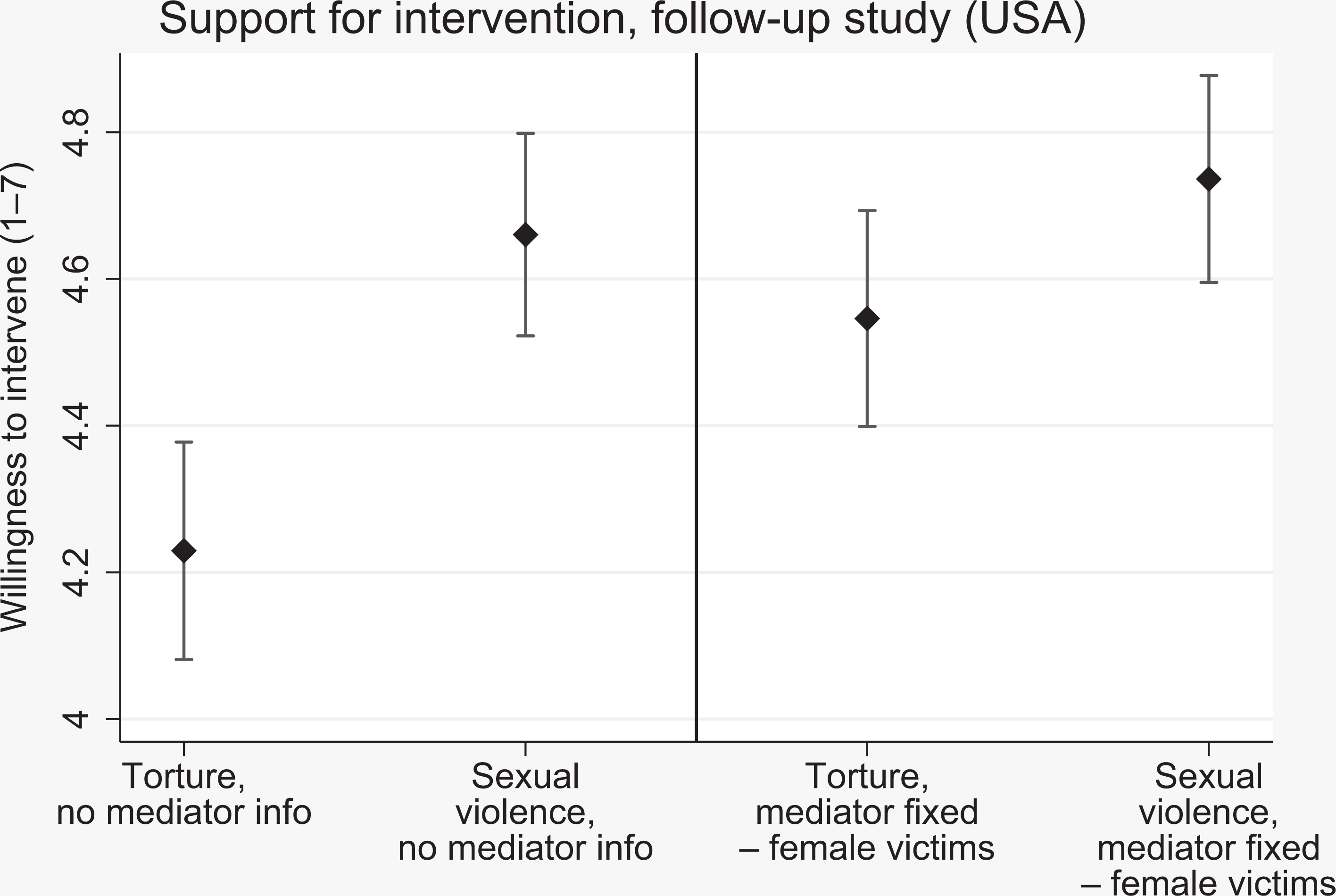
The reason for the observed pattern, we argue, lies in gendered notions of victimization and protection. As a distinctly gendered violence (understood as) primarily affecting women, sexual violence is more likely than other conflict violence to activate protection norms based in benevolent sexist notions of women as innocent, non-agentic victims in need of protection. Supplementary analyses reveal that at least in the United States and the United Kingdom, R2P is indeed invoked at higher levels in conflicts with prevalent sexual violence compared with both conflicts with widespread ethnic violence and widespread violence overall and that it mediates part of the sexual violence effect. We also took a closer look at perceptions of victimization patterns. As per our theoretical expectations, survey respondents think that women are more likely to be victims in a conflict with prevalent CRSV compared with the other types of conflict.
A follow-up study (US Study 2), in which we test the mediating effect of women as victims directly, lends further support to our theoretical expectation that sexual violence is perceived as particularly gendered by default (considerably more so than torture), and that this is linked to increased support for intervention. Moreover, support for intervention in the sexual violence scenario is higher if the victims are described as primarily female than if they are described as primarily male. In further evidence of the salience of gendered protection norms generally, once women are mentioned as the majority of victims of widespread torture, support for intervention in these scenarios also increases compared with a scenario in which the gender of the civilian victims is not indicated. Across all studies, we find no large differences between male and female respondents, 6 which provides further evidence for the structural and systemic nature of gendered protection norms based in benevolent sexism. Despite the clear support we find for our gendered protection mechanism, a small independent effect of sexual violence itself transpires in the results once we hold the ‘women as victims’ mediator fixed. The highly publicized and politicized nature of CRSV, which often coincides with sensationalist reporting of graphic acts of sexualized violence, offers a possible explanation for this effect. Future research could more systematically examine the roles of (gendered) targets and (gendered) forms of violence in driving support for intervention among Western publics.
Why our results are much less pronounced in Sweden than in the United States and the United Kingdom is worthy of further investigation in this respect. The divergent findings for the United States and United Kingdom versus Sweden in terms of the effect size for intervention support in the sexual violence treatment, the salience of R2P and more weakly gendered perceptions of victimization patterns suggests that our theory does not operate universally in Western democracies. We consider it plausible that with dissipating gender roles and expectations in society, the essentialist notions underpinning protective paternalism fall away, and both victimhood and protection imperatives are viewed in less gendered terms. In countries with high domestic gender equality (e.g. Norway or Iceland) public opinion patterns might thus be closer to the Swedish results, whereas those for other Western democracies (e.g. France, Germany or Spain) might be more similar to the results for the United States and the United Kingdom. Whether domestic gender equality is indeed the driving factor behind the variation we observe is an avenue for future research.
Regardless of these cross-national variations, it is encouraging that people consider CRSV a severe enough violence to justify intervention. CRSV is no longer tolerated as collateral damage; global awareness has clearly changed, and not just among international policy-makers. Moreover, the gendered understanding of CRSV may prompt activation of a broader set of gender norms, as a supplementary outcome question in our experiment suggests: US and UK respondents are more likely to prioritize the inclusion and empowerment of women in the peace process if confronted with the sexual violence scenario. CRSV may thus serve as an ‘entry point’ for gender-responsive policies in conflict-affected settings, as a Western diplomat based at the UN in New York put it. 7 According to that diplomat, the victimization of women in war, and in particular their victimization in CRSV, is what gains diplomats’ and senior policy makers’ attention – especially so if they are older men – and then allows a broadening of the focus to the wider range of WPS issues, including promoting women’s agency (see also Kreft, 2017).
Yet, higher sensibility to gendered patterns of victimization in armed conflicts also comes at a cost. Our results show that respondents generally perceive women as the more likely victims of violence in conflict than men, that is, also in the conflict scenarios with widespread ethnic and overall violence. This is curious insofar as (civilian) men are considerably more likely to be victims of the most lethal form of violence in armed conflict – killings and massacres – than women are (Carpenter, 2006). The salience of the women’s protection norm and the narratives in which it is grounded thus also sidelines the victimization and vulnerability of men. This applies, importantly, also to male victims of sexual violence. CRSV against men has been amply documented across contexts and can also occur on a large scale, but it is obscured by a gendered understanding of victimhood, and in particular of victimization in sexual violence (Schulz, 2020). This reinforces the (feminist) contention that patriarchal norms, whether expressed as hostile or benevolent sexism, hurt men as well as women.
Beyond the specific empirical focus on military intervention in armed conflict, in itself a major foreign policy issue, the results of this study thus also illustrate problematic patterns of who is considered a victim, vulnerable and in need of protection (women) and who is overlooked in public and policy discourses (men). This is bound to have a bearing also on attitudes towards other policy questions, such as acceptance of and attitudes towards refugees. Our study thus opens up for more fine-grained research into public opinion on men’s vulnerability and its policy implications.
Footnotes
Replication data

Acknowledgments
We thank Carlo Koos, Hannah Smidt, Ingrid Vik Bakken, Marius Wishman, participants of SPSA 2020 (Luzern) and PRIS 2019 (Göteborg), members of the gender research group at Chr. Michelsen Institute, the editor, and anonymous reviewers for useful comments, and the European Values Studies survey for running our survey experiments in Sweden.
Funding
We gratefully acknowledge financial support from Stiftelsen Lars Hiertas Minne and Wilhelm & Martina Lundgrens Vetenskapsfond.