




Abstract
How does inequality within and between ethno-religious groups influence the likelihood and frequency of communal riots? Using evidence from India, this article finds that low within-group and high between-group inequality dampens the likelihood and frequency of communal riots. Theoretically, the article suggests that the instrumental logic, which posits that ethnonationalist politicians use violence to stoke ethnic cleavages and mobilize support, best accounts for this finding. We argue that to be politically competitive, ethnonationalist politicians need their supporters to identify foremost with their ethnic identity. When inequality within groups is high and/or inequality between groups is low, citizens are less likely to focus on ethnicity as their primary identity. In such contexts, politicians may use communal riots to improve their electoral prospects by reinforcing the salience of ethnicity. Empirically, the article relies on a time-series cross-district analysis of inequality and Hindu–Muslim riots in India to test the instrumental argument against theoretical alternatives. To illustrate the causal logic, the article also uses the analysis of a communal riot that occurred in Muzaffarnagar, Uttar Pradesh. Analyzing three aspects of the riot – background conditions, timing, targets of propaganda – we evaluate the different predictions of the instrumental argument. The article concludes with the suggestion that communal riots are distinct from cases of mass violence – such as civil wars, genocide, and ethnic cleansing – and could be conceptualized, along with other types of small-scale political violence, as a separate class of events with their own internal logic.
Does economic inequality within or between ethno-religious groups impact the likelihood of communal riots? If so, what is the nature of this impact? The main finding of this article, based on evidence from India, is that higher levels of within-group inequality and lower levels of between-group inequality result in a higher likelihood of ethno-religious riots. We argue that this finding is compatible with the instrumental argument that leaders of ethnonationalist parties incite (or refuse to suppress) violence to serve their political interests. Specifically, these parties turn to communal violence to enhance the relative salience of ethno-religious cleavages when such cleavages seem less salient and compete with other types of political divisions.
Our main theoretical move is that the underlying logic of the instrumentalist explanation is applicable to the relationship between economic inequality and political violence. This argument posits that ethnonationalist politicians use violence to stoke ethno-religious cleavages and mobilize support. 1 Existing studies typically emphasize the observable implications of this argument as they apply to political institutions. Hence, they link institutional factors such as the timing of elections, the competitiveness of party systems, the transition to democracy, and reform movements to political violence (Figueiredo & Weingast, 1999; Snyder, 2000; Mansfield & Snyder, 2007; Wilkinson, 2004; Gagnon, 2006; Sidel, 2006; Brass, 1998; Selway & Templeman, 2012; Flores & Nooruddin, 2012; Nellis et al., 2016; Daxecker, 2020). We argue that the instrumental logic also yields testable implications for how economic inequality within and between groups affects violence. In short, in contexts in which economic inequality between groups is low and/or inequality within groups is high, ethnic and socio-economic cleavages tend to be cross-cutting and group attachment tends to be weak. In such contexts, nationalist politicians have incentives to utilize violence to underscore the political relevance of ethnicity. In contexts in which economic inequality between groups is high and inequality within groups is low, ethnicity already exists as a salient political cleavage. Under these circumstances, politicians do not spend their limited resources on further reinforcing this cleavage by inciting violence.
The article has implications for two bodies of literature. First, our results are relevant for scholarship on the relationship between inequality and political violence. The increasingly dominant approach within this field of study is the idea that political violence in the form of civil wars, genocide, and ethnic cleansing becomes more likely when socio-economic and ethno-religious cleavages reinforce rather than cross-cut each other (Horowitz, 1985; Stewart, 2008; Østby, 2008; Østby, 2013; Cederman et al., 2011; Gubler & Selway, 2012; Bulutgil, 2016; Siroky & Hechter, 2016). Additionally, some recent studies on civil wars suggest that within-group inequality enhances the organization of political violence by lowering opportunity costs and generating within-group division of labor (Esteban & Ray, 2008; Kuhn & Weidmann, 2015; Huber & Mayoral, 2019). We demonstrate that the first argument, while empirically convincing in the case of large-scale violence, does not travel to small-scale violence such as riots because low between-group and high within-group inequality increases rather than decreases the chances of this type of violence. Our results also indicate that, in the case of riots, the causal mechanism that links within-group inequality to political violence goes through not just organizational factors but also the instrumental considerations of politicians.
The article also has implications for the literature on communal riots. Scholars have identified the study of riots in India as an exemplary cumulative research program in political science (Chandra, 2006). This field of literature highlights several explanatory factors. Some scholars adopt the instrumental argument that the Hindu–Muslim riots are a way to trigger and sustain this political cleavage as the dominant one in India (Brass, 1998; Brass, 2005; Wilkinson, 2004; Dhattiwala & Biggs, 2012; Jha, 2013; Berenschot, 2012). 2 Examples include Paul Brass’ argument that Hindu nationalist organizations rely on local ‘institutionalized riot systems’ to maintain the salience of ethno-religious divisions and Steven Wilkinson’s argument that electoral incentives determine when politicians provoke, or fail to stop, riots (Brass, 1998; Brass, 2005; Wilkinson, 2004). 3 Following a different instrumentalist logic, Berenschot (2012) argues that the ability of politicians to organize riots is a side benefit of the patronage networks that ordinarily regulate everyday peaceful interactions between state and society. Recent work on Indonesia and Nigeria also finds that pre-existing social networks make it easier for political actors to find recruits from among ordinary youths when they organize violence (Krause, 2018, pp. 41–43; Scacco, 2019; Berenschot, 2020). Beyond the instrumental logic, other approaches stress institutional legacies and pre-existing interethnic relationships as factors that influence riot proneness (Varshney, 2002; Horowitz, 2003; Verghese, 2016). For example, focusing on India, Varshney (2002) argues that civic organizations prevent local incidents from turning into full-blown riots by using networks of trust that exist at the town level. Finally, scholars also explore the impact of economic and demographic factors, such as gross domestic product (GDP) growth, the income levels of ethnic groups, and population growth on Hindu–Muslim riots in India (Bohlken & Sergenti, 2010; Mitra & Ray, 2014; Mitra & Ray, 2019; Urdal, 2008; Scacco, 2019).
This otherwise vibrant literature largely ignores the potential effect of economic inequality within or between groups on communal riots. 4 The lack of interest in inequality is surprising given that existing studies using data from India and elsewhere have amassed significant empirical evidence indicating that within- and between-group inequality influence non-violent political mobilization in the form of voting and party system formation (Huber & Suryanarayan, 2016; Dunning & Harrison, 2010; Bulutgil & Prasad, 2020; Houle et al., 2018). Our article establishes a link between these studies and the study of political violence by showing that economic inequality within and between ethnic groups also influences violent political mobilization in the form of riots.
We proceed in four sections. The following section outlines the three main approaches and their implications for inequality and Hindu–Muslim riots in India. We then discuss our data, describe our dependent and independent variables, and present our results. Next, we focus on one riot to evaluate the causal logic of our argument. Finally, we conclude by highlighting the broader implications of our findings.
Economic inequality and ethno-religious riots: Three approaches
There are three main arguments that connect inequality within and between groups to political violence in general and ethno-religious riots in particular: the grievance-based argument, the organizational argument, and the instrumental argument. In this section, we outline these approaches and their predictions.
Inequality, grievances, and riots
A longstanding body of literature in comparative politics shows that sociopolitical cleavages and their interaction with each other influence nonviolent political mobilization such as party formation and voting as well as violent mobilization such as civil wars and communal conflict (Lipset & Rokkan, 1967; Lijphart, 1977; Chandra, 2007; Dunning & Harrison, 2010; Cederman et al., 2011; Gubler & Selway, 2012; Hillesund, 2017; Huber & Suryanarayan, 2016; Houle et al., 2018; Higashijima & Houle, 2017; Bulutgil & Prasad, 2020; Tudor & Ziegfeld, 2019). The logic of these arguments is that when social cleavages such as ethno-religious divisions cross-cut rather than overlap with other divisions such as economic ones, ethno-religious divisions become less visible and intergroup relations are less polarized.
Following these studies, scholars have suggested causal mechanisms through which overlapping ethnic and economic cleavages could generate grievances that might result in political violence. These mechanisms include relative deprivation, economic demands from underprivileged groups, intergroup polarization, and the absence of cross-cutting associations that might diffuse tensions (Horowitz, 1985; Cederman et al., 2011; Bulutgil, 2016; Bulutgil, 2017; Varshney, 2002; Selway, 2011). The last decade has brought significant empirical progress to this literature as scholars have started to specifically measure between-group (horizontal) inequality rather than individual-level (vertical) inequality (Østby, 2008; Cederman et al., 2011; Stewart, 2008).
The main empirical prediction of the grievance thesis relates to the impact of between-group inequality on political violence. Following the logic of this argument, we should observe that higher levels of between-group inequality increase the likelihood of Hindu–Muslim riots in India. However, the underlying argument also has potential observable implications for within-group economic inequality. High levels of within-group inequality might make it less likely that the members of a given ethnic group would agree on the same economic grievances and feel the same level of polarization vis-à-vis the members of the other ethnic group/s in the society. Moreover, higher levels of economic inequality within an ethnic group might also reduce the extent to which individuals in the group share lived experiences and feel attachment to each other. If this reasoning is correct, higher levels of within-group inequality should make political violence in general and communal riots in particular less likely.
Inequality, organizational factors, and riots
Another argument links high within-group economic inequality to violence using the logic of collective action (Esteban & Ray, 2008; Kuhn & Weidmann, 2015; Huber & Mayoral, 2019; Vogt, 2018). The idea is that when within-group inequality is high, the wealthy members of the group can act as funders and initial organizers whereas the poorer members provide the cheap labor needed to form and sustain the rebel organization. In this story, the primary role of within-group inequality is as a factor that enhances organization and recruitment as opposed to a factor that motivates violence. Recent studies using cross-national data have provided evidence that links within-group economic inequality to civil war initiation or the intensity of violence during civil wars (Kuhn & Weidmann, 2015; Huber & Mayoral, 2019). To the extent that the organizational logic also applies to communal riots, this argument would predict that higher levels of within-group inequality also increase the likelihood of Hindu–Muslim riots in India. Additionally, this argument would also predict that riot organizers would target co-ethnics from poor backgrounds for mobilization and recruitment.
The collective action model does not provide clear expectations for whether and how between-group inequality influences political violence. The studies that emphasize organizational factors suggest two predictions. First, some argue that economic inequality between groups motivates violence whereas organizational factors determine whether actors can turn their motivation into political action. In line with the grievance argument, these studies predict that higher between-group inequality should increase the likelihood of political violence (Kuhn & Weidmann, 2015). Second, some studies that focus on organizational factors suggest that the relationship between between-group inequality and the onset of political violence is theoretically and empirically questionable (Huber & Mayoral, 2019). They raise issues such as the low chances of victory for poor groups and high opportunity costs for wealthy groups that undermine the logic of the argument that connects between-group inequality to political violence. Their expectation is that we should not find a relationship between horizontal inequality and communal riots in India.
Inequality, instrumental logic, and riots
There is also the longstanding instrumental argument that leaders use violence as a tool to achieve political ends (Tilly, 2003: 34–41; McAdam & Tarrow, 2010). The idea that political entrepreneurs use actual or threats of violence to generate a fear of the other has been applied to contexts as varied as ancient Greece, medieval Europe, contemporary Balkans, and ethno-religious riots in India (Brass, 1998; Figueiredo & Weingast, 1999; Snyder, 2000; Wilkinson, 2004; Brass, 2005; Sidel, 2006; Mansfield & Snyder, 2007; Gagnon, 2006; Evrigenis, 2009; Brancati & Snyder, 2011; Berenschot, 2012; Malik, 2021).
In this literature the emphasis has largely been on institutional factors that enable or encourage elite manipulation of violence to fulfill political goals. Some scholars argue that transitions to democracy generate electoral incentives for inciting ethnic violence and a temporary institutional vacuum that permits such violence (Snyder, 2000; Wilkinson, 2004; Gagnon, 2006; Mansfield & Snyder, 2007; Brancati & Snyder, 2011). Others argue that authoritarian leaders use violence to divert attention from reformist demands and prevent the transition to democracy (Figueiredo & Weingast, 1999). Yet others argue that when ethno-religious cleavages compete with other divisions in the society, democratic institutions themselves trigger violence as politicians with an ethno-religious agenda incite or refuse to quell violence in contexts where electoral competition is intense (Brass, 1998; Wilkinson, 2004; Brass, 2005). The electoral logic is particularly dominant within the literature on ethno-religious riots in India, with scholars tying indicators of political competition such as effective numbers of parties, margins of electoral victory, and electoral periods to the number of riots (Engineer, 2002; Wilkinson, 2004; Berenschot, 2012; Dhattiwala & Biggs, 2012; Bohlken & Sergenti, 2010; Nellis et al., 2016; Daxecker, 2020, for a critical evaluation see, Corbridge et al., 2012).
We argue that because the instrumental approach is fundamentally about acquiring and maintaining political power, it also has implications for how inequality between and within groups might influence communal riots. The underlying logic of the instrumental argument is that politicians with an ethnonationalist agenda use violence to sustain or reignite the political relevance of ethno-religious divisions. It makes sense to expect that they would pursue this strategy not across the board but specifically in contexts where the ethno-religious cleavages are comparatively weaker or anticipated to lose their prominence. 5
This optimization of choice would be desirable for two reasons. First, from the perspective of the politicians, there would be political risks associated with inciting or encouraging a riot. If the riots get out of hand and significantly disrupt social and economic life, this might lead to a general backlash in the population against those connected to the violence. 6 Moreover, it is also conceivable that the political elite and/or their followers would face prosecution or pay a political price in the future. 7 Second, the politicians in question would face certain costs associated with organizing a riot, such as finding recruits willing to participate and ensuring that local law enforcement does not intervene in a timely manner. Given these actual and potential costs, ethnonationalist politicians should turn to violence when they cannot find alternative means of convincing their co-ethnics that ethno-religious divisions are of primary political importance.
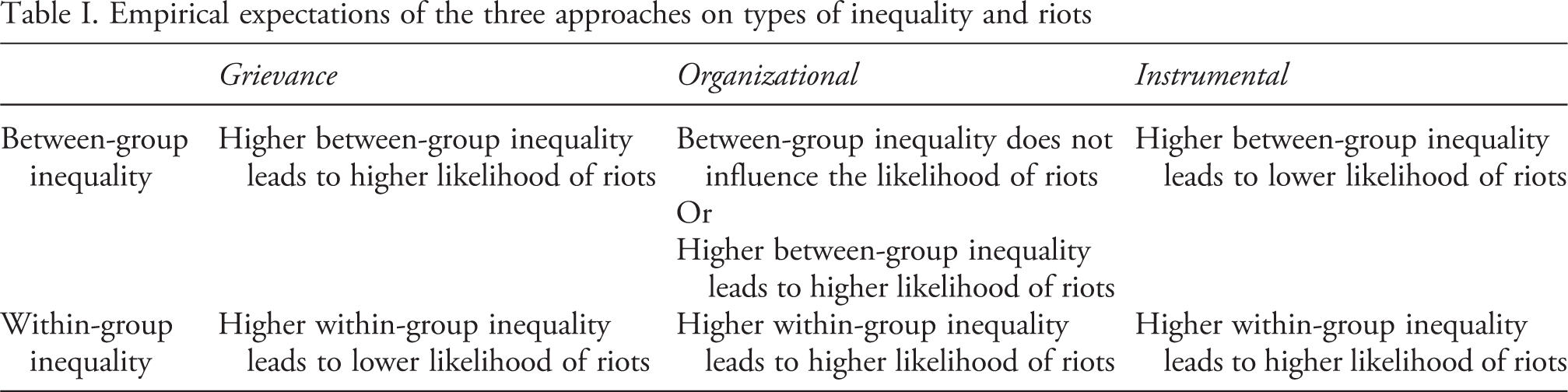
Empirical expectations of the three approaches on types of inequality and riots
In contexts in which within-group economic inequality is high and/or between-group economic inequality is low, ethno-religious divisions would not be as politically salient. This situation might threaten the ethnonationalist politicians in two ways. First, these politicians might directly observe that members of different ethnic groups share economic interests and anticipate that these shared interests might favor alternative parties that focus on economic issues. Second, even if politicians cannot directly observe levels of inequality within or between groups, they could still detect the consequences of low between-group and high within-group inequality in the form of cross-ethnic coalitions. These cross-ethnic coalitions may manifest in the form of civil society organizations that attract members from multiple ethnic/religious/caste groups, issues that galvanize communities across identity groups, and cross-ethnic political mobilization. In these contexts, the ethnonationalist political entrepreneurs would be more likely to incite riots to reinforce communal divisions.
Table I summarizes how the empirical expectations of the instrumental argument differ from the expectations of the grievance and organizational arguments. The predictions of the grievance and instrumental arguments are diametrically opposed to each other: the former expects high between-group inequality and low within-group inequality to boost the likelihood of riots; the latter expects these factors to reduce riot proneness. The instrumental and organizational arguments both predict higher levels of within-group inequality to increase the likelihood of riots, but they differ in their causal logic and their predictions on the effect of between-group inequality. The instrumental argument expects lower levels of between-group inequality to lead to higher likelihood of riots. In contrast, the organizational argument either expects between-group inequality to increase the likelihood of violence or it predicts no significant relationship. Additionally, the instrumental and organizational arguments have different predictions on the types of groups that riot organizers target for mobilization. The instrumental argument predicts that riot organizers will aim their propaganda toward subsections of ethno-religious groups that share socio-economic interests and enter coalitions with other groups. In contrast, the organizational logic predicts that the propaganda efforts will be aimed at the poorest within a group.
We expect the instrumental logic to be particularly well suited to explaining communal riots compared with larger-scale violence such as civil wars, ethnic cleansing, and genocide. According to the instrumental argument, the purpose of violence is not to inflict maximum damage or change the society and institutions in fundamental ways but to ensure that politicians with a communal agenda have a competitive advantage over their rivals who emphasize other issues. Given this goal, for the political entrepreneurs ‘most of the time the ideal outcome of political interaction is to manipulate others without damaging anything’ (Tilly, 2003: 36). The type of violence suited for this purpose would be small scale, limited in duration, and relatively easy to control and organize rather than large scale, long in duration, and hard to control and organize. 8 These conditions are fulfilled more easily by riots, lynching, or street fights than by civil war, genocide, or ethnic cleansing, which are likely to continue for a much longer period (months or years as opposed to hours or days), cost many more lives and, in the case of the latter two, aim at the elimination of the ethno-religious cleavage. 9
Data and measurement
Our sample extending from 1985 to 2001 covers an important period that witnessed the mobilization of Hindus through processions and incendiary speeches by right-wing Hindu leaders, the demolition of the Ayodhya Mosque, and riots which preceded and followed the demolition. 10 The riot and electoral data are obtained from Iyer & Shrivastava (2018). They developed their dataset by extending the Varshney & Wilkinson (2004) original dataset on riots to 2001. To the Iyer & Shrivastava (2018) dataset we have added inequality data estimated using the National Sample Survey. The National Sample Survey is conducted annually with a thick round every five years. The thick rounds have more than 100,000 observations and are representative at the district level. They report household consumption expenditure and the respondent’s religion. We use these data to estimate consumption inequality among Muslims, among Hindus, and between Hindus and Muslims at the district level. For years between the thick rounds, we interpolate our estimates using a simple straight-line rule. The large sample size ensures that consumption for the minority group can be reliably estimated. While one would expect some annual variation in estimated consumption, large oscillations over time would reduce our confidence in the quality of estimates. We find that the average annual change in consumption by Muslims is small at about 2%.
In our sample of 5,851 district-years, riots occurred in 421 instances. This represents 7.2% of all observations and 155 out of 339 districts in our sample. 11 Riots are short in duration, with an average of 3.29 days and a standard deviation of 6.34 days. Of the 421 observations, 55.34%, 16.86%, 6.18%, and 4.75% of the riots were 1, 2, 3, and 4 days long, respectively.
We measure within-group inequality using the Theil Index (Theil, 1967; Mancini et al., 2008). 12 The Index reports inequality in consumption at the district level among Hindus and among Muslims. The following formula is used;
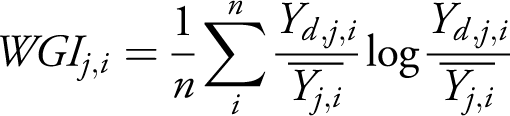
where d denotes an individual or a household, j denotes Hindu or Muslim, and i stands for district. On average, inequality is higher among Hindus. The average Theil Index measuring inequality among Hindus is 0.17 with a standard deviation of 0.08, while the average inequality among Muslims is 0.10 with a standard deviation of 0.08.
We measure between-group inequality as the difference in mean consumption by Hindus and Muslims in a given district. The following formula is used;

where i denotes a district. The average difference between the consumption by Hindus and Muslims is 41% of the district mean consumption. In general, Muslim consumption is 14% lower than district mean consumption, and Hindu consumption is 3% greater than the district mean consumption.
Inequality among and between Hindus and Muslims could be correlated either owing to structural reasons, where the same underlying factors cause both forms of inequality to exist, or owing to measurement, where a standard variance decomposition splits total inequality into within-group and between-group inequality. By measuring within-group inequality using the Theil Index and between-group inequality as the difference in group mean consumption, we avoid correlation owing to measurement. 13
We also control for existing alternative explanations. For example, Bohlken & Sergenti (2010) show that increased economic growth reduces the likelihood of Hindu–Muslim riots. Therefore, we control for the percentage annual change in state GDP. Minority group income might also influence the likelihood of riots by making the group a more attractive target or by allowing the group to better protect themselves (Mitra & Ray, 2014). We therefore control for the average consumption by Muslims. Varshney (2002) shows that Hindu–Muslim riots are more likely to occur in urban areas. Thus, we control for urbanization as the percentage of the district population living in urban areas. To control for population pressure, we include population share of Muslims and the percentage change in district population (Urdal, 2008). We also control for economic development (piped water) and the effects of elections with indicators for the election year. The summary statistics are included in Online appendix A.
Our main dependent variable is a binary indicator that measures the incidence of riots. For additional robustness, we also run our models using the number of riots in a given district-year as the dependent variable. When using the binary dependent variable, we use a Poisson model. When using count data (the number of riots) we use a negative binomial model owing to the high proportion of zero observations and high variance in our sample (Bohlken & Sergenti, 2010; Cameron & Trivedi, 2013; Iyer & Shrivastava, 2018).
We use a panel dataset with two different specifications: (1) with state and year fixed effects; and (2) with a multilevel (MLM) model. For the MLM, we nest our district-years observations under district and state (higher-level variables). This allows higher-level variables to enter the model as random errors. Instead of one general random effect that captures how each observation deviates from the predicted fixed effects, the mixed effects model generates multiple random effects that capture how observations deviate within a district, and how each district and each state deviates from the overall group. The base specification is as follows,
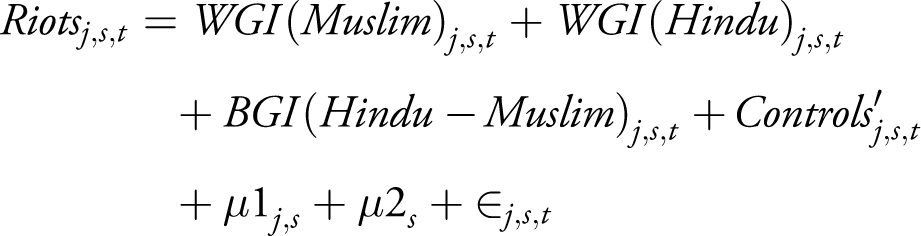
where j, s, and t denote district, state, and year respectively.
Results and analysis
Table II includes indicators for three types of inequality, the Theil Index, which measures i) inequality in consumption among Hindus and ii) inequality in consumption among Muslims, and the difference in mean consumption by Hindus and Muslims, which measures iii) inequality between Hindus and Muslims. All three are estimated at the district level. In Online appendices B and C, we present our results with other measures of inequality, the Gini Coefficient and the Atkinson Index. The results remain consistent.
Columns A1–A3 of Table II use the incidence of riots as the dependent variable. Together, they show that high inequality among Hindus, WGI (Hindus), high inequality among Muslims, WGI (Muslims), and low inequality between Hindus and Muslims, BGI (Hindu–Muslim), are associated with a higher likelihood of Hindu–Muslim riots.
Columns B1–B3 of Table II use the number of riots as the dependent variable. We find that high inequality among Hindus, high inequality among Muslims, and low inequality between Hindus and Muslims are associated with a higher frequency of Hindu–Muslim riots.
In columns A1 and B1 of Table II, we use state and year fixed effects, while in columns A2, A3, B2, and B3 we use a multilevel model. There are two differences in covariates between the two specifications: first, we do not include both the lagged dependent variable and fixed effects in the same model. 14 We do, however, control for the spatial variable estimating the effects of riots in neighboring districts in the fixed effects specification. Second, on inclusion of state and year fixed effects, two variables – (1) annual change in state gross domestic product and (2) indicator for election year – drop out because there is no within-group variation on these fronts.
Figure 1, developed using estimates from column A1 of Table II, shows the marginal effect of an increase in inequality among Muslims, among Hindus, and between Hindus and Muslims on the incidence of Hindu–Muslim riots. Figure 1A shows that as inequality among Muslims increases from two standard deviations below the mean to two standard deviations above the mean, the likelihood of Hindu–Muslim riots increases fourfold from 3% to 12% approximately. 15 A similar change in inequality among Hindus results in a twofold increase, from 5% to 10%, in the likelihood of Hindu–Muslim riots (Figure 1B). As the difference in consumption between Hindus and Muslims increases from 0% to 100%, the likelihood of Hindu–Muslim riots halves from 10% to less than 5% (Figure 1C).
Effect of inequality on the incidence and number of Hindu–Muslim riots
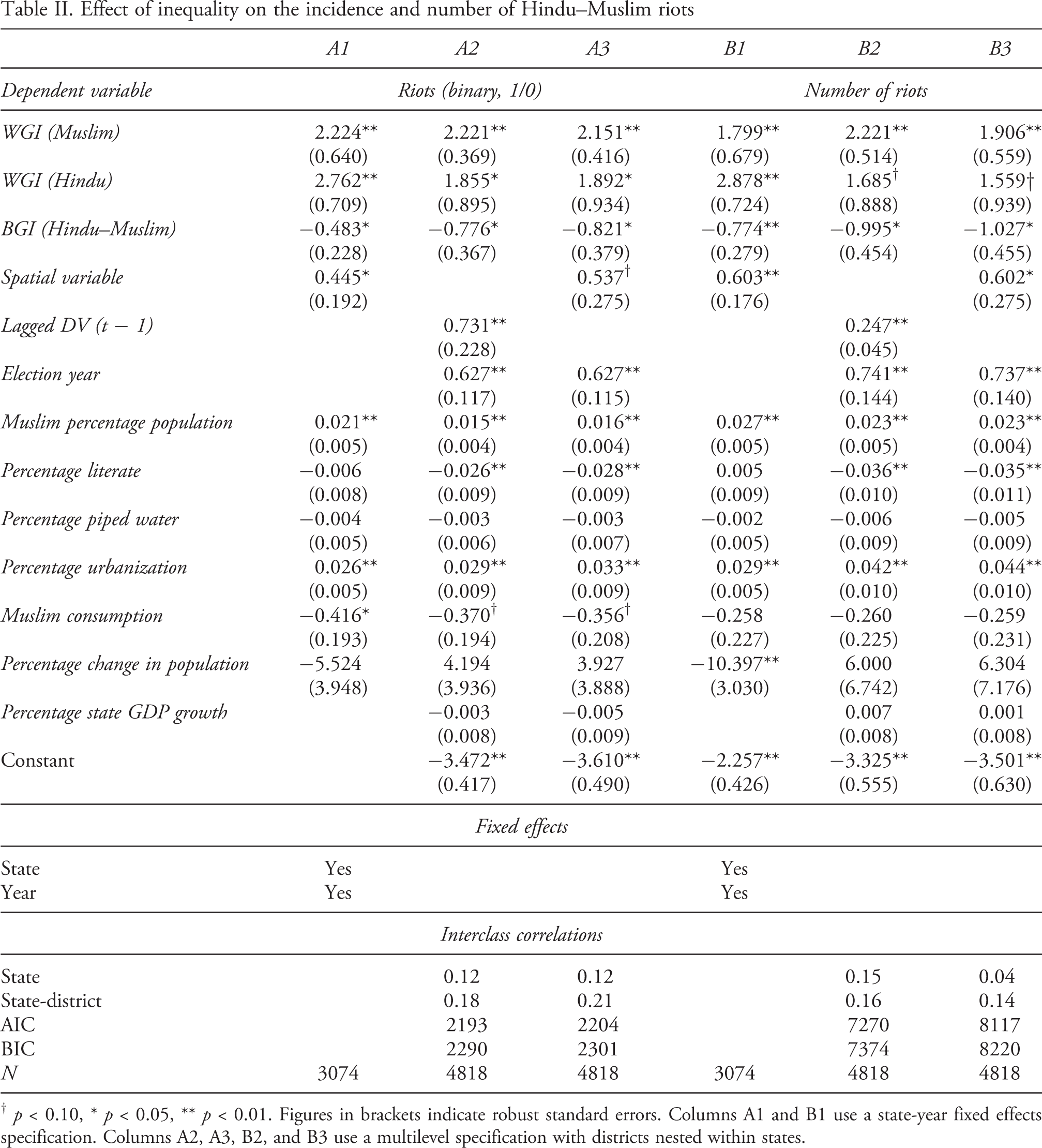
† p < 0.10, * p < 0.05, ** p < 0.01. Figures in brackets indicate robust standard errors. Columns A1 and B1 use a state-year fixed effects specification. Columns A2, A3, B2, and B3 use a multilevel specification with districts nested within states.
We control for ‘Election Year’ in Table II. The variable equals 1 in years when there are elections to either the state legislature or the national parliament. 16 We find that riots are more likely to occur when elections are due. This is consistent with the existing argument that elections increase the motivation for using violence to garner votes. In Online appendix D, we also conducted further tests to evaluate the timing of the riots vis-à-vis the timing of the elections. We find that riots are more likely to precede elections and less likely to succeed elections.
Columns A2 and B2 of Table II include a lagged dependent variable. The inclusion of lagged riots or
Marginal effect of inequality on incidence of riots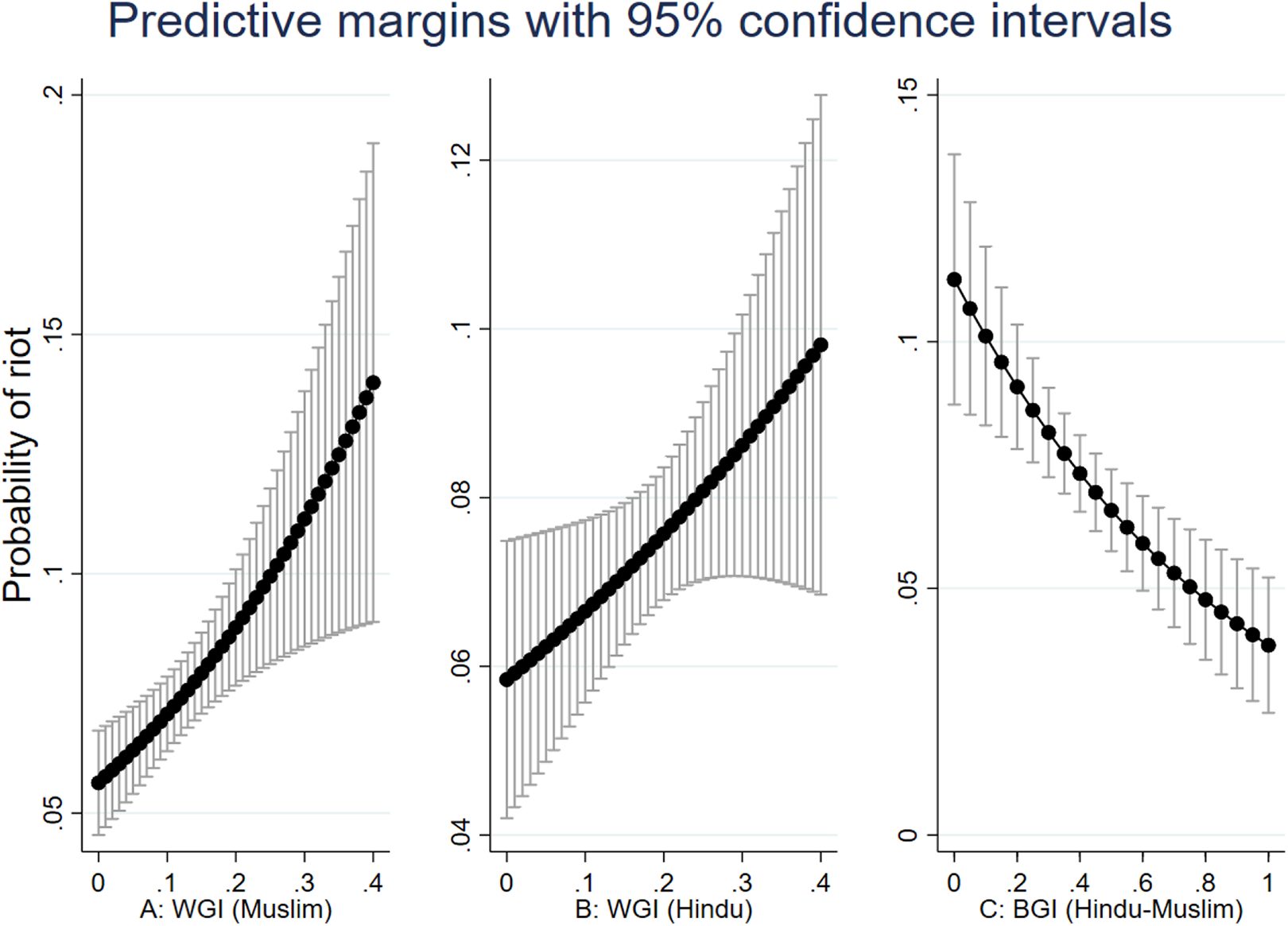
Columns A1, A3, B1, and B3 of Table II include a spatial variable that captures the effect of riots in neighboring districts. This variable, calibrated by Iyer & Shrivastava (2018: 109), not only accounts for riots in neighboring districts but also adjusts the effects of those riots by distance. The underlying motivation is that riots in the immediate vicinity may have a higher polarizing effect compared with riots in areas farther away. While we do find a positive correlation between the incidence of riots in a district and riots in neighboring districts, our findings on inequality are robust to controlling for the spatial variable.
Columns A2, A3, B2, and B3 of Table II use a multilevel regression specification in which we nest our district-year observations into district and state levels. In India, the management of police is the responsibility of state governments. We would therefore expect relatively larger interstate variation and smaller intrastate variation in the capacity to maintain law and order. Furthermore, Wilkinson (2004) shows that in states where electoral competition is high and the minimum winning threshold is low, political parties need to rely on the votes of minority groups. As a result, political leaders in such states work with the police to ensure that law and order is maintained and the minority is protected. Finally, Varshney (2002) argues that civic organizations prevent local incidents from turning into full-blown riots by using networks of trust at the town level. For these reasons, we use the nested specification. 19 For each multilevel specification, we also report the interclass correlation (ICC). The ICC gives information on the correlation of observations within states and districts. If the ICC approaches 0 then there is no variance to explain at the higher level (say state-level) and if the ICC approaches 1 then there is no variance to explain at individual level. The reported ICCs suggest that both district and state account for some variance, justifying the use of the MLM specification.
On between-group inequality, our findings are consistent with the instrumental argument, which predicts a negative relation between the incidence or frequency of riots and between-group inequality. This finding is also inconsistent with the grievance-based and organizational logics as the former argument predicts a positive relationship and the latter either agrees with this expectation or predicts a null finding.
On within-group inequality, the organizational and instrumental arguments have the same prediction. To further distinguish between the two, we focus on a subsample where the recruitment costs for riot organizers would be particularly low. 20 The organizational argument suggests that high within-group inequality enables riots by making it cheaper for wealthy organizers to recruit from among their relatively poor co-ethnics with low opportunity costs. In Online appendix F, we only include riots that lasted for less than two days and therefore the time commitment from and the corresponding opportunity cost to the riot participants was particularly low. If the organizational logic is the only one that explains the relationship between within-group inequality and riots then we should expect within-group inequality to lose statistical and/or substantive significance in this sample of short-duration/low-opportunity-cost riots. 21 Even within this subsample, we find that within-group inequality continues to have a statistically and substantively significant relationship with frequency and incidence of riots. This finding supports our argument that there exists another causal link between within-group inequality and riots beyond the organizational one. We further explore the differences in the predictions of the organizational and instrumental arguments in the next section.
Among the controls, the population share of Muslims, literacy rates, urbanization, and Muslim consumption are statistically significant, providing support for arguments that highlight these factors. We include several additional scenarios in the Online appendices. We include models that exclude inequality among Muslims or inequality among Hindus (see columns AP3 and AP4 of Tables IV and V, Online appendices B and C). Additionally, columns AP5 and AP6 of Table IV and V display models with interaction terms between WGI (Muslim) and BGI (Hindu–Muslim), or between WGI (Hindu) and BGI (Hindu–Muslim). The interaction terms are not significant, which does not contradict our expectations. None of the additional specifications influence our core findings.
Testing the causal story
The statistical analysis has provided evidence that connects between- and within-group inequality to variation in riots. In this section, we study a specific case to identify whether the causal story fits the process that we observe in the case (Lieberman, 2005). We also evaluate the different predictions of the organizational and instrumental arguments on outcomes such as mobilization.
We focus on the Hindu–Muslim communal riot that occurred in Muzaffarnagar in 2013 for two reasons. First, compared with the national average, inequality between Hindus and Muslims is low and inequality among Hindus and Muslims is relatively high in Muzaffarnagar. 22 Second, the riot has been closely examined by the media, think-tanks, and civil society, which have produced detailed reports. 23
We focus on four aspects of the riot: background conditions, timing, targets of propaganda, and electoral outcomes. First, we predict that high within- and low between-group inequality should be linked to the presence of solidary groups which promote secular voting. Second, we expect riots to be linked to forthcoming elections. Third, we expect propaganda and mobilization to target Hindus that cooperate with Muslims whereas the organizational argument expects these efforts to target the poorest of Hindus. Finally, electoral outcomes provide auxiliary evidence that strengthens the instrumental logic.
Background conditions: Inequality, solidary groups, and secular voting
While political parties may not directly observe inequality, they observe the visible manifestations of inequality and respond to their electoral implications. In western Uttar Pradesh, which includes Muzaffarnagar, many large landholders tend to belong to one Hindu community, known as the Jats. However, in Muzaffarnagar there are a fairly large number of Muslim landholders, who are colloquially known as ‘Mule Jats’ (Rao et al., 2014). These Muslim and Hindu landholders are economically better off than others in their community, who typically do not have agricultural land. Ownership of land by both Jats and Mule Jats affects inequality in two ways: first, average inequality between Muslims and Hindus is low; second, inequality among Hindus and Muslims is relatively high as both groups include landless laborers and landlords (Citizen’s Inquiry Team, 2013; Berenschot, 2015).
The Mule Jats (Muslims) and Jats (Hindus) are part of an alliance called the Bharatiya Kisan Union (Indian Farmer’s Union). While the union primarily deliberates on issues related to agriculture, their cooperation also extends into the political sphere wherein the two groups often vote jointly on class interests (Citizen’s Inquiry Team, 2013). Cross-group cooperation is particularly harmful to the Bharatiya Janata Party (BJP) for two reasons: (i) the BJP relies on a distinctly Hindu support base (Jaffrelot, 2011; Nellis et al., 2016); and (2) Hindus constitute only 57% of the total population in Muzaffarnagar (see Online appendix G, I). Thus, the BJP had incentives to weaken the alliance to prevent the splitting of the Hindu vote (Citizen’s Inquiry Team, 2013). Furthermore, the weakening of the alliance would also have benefitted the ruling party, the Samajwadi Party (SP), because in the absence of the alliance, Muslims were more likely to vote for the SP (see Online appendix G, II and VI; Berenschot 2015).
Timing: Impending elections and a weakened alliance
In Muzaffarnagar, the upcoming parliamentary elections provided the immediate cause for the BJP to mobilize its base (Malik, 2021). Parliamentary elections were scheduled in 2014, a year after the riot. The BJP had won Muzaffarnagar in 1991, 1996, and 1998. However, it lost the next three elections to Muslim candidates fielded by Indian National Congress (1999), the SP (2004), and the Bahujan Samaj Party (2009). Also, in elections to the state legislature – held a year before the riot – the BJP lost six of the seven seats in Muzaffarnagar. This defeat signaled the need for mobilizing support (Malik, 2021).
Mahendra Singh Tikait, the leader of the western Uttar Pradesh branch of the Bharatiya Kisan Union, died in 2011. His death created an additional opportunity for the BJP to polarize farmers along religious lines by weakening the secular farmer’s alliance (see Online appendix G, III).
Targets of propaganda and violent mobilization
In this section, we demonstrate that (1) the BJP and their affiliates incited violence, and (2) members of the secular farmer’s alliance, the Hindu Jats, who are a dominant agricultural caste, were selectively targeted for mobilization (Sahay, 2015; see Online appendix G, IV).
In the days preceding the riots, members of the BJP and its affiliates, Vishwa Hindu Parishad (VHP) and Rashtriya Swayam Sevak (RSS), spread divisive rhetoric, especially targeting the Jat community. Jat village leaders regularly convene community meetings known as Khap Panchayat. Membership in Khaps often overlaps with membership in the BKU (Farmer’s Union). A meeting of the Mahapanchayat (a grand council consisting of several panchayats) was convened on 31 August, 2013. Instead of the usual agrarian issues, the meeting focused on themes such as preventing Hindu women from marrying Muslim men. During the meeting, representatives of the BJP, RSS, and VHP made speeches and circulated doctored or false newspaper clips and videos accusing the Muslims of aggression. There is reasonable consensus among think-tanks, independent researchers, and academics that an atmosphere of animosity was constructed by the BJP specifically between Jats and Muslims in the period preceding the riots (see Online appendix G, V).
The riots were also strategically selective, specifically targeting communities with Hindu Jats and Muslims, where the pre-existing experience of intercommunal alliance constituted an electoral obstacle for the BJP (Citizen’s Inquiry Team, 2013; Rao et al., 2014; Susewind & Dhattiwala, 2014; Berenschot, 2015). Consider two adjacent villages, Hussainpur and Mohammadpur Raisingh, separated by a distance of 3 km. Prior to the riots, these two villages shared agricultural land and a common water supply. They also coordinated their agricultural work through informal agreements. Both villages had a sizeable population of Muslims. This would make both of them equally susceptible to an increase in communal tensions between Hindus and Muslims. However, while Mohammadpur Raisingh witnessed severe rioting, no riots were reported in Hussainpur. The main difference between the two villages is that while Mohammadpur Raisingh has a large population of Jats, Hussainpur’s Hindu population does not include Jats (Rao et al., 2014). Electorally, there is much to gain by polarizing communities in Mohammadpur Raisingh and little to gain in Hussainpur.
Thus far, we have focused on the BJP and Hindu mobilization as the Muslims in Muzaffarnagar were responding to rather than organizing the riot. However, existing works suggest that the SP, which relies on Muslim support, also considered small-scale riots potentially advantageous (Rao et al., 2014; Berenschot, 2015; Malik, 2021). The SP controlled the state government and police but did not intervene until the riots escalated significantly (see Online appendix G, VI). The SP’s lackluster response is consistent with the instrumental story that ethno-religious party leaders use riots to break cross-ethnic alliances along socio-economic lines.
Auxiliary evidence: Electoral gains after the riot
Auxiliary evidence provides inferential leverage but is itself not a part of the causal process (Collier, 2011). We observe that hate speech followed by communal violence weakened the alliance between Jats and Muslims (see Online appendix G, VII). The electoral outcomes offer concrete evidence of gains for the BJP and the SP at the expense of other parties. In 2014, six months after the riot, the BJP won the parliamentary seat with 59% of the votes. In 2009, the Bahujan Samaj Party had won the same seat with a vote share of 37%. Furthermore, in elections to the state legislature held in 2012 (a year before the riot), the BJP’s average vote share in the same region was around 22%. This gain of 37% in vote share is greater than the BJP’s average gain of 27% in the rest of Uttar Pradesh during the same period.
Conclusion
In this article, we argue that ethno-religious inequality influences riot proneness owing to its effect on the political salience of ethnic identity. To be competitive, ethnonationalist politicians need their supporters to identify foremost with their ethnic identity. When inequality between groups is low and/or inequality within groups is high, citizens are less likely to focus on ethnicity as their primary identity. To improve their electoral prospects in these contexts, communal politicians strategically use ethno-religious riots to reinforce the significance of ethnicity.
Our arguments could apply to most multi-ethnic contexts in which competitive elections take place. In such contexts, there is often a tension between voting along one’s ethnic or class interests. When too many vote along class interests, ethno-religious parties may resort to tactics aimed at increasing the political salience of communal identity. These tactics may include divisive rhetoric, such as the anti-immigrant rhetoric commonly used in the USA or Western Europe prior to elections. It could also include small-scale violence, such as lynching in the name of blasphemy in Pakistan and Bangladesh prior to their national elections.
The article also has implications for how we conceptualize communal riots and their relationship to other types of political violence. One approach is to consider riots as a type of mass violence similar to civil wars, genocide, and ethnic cleansing, which requires long-term and sustained organization and aims to fundamentally restructure the society. If this conceptual approach is correct, we should find that the underlying causes of communal riots are similar to those of these forms of violence. We show that communal riots do not conform to the standard expectation from studies of large-scale violence that high inequality between ethnic groups increases the likelihood of violence. Another approach is to categorize communal riots with small-scale violent events such as political lynching and street fights that ethno-religious parties utilize to mobilize support. Within this instrumental framework, high inequality between groups might reduce the need for small-scale violence that is meant to amplify the political salience of ethnicity. Our findings support the second approach, that of conceptualizing communal riots, and potentially other types of small-scale political violence, as a separate class of events with their own internal logic.
Footnotes
Replication data

Acknowledgements
For comments, the authors thank Sarthak Bagchi, Aaditya Dar, Emmerich Davies, Ursula Daxecker, Roxana Gutierrez-Romero, Gautam Nair, Suman Nath, Irfan Nooruddin, Niloufer Siddiqui, Shikhar Singh, Jeremy Spater, Pavithra Suryanarayan, Aarti Reddy, Emmanuel Teitelbaum, Milan Vaishnav, Rahul Verma and participants at DC India Politics Seminar (Carnegie Endowment for International Peace); the T.E. Lawrence Speaker Series at Oxford University; the Conflict & Change Cluster and Political Science Departmental Research Seminars at University College London; and the Research Workshop on ‘Elections and Violence: New Research on Actors, Targets, and Strategies’ (ERC Project, Election Violence, and Parties).
Funding
The author(s) disclosed receipt of the following financial support for the research, authorship, and/or publication of this article: Neeraj Prasad received funding from the European Research Council funded project on Elections, Violence, and Parties (ERC grant number 852439).
Notes
Replication data
The dataset, codebook, and do-files for this article can be found online.