




Abstract
This article analyses economic sanctions starting from the perspective of a target that has to allocate its income between spending on resources to pursue a contentious policy and consumption goods. By studying the target’s consumption problem, it demonstrates how sanctions could backfire causing the target to shift its spending to resources to pursue the contentious policy, thereby increasing the severity of the policy. Whether this will come to pass depends on the elasticities of substitution, which are determined by the target’s utility function. Therefore, even sanctions that seem like they could do no harm, such as embargoes on luxury goods consumed by only the target’s dictator, could aggravate the level of the policy given the right utility function. Considering the target’s consumption problem also illustrates how sanctions could (depending on the form of the target’s utility function) reduce the resources it could allocate to pursuing the contentious policy, thereby moderating it. If the benefits of this constraint outweigh the costs of sanctions to the sender, it could be in the sender’s best interest to impose sanctions. In these cases articulating a demand and waiting for the target to consider it would simply provide the target with additional time to continue the contentious policy, so the sender would impose constraining sanctions without warning. Constraining sanctions, therefore, provide an explanation for sanctions imposed without a threat stage. Constraining sanctions can occur even with complete and perfect information and may persist indefinitely, explaining the existence of long-term costly sanctions as well as sanctions that occur in cases of full information.
Introduction
Kim Jung-Un is a horrible human being. A despot known for his taste in fine wines, he runs a police state with rampant malnutrition and a GDP per capita of just $1,700 per year (Sims, 2016; FAO, 2017; CIA, 2018). According to the United Nations, his human rights violations have no parallel in the modern world (UN Human Rights Council, 2014), and his pursuit of nuclear weapons could lead to a catastrophic war that would kill millions.
I propose that, depending on his utility function, it may be in the best interests of the United States to revise its sanctions on North Korea to allow Kim to purchase as many luxury goods as his heart desires. That such a statement seems to be folly is a result of an unexamined belief that the only purpose of sanctions is to punish the target’s government with a sufficiently strong penalty that it will be deterred from pursuing its contentious policy, and therefore the sender should employ the severest sanctions possible in order to convince the target to change its ways.
This belief stems from the idea that the target passively accepts the punishment. Previous models of economic sanctions tend to assume that the target receives a fixed amount of utility from pursuing the policy (Drezner, 2003). Sanctions lower the target’s utility by a certain amount. If this amount is greater than the utility the target received from pursuing the policy, sanctions will deter the target from continuing with it. If the amount is smaller, the policy will continue. The more severe the sanctions, the more likely that the former will be true.
Unlike previous models of economic sanctions, this article considers how the target optimizes its consumption while under sanctions. Pursuing the policy requires the target to expend resources. Sanctions change the income the target has and the prices it faces, altering its incentives. As a result, they change the optimal level of spending on resources to pursue the policy. Depending on the price, cross-price and income elasticities of demand (which are determined by the form of the target’s utility function) the imposition of economic sanctions could increase the level of the policy, decrease the level of the policy, or have no effect. Even seemingly benign sanctions – such as smart sanctions that prohibit the importation of luxury goods – could exacerbate the target’s objectionable behavior if they cause the target to shift its spending away from consumer goods and devote more resources to the contentious conduct. Therefore it may be best to allow tyrants to spend their money on indulgences, even if doing so offends our innate sense of justice.
Since the effectiveness of sanctions is determined by the target’s elasticities of demand and senders are not known to take these into account when imposing sanctions, the effects of sanctions could differ substantially from what the sender intended. Given the important goals with which sanctions are tasked – from ejecting Russian troops from Ukraine (Myers & Baker, 2014), to halting the Iranian nuclear weapons program (Gladstone, 2011) and preventing genocide in Darfur (Abramowitz & Lynch, 2007) – it behooves the sender to carefully consider how the target will react in order to ensure that sanctions are effective. The failure to do so in the past raises the possibility that previous sanctions have backfired, which could make sanctions appear to be a less effective tool than they are.
Because the target optimizes its spending on resources used to pursue the contentious policy in the face of economic sanctions, not only can sanctions be used to deter the target government from pursuing the policy, but they may also be able to constrain it. That is to say, sanctions may reduce the resources the target allocates to pursuing the policy, thereby lowering the level of the policy. Under the deterrence model of economic sanctions described in the previous literature, imposing sanctions always lowers the sender’s utility. Under the constraint model developed in this article, the benefits to the sender from the sanctions-induced lower level of the policy could outweigh the sender’s costs of imposing sanctions. Such sanctions are an inherently credible threat and, if the target’s discount factor is high enough, will deter it from pursuing the policy.
If the value of defecting is too high, the severity of punishment too low, or the target’s shadow of the future too short, then sanctions imposed in the next round in retaliation for the target setting the level of the policy unacceptably high in this round may be ineffective at deterring it from setting the level unacceptably high. In this case the sender may impose economic sanctions straight away to constrain the target’s ability to pursue to policy rather than sanctions designed to deter it. The sender may impose such constraining immediately, without waiting for the target to violate its demands. Consider sanctions on al-Qaeda. Given that members of the terrorist group vowed to give their lives in jihad against the United States, it is obvious that no possible punishment could deter them. As a result US sanctions upon them were imposed with only a few hours notice (Clinton, 1995).
Therefore, with the right utility functions and discount factors, even in a world with a unitary sender, a unitary target and complete and perfect information, it is possible to see sanctions along the equilibrium path of play. In fact, 34% of the sanctions cases in the Threat and Imposition of Economic Sanctions dataset were not preceded by a threat from the sender to the target demanding that it modify its behavior or face sanctions (Morgan, Bapat & Kobayashi, 2014). Instead the sender imposed sanctions immediately, an action that is antithetical to the idea of sanctions as deterrents. Morgan (2015) argues that these sorts of incapacitating sanctions are among the most important unexplained phenomena in the study of economic sanctions. Previous models of economic sanctions as deterrents cannot explain them. This article’s model of economic sanctions as constraints can.
This article builds a parsimonious model with just two strategic actors, a sender and a target. Each player is a unitary actor whose domestic politics is not considered. While there is a long tradition of such models in the sanctions literature, there are also works that explain economic sanctions as products of the sender’s domestic politics or the interaction of multiple countries in the international system. Kaempfer & Lowenberg (1988) argue that sanctions provide protectionist benefits to domestic industries which compete with imports from the target. Peksen et al. (2014) demonstrate that media coverage of human rights abuses drives US sanctions policy and Whang (2011) shows that sanctions increase presidential job-approval. Peterson (2013) explains that countries threatened with sanctions consider the sender’s past record of following through on its threats to assess its current credibility, thereby driving senders to impose sanctions in order to maintain their reputations. All of these articles provide a richer description of sanctioning behavior by presenting more complex models and can also account for maintaining unsuccessful sanctions on a target for many years. The contribution of this article is to expand our understanding of sanctioning behavior while maintaining the simple, two-player setup. Kustra (2022) considers how domestic political advocacy by immigrant groups affects sanctions and finds that the president caters to diasporas when they form an important voting block in swing states.
Previous models
Previous models of economic sanctions have typically treated sanctions as a cost that the sender imposes on the target to deter the target from engaging in behavior that the sender finds objectionable. Provided that the cost to the target of sanctions is greater than the cost of compliance, the target will comply; otherwise it will not. Consider, for example, the anti-Apartheid sanctions on South Africa imposed in 1985. 1 The point of the sanctions was to sufficiently harm the economic interests of the white ruling-class so they would prefer ending Apartheid to continuing to suffer under sanctions (Hufbauer et al., 2007: Case 62-2).
This idea of sanctions as deterrents drives the models of Eaton & Engers (1992), Hovi et al. (2005), Lacy & Niou (2004), and Tsebelis (1990). It has been cited in the United States’ National Security Strategy (The White House, 2015) as the justification for imposing economic sanctions and, lest there be any doubt about how US senators view sanctions, a bill which would impose sanctions on Russia should it interfere in future US elections is called the Defending Elections from Threats by Establishing Redlines, or the DETER Act (Doff, 2018).
The classic deterrence model of sanctions, paraphrased here, begins with two players: the sender, denoted with a subscript s, and the target, denoted with a subscript t. Each player is a unitary actor, and their domestic politics are not considered.
The target wants to pursue a contentious policy. The policy affects the utility of both the sender and the target, denoted us
and ut
respectively. Let the level of the policy be measured by a, where
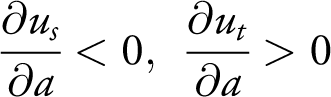
To ensure that a is set at a finite value, the model bounds a between
While the sender would like to affect a directly, setting the level of the policy is solely the prerogative of the target. Instead the sender can threaten to impose sanctions s if a exceeds a threshold set by the sender,
The game is an infinitely repeated version of the following stage game: (1) The sender determines whether to threaten to impose sanctions if a exceeds
In a world with complete and perfect information, under this model sanctions will not occur along the equilibrium path of play. Instead, the presence of sanctions is attributed to incomplete information that causes either the sender to misjudge the target’s utility and demand a greater concession than the threat of sanctions can support or the target to misjudge the sender’s resolve to impose sanctions. In these cases, the target’s refusal to abide by the sender’s demand will signal to the players that they have miscalculated and cause them to revise their expectations. Sanctions impositions in these instances should be short, and miscalculation cannot account for the multiyear and multidecade cases of sanctions that are often observed (Powell, 2004).
Even invoking incomplete information cannot explain why one-third of sanctions cases in the TIES dataset are not preceded by a threat to impose sanctions, something that this model requires. Furthermore, the model predicts that in the absence of a demand from the sender to restrain a the target will set a to
Current model
This article does not assume its model’s functions take a particular form.
Again consider an infinitely repeated game. Like the previous model, let there be two players: the sender and the target. Each player is a unitary actor and their domestic politics are not considered. As before, the target wants to pursue a contentious policy that affects the utility of both players. Let the level of the policy be measured by a, where
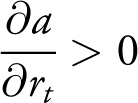
The target’s utility, ut
, is a function of the level of the policy a and n goods,

Assume that the utility-maximizing level of
The target has an income of yt
and a budget constraint of
The sender’s utility is a function of a and n other goods,

The sender has an income of ys
and a budget constraint of
If the model included just the sender and the target, then sanctions that banned the trade in a good would cause the quantity of the good to fall to zero. To prevent this the model includes third countries, which are not strategic actors, that import and export all of the goods in the model. The prices of the goods are set in international markets. This allows sanctions to increase the price the sender or the target pays for imports and to lower the price they receive for exports, rather than causing the quantity traded to fall to zero. Since the third countries are not strategic players, their behavior is not modeled. 3
For any good it is possible to purchase or sell a fraction of a unit, that is to say
Let the target’s discount factor be
Finally the values of all the coefficients are common knowledge and immediately after a player has made a move its action is observable by all the players. Both players have perfect recall of previous actions.
The game is an infinitely repeated version of the following stage game: (1) The sender decides whether to impose sanctions in this round. It also decides whether to threaten the target with sanctions in the next round if, in the current round, a exceeds a threshold,
But what will the optimal threat of sanctions be? Will the target always acquiesce to that threat? Are there cases where sanctions will occur in equilibrium? Like most games, it will be easiest to work backwards and consider how the target responds to sanctions first.
The target’s response to sanctions
First, consider sanctions which affect only the price of r to the target. In this case, the result is clear. Increases in pr cause a to decrease. 4 These are the only type of sanctions that will have an unambiguous effect on the level of the policy.
Sanctions that prohibit the export of goods that could be used to further policies to which the sender objects are common. The United States Munitions List, which is only one part of the US government’s export control regulations, comprises 21 categories of goods from fighter jets to submarines. These restrictions were critical to enabling the United States to ‘maintain a strategic and tactical advantage without having to match the Warsaw Pact nations’ troop strength in the field’ (Wallerstein, 2009: 11). Since the end of the Cold War, these restrictions have retarded (although not always prevented) the dissemination of weapons of mass destruction. However, because the restrictions apply to the vast majority of countries they are so unremarkable as to be often excluded from the sanctions datasets. Were they to be included, they would require the accepted belief that sanctions are rarely effective to be reconsidered.
Winston Churchill noted that iron ore from Scandinavia was vital to the Nazis and curtailing access to it would hobble the German war effort. There is ‘no other measure […] open to us for many months to come which gives so good a chance of abridging the waste and destruction of the conflict, or of […] preventing the vast slaughters which will attend the grapple of the main armies’ (Churchill, 1948: 490).
Different types of policies may show different responsiveness in translating resources into policy outcomes. The model provides for this by allowing the function
It could be argued that other sorts of policies, such as abusing human rights, are less dependent on imported resources. A secret policeman can always beat a dissident with his fists if a truncheon isn’t available, and it is simple enough to manufacture truncheons domestically if they cannot be imported. Yet even in this case outside resources may play a role. The People’s Republic of China has built a dystopian surveillance state by combining millions of cameras with facial recognition software in order to track – and thereby more effectively oppress – dissidents, ethnic minorities, and others that the regime deems undesirable (Harwell &d Dou, 2020). While the final assembly of the computers and cameras and the final design of the software is done in China, the hardware is built out of components manufactured across east Asia and the software was developed out of earlier algorithms designed in the United States. Halting the flow of these parts would have precluded the building of this system and forced the Chinese government to rely upon older, more expensive and less effective methods of tracking and oppressing their people.
Even if the target could be completely self-sufficient, the principle of comparative advantage means that the target will be better at manufacturing some goods than others. Therefore it should specialize in producing the goods in which it has a comparative advantage and trading part of this output for goods in which it has a comparative disadvantage. By doing so, the target will maximize its production. Even if the target could produce r itself, unless it had a comparative advantage in producing r, choosing to produce r domestically rather than import it would lower the target’s productivity. As a result, sanctions on r would still have an effect on the level of a.
Beyond simply changing the price of r, sanctions often target the consumption good c
1 as well. In these cases, the effect of sanctions on a cannot be determined a priori. Instead it will depend on whether the cross-price elasticity of demand, which is defined as
Consider sanctions which raise the price of the consumption good c
1 to the target. If c
1 is a substitute for r, that is to say
The international community is fond of imposing sanctions on luxury goods, arguing that prohibiting the sales of Rolexes and Rolls-Royces will harm the government but not the general population. For instance, the United States banned the export of jewelry, gold watches, fur coats, and other opulent items to North Korea (Department of Commerce, 2007). ‘Whether it will work, we don’t know,’ explained a former State Department official, but ‘it can’t hurt’ (Glaister, 2006). Similarly, the European Union prohibited the sale of limousines, caviar, cigars, and fine wines to Syria. Announcing the sanctions, the EU high representative for foreign affairs and security policy said that the union had ‘carefully calibrated today’s decision to avoid affecting the Syrian people’ (Council of the European Union, 2012).
Wintrobe (1990) says that dictators keep power through two methods: bribery and repression. In arguing for these types of sanctions the state department official said ‘[I]f you take away one of the tools of [Kim’s] control, perhaps you weaken his leadership’ (Glaister, 2006). It is possible that restricting the sale of the luxury goods he uses to curry favor with his winning coalition and maintain power could weaken Kim. But it could also cause him to become more repressive in order to hold on to power (Park & Choi, forthcoming). If the purpose of sanctions was to reduce Kim’s repression, then they could have precisely the opposite effect. Peksen (2009) provides evidence that the latter is what often occurs. Looking at cases of sanctions from 1981 to 2000, he finds that sanctions increase the number of political prisoners, the use of torture, and the number of extra-judicial killings. So, while it is deeply emotionally unsatisfying, it may be in the best interests of the sender to let the dictator have his baubles. This logic extends to any good which is a substitute for r, that is to say any good for which an increase in its price causes the quantity of r to increase.
Similarly, conventional and nuclear weapons both provide protection from attack. If the sender imposes an arms embargo in order to prevent the target from acquiring a nuclear weapon and the embargo raises the price of conventional weapons more than the price of nuclear weapons then the target may choose to shift its spending to its nuclear weapons program, aggravating the very policy that the sanctions were meant to curtail.
If r were a complement of c
1, that is to say that
The sender may also impose sanctions on the importation of the consumption good
In short, only in cases where sanctions affect only pr can the effect of sanctions on a be determined in abstraction. As soon as sanctions affect the price of the good c 1 or the target’s income yt , their effect on the optimal level of r, and therefore a, will be determined by the cross-price and income elasticity of demand, respectively. These elasticities are themselves determined by the target’s utility function. Unlike many cases of counter-intuitive results, the results here are not driven by preference aggregation but rather occur in a simple model with unitary actors.
Finally, if the elasticity in question equaled zero, then sanctions would have no effect on a.
In so far as the propositions expressed here flow directly from the formulas for price-elasticity, cross-price elasticity, and income elasticity, they are tautologically true and do not require a formal proof.
Deterrence sanctions
Any value of r greater than zero lowers the sender’s utility, causing it to consider sanctions to affect r and thereby a. In theory, sanctions could be any policy that affects trade in order to alter a. For instance, the sender could impose a tariff on imports from the target or exclude a portion of them using a quota in order to bend the target to its will. In practice, sanctions have been bans on trade imposed on one or more goods. As Spindler (1995) notes, ‘[N]o trading with the enemy’ is a more politically viable slogan than ‘[N]o trading with the enemy except at better prices.’
The sender now faces a choice of prohibiting trade in any or all of the goods
The sender calculates the effect of sanctions on prices for each of the goods. Using this information, the sender estimates how the target will alter its utility-maximizing consumption bundle for each of the possible combinations of sanctions and then estimates each player’s utility for each of the possibilities. Let
Despite the fact that sanctions lower the sender’s utility, it may be able to use the threat of sanctions sj
to deter the target from setting a above a certain threshold. Denote this case of sanctions as sj
and, for the remainder of this section, distinguish it from all other cases of sanctions,
Strategy profile 1
Sender: If in any previous round the sender played s
0, the target played Target: If the target has previously played
The equilibrium path of play is for the target to accede to the sender’s demand and set the level of the policy at the threshold,
Formally, for this to be a subgame-perfect Nash equilibrium two conditions must be met. First, the sender must not defect from punishing when it is required to do so. The value of punishing using sanctions sj
is


Whether the conditions on the sender hold will depend on four factors: (i) the maximum sustainable demand for the level of the policy,
The second condition is that the punishment be large enough to convince the target to change its ways. If the target heeds the sender’s demand and in the absence of sanctions plays

Because the sender will want to extract the maximum concession possible from the target, this expression will hold with equality for the level of a that the sender demands. The lowest level of a that the sender could successfully demand will depend on three factors: (i) the target’s utility of defecting
For a formal proof that provided Conditions (1), (2), and (3) hold Strategy profile 1 is an SPNE, please see the Online appendix.
Constraining sanctions
The sanctions policy presented in Strategy profile 1 demonstrates that this article’s model can account for the standard case of deterrence sanctions that has been discussed in the previous literature: a threat, which is costly to both the sender and the target, designed to dissuade the target from engaging in its contentious policy. And like all cases of threats of costly punishments, in a Coasian world the threat should not be carried out along the equilibrium path of play.
How then do we account for the numerous cases of sanctions that we observe? While miscalculation on the part of the sender or the target could account for an occasional short period of sanctions, there are numerous cases of multidecade sanctions that cannot be explained by miscalculation. There are also many cases of sanctions being imposed suddenly, without the sender issuing a threat or giving the target time to comply. This model provides an answer.
There may exist a case where the benefits of sanctions to the sender in terms of lower a match or outweigh their costs to the sender in terms of lower income and/or higher prices, making the sender weakly prefer these sanctions to the status quo. Denote this case of sanctions as sk
and, again for the remainder of this section, distinguish it from all other cases of sanctions,
Strategy profile 2
Sender: If in any previous period the sender played s
0 and then the target defected by playing Target: If the target defected in any previous round by playing
The equilibrium path of play is for the target to set the level of the policy at the threshold demanded by the sender and for the sender not to impose sanctions. Complete and perfect information allows each player to predict the other’s behavior. As a result the sender sets the threshold as low as it can while still ensuring that it is in the target’s interest to comply and the target, knowing that the sender is willing to carry out the threat and that sanctions are not in its interests, complies.
Formally, for this to be a subgame-perfect Nash equilibrium, three conditions must hold. Unlike the previous strategy profile, the threat to impose sanctions in this case is inherently credible since


The lower the level of
The second condition is that the threat of sanctions must deter the target from defecting. If the target acquiesces it receives

The maximum concession the sender will be able to extract from the target will be when Condition
The requirements of Conditions (4) and (5) that
In the previous section, where the sender’s utility under the status quo was always higher than its utility under sanctions,
Strategy profile 3
Sender: Play sk
. Target: If the sender plays sk
, play
Unlike the previous strategy profile, the equilibrium path of play is for the sender to always impose sanctions sk and the target to always set the level of the policy to the target’s utility-maximizing level given sanctions sk . Cooperation cannot be maintained because the target values the benefits of defecting today more than the cost of being sanctioned tomorrow. This could be because the benefits of defection are large compared with the punishment or it could be because the target does not put much value on the future. Given complete and perfect information the sender knows this and will impose sanctions immediately instead of trying to cooperate. Despite their costs, the sender prefers sanctions sk to no sanctions at all because of the constraining effect of sk on the level of the policy and so imposes sanctions in every round.
This equilibrium explains the sanctions against Osama bin Laden and al-Qaeda. Inheriting a fortune of $25 to $30 million, bin Laden preferred to live in a cave in Afghanistan and risk his life fighting first the Soviet Union and then the United States ( Economist, 2011). Not only did his followers also embrace the harsh conditions, they were even more willing to face death with many eager to become martyrs and volunteering for suicide missions. Obviously, sanctions against them could not impose any greater hardship than they had taken on already. Because sanctions’ ability to punish in the future was limited, the SPNE from Strategy profile 2 was unavailable. As a result, the sanctions that the United States imposed were not designed to deter bin Laden and al-Qaeda but to constrain their resources to prevent them from launching further attacks.
Constraining sanctions are common in cases where the value of a single shot defection is high relative to the punishment. This is the reasoning behind imposing export restrictions on military technology: that any credible threat of post-hoc punishment will not be sufficient to deter a country’s enemies from using its weaponry against it and therefore the country should not arm its foes no matter what assurances the foes give them.
The use of sanctions as constraints also explains sanctions against groups with low discount factors. The target’s discount factor is driven by the target’s preferences and expectations of the future. Identically situated players vary in their desire to forgo utility today in return for utility tomorrow due to different preferences. Furthermore, players with the same preference may vary in their likelihood of dying. Individuals who are more likely to die before tomorrow comes will place a lower value on future consumption to reflect the fact that they are less likely to live to receive it. For instance, given their often precarious strategic situation, rebel movements have low discount rates and cannot be trusted to keep promises they make to respect human rights and obey the laws of war. Instead, the United Nations has turned to prohibiting the sale of conflict diamonds that the groups use to support themselves, in order to lower their incomes and thereby constrain their activities (Lopez, 2012).
Threatening the target that if it does not change its policies it will be sanctioned in the next round merely allows the target to continue its contentious policy in this round. As a result, the constraining sanctions SPNE described in Strategy profile 3 will come without warning. Of the 1,412 cases in the Threat and Imposition of Economic Sanctions dataset (Morgan, Bapat & Kobayashi, 2014), just over one-third do not have a threat stage. Instead, the sender imposed economic sanctions without warning. The idea of economic sanctions as deterrents cannot explain cases of sanctions where the sender did not attempt to deter the target. The model presented here can.
Taken together, these results should cause us to reconsider the definition of successful economic sanctions. As the discussion of the target’s behavior in section IV showed, provided that the demand elasticity in question is negative, any restriction that raises the price the target faces or reduces the income that it earns will decrease the level of the contentious policy. This means that policies that are not typically thought of as cases of economic sanctions may need to be included in the definition in order to achieve a more accurate picture of the ability of senders to use economic statecraft to influence targets’ behavior. The SPNEs subsequently presented in sections V and VI show how the target’s and the sender’s reactions to sanctions, combined with their discount factors, determine what levels of
Conclusion
Despite the fact that economic sanctions have been a staple of US foreign policy since the end of the Cold War, according to the previously cited State Department official, whether they work, we don’t know, but they can’t hurt. This article builds a model of how sanctions operate and in so doing determines under which circumstances they will be effective. It begins with just two unitary strategic actors, a sender and a target. It then examines how the target allocates its resources and finds that, depending on the form of the target’s utility function, sanctions could cause the target to increase the level of the policy, decrease the level of the policy, or have no effect. This suggests that policymakers should carefully consider how sanctions will affect the target’s behavior before imposing sanctions since, contrary to what the State Department official said, even smart sanctions can hurt. It also raises the possibility that previous cases of economic sanctions have been ineffective because senders failed to take the target’s reaction into account.
The article then uses the insights gained about how the target will respond to sanctions to understand how the sender will use them. In the event that sanctions are sufficiently harmful to the target and the target’s discount factor is sufficiently high, then the sender may be able to use the threat of sanctions to pressure the target to moderate the level of its contentious policy. This is the classic deterrence effect of economic sanctions. The fact that the target optimizes the allocations of its resources raises another possibility: that the benefit of sanctions to the sender in terms of lower a outweighs the harm of lower income and/or higher prices. As a result, the sender may prefer the presence of sanctions thereby showing how economic sanctions may not only be used to deter but also to constrain. These constraining sanctions can occur without a threat stage, in cases of complete and perfect information and last for many years. Previous models of economic sanctions could not explain them. This article’s model does.
Footnotes
Acknowledgements
Thanks are due to Julio Alqueres, Jeff Freiden, David Lektzian, John Patty, and Dustin Tingley, the editor, and the three anonymous reviewers. This article also benefited from the comments provided at the political economy workshop at Harvard University and the Midwest Political Science Association conference in Chicago.