




Abstract
Extant research highlights low or unequal access of ethnic groups to socio-economic resources as a driver of communal violence. However, less is known about how institutional factors, such as control over ethnofederal units, influence the distribution of these resources in the first place. Conversely, the literature on ethnofederalism has focused on conflicts that involve the central government, while neglecting its unintended consequences at the subnational level. Building on both literatures, we argue that ethnofederalism increases the risk of communal violence between locally dominant and non-dominant groups through two mechanisms. First, it increases grievances among locally non-dominant groups. Second, it increases the utility of coercive strategies for locally dominant groups. Through both processes, ethnofederalism creates incentives for group elites to use communal violence in order to attain or maintain control over local government office. We test our argument in a subnational analysis of Ethiopia’s ethnofederal system, combining new spatial data on local demographics, government control, and horizontal inequalities. We further substantiate our analysis with quantitative tests of the mechanisms’ intermediate implications and with original interview data gathered during fieldwork. Our results highlight the importance of accounting for institutional factors in the comparative study of communal violence.
Introduction
Between October 2017 and April 2018, Kemashe Zone in Ethiopia’s Benishangul Gumuz region was the site of deadly communal violence. Attacks on Amhara perpetrated by Gumuz and Berta militias and reportedly supported by local authorities killed dozens and displaced thousands (AHRE, 2018). Although the Amhara settled in Benishangul Gumuz decades ago, they are often cast as outsiders in the region, which is designated as the ethnic ‘homeland’ of the titular Gumuz and Berta ethnic groups (Fessha & Beken, 2013). These events mirror widespread tendencies in other Ethiopian regions (Fiseha, 2017; Berhane & Tefera, 2018) and other multi-ethnic states, including India (Adeney, 2017), Kenya (Elfversson, 2019), Nigeria (Kendhammer, 2010), and Uganda (Green, 2008). Thereby, they illustrate an often-neglected aspect of ethnofederalism: while it may alleviate conflict at the national level (Cederman et al., 2015), it may inadvertently increase communal conflict at the subnational level.
Previous research highlights that communal violence is more likely where ethnic groups have low or unequal access to socio-economic resources (e.g. Østby, Nordås & Rød, 2009; Fjelde & von Uexkull, 2012; Fjelde & Østby, 2014). However, in many of the states most affected by communal violence, pervasive clientelism means that the distribution of socio-economic resources is itself profoundly shaped by institutional factors, including ethnofederalism (Hale, 2004; Cederman et al., 2013). Yet, with few exceptions (Cunningham & Weidmann, 2010; De Juan et al., 2015; Bunte & Vinson, 2016; Wig & Kromrey, 2018), the literature on communal violence has not been concerned with these institutional underpinnings.
Conversely, existing research on ethnofederalism has mainly investigated how it affects conflict at the national level (Cederman et al., 2015; Anderson, 2016). However, as indicated by our introductory example, ethnofederalism may have important consequences at the subnational level, most importantly by affecting the risk of communal violence between locally dominant and non-dominant groups. Studying this relationship is paramount, as communal violence increasingly makes up a sizable proportion of ethnic conflict in divided places (Pettersson, Högbladh & Öberg, 2019) and is often directly tied to territorial issues (von Uexkull & Pettersson, 2018: 961).
In this article, we derive a theoretical argument on the relationship between ethnofederalism and communal violence. We argue that ethnofederalism increases the risks of communal violence through two mechanisms. First, ethnofederalism boosts the grievances of locally non-dominant groups. Thereby, it increases incentives for their elites to mobilize for local government inclusion, territorial boundary changes, or ethnic ‘homelands’ of their own. Second, it creates incentives for elites of locally dominant groups to aggressively monopolize political control over ‘their’ ethnic ‘homelands’ to ensure continuing access to their socio-economic resources. Following the implications of these arguments, we hypothesize that communal violence in ethnofederations is particularly likely to erupt between locally dominant group(s) and non-dominant groups settling in the same unit.
We test our argument quantitatively for the case of Ethiopia’s ethnofederal system between 1994 and 2018. A dyadic analysis based on 118 communal groups indicates that the risk of communal violence in ethnofederations is indeed particularly high between locally dominant and non-dominant groups. Our attained effects are statistically significant and substantively meaningful. They are also robust to an exhaustive list of potential confounders, alternative measures of violence, and various model specifications. We also provide additional checks of our hypothesized mechanisms: using quantitative micro-level data, we show that ethnofederalism systematically shapes mass attitudes as predicted by our argument. And we illustrate the relevance of our mechanisms by using original interview data collected during fieldwork in Ethiopia in 2018.
Our study makes three main contributions. First, it adds to the literature on communal violence, which has only recently seen increasing systematic studies. In this literature, we shift focus from socio-economic factors (Fjelde & von Uexkull, 2012; Fjelde & Østby, 2014; Hillesund, 2019) to institutional ones, specifically those attached to ethnofederalism. Second, we add to the literature on ethnofederalism and ethnic conflict. By considering its effects on communal violence, we extend previous work beyond conflicts at the national level to subnational-level conflicts. Finally, we also add to the specific discourse on ethnic conflict in Ethiopia. Our results confirm and extend existing case studies (Kefale, 2013; Fessha & Beken, 2013; Fiseha, 2017) using systematic quantitative evidence.
Related literature
We start by defining four key terms. First, by ethnofederalism, we refer to political systems whose administrative units enjoy effective policy, fiscal, and political autonomy (Bakke, 2015; Treisman, 2007) and at the same time represent ‘homelands’ for specific ethnic groups (cf. Anderson, 2016). 1 Second, we adopt a Weberian conception of ethnic groups, by which we refer to individuals who ‘entertain a subjective belief in their common descent’ based on ‘similarities of physical type or of customs or both’ (Weber, 1978: 389). Third, intersecting the two terms, we distinguish between locally dominant and locally non-dominant groups. By locally dominant group, we refer to the ethnic group(s) that exercise(s) predominant control of a given territorial unit, often by virtue of being the local majority. Conversely, by locally non-dominant groups, we refer to groups who are outside their own ‘homeland’ or are not awarded one in the first place. Finally, by communal violence we refer to violent conflicts where both sides are nonstate actors and are simultaneously associated with specific ethnic groups, either explicitly through organizational claims or implicitly through their ethnic composition (cf. Hillesund, 2019: 532).
Communal violence: Resource scarcity, horizontal inequalities, and elite mobilization
Extant research on the group-level determinants of communal violence highlights two complementary drivers. A first strand discusses how the group-wise distribution of political power and socio-economic resources affects mass attitudes and behavior. In this vein, mounting evidence supports the view that absolute economic deprivation may spark communal violence aimed at securing access to scarce resources (e.g. Fjelde & von Uexkull, 2012; Döring, 2020). These risks may be exacerbated where economically deprived groups lack other channels for redress, for example as a result of political exclusion (Fjelde & von Uexkull, 2012). Research similarly highlights that members of relatively disadvantaged ethnic groups are more likely to engage in communal violence. Aggrieved by horizontal inequalities – most importantly, unequal access to political office and socio-economic resources, such as household assets, education, water, and arable land (Fjelde & Østby, 2014; Stewart, 2008) – they become more likely to mobilize to rectify these perceived injustices (Østby, 2008; Cederman et al., 2013). Especially in clientelist states, in which group membership is a key determinant of resource distribution, such mobilization often takes a distinctly interethnic form and may find its expression in communal violence (Fjelde & Østby, 2014).
A second strand emphasizes the strategic incentives of elites to orchestrate communal violence. Particularly in close-fought electoral contests, they may seek to frame resource scarcity or inequality in ethnic terms to ensure continuing access to political power. Communal violence is a particularly well-suited strategy to that end, as it can effectively boost ethnic salience and thereby mobilize the perpetrator’s group members (Brass 1991). Moreover, it can also serve to intimidate the followers of electoral rivals (Brass 1991; Wilkinson, 2004). Communal violence entails comparably low costs, substituting for more costly mobilization against state institutions (Fjelde & Østby, 2014).
In sum, existing research shows how considerations over access to socio-economic resources and political power shape the risks of communal violence. In contrast, less attention has been devoted to how these processes are modified by underlying institutional factors. A number of studies show that informal power-sharing (Bunte & Vinson, 2016), local religious institutions (De Juan et al., 2015), and customary authorities (Wig & Kromrey, 2018) may bridge ethnic divisions and thereby provide for communal peace in places like Nigeria and Indonesia. Others indicate that incentives to employ communal violence are affected by the type of electoral system in place (e.g. Fjelde & Höglund, 2016). However, what is missing from this picture is the role of ethnic groups’ inclusion into subnational government (cf. Cunningham & Weidmann, 2010). This not only affects local representation and policymaking, but also decisively shapes group-wise access to socio-economic resources (Fjelde & Østby, 2014). Hence, its demonstrated role in driving ethnic conflict may extend from conflict involving the central government (Cederman et al., 2013) to local dynamics of communal violence as well.
Ethnofederalism and ethnic conflict
In contrast, the literature on ethnofederalism has focused on how it affects ethnic conflict at the national level. This literature highlights that ethnofederalism empowers specific ethnic groups, typically with the rationale of preventing cultural, economic, or political discrimination against them (Bermeo, 2002). Previous literature indicates that ethnic autonomy, as provided by ethnofederalism, alleviates the grievances of locally dominant groups and thereby reduces the risk of violent conflict between them and the central government (Cederman et al., 2015; Anderson, 2016). At the same time, this literature highlights that it may also increase ethnic divisions and enhance the capabilities of locally dominant groups to mobilize (cf. Hale, 2004; Anderson, 2016).
While the debate on ethnofederalism and ethnic conflict at the national level remains salient, much less attention has been paid to its consequences at the subnational level. As communal violence is often confined to the local level, the predominant focus on national-level conflict is understandable. Yet, communal violence may not only threaten the very fabric of the societies in which it occurs, but also makes up an increasingly substantial proportion of ethnic conflict worldwide (Pettersson, Högbladh & Öberg, 2019). Given that a large share of communal conflicts revolves around territorial issues, such as the drawing of administrative boundaries (von Uexkull & Pettersson, 2018: 961), investigating how ethnofederalism affects communal violence seems all the more urgent.
However, to our knowledge, no systematic studies have so far linked ethnofederalism with communal violence. 2 Numerous case studies accuse ethnofederalism and decentralization along ethnic lines of stoking communal violence, focusing on contexts as diverse as Ethiopia (Kefale, 2013; Fiseha, 2017; Berhane & Tefera, 2018), India (Adeney, 2017), Kenya (Elfversson, 2019), Nigeria (Kendhammer, 2010), and Uganda (Green, 2008). These findings rest on persuasive in-depth evidence. However, they might be confronted with similar difficulties as the wider literature on ethnofederalism and ethnic conflict: the focus on prominent instances where violent conflict did, in fact, occur. This might neglect countervailing evidence from a potentially large number of other locations in these states where communal conflict never erupted or might even have been mitigated by ethnofederalism (Cederman et al., 2015). Alternatively, in other locations, communal violence might have erupted anyway, whether groups were provided unequal access to ethnically designated ‘homelands’ or not (Anderson, 2016).
The impact of ethnofederalism on communal violence
In the remainder of this article, we build on these two literatures by providing and testing a theoretical argument that systematically links ethnofederalism with communal violence. In deriving our hypotheses, we focus on the implications of this argument for the spatial and group-wise distribution of communal violence within ethnofederal states. We would not expect similar patterns in unitary states (which lack autonomy devolved to administrative units) and states relying on non-ethnic types of federalism (which do not designate administrative units as the homelands of specific groups, cf. Anderson, 2016).
We base our expectations on the relationship between ethnofederalism and the spatial and group-wise distribution of communal violence on two causal mechanisms. First, we expect ethnofederalism to increase grievances among members of locally non-dominant groups. Similar to the national level (Cederman et al., 2013), a group’s exclusion from government at the subnational level should also activate injustice frames (Benford & Snow, 2000; Cunningham & Weidmann, 2010). Especially where ethnofederalism coincides with entrenched clientelism, political exclusion frequently entails socio-economic marginalization. This makes grievances more severe and their alleviation more pressing. Under ethnofederalism, the explicit designation of a territorial unit as the exclusive homeland of other group(s) additionally provides a visible target for elites of locally non-dominant groups to rally against.
Elites of locally non-dominant groups have incentives to exploit these mass grievances to attain access to local political power. For this purpose, communal violence is a viable strategy, especially in contexts where relatively low central state capabilities coincide with clientelist structures. It allows elites of locally non-dominant groups to exert pressure on local and national governments to award them a share of local government power (for instance, seats in the local executive) or to change internal boundaries in their favor (by uniting their resident areas with an adjoining unit controlled by co-ethnics or by receiving a new territorial ‘homeland’ of their own). For elites of non-dominant groups, communal violence also entails comparably low costs. Most importantly, mass grievances provide a reservoir of disgruntled group members who can be mobilized for such a purpose. Simultaneously, targeting members of locally dominant groups is often less risky than targeting state institutions directly (Fjelde & Østby, 2014).
Second, elites of locally dominant groups are likely to try to pre-empt such rearrangements of political power. Similar to the equivalent situation at the national level, they face the dilemma of choosing between accommodation (by including potential challengers into local government or accepting border changes) and coercion. Uncertainty about their rivals’ intentions complicates their calculations: leaders of locally non-dominant groups might renege and use initial concessions as a springboard to press for further changes, such as incisive border changes (cf. Grigoryan, 2015) or extensive rearrangements of subnational government (cf. Roessler & Ohls, 2018).
Ostensibly, locally dominant elites might opt for accommodation, rather than coercion, even under ethnofederalism. This is evidenced by a number of power-sharing pacts at the subnational level in Ethiopia (Fessha & Beken, 2013), Nigeria (Bunte & Vinson, 2016), and Uganda (Green, 2008). However, we expect coercion to be comparably likely for two reasons. First, the connection of socio-economic resources to government control increases elites’ expected costs of both initial concessions and of their potential future exploitation. Second, the designation of their administrative unit as their homeland increases the chance that loss-averse members of locally dominant groups perceive concessions towards ethnic others in their territory as a potential security threat. Even where the optimal strategy might be conciliatory, this might bias their elites’ calculations against concessions.
The actions of locally dominant elites might result in communal violence in two scenarios. First, they might refuse the demands of mobilized locally non-dominant groups and repress them. This might spark violent contestations, possibly taking the form of communal violence. Second, they might pre-emptively inhibit potential challengers, by using communal violence as a tool of intimidation. In the most extreme case, they might even use it to enact local ethnic cleansing and enhance their local political or demographic dominance.
In sum, we expect ethnofederalism to increase the risk of communal violence between locally non-dominant and dominant groups. Elites from the former may act on mass grievances among their group and employ communal violence to force their way into local government office. Elites from the latter seek to avert losing local dominance and might rely on communal violence to repress non-dominant groups. Alternatively, they might use it pre-emptively to intimidate or dislocate members of non-dominant groups. We summarize the implications of these arguments for the group-wise and spatial distribution of communal violence expectations in ethnofederal states in our main hypothesis:
Hypothesis 1: In ethnofederal states, the risk of communal violence is particularly high between locally dominant and non-dominant groups.
Building on these mechanisms, we expect the risk of communal violence between locally dominant and non-dominant groups to be exacerbated in the presence of any of the three following conditions. First, power relations within ethnofederal units should interact with the local demographic structure. In line with previous findings (Cunningham & Weidmann, 2010), we expect units that are markedly multi-ethnic, but politically dominated by a specific group that does not constitute a clear demographic majority, to be particularly prone to conflict. Similar to the situation at the national level (Cederman et al., 2013), mass grievances should be especially pronounced where locally non-dominant groups are comparably large relative to the dominant group(s). In this case, exclusion from local government is more likely to activate injustice frames, which enable elites to engage in violent mobilization. Simultaneously, where locally dominant groups are relatively small, their elites may lack the threat capabilities that might make them more willing to accommodate potential challengers (Roessler & Ohls, 2018). Hence, elites of small locally dominant groups should be more likely to use coercion and pre-emptive violence, which further raises the risk of violent contestations.
Hypothesis 1.1: In ethnofederal states, communal violence between locally dominant and non-dominant groups is particularly likely where the former are comparably small relative to the latter.
Second, and in line with existing research (Fjelde & Østby, 2014), we expect political exclusion to interact with economic marginalization to create particularly combustible mass grievances (cf. Cederman et al., 2013). Where locally non-dominant groups lack alternative venues to attain economic resources, access to regional or local government office becomes all the more crucial. Hence, where locally non-dominant groups simultaneously suffer from economic marginalization, their elites should have especially strong incentives to engage in communal violence.
Hypothesis 1.2: In ethnofederal states, communal violence between locally dominant and non-dominant groups is particularly likely where the latter are simultaneously economically marginalized.
Finally, incentives for elites of locally dominant groups to pre-emptively employ communal violence should be particularly strong where non-dominant groups hold dominant status in a contiguous territorial unit. Similar to national-level minorities with access to adjacent kin states, such a situation renders non-dominant groups more threatening (Grigoryan, 2015). Not only are their potential bids for border changes more feasible in that case, but they might also attract support by ethnic kin across the border. In this case, elites of locally dominant groups should be particularly distrustful and more likely to use pre-emptive coercion, thus raising the risk of communal violence.
Hypothesis 1.3: In ethnofederal states, communal violence between locally dominant and non-dominant groups is particularly likely where the latter are dominant in a contiguous territorial unit.
Case selection
To test our expectations, we focus on subnational variation in communal violence among ethnic dyads settling in Ethiopia’s autonomous zones between 1994 and 2018. Ethiopia’s 1994 ethnofederal constitution, imposed by its dominant party, the Ethiopian People’s Revolutionary Democratic Front (EPRDF), recognizes over 80 ethnic groups and provides autonomy to many of them. Besides its ethnically designated regions, autonomy in Ethiopia is predominantly realized at the local level, in its zones. We follow previous research and expect the institutional set-up of these local-level governments to most strongly affect local horizontal inequalities (Kefale, 2013; Fiseha, 2017; Berhane & Tefera, 2018). In each zone, the respective titular groups hold the predominant share of political power and enjoy special cultural and economic privileges. Conversely, there are sizable shares of non-titular groups in each unit, whose members lack extensive group rights and are politically and economically marginalized (Fessha & Beken, 2013).
A focus on Ethiopia’s zones is particularly well-suited to test our hypotheses for three reasons. First, it is a case where our causal mechanisms, should they apply, are most likely to play out and be observable. Although Ethiopia possesses a dominant party structure, it has a comparably weak national government that is unable to repress communal violence across its vast territory (Fessha & Beken, 2013). Additionally, its ethnofederal system is characterized by deep neopatrimonialism, which ties government control to access to economic resources and further raises the stakes of having access to the subnational administration (Erk, 2017).
Second, for our purpose, it represents a particularly ‘tidy’ case to study the connection between subnational government access and communal violence. Almost all of Ethiopia’s zones are explicitly designated as the homelands of specific ‘titular’ groups, who effectively dominate their government apparatus (Fessha & Beken, 2013). This makes a systematic assessment of local power structures feasible. It also enables us to analytically differentiate institutional from demographic factors, which is necessitated to assess our Hypothesis 1.1. 3 Additionally, all zones have similar levels of effective autonomy, with comparable institutions. In theory, Ethiopia’s regions were given considerable freedom when designing their constitutions and creating local governments. Yet, in practice, they have made very limited use of these competencies, owing to the dominant party structure and regional elites’ lack of expertise (Van der Beken, 2019; Rohrbach, 2021). The resulting institutional similarity of Ethiopia’s zones ensures our analyses are based on comparable territorial units with similar institutional set-ups.
Finally, the Ethiopian case also offers considerable variation in both our independent and dependent variables. The spread of communal groups across multiple territorial units allows us to contrast situations where a given group holds local dominance with those where the same group is non-dominant. Additionally, communal violence is not spread uniformly across the country’s administrative units and is subject to local dynamics (Kefale, 2013).
Statistical analysis
We now conduct a systematic analysis on the relationship between ethnofederal institutions and communal violence in Ethiopia since 1994. Our unit of analysis is the ethnic dyad in each zone in a given year, for which we analyze the determinants of communal violence incidence. In this section, we first operationalize our main variables, before presenting our specification. Then, we offer quantitative evidence, which we complement with extensive robustness checks.
Data set-up
We first compile a list of Ethiopia’s ethnic groups. We rely on the exhaustive list of ‘peoples groups’ provided by the International Mission Board (IMB). 4 Its fine-grained classification of 118 Ethiopian groups (Online appendix 1.1) offers, for our purpose, key advantages. Most importantly, it encompasses locally relevant groups. For instance, it decomposes the umbrella category of Southern Nations into discrete subgroups, such as the Sidama, Welayta, and Hadiya. Not only is titular status in Ethiopia predominantly granted to these subgroups, but these are also more relevant for communal violence at the subnational level as well. To derive our unit of analysis, we create a list of all (undirected) dyads, given by the combination of these groups in each zone.
In a second step, we obtain information on ethnic demographics and locally dominant groups in each zone. To calculate each group’s zonal population share, we rely on the geo-coded list of administrative units provided by the Database of Global Administrative Areas (GADM). This contains 80, mostly ethnically designated, zones. 5 We spatially intersect these with each group’s geocoded settlement pattern (from the Peoples Groups Areas dataset) 6 and combine the result with each area’s population density. Our measure ranges from 0 (group does not settle in zone) to 1 (group makes up the full population of the zone). To obtain a dichotomous measure for locally dominant status, we manually code each zone’s designated titular group(s) (1 = titular, 0 = non-titular) and match them with our list of groups by name. 7
In a third step, we obtain information on the incidence of communal violence. We use the UCDP Non-State Conflict Dataset (Sundberg, Eck & Kreutz, 2012; Pettersson, Högbladh & Öberg, 2019). This provides information on conflict between two non-state groups resulting in at least 25 battle-related deaths in one year. We identify 66 conflicts comprising 232 events within Ethiopia since the creation of ethnofederalism (1994–2018). For each conflict, we attribute the participants by name to our list of ethnic groups. We obtain a geo-referenced list of violent events within these conflicts by relying on the UCDP Georeferenced Event Dataset (GED, Sundberg & Melander, 2013). Our measure for conflict takes the value of 1 in years where a dyad in a zone is involved in at least one communal violence event of the respective type, and 0 otherwise.
Construction of dyadic independent variables
We construct our dyadic independent variables as follows. Our main independent variable is One titular, which takes the value 1 if one dyad member holds titular status in the zone and 0 otherwise. If Hypothesis 1 applies, we should find a strong positive association of this variable with the incidence of communal violence in a dyad zone year. Next, to create variables accounting for our conditional hypotheses, we assess which of the dyad members is politically ‘subordinate’. Where one dyad member is titular, this always refers to the non-titular group. Where both dyad members are non-titular, this refers to the group with the smaller zonal population share. On this basis, we create additional independent variables to assess our conditional hypotheses. First, to test Hypothesis 1.1, we measure the zonal Size difference between the ‘subordinate’ dyad member and the zone’s total titular population, by subtracting the latter’s population share from the former’s. The resulting variable is bounded by {–1,1}. Negative values refer to situations where the subordinate dyad member is smaller than the titular groups, while increasing values refer to situations where it becomes progressively larger. Second, we construct a variable for the ‘subordinate’ group’s socio-economic status, proxied by stable Nightlights in its settlement area to test Hypothesis 1.2. 8 Third, we measure whether the ‘subordinate’ group holds Titular status in a contiguous zone to test Hypothesis 1.3. If our conditional hypotheses apply, we would expect a positive association of our size difference and titular status measures and a negative effect of our nightlights measure on the incidence of communal violence involving titular–non-titular dyads.
Figure 1 maps location and type of each communal violence event between 1994 and 2018. It shows that the most common category of communal violence by far includes at least one locally dominant (titular) group on one side and none on the other. In contrast, there are comparably fewer events exclusively involving locally non-dominant groups and almost none involving two locally dominant (titular) groups. 9
Specification and controls
Our unit of analysis is the ethnic dyad d, nested in zone z and year t. In our main analyses, we restrict this sample in three ways. First, we only include dyads whose members have a zonal population share above zero, according to our above calculations. Second, we exclude titular–titular dyads, as these virtually never engage in communal violence and do not contribute meaningful variation. Third, we exclude the small number of zones without any titular group. In those zones, our hypothesized dynamics cannot play out by definition; moreover, our variable size difference (subordinate to titular) is difficult to interpret in these cases, as it presupposes the existence of a titular group. 10 Our binary outcome measure Ydzt is the occurrence of at least one communal violence incident involving the dyad in a given zone year. To investigate its determinants, we estimate a series of logistic regression models of the form:

X1
is a vector of dyad-zone-level characteristics. This contains three of our main explanatory variables: One titular, Size difference (subordinate to titular), and Titular in contiguous zone (subordinate). X1
also contains several control variables. First, we include a cubic term measuring the number of years since the last observed episode of Communal violence events in Ethiopia, 1994–2018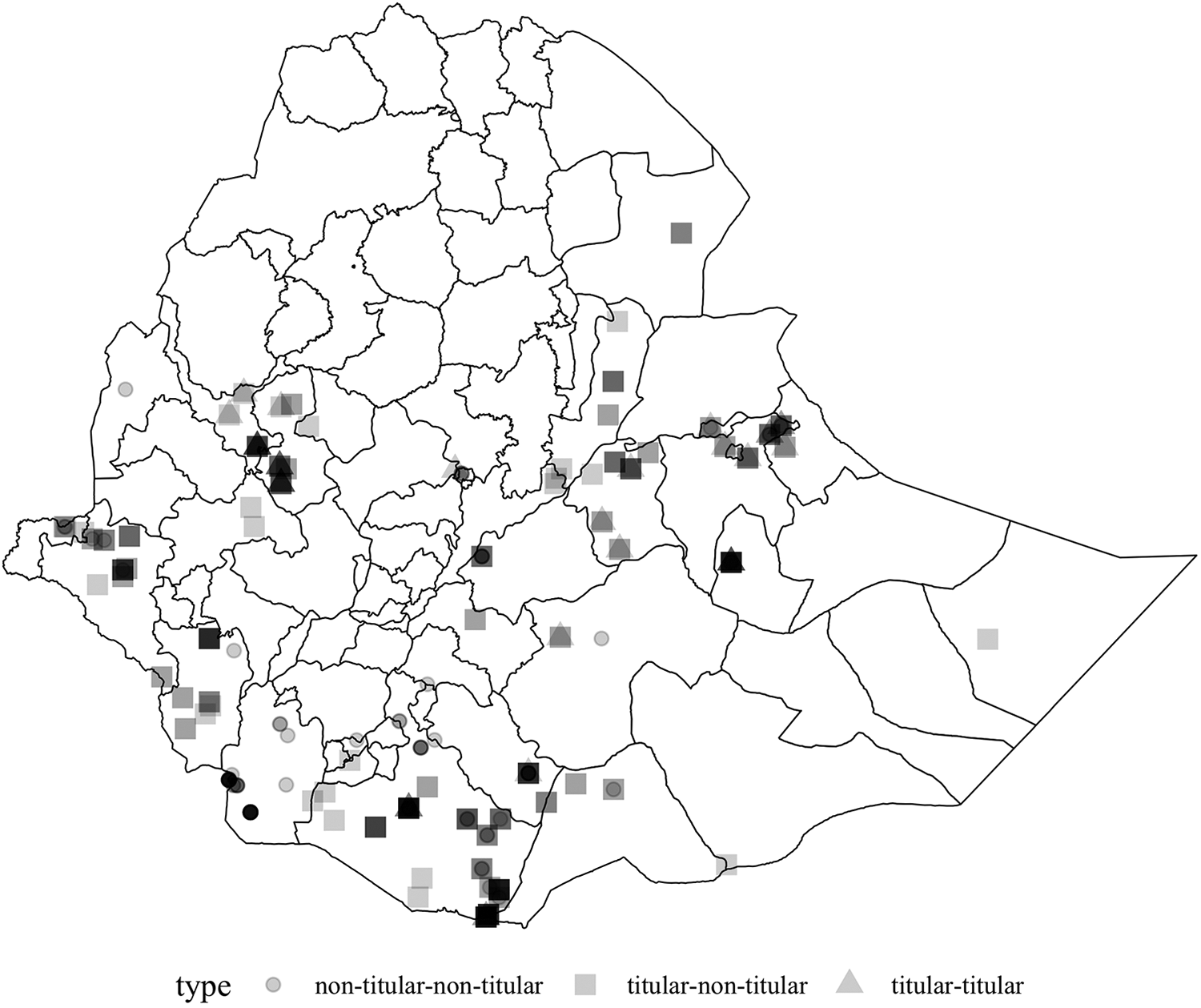
X1 is a vector of dyad-zone-level characteristics. This contains three of our main explanatory variables: One titular, Size difference (subordinate to titular), and Titular in contiguous zone (subordinate). X1 also contains several control variables. First, we include a cubic term measuring the number of years since the last observed episode of communal violence involving dyad d within zone z. The inclusion of this term enables us to flexibly account for different functional forms that temporal dependence might take. Second, we follow Fjelde & Østby (2014) by including two spatial lags, measuring whether at least one dyad member was involved, in the previous year, in communal and civil violence within a radius of 50km around zone z.
Main model results
†p < 0.1; *p < 0.05; **p < 0.01; ***p < 0.001; dyad-clustered errors in parentheses. Cubic peace-year terms and year-fixed effects included but not shown.
Main results
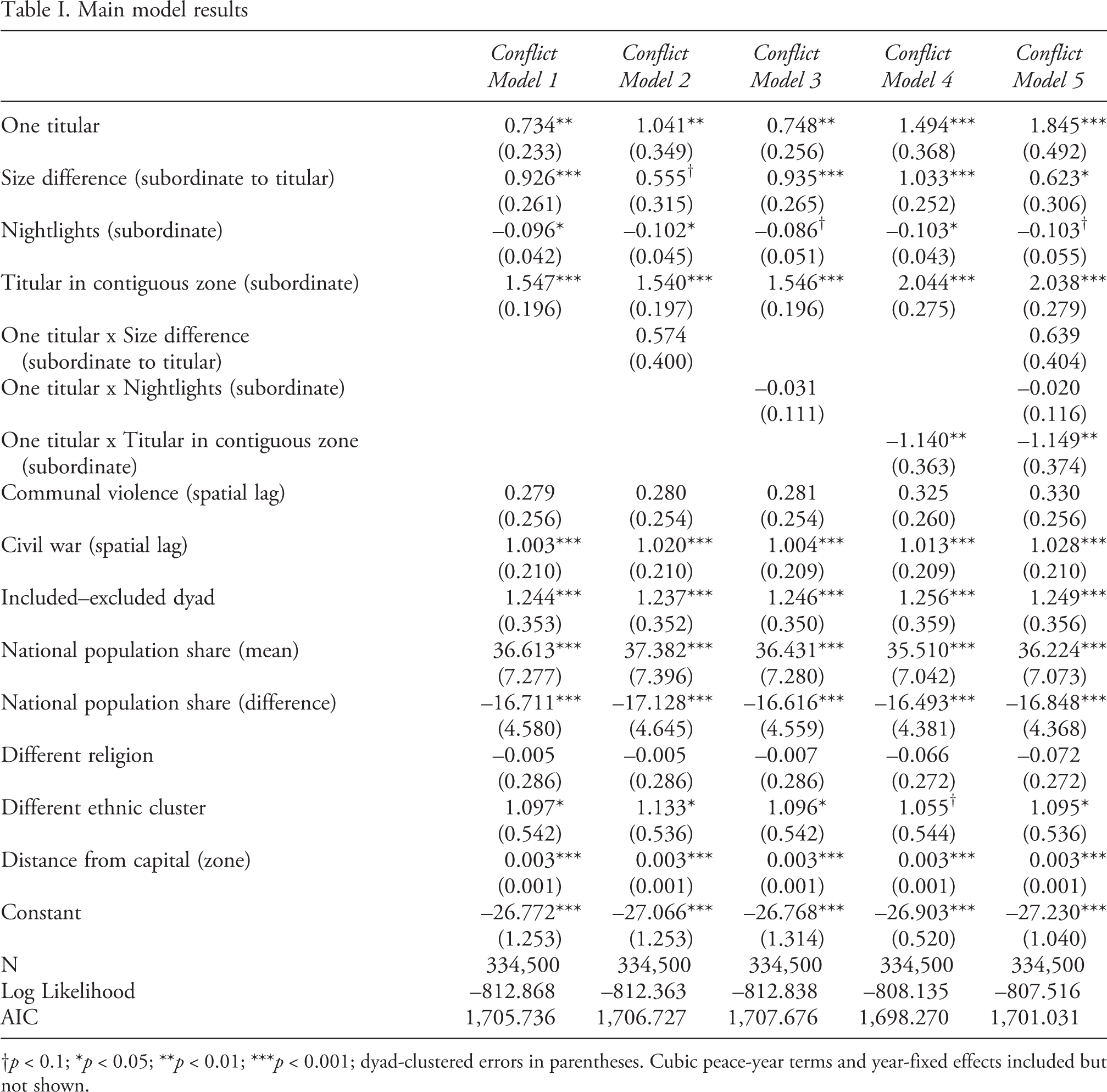
Table I shows our results. Model 1 is our baseline, containing our main variables. It represents an overall test of the relationship between locally dominant status and communal violence. In the following three models (2–4), we test our conditional hypotheses. We do so by separately interacting our main variable (One titular) with local ethnic demography (Size difference (subordinate to titular)), economic attainments (Nightlights (subordinate)), and Titular status in contiguous zone (subordinate). Finally, Model 5 contains all three interactions at the same time. We visualize our findings using Average marginal effects (AME) and 95% confidence intervals (Model 5)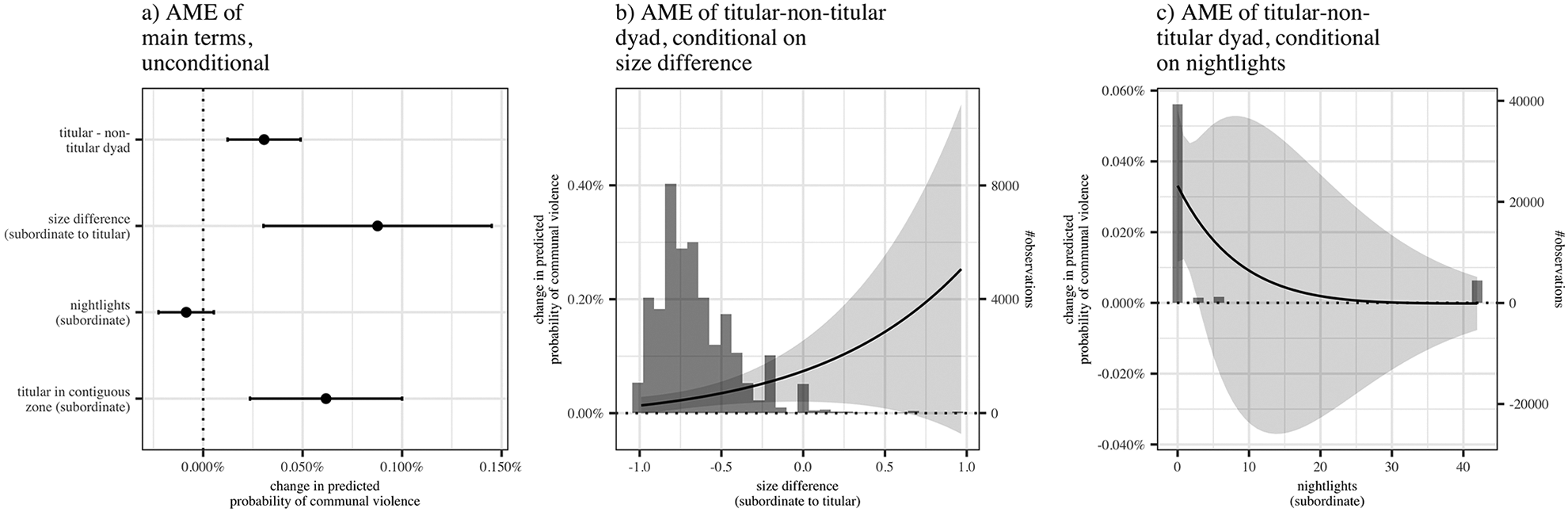
We start by discussing the results of our main independent variable, One titular. Models 1–5 indicate that the risk of communal violence in a dyad is markedly and significantly higher where a dyad contains a titular group (Figure 2a), as opposed to situations where a dyad involves two non-titular groups. 15 This is in accordance with our expectation that, in ethnofederal states, communal violence is most likely to occur between locally dominant groups and locally non-dominant ones (Hypothesis 1.1). Importantly, we attain this effect while controlling for structural and national-level characteristics, such as national demographics, central government inclusion, and ethno-religious differences.
Next, we turn to our three additional independent variables and their interaction with One titular. First, we find that subordinate groups with a large zonal size relative to the titular group(s) are more likely to become involved in communal violence. The main term for size difference in Models 2 and 5 takes a positive sign and is statistically significant at the 90% and 95% levels, respectively. Its interactions with One titular take positive signs, but are not statistically significant. Together with the results from Model 1, this indicates that the attained significant relationship holds for the ‘average’ dyad, even if it involves a titular group (Figures 2a, 2b). However, we cannot be sure whether its magnitude is larger among non-titular–titular dyads than among non-titular–non-titular dyads. Overall, this is in accordance with our expectation that comparably large locally non-dominant groups are more likely to challenge their exclusion and engage in communal violence against locally dominant groups (Hypothesis 1.1). 16 In our sample, the most striking case fitting this relationship is the Harar region where the titular Harari form a small minority. Even though they acquiesced to a power-sharing deal with the Oromo, the political reality remains highly asymmetrical: around 40% of the regional population remain excluded from political office, regularly sparking violent confrontations between the Harari and non-titular groups (Kefale, 2013: 56).
Second, across our models we find a negative association between the economic situation of the dyad’s subordinate member, proxied by Nightlights, and the incidence of communal violence (Figures 2a, 2c). The direction of this result is consistent with our expectation that economic marginalization should exacerbate grievances among locally non-dominant groups directed against locally dominant groups and lead them into violent confrontations (Hypothesis 1.2). However, neither the main nor interaction term is consistently statistically significant at the 95% level. Moreover, the coefficient appears to be driven by values at the ‘extremes’ (Figure 2c). This diminishes our confidence in this particular result. An illustrative example for this (non-significant) tendency in our sample are the non-titular Amhara settlers of Pawe in the Metekel zone that engaged in violent encounters with the titular Gumuz after mobilizing over combined political and economic grievances (Kefale, 2013, see next section).
Finally, we turn to the interaction between One titular and Titular in contiguous zone (subordinate). Across our models we find that dyads whose subordinate group is titular in a contiguous zone are more likely to experience incidences of communal violence. The interactions in Models 4 and 5 indicate that this relationship is weaker, but still substantial and statistically significant, for dyads that pit a non-titular group that is titular in a contiguous zone against the zone’s titular group (Figure 2a). This is in line with Hypothesis 1.3: locally non-dominant groups that are dominant in a contiguous unit are more likely to receive external support and more often mobilize for greater access to local resources or boundary changes. They are also more likely to be perceived as threatening by locally dominant groups and repressed as a result. 17 An example in our sample is the conflict between the Guji and the Gedeo, both of which have significant numbers of ethnic kin in their adjoining ethnic homelands. Violent conflict has erupted at several points in time with violence predominantly targeting those that find themselves on the ‘wrong’ side of the border (Fiseha, 2017: 175, see next section).
Robustness checks
We conducted several robustness checks (Online appendix 4). These probe the sensitivity of our findings to seven types of alterations to our specification. First, we rely on an alternative dependent variable, constructed with the Armed Conflict Location and Event Data (ACLED, Raleigh et al., 2010). Second, we variably exclude subsets of zones that may not enjoy effective autonomy, most importantly zones without access to substantial fiscal resources and the period of 2005–17 when central government repression was more heavy-handed. Third, we probe the robustness of our results to alterations to our gradual interacted variables, Size difference (subordinate to titular) and Nightlights (subordinate), using categorical operationalizations and alternative data sources. Fourth, we test how alterations to our sample affect our findings, including by incorporating variation from zones without titular groups and from titular–titular dyads. Fifth, we probe whether our findings travel from the incidence of communal violence to its intensity, as given by the total number of incidents involving a zone-dyad in a given year, and the total fatalities caused across them. Sixth, we vary the composition of our control variables. Seventh, we adopt a completely different set-up on the level of the ethnic group in a given zone, replacing our dyadic variables with their group-level equivalents. Reassuringly, our findings remain similar across these alternative approaches.
Additionally, we consider the ‘twin’ issues of endogeneity and reverse causation. Problematically for inferential purposes, factors we have not accounted for might simultaneously affect both the designation of zonal titular status and subsequent communal violence. Alternatively, zonal boundaries and titular status might be strategically designated with respect to future risks of communal violence. In either case, our results might be biased. Somewhat attenuating these concerns, previous research highlights national-level bargaining processes as the key determinant of group-wise territorial autonomy. Thereby, the distribution of autonomous status is mainly driven by whether a group can credibly threaten civil violence against the central government (Cederman et al., 2015; Grigoryan, 2015; Anderson, 2016), rather than by its (potential) involvement in communal violence against other groups. Further reassuring us, the creation of zones in Ethiopia has demonstrably been a top-down process. Thereby, Ethiopia’s zonal autonomy structure was uniformly imposed across the country by the dominant EPRDF, with local-level actors and considerations only playing a minimal role (Van der Beken, 2019; Rohrbach, 2021). Most importantly, ideological rather than strategic considerations played a key role in this process: in a hasty bid to redraw regional and local administrative boundaries following its civil war victory, Ethiopia’s dominant EPRDF closely followed the ethno-linguistic maps produced by its socialist predecessor regime, the Derg, who themselves were inspired by Stalinist nationalities ideology (Abbink, 2011).
In spite of these considerations, we obviously cannot fully rule out concerns of endogeneity and reverse causation. Hence, we probe the sensitivity of our results to them. First, we rerun our models with two additional controls. These are meant to (imperfectly) proxy for strategic considerations that might influence the EPRDF’s considerations in drawing zonal boundaries (Online appendix 4.8). We control for the number of fatalities in communal violence involving dyad d in zone z before the creation of ethnofederalism (1989–93) (Sundberg & Melander, 2013). And, we add a dichotomous variable measuring whether a dyad member is discriminated against nationally (Vogt et al., 2015). The incorporation of these controls does not affect our main results. Second, we conduct a set Average marginal effects of titular share in region’s zones on respondent attitudes and 95% confidence intervals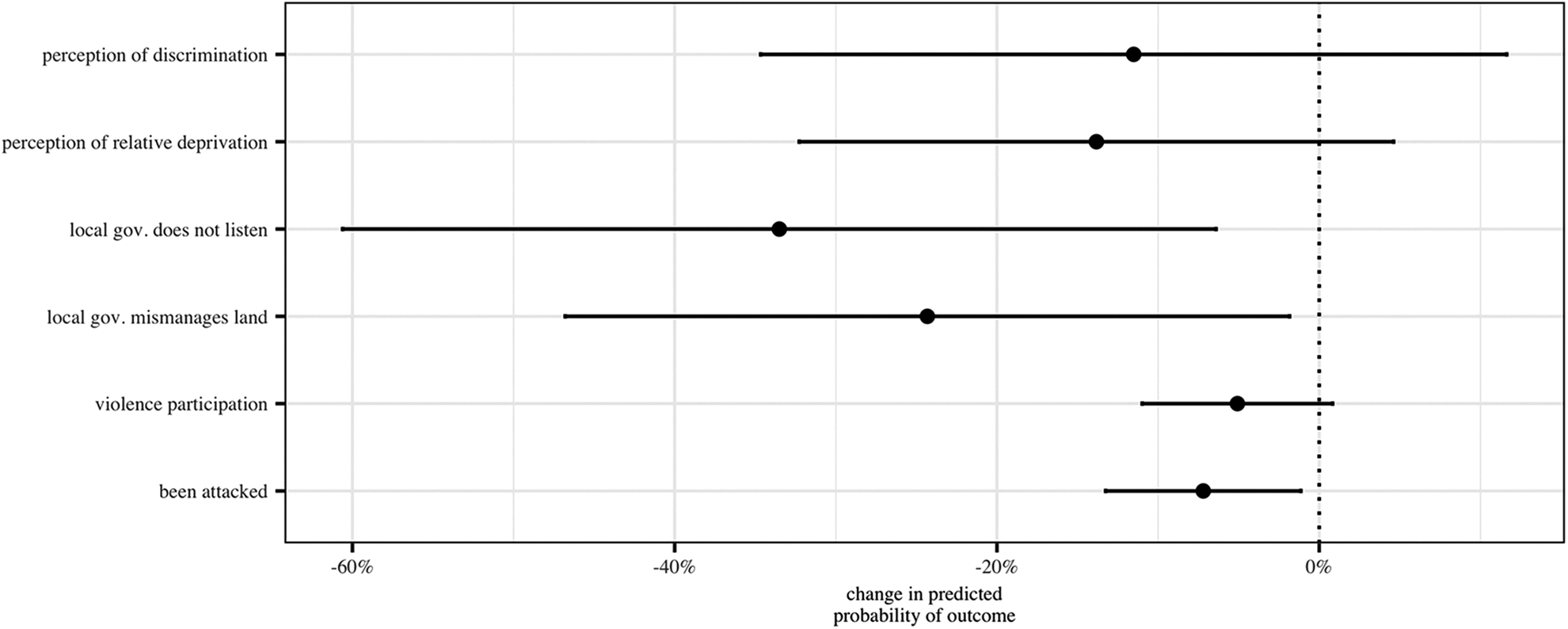
Mechanisms: Additional implications and qualitative evidence
We also conduct additional checks to trace the intermediate steps implied by our hypothesized mechanisms. First, we quantitatively examine their implications for mass attitudes. One testable implication of our arguments is that members of locally non-dominant groups should hold higher grievances and negative attitudes towards the local government. Another is that they should be more willing to engage in violence and more likely to state violence as a problem affecting them. To trace these implications, we rely on Afrobarometer data (2016, round 5), gathered across Ethiopia in 2013 (Afrobarometer, 1999–2016). Using systematic, if imperfect, 18 individual-level data, we run a series of logistic multilevel regressions. These offer general support for our expectations: non-titular status is positively associated with perceptions of discrimination and economic deprivation and with willingness to participate in violence (although these three findings are not significant at the 95% level). Moreover, non-titular members are more likely to perceive the local government as unresponsive to their demands and as mismanaging land allocation and to state that they have been physically attacked. To visualize these results, Figure 3 shows the average marginal effect of titular status on these outcomes. For details on these analyses, we refer to Online appendix 6.
Second, we provide qualitative illustrations of our hypothesized mechanisms. We combine information gathered during field research in Ethiopia with evidence from secondary sources.
19
A total of 13 semi-structured interviews were conducted with experts and members of the elite, both from the ruling party and opposition.
20
Interviews were conducted in August 2018 in the federal capital Addis Ababa and Hawassa. Interviewees were asked questions about local violence, the role of federal institutions, and possibilities to avoid future conflict. Mirroring our arguments, several interview passages highlight incentives of locally dominant group elites to employ communal violence in order to consolidate political power over their ‘homeland’. Respondents maintain that, since the introduction of ethnofederalism, titular groups have developed a strong sense of ‘entitlement’.
21
Ethnicity has become increasingly politicized, as pointed out by one of the respondents: During a meeting of regional representatives, one of my colleagues was asked where he is from and he responded ‘I am Ethiopian’. He was met with criticism from the others who did not approve that he did not say, for example, ‘I am Sidama’ or ‘I am Wolaita’. This is how difficult it has become to talk about these issues.
22
The biggest problem is not the people; they live together peacefully and are relatively happy with the current arrangement, but the elites. They are afraid of losing power and more concerned with increasing their power and benefits. There is little tolerance and sadly mobilization, which resulted in attacks and displacement of people belonging to specific groups.
23
A second example is the conflict between the Guji and the Gedeo. This illustrates the incentives of elites to use communal violence in contexts where local political inequality coincides with economic inequality and ethnic kin across zonal borders. Both the Guji and Gedeo were awarded their own ‘homeland’, in the form of adjoining zones where they hold respective titular status. However, substantial numbers of both find themselves on the ‘wrong’ side of the border and remain culturally and economically marginalized. While the two groups have a history of competition over scarce resources, these disputes only became politicized and turned into violent boundary conflicts after the ethnofederal restructuring (Fiseha, 2017; Kinfemichael, 2014). Sources indicate that political inequality combined with economic marginalization and authorities’ distrust of ethnic segments with access to external support drove much of the communal violence, which frequently aimed at displacing potential rivals (Shaban, 2018). Since the start of the recent liberalization efforts in 2015, these tensions have further escalated. 25
Conclusion
In this article, we have examined the consequences of ethnofederalism for the risks of communal violence. Our findings indicate that in ethnofederations, the risk of communal violence is particularly high between locally dominant and non-dominant groups. Thereby, they echo previous research that emphasizes resource scarcity and horizontal inequalities as key drivers of communal violence. Yet, they also highlight the importance of accounting for institutional factors, such as ethnofederalism, which often affect the magnitude, distribution, and politicization of economic deprivation and horizontal inequalities in the first place. Our findings call for more attention to the consequences of ethnofederalism for subnational conflict. Similar to the exclusion of specific groups from power-sharing at the national level (Juon, 2020), ethnofederalism may empower some groups at the cost of marginalizing others. Thereby, it may give rise to less visible and more localized forms of conflict, such as communal violence.
While our study has examined the consequences of ethnofederalism for communal violence in Ethiopia, there is reason to believe that our hypothesized mechanisms should also apply to other contexts. For instance, our theoretical argument suggests that the concentration of communal violence in sub-Saharan Africa in other federal or decentralized countries, such as Nigeria, Sudan, South Sudan, Uganda, and Kenya (Sundberg, Eck & Kreutz, 2012; Pettersson, Högbladh & Öberg, 2019) might be no coincidence and related to struggles over political power at the local level. 26 Similar dynamics of local exclusion and mobilization have been highlighted, for example, in Nigeria (Kendhammer, 2010) and Uganda (Green, 2008). The large subnational variation within Ethiopia, which we have studied, should bolster the external validity of our findings. However, it is for future research to investigate the relationship between local political dominance and communal violence in other ethnofederal states.
At this point, it is also necessary to acknowledge some limitations of our approach. First, the above examples suggest that our arguments might explain variation in communal violence between ethnofederations and their institutional alternatives more broadly. However, our analysis has focused on the implications of our argument for the group-wise and spatial distribution of communal violence within one particular ethnofederal state. Most importantly, our results rely on evidence from a very specific form of ethnofederalism, which consists of institutionally designated ‘homelands’ and is circumscribed by dominant party rule. Yet, unlike Ethiopia, most contemporary ethnofederal states do not rely on such explicit predetermination (Anderson, 2016) and are not equally circumscribed by dominant party rule. Hence, future research might expand on our study by investigating the potentially variegated impact of different types of ethnofederalism alongside their institutional alternatives, such as unitary states and non-ethnic federalism.
Second, future research should also more explicitly aim to disentangle the mechanisms connecting ethnofederalism with communal violence than has been possible in this study. We have argued that ethnofederalism concurrently affects mass attitudes and elite incentives of both locally dominant and non-dominant groups. While we have traced the implications of our arguments for mass grievances and attitudes, such analyses might be extended. Analogously to analyses of ethnic bargaining at the national level (e.g. Grigoryan, 2015; Juon, 2020), this might include investigating how ethnofederalism affects interactions preceding communal violence, for example nonviolent mobilization or the willingness of locally dominant elites to accommodate challenges peacefully.
Finally, a factor that we have largely bracketed is the role of historical intergroup relations. It seems likely, for instance, that legacies of severe conflict affect the working of Ethiopia’s ethnofederalism to this day. As previous research at the national level shows (Bulutgil, 2015), prior exposure to ethnic violence can enhance pessimistic assessments of possibilities for peaceful coexistence. Much may therefore depend on the timing by which ethnofederalism is first introduced (cf. Cederman et al., 2015). It may well be, for instance, that ethnofederalism may have fewer undesirable consequences for communal violence risks if it is introduced before subnational conflict first escalates.
Footnotes
Replication data

Acknowledgements
We are very grateful for helpful comments by Daniel Bochsler, Lars-Erik Cederman, Peter Thisded Dinesen, Henrikas Bartusevičius, Hanne Fjelde, Benjamin Egerod, Dennis Atzenhofer, Paola Galano Toro, Guy Schvitz, Roberto Valli, and participants of the 2020 Political Turbulence PhD workshop organized by the Conflict & Change group at UCL.
Funding
This work was supported by the Swiss National Science Foundation (SNF), grant number 166228.