




Abstract
How does exposure to criminal violence shape attitudes towards justice and the rule of law? Citizens care about crime prevention and procedural legality, yet they also value punishing perpetrators for the harm they have done. We argue that anger induced by exposure to criminal violence increases the demand for retribution and harsh punishments, even at the expense of the rule of law. We test this theory using one observational and two experimental studies from an original survey of 1,200 individuals in Western Mexico, a region affected by organized criminal violence and vigilantism. First, we first show that exposure to violence is correlated with increased anger and support for punitive justice, including vigilante actions. Second, across our two experiments, we show that citizens are more supportive of harsh punishments and place less value on their legality in response to morally outrageous crimes. Third, we find that the innocence of the victim, rather than the severity of the crime, is what triggers outrage and punitiveness. This suggests that citizens may support extreme levels of violence as long as they perceive that its targets are criminals. Finally, we show that outrageous forms of violence against civilians can lead individuals to prioritize harsh punishment regardless of its legality. When criminal actors target perceived innocents with common crimes like extortion, there is greater support for harsh, vigilante action. These patterns provide a bottom-up explanation for harsh justice.
Introduction
‘They kidnapped my sisters. They tried to kill my wife and my children. And when they started going into the schools and taking the baby girls, 11-year-olds, 12-year-olds, that was my breaking point…We have a lot of anger.’
In early 2013, groups of civilians in the Mexican state of Michoacán formed self-defense militias called autodefensas to fight against a drug cartel. For a short period in 2013, security in areas controlled by the autodefensas seemed to improve. Yet by early 2014, some autodefensas were accused of being allied with criminal organizations, while others were fighting for control of lucrative lime orchards (Macas, 2014). The Mexican government, unable to prevent the militias from operating, nominally formalized them as a Rural Defense Corps. Seven years after the emergence of the autodefensas, official statistics show that violence in the region has worsened (Estrada, Hinojosa & Badillo, 2019).
The events in Michoacán follow a common pattern: outrageous crimes increase demand for harsh punishment, and vigilante groups emerge to carry them out. This dynamic is not confined to Mexico. Political parties and leaders in Brazil, El Salvador, and the Philippines have invoked populist appeals for punitive justice to great electoral success, with little evidence of crime reduction (Holland, 2013). Citizens seem to support harsh justice policies regardless of their effectiveness. Under what conditions does the demand for harsh punishments dominate considerations like crime prevention or procedural legality?
We propose that anger induced by violence affects citizens’ attitudes towards criminal justice policies. Citizens care about the effectiveness of different policies. Yet, they also want to punish perpetrators in ways that correspond to their crimes. For outrageous crimes there is an increased demand for punishment, but only certain types – those with victims perceived as innocents – cause people to feel outrage and prioritize retribution.
We follow other scholars in conceptualizing violence – our independent variable of interest – as the intentional threat or use of coercive force (Tilly, 1992). Our definition of violence includes forms of extortion in which violence is threatened but not carried out if victims comply with perpetrators’ demands. Our dependent variable of interest is support for punitive responses to crime such as the death penalty or extrajudicial killings. Support for punitive crime responses may be driven by a desire to deter or incapacitate future crime, or by a preference for retribution for its own sake. It may only apply to specific crimes, or may be generalized to support for harsh criminal justice policy more broadly.
There is mixed evidence on how exposure to violence affects support for harsh punishment. In some contexts, violence increases support for escalatory policies, while in others it leads to conciliatory positions (Lyall, 2009; Canetti-Nisim et al., 2009; Beber, Roessler & Scacco, 2014; Zeitzoff, 2014; Getmansky & Zeitzoff, 2014; Hazlett, 2019). This literature rarely disaggregates the characteristics of violence that shape citizens’ reactions (e.g. severity, type of victim, or time since exposure) and often remains agnostic about the mechanisms that link violence to changes in preferences. We test our theory on the types of violence that are most likely to cause increases in support for violent retaliation, and provide evidence of emotions as a specific mechanism.
We contribute to the literature on vigilantism, an important and understudied form of violence. While we are primarily focused on support for harsh punishments, regardless of whether the state or vigilantes carry them out, increases in punitiveness can lead citizens to support vigilantes if the state fails to punish crimes. Much of the literature on vigilantism focuses on structural determinants, including the legitimacy of state security forces (Tankebe, 2009; Jung & Cohen, 2020), availability of financial resources (Phillips, 2017; Ley, Ibarra Olivo & Meseguer, 2019), and the role of local institutions (Mattiace, Ley & Trejo, 2019; Moncada, 2019). In contrast to structural explanations, we show that individual-level psychological processes help explain support for harsh and vigilante punishments. Our argument builds on research linking individual-level factors like political distrust to support for vigilantism (Zizumbo-Colunga, 2017; Cruz & Kloppe-Santamara, 2019).
We conducted three studies to test our theory using a survey of 1,200 residents in Western Mexico, including areas with vigilante groups. Study 1 examines whether those exposed to more violence prefer more punitive policies and are angrier. Study 2 tests whether anger-inducing scenarios cause people to prefer harsh and illegal punishments. Study 3 uses 125 randomly generated scenarios to test whether crimes that are more severe or target innocent victims induce more anger and increase support for harsher punishments. This set of studies enables us to draw conclusions that are based on realistic variation, generalize to the population of interest, and are causal. The first study’s observational design looks at real exposure to violence and its relationship with policy preferences and anger in a representative sample. The second study is a survey experiment where we estimate the effects of hypothetical exposure to outrageous violence. In the third study, we use a factorial experiment to causally estimate the effects of different crime characteristics.
These studies yield four findings. First, exposure to criminal violence is correlated with increased anger and support for harsh punishments, including those by vigilantes. Second, our two experiments show that morally outrageous crimes increase support for harsh punishments, and cause citizens to deprioritize the legality of punishments. We find no evidence that exposure to violence increases support for vigilantism for its own sake. Instead, we find that citizens turn to vigilantes because they offer harsher punishments than the state. Third, the innocence of victims, rather than the severity of crimes, has the largest effect on outrage and preferences for harsh punishments. Finally, we find no evidence that the relationship between exposure to violence and support for harsh punishments is stronger in areas of low state security capacity. This is suggestive evidence that the relationship between violence, anger, and support for harsh justice is driven by a desire for retribution instead of deterrence.
Taken together, our findings provide a bottom-up explanation for punitive violence. Crimes that target victims perceived as innocent induce outrage and increase support for punitive justice, even if it is carried out outside the law. Our findings also imply that citizens may tolerate high levels of violence when they believe that it is restricted to criminals. These findings provide new insights into when and why citizens support harsh justice, but they do not identify its effects. Emotions like anger can drive violent collective action processes with positive or negative consequences for their participants and their communities. More research is needed to clarify whether harsh or vigilante punishments are effective in reducing crime, or lead to spirals of violence.
Anger, exposure to violence, and attitudes towards justice
Principles underlying criminal justice preferences
Early political theorists suggested two rationales for punishing crimes: retribution and prevention. Retribution is retrospective, focusing on the perpetrator receiving their ‘just deserts’ (Kant, [1790]1952). Following this principle, the severity of the harm and the existence of extenuating circumstances that mitigate or exacerbate the moral outrage should be strongly related to the severity of the punishment. In contrast, utilitarian scholars argue that ‘general prevention ought to be the chief end of punishment’ (Bentham, 1962). More recent theorists argue that citizens also care about equitable treatment or ‘procedural justice’ (Lind & Tyler, 1988). So, while individuals care about punishing wrongs, they also care about the fairness and transparency in the judicial process, which legitimates the punishment (Tyler, 2006).
Research in the United States has attempted to identify whether attitudes towards criminal justice policy are driven by retribution, prevention, or procedural justice. Public opinion researchers have argued that the popularity of the death penalty and three strikes laws is primarily motivated by a logic of retribution (Roberts et al., 2002; Enns, 2014). Political psychologists have used vignette experiments to show that participants prefer harsher punishments for morally outrageous crimes, but not necessarily for those in which the punishment is more likely to deter future crime (Darley, Carlsmith & Robinson, 2000; Carlsmith, Darley & Robinson, 2002). This preference for harsh punishments may be part of a general willingness to punish, even when it is personally costly (Carpenter, 2007).
Emotions and preferences over criminal justice
What cognitive processes make someone prefer a severe punishment? Theories of emotion and cognition provide a foundation for how anger can increase the taste for punishment. Anger is an approach-oriented emotion that prepares individuals to take action to rectify perceived wrongs (Frijda, 1986; Carver & Harmon-Jones, 2009). This push to action distinguishes anger from other moral emotions like contempt or disgust (Hutcherson & Gross, 2011).
Experiments in psychology and behavioral economics have shown that inducing anger increases punitiveness and associated appraisals (Lerner, Goldberg & Tetlock, 1998; Bastian, Denson & Haslam, 2013). Social psychologists have argued that anger plays an integral role in explaining preferences for punishment because crime violates sacred values. Garland (2012: 30) argues that ‘[t]he criminal act violates sentiments and emotions which are deeply ingrained in most members of society […] it provokes a sense of outrage, anger, indignation, and a passionate desire for vengeance’. Studies of political violence and terrorism have similarly argued that the emotions and stress induced by violent events can affect threat perceptions, punitiveness, and political preferences (Huddy et al., 2005; Merolla & Zechmeister, 2009; Canetti et al., 2013; Hirsch-Hoefler et al., 2016).
What kind of punishments or policies will angry individuals prefer when the state is unable or unwilling to punish? Most public opinion research on criminal justice policy has been conducted in high-capacity states. However, exposure to violence is generally higher in contexts where the public is less confident that the government can effectively implement harsh punishments (Gallup, 2018). In such settings, the desire for punishment can lead affected individuals to prioritize retribution over legality and prevention of future harm, indirectly increasing support for extrajudicial options.
Theoretical expectations
What forms of violence are most likely to set off angry reactions that lead citizens to prioritize retribution? In this section, we outline our expectations of how exposure to certain types of violence will induce emotions that change how citizens prioritize justice, punitiveness, and effectiveness in crime responses.
Vigilante justice and harsh punishments are overlapping but distinct concepts. We define vigilante justice as the extralegal use of threats or force to prevent or punish criminal offenses (Moncada, 2017; Bateson, 2021). Harsh punishments are designed to inflict pain and hardship in retribution for an offense. We focus on vigilante acts of punitive justice in Western Mexico for two reasons: (1) these are highly visible crimes widely covered in media; and (2) they are important for what they signal, that is, a desire to harshly punish criminals when the state is unable to do so.
The first stage in our theoretical framework is exposure to violence. Violence that violates moral principles should be particularly likely to induce anger. We focus on two types of violence that violate clear moral tenets: first, violence that is extremely severe, and second, violence that is targeted on innocents. Fujii (2013) calls extreme violence intended to transgress shared norms about proper treatment of persons and bodies ‘extra-lethal’. This type of violence should generate anger by going beyond what is perceived as necessary to achieve a violent actor’s goal of killing a victim (Atran, Axelrod & Davis, 2007). However, violence between different groups of professional criminals should not have the same anger-inducing effects. Thus, our first prediction is that exposure to violence will be associated with the emotion of anger, especially if the violence is severe or targets victims who are perceived as innocent (Prediction 1).
The second stage in our framework focuses on how anger shapes criminal justice preferences. Anger should shift the weight that individuals place on punitiveness, legality, and effectiveness in violence prevention. Exposure to violence – particularly violence that is severe or targets innocents – should increase support for harsh punishments (Prediction 2). This increase in support for harsh punishments can also increase support for punitiveness as a principle of criminal justice policy, at the expense of procedural justice and effectiveness in reducing violence. We also expect this type of violence to be associated with higher support for extrajudicial punishments (Prediction 3). While anger could lead citizens to support vigilantes because they are an end to the means of harsh punishments, this hypothesis predicts that conditional on the punishment’s harshness, anger may cause citizens to develop a separate preference for punishments that are meted out by vigilantes.
Finally, we test whether the link between exposure to violence and our outcomes of interest is conditional on the presence of state security forces. If harsh and extrajudicial punishments were a strategic reaction to violence, we would expect to see a stronger relationship between exposure to violence and support for harsh, extrajudicial punishments in communities with lower state security capacity (Prediction 4A). However, if support for harsh punishments is instead driven by a taste for punishment at the expense of long-term security and the rule of law, then we would expect to see this reaction regardless of the state’s effectiveness in punishing and deterring crime (Prediction 4B). 1
In sum, we predict that exposure to violence, particularly severe violence and violence perpetrated against perceived innocent victims, triggers anger. It also motivates individuals to prioritize punitive, vigilante justice, at the expense of other justice principles.
Violence and vigilantism in Mexico
Vigilantism and support for harsh justice is a global phenomenon (Pratten & Sen, 2007; Jung & Cohen, 2020). Civilian self-policing and self-defense groups have responded to security threats imposed by drug trafficking organizations, gangs, and rebel groups, among others, in various parts of Latin America and sub-Saharan Africa, but also in richer countries such as the United States. Within a context of severe drug-related violence and increased militarization, armed civilian groups and community patrols have emerged in several parts of Mexico in recent years, drawing national and international attention. In this section, we explain the context in which vigilantism and support for extrajudicial violence have grown in Western Mexico, particularly in the state of Michoacán.
Mexico’s drug war
Drug-related violence is the largest security threat in Mexico, affecting numerous parts of the country for more than a decade. Official data from the National Institute of Statistics and Geography (INEGI) show that over 400,000 Mexicans have been killed since December 2006, when former Mexican president Felipe Calderón began a ‘war’ against organized crime by sending the army into the state of Michoacán. Mexico’s president at the time of this study, Enrique Peña Nieto, adopted a similar strategy towards organized crime: the army was deployed throughout the territory to capture or kill criminal bosses, seize drugs, and eradicate illicit crops.
Figure 1, Panel A, shows the geographic distribution of homicides across Mexican municipalities for 2017. While much of the violence is concentrated along
Homicides and presence of autodefensas (a) Panel A: Homicide rates at the municipality level in Mexico, 2017 (b) Panel B: Presence of autodefensas in Western Mexico (Michoacán, Nayarit, Jalisco, and Colima)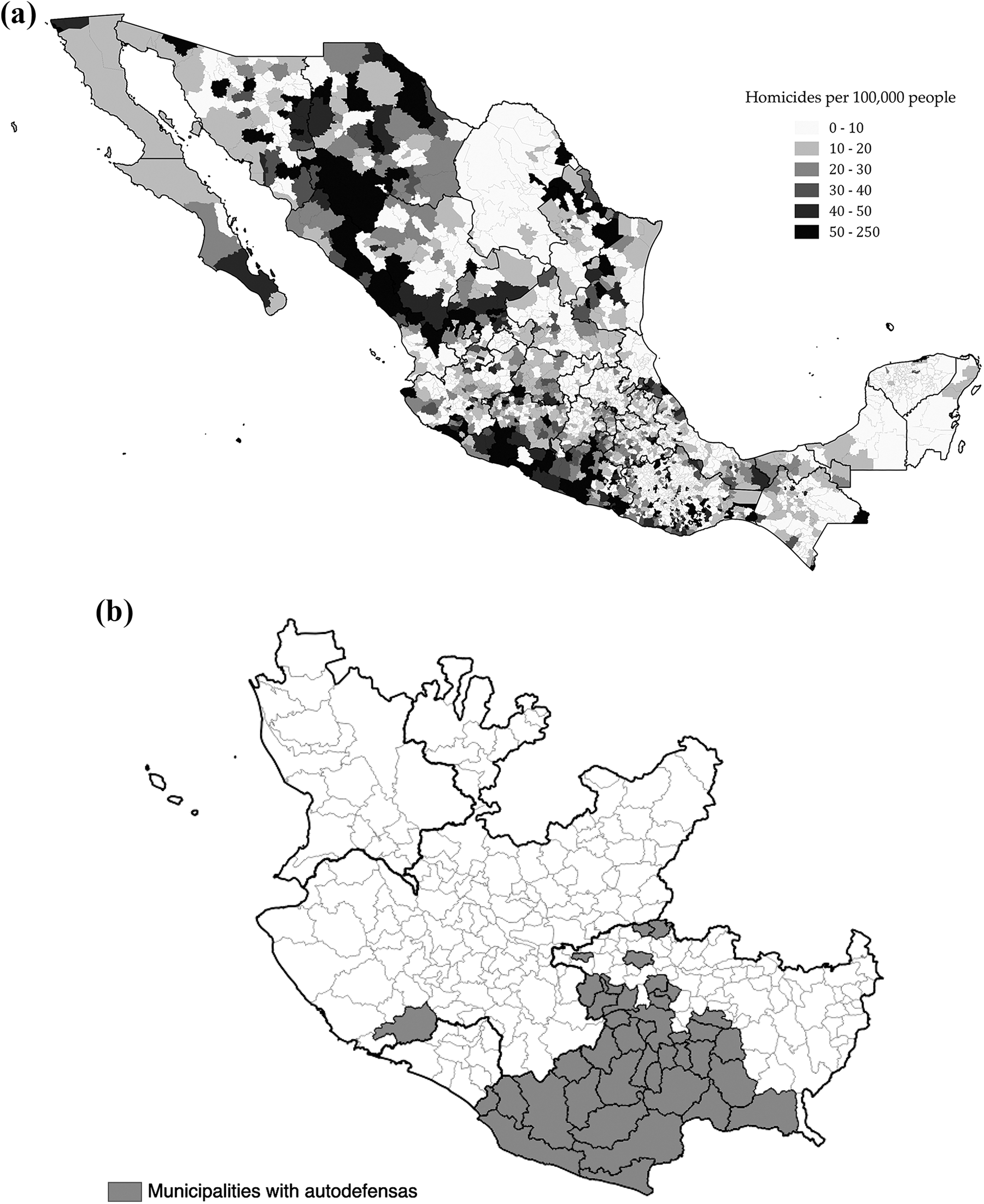
Scholars and policymakers have pointed to institutionalized corruption and an ineffective judicial system as key drivers of the violence (Ríos, 2014). Other factors that have led to heightened violence over the past decade include the fragmentation of the drug cartels, a fierce battle for controlling lucrative coastal ports, and the diversification of organized crime from drug trafficking into other criminal activities like extortion, human trafficking, and fuel theft (Beittel, 2020).
Vigilantism and support for extrajudicial violence
Violent crime and extortion are longstanding problems in Michoacán (Maldonado Aranda, 2012; Zepeda Gil, 2016). In early 2013, civilians decided to take up arms and created a number of self-defense groups with the aim of kicking out Los Templarios, one of the bloodiest criminal organizations in the country. These vigilante groups became known as autodefensas (self-defenders). José Manuel Mireles, one of the leaders of the autodefensas, explained that Los Templarios had crossed a line when they started to kidnap women and children in groups in order to rape them. Others argued that they decided to form these groups when Los Templarios started exerting direct control over agricultural production, taking over farms illegally, displacing owners and exploiting workers (García-Ponce & Lajous, 2014).
The emergence of self-defense militias is not a new phenomenon in Mexico (Kloppe-Santamaría, 2020), but the autodefensas were different in notable ways. Many of the autodefensas clashed with both drug cartels and state security forces, and were accused of carrying out lynchings and human rights abuses (Maldonado Aranda, 2019). Based on public opinion polls conducted in 2014, a majority of Mexican citizens supported the creation of such groups and perceived them as more effective than the state security forces (Animal Político, 2014). As shown in Panel B of Figure 1, the autodefensas spread throughout Michoacán, covering more than half of the state’s area.
Although the autodefensas were mainly made up of local farmers and business owners, it is suspected that their ranks were infiltrated by drug cartels. In May 2014, the government offered to incorporate the autodefensas into official public security forces, which resulted in the newly formed rural police forces. Michoacán’s homicide rate remains at historically high levels and neighboring states like Colima have experienced a sharp uptick of violence, with a homicide rate of 113 per 100,000 people in 2017.
Sampling strategy
Our target population for this study was adult residents of the four states in Western Mexico. Respondents were randomly selected using a stratified multistage cluster sampling design. We stratified electoral precincts based on variation in the presence of autodefensas, violence severity, and urbanization, and then selected them in proportion to their populations. 2 Within each precinct, surveyors used maps and a random number generator to select household clusters proportional to their size, and then selected households in intervals of three. Surveyors randomly selected a respondent from a roster of eligible adult household members. 3 If the respondent was not available or declined, we made one replacement within the household and then replaced the household with its nearest neighbor. The interview was administered on tablets using Open Data Kit.
This strategy produced a sample with considerable variation in terms of exposure to violence and criminal justice preferences. Half of the respondents in our sample are in Michoácan, 40% are in Jalisco, 6% are in Nayarit, and 4% in Colima. Summary statistics are presented in Online appendix Table B.4.
Study 1: Is victimization correlated with support for harsh, vigilante policies?
In the first study we test whether exposure to violence is correlated with punitiveness and anger. If we find the expected positive relationships between exposure to violence, punitiveness, and anger, then it provides suggestive evidence that the experimental tests of our posited causal relationships generalize to the real world.
Our main measure of exposure to violence is a standardized additive Violence index of five different types of violence: (1) abduction, (2) extortion, (3) paying for protection, (4) being threatened with a weapon, and (5) assault. Because we assessed that it was unethical to ask respondents to directly report on personal experiences with severe violence, we proxy for personal exposure with an indirect measure. Specifically, we asked respondents to estimate how likely it is that someone in their community has experienced different types of violence in the past 30 days. We selected five forms of violence based on past applications of the Harvard Trauma Questionnaire with Mexican respondents and crime statistics for the four states included in our study (O’Connor, Vizcaino & Benavides, 2015). To validate
Estimated incidence of severe violence by state in Western Mexico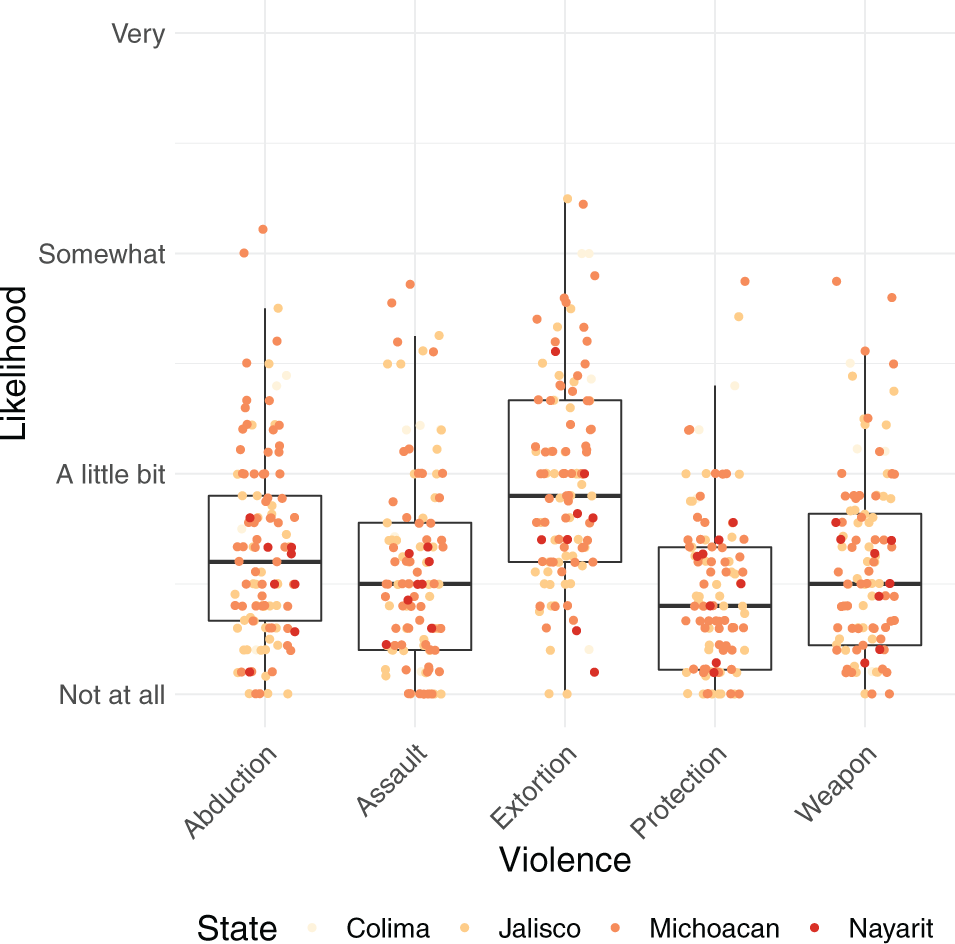
There is considerable variation in exposure to violence in our sample, both within and across states. In Figure 2, we plot precinct averages of our indirect measures of five types of violence in the past 30 days. Extortion is the most commonly reported form of violence. The extremely high incidence of extortion is also supported by our direct measure: 14% of our respondents say that they have personally experienced extortion. It is also in line with other data sources, including the 2016 National Crime Victimization Survey (ENVIPE) and other recent academic surveys (Magaloni et al., 2020).
Is exposure to violence based on these five measures correlated with differences in the psychological states and policy preferences? We first assess whether past exposure to criminal violence is associated with greater anger, an emotional reaction that we expect will increase support for punitive, pro-vigilante justice policies.
We estimate these correlations using OLS. Most specifications include individual controls, such as gender, education, an assets index, age, marital status, and employment of the household head, as well as precinct fixed effects. We selected these variables because they are both likely to explain variation in exposure to violence, and are unlikely to introduce post-treatment because they are slow-changing demographic characteristics. We cluster standard errors by precinct because violence exposure is likely correlated across residents at the local level.
Exposure to violence is associated with more anger
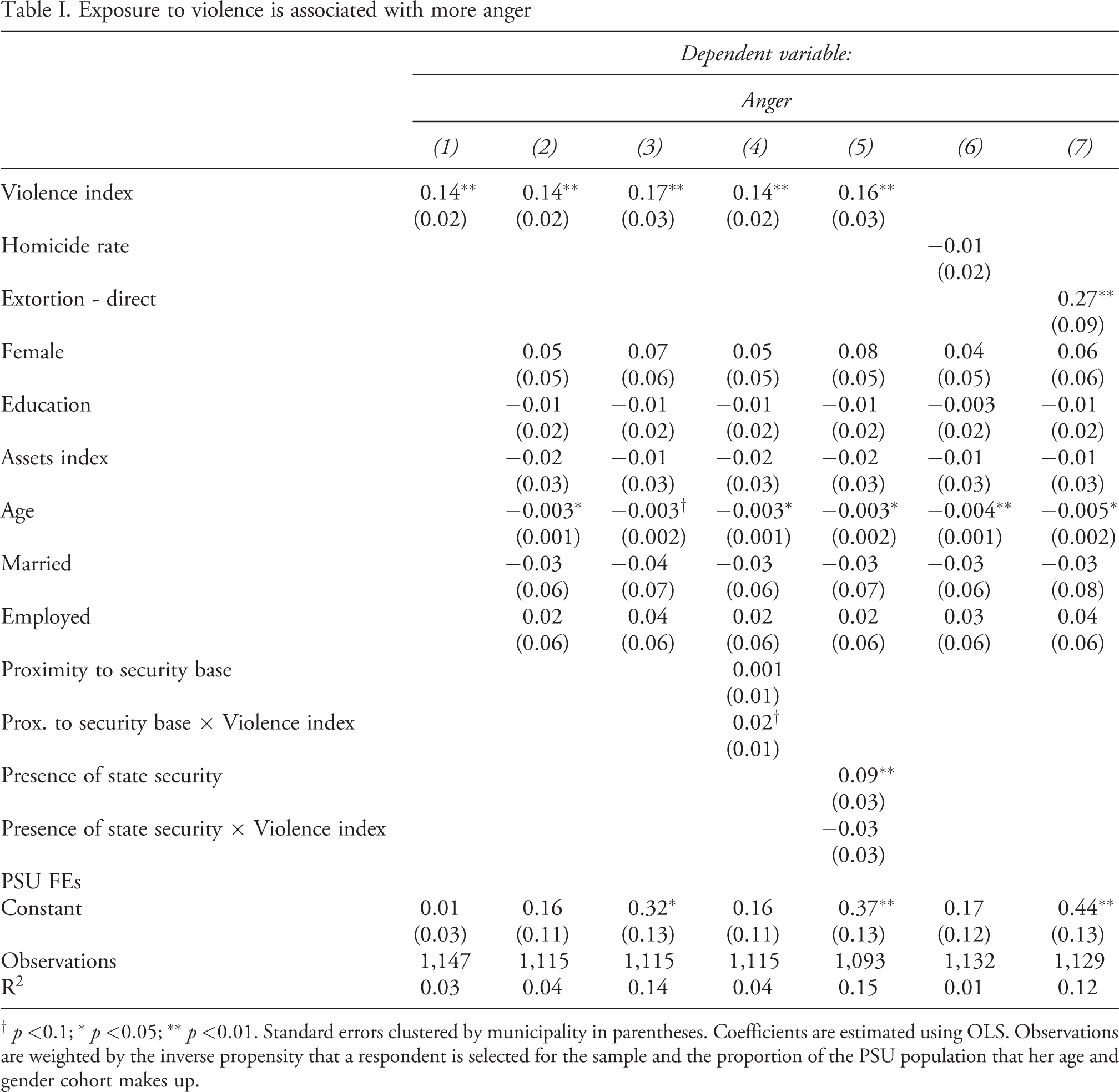
Finally, we test whether the relationship between exposure to violence and anger depends on the presence of state security forces. Ideally, we would be able to observe not only the presence but also the level of corruption of nearby security forces, as both shape their effectiveness. However, because there is no systematic data on state security force corruption we use state security force presence, for which we have two measures. Our preferred measure is based on administrative data and measures the distance from a municipality to the nearest police station or military base. 4 As a secondary measure, we use an individual survey measure of whether the respondent believes that state security forces (police or army) have been active in a municipality like theirs in the last year.
Columns 4 and 5 show that there is some evidence that state security capacity is also associated with variation in anger. A one standard deviation increase in perceived presence of state security forces is associated with a 0.09 standard deviation increase in anger, but there is no relationship with the administrative measure. The relationship between state capacity and negative emotions deserves future attention. More importantly for our analysis, the relationship between exposure to violence and anger is robust to including these state capacity proxies as controls, and is similar in high and low capacity areas.
Next, we examine the correlation between our index of exposure to violence and respondents’ policy preferences. Our key dependent variable is a Policy attitudes index based on five policy questions that measure the extent of support or opposition to (1) non governmental armed groups, (2) the autodefensas, (3) lynching a criminal rather than releasing him on a technicality, (4) reinstating the death penalty, and (5) a proposal to pay narcotraffickers to stop participating in violence. Figure 3 presents the distribution of responses to each of these five policy proposals.
We find strong support for punitive, state criminal justice policies: 36% of respondents support bringing back the death penalty, whereas a large majority (86%) opposes a policy that would pay narcotraffickers to abstain from violence. We find similar support for vigilante responses. Across the two questions that ask directly about support for nongovernmental armed Support for pro-vigilante and harsh criminal justice policy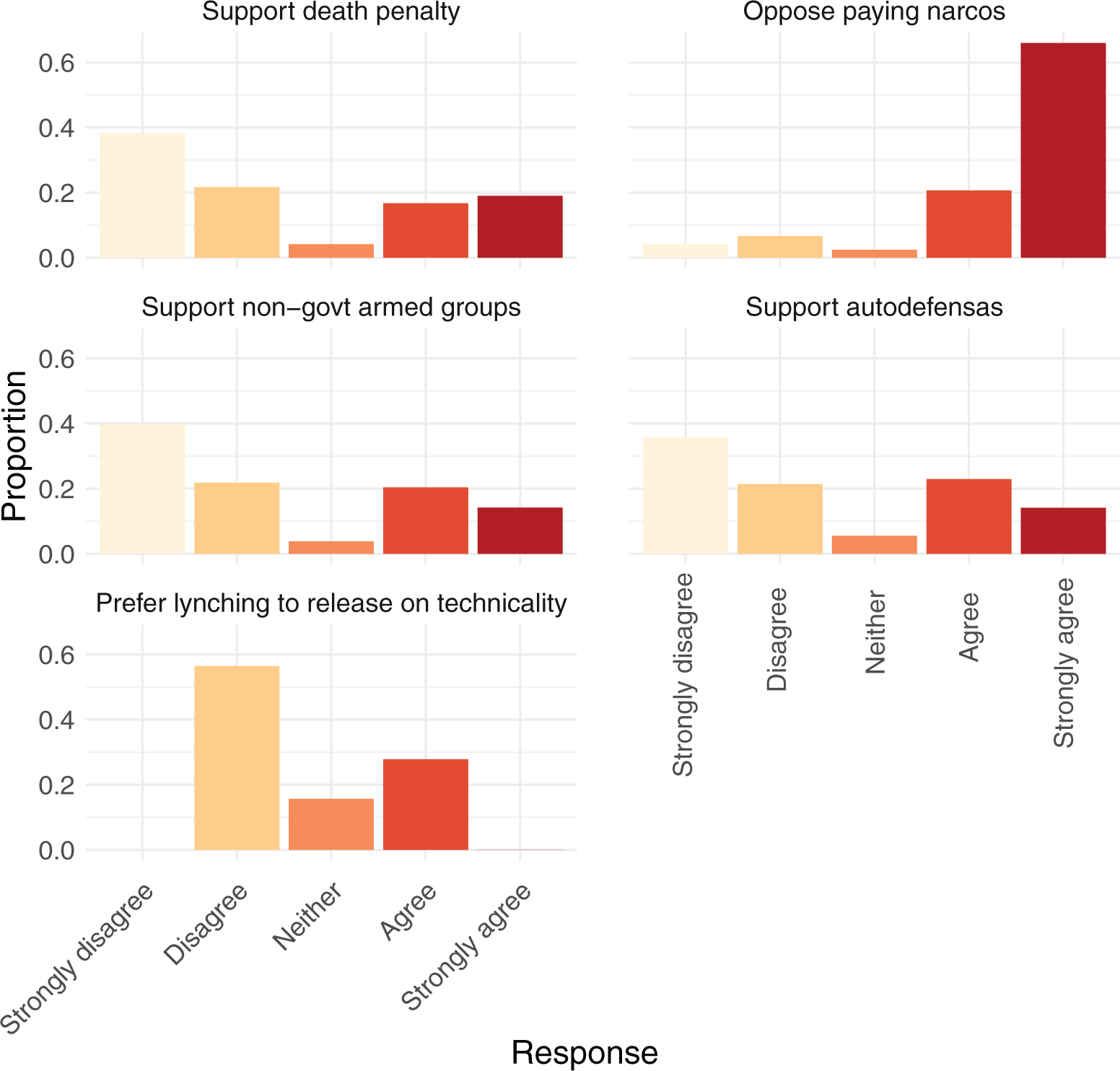
We now test whether people exposed to more violence are more likely to prefer harsh or extrajudicial criminal justice policies. 5 Our main analysis, presented in Columns 1–3 of Table II, is based on a mean effects index using all five survey questions (Policy attitudes index). In Columns 4 and 5, we also include the interaction of exposure to violence and our measures of state security force presence. Finally, in Columns 6 and 7 we replace our preferred measure of violence exposure with two alternatives: the municipality-level homicide rate during the month prior to our survey and our direct measure of personal exposure to extortion.
Columns 1–5 of Table II show that past exposure to criminal violence is strongly and robustly correlated with preferences for harsh and vigilante criminal justice policy. A one standard deviation increase in the Violence index is associated with a 0.05–0.07 standard deviation increase in the index of preferences for harsh and vigilante criminal justice policy. These effects are robust to individual-level controls and PSU fixed effects. Disaggregated results presented in Online appendix E.2 show that these results are driven primarily by support for the death penalty, and support for lynching as opposed to releasing criminals on technicalities.
Exposure to violence is associated with higher support for punitive and pro-vigilante criminal justice policy preferences
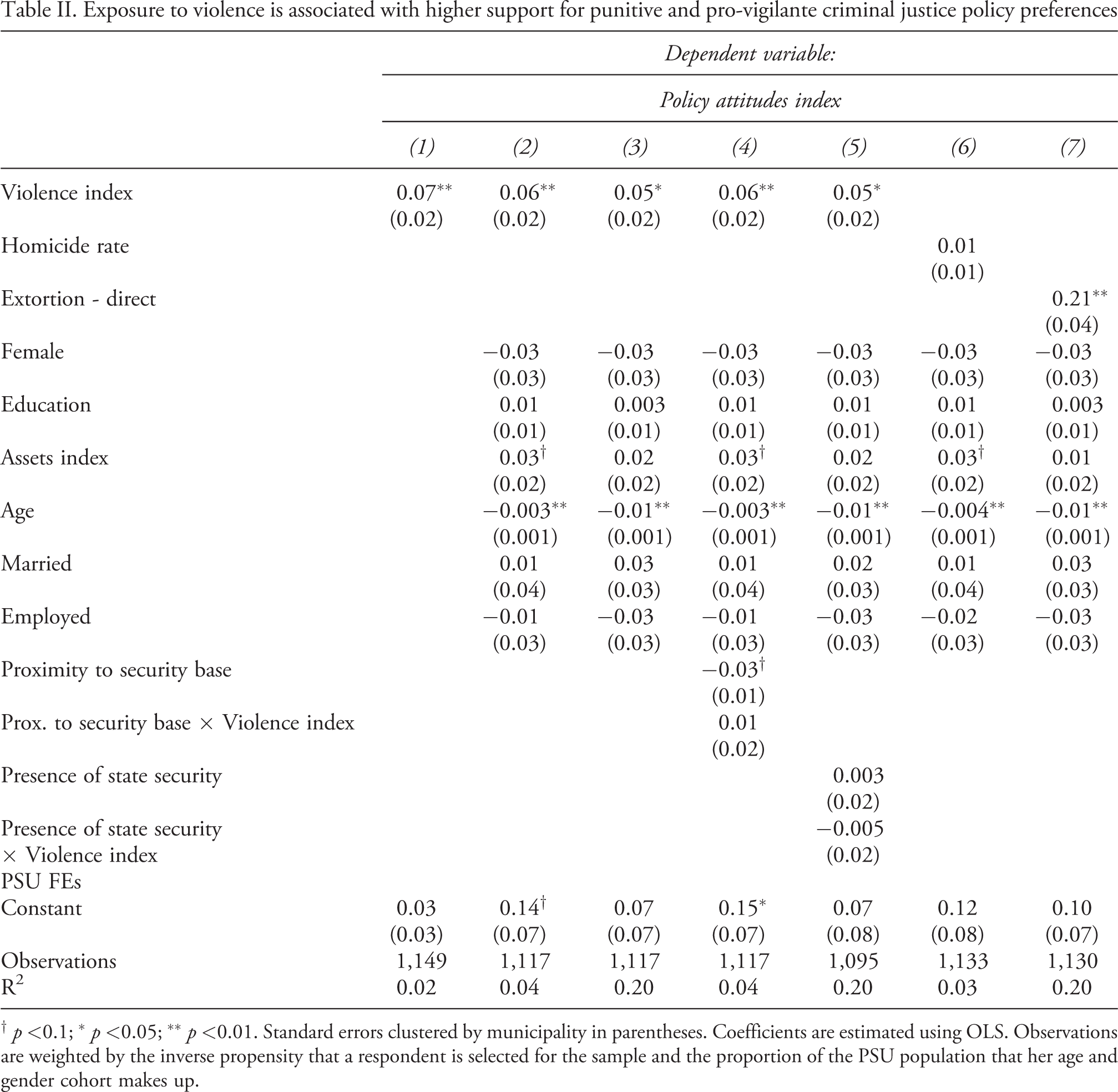
The relationship between exposure to violence and preferences for harsh and vigilante criminal justice policy is not conditioned by state security capacity. Columns 4 and 5 show that the interaction between both distance to a police or army base (Column 4) and the individual-level survey measures of state security force presence (Column 5) and exposure to violence are close to zero and insignificant.
Are citizens’ preferences for punishment driven by beliefs that state security forces are corrupt? To test this, we would want to see whether the relationship between exposure to violence and our outcomes of interest is conditional on corruption in state security and justice institutions. Unfortunately, we are not aware of a local-level observational proxy for corruption in the courts or security agencies, and beliefs about state corruption are likely influenced by experiences with violence, which would introduce post-treatment bias (Montgomery, Nyhan & Torres, 2018). Nevertheless, to the extent that the reader believes that attitudes towards the state are not affected by exposure to violence, the tests in Online appendix E.3 show that the relationship between exposure to violence and our outcomes of interest is not dependent on perceived trust or state legitimacy.
Columns 6 and 7 replace the Violence index with two alternative measures of violence to assess whether our results are driven by subjective perceptions of violence. Column 6 replaces our measure of violence exposure with the municipality-level homicide rate in the month prior to our survey. There is no relationship between this homicide rate and the Policy attitudes index. There is, however, a strong relationship between our direct measure of exposure to extortion and support for harsh, pro-vigilante policies. Column 7 shows that people who personally experienced extortion in the past year are 0.21 standard deviations higher on the Policy attitudes index. These results indicate that our findings are unlikely to be driven by subjective responses to our indirect violence exposure questions, and that civilian attitudes may be more sensitive to crimes like extortion, which often victimize civilians, than murders.
So far we have shown that exposure to violence is associated with both anger and support for harsh, extrajudicial policies. But does anger actually mediate the differences in policy preferences? Model-based mediation analysis rests on often-unrealistic assumptions, even when independent variables of interest are randomly assigned (Bullock, Green & Ha, 2010; Imai, Keele & Tingley, 2010). Recent methods have enabled decomposition of direct and indirect effects while conditioning on potential intermediate confounders and assessing sensitivity to the necessary assumptions (Acharya, Blackwell & Sen, 2016). In Online appendix H, we use the Acharya, Blackwell & Sen (2016) method to estimate the average controlled direct effect (ACDE), and by comparing it to the original coefficient under the assumption of constant interactions, the effect that is mediated by anger. This analysis suggests that 33% of the total relationship between violence exposure and our measure of policy preferences is mediated by anger.
Overall, Study 1 shows that past exposure to violence is consistently related to more punitive policy preferences and anger. One of the more important findings in this section is actually a null effect. If the harsh response to violence were driven by a calculated strategy of deterrence, we would expect it to be stronger in places where the state is less present, that is, in places where a strategy of deterrence should be more advantageous. However, there is no interaction between state capacity or even perceived state corruption and responses to violence. This suggests that the preference for harsh justice after violence is an individual-level phenomenon, unlikely to be driven by a strategic logic of deterrence.
This observational research design does not allow us to rule out the possibility that these correlations are confounded by variables jointly influencing exposure to violence and our outcomes of interest. In the next sections, we turn to experimental research designs that use random variation in exposure to hypothetical violence to causally identify the effects of different types of violent crime.
Study 2: Do outrageous crimes increase support for harsh, vigilante policies?
We use an experiment to test whether outrageous crimes are more likely to cause preferences for harsh, vigilante criminal justice policy. This eliminates the possibility that a confounding factor or reverse causation might bias our estimate of the relationship between violence, anger, and policy preferences. We directly test how individuals respond to morally outrageous violence, compared to similar scenarios that do not trigger outrage.
We manipulate the level of moral outrage that respondents feel in response to a crime by violating moral tenets in three different scenarios described during the survey. We then ask respondents to report how they would react if the crime occurred, including what emotions they would feel, and how they would evaluate two different potential punishments: one that is clearly harsh and extrajudicial (Outcome B), and another that is legal and less severe (Outcome A). The crime scenarios and potential punishments are presented in Online appendix Table F.1.
The three scenarios violate various moral tenets, and in two of the three scenarios the crime is violent. In all of the scenarios, the victims are presented as innocents, but this is particularly strong in Scenarios 1 and 2 where the victims in the outrageous versions are children. In Scenario 3, the crime involves ‘extra-lethal’ violence (Fujii, 2013). On the other hand, a number of factors are held constant between the moral outrage and control versions of the scenarios that might influence the perceived effectiveness and justice of punishment, including the perpetrator’s identity, the likely motivation, and the amount of harm. Respondents evaluated three scenarios in random order.
In this experiment we have four main outcomes of interest. First, we test whether respondents say that the scenarios would make them angry. Because the experiment is designed to induce anger, we consider it to have passed the manipulation check if the outrageous version
Scenarios 1 and 2 increased anger but not fear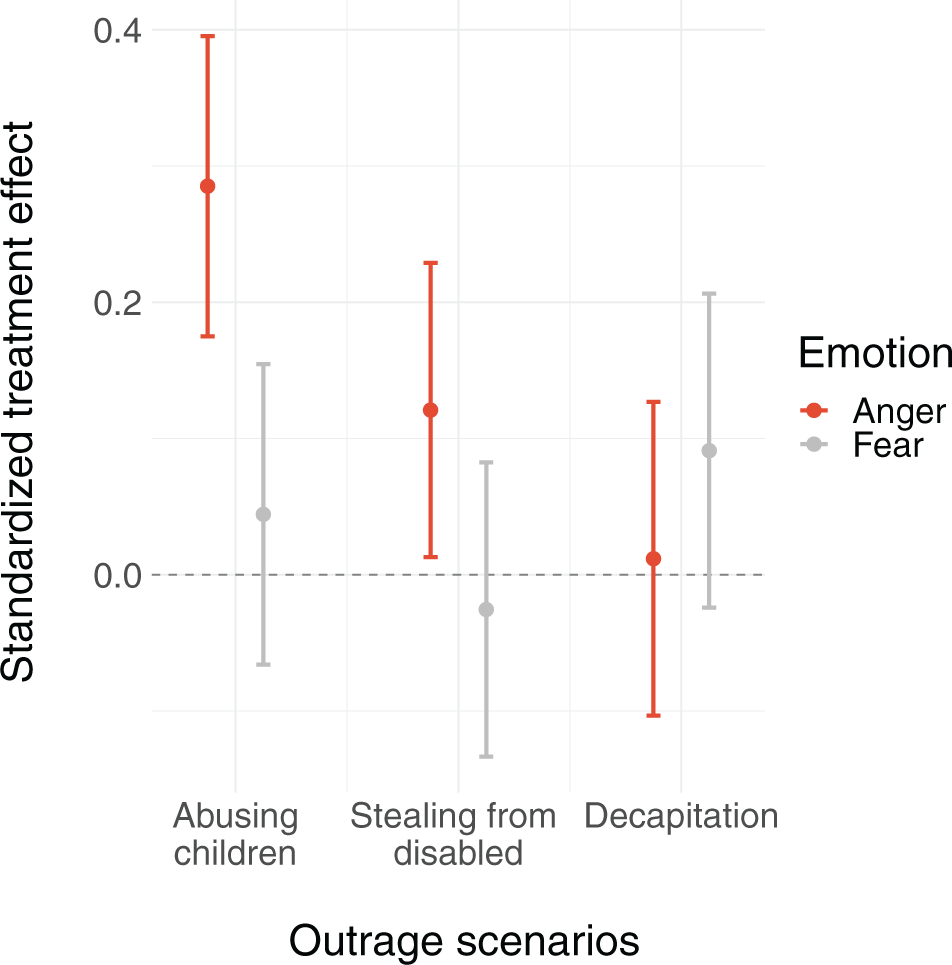
In Scenarios 1 and 2, the treatments had large, statistically significant positive effects on how angry respondents thought they would be if the crime occurred in their community. They had no detectable effect on how afraid respondents would be. Scenario 3, by contrast, failed the manipulation check. The fact that the decapitation scenario failed to induce outrage is in itself interesting, and will be explored in more depth in Study 3. In the rest of this section, we present results for the two scenarios that passed the manipulation check using a dataset that ‘stacks’ the two scenarios on top of each other. We use standard errors clustered by respondent to take this data structure into account.
Next, we turn to crime response preferences. First, we test whether respondents are more likely to prefer a harsh, vigilante crime response if they are presented with the outrageous crime. For each scenario, participants chose between two possible responses: one that involved the perpetrator being arrested and put on trial, and a second that involved physical violence carried out by ‘local citizens’ or autodefensas, which we code as the vigilante response. Second, we examine two perceptions that might underlie this preference shift: the perception
The outrage scenarios increase the likelihood that the vigilante solution is preferred and perceived as more effective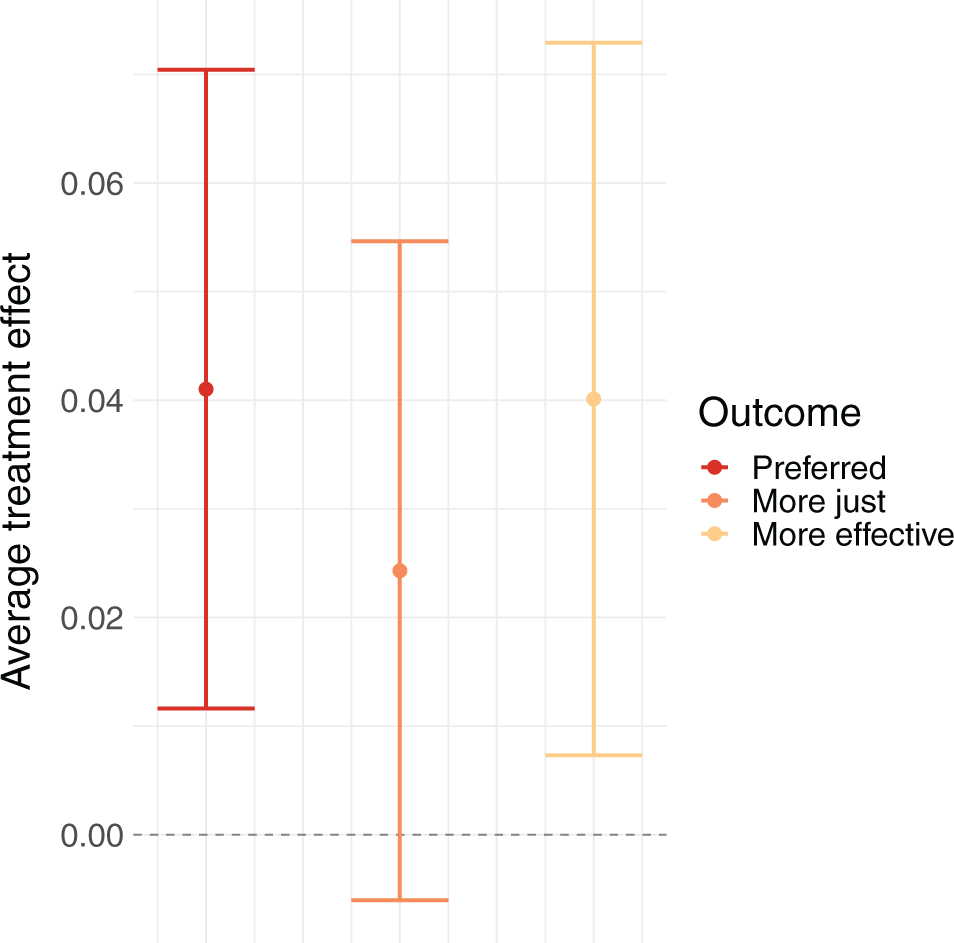
Figure 5 shows that the outrageous scenarios increased the probability that the harsh, vigilante punishment was preferred and perceived as more effective by four percentage points. The coefficient on the perception that it was more just is positive but statistically indistinguishable from zero. These results are driven by the effect on the first scenario. The individual effects on the second scenario are positive but statistically insignificant (see Online appendix Figure F.1). This may be driven by the fact that the first scenario involving child abuse had a much larger effect on anger than the second scenario involving graft.
The effect on the perceived effectiveness of the harsh, vigilante punishment is particularly interesting because there is little reason to expect that criminals who violate moral tenets would be more sensitive to harsh punishments. Indeed, in many cases brutal violence seems designed to make victims perceive perpetrators as irrational or extremely dedicated.
As in the previous study, this effect is no different depending on state security capacity (results in Online appendix Table F.4). In places close and far from a security base, and for people who do and do not perceive that state security forces are present, the effect of the outrage scenarios is the same.
Crime scenarios in Study 3

These three scenarios use language designed to maximize outrage. However, because a number of factors change across the three scenarios, they do not allow us to pinpoint the elements of a crime that make citizens outraged. In the next study, we turn to an experimental design that uses a large range of crime scenarios to do just that.
Study 3: Which crimes increase support for harsh, vigilante policies?
We now test whether the severity of a crime and the innocence of a victim are general properties that make people more likely to support a punitive or vigilante solution. We generate a survey experiment with 125 unique scenarios with different perpetrators, victims, and crimes that represent realistic crime profiles. Surveyors described a randomly generated crime during the interview. Table III presents the scenario with randomized segments in bold.
In order to test hypotheses about the elements of crimes that citizens find outrageous, we code the individual crime scenarios along two dimensions. Victim: Innocence takes a value of –1 for narcos, 0 for soldiers, and 1 for civilians (grandmother, small business owner, student). Violence: Severity takes a value of –1 for robbery, 0 for extortion and torture, and 1 for killed or disappeared. We did not have specific hypotheses about how the identity of the perpetrator would affect outrage or preferences for harsh, vigilante punishments.
We examine whether crimes with more severe violence and that have more innocent victims are more likely to induce anger, but not fear (Prediction 1). To measure these outcomes, we asked participants to assess how angry and afraid they would be on a four-point scale if the crime happened in their locality. Second, we test whether participants prefer harsher punishments for crimes that involve more severe violence and have more innocent victims (Prediction 2). To measure this outcome, we asked participants to choose the punishment that they would be most satisfied with for the crime described. We then coded the punishments by severity, so that the outcome variable Severity of punishment can take a value of 0 (no punishment), 1 (beaten, one year of jail), 2 (ten years of jail), or 3 (death penalty, lynched, shot). Similarly, in order to test Prediction 3 – that participants would be more likely to prefer extrajudicial punishments for perpetrators of more violent crimes against more innocent victims – we code the same preferences according to whether they are legal or extrajudicial. In this case, the variable takes a value of 1 for punishments that are clearly extrajudicial, such as beating, lynching, or shooting the perpetrator, and 0 otherwise.
After participants reported their preferred punishment, we also asked them to rank the relative importance of punitiveness, effectiveness in preventing future crimes, and legality in their decision about the appropriate punishment for this crime. We expected that punitiveness would increase and legality would decrease in this ranking for crimes involving more severe violence and innocent victims.
We test our main hypothesis using OLS. We weight each scenario by how likely respondents found it to be so that our treatment effects give more weight to crimes that respondents are more commonly exposed to. Online appendix G.1 provides more information on the weights. Figure 6 plots the estimated coefficients on our measures of Victim: Innocence (left panel) and Violence: Severity (right panel), respectively. The outcomes of interest in this experiment are indicated with different shades of grey.
The left panel of Figure 6 shows first that Victim: Innocence has a strong, positive effect on both how angry and fearful respondents say they would be in response to a crime. The magnitude of the effect on anger is about three times that of fear. This is strong evidence that crimes against innocent victims generate outrage. The Victim: Innocence treatments also significantly increase support for harsh punishments. By contrast, there is no increase in support for a crime response that is specifically extrajudicial. The final three coefficients in each panel plot the estimated relationship between the treatments and indicator variables that take a value of 1 if the
Victim innocence increased negative emotions and support for harsh punishment while violence severity generally did not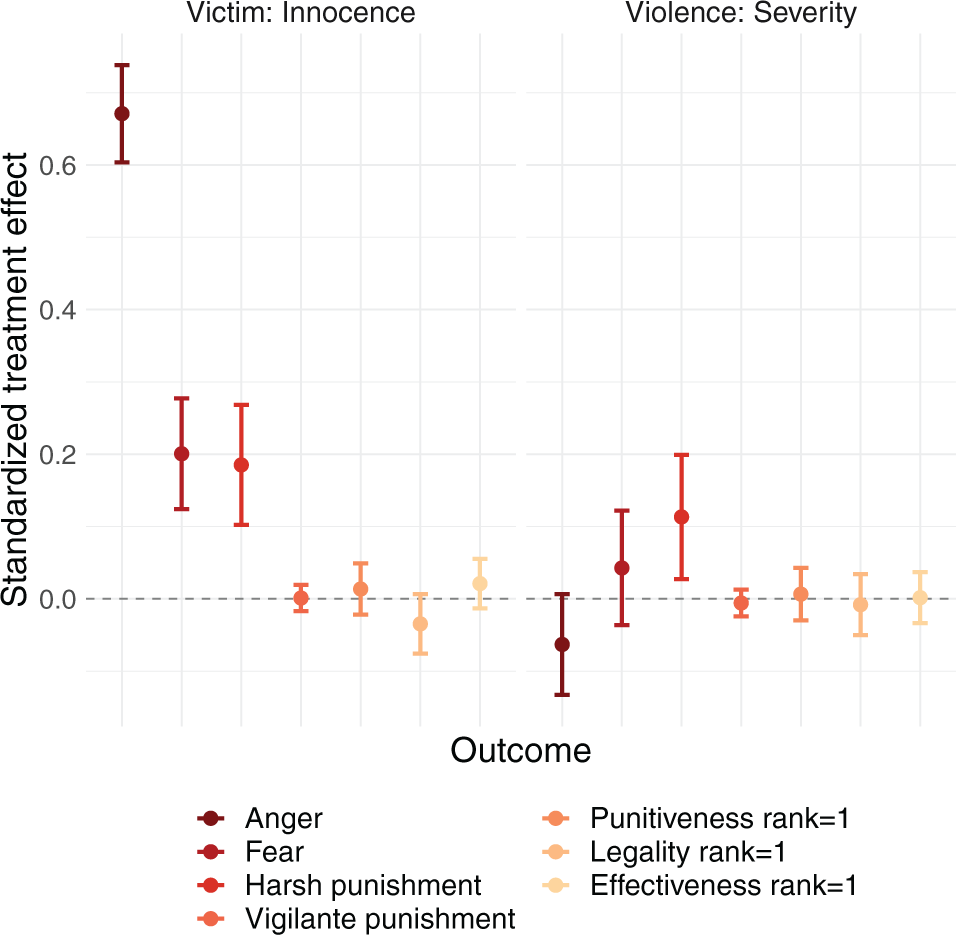
The results in the right panel suggest that the severity of violence has much weaker effects on our outcomes of interest than the innocence of the victim. First, there is no support for our hypothesis that more severe crimes induce more outrage. In fact, the severity of the crime may be slightly negatively associated with anger. Similarly, there is no relationship between the severity of violence and fear. Nevertheless, participants are slightly more supportive of harsh punishments when crimes involve more severe violence.
Altogether, these results present strong evidence that crimes against innocents (1) make civilians angry, and (2) increase support for harsh punishments, even at the expense of their legality. Furthermore, the severity of violence is not a primary factor. Instead, the innocence of the victim has much stronger effects on both emotions and punishment preferences. Again, the effects of Victim: Innocence and Violence: Severity do not systematically depend on either measure of state security capacity (see Online appendix Table G.1). The mediation analysis in Online appendix H suggests that almost 50% of the total effect of the Victim: Innocence treatments is mediated by anger.
Conclusion
Our research examines the relationship between exposure to violence, anger, and preferences over crime responses and criminal justice policy. Across three different studies we show that violence induces anger and shapes citizens’ preferences. Study 1 finds that respondents exposed to violence in the real world are more frequently angry and more supportive of harsh and vigilante justice. Studies 2 and 3 suggest that the relationship between outrageous crimes and criminal justice preferences is causal. For crimes that induce anger and moral outrage, citizens are more punitive and care less about due process.
All three studies shed light on the types of violence that citizens find outrageous. Violence targeting innocent civilians has the largest effect on anger and criminal justice preferences. Importantly, we do not find that especially severe violence drives outrage. Based on Study 2, scenarios in which children are portrayed as victims induce anger and increase preferences for harsh, vigilante punishment, but the scenario with extremely severe violence does not. In Study 3, both the victim’s perceived innocence and the severity of the violence are separately randomized, and we find that violence severity has, if anything, a slight negative independent effect on anger.
The innocence of victims, rather than the severity of violence, triggers outrage and support for punishment. This is our most novel finding. Previous work has predominantly focused on severe violence or operationalizes violence exposure as a binary variable (Ley, 2018; Hazlett, 2019; Visconti, 2020). We find that homicide rates are not associated with anger or support for harsh punishments, while our survey measures of lower-level victimization are strongly related. This supports the growing emphasis on extortion in the literature on Mexico (Moncada, 2019; Magaloni et al., 2020). Situations in which violent actors target civilians, even with crimes like extortion that are arguably minor when compared to murder or torture, are likely to lead to retribution as civilians are willing to pay a steep price to punish their abusers.
Our findings also support the view that retributive violence is in part driven by bottom-up psychological processes. Citizens become angry following criminal violence against innocent victims. There are no elites or groups pushing for certain punishments in our scenarios. Furthermore, we do not find that state capacity moderates the relationship between violence, anger, and punitiveness. Our findings thus complement the literature on the structural and organizational determinants of vigilantism (Phillips, 2017; Moncada, 2019; Jung & Cohen, 2020). This literature emphasizes the conditions in which demand for punishment translates into vigilante action. Our findings show that there is underlying variation in this demand which can be explained by exposure to outrageous violence. Our findings also align with evidence from other Latin American countries showing that victims of crimes are more likely to support harsh criminal justice (Visconti, 2020).
Finally, it is worth noting that our study does not test whether harsh punishments or vigilantism exacerbate violence. Research on the effects of harsh, extrajudicial punishments by vigilantes or by the state is sparse, and has found context-dependent effects (Magaloni, Franco-Vivanco & Melo, 2020). Vigilantism by definition reduces the rule of law. But it may still make citizens safer by deterring or incapacitating future violence. Emotions like anger can facilitate collective action and provide pro-social third-party punishments (Fehr & Gächter, 2002; Goodwin, Jasper & Polletta, 2009). While we are concerned with understanding when support for the type of harsh punishments offered by vigilantes emerges, future research should investigate how and under what conditions it might improve or deteriorate local public security.
Footnotes
Acknowledgements
Thanks to Abraham Aldama, Hannah Baron, Vincent Bauer, Alberto Díaz-Cayeros, Ashley Fabrizio, Cecilia Farfán, Saad Gulzar, Daniel Hirschel-Burns, Haemin Jee, Stathis Kalyvas, Risa Kitagawa, Beatriz Magaloni, Eduardo Moncada, David Shirk, two anonymous reviewers, and seminar participants at MPSA, APSA, Stanford, Essex, USC, UC Davis, MIT, Uppsala, NYU, Vanderbilt, Yale, UCSD, UC Merced, and GWU, for comments. We also thank Buendía and Márquez for the data collection. Isabel Mejía Fontanot and Julio Solís Arce provided excellent research assistance.
Replication data
The data collection materials and replication package can be found at http://www.prio.org/jpr/datasets and at  .
.