




Abstract
The study of security implications of climate change has developed rapidly from a nascent area of academic inquiry into an important and thriving research field that traverses epistemological and disciplinary boundaries. Here, we take stock of scientific progress by benchmarking the latest decade of empirical research against seven core research priorities collectively emphasized in 35 recent literature reviews. On the basis of this evaluation, we discuss key contributions of this special issue. Overall, we find that the research community has made important strides in specifying and evaluating plausible indirect causal pathways between climatic conditions and a wide set of conflict-related outcomes and the scope conditions that shape this relationship. Contributions to this special issue push the research frontier further along these lines. Jointly, they demonstrate significant climate impacts on social unrest in urban settings; they point to the complexity of the climate–migration–unrest link; they identify how agricultural production patterns shape conflict risk; they investigate understudied outcomes in relation to climate change, such as interstate claims and individual trust; and they discuss the relevance of this research for user groups across academia and beyond. We find that the long-term implications of gradual climate change and conflict potential of policy responses are important remaining research gaps that should guide future research.
Introduction
Climate change is widely regarded as humanity’s greatest contemporary challenge. Thirty years after the Intergovernmental Panel on Climate Change (IPCC) published its First Assessment Report in 1990, an exceptional growth in interdisciplinary research has progressively been able to demonstrate that the climate is changing, that anthropogenic emissions are the dominant cause of this change, and that both natural and human systems are impacted by climate change in complex ways. Public concern about potential security implications of climate change is high and rising (Pew Research Center, 2019), aided by the award of the 2007 Nobel Peace Prize to the IPCC together with former US Vice President Al Gore for their work on disseminating knowledge about man-made climate change. The IPCC Fifth Assessment Report (AR5) concluded unequivocally that ‘[i]ncreasing magnitudes of warming increase the likelihood of severe, pervasive, and irreversible impacts’ (Field et al., 2014: 14), and the Human Security chapter in AR5 further stated that ‘[h]uman security will be progressively threatened as the climate changes’ (Adger et al., 2014: 758).
Initiatives to address security implications of climate change are forming in key international fora, such as the UN Security Council and the European Union (Fetzek & van Schaik, 2018). Such initiatives play an invaluable role in raising risk awareness and identify common grounds for developing sustainable solutions, but their function and eventual success will depend critically on further scientific knowledge production and efficient interaction between science and policy.
In 2012, the Journal of Peace Research (JPR) published its first special issue on ‘Climate change and conflict’ (Gleditsch, 2012). At the time, the issue represented the largest collection of peer-reviewed studies on the topic, containing no less than 17 articles studying research questions ranging from public opinion concerns with global warming to climate-driven interstate conflict risk. Judging by citation statistics, the 2012 special issue was a great success. At the time of writing, the special issue contributions collectively have attracted more than 1,500 citations from Web of Science-indexed publications. 1 The issue also played an influential role in shaping the IPCC’s assessment of climate change and human security in AR5 (Adger et al., 2014; Gleditsch & Nordås, 2014), although the field at the time in many ways still could be considered ‘immature’ (Salehyan, 2014: 5).
Over the past decade, the literature has expanded rapidly in scope as well as volume. Testimony to the policy relevance and perceived urgency of the issue, the literature has sponsored a large number of scientific reviews on climate and conflict over the years, as well as multiple special issues of prominent journals (e.g. Salehyan, 2014; Selby & Hoffmann, 2014; Zografos, Goulden & Kallis, 2014; Gilmore, 2017). This article marks the publication of the second special issue of JPR dedicated to security implications of climate change. So, what have we learned and how do the special issue contributions collectively advance the field?
We evaluate scientific progress by taking stock of formulated research priorities in 35 prominent reviews of the empirical climate–conflict literature published over the past decade. Key questions that this assessment seeks to answer are: What are the major research gaps identified in these reviews? Are there notable shifts in the framing of research priorities over time? And to what extent has the scientific community responded to these calls? On the basis of this evaluation, we discuss key contributions of this special issue and provide directions for the next generation of research.
Overall, we find that the research community has made important strides in specifying and evaluating plausible indirect causal pathways between climatic conditions and a wide set of conflict-related outcomes and the scope conditions that shape this relationship. Contributions to this special issue continue this trend by advancing knowledge on understudied actors, contexts, and outcomes, pushing the research frontier on prominent pathways between climate and conflict. Jointly, they demonstrate significant climate impacts on social unrest in urban settings; they point to the complexity of the climate–migration–unrest link; they study how agricultural production patterns shape conflict risk; they investigate understudied outcomes in relation to climate change, such as interstate claims and individual trust; and they explore the relevance of this research for user groups across academia and beyond.
Seven historical priorities for climate–conflict research and their influence on the literature
The last decade has seen a plethora of scientific reviews of empirical climate–conflict research. A thorough review and assessment of this literature is beyond the scope of this introductory article. Readers interested in detailed discussions of the facets of knowledge are recommended to consult some of the studies cited here, as well as other articles in this issue. Instead, we assess the nature and extent of scientific progress in the field by consulting identified research gaps and articulated research priorities in 35 peer-reviewed review articles published over the past decade.
2
These reviews were selected as they concentrate on the positivist, empirical, and predominantly quantitative climate–conflict literature (consistent with the scope of this special issue) and because they formulate guidelines for future research, against which subsequent research can be assessed. Importantly, the sample includes reviews published in every year since 2012 to Frequency of research priorities highlighted in 35 earlier reviews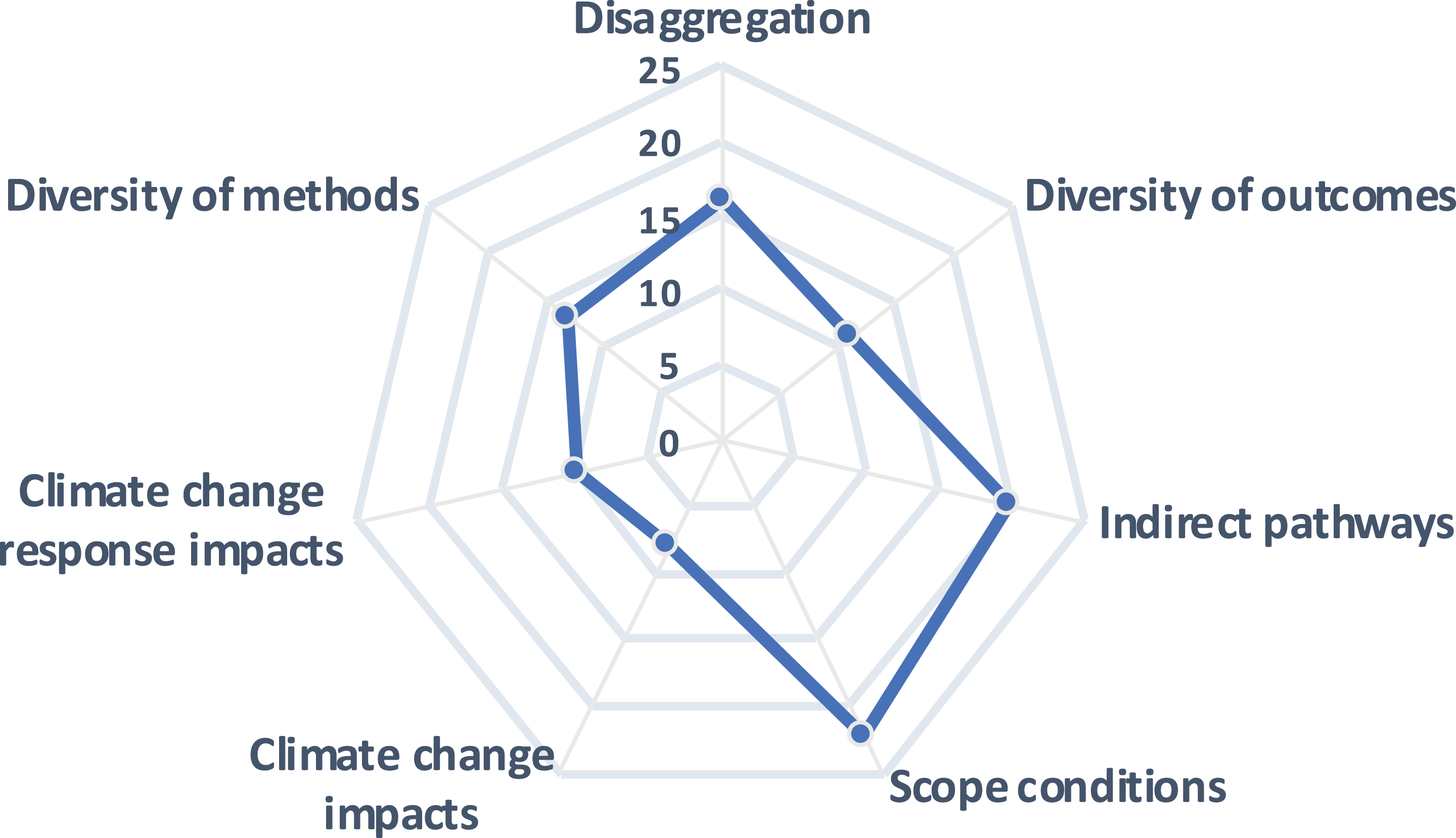
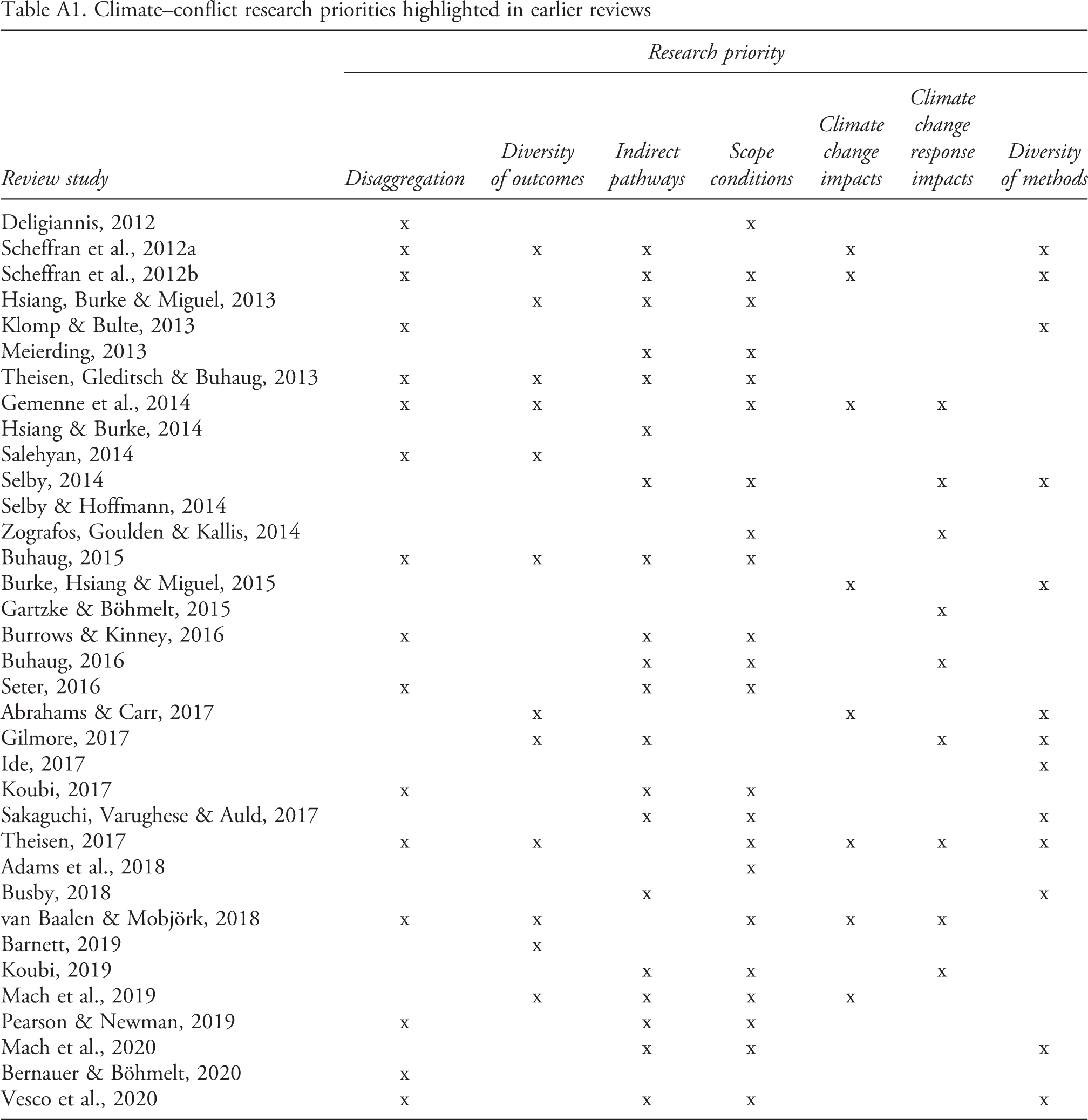
Collectively, the 35 reviews identify seven general shortcomings related to (1) disaggregation, (2) diversity of outcomes, (3) indirect pathways, (4) scope conditions, (5) climate change impacts, (6) climate change response impacts, and (7) diversity of methods. Figure 1 provides a visual depiction of the frequency of these priorities; the underlying data for the individual review studies and priorities are provided in Table A1 in the appendix. Evidently, some shortcomings are recognized much more often than others. A need for better theoretical and empirical modeling of complex and context-sensitive causal processes (i.e. scope conditions, indirect pathways) is raised most frequently, although investigating a broader set of insecurity outcomes beyond civil war is also mentioned by around half of the review studies. In contrast, only a handful of reviews highlight a need to focus more on climate change impacts (as opposed to effects of climate variability) and potential security implications of societies’ response to climate change (adaptation, mitigation).
Interestingly, there appears to be no clear temporal pattern in the discussion of these priorities (Table A1 in the appendix). Although this could indicate lack of progress in the empirical literature such that constant reminders are warranted (or, perhaps, lack of innovation among the scientific reviews), we see this as a reflection of the multifaceted nature of these challenges, where progress on one dimension inspires calls to focus on other dimensions as well. In the following, we briefly present the motivation and content of these seven priorities and consider (where relevant) how focus has shifted over time in response to early progress.
Disaggregation
The first research priority concerns the need for disaggregated research designs to better accommodate climate–conflict connections that are expected to play out only at specific scales. Early reviews of the quantitative literature frequently highlighted the promise of spatially disaggregated data, reflecting the fact that the large majority of empirical studies at the time were conducted at the country scale and with a decidedly state-centric focus. Aided by the expanding availability of georeferenced conflict data and statistical software able to handle spatial data, the climate–conflict literature has responded rapidly and comprehensively to this call, to the extent that country-level analyses of climate–conflict connections today probably represent a minority. Spatially disaggregated quantitative studies are commonly framed around grid cells (e.g. O’Loughlin, Linke & Witmer, 2014; Harari & La Ferrara, 2018; Döring, 2020a) or administrative regions (e.g. Raleigh, Choi & Kniveton, 2015; Caruso, Petrarca & Ricciuti, 2016) that permit studying within-country variation in climate–conflict connections.
Notable progress in spatial disaggregation has not appeased concerns about overly aggregated research designs, however. Instead, recent reviews increasingly point to problems related to conceptual or analytical overaggregation. This concern also relates to the potential lack in spatial overlap between environmental drivers of conflict and actual fighting due to migration or strategic movement of troops, which presents a challenge to geographically disaggregated analyses. To mitigate these issues, reviewers call for more research that explicitly relates to relevant social actors (e.g. distinct land-user communities, identity groups, individuals), both theoretically and empirically, to better account for vulnerability and to understand the incentives that might drive specific actors toward violence in response to environmental hazards (Seter, 2016; Pearson & Newman, 2019). This call is more challenging to address through quantitative comparative analysis due to scarcity of political and socio-economic data on relevant social actors across societies and over time. However, recent years have seen a rapid growth in survey-based analysis of individuals’ perceptions and actions during times of heightened environmental stress (e.g. Detges, 2017; Vestby, 2019; von Uexkull, d’Errico & Jackson, 2020). Another actor-based approach has been to focus on ethnic groups combining spatial data on settlement patterns with remote sensing-derived climate and socio-economic information (von Uexkull et al., 2016).
Diversity of outcomes
The first generation of statistical climate–conflict research focused almost exclusively on the risk of state-based conflict, such as civil war (e.g. Hendrix & Glaser, 2007; Raleigh & Urdal, 2007; Burke et al., 2009). At the same time, theoretical work and evidence from case studies suggested that environmental degradation, resource scarcity, and other impacts of adverse climatic conditions hold much greater potential to generate low-scale violence or breakdown of cooperation than major armed conflicts at national or international scale (e.g. Kahl, 1998; Homer-Dixon, 1999; Peluso & Watts, 2001). This gap between the qualitative and quantitative literature, which at least partly was due to data limitations, resulted in frequent calls for investments in data collection and research on a wider set of political violence categories. In the same vein, several reviews have pointed to the need to better understand how climate may influence the dynamics of violence beyond outbreak or incidence (e.g. severity, escalation, duration, diffusion).
With the release of new events-based datasets, such as the Armed Conflict Location and Event Dataset (Raleigh et al., 2010), the Social Conflict Analysis Database (Salehyan et al., 2012), and a suite of new datasets from the Uppsala Conflict Data Program (e.g. Sundberg, Eck & Kreutz, 2012; Sundberg & Melander, 2013), conflict scholars have gradually been able to respond to this call. Climate–conflict studies now commonly investigate implications for communal violence (e.g. Nordkvelle, Rustad & Salmivalli, 2017; van Weezel, 2019; Döring, 2020a) and social unrest events (e.g. Smith, 2014; Yeeles, 2015; Jones, Mattiacci & Braumoeller, 2017). Increasingly, scholars also make use of national or cross-national surveys to assess how climatic conditions and events influence individual acceptance for, and participation in, collective political violence (e.g. Linke et al., 2015; Detges, 2017; Vestby, 2019). The quantitative empirical literature has been less enthusiastic in its consideration of how climate change might create opportunities for increased cooperation (though see Böhmelt et al., 2014; Döring, 2020b), and this remains an understudied field of inquiry (Barnett, 2019). Likewise, there is relatively little scientific focus on implications of climate variability and change for interstate armed conflict, beyond the role of transboundary rivers (e.g. Dinar et al., 2015; De Stefano et al., 2017; Petersen-Perlman, Veilleux & Wolf, 2017). Thus far, the literature also provides limited insight into how climatic conditions might influence escalation, duration or diffusion (though see Kreutz, 2012; Eastin, 2016). This explains why this remains a commonly articulated research priority.
Indirect pathways
Quantitative empirical studies have often been limited to exploring direct correlations between climatic conditions and conflictual outcomes, thus relegating issues of causal mechanisms to mere speculation. This is in sharp contrast to the rich conceptual models proposed in the literature typically including a long chain of intermediate factors and impacts. It is little surprise, then, that more than half of the review studies considered here have called for more research that explicitly investigates pathways and intermediate factors (appendix Table A1). Responding to this call, a growing number of studies explore how climate variability might influence conflict risk indirectly via shocks to the agricultural economy and living conditions (e.g. Wischnath & Buhaug, 2014; Koren, 2018; Vestby, 2019) or through causing food and livestock price changes (e.g. Maystadt & Ecker, 2014; Raleigh, Choi & Kniveton, 2015; McGuirk & Burke, 2020). There is also a heated academic debate about whether climate-related migration can act as a catalyst for conflict (e.g. Brzoska & Fröhlich, 2016; Boas et al., 2019). Here, empirical research has made less progress due to inherent challenges in quantifying migration flows and attributing such movements to climate hazards, although several recent studies (Koubi et al., 2018; Abel et al., 2019; Ash & Obradovich, 2020) represent promising examples of how climate–migration–conflict links can be systematically assessed in detailed case studies where migration data are available or can be assessed through population surveys.
Scope conditions
A fourth frequently noted mismatch between theoretical and empirical models, often voiced in tandem with the need to investigate indirect pathways, concerns the pervasiveness of the climate–conflict relationship. Much of the early quantitative literature only estimated average effects across the full sample, thereby assuming (usually tacitly) that all units of observation, across all time periods, are equally predisposed to producing the outcome of interest (e.g. civil conflict) in response to a given treatment (e.g. drought). This assumption is less problematic when the analysis sample is specified to reduce unit heterogeneity, but even within sub-Saharan Africa – the most common region of study – communities within and across countries vary greatly in their sensitivity to environmental conditions (Busby, Smith & Krishnan, 2014; de Sherbinin et al., 2019). Divergent and incompatible findings in the climate–conflict literature have often been blamed on variation in data samples and the ignorance of underlying conditions and contexts that plausibly could affect the treatment effect (e.g. Salehyan, 2014; Buhaug, 2015).
Again, there is considerable evidence of progress in the empirical literature over the past decade, where studies increasingly are explicit about their (disaggregated) sampling design and, further, estimate climate effects in interaction with plausible drivers of vulnerability, such as ethnic diversity and exclusion (e.g. Schleussner et al., 2016; von Uexkull et al., 2016; Ide et al., 2020), high agricultural dependence (e.g. Schilling et al., 2012; Salehyan & Hendrix, 2014; Bretthauer, 2015), and population dynamics (Breckner & Sunde, 2019). Even so, concerns about insufficient consideration of scope conditions, theoretically as well as empirically, continue to trouble scholars, and calls for further progress in modeling conditional relationships and accounting for actor- and location-specific vulnerability are equally prominent in literature reviews today.
Climate change impacts
Whereas much of the relevant policy discourse concerns security implications of climate change, the empirical climate–conflict literature almost exclusively studies effects of climate variability or extreme weather events, not climate change. The distinction between climate variability and climate change is more than mere semantics; the latter term refers to a change in average weather patterns that persists for an extended period, typically decades or longer, whereas variability most often is used to denote short-term deviations from average weather conditions, including the occurrence of extreme events (Mach, Planton & von Stechow, 2014).
Recognizing this distinction, a handful of reviews have articulated a clear need for more empirical research on connections between long-term changes and armed conflict. There are at least three central reasonings behind this priority. First, although climate change will be experienced in shifting weather patterns (variability) across the planet, there are deep uncertainties concerning the true relevance of estimated climate variability effects for our understanding of future climate change impacts. Second, as societies increasingly are exposed to environmental conditions and hazards unprecedented in recent history, common coping strategies may no longer be viable, implying that the scientific value of insights from observed responses to past climate events will be declining. For example, the melting of the Arctic polar ice-cap not only provides economic opportunities via all-year shipping routes along the Northeast Passage but also increases the strategic value of territorial control and is projected to increase resource competition in the region (Åtland, 2013; Markowitz, 2020). In the longer term, unmitigated climate change in combination with insufficient adaptation might overwhelm adaptive capacities and response mechanisms across many natural and social systems, potentially leading to critical tipping elements and feedback loops in nature–society dynamics (Steffen et al., 2018). Third, armed conflict is a major driver of societal vulnerability to climate change. For example, many of the most severe hunger crises are found in sites of endemic conflict compounded by environmental hazards (FAO et al., 2017). A complete assessment of security implications of climate change thus also needs to consider conflict as a factor in climate change impacts.
Attributing observed ‘high-frequency’ social behavior, such as conflict outbreak, to inert phenomena, such as changes in the physical environment (warming, drying, sea-level rise, etc.), is inherently challenging, and empirical responses to this research priority to date are limited. However, a few recent studies provide examples of how multidecadal changes in climatic conditions might be systematically compared to shifting conflict trajectories (Burke, Hsiang & Miguel, 2015; Breckner & Sunde, 2019; van Weezel, 2020). Besides, the climate change research community has made important progress in developing methods to attribute singular events to anthropogenic climate change (Stott et al., 2016), which provides new opportunities for systematic impact attribution of armed conflicts in the future.
Climate change response impacts
A sixth research priority presented in literature reviews over the past decade concerns not how climatic conditions affect conflict risk but rather how societies’ response to climate change might increase conflict risk. On the one hand, countries seek to adapt to climate change by implementing measures to avoid or minimize damages (i.e. building resilience to climate-related hazards). On the other hand, countries are considering ways to mitigate climate change by curbing greenhouse gas emissions or in other ways manipulating the atmosphere to minimize global warming and related effects, in line with long-term temperature targets outlined in the 2016 Paris Agreement.
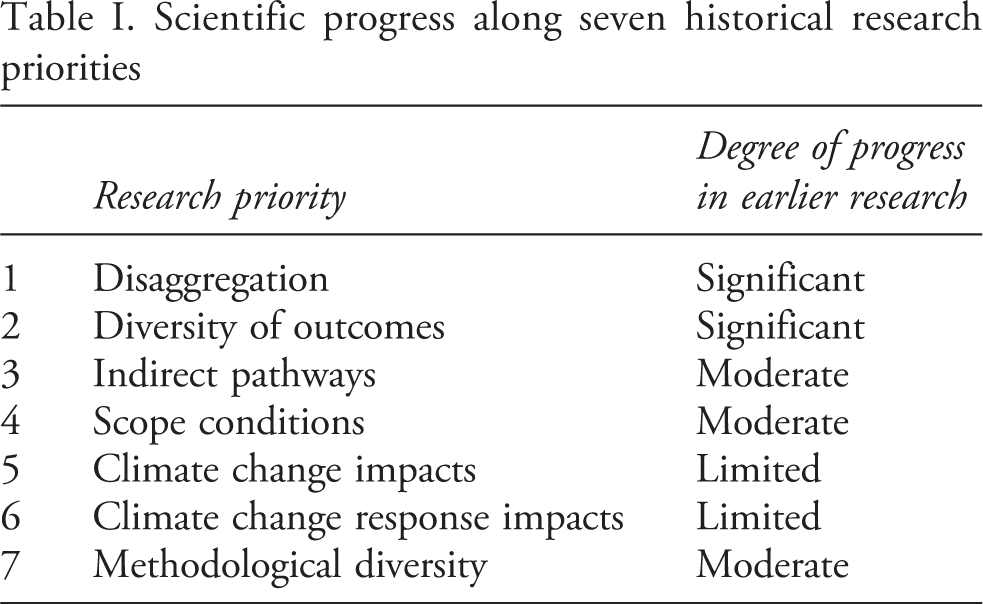
Scientific progress along seven historical research priorities
Methodological diversity
A frequently voiced recommendation in reviews of the climate–conflict literature concerns a need for increasing methodological diversity and rigor. This research priority has multiple dimensions and, at the core, applies as much to the wider research field as to any individual study, given inherent complexities of combining diverse research methods and epistemologies within a single integrated analytical framework. Common calls include (1) application of mixed-methods research designs, (2) in-depth analysis of influential data points to trace the causal processes at play and to (3) triangulate and validate findings from the quantitative empirical literature, as well as (4) out-of-sample prediction to evaluate the generalizability of particular results and to explore long-term implications of alternative scenarios. To further mitigate shortcomings of individual methods, several reviews highlight how literature assessments could benefit from utilizing structured research synthesis techniques common in other disciplines, such as meta-analysis, systematic review, weight of evidence, and expert elicitation, as well as complexity science and social-network analysis.
There is considerable evidence of scientific progress here, as recent contributions to the literature include process tracing (Gleick, 2014; Spijkers & Boonstra, 2017), qualitative comparative analysis (QCA) (Bretthauer, 2015; Ide et al., 2020), quantitative meta-analysis (Hsiang, Burke & Miguel, 2013; Buhaug et al., 2014), long-term projections (Witmer et al., 2017), and expert elicitation (Mach et al., 2019). At the same time, integrating diverse lines of evidence is especially important when the subject under study is complex and results appear sensitive to choice of method, so there is still considerable room for further development along this dimension.
Table I summarizes our subjective judgement of extent of progress over the past decade of climate–conflict research. Even though we find evidence of significant improvement along several of the seven general research priorities, all of them remain valid even today as they continue to feature in up-to-date reviews of the empirical literature (appendix, Table A1).
Contributions of this special issue: Beyond the state of the art
Given the development of the empirical climate–conflict literature over the past decade, how do the articles in this special issue push the research frontier forward? In addition to this introductory article, the special issue contains nine general empirical research articles and three viewpoint essays that collectively cover a wide set of themes related to the security implications of climate change. The articles are geographically diverse, blending global analyses with country-specific studies from Syria, Kenya, and Bangladesh. Methodologically, they encompass quantitative analyses of subnational event, survey and social media data, cross-country regression analysis, QCA, and ethnographic methods. Matching the interdisciplinary nature of the scientific problem under study, the special issue contributors have backgrounds from diverse academic disciplines, including political science, geography, economics, and environmental studies.
Overall, it is clear that the special issue contributions follow the recent trend toward increasing attention to detail, such as formulation of specific causal processes that connect particular climatic conditions with distinct conflict-related outcomes in given contexts. Although individual articles differ in the extent to which they address the seven historical research priorities, we identify three key contributions of the issue as a whole: (1) advancing research on diverse types of outcomes short of civil conflict, (2) providing further evaluation of plausible indirect causal pathways and conditioning factors, and (3) presenting new perspectives on the development of the research field. We elaborate on each of these contributions in turn; the thematic coverage of the special issue is illustrated in Figure 2.
Beyond civil war: New focus on (urban) unrest and individual-level outcomes
While the literature has progressed significantly in considering plausible insecurity outcomes beyond civil conflict (Table I), this special issue pushes the research frontier further in this regard. In contrast to the typical focus of recent empirical work on the rural context (cf. Koubi, 2019), several contributions to this issue examine climate–security dynamics in urban settings.
For example, Adger et al. (2021) apply a broad human security perspective studying perceived insecurities of migrants in urban spaces in the city of Chattogram, Bangladesh through video-elicitation and survey methods. These self-reported insecurities include ill-health, fear of eviction, and harassment and violence, which the authors find to be exacerbated by environmental hazards such as Collective thematic scope of special issue contributions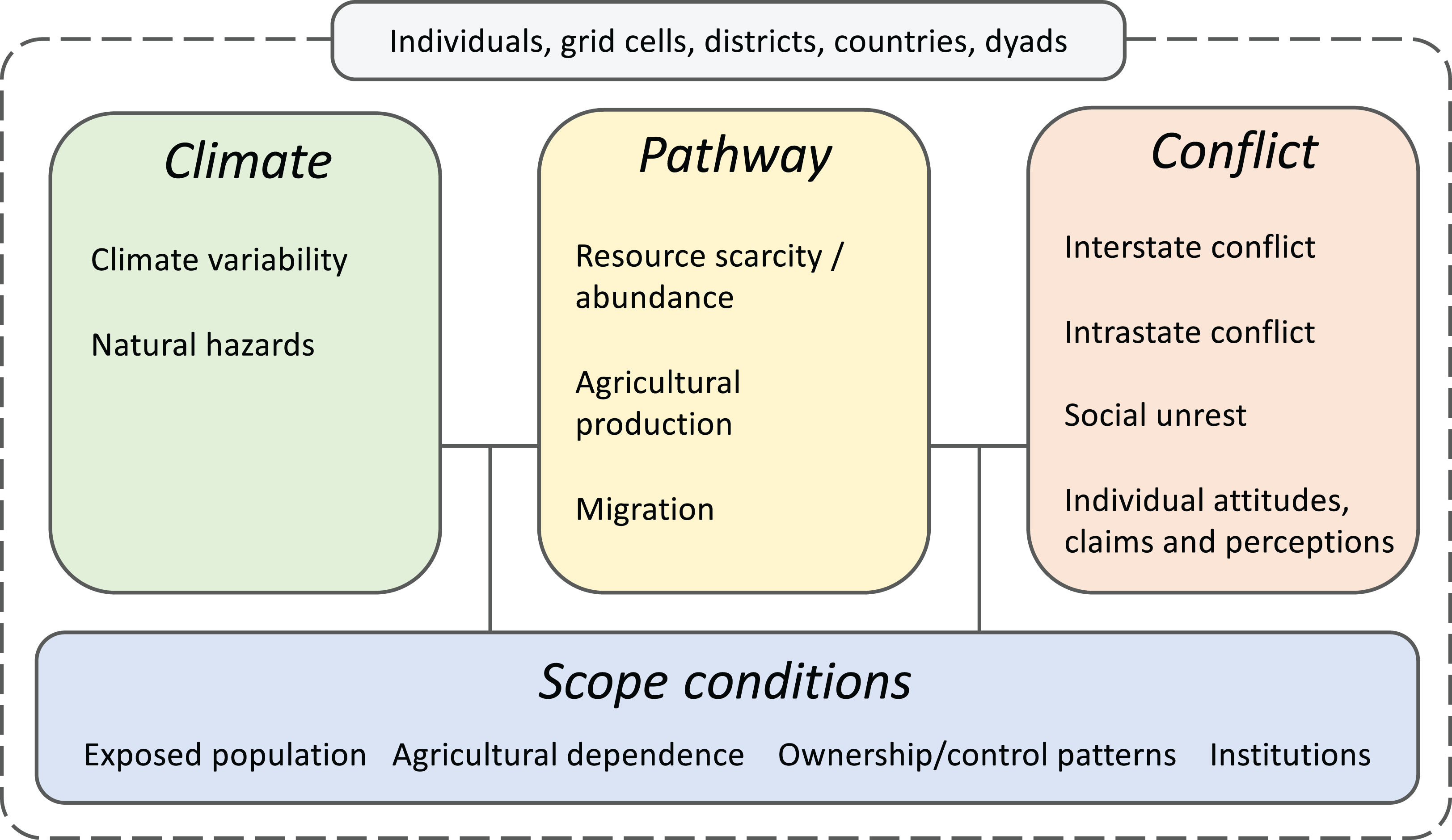
The special issue also presents new evidence for two other non-civil conflict outcomes. De Juan & Hänze (2021) analyze whether drought is associated with decreased interethnic trust, drawing on survey data spanning six African countries. Contrary to expectations, they find that drought exposure correlates with increased intergroup trust, suggesting that if a general conflict-inducing effect of drought exists, it must work through other mechanisms than ethnic polarization. Finally, Schmidt et al. (2021) shed new light on the understudied interstate dimension of climate security. They show that anomalous climate conditions can shape the risks for new diplomatic conflicts and militarization of ongoing issues, and that chances for issue claims and conflict initiation are greatest for revisionist states.
Beyond direct causality: New insights on migration and agricultural production pathways
The special issue provides important insights into plausible indirect pathways from climate to conflict. A common focus of several contributions is the migration link, which has received much attention in policy and practice (e.g. Rigaud et al., 2018). Studying Bangladesh, Petrova (2021) finds indeed that climate-hazard exposure partly drives migration. Her results also suggest that the inflow of migration is associated with more social unrest events in host areas. However, her article does not directly support the climate–migration–conflict hypothesis as the specific subset of migrants that is associated with climate hazards is not significantly linked to protests in her data. This result somewhat contrasts with the work by Koubi et al. (2021), who report that migrants who have been exposed to both gradual and sudden environmental events in their area of origin have higher willingness to engage in protest for migrant rights, based on novel survey data from three Kenyan cities. The article by Adger et al. (2021), too, makes important contributions to our understanding of human (in)security among urban migrants through a novel combination of qualitative ethnography and quantitative survey analysis in Chattogram, Bangladesh. Taken together, the evidence provided in this special issue supports the view that migration can be a relevant coping mechanism to environmental hazard exposure (Black et al., 2011). However, the link to social unrest and conflict seems to be context-specific and more complex than sometimes portrayed.
The agricultural production channel is another pathway that this special issue scrutinizes further. The agricultural sector has been a main focus of recent work on climate and conflict, owing to the sensitivity of rural agrarian livelihoods to weather shocks and climate anomalies (cf. Koubi, 2019). The contributions of articles in this issue help identify under what circumstances spatial and temporal agricultural production variations influence the risk of several conflict-related outcomes. Focusing on the dynamics of the Syrian Civil War, Linke & Ruether (2021) show that drought during the growing season increases the likelihood of violent events, but patterns differ by conflict actors. According to their analysis, the growing season is generally a time of heightened conflict activity. Relatedly, Vesco et al. (2021) identify spatial impacts on crop production as conditioning the link between drought and civil conflict onset in agriculture-dependent countries, where increasing concentration of agricultural production in parts of state territory reflects increasing economic inequalities.
Beyond causal identification: Perspectives on climate–conflict research
Against the backdrop of the gradual maturing of the research field, additional contributions of this special issue offer new perspectives on the developments of the field at large. Specifically, Mach & Kraan (2021) share insights from other climate change research fields and highlight how climate–conflict research can benefit from interdisciplinary collaboration, integration of diverse methods and lines of evidence, and iterative engagement between scientists, practitioners, and policymakers. Gleditsch (2021) discusses whether the focus and central tenets of research have changed as the literature has evolved from the original thesis of Malthus through the neoMalthusian emphasis on environmental scarcities to the contemporary climate security discourse. He concludes that although the stakes seem higher today, little has changed substantively, and the debate continues to be shaped by alarmist pessimists and complacent optimists. Finally, Busby (2021) reflects on differences between current research foci and the wider concerns in the policy world and points to a crucial lack of knowledge on effective policy responses to the challenges imposed by climate change, particularly with respect to peacebuilding and internal conflict.
Ways forward: Directions for the next generation of climate–conflict research
Research on climate and security has expanded significantly in recent years. Progress has been made in spatial and conceptual disaggregation, evaluation of plausible indirect pathways, identification of key scope conditions, and consideration of alternative insecurity outcomes through diverse methodological approaches. This special issue continues along these lines and addresses important research priorities identified in earlier reviews of the field. The contributions provide more evidence for significant climate impacts on social unrest in urban settings; they emphasize the complexity of the climate–migration–unrest link; they investigate how agricultural production patterns affect conflict risk; they study new outcomes, such as interstate claims and individual trust, that hitherto have received scant attention; and they explore the relevance of this research for user groups across academia and beyond. A red thread across these contributions is a nuanced, context-sensitive approach, further underlining that sweeping statements about climate–conflict relationships are neither helpful nor warranted.
Yet, the seven historical research priorities presented above remain valid today, despite notable scientific progress over the past decade (cf. Mach et al., 2020). In conclusion, we would like to highlight three research gaps that we consider particularly pertinent. First, our stocktaking exercise has revealed a critical need for climate–conflict research to move beyond empirical analyses of climate variability and natural hazards and consider potential long-term security impacts of climate change. Science is making rapid progress in modeling potential future impacts of climate change on crop yields (Deutsch et al., 2018), economic productivity (Murakami & Yamagata, 2019), and the prevalence of hunger (Hasegawa et al., 2018). In contrast, there is a distinct lack of scenario-based projection studies that estimate future climate change impacts on conflict risk (though see Witmer et al., 2017). Addressing this lacuna is hardly trivial. When assessing impacts in the future, the conditional and complex relationships documented in this special issue and elsewhere need to be accounted for. Departing from mere extrapolation of empirical results under a ceteris paribus assumption and carefully assessing conflict implications of alternative social, political, and climatic pathways is an important task for future research.
A related research challenge will be to assess compound effects from different hazards and climate impacts (cf. Leonard et al., 2014; Zscheischler et al., 2018). Some special issue contributions already provide initial steps in this direction: Koren et al. (2021) study the interaction of food and water scarcity and Koubi et al. (2021) emphasize the double exposure to slow and rapid-onset disasters. Yet more needs to be done. Global warming will likely simultaneously lead to sea-level rise, depress agricultural output, increase hazard frequencies, put strains on government income, and increase migration flows (Adger et al., 2014). These different impact channels may interact and produce cascading effects. Estimating how such simultaneous processes together shape conflict risk is vital to realistically assess security implications of climate change. Integration across disciplines, scenario work, and predictive approaches may help assessing such compound and cascading effects (Leonard et al., 2014; Mach et al., 2020).
A third key challenge for future research concerns the study of climate change response impacts. The longer global greenhouse gas emissions continue to overshoot trajectories consistent with the Paris Agreement’s target of maintaining global mean temperature within 2°C above pre-industrial levels, the more draconian and intrusive mitigation measures will need to be (IPCC, 2018). Such mitigation measures could lead to fundamental societal transformations. For example, a rapid decarbonization of energy systems will affect demand and rents of high market value resources, such as oil and gas, which are known to affect conflict risks (Ross, 2015). This could challenge the stability of resource-dependent states that are poorly prepared for such transformation in the medium term (Peszko et al., 2020). Assessing security risks – but also long-term benefits – that may result from increased efforts to curb climate change, including a transition to more diversified low-emission energy systems, is therefore an important task. Work on historical relationships and climate change impact assessment in other fields (e.g. Hasegawa et al., 2018) may give inspiration for analytical approaches to tackle these questions.
Footnotes
Appendix
Climate–conflict research priorities highlighted in earlier reviews
Authors’ note
Authors listed in reverse alphabetical order; equal authorship implied.
Acknowledgements
We are grateful to the professional and efficient peer reviewers of the special issue manuscripts and we thank the many colleagues not represented here whose work this collection of articles builds on. We also thank Josh Busby, Tobias Ide, and Vally Koubi and two anonymous reviewers for comments on an earlier version of this article.
Funding
We acknowledge research funding from the European Research Council, grant no. 648291, the Research Council of Norway, grant no. 268135, and the Swedish Research Council, SIDA, and Formas, grant no. 2016-06389.
