




Abstract
This article builds on the intellectual legacy of Jan Tinbergen by extending his analysis on welfare and security into a framework involving strategic interaction. I first incorporate welfare and security in terms of interstate tensions into a single utility or payoff function. An uncertain world is characterized by states that are more peaceful, and others where nations are more hostile to each other. Both conflictual and peaceful outcomes lie along a spectrum of hostility short of war. The strategies adopted by the two countries, which promote peace, can be complements or substitutes. This means that they can go up or down in response to increases in the strategies of its rival. I demonstrate that non-cooperative behaviour between nations is Pareto inferior to cooperative behaviour, because the latter is associated with more actions and efforts to promote peace. Cooperative behaviour is akin to Tinbergen’s notion of world government. Non-cooperative behaviour by states also leads to moral hazard, and there can be free-riding in joint peaceful behaviour by some nations, particularly when the strategies of the countries are substitutes. The model is extended to aggressive international behaviour, including that mandated by populist plebiscites or election victories, as well as an outline of individual behaviour driven by identity-based politics.
Introduction
2019 marked the 50th anniversary of the first Nobel Prize in Economics awarded to Jan Tinbergen. 1 Many aspects of Tinbergen’s contribution to economics are well known, for example his pioneering work in econometrics, macroeconomic modelling, and the rule regarding the correspondence between targets and instruments in macroeconomic policymaking. His views about development issues are less well known, for example the norm regarding the volume of development assistance flows from rich to poor nations at 0.7 % of each developed country’s national income. 2 Even less well known are Tinbergen’s analyses of war and peace, particularly his characterization of the linkage, indeed the inseparability, between welfare and security, and his strong advocacy for world government as a means of resolving interstate coordination failure.
The present article attempts to pay homage to Tinbergen’s work on the nature of interstate conflict by incorporating the welfare and security framework into a theoretical model of strategic interaction between nation states. It must be emphasized that interstate conflict at present rarely descends into outright ‘war’; even the militarized interstate disputes of the present era, say between India and Pakistan, are exemplified by their low intensity if measured in terms of military casualties. Instead, what needs to be understood and modelled, as is done in this article, is hostility between nations, which can take the form of the departure from international organizations, boycotts, sanctions and the general diminution of cooperative behaviour, all short of what is normally understood as war. The article begins by selectively reviewing what economists in the past thought about the nature of war and what would achieve peace. I then build a model in the Tinbergian spirit that allows us to focus on the simultaneous analysis of welfare and insecurity. Finally, the relevance of Tinbergen’s analysis in our era of heightened insecurity is demonstrated. This insecurity is a by-product of extreme or hyper-globalization of our present era, resulting in the emergence of structural and enduring inequalities, including inequalities of opportunity, as well as the rise in populism and interstate hostility short of outright war.
The rest of the article is organized as follows: the next section outlines the evolution of endogenous notions of war within the domain of economics. A two-country theoretical model, in the spirit of Tinbergen & Fischer’s (1987) outline of a social welfare or utility function, where welfare and security go hand in hand, is then constructed in the context of peaceful and less peaceful states of interstate interaction. These peaceful and less peaceful states can be affected by actions and efforts by both countries engendering interdependence, and I demonstrate the Pareto superiority of cooperative behaviour, akin to Tinbergen’s (1990) advocacy of world government. Non-cooperative behaviour by states is also associated with moral hazard and there can be free-riding in peaceful behaviour by some states. Before concluding, I extend the model to demonstrate moral hazard, as well as situations when an immiserized median voter may be induced to vote for more aggressive behaviour by his government on the international stage.
Endogenous war
Mainstream economics has traditionally regarded war to be mainly outside the realm of economic analysis, except with reference to the costs of war and the bounded (or limited) rationality of war, as war when compared to a negotiated settlement is more damaging, and therefore irrational. We may even be tempted to conclude that mainstream economics regards war as an exogenous phenomenon. In the positive sense the damage done by war on infrastructure, productive capacity and output, along with other adverse phenomena such as inflation, has long been considered in economic analysis. As early as in Adam Smith’s The Wealth of Nations (1776/1966) the costs of maintaining an army is mentioned. The sovereign may have the duty to maintain the security of his/her subjects from violence and invasion, but it comes at a price, which contemporary economists have described as the military burden of providing security, also alluding to the military establishment’s insatiable appetite for additional resources; see, for example Smith (2009). In historical terms, we have the work of Charles Davenant (1695/2019) who wrote at length about ways of financing war, with a warning about the perils of long-term borrowing in this connection. By contrast, political sociologists, such as Charles Tilly (1992), have pointed out the role of war in state-building, asserting that in the historical European context the need for ever more complex military establishments necessitated enhanced state capacity, including fiscal capacity, leading to the state’s increased ability to provide a growing array of public goods, as well as its role in economic management.
Mercantilist motives can, however, make war endogenous to the objective of accumulation at the expense of others. The acquisition of trade monopolies and resources with which to manufacture and trade can turn war into a tool to achieve these objectives; see Findlay & O’Rourke (2007) for a historical account of the relationship between trade and power in the last millennium. The theory of economic imperialism may also be considered in this context (Hobson, 1902/1948; Lenin, 1917/1963). The competition for markets and resources, and even the need to exploit foreign cheap labour for the purposes of manufacture could lead to war. Another source of endogenous war could emerge as a result of the Malthusian trap which can be traced back to the work of Thomas Malthus (1798/1965). War might act as a ‘positive’ check when population growth outstripped the available produce of agriculture, which Malthus felt to be subject to diminishing returns, due to the fixity of available land, even if occasional productivity improvements in agriculture were possible. This also meant that wars, such as the Thirty Years War in the 17th century, as well as epidemics such as the Black Death in 14th century Europe could at least temporarily raise the living standards of workers, as the population dramatically declined compared to land, the fixed factor, whose productivity was largely undiminished by war or pestilence; see, for example, Voightländer & Voth (2013).
With respect to the opportunity costs of war, Haavelmo (1954) provides us with a general equilibrium framework in which the trade-off between production and appropriation is modelled. Mankind can earn a living through production, or alternatively engage in predation. But war has costs, including the military expenditure to acquire capable armed forces, as well as the damage done by war. Pigou (1921) provided us with a measure of the military burden or defence expenditure in the UK just before World War I, which he estimated to be about 4% of national income in the UK around 1913 (Pigou, 1921: Chapter 2). He also deals with how a war economy functions in terms of the effect on consumption, investment and aspects of war finance. Keynes (1920/2004) was deeply opposed to the punitive terms of the ‘Carthaginian Peace’ imposed on Germany at the Treaty of Versailles in 1919 because he felt that the hardships imposed on the German people and economy would prevent the economic recovery of Europe, making Central Europe ripe for revolution and political instability.
Economists in the 19th century were less concerned with war, as they felt that trade stimulated peaceful relationships between nations and peoples, and the benefits of free trade would be lost when military conflicts broke out. For example, John Stuart Mill (1840/1968) argued that intensified international economic relations would reduce the incentives for conflicts among nations. Richard Cobden (1835/1978) considered commerce to be the panacea for interstate rivalry. Also, in a celebrated work at the time of its publication just before World War I, Sir Norman Angell (1910) argued that war between nations was utterly futile; it would be so destructive that even the victor’s war-related losses would outweigh any gains. Pigou (1921: Chapter 3), however, argued that the interests of the armaments industry and the competing interests among great powers associated with imperialism exacerbated the risk of war. Schumpeter (1954) believed that the growth of advanced capitalism would render war between nations less likely.
The belief – shared by classical and neoclassical economists – that intensified economic ties could be the basis of peaceful relationships between countries at first sight makes economic analysis of cooperation and conflict unnecessary. It is almost as if economists should focus on ways to secure free trade and full employment. But the notion of security (armed peace) needs to be incorporated into welfare, along with efforts to strengthen the peace if needs be via economic means (economic integration); the liberal peace concept (Gleditsch, 2008). This should minimize the risk of war, but even in a state of peace hostility between nations may still persist. Also, the peace based upon mutual economic interdependence which is central to the liberal or capitalist peace is not something that always emerges endogenously, nor is it always self-enforcing. International cooperation through commitment to common membership of international organizations, or even world government, is needed to secure the ‘liberal’ peace. Indeed, around the time of the outbreak of World War II, Lionel Robbins (1939/1968) argued that war was a consequence of the absence of federation at certain levels, implying that national economic sovereignty needed to be curtailed to ensure greater international economic policy coordination.
A Tinbergian model of interstate conflict
Currently, most wars are internal wars, which are also described as intrastate or civil wars. Yet interstate tensions, short of militarized conflict, still persist. Many Cold War rivalries have re-emerged; examples include the Syrian civil war, the recent escalation of hostilities between the USA and Iran, and trade-related hostility between the USA and China (see van Bergeijk, 2019). Tinbergen’s life, encompassing the bulk of the 20th century, was dominated by intense interstate conflict: the two World Wars and the Cold War that followed, with its ever-present threat of planetary extinction. The wastefulness of wars and the preparation for wars, which, in addition to collateral damage, created immense human suffering, was something Tinbergen was acutely aware of. The moral underpinnings of his economic analysis were modestly but oft-stated in his quest for an ‘optimum social order’. 3 This involved not just the maximization of utilitarian welfare, 4 but also the elimination of poverty, the attenuation of inequality and the feeling of security; see Tinbergen & Fischer (1987) as an example. Above all, Tinbergen clearly states that ‘welfare’ and security are inseparable. Incidentally, the welfare function in Chapter 2 of Tinbergen & Fischer (1987) also has utility declining in inequality, something that would not fit in easily with our contemporary world (and is a challenge to mainstream economics as well).
The hallmark of Tinbergen & Fischer’s (1987) theoretical contribution is that welfare cannot be assessed just in terms of the traditional notion of consumption (of private and public goods), but also includes security. This analytical approach differs from the mainstream approach to the ‘war’ sector that concentrated on the problem of how to produce an exogenously determined level of military security at minimal cost (Hitch & McKean, 1960: 2). In the view of Tinbergen and Fischer, military expenditure, particularly of the defensive variety, could be justified as it permits the existence of the other inputs into welfare. Moreover, aggregate welfare is greater in a state of peace, albeit an armed peace involving some military expenditure for self-defence, than in a more hostile environment where the risk of war is greater. Hence, uncertainty needs to be introduced into the calculus of warfare and welfare (see also van Bergeijk, 1987).
The remainder of this section builds a model of strategic interaction between two countries (a home country, H, and a foreign country, F) that are hostile to one another in two states, both falling short of outright armed conflict. One state of the world is more peaceful with greater aggregate income and the provision of security-unrelated public goods (health, education and social protection) compared to the less peaceful or more hostile state. 5 Security expenditure is greater in the more hostile state. Both countries can affect the probability of the more peaceful state by an action that is unique to the country, but each country is impacted by the action of the other. Examples of these are a greater willingness to negotiate, accommodate and enter into agreements, state visits, but also negative interaction such as (economic) sanctions, recalling of ambassadors or ending the membership of regional integration initiatives (Brexit). My model, thus, presupposes greater commerce and joint membership of international organizations, both pillars of the liberal peace between nations (Gleditsch, 2008), as well as threats to the liberal peace. In this manner, we model changes in international interdependence.
As indicated, there are two states of nature: one more peaceful (P) and the other associated with greater conflict or hostility (C). 6 Their probabilities are defined as Π and 1–Π, respectively. An important feature of our model is that states of hostility, or peace, are relative. The probability of either state is affected by an action (a) by the home country and effort (e) by the foreign country. These are also the strategic variables employed by the two sides. We postulate that the probability of the good (peaceful) state Π changes with the input of action and effort by the two sides, but at diminishing rates. These probabilities are based on a common distribution function on the likelihood of the two states, and are, therefore symmetric for both nations. 7
Actions and efforts influence the probability of peace, but they do entail costs for each country, and these are explicitly modelled via cost functions. The costs of actions to promote peace could, for example, take a variety of forms including diplomatic expenditures and numerous forms of goodwill expenditure (van Bergeijk & Moons, 2018). In addition, there may be non-pecuniary costs, such as the loss of face to domestic political supporters, for example for Donald Trump if he is perceived to be soft to China, or the British Conservative Prime Minister if he or she makes concessions to Europe, or to Narendra Modi if he was seen to be conciliatory to Pakistan. More importantly, there are costs associated with messaging domestic constituents about the relative merits of peaceful actions or vice versa.
The risk-neutral expected social welfare (UH) of the home country (H) is given by

The assumption of risk neutrality may appear strong. It may be justified by arguing that we are modelling government behaviour with regard to peace and hostility towards other nations short of outright war. Relaxing the assumption will not alter the qualitative nature of the results that follow, particularly in connection with the superiority of cooperative behaviour over non-cooperative outcomes. Due to the property of risk neutrality, welfare or utility can be described in terms of expected utility payoffs (Ys):

where YP H and YC H denote payoffs in peace and conflict, respectively, weighted by the probabilities of the two states. C is the cost function of undertaking the action, a. Action, a, increases the probability of peace, Π, but undertaking it entails a cost, for example in terms of foregone revenue. Also, Πa > 0, but Πaa < 0. Both Ca > 0 and Caa > 0. The cost functions will be influenced by domestic identity-based politics, Ca1<0, Ca2>0. There are two messages, one internationalist (m) which lowers the cost of peaceful behaviour for the state, and another (n) sending out a nationalistic message raising the cost of peaceful behaviour in the welfare function. Disposable income and public goods provision (such as health, education and social protection) are greater in the relative state of greater peace (YP H) than in the more hostile state (YC H), and there is less harmful military expenditure crowding out other public goods in the peaceful state. Normally, the individual rational economic man or homo economicus would have a strong preference for the peaceful state; a notable exception in real life would be the Brexit referendum which produced a majority to be poorer and less secure. Other examples include the election of Donald Trump in the USA in 2016, the election victories of the incumbent Indian Prime Minister, Narendra Modi and the British Prime Minister, Boris Johnson in 2019. Tinbergen & Fischer (1987: Chapter 2) explicitly enter the probability of a more peaceful world conditional on the implementation of a variety of relevant arms control treaties at the time. Hence, even if the peaceful state generates more welfare, its probability is enhanced by the choice of costly peaceful actions, both at home and abroad.
Turning to the foreign country (F), we similarly have

A similar set of arguments apply to the foreign country, E is the cost of effort, e, which increases the probability of peace, Π. Also, Πe > 0, but Πee < 0, Ee > 0, and Eee > 0. Also, similar messaging impacts on the cost of peaceful behaviour with one message lowering costs of peaceful behaviour, and another increasing it, Ee1 <0, Ee2 >0.
In the non-cooperative or Cournot-Nash type interaction, the two sides move simultaneously. The solution to the model involves each side maximizing its utility function or payoff with respect to its own choice variable. For the home government it means maximizing utility from expected payoffs in Equation (1) with respect to a as shown by

The foreign state maximizes Equation (2) with respect to e

Note that in Equations (3) and (4) each country will equate its marginal benefit from exercising its own strategic choice to the corresponding marginal cost.
World government
It is interesting to consider a counterfactual situation where both sides are compelled to cooperate by an outside power or agency. This is similar to Tinbergen’s advocacy of world government; see Kol & Wolff (1993) and Tinbergen (1987). In order to further our understanding of such cooperative behaviour between nations we may allude to two theoretical concepts from economics. The first is to do with the ‘we’ or group rationality invoked by Robert Sugden (1991) among others. This is when individuals think of the group or team they belong to and factor in what is good for this collective in the process of individual decisionmaking and welfare calculus. Although it might be difficult to envisage such ‘global’ rationality, it is not in the realm of impossibility, and in the spirit of Tinbergen as an ideal to be strived for. 8 The second notion is to do with Kenneth Boulding’s (1989) concept of integrative power. The exercise of this sort of power results in voluntary compliance, as opposed to the power of threats when potential force is at stake, or exchange power when motivation is derived from the gains from trade. Integrative power may involve use of psychic, social or religious sanctions, but in the main, invokes compliance from a sense of duty. In an ideal state, nations may be motivated to federate and act jointly via forces other than coercion and the benefits of mutual exchange.
The individual decisionmaking functions of the two countries are now federated into a joint decisionmaking authority. The upshot of this discussion is that it will lead to the maximization of welfare (W), by summing the payoffs in Equations (1) and (2) together in a utilitarian fashion. This summing of payoffs is akin to the addition of individual incomes in a social welfare function; see Myerson (1981), for example. The existence of social welfare functions was brought into doubt by the Impossibility Theorem, proposed by Kenneth Arrow (1950), based on a number of restrictive axioms. Harsanyi (1955), however, provides us with a justification of utilitarianism, particularly when we go beyond the restrictiveness of ordinal utility, which only permits the ranking of alternative preferences.
Be that as it may, at some level, the single global welfare function, sum of equation (1) and (2), is maximized with respect to a:

and with respect to e:

Comparing Equation (3) with Equation (5), and Equation (4) with Equation (6), we discover that the equilibrium levels of both a and e are greater. This is because the marginal benefits of peaceful actions and efforts for both countries have risen, as indicated by the square bracketed second terms in the right-hand sides of (5) and (6). Both terms inside the squared brackets in (5) and (6) are positive, as payoffs in the peaceful state are greater than in times of conflict. The benefits of actions by the home country for the foreign nation, as well as the benefits of efforts by the foreign country for the home nation are now internalized. Hence, cooperation is Pareto superior to non-cooperative Cournot-Nash behaviour, as the global marginal benefit of both a and e is equated to marginal cost. Note, however, that even the cooperative outcome may not be completely free of strife. Despite that, our finding is in the spirit of world government, as advocated by Tinbergen (1987), because he felt national governments were too myopic; in our case, as will be demonstrated below, they can inadvertently conspire to generate moral hazard. The equilibrium described by (5) and (6) is on the ‘contract curve’, unlike the non-cooperative solution denoted by (3) and (4).
Returning to non-cooperative interaction, each side’s strategic choices will depend on the first order conditions for a maximum given in Equations (3) and (4), along with a fixed conjecture about the opposition’s strategic choice. These lead to the (linear) reaction functions for both sides, obtained by totally differentiating Equations (3) and (4) with respect to a and e. For the home country this is indicated by

and for the foreign nation by

Since Πae = Πea by symmetry, YP > YC.
Strategic complements
Strategic substitutes
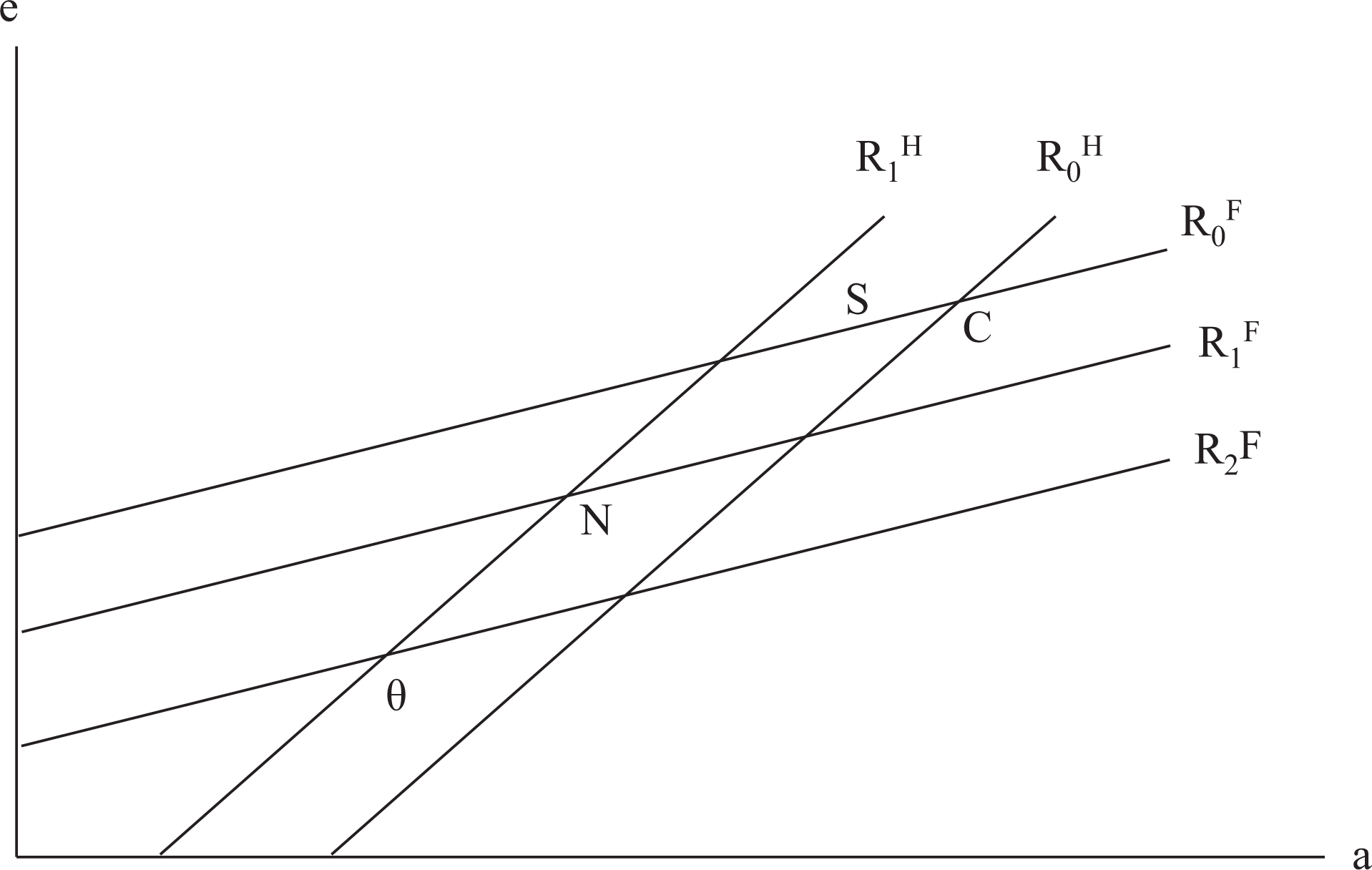
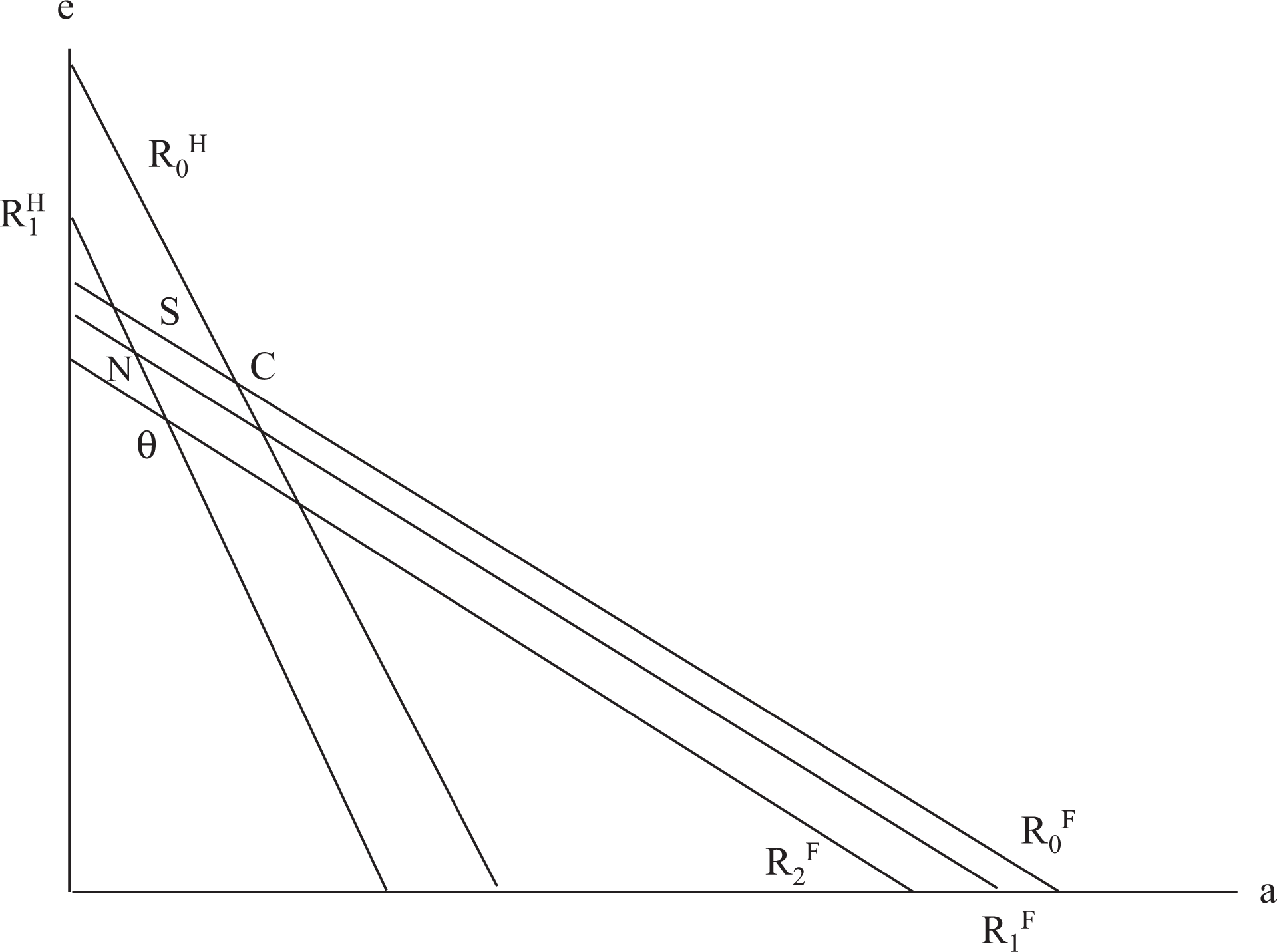
The reaction functions are positively sloped if Πae > 0, implying that the two strategies are complements (Figure 1). This is the standard assumption in the literature on conflict. In our model, however, we also allow for the possibility that Πae < 0, the choice variables are strategic substitutes, and the reaction functions could therefore slope downwards (Figure 2). This occurs because the strategy space is defined in terms of peace. Thus, if one side behaves more peacefully it increases the utility from payoffs for both parties, and the other country may free-ride on this action by not bringing about a corresponding increase in their action. It must also be remembered that action and effort are not without their costs. Also recall that we are concerned with relative states of hostility and peace, not armed conflict.
Moral hazard
Furthermore, the non-cooperative solution to the model generates moral hazard. From the viewpoint of some of the domestic citizenry and the rest of the world, the actions and efforts by the two governments are not always observable or verifiable. Also, neither side has the incentive to engage in globally optimal levels of action or effort to promote peace. Examples could include efforts to stem transnational terrorism, drug cartels and other global public ‘bads’, which tend to increase disputes between nation states. This could also extend to actions to stem the spread of the COVID-19 pandemic. Since the moral hazard is found in both parties, we have double moral hazard, as analysed in Murshed & Sen (1995). In both Figures 1 and 2, the non-cooperative solution associated with moral hazard is given by point N. The fully cooperative and Pareto optimal solution is illustrated at point C, but that requires international cooperation, policy coordination or even world government as advocated by Tinbergen & Fischer (1987) or Tinbergen (1990).
Also, in Figure 2, when the strategies are substitutes we have an additional ‘equity’ problem. In the non-cooperative equilibrium (point N) the home country has effectively passed on some of the burden of adjustment to the foreign nation. Once again the examples that spring to mind are policies to tackle pandemics, terrorism and international crime, where nations seem to occasionally pass the buck on to other countries and free-ride on them. In fact, the level of effort exercised by the foreign country is greater than in the cooperative solution. We could say that the home country is free-riding on the other nation. The positions could equally be reversed, between home and foreign countries. The elimination of double moral hazard requires the design of a mechanism that induces cooperation and transparency.
Extensions
What if one side, say the government, acts as a Stackelberg leader? Analytically speaking, this means the leader takes the follower’s reaction function into account while maximizing its utility or payoff. Diagrammatically, the leader’s utility or payoff function is made tangent to the follower’s reaction function. A variety of multiple equilibria are possible under Stackelberg leader–follower situations. We depict some of the possibilities by the point S in Figures 1 and 2. These are associated with Pareto improvements on Cournot-Nash behaviour. But this is not necessarily always the case, as a variety of equilibria are possible. 9 We may argue that the first-best outcome is globally cooperative equilibria; non-cooperative (Cournot-Nash) behaviour produces second-best outcomes. In some situations, the second-best non-cooperative outcome may be inferior to outcomes when there is a Stackelberg leader (a powerful and enlightened country) taking into account the reactions of followers (smaller countries), as may be argued to have been the case for Western nations during periods of the Cold War (1950s and 1960s) under US hegemony.
An increase in the cost of peaceful behaviour in one country (the foreign nation) is shown by point θ in both Figures 1 and 2, which is a downward movement in the foreign reaction functions. In Figure 1 when the two activities are strategic complements there is a clear welfare loss. In Figure 2, however, the two strategies are substitutes. The decrease in effort by the foreign country is matched by an increase in home country action. This might mean an improvement from the non-cooperative outcome at point N in Figure 2, as the home country was free-riding on the foreign nation at that point. Analytically it implies an increase in the cost of peaceful behaviour for the foreign country, from Equation (2). Differentiating the arguments inside the cost function for peaceful behaviour, E, in Equation (2) with respect to its arguments, and maximizing with respect to e:

The first term on the right-hand side of Equation (9) lowers the cost of peaceful behaviour or international cooperation; the second term has the opposite effect. An increase in hostility implies that the latter dominates the former.
When is there a rise in belligerent behaviour on the part of certain nations? Examples would be the British Brexit referendum, the actions of President Trump of the USA vis-à-vis Iran, and the behaviour of the Modi government in India in respect of Kashmir, which heightens tensions with Pakistan. These developments have their genesis in democratic institutions, elections and referenda, even though neither Brexit nor Trump’s behaviour can be regarded as liberal. 10 Again, economistic explanations may be paramount. The genesis of current hostile tendencies (trade wars, Brexit) may lie in the rise of interpersonal and functional inequality, co-terminus with the viral contagion of fake news spread by the electronic media. The result is populist tendencies focusing on primeval identity with little heed paid to economic self-interest which is meant to characterize homo economicus. Identity may trump (economic) interests; identity-based behaviour may entail hostility to ‘an other’, a sentiment that populist demagogues play up in order to feather their own political and economic interests; see the analysis in Glaeser (2005) and the connection made between identity politics and the Nazi regime (Caruso, 2016).
It is now useful to move from the aggregate behaviour or the state’s actions that we have described until now to the analysis of the individual. To analyse how hostility may be rising in our contemporary world, consider the behaviour of an individual voter in the model sketched above. This individual has income, Yi, and could be the median voter, who in an electoral process may swing the national policy outcome, or at least determine its direction. In a society that is unequal, the median individual has an income (or endowments) below the mean (YF) for that society, and in that sense we may deem him to be poor. He is faced with two prospects to vote on, one which advances his own income relative to the mean but is less resonant with narrow (ethnic or national) identity, and another which disadvantages him as an individual but may raise national mean income, and above all is in line with what he regards as appropriate identity-based behaviour. This, latter, policy vector will enrich the elite in his group, because even if mean national income rises, median income falls because of the relentless pursuit of laissez faire with dwindling social protection.

Individual subjective decision weights attached to what we described as relative peace (w1) and hostility (w2) are determined partially by their more objective probabilities of peace and conflict (Π, 1–Π), but also by preferences that are influenced by domestic demagoguery in terms of meme messages (m, n). Note, the partial derivatives associated with the decision weights are positive. The idea of the decision weight emanates from the theorizing of Kahneman & Tversky (1979), and Tversky & Kahneman’s (1992) prospect theory which permits framing in the mind of the individual, who may attach a greater weight to a prospect or outcome in an uncertain world based on its desirability. Hence the outcome associated with the decision weight w2 may be regarded as more worthy compared to alternative outcomes by an individual, even if it is less likely in the probabilistic sense of expected utility. Thus, decision weights differ from conventional probabilities; all probabilities may be framed in the mind, but decision weights emanating from prospect theory are connected to the individual’s perceptions of what is a more worthy outcome.
In Equation (10), the probability of the individual voting for a set of policies that promotes a more peaceful and integrated world depends positively on a message, m, sent out by one group of liberal politicians, and negatively on a (populist) message, n, sent out by another set of populist interests. 11 These rival messages compete in the framing process of the individual’s mind-set. But his personal circumstances also play a part, and may lead to a preference for narrow identity-based outcomes, such as I in (10).
A relatively deprived voter who is precariously employed with declining social protection may give greater credence to the latter ‘meme’ message because it is more intrinsically desirable; in other words, w2n > w1m, the efficacy of the populist meme message is greater. In the state of relative peace his individual income relative to the mean rises (or is at least constant); he also obtains a vector of public goods, G. In the less peaceful state, his identity-based set of outcomes is realized; he obtains I, but his individual income relative to the mean declines, although national income relative to the foreign country may increase. 12 In a sense the individual knows and votes for something which makes him proud to be English or American even when it is a Pyrrhic victory, as he makes the already rich in his own nation richer, as many voters who voted for Trump were only too painfully aware of. Out of a sense of identity, they voted to become poorer. Following Rodrik (2017), we could argue that because the poor median voter was not compensated for his loss of individual income and employment insecurity due to greater globalization in the past, he is less likely at present to put a greater weight on the peaceful outcome. He now tends to mistrust the more liberal supra-national or internationalized outcome, and any promises of redistribution are now much less credible. His choice, however, makes the world less secure.
Conclusions
Jan Tinbergen was passionate about designing world peace, the global counterpart of his notion of a socially optimal order. In the pursuit of that goal, he advocated economic analysts to view war, or for that matter conflict more generally, as a phenomenon that was endogenous and not exogenous to the variables of interest to the economist. Secondly, welfare and security could not be separated in the sense that welfare was greater in a more secure or peaceful global setting when nations felt more secure vis-á-vis each other without excessive and wasteful offensive military expenditure. Tinbergen also believed in the superiority of governance at the global level because nation states often behave myopically. In fact, he advocated a revamped and more effective United Nations system. A more modest achievement would be international cooperation at a more regional level, as with the European Union.
I have attempted to model some of these ideas. I first construct expected welfare functions for two countries weighted by the probabilities of peaceful and more conflictual states of nature. The peaceful state is more secure and gives greater welfare. Actions and efforts by both countries enhance the probability of peace and hence nations are interdependent as far as security is concerned. Non-cooperative behaviour is Pareto inferior to cooperative behaviour and also produces moral hazard and free-riding. There can be an endogenous increase in hostility by nations driven by populist identity-based politics, which have their genesis in rising inequality, and the decline of median incomes and life prospects. Thus, the politics of populism is endogenous to the disadvantaging evolution of capitalism in recent years, and the shape that greater globalization has taken in the past four decades.
The current rules of globalization and capitalism, dubbed as hyper-globalization by Rodrik (2017), seem to mainly serve elites who are owners of internationally mobile skills and wealth. There is an alarming rise in inequality, worldwide, exemplified by the rising ratio of wealth or capital to national income (Piketty, 2014). In a global context, Milanovic (2016: Figure 1.8) demonstrates that the share of billionaires’ wealth relative to global GDP was under 3% in 1987; this had increased to more than 6% by 2013. Accompanying this, the national income share of the middle class (defined as having an income in the range of 25% above and 25% below median national income) declined over this time period in nearly all Western democracies, with the United States exhibiting the lowest middle-class share, and the UK not far behind with the fourth lowest share (Milanovic, 2016: Figure 4.8). In recent years the greatest beneficiaries of changes in the global income distribution have been the world’s super rich (the top 1% in the income distribution), along with the middle classes in emerging market economies like China and India; the greatest losers have been the lower middle and low income groups in developed countries.
This rising inequality, along with the despair it produces, sows the seeds of populist politics, which takes the form of a seeming backlash to globalization, involving greater hostility in international relations, as well as to minorities in the domestic context. Rodrik (2017) describes the globalization trilemma, whereby the simultaneous achievement of national sovereignty, democracy and hyper-globalization is impossible. In a hyper-globalized context, further economic integration in terms of adverse distributional consequences outweighs the gains in terms of enhanced income. Hyper-globalization also means that the earlier domestic social contract and an earlier postwar commitment to a welfare state may become untenable, in parallel with the growth of precarious employment.
Rodrik (2018) argues that earlier on, the advance of globalization was made relatively more acceptable in Europe compared to the United States, given the greater prevalence of social protection on the continent. Gradually, after 1980, and especially since the dawn of the new millennium, more and more groups have been disadvantaged by globalization and labour-saving technical progress, and the politics of austerity has diminished social protection, fraying pre-existing domestic social contracts, and social mobility has been greatly diminished. A retreat from hyper-globalization may be desirable, even a return to the halcyon days of the Bretton Woods era (1945 to 1973), but not through channels that diminish international cooperation and partnership, like Brexit and President Trump’s protectionist sabre rattling, because they will serve to further immiserize the already disadvantaged. What is needed is internationally coordinated checks on hyper-globalization and agreements on certain wealth taxes on the richest individuals, as well as brakes on job destroying automation. These policies are needed to address the alarming rise in wealth inequality, given the fact that social protection alone can only have a palliative, but not curative, impact on these inequalities.
Rodrik’s trilemma, however, is not merely the statement of an impossibility theorem, but a clarion call to complement economic integration with political integration. Indeed, the trilemma also has a solution: world government (van Bergeijk, 2019: 70). This is because one of the problems associated with the trilemma is the extent of international economic integration without sufficient attention being paid to the interests and views of constituencies within nation states. Global government can resolve the political dilemma by restricting and governing globalization so that it conforms to the social contracts that democratically emerge in the world. While that may seem naïve to many mainstream economists, it would be exactly the kind of point that Tinbergen might have made. World government, international development and greater equality within and between countries are in the end necessary requirements for a world order that sustainably ensures welfare and security as Tinbergen had envisioned.
Footnotes
Acknowledgements
I am indebted to Peter van Bergeijk for enlightening me on many aspects of Jan Tinbergen’s work and thinking, especially in relation to war and peace. An earlier version of the article was presented at the Network of European Peace Scientists (NEPS) Conference at The Hague in the Netherlands, held between 23 and 25 June 2019. I am grateful to three anonymous referees of this journal whose comments have greatly improved the article.
