




Abstract
Disasters triggered by natural hazards will increase in the future due to climate change, population growth, and more valuable assets located in vulnerable areas. The impacts of disasters on political conflict have been the subject of broad academic and public debates. Existing research has paid little attention to the links between climate change, disasters, and small-scale conflicts, such as protests or riots. Floods are particularly relevant in this context as they are the most frequent and most costly contemporary disasters. However, they remain understudied compared to other disasters, specifically, droughts and storms. We address these gaps by focusing on flood-related political unrest between 2015 and 2018 in Africa, Asia, and the Middle East. Drawing on data from the Dartmouth Flood Observatory (DFO) and Armed Conflict Location and Event Dataset (ACLED), we find that flood-related political unrest occurs within two months after 24% of the 92 large flooding events recorded in our sample. Subsequently, a qualitative comparative analysis (QCA) shows that the simultaneous presence of a large population, a democratic regime, and either the exclusion of ethnic groups from political power or a heavy impact of the flood is an important scope condition for the onset of flood-related political unrest. This indicates that disaster–conflict links are by no means deterministic. Rather, they are contingent on complex interactions between multiple contextual factors.
Introduction
The security implications of climate change have received public and academic attention for more than a decade (McDonald, 2013; von Uexkull & Buhaug, 2021), but high-ranking decisionmakers have become particularly interested in the topic in the recent years. In 2018, Sweden initiated the third United Nations Security Council debate on climate change and security, and Germany maintained the momentum by prioritizing this topic for its two-year membership in the Council (Auswärtiges Amt, 2019). In these debates, disasters play a particularly prominent role (Peters, 2018). Disasters are defined in this study as complex emergencies that result when destructive natural hazards strike vulnerable socio-economic systems (Cohen & Werker, 2008).
The incidence and intensity of disasters have been on the rise for approximately 30 years (Formetta & Feyen, 2019). On the one hand, this increase reflects the greater number of natural hazards due to climate change. On the other, it mirrors the fact that larger populations are exposed to such hazards, due to, for example, population growth and urbanization, particularly in vulnerable areas like coasts and floodplains. Persistent socio-economic inequalities further compound the problem, since poor and marginalized populations are particularly vulnerable to natural hazards (Wisner et al., 2004).
For many years, the literature has been characterized by controversies over the existence and strength of disaster–conflict links (Xu et al., 2016). Based on qualitative case studies, some scholars argue that migration flows and grievances caused by droughts contributed to the onset of the civil wars in Sudan (2003) and Syria (2011), while others consider droughts, at best, as very minor drivers of these conflicts (for overviews, see: De Juan, 2015; Ide, 2018). Cross-case research is equally equivocal: quantitative studies have reported a positive association between disasters and armed conflict (e.g. Brancati, 2007; Kikuta, 2019; Nel & Righarts, 2008), no association (e.g. Bergholt & Lujala, 2012; Omelicheva, 2011; Petrova, 2021), and even a negative association (Slettebak, 2012). More recent research indicates that disasters increase the risk of armed conflict onset, but that this link is weak and strongly dependent on scope conditions (Ide et al., 2020a; Schleussner et al., 2016; von Uexkull et al., 2016).
In this article, we analyze the frequency of and conditions for the onset of flood-related political unrest. By studying political unrest linked to floods, which are climate-related disasters, 1 we enrich the debates on both the disaster–conflict links and climate security more broadly (although the impact of climate change on the floods in our sample cannot be clearly discerned yet). Specifically, we make the following contributions.
We analyze one specific and underexplored disaster type: floods. Floods are the most frequent disaster resulting from natural hazards and affect more people than any other disaster type. Between 1998 and 2017, at least 3,148 floods occurred worldwide (43.4% of all natural disasters), affecting two billion people in total (45% of all disaster-affected people) and causing 142,088 deaths directly (11% of all disaster-related deaths). In terms of economic costs, during the same period, floods caused destruction to the amount of 656 billion US dollars (Wallemacq & House, 2018) – roughly equivalent to Switzerland’s entire GDP in 2017. Until 2050, 300 million additional people will be exposed to high flood risks due to climate change-induced sea-level rise (Kulp & Strauss, 2019).
This notwithstanding, research on climate security and disaster–conflict links have primarily focused on droughts (e.g. Bagozzi, Koren & Mukherjee, 2017; De Juan & Hänze, 2021; Helman, Zaitchik & Funk, 2020; Linke & Ruether, 2021). Some studies find that strong storms (Ide et al., 2020a) and above-average precipitation (Nordkvelle, Rustad & Salmivalli, 2017) – both of which often cause floods – increase civil conflict risks. However, floods can also occur outside of these weather conditions, and storms as well as heavy precipitation events can take place without the occurrence of floods. Intense rainfall does not necessarily produce flooding (e.g. when soil, vegetation or streams absorb the precipitation), and floods often occur in the absence of storms (e.g. riverine floods) or heavy precipitation (e.g. when dry, bare, and rocky soils cannot absorb much water). Therefore, an analysis that is specifically focused on floods is all the more important.
The two studies closest to our research are by Ghimire and colleagues (Ghimire & Ferreira, 2016; Ghimire, Ferreira & Dorfman, 2015). In statistical analyses spanning 126 countries in 1985–2009, both studies find that large floods increase the risk of armed conflict intensity, but not onset. While Ghimire et al. have significantly advanced the literature on disaster–conflict links, we expand the research frontier in three major ways.
First, we study a dependent variable that is largely neglected in the literature. Flood-related political unrest refers to protests, demonstrations, or riots that link their demands or complaints explicitly to a flood event. As such, our study generates new theoretical insights and empirical evidence on a conflict category that is of lower intensity than those conventionally analyzed, yet still politically relevant. With few exceptions (e.g. Hendrix & Salehyan, 2012; Ide et al., 2020b), prior research on disasters and conflict has focused on armed conflict categories that involve at least one organized group, often passing the threshold of 25 battle-related deaths. This is certainly true for prior studies on floods and conflict (but see Petrova, 2021). Our analysis of political unrest contributes evidence to the growing literature on low-intensity conflict. Political unrest can be a driver of social change (Kadivar & Caren, 2016; Koubi et al., 2021) and can be a starting point for large-scale civil conflict (e.g. Bartusevičius & Gleditsch, 2019; Cunningham et al., 2017). Furthermore, early environmental security research has encouraged scholars to study low-intensity conflicts, as these are most likely to be affected by environmental stress (Homer-Dixon, 1999).
Second, the focus on flood-related unrest avoids one important attribution problem that characterizes prior cross-case research on climate security and disaster–conflict links, including research on floods. Even if a disaster caused by a natural hazard precedes a conflict, we do not know whether the disaster was indeed associated with the conflict. Quantitative research addresses this problem by using significance tests and large samples (see Selby, 2014 for a critique). Here, we follow a different approach: we rely on rich qualitative data to produce a list of unrests that are explicitly related to floods.
Third, Xu et al. (2016) highlight that our understanding of the contextual factors that determine disaster–conflict links remains limited. This is also true for the broader climate security literature (Buhaug, 2016; Mach et al., 2019). Extant research tends to focus on whether (rather than in which contexts) floods affect conflict risks. Here, by contrast, we study the conditions under which flood-related political unrest occurs. To do so, we employ qualitative comparative analysis (QCA), a method geared to detecting complex and context-dependent causal relations (Schneider & Wagemann, 2012).
The geographical scope of our analysis spans Africa, the Middle East, and Asia. This range covers many countries and regions that are currently unexplored by both disaster–conflict and climate–conflict research (Adams et al., 2018). We find that flood-related political unrest occurs in 24% of all cases in our sample. However, one should consider that we only focus on major floods (92 occurrences in the countries under study from 2015 to 2018). Importantly, our study also demonstrates that the flood–unrest link is not deterministic – it depends on complex interactions between multiple contextual factors. In particular, the simultaneous presence of a large population, a democratic political system (understood in an electoral, minimalist sense), and either a heavy flood impact or ethnopolitical exclusion is an important scope condition for the occurrence of flood-related political unrest. As such, our findings advance extant research, which has paid limited attention to floods and to vulnerability factors for disaster–conflict links. Additionally, we enrich debates about whether democracies or autocracies (Flores & Smith, 2013; Wood & Wright, 2016), and whether intense or mild events (Salehyan & Hendrix, 2014) increase the probability that floods lead to political conflict.
When do floods cause political unrest?
We follow the Armed Conflict Location and Event Dataset’s (ACLED) definition of political unrest as a violent or nonviolent demonstration for political causes (Raleigh et al., 2010). Political causes include demands for or opposition against specific forms of governance, policies, laws, or regulations. If these demands (or opposing claims) explicitly refer to floods (e.g. calls for higher compensation or better disaster risk reduction policies), we consider such events as flood-related political unrests. Consider a brief example from our dataset (see Online appendix 3). After a flood struck Khwaja Baha Wuddin district in northeastern Afghanistan, killing 72 people and displacing 4,000, the residents of the Shour Toghi area accused the government of not providing sufficient compensation. Subsequently, the aggrieved residents staged a protest to articulate their demands on 21 May 2018. The protest was shut down by the Afghan army, leaving four demonstrators wounded.
Floods can increase the likelihood of political unrest through several, often intertwined pathways. Like other forms of disasters, they can generate grievances due to human and socio-economic losses (Cassar, Healy & von Kessler, 2017). If public institutions or other social groups are considered responsible for the disasters – for instance, due to insufficient preparation, late and inadequate relief, and biased reconstruction efforts – such grievances might result in protests (Ide et al., 2020b). Flood-related migration can also be a source of discontent, both among the displaced population (which may perceive existing support as inadequate) and among people in the destination areas (which may oppose the inflow of ‘outsiders’) (Ghimire, Ferreira & Dorfman, 2015; Koubi et al., 2021; Petrova, 2021).
Additionally, the disaster sociology literature suggests that community coherence increases in the first months after a disaster, while community groups and NGOs support the organization of affected people (Gawronski & Olson, 2013; Quarantelli & Dynes, 1976). This might facilitate the articulation of grievances and coordination of protests. It is important to note, however, that the coherence and solidarity fostered by disasters may also lead to reduced conflict, including protests, although the evidence for this disaster diplomacy hypothesis is at best mixed (Kelman, 2012).
We argue that floods are only likely to cause political unrest under specific circumstances. Some of these are highly idiosyncratic (e.g. the behavior of local state representatives, household vulnerability to floods, intactness of traditional institutions) and are hence difficult to analyze in a cross-case global study. However, we theorize that there are some systematic and partly interacting vulnerability factors at the macro or meso levels that increase the likelihood of flood-related unrest. We suggest five such conditions to be particularly salient.
Heavy impact (Impact): the impact of a flood refers to the loss of lives, livelihoods, and assets, as well as the (often temporary) displacement of households. Due to the availability of reliable data, we will focus on fatalities and displaced people in our empirical analysis. All else being equal, a strong impact of a flood (indicating a severe hazard and/or a high vulnerability) should increase the likelihood of unrest. More affected or displaced people implies a larger group of potential participants in protests, more severe grievances, and stronger support for and organization among affected groups (Gawronski & Olson, 2013).
Exclusion of ethnic groups from political power (Excluded): various studies conclude that the exclusion of politically relevant ethnic groups from political power is an important predictor of disaster-related armed conflict (Ide et al., 2020a; von Uexkull et al., 2016). We posit that such ethnopolitical exclusion also relates to small-scale unrest. Discriminated groups are often more vulnerable to flood hazards and are less likely to receive state-sponsored relief (Venugopal & Yasir, 2017). In some cases, governments may even restrict international aid and NGO access to disaster-affected areas populated by such excluded groups (Zeccola, 2011). Flood-related grievances are thus magnified among excluded groups, adding to the already existing resentment against the (excluding) government, and thus increasing the likelihood of unrest.
Large population (Population): this condition partially overlaps with Impact, since floods tend to have stronger impacts in areas with large populations. However, unequally distributed vulnerabilities to floods can lead to very different outcomes among areas with similar population sizes (Wisner et al., 2004). Furthermore, larger populations are characterized by greater demographic heterogeneity. Increasing heterogeneity, in turn, implies greater diversity in political preferences and demands (Alesina et al., 2003), and hence diversity in reactions to floods. Therefore, by virtue of sheer numbers, larger populations will have a higher likelihood of some individuals or groups reacting to floods with government-focused resentment. Likewise, larger populations will have a greater number of individuals willing and able to commit their time to a demonstration in response to a flood, despite the fact that the opportunity costs of doing so are higher due to the need to recover after the flood (Salehyan & Hendrix, 2014). Therefore, we expect large populations to increase the likelihood of unrest.
Presence of a democratic regime (Democratic): the nature of the political system likely shapes the responses of states and citizens to a disaster, and hence the likelihood of flood-related unrest. The direction of this impact, however, remains unclear. On the one hand, flood-related protests might be more common in democracies because the risks of repression are lower (Flores & Smith, 2013) and leaders are (perceived to be) more responsive to public outcries (Apodaca, 2017). Democratic governments also have to provide resources to broader constituencies and cannot bias their policies heavily towards specific (disaster-affected) groups in order to prevent unrest (Hendrix & Haggard, 2015). Autocratic regimes, on the other hand, provide fewer formal options for citizens to express grievances (Ide et al., 2020b), which may also incentivize political unrest following floods. Furthermore, autocracies are more likely to respond to disasters in repressive ways, which could provoke unrest (Pfaff, 2019; Wood & Wright, 2016). We therefore include this condition in our analysis without a directional expectation.
Level of economic development (GDP): major disasters, including floods, tend to occur more frequently in economically less developed countries. Poor people often live in areas at risk of disaster (such as floodplains) due to a lack of alternative settlement and livelihoods options and have fewer means to prepare for or cope with disasters. The respective states often also lack the means to finance sufficient preparation, early warning, relief, and recovery systems, in particular for rapid-onset events like floods (Mehrabi et al., 2019; Wisner et al., 2004). The combination of personal and livelihood loss as well as dire recovery prospects with insufficient state responses can trigger a sense of frustration among the flood-affected groups (Carlin, Love & Zechmeister, 2014). Low levels of economic development might therefore promote flood-related political unrest.
Naturally, there are other factors relevant for the occurrence of flood-related political unrest, several of which we account for in the robustness tests, such as agricultural dependence, geographic location, or state capacity (see below). Nevertheless, we consider the five above conditions particularly relevant, for two reasons. First, they are among the most salient conflict-related factors discussed in existing literature on disasters and conflicts. Second, these conditions are likely to interact with, and hence reinforce, each other. For instance, large populations might be an important pre-condition for the emergence of flood-related protests, but without strong grievances fueled by ethnic exclusion or low levels of development, they are unlikely to be sufficient driving factors for the onset of unrest (and vice versa). The method we employ is particularly sensitive to such interactions. In addition, we include only five conditions in the main analysis because using a larger number of factors might result in overloaded models (Achen, 2005; Schneider & Wagemann, 2010).
Data and methods
QCA in a nutshell
Qualitative comparative analysis (QCA) is a configurational comparative research approach and data analysis technique. QCA is based on set theory, requiring the researcher to decide for each case (e.g. a flood event) whether it belongs to a certain set of cases (e.g. those that experienced flood-related unrest) or not. This is the calibration process. Partial or fuzzy set memberships are possible, but given that our outcome is binary (onset of flood-related unrest or not), all conditions (akin to independent variables) have to be binary as well (crisp-set QCA) (Ragin, 2009). Once the calibration is complete, a ‘truth table’ can be created, listing all possible combinations of conditions and the cases that are members of the respective set (the truth table for this study is provided in Online appendix 5).
In the next step, a logical minimization procedure is applied to these combinations (or truth table rows) via the Quine McCluskey algorithm, usually by a software (fsQCA 3.0 in our case). The reasoning behind the procedure is that if truth table rows ‘differ in only one causal condition yet produce the same outcome, then the causal condition that distinguishes the two expressions can be considered irrelevant and can be removed’ (Ragin, 1987: 93). The solution formula resulting from the logical minimization procedure describes the combinations of conditions quasi-sufficient for (and hence in a consistent subset-relation with) the outcome. QCA also allows for identifying necessary or quasi-necessary conditions by ascertaining whether certain conditions are in a consistent superset relation to the outcome (Legewie, 2013).
In addition to being able to distinguish between necessary and sufficient conditions, QCA offers several other distinct advantages in the study of disaster–conflict links. Most notably, QCA is geared towards detecting complex causal relations that are dependent on the simultaneous presence and/or absence of several factors (conjunctural causation), rather than analyzing linear relations or interactions between only two or three variables (Schneider & Wagemann, 2012). Further, the method allows us to infer conclusions from a broader set of cases, hence potentially increasing its generalizability when compared to small-N designs. QCA is thus highly suitable for our study focused on the (interacting) contextual factors that produce flood-related political unrest. The suitability of QCA is further reinforced by recent studies that show disaster–conflict links to be strongly context-dependent (e.g. Ide et al., 2020a; Schleussner et al., 2016; von Uexkull et al., 2016).
Although QCA has recently been successfully employed in the wider field of environmental security research (e.g. Bretthauer, 2015; Hossu et al., 2018; Ide et al., 2020b), it has also faced criticisms. Some scholars have noted that QCA is not sufficiently robust (Hug, 2013) and others have highlighted that QCA is inattentive to actual causal links (Munck, 2016). We address these concerns with multiple robustness checks as well as by focusing on a sample where the existence of causal links (between floods and flood-related unrest) is established in principle.
Sample
Our unit of analysis is the flooded area in a given country during the two-month period after a flood event. The choice of the time lag is data-driven (see Figure 1). While flood-related political unrest occurred frequently in the first two months after the start of a flood event, no additional unrest was traced when extending the lag for up to six months. Flood data are provided in the form of polygons by the Dartmouth Flood Observatory dataset (DFO, 2019), which is currently the best global flood dataset (Ghimire & Ferreira, 2016). If two or more flooded areas overlapped within a six-month period, we merged them into one case adding up the flood impact and unrest data while taking average values for all other conditions. We did so because the cases are too similar to treat as separate. The same procedure was applied to three additional cases where the minimal distance between the floods was less than 500km, but the results remain identical when these are removed from the sample (see robustness tests in Online appendix 1).
We only considered floods that the DFO assigned a severity score of at least 1.5. This level of severity indicates a recurrence interval of at least 20 years (i.e. a flood of this magnitude on average occurs once every 20 years) and an exceptionally large damage to structures, agriculture or human life. We focused on high-severity floods because of several reasons. First, although we cannot entirely rule out this possibility (Wirtz et al., 2014), severe floods are unlikely to be underreported. Second, minor floods are less likely to affect conflict dynamics, both because the hazard itself may be less severe and because the resilience to hazards may be higher (as mentioned above, we study disaster rather than hazard-related unrest). Granted, multiple minor floods can have Upper panel: Flood-related unrest onsets (y-axis) in the first 180 days (x-axis) after the start of a major flood. Lower panel: Flood-related unrest onsets (y-axis) in the first six months (x-axis) after the start of a major flood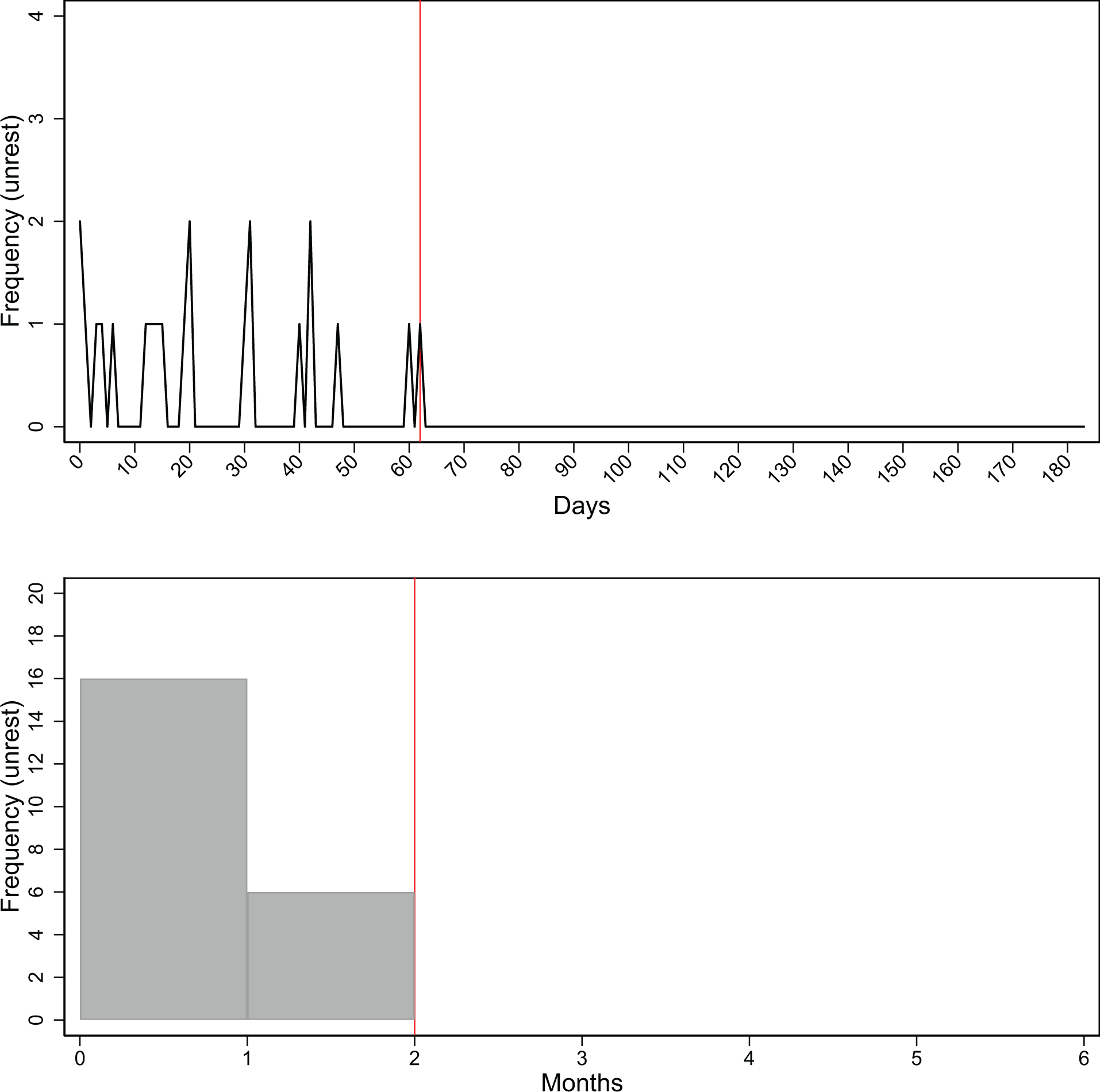
Our analysis focuses on floods recorded in 2015–18. This is partly determined by the availability of data on our outcome (i.e. flood-related political unrest as coded in the ACLED dataset; see below). ACLED provides data for a very limited set of countries prior to 2015. Focusing on 2015–18 allows us to include a wide range of countries in Asia and the Middle East which remain understudied in both climate security and disaster–conflict research (Adams et al., 2018). The analysis covers all countries in Africa, the Middle East, South Asia, and Southeast Asia for which ACLED and DFO data can be paired going back to 2015. 2 Our total sample contains 92 flood events in 40 countries (see Figure 2).
Data and calibration
We first obtained geo-coded political unrest data from ACLED, focusing on events categorized as ‘protests’ or ‘riots’ (Raleigh et al., 2010). Subsequently, we evaluated whether ACLED events were related to floods. We coded unrest events as ‘flood-related,’ if the following three criteria were fulfilled: the descriptions provided by ACLED linked the event directly to a flood, the event took place in the area affected by the respective flood (according to DFO’s flood polygons), and the start date of the flood preceded the unrest by at least one day (and no more than two months). If all three criteria for at least one event were fulfilled, we calibrated the respective case as having experienced flood-related political unrest. Our estimate of positive cases is conservative because the ACLED descriptions might not identify every case of flood-related unrest as such (see Smith, 2014 for similar considerations) and because we do not include unrest related to minor floods.
We now turn to the operationalization of the five causal conditions. Data on the democratic qualities of a regime (Democratic) was obtained from the Lexical Index of Electoral Democracy (LIED) dataset (Skaaning, Gerring & Bartusevičius, 2015). LIED combines particular features (e.g. presence/absence of multiparty elections with competitive/non-competitive elections) to produce concrete regime types (e.g. ‘multiparty autocracy’). These combinations are based on theoretical considerations over the centrality of specific features to the concept of democracy. The index both classifies regimes into qualitatively meaningful types and distinguishes between different levels of democracy (from ‘non-electoral autocracy’, coded 0, to ‘polyarchy’, coded 6). As such, LIED is particularly well suited for crisp-set QCA, which requires the dichotomization of data. Furthermore, LIED data (version 5.1) is available for the whole study period. Here, we use 4 as a cut-off point for the calibration. Countries with a value of 4 or higher have minimally competitive elections, hence making the exclusion of larger constituencies (e.g. from flood preventions and relief measures) politically risky and enabling the expression of grievances through the electoral system. Furthermore, this choice enables us to exploit a natural gap in the data as all cases in the sample have values of 6 (Democratic = 1) or below 4 (Democratic = 0). We subject this decision to robustness tests (see Online appendix 1). Note that this condition reflects a minimalist understanding of democracy, which centers on the electoral qualities of regimes, disregarding other attributes of the concept (e.g. rule of law).
Data on the exclusion of politically relevant ethnic groups from political power are provided by the Ethnic Power Relations (EPR) dataset (Vogt et al., 2015). To utilize disaggregated geo-spatial data, we used the 2014 Flood cases under study (several flood areas are overlapping)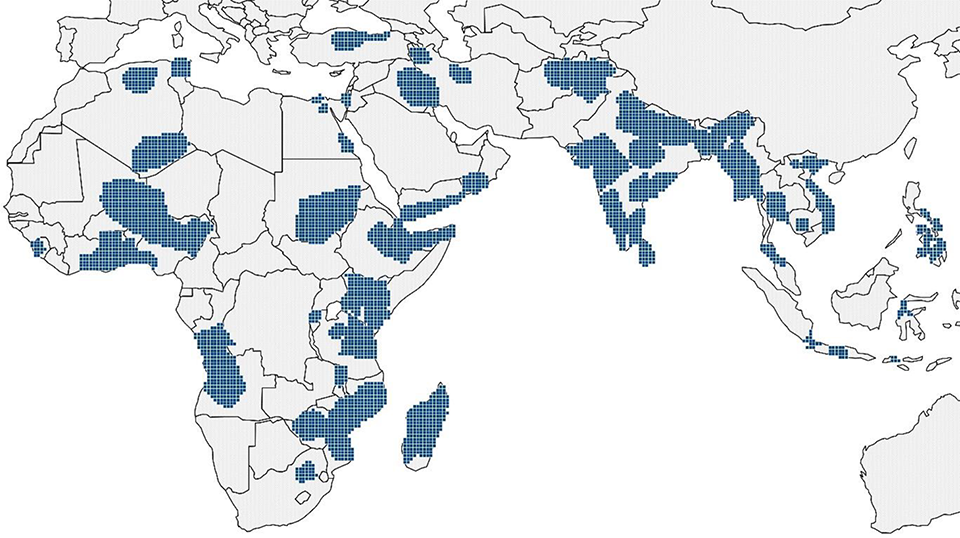
We also draw on PRIO-GRID to determine the total population living in the flooded area (Population) (2005 values based on CIESIN, 2005). It should be mentioned, however, that not all inhabitants are necessarily impacted by the flood, and that they may not be affected to the same extent. We added the population values for all cells that were at least partly overlapping with the respective DFO flood polygon. While the data have the disadvantage of being relatively old, they come with the benefit of having a high spatial resolution. The crisp-set version of QCA requires us to dichotomize conditions (Ragin, 2009), posing a challenge, because population values are continuous. With little theoretical guidance to inform the cutoff point, we chose a data-driven procedure as suggested by Basedau & Richter (2014). As illustrated by Figure 3, the cumulative number of flood-related unrests rises steeply once the population living in the affected area exceeds 35 million. Consequently, all cases with populations above 35 million were calibrated as having a large population (Population = 1). In additional analyses reported in Online appendix 1, we subjected this calibration decision to robustness tests.
We proxied the impact of a flood (Impact) with two indicators: fatalities and displacement. A high number of deaths is often associated with intense grievances and considerable destruction of property (Cassar, Healy & von Kessler, 2017). Displacement usually implies flooded houses as well as commercial, industrial, and agricultural areas. Since floods are rapid onset events, it further indicates that people have to leave valuable assets behind (Venugopal & Yasir, 2017). Displacement is also a proxy for flood-related migration. Drawing on natural gaps in the data, we calibrate all floods that caused at least 100 deaths or 30,000 displaced people as heavy impact (Impact = 1). Again, we assessed the robustness of our results to different thresholds (see Online appendix 1).
Finally, we used the World Bank’s (2020) data on gross domestic product (GDP) per capita to operationalize level of economic development. Although these data disregard within-country variation, they are suitable to assess our stated theoretical expectations because they indicate the wealth (or poverty) of states as well as citizens (UN, n.d.). The data are also available for the entire period under study. Using a natural gap in the data, our analysis considers countries with a GDP per capita of more than 2,000 US$ (adjusted for purchasing power parity) as economically more highly developed. The robustness of this decision was tested as well (see Online appendix 1).
Prevalence of and conditions for flood-related political unrest
Findings
The descriptive statistics already reveal several notable patterns (see Online appendix 2 for the full data). First, flood-related political unrest occurred (in the two-month period after the beginning of a severe flood) in almost one-quarter of all our cases (22 out of 92). This finding underscores the relevance of our analyzed phenomenon. Second, as shown in Figure 4, flood-related unrest only occurred in 11 of the 40 countries: Afghanistan, Egypt, Ghana, India, Myanmar, Nepal, Nigeria, Pakistan, Sierra Leone, Sri Lanka, and Tunisia. At face value, this suggests that flood-related unrests did not occur in the remaining countries. However, previous research indicates that political unrests may be underreported in autocratic regimes (e.g. Algeria, Iran, Sudan) because ruling elites often try to prevent reports about dissent (Böhmelt et al., 2014). Conflict reporting in fragile countries (e.g. DRC, Somalia, Yemen) is also Population living in the flood-affected area (for each case in the sample) and cumulative number of flood-related political unrest cases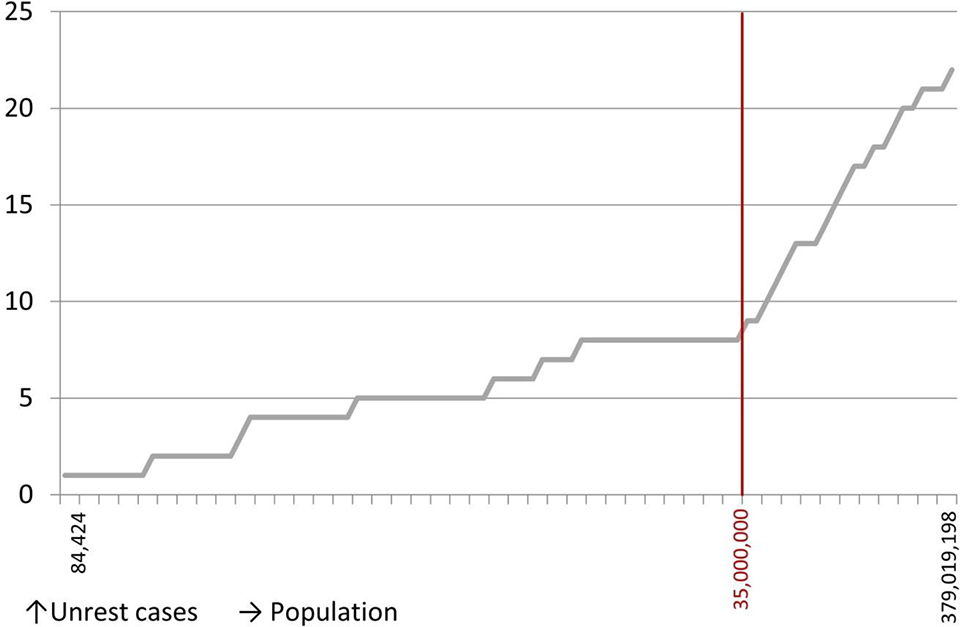
We now turn to QCA, starting with an analysis of necessary conditions. A condition is commonly considered necessary if its consistency score is 0.9 or higher (Schneider & Wagemann, 2010). The consistency score can range from 0.0 (indicating that in none of the cases the condition is present when the outcome is present) to 1.0 (implying that in all the cases where the outcome is present, the condition is present as well). None of the conditions pass the 0.9 threshold, although the presence of a democratic regime (0.86) comes very close.
The analysis of sufficient conditions can draw on different types of solutions produced by the QCA algorithm. Baumgartner & Thiem (2020) find that only the parsimonious solution can reliably uncover patterns of sufficiency. However, other researchers have disputed this and suggested that the intermediate condition minimizes the risk of omitting important causal conditions (Dusa, 2019; Wagemann, Buche & Siewert, 2016). Given this we computed both the parsimonious and the intermediate solutions and found them to be identical for our analysis. 3
Table I shows the parsimonious solution yielded by the QCA algorithm. The solution formula can be read as follows: a large population and the presence of a democratic regime in combination with either politically excluded ethnic groups or a heavy impact of the flood is quasi-sufficient for the onset of flood-related political unrest. Level of economic development, by contrast, is not a relevant causal condition. The consistency score of 1.00 indicates that the solution is free of contradictions, that is, in all cases where the combination of conditions is present, the outcome is present as well. The coverage score of 0.64 indicates that 14 out of 22 unrest cases are covered by the solution. In addition, the combination of conditions is present in none of the 70 cases without unrest.
A closer look at the eight unexplained cases reveals that they all have a rather small population (∼Population). Furthermore, four of them are non-democracies (∼Democratic) and three are characterized by the absence of both heavy impacts (∼Impact) and excluded ethnic groups (∼Excluded). Ethnographic research has shown that highly idiosyncratic, micro-level factors (e.g. local party politics) can shape the presence of flood-related conflicts (Siddiqi, 2014). Such factors are likely at play in the eight unexplained cases and can only be discerned by in-depth, qualitative research, which goes beyond the scope of this article.
Following standard procedures, we performed a range of robustness tests, with different frequency thresholds, different sets of cases, the inclusion of additional causal conditions, and modifications of the calibration decisions (Cooper & Glaesser, 2016; Skaaning, 2011). The main solution formula is exactly reproduced by nine out of 14 alternative tests and in a perfect sub-/super-set relation with the remaining five, hence indicating a high degree of robustness (see Online appendix 1 for further details). The data matrix used for the QCA can be found in Online appendix 4.
Discussion
In line with our theoretical claims, these results illustrate that the onset of flood-related political unrest depends on a complex conjunction of contextual factors. A large population contains more potential participants in protests, which are otherwise impeded in post-flood settings because large parts of the population might be unable or unwilling to forego recovery work for political activism (Salehyan & Hendrix, 2014). However, a large population alone seems neither a necessary nor a sufficient condition for unrest onset. Additional factors, such as heavy impact of floods, must be present simultaneously to generate resentment of sufficient intensity to provoke unrest.
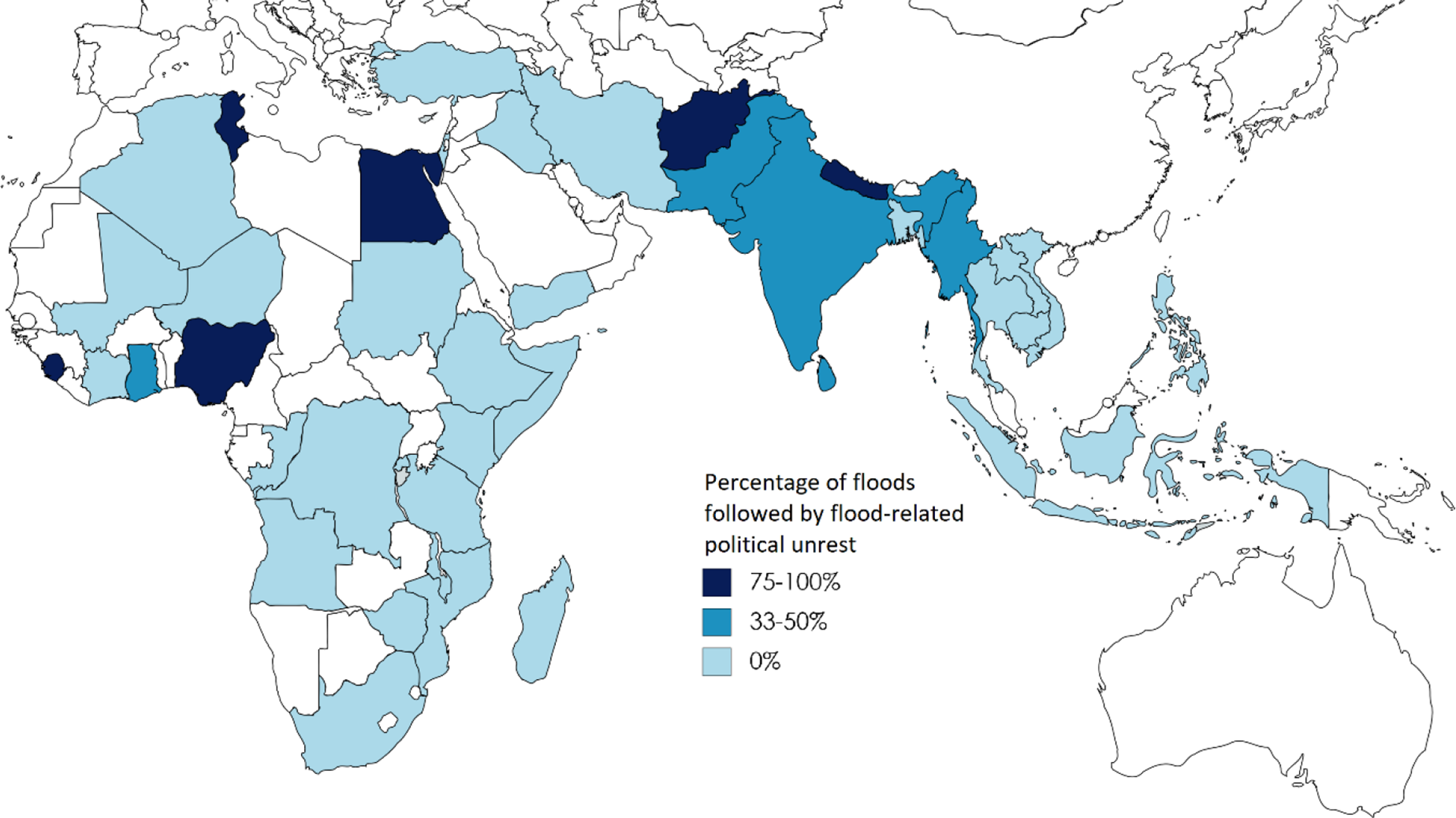
Countries included in the analysis and their unrest/flood ratio
Our solution identifies either the exclusion of ethnic groups from political power or a heavy impact of the flood as a relevant condition for the onset of flood-related political unrest. Both conditions are good indicators of grievances, and ethnopolitical exclusion has also been associated with increased mobilization opportunities (Cederman, Gleditsch & Buhaug, 2013). Flood-related vulnerability, relief efforts, and reconstruction funds are likely to be unequally distributed along ethnic lines in societies characterized by ethnopolitical exclusion, thereby compounding existing group-based grievances (von Uexkull et al., 2016). However, even in the absence of such discrimination, risk reduction and relief activities are usually perceived as insufficient if the disaster generates considerable numbers of dead and displaced people (Cassar, Healy & von Kessler, 2017).
The last relevant condition is the presence of a (minimally) democratic regime, which corroborates several studies that deem such regimes as more vulnerable to disaster-related conflicts (Apodaca, 2017; Flores & Smith, 2013). Several mechanisms potentially account for this. Demonstrations and protests are part of a democratic culture; hence, in democratic regimes, citizens may consider protesting as an adequate means to voice their discontent following floods. In autocracies, by contrast, people face the risk of repression, which potentially reduces incentives to protest, despite discontent due to floods. Indeed, some studies show that political repression (including repression of protesters) increases after rapid-onset disasters (Wood & Wright, 2016). This relates to previous research suggesting that unrest events tend to be underreported in non-democratic regimes (Böhmelt et al., 2014). In effect, we cannot rule out the possibility that such reporting bias drives our results pertaining to the democracy condition. These three explanations (i.e. democratic culture, absence of repression, reporting bias) are not mutually exclusive.
Unrest events are also often underreported in remote and sparsely populated areas (Ide & Scheffran, 2014). Consequentially, one might argue that the relevance of a large population as a causal condition is driven by similar reporting biases. While we cannot exclude this possibility, we consider it unlikely because major disasters, even in remote areas, receive considerable media and NGO attention (Zeccola, 2011) and because population size is a well-established predictor of civil conflict (Dixon, 2009).
Results of the QCA (parsimonious and intermediate solution)
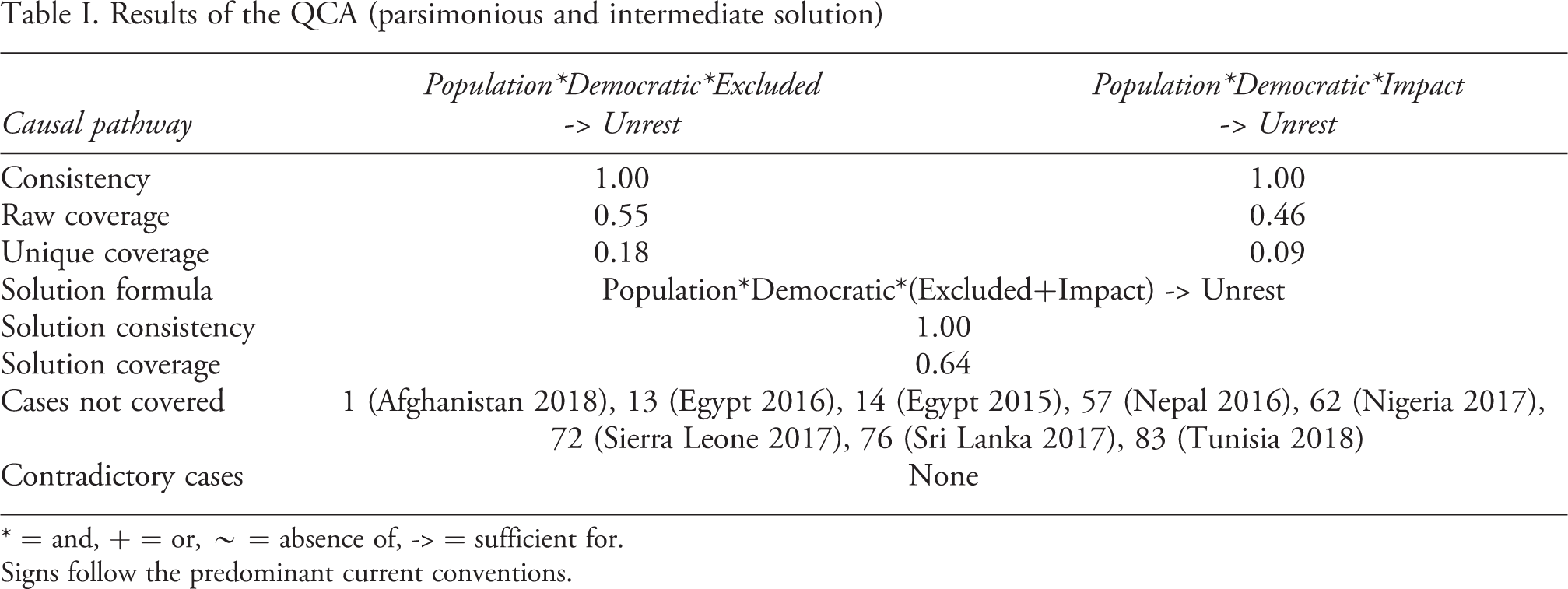
* = and, + = or, ∼ = absence of, -> = sufficient for.
Signs follow the predominant current conventions.
When it comes to individual conditions, our results contribute to existing debates in three ways. First, previous studies find that ethnic exclusion from political power is an important contextual factor for drought–conflict links (Detges, 2017; Ide et al., 2020a; von Uexkull et al., 2016). We confirm this insight for another type of disaster: floods. Second, existing research disagrees as to whether democratic (Flores & Smith, 2013; Hendrix & Haggard, 2015) or autocratic regimes (Ide et al., 2020b; Pfaff, 2019; Wood & Wright, 2016) are more likely to experience conflicts after climate-related disasters. Our results support the former position.
Third, some authors argue that the occurrence of conflict events in the immediate aftermath of very intense disasters is less likely because affected people are preoccupied with securing their livelihoods or express increased solidarity (Adano et al., 2012; Salehyan & Hendrix, 2014; Slettebak, 2012). However, we find that of the 92 severe floods in our sample, unrest occurs in 24% of all cases. Furthermore, a high impact of the flood increases, rather than decreases, the likelihood of flood-related unrest.
Conclusion
This article provides several contributions to research on disaster–conflict links as well as the broader field of climate security. We use QCA to discover conjunctural causation, which is an important, but so far underexplored aspect of climate–conflict and disaster–conflict links (Mach et al., 2019; Xu et al., 2016). We also focus on a highly destructive but so far rarely considered type of disaster (floods), focus on low-intensity conflicts after disasters (hence complementing existing work on intense armed conflicts), and avoid attribution problems by studying, specifically, flood-related unrest.
Our results indicate that low-intensity political unrest after severe floods occurs relatively frequently. According to our conservative estimate, at least 24% of the major floods in our sample are followed by flood-related unrest in the subsequent two months. The importance of this finding for the debates on climate change and security is emphasized by the prediction that flood numbers and intensity will increase in the future (IPCC, 2014; Kulp & Strauss, 2019). Currently, however, floods of this scale have been relatively rare, with only 92 of them occurring in Africa, the Middle East, South Asia, and Southeast Asia between 2015 and 2018. Given the relevance of flood impact as a causal condition, it is likely that minor floods trigger political unrest less frequently. Exploring in detail the links between lower intensity floods and political unrest remains a task for future research.
Our results also support voices that reject determinist linkages between climate change and conflict (e.g. Barnett, 2019; Gleditsch, 2021; Selby, 2014). Even with the consideration of high-impact events and local diffuse conflicts that are regarded to be most directly affected by disasters, the onset of unrest strongly depends on a combination of specific contextual factors. The simultaneous presence of a large population, a democratic regime (when understood in a minimalist, electoral sense), and either the exclusion of ethnic groups from political power or a heavy impact of the flood is crucial for the onset of flood-related political unrest.
What are the implications of our findings on (low-intensity) political unrest for the study of civil conflict writ large? Conflicts that do not reach intensity thresholds of conventional categories of ‘civil conflict’ or ‘civil war’ are of interest in themselves. Whether involving violence or not, protests, riots, and other contentious collective actions can initiate political change or even contribute to democratization (Kadivar & Caren, 2016). They may also result in considerable socio-economic disruptions, damage to the economy, alienation of involved social groups, and – in the case of violent forms – cause substantial numbers of deaths and injuries (Salehyan et al., 2012). Importantly, low-intensity political unrest may also constitute the first stage of a process that eventually leads to large-scale organized violence (Bartusevičius & Gleditsch, 2019; Cunningham et al., 2017). Granted, flood-related unrests account for only a portion of all political unrests, and not every political unrest turns into a large-scale civil conflict. However, given the increasing frequency and devastation of floods, the impacts of flood-related political unrest – both direct and through the possible contribution to large-scale conflict onset – must be considered as of key importance in the broader conflict research field.
Several blind spots and unanswered questions remain. After substantial research has been devoted to droughts and we have contributed to closing the knowledge gap on floods (see also Ghimire & Ferreira, 2016), a study on storm-related unrest would further enrich the literature. This is especially so because storms are climate-related events and the relationship between storms and armed conflict has been discussed for a while (Walch, 2018). Cross-case studies drawing on quantitative data can mostly identify meso- and macro-level scope conditions for small-scale conflict onset, even when using a high spatial resolution. Local (idiosyncratic) conditions remain important for unrest occurrence (Chenoweth, Hendrix & Hunter, 2019), and can most likely explain the eight cases in our sample that remained unexplained by the QCA. In-depth, qualitative studies could address such gaps (Adger et al., 2021) and might also be able to provide important inputs regarding how to solve issues of conflict underreporting in remote regions and autocratic states.
We remain optimistic that research along these lines will further elaborate existing knowledge on climate change, disasters, and conflict, including the insights provided by our study. Such knowledge is in high demand in the political arena (Gilmore et al., 2018) and could equip decisionmakers with evidence-based tools to design inclusive and conflict-sensitive policies in a future likely to be characterized by more (intense) disasters.
Footnotes
Replication data

Acknowledgements
This study emerged from the Master’s thesis of Anders Kristensen completed at Aarhus University in 2019. We thank Adrien Detges and Immanuel Jacobi for supporting the data preparation, as well as Halvard Buhaug, Nina von Uexkull, Arden Haar, and three anonymous reviewers for insightful feedback on earlier versions of the study.
Funding
Tobias Ide’s research was funded by the Australian Research Council (ARC) under the DECRA scheme (DE190101268). Henrikas Bartusevičius’s research was supported by an internal grant from Aarhus University.